The Demons Say “We Are Legion.” Jesus says “Trust Me.”

The Gospels of Matthew, Mark, and Luke all contain the story of the demoniac from the territory in northern Israel called the land of the Gerasenes. They describe the fact that the demons had united within this man for a specific purpose – to torment this poor sinner and to terrorize the countryside with demonic power so concentrated – that the evil was unable to be controlled.

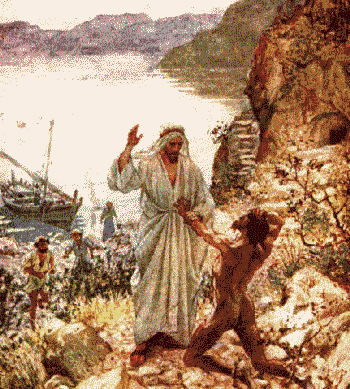
Unclean spirits fueled the demoniac’s actions; and as Jesus steps out of the boat onto the shore the demoniac immediately confronts Jesus and the demons within him beg to be left alone.

Jesus enters into dialogue with the possessed man. He asks him his name, and the demons respond, “My name is Legion, for we are many.” The disciples, hearing this response would have been horrified because a legion, at that time, was no small force – in the Roman army a legion encompassed  6,000 soldiers.

What’s left of the possessed man’s free will had run toward the Lord – and the psalmist tells us to do the same because they both realize who God is, the magnitude of His power and mercy, and that true healing, security, and protection from evil can only be found under His protection.
 

Psalm 91 alludes to this, and uses military language to express its message as it says: “A thousand may fall at your side, ten thousand at your right hand; but [evil] will not come near you Because you have made the Lord your refuge, the Most High your habitation.”

At times, our technologically driven society has desensitized us to the wonder of Jesus’ mercy, or, like the people in the city – upon hearing of the demoniac’s healing – recoil from Mercy’s power. Like them we may be satisfied with our own circumstances, we may feel that we do not need to be healed or evangelized, that we don’t need the grace of God’s mercy in the Sacraments, especially the Sacrament of Recon-ciliation,  what an extraordinary mistake – what a rejection of God’s grace that would be for us.

Perhaps we are afraid to pay the price of liberation from the power of evil in our lives. Yet, what is the cost to us? Is it the cost of being healed of our sins? The true cost was paid by Jesus Christ in His suffering and death upon the Cross.

The cost, having been paid by the Son, provides the opportunity for the Father and the Holy Spirit to freely give us the grace that Christ has merited for us. The only thing that Jesus requests of the healed demoniac is that he go home and give witness. Jesus says,  “Go home to your friends, and [and in thanks] tell them how much the Lord has done for you, and how He has had mercy on you.”

The only price that needs to be paid is the price of thankful witness – the price of unselfconsciously showing others that we have turned away from evil – and that God has changed our lives through the power of His grace and mercy.
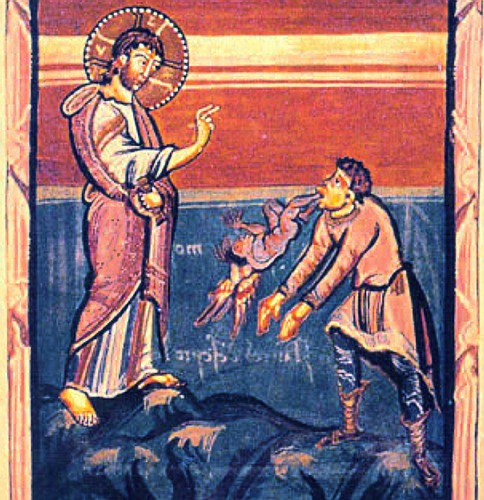
The freed and healed demoniac was asked to evangelize his friends, and we, are asked to do the same. Interestingly, the territory of the Ten Cities – the Decapolis – which were primarily Greek and pagan territories was an extraordinarily difficult missionary area. The now healed man was asked to go into that territory – to those Ten Cities –and preach to them of his healing and deliverance. He was, in no uncertain terms, a missionary – a missionary to the Gentile people of the Decapolis. It appears that he was successful, because, Mark (in his Gospel’s 7th  chapter, vs. 31ff) speaks of the hopeful crowds from the Ten Cities bringing Jesus another man to be healed.

So what is the final message of this Gospel for us today? It may be that even though, thank God, we may not be possessed by one or thousands of demons, we are still tempted, we fall, and we do sin.

So we are always in need of God’s mercy – and after repenting of our sins and receiving God’s forgiveness, mercy, and healing in the Sacrament of Reconciliation we need to give thanks to the Lord; and like the healed demoniac, share the story of our spiritual journey, healing,  and God’s love for us with all those who will listen.

Copyright © 2012 Deacon Paul O. Iacono All Rights Reserved

St. Vincent of Saragossa – Martyr – And An Artistic Challenge!

Today, January 23rd, is the Feast Day of Saint Vincent of Saragossa.  St. Vincent was a deacon and served as a minister and trustworthy pastoral assistant of Bishop Valerius, of Saragossa, Spain. He was martyred in the year 304 during the ferocious persecution of the Roman Emperor Diocletian. Saint Vincent is the most famous martyr of Spain, and St. Augustine testifies to this in his sermons that Vincent’s acts of love and loyalty to Jesus Christ, and service to the Catholic faith, were so respected that they were read and discussed in all the churches of North Africa.

Owing to the fact that Bishop Valerius had a speech impediment, Deacon Vincent was given the faculty to do all the preaching in their diocese. When the persecutions resumed, the Roman governor Dacian had Vincent and the bishop dragged in chains to Valencia where they were imprisoned. Bishop Valerius was subsequently banished, but Deacon Vincent, as a result of his preaching, was subjected to many cruel tortures such as the rack, the gridiron, and frequent scourging, all of which ultimately led to his martyrdom.

Legend tells us that even in death his murderers were not satisfied, for they threw his corpse into a field to be devoured by vultures; but, according to eyewitnes- ses, a raven defended his body by successfully fighting off the scavengers. His body was later buried and a chapel built over it.

In Vincent’s story we have the witness of a man who stood up, in Christian love and faith, to the might of a Roman imperial government that did all it could to destroy him in life and in death. They were so outraged by him because Saint Vincent would not renounce his sacred ordination to the diaconate, would not renounce the truth of the Church, and would not renounce Jesus Christ even in the face of unspeakable and savage tortures.

St. Vincent of Saragossa is a man who deserves to be recognized. If we review the images of this early Spanish saint, we see  a number that are sensitive and well-done, but it really is time to produce a new icon, or sacred image, of this great witness to the truth, love, and mercy of Jesus Christ. If you are a sacred artist or iconographer, and are interested in producing an icon or sacred image of St. Vincent, I will happily post it (with your permission of course) on this blog. He is a great model for all Christian young people today and we need an image of him that is contemporary to our age.

Come and join us, and like St. Vincent of Saragossa, have some of your art, or all of it, spread the Good News that the love, life, death, and resurrection of Jesus Christ has healed our broken relationship with God the Father!

Copyright © 2012 Deacon Paul O. Iacono All Rights Reserved

Whose Star Do We Follow?

St. Thomas, in his Summa Theologiae, has a wonderful meditation on today’s Solemnity of the Epiphany. He says that “Salvation was to be through Christ and apply to all sorts and conditions of men because in Christ Jesus there cannot be Greek or Jew, slave and free man. In order that this should be foreshadowed in Christ’s birth, he was made known to men and women of all conditions, because as St. Augustine says, the shepherds were Israelites, the Magi were Gentiles, the first were near, the latter from afar: both hastened to Christ the cornerstone…. The Magi were wise and powerful, the shepherds, simple and lowly. He was also manifested to the just, Simon and Anna, and to sinners, namely the Magi. And also both to men and to women… so as to show that no human condition was barred from His salvation.”

Dominican Father Andrew Carl Wisdom, OP adds to these observations the following prayer: “Newborn King, you show no partiality in your love for us. Young or old, rich or poor, educated or uneducated, you could not love us any more in the next moment than you do in this moment. But my witness wavers at times, Lord. I lose track of the real Star, caught up in becoming one myself. Help me to once again kneel before you like a little child and open up my treasuries of time and talent on behalf of the work which I was sent.”

As you know, this blog is dedicated to evangelizing the truth, goodness, and beauty of God through the study and creation of sacred art in His honor. As artists the meaning of the Epiphany is very important solemnity to us. Why? Because it reminds us and redirects our creative efforts away from following the supposed light and friendship of the secular world, the television, the political party, or the glow of the computer screen, to the true Light – the Light emanating from the face of Christ.

Yes, we have to exist within our particular culture. We have to make a living and provide for ourselves and our loved ones. Yet, as Christians, Jesus Christ’s manifestation to the Magi asks us to remember that we must live in the world but not have our souls be overcome or compromised by it. The shepherds and Magi were changed by the Light of Christ’s face – may His Light and Presence change us, too.

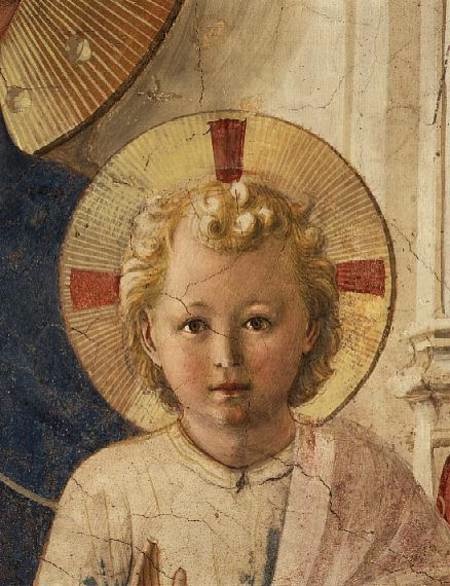
Image of Jesus Christ by Blessed Fra Angelico (1387 – 1455).

Copyright © 2012 Deacon Paul O. Iacono All Rights Reserved