Part Two: Icons, Icon Painters, and Praying With Sacred Icons

The sacred icon is a visual aid that helps the person enter into a conversation with God, an angel, or a saint. If a sacred icon is to be painted with this purpose in mind then it it is a major responsibility of the sacred artist to construct the icon so that it may serve, rather than interfere with or destroy, that purpose. Thus, it is necessary for the sacred artist to curb the desire for ornateness, since it might detract from the prayer itself by focusing the viewer’s eyes on embellishment versus Person, or saint. 

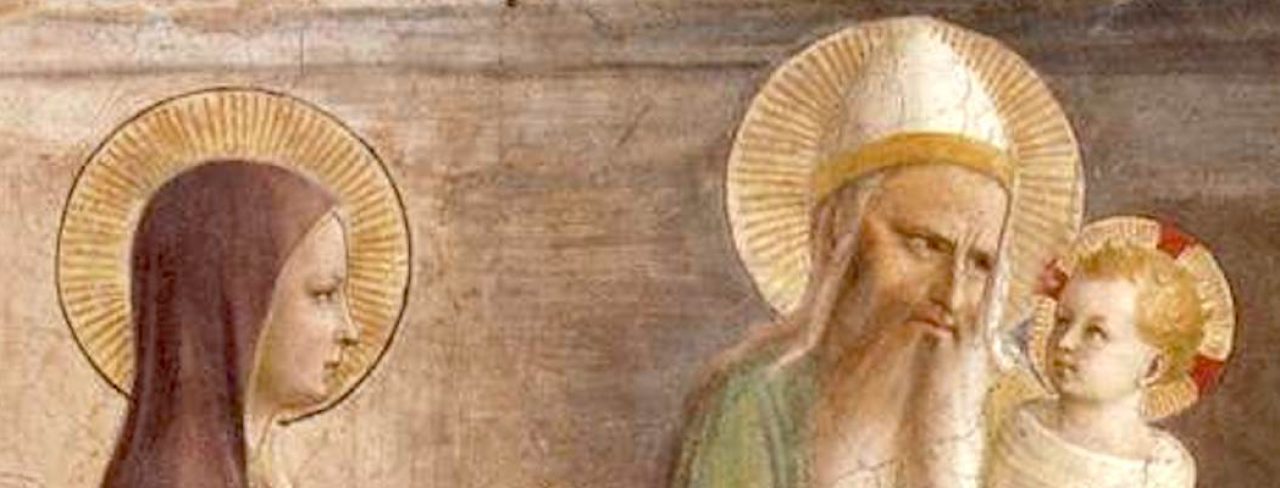
Of all the physical features in an icon, in my opinion, the most important are the eyes. The eyes of the person represented in the icon – Our Lord, the angels, or the saints – are critical. They normally look out at the viewer. They are painted this way because icons, which should be painted in a spirit of deep prayer, are trying to establish or renew our relationship with the Heavenly person portrayed. So, as in typical conversation, we look at the person and they look at us. Yet, in many cases the eyes of the Blessed Mother, as the greatest of the saints, do not look at us; they are usually looking at her Son, or, are looking away from the viewer, or present us with  a “distant gaze.” These particular types of steady and intense looks of the Blessed Mother may also be seen in statues – especially those of medieval France. Please note the following link to an excellent site which shows some of these gazes in statues of Mother Mary and the Christ Child:

vialucispress.wordpress.com/2012/05/04/the-thrones-of-wisdom-dennis-aubrey/  By the way, I highly recommend Dennis Aubrey and PJ McKey’s site for your subscription.

Sacred icons are the traditional form of artistic expression of the Eastern and Western Rites of  the Catholic Church from approximately the 6th century on. The Western Rite moved away from purely painting sacred icons in approximately the 12th century and moved into the Gothic Period of sacred art. The Eastern Rite continued to develop its devotion to sacred icons with differences being seen within the various cultural areas of Orthodoxy – from Greece, to Serbia, Russia, Crete, etc.

As mentioned above, the use of a sacred icon is of practical spiritual value in that it is an aid in prayer. On an additional note, when we pray with a sacred icon, we are doing the same thing as when we speak to someone that we know and love. We speak to them, we may be in their physical presence, or we may be on a phone or computer connection with them, but we are with them in the sense that we are focusing on them at that moment in time – either physically facing them – or –  on a phone or computer screen. So when we pray to an icon we are looking at it in the same way we would look at someone in a face-to-face conversation; for that is what prayer is: conversation with God, Our Blessed Mother, the angels, or a particular saint.

Some people have a tendency to get themselves upset over the use of the term iconographer (icon writer) versus icon painter. The word graphein in Greek means “to write,” and it also means, “to paint.” A linguist and museum curator by the name of David Coomler informs us that in the Russian language the English word “write” is pisat, and the word “paint” is pisat. So, in Greek and Russian we have a double meaning for one word that represents both “to paint” and “to write;” however, this doesn’t transfer into the English language since in English we obviously have two different words to express graphein and pisat: write and paint.

I have no problem with people saying “I am a sacred icon painter.” The reason being – it is correct English. The term iconographer, however, is used and you see it in numerous books and in conversation in non-Russian or Greek formats. When people ask me how I identify myself – as an icon painter or an icon writer – I respond that I am a simple “sacred artist”!

Yet, we have an obligation to be truthful to our Holy Faith, so, when we paint icons we need to be attentive to and follow Sacred Scripture and Sacred Tradition. In that sense, we are “writing” icons because we are scribing into visual form – using paint rather than just ink – the images from Sacred Scripture and Tradition. I may be breaking a grammatical rule in saying that; yet, I feel that it is appropriate owing to the nature of what we are trying to do in painting sacred icons.

May I suggest that as icon painters we must be conscious of the truth that the images that we copy of Our Lord, Our Blessed Mother, the angels, and the saints (saints prior to the 14th century) were and are built on our human imagination, for we do not have an actual authentic portrait of Our Lord, or Our Blessed Mother. There is consensus that St. Peter had a full head of hair and full beard, while St. Paul had a bald or balding head and full beard. I can say that because recent archaeological discoveries in Rome have continued to show those pictorial images for these two saints.

Still, that being said, we cannot be absolutely sure of this because we have no photographs, or, first century portraits of them; but, we do have a sacred tradition that portrays them that way; but this is not true for many of the saints – unfortunately, we just don’t know what they looked like. So we have to be very careful in our portrayal of saints, and remember, that basic cultural and historic research will help us in painting a quality sacred icon or image.
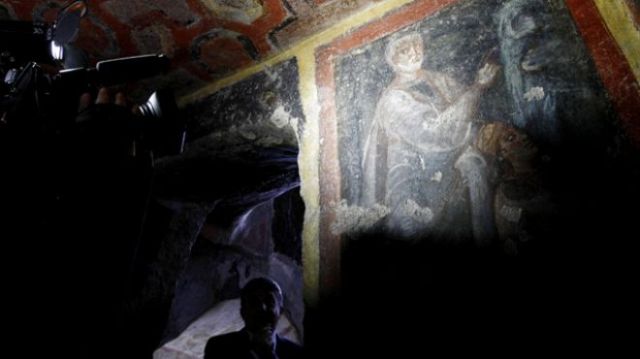
The above photo shows a recent interesting archaeological discovery that occurred in June 2010: The link below shows the cameraman filming  paintings of some of the earliest known images of the Apostles Peter and Paul (these ceiling paintings date from between AD 350 and 400) in a catacomb located under a modern office building in Rome. The images were uncovered using lasers and were under thick deposits of calcium carbonate. ((AP Photo/Pier Paolo Cito)) Click on this link below to see more photos:

http://www.foxnews.com/scitech/2010/06/22/ancient-icons-apostles-peter-paul-rome/#ixzz1voqaPpKJ  Thanks to this site for the information.

 Copyright © 2012 Deacon Paul O. Iacono All Rights Reserved

A New Class of Iconographers Begin Their Studies: The Work of The Holy Spirit

On Wednesday evening, May 23rd, ten members of the Fra Angelico Institute for the Sacred Arts here in the Roman Catholic Diocese of Providence, Rhode Island USA were commissioned and blessed to begin their study, here at the Institute, and work to become competent painters of sacred icons.

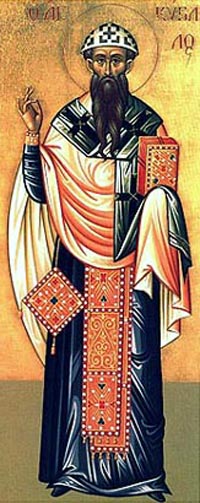
As we approach the Solemnity of Pentecost we can certainly see the movement of the Holy Spirit in this work. We are reminded of a commentary by St. Cyril of Alexandria, the bishop and patriarch of Alexandria, Egypt during the years of 412 to his death in 444. He was a man of great learning, holiness, and courage who defended the divinity of Christ and the specific role of Our Blessed Mother – the Holy Theotokos – in the plan of salvation.

In one of his commentaries he summarizes what we see in the early history of our Church, and continue to experience in our own time. He says: “After Christ had completed His mission on earth, it still remained necessary for us to become sharers in the divine nature of the Word. We had to give up our own life and be so transformed that we would begin to live an entirely new kind of life that would be pleasing to God. This, was something we could do only by sharing in the Holy Spirit.” [bold, mine, DPI]

He continues: “It was most fitting that the sending of the Spirit and His descent upon us should take place after the departure of Christ our Savior. As long as Christ was with them in the flesh, it must have seemed to believers that they possessed every blessing in Him, and to dwell in our hearts through faith. Only by His own presence within us in this way could He give us confidence to cry out, Abba, Father, make it easy for us to grow in holiness and, through our possession of the all-powerful Spirit, fortify us invincibly against the wiles of the devil and the assaults of men. It can easily be shown from examples both in the Old Testament and the New that the Spirit changes those in whom He comes to dwell; He so transforms them that they begin to live a completely new kind of life.”

I  briefly mentioned this in passing on Wednesday night to the class of sacred artists.  The statement being that the work of the sacred artist is the work of the Holy Spirit. The Spirit is involved in their training, work, and prayer and He is involved in transforming their lives as well. Why? Because they opened their hearts, and accepted the challenge that was spoken to them in the recesses of their soul.

All sacred artists are intimately involved in Pentecost. They are involved in having their lives changed through the love of the Holy Spirit who comes to dwell in their hearts so their art may give glory to God.

St. Cyril of Alexandria says to us that “….the strength that they [the Apostles at Pentecost] received from the Spirit enabled them to hold firmly to the love of Christ, facing the violence of their persecutors unafraid. Very true, then, was our Savior’s saying that it was to their advantage for Him to return to Heaven: His return was the time appointed for the descent of the Holy Spirit.”

Christian sacred artists throughout the world have been graced by the Lord to create prayer focused art works that have, as their very purpose, to promote prayer and to give glory to God. In this weekend of Pentecost, let us open our hearts, enter into this effort, and together say, “Come Holy Spirit, fill the hearts of your faithful and kindle in them the fire of Your love. Send forth Your Spirit and they shall be created. And You shall renew the face of the earth.”

Sacred Beauty has saved the world.

Copyright © 2012 Deacon Paul O. Iacono All Rights Reserved.   The icon of St. Cyril of Alexandria is from the website: traditioninaction.org Thanks to them for the image.

Icons, Icon Painters, and Praying With Sacred Icons: Part One

A few issues have come up in discussing some basic terms with people. I would like to be clear on how I have come to understand these words because it may affect how we view our “ministry” to be painters of sacred icons and or sacred images.

From my understanding, the word icon in English, Greek, and Latin, is the word for image. In our usage as sacred artists, it refers to a sacred image of Our Lord, Our Blessed Mother, angels, or specific saints. The purpose of a  sacred icon is that, as a piece of sacred art, it  focuses an individual in prayer.  A sacred icon is a specific type of sacred art. It is created following certain traditions – tradition with a small “t” and a large “T.”

Many sacred icons are presented with a simplicity of style, the use of color, the types of colors used, the use of symbols, etc. A sacred icon is different from a sacred image, in that the sole purpose of the sacred icon is that it is to be used as a focal point for personal or communal prayer.

A sacred image, however, may have been commissioned by a patron for personal prayer, but it may also have been commissioned for the pure enjoyment of its beauty. In the case of Renaissance sacred art, the Roman Catholic Church became the patron of many pieces of sacred art in order to affect the communal prayer of the faithful who came to the small churches and the great basilicas for Holy Mass.

With a sacred image (such as a religious image painted by Michelangelo or Leonardo) you have the artist’s personal imagination heavily influencing and entering into the creation of the beauty of the image, possibly even manipulating and combining Scriptural passages for the purpose of the story the artist would like to tell. Yet, even though I have just made that statement, the truth of the matter is that it is not always so clear cut. We do have icons, such as the famous Nativity icon of the birth of Christ, in which you have numerous Scriptural passages – conveying different events – being used to convey a catechetical sequence surrounding the birth of Our Lord – and all of this is done on the same icon panel!

In a sacred icon, the imagination of the artist is present, yet, it is supposed to be subordinate to his/her faith’s perception of Sacred Scripture and Sacred Tradition (how the early Church viewed their beliefs and expressed them within their specific cultural tradition). So, if a sacred artist is painting a sacred icon, he or she is aware of the theological, aesthetic, and semantic rules that have been developed and followed through the centuries. These rules – “the Canon of Iconography” – are affected by cultural area and religious Sacred Tradition.

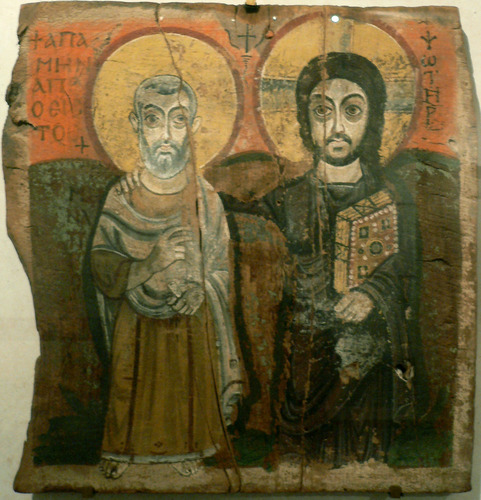
For example, a Coptic sacred icon (see image below), by a painter of the Egyptian Coptic Church will express the image of Christ and a saint (in the icon below an abbot of the Coptic Christian Church) somewhat differently than a Greek or Russian Orthodox painter; and yet, there is nothing wrong with this, as long as the painter is not fomenting apostasy or heresy.

All of that being said, sacred images, for example, by Renaissance painters, can certainly be used to focus an individual in their personal prayer, as do the beautiful stained glass windows of the great Gothic cathedrals. Care must be taken, however, in selecting appropriate images for use in personal prayer. It is my perception that the type of image a soul uses in personal prayer – sacred icons (from the Eastern Rite) or sacred images (from the Western Rite) – is a matter of personal preference and certainly does not  indicate that one type is better or “more truthful” than another. Eastern and Western sacred artists are both working off of their own perceptions and spirituality; there are disagreements with this, but we must always remain charitable with each other.

Within the last twenty years there have been many Western sacred artists that have rediscovered the beauty of painting sacred icons, and are trying to be sensitive to the Eastern Rites’ traditions,  as they bring it back into the consciousness of the Roman Catholic Church. The Eastern Orthodox Churches, thankfully, never lost appreciation for their tradition.

I will post Parts Two and Three on this same theme in the upcoming days. Be sure to look for them on-line or in the archives. Thanks.

Copyright © 2012 Deacon Paul O. Iacono All Rights Reserved

The image of Christ and the Abbot – a panel depicting a monk with Christ. It was excavated in the early 20th century from a monastery in Egypt and is located in the Bawit room at the Louvre. Thanks to: Photo by Clio 20, CC attribution share-alike 3.0. I believe the icon dates to about the 7th century.

St. Matthias and the Renewal of Easter Hope – The Lord Loves His Friends

Today is the feast day of St. Matthias. The Acts of the Apostles relate that Matthias was chosen by lot to replace the disciple who had betrayed Jesus in the garden.

In chapter 18 of our Gospel, St. John speaks of Judas, who was in collusion with the Romans and the Jewish elders, and brought them to the place where Jesus was staying in the garden; the betrayal took place and the deaths occurred.

In the period after Jesus’ death the Apostles were known as the Eleven.

The Eleven. A title which causes us to pause, even today, two thousand years later. They were twelve, but then the betrayal took place. Judas hung himself; and the Romans hung Jesus on a cross. Even in those anxiety filled days after the death of Jesus, and before His resurrection, the Eleven knew in their hearts that Judas was not the only one, who had betrayed Jesus. For in cold terror they ran from the garden – they ran from the Cross – abandoning their Master and betraying His friendship.

It was only John, and the women, who had the courage to stand there and minister in silence, in tears and sobs, to their dying master. We wonder, that as they stood before the Cross, was there a crisis of trust in their own hearts? Did they wonder about the other ten who were not there? Did they wonder about their own possible betrayal? Yet, all of their self doubts and agony would be washed away through the truth of the Resurrection.

Today’s feast of St. Matthias gives us renewed hope in this, the sixth week, of the Easter season; for it directs us to the great love of God for His friends. It also reminds us that He never leaves His friends alone in their mission of building His Church.

After the Ascension of Jesus into Heaven, Peter, as the great leader of this little group of friends, realized that something had to be done to fill the hole, the gaping hole, that echoed with the cries caused by the betrayal of trust,  friendship, and fidelity to God Himself.

Peter knew that this cavity had to be repaired because Jesus Himself had filled the hole in Peter’s heart. It was Peter’s realization and trust that Jesus could heal him that led to his putting the mantle of leadership back on.

Peter knew that the grace of Jesus could heal them,too, and that they could become the ambassadors of the Good News who would carry out Jesus’ commands. Their group of twelve, by mirroring the twelve tribes of Israel, could evangelize Israel itself.

So, they cast lots – because they did not think themselves worthy to make the choice of their own accord, and wanted some sign [from the Holy Spirit] for their instruction.

Matthias was chosen.

St. Matthias was a disciple of Jesus who loved much, he witnessed the resurrection, he lived in the Father’s love, he followed Jesus’ commands, and was willing to lay down his life for the Lord and His Mission.

May God grant that we have Matthias’ courage to be open to the grace of Christ and use it to  build-up His Church.

Quote taken from a 4th century homily by St. John Chrysostom on the Acts of the Apostles found on pages 1822-24 of The Divine Office volume 2.

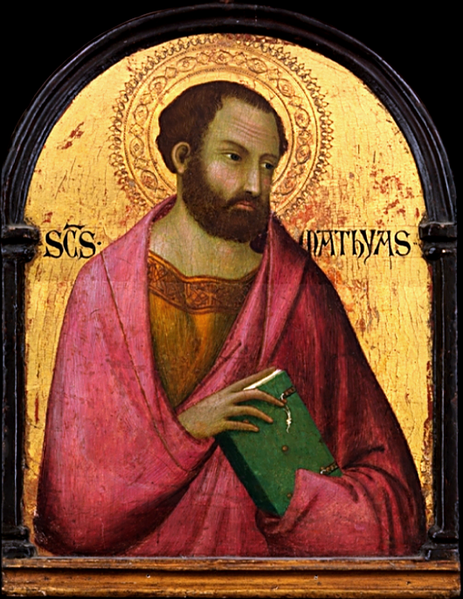
The sacred image of St. Matthias is from the workshop of Simone Martini the 14th century painter from Siena whose style influenced the Gothic movement. Martini portrays Matthias wrapped in the red mantle of martyrdom holding  a book that is painted green. Green is the color used by sacred iconographers and sacred artists to represent hope, life, and renewal. The book he is holding is a  reference to the truth of Christ’s Gospel preached by St. Matthias. This painting is dated between 1317-1319. Maestro Martini died in France at the age of 60 in 1344.

Copyright © 2012 Deacon Paul O. Iacono All Rights Reserved

Stones that Sing – The Photography of Dennis Aubrey and PJ McKey

A few months ago I discovered the exquisite photography of Dennis Aubrey and PJ McKey. They have a blog here on WordPress called Via Lucis.

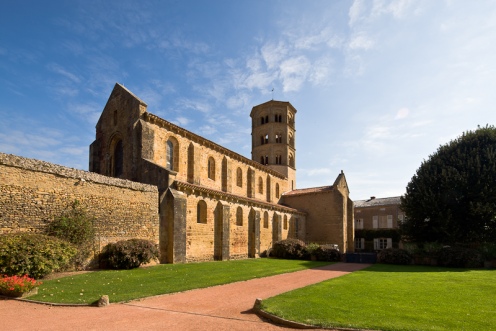
Their post of May 10th discusses and shows the beauty of a Romanesque church (Our Lady of the Assumption) located in the Burgundy region of France. Dennis entitles the church as “The Great Survivor.” When you read the fascinating history of this church (a priory church was first built on this site in the 9th century) you see that it is, indeed, a great survivor. For it has survived the onslaughts of man’s barbarity in the name of religion, or in the case of the secularists of the French Revolution, desecration in the name of “The  Citizen.”

Like a magnificent athlete who has taken a punishing series of blows, blocks, and beatings this church still stands tall. Quietly proclaiming to the world that no matter what it does, short of hauling her down in a pile of rubble, it will remain standing giving witness to the glory of God and the faith of the men and women who with their sweat, toil, and treasure built it in the name of love and honor of God.

Even if future generations haul it down and reduce it to a pile of rubble, those stones will continue to sing, will continue to give glory to God – as they should – for the love that went into building the church remains – embracing the stones – caressing the stones like ancient mortar.

Please visit Dennis and PJ’s beautiful site (it contains their magnificent sacred photography). You will be inspired by the artistry of their photography. The link is here: vialucispress.wordpress.com/2012/05/10/anzy-le-duc-the-great-survivor-dennis-aubrey/

Thanks to Dennis Aubrey for allowing me to paste the photo: Église Notre-Dame de l’Assomption, Anzy-le-Duc (Saône-et-Loire) Photo by Dennis Aubrey. Photo Copyright © Dennis Aubrey. All Rights Reserved.

Copyright © 2012 Deacon Paul O. Iacono All Rights Reserved

ORO et CREO: PART THREE – A Personal Reflection

This is the third part of a three part series on a Spirit filled idea called Oro et Creo (“I Pray – I Create”). This idea was started by artists Jamie Medeiros and Deacon Tom Lambert. Please check out the first two parts of this series which have already been posted in order to get a full perspective on what they are accomplishing on the parish level.

What is wonderful about what Jamie and Deacon Tom are doing is that they are providing a simple, no anxiety-no pressure structure through which the  Holy Spirit can move the person to unite their artistic and creative impulses to their desire for union and communication with God. This is done in a silent, communal, setting, but it can also be done in an individual setting.

Creativity and prayer go hand-in-hand – it just takes the desire of the individual artist, regardless of the medium, to take the simple step of uniting the creative moment to their spiritual life. How is that done? Simply, it is an affirmation of the will to prepare yourself through short silent prayers, and then to consciously say, “Lord God – I offer this moment of creativity to you, help me to create something which gives You glory;” and  then, you create: poetry, stories, visual art, cosmetic design, fashion design, music, photography – whatever appeals to you.

St. Benedict of Nursia, when he established his community of Benedictine monks at Monte Cassino in 6th century Italy, was concerned that his monks balance their life between work and prayer. He developed his Rule which ordered their day into specific moments of prayer, work, and relaxation. Even in the 21st century we can relate to the significance of this type of structure within our busy day.

The point being that we must be balanced and make time for the important things of our life and not be a slave to the world, materialism, or current fads. St. Paul speaks of this in Colossians 3: 23-24 when he says: “Whatever you do, work at it with your whole being. Do it for the Lord rather than for men, since you know full well you will receive an inheritance from Him as your reward. Be slaves of Christ the Lord.” 

As I perceive it, when we are involved in the Oro et Creo process we have made the decision  to unite ourselves to the Holy Spirit – the Sanctifier – and then, we allow the Holy Spirit to guide us in our creative work. It is through the process of this creative effort that we speak to God and tell Him we love Him.

This process occurs when we are silent, and caught up in the moment of doing our work. It is at these times of intense concentration that we are taken “out of ourselves” (only to come back when we realize that we have been so focused on the creative work that we have forgotten the experience of time).

Our conscious prayerful effort at the beginning of the process expresses to God our love and thanks. From my experience, we don’t have to be consciously involved in constantly praying as we are creating. When your mind reflects on the need to pray – it is then appropriate to say a short prayer – such as “Jesus Christ, Son of God, have mercy on me a sinner” or, “Holy God, Holy Mighty One, Holy Immortal One have mercy on us,” or, just simply, “Jesus, I love and trust you.”

Jamie and Deacon Tom use the phrase Oro et Creo (I Pray – I Create) which was inspired by the Benedictine motto Ora et Labora (Pray and Work). To this I would add another section of the Benedictine Rule:  ut in omnibus glorificetur Deus, “that in all [things] God may be glorified” (Rule, chapter 57.9) which was also adopted and adapted by St. Ignatius of Loyola in his Jesuit motto: All for the Greater Glory of God. So, in our prayer/creative efforts – our intent – whatever results, should always be our desire to give honor, thanks, love, and glory to God. If we enter into these moments with an open heart and pure soul – it will.

Bravo and thank you, Jamie Medeiros and Deacon Tom Lambert, for your faith, prayer, and creativity! I am sure you have inspired many to continue your ideas in their own settings.

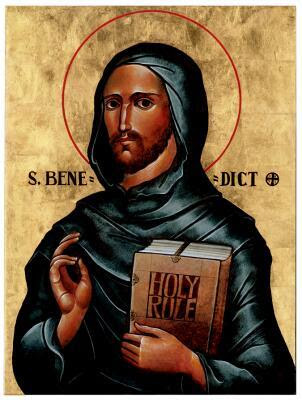
Thanks to ad-orientem.blogspot.com/200 for the icon of St. Benedict.

Copyright © 2012 Deacon Paul O. Iacono All Rights Reserved


ORO et CREO: I Pray – I Create – Part Two – A Wonderful Idea For Your Church

This is the second part of a three part series with Jamie Medeiros, an artist whose parish is in Tiverton, Rhode Island, and Deacon Tom Lambert, a Permanent Deacon within the Diocese of Chicago, and whose parish is Our Lady of Mt. Carmel in Chicago, Illinois.

Please be sure to read Part One of this two part interview in order to obtain a complete understanding of what the Lambert/Medeiros model of prayer and the creation of art is trying to accomplish. It is a model easily applicable to any Christian parish, within any Christian denomination, in the world.

The Interview: continued…

5) Is there any specific format that you use – such as – do you gather after Sunday Mass, do you say specific prayers together, or do you say prayers in individual meditation? Are all the participants Catholic?

Jamie: We begin in the church with some music (to help us transition from our busy days to awareness of God’s presence) and a brief reflection or guided meditation (usually a quote from Scripture or contemplative reading, followed by questions to think about).  We then begin our hour of prayerful creation.  We each go to an area of the church we are drawn to and create for an hour.  As we create, we let the images, questions, and movements guide us in our conversation with God.  Sometimes getting in the creating “zone” helps us rest in His presence. After one hour of prayerful creation, we meet in the front of the church and discuss our prayers (if we feel comfortable doing so).  Everyone places their artwork out for others to see and each of us explains what was going on, what we were thinking about, how it lead us to our results, etc.  There is a closing prayer.

Not all participants are Catholic, but all are Christian.

Deacon Tom: [He answered the format question in the previous post]. It is a parish ministry offered for members of our parish. We do occasionally get non-parishioners.

6) Does the “create” side of the session happen simultaneously with your prayer, or have you divided it – such as 10 minutes for prayer, 50 minutes for “create” after the communal or individual prayer session? Or do the participants desire for it to happen spontaneously?  What types of art are being produced: sketches, paintings, literary, etc. Have you ever had any formal or informal showings of the art that has been produced? Would your parish be open to displaying the art produced?

Jamie: For Oro et Creo, the prayer IS the creation (the Benedictines use the motto Ora et Labora – Pray and Work, we use Oro et Creo – I Pray – I Create, because creating can be prayer).  Our format is basically– an opening prayer, one hour of prayerful creation, and a closing prayer.  The opening prayer varies in length depending on what reflection I find for the week (usually having to do with current liturgical season, daily readings, or creation [the creative process]).

The type of art that is being produced are drawings, paintings, poetry, photography, and mixes of all of these. We have not had any exhibition of works yet.  We have talked about it.  I’m sure our parish would be open to it.

We definitely want to make sure that the practice remains prayerful and that participants are not pressured toward “perfection” of a work because others will see it, but it remains a space for a deep listening and responding to God’s voice.

Deacon Tom: [See previous post, question # 3]. We haven’t had any formal showings of the participants artwork. We have talked about the possibility of displaying the art but most are content to do this as a form of personal prayer

7) Do you have any guidelines that would be important for other parishes within the Diocese or other Dioceses around the world to be conscious of so that it would develop with the minimum number of personal or organizational potholes?

Deacon Tom: We are open to movement of the Spirit and the priority of art as a prayer experience. Silence [during the creative moments] is an important aspect [of what we are doing].

Jamie: I second what Deacon Tom said, “We are open to movement of the Spirit and the priority of art as a prayer experience.” Silence is an important aspect [of the creative moment].

8) Would you mind having people contact you – through your blog  or email – about the process?

Jamie:  Not at all.  They can email me at: medeirosjamie@gmail.com, at my website: www.iliveinhope.com, or blog: jamiedmedeiros.wordpress.com

Deacon Tom:  People can contact me at  olmcinfo2@aol.com  or Deacon Tom Lambert         Our Lady of Mt Carmel Parish    708 W Belmont, Chicago, IL 60657        773-525-0453 x 21.

In the third and last post of this series I will offer a personal reflection on what they have accomplished.

Copyright © 2012 Deacon Paul O. Iacono All Rights Reserved

ORO et CREO: “I Pray – I Create” – Part One

Soon after an article appeared in our Diocesan newspaper (The Rhode Island Catholic) in June 2011 on the Fra Angelico Institute for the Sacred Arts, I spoke on the phone with a talented artist by the name of Jamie Medeiros. We talked about the mission and goals of the Fra Angelico Institute and then she explained to me the mission of a group that she started at her parish in Tiverton, RI. Her group’s name is Oro et Creo (I Pray – I Create). I was fascinated by her description since it clearly was another example of the Holy Spirit’s continuing witness to get Catholics, and Christians of all denominations, interested in uniting the dual impulse of prayer and the creation of sacred art in all its various forms.

The following interview (the first part of a three part series) with Jamie Medeiros and Deacon Tom Lambert illustrate how their combined efforts and continuing positive influence have opened up the creative and spiritual impulses of many people.

The Lambert/Medeiros model can easily be replicated in your parish – regardless of where you are in the world. As of last week, this website/blog on The Fra Angelico Institute for the Sacred Arts, is read by people in 63 nations and on every continent except Antarctica. As far as I am concerned, these numbers are a clear example of how the Holy Spirit utilizes all resources to touch people’s hearts and move them back into a closer relationship with Him. Regardless of where you live in the world, and whether your parish is Roman Catholic, Greek or Russian Orthodox, Middle Eastern Catholic, or one of the Protestant denominations, the Lambert/Medeiros model of Oro et Creo, which unites personal prayer and the creative impulse within a church setting and in community with other artists, is a powerful tool of evangelization.

The Interview:

1) What inspired you to establish the Oro et Creo community?

Jamie Medeiros (St. Theresa’s Parish Tiverton, Rhode Island):     In Chicago at Our Lady of Mt.Carmel I had befriended one of the deacons [Deacon Tom Lambert] who had picked up art in his retirement.  He asked if I would meet one of the RCIA candidates [Belinda Cook Blakely] who was a student at The Art Institute of Chicago.  All three of us met after Mass one day and began a discussion about this common thread of art and God.  We discussed the fact that there seemed to be a lot of artists in our parish.  We joked, “we should start a group!”  The Deacon didn’t miss a beat.  He said, “We SHOULD start a group.”  We proceeded to discuss what it might “look like” if we started one.  This was just at the beginning of Lent [2008].  We all saw the movement of the Holy Spirit and thought the timing of this discussion was remarkable.  We picked a day, wrote up a blurb for the bulletin and decided to see if anyone would show.  They did.  We named it Oro et Creo after the Benedictine motto Ora et Labora (Pray and Work).  It is a time to pray while creating.  We continue to sit in wonder of the role of it as ministry for its participants.

Deacon Tom Lambert (Our Lady of Mt. Carmel Parish Chicago, Illinois): Oro et Creo started at Our Lady of Mt Carmel Church, Chicago when I introduced Jamie [Medeiros] and Belinda [Cook Blakely], two artists, to each other. They then approached me to start Oro et Creo because they didn’t find much connection between art and God in their work environments. Although both have moved on, Jamie to start an Oro et Creo group in Rhode Island, the group they started [here in Chicago] is still going on. For the translation of Oro et Creo I applied its meaning of ” I pray – I create” which says (to me) out of my prayer comes my creation. It is an invitation, a prayerful desire for one to create not a command to others, which is how I see Benedict’s Ora et Labora applying to his monks. [Deacon Tom and Jaime are using the phrase differently then St. Benedict, since St. Benedict was speaking in the imperative, that is, he was giving a command to his monks: “Pray and Work.” Deacon Tom and Jaime, however, are using Oro et Creo, the Latin is spelled differently because it  applies to an individual who prays and then creates, or creates while they are in a prayerful state – I Pray – I Create].

2) How long has your Oro et Creo sessions been in existence, what Church did it begin in, and is it taking place right now – name and geographical location?

Jamie: Oro et Creo first met during Lent 2008.  We began it at Our Lady of Mt. Carmel Church in Chicago, Illinois.  They are still meeting weekly on Monday nights.  Here in Tiverton, Rhode Island, Oro et Creo began the summer of 2010, meeting weekly, and now meets once a month on Mondays (7 pm) at St.Theresa’s Church in Tiverton.

Deacon Tom:  We meet weekly at Our Lady of Mt Carmel Parish 708 W  Belmont, Chicago, IL

3) Is the clergy involved in any way? Can people in your area join at any time and who would they contact and when would they show up?

Jamie: Here in Tiverton, our Pastor approved the program and likes to hear updates.  People are welcome to show up.  We meet at St. Theresa’s in Tiverton, RI on the first Monday of every month at 7 pm, unless it is a Faith Formation GIFT week.  People are welcome to email me with questions.

Deacon Tom: I am involved as a participant and [Parish] staff representative. The leader of the group is a layperson who is an artist.

4) How often do you come together to pray and create? Where do you actually meet – in the Church Hall, in the Church, at someone’s home?

Jamie: We currently meet once a month on Monday nights from 7 – 8:30ish pm.  This is open to change, depending on the seasons/ availability.  We meet in the Church.

Deacon Tom: We meet weekly. We start at the parish ministry center where we gather until everyone arrives. Then we have an opening prayer and then go in silence to the church or chapel. We sketch in silence for about an hour or more. People can sit anywhere in the church outside the sanctuary and sketch whatever they choose to do. Some bring pictures with them to sketch. We then go back to the ministry center where people may or may not choose to show the group what they were working on. Then a closing prayer is said. [Italics and boldface are my emphasis – Deacon Paul Iacono].

Part Two of this Interview with Jamie Medeiros and Deacon Tom Lambert will soon follow. In it they provide additional insights into this wonderful model which can easily be applied in your setting. Come on, what are you waiting for?!! Call one of your friends or church members who is creative, approach the parish clergy for permission to use the church for one hour a week, apply their model and get started!

 Copyright © 2012 Deacon Paul O. Iacono All Rights Reserved