Today is the memorial of St. Monica, the extraordinarily faith-filled mother of St. Augustine.
In the year 321, Monica was born in Algeria into a family that was devoutly Christian. As a child she was baptized a Christian and was raised to be a dutiful wife. She was given in marriage to a bad tempered, adulterous pagan official, by the name of Patricius.
In examining the life of Saint Monica one is struck by the extent of the abuse she and other women endured throughout their marriage. Under the laws of the time Monica’s husband could physically and emotionally abuse his wife. Compounding the problem was the fact that Patricius’ mother also lived with them and she, like her son, ridiculed his young wife. Monica had three children with this man and, of course the most famous was her oldest, the man that history now knows as Saint Augustine.
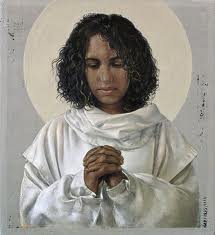
But it is important to reflect for a moment on how she dealt with all the stresses of her life: family relations that mistreated her, children that ignored her model of conduct and faith, a culture that looked the other way when her husband abused her. The circumstances of St. Monica’s life could easily have made her a miserable woman, a sour daughter-in-law, and a depressed parent, yet she didn’t become any of these; instead, she became a saint. A saint that is known for two major personal qualities: her love of Jesus Christ and her prayerful persistence in bringing her physical family into the family of God. This beautiful painting, by artist John Nava, (http://johnnava.com) eloquently captures her spirituality and desire for prayer and union with Christ.
Monica was upset to learn that Augustine had accepted the Manichean heresy and was also living an immoral life. Manichaeism stated, among other things, that there is no all knowing good power, so there is neither lord nor savior. She was so angered by his beliefs that she refused to let him eat or sleep in her house and became enraged when he explained to her that his belief trumped her faith in Jesus Christ. She threw him out of the house, but later pursued him and attempted to reason with him.
Monica took comfort in the fact that she had a dream that assured her Augustine would return to the faith. From that moment she vowed to continually pray and fast for her son and to remain close to him so that she would have the opportunity to discuss her faith with him. The histories tell us that she in fact stayed much closer than Augustine wanted.
One night Augustine told Monica that he was going to the docks to say goodbye to a friend. Instead, he himself set sail for Rome. Monica was stunned when she learned of Augustine’s trick, but she booked passage on the next boat. When she arrived in Rome, she learned that he had left to travel to the city of Milan in northern Italy where he hoped to obtain a teaching post. Monica pursued him to Milan, and it is in Milan that both mother and son came under the influence of the great saint Ambrose who was bishop of Milan.
Bishop Ambrose became Monica’s spiritual director, and ultimately, she accepted Ambrose’s advice. He advised her that what she was doing was correct – that prayer and fasting would have its affect on the situation. He commended her persistence and directed her to keep the faith, and in humility, accept her circumstances. Monica did exactly that, and in Milan, became a leader of devout women, some of whom were also being abused by their husbands.
Ultimately, Saint Monica won the day; her abusive husband, mother in law, and her youngest son and daughter were all baptized into the faith. Augustine, too, eventually saw the logic of his mother’s faith, became a catechumen, and took religious instruction from Ambrose. In the year 387, Bishop Ambrose baptized Augustine into the Catholic faith in Milan’s cathedral.
Saint Monica was an exemplary mother; a woman who perseveringly pursued her wayward family not with threats but with prayerful cries to heaven. Let us pray that she intercedes for all mothers in our day so that they may learn to guide their children to God. Let us also pray that she teaches mothers, through her example of prayer and fasting, to remain close to their children, even prodigal sons and daughters, who have sadly gone astray.
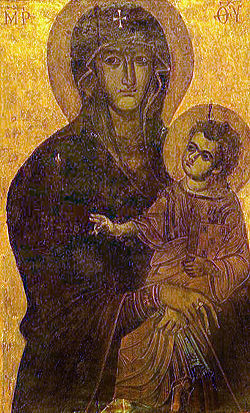
Through the centuries, sacred icons and images have expressed the Queenship and Coronation of the Holy Theotokos – the Mother of God. The icon The VirginSalus Populi Romani, a 5th century icon, displayed in the Church of Saint Mary Major in Rome, and seen below, shows the Blessed Mother dressed in typical first century Middle Eastern garb as she holds her Son who gives a blessing. This icon is reputed to
be a copy of one that was painted by St. Luke the evangelist who tradition states knew and spoke to the Blessed Mother.
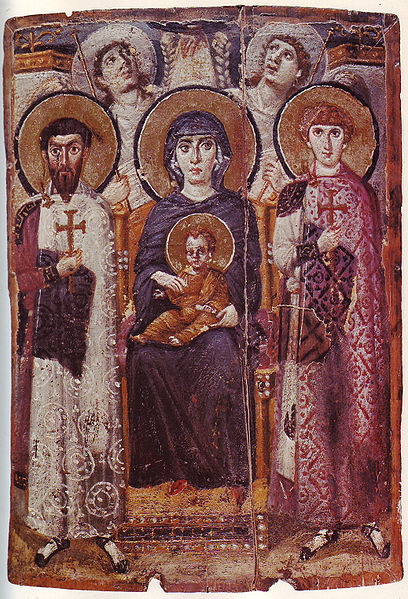
A 6th century icon of Mary and Jesus displays a coronation theme portraying the Blessed Mother and her Son in Heaven. Mary sits on her throne with Her Son on her lap, surrounded by St. Theodore on the left and St. George on the right, while two angels look up as the hand of the Father gives a blessing. This icon is found in the Monastery of St. Catherine in the Sinai Peninsula.
Iconic images painted (“written”) by orthodox iconographers of both the Latin, Greek, Russian, Coptic, and other Rites agree with images found within our Holy Scriptures. For example, a Gospel passage tells us “… the Lord God will give to Him the throne of His father David; and He will reign over the house of Jacob forever, and of His kingdom there will be no end.” This Scripture explains that the Lord willingly takes the initiative to come forth, with hands extended, to meet us and share the reign of His kingdom.
In sacred art we visualize this not only in the extension of Christ’s hands on the cross – but also, in the extension of the infant Jesus’ hands, to give us a blessing as He sits in His mother’s lap, or is caressed in her arms, an image that is found not only in the above sacred images but in numerous statues found in Latin Rite churches throughout the world.
The prophet Isaiah also speaks of Christ in regal terms as Emmanuel (God is with us) and the “Prince of Peace.” We can even get apocalyptic and speak of the Books of Daniel and Revelation which recall the truth that the world will be transformed through the birth of the Redeemer, made possible by Mary. She is a “a woman clothed with the sun, with the moon under her feet, and on her head a crown of twelve stars… who gave birth to a son, a boy destined to shepherd all the nations with an iron rod. Her child was caught up to God and His throne.” So we see that Mary enables the incorporation of the reign of God into the world. She is thewoman destined to crush the head of the apocalyptic serpent.
St. John of Damascus wrote about this in the 8th century when he says of the Blessed Mother that she “has become the terror of demons, the city of refuge for those who turn to her. [He has her say:] Come to me in faith, O people, and draw as from a river of grace. Come to me in faith, without doubt, and draw from the mighty and certain source of grace.”
Last week, on the solemnity of the Assumption, we recalled Blessed John Paul 2 saying “…the Assumption of the Mother of Christ in Heaven forms part of [the Lord’s teaching about] His victory over death, the beginning of which is found in the death and resurrection of Christ.”
So in today’s memorial, Mary, the humble daughter of Joachim and Anna and the chosen daughter of our Heavenly Father, is garbed in the majestic robes of a queen. She takes her rightful place next to the throne of her resurrected and ascended Son.
Why?
Because the Church desires to teach us that Mary is privileged, beyond all other women and men, to be the first and most significant human being to participate in the glory, triumph, and reign of God. By her very willingness to become the Mother of God, the Theotokos, she agreed to become our spiritual Mother, too.
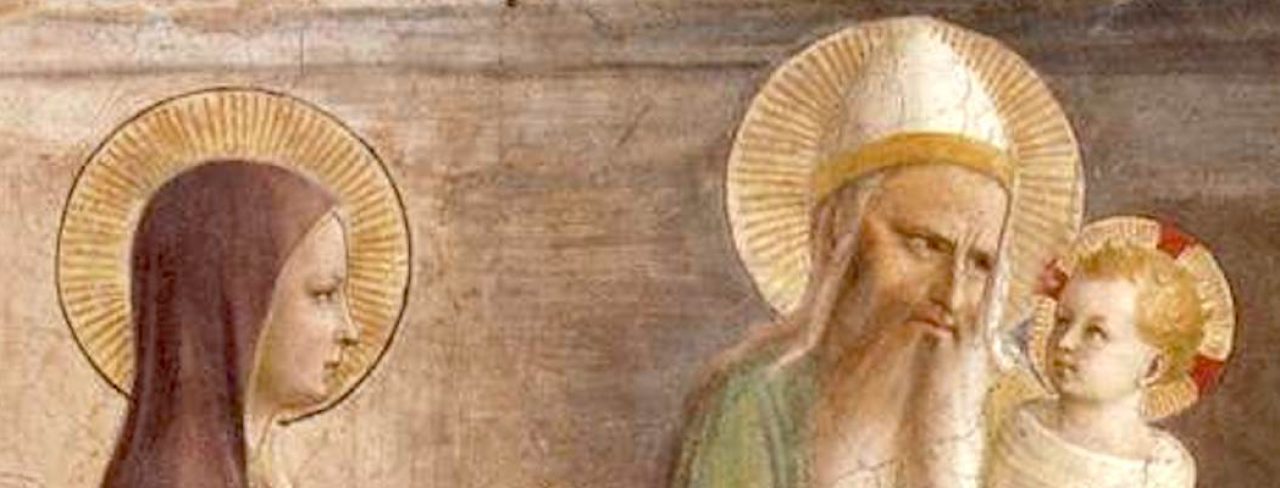
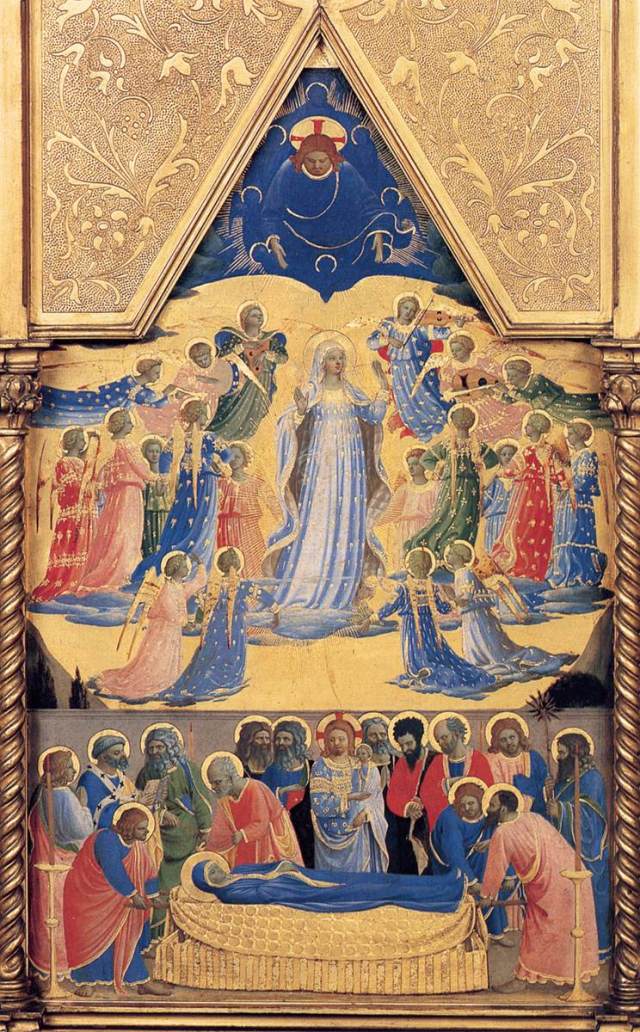
In this beautiful sacred image by Blessed John of Fiesole, also known as Fra Angelico the great Dominican artist of 15th century Florence, portrays the moment of Our Lady’s Coronation with the Heavenly court surrounding her.
We observe men and women saints that were alive thousands of years after Mary’s Coronation observing the event.
Why did the good Friar do that?
He is expressing the fact that Heaven is within the eternal now of the Trinity, so it follows that all the saints are knowledgeable of the truths of Heaven. If we carefully observe the painting we see that the knowledge of that coronation moment is known by St. Thomas Aquinas. We see him looking out at us (in the lower left corner), noting the truth, goodness, and beauty of God, and the fact that God desires this coronation for His beloved and humble human daughter, the Queen of Heaven.
The Blessed Mother, in her regal beauty, authority, and power, has not left us orphans. She is “the Living Temple of the Holy Spirit, the Inviolate Mountain, the ladder” that joins Heaven and earth. Mary is the “One who Shows the Way” (as the Greeks would say the Hodigitria) to her Son and to our Heavenly reward.
If we remain faithful and loyal to the teachings of Jesus Christ, as expressed through our Sacred Scriptures and our Church, and act on that faith, then we, too, will reign alongside our Heavenly Mother and give praise and glory to God. Our Lady, Queen of Heaven, pray for us.
St. Paul’s Letter to the Romans (8:30), sets that stage for this great solemnity: “Those God predestined He likewise called; those He called He also justified; and those He justified He in turn glorified.”
Today we celebrate the solemnity of the Assumption/Dormition of Mary. This is an ancient celebration documented as occurring as early as the 400’s, probably soon after the Council of Ephesus in 431 declared Mary the Theotokos: the Mother of God.
In a homily on the solemnity of the Assumption, Pope John Paul II used John 14:3 as a Scriptural foundation for understanding the dogma of the Assumption of Mary. In those verses Jesus tells his disciples at the Last Supper, “If I go and prepare a place for you, I will come again, and will receive you to myself; that where I am, you may be there also.” Our belief is that Mary’s rising to Heaven is the pledge of the fulfillment of Christ’s promise to His disciples: “…where I am, you will be also.” Mary, as our spiritual Mother, through Christ’s promise beckons us to follow her.
With this celebration comes the renewal of the truth that Mary not only belonged to Christ as His Blessed Mother, but that she was truly raised on high as our Queen of Heaven. Beautiful Mary, is in her simplicity, the true sign that informs the world of the humility, love, and mercy of her Messiah Son.
Today we acknowledge Mary as a Queen, who takes her place in the throne room of God, not to have power over us, but, rather, to intercede for us as the perfect mother and faith-filled disciple. We witness this truth in this exquisite painting by Beato Fra Angelico completed in the year 1430.
In the “fullness of time” after millennia of human history, the Father of Mercies saw in Mary a loving and lovable woman who possessed great courage. She is the personwho in her simplicity and purity would be completely open, totally surrendering, and free from the pollution of pride or self-will. She was the woman who would be the New Eve, the mother of the living, the mother of a new creation.
She is, as the Eastern Rite proclaims, the All Holy One,the Panagia, who as our spiritual mother shows us the way by guiding us to her Son who through His Redemptive Act and Redeeming Grace enables us to be reborn into eternal life. The Divine Office in Evening Prayer I for the Assumption (the second antiphon) reminds us: “Through Eve the gates of heaven were closed to all mankind; through the Virgin Mother they were opened wide again, alleluia.”
It is through our own rebirth, through water and the Spirit, that we are able to bear fruit and imitate Mary in bringing the newborn Christ to others. St. Maximus the Confessor speaks of this when he says “Every soul that believes, conceives and gives birth to the Word of God according to faith. Christ is the fruit, and all of us, are mothers of the Christ.” (from Vladimir Zelinsky’s “Mary in the Mystery of the Church: The Orthodox Search for Unity” found in Mary CoRedmptrix, Mediatrix, Advocate – Theological Foundations II. M.I. Miravalle, S.T.D., editor).
The Catechism of the Catholic Church (paragraph 966) states, “The Immaculate Virgin, when the course of her earthly life was finished, was taken up, body and soul, into heavenly glory, and exalted by the Lord as Queen over all things, so that she might be the more fully conformed to her Son, the Lord of Lords, and the conqueror of sin and death”
This proclaims the wonderful news that the Assumption of Mary is a participationin the act of her Son being raised from the dead, and so is a Sign, a Sign that points to our own resurrection and union with God. The Eastern Rite liturgy says on this solemnity: “In giving birth you kept your virginity; in your Dormition you did not leave the world, O Mother of God, but were joined to the Source of Life.”
Our Blessed Mother’s words in her beautiful Canticle, and her personal destiny, are inseparably linked to our own – for she is one of us; and by keeping our focus on her Son, we too, through the grace of God, will experience His mercy which lasts from age to age on those who fear Him.
In these very troubled times may Our Lady of the Assumption always keep us close to her heart.
(Additional sources: 1 Corinthians 15: 20-27; Revelation, Chapters 12 and 19; Lumen Gentium, 59; and Pope Pius XII in his Munificentissimus Deus (November, 1950).
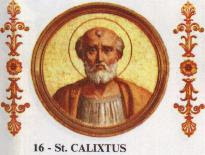
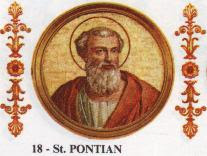
Today we celebrate the martyrdom of Saint Pontian, who was the lawfully elected successor pope to St. Callistus during the early 3rd century. St. Pontian was considered a criminal by the emperor Maximinius and banished to the silver mines in Sardinia – an exile which meant certain death. We also celebrate today a saint by the name of Hippolytus, who was a priest in the Church of Rome at this same moment in time.
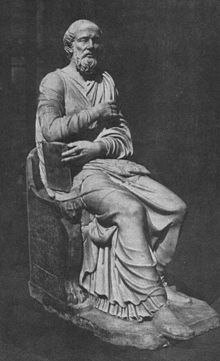
Saint Hippolytus is recognized because of his brilliance and profound scholarship. He is considered to be one of the finest theologians of the 3rd century, and is the source of the 2nd Eucharistic Prayer recited at Mass. Hippolytus’ most important work is a treatise known as The Apostolic Tradition; and scholars such as Dr. Marcellino D’Ambrosio, (at http://www.crossroadsinitiative.com) tell us that it provides “an enlightening and extensive glimpse into the liturgical and devotional life of Roman Christians around the year 200.” The statue found below is of Roman origin, found in the mid 16th century. It has the name Hippolytus carved into it as well as references to works of other Apostolic Fathers. The image is presented through the courtesy of Dr. D’Ambrosio.
Controversy, however, erupted when St. Callistus, was elected to the papacy. St. Hippolytus considered Callistus to be a liberal since Callistus extended absolution to new converts who had committed mortal sins such as adultery and murder. Hippolytus contested the election, violently disagreed when Callistus was affirmed, and then made history by declaring himself pope, thus becoming the first anti-pope in the history of the Church!
As a result of his action he divorced himself from full communion with the Church. When Pope Callistus was martyred, in the year 222, Hippolytus began disagreeing with his successors – the last being Pope Pontian. Hippolytus’ theological differences and self-imposed actions didn’t mean anything to the Romans for they arrested him, too, and exiled him off to Sardinia; and there, St. Hippolytus – the anti-pope met St Pontian, the true pope and lawful successor to Pope Callistus.
In the silver mines of Sardinia, Pope Pontian abdicated his office, making way for a lawful successor to be elected, and Hippolytus renounced his anti-papacy and was absolved of his sins by Pontian. Fully reconciled they died together for the faith in the year 235.
So, what does this have to do with us?!
Our Gospel today (Matt 17: 22 – 27) provides the answer, for in it our Lord and the Apostles were confronted with the arrogance of the officials who implied they were evading the local taxes. Jesus attempts to clarify His position not only for St. Peter but for the officials as well.
Jesus is basically saying that, yes, they must pay the tax; the reason being they must not do anything to put a stumbling block in the way of people understanding His ministry and message. Again we see Christ not getting political. He is not ranting about the just or unjust qualities of the Temple tax, or Roman occupation. He is beyond that, and demands that the Apostles, as His successors, not give a bad example to the people.
This is a lesson that St. Hippolytus, for all of his brilliance never learned. He did give bad example to the Church of Rome in declaring himself an anti-pope. His dissension and attacks were not productive or helpful in a highly charged environment which constantly witnessed Roman persecution.
Yet, St. Hippolytus ultimately saw his sin, repented of it, and along with Pope St. Pontian, did his duty and defended the true faith with his life. We must always do the same, and whatever our calling or ministry may be, we must never become a stumbling block that prevents others from seeing and believing in Jesus and His Church.
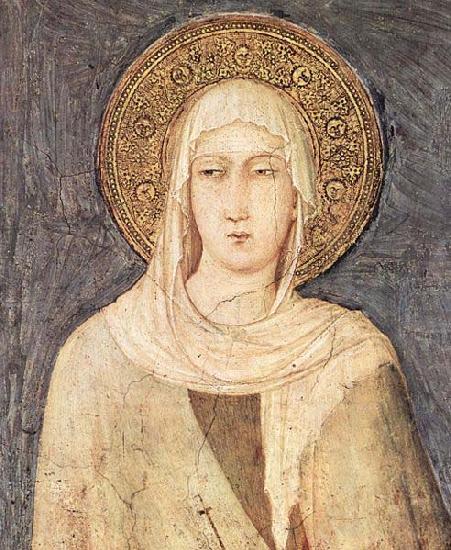
The Church honors today, August 11th, the holy woman, consecrated virgin, founder and Abbess of the religious order known as the Poor Clares, and dear friend of St. Francis of Assisi. We know her by her Anglicized name: Clare.
She was, however, born Chiara Offreduccio in Assisi, Italy on July 16, 1194.
The Italian language has always been especially tuned to convey, through words and sounds, a delicacy and refinement of spirit. Her Italian name, Chiara, gives witness to this observation, since its English equivalent means – clear.
The image above by Simone Martini (1283 – 1344) conveys this quiet asceticism in his lovely fresco of her completed between the years 1312 and 1320 and found in the lower basilica of San Francesco in Assisi (image courtesy of www.berthemorisot.org/index.htm ). To the historical and spiritual observer, St. Chiara’s life is very clear in its direction and goal. It is well known that she was influenced by her fellow citizen of Assisi, Francis, yet, an examination of her life shows that she was directed and formed by her profound love for Jesus in Scripture and in His real presence in the Eucharist.
A letter from her to a close friend, Blessed Agnes of Prague, shows the depth of her own mysticism and the clear guidance that directs another onto the correct path: “Happy indeed is she who is granted a place at the divine banquet, for she may cling with her inmost heart to Him whose beauty eternally awes the blessed hosts of heaven; to Him whose love inspires love, whose contemplation, refreshes, who generously satisfies, whose gentleness delights, whose memory shines sweetly as the dawn, to Him whose fragrance revives the dead, and whose glorious vision will bless all the citizens of that heavenly Jerusalem. For He is the splendor of eternal glory, the brightness of eternal light, and the mirror without cloud.”
This great mystic of the Church also led a life of austere poverty, chastity, and obedience, yet, her life, as the Divine Office tells us, was “rich in works of charity and piety.”
St. Chiara, passed on to the heavenly banquet on August 11, 1253.
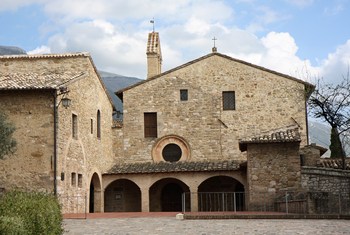
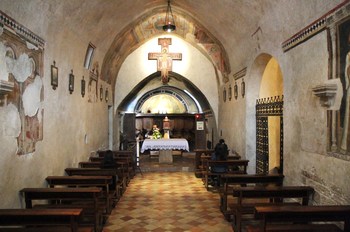
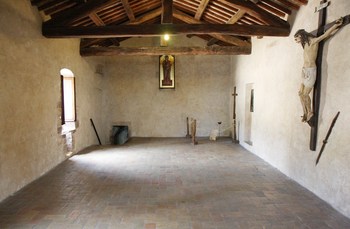
The following beautiful images are from the excellent website: http://www.sacred-destinations.com I thank them for the courtesy of providing the images.
The first photo is the church of San Damiano, which St. Francis restored when, after praying before the crucifix within its broken down walls, heard the Lord’s voice saying “Francis, rebuild My Church.”
The second photo is the image of the interior of San Damiano Church. It is this crucifix, painted in a unique Byzantine icon style and which is known as the San Damiano Crucifix, that spoke the words that changed the direction of Francis’ life, and, the life of the Church.
The third photo shows the interior of the room that St. Clare died in on this day 759 years ago. Tradition states that her bed was in the upper right corner of the room.
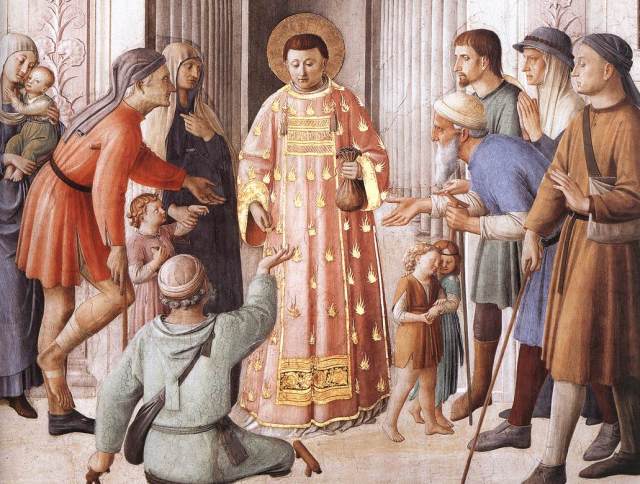
St. Lawrence, archdeacon of Rome, distributing alms to the poor; painted by Fra Angelico, circa 1447.
Today we celebrate the feast of St. Lawrence, a deacon and third century martyr. St. Lawrence was one of the seven deacons of Rome who served as the Pope’s ministers during Holy Mass and as his administrators to the people of Rome. His execution occurred a few days after the martyrdom of Pope Sixtus II and four deacons (Januarius, Vincent, Magnus, and Stephen). At that time, all the deacons of Rome were executed.
The role of deacon is distinguished by service to the poor – both in mind and body. A deacon serves at “table” which results in his participating in the corporal works of mercy; and he performs service to “the Word,” which are the spiritual works of mercy. These actions are given witness through various works: teaching the Faith, baptizing adults and infants, reading the Holy Gospel during Mass, distributing alms, admonishing sinners, feeding and clothing those in need, praying for the living and the dead, serving and visiting the sick, administrating parish and diocesan needs, etc. The deacon is the first Order within the Sacrament of Holy Orders (the other two Orders being the priest and bishop).
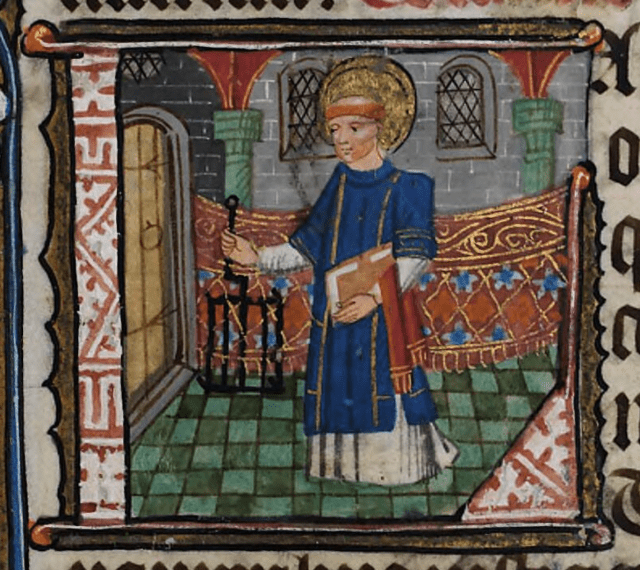
St. Lawrence depicted in a Roman Catholic Breviary (Book of Hours). circa 1300’s. He is holding a gridiron, the instrument of his torture and death (he was placed on the gridiron and roasted to death by his Roman executioners).
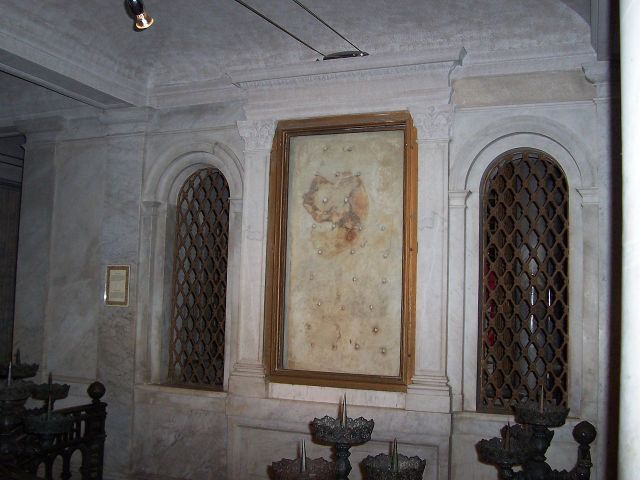
According to Church tradition, this is the stone on which St Lawrence’s body was laid after his death. It is located in the church of San Lorenzo fuori le mura (St. Lawrence Outside the Walls) located in Rome. My wife and I were privileged to visit this church in 2007.
These frescoes, and illuminated miniatures are catechesis as well as beautiful art. Fra Angelico’s paintings portray St. Lawrence in an exquisite salmon rose colored dalmatic (the garment which signifies the deacon’s service and loyalty to his bishop). In liturgical use the color salmon rose represents the virtue of joy. This image was painted (fresco) between 1447 – 1449 and is approximately 9 by 7 feet.
St. Lawrence, deacon of Rome, distributing alms to the poor; painted by Fra Angelico, circa 1447.
Praise be the name of Our Lord Jesus Christ and His faith-filled martyrs.
The article that is found below my opening comments, and the image of the Transfiguration, is reblogged, through the courtesy of Fr. Richard Reiser, pastor of St. James Catholic Church Omaha, Nebraska.
I really enjoy Fr. Reiser’s iconographic style. He is able to convey the Scriptural truth of the Transfiguration while, at the same time expressing it in artistic language accessible to contemporary Christians. Fr. Reiser studied with noted master iconographer Philip Zimmerman who founded the St. John of Damascus Icon Studio in Pennsylvania. Father Reiser pointed out to me in an email, that St. James is larger than the other saints. This resulted from the fact that he painted this icon for his parish church – St. James Parish.
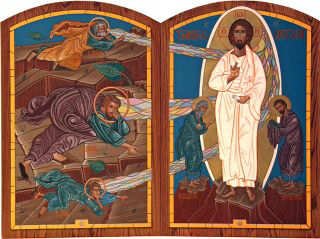
Icon of the Transfiguration (Mark 9: 2 – 10), by Fr. Richard Reiser, pastor of St. James Catholic Church Omaha, Nebraska. Copyright Fr. Richard J. Reiser, iconographer. Each icon panel measure 36″ x 54.”
God our Father in the transfigured glory of Christ your Son, You strengthen our faith by confirming the witness of Your prophets, and show us the splendor of Your beloved sons and daughters. As we listen to the voice of your Son, help us to become heirs to eternal life with Him who lives and reigns with You and the Holy Spirit, one God, forever and ever. Amen.
THE TRANSFIGURATION OF THE LORD
by Fr. Richard J. Reiser
A HISTORY OF ICONS
“An icon is a religious work of art done in a symbolic and stylistic manner. Its main focus is not with realism but with spiritual realities. The icon was a favorite art form that developed in the early Church and became the preferred style of religious representation for the Eastern Orthodox Church. In the Roman Catholic Church, mosaics and types of statuary were the prominent styles of art used for religious representation.
Realism or accurate perspective is not a primary concern in iconography. The main purpose of an icon is to draw the viewer into the realm of the holy through contemplation. An icon in this sense means to “see through to the divine,” or to be a “window to heaven”. In icons, the details of the eyes should draw the viewer into a vision beyond the present. The perspectives are more subject-centered as a way of focus, rather than relying on realistic horizon lines. The icon does not, after all, represent the material world, but the realm of the Divine.
The stoic faces on the figures in icons suggest that the holy ones, whose lives of service work are now accomplished on earth, now contemplate and rest in the presence of the Divine (signified by the light [halo] which surrounds the heads of the holy figures).
THE TRANSFIGURATION ICON
The two-panel icon of the Transfiguration has been done in a contemporary method and should be understood as a religious painting done in an iconographic style since it was not written (painted) following the strict rules of traditional icons that included rigorous fasting, special prayers, and special mixing of pigments with egg whites. This icon is written with acrylic paints.
The two oaken panels each measure 36″ x 54″, and their rounded tops echo the architectural detail found elsewhere in the church. The event of the Transfiguration is found in Matthew 17: 1 – 8 and Mark 9: 2 – 8. The naming of the icon (Transfiguration) is done in English, but in a contemporary Slavonic (Old Russian) style of lettering.
The images on the panels are of Jesus Christ, St. Elijah (1), St. Moses (1), St. Peter, St. James, and St. John. Jesus Christ and St. James are larger than the other figures to give them prominence; Jesus, since he is the main figure of the Transfiguration, and St. James, since he is the patron of the parish. The icon is designed to invite the viewer to participate in the event of the Transfiguration by allowing the light coming from Christ in the first panel to confront the viewer, then, inviting the viewer to connect the light of Christ to the apostles in the second panel. The rays of light that emanate from Christ were done in a stained-glass style that reflects the shape and colors of the stained glass found elsewhere in the church (2).
THE MOUNT TABOR PANEL (at right)
The central figure of the right panel is Jesus Christ, clothes in white and surrounded by light in the traditional manner which depicts Him in glory, along with the creedal statement of “Light from Light.” The aureole (the gold-leaf background) which surrounds the entire body of Jesus. Christ’s halo contains the traditional Greek letters that identify Jesus Christ as “I Am,” the title of God given to Moses in Exodus 3:14 and given human expression in Jesus as the divine Son of God. The Greek letters to the left and right of the aureole are the traditional abbreviations for “Jesus Christ.” High right hand is raised in the traditional gesture of blessing where the two joined fingers represent the two natures (human and divine) of Christ.
A scroll is held in Christ’s left hand and is symbolic of Christ being the Word that became flesh (John 1:14).
The haloed figure of Moses to the right of the Christ figure bows in deference towards Christ who is the completion and fulfillment of the law. Moses reverently holds the two tablets of the Ten Commandments without directly touching them. They symbolize the law with the word Torah (3) inscribed on them in Hebrew. Moses is represented as the younger man than he was at the time he received the tablets of the law. The garments of Moses are brownish red and blue.
The haloed figure of Elijah to the left of the Christ figure, also defers to Christ as the completion and fulfillment of the prophets. Elijah was taken up to heaven in a whirlwind. His garments are green and blue.
All three figures on the right panel stand atop Mount Tabor (4). The mountain suggests the place of God’s revelation to Moses in the Old Testament when he was given the law (Deuteronomy 5), and the place where Elijah the prophet experienced the voice of the Lord in the gentle breeze (1 Kings 19: 8 – 13). Icons of the Transfiguration show Jesus Christ as God’s full revelation by being presented on a mountain.
THE APOSTLES PANEL (at left)
The Apostles panel of the left is divided into three plateaus each supporting one of the apostles closest to Christ. The center plateau is larger and bright and it supports St. James. He is shown humbled on his knees, because of the experience of the Transfiguration. He is reaching forward while attempting to secure stability and balance on the rocky plane. He is presented with his hand shielding his face from the light. His outer garment flows in the wind generated by the force of the transfigured Christ. The trees representing creation also bend by the power of Christ’s transfiguration. He is attempting to seek Christ, but with difficulty. The halo surrounding his head marks him as a saint. His outer garment is purple and his undergarment is green.
The upper plateau supports St. Peter who is held back from the force of the Transfiguration by a ledge where his feet are supported. His outer garments flows in the win. As the leader of the apostles, he points to the light and to Christ. The haloed figure is presented with the traditional gray hair and beard suggesting wisdom. Positioned on the rock, he is named by Christ as the “Rock” on which Christ will build His Church. His outer garment is the traditional gold, and his undergarment is green.
The haloed figure of St. John is the bottom figure. He is the brother of St. James. His right hand shield his face from the light. His outer garment flows in the wind. His left hand reaches forward clinging to the rock. A ledge supports his forward right leg and holds him which his back leg waves freely with the force almost releasing his sandal. His beardless face is the traditional way of depicting his youth. He is said to be the youngest of the apostles. His outer garment is green and his undergarment is blue.
The maize-colored border of both panels reflects the color and stained glass of the central rose windows in the church (5). The medallion on the right panel border holds a piece of rock from Mt. Tabor. The medallion on the left panel border holds a relic of St. James.”
THE INSCRIPTION ON THE BACK OF THE ICON PANEL
“The inscription on the back of the icon panels reads: The Transfiguration Feast – August 6. Blessed by Fr. Richard Reiser August 6, 2006. Donated by Colleen Mahoney in memory of the William and Colleen Mahoney Family Fr. Richard Reiser, iconographer.”
“Notes:
(1) In the Orthodox tradition, both Elijah and Moses are considered saints.
(2) A similar technique with the fishing net was used by Brother Robert in the “Calling of James” icon in our (St. James) church.
(3) The first five books of the Old Testament’ they present all of the 613 laws and interpretations that are central to Judaism. In Jewish services the scrolls of the Torah are still extravagantly decorated and venerated with respect when they are proclaimed.
(4) Mount Tabor is more of a geographical mound in the area of Galilee and not a mountain as such.
(5) This border also is found on the “Calling of James” icon.”
The Fra Angelico Institute for the Sacred Arts is truly honored to receive three blogging awards. Teresa Rice at Catholiclibertarian has nominated this blog for three awards: The Illuminating Blogger Award, The One Lovely Blog Award, and The Very Inspiring Blogger Award.
Teresa Rice’s blog at Catholiclibertarian is dedicated to discussing contemporary issues through the lens of being a faith-filled Catholic as well as a person who has a mixture of conservative and libertarian political views. Teresa’s columns are always well written, insightful, challenging and dogmatically faithful to the Catholic Church. We are proud, honored, and humbled by her confidence and support for our mission – which is to evangelize the truth, beauty, and goodness of God through the prayerful study and creation of sacred art.
We also received notification this morning that reinkat has awarded this blog an award, too. We are truly touched to the heart by these awards from our readers. We admit, however, that the entire impetus for the Fra Angelico Institute for the Sacred Arts, and this blog, is the work of the Holy Spirit. He deserves all praise, honor, and glory. Everything that we do here develops out of prayer, is performed in prayer, and hopefully, is sustained through prayer. Again, thanks very much. As part of the Award system I am happy to nominate fourteen other bloggers that I regularly read and find illuminating in various ways. Their names are found below.
The conditions for accepting The Illuminating Blogger Award are:
1) Add a picture of the award to your blog post.
2) Thank the blogger who nominated you and include a link to their blog.
3) Nominate 5 to 10 other Bloggers and inform those selected that they have been nominated.
4) Say seven interesting things about yourself to give some insight into what you are like, interested in, etc.
I am happy to award the writers of the following blogs The Illuminating Blogger Award because all of them make you think and provide illumination in various ways. Some of them promote the arts – in all of their various forms; others promote humor (in these days anyone that promotes clean intellectual humor deserves a prize!). A few are promoting the Catholic faith (which from my point of view is very good!), and some are just a lot of wacky fun.
The following blogs are not ranked in any order of one being better than another.
The blogs Catholiclibertarian,reinkat, and Biltrix would have been on the list but they have already received the award.
Here are the blogs that receive the most prestigious Illuminating Blogger Award from me.
Here are the seven Award required “interesting things” I will divulge about myself:
1) I sing Christmas songs throughout the year.
2) I enjoy reading about British personalities, fictional and non-fictional. An example being Winston Churchill and what made him tick as a man and personality. Another character that I enjoy is Sherlock Holmes. Very few people are aware (ahem, or care!) that I wrote a definitive monograph in the early 1980’s on the True Location of 221B Baker Street. It was published in the Baker Street Journal to loud huzzahs.
3) I became fascinated with the French Impressionists in college, yet, today, have a deep affection for Cezanne as a man and as an artist.
4) I enjoy solitude, or, the company of very small groups of people.
5) I have had a deep affection for Scottish Terriers since I was in elementary school. Our third Scottie has a huge heart and an extraordinary sense of loyalty for close family members. He has a toughness that is quite admirable; he has been battling cancer for 15 months. Our vets are astounded by his longevity owing to the fact that veterinary science and experience said he had four to six months to live.
6) I would have absolutely no problem eating apple pie as a dessert for breakfast, lunch, and dinner. Let’s not forget snacks. You may ask: Who has a dessert for breakfast? Answer: interesting people.
7) I have a fascination for the woodcuts and drawings of Brother Martin Erspamer, O.S.B.; yet, I have a deep interest and desire to emulate the artistry of Italian painters from the 12th through the mid 15th centuries. There is a spiritual purity in their work; however, I am far from even approaching some sense of true understanding of them and would appreciate anyone who knows of specific research and tomes that could assist me in the understanding of their techniques.
Today we celebrate the feast of the Transfiguration of the Lord. This feast has been celebrated since the 5th century. It was inserted into the general calendar of the Church in 1457 by Pope Callistus III in order to celebrate the defeat of the advancing Moslem army in the Serbian city of Belgrade. Today’s feast was announced in Rome on August 6, 1457, and was placed in the calendar to occur forty days before the feast of the Triumph of the Cross, on September 14.
Let’s reflect for a moment on today’s Gospel account (Mark 9: 2-10). Jesus knew exactly what He was doing when He took Peter, James, and John to the top of Mount Tabor. He knew that His Passion and Crucifixion would be so absolutely terrifying, that when the complete horror of the crucifixion settled in over those three Apostles that they needed to have, in the back of their minds, this moment, this glorious moment, of the Transfiguration.
By remembering its truth, beauty, and power they would understand that Jesus walked to His death under His own free will. No government, no authority – religious or secular – forced Him to go to the Cross. He went under His own power – a power that was completely obedient to His Father’s will. The Father sent Jesus to call and redeem humanity so that we, under our own power – under our own free will, could choose to enter back into relationship with the Father. After the Redemption occurred, Jesus in turn, sent the Holy Spirit to defend us, from all the various worldly and demonic forces arrayed against us.
The Transfiguration is so important to all of us because at the moment in which Jesus’ glory is manifested the identity of Jesus becomes clear not only for the Apostles but for us, too. When we reflect on this moment we recognize what the Apostles came to understand: that the Cross – is not the end of the story. There is something more that lies beyond the Cross – not only for Jesus – but for all who believe in Him and are baptized in the name of His Divine Family.
There is an ancient Church hymn, called the Kontakionof the Transfiguration, which has been sung in Greek for thousands of years, it declares:
“You were transfigured on the mount, and Your disciples beheld Your glory as far as they could bear it O Christ our God, so that when they should see You crucified, they would remember that Your suffering was voluntary, and could declare to all the world that You are truly the radiant splendor of the Father.”
The glory of our faith is that the Holy Trinity desires this transfiguration for us, too. If we cooperate with God’s grace, spend time with the Lord, and walk the narrow path of holiness, we too, will be resurrected and experience the power of His transfiguration.
We are so very grateful to everyone who has visited this website over the past year. It was on August 1, 2011 that I posted my first essay. By midnight tonight over 13,000 people, from 106 nations, will have visited this site and, hopefully, been spiritually fed by the discussion on issues concerning sacred images and iconography, prayer, and reflections on the Holy Scripture.
May God continue to bless all those who have an interest in sacred art and move them to deepen their prayer life by using sacred art as a focal point in their meditations.
Thank you!
May the Blessed Mother continue to intercede for all of us.
Peace and Victory in Christ!
Deacon Paul and Jackie Iacono
Roman Catholic Diocese of Providence, Rhode Island













 The Fra Angelico Institute for Sacred Art
You must be logged in to post a comment.