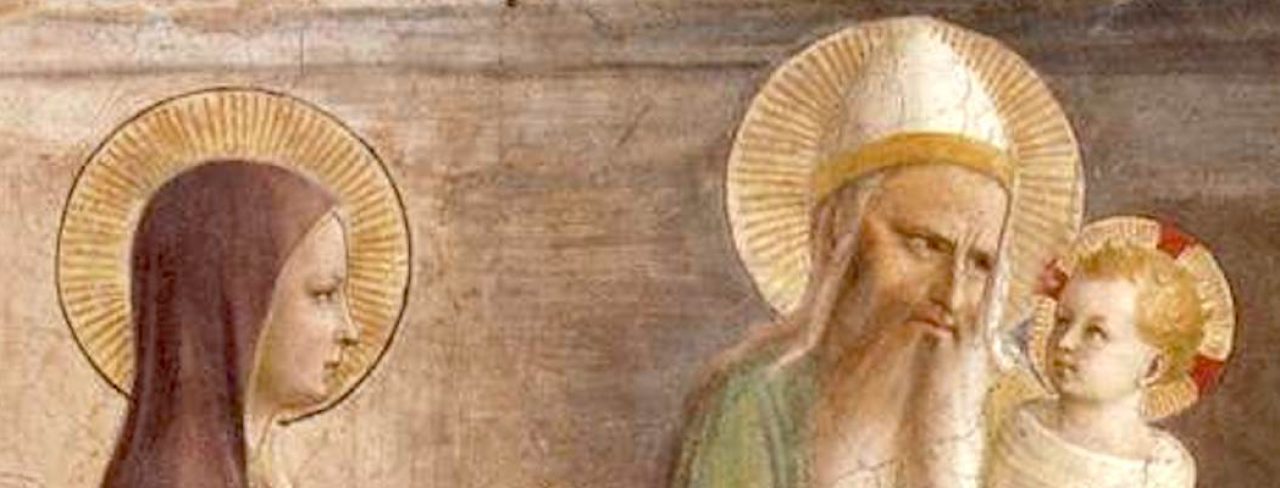
Theophilus, the Art of Iconography, and the Contemporary Sacred Artist – Part 2

Please take a moment to read the first part of this multi-part essay that I posted a few days ago. I am requesting that you do this in order for you to understand my perspective on creating contemporary sacred art within the Latin Rite.

Creating sacred art for me is a service ministry. It is a ministry through which a sacred artist unites him or herself to God’s Redemptive efforts. If you are a Baptized Christian who has been educated in the faith, regardless of the Rite or the denomination, you know that the Christian faith requires you to cooperate with the grace that the Holy Spirit provides to you through Scripture and the Sacraments. If one does this, and maintains a disciplined prayer life, you are cooperating with the Spirit in the duties that you must perform in your life.

For a Christian, human history is more than the individual searching for God. As the book of Genesis (3: 8-9) tells us, God walked through the Garden of Eden searching for us – for our spiritual parents: “When they heard the sound of the Lord God walking in the garden in the cool of the day, the man and his wife hid themselves from the Lord God among the trees of the garden. But the Lord God called the man and said to him, “Where are you?”

The Lord asks that question of us, too. 

Jesus is constantly calling out to us, constantly searching for us, constantly knocking on the door of our hearts hoping to hear our loving response. Christianity is the faith through which a searching God shows Himself to be so loving and so merciful as to persevere, to the point of sacrificing His own Son, in the effort of bringing rebellious humanity back into His family.

So the history of Christian sacred art shows us that people desired sacred icons (Greek, eikon: image) to reference that sense of family, in the same way that we have photographs today of family members, living and dead, which remind us of the love shared and their importance to our lives. These photographs or images are not idols. Even if a loved one does kiss a photograph or a sacred icon or image, the meaning behind that gesture is that the kiss – the love and respect – is not meant for the celluloid, or the wood and pigment; rather, it is meant for the prototype, for the person it represents, the loved one, God, His saints and angels.

Unfortunately, the faith family that is the Church split in the Great Schism of 1054. The Latin Rite and the Greek/Russian Rite split along cultural, theological, philosophical, political, and artistic lines. This Schism is one of the great scandals that has affected Christ’s Church.

The Schism, however, did not affect trade and the exchange of ideas among the laity. Commerce continued and new products, artistic materials, and techniques were evaluated, bought, and sold. The development of the Latin Rite artistic tradition after the Schism indicates that in Western Europe the linking of faith with the creative impulse was very strong and did much to solidify and unify the various cultural groups within the Latin Rite.

But, what was the Latin Rite tradition post AD 1054? What were the techniques of the Latin Rite artists of the Romanesque and early to mid Gothic period? Were there artistic manuals that were more than just recipe books on preparing pigments and varnishes and which discussed the spiritual underpinnings of the artisan’s art?

Where to begin?

As mentioned before, I happily discovered Pope Benedict XVI’s book –The Spirit of the Liturgy. This became my starting point, with its expression that the three periods within the liturgical art of the Latin Rite can be found in the Iconographic, Gothic, and Baroque styles of art.

I was searching for the techniques that Catholic artists would have used approximately one thousand years ago. Sacred artists within the late Iconographic period and early Romanesque period (AD 900 – 1300) would have approached their art within a disciplined theological, semantic, and aesthetic viewpoint. As Western Europeans, however, they easily accepted innovation and even experimentation if it provided a final product which met the artisan’s demanding and critical eye, and especially that of the master artisan of the workshop.

In the Spring of 2012 I discovered a twelfth century book entitled On Diverse Arts by Theophilus the Presbyter (translated by Hawthorne and Smith, Dover Press, 1979, 216 pages). This book is the critical corner stone of my attempt to link contemporary sacred art with its medieval roots. For Theophilus the Presbyter – a twelfth century master artist – is an individual who can still effectively speak to us in our own time. Theophilus has the perspective and the attitude that provides us with a foundation for our spiritual view of art.

This does not mean that we are slavishly going back in an attempt to reproduce the twelfth century. To do that would not be honest, rather, while staying true to the theological, semantic, and aesthetic beliefs of artists like Theophilus we are able to reinterpret and refresh our current situation in light of the contributions and truths discovered and lived in the past. Truth, goodness, and beauty are not limited by space and time.

O Beauty, ever ancient, O Beauty, ever new.

One of the key ideas of Theophilus that needs to be shared with Christian sacred artists is that the Holy Spirit is moving through our creative efforts, and is actively involved in the artist’s daily work. It is my belief that Theophilus sees the role of the artist as a person with a specific vocation, a calling, who is to unite his call by God to create beautiful works of art with his own prayer life and the Catholic spiritual view of reality.

Many, but not all art historians, believe that Theophilus is the pen name for a Benedictine monk by the name of Roger of Helmarshausen. Roger was a master at metalworking, specializing in gold and silver, and lived in the Benedictine monastery located in the town of Helmarshausen in modern day Germany.

In his manual, On Diverse Arts, Theophilus not only lays out his spiritual vision in three specific prologues to his chapters on painting, glassmaking, and metalworking but he provides specific directions and guidance to fellow artists. For example, he lays out – step by step – the process for creating a sacred image: the types of pigments to use, specific colors for the base coat, shadows, colors to use for hair, beards, skin, drapery, etc.

Theophilus’ union of a sincere spiritual perspective with technical guidance shows him to be a master teacher and mentor. He accomplished this within his own Benedictine monastery at Helmarshausen and his reputation expanded throughout the Rhine-Meuse River Valley in Germany.

In my next post I hope to discuss the spiritual importance of Theophilus’ three chapter prologues, and ultimately their relationship to the contemporary Catholic sacred artist.

In my fourth post in this series I will discuss a marvelous doctoral dissertation on Theophilus that was written in 2010 by Heidi Gearhart, Ph.D.

And in my fifth and last post in this series I will discuss how, in the mode of Theophilus, I am developing a practical sacred art workbook that provides step-by-step advice for the contemporary sacred artist. I have two of the four chapters completed and I will probably self-publish it for my sacred art workshops prior to a publisher (hopefully, :{) !) formally printing it.

Copyright © 2011- 2013 Deacon Paul O. Iacono All Rights Reserved

Theophilus, Iconography, and the Contemporary Sacred Artist – Part One

Today’s sacred artist within the Western tradition may have been exposed to many different artistic traditions. Artists may have been classically trained in a formal academy such as the Florence Academy of Art, or, they may have been educated at a secular institution that emphasizes a modern abstract expressionistic form of art. Other models are available, too. Some artists may have been self-taught, or, as in my case, study with specific masters of sacred art that offered intensive workshops to interested groups or individuals.

Upon my retirement from a career in education, I finally had the opportunity to study and actually make art. I knew that the form of art that I wanted to pursue was sacred art and sacred iconography spoke to me as a specific art form. Sacred art necessarily carried with it two elements that were critical for me: a devotion to conversation with God while making the art and an interest in a specific historical methodology for the creative process.

Between 2006 and 2010, I happily studied with four contemporary masters in the field of sacred iconography. They taught me different approaches, techniques, and the use of a variety of materials. This was all well and good, a necessary series of steps for a student artist to go through in order to develop some sense of familiarity and a working comfort level.

After spending time with the last two of my art teachers (Marek Czarnecki and Anna Pokrovsky Gouriev) an important question  had to be answered. They wisely asked all of us to eventually answer this question: “Do you want to paint sacred images in the Russian Orthodox or the Western Latin Rite tradition?”

You see, Marek is Roman Catholic and Anna is Russian Orthodox. They both paint/”write” sacred icons in the Russian Orthodox tradition. Anna’s mother, Ksenia Pokrovsky (marylowell.wix.com/hexaemeron-6#!__xenia-pokrovsky) is a master iconographer who has added a great deal to our understanding of the techniques of sacred iconography within the Russian Orthodox and earlier Byzantine traditions.

Ksenia founded the well known Izograph School of Iconography near Boston, MA, and Marek and Anna assist her with teaching, the creation of sacred icons, and restoration work. Their work is quite beautiful and I highly recommend them to you, your parish, or an educational institution that is interested in high quality iconographic work in the Byzantine tradition.

It is important for a contemporary sacred artist to understand the artistic approaches of the Byzantine/Russian tradition. I learned a great deal from them, not only about sacred art but about myself; yet, their question continued to haunt me. For the year or so after I studied with them I continued to paint in the Russian Orthodox tradition. My first teachers in this art form – Peter Pearson and Dimitryi Andreyev – had built a strong foundation for me. Dimitryi’s father Vladislav, founded the Prosopon School of Iconography, another influential school, in New York City (www.prosoponschool.org).

So, with all of this rich and fruitful tradition passed on to me by four wonderful and prayerful people, I was still left with the unanswered question: Orthodox or Latin Rite? My training had been in pure Orthodox tradition. Wonderful as it is, I still had not answered the question Marek and Anna had posed. Before I could answer it I had to discover if there was a Latin Rite tradition to painting sacred images/icons. This brought up the question of “Why is it that when we hear talk of “sacred icons” today it is always in the context of the Byzantine Catholic/Greek/Russian Orthodox Rite?”

The Western European/Latin (Roman) Rite of the Catholic Church had co-existed and was in communion with the Greek Orthodox/Byzantine/Eastern Rite since the first century. It was 900 years old prior to Russian Grand Prince Vladimir of Novgorod formally converting the Russian people to the Eastern Rite of the Catholic Church. So you would think that there would have been some communication between the Eastern and Western Rites of the Catholic Church and the sharing of information and ideas about sacred art.

So, why do we now just associate sacred icons with the Eastern Rite tradition? It is primarily because of the western European sense of artistic experimentation and creativity that developed around the 12th century. Different artistic, theological, and philosophical traditions developed within Western Europe that affected the Latin Rite of the Church and produced different artistic results. Yet the Byzantine Rite’s art continued to influence Latin Rite artists all the way up to the fourteenth century.

Whereas the Greek/Byzantine/Russian Orthodox approach to sacred art and icons remained steadfast to tradition. While there were different “schools” of sacred iconography within their tradition and different masters anchoring those schools, they always remained faithful to the basic tradition of painting/”writing” sacred icons. You begin to see a shift in thinking within this tradition in the early 18th century when influences from the Western European artistic tradition begin to seep into the Orthodox schools and workshops.

Usually when we think of Latin Rite sacred art we have the images of Giotto, Michelangelo, Leonardo, and Raphael immediately pop into our mind. As Pope Benedict XVI has said in his book The Spirit of the Liturgy the Latin Rite had three specific stages of sacred art develop in its history: the Iconographic, the Gothic, and the Baroque. Each one of these stages contributed to the liturgical life of the Church and had a unique catechetical message for the faithful. It is not to say that the Renaissance artists, many of them working with sacred themes, did not contribute to the artistic tradition of the Church. They certainly did, however, their emphasis, at times, was more on pleasing the patron then on fostering a sense of prayer in the individual penitent.

So, I spent the year 2012 investigating the sources of the Latin Rite’s artistic tradition. The next few posts will reveal what I found, and the fact that a very talented 12th century metalworker and artist, the Benedictine monk Roger of Helmarshausen (also known as Theophilus) was at the forefront of the Latin Rite’s artistic techniques.

It was what Theophilus taught me that finally allowed me to answer Marek and Anna’s question and change my artistic technique. The witness and work of the good Benedictine Theophilus continues to inspire me in the teaching of my own students the prayerful benefits of sacred art. More on Theophilus in the next few days!

Copyright © 2011- 2013 Deacon Paul O. Iacono All Rights Reserved

The Penitent Magdalene and the Way to True Conversion of Heart – A RePost Of Fr. Jason Smith’s Essay

As we begin the season of Lent I thought you would enjoy this article by Father Jason Smith. It contains a magnificent sacred image painted by George de La Tour (1593 – 1652). La Tour is one of my favorite artists; I especially enjoy his beautiful sacred image of St. Joseph teaching the child Jesus. During his lifetime La Tour was considered to be the painter for the French nobility. His son Etienne became his pupil and followed his father’s style so closely that it is very difficult for today’s art historians to determine the author of certain paintings within their collection.
La Tour was a master of the chiarascuro (light/dark/shadow) technique. He developed this technique in new ways, adopting a softer, gentler, and simple approach to presenting the interplay of light, shadow, and color.  After his involvement with a Franciscan led spiritual revival he eventually devoted himself to religious subjects. His two paintings on Mary Magdalene are masterpieces of this style of art and they truly speak to the soul who is interested in listening.
The de La Tour family unfortunately died in 1652 as a result of an epidemic that devastated his city.
The essay below was written a few years ago by Fr. Jason Smith. Fr. Smith’s essay on the truth, beauty, and meaning of de La Tour’s painting reflects the Lord’s ability to use sacred artists to express His continual grace and mercy to us. It is my wish that you spiritually profit by the painting and its analysis. Thank you Fr. Smith for posting this fine essay.

The Penitent Magdalene and the Way to True Conversion of Heart   By Fr Jason Smith, published at the Biltrix blog 

“I have found no better representation of conversion and penance in art than The Penitent Magdalene, by George de La Tour. Though simple, it expresses the essential elements behind every conversion, and we can find in it powerful lessons to apply to our own life. Let’s take a closer look.

The Penitent Magdalen, George de la Tour

The painting presents Mary at the very beginning of her conversion, on the night that she met Jesus Christ for the first time. Her life is just as it was the day the Lord crossed her path. Yet the subtle but evocative tension in the painting makes it evident that her world has been shaken and she knows she must change.

She has returned home, alone, and cannot sleep. She sits down at her vanity which until this afternoon was the center of her life. La Tour paints nothing superfluous here; only those things most dear to her, things to which she has clung for happiness and fulfillment, but that have only served to leave her feeling empty inside: Her richly embroidered clothing, her silver mirror with its carved and gilded frame, her fine jewels and her string of pearls which, while tossed aside, are still within her grasp.

Interestingly enough Mary’s head is turned away from the viewer—leaving us to imagine her expression, and even better, identify ourselves with it—and, while facing the mirror, she is not looking into it. She is gazing far beyond; she has realized there is something more to life then what is external, then in those things which she has placed her security and happiness. The Lord had cast seven demons from her life, seven lies that she had believed about God and about herself; this night, however, she is finally free of them, but she knows that the changes she has to make and which still lie ahead will be hard.

The flickering flame of the candle is the primary source of light. It is soft, calm, inviting, strong, and supersedes the light of an ordinary candle. It keeps the menacing darkness away. It illuminates her face and her heart—primarily her heart—to show that she has focused on the core of who she is, and subtly shows the love that she has felt that day. Yet it also shines on the mirror and on her robes and on her jewels—the light of Christ has begun to enlighten everything in her life. It is the power of the Holy Spirit through which all true conversion and penance is inspired.

She holds a skull, which at first seems macabre, and certainly was not a fitting decoration for her vanity, but is symbolic of the gravity and seriousness of the assessment she is making of her life. Her hands are folded calmly upon it and it rests gently in her lap; this is not an anxious and tense conversion, but a realistic one. She knows her life will end; she recognizes her mortality; she is asking herself what is truly important in her life—not her mirror or her jewels—and she is preparing her heart to die to those things.

But what will she exchange them with after she gives them up? What will tomorrow morning bring? She stares into the darkness looking for an answer but there is no reply. Conversion always requires faith. The answers and the way are presented gradually. There is a natural trepidation when it comes to change, conversion, stepping out to follow the Lord, and, yes, penance—but this is only a smaller aspect of a larger and more liberating truth, which Pope Benedict expressed so well in his inaugural homily:

Are we not perhaps all afraid in some way? If we let Christ enter fully into our lives, if we open ourselves totally to him, are we not afraid that He might take something away from us? Are we not perhaps afraid to give up something significant, something unique, something that makes life so beautiful? Do we not then risk ending up diminished and deprived of our freedom? And once again the Pope said: No! If we let Christ into our lives, we lose nothing, nothing, absolutely nothing of what makes life free, beautiful and great. No! Only in this friendship are the doors of life opened wide. Only in this friendship is the great potential of human existence truly revealed. Only in this friendship do we experience beauty and liberation. And so, today, with great strength and great conviction, on the basis of long personal experience of life, I say to you, dear young people: Do not be afraid of Christ! He takes nothing away, and he gives you everything. When we give ourselves to him, we receive a hundredfold in return. Yes, open, open wide the doors to Christ – and you will find true life.

Conversion and penance should never be thought of as a loss but as a transformation, an exchange, for something greater: From what is bad to good, from good to better, and from better to best. In reality the Lord does not ask us to give anything up; rather, he asks that we chose the better part, to go from vice to virtue, from complaining to gratitude, from bitterness to forgiveness, from vanity to humility, from lust to love, from anger to patience, from discouragement to hope, from where we are to where we know we are called by the Lord to be.

Conversion and all it entails is a calling of love and is not reached with an empty white knuckle attitude. Notice how gently her hands are folded upon the skull. It is not angst but Christ’s transforming love that impels and inspires her to change. The strength to do this does not come from within one’s own will, though the will is certainly needed, but from the light and the guidance and the power and the fire of the Holy Spirit active in an open heart. Notice how Mary’s garments show how open her heart is.

I’m not certain if George de la Tour ever underwent a conversion himself, but through candlelight and shadow, a mirror and jewels, a skull and robes, and a facial expression we can’t see, he captures the essential elements of one: The love of Christ and the guidance of the Holy Spirit.”

Fr Jason Smith

Penitent Magdalene essay: Copyright © 2012-2013 Fr. Jason Smith. All Rights Reserved

Copyright © 2011-2013 Deacon Paul O. Iacono All Rights Reserved

Pope Benedict 16th – Evangelization Demands Courage and the Truth

No sooner had Pope Benedict announced his planned abdication of St. Peter’s chair when the attacks on him began to appear. I am posting on this story because the Fra Angelico Institute for the Sacred Arts is primarily concerned with evangelization of the Catholic faith through the prayerful study and creation of the sacred arts. Be that as it may, when a vicious and false attack occurs on the Church or a member of the clergy it is incumbent upon us as Catholics to respond with courage and the truth.

The Catholic League for Religious and Civil Rights, based in New York, and headed by Bill Donohue, Ph.D is in the forefront of presenting the truth when the Church is attacked. It deserves our support and prayers.

The following re-post which concerns an attack on Pope Benedict 16th (found below after my comments) is from their website http://www.catholicleague.org/.

Bill Donohue wrote the post which tells the truth about the Pope’s actions and it deserves to be read by every Catholic. We cannot sit idly by while the Church is being attacked. If you read this blog then you are interested in sacred beauty and the truth, goodness, and beauty of God that the Church has faithfully taught for two thousand years. Yet, it is very easy to get lost in beauty. We must support the arts, but we must not retreat into them. Saying, “Well, there is nothing I can do about it.” Wrong. There is something you can do about it.

There are two ways to support the Church in this effort: first through your prayers for those who are in the front-lines fighting on behalf of the Church, and second, through your actual involvement by defending the Church when you see or hear it attacked. We are in a very dynamic spiritual war. We cannot sit on the side-lines. The Lord Himself said that we need to choose – one side or the other – but don’t be neutral. He was very specific about the truth that He is sickened by neutrality (confer Revelation 3: 13 – 22; Romans 16: 17-18).

The re-post of Bill Donohue’s article concerns a now dead atheist British journalist named Christopher Hitchens (1949-2011) who loved to attack the Church and any public figures who he believed were wrong or, in his opinion, frauds (from Mother Teresa, to Winston Churchill, to Princess Diana).

The article that Bill Donohue wrote and published this morning relates some of the lies that Hitchens told concerning Pope Benedict 16th. These lies have been picked up and resold as the truth by another journalist by the name of Andrew Sullivan. I have posted this article by Donohue so you can be armed with the truth.

We must unite as a force for truth-filled evangelization and arm ourselves with the facts. Donohue’s article contains the facts – arm yourself with them and use the grace you received at your Confirmation to patiently, but firmly, inform those that malign our Catholic faith, the papacy, and Benedict in particular, with the truth.

Here is Bill Donohue’s article:

Hitchens is Back from the Dead

February 12, 2013

“Bill Donohue takes note of the resurrection of Christopher Hitchens:

Hitchens has been brought back from the dead by Slate and Andrew Sullivan, but it won’t do them any good. Yesterday, they republished a hit piece by the atheist from 2010 that was vintage Hitchens: the man was a great polemicist but a third-class scholar. Facts never mattered to him.

Hitchens said the scandal “has only just begun.” Wrong. It began in the mid-60s and ended in the mid-80s. Current reports are almost all about old cases.

Hitchens said Munich Archbishop Joseph Ratzinger (the pope) transferred an offending cleric to another parish. Wrong. Ratzinger’s deputy placed the priest in a new parish after he received therapy (the tonic loved by those pushing rehabilitation), and even the New York Times admitted there was no evidence that Ratzinger knew about it. By the way, there were 1,717 priests serving under him at the time.

Hitchens said Ratzinger wrote a 2001 letter to the bishops telling them it was a crime to report sexual abuse. Wrong. The letter dealt with desecrating the Eucharist, and the sexual solicitation by a priest in the confessional (the letter cited a 1962 document detailing harsh sanctions).

Hitchens said Ratzinger was obstructing justice when he crafted new norms on sexual abuse in 2001. Wrong. He actually added new sanctions and extended the statute of limitations for such offenses.

Hitchens says Ratzinger ignored accusations against Father Marcial Maciel. Wrong. It was Benedict who got him removed from ministry (he was too infirm to put on trial) and put his religious order in receivership.

In short, Hitchens’ hatred of Catholicism allowed him to swing wildly. That he should be resurrected by Slate and Andrew Sullivan makes them all look incompetent, as well as vicious.”

Copyright © 2013 Deacon Paul O. Iacono All Rights Reserved

Pope Benedict 16th and the Virtues of Humility and Patience

May the Peace of Christ be with you on this unique day in the history of the Roman Catholic Church.
Today we commemorate the memorial of Our Lady of Lourdes which reminds us that the Virgin Mary appeared to St. Bernadette in 1858 at Lourdes, France. Her message was clear and concise to the young Bernadette: “I am the Immaculate Conception.” She requested Bernadette to tell the local clergy that a church should be built on the site of the apparition so that the sick and suffering might come to find comfort, and healing of both body and soul.
A beautiful church was built, and on a yearly basis hundreds of thousands of people  come to Lourdes to be in prayerful union with the suffering Christ and His Immaculate Mother.
In 1992 Pope John Paul 2nd declared this day as the “World Day of the Sick.” He said that this day was to be a “special time of prayer and sharing, of offering one’s suffering for the good of the Church, and of reminding us to see in our sick brothers and sisters the face of Christ, who, by suffering, dying, and rising, achieved the salvation of humankind.”
John Paul 2 in his later years provided a great witness to the nobility of the elderly since he modeled for us the suffering Christ. His successor and close friend, Pope Benedict 16th, has also given us the witness of a man who silently suffered many troubles while valiantly leading the Church and protecting its traditions and spiritual truths.
With the news this morning of Pope Benedict’s announcement of his planned resignation on February 28th the Church has entered a transitional period which has not occurred since Pope Gregory 12th resigned the papacy in 1415.
What does this tell us?
It tells us that the Holy Spirit continues to guide the Holy Catholic Church. Christ is the Head of the Church and we, faith-filled clergy and laity, are its Body.
The papacy, originating with St. Peter, has provided the Church with the leadership that was and is required in any continually maturing and growing institution.
The papacy has, at times, been on a roller coaster ride of popularity, yet, throughout the two thousand years of its history it has never done anything to confuse or limit the truths found in the revealed word of God or the Traditional faith and moral teachings of the Church itself.
People may like the personality or find the historical stance or perception of one pope more acceptable than another, yet, if one truly looks at the history of the papacy, without the proverbial axe to grind, you find an institution based in the humanity of Jesus Christ giving Peter “the Keys to the Kingdom” (Matthew 16: 13-20) and which continues to be guided and protected by the wisdom of the Holy Spirit.
That wisdom guided, and continues to guide, Pope Benedict 16th, for his decision to resign his office speaks volumes about his understanding of the virtues of humility and patience. Humility, in that he understands that owing to his age and physical condition, it is right to turn over the chair of Peter to another man; and patience, in that he knows (and lovingly trusts) that the Holy Spirit will patiently guide the Cardinals to select a new pope who will continue to lead the Church with love and fidelity to Christ and His teachings.
We wish Pope Benedict 16th well and pray for the continued blessings of the Holy Trinity to be with him. We thank him for his great gifts of teaching, scholarship, and leadership to the Church over the long history of his service to us as deacon, priest, bishop, cardinal, and pope.
We must continue to remember him in our prayers.
The Catholic League for Civil Rights
http://www.catholicleague.org/ just posted a wonderful summary of the Legacy of Pope Benedict 16th, I have reposted it below for your edification.

Pope’s Legacy is Secure

February 11, 2013

“Bill Donohue offers seven good reasons why the pope’s legacy is secure:

Religion for Pope Benedict XVI is as much a public issue as it is a private one.

In 2008, he warned American bishops against “the subtle influence of secularism,” holding that “any tendency to treat religion as a private matter must be resisted.”

The pope made it clear that religious freedom was not only a God-given right, it was “the path to peace.”

He knew religion could be abused, leading even to violence. His much misunderstood 2006 Regensburg University lecture was really about the uncoupling of religion from reason (reason not united to faith also leads to violence).

The pope reached out to dissidents on the right and the left, seeking to bring them to communion. Not all his efforts succeeded, but his attempts were noble.

No one did more to successfully address the problem of priestly sexual abuse than Joseph Ratzinger. Just weeks before he was chosen to be the new pope, he spoke bluntly about this issue: “How much filth there is in the Church, and even among those who, in the priesthood, ought to belong entirely to Him!”

Addressing those who still blame Jews for the death of Christ, the pope settled the issue with authority by pointing out that no one should be blamed since, as he argued, the crucifixion was necessary for God’s plan of universal redemption.

The pope’s many references to what he called “the dictatorship of relativism” were a constant reminder that one of the greatest threats to freedom today is the abandonment of the search for truth.

Pope Benedict XVI’s willingness to step aside comes as a surprise this Monday morning. What is not surprising is his humility. Indeed, it is one of his most defining characteristics, one that separates him from today’s ego-centric public figures.”

Copyright © 2013 Deacon Paul O. Iacono All Rights Reserved