Easter 2013

“The splendor of Christ risen from the dead has shone on the people redeemed by His blood, alleluia.”

“Our Redeemer has risen from the tomb; let us sing a hymn of praise to the Lord our God, alleluia.”

“Alleluia, the Lord is risen as He promised, alleluia.”

Fra_Angelico_024

God our Father, by raising Christ Your Son You conquered the power of death and opened for us the way to eternal life. Let our celebration today raise us up and renew our lives by the Spirit that is within us [through our Baptism into Your Life]. Grant this through our Lord Jesus Christ, Your Son, who lives and reigns with You and the Holy Spirit, one God, for ever and ever.” Amen

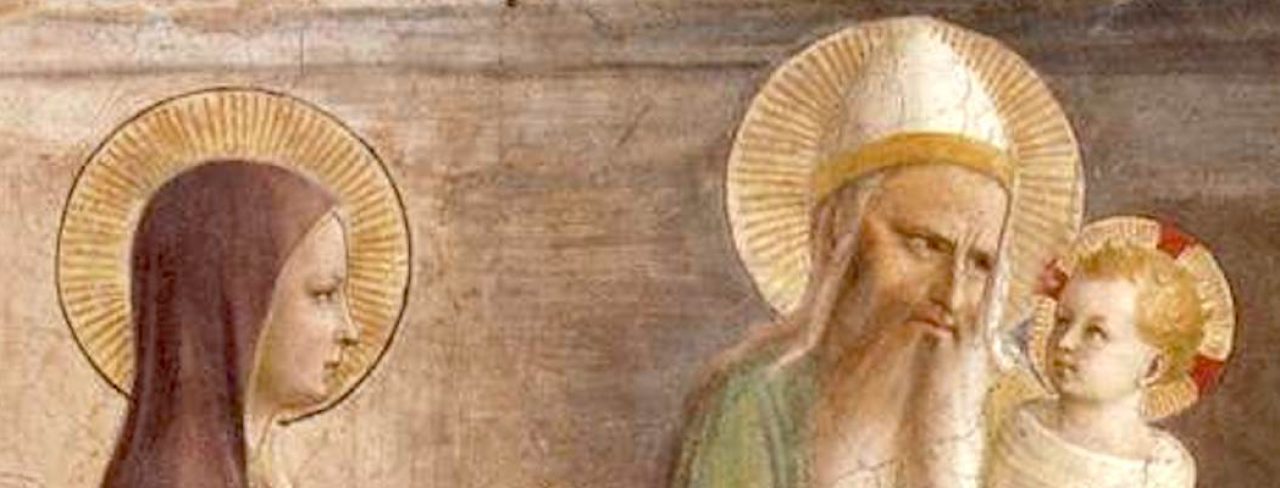
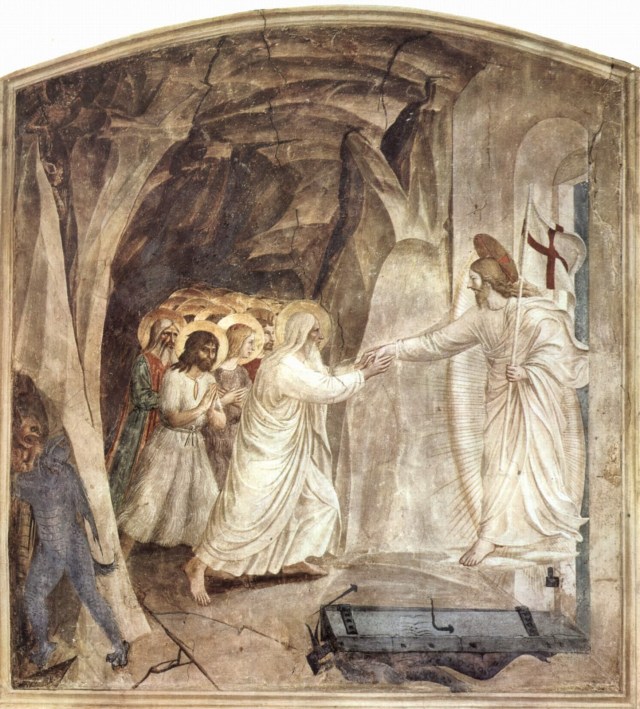
Notes on the painting: This painting by Fra Angelico is found in one of the “cells” (cell 31), that is, one of the rooms that were used by Dominican friars as their personal living quarters in their priory, or what is today called the Museo de San Marco, in Florence, Italy. The painting portrays Jesus Christ, after His resurrection on Easter Sunday morning, entering into that spiritual place where the souls of the righteous deceased were waiting for their expected liberation by the Messiah. Christ’s hand is extended to Adam, Eve is behind him and St. John the Baptist is next to her, followed by all the righteous from past history. Jesus, the Son of God, will now lead them into Heaven, to rejoice forever with the Trinity. The door to this spiritual place has been shattered, catching a demon under its fall. Other demons cower in a corner, totally overcome by the beauty, majesty, and spiritual power of God Himself. Jesus Christ’s image is one of love, mercy, tenderness, and welcoming. He is happy to be there and to be the source of their personal spiritual Redemption and liberation. This Redemption was made possible by Jesus’ bloody sacrifice and death on the Holy Cross which is represented on the standard that He holds.

This painting is a fresco and is approximately 5 feet by 6 feet in size. It is called Christ Storming Hell, and is also known as Christ in Limbo. It was completed between 1437 and 1450.

We pray that  you have a Happy Easter Day and a grace filled Easter Season!

The quotations are taken from volume 2 of the Roman Breviary – The Divine Office, page 524-526, antiphons and closing prayer for Easter Sunday morning.

Copyright © 2011- 2013 Deacon Paul O. Iacono All Rights Reserved

Good Friday

“Come, let us worship Jesus Christ, the Son of God, who redeemed us with His Precious Blood.”

“If we wish to  understand the power of Christ’s blood, we should go back to the ancient account of its prefiguration in Egypt. Sacrifice a lamb without blemish, a one year old male, commanded Moses, and sprinkle its blood on your doors. If we were to ask him what he meant, and how the blood of an irrational beast could possible save men endowed with reason, his answer would be that the saving power lies not in the blood itself, but in the fact that it is a sign of the Lord’s blood. In those days, when the destroying angel saw the blood on the doors he did not dare to enter, so how much less will the devil approach now when he sees, not that figurative blood on the doors, but the true blood on the lips of believers, the doors of the temple of Christ.

If you desire further proof of the power of this blood, remember where it came from, how it ran down from the cross, flowing from the Master’s side. The gospel records that when Christ was dead, but still hung on the cross, a soldier came and pierced his side with a lance and immediately there poured out water and blood. Now the water was a symbol of baptism and the blood, of the holy eucharist. The soldier pierced the Lord’s side, he breached the wall of  the sacred temple, and I have found the treasure and made it my own. So also with the lamb: the Jews sacrificed the victim and I have been saved by it.”

It was about nine in the morning when they nailed Jesus to the cross.

From noon until three o’clock there was darkness over the whole world.

christ_cross

At three o’clock, Jesus cried out in a loud voice: My God, my God, why have you forsaken me?

It is finished.

When we were His enemies, God reconciled us to Himself by the death of His Son Jesus Christ.

An innocent Jesus sacrificed for us, the guilty.

Realize that you were delivered from the futile way of life your fathers handed on to you, not by any diminishable sum of silver or gold, but by Christ’s blood beyond all price: the blood of a spotless, unblemished lamb chosen before the world’s foundation and revealed for your sake in these last days. It is through Him that you are believers in God, the God who raised Him from the dead and gave Him glory. Your faith and hope, then, are centered in God.  (1 Peter 1: 18-21)

“Awake, O Sleeper, and rise from the dead, and Christ will give you light.”

Copyright © 2013 Deacon Paul O. Iacono All Rights Reserved

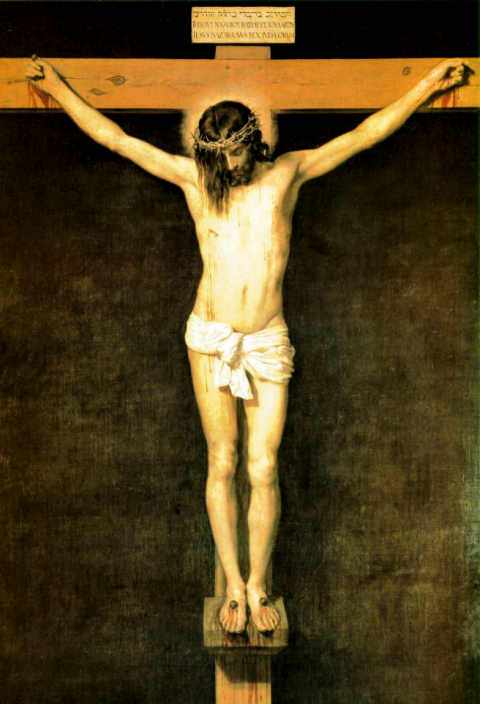
Notes on the painting: Christ’s Crucifixion, is by the Spanish master Diego Velazquez (1599 – 1660); it was completed between 1631 – 32.

All the Scriptural quotations are taken from The New American Bible (1970) Confraternity of Christian Doctrine, Washington, D.C. The “Awake, O sleeper…” verse is taken from an ancient homily from the first centuries of the Church. First quotation is from The Roman Breviary: The Divine Office, volume 2, page 467. The second quotation is from The Catecheses by Saint John Chrysostom (AD 347-407), archbishop of Constantinople, Byzantium (present day Istanbul, Turkey). His Catecheses is also found in volume 2 of the Breviary, pages 473-475.

The Last Supper – Jesus as Servant, Christ as Sacrifice: An Evening Meditation

At the Last Supper, on the night He was betrayed, our Savior entrusted to His Church the memorial of His death and resurrection.
This memorial came to us through the Institution of the Holy Eucharist, a memorial that He intended would be celebrated forever by His Church in the magnificent prayer that is known as the Holy Mass.
Let us adore Him, and say:
Jesus, sanctify Your people, redeemed by Your blood.
Lord, You humbled Yourself by being obedient to the Father’s will, even to accepting death, death on a cross.
Please give all who faithfully serve You the gifts of:
obedience to Your Holy Word found in Your Gospel,
service to our neighbor because they are reflections of You,
and patient endurance in all our troubles and tests.
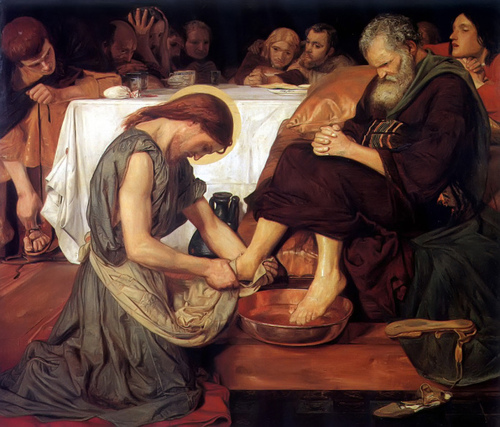
Christ Washing Peter's Feet, Ford Madox Brown

Jesus Washing Peter’s Feet, (1852-56) by Ford Madox Brown (1821 – 1893), Tate Britain, London.

(Meditation based on the Intercessions, Evening Prayer for Holy Thursday, found in the Roman Breviary: The Divine Office, volume 2, page 465. Thanks to the Catholic Artists Society for the posting of Ford Madox Brown’s painting, please visit their site and consider becoming a member: http://catholicartistssociety.posterous.com ).

Copyright © 2011- 2013 Deacon Paul O. Iacono All Rights Reserved


The Meaning of Lent: Repentance and Renewal

The following is a homily that was delivered at St. Francis of Assisi Church and St. Romuald Chapel in Wakefield, Rhode Island USA by Deacon Paul O. Iacono on the weekend of the 5th Sunday of Lent –  March 16/17, 2013.

Last week’s Gospel related the story of the prodigal son; this week the prodigal daughter stands before us.

These two people start with dissent against authority and its commands. Their actions led to life altering, almost near death experiences. They end their self-destructive journey with a conversion that speaks to all repentant sinners of the availability of the astonishing love, mercy, and forgiveness of God.

In last week’s Gospel, the merciful father pardons his prodigal son; today, God’s merciful Son pardons the sinful daughter.

Last week, the oldest son questioned the father’s reasoning; today, the Jewish elders question Jesus’ reasoning, and He responds to this challenge with questions of His own.

Jesus’ first challenge is to the mob: “Let the one among you who is without sin be the first to throw a stone at her.”

This inquisitive command forces even the most proud and dogmatic of them into uncomfortable moments of self-reflection, and to see in that mirror their own sins – which results in their silently walking away.

Then Jesus turns, and looks at the woman – twenty-four hours earlier she was beautiful and appealing. What does He see now?  A woman whose feet were bloodied from running in panic through the streets, clothes torn, hair askew, mind and heart filled with panic at her impending death.

Her defiance of the 6th Commandment was gone; as she was running for her life defiance gave way to abject terror and remorse, and when finally caught, her grief gave way to despair.

In lust’s name, she had betrayed married love – publicly humiliated and publicly condemned – she stood surrounded by the mob – waiting for the first rock to be thrown – staring alternately at Jesus and the ground.

But, Jesus’ second challenge is to the woman herself. His challenge doesn’t wound her, rather, she comes into full contact with Jesus’ Sacred Heart. His words, spoken from His heart – caresses her heart; and as their eyes meet He says:    “Neither do I condemn you. Go, and sin no more.”

Stunned with disbelief she must have stood there for a few moments, staring into Jesus’ eyes, the realization of His forgiveness washing over her – her heart filled with a new sense of hope and an overwhelming awareness of the invitation to live in His love and mercy.

The woman caught in adultery was blinded by her own lust, caught in the web of darkness she was unable to hear and speak to God, yet, what does Jesus do?

Ben1047ChristAndTheWomanInAdultery1659MunichW

He opens her eyes and ears; He gives her interior light; He covers her nakedness with a mantle of love and mercy and renews her ability to live a life that respects the laws of God.

At that moment Jesus blessed the adulterous woman with all the graces that are available to us in the Sacrament of Reconciliation

In the stories of the prodigal son and daughter, we have a new awareness that in our own ways, we too, are prodigals; and relief – relief in the knowledge that when we do Sacramentally repent, and attempt to sin no more, we receive extraordinary graces and the invitation to live in the love of divine mercy.

This is the meaning of Lent my brothers and sisters. For it teaches us that we have no reason to fear Christ – no reason to fear reconciliation with Him – for He freely offers us His Sacramental strength so that we may walk in His freedom, be renewed, and become more like Him.

Like the prodigal son and daughter, let us put aside our sinful ways, and grasp the hand of our merciful God in Sacramental Confession. Let us trust in Him; for Jesus’ love is vast and the waters of His mercy, to those who repent, continually refresh and satisfy our deepest longings to rest in Him.

Copyright © 2011- 2013 Deacon Paul O. Iacono All Rights Reserved. Notes on painting: The above artwork is a preliminary sketch by Rembrandt for his finished painting on Christ and the  Woman Taken in Adultery (1644). I thank art historian Gary Schwartz for providing an image of that sketch at his website: www.garyschwartzarthistorian.nl/. Rembrandt’s finished painting is now displayed at the National Gallery in London, England.  

Beauty – “The Great Legacy” of Pope Benedict XVI

I am interrupting my series on Theophilus the Presbyter and the affect he had on the development Medieval art and technology with this post that just came in from the Catholic News Service/EWTN.

The following article is very important and relevant to our understanding of the significant role that his Holiness Emeritus Benedict XVI had in moving the Church forward while appreciating and applying the beauty of our faith, in all of its component parts, to our holy liturgy, prayer, and devotion to our Eucharistic Lord. This understanding contributes to our appreciation of what it means to be a member of the Latin Rite of the Catholic Church. The complete article appears below:

Beauty in liturgy the ‘great legacy’ of Benedict XVI

By Carl Bunderson

VATICAN CITY, March 1, 2013 (CNA/EWTN News) .  Pope Emeritus Benedict XVI will be remembered in Church history for his work to recover the beauty of traditional liturgy, according to Bishop James D. Conley.

The head of the Lincoln, Neb. Diocese, who has been reading Benedict’s writings on liturgy for decades, said these works “will remain a great contribution to liturgical theology for years to come.”

“His great legacy,” Bishop Conley told CNA Feb. 27, “will be the re-discovery of the beauty of the traditional liturgy.”

Benedict awakened a “new way” of looking at the ordinary form of the Mass – the liturgy which came after the 1960s Second Vatican Council – “with a greater attempt to be more attentive to the rubrics.”

In the former pontiff’s view, Mass should be celebrated with beauty, dignity, and in continuity with the tradition of the Church, Bishop Conley noted.

Benedict’s liturgical legacy also includes his “blessing” of those “who have a great attachment to the old Mass” and who are in union with the Holy See, the bishop said.

In 2007, Pope Benedict released a directive titled “Summorum pontificum,” which in a “watershed moment,” gave every priest permission to say Mass using the 1962, or pre-Vatican II Missal.

“He made it one of his priorities to…introduce the ‘hermeneutic of continuity’, trying to show that the pre-conciliar liturgy of the 1962 Missal is the same liturgy as the Roman Missal of Pope Paul VI,” the bishop explained.

Pope Benedict “allowed the traditions to harmonize…so the cross-pollination could take place; so the very best of the reforms of the post-conciliar liturgy could be enhanced and influenced, by an open, unbiased acceptance of the Mass that preceded it.”

Bishop Conley believes that Pope Benedict has allowed the pre-conciliar liturgy to flourish alongside of the post-conciliar liturgy “in a hope that some of the transcendence, the beauty, the tradition, the Latin” will permeate the new liturgy.

The Pope’s own manner of celebrating Mass, including subtle “symbolic gestures” have “sent a message” and have had “a catechetical value” for both priests and faithful, said Bishop Conley.

These gestures include distributing Communion to the faithful kneeling; beautiful vestments and those which had fallen into disuse; ensuring a cross and candles are on the altar; and celebrating facing the same direction as the faithful, all elements of a “reform of the reform of the liturgy.”

“He even created a new way of looking at the two traditions,” reflected Bishop Conley, “the extraordinary form and the ordinary form.” Pope Benedict coined these terms in “Summorum pontificum,” to refer to pre and post Vatican liturgies respectively.

“They’re two parts of the same form, and of the same Roman rite: that’s what he really wanted to emphasize by that change in language.”

Transcendence and beauty

Pope Benedict has long been “trying to recover that sense of transcendence and beauty of the liturgy,” reflected the bishop.

Part of this effort was his involvement in the translation of the third edition of the Roman Missal. Bishop Conley noted the former Roman pontiff’s concern that the Latin prayers be translated both accurately and “also with a sense of beauty in the language.”

The bishop also noted Pope Benedict’s creation in November of a “Pontifical Academy for Latin.” He sees this as tied to the Pontiff’s desire to increase the use of Latin in the Church’s life, including in her liturgy.

Bishop Conley also noted how Pope Benedict’s vision was shaped by the Liturgical Movement of the early 20th century, an effort that called for a reform of the Church’s worship, led largely by Benedictines.

“He knew the great players of the Liturgical Movement back before the Council,” the bishop said.

One of his major writings on the liturgy was his 2000 work The Spirit of the Liturgy. That publication hearkened back to a book of the same name by Father Romano Guardini, known as one of those “great players.”

In The Spirit of the Liturgy,  Benedict – as a theologian writing before his rise to the papacy – encouraged a “New Liturgical Movement” that would recall the best elements of the first Liturgical Movement.

Benedict’s concern with beauty and liturgy is not one of mere aesthetics, Bishop Conley noted, but flows from a recognition that liturgical prayer is the “source and summit” of the Christian life, as the Second Vatican Council taught.

“A lot of people are talking about the impact that he’s had on the Church, and you certainly have to say that the liturgy is going to be one; primarily because he took such a personal interest in it and he believed that…everything flows from prayer,” said Bishop Conley.

“That’s what he said when he announced his resignation, that he made this decision after deep prayer. And now he’s going to a life of deep meditation and contemplation, and all that centers on the Eucharist, and the liturgical worship of the Church, which he very much has a profound love for.”


A continuing influence

Doctor Horst Buchholz, director of music at the St. Louis archdiocese, told CNA Feb. 25 that Pope Benedict has offered such a wealth of teaching on the liturgy that his influence has yet to come to full fruition.

“There has been no Pope since Pius X, or even before, with such a fervent love for liturgy and Sacred Music like Benedict XVI…We still have to accept, digest, and adapt many of Benedict’s thoughts and directives on liturgy and Sacred Music,” he said.

Buchholz commended Pope Benedict’s example of including the use of the Gradual at his recent Masses in St. Peter’s Basilica. The Gradual is an ancient form of singing the psalm between the readings that may replace the responsorial psalm.

“The Gradual is rarely, rarely ever sung, so that is a very good sign, that people are even aware that there is an option like that,” largely through the example of the Pope’s Masses.

Illustration, not imposition

Jeffrey Tucker, publications director for the Church Music Association of America, agreed that Pope Benedict has led by example in liturgy.

“I knew he would show us the beauty of the Roman rite in a way people hadn’t seen it before, and inspire people through example,” he said to CNA Feb. 20.

Tucker called Pope Benedict a liberal, “in the best sense of that term.” The Roman Pontiff provided “a kind of license” for the pre-conciliar liturgy, he said, and integrated “the reformed Mass into the tradition of the Roman rite more generally.”

“The reforms at St. Peter’s Masses and (papal) liturgy generally have been astonishing, extraordinary, especially from a musical standpoint,” Tucker said.

He pointed particularly to the use of the Introit, the official text from the psalms meant to be sung at the beginning of Mass, at every large Mass said at St. Peter’s recently.

“He’s worked to make the Roman rite more true to itself, which is very encouraging for those of us at the grass roots level, because now we can point to papal liturgies as a useful example of what we’re seeking to accomplish in our own parish lives.”

Tucker praised the fact that while Pope Benedict did make minor changes in liturgical laws, he recognized that “beauty itself, once it’s liberated, compels belief in a sense.” He described the Pope as working not through imposition, but with “inspiration, illustration, example – putting beauty on display and creating a kind of global hunger for solemnity and seriousness, and ritual.

Charles Cole, director of the schola at the London Oratory, told Vatican Radio Feb. 24 that “under the pontificate of Benedict XVI there has been a particular focus on the relationship of the liturgy and music and this remarkable heritage and its grown to ever greater prominence.”

In 2007 Pope Benedict wrote an apostolic exhortation on the Eucharist, “Sacramentum Caritatis,” cementing some of his teachings on the liturgy into the Magisterium.

Writing for The Catholic Herald, Dom Alcuin Reid, a Benedictine monk, said that “his conviction expressed therein, that ‘everything related to the Eucharist should be marked by beauty,’ was reflected in papal liturgies. These became master classes on how to celebrate the modern liturgy in continuity with tradition, where the best of the old and of the new serve to raise our minds and hearts to God.”

Bishop Conley concluded with CNA by remembering the Pope’s constant example of reverence and beauty in celebrating the liturgy.

“When I first came to Rome in 1989 as a priest-student, on Thursday mornings he would celebrate Mass in a chapel of the proto-martyrs inside the Vatican.”

“It would be a Latin Novus Ordo mass, always Novus Ordo, but always celebrated very reverently and with a great sense of transcendence. So not only by his writings, but by the way he celebrated Mass, he was teaching.”