St. Teresa of Avila – On Love

On October 15th we celebrate the Memorial of the great Spanish saint and the first woman declared a “Doctor of the Church” – Teresa of Jesus, also known as Teresa of Avila.

Saint Teresa grew up in the early 1500’s and at the age of 20, entered the Carmelite convent in Avila. She freely admitted that for twenty years she had a very difficult time with prayer and distractions. Compounding the problem was the lifestyle of her fellow nuns. In the 16th century, Spanish convents were very relaxed places since a festive, vain, and worldly attitude was prevalent. The idea of strict discipline, contemplative prayer, and living a life of poverty and service was not a priority.

At the age of forty, Teresa’s life suddenly changed. While she was praying she had a profound religious experience. She fully realized the depth of the sacrifice God’s Son Jesus had made for humanity and vowed to pursue a life of spiritual perfection, centering on poverty and developing the art of mental prayer known as contemplation.

She realized that the Carmelite convent that she was living in was not contributing to her spiritual life; and with characteristic energy, she decided to break away from it. With her friend St. John of the Cross, she founded a reformed Carmelite order for friars and nuns known as the Discalced Carmelites. Her new order met with great hostility both from within the Church hierarchy, the regular Carmelite Order, and from the local parishioners, yet, she didn’t give up on her vision of reformation from within the Church.

What does her witness have to say to us today?
First she teaches us the value of perseverance. Both in prayer and in the vision we have been given by God to do whatever He asks us to do. Getting up, going to work every day, reforming a religious order or providing a home for your loved ones, completing your work for the Church – all of this – no matter how mundane or important, is fulfilling the will of God and is evidence of your love for Him.

Second, her life was a model of charitable patience. St. Teresa of Avila received a great deal of verbal, emotional, and spiritual abuse by fellow Catholics. This woman suffered both from physical and mental pain. The physical pain was caused by numerous ailments, however, her emotional pain was caused by people, fellow Catholics, that should have known better, yet, sadly, were far from practicing the cardinal virtues or willing to see the need for internal reformation.

But most importantly, her experiences give us a wonderful description of the art of contemplation and love of God.  In one of her books she says, “Mental prayer, in my opinion, is nothing other than an intimate sharing between friends – between Jesus and ourselves; it means frequently taking the time to be alone with Jesus whom we know loves us. The important thing is not to think much about saying a lot of words, but to love much, and do those actions which best stirs you to the love of our Lord. [What is this spiritual love?] Love is a desire to please God in everything.”

Saint Teresa of Jesus died in 1582 at the age of 67. She disliked gloom and always attempted to radiate joy, cheerfulness, and good spirits. In spite of her many physical ailments and emotional sufferings she kept her sense of humor and her vision of reformation: of self and of her beloved religious community. Her books are filled with optimism as well as a profound understanding of prayer, human nature, and spiritual warfare. We would be wise in applying to our own restless spirits the advice she gave to her fellow nuns, she said:  “Let nothing trouble you, let nothing make you afraid. All these things pass away. God never changes. Patience obtains everything. God alone is enough.”

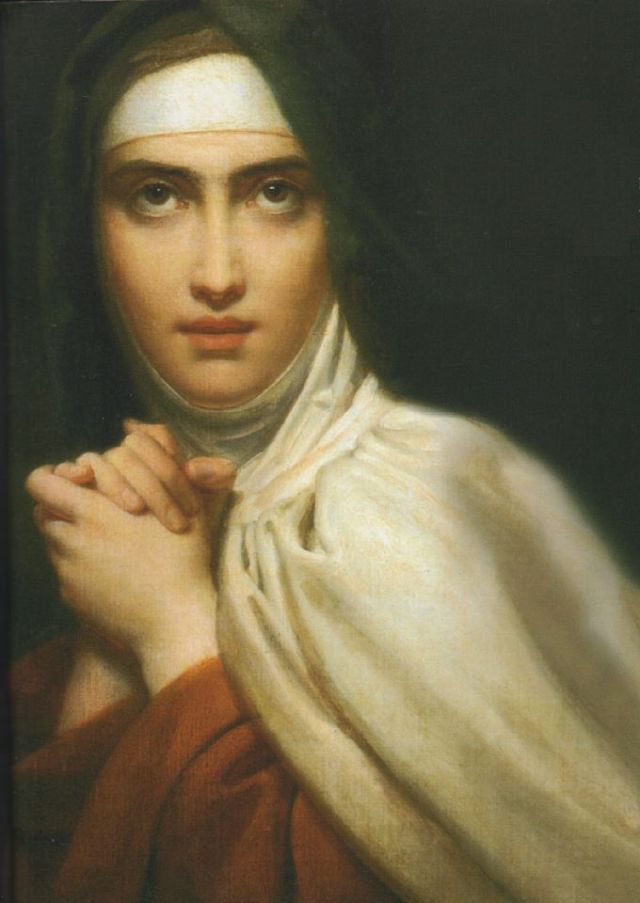
Copyright © 2012 Deacon Paul O. Iacono All Rights Reserved.   Notes on the painting: The above painting is by one of the great painters of the early 19th century – Francois Gerard. Gerard, who died in 1837, painted this masterpiece of St. Teresa of Avila ten years earlier. It was commissioned for a hospital and before its placement was shown in the salons of Paris. It is one of the great masterpieces of French Romanticism. It is painted in oils, on canvas, and measures approximately 3 feet by 5.6 ft.

The Virtues of St. Francis of Assisi – A Model For Sacred Artists, October 4th

(This post is a reprint of my 2012 post on this topic).

In our celebration of the memorial of St. Francis of Assisi we must pause for a moment and examine the virtues that motivated and energized his life.

We can begin by saying that he was a simple man. He pursued simplicity. This does not mean that he was of limited intelligence, or that he pursued simplicity for simplicity sake, rather, it means that he was successful at eliminating everything from his life that did not enhance his understanding and love of Jesus.

In other words, he kept to what was essential in life: “God, the state of our soul, judgment and eternal life.” He realized that “to be simple is to see things with the eyes of God. St. Francis pursued simplicity because he innately knew that God Himself is simple” (from a sermon by Fr. Ronald Knox, 1936).

Other characteristics of Francis’ life are the virtues of faith and love. St. Francis understood that by praying  for faith, by acting faithfully and lovingly, his spiritual muscles would be stressed, making him  grow stronger in faith and love of God. He knew that God’s grace would assist him in this spiritual exercise if he committed himself to it.

Thus we see his extraordinary reaction to his father’s demand for repayment for the fabrics he took, and sold, to benefit the poor. How did he react when accused? He publicly disrobed; a humble nude standing majestically in the town square. Michelangelo should have attempted to sculpt that scene in marble. For what was the scene?

It was the image of the young Francis, not confronting the Goliath of military invasion, rather, the Goliath of a garden serpent who tempted him to return to the sweet life, la dolce vita. It was the image of the grace of a God given vision to live a virtuous life. Its simple grace would be the stone that would bring down the giant of his own ego and worldliness.

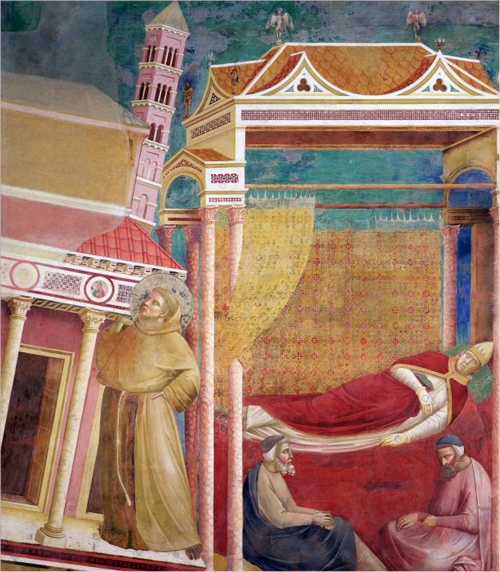
The magnificent Florentine painter, Giotto (1226-1337), born the same year St. Francis died, painted these virtues of St. Francis at work when he portrayed Pope Innocent III’s dream of Francis holding up the pillars of the Church.

It was St. Francis, and his fellow friars that would live in their daily lives the virtues of poverty, chastity, and obedience. These virtues, within the Franciscan perspective, would sweep the imagination of Europe and even gain respect in the Mid East.

How does this apply to an artist? Sacred artists must strive for balance in their spiritual and artistic life. Giotto is a wonderful example for us because he combines the principles of action and contemplation. Like Francis, Giotto was balanced. He achieved simplicity in his portrayal of spiritual truths, and was able to witness  continual dedication to combining action (art) with contemplation (prayer during the creative process).

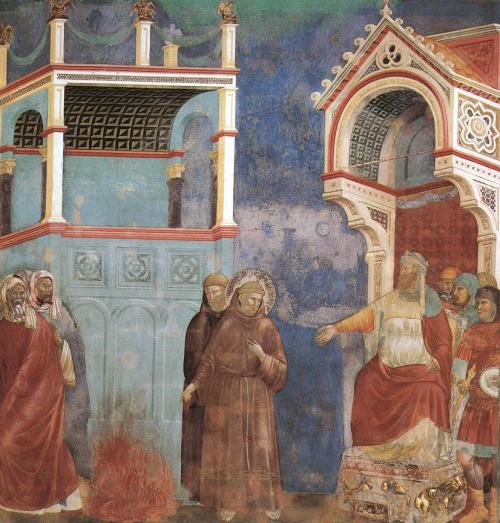
Giotto was a master of painting sacred images that made St. Francis’ life come alive. For example, he captures the spirit of Francis in the Holy Land and brings a favorite story about him to life. In the year 1219 during the Fifth Crusade, Francis traveled to the Holy Land, where he was captured and beaten by the Muslims.

St. Bonaventure tells us in his history of the Franciscan Order that St. Francis was brought before the sultan Al Kamil, and he preached to him about love and the meaning of Jesus’ life. When Francis finished his sermon he then challenged the Sultan’s imams to a religious test to determine which was the true religion – Islam or Catholicism. The painting below, entitled Trial by Fire by Giotto, illustrates the drama of that moment.

“Francis said to the Sultan: “Please have a bonfire lit, and have your imam, along with me, enter the fire – so let it be that his God is the true God whoever emerges from the flames unhurt.”

The Sultan’s eyes lit up – now this is a man of faith!

His imams, however, felt that they had better things to do.

But from that moment on Al Kamil was so impressed with Francis that he gave the Franciscans safe passage to travel and stay unhindered, anywhere, in Muslim occupied territories; and as a direct result of this act, eight hundred years later, if you go to Jerusalem you will see that the Franciscans are still the Catholic Religious Order responsible for the maintenance of the holy shrines.

Theologian Dr. Marcellino D’Ambrosio teaches us that “St. Thomas Aquinas explains that a virtue, like a physical muscle, is a habit – a power or capacity – that gets stronger when its exercised – and atrophies – when it is not.” St. Francis shows us that faith and love, prayer and service are the main muscles in our spiritual body; and for artists they are the virtues that keep our lives balanced. Are we not all artists?

The life of St. Francis of Assisi was, itself, a work of art. For it was one in which the person, Francis, cooperated with the grace of God and allowed himself to be sculpted by the Divine Artist Himself; may we all be as courageous to do the same.

*Readers are welcome to read all my posts on St. Francis, and a relatively new one, entitled St. Francis of Assisi: A Nice Man or a Soldier of Christ? https://fraangelicoinstitute.com/2021/03/04/st-francis-of-assisi-a-nice-man-or-a-soldier-of-christ/

Copyright © 2011- 2021, Deacon Paul O. Iacono – All Rights Reserved. Permission to reprint must be obtained from the author through making comment on this post in its comment section. Students, and those interested, may quote small sections of the article as long as the proper credit and notation is given. Thank you.