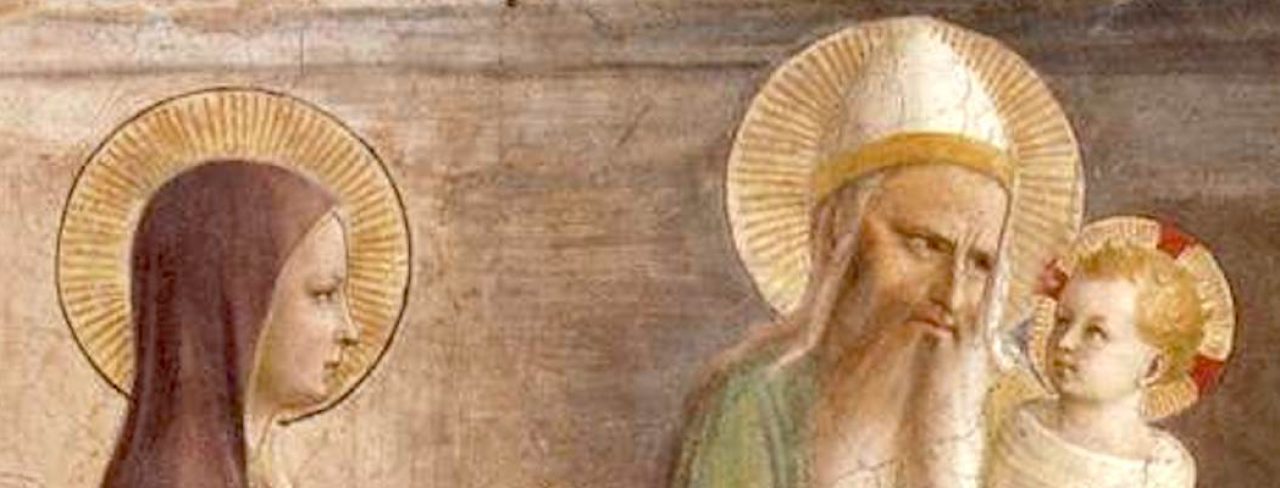
In this series on the Artist As Contemplative it is my hope that you are exposed to some different techniques that may assist you in your prayer relationship with Our Lord.
The last post in this series specifically mentioned that we do not need to use many words during prayer. This may be uncomfortable for us at first since we have developed into a species that appears to constantly need some type of noise, talk, music, or in some cases, cacophony going on inside our mind. I am not a social psychologist so I will not venture a reason for such a trend within American society, other than to say that it may be an attempt to buffer the anxiety that people, especially the young, feel.
We must reduce the amount of noise, superfluous talk, and loud dissonant music that hammers our nervous system. We have to do this in order to allow sacred silence the opportunity to blanket us with its warmth so we can settle into a comfortable conversation with Christ.
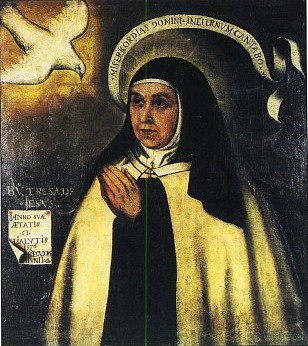
St. Teresa of Avila is very helpful in this regard. Fr. Peter-Thomas Rohrbach, O.C.D. clearly states in his wonderful book Conversation With Christ that the prayer doctrine of St. Teresa is clear: “Prayer does not consist in involved, complicated reasoning, but in thought which is productive of conversation with Christ.” So prayer, productive prayer, is conversation with Jesus.
Fr. Rohrbach then goes on to provide an actual demonstration of true meditation provided by St. Teresa of Avila in her own autobiography.
She says: “We begin to meditate upon a scene of the Passion – let us say upon the binding of the Lord to the columns. The mind sets to work to seek out the reasons, which are to be found for the great afflictions, and distress, which His Majesty must have suffered when He was alone there.
It also meditates on the many other lessons, which, if it is industrious, or well stored with learning, this mystery can teach. This method should be the beginning, the middle, and the end of prayer for us: it is a most excellent and safe road until the Lord leads us to other methods, which are supernatural… it is well to reflect for a time and to think of the pains which He bore there, why He bore them, Who He is that bore them and with what love He suffered them.
But we must not always tire ourselves by going in search of such ideas; we must sometimes remain by His side with our minds hushed in silence. If we can, we should occupy ourselves in looking upon Him Who is looking at us; keep Him company, talk with Him; pray to Him; humble ourselves before Him; have our delight in Him, and remember that He never deserved to be there. Anyone who can do this, though he may be but a beginner in prayer, will derive great benefit from it, for this kind of prayer brings many benefits; at least, so my soul has found.”
The beauty of this approach is that it is completely natural for us to do what she directs in prayer. If we look again at the passages that I have highlighted in bold face you will see that this prayer behavior is the same we would express if we were with a close friend or relative experiencing a troubled or stress filled moment in their life.
So the watchwords here are sensitivity, awareness, and humility. Sensitivity because we need to be willing to listen, and humility in knowing we don’t have all the answers, and the awareness to know that sometimes it is necessary just to keep someone company, and quietly talk to them, without trying to provide solutions.
But it is more than that, isn’t it; because in our prayer we are talking to God. We are talking to the Son of God who suffered for us, because it was the Father’s desire, which He willingly accepts in order to accomplish the salvific act of our Redemption. Our ability to keep ourselves humble before God, delight in His Divine Presence, and remember His Life and Death is critical for a healthy prayer experience.
Our intellect and will working with the faculty of our memory of scenes from Sacred Scripture provide us with the ability to soak ourselves in the meaning of Christ’s great sacrifice. For this is who we are as Catholics, Orthodox, or Protestants – people who bring the images and truth of Scripture and the saints of our traditions into our prayer life.
Does any of this apply to sacred art? Yes, as sacred artists, St. Teresa of Avila would probably say, “Paint and use the best quality and Scripturally correct icons, paintings, sculpture, etc as prayer aids. We need these aids to help the entire person: mind, heart, soul, and body to be focused on Him.”
I’d also venture to suggest that she would say “If you are a sacred artist produce a piece of sacred art that correctly portrays the Scriptural Jesus, the Blessed Mother, His angels, and saints. Remember, a sacred artist must be a person of deep prayer.”
St. John Damascene (Damascus), thirteen hundred years ago, in his writings and teachings very clearly stated that when we do this it is not idol worship. We believe that the Son of God became man; therefore, He became the icon – the image – of God for us to see, hear, touch, scourge, and crucify – “The Word became flesh and dwelt among us.”
This is not idol worship, just as it is not idol worship when you have a picture of your deceased parents on your bureau – you are not making an idol of them – your are not worshipping them – rather, you are remembering them through a celluloid image – an image which helps you relive what they taught and how they loved you – and still do from beyond the grave. So never fear your imagination – or images of the Lord – as long as you guard yourself with images and imagination that are focused with correct theology, semantics, and aesthetics.
I’ll let Father Rohrbach have the last word, he says: “St. Teresa presents us a crystal-clear picture of meditation: the mind furnishing matter for the heart’s talk with Christ. And above all, her fundamental rule that prayer consists not in thought, but in love.”
The above image of St. Teresa of Avila is considered to be the closest likeness to her. It was painted in 1576 when she was 61 years old.
Copyright © 2012 Deacon Paul O. Iacono All Rights Reserved


 The Fra Angelico Institute for Sacred Art
You must be logged in to post a comment.