The Solemnity of the Annunciation – The Confident Sacrifice Of A Pure Heart

Many years ago, Blessed John Paul 2 spoke to the seminarians of Rome on this, the Solemnity of the Annunciation. He began his homily with the phrase: “Fear not!”  Echoing the archangel’s comments to our Blessed Mother he was trying to calm the natural anxiety of those young men as they  prepared for their Gospel ministry in the world. The Pope counseled them that “We must all accept the call. We must listen [to the Holy Spirit],  and use the grace that we have received from God. We must shore up our strength, and say, “Yes” in confidence and certainty to the call that we hear from the whispers of the Holy Spirit.”

Upon hearing the message of the archangel Gabriel, the ultimate decision by Mary that “Let it be done to me according to your word” conclusively and forever changed cosmic and spiritual history. For at the moment she said “Yes” to Gabriel, our salvation and redemption, through the Cross, began.

Let us not forget, however, that Mary’s “Yes” had a tremendous affect on her, too.  It required a great cost from her personally because it resulted in the Crucifixion – it resulted in the sacrifice of her own son Jesus – and – the sacrifice of her own heart.
Blessed John Paul 2 speaks of this when he says:  “Mary in a particular way – unlike any other – experienced mercy, and at the same time, made her participation in the revelation of the Divine Mercy possible with the sacrifice of her own heart.  Such a sacrifice is closely bound up with the Cross of Her Son, at which she was to stand at Calvary… No one has experienced the mystery of the Cross as did the Mother of the Crucified…. Mary is therefore the person who knows the Divine Mercy most deeply. She knows the price; she knows how high it is.”
He goes on to say, “Maybe there is another point: for all people are born at Mary’s Yes.” This must be understood: such a Yes in imitation of Mary creates joy, a new life, a breath, a blessing;” it creates opportunities for us to  sacrifice our own hearts in imitation of her and the Holy Family.

So as we enter the 5th week of Lent let us celebrate this Solemnity by trying our best to live like our Blessed Mother – a person with complete confidence in the Lord. Let us say Yes to God in imitation of Mary and allow the Lord to work wonders in our own lives, as well.
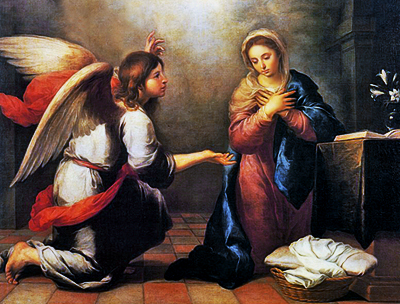
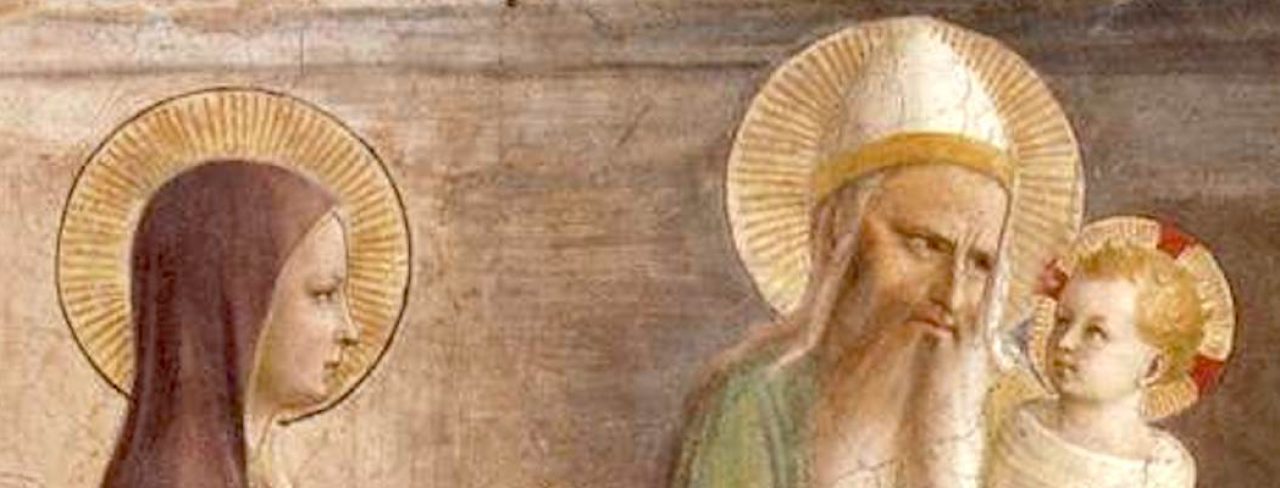
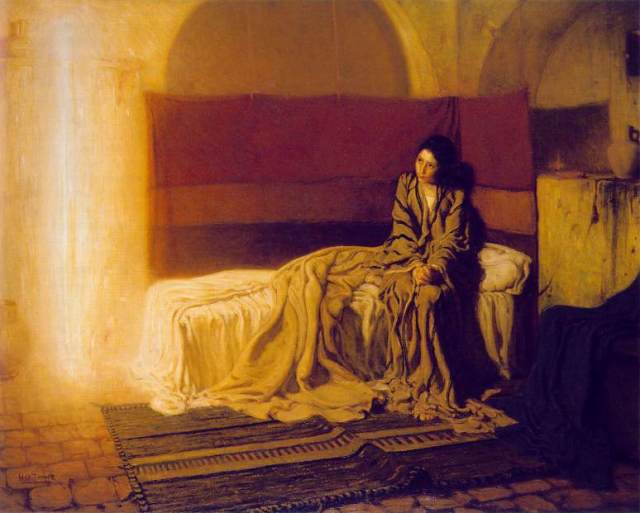
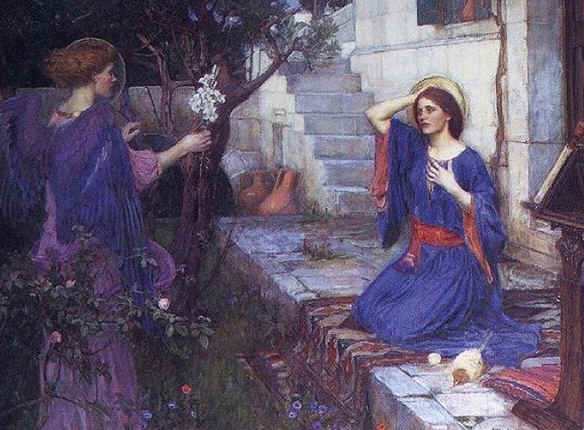
Images in order of appearance: A 13th Century Byzantine icon of the Annunciation from St. Catherine’s Monastery in the Sinai; Henry Ossawa Tanner’s Annunciation (1898); John William Waterhouse’s Annunciation (1914); and Bartolome E. Murillo’s Annunciation completed between 1660 -1665, and please don’t forget to do some research and take a closer look at one of Fra Angelico’s versions of the Annunciation! Please also notice that in Waterhouse’s and Murillo’s renditions both artists have included the tradition that Mary was in the process of sewing the veil that separated the Holy of Holies from the outer room which housed the Altar of Incense in the Temple in Jerusalem; other artists, such as El Greco, do that too.

Copyright © 2012 Deacon Paul O. Iacono All Rights Reserved

The Artist As Contemplative – Part 4 – A Meditation on the Scourging of Christ

In this series on the Artist As Contemplative it is my hope that you are exposed to some different techniques that may assist you in your prayer relationship with Our Lord.

The last post in this series specifically mentioned that we do not need to use many words during prayer. This may be uncomfortable for us at first since we have developed into a species that appears to constantly need some type of noise, talk, music, or in some cases, cacophony going on inside our mind. I am not a social psychologist so I will not venture a reason for such a trend within American society, other than to say that it may be an attempt to buffer the anxiety that people, especially the young, feel.

We must reduce the amount of noise, superfluous talk, and loud dissonant music that hammers our nervous system. We have to do this in order to allow sacred silence the opportunity to blanket us with its warmth so we can settle into a comfortable conversation with Christ.

St. Teresa of Avila is very helpful in this regard. Fr. Peter-Thomas Rohrbach, O.C.D.  clearly states in his wonderful book Conversation With Christ that the prayer doctrine of St. Teresa is clear: “Prayer does not consist in involved, complicated reasoning, but in thought which is productive of conversation with Christ.” So prayer, productive prayer, is conversation with Jesus.

Fr. Rohrbach then goes on to provide an actual demonstration of true meditation provided by St. Teresa of Avila in her own autobiography.

She says: “We begin to meditate upon a scene of the Passion – let us say upon the binding of the Lord to the columns. The mind sets to work to seek out the reasons, which are to be found for the great afflictions, and distress, which His Majesty must have suffered when He was alone there.

It also meditates on the many other lessons, which, if it is industrious, or well stored with learning, this mystery can teach. This method should be the beginning, the middle, and the end of prayer for us: it is a most excellent and safe road until the Lord leads us to other methods, which are supernatural…   it is well to reflect for a time and to think of the pains which He bore there, why He bore them, Who He is that bore them and with what love He suffered them.

But we must not always tire ourselves by going in search of such ideas; we must sometimes remain by His side with our minds hushed in silence. If we can, we should occupy ourselves in looking upon Him Who is looking at us; keep Him company, talk with Him; pray to Him; humble ourselves before Him; have our delight in Him, and remember that He never deserved to be there. Anyone who can do this, though he may be but a beginner in prayer, will derive great benefit from it, for this kind of prayer brings many benefits; at least, so my soul has found.”

The beauty of this approach is that it is completely natural for us to do what she directs in prayer. If we look again at the passages that I have highlighted in bold face you will see that this prayer behavior is the same we would express if we were with a close friend or relative experiencing a troubled or stress filled moment in their life.

So the watchwords here are sensitivity, awareness, and humility. Sensitivity because we need to be willing to listen, and humility in knowing we don’t have all the answers, and the awareness to know that sometimes it is necessary just to keep someone company, and quietly talk to them, without trying to provide solutions.

But it is more than that, isn’t it; because in our prayer we are talking to God. We are talking to the Son of God who suffered for us, because it was the Father’s desire, which He willingly accepts in order to accomplish the salvific act of our Redemption. Our ability to keep ourselves humble before God, delight in His Divine Presence, and remember His Life and Death is critical for a healthy prayer experience.

Our intellect and will working with the faculty of our memory of scenes from Sacred Scripture provide us with the ability to soak ourselves in the meaning of Christ’s great sacrifice. For this is who we are as Catholics, Orthodox, or Protestants – people who bring the images and truth of Scripture and the saints of our traditions into our prayer life.

Does any of this apply to sacred art? Yes, as sacred artists, St. Teresa of Avila would probably say, “Paint and use the best quality and Scripturally correct icons, paintings, sculpture, etc as prayer aids. We need these aids to help the entire person: mind, heart, soul, and body to be focused on Him.”

I’d also venture to suggest that she would say “If you are a sacred artist produce a piece of sacred art that correctly portrays the Scriptural Jesus, the Blessed Mother, His angels, and saints. Remember, a sacred artist must be a person of deep prayer.”

St. John Damascene (Damascus), thirteen hundred years ago, in his writings and teachings very clearly stated that when we do this it is not idol worship. We believe that the Son of God became man; therefore, He became the iconthe image – of God for us to see, hear, touch, scourge, and crucify – “The Word became flesh and dwelt among us.”

This is not idol worship, just as it is not idol worship when you have a picture of your deceased parents on your bureau – you are not making an idol of them – your are not worshipping them – rather, you are remembering them through a celluloid image – an image which helps you relive what they taught and how they loved you – and still do from beyond the grave. So never fear your imagination – or images of the Lord – as long as you guard yourself with images and imagination that are focused with correct theology, semantics, and aesthetics.

I’ll let Father Rohrbach have the last word, he says: “St. Teresa presents us a crystal-clear picture of meditation: the mind furnishing matter for the heart’s talk with Christ. And above all, her fundamental rule that prayer consists not in thought, but in love.”

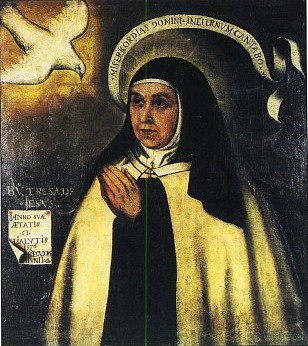
The above image of St. Teresa of Avila is considered to be the closest likeness to her. It was painted in 1576 when she was 61 years old.

Copyright © 2012 Deacon Paul O. Iacono All Rights Reserved
The Feast of St. Joseph – Universal Patron of the Church

At the birth of Christ, the seven hundred year old messianic prophecies of the prophet Isaiah became an historic reality. On a yearly basis, we celebrate and remember that moment on the Feast day of St. Joseph, the patron of the universal Church; for we see in Joseph not only a loyal husband and foster father of Jesus – our Savior – but also a man of conviction and prayer.

Upon hearing that Mary is pregnant Joseph is filled with pain and anger. Understandably, at first, he is not ready to say “yes” to Mary and her story of divine intercession – there are few men that would.  But through divine intervention and the sending of His angel, God makes another request, for the angel relates God’s message: “Joseph, Joseph, do not be afraid to take Mary your wife into your home.”

We call St. Joseph a confident man because – ultimately – he, like Mary, says “Yes” to God. He has confidence because he proclaims his trust in God. With Joseph’s “Yes,” his anger subsides and is replaced with a joyful nurturing spirit that enables him to exert leadership and act as a faith-filled father and loving husband.

Joseph, from that moment, grows in love for his wife and unborn child and through the years, like all fathers, he grows in love and intimacy with Jesus.

An intimacy not only of physical closeness and rapport – but of soul – an intimacy of prayer and meditation that filled his heart and mind with awe; this intimacy and proximity to Jesus meant that he was constantly exposed to the same grace that Jesus gives us in our Eucharistic adoration of Him.

Pope Pius 11th, in his teaching on St. Joseph in March 1928 said, “All Joseph’s sanctity lies precisely in the completely faithful accomplishment of his great and humble mission, so high and so hidden, so splendid and so surrounded with shadows.”

We are truly graced if we realize, like St. Joseph, that we must make ourselves vulnerable to God -– vulnerable to the gifts of God – by exposing our heart, and soul to God’s love – and trusting God – through His Sacramental grace, to turn our hearts, so that we, too, may fulfill the mission – simple or profound – that we are asked to complete in life.

Saint Joseph, pray for us.

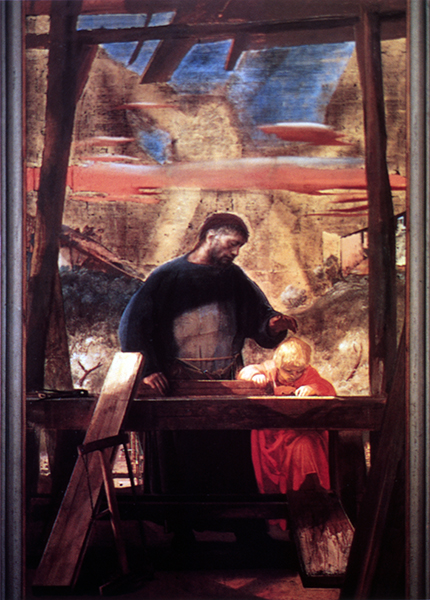
Sacred image of St. Joseph and Jesus by Pietro Annigoni. It hangs in the Church of St. Lawrence in Florence, Italy. It was painted in 1963. Thanks to the website of the Oblates of St. Joseph for the painting by Annigoni.

Copyright © 2012 Deacon Paul O. Iacono All Rights Reserved

The Artist As Contemplative – Part 3 – Prayer Tips

Today, we are asking our good friend, St. Teresa of Avila to help us in the process of thinking clearly about prayer.  She is a worthy mentor – for she cuts to the heart of the matter in a practical and meaningful way.

In her Book of Foundations, she makes many important observations that will help us become more focused on what we are doing in prayer. This focus will in turn help us with our artistic creativity.

A few examples of her perceptive thoughts:

“The first thing I wish to discuss, as far as my limited understanding will allow, is the nature of the essence of perfect prayer. I have come across people who believe that the whole thing consists in thought, [but] if they become distracted and their efforts to think of good things fail, they at once become greatly discouraged and suppose themselves to be lost. It must be recognized that not everyone has by nature an imagination capable of meditating, whereas all souls are capable of love.”

It is my belief, however, that as creative people, artists are very capable of meditation because it involves the imagination. It is crucial, however, that they learn the proper process, and especially for them to remember, if they are a Catholic Christian, that St. Teresa of Avila happily gives sound advice and clear direction to conversation with Christ.

St. Teresa continues, “I am anxious to explain that the soul is not thought, nor will it be controlled by thought – it would be great misfortune if it were. The soul’s profit, then, consists not in thinking much, but in loving much.”

“Do not imagine that I want you to make long meditations on our divine Savior or much reasoning or profound and subtle conceptions. If you cannot do more, [just] keep your eyes fixed for some moments on your adorable Savior [really present in your church’s tabernacle, or, who as Love personified, was nailed to a cross for our Redemption].”

“[Rather than] spending time in prayer profoundly investigating some subject on which they are meditating [you should] place yourself in the presence of Our Lord and converse with Him, heart to heart, without fatiguing the understanding, and tasting the happiness of being in His company.”

The Lord doesn’t need many words from us – less, truly is, more; but He does thirst for our creative and heartfelt love.

As creative people, we necessarily have many things on our “to do” lists. You don’t need me to tell you that 21st century life is exhausting. With that in mind, St. Teresa’s advice is all the more relevant. For we should avoid at all costs making our prayer life another intellectual challenge – another task – that saps the little energy we have left!

She counsels us to meditate using some simple techniques of, at first, opening our mind and heart to the stillness – the quiet – that two friends experience in which they can be in each other’s company and not have to constantly be talking. The subconscious – or conscious – stress of having to keep up the conversation is gone. It is like a husband and a wife, who after many years of marriage, can be in each other’s company, enjoying moments that could stretch on for some time, and yet, not needing to say more than some words of awareness, support, agreement, or recognition.

My next post will provide a meditation by St. Teresa on Our Lord’s Passion.

Copyright © 2012 Deacon Paul O. Iacono All Rights Reserved
The Artist As Contemplative: Part 2: A Simple Step Into Prayer By St. Teresa of Avila

In our last post, The Artist as Contemplative – Part 1: The Proper Approach, we discussed the need to have the proper approach to prayer. One of the assumptions that I have is that if you are reading these posts you are a creative person. You may be an actual working artist, or, you may be attracted to art in one of the various forms it takes and are considering taking the first step in its exploration. Even if you are just beginning to explore a specific art form it is important for you to consider yourself an artist. This is not a fraudulent act. It is the perception of yourself as you truly are as a creation of God – a naturally creative person.

The Lord has made all of us creative beings, and regardless of our job or profession we should make time in our life to develop this creativity and allow it to be expressed. If we have no time for prayer and personal creative growth then we may be in a situation that is truly unhealthy for us. Our Sacred Scriptures tell us that our God is a jealous God – He specifically said that He wants “no other gods before Him” – that is a very sobering thought. So, quiet, prayer time – even if it is only thirty minutes a day – is critical to our spiritual, physical, and creative health.

If we make time for prayer, God’s grace and energy will cascade over into our creative life.  This is very important to artists, regardless of what media or medium we work in, since it demands that we focus our attention on one thing: talking to God in a natural way – talking to Him as we would talk to a close and intimate friend. 

This is difficult for many people. Childhood ignorance or anxieties may still be with us. There may have been bad influences from teachers, members of the clergy and religious life, and others (including, at times, parents) who took a limited view of prayer and taught a specific prayer style to the detriment of other approaches.

By remaining positive we see that a key idea in the prayer process is to remember that when we have a conversation with someone our intellect is remembering ideas and images. We are using those ideas and images in our actual conversation. This allows the conversation to proceed from one point to another and allows ideas or issues to be shared. This is also true in conversation – that is, our prayer – with God. Our intellect, memory, and silent conversation skills within our mind cooperate together to naturally express ourselves to God. Just like the story, in my preceding post, of the little girl receiving her first Holy Communion. She expressed her prayer to God in a natural manner, which made sense and allowed her to share the concerns or ideas with the Lord that were on her mind at that time. Her prayer was a perfect natural prayer.

In examining the teachings and prayer process of St. Teresa of Avila (1515-1585), the Spanish Carmelite, Father Peter Thomas Rohrbach, O.C.D. breaks her basic prayer technique into a simple step formula. He says the goal of prayerful meditation is conversation with Jesus. You achieve  this by engaging your visual memory  with a specific spiritual passage. This con-versation with Jesus about the passage moves to consideration of events within your own life. This process is actual conversation with Jesus in which He, like a good friend, is quietly listening to you.

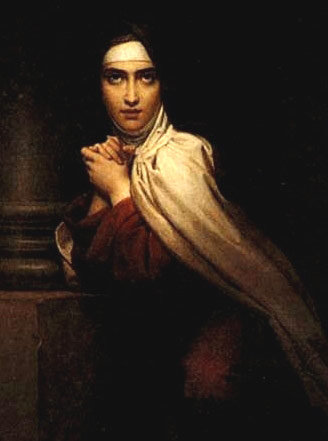
St. Teresa of Avila (seen above in the portrayal by Gérard) is not promoting a prayer life which is filled with complexities, intellectual knots, and unnatural irritations, rather, she is presenting a style which reminds us of a wise old person who has no need of thinking about numerous paragraphs of words to say to God in prayer. The wise one enters their prayer time thinking about God, and specifically His Son, Jesus – the true icon (image) of God. They then allow their love of Him to take over – and fill the blessed silence of that present moment – not with many words – but with much love. You see this is the goal: to move from quiet conversation to quiet meditation – in love – of God’s truth, goodness, and beauty.

In my next post I will provide you with a meditation taught by St. Teresa of Avila. With  this Lenten meditation you should easily exercise your spiritual muscles. Also, it will help you take some time to reflect on St. Teresa of Avila’s approach and application to other moments in Jesus’ life and yours, too.

Copyright © 2012 Deacon Paul O. Iacono All Rights Reserved.  Thanks to avila.com for the image of St. Teresa of Avila by artist François Gérard (1770-1837).