Sacred Artists Must Be Empty Vessels

In this morning’s Gospel St. Luke is clear that Jesus is carefully listening to the argument that breaks out among His disciples as to who is the greatest among them. One translation has St. Luke saying, “He perceives the thoughts in their hearts.” 

It would be prudent to say that we are all psychologically and theologically hardwired to look for approval. King David wrote of this in the Psalms when he said:  “You have made them a little lower than God, and crowned them with honor and glory.”  David recognized the fact that we are something special in the grand scheme of creation, but Jesus has come to set even the wisdom of King David straight. (Psalm 8 verse 5).

He tells His disciples,  “… for he who is the least among you – is the one who is great.” The disciples must have done a double take when He said this, for it went counter to their understanding of reality. But Jesus uses a child to demonstrate this truth; for  children in ancient times were socially at the bottom of the barrel, they had no rights, and basically were – if a family was lucky enough to have them – equivalent to  domestic staff and servants. Children were expected to be seen and not heard – the watchwords for them were humility, listening, and service. An honorable Jewish child of the first century AD would not be bold enough to assert any supposed rights, or demand anything of their parents. There was no self-seeking here, there was no expectation of a mandatory trophy given to raise self-esteem.

Jesus is telling His disciples to see in the child standing next to Him the model for their own behavior. For they, too, should view themselves as servants; as James would say in a later epistle “God opposes the proud, but gives grace to the humble.” (James 4:6).  Jesus explains that we must eliminate from our life everything that blocks our spiritual progress – vanity, self-aggrandizement, power-grabs – and the greatest of all sins – pride. St. Paul tells us very clearly in the 2nd epistle to the Corinthians that the Lord wants us to be empty vessels so that He can fill us up with His love, grace, and power.

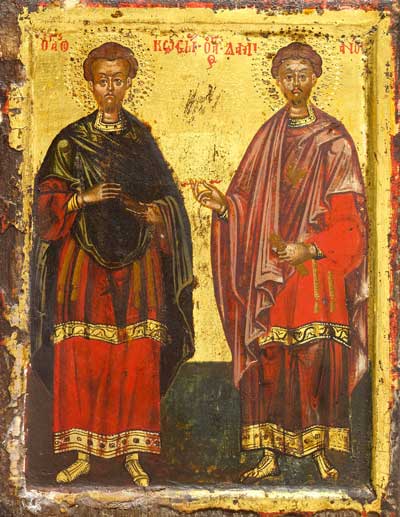
We cannot leave this day without mentioning two men who were “empty vessels” for the Lord. They were early martyrs of the Church – Sts. Cosmas and Damian – excellent models for all of us who aspire to be sacred artists. They met their death at the hands of the Emperor Diocletian in the late 3rd century BC.
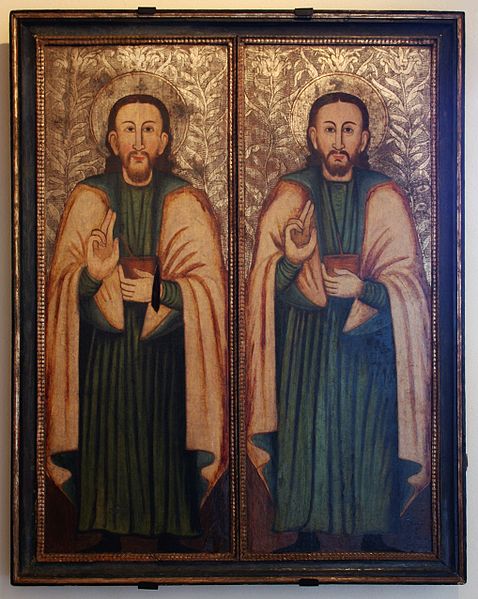
The above two icons are of the twin brothers Saints Cosmas and Damian. The very top icon was done many centuries ago, and the icon right above these lines is a more contemporary interpretation.  Unfortunately I was not able to locate the names of the artists that “wrote” these two beautiful icons.

Sts. Cosmas and Damian are models for us because they were not interested in making a name for themselves (even though because of their medical skills they were known throughout the Eastern Roman Empire). They were not interested in making money in return for their remedies (they were called the “moneyless ones” since they did not accept money for their services).
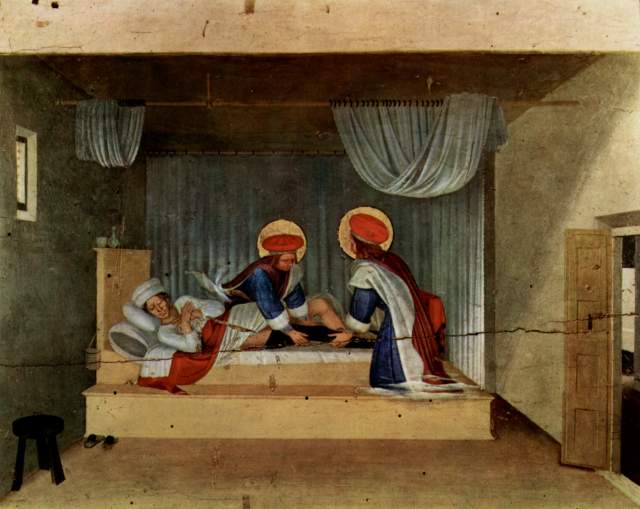
The above image is by Fra Angelico. It is his interpretation of Saints Cosmas and Damian miraculously treating the emperor Justinian after he prayed for their help, three hundred years after their death. The leg was healed, and Justinian attributed it to his prayers for their intercession. The icon shows them practicing their skills, following through and using their knowledge (they studied at the famous medical centers in Arabia). As artists (for we can say “the art of medicine”) they confronted all illness head on and relieved suffering, not by just turning to past remedies, but willingly using their common sense and their ability to adapt remedies to new situations. They were “with-it” as the current parlance would say. Yet, they were novel in their approach since they were practical men who “emptied themselves of self,” had a deep love and faith in Jesus, while at the same time, doing all they could to increase their skills for the benefit of their fellow man.

Thus, they apply to our desire to be sacred artists by showing us that we must make the effort, as St. Paul says, to be empty vessels: to allow our own ego to be overwhelmed by the power of the Lord, to confidently go about the process of learning the art form(s) that we are called to concentrate on, keeping our sense of humor as to the rate of our improvement, steadily practicing the art, and prayerfully putting our trust in Jesus to help us be the best artists we can be.

Sts. Cosmas and Damian were committed Christians, and the early Church regarded them with great honor from the moment of their martyrdom. They truly are a symbol of what our Gospel speaks about this morning – for they made it their duty – especially in the manner of their deaths – to empty themselves – and be filled beyond measure with God’s gifts.

Copyright © 2011 Deacon Paul O. Iacono All Rights Reserved

The Challenge of Sacred Iconography – Part 2: The Byzantine Empire – Justinian and the Church of Holy Wisdom

As we continue our discussion of sacred iconography it is imperative that we take a historical view and look at the major contribution the Byzantine Empire and its civilization made to this sacred art form.

When we speak of the Byzantine Empire we are referring, initially, to the eastern region of the Roman Empire. The Roman civilization was eight hundred years old when it began to feel the pressure of highly motivated foreign tribes that desired to pick away at her borders and plunder her cities. By the fourth century AD the Emperor Constantine moved the capital of the Empire out of Rome, Italy and firmly established it in a new city that he named after himself – Constantinople. He accomplished this by AD 330.

The name Byzantine derives from the Greek colony (Byzantium) that had been established in the 7th century BC in that area of eastern Turkey that borders the Black Sea. It was a successful colony primarily because it had a fabulous harbor – the area known as the “Golden Horn,” and was easily defended. What distinguished the new city of Constantinople from the other major cities of the Roman Empire was the fact that the Emperor Constantine was a convert to Christianity. As a result, the city of Constantinople and the resulting development of the new Byzantine Empire was Christian, as compared to the Roman west, which still had large cultural areas that were dominated by Greek, Roman, Germanic, and Celtic paganism.

The Byzantine Empire lasted for over one thousand years; and within that period of time produced magnificent architectural and portable sacred art. Justinian, the great Roman-Byzantine emperor of the 6th century, heavily promoted the expansion of the Empire (see map) and sacred art – especially in his building the magnificent Church of the Holy Wisdom (Hagia Sophia) in Constantinople. In the map below the green area is the Byzantine Empire prior to Justinian. The purple is the territory that was part of the western Roman Empire, and was retaken from various barbarian tribes as a result of Justinian’s considerable military efforts.

As you can see from the small image at the left – The Church of Holy Wisdom was an extraordinary undertaking even for the renowned Roman and Greek architects and engineers that worked on its construction. Its completion was complicated because Justinian demanded that his architects build high and have a wide cupola – which ultimately led to cracks forming, partial collapse, and major renovations having to take place within the same century that it was built.

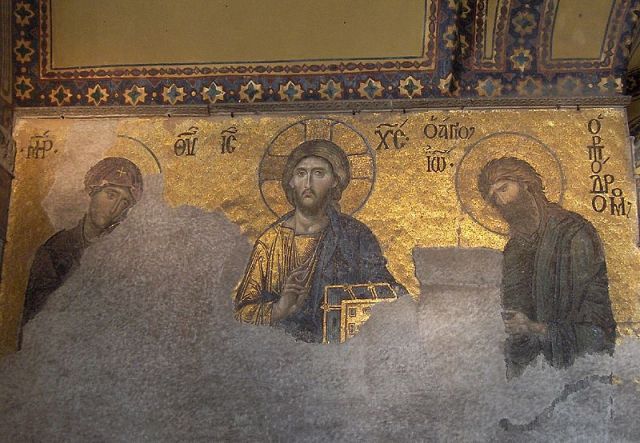
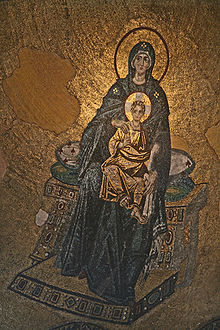
The beautiful and very large mosaics (found below) of Christ, His Mother, and John the Baptist are found within the Church of Holy Wisdom in Constantinople (the first image of Christ is a close-up of the three figure mosaic below it). You will be able to tell from my next post that it had a major impact on the development of the sacred art of the Byzantine Empire.

The large mosaic of the Blessed Mother and the child Jesus dates to the 9th century; and the three figures of Mary, Jesus, and John the Baptist dates from the 13th century. The Church of the Holy Wisdom was the largest church in Catholicism for 1000 years. The Muslims converted it into a mosque after the conquest of Constantinople in 1453. Today, it is a museum, a major tourist attraction, and is considered priceless by the secular Muslim government of Turkey and the entire Christian world.

Copyright © 2011 Deacon Paul O. Iacono All Rights Reserved

The Triumph of the Cross and Our Lady of Sorrows by Jed Gibbons

Today we celebrate the feast of the Exaltation – or Triumph – of the Holy Cross.

The early Catholic Church was intensely persecuted during the first 280 years of its life – so the symbol of the Cross – the symbol of public humiliation and excruciating death – was rarely used in our Christian iconography. But this doesn’t mean that the early Christians were reluctant to express their devotion to the Cross. Writing in the year 204, the Christian theologian Tertullian said: “At every going in and out, when we put on our clothes, when we sit at table, in all the ordinary actions of daily life, we trace upon our forehead the sign [of the Cross].”

In the year 313, the Emperor Constantine signed the Edict of Milan, which proclaimed toleration for the Christian faith within the Roman Empire. Constantine’s mother, Helena, made a pilgrimage to the Holy Land, and with the support of the local bishop – excavated the area known as the site of Golgotha. Tradition states that portions of the true Cross, with a partial nameplate still attached was found, resulting in Constantine ordering that the Church of the Holy Sepulcher be built over the site. The church was dedicated nine years later, with a portion of the Cross placed inside it. So the feast that we celebrate today marks the dedication of the Church of the Holy Sepulcher in the year 335. That Church was unfortunately destroyed by the Muslims in the year 1009, only to be rebuilt centuries later, with the new occupants – all Christians – vying for control of the site! Unfortunately even among our brother Christian Churches there have been numerous clashes and conflicts over the control of this holy site. It is as if all of us – as guardians of the Church’s holiest site – had not internalized the meaning of the true Cross – the meaning of what happened on that site 2000 years ago – the meaning of the Father’s supreme sacrifice of His Son for the sake of His creation. God’s love was raised up on Golgotha that day and Satan’s venom was forever neutralized, but the sting of Satan’s original bite in the Garden of Eden still remains.

The truth of our Scripture readings tell us that Moses lifted up the bronze serpent, a sign of sin, and the people were healed. Jesus makes an analogy of the serpent with the healing power of the Cross – since it is a sign of our sin and our redemption. When the Father, through the Holy Spirit, lifted up Jesus in the resurrection, the Holy Cross was no longer viewed as a sign of evil and sin – rather it became a sign of Christ’s victory and our salvation.

Our Savior, through the instrument of the Holy Cross, shows us the level of His love for His  creation. The Father shows His love for us by giving us the best He has  – His Son – and His Son shows His obedience and trust in the Father – through His willingness to take upon Himself all sin and become a perfect offering back to the Father on our behalf. The Fra Angelico Institute for the Sacred Arts chaplain, Fr. Joseph Upton, gave a beautiful homily today at morning Mass in which he emphasized that every day, we too raise up Jesus on the Cross. In every Mass, we have re-presented the sacrifice of Jesus for us. We commemorate His act and we thank Him for it in His gift of Himself to us in the Eucharist. We unite ourselves to the Triumph of the Cross through the Mass.

As sacred artists, on a daily basis, we must attempt to imitate this profound love of God in our creation of artistic works, and in our families and community. Our love must be strengthened by the truth of our faith – and by the triumph of the Cross; when we do this we will understand that the crosses that we carry, and the sufferings that we endure, unite us to the Lord, and help us transform our lives into His. Our Blessed Mother is our model for this transformation.

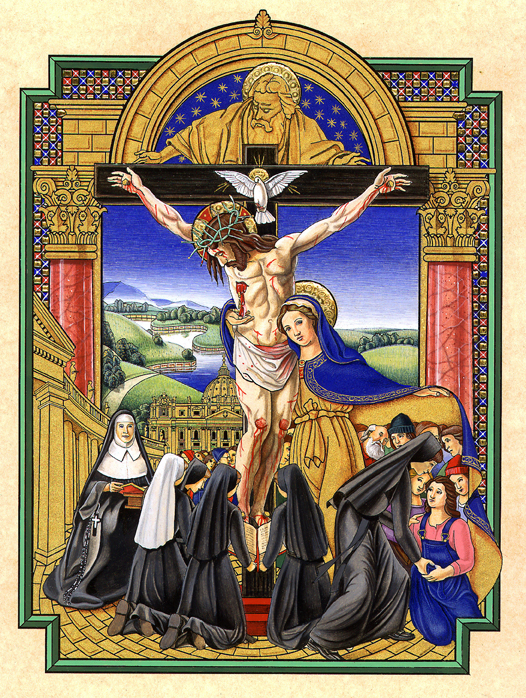
Tomorrow, September 15th, is the memorial of Our Lady of Sorrows. The Invitatory prayer that begins the Office of Readings in the Liturgy of the Hours says, “Let us adore Christ, the Savior of the world, who called his mother to share in his passion.” Those words reminded me of a beautiful illuminated miniature by Jed Gibbons, a very fine artist from Chicago. I met Jed when he was teaching at the St. Michael’s Institute for the Sacred Arts at Enders Island in Mystic, CT. Jed has produced some truly inspirational work (his Stations of the Cross in the chapel on Enders Island are exquisite) and this piece that you see below captures not only the theme of the Triumph of the Cross but the truth of the Church’s teaching that Mary shared in the passion of her  Son. This piece is entitled   Maria, Mater Misericordiae (Mary, Mother of Mercy); it was completed in 2006, and was done in historic earth pigments and 23 karat gold. It measures 6.75 by 9.25 inches. I thank the Foundation for the Sacred Arts website for the image.

Copyright © 2011 Deacon Paul O. Iacono All Rights Reserved. Image copyrighted by Jed Gibbons All Rights Reserved


David Clayton, Needle Arts, Music, and the Creation of Beauty

My wife Jackie and I had the pleasure to meet Mr. David Clayton, artist-in-residence at Thomas More College of Liberal Arts in Merrimack, NH at a lecture he gave this week in New Hampshire. David is a fine artist, teacher, and creator of The Way of Beauty blog and program at the College.

He posted comments on 9/9/11 on the connection and application of artistic traditions within the American experience. His blog was posted on The New Liturgical Movement’s website and is attached here: www.newliturgicalmovement.org.

David has a quality to his artistic perception that needs to be mentioned as valuable for all of us to emulate – and that is – let us examine all that is around us and see the patterns of beauty that are there and draw from them a deep sense of contentment, order, inspiration, and spiritual nourishment.

Natural and artistic life and expression in all its forms may speak to us of the patterns, harmonies, and flavors of reality that express the beauty that was created by God. A sensitive eye and soul is able to distinguish, with a little tutoring, the wheat from the chaff.

God’s palette and palate are perfect – but, even in our artistic weakness and imperfection we must try, in imitation of Him, to replicate what He has laid out for us.

I especially would like the members of the Institute’s Sacred Needle Arts Guild to enjoy the article as a means of inspiration for their own work. Also, Adam Wood’s comment which is at the end of David’s article speaks of applying these ideas to music and he provides a sample of his work, too.

Copyright © 2011 Deacon Paul O. Iacono All Rights Reserved

The Birth of Mary – The Pure Disciple Who Shows Us the Way

We cannot allow this day, September 8th, to slip by without celebrating the nativity of  our Blessed Mother. For as the Invitatory in the Roman Breviary says for today’s feast: “Come, let us celebrate the birth of the Virgin Mary, let us worship her Son, Christ the Lord.”

It is right, and proper, and good that we do this. Inspired by divine Wisdom, the Holy Church of Jesus Christ, has through the years been fractured, tempted, and bruised by the assaults of Satan. Yet, in this feast we remember that we are saved, that Satan, ultimately, has been defeated by the willingness of a young woman to be the Mother of our Savior. It is through the grace filled moment of Mary’s conception and birth that we have the Scriptural road diverge toward final fulfillment of the Divine Will.

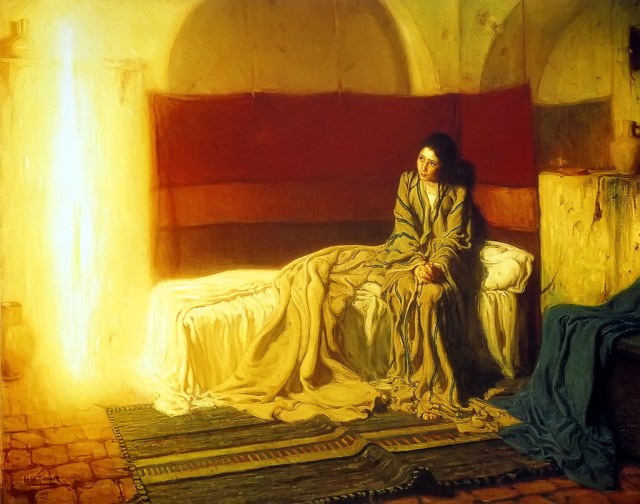
As Saint Luke tells us in chapter 1 of his gospel verses 26 ff., her birth began the dramatic shift in the theological paradigm since it provided the opportunity for her to ultimately see, understand, and say a quiet “Yes” to the truths that Gabriel announced to her. Mary, is the pure disciple, and because of that she “… found favor with God… the Holy Spirit will come upon you and the power of the most high will overshadow you.”  For what end? The end is clear, Gabriel tells her “You shall conceive and bear a son and give him the name of Jesus. Great will be His dignity and he will be called Son of the Most High… hence, the holy offspring to be born will be called the Son of God.”

The sacred image below is by the late 19th century American artist Henry Ossawa Tanner. Of all the sacred art that has been done through the centuries, I believe, this is the best image of that moment of the Annunciation, the moment in which the Old Testament became the New, because it is correct in the manner in which it presents the theological, symbolic (semantic) and artistic truth of that instant in historic time (I thank freechristimages.org/index.htm for the clarity of Tanner’s painting). 

So it is at her birth that we have the road of our spiritual journey fork to the right. Mary’s decisions and actions allowed us to ultimately come to the point in our own life in which we, too, must make a decision. Mary shows us the way (as our Orthodox brothers and sisters would say – hodegetria) to Christ her Son, as she lovingly holds Him in her arms.

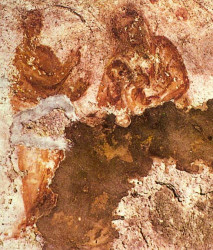
The ancient sacred icon, that you see below, is the earliest image of the Blessed Mother holding the Christ child. It is found in the catacombs of Priscilla, on the Via Saleria in Rome, and is dated to circa AD 225.

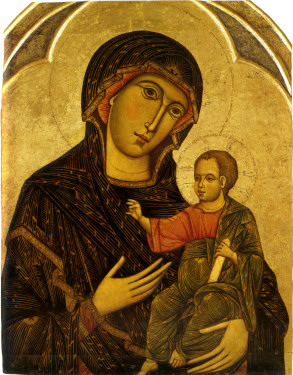
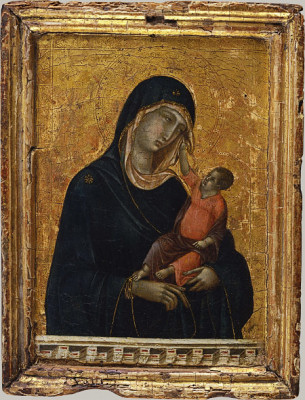
The sacred art of the early Church desired to express the beauty of the Scriptural truth. As you can see from the following two images – the first a Byzantine icon, and the second a painting by the great 13th century master painter – Duccio, from Siena, Italy. Duccio led a school of painters to infuse a strong sense of the humanity of Jesus and Mary into their figures.

These images, and others like them, continue to have an impact on the hearts and minds of those who are open to their Truth. As simple human beings, and as Catholic artists, it is our delight to not only appreciate them, but, to venerate and delight in the Truth that they convey – all of which was made possible by the birth of a humble Hebrew teenager two thousand years ago.

May she continue to show us the way.

Copyright © 2011 Deacon Paul O. Iacono All Rights Reserved

Sacred Iconography and Personal Creativity – Do Not be Afraid!

What is iconography?

The Sacred Iconography Guild is one of the twelve Sacred Arts Guilds that is sponsored by the Fra Angelico Institute. As of this post we have six members of this Guild who have expressed interest in learning this particular artistic tradition of the Church. Unfortunately, many people in the 21st century do not know the traditions of the Western (Latin, that is the Roman and affiliated rites of the Church) or the Eastern (Orthodox, that is the Coptic, Greek, Russian, and other Middle Eastern Rites) of Christ’s Church. All of these Rites have beautiful liturgies, the Sacraments – Holy Mysteries, and traditions – of which sacred iconography is one. This Institute hopes to be one more voice – among many – bringing these traditions to light to a new generation of people. So this post hopes to begin the survey of what sacred iconography is and how we can participate in it.

The word icon is Greek for “image.” Specifically, as it is applied in our usage, it refers to a sacred image that has been painted by a trained iconographer in a way that portrays the sacred presence of Jesus Christ, His mother – “the Theotokos,” His angels, and the saints. Icons in both the Latin Rite and Eastern Rite Churches are venerated – never worshipped. They act as sacred windows or doorways that allow us to view the heavenly realm of divinized humanity or the visual representation of Scriptural truth.

Iconography is simply the study of icons, their development through the centuries (the first iconographer is considered to be St. Luke the Evangelist), the techniques and methods used by various “schools” of iconography within specific cultural regions – and within specific national areas. By “school” I mean a collection of iconographers working under a master iconographer that has a specific style through which they portray Our Lord and the sacred people, mysteries, and historic occurrences within the Church’s history.

Sacred icons portray theological reality. So, it is mandatory that a sacred iconographer follows the “canon” of iconography that developed through the centuries. The “canon” consists of the rules that an iconographer must follow in painting, that is, “writing” an icon. I say “writing” because the tradition states that an iconographer must be aware of the great responsibility that he or she has in conveying the “Scriptural truth” within the image itself. In other words, the iconographer must not change Holy Scripture. He or she paints (“writes”) what is in Holy Scripture, or within Church history and Tradition, because as Pope Benedict 16th has said: sacred images have an important role to play in the “catechesis of the people.” So the iconographer cannot be portraying his or her version of Scripture – or Church history – to do so would be as bad as one of the Evangelists changing the words of the Gospel as he writes or prints a new copy because he desires to be creative or “express” himself.

So this brings up the question of the role that an artist’s personal creativity and skill plays in the development and expression of the written icon. I highly recommend that you go to the websites of my teachers (Peter Pearson; Dimitri Andreyev (Prosopon School); Marek Czarnecki (Seraphic Resorations); and Anna Pokrovskaya Gouriev (Izograph School) to examine their galleries and to see the beauty of their work. Examine an icon of our Lord Jesus or our Blessed Mother by Peter, Dimitri (or his father Vladislav), Marek, Anna (or her mother Xenia) and you will see not only the display of creativity of these iconographers, their skills, their color choices, their simplicity and purity, but also, the truth, goodness, and beauty that is the theological truth of their icons. Their icons are 20th and 21st century pieces of sacred art – yet – they are firmly within the “canon” of the Church’s perception of iconography and serve as models for the expression of Truth, Goodness, and Beauty.

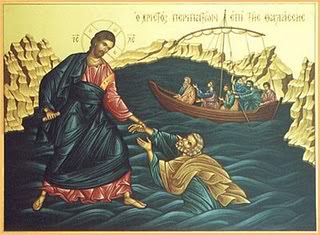
As our Lord said to His disciples in the boat as they were being tossed about by the sea – “It is I. Do not be afraid.” This applies to us, too, as spiritual travelers, artists, and novice iconographers – the Lord is with us – we have nothing to fear because we have put our trust in Him.

Copyright © 2011 Deacon Paul O. Iacono All Rights Reserved