The third Sunday of Advent is celebrated as Gaudete Sunday and it marks the middle of the Advent season. In ecclesiastical Latin, “gaudete” means “rejoice” and is symbolized by the rose-colored candle in the Advent wreath.
This Sunday’s reading from St. Paul may give you a sense of pause. You may say: “You mean I’m to rejoice even if I have just lost my job, or my spouse is very ill, or my husband, wife, or child has abandoned me and wants nothing to do with me?”
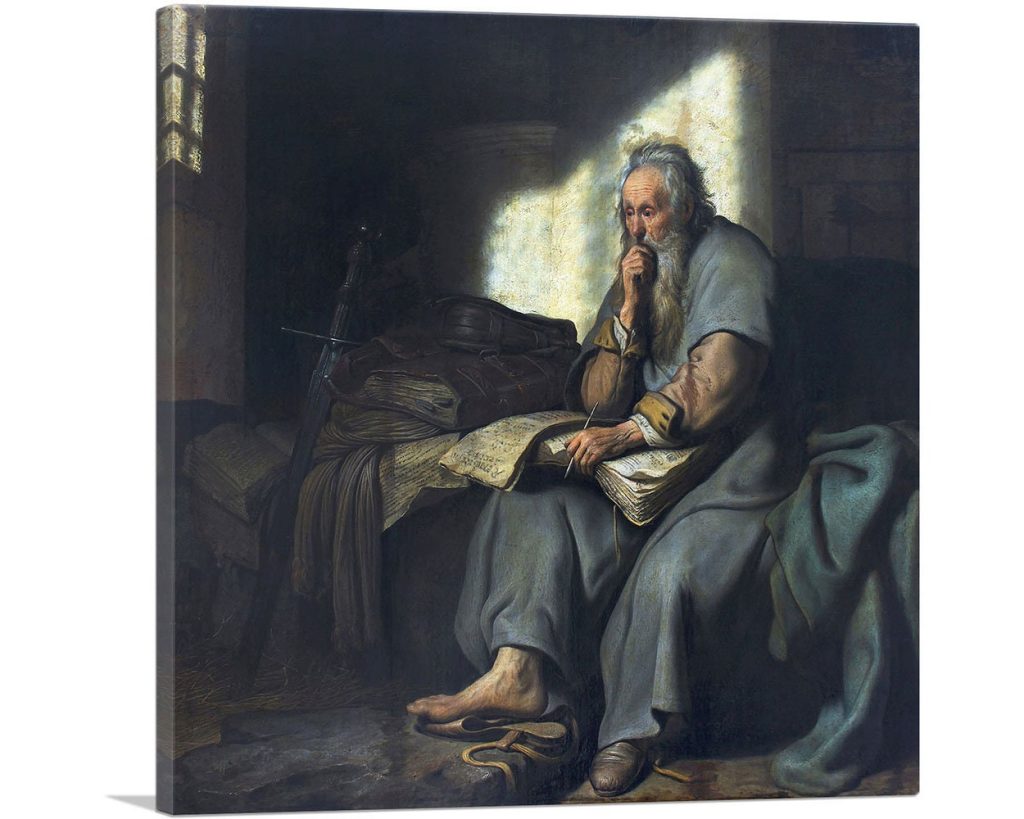
Remarkably, St. Paul’s message is “Yes, give thanks, and rejoice!” That is a hard pill to swallow. Although, let’s be careful. He is not saying for us to put on blinders and happily skip down the yellow brick road. St. Paul had plenty of trials and accusations leveled against him. His epistles to the various churches of Asia Minor, Greece, and Italy are filled with numerous personal problems and tribulations. Chained, beaten, and thrown into prison Paul came face-to-face with trouble, understood its meaning, and in the end, smiled.
“St. Paul in Prison” by Rembrandt, 1627
An example of this is in Paul’s Epistle to the Philippians, (composed between 52 and 62 AD, source: The Jerusalem Bible, chapter 1, verses 1-11, and following),
“1:1) From Paul and Timothy, servants of Christ Jesus, to all the saints in Christ Jesus, together with their presiding elders and deacons.
1:2) We wish you the grace and peace of God our Father and of the Lord Jesus Christ. (1:3) I thank my God whenever I think of you; and (1:4) every time I pray for all of you, I pray with joy, (1:5) remembering how you have helped to spread the Good News from the day you first heard it right up to the present. (1:6) I am quite certain that the One who began this good work in you will see that it is finished when the Day of Christ Jesus comes.
1:7) It is only natural that I should feel like this towards you all, since you have shared the privileges which have been mine: both my chains and my work defending and establishing the Gospel. You have a permanent place in my heart, (1:8) and God knows how much I miss you all, loving you as Christ Jesus loves you.
1:9) My prayer is that your love for each other may increase more and more and never stop improving your knowledge and deepening your perception, (1:10) so that you can always recognize what is best. This will help you to become pure and blameless, and prepare you for the Day of Christ, (1:11) when you will reach the perfect goodness which Jesus Christ produces in us for the glory and praise of God.”
St. Paul links the ability to possess sincere joy with prayer. Our spiritual, and possibly physical survival, depends on our developing a sincere daily prayer life. Regardless of whether it is long or short the heart of all prayer is a conversation with our Lord. This conversation can only occur when we perceive reality as a trusting and knowledgeable child of God rather than that of a secular adult; however, we must “be as wise as serpents but as innocent as doves” (Matthew10: 16).
On Gaudete Sunday we rejoice that our faith and trust in His love will enable us to endure any tribulation; and this gives us the strength to love and serve Him by loving, serving, and praying for one another.
My family and I hope you have a prayerful Advent and a joy-filled Christmas season! May God bless you and your families.
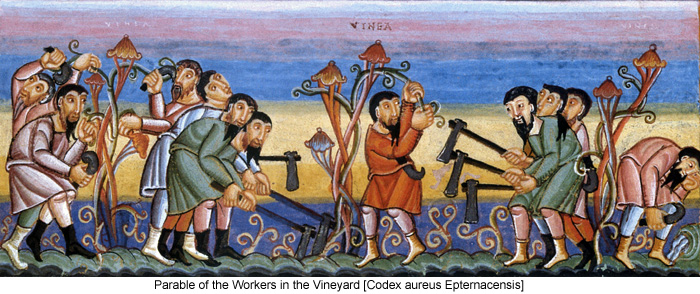
In this Gospel passage from Matthew 20: 1-16, the Lord explains that the last workers called (a veiled reference to the Gentiles) were paid the same as the first (Israel) because they made the effort, even though it was late in the day, to work in His vineyard.
On a personal level this applies to us, too.
God’s call: don’t delay in responding to His invitation.
God’s payment: the abundant generosity of His mercy, forgiveness, and Sacramental grace.
Our response to God: love, praise, and thanksgiving.
Even though we may understand this, there is still the nagging question: “Have I responded to Christ’s call to work in the vineyard of my own soul?”
How fruitful have I been?
How fruitful will I be?
Christ’s efforts on our behalf takes us by surprise; but as the prophet Isaiah reminds us: God’s thoughts are not our thoughts, nor are our ways God’s ways.
Notes on the images: The Parable of the Workers in the Vineyard image is from the Codex Aureus Epternacensis. It is an illuminated book of the Gospels (Latin Vulgate). The Codex Aureus was written/illuminated by monks of the Benedictine Abbey of Echternach (within Luxembourg) circa AD 1040. It is presently located in the National Museum in Nuremberg, Germany. The image below is the portrait of St. Matthew which appears in the pages preceding the Codex’s text of the Gospel of St. Matthew.
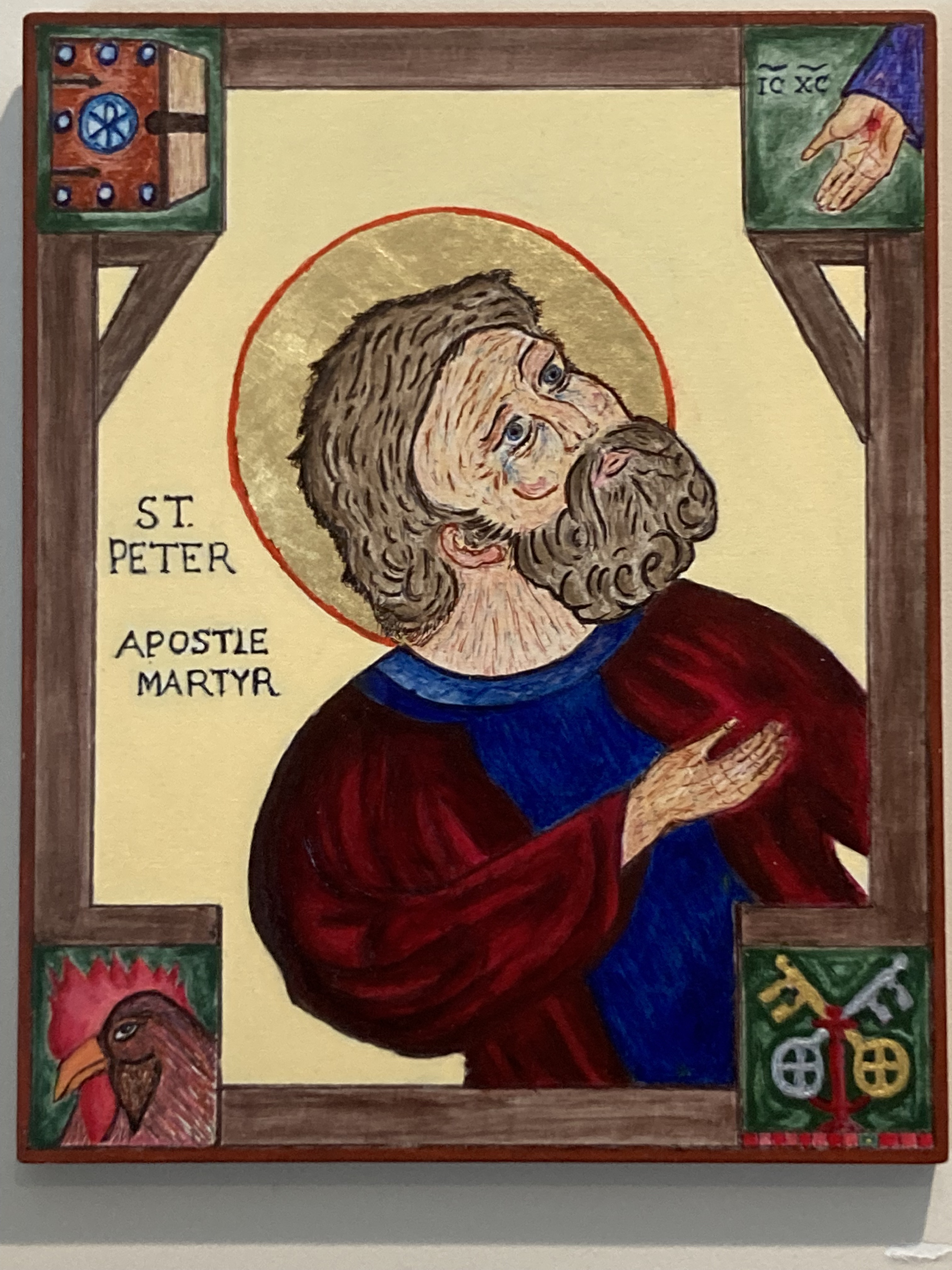
One of my goals in painting the above image of St. Peter was to provide a catechist/observer with seven focus ideas within one image. This sacred image also presents some of the life events of the “Rock” on which Jesus Christ built His Church. I have painted this image with the approach of the Naive/Folk Art genre or “school.” I will discuss the Naive/Folk art approach in my next post. Below are my seven fundamental ideas that can be used as a lesson plan(s) for the above image:
The image is based on Christ’s words and Peter’s actions within the New Testament (have the students look up the verses found within the Gospels and Epistles).
The image itself presents the presence of Peter who is suffering (his posture, body movement, expression, tears, and the extension of his hand). He is requesting Christ’s forgiveness.
Christ is identified by the label IC XC (the Greek abbreviation for the name Jesus Christ). Christ is extending His hand in forgiveness and to raise Peter’s spirit.
The rooster in the bottom left corner is harkening back to its crowing after Peter denies Jesus (Scripturally predicted by Christ). The rooster is also looking at the viewer, reminding us of our personal sins.
Papal authority. Peter is the first pope. He is the first bishop of Rome, the spiritual leader of the Church, and is symbolized by the two keys that are given to him, echoing Christ’s words of “you are Peter (Petros) and on this rock/stone (Petra) I will build my Church.” The keys are painted in gold and silver. Gold represents spiritual authority in union with the Church’s bishops. The silver key represents the papal influence within the world for issues that would affect the good of the Church and people as a whole. The keys are united by a red anchor (symbol of hope and steadfastness – found in the catacombs and the Epistle to the Hebrews). The sufferings of the clergy and laity are built upon the sufferings of Christ and the ministry/martyrdom of the first Apostles (12 squares under the keys; the green square represents St. John who was not martyred). The brown border encapsulating St. Peter reminds us of the cross on which he was martyred as well as the Cross of Christ.
Diagonal lines could be visually drawn through Peter from the upper left corner of the books of the Holy Scriptures to the lower right representing the teaching authority of the pope (Peter’s successors); as well as the upper right of Christ’s hand to the rooster on the lower left reminding us of Peter’s denial and Christ’s forgiveness.
This denial by Peter is not the denial of Judas Iscariot who was also an Apostle. Throughout the Catholic Church’s history we have had both clergy and lay people deny Christ through their words and actions. It all began with the Apostles; however the difference between Peter and Judas is that Peter despaired, pleaded for forgiveness, and was picked up through Christ’s forgiveness. Judas despaired, did not plead for forgiveness, and threw himself down on the end of a rope.
If you find this subject interesting I recommend you read my post on Catechesis and Catholic Art published on June 26, 2021. Thanks.
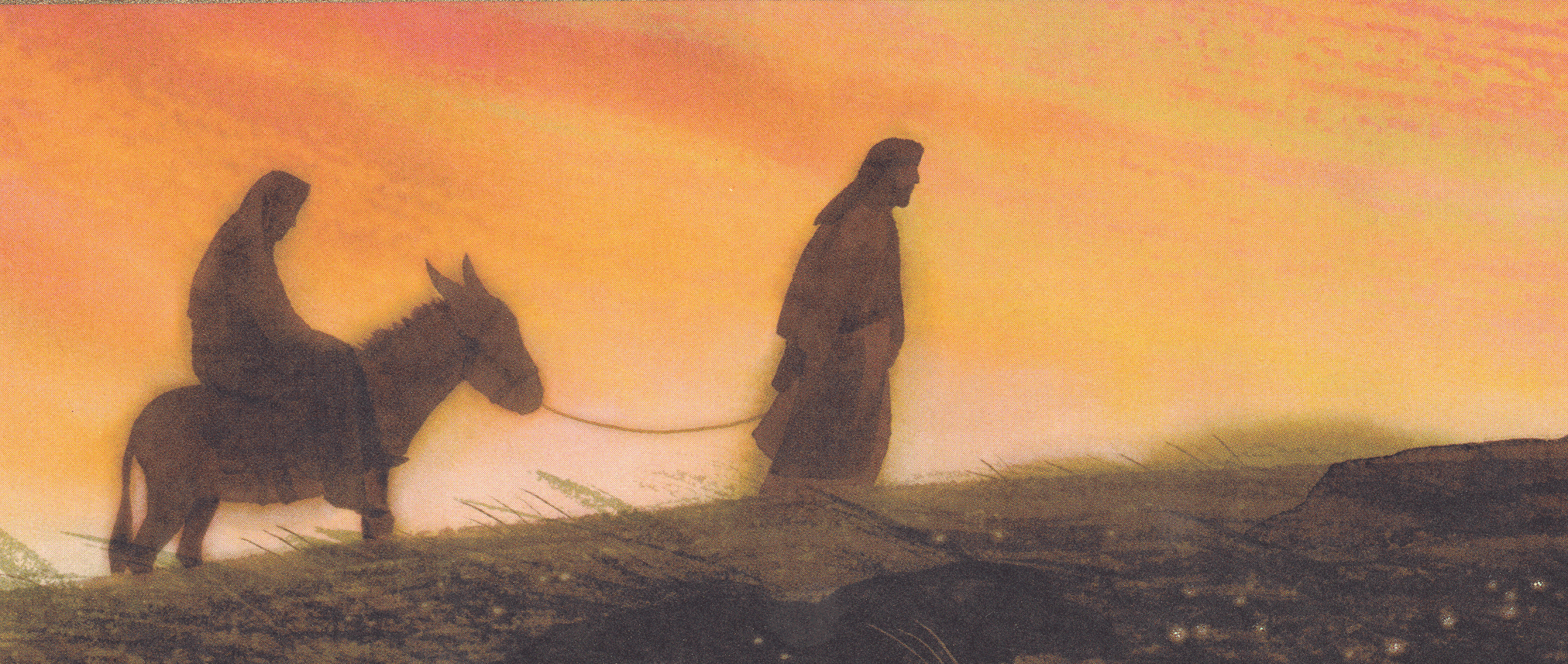
This is a beautiful painting. Yet, I think something is wrong. It’s not the technical expertise, that is very good, or the colors, they are well chosen.
I believe it is St. Joseph himself. He is too far away from Mary.
He would have been much closer to her, to give her comfort and to be quickly aware of any of her needs. He would have been much closer to the donkey’s head, holding the reins softly yet securely in order to prevent any bucks or missteps that the animal might be in mind to give.
The rope shows a distance, a separation, between them. Possibly it indicates the separation that a husband experiences when his wife is in the last days, or hours, before the birth. It is a separation because no husband can understand or experience his wife’s physical pain, her labor, and her extreme maternal joy at the moment of birth.
But, on this night, as they slowly travel toward Bethlehem, they are not separated at all. They are united in their humility, the silent secrets of their own thoughts, and their total obedience and trust in God’s will, and, each other.
May you be united to Jesus, Mary, and Joseph this Christmas Day and throughout the New Year. Glory be to the Father, and the Son, and the Holy Spirit as it was in the beginning, is now, and will be forever. Amen. Alleluia.
Merry Christmas from my home to yours!
** I have not been able to discover the artist of the above painting. If anyone knows who he or she is please comment and I’ll give the proper credit. Thanks
“The artist is Matthew Q. Kesler. He is my brother in law. He works for Hallmark as an artist and this piece is the cover of a book Hallmark released. The book is full of artwork by Matt and depicts the sacred Christmas story. I believe there is a copyright on it as well.”
Sacred art, by its very nature, is catechetical. The purpose of this art was and continues to be a method of instruction. The Catholic Church, in its Latin and Greek Rites, and the twenty-six Catholic Rites that are in union with Rome, have all produced magnificent sacred calligraphy and art; non-Catholic faiths have done this, too.
Two thousand years ago Christians hiding in Rome inscribed images of Christ, the Blessed Mother and with the Christ child, and other Scriptural images on the walls of the catacombs. That art contributed to the catechesis of the early Christians. Two millennia later, Pope St. John Paul II in paragraph 18 of his Apostolic Exhortation, Catachesi tradendae, speaks of this function: it is “an education in the faith… in an organic and systematic way, with a view to initiating the hearers into the fullness of Christian life.”
Sacred art, in tandem with scholarship, edifies and makes beautiful the truth, goodness, and beauty of God. One of my favorite forms of sacred art is that of the Coptic Christian Church (historically based in Alexandria, Egypt). Coptic art is presented in an especially down to earth way. It is beautiful and humble at the same time. It is catechetical and colorful. It possesses a fine palette, yet the viewer does not get caught up in the colors to the detriment of catechesis.
The Coptic faith’s icons are simple, yet, profound. They convey theological truths in a way that can be understood by all age groups and are excellent sources of catechesis.
The first image above is a 7th century Coptic icon. It was discovered at the Monastery of Bawit (Egypt) in the early 20th century by two French archaeologists who brought it, and other Monastery artifacts, back to Paris. Currently located in the Byzantine wing of the Louvre it is unique because it presents Jesus affectionately putting his arm around the Monastery’s abbot – Abbot Mena.
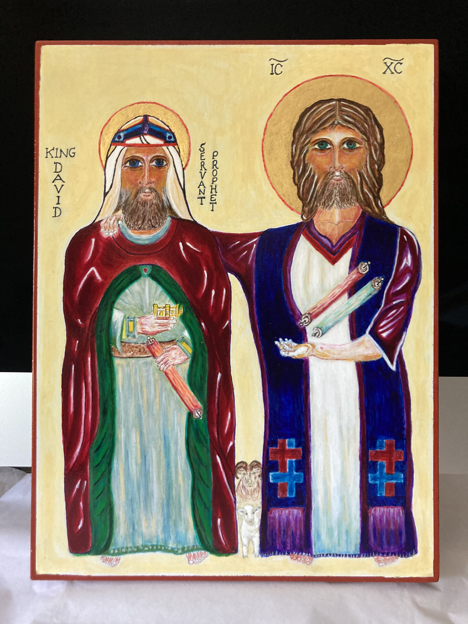
The second sacred image is my original composition. It is painted in archival ink, acrylic paint, and the halos are 23 karat gold leaf. My style slightly follows the Coptic in that it portrays figures that are not intimidating, are easily understandable, and act as a teaching tool for children and adults. It does present additional symbolism which further explains key theological truths of our faith.
Symbolism of the second sacred image:
The IC XC is the Greek abbreviation for Jesus Christ.
The slightly larger than normal eyes represents holiness, spiritual wisdom, and maturity.
Jesus’ white alb (tunic): purity; King David’s light green alb: hope for spiritual growth and friendship with God.
Jesus’ outer garments consist of two parts: robe and stole which are painted in various shades of royal purple. Royal purple indicates kingly authority. The tassels of His stole are multicolored representing the intersection of purity and kingship. Christ’s lower stole’s has an intersecting weave representing Jesus’ blood and water shed for us on the Holy Cross. Liturgically, deacons, priests, and bishops all wear albs, cinctures (belts), stoles, and outer garments (dalmatic or chasuble). These articles of clothing each symbolize different aspects of Jesus’ Passion and ministry.
Elevated above Jesus’ left hand are the scrolls of the Old (Hebrew) and New (Christian) Testaments. The color symbolism for the Hebrew Scriptures’ scroll: green, which represents hope, expectation of the Messiah, and devotion to God. The Christian Scriptures‘ scroll: red, representing Jesus divine and human energy, love, Redemptive sacrifice, and His mercy and justice.
Jesus’ arm is around David’s shoulder. His gesture to David expresses His love, affection, and mercy which are evident and available to everyone. However, the expression that I put on Jesus’ face, especially His eyes, conveys the severe justice that Jesus’ renders to all non repentant sinners. David committed murder and adultery yet ultimately becomes aware of the enormity of his sins. His Psalms were written to plead for mercy, express sorrow for sins, and give praise and thanksgiving to God (see especially: Psalms: 1, 51, 56, 65, and 117). David’s crimson coat symbolizes human life and energy, it is trimmed in dark green symbolizing his hope for mercy.
Circa 1000 BC, David and his armies captured Jerusalem and brought the Ark of the Covenant into the city (1 & 2 Samuel). King David is holding the city of Jerusalem in his right hand; and in his left the book of Psalms. David’s son Solomon built the First Temple to house the Ark of the Covenant (1 & 2 Kings).
Between David and Jesus are a ram and a new born lamb.
The ram refers to the sacrifice by Abram (Abraham) of a ram caught in a thicket in substitution for the sacrifice of his son Isaac (Genesis 22). Jesus and David are members of the same genealogical family, stretching all the way back to Abraham and Isaac and Isaac’s son Jacob.
The newborn lamb represents Jesus Christ, the “lamb of God” (John 1: 29). He was given in sacrifice by the Holy Trinity for the Redemption of mankind from their sins. That Redemptive act by Our Lord and Savior, Jesus the Christ, instituted the New Covenant which was sealed with His, the Lamb of God’s, blood.
The New Covenant does not replace the Old Covenant God made with the Hebrews. The New Covenant of Christ’s sacrifice (as described in the 27 books of the Christian Scriptures) fulfills the Old Covenant promise of a Savior found within the 45 books of the Hebrew Scriptures. The ram and the lamb provide the visible connection between the Hebrew Scriptures (Old Covenant) and Christian Scriptures (New Covenant).
The New Covenant is continued down through the centuries by the un-bloody sacrifice of Holy Mass. Selections from the Hebrew and Christian Scriptures are read. The Gospel is proclaimed prior to the priest representing Christ, in Persona Christi, transubstantiating the host and wine into the Body, Blood, Soul and Divinity of Jesus Christ.
In faith and action Catholics consume His Body and Blood toward the end of Holy Mass. This consumption does not transform Him, as simple food, into ourselves. Rather, we (as repentant sinners) are transformed by Him (through Sanctifying Grace) into Himself. He doesn’t become part of us, rather, we become part of Him. This is an article of faith believed by all Catholic Christians of the Western an Eastern Rites of the Church. The reception of Holy Communion by Catholics is not a “right,” it is a privilege given by Jesus Christ to worthy (repentant and Reconciled) recipients (culminating in our giving eternal thanks and praise to Him in Heaven; see Matthew 26: 29).
Therefore, in this non-intimidating sacred image you have a teaching tool that includes elements of Sacred Scripture and Sacred Tradition. It is simple grist for any informed catechist’s mill.
UPDATE:If you find this subject interesting I recommend you read my post on CatechesisandNaive Sacred Art: St. Peter – A Lesson Plan, published on January 25, 2022. Thanks!








 The Fra Angelico Institute for Sacred Art
“The artist is Matthew Q. Kesler. He is my brother in law. He works for Hallmark as an artist and this piece is the cover of a book Hallmark released. The book is full of artwork by Matt and depicts the sacred Christmas story. I believe there is a copyright on it as well.”
Thanks Heidi!!