Chinese Martyrs and the Beautiful Art of Ken Jan Woo

We remember today, July 9th, the 120 martyrs who died in China between the years 1648 and 1930. Eighty-seven of these were native born Chinese and were children, parents, catechists, and simple laborers ranging in age from nine to seventy-two.

In the early 19th century, St. Augustine Zhao Rong was a Chinese soldier who accompanied French missionary Bishop John Gabriel Taurin Dufresse to his martyrdom in Bejiing.  He was profoundly touched by the Bishop’s courage in the face of great trials, humiliation, and eventual death. As a result, Zhao Rong sought baptism, was given the baptismal name of Augustine, and soon ordained a diocesan priest. He spoke often of Bishop Dufresse’s sense of hope, love of Christ, and confidence.

In 1815 the Chinese government martyred Father Augustine Zhao Rong.

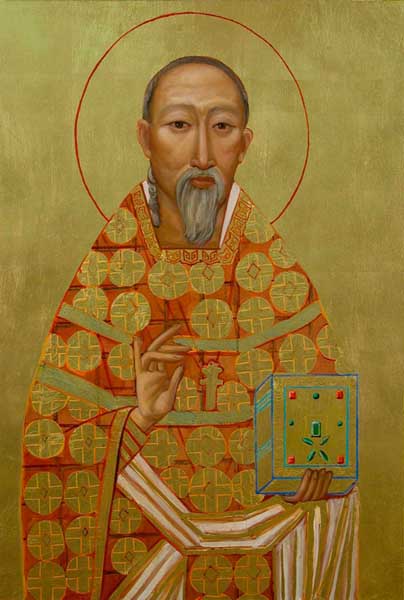
An icon of Father Zhao Rong was completed by the brilliant Chinese artist Ken Jan Woo. Many of his icons and sacred art can be seen at his website http://www.kenwooart.com/index.html. Classically trained, Ken brings a new contemporary spirit to the sacred images of the Church’s past history. His exquisite rendering of this saint, in a typical icon format, is powerful in its simplicity and harmony.
The witness of these Chinese saints, in association with the Gospel passage of Matthew 9: 18-26, begs a question: What sets St. Zhao Rong, his martyred companions, and the people in the Gospel apart from many in our society?

Jesus provided the people with faith-filled hope even when circumstances dictated that their situation was hopeless. Why is this?  It is because Jesus’ love for them, and willingness to share The Truth, was always directed back to His Father. Jesus tells us, “With God, all things are possible to those who believe.”

Jesus’ words were incendiary; for He said to the woman “Take heart, daughter – your faith has made you well.” That phrase “Take heart” ignited the woman’s expectant faith. Her belief allowed her to cooperate with the healing process.

Matthew’s Gospel passage provides witness to the local ruler’s spiritual courage to request Jesus’ help. The girl was already considered dead.  Professional mourners had already been hired to demonstrate the family’s public grief. The mourners and others in the crowd scornfully laughed at Jesus. Their grief was as bogus as their lack of faith. Jesus’ was ready to heal, teach, and be open to the needs of that family. It gave them a glimpse into the mind and heart of God; and it provides us with a model to follow, too.

Let our prayer be the prayer of the martyrs: Lord, you love each of us with a unique and personal love. As we face our troubles with confident hope, touch our souls with your saving power, and restore us to the fullness of your eternal life. Amen

Artwork Copyright © Ken Jan Woo. All Rights Reserved.

Copyright © 2011- 2020, Deacon Paul O. Iacono – All Rights Reserved. Permission to reprint must be obtained from the author in email/writing. Students, and those interested, may quote small sections of the article as long as the proper credit and notation is given. Thank you.

God is a God of Compassion

“God of all compassion, Father of all goodness,

to heal the wounds our sins and selfishness bring upon us

You bid us turn to fasting, prayer, and sharing with our brothers and sisters.

We acknowledge our sinfulness, our guilt is ever before us;

when our weakness causes discouragement,

let your compassion fill us with hope

and lead us through a Lent of repentance to the beauty of Easter joy.

Grant this through Christ our Lord.”*    Amen.


*Roman Breviary – Vol. 2; Third Sunday of Lent, Evening Prayer I, Closing Prayer, pg. 210.

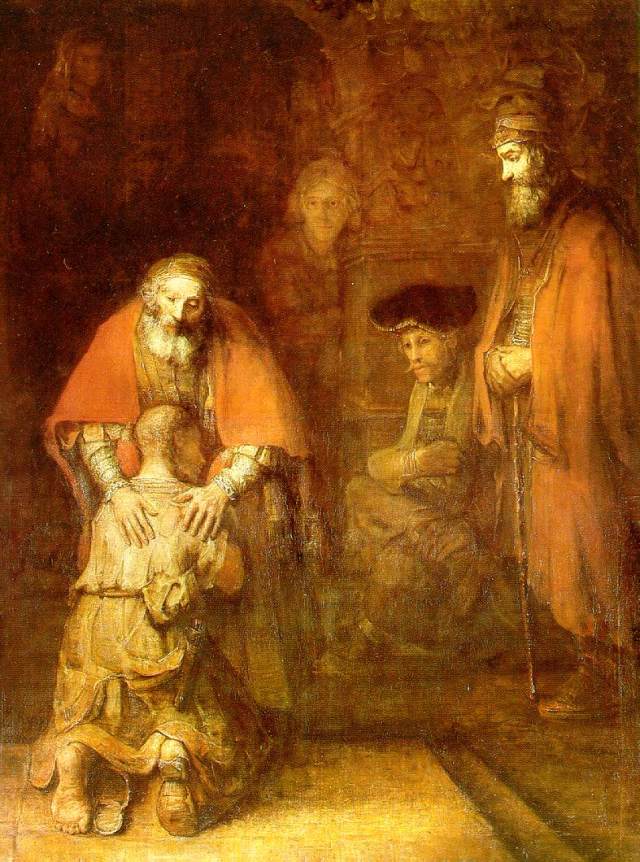
Rembrandt_Harmensz._van_Rijn_-_The_Return_of_the_Prodigal_Son_-_Detail_Father_Son

Rembrandt-The_return_of_the_prodigal_son
Rembrandt van Rijn, The Return of the Prodigal Son, c. 1661–1669.

Ken Jan Woo – sacred artist

Please see my post of July 9, 2020 entitled Chinese Martyrs and the Art of Ken Jan Woo. Thank you.


Our Living Hope: The Tomb Cannot Hold Us

Catholics, Orthodox, and Protestants  – we are all an Easter people. For two thousand years we have – through faith in historical documents and human witness – been invited to believe in a divine act of revelation: the Easter resurrection of our Lord and Savior; for it is in that act that our God shows us who He truly is.

We believe that the resurrection of Jesus is a historical and spiritual fact; and that the resurrection of Jesus not only explains the truth of His promises but it demonstrates what has been promised to us.

On the first Easter morning, Mary Magdalene, Peter, and John saw that the stone had been rolled away from Jesus’ tomb; and as they looked in  – they came face to face with their eternal destiny. Since no stone could have stopped the resurrected Jesus, it was pushed away not to let Jesus out – but to let them – and us – in.

Like Mary, Peter, and John, and all the others, we come to realize that we are an Easter people – which means that we are an eternal people – members, through our holy baptism, of the family of the eternal high God. The tomb could never hold the resurrected Jesus, and – as a people of faith – it cannot hold us.

St. Paul tells us in his epistle to the Hebrews that “faith is the assurance of things hoped for, the conviction of things not seen.” (11: 1)

But what is hope? Hope is trust based on a divine promise. We have hope because we trust the words and deeds of Jesus Christ. We trust in His promises to us.

Our hope interacts with our faith in Him – and we are forever changed because of it. You and I are certain of our faith, because we understand and rejoice in the hope that our God does not lie – our Scriptures do not lie  – our Sacred Tradition does not lie; so as an Easter people we possess the hope that St. Peter speaks of when he says: “…we have been born anew to a living hope through the resurrection of Jesus Christ from the dead.   (1 Peter 1:3).

As we celebrate the Easter season, let us – as our Lord tells us today – “Be not afraid”  – let us be joyful and thankful for the gift of faith and the willingness, in the face of all odds, to share our faith and joy with others.

May God grant you a joyous and creative Easter season!

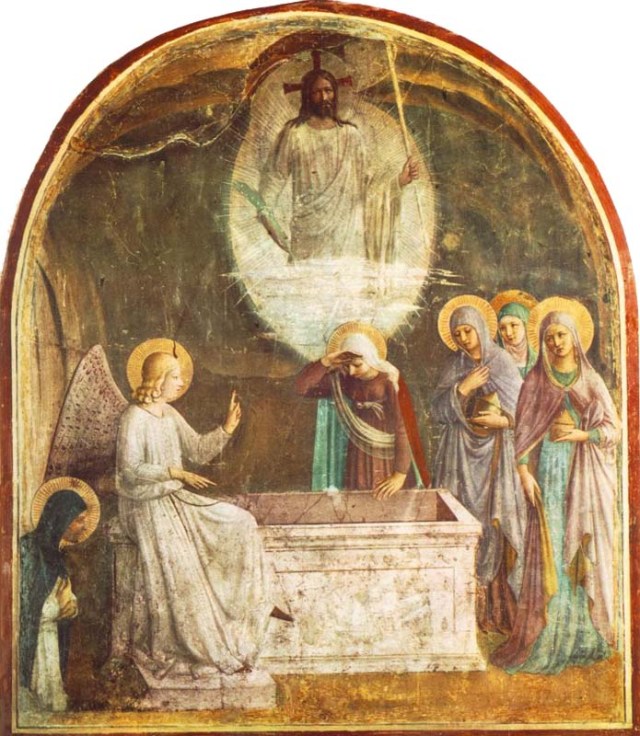
The attached sacred image was painted by Fra Angelico in 1441 and is entitled “The Women at the Tomb.”       Copyright © 2012 Deacon Paul O. Iacono All Rights Reserved