St. Therese of Lisieux and the Christian Way of Beauty

On October 1st we celebrate the memorial to Saint Thérèse of The Holy Face, also known as St. Thérèse of Lisieux and St Thérèse  – The Little Flower. She was born Therese Martin in France in 1873 and died from tuberculosis 24 years later in 1897. When she was fifteen she entered the Carmelite monastery at Lisieux and took the name Thérèse of the Child Jesus and the Holy Face.

She lived a life of simplicity, humility, and trust in God. “Therese never went on missions, never founded a religious order, and never performed great public works. Her only book, published after her death, was a brief edited version of her journal called Story of a Soul,” and in it she dramatically proclaims, “’Love proves itself by deeds, so how am I  to show my love? Great deeds are forbidden me. The only way I can prove my love is by scattering flowers and these flowers are every little sacrifice, every glance and word, and the doing of the least actions for love.’

Her spirituality and her method of achieving holiness is known as “her little way” – her little way – let’s examine for a moment what that means.
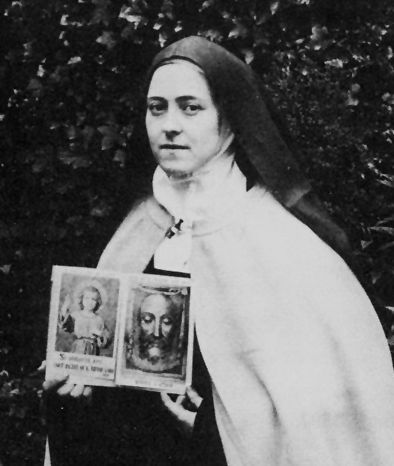
Therese saw herself as a child of God. She liked to keep things simple and focused. Trust, especially trust in God, is a childlike, not a childish  virtue – childlike, because its qualities consist of innocence and being down-to-earth. She believed that life presents many challenges and opportunities for grace. This was a young woman who tolerated great emotional, physical and spiritual suffering, yet, she was able to rise above all of it.

Her “Little Way” coaches us to do the ordinary things of life with extraordinary love. A smile, a note or email of encouragement, a phone call or visit, joining your suffering to the suffering of Jesus and Mary, being positive rather than giving in to the impulse to be grumpy, doing simple unnoticed tasks to help another person – deeds done with the love of, and for Christ, who is within each person – this is the heart of her “little way” – her Christian spirituality.

Saint Therese would say that the smallest action, done with love, is more important than great deeds done out of obedience or self-gratification. She was an average person who saw that our daily life is truly not average or ordinary because it provides us with the opportunity for union with Jesus and His life giving energy and grace.
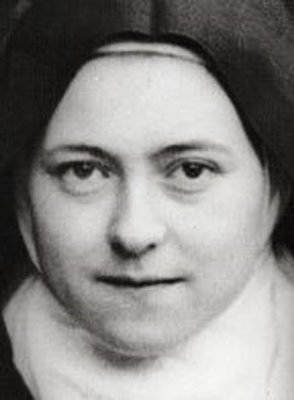
We can also see her greatness in her method of prayer; again, Therese teaches simplicity – talk to the Father, Son, and Holy Spirit in a direct, personal and genuine manner. She tells us, “For me, prayer is a surge of the heart; it is a simple look turned toward heaven, it is a cry of recognition and of love, embracing both trial and joy.”

“She did not like long repetitive prayers; in fact, she was known to fall asleep during community prayer.” What she excelled at was prayer from the heart; she prayed from her heart as a child speaking honestly and trustingly to a parent they love.

We honor Saint Therese today because she was faithful to the Gospel of Jesus and the heart of His message.  So many Catholics are drawn to her because she has shown them that sanctity through simplicity is possible for all of us. She helps us understand that short heartfelt prayers, and simple deeds done with love for both Jesus and neighbor, are a sure path to union with Christ. She truly lived the Christian way of beauty.
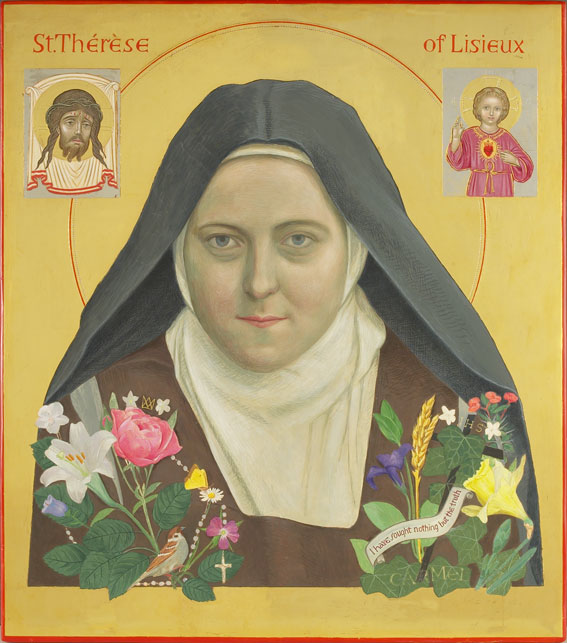
Copyright © 2012 Deacon Paul O. Iacono All Rights Reserved. Special thanks to the website the Society of the Little Flower – http://www.littleflower.org/ for information about St. Theresa’s life; and to the iconographer Guillem Ramos-Poqui who painted this beautiful icon of St. Therese of the Holy Face in 2009. It measures 29″ by 251/2 inches.

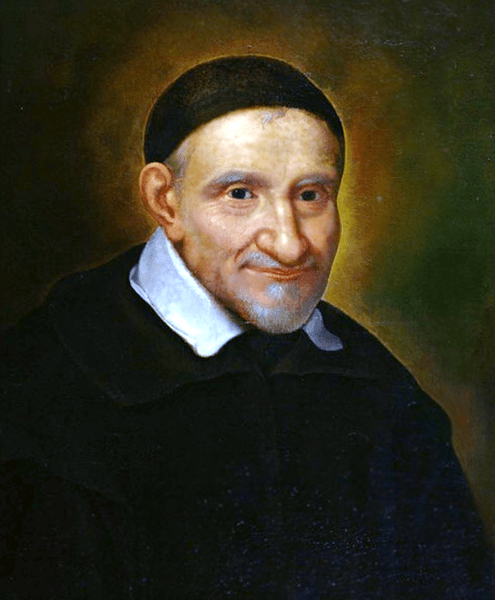
St. Vincent de Paul: Seeing the Poor in the Light of Faith

On September 27th the Roman Catholic Church and the Anglican Communion celebrate the memorial of St. Vincent de Paul.

St. Vincent was born in Gascony, France in 1581. After completing his studies for the priesthood he was ordained in 1600. He had a very interesting early ministry. He served well connected families, including the nobility of France, and on one   trip to Marseilles he was kidnapped by Turkish pirates, sold into slavery, and ended up in the North African city of Tunis. It is said that he converted his owner to the Catholic faith and was then able to escape and return to France.

He returned to Paris and served in a local parish. He founded the Congregation of the Mission which had as its purpose the supervision of the formation of priests and to give support to the poor. With the help and support of St. Louise de Marillac, he also founded the Congregation of the Daughters of Charity. He died in 1660 and was canonized in 1737.

Joyce Carroll Cruz mentions in her book (The Incorruptibles, Tan Books and Publishers, Inc., 1977, pp. 248–9) that St. Vincent’s body was exhumed in 1712, 53 years after his death. The written account of an eye witness states that “…(t)he eyes and nose alone showed some decay.” However, when the body was exhumed again during the canonization in 1737 it was then discovered to have decomposed due to an underground flood. His bones have been encased in a waxen figure which is displayed in a glass reliquary in the chapel of the headquarters of the Vincentian fathers in Paris. His heart is still incorrupt, and is displayed in a reliquary in the chapel of the motherhouse of the Daughters of Charity in Paris.

In April of 2007, my wife and I had the opportunity to visit the church in Paris where St. Vincent’s body reposes. The church was illuminated only by the light coming through the windows. When our eyes adjusted to the dim light and, as we stood at the back of the church, we noticed that there is a staircase leading up to the level, directly above the main altar, where St. Vincent’s body is located. No one else was in the church at the time and we carefully made our way up the staircase to stand directly in front of St. Vincent’s remains. He is dressed in his clerical vestments and there is a wax-like mask on his face. It looks very natural and is not in any way disrespectful or garish in appearance. We felt very comfortable praying with him. There was a palpable feeling of peace that radiated from the glass reliquary.

St. Vincent de Paul gave witness to the truth that the Church remains in existence primarily to provide the means for the sanctification of her members and the world at large. He mentions in one of his writings: “Even though the poor are often rough and unrefined, we must not judge them from external appearances nor from the mental gifts they seem to have received. On the contrary, if you consider the poor in the light of faith, then you will observe that they are taking the place of the Son of God who chose to be poor. Although in His passion He almost lost the appearance of a man and was considered a fool by the Gentiles and a stumbling block by the Jews, He showed them that His mission was to preach to the poor: [as He says in the Gospel] “He [God the Father] sent me to preach the good news to the poor.” We also ought to have this same spirit and imitate Christ’s actions, that is, we must take care of the poor, console them, help them, support their cause.” (taken from the Roman Breviary for today’s Office of Readings)

It is our duty to serve the poor in any way that we can. Some of us are called to directly serve in some type of ministry that is of assistance to them. Others are called to be prayer warriors that will act as a support system for those who work in the various charitable ministries of the Church. Some of us, because of wealth and good fortune, are called to serve the poor by financially supporting charities that directly serve them, that lift them up, not only out of physical poverty but most importantly, spiritual poverty as well.

It is appropriate, and a true witness, that St. Vincent de Paul’s heart has remained totally incorrupt from the passage of time or decay. It is as if Our Lord is telling us, “Look how much St. Vincent loved the poor. Look how much he loved Me!”

On this memorial of St. Vincent de Paul’s death to physical life but rising to eternal life, may we never forget his tri-fold missionary message of sanctification/compassion/action and the importance of  implementing it in our own lives.

Copyright © 2012 Deacon Paul O. Iacono All Rights Reserved

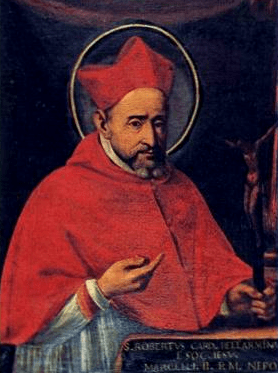
St. Robert Bellarmine, Galileo, and the Glory of God

Today, September 17th, the Church celebrates the memorial of Cardinal Robert Bellarmine. St. Robert was born into a noble Italian family during the crisis filled 16th century – a time of great artistic and scientific achievements and a time of heart breaking dissension within the Catholic Church.

In 1560, St. Robert entered the Society of Jesus, became a teacher, and was ordained ten years later. St. Robert’s Jesuit superiors sent him to the Catholic University in Louvain and there he developed a reputation for scholarship, disputation, and eloquence. When he returned to Rome in 1576, he became a professor of theology and began the systematic dismantling of the Protestant positions on faith and spirituality.

His book Disputations on the Controversies of the Christian Faith criticizing and refuting the Protestant errors was so effective, and caused such a stir throughout Europe, that special faculty positions were established in Protestant colleges in an attempt to refute Bellarmine’s positions.

So why is Saint Robert Bellarmine important for us today?

First, his witness as a scholar and cardinal expresses that the Church must always remain vigilant in its mission to promote the truth and protect its Apostolic and Sacred Tradition. Second, Robert Bellarmine as a Jesuit was loyal to its motto, which is “All for the greater glory of God.” In that motto, you have the structure of a Jesuit’s life, of Saint Bellarmine’s life, for through it he was able to weigh issues in the balance of whether or not they promoted the truth of God’s glory. Allow me to provide a very brief example.

Bellarmine was involved in the early stages of the astronomer Galileo’s difficulties with the Church. In 1615, Cardinal Bellarmine was interested in, and open to, various types of scientific research. He recognized that indeed, the Church’s own astronomers had validated many of Galileo’s scientific observations, and he was certainly knowledgeable of the fact that Cardinal Barberini (the future Pope Urban the 8th) had spoken with Galileo and gave Galileo his personal support.

So what was the problem?

Cardinal Bellarmine said in an open statement that, because Galileo’s scientific theories were not sufficiently supported with solid evidence, then Galileo should follow the position of the Church and call his theories a hypothesis and not scientific fact; and very importantly, he went on to say that, if Galileo’s theories were solidly proven to be true, then care must be taken to interpret Holy Scripture only in accordance with these new scientific truths.

Galileo rebelled against this common sense position. He demanded that his theories be acknowledged as scientific truth and publicly said so. The Holy Office, St. Bellarmine, and the other cardinals had no other choice than to censure him.

They did so not because they completely disagreed with his scientific theories, rather, the censure occurred because Galileo was promoting his ideas as scientific truth when, in reality, he did not have conclusive proof to do so. It should be remembered that St. Bellarmine, in dealing with Galileo, did so “in a sympathetic and not in a heavy handed way.” Bellarmine saw his duty to reason and ethics, and, the decision’s impact on a continent in social and religious turmoil.

Cardinal Bellarmine died in 1621. He was canonized in 1930 and made a Doctor of the Church  a year later.

Galileo had some virtues, however, prudence does not appear to be one of them. As the years went on he continued to do his research; but ultimately got himself into trouble again when he published a book which made his friend, Pope Urban 8th, look like a simpleton.

As a result of this insult, in 1632, he was called to Rome to stand trial for a second time. At that trial the ideas in his new book were examined, and sadly, the case was mishandled on both sides. It was unfortunate that Cardinal Bellarmine was not there to add his reason and judgement. Galileo died ten years later while under house arrest. Many of those years were spent in continued research and writing on various scientific topics.

Cardinal Bellarmine desired to see God glorified, and understood that science, music, art, and architecture were just a few of the ways to do it. He said in one of his essays: “May you consider truly good whatever leads to your goal of the glory of God and your eternal salvation with Him. May you consider truly evil whatever makes you fall away from it.”

Copyright © 2012 Deacon Paul O. Iacono All Rights Reserved

Our Lady of Sorrows – Seven Sorrows – Seven Graces

Today is the memorial of Our Lady of Sorrows.

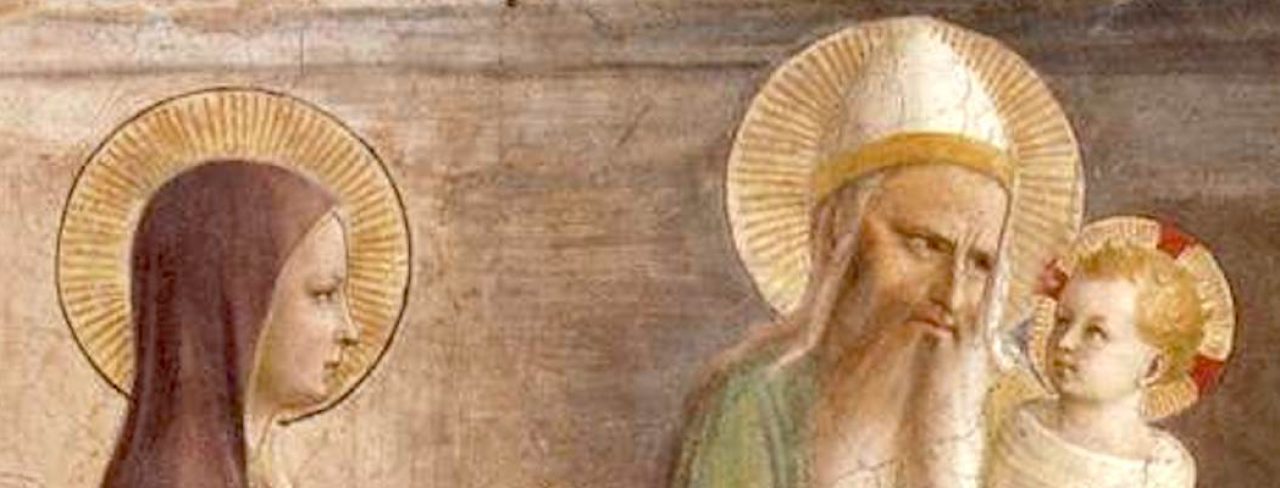
The Roman Breviary tells us that in a sermon by St. Bernard of Clairvaux he explains that “The martyrdom of the Virgin is set forth both in the prophecy of Simeon and in the actual story of our Lord’s passion. The holy old man said of the infant Jesus: He has been established as a sign which will be contradicted. He went on to say to Mary: And your own heart will be pierced by a sword.”

Yesterday, we celebrated the feast of the Exaltation of the Cross. That feast asks us to remember that it was through the Cross, through the violent execution of our Lord, that our redemption took place. The triumph of the Father’s love for His creation, and the Son’s sacrifice, was able to reorder a sin filled world.

As St. Andrew of Crete reminds us “the legal bond of our sin was cancelled and through His death we obtained our freedom and death was trodden underfoot.” Today, the Church in its wisdom again reminds us of the scene of Christ’s victory – and the people that witnessed it.

St. Bernard of Clairvaux eloquently reminds us that along with the death of Christ you have Golgotha being the scene of the martyrdom of Mary. He stresses the phrase, the martyrdom of Mary, because Jesus, as Mary’s child, held a unique and special place in her heart. This is true of the relationship of every mother to their child or children.

All mothers will tell you that every one of their children is special to them; all the more so with Mary, who knew and understood the role that her child was to play in our lives. So when the lance tore through His chest and entered His heart, the prophecy of Simeon, uttered so many years earlier flooded into her mind: “He has been established as a sign which will be contradicted, and your own heart will be pierced by a sword.”

Mary witnessed the execution, she saw the spear tear through her Son’s lifeless body and the violence of that act ripped through her as well. Her body and soul filled with pain and, at that moment, she suffered the martyrdom of every mother who witnesses the death of an innocent child.

At Golgotha, watching the agonizing death of her Son, our blessed Mother, in obedience to the Father’s will for her life, stood by the Cross not only to witness the death of her obedient Son, but to hear her Son say that she was to now be the mother, not only of John, but all of us who believe in Him as Lord and Savior.

Through the sufferings of Mary, the mother of God, we have been made sharers in Christ’s passion. Through Mary’s original obedience to the Father’s will and invitation, we have be given the supreme gift of being able to participate in His Sacramental life, which enables us to share in His rising to everlasting life.

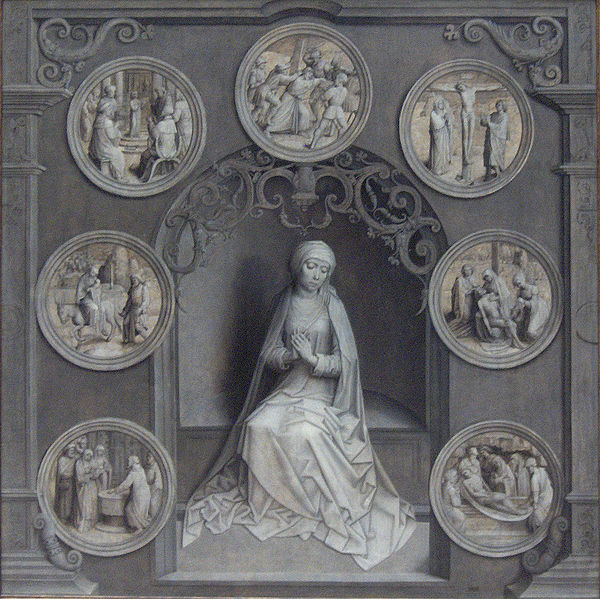
The Church has identified “Seven Sorrows” of Mary: 1) The prophecy of Simeon, 2) The flight into Egypt, 3) The loss of the child Jesus in the Temple, 4) The meeting of Jesus and Mary on the Way of the Cross, 5) The Crucifixion, 6) The taking down of the Body of Jesus from the Cross, 7) The burial of Jesus.

According to the 14th century visions of St. Bridget of Sweden, mystic and patroness of Europe, Our Blessed Mother Mary grants Seven Graces to all souls who honor her on a daily basis by saying seven Hail Mary’s and thinking about the above Seven Sorrows. The Seven Graces are: 1) Mary will grant peace to their families; 2) They will be enlightened about the divine mysteries; 3) They will be comforted in their sickness and assisted in their work; 4) They will be given additional graces as long as what the soul asks for does not violate the will of Jesus or the eventual sanctification of their own soul;  5) Mary will defend the soul in their own particular spiritual battle with the demons, and, will provide her protection to them; 6) The soul will be helped at the time of their death and will experience seeing the face of the Blessed Mother; 7) Mary told St. Bridget that she obtained these graces from Jesus so those souls who are in the state of grace and spread this devotion among their families and friends will be attain Heaven.

St. Paul’s 2nd Letter to Timothy (2: 10-12) directs us to the Scriptural truth of these ideas when he says, “I bear with all this for the sake of those whom God has chosen, in order that they may obtain the salvation to be found in Christ Jesus and with it eternal glory. You can depend on this: If we have died with him we shall also live with him; if we hold out to the end we shall also reign with him.” These words, while not said by Our Blessed Mother, were in reality, lived by her.

our-lady-of-sorrows

Let us pray that through Our Lady of Sorrows, her love and grace shall bring the hearts of all of us to her Son, so that His Heart may reign in the hearts of all mankind.

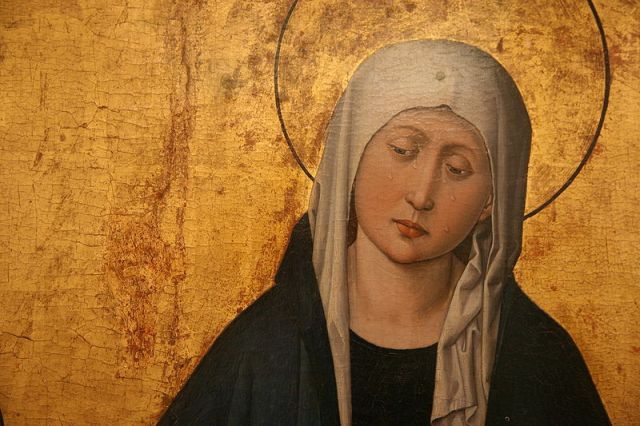
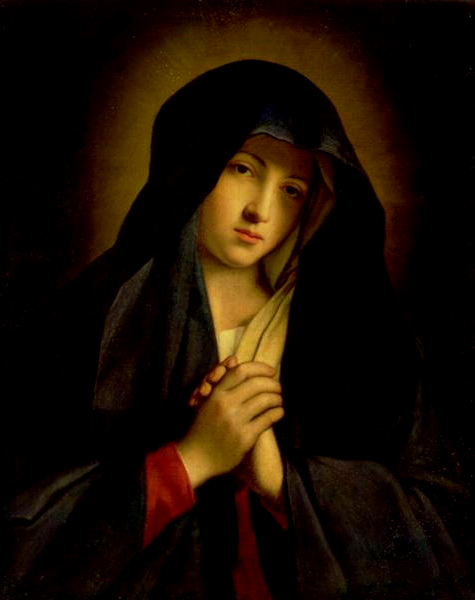
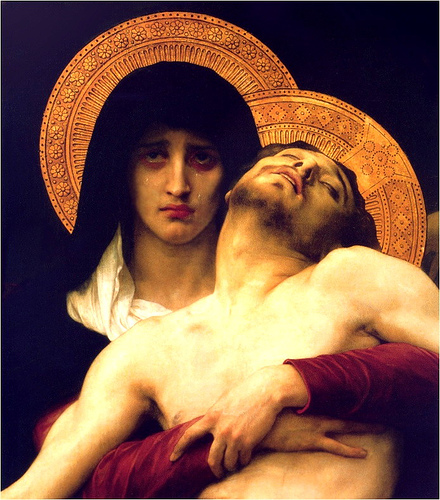
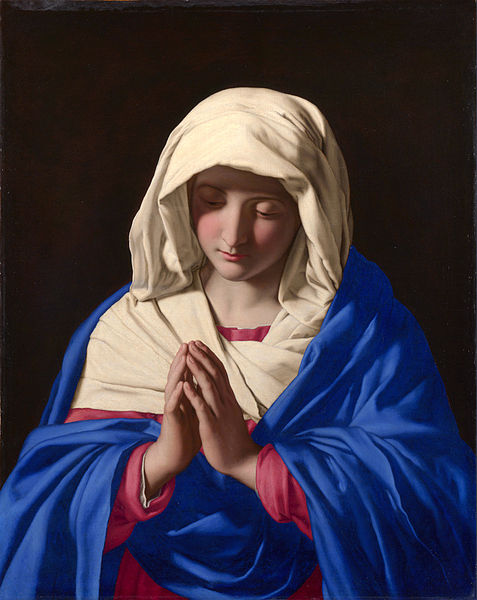
Copyright © 2012 Deacon Paul O. Iacono All Rights Reserved. Notes on the paintings: The first painting is an archetypal Gothic Lady of Sorrows from a triptych by the Master of the Stauffenberg Altarpiece, Alsace, c. 1455. The  second image is of a 15th century sculpture for a cathedral door showing the Seven Sorrows of Our Lady (by Adriaen Isenbrandt, circa 1490 – 1511). The third image, The Madonna in Sorrow, is by the 17th century Italian artist Giovanni Salvi (also known as Sassoferrato). The fourth painting is by William- Adolphe Bougereau, a French realist painter (1825 – 1905).


The Exaltation of the Holy Cross of Jesus

Today we celebrate the feast of the Exaltation of the Holy Cross.

During the first 280 years of its life the Catholic Church was severely persecuted. The symbol of the Cross, the symbol of public humiliation and excruciating death, was rarely used in our Christian iconography. But this doesn’t mean that the early Christians were reluctant to express their devotion to the Cross. Writing in the year 204, the Christian theologian Tertullian said: “At every going in and out, when we put on our clothes, when we sit at table, in all the ordinary actions of daily life, we trace upon the forehead the sign [of the Cross].”

In the year 313, the Emperor Constantine signed the Edict of Milan which proclaimed toleration for the Christian faith within the Roman Empire. Constantine’s mother, Helena, made a pilgrimage to the Holy Land, and with the support of the local bishop, excavated the area known as the site of Golgotha.

Tradition states that portions of the true Cross, with a partial nameplate still attached was found, resulting in Constantine ordering that the Church of the Holy Sepulcher be built over the site. The church was dedicated nine years later, with a portion of the Cross placed inside it.

So the feast that we celebrate today marks the dedication of the Church of the Holy Sepulcher in the year 335. That Church was unfortunately destroyed by the Muslims in the year 1009, only to be rebuilt centuries later, with the new occupants, all Christians from different Rites of the Catholic Church, vying for control of the site.

Unfortunately, even among our brother Christian Churches – Orthodox, Latin, Ethiopian, Coptic, there have been numerous clashes and conflicts over the control of the site. It is as if these guardians of the Church had not internalized the meaning of the true Cross, the meaning of what happened on that site 2000 years ago, the meaning of the supreme sacrifice of God’s love.

Our Holy Scriptures tell us that Moses lifted up the bronze serpent, a sign of sin, and the people were healed. Jesus makes an analogy of the serpent with the healing power of the Cross, since it is a sign of our sin and our redemption.

The meaning of the Cross takes on a new dimension as a result of  the Father, through the power of the Holy Spirit, resurrecting Jesus from the dead. The Resurrection transforms the Holy Cross into a sign of Christ’s victory over sin and the opportunity that we have to personally choose to accept His victory and make it a part of our life.

God, through the instrument of the Holy Cross, shows us the level of His love for His creation. The Father shows His love for us by giving us the best He has, His Son, and His Son shows His obedience and trust in the Father,  through His willingness to become a perfect offering, a pure sacrifice, back to the Father on our behalf.

Let us pray that we, on a daily basis, attempt to imitate this profound love of God. Our love is strengthened by the truth of our faith, and by the historic reality of the Cross. When we do this we will understand that the crosses that we carry, and the sufferings that we endure, unite us to the Lord, and help us transform our lives into His.

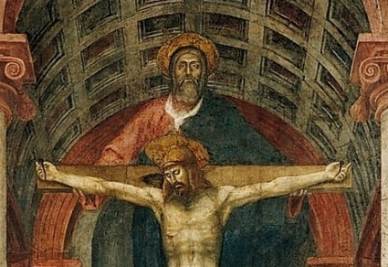
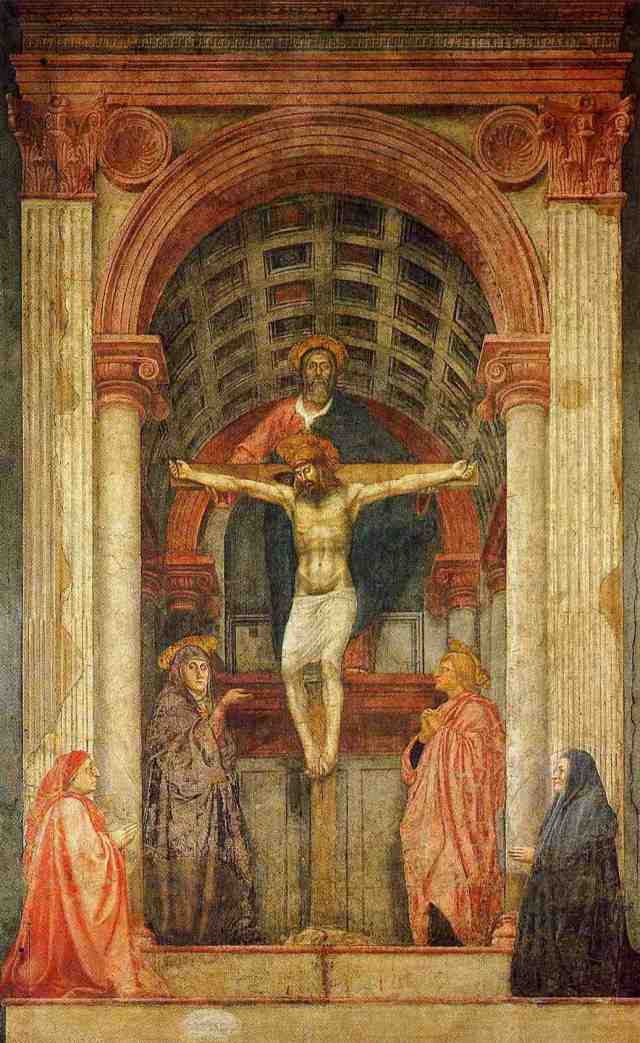
Copyright © 2012 Deacon Paul O. Iacono All Rights Reserved.  Notes on the painting: The above fresco painting and its close-up were completed by the Italian painter Masaccio during the years 1425-27. It is currently located in the church of Santa Maria Novella in Florence, Italy. This is a very important painting in the history of western liturgical art for it combines the images of the Father, Son, and the Holy Spirit (the white dove that appears as a scarf or collar around the Father’s neck). Current research mentions that the brilliant engineer and architect, Philip Brunelleschi, may have been consulted by Masaccio since he had continued the research into the ideas of linear perspective. You can view this sense of linear perspective in this painting in the three dimensional aspect of the vaulting behind the figures. Brunelleschi had continued the studies on linear perspective that were started by the famous painter from Siena, Peter Lorenzetti, in the early 1300’s.

The Most Holy Name of Mary

This is my third post in as many days on Our Blessed Mother Mary. September is an appropriate time to remember the significance of Mary in the life of the Church and, more importantly, in our own lives. For as the Mother of God she is, necessarily, the mother of our own spiritual life. She nurtures us to understand that her Son is always there for us. He does not impose Himself on us and neither does Mary. They desire us to freely choose kinship with them.

Today, September 12th is the memorial of the Most Holy Name of Mary. The name Mary is one of the Greek forms (others being Maria and Mariam) of the Hebrew Miriam (Miryam; and in Aramaic, Maryam). Webster’s Dictionary defines its meaning as “rebellion,” another dictionary refers to the name as meaning  “strong.”

It is interesting to note that Mary’s name contains within it the seed of understanding who and what she means to the Church. God the Father, from all eternity, fashioned Mary in His mind to be His future daughter. The Holy Spirit, at  her immaculate conception, shaped her heart, mind, soul, and body. The incarnate Son of God, Jesus, was in turn shaped by her own womb, and at the end of those nine months, gloriously born to become the Redeemer of Man.

Our Catholic Catechism speaks of this when it says, “Mary, the all-holy ever-Virgin Mother of God, is the masterwork of the mission of the Son and the Spirit in the fullness of time. For the first time in the plan of salvation and because his Spirit had prepared her, the Father found the dwelling place where his Son and his Spirit could dwell among men. In this sense the Church’s Tradition has often read the most beautiful texts on wisdom in relation to Mary (confer Proverbs 8: 1-9: 6; Sirach 24). Mary is acclaimed and represented in the liturgy as the Seat of Wisdom. In her the “wonders of God” that the Spirit was to fulfill in Christ and the Church began to be manifested.” (confer paragraphs 721 – 722ff in the Catechism of the Catholic Church).

Are these ideas prefigured in her name?

If we are to use the terms “rebellion” and “strong” as the meaning for the name Mary then we may ask “Rebellion against what? Strong for what ends?”

The Church’s Tradition, from the earliest centuries, teaches that Mary was to was to be the faith-filled instrument that God would use to enable the Son of God to enter into the world of men, as man and God. She was the instrument of faith, humility and obedience that would model the skills that we personally need in order to rebel against the forces of this world, the forces of Satan, himself. Her name, along with the victory won for us by her Son, is the rallying cry for all who desire to see the forces of Satan destroyed. Her name – Mary – sustains us in our own fight, our own rebellion, against the serpent and his wily attempts to seduce us, too.

Satan’s victory at the Tree in the Garden was short-lived. St. Irenaeus, bishop of Lyon in the second century, speaks of this when he says, “The Lord came visibly to his own domain and was sustained by his own creation which he himself sustains in being. By his obedience upon a tree he reversed the disobedience shown because of another tree. The seduction to which the betrothed virgin Eve had miserably fallen victim was remedied by the truth happily announced by the angel to Mary, another betrothed virgin. As Eve, seduced by a [fallen] angel, turned away from God by disobedience to his word, so Mary, receiving the good news from an angel, bore God in her womb in obedience to his word; and as Eve had been led to disobey God, so Mary obeyed him. Thus the Virgin Mary became the advocate of the virgin Eve.” (excerpted from Mary’s Yes, edited by John Rotelle, O.S.A. Servant Publications, Ann Arbor, MI).

The most holy name of Mary also provides us with spiritual strength. As the angel Gabriel announced, and as our Catechism explains, she is full of grace. These graces, however, do not lie dormant within her. The Catechism explains: “The Holy Spirit prepared Mary by His grace. It is through Mary, that the Holy Spirit prepares men and women into communion with Christ.”

The strength of her humility, faith, obedience, and prayer act as the four cornerstones to assist us in modeling our life on hers. This appeals to humble people; and indeed, the first to witness the birth of the Redeemer were St. Joseph and the shepherds.

Mary is an example of  faith, hope, holiness, obedience, love, and prayer. As “the Daughter of the Father, the Mother of the Son, and the Spouse of the Holy Spirit” she assists us in uniting ourselves to her Son. Her quiet strength, like many human mothers down through the centuries, enables her to meet our needs in both body and soul. We are her spiritual children. Let us run to her with all our cares, with all our spiritual and bodily illnesses, with our anxiety, fears, and despair. She is here to not only comfort us, but to strengthen us, through a multitude of graces, so that we may be powerful witnesses of faith in Christ in the spiritual war that is waging all around us.  May the Holy Name of Mary always give us strength to realize that Jesus Christ is our one true Savior and the fount of all mercy.

Copyright © 2012 Deacon Paul O. Iacono All Rights Reserved

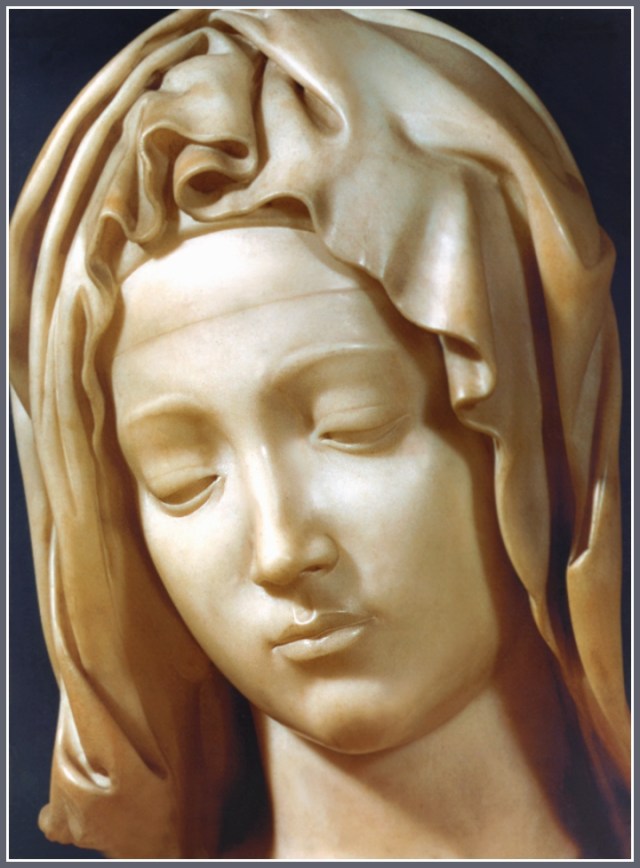
(“Daughter of the Father …etc” passage is taken from a meditation by Father Emanuel d’Alzon, 19th century founder of the Augustinians of the Assumption, excerpted from his book Mary Our Mother, Our Model, Our Queen, translated by M. Angeline Bouchard from the original French, Trente Jours avec Marie. which received the Nihil Obstat and Imprimatur of the Church). Notes on the sacred images: The first painting is by the 17th century Italian artist Giovanni Salvi (also known as Sassoferrato). The title of the painting is The Virgin at Prayer. It is in the National Gallery of Art in London. The second image is a close-up of the Blessed Mother’s face that was sculpted by Michelangelo in 1499 for his extraordinary sculpture known as the Pieta. Michelangelo was 24 years old at the time he sculpted this masterpiece! It is located in the St. Peter’s Basilica in Vatican City.

Mary – The Mystical Spouse of the Holy Spirit and the Wife of Joseph

The question may be asked “How is the word “spouse” used in reference to Mary and the Holy Spirit?

We have all read the nativity accounts of St. Matthew and St. Luke and if you are a Roman Catholic you believe that Sacred Scripture is the foundation on which we build our theology; however, Sacred Tradition and the scholarship and teaching of the Magisterium of the Church are also very important.

Sacred Tradition, scholarship, and the Magisterium (the teaching authority of the Church) act as the counterbalance for our understanding of God’s Truth in Scripture. These elements, together with Sacramental grace, prayer, and good works help us live our life in Christ.

Theologians, saints, and mystics have used marital language to express the love of God for His Church and the mystical relationship between our Blessed Mother and the Holy Spirit. The use of marital language in relation to Mary, the Holy Spirit, and the Church has a long and varied history. A few recent examples of a pope and documents of the Church using this language are Pope John Paul 2 in numerous homilies and encyclicals, and the very important document that resulted from the Second Vatican Council entitled The Dogmatic Constitution of the Church – Lumen Gentium.

If we go back to the earliest writings of the Church, and quickly examine some sources, we see the “marital and spousal” aspect of this mystical language used in a second century AD document called the Odes of Solomon; and as we proceed up through history we see mention of it in the writings of St. Augustine (4th century), St. Ildephonsus, archbishop of Toledo, Spain (7th century), St. Germanus, patriarch of Constantinople (7th century), Cardinal St. Peter Damian (11th century), St. Bonaventure (13th century), Emmanuel d’Alzon (19th century), and, in the many scholars of the 20th century, such as Cardinal Joseph Suenens, Karl Rahner, Pope John Paul 2, Rev. Peter Damian M. Fehlner, F.F.I., and Pope Benedict 16th.

A few examples of how the word “spouse” is used in these theological contexts may be helpful. In 1979, on Pope John Paul 2 first pilgrimage to the United States, he gave a sermon on our Blessed Mother at the National Shrine of the Immaculate Conception and made this point in relation to Mary:

“…Through her, the Sun of Justice was to rise in the world. Through her, the great healer of humanity, the reconciler of hearts and consciences, her Son, the God-Man, Jesus Christ, was to transform the human condition and by his death and resurrection, uplift the entire human family. As a great sign that appeared in the heavens, in the fullness of time, this woman dominates all history as the Virgin Mother of the Son, as the Spouse of the Holy Spirit, and as the Handmaid of humanity.” (excerpted from Mary’s Yes – Meditations on Mary Through The Ages, edited by John Rotelle, O.S.A., Servant Press, Ann Arbor, 1988)

In his important 1986 encyclical on the Holy Spirit  “The Lord and Giver of Life” (Dominum et Vivificantem) Pope John Paul 2 continues to use these expressions to help explain his insights:

“…It is the [2nd Vatican] Council that says to us: “The Blessed Virgin…overshadowed by the Holy Spirit…brought forth…the Son…, he whom God placed as the first-born among many brethren namely the faithful (cf. Romans 8: 29). In their birth and development she cooperates with a maternal love”; she is through “his singular graces and offices…intimately united with the Church…. [She/Mary] is a model of the Church” (Lumen Gentium, note 63). “The Church, moreover, contemplating Mary’s mysterious sanctity, imitating her charity,…becomes herself a mother” and “herself a virgin, who keeps…the fidelity she has pledged to her Spouse. Imitating the Mother of the Lord, and by the power of the Holy Spirit, she preserves with a virginal purity an integral faith, a firm hope, and a sincere charity” (Lumen Gentium note 64).

Pope John Paul 2 continues, “Thus one can understand the profound reason why the Church, united with the Virgin Mother, prays unceasingly as the Bride to her Divine Spouse, as the words of the Book of Revelation, quoted by the [2nd Vatican] Council, attest: “The Spirit and the bride say to the Lord Jesus Christ: Come!” (Rev. 22: 17).

The Church’s prayer is this unceasing invocation, in which “the Spirit himself intercedes for us”: in a certain sense, the Spirit himself utters it with the Church and in the Church.”

So, we see in these few examples that the Church has used this type of mystical language to help express and make meaningful the divine union of Mary and the Holy Spirit. This, of course, was made possible by Mary’s humility, and the grace of the Holy Spirit which fashioned Mary from the moment of her conception.

God has given Himself as a divine Gift to mankind. This mirrors the gift of self that a husband and wife make of themselves to each other; or, the gift that a consecrated virgin makes of him or herself to God. Our eternal destiny has been played out on this field, for with mystical insight we understand that a divine proposal was made to this young woman Mary, and using her free will and reason, she consented to the request to become the Theotokos – the Mother of God. It is important to remember that she consented, in humility, and out of her profound sense of love, service, and faith in God. These are the characteristics of all consecrated virgins, and the characteristics of all faith-filled wives and husbands who freely give the gift of themselves to their spouse in recognition of their marriage covenant.

At the moment of her “Let it be done to me according to your word,” her Spouse, the Holy Spirit, dwelt within her and uniting with her blood conceived the child Jesus in her womb. This was the divine act of conception – the miracle of  the Incarnation – resulting in a natural child and the full flowering of Mary’s motherhood. In practical terms, her consecrated virginity was not disturbed. She was an immaculate virgin before, during, and after her pregnancy. During her pregnancy and after the birth of Jesus, the Holy Family was exactly that – a holy family. Her legal husband Joseph understood and respected her vow of consecrated virginity, and she dedicated herself to being a model wife and mother – a woman who supported her husband Joseph in his work and her Son, Jesus, in His future ministry.

Glory and Praise to God! Praise be to the Mother of God, Mary, most holy! May she always intercede with her Son for mercy on our behalf!

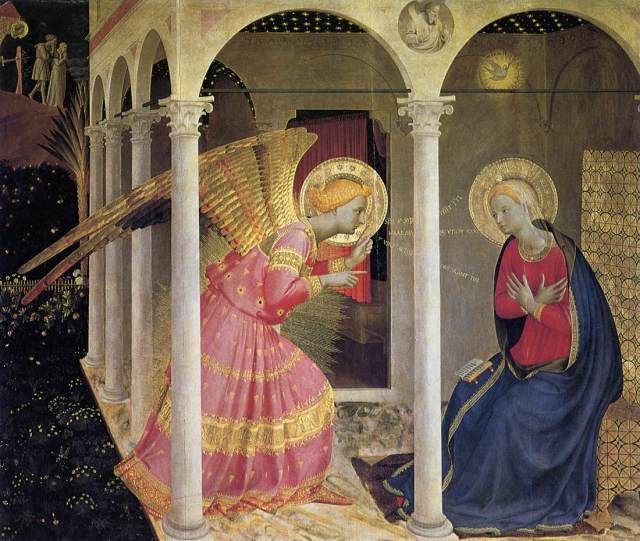
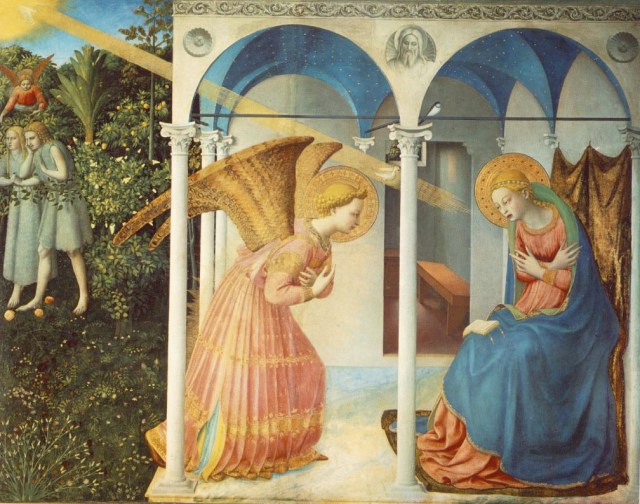
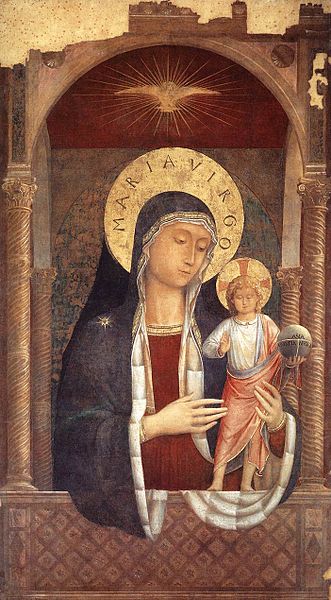
Notes on the paintings: The first painting of the Annunciation is by Fra Angelico (Brother John of Fiesole, died 1455) and is done in egg tempera on wood; completed between 1430-32 it is found in the Museo Diocesano in Cortona, Italy. The second painting is also by Fra Angelico it was painted between 1430-32 and is done in egg tempera on wood. It measures approximately 76 inches by 76 inches and hangs in the Prado Museum in Madrid. The third painting is by Benozzo Gozzoli entitled Madonna and Child Giving Blessings.  Painted in 1449, it is egg tempera on silk and mounted on wood. It is currently located in the church of Santa Maria Sopra Minerva in Rome. It is approximately 100 inches high by 51 inches wide.

Copyright © 2012 Deacon Paul O. Iacono All Rights Reserved.

The Nativity of Mary – Our Blessed Mother

On September 8th the Church celebrates the feast of the birthday of Mary, our Blessed Mother.

Tradition tells us that Mary was the daughter of Saints Joachim and Anne. She was betrothed to and later married Joseph, a respected Jewish carpenter from Nazareth. Little is known of Mary’s life other than the references to her in the Gospels. She attended the wedding feast at Cana, was present at Jesus’ crucifixion, and was with the Apostles at the coming of the Holy Spirit on Pentecost.

St. Andrew of Crete puts this feast day, celebrated since the 5th century, in perspective for us when he says: “[In the great play of salvation] today’s festival, the birth of the Mother of God, is the joyful prelude, while the final act is the union of the Word [of God] with human flesh.  Through Mary’s birth we are led away from slavery and toward the Truth. We are led away from darkness and toward the Light. Therefore, let all creation sing and dance and unite to make a worthy contribution to the celebration of this day. Let there be one common festival for saints in heaven and people on earth. Let everything join in festive celebration, for today, [through the birth of Mary] this created world is raised to the dignity of a holy place for [her Son] who made all things. The creature is newly prepared to be a divine dwelling place for her Creator.”

We give praise to our Blessed Mother today. We celebrate her being the new Temple, the pristine Tabernacle, our Virgin Mother, who gave birth to our Redeemer. Mary, through her life, gave witness to the true meaning of trust and charity.

Father Joseph R. Upton, the chaplain for The Fra Angelico Institute for the Sacred Arts and assistant pastor in my parish, mentioned in a sermon a few years ago that three births are celebrated in the Church’s calendar: John the Baptist, Mary, and Jesus. All three of these people were devout Jews. It  is through them, and their understanding of trust and charity, that we can see that the Jewish people have always been a people who truly love God. Their love expresses a deep sense of trust, because in love we see that their devotion is based on the virtues of faith and hope which expresses itself in word and deed. Fr. Upton went on to say, “Mary is the bridge” that allows not only the Jewish people, but all people, to see that God has fulfilled the promise that He made to their ancestors.

Mary, our Blessed Mother, enables that promise of redemption to be fulfilled through her “Yes” to the invitation to be the spouse of the Holy Spirit, which enabled the birth of her Son, Jesus to occur. Mary’s personal qualities of simplicity, humility, love, faith, and hope combined into a dynamic personality who, as she grew to adulthood, betrothal, and marriage to Joseph, enabled her to exemplify to all generations the meaning of a life that is full of grace.

Scholars remind us that “The angel Gabriel’s greeting to Mary is of great consequence for our understanding of Mary and Marian doctrine. The greeting has been variously translated as “Rejoice highly favored” and “Hail full of grace.” The object of the varied translations is the Greek word kecharitomene which refers to one who has been transformed by God’s grace. The word is used only one other time in the New Testament and that is in the Epistle to the Ephesians where Paul is addressing those who by becoming Christians are transformed by grace and receive the remission of sins. It is clearly significant that Mary is considered to already have been transformed by grace before the birth of Christ.”  So, we see that God intervened and did not allow the stain of original sin to be passed to Mary. She – as the pure vessel – would partake of the redemptive grace of God before the actual Redemption took place. Her “Yes” to God’s request that she become the Mother of the Incarnate God, Jesus, enabled our Redemption to occur. The scholar Origen (AD 185 -254) wrote: “Because the angel greeted Mary with new expressions, I do not, in fact, recall having read in any other place in the Sacred Scriptures these words: Rejoice, O Full of Grace. Neither of these expressions is ever addressed to a man: such a special greeting was reserved only for Mary.” (this quote is from http://www.ewtn.com/library/MARY/MARYINSC.htm 

We must remember that Catholics do not worship Mary. Worship is reserved for God alone. The Latin or Western Rite (Roman Catholics and those Eastern Rite churches in union with Rome), and the Eastern Rites  (Orthodox churches) pay respect and reverence to Mary but never worship her. We pay special reverence to her because, she as the mother of the Redeemer, deserves that respect and honor. We also acknowledge her in a special way because Mary intercedes (pleads for mercy on behalf of the Church) before the throne of God in the same way that a mother would intercede with the father on behalf of her children.

Thank you Blessed Mother for all you have done for us – and – Happy Birthday!

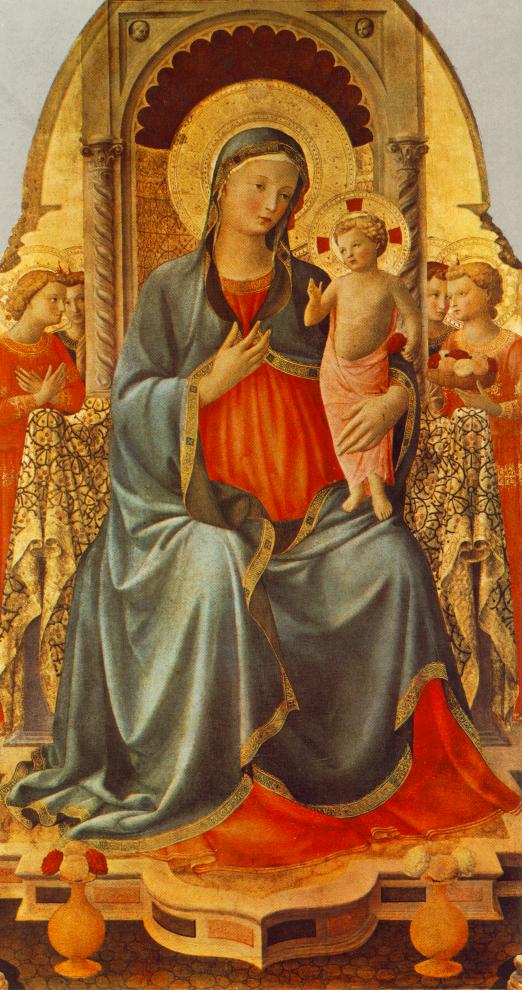
Copyright © 2012 Deacon Paul O. Iacono All Rights Reserved.  The above painting is by Fra Angelico. It is entitled Madonna with the Child and Angels, completed between 1435 and 1436. It is egg tempera on wood and measures approximately 27 inches by 4 feet 6 inches. It is in the Diocesan Museum in Camerino, Italy. Thanks to the Art Renewal Center website for the image: http://www.artrenewal.org/pages/artist.php?artistid=241&page=2
 

St. Gregory the Great – Laborer in Christ’s Vineyard

Today is the feast day of Saint Gregory the Great, pope and doctor of the Church.

Gregory was born in the year 540 of a noble Roman family who believed in the value of education and public service.

At the age of thirty he was appointed mayor of Rome; but after his father’s death, he decided to leave politics and become a Benedictine monk. Around the year 575, he transformed his family’s home into a monastery dedicated to the Apostle St. Andrew; he also established several monasteries on his father’s estates in Sicily. But in the year 579, he was ordained a deacon. Historians have mentioned that ordination was not really what Gregory wanted for his life. He enjoyed studying Scripture and music, writing, praying, and living the life of a Benedictine monk.  At that point in Church history, to be ordained a deacon meant that you were going to have a very public life assisting the local bishop in political, economic, and ecclesiastical affairs.

Pope Pelagius 2 saw Gregory’s talents and tapped him to become his papal ambassador to the imperial city of Constantinople. In Constantinople he gained a great deal of experience in both secular and ecclesiastical politics. Seven years later he was recalled to Rome and was appointed Deacon of Rome and acted as the Pope’s counselor. In 590 when Pope Pelagius died from the plague, the people elected Gregory to be the new pope.

Saint Gregory the Great is a model for all of us. For he, as today’s Gospel (Luke 4: 16-30) implies, also had the Spirit of God upon him. The Lord had anointed him as “the servant of the servants of God” to bring glad tidings to the poor and announce liberty to those captured by sin. The histories tell us that Gregory did not seek to be ordained a deacon or elected a pope; yet, once in those positions he valiantly labored in Christ’s vineyard to perform God’s will as he understood it.

He wrote beautiful and insightful works on theology and the pastoral care of  souls. He implemented some liturgical reforms especially in the area of music. The music that we know today as Gregorian chant developed from his impetus; however, his true greatness is found in his humility, his gentleness in dealing with all types of people, his steadfast devotion and love of Christ, His Scriptures, and prayer. All of these traits, combined with God’s grace and Gregory’s love for the people, helped him solve the practical everyday problems of Christ’s Church in a manner that provided a path for others to follow.

St. Gregory the Great was able to establish a model of the papacy that we still have with us today – the model of the pope, yes, as a suffering servant, but one who is also filled with joy at the challenge of laboring for the people of God in all their various needs. St. Gregory the Great, pray for us.

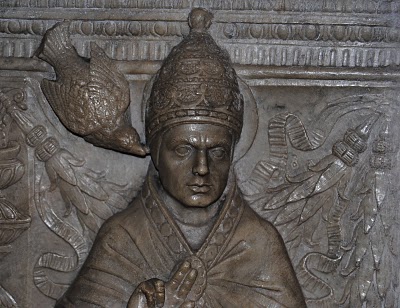
The image of Pope St. Gregory the Great is from the Vatican grottos and is made available through the courtesy of orbiscatholicussecundus.blogspot.com.

Copyright © 2012 Deacon Paul O. Iacono All Rights Reserved