This is an easier way to view the material within yesterday’s post.
Copyright © 2011- 2018 Deacon Paul O. Iacono All Rights Reserved
Discovering the truth, beauty, and goodness of God by creating and studying the sacred art of the Western and Eastern Rites of the Catholic Church.
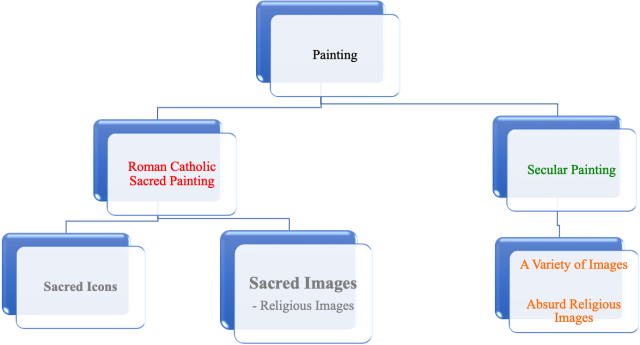
This is an easier way to view the material within yesterday’s post.
Copyright © 2011- 2018 Deacon Paul O. Iacono All Rights Reserved
Tonight we will use yesterday’s post as a starting point to examine Roman Catholic painting. I mentioned that there are seven disciplines within the definition of Art. One of those disciplines is painting.
As it applies to this discussion when we consider the discipline of painting we can say that there are two major categories: Roman Catholic Sacred Painting and Secular Painting.
We can then subdivide these two major categories.
Within the category of Roman Catholic Sacred Painting we have two major subcategories: Sacred Icons and Sacred Images.
I propose that there is a subcategory below Sacred Images, it is called Religious Images. I will explain in later posts the difference between Sacred Images and Religious Images.
Within the category of Secular Painting we can say that there are two subcategories. Let us call the first subcategory A Variety of Images. It consists of all the different types of paintings, made for the purpose of being “artifact, entertainment, political or social commentary, therapy, or a combination of two or more.” (Sporre, 1996; see previous post). It begins with the many generational wall and ceiling cave paintings painted by Paleolithic Man in the Vezere Valley, France approximately 17,000 years ago and continues with contemporary painters. Mankind loves to paint pictures.
The second subcategory within Secular Painting, as it applies to this discussion, is what I call Absurd Religious Images. Even though it has religious subject matter it is, in my opinion, secular art. I will provide a definition of that subcategory in an upcoming post and images which will make it recognizable.
Thanks for stopping by and spending some time here.
Copyright © 2011- 2018 Deacon Paul O. Iacono All Rights Reserved
Hello! Glad to be back after a series of learning experiences which took me away from the keyboard. I see from the website’s analytics that we are still popular on a worldwide level (thank you!). I also appreciate and thank all of the hundreds of subscribers that have stayed with this blog and continue to use and enjoy the material I’ve presented and the many tens of thousands that have popped in and out over the past seven years.
Last week I made a church presentation (a power point lecture) on “Our Blessed Mother and Sacred Art Applied to Prayer.” For the upcoming weeks, during the Advent and Christmas seasons, I will be presenting to you – in short form – my lecture notes accompanied by relevant sacred and religious art. This is probably one of the busiest times of the year so I will be blogging it to you in small doses on a frequent basis. If you use any of it in your work, ministry, or studies please reference me. Thanks.
My lecture had three major goals:
Let’s tackle the first part of the first goal: What is Art?
My perception is that art is a process in which an artist:
The above process occurs in all seven major disciplines of art. More recent historical artistic disciplines such as photography, computer art, grand and small scale landscape architecture possess this process, too.
Also, Professor Dennis J. Sporre has discussed that “Art has four functions: artifact, entertainment, social and political commentary, and therapy. These functions, or options, are not mutually exclusive, nor is one more important than the others” (found in his book The Creative Impulse, Prentice Hall, 4th ed., 1996. When I taught Humanities years ago this highly valuable book was one of the foundation blocks of my lectures and activities).
Tomorrow I will discuss Roman Catholic sacred art within the discipline of painting.
Thanks for joining me today.
Copyright © 2011- 2018 Deacon Paul O. Iacono All Rights Reserved


 The Fra Angelico Institute for Sacred Art
You must be logged in to post a comment.