Christian Witness and Sacred Art – The Early Church Fathers – Part 7

A Challenge: Are you as a Christian artist willing to internalize the message of the saint, scene, or Scripture passage you are artistically representing, and then, correctly portray it according to Church tradition?

Sacred artists must have more than just an awarenesses of Jesus, His Mother, angels and  saints because their witness provides us with the foundation stones of our Faith. Sacred artists must be more than artists who propose “Art for art’s sake”.

If we do this what do we become? We become evangelists to the truth, goodness, and beauty of God, through the witness of Jesus Christ and the holy men and women who called Him the Son of God.

In the years immediately following St. Polycarp’s martyrdom (died, circa AD 155, and remembered yesterday, February 22nd, in the Roman Breviary and Missal) a group of eight Western and Eastern Rite scholars and clerics arose known as the Apologists (Defenders of the Faith).

The Apologists defended the beliefs and traditions of the Church that passed down to them, in an uninterrupted line, directly from the Apostles and Apostolic Fathers.  This occurred during the years of continued persecution – AD 155 through AD 313.

The works and ministerial witness of the Apologists provide evidence for the continuity of beliefs and dogmas in the Early Christian Church. It is through this historic development, and the literary and physical witness of their efforts, that we have  religious and cultural traditions which dramatically affected the growth of sacred art. These clerics and scholars desired to unify and establish the beliefs of the Western and Eastern Rites of the Church.

Church artists, and the later group of clerics and scholars known as the Nicene Fathers (who I will cover in later posts), were heavily influenced by their efforts. These two groups, the Ante Nicene and Nicene Fathers all desired to make concrete and visible the correct teaching – the orthodoxy – of the Church. These efforts ultimately produced artistic representations of these early spiritual heroes – a visible sign of the truths of the Gospels being preached – and in some cases, their witness in blood.

The Apologists have also been termed The Ante (Before) Nicene Fathers because they lived and died prior to the establishment of the  Creed of the Catholic Faith, ultimately to be known as the Nicene Creed.

Let us briefly review two of the Apologists: St. Irenaeus of Lyons, and St. Clement of Alexandria. In a subsequent post you will have the opportunity to read three or four sentence descriptions of the contributions of the other six  Apologists.

St. Irenaeus of Lyons was born in AD 130 and died circa AD 202. He speaks of the four Gospels as being the “Four Pillars of the Church,” and was in a position to know that since he heard St. Polycarp (a friend and disciple of the Apostle John) preach. He was steadfast in supporting the belief in Apostolic Tradition. He taught that the true Faith is the one imparted by the bishops of the Church who, in turn, received it directly in an uninterrupted set of teachings from the Apostles. St. Irenaeus was tenacious in his fight against heterodoxy, specifically the Gnostic heresy.

St. Irenaeus understood the value of St. Polycarp’s New Testament scholarship and his emphasis on the Church’s sacred Tradition. He spoke with authority on Mary as the New Eve, and the Holy Eucharist. St. Irenaeus barely escaped death during the persecution of Emperor Marcus Aurelius, however during the round-up approximately 50 other Christians had the joy of earning the holy crown of martyrdom. He may have eventually died a martyr, yet, there is not sufficient evidence to support it.
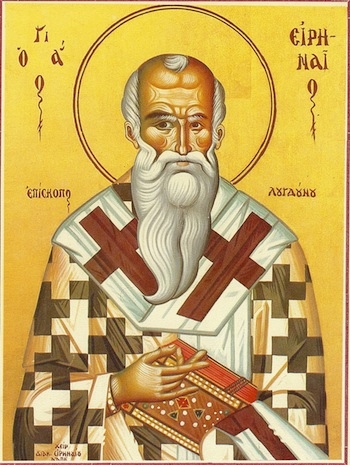
IconPM-Irenaeus-2
St. Irenaeus of Lyons (died circa 202). Famous for his manuscripts Against Heresies. He used 21 out of the 27 books of the New Testament in his writings and sermons.

Another critical Apologist is St. Clement of Alexandria (born circa AD 150, died circa 215). He led a major catechetical school in Alexandria, Egypt and agreed with St. Irenaeus that the truth and knowledge of the holy Gospels proceed through the bishops and are for the population as a whole and not for any secret society (thus, he fought against the Gnostic heresy).

He taught that in order to understand the truths of the Gospels you must have faith in unison with reason. He is also known for three major catechetical works which are still in existence. These works were meant to accompany catechumens and those baptized into the Christian faith as an aid to their spiritual development. He was not martyred.
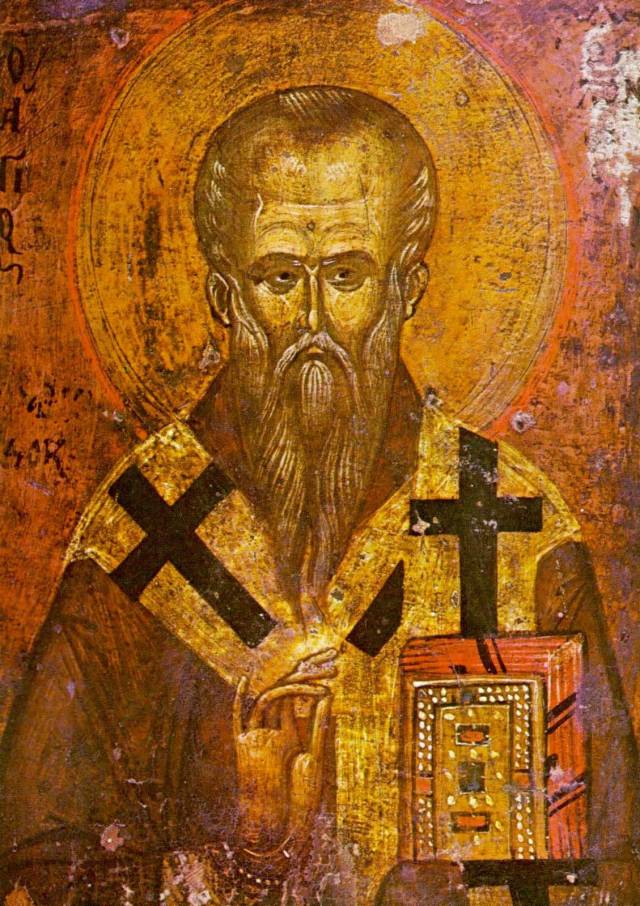
SAINT-CLEMENT-I
St. Clement of Alexandria – an Apologist of the Early Church – as represented by an early iconographer of the Eastern Rite of the Catholic Church.


Thanks for stopping by the Institute. I hope you have a relaxing weekend.

Copyright © 2011- 2019 Deacon Paul O. Iacono All Rights Reserved. Permission to reprint must be obtained from the author in writing. Students may quote small sections of the article as long as the proper credit and notation is given. Thank you. Permission to copy these posts must be obtained from Deacon Paul Iacono at deaconiacono@icloud.com.

Amazing Grace – Amazing Piano!

Okay, we have reached Wednesday, the supposed day that if we can just get through it we will be on the downward slide toward the weekend.

In an attempt to put a little pick-me-up in your afternoon I ask you to put aside your pencils, pens, and paint brushes and take 4 minutes and 9 seconds to listen to a “Dude Rocks Out Amazing Grace on the Piano.”

The “Dude” in the green jacket and rose colored glasses is Terry Miles. He is an accomplished pianist, yet, this day he sits down to a public piano in a London train station and puts a little joy into peoples’ hearts.

The song starts out as usual and then slowly, with a little flutter, breaks into Terry’s personal interpretation; but, then at approximately 1 minute 20 seconds into the piece, he takes off! The style is called “Boogie Woogie;” and believe it or not, it is one of my favorite types of music from my teen age years.

Click on the red or blue site address below (which gives a short description), click on the red and white arrow (depending on how it loads, at the top or bottom of the page), and enjoy!!

I hope I linked it correctly. If it doesn’t pop up for you use the address below in your search engine. For those unfamiliar with searching YouTube – enter youtube.com for “Terry Miles Amazing Grace” in your search box, click on it, and it should pop-up for you.

Thanks to godtube.com for posting Terry’s video.

https://www.godtube.com/watch/?v=YYYGG7NX

Early Church Fathers – A Short Bibliography

I mentioned in my last post of February 3, 2019 that I am presenting some material on the early Church Teachers and “Fathers.”

Why is this necessary?

People studying and painting sacred images and icons should be aware of the theological underpinnings of a specific image. This especially applies to the major personalities of the Church’s early history (AD 65 – AD 800). Sacred artists do not need to become  theologians or historians of this period in the Church’s history! Yet, they do need to acquaint themselves with some basic facts. As artists we must be faithful to Church Tradition and cultural traditions.

My posts will present some of these key figures in chronological order.  A very brief, one paragraph or less description of their major contributions will be provided, and if possible, a sacred icon of them.

Otsy
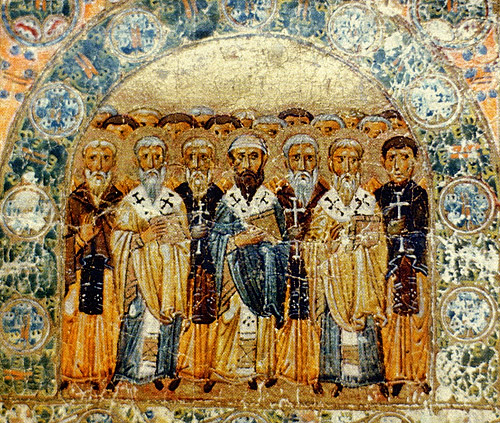
Russian Icon from the city of Kiev painted within the 11th century. Notice that there are many others behind them.

I will also provide you with the names of Councils of Bishops (such as Nicaea, Ephesus, Chalcedon, etc) and their key teaching (in brief sentences!). These Councils codified specific truths that became dogmas of the Catholic Church (Eastern and Western Rites). It follows that the Church’s sacred art developed in tandem with the understanding of its approved theological dogmas  – all heavily influenced and directed by the Holy Spirit, Apostolic Tradition, and Sacred Scripture.

It is also important to remember that the four criteria for being considered a “Father” (exceptional teacher of the Church) are: Antiquity, existing between the years AD 65 – AD 800; Evidence that his teachings and writings were accepted by the bishops of the Church; Orthodoxy, true and faithful teachings; and Piety, the holiness of the teacher.

So, you can ask the question: “What are your sources for this information?”

Great question!

The information I am presenting is based on twelve sources.

These sources will discuss teachers who were called Apostolic Fathers (men who knew, or were taught by those who did know the Apostles; I covered three of the Apostolic Fathers in the post of February 3rd). I will also discuss other periods which saw the rise of the Latin Fathers (wrote in Latin), Greek Fathers (wrote in Greek),  Syriac Fathers (wrote in a dialect of Aramaic), and the Desert Fathers (monks living in caves or early monasteries in the Egyptian deserts). I will list my sources (found below) in a simple bibliography.

Please remember this is certainly not an exhaustive list! It will provide you with a starting point, and if you are writing a paper for your studies it will point you in the right direction.

Here are my sources:

  • Aquilina, Mike. The Fathers of the Church (expanded edition). Our Sunday Visitor Publishing Division: Huntington, Indiana, 2006. Note well: this is an excellent introduction and critical if you were to purchase only two of these sources – this book and the CD set from Dr. D’Ambrosio.
  • Benedict XVI (Pope Emeritus). Church Fathers – From St. Clement of Rome to St. Augustine. Ignatius Press: San Francisco, 2008.
  • Benedict XVI (Pope Emeritus).  Church Fathers and Teachers – From St. Leo the Great to Peter Lombard.  Ignatius Press: San Francisco, 2010.
  • Cannuyer, Christian. Coptic Egypt – The Christians of the Nile. Harry N. Abrams, Inc.: New York, 2001.
  • Catechism of the Catholic Church – Second Edition. Libreria Editrice Vaticana: Vatican City, 1997. (The source citations at the back of the Catechism, pages 741 – 752, are very helpful because it links specific Fathers of the early Church to passages within the Catechism).
  • D”Ambrosio, Marcellino. When the Church was Young – Voices of the Early Fathers. Servant Books: Cincinnati, 2014.
  • D”Ambrosio, Marcellino. Early Church Fathers – From St. Clement of Rome to St. Peter Chrysologus (2 Volume CD set). Produced by Champions of the Truth, 2004. (This CD set is an excellent overview presented in quick ten minute snippets on the early Fathers. It can be purchased for $18.00 (a bargain price!) at https://www.crossroadsinitiative.com
  • Hahn, Scott and Aquilina, Mike. Living the Mysteries – A Guide for Unfinished Christians. Our Sunday Visitor Publishing Division: Huntington, Indiana, 2003.
  • Nichols, Aidan, O.P. Rome and the Eastern Churches. Ignatius Press: San Francisco, 2010.
  • Hitchcock, James. The History of the Catholic Church – From the Apostolic Age to the Third Millennium. Ignatius Press: San Francisco, 2012.
  • Staniforth, Maxwell. Early Christian Writings. Penguin: Baltimore, 1975.
  • Willis, John R., S.J. The Teachings of the Church Fathers. Ignatius Press: San Francisco, 2010.  Note well: This book is a wonderful source for the Early Church Fathers and teachers speaking in their own words about specific issues that concern the Church: the idea of One God, the Trinity,  the Person of Jesus, the Real Presence of Christ in the Eucharist, the Sacraments, Grace, the hierarchy of Orders, Sin, the Apocalypse (the Last Things), etc.

I pray that this helps you in your understanding of Patristics (the study of the writings of the Early Fathers of the Church) and how they influenced early sacred artists in correctly portraying their subjects.

Thanks for visiting with me. I hope you have a relaxing weekend.

Copyright © 2011- 2019 Deacon Paul O. Iacono All Rights Reserved


The Apostolic Fathers in Roman Catholic Sacred Art – Part Six

This post and an upcoming posts will very briefly explain some of the major figures in the Church history during the period of AD 65 through AD 155 – the period known as the age of the Apostolic Fathers. Ultimately, Parts 7 through 9 will cover some of the key leaders within the three subsequent periods of the early  Church (circa AD 155 to circa AD 800). I am presenting this material because it is critical for anyone studying and painting sacred images and sacred icons to be aware of the theological understanding of the scholars and bishops in the Church’s early history.  Sacred art developed in tandem with the approved theology of the Church. I will ultimately show you how this is expressed, specifically how our Blessed Mother Mary is artistically portrayed in Part Nine and subsequent  posts.

After Jesus Ascension to Heaven the Apostolic Fathers continued the mission of Jesus and His Apostles to shepherd the early Church. The term “Father” refers to the early leaders of the Church who remained faithful to the Apostolic faith and traditions and brought the early Church out of “diapers” into “young adulthood.” These men carried on the spiritual beliefs and religious traditions of the Apostles and, in some cases, directly knew the Apostles (for example, both St. Ignatius of Antioch and St. Polycarp were disciples of St. John the Apostle, and St. Peter consecrated St. Clement of Rome a bishop).

The Apostolic Fathers lived and died between the years AD 65 through AD 155. Their writings began to be circulated around the year AD 95. Apostolic Fathers that I will not cover in this post are Marcion, who was an eye-witness to the martyrdom of St. Polycarp and wrote an account of it and the anonymous writers of important documents: (The Shepherd of Hermas – this document and the Apocalypse of Peter were eventually removed from the canonical collections of Christian writings), The Didache, The Epistle to Diognetus, and The Epistle of Barnabas.

Many scholars believe that the four Gospels: Matthew, Mark, Luke, and John, and the Epistles: of Paul, Peter, James, Jude, and John  were all written before the year AD 100. Yet  it took approximately another four hundred years for the dogmas, doctrines, writings and the Church approved Gospels/Epistles to be studied, discussed, codified, and accepted or eliminated by the bishops of the Catholic Church (Eastern and Western Rites). Concomitantly, the sacred art of the early Church was affected by and developed within these cultural and spiritual currents. To exemplify this I will definitely present images of these developments, as they apply to Our Blessed Mother Mary, in upcoming posts.

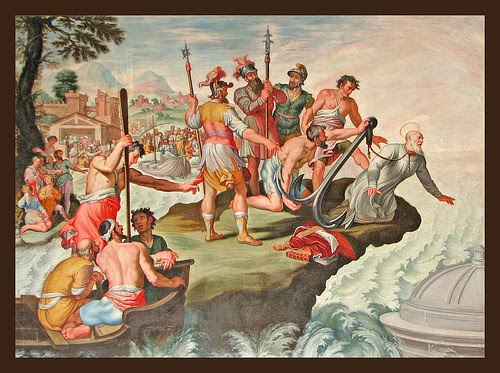
The Apostolic Fathers confronted numerous controversies and heresies. For example, Pope St. Clement of Rome (martyred in AD 99 or 101) addressed the question of the authority of the Bishop of Rome and clerical leadership (see his very important Letter to the Church at Corinth written in the first century). The Emperor Trajan (reigned AD 98 – 117) had him martyred by being thrown into the sea with an anchor around his neck.

St Clement of Rome
Pope St. Clement being martyred by drowning (Renaissance image)

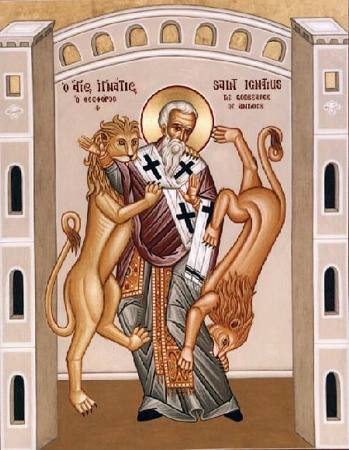
While traveling to Rome to be martyred, the bishop St. Ignatius of Antioch wrote significant letters to various churches in Asia Minor on important theological issues. He promoted the structure of clerical hierarchy (deacons, priests, and bishops). Adhering to Apostolic Tradition, Ignatius promoted belief in the Real Presence of Jesus Christ in the Holy Eucharist (which was achieved by a validly ordained male priest through the Scriptural words of Consecration within the liturgical structure of the Holy Mass). St. Ignatius of Antioch is also the first bishop to use the word “catholic” (universal) to describe the first Christian Church communities. He was martyred in Rome’s Circus Maximus by being savaged by lions. His martyrdom occurred in AD 107 – 108.

ignatius_of_antioch_2
Martyrdom of St. Ignatius of Antioch (contemporary sacred icon)

The last Apostolic Father that I will briefly discuss in this post is the bishop St. Polycarp of Smyrna (a city in Asia Minor – currently in Turkey). Polycarp’s name, in Greek, means “much fruit.” St. Polycarp was a friend and disciple of St. John the Apostle; and he was known as a New Testament scholar, and author of an important letter to a Church community in Greece.

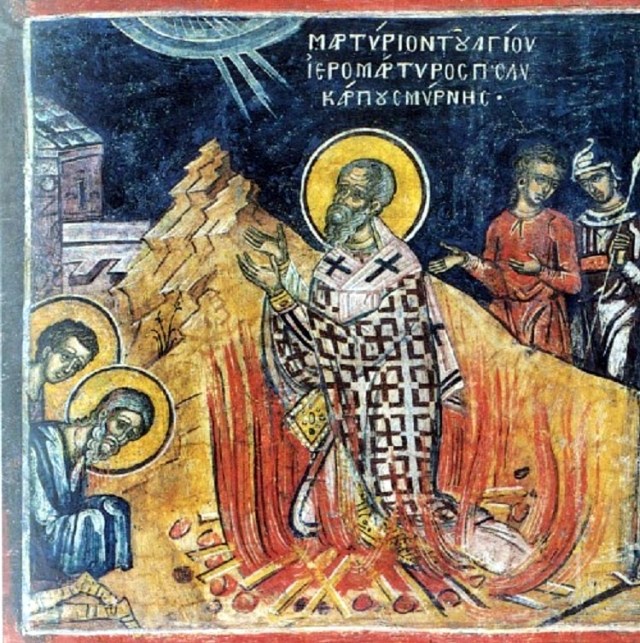
St. Polycarp was tireless in his fight against the Marcionite heresy. That heresy grew out of a heresy accepted by some interpreters of the Hebrew Scriptures who claimed that there were “two Gods” – one good and one bad. Polycarp was martyred in AD 155 or 156. The story of his martyrdom relates the attempted burning of this good bishop at the stake, but when the fire had no affect at all his frustrated executioners pulled him out and did the deed with a dagger!

polycarp-martyrdom
Martyrdom of the bishop St. Polycarp (not a contemporary sacred icon; possibly 15th century).Notice that it remains loyal to the story of his witness and martyrdom.


The “Great Schism” between the Roman Catholic and Greek Catholic (Orthodox) Rites did not occur until AD 1056; and the Protestant movement did not begin until the middle of the 15th century. The Protestant Revolt came to full force in the early 16th century and continued through to the 17th century. The Protestant sects viewed sacred art as unnecessary for the faithful since they needed to concentrate only on Sacred Scripture (Sola Scriptura).

Prior to AD 1056 all Christians were “Catholics” from different cultural areas of Europe, Africa, and the Near East. Each one of these Eastern and Western Rite communities applied their own interpretation to appropriate liturgical music, sacred art, liturgical disciplines to their regional church environments. Examples of this interpretation are  celibacy for male deacons and priests, and liturgical use of cultural specific language. This was achieved by remaining faithful to approved Catholic Creeds (Nicene and Apostles), Holy Scripture, clerical/hierarchical organization, etc. A unified set of Church dogmas and doctrines developed out of this 800 year history.

Thank you for stopping by and reading this brief post. My next post will briefly review the next group of “Fathers of the Church” – the Apologists.

My best wishes for a restful weekend; and if you are in the United Stats an enjoyable Super Bowl football game!

Copyright © 2011- 2019 Deacon Paul O. Iacono All Rights Reserved. Permission to reprint must be obtained from the author in writing. Students may quote small sections of the article as long as the proper credit and notation is given. Thank you. Deacon Paul Iacono, deaconiacono@icloud.com.