Good Friday 2020

Father, by the merits of your Son’s passion, death, and resurrection  hear us in our troubles and fears. Strengthen us against anxiety and illness. This day allow us to join Jesus’ suffering with ours. Please have mercy on the souls of those who, from this current pandemic, pass into eternal life.

Thank you Lord, for Your Son’s sacrifice, love, and mercy.

“It was about nine in the morning when they nailed Jesus to the Cross. From noon until three o’clock there was darkness over the whole world. At three o’clock, Jesus cried out in a loud voice: ‘Father, into Thy hands I commend My spirit;’ and having said this He expired.”

maxresdefault
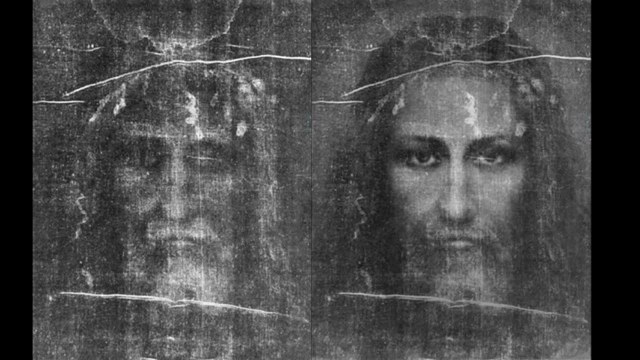
Closeup of the face on the Holy Shroud of Turin. A forensic artist’s recreation of a potential human likeness of the image found on the Shroud.

St. John Chrysostom, an Early Church Father, tells us: “There flowed from His side water and blood. Beloved do not pass over this mystery without thought; it has yet another hidden meaning, which I will explain to you. I said that water and blood symbolized Baptism and the Holy Eucharist. From these two Sacraments the Church is born: from Baptism, the cleansing water that gives rebirth [into the family of God] and renewal through the Holy Spirit, and from the Holy Eucharist [physical and spiritual nourishment; as He said: “Take and eat this is My Body. Take and drink for this is My blood]…   (Excerpts from the Holy Gospels and the Catechesis by St. John Chrysostom, AD 347 – 407, Archbishop of Constantinople).


image7
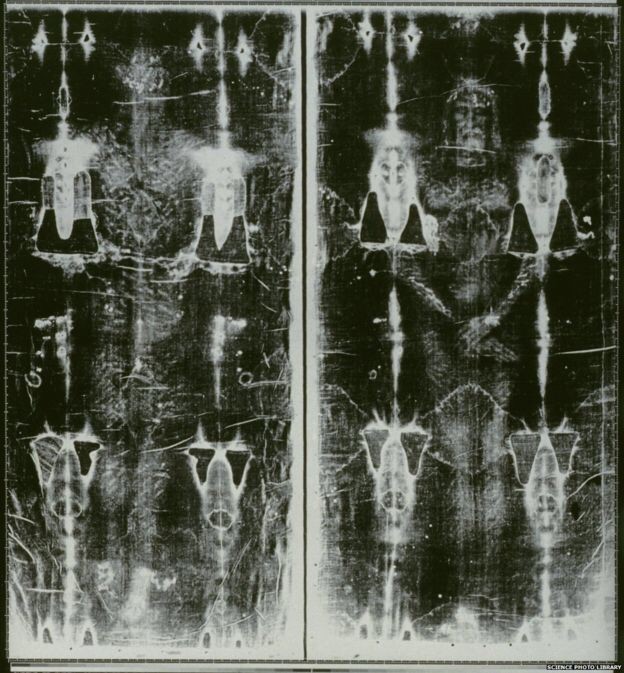
Full view of the Holy Shroud of Turin. It shows the results of the scourging on both sides of His Body, the crowning with thorns, the wound in His side, and the marks of the nails in His feet and wrists (necessary because the wrists would have been able to hold the weight of His Body). The triangular patches surrounded by white areas on the Shroud are the result of a fire which melted a lead casket encasing the Shroud. 

On this day our Redemption [from sin] was earned by the suffering and death of Jesus, the Son of God; by His wounds you were healed. JESUS CHRIST IS LORD!  (Philippians 2: 6-11, and 1 Peter (chapter 2: 21-24).

Copyright © 2011- 2020, Deacon Paul O. Iacono – All Rights Reserved. Permission to reprint must be obtained from the author in writing. Students, and those interested, may quote small sections of the article as long as the proper credit and notation is given. Thank you.

Do Pagans Go To Heaven or Hell?

by Deacon Paul O. Iacono, Diocese of Providence, Rhode Island USA

The author of the interesting and challenging blog site on sacred art and its analysis called Catchlight sent me two questions yesterday. They related to my last post which was entitled Fatima Messages, Pagans in the Vatican, and the End Times.

“Paul, your protestations begs the question, do pagans go to Heaven? If so, why? If not, why not?”      from Bernard Gallagher

These are excellent questions.

Before I attempt to answer them my readers should understand that I am a committed and Traditional Roman Catholic. His questions will be answered through the lens of the teachings of my Faith. That Faith is based on a foundation of Holy Scripture, Sacred Tradition, and two thousand years of Catholic scholarship.

Allow me to also mention that we need to understand that two Councils of the Church, the Councils of Orange and Trent (1000 years later), are critical in forming a correct answer to Mr. Gallagher’s questions. The Councils of Orange are significant (both of them were held in the city of Orange in Southern France, AD 441 and 529). The more important Second Council of Orange’s episcopal deliberations were sent to Rome and approved by Pope Boniface II in AD 531. That Council specifically proclaimed that everyone (who has reached the “age of reason”) is given sufficient Grace to be saved from eternal damnation. God will give, and has given all people, Actual Grace. If a person accepts and acts on that Grace, they will be saved.

What is Actual Grace? Actual Grace is an admonition by God for a person to correct their way of life, desire, search after, and make the sincere effort to obtain the Sanctifying Grace provided by the Catholic ChurchThe key action which achieves salvation and eternal life with God is the Holy Sacrament of Baptism. This allows the person to enter into God’s family. The Sacrament of Baptism removes Original Sin from an individual’s soul and enables it to receive additional Sacramental Sanctifying Grace. All Grace enables a person to become holy in God’s eyes. The other six Sacraments flow from the waters of Baptism. Pope Pius 9th (papal reign 1846 -1878) proclaimed that it would be extraordinary for an unbaptized person to achieve the eternal salvation and reward of Heaven.

First principle,

a) The Roman Catholic Church, the ethnic church Rites that are in union with Rome, the Greek and Russian Orthodox Churches, and some of the Protestant churches say that Jesus Christ, is the Word of God, the Son of the Father, begotten not made and consubstantial with Him. He is the Messiah, the Savior.  His human life, ministry, passion, death, and resurrection redeemed mankind from their sins. His divinity is expressed through His position as the Second Person of the Blessed Trinity.

b) He is known to mankind through the historical Gospels and Epistles of the Apostles, the witness of His Mother, the Virgin Mary (especially at her apparition at Fatima, Portugal in 1917. When asked what sin was most harmful and condemned unrepentant people to Hell she responded: ‘The sins of impurity are one of the major reasons why men and women are condemned to Hell.'” We cannot ignore our sins or consider them unimportant because of the current worldview. Also, the erudition of the Catholic Church Fathers, Doctors of the Church, Saints, and the historical teaching authority of the Church have all provided the scholarship and analysis that is sufficient for humanity to understand God’d Revelation and laws.

c) He is also known through the extraordinary scholarship of St. Augustine and St. Thomas Aquinas. The teaching authority of the Church, (as found in its Magisterium), is the Church’s responsibility to give to the world an authentic interpretation of the Revelation of God as found in Sacred Scripture and Sacred Tradition.

d) Additionally, let us not forget the importance of the testimony of the angels found in Holy Scripture, and the saints, of whom Jesus’ Mother Mary is the greatest of saints. All of these facts contribute to mankind’s understanding and witness of our Savior Jesus Christ.

e) Jesus commissioned His Apostles (the first bishops) to make known the free gift of His Redemption and graces. These critical graces are found in the Seven Sacraments of the Church, beginning with the keystone Sacrament, Baptism.

Hagiasophia-christ-1
An icon of Jesus Christ. It is found within the former Eastern Rite Church of Hagia Sophia (Holy Wisdom). The Church was built in the early 6th century and is located in Istanbul, Turkey (formerly Constantinople). It was a mosque, then was a museum since 1935, but recently it was converted back into a mosque.

Second, let’s refer to what Jesus Christ says in response to Nicodemus’ questions concerning eternal life in the Gospel of St. John, John 3: 1-21: “Amen, amen, I say to you, unless a man be born again, he cannot see the kingdom of God.” Nicodemus continues to question Him, and Jesus responds, “Amen, amen, I say to you, unless a man be born again of water and the Spirit, he cannot enter the kingdom of God…You must be born again.”

The great significance of the necessity of Baptism into the Christian faith is again stressed in another passage of the Gospels. The Gospel of St. Matthew, in its very last passage deals with the commissioning of the Apostles which occurred after His resurrection and before His Ascension back to the Father. Jesus emphasizes that combined with their preaching and works they must baptize faith-filled individuals because of Adam and Eve’s sin. Humanity’s broken relationship with God must be healed. It was healed through the death and resurrection of the Father’s Son Jesus the Christ. Jesus death, on our behalf allowed the formation of the Church and the Sacraments to be instituted to provide the grace to a broken humanity. Baptism is the Sacrament that makes this happen. It makes an individual’s body and soul a member of God’s family. Matthew 28: 18-20: “Jesus drew near and spoke to them saying, “all power in Heaven and on earth has been given to me. Go, therefore, and make disciples of all nations, baptizing them in the name of the Father, and the Son, and the Holy Spirit, teaching them to observe all that I have commanded you; and behold, I am with you always, to the close of the age.” 

Third, it appears, within the Christian faith, that we can come to specific conclusions that will provide a springboard for my response to Mr. Gallagher:

  1. If the human race was alienated from God, and the spiritual relationship with Him was broken, then a loving and merciful God would not give up on His children. Thus, through the course of history God has slowly manifested and revealed Himself to humanity starting with our spiritual parents, Adam and Eve; then through the patriarchs, leaders, and prophets of the chosen Jewish tribes culminating in the Incarnation of His Son, Jesus the Christ. God desires us to love Him and conform to His Laws. He has given us reason and free will. He has given us the ability to think and act not like robots but as free men and women. His revealed truths and laws must be evangelized and faithfully kept by individuals and mankind as a whole. The “Good News” must be spread by the Church as a whole and individuals, too.
  2. The First Commandment applies, as we see in Exodus 20: 1-6ff: “I, the Lord am your God, who brought you out of the land of Egypt, that place of slavery. You shall not have other gods besides Me. You shall not carve idols for yourselves…you shall not bow down to them or worship them. For I the Lord am a jealous God…inflicting punishment on those who are wicked and hate me…and mercy on those who love Me and keep My commandments.”
  3. Through Scripture and study of the Catechisms of the Council of Trent and that of Pope St. John Paul II, united with faith we also know that Jesus Christ is the consubstantial only Son of God and the promised Savior. Now, have (for example) the Amazonian pagans that we recently observed in Rome, or the new pagans of the 20th and 21st centuries been exposed to that truth?
  4. Christ freely offered Himself for our eternal salvation. This was accomplished through the words and actions of His human ministry and ultimately through His Passion, death, and resurrection. Jesus Christ is the Way, the Truth, and the Life. Have apostates, pagans, or other non believers been exposed to that truth?
  5. We see God through faith in Him, participating in prayer, Scripture study, good works, and the Sanctifying Grace found in the Seven Sacraments. Have pagans, past and present, been exposed to and accept these truths?

Fourth, so,  are pagans going to Heaven or Hell?

In a nutshell, I would never presume to know God’s mind, except from that which He revealed through Holy Scripture and Sacred Tradition. I would never make a judgement on another person’s soul as he or she are seen by God at the time of their death and individual judgement. Unknown to the world, even a great sinner may suddenly, in their last moments, repent of their sins and ask for God’s mercy. But, make no mistake about it, Scriptural Revelation, and the Sacred Tradition of the Catholic Church and specifically the words of Jesus in the Holy Scriptures, states that there is a Hell (Matthew 10: 28; 22: 13. Luke 16: 26; etc.); there is a Heaven, and, damnation into Hell for all eternity. 

It is believed that there is also a place of natural happiness called Limbo. It is not within Heaven, nor is it in the fires of the Hell of the Damned. It is a state of natural happiness and joy. It is not supernatural happiness because its inhabitants do not have the Beatific Vision (see additional discussion in the Summa Theologica, Supplement 1, 3rd part article 2, by Fra Rainaldo da Piperino). The question of what happens to infants who die without the Sanctifying Grace of Baptism is a much debated issue. Many Traditionalists support the idea of Limbo; however, contemporary scholarship supports the idea that God, in His mercy, would not withdraw the vision of His glory to unbaptized infants who have died.

Some additional issues:

  1. Let’s take a look at three major Greek philosophers: Socrates, Plato, and Aristotle. They were scholars who lived and died before the birth and ministry of  Jesus Christ. They lived within a pagan/pantheistic society whose members believed in a multitude of gods  Are Socrates, Plato, and Aristotle in Heaven or Hell?
  2. The answer is, “I don’t know!”
  3. But Jesus said, “I am the Way, and the Truth, and the Life. No one comes to the Father but through Me” (John 14: 6). Wouldn’t that statement preclude the unbaptized Greek philosophers entrance into Heaven?
  4. The answer is “Not automatically.”
  5. So, what do we know? We know that those three philosophers were men who searched for the truth, not only about  themselves as individuals but about the world itself. They searched after the truth. They made the sincere effort to find the truth by thinking, questioning, analyzing reality, both physical and metaphysical. They used all the evidence at their disposal to do so. They lived, before the Son of God was incarnated. They did not have the witness of Jesus Christ and to His specific and eternal revelation as the Son of God, both human and divine. They also probably did not have any exposure to the history of the Jewish people and God’s revelation to them. As per the the points made earlier, did they act on God’s Actual Grace to truly desire life with Him?
  6. But, in the time after the Incarnation and Ascension of Jesus, a person who had the opportunity to be exposed to and Baptized into the  Christian Faith (in the full expression of it in the Western and Eastern Rites of the Catholic Church, and some of the Protestant and Anglican churches if they use the Trinitarian formula), would have a critical free choice to make.
  7. If they are pagan, agnostic, atheist, Catholic Christian, Deist, Protestant Christian, Satanist, Wiccan, etc, and they would then, after an effort to know the truth, reject Actual Grace and the witness of Jesus Christ out of intentional misunderstanding, intellectual arrogance, stubbornness, cultural and historic prejudices, selfishness, willful rejection of Christian Revelation, narcissistic impulses, apostasy, or some evil influence, they would be freely putting their eternal soul into mortal sin. They would be facing the eternal punishment of Hell because they chose the path, through their own free will of “definitive self-exclusion from communion with God and the blessed in Heaven” (confer page 269 in the Catechism of the Catholic Church,  2nd edition).
  8. God is loving and compassionate. He is filled with mercy for those who sincerely repent their sins. God is merciful; however, our God is a God of Justice. Why would Jesus Christ be Incarnated to minister, suffer, die, and be resurrected if the Holy Trinity would give mortal sinners “A get into Heaven free pass?” The “Pass theory” doesn’t make sense, it is illogical, bogus, and yes it is a lie. There are dire consequences for freely turning your back on Jesus Christ: Hell.
  9. But do today’s pagans turn their backs?
  10. The answer to that question is: Have they made the effort to know the Truth? Have they been exposed to the truths of the Hebrew and Christian Scriptures? Have they been evangelized by courageous and selfless missionaries who are willing to undergo all sorts of hardships and possibly even martyrdom for the sake of their flocks’ eternal souls? Have they deliberately turned their backs on the truth and revelation of God through the Christian Scriptures, and the documents and witness of the Apostles, Saints, Church’s Doctors and Fathers, bishops and Pope as they present the truth on faith and morals? Have the pagans or people of other religions acted on the free gift of God’s Actual Grace?
  11. The Church’s duty and responsibility is to bring, without arrogance or condescension, the Holy Scriptures, Sacred Traditions, and the Holy Sacraments to the world. If its bishops, priests, deacons, consecrated brothers and sisters in various religious orders, and laity shirk or compromise their duties and teaching authority, give bad example through public and private sin, then they possibly will be denied entrance into Heaven, too.
  12. Is the Church giving sufficient resources to the missionaries in the field? Are we able to inspire young men and women in today’s world of the necessity and challenge to enter the life of a missionary? Have we thrown in the towel?
  13. This is my great concern about what I see in the Church today (especially the recent blessing of the pagan Pachamama statue in Rome; (by the way, all of the Amazonian Pachamama rituals were condemned by six Cardinals). The Christian churches should not be about assimilation of pagan cultures into the Faith in order “to learn from them,” or do so in a “spirit of dialogue” and accommodation.
  14.  The Western and Eastern Rites of the Catholic Church have the complete and total revelation of God to humanity. We have the complete revealed truth of The Trinity. We have the example of what it means to live in the heart of the Father through the life of Jesus Christ. Christ’s life, redemptive death, and resurrection made possible our entrance into God’s family. This entrance is accomplished through the Sacrament of Baptism (using the Trinitarian formula), and individuals’ growth in faith and good works.
  15. Matthew 28: 18-20, relates Jesus’ specific command. Our duty is to compassionately and without arrogance teach pagans and other non-believers about Jesus Christ, baptizing them in the name of the Father, and the Son, and the Holy Spirit.
  16. It is intellectually and morally irresponsible to give the impression that apostates, heretics, pagan/polytheistic cultures, and people of other faiths can add to the Deposit of Faith.We either understand the gift of the Deposit of the Faith or we don’t. There should be no waffling.
  17. We either proclaim His truth effectively and with conviction or we will see the Church continue to decline, make compromises, cause confusion, anxiety, division, and resentment among its faithful. Hell is a reality. It is our responsibility to act with courage and truthfulness to ensure that a person’s eternal salvation is not compromised through confused or false teachings.
  18. The Gospel of Luke 18: 8 challenges us to examine our own hearts: “When the Son of Man comes will He find faith on the earth?” 
  19. To paraphrase Peter Kreeft, Ph.D and Rev. Ronald Tacelli S.J. “if we have a diamond of immense and extraordinary value (our Catholic/Christian Faith) why would we go about the world seeking additional baubles?
  20. Refer also to the Catechism of the Catholic Church (2nd edition, 1997, pages 311-324) which has an excellent section on the Sacrament of Baptism.

Copyright © 2011- 2019, Deacon Paul O. Iacono – All Rights Reserved. Permission to reprint must be obtained (through the Comments section below) from the author in writing. Students, and those interested, may quote small sections of the article as long as the proper credit and notation is given. Thank you

Baptism, Discipleship, and the Art of Lorenzo Lotto

In our Gospel last week we stood at the banks of the Jordan River and witnessed Jesus’ baptism by John the Baptist. Today we hear John announce to all that the Spirit of God rests upon Jesus who is described as the Lamb of God and the Light of the World. John goes on to say that Jesus is not an angel, a prophet, nor a magician; rather, He is the incarnate Son of the Most High God. John reminds us that as the “Lamb of God” Jesus has a specific mission. His role is to teach and preach, and most importantly, it is to heal, and that healing can only occur through sacrificial service – specifically through the sacrifice of His own blood.

We are just one month past the celebration of the birth of Jesus and today our Gospel reminds us of the purpose of His mission.

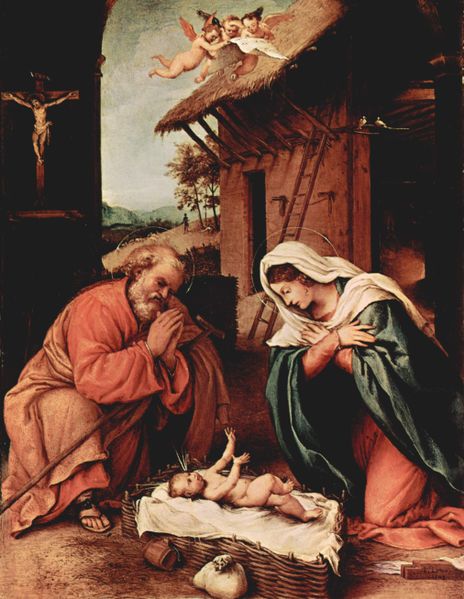
Five hundred years ago a beautiful painting was completed by the Italian artist Lorenzo Lotto entitled the Nativity of Christ. Lotto presents the typical stable scene, yet, his spiritual insight focuses on one specific artistic touch: he places on the wall behind a kneeling St. Joseph the image of a crucifix with the body of Christ emanating a beautiful glowing light that spills out onto the wood of the cross and the stable itself.
nativity

To my knowledge, Lotto’s innovation was the first time such an insight had been seen in Western art, but its originality is emphasized by the fact that your eye naturally moves from the crucifix, through the eyes of Joseph and Mary, and then down to the open arms of Jesus. Here as an infant, on the wood of the manger, He freely opened His arms to Mary and Joseph; and as an adult carpenter, He freely laid Himself down upon the wood of the Cross, to be sacrificed in an open embrace of love for all.

The challenge of this Gospel is that Christ offers us, as His disciples, the model of sacrificial service. No matter who you are, or what your age or station in life, you can perform sacrificial service to those around you. But it must be offered in the same redemptive spirit that Christ offered His service: with spiritual love and compassion for the souls of those in need. By virtue of our own Baptism we are all called to serve others as Christ has served us. You may be a mother or father caring for children or elderly parents – this care, if offered in the spirit of Christ – is sacrificial service. You may be a sacred artist, laboring quietly and prayerfully to create beautiful images that will assist yourself and others in prayer. This creative labor is sacrificial service.

You may be a child or teenager that courageously doesn’t participate in the bullying of another and comforts the one injured – if offered in the spirit of Christ – this is sacrificial service. You may be an adult – sick or aching from the pain of years of courageous work for your family or on behalf of the Church’s needs, such as supporting the pro-life movement or other social and moral justice issues. You see, if in prayer – you offer up your pain and efforts for souls in need – this is Christ-like, redemptive, sacrificial service. So as we offer sacrificial service on behalf of others, we turn our mind to God and place ourselves in His presence. This presence is a moment of prayer for us.

Allow me to make a recommendation: when we offer sacrificial service we should say the first verse of Psalm 70, which says, “God come to my assistance, Lord make haste to help me.” By saying this prayer, awareness of our Baptismal discipleship takes root. For it is in that short verse that we successfully unite ourselves to Jesus in the Jordan River, and like Him, receive grace from the Father to continue our mission, even if it ends up on Calvary.

As we travel through the dark days of winter, let us not forget that the Light of Christ is always present to us, and that Jesus’ arms will always remain open to patiently help us as we serve others.

God come to our assistance. Lord, make haste to help us.

***The above homily will be delivered by me at St. Romuald Chapel at 10 AM, and Noon at St. Francis of Assisi Church, South Kingstown, Rhode Island, USA on Sunday January 19, 2014. Copyright © 2011- 2014 Deacon Paul O. Iacono All Rights Reserved. Notes on the Painting: Lorenzo Lotto’s Nativity of Christ was completed in 1523. It is painted in oil on wood, and is presently in The National Gallery of Art in Washington, D.C.