Suicide of a Nation

This list is not a typical statement for my blog owing to the fact that it normally concerns sacred art and catechesis; however, I felt I needed to compose and share my thoughts with you. The views below are solely mine and are not meant to imply they have the endorsement of my Diocese (Providence, RI, USA).

The United States of America consists of fifty states that are ruled by a National (and an individual State) Constitution. My views certainly may be applied to other world governments.

  1. Any nation that allows and supports the destruction of established truth for the sake of educational indoctrination, political expediency and partisanship is on the road to national suicide.
  2. Any nation that supports, allows, or turns a blind eye to destructive and prejudiced mobs, some of which have the specific desire to destroy the political, economic, and religious systems of the nation, is on the road to national suicide.
  3. Any nation, wherever in the world, that supports the killing of its unborn (as of today, 1.72 billion worldwide abortion deaths since 1980; and in the United States 61,628,584 abortion deaths since 1973), ignores the worship of God, profanes His name and laws, and refuses to accept that the husband/wife family is the cornerstone of society is on the road to national suicide.
  4. Any nation that allows the abuse of children and deprives its citizens the opportunities to improve their plight through unbiased education and hard-work is on the road to national suicide.
  5. Any nation that ignores and discriminates against its poor and culturally indigenous people is on the road to national suicide.
  6. Any nation that ignores its established historical citizenry to then welcome and support individual immigrants that have no desire to assimilate into the nation’s established political, economic, and historical culture, is on the road to national suicide.
  7. Any nation that prevents its citizens from receiving appropriate health care, that is efficient and economically fair, is on the road to national suicide.
  8. Any nation that allows its citizens to discriminate and attack its own history or an individual’s religious beliefs, ancestral, and national history is on the road to national suicide.
  9. Any state or nation that allows its national and local press, except for its editorials, to become instruments of propaganda rather than truthful news dissemination is on the road to national suicide.
  10. Any nation that ignores or discriminates against the rights of: life, liberty, the pursuit of happiness, the freedom of economic well being through the preservation of jobs within the nation, and the freedom of productive opportunity, is on the road to national suicide.
  11. Any nation that demoralizes its citizenry by fomenting confusion and fear, limits or eradicates freedom of speech, freedom to peacefully assemble, freedom of the press, freedom to peacefully petition the government for redress of grievances, freedom of religion, and the freedom to keep and bear arms, is on the road to national suicide.
  12. Any nation that prevents its duly constituted political citizenry the right to have their votes legitimately counted, allows electoral fraud, does not preserve the privilege of one person-one vote in its elections, ignores the principles of compromise, and is politically corrupt, is on the road to national suicide.

A state and nation, that is a representative democracy, is its people. A free people determine their state and nation’s future by critically examining, and if necessary, vociferously removing elected politicians that are scoundrels, oligarchs, elitists and who willfully ignore their national Constitution and its documents of freedom. If citizens refuse to do so, or are ignorant of their responsibility, they are providing the foundation for tyranny.

What legacy will we leave our children?

Paul O. Iacono

Rhode Island/Massachusetts

Copyright © 2011- 2020, Deacon Paul O. Iacono – All Rights Reserved. The above views are mine and are not meant to imply they have the endorsement of my Diocese (Providence, RI). Permission to reprint must be obtained from the author in writing. Students, and those interested, may quote small sections of the article as long as the proper credit and notation is given. Thank you.

Iconoclasm and Shaun King

In the June 22, 2020 issue of Newsweek an on-line article by Aila Slisco reported some statements by political activist Mr. Shaun King. 

She states: “He [King] also remarked that stained glass windows and other images of a white Jesus, his European mother and their white friends should all be destroyed, insisting they are racist, examples of ethnic propaganda, and “a form of white supremacy. “They should all come down.” (I’ll comment on these statements by Mr. King in another post).

King’s comments came in association with Black Lives Matter protests against the brutality of some police officers toward minorities. These protests quickly moved away from the issue of police brutality in some major cites and expanded into protests against historic and artistic representations of American/European civilization and the “white supremacy” that it allegedly represented. 

We have observed over the last two weeks examples of the new iconoclasm. 

Rhetoric like Mr. King’s and other activists could be passed off as uninformed except for the fact that two California mobs tore down and desecrated a statue of the Spanish missionary Fr. Serra. In the process they also harassed Catholic college students, laity, and a priest who were defending it.

Legitimate non-violent protests are protected by the U.S. Constitution, however, the destruction of public or private property is not. 

Public religious, military and political statues are the property of the local churches and governments. What happened to the government’s responsibility to protect them? Churches, and whatever articles they contain, are the property of the church regardless of denomination. Will the governments across the nation protect them?

Religious statues, sacred art, stained glass windows, etc, are defended by the 1st amendment of the U. S. Constitution. Is Mr. King saying that a Satanic statue of Baphomet can be placed in a public square but a statue of a Roman Catholic saint, who is specifically honored for his cultural contributions, cannot? 

Are the representations of the God and saints of the Roman Catholic Church, who has been a major contributor to world civilization, to be torn down because a segment of the population believe that they, without taking into account time period or cultural conditions, have been historically ethnocentric and intolerant of other cultures? Are these legitimate religious statues equivalent to the statues of Lenin, Stalin, Mao or Saddam Hussein?

What happened to Martin Luther King Jr.’s call for positive non violent change and tolerance in America?

Today, July 1st, is the Roman Catholic Church’s memorial of the missionary efforts of Fr. Junipero Serra, an 18th century Spanish missionary priest. Fr. Serra’s leadership and contributions to improving the educational and technological life of Native Americans and development of California is recognized as a public act and not just a religious effort; this is why his statues were erected by the state of California. His statue also stands in Statuary Hall in the U. S. Capitol building in Washington, D. C.  At various times national and state politicians, of both political parties, were present to honor him.

Fr. Serra’s main goal was to be an effective Christian missionary. He was following the Gospel injunction of Christ Himself in the 28th chapter of the Gospel of Matthew: “All power in heaven and earth has been given to me. Go, therefore, and make disciples of all nations, baptizing them in the name of the Father, and of the Son, and the Holy Ghost, teaching them to observe all that I have commanded you. And behold, I am with you always, until the end of the age.”

The new iconoclasm appears to be intolerant, or unaware, of history. The adherents public efforts, both in word and deed, are clearly seen in the mobs in California and specifically in St. Louis, Missouri where they beat Catholics who were praying in front of a monument of St. Louis IX. In both cases mob action desires to vent its anger, ideology, and psychological wounds against historic personalities. The mob desires to sponge away the past rather than continue to lawfully, peacefully, and vigorously work for social change. 

Is significant change necessary in the way some police departments train their recruits? Absolutely. Productive change can occur. It cannot occur when the structures of Constitutional democracy are trampled upon. Polarization has never accomplished anything; positive social change has never occurred through a mob’s physical or verbal violence.

The past cannot be rewritten. In America, many times statues regardless of being religious, political, or military, celebrate the good that people have accomplished, not their ethnocentrism. If small groups through mob action tear down public property, or Church property, then they are no better than many other mobs, tyrants and demagogues through history; such as Mao Zedong’s actions during the ten years of China’s Cultural Revolution, Lenin and Stalin’s iconoclasm and political/religious oppression during the 70 odd years of their Communist debacle, Hitler’s 13 year rampage of mass destruction and inhumanity, or present day Isil and their damage of populations and  archaeological sites in the name of religious ideology.

As civilizations are we still unable to learn from the lessons of history? Is it too late?

Copyright © 2011- 2020, Deacon Paul O. Iacono – All Rights Reserved. Permission to reprint must be obtained from the author in writing. Students, and those interested, may quote small sections of the article as long as the proper credit and notation is given. Thank you.

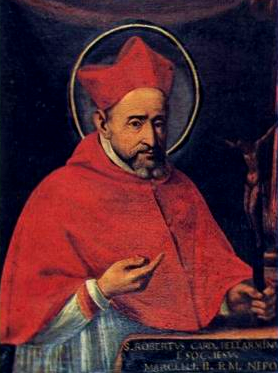
St. Robert Bellarmine, Galileo, and the Glory of God

Today, September 17th, the Church celebrates the memorial of Cardinal Robert Bellarmine. St. Robert was born into a noble Italian family during the crisis filled 16th century – a time of great artistic and scientific achievements and a time of heart breaking dissension within the Catholic Church.

In 1560, St. Robert entered the Society of Jesus, became a teacher, and was ordained ten years later. St. Robert’s Jesuit superiors sent him to the Catholic University in Louvain and there he developed a reputation for scholarship, disputation, and eloquence. When he returned to Rome in 1576, he became a professor of theology and began the systematic dismantling of the Protestant positions on faith and spirituality.

His book Disputations on the Controversies of the Christian Faith criticizing and refuting the Protestant errors was so effective, and caused such a stir throughout Europe, that special faculty positions were established in Protestant colleges in an attempt to refute Bellarmine’s positions.

So why is Saint Robert Bellarmine important for us today?

First, his witness as a scholar and cardinal expresses that the Church must always remain vigilant in its mission to promote the truth and protect its Apostolic and Sacred Tradition. Second, Robert Bellarmine as a Jesuit was loyal to its motto, which is “All for the greater glory of God.” In that motto, you have the structure of a Jesuit’s life, of Saint Bellarmine’s life, for through it he was able to weigh issues in the balance of whether or not they promoted the truth of God’s glory. Allow me to provide a very brief example.

Bellarmine was involved in the early stages of the astronomer Galileo’s difficulties with the Church. In 1615, Cardinal Bellarmine was interested in, and open to, various types of scientific research. He recognized that indeed, the Church’s own astronomers had validated many of Galileo’s scientific observations, and he was certainly knowledgeable of the fact that Cardinal Barberini (the future Pope Urban the 8th) had spoken with Galileo and gave Galileo his personal support.

So what was the problem?

Cardinal Bellarmine said in an open statement that, because Galileo’s scientific theories were not sufficiently supported with solid evidence, then Galileo should follow the position of the Church and call his theories a hypothesis and not scientific fact; and very importantly, he went on to say that, if Galileo’s theories were solidly proven to be true, then care must be taken to interpret Holy Scripture only in accordance with these new scientific truths.

Galileo rebelled against this common sense position. He demanded that his theories be acknowledged as scientific truth and publicly said so. The Holy Office, St. Bellarmine, and the other cardinals had no other choice than to censure him.

They did so not because they completely disagreed with his scientific theories, rather, the censure occurred because Galileo was promoting his ideas as scientific truth when, in reality, he did not have conclusive proof to do so. It should be remembered that St. Bellarmine, in dealing with Galileo, did so “in a sympathetic and not in a heavy handed way.” Bellarmine saw his duty to reason and ethics, and, the decision’s impact on a continent in social and religious turmoil.

Cardinal Bellarmine died in 1621. He was canonized in 1930 and made a Doctor of the Church  a year later.

Galileo had some virtues, however, prudence does not appear to be one of them. As the years went on he continued to do his research; but ultimately got himself into trouble again when he published a book which made his friend, Pope Urban 8th, look like a simpleton.

As a result of this insult, in 1632, he was called to Rome to stand trial for a second time. At that trial the ideas in his new book were examined, and sadly, the case was mishandled on both sides. It was unfortunate that Cardinal Bellarmine was not there to add his reason and judgement. Galileo died ten years later while under house arrest. Many of those years were spent in continued research and writing on various scientific topics.

Cardinal Bellarmine desired to see God glorified, and understood that science, music, art, and architecture were just a few of the ways to do it. He said in one of his essays: “May you consider truly good whatever leads to your goal of the glory of God and your eternal salvation with Him. May you consider truly evil whatever makes you fall away from it.”

Copyright © 2012 Deacon Paul O. Iacono All Rights Reserved

When People Or Governments Get In Our Face

Recently I received a rather funny email from a friend concerning a God loving Marine coming to terms with an atheist professor. It triggered, however, a serious reflection on how we, as Christians, are to confront those who “get in our face” about issues of spiritual beliefs, sacred art, religious freedom, and personal liberty.

The passage from St. Matthew’s Gospel, chapter 5: 38-42, on “an eye for an eye and a tooth for a tooth” gives us an insight into who Jesus is as God. The behaviors that He explains, and asks us to imitate, are actions that He would perform; so in this passage on “an eye for an eye” we are getting a glimpse into the personality of God.

Jesus explains that the old Jewish law of “an eye for an eye and a tooth for a tooth” is no longer appropriate or virtuous in God’s eyes, it doesn’t reflect the behavior and actions that the Lord is trying to teach His people to follow, actions which reflect the Lord’s own mind and heart.

The following photo by talented photographer Kenny Lindstrom found at www.flickr.com/photos/kennylindstrom/ provides meaning, visual imagery, and the clarity of a typical traffic stop sign. We instantly recognize what the creator of this sculpture is trying to say (by the way, is this image done in sand, stone, or clay?). We get the message; but, as in all art, its interpretation depends on the values and beliefs of the viewer. Lindstrom’s photograph is a wonderful example of how a piece of art can display an impression that is both a teaching and reflective moment for the viewer.

The Holy Scriptures, however, are not to be viewed as artistic reflections or suggestions to the reader and listener. The Holy Spirit divinely inspired the Bible; thus, the faithful understand (sometimes better than many of the academics) that Jesus, as the Son of God, came to teach, preach, and heal mankind. His words are not suggestions, they are directions for living within His Sacred Heart; and that demands fortitude, perseverance, and most importantly, His grace.

Over the last two thousand years the Catholic Church has taught that we have a right to defend ourselves – a right to resist the evil that is done to us. But Jesus teaches that we should not resist evil with an evil response or by an evil means  – in other words we should not resist evil with a spirit of vengeance, rage, anger or with an unlawful or excessive physical or verbal response.

So, Jesus is teaching us that the tribal law of an “an eye for an eye and a tooth for a tooth” is destructive and directly opposed to the Father’s plan of a loving spiritual family living within a shared community.  Yet, not everyone in the world is a Christian; and the 20th and 21st centuries are showing themselves to be much more personally and collectively violent than many of the other centuries combined.

So what do we do? Jesus teaches us that our response to evil and insult, as difficult as this may be, should be measured; that is, it should be filled with patience and grace. For if we confront and attempt to defeat evil with an evil or vengeful response, then, we are weakening ourselves and empowering that which we hope to defeat. This does not mean, however, that we are to deny a sense of righteous and justifiable anger over injustices that are done – the Lord Himself gave witness to that when He drove the moneychangers and polluters of His Father’s Temple into the street.

The world can slap us on the cheek, it can take our belongings, it can take away our religious, political, and artistic freedoms and prevent us from speaking out against injustice, and it can even take our lives, but it can never touch our hearts or souls because the Lord God Himself has forever claimed us as His own children.

Let us pray that when we do have to correct our own actions or those of another, we do it based on Jesus’ spirit of graceful moderation, love, and kindness.

Copyright © 2012 Deacon Paul O. Iacono All Rights Reserved