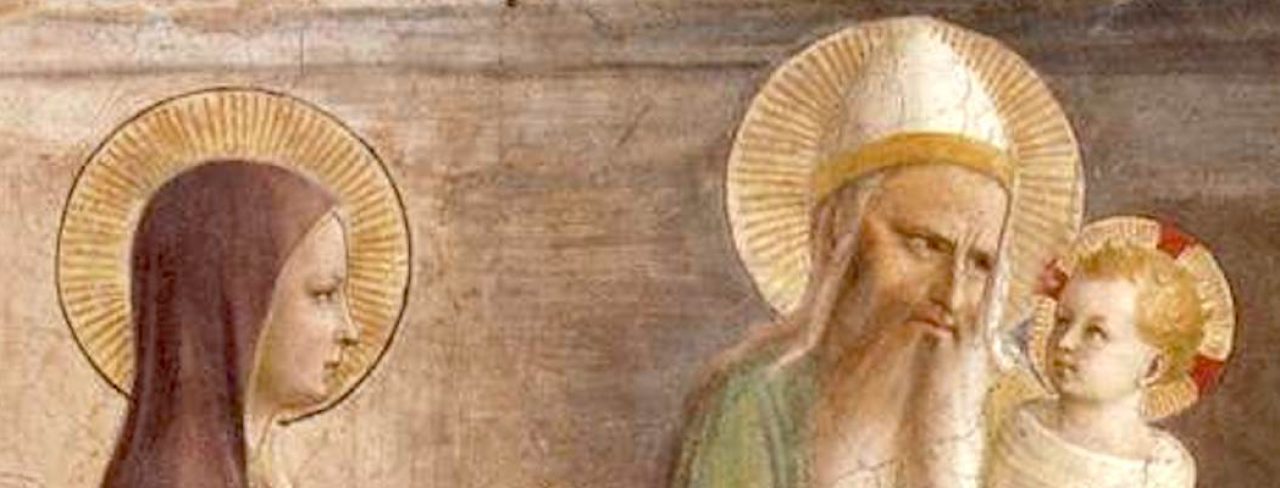
Lesley Green – A Rhode Island Sacred Artist

One of the great blessings the Lord has granted me is the privilege of meeting so many wonderful people who are interested in studying and creating sacred art. An example of this is the fine Rhode Island artist, Lesley Green.

Lesley is no stranger to art. She has been interested in it since adolescence and received a BFA from the Rhode Island School of Design. She continued to pursue her studies while taking time out to marry and raise a family.

I first met Lesley a number of years ago, when my wife and I started the Fra Angelico Institute for the Sacred Arts.  We invited people from around the Diocese of Providence to come to our first informational meeting. I could tell upon first meeting her that she was highly motivated to consider studying and prayerfully create sacred art.

My first workshop in sacred art soon followed that meeting and Lesley came to learn the basics of how to paint a sacred icon. Her excitement and interest were, and still are, gratifying to see. She continued to make rapid progress with me and took the advice that I give to all of my students: “Branch out, and study with as many other sacred artists as you can.”

I firmly believe that a sacred artist needs to be exposed to, not only a variety of artistic talents and skills, but to the prayerfulness of other iconographers as they practice their ministry in sacred art. As a result, she has since enjoyed studying with Rev. Peter Pearson and Michael Kapeluck, two artists from Pennsylvania who paint in the Russian Orthodox style.

Lesley realizes that her art is more than art for art’s sake. As a committed Roman Catholic she understands that her art is a dramatic form of silent evangelization of the Word of God. She takes seriously the invitation of St. John Paul 2’s 1999 Letter to Artists to participate in the “call” to the vocation of a sacred artist. He tells us that in doing so we fulfill our personal responsibility to do our part in spreading the Good News of Christ. He says,

“In order to communicate the message entrusted to her by Christ, the Church needs art.  Art must make perceptible, and as far as possible attractive, the world of the spirit, of the invisible, of God.  It must therefore translate into meaningful terms, which is in itself ineffable.

Art has a unique capacity to take one or other facet of the message and translate it into colors, shapes and sounds, which nourish the intuition of those who look or listen. It does so without emptying the message itself of its transcendent value and its aura of mystery.” 

It is this “aura of mystery” that Lesley is prayerfully attempting to make visible to the viewer of her art. For, as sacred artists, we are all called to make visible the “ineffable mystery” that is God, His angels, and His saints.

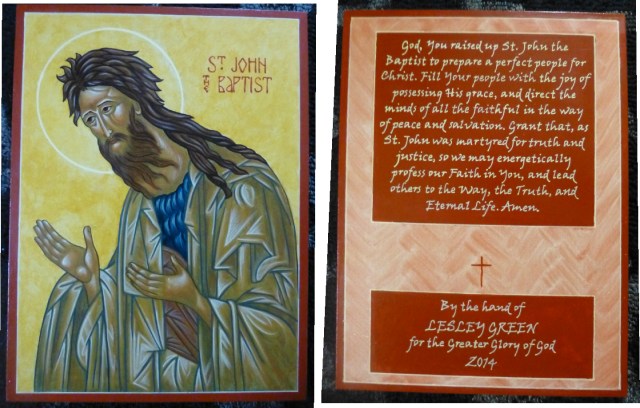
Lesley’s most recent completed icons of Saint Gabriel and St. John the Baptist are quite lovely. I especially like the fact that St. Gabriel is shown holding the Holy Eucharist. As you know, the Archangel Gabriel was depicted in the Hebrew Scriptures as being a healer, especially of the eyes. This sacred icon aptly shows that the source of the Archangel’s power is Christ Himself. The second icon showing St. John the Baptist in a prayerful pose indicates that even in Heaven he continues his mission of imploring us to repent of our sins.

St. Gabriel the Archangel and St. John the Baptist, pray for us.
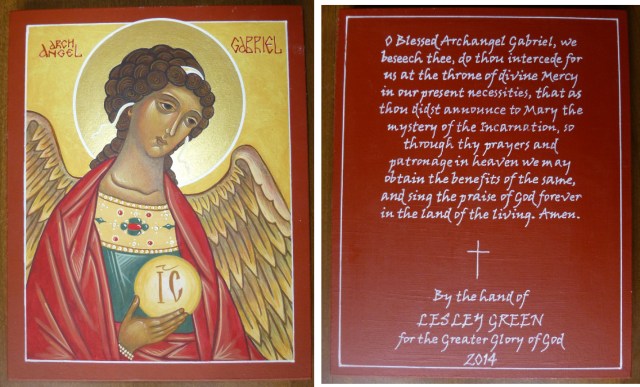
image description


image description

Copyright © 2011- 2014 Deacon Paul O. Iacono All Rights Reserved


Seeds of Faith and Art

In our Gospel today, from St. Mark Chapter 4: 26-34, we have two important parables concerning the reign of God: the first concerns the farmer’s sowing of seed and the second refers to the growth of the seed.

When we examine the threads running through these parables we hear  Jesus explaining not only the functions that the farmer performs, but the nature of the seed that is sown, as well. This first parable is found only in Mark’s Gospel and explains that through the ministry of Jesus, God’s sovereign and all-powerful rule over mankind is made visible.

This is similar to a passage from the book of Ezekiel, chapter 17: 22-24, where we hear God asserting His sovereignty; the prophet Ezekiel concludes his passage with God saying, “As I, the Lord, have spoken, so will I do.” God is telling the ancient Hebrews that they will see what He can do – He will manifest and make Himself visible to them.

In the first parable the evangelist Mark explains that God is the Divine Sower, the Divine farmer, and that God’s power and fruitfulness appears throughout the history of the Jewish people. Mysteriously, at a time known only to God, His reign would suddenly be made visible and manifest – like a seed which was nestled in the warm soil, suddenly appearing one morning as a young shoot – ready to grow into a fruitful plant.

Jesus is that fruitful plant – that vine – that cedar – that shoot of Jesse that developed out of  the family of King David, and suddenly appeared in ministry to all of Israel.

If we are open to its influence, spiritual and natural growth in the life of Jesus Christ is the process  of entering into the rhythm of God’s beating Sacred Heart; with every beat there is growth. We may be unaware of it – but it occurs – it goes on all around us – it sustains us in our very being –  it sustains the very existence  of the universe.

In the second parable from this passage from Mark’s Gospel, we again hear Jesus speak of a growing plant and tell His disciples that the Kingdom of God works like the natural growth process of a typical mustard seed.

Jesus is emphasizing that the growth of the Kingdom of God, and the reign of God in our individual hearts through faith in Him, is exactly like a natural process. A mustard seed is small but when it matures it becomes a large shrub – and the same is true with faith.

When I was younger, my wife and I enjoyed planting a  large garden. we quickly learned that in order to have a successful garden, we needed to thoroughly pastor the soil, sow the seed in a specific way to allow it to germinate, and then water and feed the plants when they sprouted.

I mention this because the Divine Sower must also pastor the seed of faith in order for it to grow. St. Mark explains that Jesus tells His disciples that the Kingdom of God will sprout and  grow in their hearts. Like a garden, their hearts, as well as  ours – must be tilled, warmed, and watered, to receive the seed of His Son who is Sower, Servant  and Savior. Once that is done, the people of the Kingdom of God – the Church – will grow into a mighty plant, a mighty tree, one in which there will be many branches. That tree, as Ezekiel tells us, will be fed and watered with God’s graces.

So, how does this Gospel challenge us – especially those of us who are artists?

Our faith is like an unmarked packet of seeds – God sows – we grow; and sometimes we stand in astonishment at what has – or has not – taken root. As the faith of a child grows and receives the good, or, bad food that the family, Church, and society provides, he or she ultimately begins to make choices – choices which may, unbeknownst at the time, have a dramatic impact on whether their faith bears fruit abundantly, moderately, or not at all.

God is the Divine Sower of the seeds of faith. Each seed that He sows is good, each soul that receives it is good – and we, as pastors of that seed, must do all that we can to assist God in its growth in our own hearts and the hearts of those around us. If you are Christian, you may have been taught to believe that we must never tire of carefully tending the vine of faith that has enwrapped our hearts. God the Father’s witness is our model. He continuously gives of Himself to His Son, who in turn, gives of Himself to us through Scripture and Sacrament, and sends the Spirit to shower His Gifts upon our hearts.

But this blog reaches many people throughout the world. As of the last count, people in 65 different nations have stopped by and read some of these posts. I am sure that there may be many people who are not Christian who read this blog for one reason or another, Some artists may be  attracted to it because of a “prompting” within their soul to see and read about the truth, goodness, and beauty of God, others may just be curious, and that’s fine, too.

So as artists, I believe that the promptings that we follow to create something new, to experiment with color, clay, sound or image, are sprouts of the divine vine that blooms within our own soul. Our art, whether we realize it or not, is an expression of the fruitfulness of that seed that Jesus speaks of in His parable. The problem that many of us face is that we want the vine to “fruit” as quickly as possible. The virtue of Patience is an absolute necessity for the successful artist. We are not born with this virtue, it must be developed, and cultivated. How many artists have been frustrated and irritated by the fact that some thing, some person, some event has gotten in their way to start or finish a project or piece – whatever it might be. Yet, many times, it is the artist him or herself, that is the cause of the delay. For we forget that the seed, when planted, is a good seed. The concept, the idea, the score or sculpture, is a good idea – we just have to follow through with it and have confidence in our own abilities, that it will “sprout.”

So if the Lord is the Divine Sower, who has planted and enabled the seed to germinate, sprout, and take root, it is now our job – as His servants, to model His work, and tend the seed, tend the gift of our faith and our art, as well as we can; and then, know when to get out of the way, and trust God to do the rest.

Copyright © 2012 Deacon Paul O. Iacono All Rights Reserved.     The painting of The Sower is by Harold Copping. Copping was a British artist who was born in 1863 and died in 1932. He was especially known for his Biblical scenes and travelled to the Middle East on a number of occasions to study the people and places of the Bible. Thanks to Bing images and Wikipedia for the reference.

The Solemnity of the Annunciation – The Confident Sacrifice Of A Pure Heart

Many years ago, Blessed John Paul 2 spoke to the seminarians of Rome on this, the Solemnity of the Annunciation. He began his homily with the phrase: “Fear not!”  Echoing the archangel’s comments to our Blessed Mother he was trying to calm the natural anxiety of those young men as they  prepared for their Gospel ministry in the world. The Pope counseled them that “We must all accept the call. We must listen [to the Holy Spirit],  and use the grace that we have received from God. We must shore up our strength, and say, “Yes” in confidence and certainty to the call that we hear from the whispers of the Holy Spirit.”

Upon hearing the message of the archangel Gabriel, the ultimate decision by Mary that “Let it be done to me according to your word” conclusively and forever changed cosmic and spiritual history. For at the moment she said “Yes” to Gabriel, our salvation and redemption, through the Cross, began.

Let us not forget, however, that Mary’s “Yes” had a tremendous affect on her, too.  It required a great cost from her personally because it resulted in the Crucifixion – it resulted in the sacrifice of her own son Jesus – and – the sacrifice of her own heart.

Blessed John Paul 2 speaks of this when he says:  “Mary in a particular way – unlike any other – experienced mercy, and at the same time, made her participation in the revelation of the Divine Mercy possible with the sacrifice of her own heart.  Such a sacrifice is closely bound up with the Cross of Her Son, at which she was to stand at Calvary… No one has experienced the mystery of the Cross as did the Mother of the Crucified…. Mary is therefore the person who knows the Divine Mercy most deeply. She knows the price; she knows how high it is.”

He goes on to say, “Maybe there is another point: for all people are born at Mary’s Yes.” This must be understood: such a Yes in imitation of Mary creates joy, a new life, a breath, a blessing;” it creates opportunities for us to  sacrifice our own hearts in imitation of her and the Holy Family.

So as we enter the 5th week of Lent let us celebrate this Solemnity by trying our best to live like our Blessed Mother – a person with complete confidence in the Lord. Let us say Yes to God in imitation of Mary and allow the Lord to work wonders in our own lives, as well.

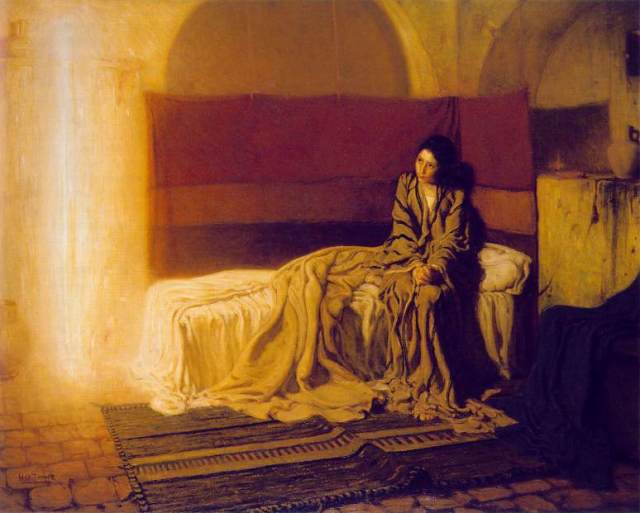
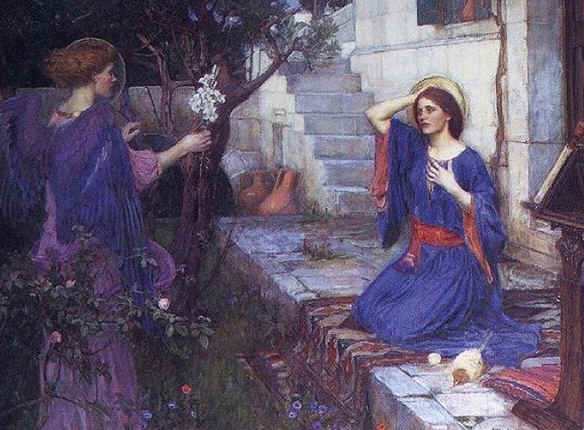
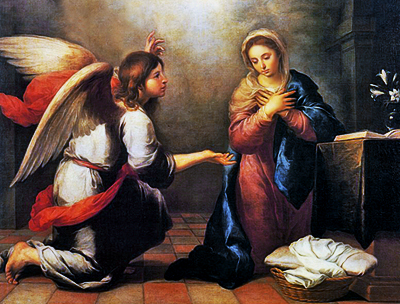
Images in order of appearance: A 13th Century Byzantine icon of the Annunciation from St. Catherine’s Monastery in the Sinai; Henry Ossawa Tanner’s Annunciation (1898); John William Waterhouse’s Annunciation (1914); and Bartolome E. Murillo’s Annunciation completed between 1660 -1665, and please don’t forget to do some research and take a closer look at one of Fra Angelico’s versions of the Annunciation! Please also notice that in Waterhouse’s and Murillo’s renditions both artists have included the tradition that Mary was in the process of sewing the veil that separated the Holy of Holies from the outer room which housed the Altar of Incense in the Temple in Jerusalem; other artists, such as El Greco, do that too.

Copyright © 2012 Deacon Paul O. Iacono All Rights Reserved