The Solemnity of the Annunciation – The Confident Sacrifice Of A Pure Heart

Many years ago, Blessed John Paul 2 spoke to the seminarians of Rome on this, the Solemnity of the Annunciation. He began his homily with the phrase: “Fear not!”  Echoing the archangel’s comments to our Blessed Mother he was trying to calm the natural anxiety of those young men as they  prepared for their Gospel ministry in the world. The Pope counseled them that “We must all accept the call. We must listen [to the Holy Spirit],  and use the grace that we have received from God. We must shore up our strength, and say, “Yes” in confidence and certainty to the call that we hear from the whispers of the Holy Spirit.”

Upon hearing the message of the archangel Gabriel, the ultimate decision by Mary that “Let it be done to me according to your word” conclusively and forever changed cosmic and spiritual history. For at the moment she said “Yes” to Gabriel, our salvation and redemption, through the Cross, began.

Let us not forget, however, that Mary’s “Yes” had a tremendous affect on her, too.  It required a great cost from her personally because it resulted in the Crucifixion – it resulted in the sacrifice of her own son Jesus – and – the sacrifice of her own heart.
Blessed John Paul 2 speaks of this when he says:  “Mary in a particular way – unlike any other – experienced mercy, and at the same time, made her participation in the revelation of the Divine Mercy possible with the sacrifice of her own heart.  Such a sacrifice is closely bound up with the Cross of Her Son, at which she was to stand at Calvary… No one has experienced the mystery of the Cross as did the Mother of the Crucified…. Mary is therefore the person who knows the Divine Mercy most deeply. She knows the price; she knows how high it is.”
He goes on to say, “Maybe there is another point: for all people are born at Mary’s Yes.” This must be understood: such a Yes in imitation of Mary creates joy, a new life, a breath, a blessing;” it creates opportunities for us to  sacrifice our own hearts in imitation of her and the Holy Family.

So as we enter the 5th week of Lent let us celebrate this Solemnity by trying our best to live like our Blessed Mother – a person with complete confidence in the Lord. Let us say Yes to God in imitation of Mary and allow the Lord to work wonders in our own lives, as well.
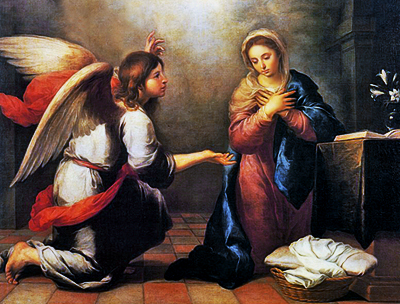
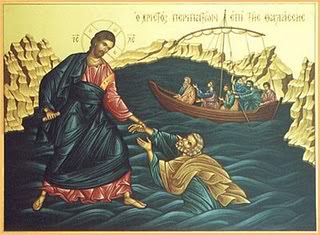
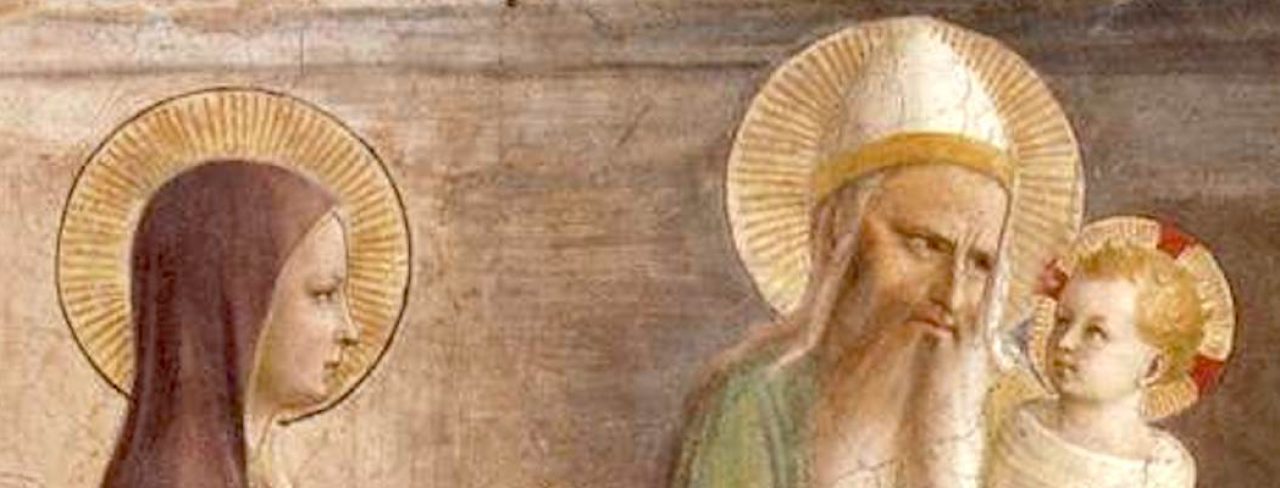
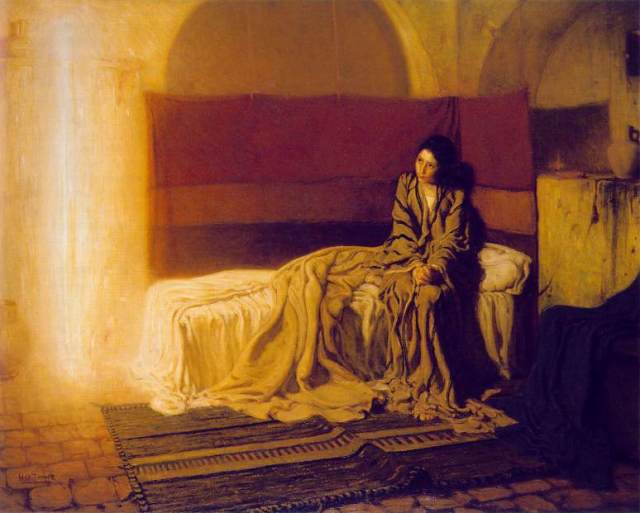
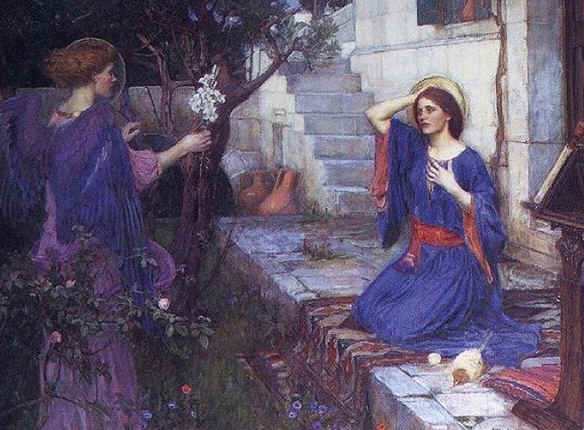
Images in order of appearance: A 13th Century Byzantine icon of the Annunciation from St. Catherine’s Monastery in the Sinai; Henry Ossawa Tanner’s Annunciation (1898); John William Waterhouse’s Annunciation (1914); and Bartolome E. Murillo’s Annunciation completed between 1660 -1665, and please don’t forget to do some research and take a closer look at one of Fra Angelico’s versions of the Annunciation! Please also notice that in Waterhouse’s and Murillo’s renditions both artists have included the tradition that Mary was in the process of sewing the veil that separated the Holy of Holies from the outer room which housed the Altar of Incense in the Temple in Jerusalem; other artists, such as El Greco, do that too.

Copyright © 2012 Deacon Paul O. Iacono All Rights Reserved

The Artist As Contemplative – Part 4 – A Meditation on the Scourging of Christ

In this series on the Artist As Contemplative it is my hope that you are exposed to some different techniques that may assist you in your prayer relationship with Our Lord.

The last post in this series specifically mentioned that we do not need to use many words during prayer. This may be uncomfortable for us at first since we have developed into a species that appears to constantly need some type of noise, talk, music, or in some cases, cacophony going on inside our mind. I am not a social psychologist so I will not venture a reason for such a trend within American society, other than to say that it may be an attempt to buffer the anxiety that people, especially the young, feel.

We must reduce the amount of noise, superfluous talk, and loud dissonant music that hammers our nervous system. We have to do this in order to allow sacred silence the opportunity to blanket us with its warmth so we can settle into a comfortable conversation with Christ.

St. Teresa of Avila is very helpful in this regard. Fr. Peter-Thomas Rohrbach, O.C.D.  clearly states in his wonderful book Conversation With Christ that the prayer doctrine of St. Teresa is clear: “Prayer does not consist in involved, complicated reasoning, but in thought which is productive of conversation with Christ.” So prayer, productive prayer, is conversation with Jesus.

Fr. Rohrbach then goes on to provide an actual demonstration of true meditation provided by St. Teresa of Avila in her own autobiography.

She says: “We begin to meditate upon a scene of the Passion – let us say upon the binding of the Lord to the columns. The mind sets to work to seek out the reasons, which are to be found for the great afflictions, and distress, which His Majesty must have suffered when He was alone there.

It also meditates on the many other lessons, which, if it is industrious, or well stored with learning, this mystery can teach. This method should be the beginning, the middle, and the end of prayer for us: it is a most excellent and safe road until the Lord leads us to other methods, which are supernatural…   it is well to reflect for a time and to think of the pains which He bore there, why He bore them, Who He is that bore them and with what love He suffered them.

But we must not always tire ourselves by going in search of such ideas; we must sometimes remain by His side with our minds hushed in silence. If we can, we should occupy ourselves in looking upon Him Who is looking at us; keep Him company, talk with Him; pray to Him; humble ourselves before Him; have our delight in Him, and remember that He never deserved to be there. Anyone who can do this, though he may be but a beginner in prayer, will derive great benefit from it, for this kind of prayer brings many benefits; at least, so my soul has found.”

The beauty of this approach is that it is completely natural for us to do what she directs in prayer. If we look again at the passages that I have highlighted in bold face you will see that this prayer behavior is the same we would express if we were with a close friend or relative experiencing a troubled or stress filled moment in their life.

So the watchwords here are sensitivity, awareness, and humility. Sensitivity because we need to be willing to listen, and humility in knowing we don’t have all the answers, and the awareness to know that sometimes it is necessary just to keep someone company, and quietly talk to them, without trying to provide solutions.

But it is more than that, isn’t it; because in our prayer we are talking to God. We are talking to the Son of God who suffered for us, because it was the Father’s desire, which He willingly accepts in order to accomplish the salvific act of our Redemption. Our ability to keep ourselves humble before God, delight in His Divine Presence, and remember His Life and Death is critical for a healthy prayer experience.

Our intellect and will working with the faculty of our memory of scenes from Sacred Scripture provide us with the ability to soak ourselves in the meaning of Christ’s great sacrifice. For this is who we are as Catholics, Orthodox, or Protestants – people who bring the images and truth of Scripture and the saints of our traditions into our prayer life.

Does any of this apply to sacred art? Yes, as sacred artists, St. Teresa of Avila would probably say, “Paint and use the best quality and Scripturally correct icons, paintings, sculpture, etc as prayer aids. We need these aids to help the entire person: mind, heart, soul, and body to be focused on Him.”

I’d also venture to suggest that she would say “If you are a sacred artist produce a piece of sacred art that correctly portrays the Scriptural Jesus, the Blessed Mother, His angels, and saints. Remember, a sacred artist must be a person of deep prayer.”

St. John Damascene (Damascus), thirteen hundred years ago, in his writings and teachings very clearly stated that when we do this it is not idol worship. We believe that the Son of God became man; therefore, He became the iconthe image – of God for us to see, hear, touch, scourge, and crucify – “The Word became flesh and dwelt among us.”

This is not idol worship, just as it is not idol worship when you have a picture of your deceased parents on your bureau – you are not making an idol of them – your are not worshipping them – rather, you are remembering them through a celluloid image – an image which helps you relive what they taught and how they loved you – and still do from beyond the grave. So never fear your imagination – or images of the Lord – as long as you guard yourself with images and imagination that are focused with correct theology, semantics, and aesthetics.

I’ll let Father Rohrbach have the last word, he says: “St. Teresa presents us a crystal-clear picture of meditation: the mind furnishing matter for the heart’s talk with Christ. And above all, her fundamental rule that prayer consists not in thought, but in love.”

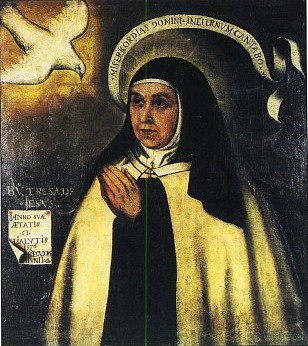
The above image of St. Teresa of Avila is considered to be the closest likeness to her. It was painted in 1576 when she was 61 years old.

Copyright © 2012 Deacon Paul O. Iacono All Rights Reserved
The Feast of St. Joseph – Universal Patron of the Church

At the birth of Christ, the seven hundred year old messianic prophecies of the prophet Isaiah became an historic reality. On a yearly basis, we celebrate and remember that moment on the Feast day of St. Joseph, the patron of the universal Church; for we see in Joseph not only a loyal husband and foster father of Jesus – our Savior – but also a man of conviction and prayer.

Upon hearing that Mary is pregnant Joseph is filled with pain and anger. Understandably, at first, he is not ready to say “yes” to Mary and her story of divine intercession – there are few men that would.  But through divine intervention and the sending of His angel, God makes another request, for the angel relates God’s message: “Joseph, Joseph, do not be afraid to take Mary your wife into your home.”

We call St. Joseph a confident man because – ultimately – he, like Mary, says “Yes” to God. He has confidence because he proclaims his trust in God. With Joseph’s “Yes,” his anger subsides and is replaced with a joyful nurturing spirit that enables him to exert leadership and act as a faith-filled father and loving husband.

Joseph, from that moment, grows in love for his wife and unborn child and through the years, like all fathers, he grows in love and intimacy with Jesus.

An intimacy not only of physical closeness and rapport – but of soul – an intimacy of prayer and meditation that filled his heart and mind with awe; this intimacy and proximity to Jesus meant that he was constantly exposed to the same grace that Jesus gives us in our Eucharistic adoration of Him.

Pope Pius 11th, in his teaching on St. Joseph in March 1928 said, “All Joseph’s sanctity lies precisely in the completely faithful accomplishment of his great and humble mission, so high and so hidden, so splendid and so surrounded with shadows.”

We are truly graced if we realize, like St. Joseph, that we must make ourselves vulnerable to God -– vulnerable to the gifts of God – by exposing our heart, and soul to God’s love – and trusting God – through His Sacramental grace, to turn our hearts, so that we, too, may fulfill the mission – simple or profound – that we are asked to complete in life.

Saint Joseph, pray for us.

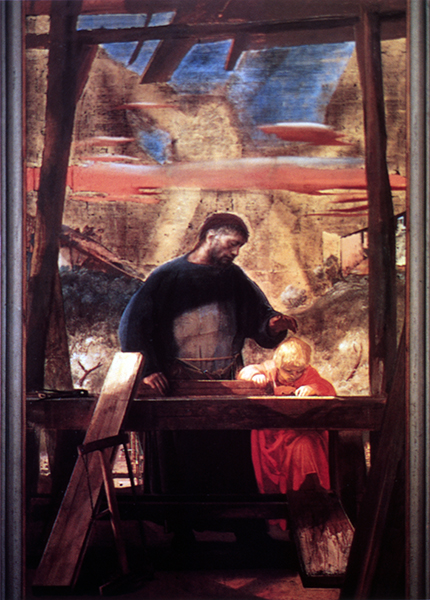
Sacred image of St. Joseph and Jesus by Pietro Annigoni. It hangs in the Church of St. Lawrence in Florence, Italy. It was painted in 1963. Thanks to the website of the Oblates of St. Joseph for the painting by Annigoni.

Copyright © 2012 Deacon Paul O. Iacono All Rights Reserved

The Artist As Contemplative – Part 3 – Prayer Tips

Today, we are asking our good friend, St. Teresa of Avila to help us in the process of thinking clearly about prayer.  She is a worthy mentor – for she cuts to the heart of the matter in a practical and meaningful way.

In her Book of Foundations, she makes many important observations that will help us become more focused on what we are doing in prayer. This focus will in turn help us with our artistic creativity.

A few examples of her perceptive thoughts:

“The first thing I wish to discuss, as far as my limited understanding will allow, is the nature of the essence of perfect prayer. I have come across people who believe that the whole thing consists in thought, [but] if they become distracted and their efforts to think of good things fail, they at once become greatly discouraged and suppose themselves to be lost. It must be recognized that not everyone has by nature an imagination capable of meditating, whereas all souls are capable of love.”

It is my belief, however, that as creative people, artists are very capable of meditation because it involves the imagination. It is crucial, however, that they learn the proper process, and especially for them to remember, if they are a Catholic Christian, that St. Teresa of Avila happily gives sound advice and clear direction to conversation with Christ.

St. Teresa continues, “I am anxious to explain that the soul is not thought, nor will it be controlled by thought – it would be great misfortune if it were. The soul’s profit, then, consists not in thinking much, but in loving much.”

“Do not imagine that I want you to make long meditations on our divine Savior or much reasoning or profound and subtle conceptions. If you cannot do more, [just] keep your eyes fixed for some moments on your adorable Savior [really present in your church’s tabernacle, or, who as Love personified, was nailed to a cross for our Redemption].”

“[Rather than] spending time in prayer profoundly investigating some subject on which they are meditating [you should] place yourself in the presence of Our Lord and converse with Him, heart to heart, without fatiguing the understanding, and tasting the happiness of being in His company.”

The Lord doesn’t need many words from us – less, truly is, more; but He does thirst for our creative and heartfelt love.

As creative people, we necessarily have many things on our “to do” lists. You don’t need me to tell you that 21st century life is exhausting. With that in mind, St. Teresa’s advice is all the more relevant. For we should avoid at all costs making our prayer life another intellectual challenge – another task – that saps the little energy we have left!

She counsels us to meditate using some simple techniques of, at first, opening our mind and heart to the stillness – the quiet – that two friends experience in which they can be in each other’s company and not have to constantly be talking. The subconscious – or conscious – stress of having to keep up the conversation is gone. It is like a husband and a wife, who after many years of marriage, can be in each other’s company, enjoying moments that could stretch on for some time, and yet, not needing to say more than some words of awareness, support, agreement, or recognition.

My next post will provide a meditation by St. Teresa on Our Lord’s Passion.

Copyright © 2012 Deacon Paul O. Iacono All Rights Reserved
The Artist As Contemplative: Part 2: A Simple Step Into Prayer By St. Teresa of Avila

In our last post, The Artist as Contemplative – Part 1: The Proper Approach, we discussed the need to have the proper approach to prayer. One of the assumptions that I have is that if you are reading these posts you are a creative person. You may be an actual working artist, or, you may be attracted to art in one of the various forms it takes and are considering taking the first step in its exploration. Even if you are just beginning to explore a specific art form it is important for you to consider yourself an artist. This is not a fraudulent act. It is the perception of yourself as you truly are as a creation of God – a naturally creative person.

The Lord has made all of us creative beings, and regardless of our job or profession we should make time in our life to develop this creativity and allow it to be expressed. If we have no time for prayer and personal creative growth then we may be in a situation that is truly unhealthy for us. Our Sacred Scriptures tell us that our God is a jealous God – He specifically said that He wants “no other gods before Him” – that is a very sobering thought. So, quiet, prayer time – even if it is only thirty minutes a day – is critical to our spiritual, physical, and creative health.

If we make time for prayer, God’s grace and energy will cascade over into our creative life.  This is very important to artists, regardless of what media or medium we work in, since it demands that we focus our attention on one thing: talking to God in a natural way – talking to Him as we would talk to a close and intimate friend. 

This is difficult for many people. Childhood ignorance or anxieties may still be with us. There may have been bad influences from teachers, members of the clergy and religious life, and others (including, at times, parents) who took a limited view of prayer and taught a specific prayer style to the detriment of other approaches.

By remaining positive we see that a key idea in the prayer process is to remember that when we have a conversation with someone our intellect is remembering ideas and images. We are using those ideas and images in our actual conversation. This allows the conversation to proceed from one point to another and allows ideas or issues to be shared. This is also true in conversation – that is, our prayer – with God. Our intellect, memory, and silent conversation skills within our mind cooperate together to naturally express ourselves to God. Just like the story, in my preceding post, of the little girl receiving her first Holy Communion. She expressed her prayer to God in a natural manner, which made sense and allowed her to share the concerns or ideas with the Lord that were on her mind at that time. Her prayer was a perfect natural prayer.

In examining the teachings and prayer process of St. Teresa of Avila (1515-1585), the Spanish Carmelite, Father Peter Thomas Rohrbach, O.C.D. breaks her basic prayer technique into a simple step formula. He says the goal of prayerful meditation is conversation with Jesus. You achieve  this by engaging your visual memory  with a specific spiritual passage. This con-versation with Jesus about the passage moves to consideration of events within your own life. This process is actual conversation with Jesus in which He, like a good friend, is quietly listening to you.

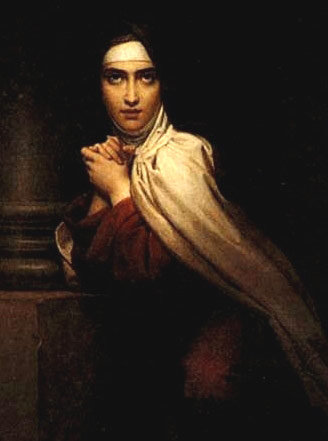
St. Teresa of Avila (seen above in the portrayal by Gérard) is not promoting a prayer life which is filled with complexities, intellectual knots, and unnatural irritations, rather, she is presenting a style which reminds us of a wise old person who has no need of thinking about numerous paragraphs of words to say to God in prayer. The wise one enters their prayer time thinking about God, and specifically His Son, Jesus – the true icon (image) of God. They then allow their love of Him to take over – and fill the blessed silence of that present moment – not with many words – but with much love. You see this is the goal: to move from quiet conversation to quiet meditation – in love – of God’s truth, goodness, and beauty.

In my next post I will provide you with a meditation taught by St. Teresa of Avila. With  this Lenten meditation you should easily exercise your spiritual muscles. Also, it will help you take some time to reflect on St. Teresa of Avila’s approach and application to other moments in Jesus’ life and yours, too.

Copyright © 2012 Deacon Paul O. Iacono All Rights Reserved.  Thanks to avila.com for the image of St. Teresa of Avila by artist François Gérard (1770-1837).

The Artist As Contemplative – Part 1: The Proper Approach

All artists, by their very nature, contemplate. They are natural born contemplatives.

In its dictionary definitions we see that the word contemplate means: 1) “to intently look at something, 2) to study carefully, and 3) to have in mind the possibility or a plan of action.”

A person whose artistic skills are expressed through photography or the enhancement of physical beauty through fashion or cosmetics can certainly contemplate the meaning of beauty and maintain its traditions or break out and establish new ones. The same is true of a sculptor, painter, musician, needlework artist, poet, writer or any person working within other artistic mediums. For they, too, can “look intently at, study carefully, or have in mind the possibility of a plan” to create beauty or a new interpretation of it. As you see, at first glance there is no overt mention of religious or spiritual themes in these definitions.

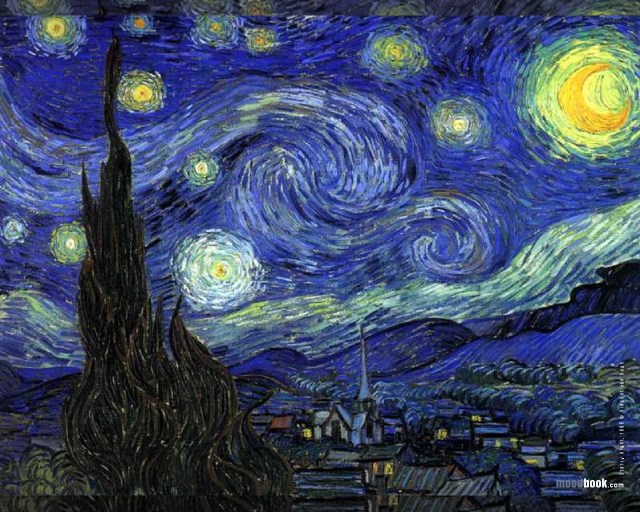
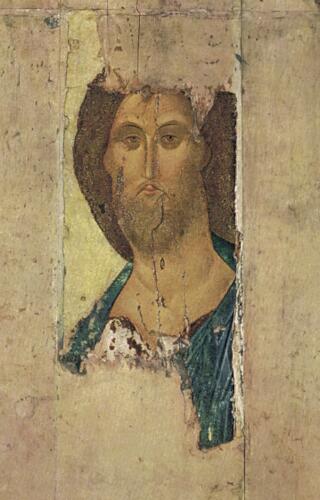
Now let’s go a step further and ask a few questions: 1) Can the Christian artist (who has a natural contemplative spirit by virtue of being an artist), establish the artistic process as a vehicle for authentic prayer and union with God? 2) For example, did our friends Vincent Van Gogh or St. Andrei Rublev experience authentic prayer moments in their creative process? 3) When we look intently at  Starry Night or Christ the Redeemer – the Savior of Zvenigorod (seen below) do we feel comfortable using them in our conversation with God, and if not, why not?

Okay, as the old saying goes, “What does this have to do with the price of eggs?”

Young or old, there are times in our lives when we put up barriers in our minds to pursuing some study or some plan of action. This is especially true when it comes to the whole idea of prayer, and specifically, meditation and contemplation. People have a tendency to say, “Oh, that’s for holy people. I’m a sinner. I could never do it nor do I have the skills to do it. Bottom line, no one has ever taught me how to pray other than saying rote memory prayers.”

Good point. That perception is held by many people, especially Christians that have fallen away from the church of their ancestors. But is that belief just another mind barrier?

It is an established fact of being a Christian that we can be in touch with God, specifically His Divine Son, Jesus. We do believe, if we are Christians, that we all have the ability to enter into deep spiritual union and friendship with God by virtue of our Baptism. Baptism was the first very important step, and then, after that, the friendship of Christ is developed through our weekly worship and daily prayer life, our Scripture study and our Sacramental life. It takes effort, yes; but as Christians we understand that we enter into that relationship with Christ by walking with Him through His ministry and onto the path to Calvary.

The reader might say, however, “I am not a Christian. What does this have to do with me?” Even if the artist is not Christian they have the ability to enter into deep spiritual union with God through their own faith traditions. All the major religions of the world speak of and promote prayer; and all artists, even if they are not Christian, can enter into spiritual union with the Divine through the creative process.

But there is a little known maxim in Catholic Christian prayer practice: if you can think and if you can read (at the second grade level) you are capable of meditation; let me repeat, you are capable of experiencing authentic, prayer filled, and profound contemplation of God.

A quick example of this is the story that Father Peter-Thomas Rohrbach, in his important and delightful book Conversation With Christ that I discovered forty-five years ago. He tells of a young Catholic girl’s experience on receiving her first Holy Communion. He says, “The story is related of a small girl who, after the reception of her first Holy Communion, was questioned tenderly by her parents as to what she had done when she arrived back at her pew and prayerfully bowed her head. The girl hesitated momentarily, and then said in her thin, small voice: “‘I prayed to Our Lord for Mommy and Daddy, and for my sister Helen, and my brother George; and then I recited the alphabet to Our Lord and told Him a ghost story.'”

Father Rohrbach continues, “We, of course smile indulgently at the naivete and innocence of the small child; but after reflecting on the story, we might suddenly wake to the realization that the girl possessed the proper approach to prayer – she was actually talking to Our Lord. What she said to Christ was relatively unimportant, what she did was decidedly important: she entered into immediate contact with her Friend, Christ. If we could learn to converse with Christ as she did, we would be making successful prayer; if we could adopt her attitude for the conversation period of our meditation, our problems in this regard would be at an end.”

So, this is what we hope to accomplish in this blog’s series on The Artist  As Contemplative – to learn and develop the proper approach to prayer. My posts over the next month or two will deal with different approaches to prayer that an artist might use to assist in their artistic creativity and in their prayer life; and ultimately, to explore and apply the idea that contemplative prayer is unspoken prayer of the highest order; for it is in contemplative prayer that a person is united to God and ponders His truth, goodness, and beauty.

My next post will discuss the eight simple steps of prayer that has been promoted by the spiritual studies and athleticism of the nuns, brothers, and priests of the Roman Catholic Order of Carmel – Discalced Carmelites – over the last four hundred and fifty years. It is my perception that these simple steps are essential in mastering the procedure of spiritual contemplation and meaningful prayer with Our Lord. Subsequent posts will demonstrate other approaches to Christian prayer, some new, some very creative, and others ancient tried  and true techniques that the Church – both Eastern and Western Rites – have expressed over the last two thousand years of its history.

Copyright © 2012 Deacon Paul O. Iacono All Rights Reserved

Making Room In Your Heart for God, Prayer, and Creativity

The Gospel of St Mark, chapter 9: 14-29, challenges us to ask ourselves the question “How does the effective disciple of Jesus live his or her life?” Clearly the ineffectiveness of Jesus’ disciples in doing His work is evidenced when the father of the possessed boy complains to Jesus that His disciples were unable to help his son, and even questions the power of Jesus to intervene on his son’s behalf.

Jesus responds with disappointment tinged with anger over the actions of some of His disciples; people who took it upon themselves to act in Jesus’ name but were not prepared to do so – for they did not ready themselves through prayer, fasting, and good works.

Jesus was upset with them for their lack of preparation. He implies that they were not effective co-workers. They were not ready to share His mission because they believed  they could remain who they were and still carry out the work of Jesus.

At that point in Christ’s ministry they didn’t realize that they had to be willing to cooperate with Him and transform themselves into His Life; a transformation, which accompanied by the grace of God, demanded great effort on their part.

In private, Jesus’ disciples asked Him why they didn’t have any success. He said, referring to the evil spirits,  “This kind can only come out through prayer.”

An Internet friend of mine from West Virginia, Fr. Paul Wharton recently said, “the transcendent knowing of God in prayer is making room in myself for an experience of His loving presence deep within me and all around me.”

This is such an important point, for we must make room for God deep within ourselves. As spiritual people we must guard against the weakness evidenced by the disciples in this Gospel. They thought they were acting like Christ, they thought they had His power in their lives, but they had not made room for Jesus in their hearts, and when faced with the enemy they were unprepared – they were helpless and impotent.

So, as creative people – as artists in our various fields – how do we become effective disciples of Jesus Christ? I believe our effectiveness is based on four concepts: 1) the grace of God coming to our hearts and souls through Christ’s Holy Sacraments; 2) our willingness to open our hearts and allow God to go deep within our souls so that He may evangelize us; 3)  our personal effort to be transformed into His Gospel Life through prayer, Scripture study, and our  unique approach to the creation of sacred art; and, 4) our faith and trust in His ability to lift us up, like the possessed boy, out of our suffering – or to give us the strength to bear what we are asked to endure.

These four concepts have an important part to play in our creativity and productivity as sacred artists. We must see ourselves, and the various arts that we produce, as part of His divine mission to first, evangelize ourselves, and then, through our art, those around us.

As we approach Ash Wednesday and the first week of Lent, I would like to raise your attention to a series of posts that I will publish during Lent dealing with the idea of prayer as it applies to our creativity. I will explain and explore with you a few valuable methods that I have learned over the years and one that I have recently been made aware of by a fellow member of the Fra Angelico Institute for the Sacred Arts.

I pray that you will profit from these upcoming posts and that they may help you in your process of becoming an effective disciple of Christ and an even more creative and Spirit filled person! May the Lord bless you with a happy and creative Lent.

Copyright © 2012 Deacon Paul O. Iacono All Rights Reserved     Thanks to starrymantle.blogspot for the sacred art rendition of today’s Gospel; and if you have a chance check out Fr. Paul Wharton’s blog at http://heartsonfire33.wordpress.com/2012/02/17/adrian-van-kaam-1920-2007-on-prayer/

St. Vincent of Saragossa – Martyr – And An Artistic Challenge!

Today, January 23rd, is the Feast Day of Saint Vincent of Saragossa.  St. Vincent was a deacon and served as a minister and trustworthy pastoral assistant of Bishop Valerius, of Saragossa, Spain. He was martyred in the year 304 during the ferocious persecution of the Roman Emperor Diocletian. Saint Vincent is the most famous martyr of Spain, and St. Augustine testifies to this in his sermons that Vincent’s acts of love and loyalty to Jesus Christ, and service to the Catholic faith, were so respected that they were read and discussed in all the churches of North Africa.

Owing to the fact that Bishop Valerius had a speech impediment, Deacon Vincent was given the faculty to do all the preaching in their diocese. When the persecutions resumed, the Roman governor Dacian had Vincent and the bishop dragged in chains to Valencia where they were imprisoned. Bishop Valerius was subsequently banished, but Deacon Vincent, as a result of his preaching, was subjected to many cruel tortures such as the rack, the gridiron, and frequent scourging, all of which ultimately led to his martyrdom.

Legend tells us that even in death his murderers were not satisfied, for they threw his corpse into a field to be devoured by vultures; but, according to eyewitnes- ses, a raven defended his body by successfully fighting off the scavengers. His body was later buried and a chapel built over it.

In Vincent’s story we have the witness of a man who stood up, in Christian love and faith, to the might of a Roman imperial government that did all it could to destroy him in life and in death. They were so outraged by him because Saint Vincent would not renounce his sacred ordination to the diaconate, would not renounce the truth of the Church, and would not renounce Jesus Christ even in the face of unspeakable and savage tortures.

St. Vincent of Saragossa is a man who deserves to be recognized. If we review the images of this early Spanish saint, we see  a number that are sensitive and well-done, but it really is time to produce a new icon, or sacred image, of this great witness to the truth, love, and mercy of Jesus Christ. If you are a sacred artist or iconographer, and are interested in producing an icon or sacred image of St. Vincent, I will happily post it (with your permission of course) on this blog. He is a great model for all Christian young people today and we need an image of him that is contemporary to our age.

Come and join us, and like St. Vincent of Saragossa, have some of your art, or all of it, spread the Good News that the love, life, death, and resurrection of Jesus Christ has healed our broken relationship with God the Father!

Copyright © 2012 Deacon Paul O. Iacono All Rights Reserved
Whose Star Do We Follow?

St. Thomas, in his Summa Theologiae, has a wonderful meditation on today’s Solemnity of the Epiphany. He says that “Salvation was to be through Christ and apply to all sorts and conditions of men because in Christ Jesus there cannot be Greek or Jew, slave and free man. In order that this should be foreshadowed in Christ’s birth, he was made known to men and women of all conditions, because as St. Augustine says, the shepherds were Israelites, the Magi were Gentiles, the first were near, the latter from afar: both hastened to Christ the cornerstone…. The Magi were wise and powerful, the shepherds, simple and lowly. He was also manifested to the just, Simon and Anna, and to sinners, namely the Magi. And also both to men and to women… so as to show that no human condition was barred from His salvation.”

Dominican Father Andrew Carl Wisdom, OP adds to these observations the following prayer: “Newborn King, you show no partiality in your love for us. Young or old, rich or poor, educated or uneducated, you could not love us any more in the next moment than you do in this moment. But my witness wavers at times, Lord. I lose track of the real Star, caught up in becoming one myself. Help me to once again kneel before you like a little child and open up my treasuries of time and talent on behalf of the work which I was sent.”

As you know, this blog is dedicated to evangelizing the truth, goodness, and beauty of God through the study and creation of sacred art in His honor. As artists the meaning of the Epiphany is very important solemnity to us. Why? Because it reminds us and redirects our creative efforts away from following the supposed light and friendship of the secular world, the television, the political party, or the glow of the computer screen, to the true Light – the Light emanating from the face of Christ.

Yes, we have to exist within our particular culture. We have to make a living and provide for ourselves and our loved ones. Yet, as Christians, Jesus Christ’s manifestation to the Magi asks us to remember that we must live in the world but not have our souls be overcome or compromised by it. The shepherds and Magi were changed by the Light of Christ’s face – may His Light and Presence change us, too.

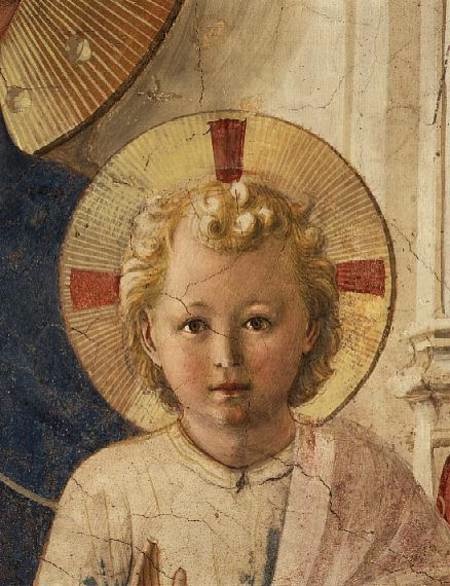
Image of Jesus Christ by Blessed Fra Angelico (1387 – 1455).

Copyright © 2012 Deacon Paul O. Iacono All Rights Reserved

Christ Child by Fra Angelico

To all the friends, followers, and members of the Fra Angelico Institute for the Sacred Arts,

We wish you all a very Merry and Holy Christmas Season and a grace filled New Year!  May the blessings of the child Jesus and the adult Savior remain with you, and your loved ones, throughout the coming months.

We thank you so very much for your support, advice, and participation, and we look forward to sharing new artistic adventures with you during the next year! Thanks again for all that you have done to make the Institute meaningful and helpful in the promotion of the sacred arts and in the evangelization of the truth, goodness, and beauty of God, His angels, and His saints.

Warm regards,   Deacon Paul and Jackie Iacono

This image is an extreme close-up of a painting of the Madonna and Child Jesus with assorted saints painted by Fra Angelico in Florence during the early 15th century.

Copyright © 2011 Deacon Paul O. Iacono All Rights Reserved
 

The Triumph of the Cross and Our Lady of Sorrows by Jed Gibbons

Today we celebrate the feast of the Exaltation – or Triumph – of the Holy Cross.

The early Catholic Church was intensely persecuted during the first 280 years of its life – so the symbol of the Cross – the symbol of public humiliation and excruciating death – was rarely used in our Christian iconography. But this doesn’t mean that the early Christians were reluctant to express their devotion to the Cross. Writing in the year 204, the Christian theologian Tertullian said: “At every going in and out, when we put on our clothes, when we sit at table, in all the ordinary actions of daily life, we trace upon our forehead the sign [of the Cross].”

In the year 313, the Emperor Constantine signed the Edict of Milan, which proclaimed toleration for the Christian faith within the Roman Empire. Constantine’s mother, Helena, made a pilgrimage to the Holy Land, and with the support of the local bishop – excavated the area known as the site of Golgotha. Tradition states that portions of the true Cross, with a partial nameplate still attached was found, resulting in Constantine ordering that the Church of the Holy Sepulcher be built over the site. The church was dedicated nine years later, with a portion of the Cross placed inside it. So the feast that we celebrate today marks the dedication of the Church of the Holy Sepulcher in the year 335. That Church was unfortunately destroyed by the Muslims in the year 1009, only to be rebuilt centuries later, with the new occupants – all Christians – vying for control of the site! Unfortunately even among our brother Christian Churches there have been numerous clashes and conflicts over the control of this holy site. It is as if all of us – as guardians of the Church’s holiest site – had not internalized the meaning of the true Cross – the meaning of what happened on that site 2000 years ago – the meaning of the Father’s supreme sacrifice of His Son for the sake of His creation. God’s love was raised up on Golgotha that day and Satan’s venom was forever neutralized, but the sting of Satan’s original bite in the Garden of Eden still remains.

The truth of our Scripture readings tell us that Moses lifted up the bronze serpent, a sign of sin, and the people were healed. Jesus makes an analogy of the serpent with the healing power of the Cross – since it is a sign of our sin and our redemption. When the Father, through the Holy Spirit, lifted up Jesus in the resurrection, the Holy Cross was no longer viewed as a sign of evil and sin – rather it became a sign of Christ’s victory and our salvation.

Our Savior, through the instrument of the Holy Cross, shows us the level of His love for His  creation. The Father shows His love for us by giving us the best He has  – His Son – and His Son shows His obedience and trust in the Father – through His willingness to take upon Himself all sin and become a perfect offering back to the Father on our behalf. The Fra Angelico Institute for the Sacred Arts chaplain, Fr. Joseph Upton, gave a beautiful homily today at morning Mass in which he emphasized that every day, we too raise up Jesus on the Cross. In every Mass, we have re-presented the sacrifice of Jesus for us. We commemorate His act and we thank Him for it in His gift of Himself to us in the Eucharist. We unite ourselves to the Triumph of the Cross through the Mass.

As sacred artists, on a daily basis, we must attempt to imitate this profound love of God in our creation of artistic works, and in our families and community. Our love must be strengthened by the truth of our faith – and by the triumph of the Cross; when we do this we will understand that the crosses that we carry, and the sufferings that we endure, unite us to the Lord, and help us transform our lives into His. Our Blessed Mother is our model for this transformation.

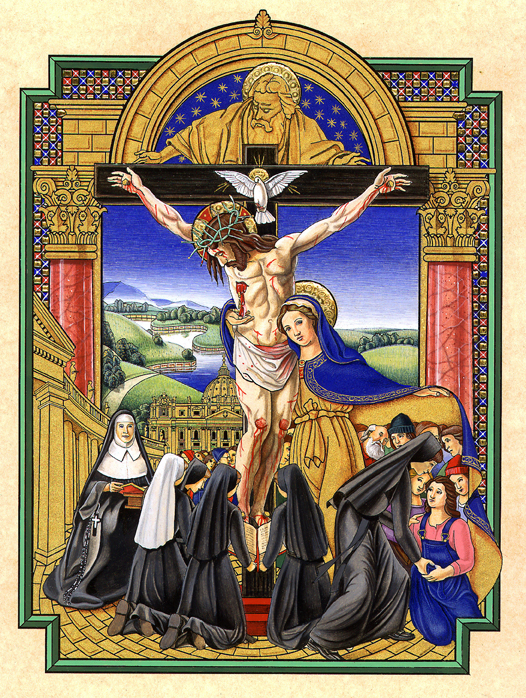
Tomorrow, September 15th, is the memorial of Our Lady of Sorrows. The Invitatory prayer that begins the Office of Readings in the Liturgy of the Hours says, “Let us adore Christ, the Savior of the world, who called his mother to share in his passion.” Those words reminded me of a beautiful illuminated miniature by Jed Gibbons, a very fine artist from Chicago. I met Jed when he was teaching at the St. Michael’s Institute for the Sacred Arts at Enders Island in Mystic, CT. Jed has produced some truly inspirational work (his Stations of the Cross in the chapel on Enders Island are exquisite) and this piece that you see below captures not only the theme of the Triumph of the Cross but the truth of the Church’s teaching that Mary shared in the passion of her  Son. This piece is entitled   Maria, Mater Misericordiae (Mary, Mother of Mercy); it was completed in 2006, and was done in historic earth pigments and 23 karat gold. It measures 6.75 by 9.25 inches. I thank the Foundation for the Sacred Arts website for the image.

Copyright © 2011 Deacon Paul O. Iacono All Rights Reserved. Image copyrighted by Jed Gibbons All Rights Reserved


Sacred Iconography and Personal Creativity – Do Not be Afraid!

What is iconography?

The Sacred Iconography Guild is one of the twelve Sacred Arts Guilds that is sponsored by the Fra Angelico Institute. As of this post we have six members of this Guild who have expressed interest in learning this particular artistic tradition of the Church. Unfortunately, many people in the 21st century do not know the traditions of the Western (Latin, that is the Roman and affiliated rites of the Church) or the Eastern (Orthodox, that is the Coptic, Greek, Russian, and other Middle Eastern Rites) of Christ’s Church. All of these Rites have beautiful liturgies, the Sacraments – Holy Mysteries, and traditions – of which sacred iconography is one. This Institute hopes to be one more voice – among many – bringing these traditions to light to a new generation of people. So this post hopes to begin the survey of what sacred iconography is and how we can participate in it.

The word icon is Greek for “image.” Specifically, as it is applied in our usage, it refers to a sacred image that has been painted by a trained iconographer in a way that portrays the sacred presence of Jesus Christ, His mother – “the Theotokos,” His angels, and the saints. Icons in both the Latin Rite and Eastern Rite Churches are venerated – never worshipped. They act as sacred windows or doorways that allow us to view the heavenly realm of divinized humanity or the visual representation of Scriptural truth.

Iconography is simply the study of icons, their development through the centuries (the first iconographer is considered to be St. Luke the Evangelist), the techniques and methods used by various “schools” of iconography within specific cultural regions – and within specific national areas. By “school” I mean a collection of iconographers working under a master iconographer that has a specific style through which they portray Our Lord and the sacred people, mysteries, and historic occurrences within the Church’s history.

Sacred icons portray theological reality. So, it is mandatory that a sacred iconographer follows the “canon” of iconography that developed through the centuries. The “canon” consists of the rules that an iconographer must follow in painting, that is, “writing” an icon. I say “writing” because the tradition states that an iconographer must be aware of the great responsibility that he or she has in conveying the “Scriptural truth” within the image itself. In other words, the iconographer must not change Holy Scripture. He or she paints (“writes”) what is in Holy Scripture, or within Church history and Tradition, because as Pope Benedict 16th has said: sacred images have an important role to play in the “catechesis of the people.” So the iconographer cannot be portraying his or her version of Scripture – or Church history – to do so would be as bad as one of the Evangelists changing the words of the Gospel as he writes or prints a new copy because he desires to be creative or “express” himself.

So this brings up the question of the role that an artist’s personal creativity and skill plays in the development and expression of the written icon. I highly recommend that you go to the websites of my teachers (Peter Pearson; Dimitri Andreyev (Prosopon School); Marek Czarnecki (Seraphic Resorations); and Anna Pokrovskaya Gouriev (Izograph School) to examine their galleries and to see the beauty of their work. Examine an icon of our Lord Jesus or our Blessed Mother by Peter, Dimitri (or his father Vladislav), Marek, Anna (or her mother Xenia) and you will see not only the display of creativity of these iconographers, their skills, their color choices, their simplicity and purity, but also, the truth, goodness, and beauty that is the theological truth of their icons. Their icons are 20th and 21st century pieces of sacred art – yet – they are firmly within the “canon” of the Church’s perception of iconography and serve as models for the expression of Truth, Goodness, and Beauty.

As our Lord said to His disciples in the boat as they were being tossed about by the sea – “It is I. Do not be afraid.” This applies to us, too, as spiritual travelers, artists, and novice iconographers – the Lord is with us – we have nothing to fear because we have put our trust in Him.

Copyright © 2011 Deacon Paul O. Iacono All Rights Reserved
The Eternal Now and the Coronation of the Blessed Virgin Mary

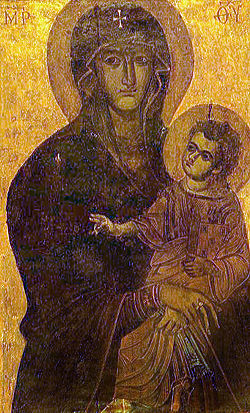
Today is the memorial of the Coronation of our Blessed Mother. Sacred icons and images have expressed the Queenship and Coronation of the Holy Theotokos – the Mother of God – for at least 1500 years. The icon The Virgin Salus Populi Romani, a 5th century icon, displayed in the Church of Saint Mary Major in Rome, and seen below, shows the Blessed Mother dressed in typical first century Middle Eastern garb as she holds her Son who gives a blessing. This icon reputed to

be a copy of one that was painted by St. Luke the evangelist who tradition states knew the Blessed Mother and spoke and listened to her .

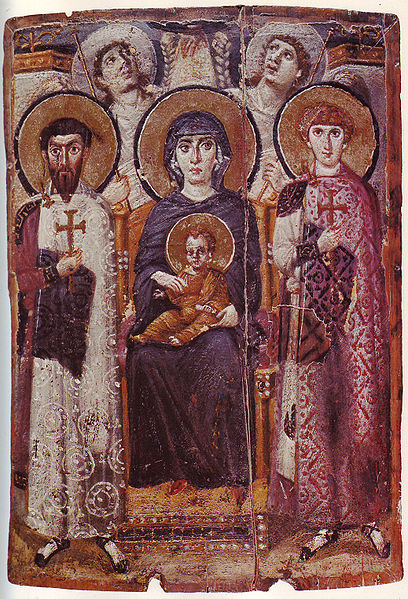
A 6th century icon of the Blessed Mother and Child displays a coronation theme – in which the Blessed Mother and her Son are in Heaven. Mary sits on her throne with Her Son on her lap, surrounded by St. Theodore on the left and St. George on the right, while two angels look up as the hand of the Father gives a blessing. This icon is found in the Monastery of St. Catherine in the Sinai Peninsula.

Our iconic images painted (“written”) by orthodox iconographers of both the Latin, Greek, Russian, Coptic, and other Rites agree with the ideas found within our Holy Scriptures. For example, today’s Gospel passage tells us “… the Lord God will give to Him the throne of His father David; and He will reign over the house of Jacob forever, and of His kingdom there will be no end.” This Scripture explains that the Lord willingly takes the initiative to come forth – with hands extended – to meet us and share the reign of His kingdom.

In sacred art we visualize this not only in the extension of Christ’s hands on the cross – but also, in the extension of the infant Jesus’ hands, to give us a blessing, as He sits in His mother’s lap – or is caressed in her arms – an image that is found not only in the above icons but in numerous statues found in Latin Rite churches throughout the world.

Our first reading – from Isaiah – also speaks of Christ in regal terms – as Emmanuel (God is with us) – the “Prince of Peace.” And we can even get apocalyptic and speak of the Books of Daniel and Revelation which recall the truth that the world will be transformed through the birth of the Redeemer, made possible by Mary, (“a woman clothed with the sun, with the moon under her feet, and on her head a crown of twelve stars… who gave birth to a son – a boy destined to shepherd all the nations with an iron rod. Her child was caught up to God and His throne”). – This woman, our Blessed Mother, enables the incorporation of the reign of God into the world. She is the  woman destined to crush the head of the apocalyptic serpent.

St. John of Damascus speaks about this in the 8th century when he says of the Blessed Mother that she “has become the terror of demons, the city of refuge for those who turn to her. [He has her say:] Come to me in faith, O people, and draw as from a river of grace. Come to me in faith, without doubt, and draw from the mighty and certain source of grace.”

On the solemnity of the Assumption – we recalled Blessed John Paul 2nd saying “…the Assumption of the Mother of Christ in Heaven forms part of the [Lord’s teaching about] His victory over death – the beginning of which is found in the death and resurrection of Christ.”

So in today’s memorial – Mary, the humble daughter of our Heavenly Father, garbed in the majestic robes of a queen takes her place next to the throne of her resurrected and ascended Son.

Why? 

Because the Church desires to teach us that Mary is privileged – beyond all other women and men – to be the first and most significant human being to participate in the glory, triumph, and reign of God. By her very willingness to become the Mother of God – the Theotokos – she agreed to become our spiritual Mother, too.

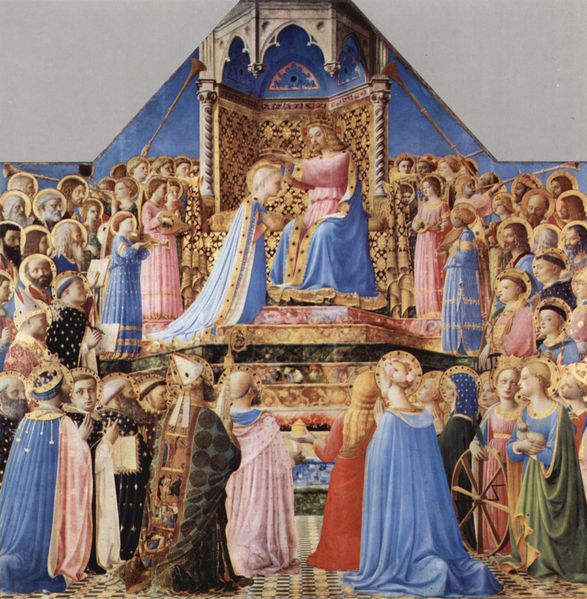
In this beautiful sacred image by Blessed John of Fiesole, also known as Fra Angelico, the great Dominican artist of 15th century Florence, portrays the moment of Our Lady’s Coronation – with the Heavenly court surrounding her. Interestingly, you see men and women saints that were alive thousands of years after Mary’s assumption observing the event. Why did the good Friar do that? He is expressing the fact that Heaven is within the eternal now of the Trinity – the knowledge of that coronation moment is known by St. Thomas Aquinas – who looks out at the observer (in the lower left corner) – and notes the truth, goodness, and beauty of God in desiring this for His beloved and humble human daughter – the Queen of Heaven.

The Blessed Mother, in her regal beauty, authority, and power, has not left us orphans – for she is “the Living Temple of the Holy Spirit, the Inviolate Mountain, the ladder” that joins Heaven and earth – the “One who Shows the Way” (Hodigitria) to her Son and to our Heavenly reward.

If we remain faithful and loyal to the teachings of Christ – as expressed through our Sacred Scriptures and our Church – and as the Epistle of St. James teaches – “Act on that faith…” then we, too, will reign alongside our Heavenly Mother as we give praise and glory to God.

Our Lady – Queen of Heaven – pray for us.        Sources: John Paul 2, L’Osservatore Romano, August 15, 1983; Pope Pius 12th – encyclical Ad Caeli Reginam, October 11, 1954.

Copyright © 2011 Deacon Paul O. Iacono All Rights Reserved

Welcome to the Fra Angelico Institute

Our First Post

As our first post – on August 1, 2011 – I would like to explain that the mission of the Fra Angelico Institute for the Sacred Arts is to promote the creation of Christian sacred art and unite the creative process to the artist’s personal prayer life. Over the coming months we will be discussing various topics within the sacred arts, the creation of sacred art, important sacred artists from the past and present, and the development of our personal prayer life in union with our personal creative efforts.

The Fra Angelico Institute for the Sacred Arts was founded by myself and my wife Jackie in 2009. I am an ordained Roman Catholic deacon in the Diocese of Providence, Rhode Island. Professionally, before my retirement, I was a teacher of history and the humanities. I have studied and created sacred art since 2006. I am a sacred image painter.

An Amazing Revelation!

In my very first sacred art workshop, that was conducted by the talented and very fine teacher, Rev. Peter Pearson, I was profoundly struck by the impression that the actual creation of sacred art was of great importance to the improvement of my own personal prayer life. As I followed Peter’s directions in the creation of a sacred image, I realized that the truly spiritual connection I was experiencing was not the result of anything artificial, rather, it was the yearning of my soul to “connect” with the Person  coming into view on the wooden panel (the image that I was painting was an interpretation of St. Andrei Rublev’s icon of Jesus). It became very clear to me, as it had to so many other artists down through the centuries, that the creation of sacred art, regardless of what medium or form it takes, is a profoundly spiritual and prayerful act – IF – the artist decides to open up their mind, heart, and soul to the whispers of the Holy Spirit.

Join Us In This Exciting Adventure!

We think that the Institute is an exciting adventure in art and prayer. Currently we have over twenty people from the Diocese of Providence who are members, and, a few from out of state. The ideas and images that you will be seeing are meant to be educational, inspirational, and practical in the improvement of your development as a sacred artist. You may be a seasoned artist – secular or sacred, or, you may be a complete novice – all are welcome. In future posts I will explain the different categories of art you may want to explore and – if you are an experienced artist – display and express your creativity in the galleries on this site.

As Roman Catholics we have a specific theological perspective and faith tradition, however, please consider following us if you are from a different Christian denomination. After all, my teachers of sacred art are Episcopalian, Russian Orthodox, and Roman Catholic; and the participants in the sacred arts workshops that I have attended have been from many different Christian and non Christian denominations. Thanks for your interest and we look forward to your comments.

Copyright © 2011 Deacon Paul O. Iacono All Rights Reserved