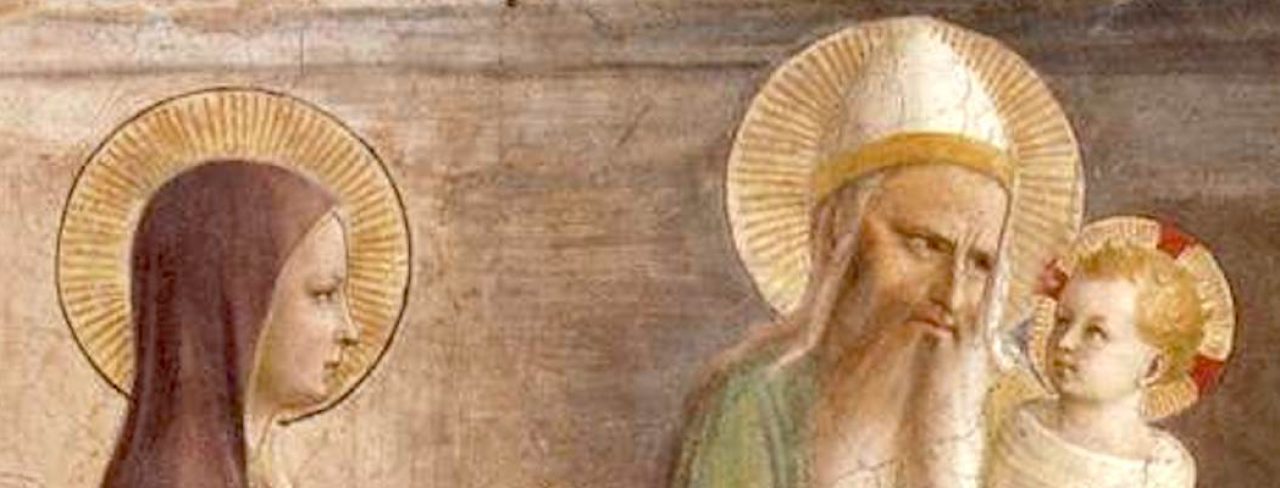
Today is the memorial of the Coronation of our Blessed Mother. Sacred icons and images have expressed the Queenship and Coronation of the Holy Theotokos – the Mother of God – for at least 1500 years. The icon The Virgin Salus Populi Romani, a 5th century icon, displayed in the Church of Saint Mary Major in Rome, and seen below, shows the Blessed Mother dressed in typical first century Middle Eastern garb as she holds her Son who gives a blessing. This icon reputed to
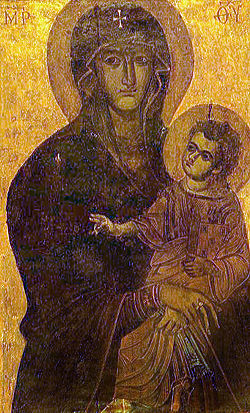 be a copy of one that was painted by St. Luke the evangelist who tradition states knew the Blessed Mother and spoke and listened to her .
A 6th century icon of the Blessed Mother and Child displays a coronation theme – in which the Blessed Mother and her Son are in Heaven. Mary sits on her throne with Her Son on her lap, surrounded by St. Theodore on the left and St. George on the right, while two angels look up as the hand of the Father gives a blessing. This icon is found in the Monastery of St. Catherine in the Sinai Peninsula.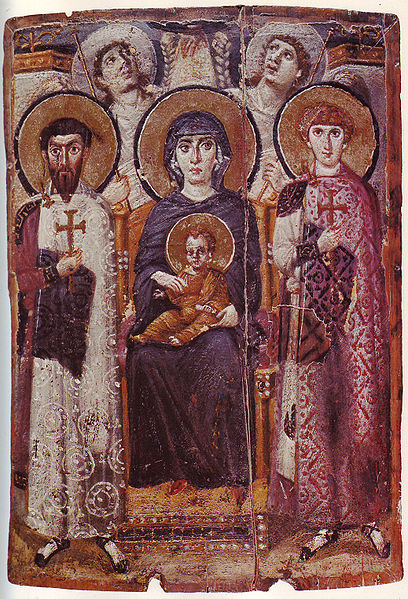
Our iconic images painted (“written”) by orthodox iconographers of both the Latin, Greek, Russian, Coptic, and other Rites agree with the ideas found within our Holy Scriptures. For example, today’s Gospel passage tells us “… the Lord God will give to Him the throne of His father David; and He will reign over the house of Jacob forever, and of His kingdom there will be no end.” This Scripture explains that the Lord willingly takes the initiative to come forth – with hands extended – to meet us and share the reign of His kingdom.
In sacred art we visualize this not only in the extension of Christ’s hands on the cross – but also, in the extension of the infant Jesus’ hands, to give us a blessing, as He sits in His mother’s lap – or is caressed in her arms – an image that is found not only in the above icons but in numerous statues found in Latin Rite churches throughout the world.
Our first reading – from Isaiah – also speaks of Christ in regal terms – as Emmanuel (God is with us) – the “Prince of Peace.” And we can even get apocalyptic and speak of the Books of Daniel and Revelation which recall the truth that the world will be transformed through the birth of the Redeemer, made possible by Mary, (“a woman clothed with the sun, with the moon under her feet, and on her head a crown of twelve stars… who gave birth to a son – a boy destined to shepherd all the nations with an iron rod. Her child was caught up to God and His throne”). – This woman, our Blessed Mother, enables the incorporation of the reign of God into the world. She is the woman destined to crush the head of the apocalyptic serpent.
St. John of Damascus speaks about this in the 8th century when he says of the Blessed Mother that she “has become the terror of demons, the city of refuge for those who turn to her. [He has her say:] Come to me in faith, O people, and draw as from a river of grace. Come to me in faith, without doubt, and draw from the mighty and certain source of grace.”
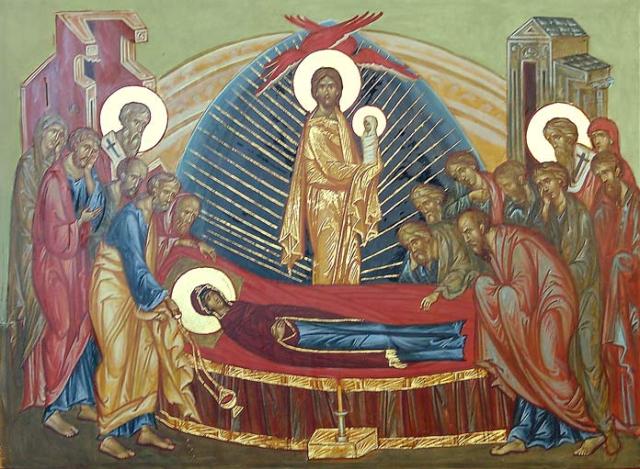
On the solemnity of the Assumption – we recalled Blessed John Paul 2nd saying “…the Assumption of the Mother of Christ in Heaven forms part of the [Lord’s teaching about] His victory over death – the beginning of which is found in the death and resurrection of Christ.”
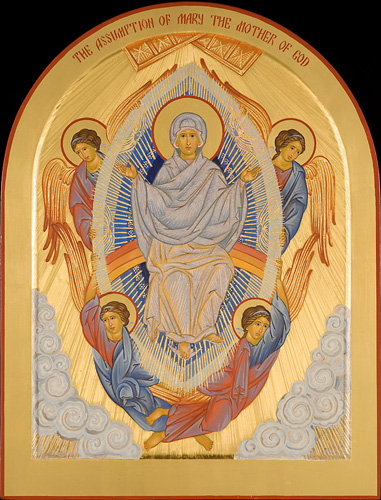
So in today’s memorial – Mary, the humble daughter of our Heavenly Father, garbed in the majestic robes of a queen takes her place next to the throne of her resurrected and ascended Son.
Why?
Because the Church desires to teach us that Mary is privileged – beyond all other women and men – to be the first and most significant human being to participate in the glory, triumph, and reign of God. By her very willingness to become the Mother of God – the Theotokos – she agreed to become our spiritual Mother, too.
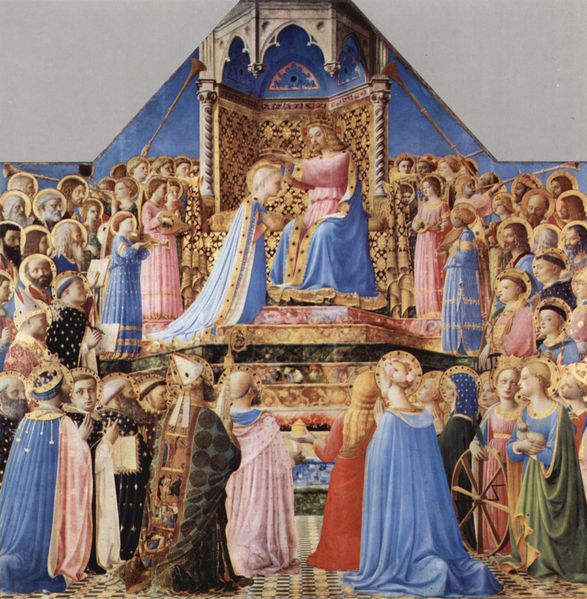 In this beautiful sacred image by Blessed John of Fiesole, also known as Fra Angelico, the great Dominican artist of 15th century Florence, portrays the moment of Our Lady’s Coronation – with the Heavenly court surrounding her. Interestingly, you see men and women saints that were alive thousands of years after Mary’s assumption observing the event. Why did the good Friar do that? He is expressing the fact that Heaven is within the eternal now of the Trinity – the knowledge of that coronation moment is known by St. Thomas Aquinas – who looks out at the observer (in the lower left corner) – and notes the truth, goodness, and beauty of God in desiring this for His beloved and humble human daughter – the Queen of Heaven.
The Blessed Mother, in her regal beauty, authority, and power, has not left us orphans – for she is “the Living Temple of the Holy Spirit, the Inviolate Mountain, the ladder” that joins Heaven and earth – the “One who Shows the Way” (Hodigitria) to her Son and to our Heavenly reward.
If we remain faithful and loyal to the teachings of Christ – as expressed through our Sacred Scriptures and our Church – and as the Epistle of St. James teaches – “Act on that faith…” then we, too, will reign alongside our Heavenly Mother as we give praise and glory to God.
Our Lady – Queen of Heaven – pray for us. Sources: John Paul 2, L’Osservatore Romano, August 15, 1983; Pope Pius 12th – encyclical Ad Caeli Reginam, October 11, 1954.
Copyright © 2011 Deacon Paul O. Iacono All Rights Reserved



 The Fra Angelico Institute for Sacred Art
You must be logged in to post a comment.