Catechesis and Naive Sacred Art: St. Peter – A Lesson Plan

IMG_5011
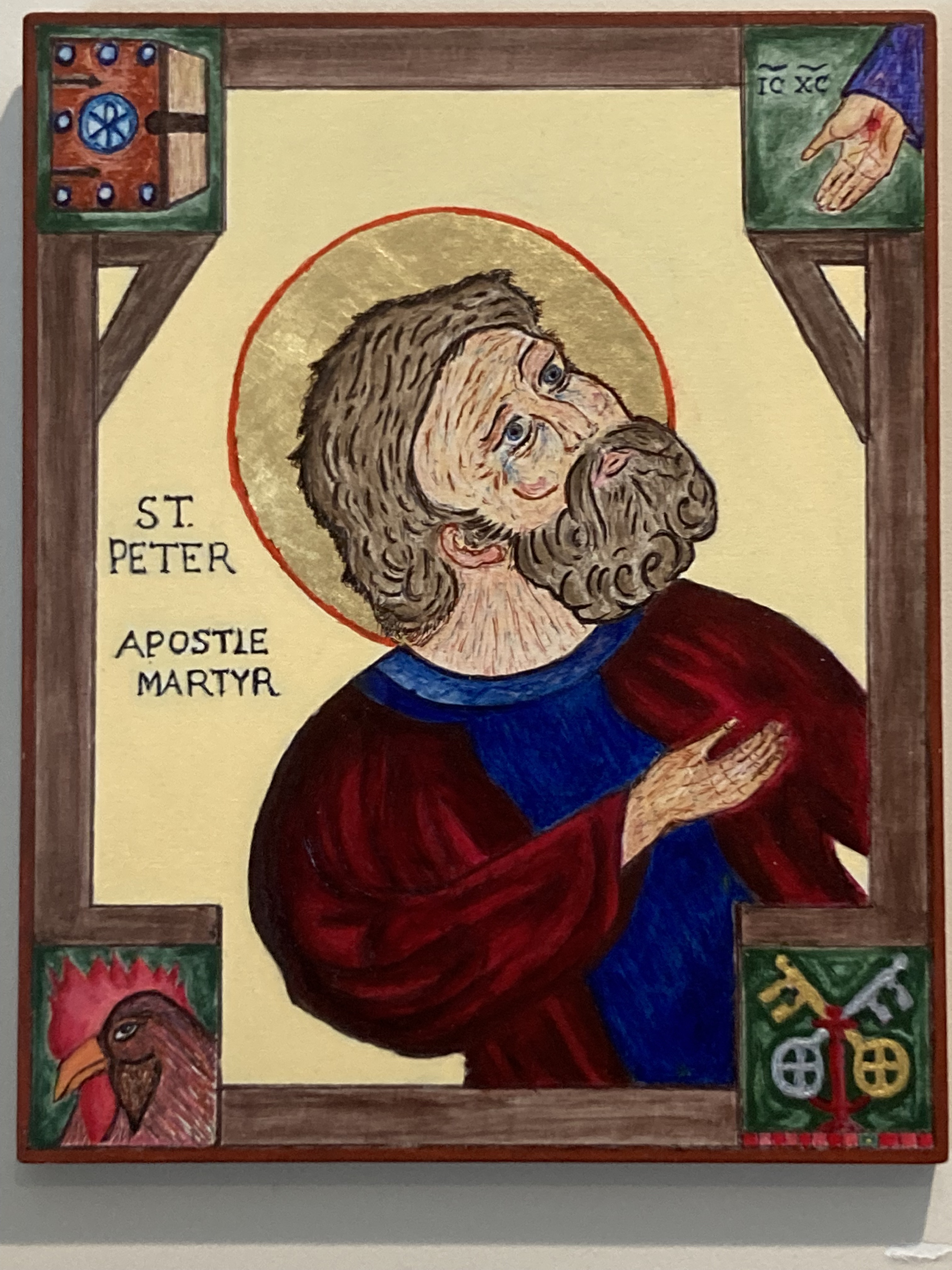
Image painted by Deacon Paul O. Iacono Copyright © 2021-2022

One of my goals in painting the above image of St. Peter was to provide a catechist/observer with seven focus ideas within one image. This sacred image also presents some of the life events of the “Rock” on which Jesus Christ built His Church. I have painted this image with the approach of the Naive/Folk Art genre or “school.” I will discuss the Naive/Folk art approach in my next post. Below are my seven fundamental ideas that can be used as a lesson plan(s) for the above image:

  1. The image is based on Christ’s words and Peter’s actions within the New Testament (have the students look up the verses found within the Gospels and Epistles).
  2. The image itself presents the presence of Peter who is suffering (his posture, body movement, expression, tears, and the extension of his hand). He is requesting Christ’s forgiveness.
  3. Christ is identified by the label IC XC (the Greek abbreviation for the name Jesus Christ). Christ is extending His hand in forgiveness and to raise Peter’s spirit.
  4. The rooster in the bottom left corner is harkening back to its crowing after Peter denies Jesus (Scripturally predicted by Christ). The rooster is also looking at the viewer, reminding us of our personal sins.
  5. Papal authority. Peter is the first pope. He is the first bishop of Rome, the spiritual leader of the Church, and is symbolized by the two keys that are given to him, echoing Christ’s words of “you are Peter (Petros) and on this rock/stone (Petra) I will build my Church.” The keys are painted in gold and silver. Gold represents spiritual authority in union with the Church’s bishops. The silver key represents the papal influence within the world for issues that would affect the good of the Church and people as a whole. The keys are united by a red anchor (symbol of hope and steadfastness – found in the catacombs and the Epistle to the Hebrews). The sufferings of the clergy and laity are built upon the sufferings of Christ and the ministry/martyrdom of the first Apostles (12 squares under the keys; the green square represents St. John who was not martyred). The brown border encapsulating St. Peter reminds us of the cross on which he was martyred as well as the Cross of Christ.
  6. Diagonal lines could be visually drawn through Peter from the upper left corner of the books of the Holy Scriptures to the lower right representing the teaching authority of the pope (Peter’s successors); as well as the upper right of Christ’s hand to the rooster on the lower left reminding us of Peter’s denial and Christ’s forgiveness.
  7. This denial by Peter is not the denial of Judas Iscariot who was also an Apostle. Throughout the Catholic Church’s history we have had both clergy and lay people deny Christ through their words and actions. It all began with the Apostles; however the difference between Peter and Judas is that Peter despaired, pleaded for forgiveness, and was picked up through Christ’s forgiveness. Judas despaired, did not plead for forgiveness, and threw himself down on the end of a rope.

If you find this subject interesting I recommend you read my post on Catechesis and Catholic Art published on June 26, 2021. Thanks.

Copyright © 2011- 2022 by Deacon Paul O. Iacono – All Rights Reserved. Permission to reprint essays and/or my paintings must be obtained from me by, using the comment box and making a comment/request on the post. I will respond to you through answering in the comment box. Students, and those interested, may quote small sections of my essays as long as the proper credit and notation are given. Thank you.

St. Lawrence – Deacon and Martyr

18956-st-lawrence-distributing-alms-fra-angelico
St. Lawrence, deacon of Rome, distributing alms to the poor; painted by  Fra Angelico, circa 1447.

Today we celebrate the feast of St. Lawrence, a deacon and third century martyr.

St. Lawrence was one of the seven deacons of Rome who served as the Pope’s ministers during Holy Mass and as his administrators to the people of Rome.

There is little historical evidence remaining on St. Lawrence. His Acts had been lost by the time of St. Augustine in the 4th century, yet, Pope St. Leo the Great and St. Augustine wrote about him and his martyrdom. The tradition of the Church states that he was a native of northern Spain and was ordained by Pope St. Sixtus II. The Pope made Lawrence responsible for the distribution of the Church’s alms.

St. Lawrence died during a persecution by the Emperor Valerian (circa 258). His death occurred a few days after the martyrdom of Pope Sixtus II and four deacons (Januarius, Vincent, Magnus, and Stephen).

Art historian Carl Brandon Strehlke (see note at bottom) has mentioned that there is controversy over the specific date of his martyrdom. Some accounts state that  Lawrence was martyred under the emperor Decius (AD 249 – 251) and others insist that it was under the reign of Valerian (253 – 260).

Regardless, the Church’s tradition states that he was martyred soon after the emperor Valerian issued an edict in early August, 257. This edict required all Catholic bishops, priests, and deacons to be denied trial and be immediately put to death.

As the Pope and four of his deacons were led to their deaths, Lawrence is purported to have said: “Where are you going, Holy Father, without your son? Where, O Bishop, without your archdeacon? Before you never approached the altar of sacrifice without your servant, and now you are going without me?”  Pope St. Sixtus commented that Lawrence would soon follow him.

Valerian’s administrators came to Lawrence and demanded access to the wealth of the Church. He asked for a few days to assemble it, and subsequently, distributed much of the Church’s treasury to the poor.

The money transfer to the Roman government was to occur on August 10th. Lawrence led the prefect and guards to a room within the Vatican. Upon opening the door and with the force of  a saint he declared:  “Behold the jewels of the Church.” The room contained some of Rome’s blind, poor, sick and maimed!

On the same day Valerian ordered that Lawrence be taken out and slowly martyred in payment for his cheeky behavior towards imperial dignity. St. Lawrence refused to renounce our holy Faith, and was roasted on a gridiron used for cattle. Legend says that he was of good humor to the very end, at one point saying to his executioners: “I’m done on this side. You can turn me over now!”

Many centuries later his story of faith and heroism was artistically proclaimed to the faithful. In 1447 Pope Nicholas V selected Fra Angelico to decorate a Vatican chapel dedicated to the two famous martyrs and deacons of the Church: the protomartyr St. Stephen of Jerusalem and St. Lawrence of Rome.

Fra Angelico successfully linked the narratives of their stories together so that they convincingly expressed the main elements of each saint’s life. They are catechesis as well as beautiful art. Angelico’s painting portrays St. Lawrence in an exquisite rose colored dalmatic (the garment which signifies the deacon’s service and loyalty to his bishop). The fresco is approximately 9 by 7 feet and was painted between 1447 – 1449.

Note: Carl Brandon Strehlke’s comments on St. Lawrence are to be found in Kanter and Palladino. Fra Angelico. Metropolitan Museum of Art, Yale University Press, 2005.

Copyright © 2011- 2020, Deacon Paul O. Iacono – All Rights Reserved. Permission to reprint must be obtained from the author in writing. Students, and those interested, may quote small sections of the article as long as the proper credit and notation is given. Thank you.


Fra Angelico – “Heaven on Earth” Exhibition – Part 2 – Ascension, Pentecost, the Last Judgement

I hope you had a blessed Feast of Pentecost!

Please read Part 1 of “Fra Angelico – Heaven on Earth” (posted here on May 16, 2018) in order to receive a proper introduction to the Isabella Stewart Gardner Museum’s extraordinary exhibition that, unfortunately, closed this weekend..

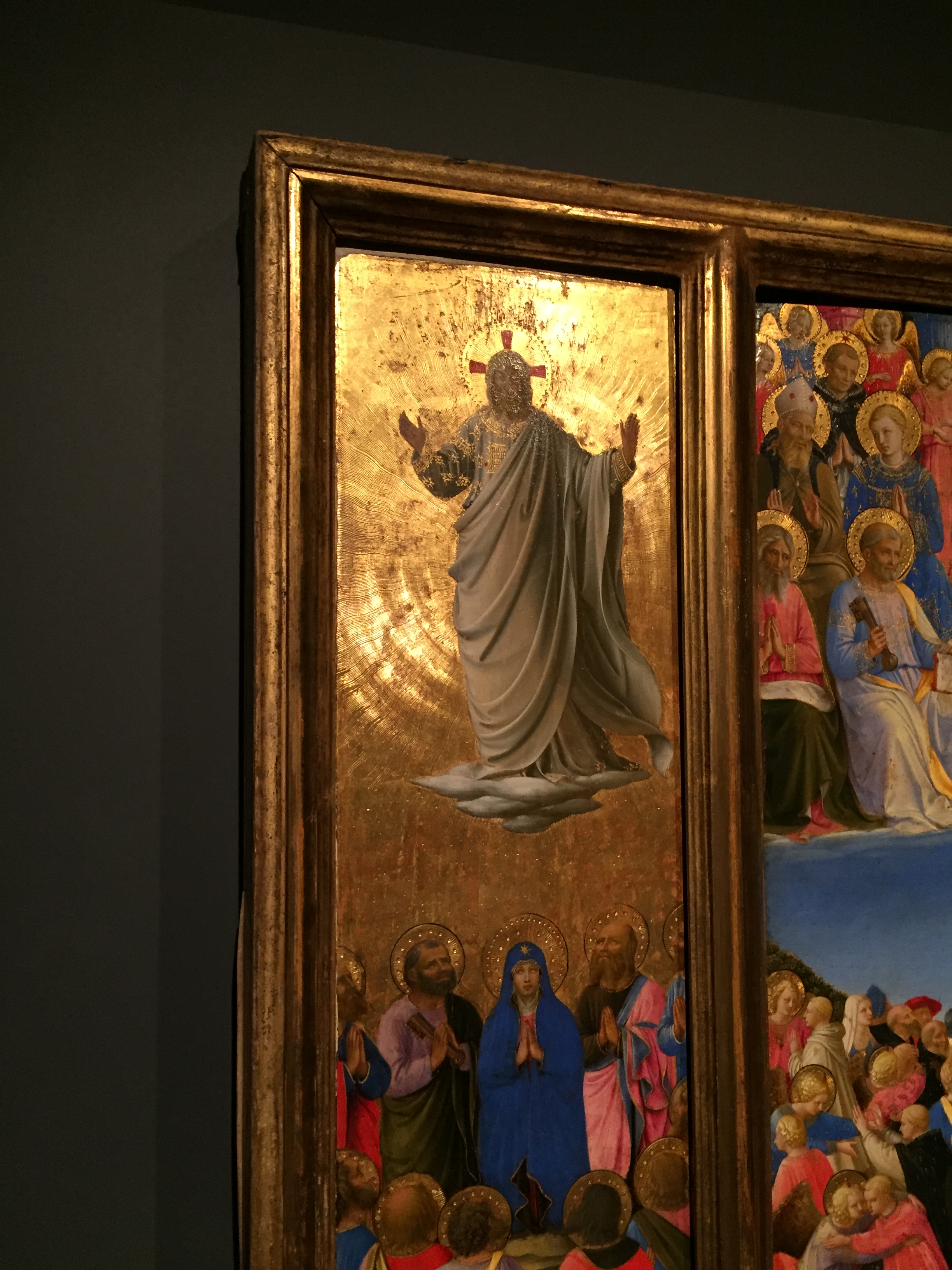
As you moved into the gallery that exhibited this once in a lifetime collection of Fra Angelico paintings you first saw the beautiful painting entitled The Ascension of Christ, The Last Judgement, and Pentecost (the Corsini Triptych). It is painted in egg tempera with gold leaf on a wood panel. Fra Angelico painted it during the years 1447-1448, seven years before his death in 1455. It was loaned to the Gardner Museum from the Galleria Nazionali d’Arte Antica di Roma – Galerie Barberini Corsini, Palazzo Corsini.

My photographic images of that painting are found below:

The Ascension, Last Judgement, and PentecostIMG_1686

The following quotation is taken from the Exhibition’s commentary found on the right side of the painting. Mesmerizing in its detail, Fra Angelico’s painting pictures three biblical events. At left, Christ ascends into heaven over the heads of the Virgin Mary and the  Apostles. At right, a masterfully foreshortened dove – the Holy Spirit – descends to earth. The story culminates in the center. Christ passes judgment over the living and the dead, saving the worthy (left) and condemning the wicked (right). While the damned cower from fearsome devils who attack the poor souls with claws, angels embrace the blessed.

“This small devotional triptych – a painting with three parts – served a cultivated individual, probably a cleric (deacon, priest, or bishop) in Rome.” Please compare its three episodes to others in my upcoming posts. In the above painting Fra Angelico adopts a vertical presentation. This energizes the connection and communication between heaven and earth. The Gardner Museum’s curator remarked that this technique “enlarges the central scene, and emphasizes” the Catholic Church’s spiritual power.

Fra Angelico, as a Dominican priest, desired to present that Jesus’ act of Redemption (passion, death, and resurrection), and His Ascension back to the Father, made possible the moment of Pentecost. Christ’s actions enabled the eventual opportunity for our free will to choose to accept His Truth and be fed by the Spirit’s power. It is the Father and the Son’s will to have the Holy Spirit nourish us through His grace. This grace is available to us through the proper administration and worthy reception of the Holy Sacraments. Thus, we come to the central panel –  the Last Judgement. Did we freely accept His Sacramental grace or did we ignore, and thereby, reject it? At that moment will we be on the right or the left of Christ?

Allow me to make some personal points on the three close-up photos below. In the first panel of this painting, notice the gold work around the body of Christ. I was allowed to closely examine it. I have never seen a painting’s gold work done with such precision and delicacy. It is not just gold leaf that is applied in a flat manner to the panel. It appears to be actual raised strands, or threads of gold, all applied with great precision. As you slowly move left or right around that part of the painting you notice the light catching the gold and literally radiating and shimmering around the image of Christ. IMG_1745

The Ascension, with Pentecost below.

Second, the image of Pentecost, with the Blessed Mother in the center of the Apostles as the dove hovers and the fire of the Holy Spirit descends upon them and gives them the gifts and fruits of the Holy Spirit (Isaiah 11:23; 1st Corinthians 12: 4 ff; Galatians 5: 22 ff).

Notice St. Peter, filled with conviction, speaking to the assembly of men below (“Peter’s Discourse” found in the Acts of the Apostles chapter 2, verses 14 ff.). Also, notice the clothing on one of the men who gather outside of the upper room listening to Peter: the detail of the lace work on the bottom of one of his garments, and the shadows on the man’s red leotard/shoe. If you stand away from the painting at approximately eight to ten feet to take it all in (as you see in the panoramic top photo) you don’t notice all the detail; but the blessed Fra with his extraordinary perception, noticed the need for it, and he painted it in. A master of detail, and as a true maestro, he knew how to successfully accomplish it. Wonderful!     The last two close-up pictures are below.

IMG_1748

IMG_1749

My photos (through the kindness of the Isabella Stewart Gardner Museum), and            my text © Deacon Paul O. Iacono 2011-2018. Photos taken with an iPhone 6, no flash.