3rd Century Bronze Medallion of Saints Peter and Paul

In response to a valuable comment made about my post – Part 2 – Icons, Icon Painters, and Praying with Sacred Images, I thought everyone would enjoy seeing one of the oldest images in existence of Saints Peter and Paul: a bronze medallion found in an excavation of the cemetery of Saint Domitilla in Rome.

The Domitilla cemetery is fascinating because it is the oldest of the Roman catacombs and, according to one source, still contain bones. The Domitilla catacombs are very well preserved and contain a second century (AD 101 – 200) fresco of the Last Supper.

This image of the 3rd century bronze medallion is provided through the courtesy of Dr. Margherita Guarducci. It is found in her book The Tomb of Peter, which was published in 1960 through Hawthorn Books. The 1911 edition of the Catholic Encyclopedia verifies the authenticity of this bronze medallion and identifies other sources for the likenesses of Saints Peter and Paul. This bronze medallion is  in the Vatican Museum in Rome.

The medallion is unique, not only because of its age, but for its iconography; for it shows us the typical images of Peter and Paul that we know through our Church’s sacred art. St Paul (on the left) is portrayed with bald head and full beard, and St. Peter is portrayed with a full head of hair and a full beard.

The artistry of the medallion maker in crafting this piece is superb, since we can see that Peter has high cheek bones, a steady gaze, and pleasant facial expression. St. Paul also has unique features, with a specific cast to his nose and gaze in his eyes. The Scriptures tell us that St. Paul was afflicted with a number of ailments, and it appears, that the maker of this medallion was aware of that fact. One of the key features that St. Paul projects in this medallion is the steadiness of the gaze, and what appears to be the readiness to enter into debate and preach the word of God to all that would listen to him.

This is a fine image to pray with and meditate on this week, especially owing to the fact that this Friday, June 29th, is the Solemnity of Saints Peter and Paul. The Depositio Martyrum (dated to the year AD 258) places the solemnity of these two men on that date. They are also the patrons of my Diocese – Providence, Rhode Island, U.S.A.

Saints Peter and Paul, pray for us.

When People Or Governments Get In Our Face

Recently I received a rather funny email from a friend concerning a God loving Marine coming to terms with an atheist professor. It triggered, however, a serious reflection on how we, as Christians, are to confront those who “get in our face” about issues of spiritual beliefs, sacred art, religious freedom, and personal liberty.

The passage from St. Matthew’s Gospel, chapter 5: 38-42, on “an eye for an eye and a tooth for a tooth” gives us an insight into who Jesus is as God. The behaviors that He explains, and asks us to imitate, are actions that He would perform; so in this passage on “an eye for an eye” we are getting a glimpse into the personality of God.

Jesus explains that the old Jewish law of “an eye for an eye and a tooth for a tooth” is no longer appropriate or virtuous in God’s eyes, it doesn’t reflect the behavior and actions that the Lord is trying to teach His people to follow, actions which reflect the Lord’s own mind and heart.

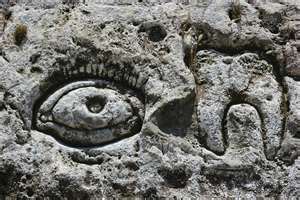
The following photo by talented photographer Kenny Lindstrom found at www.flickr.com/photos/kennylindstrom/ provides meaning, visual imagery, and the clarity of a typical traffic stop sign. We instantly recognize what the creator of this sculpture is trying to say (by the way, is this image done in sand, stone, or clay?). We get the message; but, as in all art, its interpretation depends on the values and beliefs of the viewer. Lindstrom’s photograph is a wonderful example of how a piece of art can display an impression that is both a teaching and reflective moment for the viewer.

The Holy Scriptures, however, are not to be viewed as artistic reflections or suggestions to the reader and listener. The Holy Spirit divinely inspired the Bible; thus, the faithful understand (sometimes better than many of the academics) that Jesus, as the Son of God, came to teach, preach, and heal mankind. His words are not suggestions, they are directions for living within His Sacred Heart; and that demands fortitude, perseverance, and most importantly, His grace.

Over the last two thousand years the Catholic Church has taught that we have a right to defend ourselves – a right to resist the evil that is done to us. But Jesus teaches that we should not resist evil with an evil response or by an evil means  – in other words we should not resist evil with a spirit of vengeance, rage, anger or with an unlawful or excessive physical or verbal response.

So, Jesus is teaching us that the tribal law of an “an eye for an eye and a tooth for a tooth” is destructive and directly opposed to the Father’s plan of a loving spiritual family living within a shared community.  Yet, not everyone in the world is a Christian; and the 20th and 21st centuries are showing themselves to be much more personally and collectively violent than many of the other centuries combined.

So what do we do? Jesus teaches us that our response to evil and insult, as difficult as this may be, should be measured; that is, it should be filled with patience and grace. For if we confront and attempt to defeat evil with an evil or vengeful response, then, we are weakening ourselves and empowering that which we hope to defeat. This does not mean, however, that we are to deny a sense of righteous and justifiable anger over injustices that are done – the Lord Himself gave witness to that when He drove the moneychangers and polluters of His Father’s Temple into the street.

The world can slap us on the cheek, it can take our belongings, it can take away our religious, political, and artistic freedoms and prevent us from speaking out against injustice, and it can even take our lives, but it can never touch our hearts or souls because the Lord God Himself has forever claimed us as His own children.

Let us pray that when we do have to correct our own actions or those of another, we do it based on Jesus’ spirit of graceful moderation, love, and kindness.

Copyright © 2012 Deacon Paul O. Iacono All Rights Reserved

Seeds of Faith and Art

In our Gospel today, from St. Mark Chapter 4: 26-34, we have two important parables concerning the reign of God: the first concerns the farmer’s sowing of seed and the second refers to the growth of the seed.

When we examine the threads running through these parables we hear  Jesus explaining not only the functions that the farmer performs, but the nature of the seed that is sown, as well. This first parable is found only in Mark’s Gospel and explains that through the ministry of Jesus, God’s sovereign and all-powerful rule over mankind is made visible.

This is similar to a passage from the book of Ezekiel, chapter 17: 22-24, where we hear God asserting His sovereignty; the prophet Ezekiel concludes his passage with God saying, “As I, the Lord, have spoken, so will I do.” God is telling the ancient Hebrews that they will see what He can do – He will manifest and make Himself visible to them.

In the first parable the evangelist Mark explains that God is the Divine Sower, the Divine farmer, and that God’s power and fruitfulness appears throughout the history of the Jewish people. Mysteriously, at a time known only to God, His reign would suddenly be made visible and manifest – like a seed which was nestled in the warm soil, suddenly appearing one morning as a young shoot – ready to grow into a fruitful plant.

Jesus is that fruitful plant – that vine – that cedar – that shoot of Jesse that developed out of  the family of King David, and suddenly appeared in ministry to all of Israel.

If we are open to its influence, spiritual and natural growth in the life of Jesus Christ is the process  of entering into the rhythm of God’s beating Sacred Heart; with every beat there is growth. We may be unaware of it – but it occurs – it goes on all around us – it sustains us in our very being –  it sustains the very existence  of the universe.

In the second parable from this passage from Mark’s Gospel, we again hear Jesus speak of a growing plant and tell His disciples that the Kingdom of God works like the natural growth process of a typical mustard seed.

Jesus is emphasizing that the growth of the Kingdom of God, and the reign of God in our individual hearts through faith in Him, is exactly like a natural process. A mustard seed is small but when it matures it becomes a large shrub – and the same is true with faith.

When I was younger, my wife and I enjoyed planting a  large garden. we quickly learned that in order to have a successful garden, we needed to thoroughly pastor the soil, sow the seed in a specific way to allow it to germinate, and then water and feed the plants when they sprouted.

I mention this because the Divine Sower must also pastor the seed of faith in order for it to grow. St. Mark explains that Jesus tells His disciples that the Kingdom of God will sprout and  grow in their hearts. Like a garden, their hearts, as well as  ours – must be tilled, warmed, and watered, to receive the seed of His Son who is Sower, Servant  and Savior. Once that is done, the people of the Kingdom of God – the Church – will grow into a mighty plant, a mighty tree, one in which there will be many branches. That tree, as Ezekiel tells us, will be fed and watered with God’s graces.

So, how does this Gospel challenge us – especially those of us who are artists?

Our faith is like an unmarked packet of seeds – God sows – we grow; and sometimes we stand in astonishment at what has – or has not – taken root. As the faith of a child grows and receives the good, or, bad food that the family, Church, and society provides, he or she ultimately begins to make choices – choices which may, unbeknownst at the time, have a dramatic impact on whether their faith bears fruit abundantly, moderately, or not at all.

God is the Divine Sower of the seeds of faith. Each seed that He sows is good, each soul that receives it is good – and we, as pastors of that seed, must do all that we can to assist God in its growth in our own hearts and the hearts of those around us. If you are Christian, you may have been taught to believe that we must never tire of carefully tending the vine of faith that has enwrapped our hearts. God the Father’s witness is our model. He continuously gives of Himself to His Son, who in turn, gives of Himself to us through Scripture and Sacrament, and sends the Spirit to shower His Gifts upon our hearts.

But this blog reaches many people throughout the world. As of the last count, people in 65 different nations have stopped by and read some of these posts. I am sure that there may be many people who are not Christian who read this blog for one reason or another, Some artists may be  attracted to it because of a “prompting” within their soul to see and read about the truth, goodness, and beauty of God, others may just be curious, and that’s fine, too.

So as artists, I believe that the promptings that we follow to create something new, to experiment with color, clay, sound or image, are sprouts of the divine vine that blooms within our own soul. Our art, whether we realize it or not, is an expression of the fruitfulness of that seed that Jesus speaks of in His parable. The problem that many of us face is that we want the vine to “fruit” as quickly as possible. The virtue of Patience is an absolute necessity for the successful artist. We are not born with this virtue, it must be developed, and cultivated. How many artists have been frustrated and irritated by the fact that some thing, some person, some event has gotten in their way to start or finish a project or piece – whatever it might be. Yet, many times, it is the artist him or herself, that is the cause of the delay. For we forget that the seed, when planted, is a good seed. The concept, the idea, the score or sculpture, is a good idea – we just have to follow through with it and have confidence in our own abilities, that it will “sprout.”

So if the Lord is the Divine Sower, who has planted and enabled the seed to germinate, sprout, and take root, it is now our job – as His servants, to model His work, and tend the seed, tend the gift of our faith and our art, as well as we can; and then, know when to get out of the way, and trust God to do the rest.

Copyright © 2012 Deacon Paul O. Iacono All Rights Reserved.     The painting of The Sower is by Harold Copping. Copping was a British artist who was born in 1863 and died in 1932. He was especially known for his Biblical scenes and travelled to the Middle East on a number of occasions to study the people and places of the Bible. Thanks to Bing images and Wikipedia for the reference.
Icons, Icon Painters, and Praying With Sacred Icons: PART 3

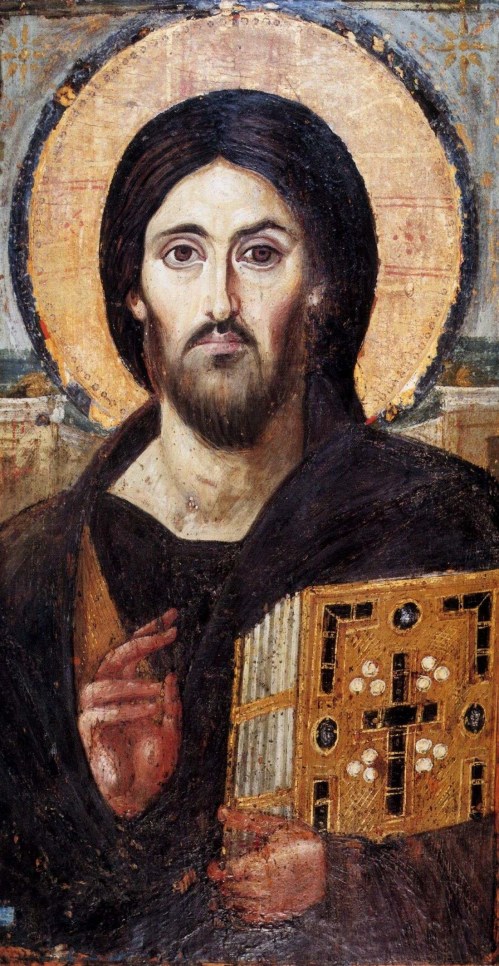
My favorite sacred icon of  Our Lord Jesus Christ is the 6th century encaustic icon of Christ Pantocrator (Christ The Almighty One) from St. Catherine’s Monastery in the Sinai Peninsula.

This sacred image was a paradigm shift in the way early Christians viewed and portrayed Jesus Christ. This icon (shown below) is not the thin young  Messiah of the Catacombs, or the Roman nobleman presentation of the first four centuries of Church art (for examples confer Pierre du Bourguet’s book on Early Christian Painting). The Sinai Christ Pantocrator is portrayed as a robust Semitic man, who knows exactly what He is about, what His mission is, and what He expects of His followers in their living out of His Gospel life.

Interestingly, recent research has shown that when the image from the Shroud of Turin is compared to the image of Christ in this icon of Christ Pantocrator there are many points of similarity between the two images; possibly implying that the painter of Christ Pantocrator had seen the facial image found on the Shroud of Turin.

Allow me to suggest that when we are painting a sacred image/icon we must prayerfully enter into conversation with the Heavenly person we are representing, we must research his or her life, and then view what the Traditional forms of their representation has been in the history of sacred iconography.

We should then explore how we could make the truth of the Lord’s or a saint’s holy witness speak – using the language of the palette – to the 21st century. We should learn from the past, and absorb and pass on the beauty that is found within Holy Tradition.

Yet, at the same time, we need to constantly examine the work of some of the fine icon painters in the world today, people like my teachers: Peter Pearson, Marek Czarnecki, Anna Gouriev Pokrovsky, and Dimitri Andreyev. I have recently been influenced by the work of  Ksenia (Xenia) Mikhailovna Pokrovskaya, originally from Moscow, and now living in Massachusetts. Not to be missed is the work of Vladimir Grygorenko from Dallas, Texas. His sacred icons have a richness and luminous quality that is very beautiful and spiritual. We must also become familiar with the work of British iconographers Brother Aidan Hart, and David Clayton; the Norwegian Solrunn Nes, and the Russians: Archimandrite Zinon from the Pskov-Caves Monastery, and Philip Davydov and Olga Shalymova from St. Petersburg, Russia –  all of these people, and many others, prayerfully create beautiful icons that speak to 21st century people who are willing to listen. The wonderful news is that there are many sacred artists and iconographers – known and unknown – that are prayerfully engaging the ancient traditions of Catholic and Orthodox art, and prayer from the heart, throughout the world.

As we enter into our study of sacred art and iconography we need to first start with a survey book which gives us an overview of the sacred artistic tradition of the Eastern Church. We should first examine the great little book Icons and Saints of the Eastern Orthodox Church (ISBN 0-89236-845-4; translated by Stephen Sartarelli and published by the J. Paul-Getty Museum, 2004) and use it as a starting point to observe the styles and techniques of the various regional traditions over the last 1500 years.

We don’t have to “like” all the styles of the images that icon painters, from various cultures, have portrayed down through the centuries. But, we must respect their efforts because, hopefully, they were created in the true spirit of prayer, and each of them can teach us something about technique, color, symbol and theology.

When we begin our studies with a teacher of iconography, and sit down to draw the sacred image and apply the paint and gold-leaf, we must remember that we have a sacred responsibility to the faithful who view our sacred icons and images. These images must be correct from a theological, semantic, and aesthetic point-of-view. Our call, our ministry, is to lead the viewer to prayer and communion with Christ and His Saints, not to a secular admiration for an avant-garde or cavalier attitude toward our Holy Faith, or the people who died witnessing to it.

Copyright © 2012 Deacon Paul O. Iacono All Rights Reserved