Shades of Monet – The Art of Eric Peter McLaughlin

The Fra Angelico Institute for the Sacred Arts, as a gathering place for sacred artists to create, share, learn, and pray together about their creation of sacred art, has blossomed into a small organization that has met the spiritual and creative needs of a number of people within, and outside, of the Diocese of Providence, Rhode Island. This post, and the next three posts, will continue to discuss and display some of the work that was displayed by member artists at our Autumn meeting. One of those artists is the talented Eric Peter McLaughlin.

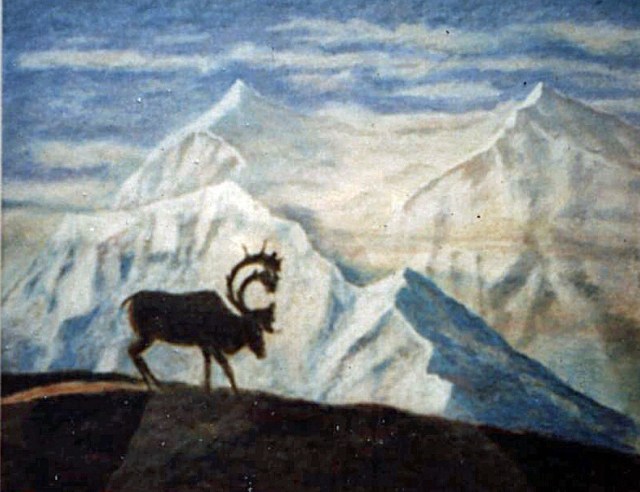
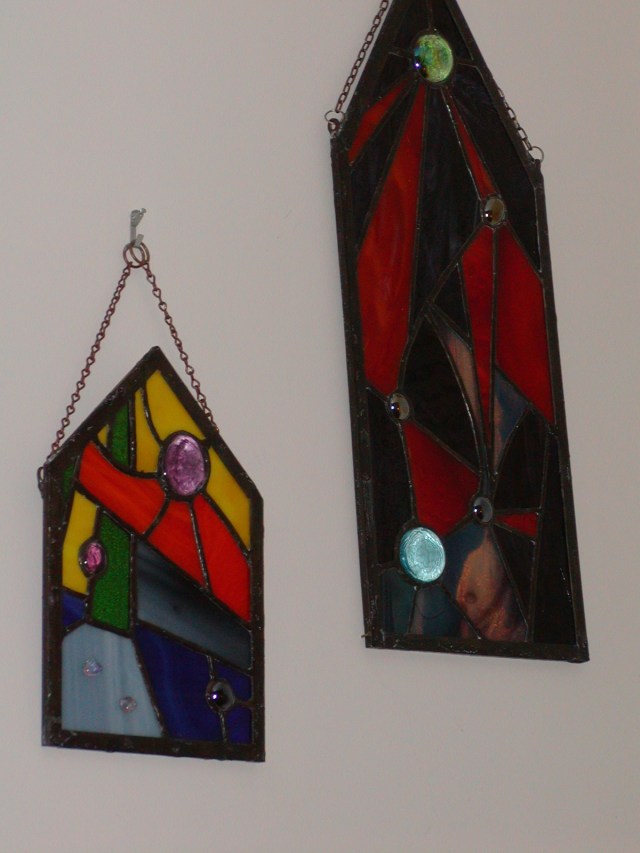
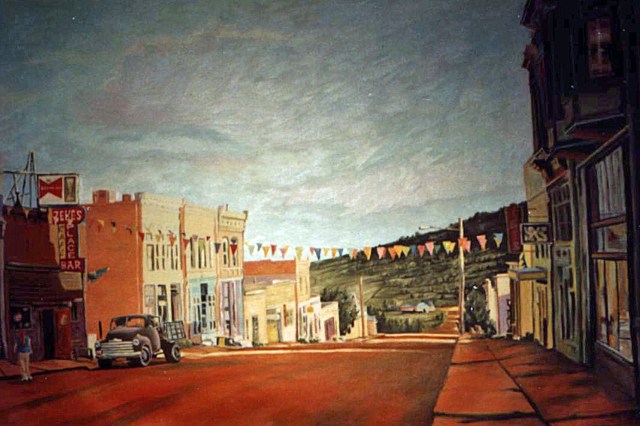
Eric is an artist and a wordsmith. He contacted me last summer to learn more about the Institute and to become a member. Eric is a fascinating person. As a  multidimensional artist he creates two and three dimensional works in a variety of media. He composes in stained glass, sculpture, and images in oil, watercolor, pastel, and acrylic. He also writes and teaches classes to all age groups and experience levels. His work has been shown at the Lowell Thomas Museum and the Monarch Gallery in Victor, Colorado, as well as the Providence Art Club and the Rhode Island Watercolor Society.

Eric has exhibited in over twenty shows and won awards in Michigan and Rhode Island for his stained glass and watercolor pieces. No stranger to the written word, Eric has written a newspaper column, newsletters, promotional literature, and a children’s play for a theater arts program. He currently is the author of his own blog entitled The Cranky Bachelor Blog, which can be read at http://the crankybachelor.blogspot.com. He describes it as the world seen through the lens of a “cranky bachelor.” It’s a fun read.

When Eric contacted me he expressed sincere interest in moving into the category of sacred art. He wanted me to see some of his work so we met and discussed what he was interested in and he also provided me with some samples of his art.  At the recent Autumn meeting of the Fra Angelico Institute, he brought some beautiful works that show the level of skill that he has achieved.

Eric’s works bring me back to Claude Monet, Edward Hopper, and Pietro Annigoni. His shading and color choices are wonderful in their ability to set a mood and convey the beauty of a scene. He has much to teach us and we look forward to it.

Copyright © 2011 Deacon Paul O. Iacono All Rights Reserved

The following photos were taken by, or with the permission of, Eric P. McLaughlin. All images and photos are Copyright © 2011 Eric Peter McLaughlin. All Rights Reserved.

A Custodian of Beauty – The Talent of Artist Jamie Medeiros

After an article explaining the mission of the Fra Angelico Institute for the Sacred Arts appeared last June in our Diocesan newspaper, the Rhode Island Catholic, I received a call from a lovely young woman by the name of Jamie Medeiros. She explained that she was from Massachusetts and that she, too, had been touched by the Holy Spirit to offer people the opportunity to blend the creation of beauty with personal prayer. She described the process through which she currently leads people to express themselves in art while they are praying – actually to make prayer part of their artisitc process. She told me that she calls their parish meetings Pray and Create, and that they successfully had a number of parishioners involved who were doing exactly that – joining prayer with artistic expression.

As she was explaining what she was doing in her Pray and Create sessions I couldn’t help but stand in awe of the power of the Holy Spirit to be touching people with the same impulse throughout the United States. This same impulse – the same desire – to combine prayer with art; from the Fra Angelico Institute for the Sacred Arts in Rhode Island to the Catholic Artists Society in New York City, to Pray and Create in Massachusetts, and the Way of Beauty at Thomas More College in New Hampshire, to the Foundation for the Sacred Arts in Washington, D.C. – all attempting to examine and put into practice the words of Beato John Paul 2 and Pope Benedict 16th to become “custodians of sacred beauty.”

By becoming involved in the sacred movement to be a custodian of beauty we refashion culture and ourselves. We accomplish that end by evangelizing the truth, goodness and beauty of God through the study and creation of sacred art.

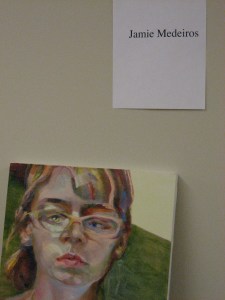
We continued to talk and I invited Jamie to become a member of the Fra Angelico Institute for the Sacred Arts, and she graciously accepted. Jamie has a wealth of experience in the arts, having received a Master of Fine Arts in painting from the American University in Italy, and an undergraduate degree from the Catholic University of America. She currently is a self employed artist and lives in Massachusetts. A self portrait appears here:

Jamie’s talent can be appreciated in the above portrait as well as in a sampling of her sketches (seen below) – which she showed at our Autumn Meeting. To see more of Jamie’s paintings and sketches please go to her web site iliveinhope.com. She has a potpourri of different photographs, sketches, paintings, and whimsical studies. I especially like the work she has done of her dog “Daisy” and – a Rhode Island icon: Mr. Potato Head! Actually, I am sure that as soon as  Hasbro Industries (headquartered in Rhode Island and the creator of Mr. Potato Head), or Hasbro Children’s Hospital in Providence sees them they will snatch up those beauties!

The sketches below were done during her Pray and Create sessions at her parish church. Photos taken and used with the permission of Jamie Medeiros. Her painting and sketches are Copyright © 2011 Jamie Medeiros All Rights Reserved.

Very powerful, indeed! Thank you Jamie for the time, talent, and treasure that you are willing to share with others who accompany you on our beautiful spiritual journey back to the Lord.

Photos taken and used with the permission of Jamie Medeiros. Her painting and sketches are Copyright © 2011 Jamie Medeiros All Rights Reserved.

 Copyright © 2011 Deacon Paul O. All Rights Reserved.

The Lovely Work of Artist Trudy Manney

One of the Institute’s members, Trudy Manney, has been an important contributor to St. Francis of Assisi Parish here in Wakefield, RI for many years.

She is a painter and she also restores statues. If you ever visit St. Francis Church you will see the beautiful job she did in restoring the statue of our Blessed Mother. Trudy correctly composed the colors of Our Lady’s garments and did a fine job in her color choice for the skin tones of both the Blessed Mother and the infant Jesus.

Besides the restoration of the Blessed Mother’s statue, Trudy also recently restored the figures for our Christmas creche scene, her color choice in that instance also restored a “tired” creche into a beautiful aid to our Christmas prayers.

Found below is a photograph of a lovely rendition of our Lord as a teenager which appeared at our Autumn meeting and one of the many statues that she restored from our Christmas creche.

Image of Teenage Jesus Copyright © 2011 Trudy Manney All Rights Reserved. Photo taken and used with her permission.

Thank you Trudy for all the beauty you have contributed to our Church!

Copyright © 2011 Deacon Paul O. Iacono All Rights Reserved

The Beautiful Lace Needlework of Esther Paris

Two weeks ago, at our Autumn Meeting of the Fra Angelico Institute for the Sacred Arts, some of the members displayed examples of their secular and sacred art.

The mission of the Institute is to deepen the prayer life of its participants by evangelizing the truth, goodness, and beauty of God through the understanding and creation of sacred art. Some of our members were involved in this effort before they became participants in the Institute – evidence that the Holy Spirit is working in many different ways, through the efforts of a variety of talents, to express the truth, beauty, and goodness of God through artistic creativity.

In this post I’ll be showing the work of the artist Esther Paris. Throughout this week and next, I’ll be featuring the work of other artists that presented their work at our  October 28th meeting.  All of the work is of superb quality and shows a wonderful diversity of approaches, interests, and techniques. Some of the art is secular and some is sacred – but all of it exemplifies the care, commitment, and wonderful creativity of the artists who are members of the Institute. If you are an artist – novice or veteran – seriously consider joining our efforts to give glory to God through the creation of sacred art! If you are interested in learning more, or joining us, please contact me at frainstitute@cox.net.

The photograph below is of the beautiful lace needlework of Esther Paris. Esther is a member of the Institute’s Sacred Needle Arts Guild, and we are very happy to have a person of her talent acting as the “maestro” of that Guild!

Photo and design: Copyright © 2011 Esther Paris All Rights Reserved. Used with permission.

Esther Paris is from Cumberland, Rhode Island and she is the 2011 Eastern States Exposition First Place Winner and People’s Choice Award Winner in the Lace category, Non-Instructors, “Class H – Tatting – Adaptation.” This competition was held at the Eastern States Exposition in Springfield, MA this past September. People from as far away as Florida competed in the various categories within the Lace Competition department. Congratulations Esther! In the future, I will post other work completed by her – it is sure to please!

Copyright © 2011 Deacon Paul O. Iacono All Rights Reserved

The Fra Angelico Institute’s Appearance on Catholictv.com

My wife and I were invited by Catholictv.com to appear on their network on November 4, 2011 to explain the Fra Angelico Institute for the Sacred Arts and its relation to the New Evangelization of the Church. We appeared on the “This Is The Day” show hosted by Father Robert Reed and Mr. Jay Fadden.  We appear approximately seventeen minutes into the show. The interview lasts about twelve minutes.

You can catch our appearance on your cable TV channel if you have Comcast, VerizonFIOS, or Sky Angel, (however, they are not on Cox), or double click on the address below and it should send you right to their address. Enjoy the show!

www.catholictv.com/New-Catholic-Evangelization.aspx


If that doesn’t work for you go to catholictv.com to the tab entitled “Shows” and then type in, or click on, the show entitled “The New Evangelization.”  The show was filmed on November 4, 2011.

The “This is the Day” show airs live every Tuesday and Friday through the independent Catholic network on the internet and various cable systems around the nation such as Comcast, Sky Angel VerizonFIOS, etc. Catholic TV is a 24/7 media network that is currently appearing in over ten million homes and is growing on a monthly basis. Their program is the Catholic TV’s version of a Today Show format in which they report the major Catholic news stories that have occurred within the last seventy-two hours plus conduct interviews with various guests on topics of interest to the Catholic community. Our segment was filmed in their studios outside of Boston in Watertown, Massachusetts.

Copyright © 2011 Deacon Paul O. Iacono All Rights Reserved

Fra Angelico and Your Mission as a Sacred Artist

The following is a homily that I gave during the Inaugural Mass of the Fra Angelico Institute for the Sacred Arts which occurred on Friday October 28, 2011 at St. Francis of Assisi Church (Diocese of Providence) in Wakefield, Rhode Island USA. The Institute can be contacted at frainstitute@cox.net  for membership information. We are on Facebook at Fra Angelico Institute for the Sacred Arts.

Tonight’s inaugural Mass of the Fra Angelico Institute for the Sacred Arts falls on the feast day of two Apostles – Saints Simon and Jude Thaddeus. The Gospel for today’s feast, speaks of how Jesus called the disciples together and selected twelve of them to be Apostles. They traveled with Jesus during His ministry, received the gifts of the Holy Spirit at Pentecost, and were sent to preach the Good News of the truth, goodness, and beauty of salvation through Jesus Christ.

Saints Simon and Jude Thaddeus, along with the other Apostles, had the courage, and the fervor, to lead people to the faith and to support them in their understanding of its meaning for their lives. Their witness cries out to us“Continue our mission.”

When my wife Jackie and I founded the Fra Angelico Institute for the Sacred Arts in 2009 we knew it would be a missionary effort; and that as a lay apostolate of the Church, with a cleric – myself – as its director, it exercises a specific ministry through the permission and blessing of His Excellency Bishop Thomas Tobin, our pastor Monsignor Paul Theroux, and our chaplain Father Joseph Upton.

The document entitled Apostolic Activity, the Second Vatican Council’s 1965 Decree on the Apostolate of the Laity, defines the mission of all adult Catholics to “lead non-believers to the faith and to instruct, strengthen, and encourage the faithful to a more fervent life; [so that they may understand that] God’s plan for the world is that men [and women] work together to renew and constantly perfect the temporal order.”  The Fra Angelico Institute for the Sacred Arts was formed primarily to contribute to accomplishing these goals.

But how do we do that?

Our mission is to deepen the prayer life of all our participants by evangelizing the truth, goodness, and beauty of God through the understanding and creation of sacred art.  I emphasize creation of sacred art because, as artists, novice or veteran, we have been given the grace to appreciate, care for and the desire to create sacred art in all it’s various forms.  Our Institute has twelve Guilds within it and each Guild is a specific branch of art in which the artists produce sacred art at their own pace, with complete freedom, and with the understanding that their final product should reflect and promote faith in the truth, goodness, and beauty of God as taught by the one Holy, Catholic, and Apostolic Church.

We cannot help but reflect that the Florentine artist whose name graces the title of our Institute – Fra Angelico – and whose actual name in religious life was Brother John of Fiesole  – Fra Giovanni – as he was known by his fellow friars, quietly worked as a Dominican in and around the city of

Florence during the early and mid 15th century, painting and illuminating masterpieces whose beauty haunts us to this day. His art radiates stunning simplicity and has a profound ability to preach the truth, beauty and goodness of God, His angels and His saints.

A Third Order Dominican – Eleanor Carlo has written:

               “Preaching and religious art are related in that each is concerned with communicating truth and beauty. Since Dominicans are called to preach the truth and beauty of the Catholic faith, not only by word and example, but also in every possible way; it follows that if one happens to be an artist in the Dominican Family, he [or she] will endeavor to lead others to God through [their] art.   As St. Catherine of Siena relates in her Dialogues there are many roads and ways that God uses through His love to lead people to Him. [Sacred] Art is the way of beauty, a road that leads directly to Him, if we are so blessed as to be led along this road.   Because their inspiration comes from God, the preacher and the artist communicate with a sense of mission. Mission implies the giving of self – and the motive of the mission is Love.  [Sacred] artists are ardent preachers who have been inspired by God and have been given gifts for interpreting the Gospel and spiritual reality.  Fra Angelico is among those who point out things we often fail to see without their help.” (Ms. Carlo’s remarks were taken from part of an address given in March 1978 at Providence College entitled Creative Preaching Through Art: The Dominican Contribution)

Yet , as foundation stones of this Apostolate, it is our belief that this mission is not just for artists within the Dominican Order. All Catholic artists – ordained, professed religious, or laypersons have the ability to reach deep within the human mind and soul and restore the fires of faith and love for God. Like Saints Simon and Jude – we have been called to continue the mission of the Apostles in a special way. Catholic artists, in the state of grace and creating art for the sake of evangelization – their own and others – have the power to change the perspective and habits of the most hardened soul, and that is the hope of this Institute: to study, pray, and produce art that inspires others to a greater love for God and His Kingdom.

May God bless you for your sincere interest and participation in this Institute; and may saints Simon and Jude Thaddeus, and Blessed Fra Angelico, pray for us.

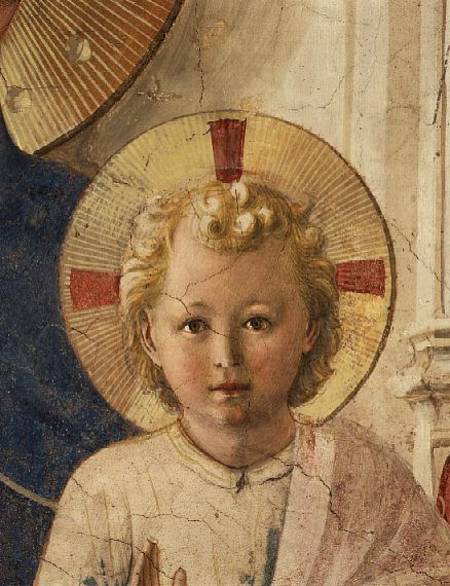
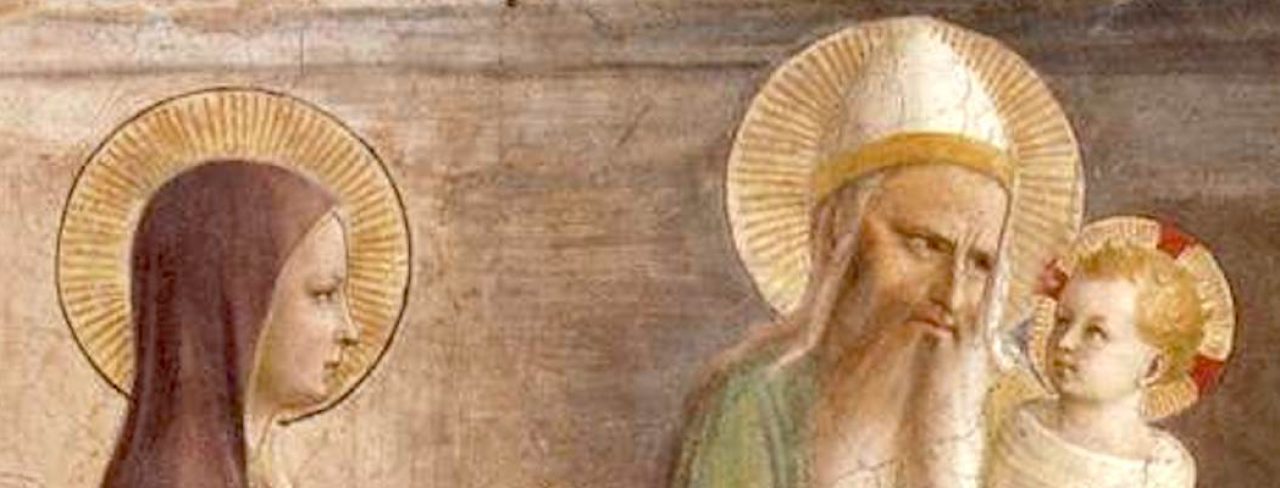
The painting above of the infant Jesus is by Fra Angelico and it is a close-up of the painting entitled Madonna delle ombre (Madonna of the Shadows), painted around 1450. It is a fresco painted in egg tempera. It is located in the Museo di San Marco in Florence. 

Copyright © 2011 Deacon Paul O. Iacono All Rights Reserved

Beauty Built on Gospel Values

David Clayton, artist in residence at Thomas More College of Liberal Arts in New Hampshire, has written a wonderful essay that capsulizes the essential nature of what Pope Benedict 16th is saying about creating a culture of beauty. It should be required reading by all seminarians, clerics, and laypeople who are interested in evangelization and the recreation of a culture of beauty based on sound Gospel principles and the appeal to our innate sense of the beautiful. Please copy and paste the link below into your search engine bar and it should pop up for you.

http://thewayofbeauty.org/2011/10/the-psalms-and-the-evangelisation-of-the-culture/             


Copyright © 2011 Deacon Paul O. Iacono All Rights Reserved

Our Lady of the Rosary

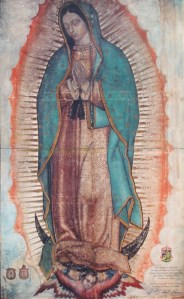
All the events of human history have to be backlit by the reality of our faith that God does not abandon His people. An example of this truth is today’s memorial of Our Lady of the Rosary. This memorial was established by Pope St. Pius 5th in thanksgiving for the Catholic victory over the Muslim army and navy at the famous battle of Lepanto on October 7, 1571. Many rosaries were said by the European faithful during the battle to stem the tide of the Islamic invasion. The admiral for the Catholic Fleet, Andrea Doria, had the miraculous image of Our Lady of Guadalupe (seen below) in the stateroom of his flagship. Prior to the battle King Philip 2nd of Spain had given the Mexican icon of the Blessed Mother to Admiral Doria.

Our Gospel today tells us that our Lord God chose Mary, a humble Hebrew teenager, to be the finest being within His creation. She was offered the opportunity to be the counterpoint to the sin and evil that consumed the world. She was offered the opportunity to be the Theotokos- – the Bearer of God – the Mother of the Messiah.

It is God’s will to have beauty and purity, mercy and justice, exist along side the evil that Satan – with man’s complicity – brought into the world; and it is the Father’s will, through the actions of Jesus and His mother Mary, that they overcome and defeat the evil that Satan spawned.

God is an artist. His palette consists of many different colors. He uses the darks as well as the lights to achieve His end. We too, are artists. Like Mary we have a choice. Mary chose to humbly accept the will of God for her life, even though she did not foresee and understand all that was to take place. She decided to paint the structure of her life – and the life of her family – with the colors of faith, humility, love, and joy. Did the masterpiece of her life include the darkness of suffering, pain, and loss; yes, of course it did, but those dark shadows did not muddy the joy and happiness she was to know in doing the will of God – it was not to interfere with her accomplishing her grace filled mission for the family of God.

It is through the humble statement of Mary to the angel Gabriel, “Behold, I am the handmaid of the Lord. May it be done to me according to your word,” that our salvation was made possible. It is through Mary’s “Yes” that the Holy Spirit, in an intimate and personal encounter with her, was able to accomplish the pledge made to King David that “the time of the fulfillment of God’s promises and preparations [will begin].” (CCC # 484).

As Catholic Christians we understand that the prayer that we call the Holy Rosary was given to St. Domenic (Domingo de Guzman) in 1208 by the Blessed Mother. If prayed with reverence and attention, the Holy Rosary through the recitation of the four great Mysteries: Joyful, Luminous, Sorrowful, and Glorious, recount the entire life of our Lord and His ministry to us. Mary gave this prayer to St. Domenic so that it might become a vehicle for meditation and contemplation on all that her Son did for us. It is not meant to be a tool of mindless recitation. To say that would be as callous as saying that Michelangelo used his sculptor’s tools to just break marble.

Mary understood – and understands – that we need a process in which we can reflect on the saving actions of her Son, while at the same time, intoning – either privately in silence or audibly in a group – the beautiful prayer of the angel Gabriel at her Annunciation, the prayer that Jesus Himself taught us, and the famous doxology of the Glory be.

Faith, humility, love, and joy – these virtues will help us become better sacred artists – and better people, and the Holy Rosary is an important tool to help us achieve our goal.

The painting below is by Fra Angelico and shows St. Dominic, the Blessed Mother, and St. John the Evangelist. Fra Angelico inserted St. Dominic into the scene in an attempt to suggest to his fellow friars that Dominic’s prayer was so mystical and so intimate that he united himself to the Cross of Christ – and that he embraced the Cross in faith, humility, love, and joy. It is a worthy suggestion for us to contemplate, too.

Copyright © 2011 Deacon Paul O. Iacono All Rights Reserved

Sacred Artists Must Be Empty Vessels

In this morning’s Gospel St. Luke is clear that Jesus is carefully listening to the argument that breaks out among His disciples as to who is the greatest among them. One translation has St. Luke saying, “He perceives the thoughts in their hearts.” 

It would be prudent to say that we are all psychologically and theologically hardwired to look for approval. King David wrote of this in the Psalms when he said:  “You have made them a little lower than God, and crowned them with honor and glory.”  David recognized the fact that we are something special in the grand scheme of creation, but Jesus has come to set even the wisdom of King David straight. (Psalm 8 verse 5).

He tells His disciples,  “… for he who is the least among you – is the one who is great.” The disciples must have done a double take when He said this, for it went counter to their understanding of reality. But Jesus uses a child to demonstrate this truth; for  children in ancient times were socially at the bottom of the barrel, they had no rights, and basically were – if a family was lucky enough to have them – equivalent to  domestic staff and servants. Children were expected to be seen and not heard – the watchwords for them were humility, listening, and service. An honorable Jewish child of the first century AD would not be bold enough to assert any supposed rights, or demand anything of their parents. There was no self-seeking here, there was no expectation of a mandatory trophy given to raise self-esteem.

Jesus is telling His disciples to see in the child standing next to Him the model for their own behavior. For they, too, should view themselves as servants; as James would say in a later epistle “God opposes the proud, but gives grace to the humble.” (James 4:6).  Jesus explains that we must eliminate from our life everything that blocks our spiritual progress – vanity, self-aggrandizement, power-grabs – and the greatest of all sins – pride. St. Paul tells us very clearly in the 2nd epistle to the Corinthians that the Lord wants us to be empty vessels so that He can fill us up with His love, grace, and power.

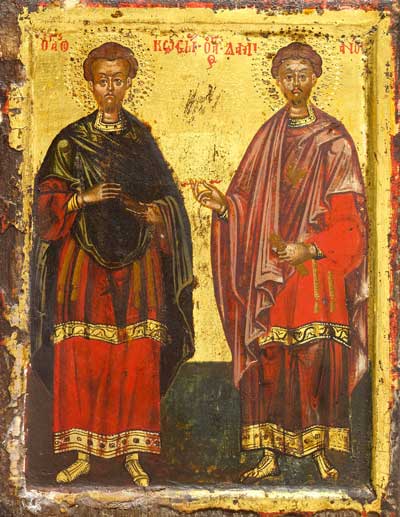
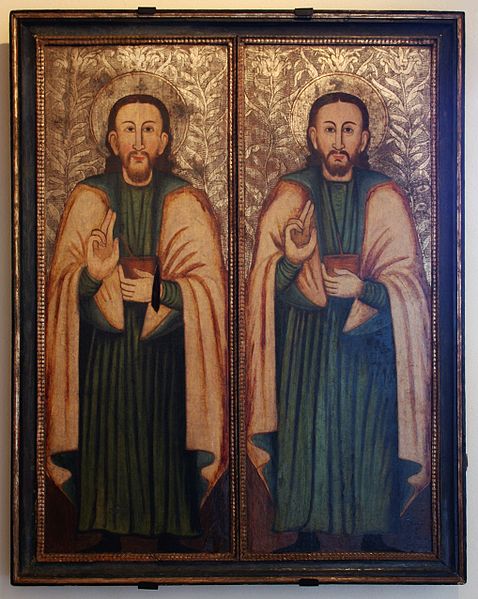
We cannot leave this day without mentioning two men who were “empty vessels” for the Lord. They were early martyrs of the Church – Sts. Cosmas and Damian – excellent models for all of us who aspire to be sacred artists. They met their death at the hands of the Emperor Diocletian in the late 3rd century BC.

The above two icons are of the twin brothers Saints Cosmas and Damian. The very top icon was done many centuries ago, and the icon right above these lines is a more contemporary interpretation.  Unfortunately I was not able to locate the names of the artists that “wrote” these two beautiful icons.

Sts. Cosmas and Damian are models for us because they were not interested in making a name for themselves (even though because of their medical skills they were known throughout the Eastern Roman Empire). They were not interested in making money in return for their remedies (they were called the “moneyless ones” since they did not accept money for their services).

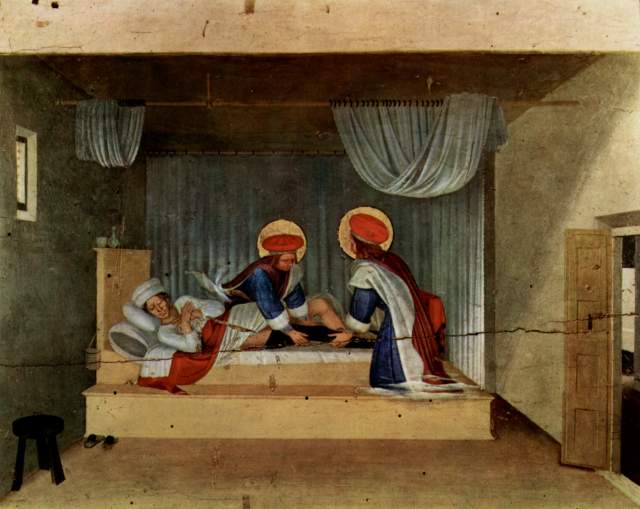
The above image is by Fra Angelico. It is his interpretation of Saints Cosmas and Damian miraculously treating the emperor Justinian after he prayed for their help, three hundred years after their death. The leg was healed, and Justinian attributed it to his prayers for their intercession. The icon shows them practicing their skills, following through and using their knowledge (they studied at the famous medical centers in Arabia). As artists (for we can say “the art of medicine”) they confronted all illness head on and relieved suffering, not by just turning to past remedies, but willingly using their common sense and their ability to adapt remedies to new situations. They were “with-it” as the current parlance would say. Yet, they were novel in their approach since they were practical men who “emptied themselves of self,” had a deep love and faith in Jesus, while at the same time, doing all they could to increase their skills for the benefit of their fellow man.

Thus, they apply to our desire to be sacred artists by showing us that we must make the effort, as St. Paul says, to be empty vessels: to allow our own ego to be overwhelmed by the power of the Lord, to confidently go about the process of learning the art form(s) that we are called to concentrate on, keeping our sense of humor as to the rate of our improvement, steadily practicing the art, and prayerfully putting our trust in Jesus to help us be the best artists we can be.

Sts. Cosmas and Damian were committed Christians, and the early Church regarded them with great honor from the moment of their martyrdom. They truly are a symbol of what our Gospel speaks about this morning – for they made it their duty – especially in the manner of their deaths – to empty themselves – and be filled beyond measure with God’s gifts.

Copyright © 2011 Deacon Paul O. Iacono All Rights Reserved

The Challenge of Sacred Iconography – Part 2: The Byzantine Empire – Justinian and the Church of Holy Wisdom

As we continue our discussion of sacred iconography it is imperative that we take a historical view and look at the major contribution the Byzantine Empire and its civilization made to this sacred art form.

When we speak of the Byzantine Empire we are referring, initially, to the eastern region of the Roman Empire. The Roman civilization was eight hundred years old when it began to feel the pressure of highly motivated foreign tribes that desired to pick away at her borders and plunder her cities. By the fourth century AD the Emperor Constantine moved the capital of the Empire out of Rome, Italy and firmly established it in a new city that he named after himself – Constantinople. He accomplished this by AD 330.

The name Byzantine derives from the Greek colony (Byzantium) that had been established in the 7th century BC in that area of eastern Turkey that borders the Black Sea. It was a successful colony primarily because it had a fabulous harbor – the area known as the “Golden Horn,” and was easily defended. What distinguished the new city of Constantinople from the other major cities of the Roman Empire was the fact that the Emperor Constantine was a convert to Christianity. As a result, the city of Constantinople and the resulting development of the new Byzantine Empire was Christian, as compared to the Roman west, which still had large cultural areas that were dominated by Greek, Roman, Germanic, and Celtic paganism.

The Byzantine Empire lasted for over one thousand years; and within that period of time produced magnificent architectural and portable sacred art. Justinian, the great Roman-Byzantine emperor of the 6th century, heavily promoted the expansion of the Empire (see map) and sacred art – especially in his building the magnificent Church of the Holy Wisdom (Hagia Sophia) in Constantinople. In the map below the green area is the Byzantine Empire prior to Justinian. The purple is the territory that was part of the western Roman Empire, and was retaken from various barbarian tribes as a result of Justinian’s considerable military efforts.

As you can see from the small image at the left – The Church of Holy Wisdom was an extraordinary undertaking even for the renowned Roman and Greek architects and engineers that worked on its construction. Its completion was complicated because Justinian demanded that his architects build high and have a wide cupola – which ultimately led to cracks forming, partial collapse, and major renovations having to take place within the same century that it was built.

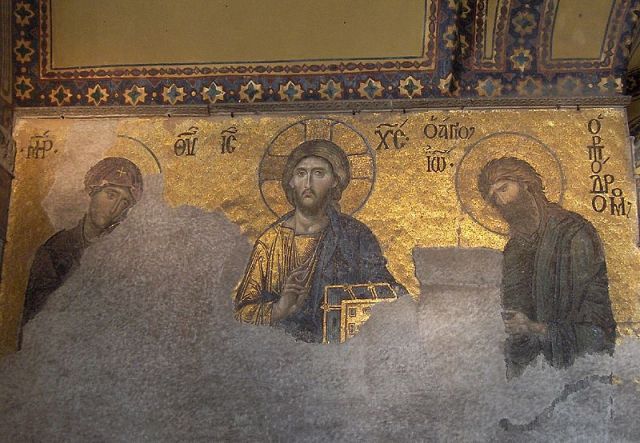
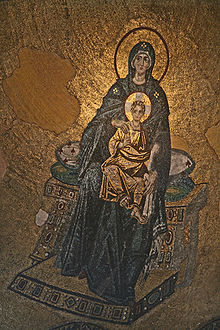
The beautiful and very large mosaics (found below) of Christ, His Mother, and John the Baptist are found within the Church of Holy Wisdom in Constantinople (the first image of Christ is a close-up of the three figure mosaic below it). You will be able to tell from my next post that it had a major impact on the development of the sacred art of the Byzantine Empire.

The large mosaic of the Blessed Mother and the child Jesus dates to the 9th century; and the three figures of Mary, Jesus, and John the Baptist dates from the 13th century. The Church of the Holy Wisdom was the largest church in Catholicism for 1000 years. The Muslims converted it into a mosque after the conquest of Constantinople in 1453. Today, it is a museum, a major tourist attraction, and is considered priceless by the secular Muslim government of Turkey and the entire Christian world.

Copyright © 2011 Deacon Paul O. Iacono All Rights Reserved

The Triumph of the Cross and Our Lady of Sorrows by Jed Gibbons

Today we celebrate the feast of the Exaltation – or Triumph – of the Holy Cross.

The early Catholic Church was intensely persecuted during the first 280 years of its life – so the symbol of the Cross – the symbol of public humiliation and excruciating death – was rarely used in our Christian iconography. But this doesn’t mean that the early Christians were reluctant to express their devotion to the Cross. Writing in the year 204, the Christian theologian Tertullian said: “At every going in and out, when we put on our clothes, when we sit at table, in all the ordinary actions of daily life, we trace upon our forehead the sign [of the Cross].”

In the year 313, the Emperor Constantine signed the Edict of Milan, which proclaimed toleration for the Christian faith within the Roman Empire. Constantine’s mother, Helena, made a pilgrimage to the Holy Land, and with the support of the local bishop – excavated the area known as the site of Golgotha. Tradition states that portions of the true Cross, with a partial nameplate still attached was found, resulting in Constantine ordering that the Church of the Holy Sepulcher be built over the site. The church was dedicated nine years later, with a portion of the Cross placed inside it. So the feast that we celebrate today marks the dedication of the Church of the Holy Sepulcher in the year 335. That Church was unfortunately destroyed by the Muslims in the year 1009, only to be rebuilt centuries later, with the new occupants – all Christians – vying for control of the site! Unfortunately even among our brother Christian Churches there have been numerous clashes and conflicts over the control of this holy site. It is as if all of us – as guardians of the Church’s holiest site – had not internalized the meaning of the true Cross – the meaning of what happened on that site 2000 years ago – the meaning of the Father’s supreme sacrifice of His Son for the sake of His creation. God’s love was raised up on Golgotha that day and Satan’s venom was forever neutralized, but the sting of Satan’s original bite in the Garden of Eden still remains.

The truth of our Scripture readings tell us that Moses lifted up the bronze serpent, a sign of sin, and the people were healed. Jesus makes an analogy of the serpent with the healing power of the Cross – since it is a sign of our sin and our redemption. When the Father, through the Holy Spirit, lifted up Jesus in the resurrection, the Holy Cross was no longer viewed as a sign of evil and sin – rather it became a sign of Christ’s victory and our salvation.

Our Savior, through the instrument of the Holy Cross, shows us the level of His love for His  creation. The Father shows His love for us by giving us the best He has  – His Son – and His Son shows His obedience and trust in the Father – through His willingness to take upon Himself all sin and become a perfect offering back to the Father on our behalf. The Fra Angelico Institute for the Sacred Arts chaplain, Fr. Joseph Upton, gave a beautiful homily today at morning Mass in which he emphasized that every day, we too raise up Jesus on the Cross. In every Mass, we have re-presented the sacrifice of Jesus for us. We commemorate His act and we thank Him for it in His gift of Himself to us in the Eucharist. We unite ourselves to the Triumph of the Cross through the Mass.

As sacred artists, on a daily basis, we must attempt to imitate this profound love of God in our creation of artistic works, and in our families and community. Our love must be strengthened by the truth of our faith – and by the triumph of the Cross; when we do this we will understand that the crosses that we carry, and the sufferings that we endure, unite us to the Lord, and help us transform our lives into His. Our Blessed Mother is our model for this transformation.

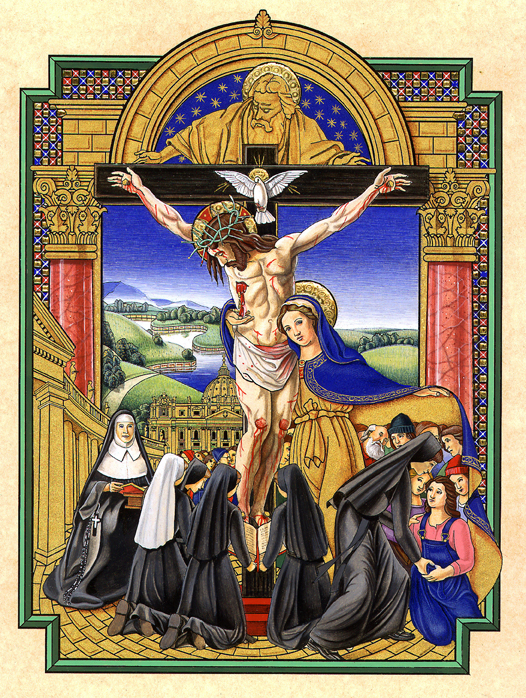
Tomorrow, September 15th, is the memorial of Our Lady of Sorrows. The Invitatory prayer that begins the Office of Readings in the Liturgy of the Hours says, “Let us adore Christ, the Savior of the world, who called his mother to share in his passion.” Those words reminded me of a beautiful illuminated miniature by Jed Gibbons, a very fine artist from Chicago. I met Jed when he was teaching at the St. Michael’s Institute for the Sacred Arts at Enders Island in Mystic, CT. Jed has produced some truly inspirational work (his Stations of the Cross in the chapel on Enders Island are exquisite) and this piece that you see below captures not only the theme of the Triumph of the Cross but the truth of the Church’s teaching that Mary shared in the passion of her  Son. This piece is entitled   Maria, Mater Misericordiae (Mary, Mother of Mercy); it was completed in 2006, and was done in historic earth pigments and 23 karat gold. It measures 6.75 by 9.25 inches. I thank the Foundation for the Sacred Arts website for the image.

Copyright © 2011 Deacon Paul O. Iacono All Rights Reserved. Image copyrighted by Jed Gibbons All Rights Reserved


David Clayton, Needle Arts, Music, and the Creation of Beauty

My wife Jackie and I had the pleasure to meet Mr. David Clayton, artist-in-residence at Thomas More College of Liberal Arts in Merrimack, NH at a lecture he gave this week in New Hampshire. David is a fine artist, teacher, and creator of The Way of Beauty blog and program at the College.

He posted comments on 9/9/11 on the connection and application of artistic traditions within the American experience. His blog was posted on The New Liturgical Movement’s website and is attached here: www.newliturgicalmovement.org.

David has a quality to his artistic perception that needs to be mentioned as valuable for all of us to emulate – and that is – let us examine all that is around us and see the patterns of beauty that are there and draw from them a deep sense of contentment, order, inspiration, and spiritual nourishment.

Natural and artistic life and expression in all its forms may speak to us of the patterns, harmonies, and flavors of reality that express the beauty that was created by God. A sensitive eye and soul is able to distinguish, with a little tutoring, the wheat from the chaff.

God’s palette and palate are perfect – but, even in our artistic weakness and imperfection we must try, in imitation of Him, to replicate what He has laid out for us.

I especially would like the members of the Institute’s Sacred Needle Arts Guild to enjoy the article as a means of inspiration for their own work. Also, Adam Wood’s comment which is at the end of David’s article speaks of applying these ideas to music and he provides a sample of his work, too.

Copyright © 2011 Deacon Paul O. Iacono All Rights Reserved

The Birth of Mary – The Pure Disciple Who Shows Us the Way

We cannot allow this day, September 8th, to slip by without celebrating the nativity of  our Blessed Mother. For as the Invitatory in the Roman Breviary says for today’s feast: “Come, let us celebrate the birth of the Virgin Mary, let us worship her Son, Christ the Lord.”

It is right, and proper, and good that we do this. Inspired by divine Wisdom, the Holy Church of Jesus Christ, has through the years been fractured, tempted, and bruised by the assaults of Satan. Yet, in this feast we remember that we are saved, that Satan, ultimately, has been defeated by the willingness of a young woman to be the Mother of our Savior. It is through the grace filled moment of Mary’s conception and birth that we have the Scriptural road diverge toward final fulfillment of the Divine Will.

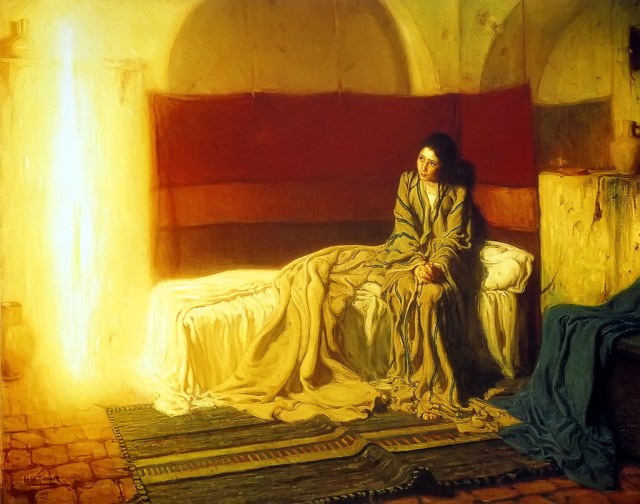
As Saint Luke tells us in chapter 1 of his gospel verses 26 ff., her birth began the dramatic shift in the theological paradigm since it provided the opportunity for her to ultimately see, understand, and say a quiet “Yes” to the truths that Gabriel announced to her. Mary, is the pure disciple, and because of that she “… found favor with God… the Holy Spirit will come upon you and the power of the most high will overshadow you.”  For what end? The end is clear, Gabriel tells her “You shall conceive and bear a son and give him the name of Jesus. Great will be His dignity and he will be called Son of the Most High… hence, the holy offspring to be born will be called the Son of God.”

The sacred image below is by the late 19th century American artist Henry Ossawa Tanner. Of all the sacred art that has been done through the centuries, I believe, this is the best image of that moment of the Annunciation, the moment in which the Old Testament became the New, because it is correct in the manner in which it presents the theological, symbolic (semantic) and artistic truth of that instant in historic time (I thank freechristimages.org/index.htm for the clarity of Tanner’s painting). 

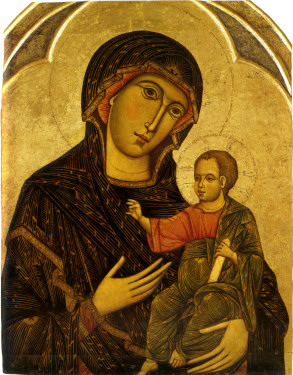
So it is at her birth that we have the road of our spiritual journey fork to the right. Mary’s decisions and actions allowed us to ultimately come to the point in our own life in which we, too, must make a decision. Mary shows us the way (as our Orthodox brothers and sisters would say – hodegetria) to Christ her Son, as she lovingly holds Him in her arms.

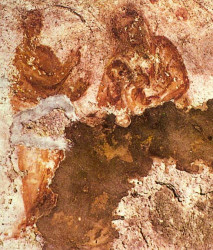
The ancient sacred icon, that you see below, is the earliest image of the Blessed Mother holding the Christ child. It is found in the catacombs of Priscilla, on the Via Saleria in Rome, and is dated to circa AD 225.

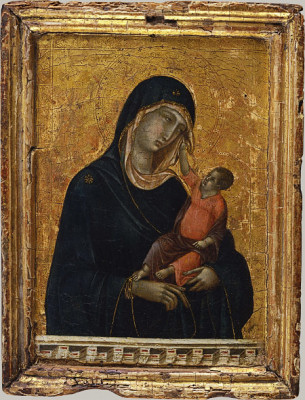
The sacred art of the early Church desired to express the beauty of the Scriptural truth. As you can see from the following two images – the first a Byzantine icon, and the second a painting by the great 13th century master painter – Duccio, from Siena, Italy. Duccio led a school of painters to infuse a strong sense of the humanity of Jesus and Mary into their figures.

These images, and others like them, continue to have an impact on the hearts and minds of those who are open to their Truth. As simple human beings, and as Catholic artists, it is our delight to not only appreciate them, but, to venerate and delight in the Truth that they convey – all of which was made possible by the birth of a humble Hebrew teenager two thousand years ago.

May she continue to show us the way.

Copyright © 2011 Deacon Paul O. Iacono All Rights Reserved

Sacred Iconography and Personal Creativity – Do Not be Afraid!

What is iconography?

The Sacred Iconography Guild is one of the twelve Sacred Arts Guilds that is sponsored by the Fra Angelico Institute. As of this post we have six members of this Guild who have expressed interest in learning this particular artistic tradition of the Church. Unfortunately, many people in the 21st century do not know the traditions of the Western (Latin, that is the Roman and affiliated rites of the Church) or the Eastern (Orthodox, that is the Coptic, Greek, Russian, and other Middle Eastern Rites) of Christ’s Church. All of these Rites have beautiful liturgies, the Sacraments – Holy Mysteries, and traditions – of which sacred iconography is one. This Institute hopes to be one more voice – among many – bringing these traditions to light to a new generation of people. So this post hopes to begin the survey of what sacred iconography is and how we can participate in it.

The word icon is Greek for “image.” Specifically, as it is applied in our usage, it refers to a sacred image that has been painted by a trained iconographer in a way that portrays the sacred presence of Jesus Christ, His mother – “the Theotokos,” His angels, and the saints. Icons in both the Latin Rite and Eastern Rite Churches are venerated – never worshipped. They act as sacred windows or doorways that allow us to view the heavenly realm of divinized humanity or the visual representation of Scriptural truth.

Iconography is simply the study of icons, their development through the centuries (the first iconographer is considered to be St. Luke the Evangelist), the techniques and methods used by various “schools” of iconography within specific cultural regions – and within specific national areas. By “school” I mean a collection of iconographers working under a master iconographer that has a specific style through which they portray Our Lord and the sacred people, mysteries, and historic occurrences within the Church’s history.

Sacred icons portray theological reality. So, it is mandatory that a sacred iconographer follows the “canon” of iconography that developed through the centuries. The “canon” consists of the rules that an iconographer must follow in painting, that is, “writing” an icon. I say “writing” because the tradition states that an iconographer must be aware of the great responsibility that he or she has in conveying the “Scriptural truth” within the image itself. In other words, the iconographer must not change Holy Scripture. He or she paints (“writes”) what is in Holy Scripture, or within Church history and Tradition, because as Pope Benedict 16th has said: sacred images have an important role to play in the “catechesis of the people.” So the iconographer cannot be portraying his or her version of Scripture – or Church history – to do so would be as bad as one of the Evangelists changing the words of the Gospel as he writes or prints a new copy because he desires to be creative or “express” himself.

So this brings up the question of the role that an artist’s personal creativity and skill plays in the development and expression of the written icon. I highly recommend that you go to the websites of my teachers (Peter Pearson; Dimitri Andreyev (Prosopon School); Marek Czarnecki (Seraphic Resorations); and Anna Pokrovskaya Gouriev (Izograph School) to examine their galleries and to see the beauty of their work. Examine an icon of our Lord Jesus or our Blessed Mother by Peter, Dimitri (or his father Vladislav), Marek, Anna (or her mother Xenia) and you will see not only the display of creativity of these iconographers, their skills, their color choices, their simplicity and purity, but also, the truth, goodness, and beauty that is the theological truth of their icons. Their icons are 20th and 21st century pieces of sacred art – yet – they are firmly within the “canon” of the Church’s perception of iconography and serve as models for the expression of Truth, Goodness, and Beauty.

As our Lord said to His disciples in the boat as they were being tossed about by the sea – “It is I. Do not be afraid.” This applies to us, too, as spiritual travelers, artists, and novice iconographers – the Lord is with us – we have nothing to fear because we have put our trust in Him.

Copyright © 2011 Deacon Paul O. Iacono All Rights Reserved

The Eternal Now and the Coronation of the Blessed Virgin Mary

Today is the memorial of the Coronation of our Blessed Mother. Sacred icons and images have expressed the Queenship and Coronation of the Holy Theotokos – the Mother of God – for at least 1500 years. The icon The Virgin Salus Populi Romani, a 5th century icon, displayed in the Church of Saint Mary Major in Rome, and seen below, shows the Blessed Mother dressed in typical first century Middle Eastern garb as she holds her Son who gives a blessing. This icon reputed to
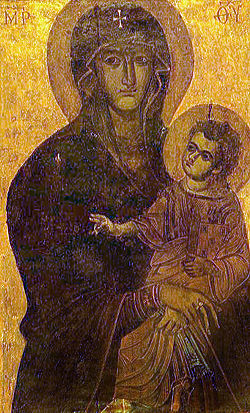
be a copy of one that was painted by St. Luke the evangelist who tradition states knew the Blessed Mother and spoke and listened to her .

A 6th century icon of the Blessed Mother and Child displays a coronation theme – in which the Blessed Mother and her Son are in Heaven. Mary sits on her throne with Her Son on her lap, surrounded by St. Theodore on the left and St. George on the right, while two angels look up as the hand of the Father gives a blessing. This icon is found in the Monastery of St. Catherine in the Sinai Peninsula.
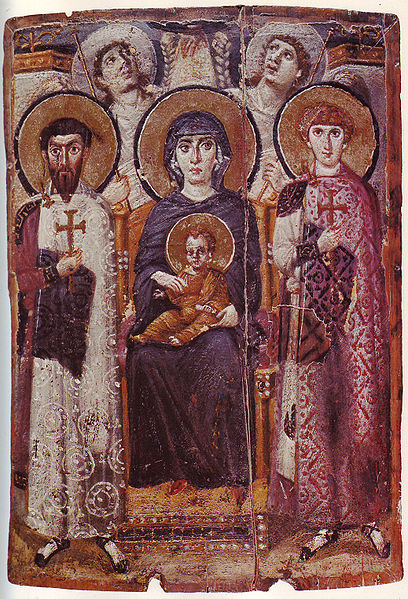
Our iconic images painted (“written”) by orthodox iconographers of both the Latin, Greek, Russian, Coptic, and other Rites agree with the ideas found within our Holy Scriptures. For example, today’s Gospel passage tells us “… the Lord God will give to Him the throne of His father David; and He will reign over the house of Jacob forever, and of His kingdom there will be no end.” This Scripture explains that the Lord willingly takes the initiative to come forth – with hands extended – to meet us and share the reign of His kingdom.

In sacred art we visualize this not only in the extension of Christ’s hands on the cross – but also, in the extension of the infant Jesus’ hands, to give us a blessing, as He sits in His mother’s lap – or is caressed in her arms – an image that is found not only in the above icons but in numerous statues found in Latin Rite churches throughout the world.

Our first reading – from Isaiah – also speaks of Christ in regal terms – as Emmanuel (God is with us) – the “Prince of Peace.” And we can even get apocalyptic and speak of the Books of Daniel and Revelation which recall the truth that the world will be transformed through the birth of the Redeemer, made possible by Mary, (“a woman clothed with the sun, with the moon under her feet, and on her head a crown of twelve stars… who gave birth to a son – a boy destined to shepherd all the nations with an iron rod. Her child was caught up to God and His throne”). – This woman, our Blessed Mother, enables the incorporation of the reign of God into the world. She is the  woman destined to crush the head of the apocalyptic serpent.

St. John of Damascus speaks about this in the 8th century when he says of the Blessed Mother that she “has become the terror of demons, the city of refuge for those who turn to her. [He has her say:] Come to me in faith, O people, and draw as from a river of grace. Come to me in faith, without doubt, and draw from the mighty and certain source of grace.”

On the solemnity of the Assumption – we recalled Blessed John Paul 2nd saying “…the Assumption of the Mother of Christ in Heaven forms part of the [Lord’s teaching about] His victory over death – the beginning of which is found in the death and resurrection of Christ.”

So in today’s memorial – Mary, the humble daughter of our Heavenly Father, garbed in the majestic robes of a queen takes her place next to the throne of her resurrected and ascended Son.

Why? 

Because the Church desires to teach us that Mary is privileged – beyond all other women and men – to be the first and most significant human being to participate in the glory, triumph, and reign of God. By her very willingness to become the Mother of God – the Theotokos – she agreed to become our spiritual Mother, too.
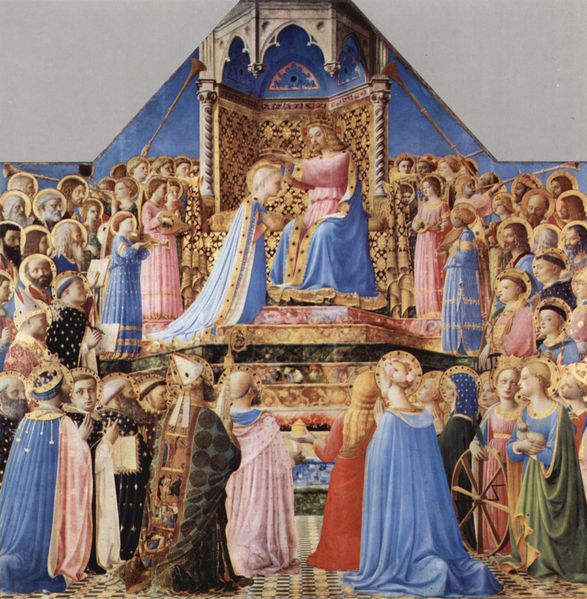
In this beautiful sacred image by Blessed John of Fiesole, also known as Fra Angelico, the great Dominican artist of 15th century Florence, portrays the moment of Our Lady’s Coronation – with the Heavenly court surrounding her. Interestingly, you see men and women saints that were alive thousands of years after Mary’s assumption observing the event. Why did the good Friar do that? He is expressing the fact that Heaven is within the eternal now of the Trinity – the knowledge of that coronation moment is known by St. Thomas Aquinas – who looks out at the observer (in the lower left corner) – and notes the truth, goodness, and beauty of God in desiring this for His beloved and humble human daughter – the Queen of Heaven.

The Blessed Mother, in her regal beauty, authority, and power, has not left us orphans – for she is “the Living Temple of the Holy Spirit, the Inviolate Mountain, the ladder” that joins Heaven and earth – the “One who Shows the Way” (Hodigitria) to her Son and to our Heavenly reward.

If we remain faithful and loyal to the teachings of Christ – as expressed through our Sacred Scriptures and our Church – and as the Epistle of St. James teaches – “Act on that faith…” then we, too, will reign alongside our Heavenly Mother as we give praise and glory to God.

Our Lady – Queen of Heaven – pray for us.        Sources: John Paul 2, L’Osservatore Romano, August 15, 1983; Pope Pius 12th – encyclical Ad Caeli Reginam, October 11, 1954.

Copyright © 2011 Deacon Paul O. Iacono All Rights Reserved
The Dormition – Assumption of Mary

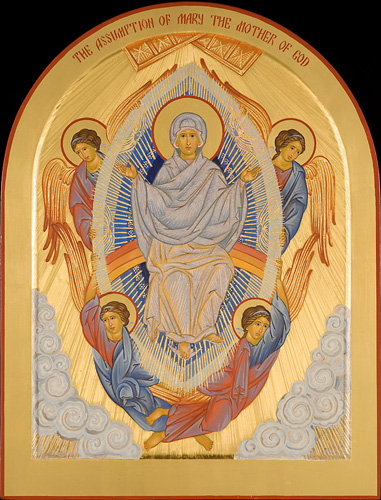
Over the past two weeks, our Sunday Gospels have stressed the truth that to be a faithful disciple of Christ we must keep our focus – in good times and bad – on Jesus. On August 15th, the solemnity of the Assumption/Dormition of Mary, the Church again directs our gaze – for in focusing on Mary we see not only our Queen – but the one true sign – the Great Sign – who points the way to her Son.

Her signature was that of a perfect disciple – for she possessed the confident competence and the courageous commitment – of true faith.

In the “fullness of time” – after millennia of human history – the Father of Mercies saw in Mary – a loving and lovable woman who possessed great courage – the person – who in her simplicity and purity would be completely open, totally surrendering, and free from the pollution of pride or self-will.  She was the woman who would be the New Eve – the mother of the living – the mother of a new creation. She is, as the Eastern Rite proclaims, the All Holy Onethe Panagia, who as our spiritual mother shows us the way by guiding us to her Son – and through His grace – enables us to be reborn into eternal life.

It is through our own rebirth, through water and the Spirit, that we are able to bear fruit and imitate Mary in bringing the newborn Christ to others. St. Maximus the Confessor speaks of this when he says “Every soul that believes, conceives and gives birth to the Word of God according to faith. Christ is the fruit – and all of us – are mothers of the Christ.” (quote found in Vladimir Zelinsky’s  “Mary in the Mystery of the Church: The Orthodox Search for Unity” which is contained in Mary CoRedmptrix, Mediatrix, Advocate – Theological Foundations II. M.I. Miravalle, S.T.D., editor).

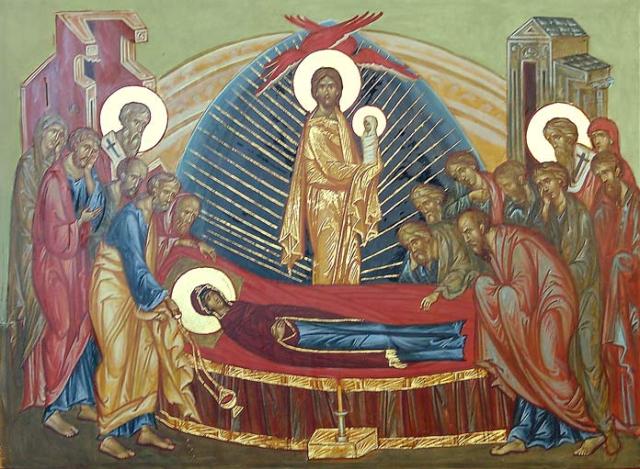
This beautiful sacred icon was done by one of my teachers – the master Marek Czarnecki of Seraphic Restoration Studio in Meriden, Connecticut. It is done in the traditional egg tempera and measures 13 by 17 inches. It is different from one of the most famous sacred images of  the Italian Renaissance – The Assunta by the master – Titian – yet Czarnecki’s sacred icon is theologically, aesthetically, and semantically correct. Titian painted his Assunta between 1516-18.

Our Catechism (of the Catholic Church, paragraph 966), proclaims that “The Immaculate Virgin, when the course of her earthly life was finished, was taken up – body and soul – into heavenly glory, and exalted by the Lord as Queen over all things, so that she might be the more fully conformed to her Son, the Lord of lords, and the conqueror of sin and death”

This proclaims the wonderful news that the Assumption of Mary is a participation in the act of her Son being raised from the dead – and so is a Sign – a Sign that points to our own resurrection and union with God. The Eastern Rite liturgy says on its August 15th celebration of this solemnity: “In giving birth you kept your virginity; in your Dormition you did not leave the world, O Mother of God, but were joined to the Source of Life.”

Our Blessed Mother’s words in her beautiful Canticle, and her personal destiny, are inseparably linked to our own – for she is one of us; and by keeping our focus on her Son  – we too – through the grace of God – will experience His mercy which lasts from age to age on those who fear Him.


Below Titian’s masterpiece is a traditional Orthodox icon of the Dormition (or falling asleep) of Mary with the grieving apostles surrounding her bed. This icon was painted (“written”) by Irina Kolbneva.

One of the purposes of this blog is that we will explore how a sacred icon is painted (“written”) in the Eastern Church’s tradition and how the Western Church began to explore new avenues of visual expression after being in harmony with the Eastern Church for the first thousand years of our existence.

(Additional sources: The Book of Revelation, Chapter 19; Lumen Gentium, 59; and Pope Pius 12th in his Munificentissimus Deus (November, 1950).  Our Lady of the Assumption, pray for us.

Copyright © 2011 Deacon Paul O. Iacono All Rights Reserved.


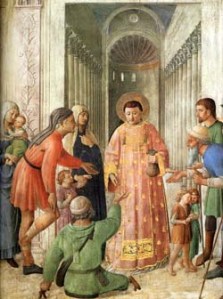
Fra Angelico’s Beautiful Image of St. Lawrence

Fra Angelico painted (fresco) this image between 1447 – 1449. It is found in the Vatican. It is approximately 9 by 7 feet and portrays the deacon, St. Lawrence, distributing the Church’s monies to the poor of Rome.

St. Lawrence is wearing a beautiful rose colored dalmatic A dalmatic is the outer garment that is worn over an alb, stole, and cincture.  The dalmatic represents the deacon’s service to his bishop. It is only worn during the celebration of Holy Mass. St. Lawrence was martyred on August 10, 257.

If you are interested in a more detailed review of the history of St. Lawrence  please refer to my post of August 10, 2020 entitled “St. Lawrence – Deacon and Martyr.” Thanks.

(This post was edited on August 10, 2020).

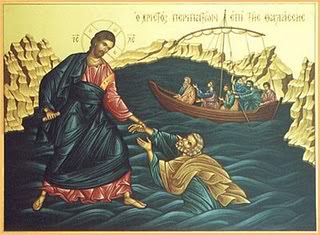
A Reflection on St. Matthew 14: 22-33

Today’s Gospel reading cuts right to the heart of the matter – and asks the question: do we have faith in our Lord Jesus Christ?

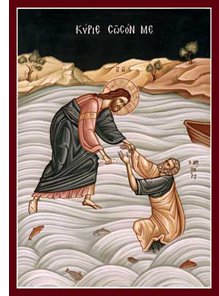
St. Peter certainly came face-to-face with that question. As a commercial fisherman he knew how dangerous that storm was and that his boat and companions could easily perish in its waves. Then, suddenly, Jesus appears – walking on the water. The companions respond – “It’s a ghost!” Jesus calms them and says “Get a hold of yourselves! It is I. Do not be afraid!” Peter speaks up and says, “Lord, if it is really you, tell me to come to you across the water.” Jesus responds “Come.”

Peter gets out of the boat and begins to walk toward Jesus, but when the wind begins to buffet him he becomes frightened and begins to sink. He cries out “Lord, save me!” Jesus at once stretched out His hand and caught him.”

Jesus wants us all to walk toward Him – in faith – on the “water” of our life. He wants us to cast aside our fears and commit to Him with a radical faith. We are all like St. Peter. We want to walk on the water toward Jesus but the waves of doubt mingle with the inner turmoil of our own hearts, and the circumstances of our own life. That truth continually affects our heart and our faith.

Peter’s faith was tested – as is ours – everyday. His example of calling out to the Lord – in faith – should be our prayer, too. This is especially true when we pick up the tools of our art and begin to feel the winds of self-doubt and dissatisfaction brush against our cheeks.

Copyright © 2011 Deacon Paul O. Iacono All Rights Reserved
What is a Sacred Arts Guild?

We, here at the Fra Angelico Institute for the Sacred Arts, believe that the foundation stones for this Institute are its Sacred Arts Guilds. A Sacred Arts Guild is a collection of people within a specific type of art form such as painting, sculpture, wood-carving, story writing, music, etc. The Sacred Arts Guilds are made up of those artists who are willing to come together on-line through posting and commenting with me on this blog, and when possible, in person to discuss and share their sacred art with other interested artists, and, if working in the same field, be willing to discuss and solve problems, gain insight, and rejoice with fellow artists in a final product that was personally satisfying and prayerful to create, simultaneously inspires others to prayer, and gives glory to God.

Within our Institute there are numerous categories of Sacred Art Guilds:

Painting of Sacred images

Sacred illuminated miniatures

Sacred calligraphy

Sacred stained glass

Sacred architecture and gardens

Sacred needlework – includes the knitting of prayer shawls/quilts

Sacred ceramics and tile work

Sacred music: singing, playing, or composing of music and chant

Sacred sculpture and wood working/carving

Sacred photography and the digital arts

and the Written word: sermons, essays, poetry, literature, drama

It is our prayerful hope that these Guilds will bring together individuals with a love for God and who desire to create beautiful works – to give glory to God – improve their own personal prayer life – and evangelize their fellow man.

Our motto being: Accept Lord, our prayers, petitions, and creativity, as the fruits of our day.

Copyright © 2011 Deacon Paul O. Iacono All Rights Reserved

Welcome to the Fra Angelico Institute

Our First Post

As our first post – on August 1, 2011 – I would like to explain that the mission of the Fra Angelico Institute for the Sacred Arts is to promote the creation of Christian sacred art and unite the creative process to the artist’s personal prayer life. Over the coming months we will be discussing various topics within the sacred arts, the creation of sacred art, important sacred artists from the past and present, and the development of our personal prayer life in union with our personal creative efforts.
The Fra Angelico Institute for the Sacred Arts was founded by myself and my wife Jackie in 2009. I am an ordained Roman Catholic deacon in the Diocese of Providence, Rhode Island. Professionally, before my retirement, I was a teacher of history and the humanities. I have studied and created sacred art since 2006. I am a sacred image painter.

An Amazing Revelation!

In my very first sacred art workshop, that was conducted by the talented and very fine teacher, Rev. Peter Pearson, I was profoundly struck by the impression that the actual creation of sacred art was of great importance to the improvement of my own personal prayer life. As I followed Peter’s directions in the creation of a sacred image, I realized that the truly spiritual connection I was experiencing was not the result of anything artificial, rather, it was the yearning of my soul to “connect” with the Person  coming into view on the wooden panel (the image that I was painting was an interpretation of St. Andrei Rublev’s icon of Jesus). It became very clear to me, as it had to so many other artists down through the centuries, that the creation of sacred art, regardless of what medium or form it takes, is a profoundly spiritual and prayerful act – IF – the artist decides to open up their mind, heart, and soul to the whispers of the Holy Spirit.

Join Us In This Exciting Adventure!

We think that the Institute is an exciting adventure in art and prayer. Currently we have over twenty people from the Diocese of Providence who are members, and, a few from out of state. The ideas and images that you will be seeing are meant to be educational, inspirational, and practical in the improvement of your development as a sacred artist. You may be a seasoned artist – secular or sacred, or, you may be a complete novice – all are welcome. In future posts I will explain the different categories of art you may want to explore and – if you are an experienced artist – display and express your creativity in the galleries on this site.

As Roman Catholics we have a specific theological perspective and faith tradition, however, please consider following us if you are from a different Christian denomination. After all, my teachers of sacred art are Episcopalian, Russian Orthodox, and Roman Catholic; and the participants in the sacred arts workshops that I have attended have been from many different Christian and non Christian denominations. Thanks for your interest and we look forward to your comments.

Copyright © 2011 Deacon Paul O. Iacono All Rights Reserved