A Decisive Hour for American Catholics

As we approach the conclusion of the Fortnight for Freedom, we draw near to the decisive hour, an hour of decision in the history of our great nation; an hour which truly challenges  American Catholics’ sense of discipleship.

It has been a fortnight in which our bishops have asked us to reflect upon our liberties, our history, and our current state of affairs. If you have thought about these issues at all you know that our history has not lied in this case: America is a nation that was built upon reverence for God, His natural law, and respect for the primacy of individual conscience and religious tradition.

In 1636, one hundred forty years before Jefferson penned the Declaration of Independence, the founder of the little colony of Rhode Island, Roger Williams, made freedom of conscience and religion the keystone of his community.

In 1776, The Declaration of Independence, and in 1789 the Constitution of the United States, all clearly stated the limitations of government; and in 1791, the Bill of Rights, carefully enunciated the rights of each individual citizen – the first right being, freedom of religion.

James Madison, a delegate to the Constitutional Convention and its secretary and recorder, described the legitimacy of conscience as “the most sacred of all property.” (1)   He wrote, “The religion then of every man must be left to the conviction and conscience of every man; and it is the right of every man to exercise it as they may dictate.” (2)

George Washington wrote, “the establishment of civil and religious liberty was the motive that induced [him] to the field of battle.” (3)

In 1804, President Thomas Jefferson assured the Ursuline Sisters of Louisiana – who had, for seventy-seven years, been serving an indigenous population by operating schools, hospitals, and an orphanage – that the principles of the Constitution were a “sure guarantee” that their ministry would be free “to govern itself according to its own voluntary rules, without, interference from the civil authority.” (4)

This is a matter of history. It is not a matter of conjecture, dispute, or equivocation; yet it is clear that the vast majority of our current state and federal government leaders do not accept this understanding of what the founding fathers of our nation wrote, lived, and established as our heritage.

So, we are at a decisive hour – an hour of decision – an hour that will determine the depth of our discipleship and test our understanding of who we are as American Catholics.

Many pundits, commentators, and yes even Catholic politicians, have remarked that there is nothing to worry about with this now Supreme Court approved Health Care Law. Yet our Church leaders – our bishops – are united in telling us that there is something drastically wrong with this law.

The American bishops have been united and clear on this issue and they clearly tell us that the Fortnight for Freedom has been about getting American Catholics – all 52 million of us – to understand that our federal government will force our Church to provide for certain types of medical procedures even though it is in direct violation of our collective conscience. My brothers and sisters, the Federal government’s actions are wrong and must be opposed.

So society may ask, “What do you want?”

Our Church responds, we respond, that as Catholics we ask nothing more than what Saints Peter and Paul and all the martyred saints and true disciples of Jesus Christ wanted; and as Americans we want nothing more than what Roger Williams, George Washington, James Madison, Thomas Jefferson and all true American statesmen and women have wanted: the right to follow our conscience, worship our God as we see fit, and to live out our faith by making a contribution within the public square.

We ask nothing more of our government than what our history has told us is our patrimony, our heritage: our blessed liberties.

This is a decisive hour – for it is the hour of discipleship in Christ Jesus. We must not shrink back in fear; for our sense of commitment to our nation’s heritage, and our loyalty to Jesus Christ and our Church, demands that we do not compromise on this issue.

We believe that all Americans, of all religious persuasions, and not just Federal or state government, must be allowed to have a contribution to the common good as prescribed by their faith and sense of duty. This is a liberty that has always been granted under our system of laws – until, until this critical moment in time.

So you may ask, “What do we do?”

We rise up my brothers and sisters and use all the law abiding and peaceful means at our disposal to inform our elected officials of this singular outrage against freedom of conscience. If they don’t address and rectify our concerns – we must remember it, and respond accordingly when we select our state and federal representatives. We can do no less.

Let us pray that through the intercession of the Holy Spirit we may have the courage to act as disciples of Christ – peaceful, courageous, and steadfast in the face of imperial tyranny.

Copyright © 2012 Deacon Paul O. Iacono All Rights Reserved

Quotations taken from: United States Conference of Catholic Bishops Ad Hoc Committee for Religious Liberty – their document: Our First, Most Cherished Liberty – A Statement on Religious Liberty

1. James Madison, “Property,” March 29, 1792, in The Founding Fathers, Eds. Philip B. Kurland and Ralph Lerner (Chicago: The University of Chicago Press, 1987) accessed March 27, 2012. http://press-pubs.uchicago.edu/founders/documents/v1ch16s23.html.

2.  James Madison, “Memorial and Remonstrance Against Religious Assessment,” June 20, 1785, in The Founding Fathers, accessed March 27, 2012. http://press-pubs.uchicago.edu/founders/documents/amendI_religions43.html.

3. Michael Novak and Jana Novak, Washington’s God, 2006.

4. Anson Phelps Stokes, Church and State in the United States (Harper & Brothers Publishers, 1950), 678.

When People Or Governments Get In Our Face

Recently I received a rather funny email from a friend concerning a God loving Marine coming to terms with an atheist professor. It triggered, however, a serious reflection on how we, as Christians, are to confront those who “get in our face” about issues of spiritual beliefs, sacred art, religious freedom, and personal liberty.

The passage from St. Matthew’s Gospel, chapter 5: 38-42, on “an eye for an eye and a tooth for a tooth” gives us an insight into who Jesus is as God. The behaviors that He explains, and asks us to imitate, are actions that He would perform; so in this passage on “an eye for an eye” we are getting a glimpse into the personality of God.

Jesus explains that the old Jewish law of “an eye for an eye and a tooth for a tooth” is no longer appropriate or virtuous in God’s eyes, it doesn’t reflect the behavior and actions that the Lord is trying to teach His people to follow, actions which reflect the Lord’s own mind and heart.

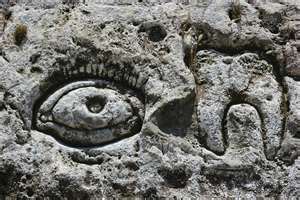
The following photo by talented photographer Kenny Lindstrom found at www.flickr.com/photos/kennylindstrom/ provides meaning, visual imagery, and the clarity of a typical traffic stop sign. We instantly recognize what the creator of this sculpture is trying to say (by the way, is this image done in sand, stone, or clay?). We get the message; but, as in all art, its interpretation depends on the values and beliefs of the viewer. Lindstrom’s photograph is a wonderful example of how a piece of art can display an impression that is both a teaching and reflective moment for the viewer.

The Holy Scriptures, however, are not to be viewed as artistic reflections or suggestions to the reader and listener. The Holy Spirit divinely inspired the Bible; thus, the faithful understand (sometimes better than many of the academics) that Jesus, as the Son of God, came to teach, preach, and heal mankind. His words are not suggestions, they are directions for living within His Sacred Heart; and that demands fortitude, perseverance, and most importantly, His grace.

Over the last two thousand years the Catholic Church has taught that we have a right to defend ourselves – a right to resist the evil that is done to us. But Jesus teaches that we should not resist evil with an evil response or by an evil means  – in other words we should not resist evil with a spirit of vengeance, rage, anger or with an unlawful or excessive physical or verbal response.

So, Jesus is teaching us that the tribal law of an “an eye for an eye and a tooth for a tooth” is destructive and directly opposed to the Father’s plan of a loving spiritual family living within a shared community.  Yet, not everyone in the world is a Christian; and the 20th and 21st centuries are showing themselves to be much more personally and collectively violent than many of the other centuries combined.

So what do we do? Jesus teaches us that our response to evil and insult, as difficult as this may be, should be measured; that is, it should be filled with patience and grace. For if we confront and attempt to defeat evil with an evil or vengeful response, then, we are weakening ourselves and empowering that which we hope to defeat. This does not mean, however, that we are to deny a sense of righteous and justifiable anger over injustices that are done – the Lord Himself gave witness to that when He drove the moneychangers and polluters of His Father’s Temple into the street.

The world can slap us on the cheek, it can take our belongings, it can take away our religious, political, and artistic freedoms and prevent us from speaking out against injustice, and it can even take our lives, but it can never touch our hearts or souls because the Lord God Himself has forever claimed us as His own children.

Let us pray that when we do have to correct our own actions or those of another, we do it based on Jesus’ spirit of graceful moderation, love, and kindness.

Copyright © 2012 Deacon Paul O. Iacono All Rights Reserved

A New Class of Iconographers Begin Their Studies: The Work of The Holy Spirit

On Wednesday evening, May 23rd, ten members of the Fra Angelico Institute for the Sacred Arts here in the Roman Catholic Diocese of Providence, Rhode Island USA were commissioned and blessed to begin their study, here at the Institute, and work to become competent painters of sacred icons.

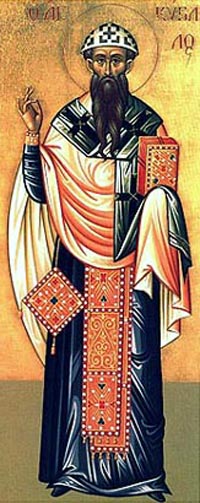
As we approach the Solemnity of Pentecost we can certainly see the movement of the Holy Spirit in this work. We are reminded of a commentary by St. Cyril of Alexandria, the bishop and patriarch of Alexandria, Egypt during the years of 412 to his death in 444. He was a man of great learning, holiness, and courage who defended the divinity of Christ and the specific role of Our Blessed Mother – the Holy Theotokos – in the plan of salvation.

In one of his commentaries he summarizes what we see in the early history of our Church, and continue to experience in our own time. He says: “After Christ had completed His mission on earth, it still remained necessary for us to become sharers in the divine nature of the Word. We had to give up our own life and be so transformed that we would begin to live an entirely new kind of life that would be pleasing to God. This, was something we could do only by sharing in the Holy Spirit.” [bold, mine, DPI]

He continues: “It was most fitting that the sending of the Spirit and His descent upon us should take place after the departure of Christ our Savior. As long as Christ was with them in the flesh, it must have seemed to believers that they possessed every blessing in Him, and to dwell in our hearts through faith. Only by His own presence within us in this way could He give us confidence to cry out, Abba, Father, make it easy for us to grow in holiness and, through our possession of the all-powerful Spirit, fortify us invincibly against the wiles of the devil and the assaults of men. It can easily be shown from examples both in the Old Testament and the New that the Spirit changes those in whom He comes to dwell; He so transforms them that they begin to live a completely new kind of life.”

I  briefly mentioned this in passing on Wednesday night to the class of sacred artists.  The statement being that the work of the sacred artist is the work of the Holy Spirit. The Spirit is involved in their training, work, and prayer and He is involved in transforming their lives as well. Why? Because they opened their hearts, and accepted the challenge that was spoken to them in the recesses of their soul.

All sacred artists are intimately involved in Pentecost. They are involved in having their lives changed through the love of the Holy Spirit who comes to dwell in their hearts so their art may give glory to God.

St. Cyril of Alexandria says to us that “….the strength that they [the Apostles at Pentecost] received from the Spirit enabled them to hold firmly to the love of Christ, facing the violence of their persecutors unafraid. Very true, then, was our Savior’s saying that it was to their advantage for Him to return to Heaven: His return was the time appointed for the descent of the Holy Spirit.”

Christian sacred artists throughout the world have been graced by the Lord to create prayer focused art works that have, as their very purpose, to promote prayer and to give glory to God. In this weekend of Pentecost, let us open our hearts, enter into this effort, and together say, “Come Holy Spirit, fill the hearts of your faithful and kindle in them the fire of Your love. Send forth Your Spirit and they shall be created. And You shall renew the face of the earth.”

Sacred Beauty has saved the world.

Copyright © 2012 Deacon Paul O. Iacono All Rights Reserved.   The icon of St. Cyril of Alexandria is from the website: traditioninaction.org Thanks to them for the image.

Icons, Icon Painters, and Praying With Sacred Icons: Part One

A few issues have come up in discussing some basic terms with people. I would like to be clear on how I have come to understand these words because it may affect how we view our “ministry” to be painters of sacred icons and or sacred images.

From my understanding, the word icon in English, Greek, and Latin, is the word for image. In our usage as sacred artists, it refers to a sacred image of Our Lord, Our Blessed Mother, angels, or specific saints. The purpose of a  sacred icon is that, as a piece of sacred art, it  focuses an individual in prayer.  A sacred icon is a specific type of sacred art. It is created following certain traditions – tradition with a small “t” and a large “T.”

Many sacred icons are presented with a simplicity of style, the use of color, the types of colors used, the use of symbols, etc. A sacred icon is different from a sacred image, in that the sole purpose of the sacred icon is that it is to be used as a focal point for personal or communal prayer.

A sacred image, however, may have been commissioned by a patron for personal prayer, but it may also have been commissioned for the pure enjoyment of its beauty. In the case of Renaissance sacred art, the Roman Catholic Church became the patron of many pieces of sacred art in order to affect the communal prayer of the faithful who came to the small churches and the great basilicas for Holy Mass.

With a sacred image (such as a religious image painted by Michelangelo or Leonardo) you have the artist’s personal imagination heavily influencing and entering into the creation of the beauty of the image, possibly even manipulating and combining Scriptural passages for the purpose of the story the artist would like to tell. Yet, even though I have just made that statement, the truth of the matter is that it is not always so clear cut. We do have icons, such as the famous Nativity icon of the birth of Christ, in which you have numerous Scriptural passages – conveying different events – being used to convey a catechetical sequence surrounding the birth of Our Lord – and all of this is done on the same icon panel!

In a sacred icon, the imagination of the artist is present, yet, it is supposed to be subordinate to his/her faith’s perception of Sacred Scripture and Sacred Tradition (how the early Church viewed their beliefs and expressed them within their specific cultural tradition). So, if a sacred artist is painting a sacred icon, he or she is aware of the theological, aesthetic, and semantic rules that have been developed and followed through the centuries. These rules – “the Canon of Iconography” – are affected by cultural area and religious Sacred Tradition.

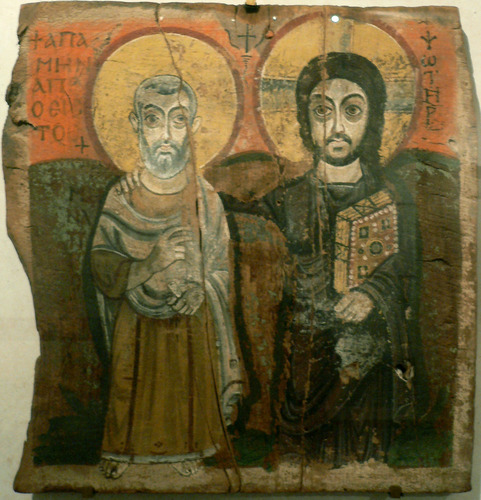
For example, a Coptic sacred icon (see image below), by a painter of the Egyptian Coptic Church will express the image of Christ and a saint (in the icon below an abbot of the Coptic Christian Church) somewhat differently than a Greek or Russian Orthodox painter; and yet, there is nothing wrong with this, as long as the painter is not fomenting apostasy or heresy.

All of that being said, sacred images, for example, by Renaissance painters, can certainly be used to focus an individual in their personal prayer, as do the beautiful stained glass windows of the great Gothic cathedrals. Care must be taken, however, in selecting appropriate images for use in personal prayer. It is my perception that the type of image a soul uses in personal prayer – sacred icons (from the Eastern Rite) or sacred images (from the Western Rite) – is a matter of personal preference and certainly does not  indicate that one type is better or “more truthful” than another. Eastern and Western sacred artists are both working off of their own perceptions and spirituality; there are disagreements with this, but we must always remain charitable with each other.

Within the last twenty years there have been many Western sacred artists that have rediscovered the beauty of painting sacred icons, and are trying to be sensitive to the Eastern Rites’ traditions,  as they bring it back into the consciousness of the Roman Catholic Church. The Eastern Orthodox Churches, thankfully, never lost appreciation for their tradition.

I will post Parts Two and Three on this same theme in the upcoming days. Be sure to look for them on-line or in the archives. Thanks.

Copyright © 2012 Deacon Paul O. Iacono All Rights Reserved

The image of Christ and the Abbot – a panel depicting a monk with Christ. It was excavated in the early 20th century from a monastery in Egypt and is located in the Bawit room at the Louvre. Thanks to: Photo by Clio 20, CC attribution share-alike 3.0. I believe the icon dates to about the 7th century.

St. Matthias and the Renewal of Easter Hope – The Lord Loves His Friends

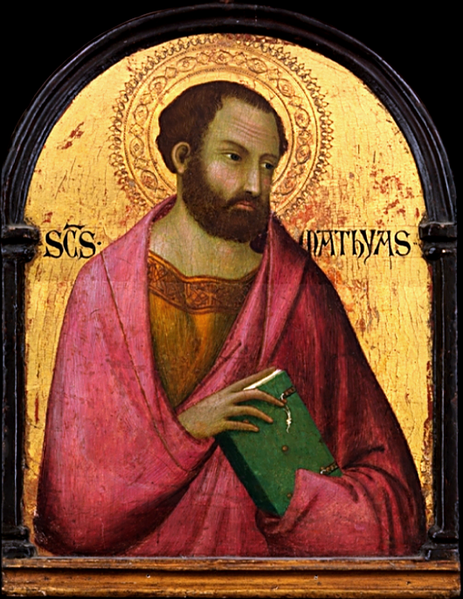
Today is the feast day of St. Matthias. The Acts of the Apostles relate that Matthias was chosen by lot to replace the disciple who had betrayed Jesus in the garden.

In chapter 18 of our Gospel, St. John speaks of Judas, who was in collusion with the Romans and the Jewish elders, and brought them to the place where Jesus was staying in the garden; the betrayal took place and the deaths occurred.

In the period after Jesus’ death the Apostles were known as the Eleven.

The Eleven. A title which causes us to pause, even today, two thousand years later. They were twelve, but then the betrayal took place. Judas hung himself; and the Romans hung Jesus on a cross. Even in those anxiety filled days after the death of Jesus, and before His resurrection, the Eleven knew in their hearts that Judas was not the only one, who had betrayed Jesus. For in cold terror they ran from the garden – they ran from the Cross – abandoning their Master and betraying His friendship.

It was only John, and the women, who had the courage to stand there and minister in silence, in tears and sobs, to their dying master. We wonder, that as they stood before the Cross, was there a crisis of trust in their own hearts? Did they wonder about the other ten who were not there? Did they wonder about their own possible betrayal? Yet, all of their self doubts and agony would be washed away through the truth of the Resurrection.

Today’s feast of St. Matthias gives us renewed hope in this, the sixth week, of the Easter season; for it directs us to the great love of God for His friends. It also reminds us that He never leaves His friends alone in their mission of building His Church.

After the Ascension of Jesus into Heaven, Peter, as the great leader of this little group of friends, realized that something had to be done to fill the hole, the gaping hole, that echoed with the cries caused by the betrayal of trust,  friendship, and fidelity to God Himself.

Peter knew that this cavity had to be repaired because Jesus Himself had filled the hole in Peter’s heart. It was Peter’s realization and trust that Jesus could heal him that led to his putting the mantle of leadership back on.

Peter knew that the grace of Jesus could heal them,too, and that they could become the ambassadors of the Good News who would carry out Jesus’ commands. Their group of twelve, by mirroring the twelve tribes of Israel, could evangelize Israel itself.

So, they cast lots – because they did not think themselves worthy to make the choice of their own accord, and wanted some sign [from the Holy Spirit] for their instruction.

Matthias was chosen.

St. Matthias was a disciple of Jesus who loved much, he witnessed the resurrection, he lived in the Father’s love, he followed Jesus’ commands, and was willing to lay down his life for the Lord and His Mission.

May God grant that we have Matthias’ courage to be open to the grace of Christ and use it to  build-up His Church.

Quote taken from a 4th century homily by St. John Chrysostom on the Acts of the Apostles found on pages 1822-24 of The Divine Office volume 2.

The sacred image of St. Matthias is from the workshop of Simone Martini the 14th century painter from Siena whose style influenced the Gothic movement. Martini portrays Matthias wrapped in the red mantle of martyrdom holding  a book that is painted green. Green is the color used by sacred iconographers and sacred artists to represent hope, life, and renewal. The book he is holding is a  reference to the truth of Christ’s Gospel preached by St. Matthias. This painting is dated between 1317-1319. Maestro Martini died in France at the age of 60 in 1344.

Copyright © 2012 Deacon Paul O. Iacono All Rights Reserved

ORO et CREO: I Pray – I Create – Part Two – A Wonderful Idea For Your Church

This is the second part of a three part series with Jamie Medeiros, an artist whose parish is in Tiverton, Rhode Island, and Deacon Tom Lambert, a Permanent Deacon within the Diocese of Chicago, and whose parish is Our Lady of Mt. Carmel in Chicago, Illinois.

Please be sure to read Part One of this two part interview in order to obtain a complete understanding of what the Lambert/Medeiros model of prayer and the creation of art is trying to accomplish. It is a model easily applicable to any Christian parish, within any Christian denomination, in the world.

The Interview: continued…

5) Is there any specific format that you use – such as – do you gather after Sunday Mass, do you say specific prayers together, or do you say prayers in individual meditation? Are all the participants Catholic?

Jamie: We begin in the church with some music (to help us transition from our busy days to awareness of God’s presence) and a brief reflection or guided meditation (usually a quote from Scripture or contemplative reading, followed by questions to think about).  We then begin our hour of prayerful creation.  We each go to an area of the church we are drawn to and create for an hour.  As we create, we let the images, questions, and movements guide us in our conversation with God.  Sometimes getting in the creating “zone” helps us rest in His presence. After one hour of prayerful creation, we meet in the front of the church and discuss our prayers (if we feel comfortable doing so).  Everyone places their artwork out for others to see and each of us explains what was going on, what we were thinking about, how it lead us to our results, etc.  There is a closing prayer.

Not all participants are Catholic, but all are Christian.

Deacon Tom: [He answered the format question in the previous post]. It is a parish ministry offered for members of our parish. We do occasionally get non-parishioners.

6) Does the “create” side of the session happen simultaneously with your prayer, or have you divided it – such as 10 minutes for prayer, 50 minutes for “create” after the communal or individual prayer session? Or do the participants desire for it to happen spontaneously?  What types of art are being produced: sketches, paintings, literary, etc. Have you ever had any formal or informal showings of the art that has been produced? Would your parish be open to displaying the art produced?

Jamie: For Oro et Creo, the prayer IS the creation (the Benedictines use the motto Ora et Labora – Pray and Work, we use Oro et Creo – I Pray – I Create, because creating can be prayer).  Our format is basically– an opening prayer, one hour of prayerful creation, and a closing prayer.  The opening prayer varies in length depending on what reflection I find for the week (usually having to do with current liturgical season, daily readings, or creation [the creative process]).

The type of art that is being produced are drawings, paintings, poetry, photography, and mixes of all of these. We have not had any exhibition of works yet.  We have talked about it.  I’m sure our parish would be open to it.

We definitely want to make sure that the practice remains prayerful and that participants are not pressured toward “perfection” of a work because others will see it, but it remains a space for a deep listening and responding to God’s voice.

Deacon Tom: [See previous post, question # 3]. We haven’t had any formal showings of the participants artwork. We have talked about the possibility of displaying the art but most are content to do this as a form of personal prayer

7) Do you have any guidelines that would be important for other parishes within the Diocese or other Dioceses around the world to be conscious of so that it would develop with the minimum number of personal or organizational potholes?

Deacon Tom: We are open to movement of the Spirit and the priority of art as a prayer experience. Silence [during the creative moments] is an important aspect [of what we are doing].

Jamie: I second what Deacon Tom said, “We are open to movement of the Spirit and the priority of art as a prayer experience.” Silence is an important aspect [of the creative moment].

8) Would you mind having people contact you – through your blog  or email – about the process?

Jamie:  Not at all.  They can email me at: medeirosjamie@gmail.com, at my website: www.iliveinhope.com, or blog: jamiedmedeiros.wordpress.com

Deacon Tom:  People can contact me at  olmcinfo2@aol.com  or Deacon Tom Lambert         Our Lady of Mt Carmel Parish    708 W Belmont, Chicago, IL 60657        773-525-0453 x 21.

In the third and last post of this series I will offer a personal reflection on what they have accomplished.

Copyright © 2012 Deacon Paul O. Iacono All Rights Reserved

ORO et CREO: “I Pray – I Create” – Part One

Soon after an article appeared in our Diocesan newspaper (The Rhode Island Catholic) in June 2011 on the Fra Angelico Institute for the Sacred Arts, I spoke on the phone with a talented artist by the name of Jamie Medeiros. We talked about the mission and goals of the Fra Angelico Institute and then she explained to me the mission of a group that she started at her parish in Tiverton, RI. Her group’s name is Oro et Creo (I Pray – I Create). I was fascinated by her description since it clearly was another example of the Holy Spirit’s continuing witness to get Catholics, and Christians of all denominations, interested in uniting the dual impulse of prayer and the creation of sacred art in all its various forms.

The following interview (the first part of a three part series) with Jamie Medeiros and Deacon Tom Lambert illustrate how their combined efforts and continuing positive influence have opened up the creative and spiritual impulses of many people.

The Lambert/Medeiros model can easily be replicated in your parish – regardless of where you are in the world. As of last week, this website/blog on The Fra Angelico Institute for the Sacred Arts, is read by people in 63 nations and on every continent except Antarctica. As far as I am concerned, these numbers are a clear example of how the Holy Spirit utilizes all resources to touch people’s hearts and move them back into a closer relationship with Him. Regardless of where you live in the world, and whether your parish is Roman Catholic, Greek or Russian Orthodox, Middle Eastern Catholic, or one of the Protestant denominations, the Lambert/Medeiros model of Oro et Creo, which unites personal prayer and the creative impulse within a church setting and in community with other artists, is a powerful tool of evangelization.

The Interview:

1) What inspired you to establish the Oro et Creo community?

Jamie Medeiros (St. Theresa’s Parish Tiverton, Rhode Island):     In Chicago at Our Lady of Mt.Carmel I had befriended one of the deacons [Deacon Tom Lambert] who had picked up art in his retirement.  He asked if I would meet one of the RCIA candidates [Belinda Cook Blakely] who was a student at The Art Institute of Chicago.  All three of us met after Mass one day and began a discussion about this common thread of art and God.  We discussed the fact that there seemed to be a lot of artists in our parish.  We joked, “we should start a group!”  The Deacon didn’t miss a beat.  He said, “We SHOULD start a group.”  We proceeded to discuss what it might “look like” if we started one.  This was just at the beginning of Lent [2008].  We all saw the movement of the Holy Spirit and thought the timing of this discussion was remarkable.  We picked a day, wrote up a blurb for the bulletin and decided to see if anyone would show.  They did.  We named it Oro et Creo after the Benedictine motto Ora et Labora (Pray and Work).  It is a time to pray while creating.  We continue to sit in wonder of the role of it as ministry for its participants.

Deacon Tom Lambert (Our Lady of Mt. Carmel Parish Chicago, Illinois): Oro et Creo started at Our Lady of Mt Carmel Church, Chicago when I introduced Jamie [Medeiros] and Belinda [Cook Blakely], two artists, to each other. They then approached me to start Oro et Creo because they didn’t find much connection between art and God in their work environments. Although both have moved on, Jamie to start an Oro et Creo group in Rhode Island, the group they started [here in Chicago] is still going on. For the translation of Oro et Creo I applied its meaning of ” I pray – I create” which says (to me) out of my prayer comes my creation. It is an invitation, a prayerful desire for one to create not a command to others, which is how I see Benedict’s Ora et Labora applying to his monks. [Deacon Tom and Jaime are using the phrase differently then St. Benedict, since St. Benedict was speaking in the imperative, that is, he was giving a command to his monks: “Pray and Work.” Deacon Tom and Jaime, however, are using Oro et Creo, the Latin is spelled differently because it  applies to an individual who prays and then creates, or creates while they are in a prayerful state – I Pray – I Create].

2) How long has your Oro et Creo sessions been in existence, what Church did it begin in, and is it taking place right now – name and geographical location?

Jamie: Oro et Creo first met during Lent 2008.  We began it at Our Lady of Mt. Carmel Church in Chicago, Illinois.  They are still meeting weekly on Monday nights.  Here in Tiverton, Rhode Island, Oro et Creo began the summer of 2010, meeting weekly, and now meets once a month on Mondays (7 pm) at St.Theresa’s Church in Tiverton.
Deacon Tom:  We meet weekly at Our Lady of Mt Carmel Parish 708 W  Belmont, Chicago, IL

3) Is the clergy involved in any way? Can people in your area join at any time and who would they contact and when would they show up?

Jamie: Here in Tiverton, our Pastor approved the program and likes to hear updates.  People are welcome to show up.  We meet at St. Theresa’s in Tiverton, RI on the first Monday of every month at 7 pm, unless it is a Faith Formation GIFT week.  People are welcome to email me with questions.

Deacon Tom: I am involved as a participant and [Parish] staff representative. The leader of the group is a layperson who is an artist.

4) How often do you come together to pray and create? Where do you actually meet – in the Church Hall, in the Church, at someone’s home?

Jamie: We currently meet once a month on Monday nights from 7 – 8:30ish pm.  This is open to change, depending on the seasons/ availability.  We meet in the Church.

Deacon Tom: We meet weekly. We start at the parish ministry center where we gather until everyone arrives. Then we have an opening prayer and then go in silence to the church or chapel. We sketch in silence for about an hour or more. People can sit anywhere in the church outside the sanctuary and sketch whatever they choose to do. Some bring pictures with them to sketch. We then go back to the ministry center where people may or may not choose to show the group what they were working on. Then a closing prayer is said. [Italics and boldface are my emphasis – Deacon Paul Iacono].

Part Two of this Interview with Jamie Medeiros and Deacon Tom Lambert will soon follow. In it they provide additional insights into this wonderful model which can easily be applied in your setting. Come on, what are you waiting for?!! Call one of your friends or church members who is creative, approach the parish clergy for permission to use the church for one hour a week, apply their model and get started!

 Copyright © 2012 Deacon Paul O. Iacono All Rights Reserved

Shaped By The Potter’s Hands

All of us struggle with the reality that the experiences of our life may harden our hearts and deafen our ears to God’s truth. We may be similar to the  disciples in this past Sunday’s Gospel (Luke 24: 35-48), who were filled with anxiety – until – – the moment “He opened their minds to understand the Scriptures.”

Jesus shows them the nail wounds in His hands and feet. He explains to them that the Scriptures teach that we cannot have glory and honor without the willingness to suffer and die to our own sinful will and perceptions.

He teaches them that they need to see the connection between His passion and death with His resurrection. He explains this so that they can understand what He is truly about, and that their mission, “as witnesses to these things” is to go out and preach the truth of His words and resurrection. Jesus explains, if they cooperate with and are open to His teaching, then they will realize that life’s events will shape them into what they are truly meant to be and the Father’s plan will end in glory for them, too.

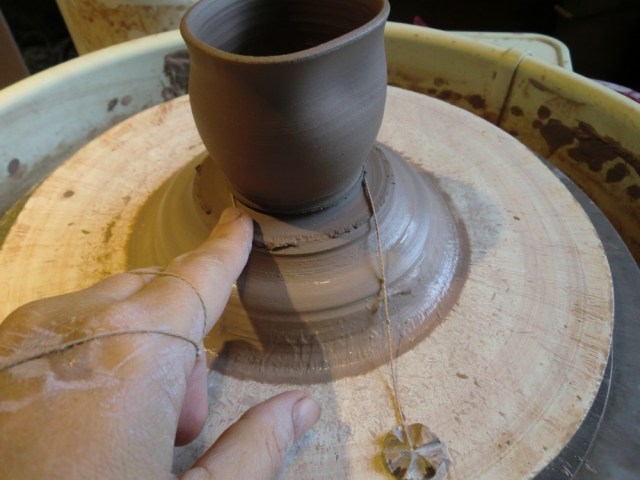
We can relate the shaping and opening of the disciples’ minds to the creation of a beautiful piece of pottery or a favorite coffee mug or tea cup that we may own. That cup started out as a simple lump of clay. Its creator – the artist – put it on a potter’s wheel, moistened his or her hands, and began to firmly and patiently mold the lump of clay into a cup.

The cup had to be put into a kiln and heated – then taken out, allowed to cool – painted – put back into the kiln again – and then, at the right moment – taken out of the heat and allowed to cool – to eventually be used for the purpose it was created.

The cup – a few days or weeks before – was just a soggy lump of clay – all closed in on itself; but now, after all the pounding, shaping, heat, and stress of its experience – it is open to serve the purpose intended for it by its creator – its ceramic arms now open to embrace and hold what it was intended to receive – and thus, be a useful instrument – a good and faithful servant.

This analogy helps to explain a thread running through the fabric of Holy Scripture, a thread, Jesus probably repeated to His disciples which is from the prophet Jeremiah, it says “As clay in the potter’s hand, so are you in My hand…” (Jer.18.6);

Our creator, God the Father – has spoken to us through His Son and laid His potter’s hands on us – His chosen vessels. We are all lumps of clay. We have all been pounded and shaped on the wheel of life.

We are a people who have been put into the furnace of life’s circumstances, suffered through sickness or various types of torments and troubles, and who sometimes find ourselves hanging on by a mere thread, but with Jesus’ help – in the end – even though we have suffered much – we are made stronger in our faith – and are viewed as beautiful in the eyes of God because we have not given up.  The clay of our life has been moistened by God’s Holy Scriptures and Sacraments – and because we have patiently kept the faith – we have not cracked in the heat of the kiln of life.

Like the disciples in today’s Gospel let us be willing during this Easter season, to have our hearts and minds opened, shaped, and molded through the patient and loving hands of Our Lord in His Words and Sacraments. If we allow Him to do this, even though we have experienced the wheel of life and the kiln of adversity, we will emerge as beautiful and faithful servants of our Lord.

Special thanks to http://blog.lablanchepoterie.com/ for providing the image of the potter cutting the cup away from its base.

Copyright © 2012 Deacon Paul O. Iacono All Rights Reserved

Our Living Hope: The Tomb Cannot Hold Us

Catholics, Orthodox, and Protestants  – we are all an Easter people. For two thousand years we have – through faith in historical documents and human witness – been invited to believe in a divine act of revelation: the Easter resurrection of our Lord and Savior; for it is in that act that our God shows us who He truly is.

We believe that the resurrection of Jesus is a historical and spiritual fact; and that the resurrection of Jesus not only explains the truth of His promises but it demonstrates what has been promised to us.

On the first Easter morning, Mary Magdalene, Peter, and John saw that the stone had been rolled away from Jesus’ tomb; and as they looked in  – they came face to face with their eternal destiny. Since no stone could have stopped the resurrected Jesus, it was pushed away not to let Jesus out – but to let them – and us – in.

Like Mary, Peter, and John, and all the others, we come to realize that we are an Easter people – which means that we are an eternal people – members, through our holy baptism, of the family of the eternal high God. The tomb could never hold the resurrected Jesus, and – as a people of faith – it cannot hold us.

St. Paul tells us in his epistle to the Hebrews that “faith is the assurance of things hoped for, the conviction of things not seen.” (11: 1)

But what is hope? Hope is trust based on a divine promise. We have hope because we trust the words and deeds of Jesus Christ. We trust in His promises to us.

Our hope interacts with our faith in Him – and we are forever changed because of it. You and I are certain of our faith, because we understand and rejoice in the hope that our God does not lie – our Scriptures do not lie  – our Sacred Tradition does not lie; so as an Easter people we possess the hope that St. Peter speaks of when he says: “…we have been born anew to a living hope through the resurrection of Jesus Christ from the dead.   (1 Peter 1:3).

As we celebrate the Easter season, let us – as our Lord tells us today – “Be not afraid”  – let us be joyful and thankful for the gift of faith and the willingness, in the face of all odds, to share our faith and joy with others.

May God grant you a joyous and creative Easter season!

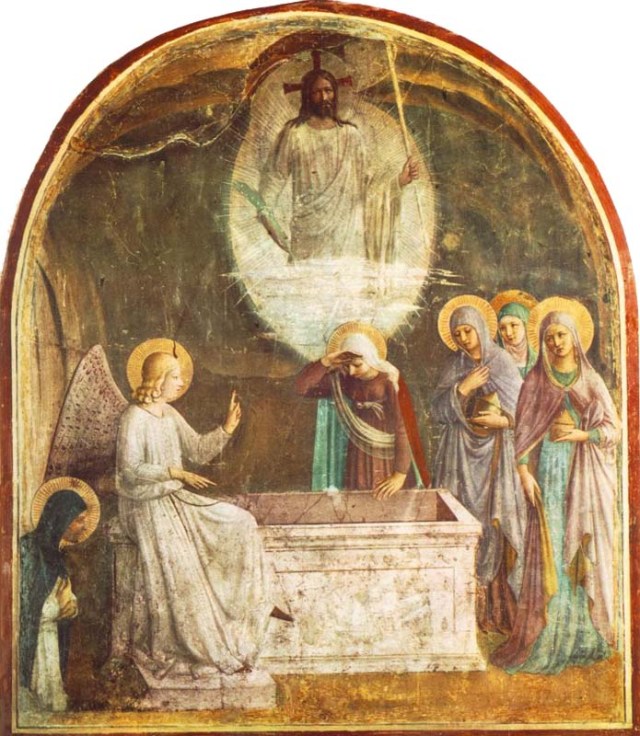
The attached sacred image was painted by Fra Angelico in 1441 and is entitled “The Women at the Tomb.”       Copyright © 2012 Deacon Paul O. Iacono All Rights Reserved

Holy Saturday Meditation: Something Strange Is Happening

“Something strange is happening – there is a great silence on the earth today, a great silence and stillness. The whole earth keeps silence because the King is asleep. The earth trembled and is still because God has fallen asleep in the flesh and he has raised up all who have slept ever since the world began. God has died in the flesh and hell trembles with fear.

He has gone to search for our first parent, as for a lost sheep. Greatly desiring to visit those who live in darkness and in the shadow of death, he has gone to free from sorrow the captives Adam and Eve, he who is both God and the son of Eve.

The Lord approached them bearing the cross, the weapon that had won Him the victory. At the sight of Him Adam, the first man He had created, struck his breast in terror and cried out to everyone: “My Lord be with you all.” Christ answered him: “And with your spirit.” He took him by the hand and raised him up, saying: “Awake, O sleeper, and rise from the dead, and Christ will give you light.”

I am your God, who for your sake have become your son. Out of love for you and for your descendants I now by my own authority command all who are held in bondage to come forth, all who are in darkness to be enlightened, all who are sleeping to arise. I order you, O sleeper to awake. I did not create you to be held a prisoner in hell. Rise from the dead, for I am the life of the dead. Rise up, work of my hands, you who were created in my image. Rise, let us leave this place, for you are in me and I am in you; together we form only one person and we cannot be separated.

…For the sake of you, who left a garden, I was betrayed to the Jews in a garden, and I was crucified in a garden.

See on my face the spittle I received in order to restore to you the life I once breathed into you. See there the marks of the blows I received in order to refashion your warped nature in my image. On my back see the marks of the scourging I endured to remove the burden of sin that weighs upon your back. See my hands, nailed firmly to a tree, for you who once wickedly stretched out your hand to a tree.

…a sword pierced my side for you who slept in paradise and brought forth Eve from  your side. My side has healed the pain in yours. My sleep will rouse you from your sleep in hell. The sword that pierced me has sheathed the sword that was turned against you.

Rise, let us leave this place. The enemy led you out of the earthly paradise. I will not restore you to that paradise, but I will enthrone you in heaven… the kingdom of heaven has been prepared for you from all eternity.”

The above quotation is from an ancient homily of the Catholic Church from its earliest centuries and is found within the Divine Office of the Roman Catholic Church. It is taken from the Office of Readings for Holy Saturday.

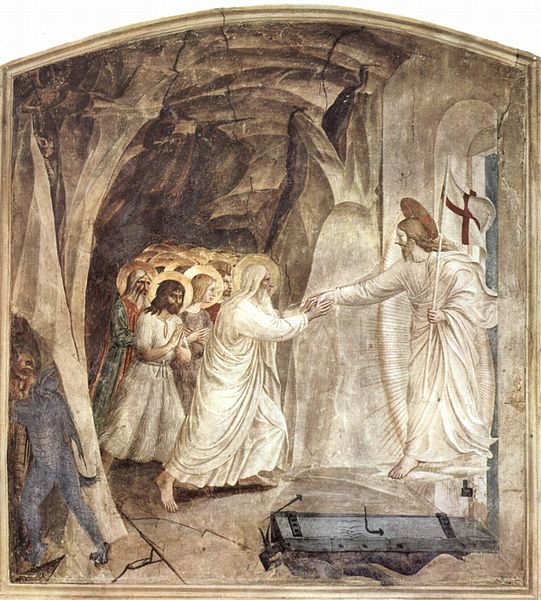
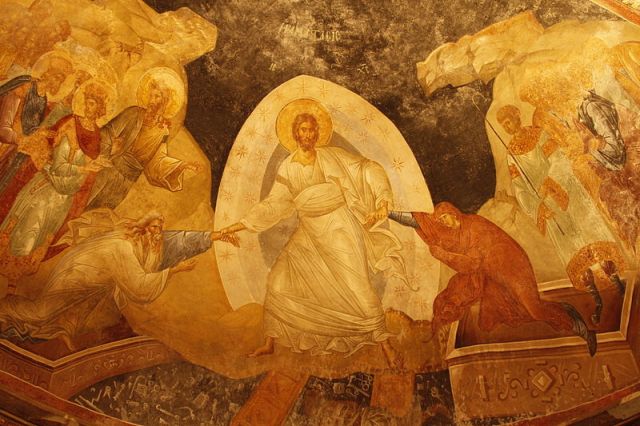
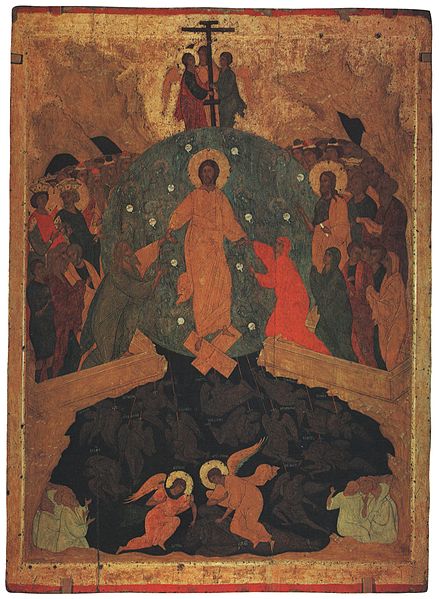
The first image of “The Harrowing of Hell” was painted by the Florentine painter Fra Angelico between the years 1437-46. The second image on this same subject was completed around the year 1315 by an artist of the Orthodox Church who painted this wall icon in fresco. It is presently found in the Chora Church in Istanbul, Turkey. The third image of the “Harrowing of Hell” is by the head of the Moscow school of icon painters from the late 15th century – the master Dionysius. This Russian Orthodox  icon was completed around 1481.

Copyright © 2012 Deacon Paul O. Iacono All Rights Reserved

Good Friday Meditations

It was about nine in the morning when they nailed Jesus to the cross.

From noon until three o’clock there was darkness over the whole world.

At three o’clock, Jesus cried out in a loud voice: My God, my God, why have you forsaken me?

It is finished.

When we were His enemies, God reconciled us to Himself by the death of His Son.

Realize that you were delivered from the futile way of life your fathers handed on to you, not by any diminishable sum of silver or gold, but by Christ’s blood beyond all price: the blood of a spotless, unblemished lamb chosen before the world’s foundation and revealed for your sake in these last days. It is through Him that you are believers in God, the God who raised Him from the dead and gave Him glory. Your faith and hope, then, are centered in God.  (1 Peter 1: 18-21)

“Awake, O Sleeper, and rise from the dead, and Christ will give you light.”


Copyright © 2012 Deacon Paul O. Iacono All Rights Reserved

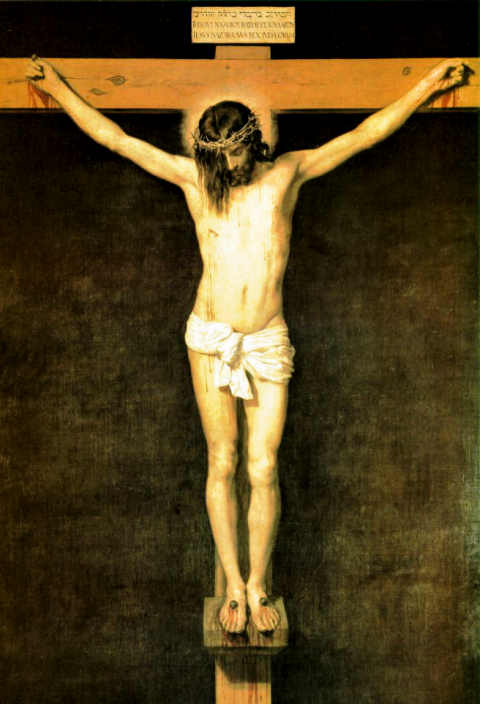
The painting, Christ’s Crucifixion, is by the Spanish master Diego Velazquez (1599 – 1660); it was completed between 1631 – 32.  All the Scriptural quotations are taken from The New American Bible (1970) Confraternity of Christian Doctrine, Washington, D.C. The “Awake, O sleeper…” verse is taken from an ancient homily from the first centuries of the Church.

What Does The Silence Of Christ Say To Us?

In the passage from the first Epistle of Peter known as the Canticle of Peter (1 Peter 2: 21-24) Peter describes Jesus’ acceptance of His passion. He explains:

“Christ suffered for you, and left you an example to have you follow in His footsteps. He did no wrong; no deceit was found in His mouth. When He was insulted He returned no insult. When He was made to suffer, He did not counter with threats. Instead He delivered Himself up to the One who judges justly. In His own body He brought your sins to the cross, so that all of us, dead to sin, could live in accord with God’s will. By His wounds you were healed.”

In this morning’s first reading we have Isaiah tell us, “He [the suffering servant] does not cry out or shout aloud, or make his voice heard in the streets.”

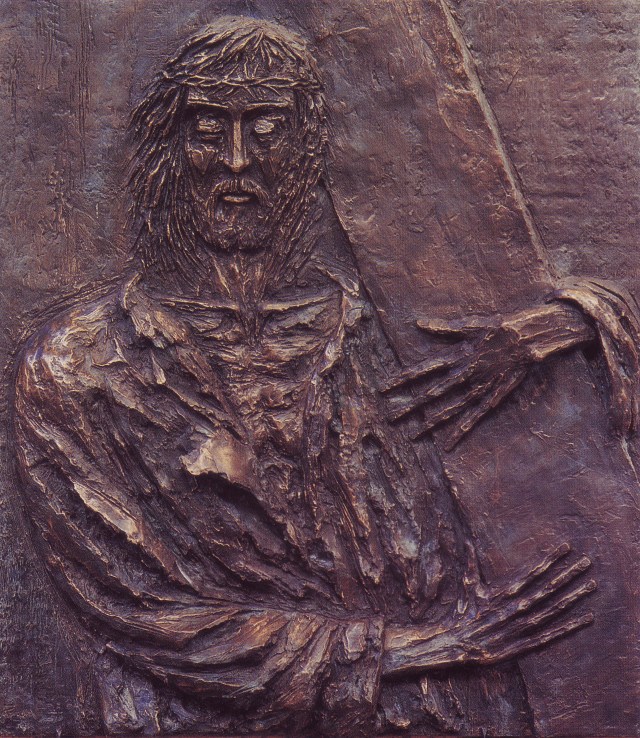
We can picture Jesus carrying the Cross, carrying the weight of our sins through the streets of Jerusalem to His place of execution.

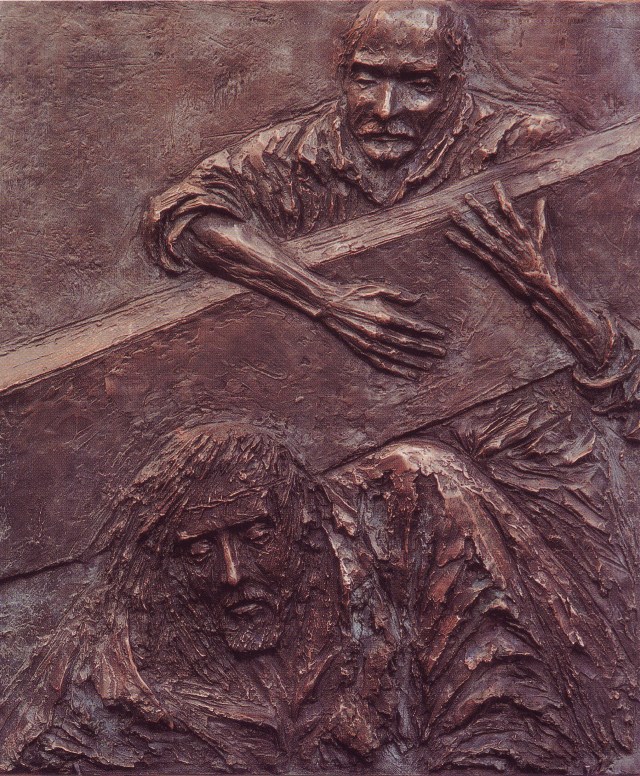
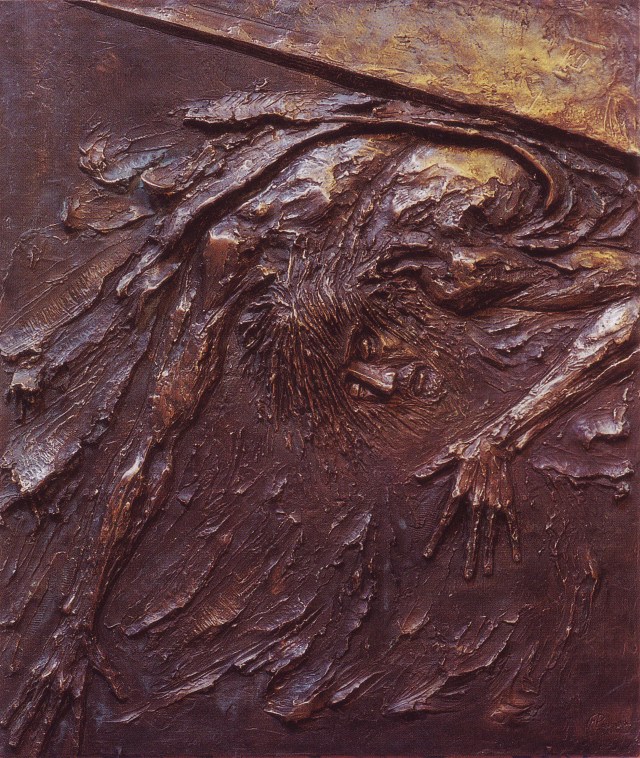
After receiving a savage beating and scourging at the hands of the Roman soldiers, He said nothing; after having the weight of the Cross thrust upon His raw and bleeding shoulders – He said nothing; as He stumbled and zigzagged through the streets of Jerusalem, being hounded every step of the way by sadistic soldiers and a callous mob, He said — nothing.

What does His silence say to us?

Possibly, if we unite ourselves to His sufferings, we can see that our own life consists of spiritual, physical, and emotional beatings, scourgings, sufferings, and crosses that are thrust upon us.

Like Jesus, we may feel that we are being ground into the street by the suffering we are experiencing – but like Him – we must rise up – to carry our personal cross as best we can.

As Catholic Christians – actually, all Christians regardless of denomination – have as our calling the duty to carry our trials and troubles in the same way that Jesus did. Like Him, we will zigzag through the streets, we too, will stumble and fall; but Holy Week reminds us that we must always see Jesus’ composure, humility and strength in the face of unbelievable pain and extraordinary adversity as a model that we must strive to emulate.

Jesus was not a masochist; nor are we. But we understand that the mystery of suffering contains within it the seed of our redemption – the seed of our spiritual rebirth – for a seed must fall to the ground and have its outer shell stressed, broken, and yes, pulverized, so that its center may take root and give birth to new life.

This week we must make a silent prayer, to join our trials and sufferings, those of our loved ones, and those of our nation – to His, and to implore the Father to help us raise up our nation, family, and ourselves as best we can, so that we may, as Saint Peter tells us, “follow in His footsteps” and silently and without complaint, carry our own cross – as well as the crosses of others.

Special thanks to Fernando Mario Paonessa a contemporary artist for providing the images of Jesus suffering the Way of the Cross. Fernando created these stunning sculptures (reliefs); more images may be found on his website: http://fernandomariopaonessa.eu/pages/via_crucis.htm

Copyright © 2012 Deacon Paul O. Iacono All Rights Reserved

The Solemnity of the Annunciation – The Confident Sacrifice Of A Pure Heart

Many years ago, Blessed John Paul 2 spoke to the seminarians of Rome on this, the Solemnity of the Annunciation. He began his homily with the phrase: “Fear not!”  Echoing the archangel’s comments to our Blessed Mother he was trying to calm the natural anxiety of those young men as they  prepared for their Gospel ministry in the world. The Pope counseled them that “We must all accept the call. We must listen [to the Holy Spirit],  and use the grace that we have received from God. We must shore up our strength, and say, “Yes” in confidence and certainty to the call that we hear from the whispers of the Holy Spirit.”

Upon hearing the message of the archangel Gabriel, the ultimate decision by Mary that “Let it be done to me according to your word” conclusively and forever changed cosmic and spiritual history. For at the moment she said “Yes” to Gabriel, our salvation and redemption, through the Cross, began.

Let us not forget, however, that Mary’s “Yes” had a tremendous affect on her, too.  It required a great cost from her personally because it resulted in the Crucifixion – it resulted in the sacrifice of her own son Jesus – and – the sacrifice of her own heart.

Blessed John Paul 2 speaks of this when he says:  “Mary in a particular way – unlike any other – experienced mercy, and at the same time, made her participation in the revelation of the Divine Mercy possible with the sacrifice of her own heart.  Such a sacrifice is closely bound up with the Cross of Her Son, at which she was to stand at Calvary… No one has experienced the mystery of the Cross as did the Mother of the Crucified…. Mary is therefore the person who knows the Divine Mercy most deeply. She knows the price; she knows how high it is.”

He goes on to say, “Maybe there is another point: for all people are born at Mary’s Yes.” This must be understood: such a Yes in imitation of Mary creates joy, a new life, a breath, a blessing;” it creates opportunities for us to  sacrifice our own hearts in imitation of her and the Holy Family.

So as we enter the 5th week of Lent let us celebrate this Solemnity by trying our best to live like our Blessed Mother – a person with complete confidence in the Lord. Let us say Yes to God in imitation of Mary and allow the Lord to work wonders in our own lives, as well.

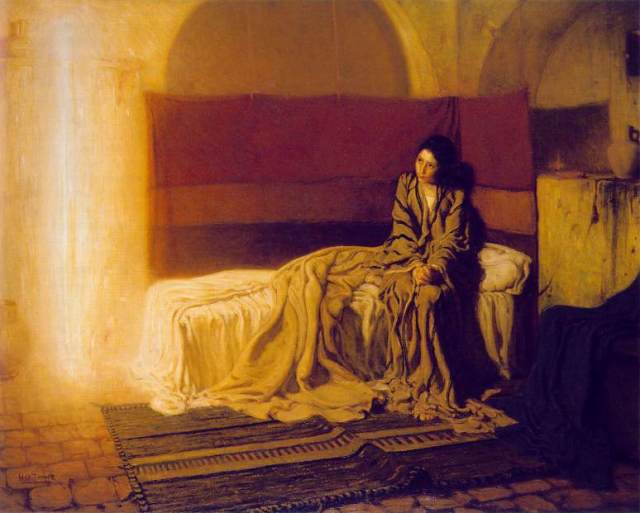
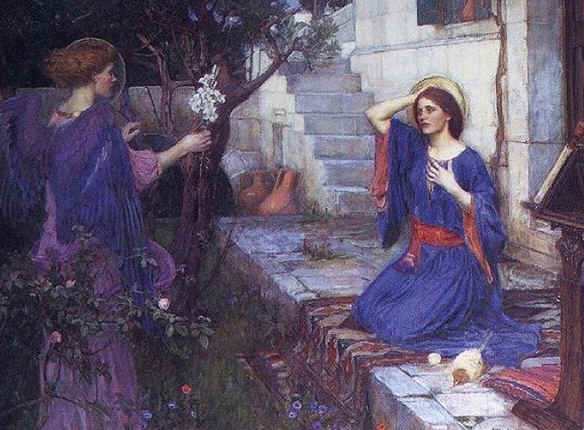
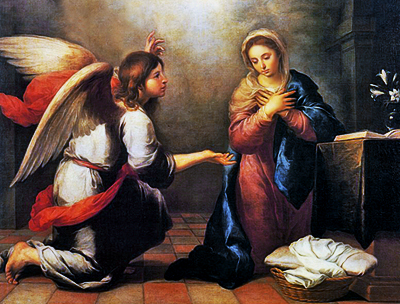
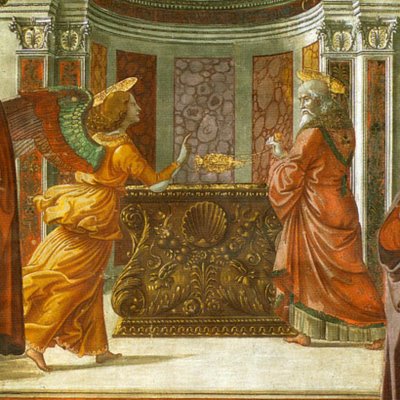
Images in order of appearance: A 13th Century Byzantine icon of the Annunciation from St. Catherine’s Monastery in the Sinai; Henry Ossawa Tanner’s Annunciation (1898); John William Waterhouse’s Annunciation (1914); and Bartolome E. Murillo’s Annunciation completed between 1660 -1665, and please don’t forget to do some research and take a closer look at one of Fra Angelico’s versions of the Annunciation! Please also notice that in Waterhouse’s and Murillo’s renditions both artists have included the tradition that Mary was in the process of sewing the veil that separated the Holy of Holies from the outer room which housed the Altar of Incense in the Temple in Jerusalem; other artists, such as El Greco, do that too.

Copyright © 2012 Deacon Paul O. Iacono All Rights Reserved

The Artist As Contemplative – Part 4 – A Meditation on the Scourging of Christ

In this series on the Artist As Contemplative it is my hope that you are exposed to some different techniques that may assist you in your prayer relationship with Our Lord.

The last post in this series specifically mentioned that we do not need to use many words during prayer. This may be uncomfortable for us at first since we have developed into a species that appears to constantly need some type of noise, talk, music, or in some cases, cacophony going on inside our mind. I am not a social psychologist so I will not venture a reason for such a trend within American society, other than to say that it may be an attempt to buffer the anxiety that people, especially the young, feel.

We must reduce the amount of noise, superfluous talk, and loud dissonant music that hammers our nervous system. We have to do this in order to allow sacred silence the opportunity to blanket us with its warmth so we can settle into a comfortable conversation with Christ.

St. Teresa of Avila is very helpful in this regard. Fr. Peter-Thomas Rohrbach, O.C.D.  clearly states in his wonderful book Conversation With Christ that the prayer doctrine of St. Teresa is clear: “Prayer does not consist in involved, complicated reasoning, but in thought which is productive of conversation with Christ.” So prayer, productive prayer, is conversation with Jesus.

Fr. Rohrbach then goes on to provide an actual demonstration of true meditation provided by St. Teresa of Avila in her own autobiography.

She says: “We begin to meditate upon a scene of the Passion – let us say upon the binding of the Lord to the columns. The mind sets to work to seek out the reasons, which are to be found for the great afflictions, and distress, which His Majesty must have suffered when He was alone there.

It also meditates on the many other lessons, which, if it is industrious, or well stored with learning, this mystery can teach. This method should be the beginning, the middle, and the end of prayer for us: it is a most excellent and safe road until the Lord leads us to other methods, which are supernatural…   it is well to reflect for a time and to think of the pains which He bore there, why He bore them, Who He is that bore them and with what love He suffered them.

But we must not always tire ourselves by going in search of such ideas; we must sometimes remain by His side with our minds hushed in silence. If we can, we should occupy ourselves in looking upon Him Who is looking at us; keep Him company, talk with Him; pray to Him; humble ourselves before Him; have our delight in Him, and remember that He never deserved to be there. Anyone who can do this, though he may be but a beginner in prayer, will derive great benefit from it, for this kind of prayer brings many benefits; at least, so my soul has found.”

The beauty of this approach is that it is completely natural for us to do what she directs in prayer. If we look again at the passages that I have highlighted in bold face you will see that this prayer behavior is the same we would express if we were with a close friend or relative experiencing a troubled or stress filled moment in their life.

So the watchwords here are sensitivity, awareness, and humility. Sensitivity because we need to be willing to listen, and humility in knowing we don’t have all the answers, and the awareness to know that sometimes it is necessary just to keep someone company, and quietly talk to them, without trying to provide solutions.

But it is more than that, isn’t it; because in our prayer we are talking to God. We are talking to the Son of God who suffered for us, because it was the Father’s desire, which He willingly accepts in order to accomplish the salvific act of our Redemption. Our ability to keep ourselves humble before God, delight in His Divine Presence, and remember His Life and Death is critical for a healthy prayer experience.

Our intellect and will working with the faculty of our memory of scenes from Sacred Scripture provide us with the ability to soak ourselves in the meaning of Christ’s great sacrifice. For this is who we are as Catholics, Orthodox, or Protestants – people who bring the images and truth of Scripture and the saints of our traditions into our prayer life.

Does any of this apply to sacred art? Yes, as sacred artists, St. Teresa of Avila would probably say, “Paint and use the best quality and Scripturally correct icons, paintings, sculpture, etc as prayer aids. We need these aids to help the entire person: mind, heart, soul, and body to be focused on Him.”

I’d also venture to suggest that she would say “If you are a sacred artist produce a piece of sacred art that correctly portrays the Scriptural Jesus, the Blessed Mother, His angels, and saints. Remember, a sacred artist must be a person of deep prayer.”

St. John Damascene (Damascus), thirteen hundred years ago, in his writings and teachings very clearly stated that when we do this it is not idol worship. We believe that the Son of God became man; therefore, He became the iconthe image – of God for us to see, hear, touch, scourge, and crucify – “The Word became flesh and dwelt among us.”

This is not idol worship, just as it is not idol worship when you have a picture of your deceased parents on your bureau – you are not making an idol of them – your are not worshipping them – rather, you are remembering them through a celluloid image – an image which helps you relive what they taught and how they loved you – and still do from beyond the grave. So never fear your imagination – or images of the Lord – as long as you guard yourself with images and imagination that are focused with correct theology, semantics, and aesthetics.

I’ll let Father Rohrbach have the last word, he says: “St. Teresa presents us a crystal-clear picture of meditation: the mind furnishing matter for the heart’s talk with Christ. And above all, her fundamental rule that prayer consists not in thought, but in love.”

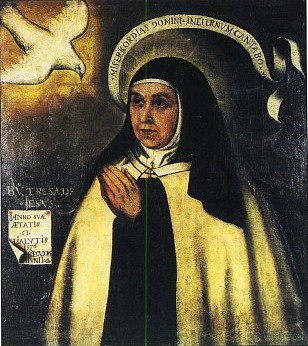
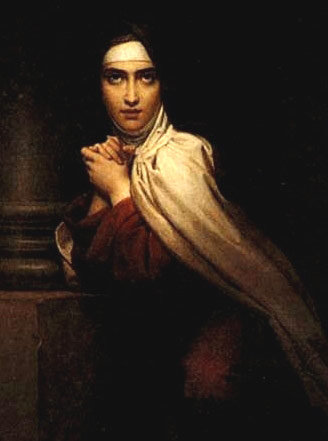
The above image of St. Teresa of Avila is considered to be the closest likeness to her. It was painted in 1576 when she was 61 years old.

Copyright © 2012 Deacon Paul O. Iacono All Rights Reserved

The Feast of St. Joseph – Universal Patron of the Church

At the birth of Christ, the seven hundred year old messianic prophecies of the prophet Isaiah became an historic reality. On a yearly basis, we celebrate and remember that moment on the Feast day of St. Joseph, the patron of the universal Church; for we see in Joseph not only a loyal husband and foster father of Jesus – our Savior – but also a man of conviction and prayer.

Upon hearing that Mary is pregnant Joseph is filled with pain and anger. Understandably, at first, he is not ready to say “yes” to Mary and her story of divine intercession – there are few men that would.  But through divine intervention and the sending of His angel, God makes another request, for the angel relates God’s message: “Joseph, Joseph, do not be afraid to take Mary your wife into your home.”

We call St. Joseph a confident man because – ultimately – he, like Mary, says “Yes” to God. He has confidence because he proclaims his trust in God. With Joseph’s “Yes,” his anger subsides and is replaced with a joyful nurturing spirit that enables him to exert leadership and act as a faith-filled father and loving husband.

Joseph, from that moment, grows in love for his wife and unborn child and through the years, like all fathers, he grows in love and intimacy with Jesus.

An intimacy not only of physical closeness and rapport – but of soul – an intimacy of prayer and meditation that filled his heart and mind with awe; this intimacy and proximity to Jesus meant that he was constantly exposed to the same grace that Jesus gives us in our Eucharistic adoration of Him.

Pope Pius 11th, in his teaching on St. Joseph in March 1928 said, “All Joseph’s sanctity lies precisely in the completely faithful accomplishment of his great and humble mission, so high and so hidden, so splendid and so surrounded with shadows.”

We are truly graced if we realize, like St. Joseph, that we must make ourselves vulnerable to God -– vulnerable to the gifts of God – by exposing our heart, and soul to God’s love – and trusting God – through His Sacramental grace, to turn our hearts, so that we, too, may fulfill the mission – simple or profound – that we are asked to complete in life.

Saint Joseph, pray for us.

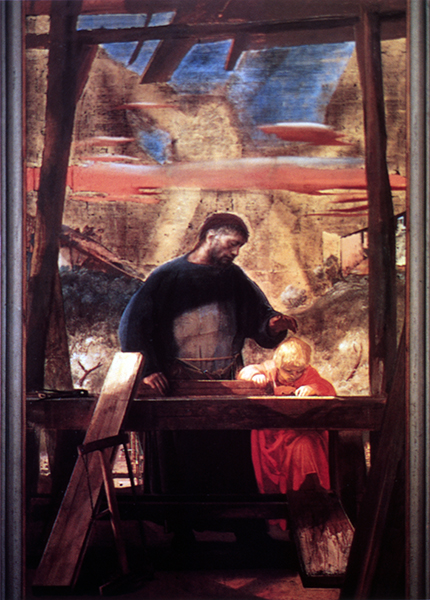
Sacred image of St. Joseph and Jesus by Pietro Annigoni. It hangs in the Church of St. Lawrence in Florence, Italy. It was painted in 1963. Thanks to the website of the Oblates of St. Joseph for the painting by Annigoni.

Copyright © 2012 Deacon Paul O. Iacono All Rights Reserved

The Artist As Contemplative: Part 2: A Simple Step Into Prayer By St. Teresa of Avila

In our last post, The Artist as Contemplative – Part 1: The Proper Approach, we discussed the need to have the proper approach to prayer. One of the assumptions that I have is that if you are reading these posts you are a creative person. You may be an actual working artist, or, you may be attracted to art in one of the various forms it takes and are considering taking the first step in its exploration. Even if you are just beginning to explore a specific art form it is important for you to consider yourself an artist. This is not a fraudulent act. It is the perception of yourself as you truly are as a creation of God – a naturally creative person.

The Lord has made all of us creative beings, and regardless of our job or profession we should make time in our life to develop this creativity and allow it to be expressed. If we have no time for prayer and personal creative growth then we may be in a situation that is truly unhealthy for us. Our Sacred Scriptures tell us that our God is a jealous God – He specifically said that He wants “no other gods before Him” – that is a very sobering thought. So, quiet, prayer time – even if it is only thirty minutes a day – is critical to our spiritual, physical, and creative health.

If we make time for prayer, God’s grace and energy will cascade over into our creative life.  This is very important to artists, regardless of what media or medium we work in, since it demands that we focus our attention on one thing: talking to God in a natural way – talking to Him as we would talk to a close and intimate friend. 

This is difficult for many people. Childhood ignorance or anxieties may still be with us. There may have been bad influences from teachers, members of the clergy and religious life, and others (including, at times, parents) who took a limited view of prayer and taught a specific prayer style to the detriment of other approaches.

By remaining positive we see that a key idea in the prayer process is to remember that when we have a conversation with someone our intellect is remembering ideas and images. We are using those ideas and images in our actual conversation. This allows the conversation to proceed from one point to another and allows ideas or issues to be shared. This is also true in conversation – that is, our prayer – with God. Our intellect, memory, and silent conversation skills within our mind cooperate together to naturally express ourselves to God. Just like the story, in my preceding post, of the little girl receiving her first Holy Communion. She expressed her prayer to God in a natural manner, which made sense and allowed her to share the concerns or ideas with the Lord that were on her mind at that time. Her prayer was a perfect natural prayer.

In examining the teachings and prayer process of St. Teresa of Avila (1515-1585), the Spanish Carmelite, Father Peter Thomas Rohrbach, O.C.D. breaks her basic prayer technique into a simple step formula. He says the goal of prayerful meditation is conversation with Jesus. You achieve  this by engaging your visual memory  with a specific spiritual passage. This con-versation with Jesus about the passage moves to consideration of events within your own life. This process is actual conversation with Jesus in which He, like a good friend, is quietly listening to you.

St. Teresa of Avila (seen above in the portrayal by Gérard) is not promoting a prayer life which is filled with complexities, intellectual knots, and unnatural irritations, rather, she is presenting a style which reminds us of a wise old person who has no need of thinking about numerous paragraphs of words to say to God in prayer. The wise one enters their prayer time thinking about God, and specifically His Son, Jesus – the true icon (image) of God. They then allow their love of Him to take over – and fill the blessed silence of that present moment – not with many words – but with much love. You see this is the goal: to move from quiet conversation to quiet meditation – in love – of God’s truth, goodness, and beauty.

In my next post I will provide you with a meditation taught by St. Teresa of Avila. With  this Lenten meditation you should easily exercise your spiritual muscles. Also, it will help you take some time to reflect on St. Teresa of Avila’s approach and application to other moments in Jesus’ life and yours, too.

Copyright © 2012 Deacon Paul O. Iacono All Rights Reserved.  Thanks to avila.com for the image of St. Teresa of Avila by artist François Gérard (1770-1837).

The Artist As Contemplative – Part 1: The Proper Approach

All artists, by their very nature, contemplate. They are natural born contemplatives.

In its dictionary definitions we see that the word contemplate means: 1) “to intently look at something, 2) to study carefully, and 3) to have in mind the possibility or a plan of action.”

A person whose artistic skills are expressed through photography or the enhancement of physical beauty through fashion or cosmetics can certainly contemplate the meaning of beauty and maintain its traditions or break out and establish new ones. The same is true of a sculptor, painter, musician, needlework artist, poet, writer or any person working within other artistic mediums. For they, too, can “look intently at, study carefully, or have in mind the possibility of a plan” to create beauty or a new interpretation of it. As you see, at first glance there is no overt mention of religious or spiritual themes in these definitions.

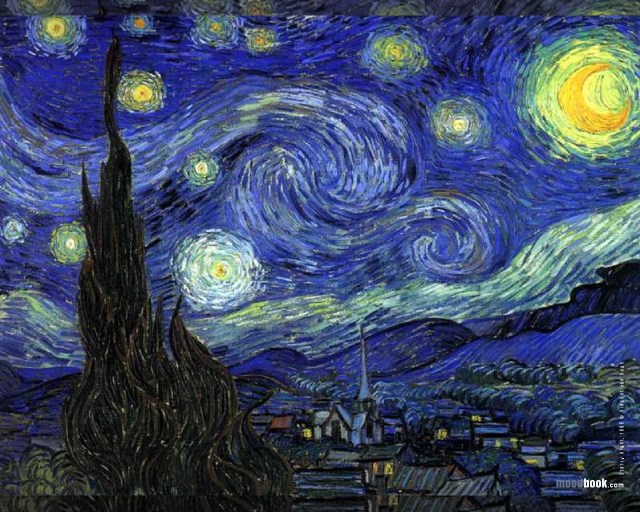
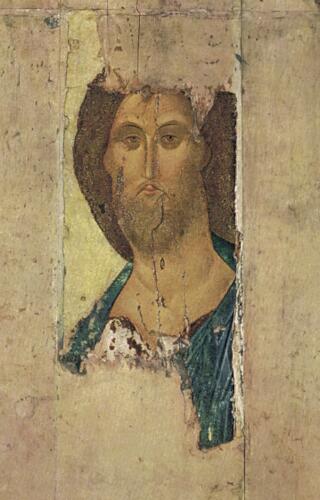
Now let’s go a step further and ask a few questions: 1) Can the Christian artist (who has a natural contemplative spirit by virtue of being an artist), establish the artistic process as a vehicle for authentic prayer and union with God? 2) For example, did our friends Vincent Van Gogh or St. Andrei Rublev experience authentic prayer moments in their creative process? 3) When we look intently at  Starry Night or Christ the Redeemer – the Savior of Zvenigorod (seen below) do we feel comfortable using them in our conversation with God, and if not, why not?

Okay, as the old saying goes, “What does this have to do with the price of eggs?”

Young or old, there are times in our lives when we put up barriers in our minds to pursuing some study or some plan of action. This is especially true when it comes to the whole idea of prayer, and specifically, meditation and contemplation. People have a tendency to say, “Oh, that’s for holy people. I’m a sinner. I could never do it nor do I have the skills to do it. Bottom line, no one has ever taught me how to pray other than saying rote memory prayers.”

Good point. That perception is held by many people, especially Christians that have fallen away from the church of their ancestors. But is that belief just another mind barrier?

It is an established fact of being a Christian that we can be in touch with God, specifically His Divine Son, Jesus. We do believe, if we are Christians, that we all have the ability to enter into deep spiritual union and friendship with God by virtue of our Baptism. Baptism was the first very important step, and then, after that, the friendship of Christ is developed through our weekly worship and daily prayer life, our Scripture study and our Sacramental life. It takes effort, yes; but as Christians we understand that we enter into that relationship with Christ by walking with Him through His ministry and onto the path to Calvary.

The reader might say, however, “I am not a Christian. What does this have to do with me?” Even if the artist is not Christian they have the ability to enter into deep spiritual union with God through their own faith traditions. All the major religions of the world speak of and promote prayer; and all artists, even if they are not Christian, can enter into spiritual union with the Divine through the creative process.

But there is a little known maxim in Catholic Christian prayer practice: if you can think and if you can read (at the second grade level) you are capable of meditation; let me repeat, you are capable of experiencing authentic, prayer filled, and profound contemplation of God.

A quick example of this is the story that Father Peter-Thomas Rohrbach, in his important and delightful book Conversation With Christ that I discovered forty-five years ago. He tells of a young Catholic girl’s experience on receiving her first Holy Communion. He says, “The story is related of a small girl who, after the reception of her first Holy Communion, was questioned tenderly by her parents as to what she had done when she arrived back at her pew and prayerfully bowed her head. The girl hesitated momentarily, and then said in her thin, small voice: “‘I prayed to Our Lord for Mommy and Daddy, and for my sister Helen, and my brother George; and then I recited the alphabet to Our Lord and told Him a ghost story.'”

Father Rohrbach continues, “We, of course smile indulgently at the naivete and innocence of the small child; but after reflecting on the story, we might suddenly wake to the realization that the girl possessed the proper approach to prayer – she was actually talking to Our Lord. What she said to Christ was relatively unimportant, what she did was decidedly important: she entered into immediate contact with her Friend, Christ. If we could learn to converse with Christ as she did, we would be making successful prayer; if we could adopt her attitude for the conversation period of our meditation, our problems in this regard would be at an end.”

So, this is what we hope to accomplish in this blog’s series on The Artist  As Contemplative – to learn and develop the proper approach to prayer. My posts over the next month or two will deal with different approaches to prayer that an artist might use to assist in their artistic creativity and in their prayer life; and ultimately, to explore and apply the idea that contemplative prayer is unspoken prayer of the highest order; for it is in contemplative prayer that a person is united to God and ponders His truth, goodness, and beauty.

My next post will discuss the eight simple steps of prayer that has been promoted by the spiritual studies and athleticism of the nuns, brothers, and priests of the Roman Catholic Order of Carmel – Discalced Carmelites – over the last four hundred and fifty years. It is my perception that these simple steps are essential in mastering the procedure of spiritual contemplation and meaningful prayer with Our Lord. Subsequent posts will demonstrate other approaches to Christian prayer, some new, some very creative, and others ancient tried  and true techniques that the Church – both Eastern and Western Rites – have expressed over the last two thousand years of its history.

Copyright © 2012 Deacon Paul O. Iacono All Rights Reserved

Making Room In Your Heart for God, Prayer, and Creativity

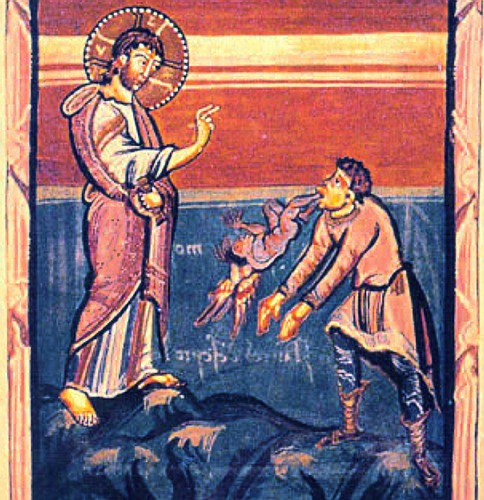
The Gospel of St Mark, chapter 9: 14-29, challenges us to ask ourselves the question “How does the effective disciple of Jesus live his or her life?” Clearly the ineffectiveness of Jesus’ disciples in doing His work is evidenced when the father of the possessed boy complains to Jesus that His disciples were unable to help his son, and even questions the power of Jesus to intervene on his son’s behalf.

Jesus responds with disappointment tinged with anger over the actions of some of His disciples; people who took it upon themselves to act in Jesus’ name but were not prepared to do so – for they did not ready themselves through prayer, fasting, and good works.

Jesus was upset with them for their lack of preparation. He implies that they were not effective co-workers. They were not ready to share His mission because they believed  they could remain who they were and still carry out the work of Jesus.

At that point in Christ’s ministry they didn’t realize that they had to be willing to cooperate with Him and transform themselves into His Life; a transformation, which accompanied by the grace of God, demanded great effort on their part.

In private, Jesus’ disciples asked Him why they didn’t have any success. He said, referring to the evil spirits,  “This kind can only come out through prayer.”

An Internet friend of mine from West Virginia, Fr. Paul Wharton recently said, “the transcendent knowing of God in prayer is making room in myself for an experience of His loving presence deep within me and all around me.”

This is such an important point, for we must make room for God deep within ourselves. As spiritual people we must guard against the weakness evidenced by the disciples in this Gospel. They thought they were acting like Christ, they thought they had His power in their lives, but they had not made room for Jesus in their hearts, and when faced with the enemy they were unprepared – they were helpless and impotent.

So, as creative people – as artists in our various fields – how do we become effective disciples of Jesus Christ? I believe our effectiveness is based on four concepts: 1) the grace of God coming to our hearts and souls through Christ’s Holy Sacraments; 2) our willingness to open our hearts and allow God to go deep within our souls so that He may evangelize us; 3)  our personal effort to be transformed into His Gospel Life through prayer, Scripture study, and our  unique approach to the creation of sacred art; and, 4) our faith and trust in His ability to lift us up, like the possessed boy, out of our suffering – or to give us the strength to bear what we are asked to endure.

These four concepts have an important part to play in our creativity and productivity as sacred artists. We must see ourselves, and the various arts that we produce, as part of His divine mission to first, evangelize ourselves, and then, through our art, those around us.

As we approach Ash Wednesday and the first week of Lent, I would like to raise your attention to a series of posts that I will publish during Lent dealing with the idea of prayer as it applies to our creativity. I will explain and explore with you a few valuable methods that I have learned over the years and one that I have recently been made aware of by a fellow member of the Fra Angelico Institute for the Sacred Arts.

I pray that you will profit from these upcoming posts and that they may help you in your process of becoming an effective disciple of Christ and an even more creative and Spirit filled person! May the Lord bless you with a happy and creative Lent.

Copyright © 2012 Deacon Paul O. Iacono All Rights Reserved     Thanks to starrymantle.blogspot for the sacred art rendition of today’s Gospel; and if you have a chance check out Fr. Paul Wharton’s blog at http://heartsonfire33.wordpress.com/2012/02/17/adrian-van-kaam-1920-2007-on-prayer/

Perilous Times For People Of All Faiths

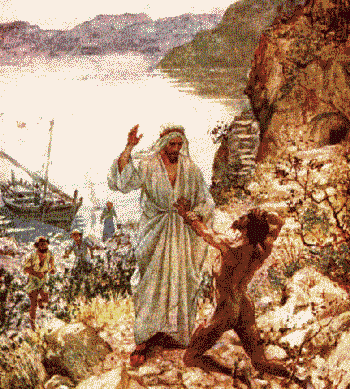
There is a very striking phrase from yesterday morning’s Gospel:  Mark says, “…and when they got out of the boat, the people at once recognized Him…”  – they immediately recognized Him. The question that begs to be asked is “If they immediately recognized Him – what did they recognize?”

Was it just the fact that they identified a teacher of profound importance, or a powerful prophet, or a new healer with extraordinary ability?  Or did they recognize the fact that this person was someone totally above and beyond that – a man truly sent from God – to do God’s will and to meet all of their spiritual needs?

Possibly, St. Mark desires to communicate that besides the truth that Jesus was capable of performing astonishing healings, there was the blatant truth that the simple people of Israel were approaching Him with faith – they were approaching with expectant faith.  They brought their sick and demon possessed to Him because they instinctively knew that He could heal them and, more importantly, that He would heal them. What does this teach us? It teaches us that their faith was alive – their faith was confident.

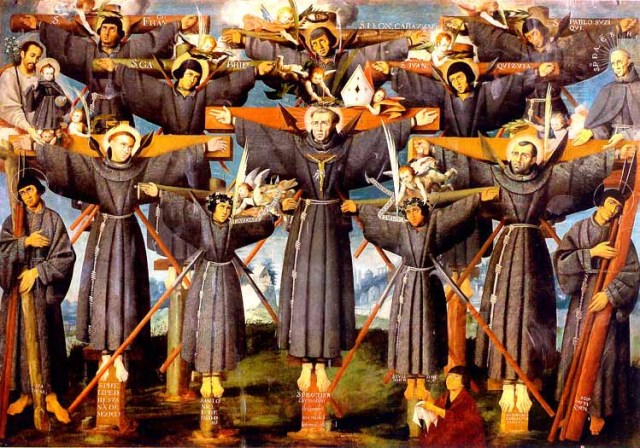
Yesterday, I wore a red dalmatic and stole as I assisted our Assistant Pastor Fr. Joseph P. Upton at Holy Mass. We wore red in honor of St. Paul Miki, a Japanese Jesuit Scholastic, who along with twenty-five of his companions including two other Jesuits, six Franciscans, fifteen Franciscan tertiaries, and two laymen were all put to death on February 5, 1597 on the order of the ruler Hideyoshi.

These martyrs gave witness to Christ within a hostile society whose people and rulers were unable to see and accept the Truth. Their courage speaks volumes as to the ability of average men and women to stand up to tyranny and promote the truth and love of our Lord Jesus Christ. These martyrs were able to defy governmental tyranny because their faith was alive and confident.

This is not a political blog. It is a blog that is intended to promote the prayer life, the artistic appreciation, and creation of sacred art by its subscribers; but, we cannot fail to observe with sadness and deep concern all of the repugnant and anti-Constitutional acts that have been imposed on the Catholic Church as an institution, and upon its individual members within the last few weeks (here, most recently, I speak of the bishops, priests, and deacons who serve within the Armed Services who were told not to publicly read a letter of opposition from the Catholic bishops in response to the Executive Branch’s mandate to impose its Health and Human Services Policy throughout the nation).

As primarily artists of faith we cannot fail to see the implications of the Administration’s actions. They are embarking the ship of state on very dangerous waters. These are perilous times for people of all faiths.

I cannot and should not fail to mention the witness, a week or so ago within our own State of Rhode Island, of the courageous students, laypeople, and clergy who gathered at the State House to pray in favor of the Pro-Life movement. They were met not with the opportunity, guaranteed by the Constitution, to freely express their views – rather, they were met with opposition members of various groups (one being identified as Occupy Providence) who shouted them down, prevented them from expressing their prayer, and pelted female high school students with condoms. Is this what public discourse has come to in our State and Nation?

As you may know the forces of secularism will stop at nothing in their attempt to shout down the Pro Life’s right to freedom of speech; but we should remember that the Pro Life Movement mirrors the witness of the simple people of Israel in yesterday’s Gospel – and the testimony of the martyrs – because like them they are willing to publicly stand up to the forces of darkness and say – with charity  – “Our faith is alive and confident – we believe in Jesus Christ and the witness for life that He embodies – and the darkness of secularism will never stifle the shining light of His Truth.”

As writers, as artists in various media, as musicians, and as performance artists who may be Catholic, Protestant, Orthodox, or Jewish, or members of other faiths – it is critical that we do not lose sight of what is happening in our society. We cannot pursue our art in a vacuum. Rather, we pursue our art, and the Holy Spirit as well, so that our faith and confidence will be strengthened, and our sense of gratitude will be increased, for all those within our Church – and those from other denominations – who courageously witness to the truth of the Gospel and promote the value of life in their  prayer, art, and social action.

Copyright © 2012 Deacon Paul O. Iacono All Rights Reserved

Thanks to/redemptores.blogspot.com/2011/02/st-paul-miki-companions-m.html for the image of St. Paul Miki and companions.

The Demons Say “We Are Legion.” Jesus says “Trust Me.”

The Gospels of Matthew, Mark, and Luke all contain the story of the demoniac from the territory in northern Israel called the land of the Gerasenes. They describe the fact that the demons had united within this man for a specific purpose – to torment this poor sinner and to terrorize the countryside with demonic power so concentrated – that the evil was unable to be controlled.

Unclean spirits fueled the demoniac’s actions; and as Jesus steps out of the boat onto the shore the demoniac immediately confronts Jesus and the demons within him beg to be left alone.

Jesus enters into dialogue with the possessed man. He asks him his name, and the demons respond, “My name is Legion, for we are many.” The disciples, hearing this response would have been horrified because a legion, at that time, was no small force – in the Roman army a legion encompassed  6,000 soldiers.

What’s left of the possessed man’s free will had run toward the Lord – and the psalmist tells us to do the same because they both realize who God is, the magnitude of His power and mercy, and that true healing, security, and protection from evil can only be found under His protection.


Psalm 91 alludes to this, and uses military language to express its message as it says: “A thousand may fall at your side, ten thousand at your right hand; but [evil] will not come near you Because you have made the Lord your refuge, the Most High your habitation.”

At times, our technologically driven society has desensitized us to the wonder of Jesus’ mercy, or, like the people in the city – upon hearing of the demoniac’s healing – recoil from Mercy’s power. Like them we may be satisfied with our own circumstances, we may feel that we do not need to be healed or evangelized, that we don’t need the grace of God’s mercy in the Sacraments, especially the Sacrament of Recon-ciliation,  what an extraordinary mistake – what a rejection of God’s grace that would be for us.

Perhaps we are afraid to pay the price of liberation from the power of evil in our lives. Yet, what is the cost to us? Is it the cost of being healed of our sins? The true cost was paid by Jesus Christ in His suffering and death upon the Cross.

The cost, having been paid by the Son, provides the opportunity for the Father and the Holy Spirit to freely give us the grace that Christ has merited for us. The only thing that Jesus requests of the healed demoniac is that he go home and give witness. Jesus says,  “Go home to your friends, and [and in thanks] tell them how much the Lord has done for you, and how He has had mercy on you.”

The only price that needs to be paid is the price of thankful witness – the price of unselfconsciously showing others that we have turned away from evil – and that God has changed our lives through the power of His grace and mercy.

The freed and healed demoniac was asked to evangelize his friends, and we, are asked to do the same. Interestingly, the territory of the Ten Cities – the Decapolis – which were primarily Greek and pagan territories was an extraordinarily difficult missionary area. The now healed man was asked to go into that territory – to those Ten Cities –and preach to them of his healing and deliverance. He was, in no uncertain terms, a missionary – a missionary to the Gentile people of the Decapolis. It appears that he was successful, because, Mark (in his Gospel’s 7th  chapter, vs. 31ff) speaks of the hopeful crowds from the Ten Cities bringing Jesus another man to be healed.

So what is the final message of this Gospel for us today? It may be that even though, thank God, we may not be possessed by one or thousands of demons, we are still tempted, we fall, and we do sin.

So we are always in need of God’s mercy – and after repenting of our sins and receiving God’s forgiveness, mercy, and healing in the Sacrament of Reconciliation we need to give thanks to the Lord; and like the healed demoniac, share the story of our spiritual journey, healing,  and God’s love for us with all those who will listen.

Copyright © 2012 Deacon Paul O. Iacono All Rights Reserved

Christ Child by Fra Angelico

To all the friends, followers, and members of the Fra Angelico Institute for the Sacred Arts,

We wish you all a very Merry and Holy Christmas Season and a grace filled New Year!  May the blessings of the child Jesus and the adult Savior remain with you, and your loved ones, throughout the coming months.

We thank you so very much for your support, advice, and participation, and we look forward to sharing new artistic adventures with you during the next year! Thanks again for all that you have done to make the Institute meaningful and helpful in the promotion of the sacred arts and in the evangelization of the truth, goodness, and beauty of God, His angels, and His saints.

Warm regards,   Deacon Paul and Jackie Iacono

This image is an extreme close-up of a painting of the Madonna and Child Jesus with assorted saints painted by Fra Angelico in Florence during the early 15th century.

Copyright © 2011 Deacon Paul O. Iacono All Rights Reserved


Five Days Before Christmas: A Unique Story About The Graciousness of God

A very clear narrative greeted us in yesterday morning’s Gospel by St. Luke. He tells us that both Zechariah and his wife Elizabeth were both righteous before God: walking in all the commandments and ordinances of the Lord – they were blameless; but they have no child. Elizabeth was barren and both were elderly. We read of Zechariah silently bringing his heavy heart before the Lord – even after all those years – it was still burdened with disappointment. The couple probably remembered Psalm 112 which says:

“Happy the man who fears the Lord, who takes delight in his commands. His sons will be powerful on earth; the children of the upright are blessed.”

Zechariah was a priest, and on that day – by lot – it was his turn to enter the chamber within the Temple called the Holy Place and burn incense on the special altar. The Holy Place was a small chamber that led to the Holy of Holies, which housed the Ark of the Covenant.

For whatever reason, Zechariah that morning carried his disappointment with him into the Holy Place; and while he was there the archangel, Gabriel, appeared on the right side of the Altar of Incense. Gabriel tells Zechariah not to be afraid and that his prayer was heard before the throne of God. Gabriel continues with the joyous news that Elizabeth will bear a son, and that he will be called John – which in Hebrew means – “the Lord is gracious.” This child will grow and be great before the Lord, and even from his mother’s womb – he will be filled with the Holy Spirit.

But, in a typically human way, Zechariah questions the archangel’s announcement. His query must have been different in tone. It must have had the typical masculine attitude of “Are you kidding me!” Zechariah’s tenor makes Gabriel, and possibly God, indignant – and Zechariah is struck speechless for his insolence.

In Scripture, few lines later, we see Gabriel’s announcement to Mary. She questions him, too, as “How can this be since I do not know man? But Gabriel does not strike her speechless. We have to be struck by this difference. What does it teach us?

It is clear that God knows our hearts. God knew what was on Zechariah’s heart when he was in the Holy Place. Zechariah does not trust the message or the messenger, and by inference – he does not trust God. God knows his heart; and disciplines this good man. Like Zechariah, we, too, may disbelieve God. In our sophistication or position in life we may say “Well that’s fine, but, the Scriptures don’t apply to our situation, or this specific teaching was acceptable years ago, but, too much time has passed and it doesn’t apply to my problems. Remember, the Gospel says that Zechariah and his wife were good and righteous people. It was mentioned that he kept all the Commandments and ordinances. Yet, when his big moment comes – where is all that goodness and righteousness? It might still be there in his heart, but, there was also a pocket of doubta crevice of skepticism – that was significant enough for him, as a priest of the Almighty God, to be struck speechless in punishment for not trusting Gabriel’s message.

As sacred artists, as Christians, this Gospel asks us to stop, and check our souls in this last week of Advent. It asks us how patient, confident, and trusting have we been of the Lord’s message to our hearts, and have we allowed this to carry over into our actions?

Zechariah learned the hard way that when the Lord prepares us for His coming He desires us to be alive, awake, and alert to His call and to trust His message. So, our prayer this week should echo that of Zechariah, who in the months of speechless waiting, most likely in his mental prayer said,  “Lord, I believe; cleanse me of my disbelief. Lord, I trust, heal me of my distrust;” and it should also echo that of Mary – who in humility and expectation waited patiently for the graciousness of the Lord to take fruit in her womb.

Copyright © 2011 Deacon Paul O. Iacono All Rights Reserved

Thanks to angels-angelology.com for stained glass window image.

A Beautiful Pregnant Young Woman And Her Message To A Weary World

Today’s feast of Our Lady of Guadalupe, the patroness of all the Americas, recalls the apparition of our Blessed Mother on the hill of Tepeyac in present day Mexico City from December 9th through the 12th in the year 1531. Guadalupe is the Spanish translation of the Aztec phrase that Juan Diego heard Mary associate herself with – the name, interestingly, in Aztec means “she will crush the serpent of stone.”

In the same year – 1531 – thousands of miles away in what today we call Germany – Martin Luther was pro- claiming his doctrine of protest and rebellion from the Catholic faith. As Martin Luther was convincing millions of Catholics to leave the faith, our Blessed Mother, through the miraculous image that appeared on Juan Diego’s tilma, convinces millions of Native Americans to convert to the faith.

As the Protestant rebellion was tearing down millennia of Church theology and sacred tradition, Our Lady was building up the understanding of both the Spanish clergy in Mexico and the Native American population, of the love of God and the assurance of her protection.

Our Lady spoke to Juan Diego in his native dialect. She identified herself and said:  “Juanito, the humblest of my children, know and understand that I am the ever virgin Mary, Mother of the true God through whom all things live. It is my ardent desire that a church be erected here so that in it I can show and bestow my love, compassion, help, and protection to all who inhabit this land and to those others who love me, that they might call upon and confide in me. Go to the Bishop of Mexico to make known to him what I greatly desire. Go and put all your efforts into this.”(1)


Of course you probably know the rest of the story. The Bishop is told, disbelieves Juan Diego, the bishop asks for a sign, Juan Diego reports back to Mary and is told by her to cut the Castilian roses that are growing and put them in his poncho which is called a tilma. The tilma is opened in front of the Bishop and other witnesses, the roses fall out, and the miraculous image of Our Lady appears on the tilma. But is this story true? What are the facts that surround it?

Our Lady of Guadalupe is honored as a feast throughout the Americas on this day because of the miraculous events associated with this particular three-day apparition, a very few being:

1) The extraordinary conversion of multi-millions of Native Americans, and the Aztecs in particular, who, as a blood thirsty civilization, were known to kill as many as 20,000 human beings in one day to appease the blood lust of their primary god.

2) The roses that Juan Diego cut were native of Damascus, Syria, and did grow in Spain, but were unknown in Mexico at that time.

3) The tilma, or poncho, that Juan Diego wore was made of the agave fibers traditionally used by the Native Americans. These fibers were a natural substance that should have deteriorated within 35 years, and yet, today, the 480th anniversary of the event – this tilma is still in excellent condition.

4) Through scientific analysis done over the last forty years, it has been determined that the pigments used on the tilma are not of natural or man-made material, and there is no glue or sizing on the tilma to fix the pigment in place. Plus the colorization or iridescence of the image on this “icon not made with human hands” would not have been able to be produced by a human artist in the 16th century. This iridescent effect would have been seen only in nature.

5) Our Lady is represented in the colors and dress of a pregnant Aztec princess. Modern astronomical research has shown that the stars on Our Lady’s image are in the configuration of the stars in the heavens on the nights of the apparition in 1531. Most remarkably, a microscopic analysis of Our Lady’s eyes was completed by Peruvian engineer and optical scientist Dr. Jose Aste Tonsmann (who trained at Cornell University and worked at IBM). He magnified the iris of the Virgin’s eyes 2,500 times and, through mathematical and optical calculations, was able to identify the witnesses of the Guadalupan miracle at the moment Juan Diego unfurled his tilma before the bishop and other witnesses [the bishop was Juan de Zumarraga, the Franciscan bishop of Mexico City.] (2)

But most importantly, these few miraculous facts about the icon of Our Lady of Guadalupe, do not stress the key issues of this apparition.

You see, Our Lady came to the Mexican people – as she comes to us this Advent season – as a pregnant young woman who is promoting life and her protection – not only for her unborn child – but for all of us.

Our Lady calls to us through this icon to stress that she loves us, has compassion for us, sees our tears, and desires to offer us her love and comfort. As the Mother of the incarnate Son of God she also points to her Son, and desires a church to be built so He can be properly worshipped and so she can be there to assist us in our prayers to God.

Mary has always reminded us that He is the One, True, All Powerful God who desires our love and respect. She also stresses that she is always here to provide her protection.

I commend to you to do some research this week on this magnificent Church approved apparition which indicates the Lord’s and Our Lady’s love for us. How blessed we are to have the spiritual motherhood of Mary, and the Fatherhood of the One True God.

Copyright © 2011 Deacon Paul O. Iacono All Rights Reserved

Footnotes and  sites to investigate for more information:

(1) From a report by Don Antonio Valeriano, a Native American author of the 16th century; as published in the Supplement of the New Feasts and Memorials for the General Roman Calendar – The Liturgy of the Hours.

(2)Science Sees What Mary Saw From Juan Diego’s Tilma”   Zenit News Service, 2001.

Zenit News Agency. Science Stunned by Virgin of Guadalupe’s Eyes. 1/14/2001

http://www.miraclehunter.com/marian_apparitions/index.html

The Joy Filled Christian – A Sermon on Survival in the Face of Tribulation

Today is Gaudete Sunday. Gaudete means “Rejoice!” The Church has us  visualize this by the rose colored candle in the Advent wreath and the rose colored vestments. Gaudete Sunday appears at the midpoint of the Advent season, and we pause to rejoice and reflect on the marvelous work of God and His plan of salvation for us.

Our readings show us Isaiah speaking of the splendid work of God – – St. Paul telling us to “give thanks and rejoice always,” not just in good times, but in all circumstances, and our Gospel describes St. John the Baptist testifying that the Light of the World would soon begin His ministry.

But today’s reading from St. Paul may have given you pause and trouble: you may say:  “You mean I’m to rejoice even if I have just lost my job, even if corporate and governmental corruption has destroyed my retirement income, even if I am mourning a deceased loved one, even if my husband, wife, or child is sick, or has abandoned me, or wants nothing to do with me?

Remarkably, St. Paul’s message is “Yes, give thanks, and rejoice!” 

Although, let’s be careful, he is not saying for us to put on blinders and act like Pollyanna. St. Paul knew what trouble was. He had plenty of trials to deal with, his letters to the various churches of Asia Minor, Greece, and Italy are filled with numerous personal problems and tribulations.

Yet, through all of that, he kept his vision focused firmly on Jesus. It was that mental memory of who Jesus was, what He preached, how He suffered and died; and the truth that was well known to St. Paul and many others that Jesus the Word of God and the Light of the World had resurrected from the dead and had appeared to him, face to face, mind to mind, to express His love for those Paul was persecuting, and to ask him to stop, and to follow Him as Lord.

It is this focus, this trust, this faith that enabled St. Paul to deal with his problems.  

It is this focus, this trust, this faith that enabled him to maintain joy in the knowledge that his eternal salvation was certain through faith in Jesus Christ.

St. Paul’s focus was on his eternal salvation through Jesus – not on the trials of this world.

But how does St. Paul keep his focus?

You see, Paul links the ability to possess sincere joy with praying; because joy is a gift from God. It comes to us through His grace – it is a specific fruit of the Holy Spirit.

So, joy enters our world when we humble ourselves to receive God’s grace and see the real meaning of our life as a child of God – when we look at our own fragility and brokenness – and realize that we are not able to survive without the help of God.

Joy will come into our life when we realize that survival depends on our developing a prayer filled and Sacramental relationship with Christ – which leads to our being sanctified by His grace. This relationship can only occur when we seriously view our prayer life – and Christ’s Sacraments – through the eyes of a trusting and knowledgeable child – rather than that of a worldly wise adult.

We must be humble enough to start with daily traditional prayer; however, there will come a moment in which these prayers move us into a dialogue, a conversation with our Lord, and this is the heart of prayer.  Saints Paul, John the Baptist, and Isaiah all spent time in deep conversation with God. It is through their prayer life that the gift of God’s joy was able to fill their hearts.

So on this Gaudete Sunday we remember that we are called to rejoice through prayer in the truth that, regardless of how dismal our personal circumstances, Jesus our Savior loves us – and will never abandon us.

Let us remember that our lives should be a testimony, not to sorrow, guilt, or fear, but to the mature trust and joy that delights in the knowledge that – by virtue of the saving power of Jesus Christ and His Sacramental grace – we are redeemed children of God, who with His grace and strength, can endure any tribulation.

Copyright © 2011 Deacon Paul O. Iacono All Rights Reserved

The above is a sermon Deacon Paul O. Iacono gave at St. Francis of Assisi Church in Wakefield, Rhode Island on the weekend of December 10/11, 2011 Scriptural references referred to in this, the 3rd Sunday of Advent, were from Isaiah 61: 1-2, 10-11; 1st Thessalonians. 5: 16-24;  John. 1: 6 -8, 19-28.