St. Lawrence – Deacon and Martyr

18956-st-lawrence-distributing-alms-fra-angelico
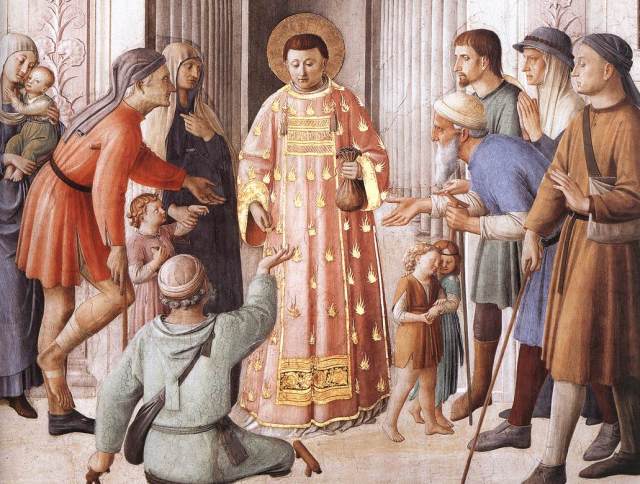
St. Lawrence, deacon of Rome, distributing alms to the poor; painted by  Fra Angelico, circa 1447.

Today we celebrate the feast of St. Lawrence, a deacon and third century martyr.

St. Lawrence was one of the seven deacons of Rome who served as the Pope’s ministers during Holy Mass and as his administrators to the people of Rome.

There is little historical evidence remaining on St. Lawrence. His Acts had been lost by the time of St. Augustine in the 4th century, yet, Pope St. Leo the Great and St. Augustine wrote about him and his martyrdom. The tradition of the Church states that he was a native of northern Spain and was ordained by Pope St. Sixtus II. The Pope made Lawrence responsible for the distribution of the Church’s alms.

St. Lawrence died during a persecution by the Emperor Valerian (circa 258). His death occurred a few days after the martyrdom of Pope Sixtus II and four deacons (Januarius, Vincent, Magnus, and Stephen).

Art historian Carl Brandon Strehlke (see note at bottom) has mentioned that there is controversy over the specific date of his martyrdom. Some accounts state that  Lawrence was martyred under the emperor Decius (AD 249 – 251) and others insist that it was under the reign of Valerian (253 – 260).

Regardless, the Church’s tradition states that he was martyred soon after the emperor Valerian issued an edict in early August, 257. This edict required all Catholic bishops, priests, and deacons to be denied trial and be immediately put to death.

As the Pope and four of his deacons were led to their deaths, Lawrence is purported to have said: “Where are you going, Holy Father, without your son? Where, O Bishop, without your archdeacon? Before you never approached the altar of sacrifice without your servant, and now you are going without me?”  Pope St. Sixtus commented that Lawrence would soon follow him.

Valerian’s administrators came to Lawrence and demanded access to the wealth of the Church. He asked for a few days to assemble it, and subsequently, distributed much of the Church’s treasury to the poor.

The money transfer to the Roman government was to occur on August 10th. Lawrence led the prefect and guards to a room within the Vatican. Upon opening the door and with the force of  a saint he declared:  “Behold the jewels of the Church.” The room contained some of Rome’s blind, poor, sick and maimed!

On the same day Valerian ordered that Lawrence be taken out and slowly martyred in payment for his cheeky behavior towards imperial dignity. St. Lawrence refused to renounce our holy Faith, and was roasted on a gridiron used for cattle. Legend says that he was of good humor to the very end, at one point saying to his executioners: “I’m done on this side. You can turn me over now!”

Many centuries later his story of faith and heroism was artistically proclaimed to the faithful. In 1447 Pope Nicholas V selected Fra Angelico to decorate a Vatican chapel dedicated to the two famous martyrs and deacons of the Church: the protomartyr St. Stephen of Jerusalem and St. Lawrence of Rome.

Fra Angelico successfully linked the narratives of their stories together so that they convincingly expressed the main elements of each saint’s life. They are catechesis as well as beautiful art. Angelico’s painting portrays St. Lawrence in an exquisite rose colored dalmatic (the garment which signifies the deacon’s service and loyalty to his bishop). The fresco is approximately 9 by 7 feet and was painted between 1447 – 1449.

Note: Carl Brandon Strehlke’s comments on St. Lawrence are to be found in Kanter and Palladino. Fra Angelico. Metropolitan Museum of Art, Yale University Press, 2005.

Copyright © 2011- 2020, Deacon Paul O. Iacono – All Rights Reserved. Permission to reprint must be obtained from the author in writing. Students, and those interested, may quote small sections of the article as long as the proper credit and notation is given. Thank you.



Sacred Icons and Sacred Images – the Nicene Debate Continues!

AyaSofya
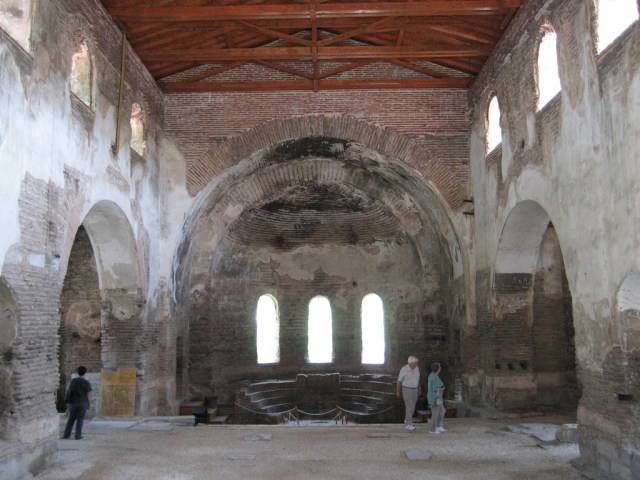
A photo of the inside of the Aya Sofya (Hagia Sophia) church in what is the present-day city of Iznik, Turkey. Iznik was called Nicaea prior to the rule of the Ottoman Turks . This photo shows the interior of one of the rooms in the  building complex that served as the location for the First Council of Nicaea (AD 325). Also, in the late 8th century the Seventh Ecumenical Council met in this building, too. That Council met to debate and decide the issue of iconoclasm (should sacred icons and images be prohibited and destroyed). The written arguments of St. John Damascene (Damascus) won the day and sacred icons were allowed to continue to be made. Iconoclasm was to raise its ugly head again in later years, and came to full fruition during the Protestant rebellion/reformation, the French Revolution, and worldwide Communism in all its cultural forms.  This photo of the inside of the Nicaean building is from Bryan Cross’ website: calledtocommunion.com. It was posted in May, 2010. Thanks Bryan!

I would like to thank one of my readers who identified the  contemporary icon of St. Spyridon (thanks Carol!). The iconographer is the Catholic priest William Hart McNichols. He is a very talented artist who paints traditional icons and sacred images. At times, he steps out of the bounds of the traditional approach and adds his own personal interpretation of the person he is portraying. His artistic vision is unique.

John Daly from Australia emailed me this morning to provide further grist for our mill concerning St. Athanasius, St. Spyridon, and the Council of Nicaea. One of the participants in his iconography school is a Greek Orthodox lady who is the sister-in-law of an Orthodox priest. He is coincidentally named Athanasius.

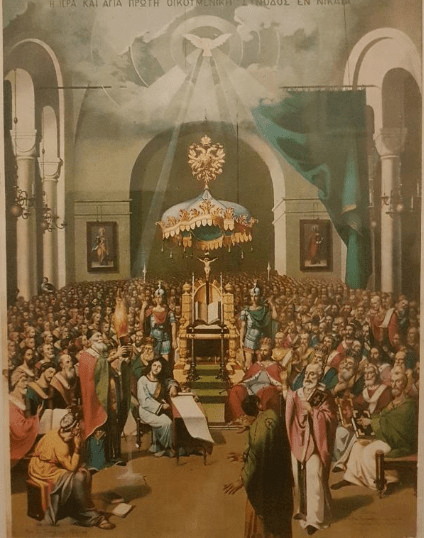
John had the opportunity to discuss with her the icons that we were analyzing in my posts of the last few days. She provided John some valuable information by explaining  that her mother had given her a beautiful sacred image of the First Council of Nicaea and specifically St. Spyridon’s role in the debate with the heretic Arius. The sacred image is below.

1555507279899blob.png
Greek Orthodox sacred image of the First Council of Nicaea. Notice St. Nicholas on the lower right about to possibly physically strike Arius who reacts by pulling away. On the left you see St. Spyridon, holding a brick with flames streaming upward and water puddling below it to the floor (confer yesterday’s post of April 16th to obtain the explanation of that imagery). The room of the actual Council, as portrayed in this sacred image is quite ornate.

Also, like the sacred icon we examined in yesterday’s post we see the Emperor Constantine, dressed in the royal robes of Byzantine reddish purple (almost a maroon) sitting on the right. On the Emperor’s right we again observe a bishop, maybe its Bishop Alexander of Alexandria, Egypt. In front of him we again see a deacon, dressed in what is either an alb or dalmatic (he would have to stand up to see all the garments).

In the above sacred image, the deacon is again seated at the scribe’s desk. This makes sense, since a deacon serves the administrative needs and report’s directly to his bishop. That is true to this day; yet, throughout the world today the local bishop has his deacons serving in parishes, hospitals, prisons, etc. rather than in an administrative capacity in the local chancery. Notice the bishop is behind the deacon scribe to facilitate accurate communication.

The above sacred  image, which I have never seen before John Daly sending it to me, is very well done. The painter has captured the meaning of the Council as a whole and two of its major participants: St. Nicholas’, in his famous interaction with the heretic Arius, and the great oratorical and mystical abilities of St. Spyridon challenging Arius, too.

Is the deacon pictured in the painting from the Latin Rite or is he Orthodox? Truly, there is no way to accurately tell because the deacon is seated, and what is showing of the deacon’s stole is inconclusive. Depending on the angle of view both the Western and Eastern Rites’ deacon’s stole placement looks the same.

In today’s painting and in yesterday’s post of the icon, the deacon is seated and the possible vertical panel on the Eastern Rite and Orthodox stole is in shadow or not detectable, yet, the panel that drapes from left shoulder and gathers at the waist is visible, and would appear, as you see below, in both Latin, Eastern, and Orthodox Rites!

Just between you and me, I think the deacon depicted in the icon, from my April 16, 2019 post and today’s, is St. Athanasius from Alexandria, Egypt. The Catholic Church, the Eastern Rites in union with Rome, and all the Orthodox Churches venerate St. Athanasius as a great saint and designate specific feast days for him. He belongs to all of us.

The deacon’s stole in the Eastern Rites of the Catholic Church that are in union with Rome; and, the Greek Orthodox, the Russian Orthodox, and Coptic Orthodox deacon stoles look like this:

Unknown
Orthodox deacon’s stole in a royal Byzantine fabric (in  what appears to be a royal maroon purple) is bordered in gold thread with gold crosses. Originating at the left shoulder, gathered at the waist, with the fabric of the stole hanging vertically on the left shoulder both in the front and the back. The stole is worn on top of  the ornate gold and white dalmatic.

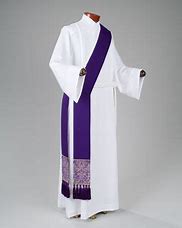
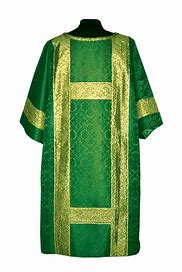
The cassock, alb, stole, and dalmatic all have the same meaning and functions in both the Western and Eastern Rites of the Church. In today’s Western, that is, the Latin Rite (Roman Catholic) tradition, a deacon wears the rank of his ministry and ordination, the stole, over the alb but under the dalmatic. Latin Rite deacons would wear their stole’s in this manner:

th-3
A Roman Catholic deacon’s stole running from the left shoulder and gathered at the waist, then hangs vertically under the right arm. It is worn on top of a white alb, and under a dalmatic. The dalmatic is only worn during Holy Mass. When the deacon performs baptisms, marriage and funeral services, liturgical prayer services, and formal blessings, etc. the deacon would not wear a dalmatic, so the deacon would appear as in the above photo wearing a simple white or cream colored alb and a stole in the appropriate color..  The stole’s fabric in the photo above is dyed dark purple for Lent; during the season of Advent a purple stole is used, too; sometimes, it is of a lighter purple than the Lenten penitential purple. A white stole would be used for Baptisms. Marriages, Funerals, Holy Thursday services, and during the Easter and Christmas season. Red stoles would be worn at Palm Sunday and Good Friday services, Pentecost, and on the feast days of martyrs.
th-5
A Roman Catholic deacon’s dalmatic which is worn over the white alb and the stole. The dalmatic is in the corresponding color to the stole. The color green is worn during “Ordinary” time (which is the liturgical period that borders the great seasons of Advent, Christmas, Lent, and Easter).

I’ve really enjoyed this lively information exchange. Thanks to all who participated in it!

May you have a blessed Easter Tridiuum of the Passion and Resurrection of Our Lord Jesus Christ.

Peace be with you.

Copyright © 2011- 2019, Deacon Paul O. Iacono – All Rights Reserved. Permission to reprint must be obtained from the author in writing. Students, and those interested, may quote small sections of the article as long as the proper credit and notation is given. Thank you.