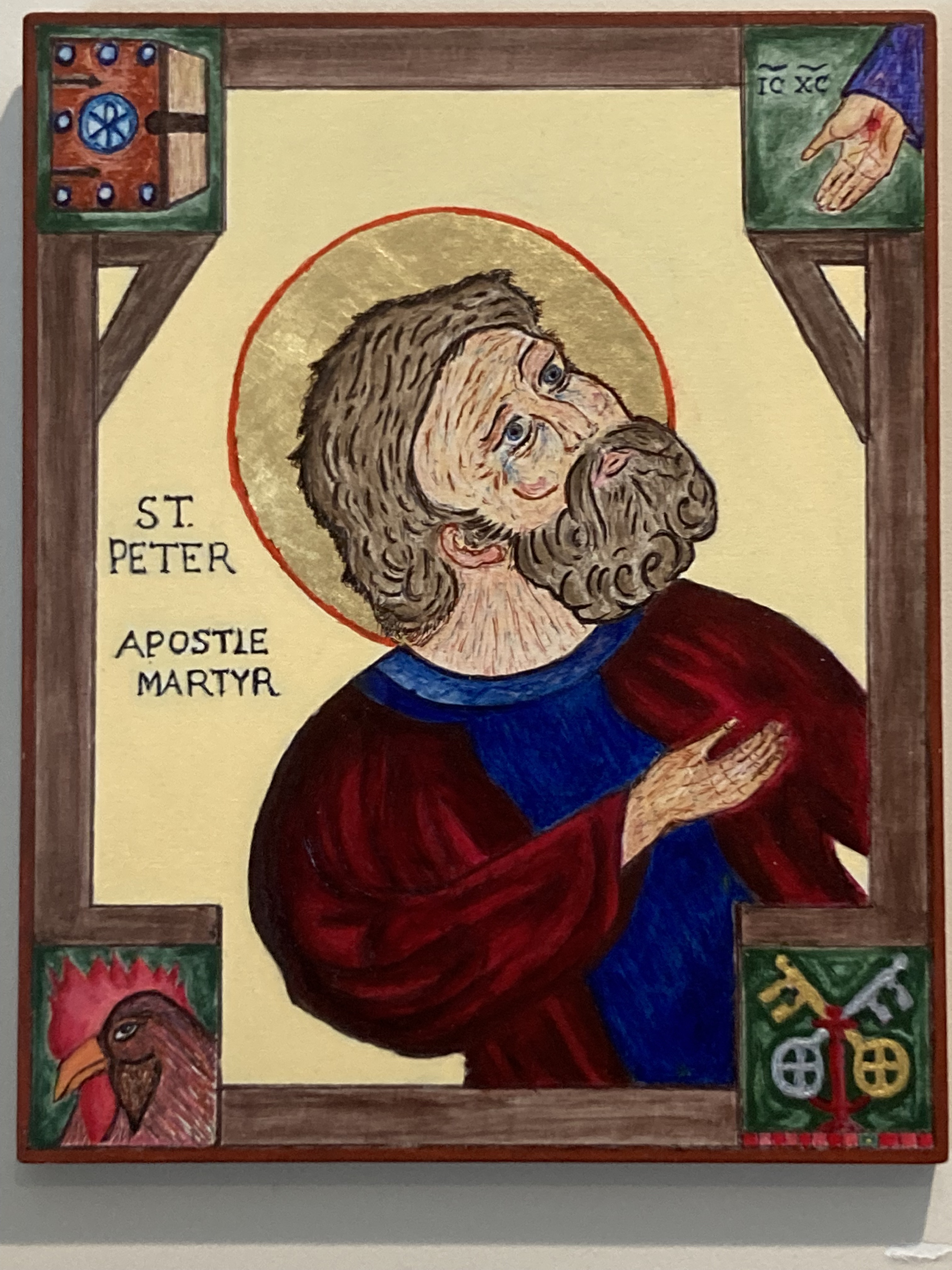
One of my goals in painting the above image of St. Peter was to provide a catechist/observer with seven focus ideas within one image. This sacred image also presents some of the life events of the “Rock” on which Jesus Christ built His Church. I have painted this image with the approach of the Naive/Folk Art genre or “school.” I will discuss the Naive/Folk art approach in my next post. Below are my seven fundamental ideas that can be used as a lesson plan(s) for the above image:
The image is based on Christ’s words and Peter’s actions within the New Testament (have the students look up the verses found within the Gospels and Epistles).
The image itself presents the presence of Peter who is suffering (his posture, body movement, expression, tears, and the extension of his hand). He is requesting Christ’s forgiveness.
Christ is identified by the label IC XC (the Greek abbreviation for the name Jesus Christ). Christ is extending His hand in forgiveness and to raise Peter’s spirit.
The rooster in the bottom left corner is harkening back to its crowing after Peter denies Jesus (Scripturally predicted by Christ). The rooster is also looking at the viewer, reminding us of our personal sins.
Papal authority. Peter is the first pope. He is the first bishop of Rome, the spiritual leader of the Church, and is symbolized by the two keys that are given to him, echoing Christ’s words of “you are Peter (Petros) and on this rock/stone (Petra) I will build my Church.” The keys are painted in gold and silver. Gold represents spiritual authority in union with the Church’s bishops. The silver key represents the papal influence within the world for issues that would affect the good of the Church and people as a whole. The keys are united by a red anchor (symbol of hope and steadfastness – found in the catacombs and the Epistle to the Hebrews). The sufferings of the clergy and laity are built upon the sufferings of Christ and the ministry/martyrdom of the first Apostles (12 squares under the keys; the green square represents St. John who was not martyred). The brown border encapsulating St. Peter reminds us of the cross on which he was martyred as well as the Cross of Christ.
Diagonal lines could be visually drawn through Peter from the upper left corner of the books of the Holy Scriptures to the lower right representing the teaching authority of the pope (Peter’s successors); as well as the upper right of Christ’s hand to the rooster on the lower left reminding us of Peter’s denial and Christ’s forgiveness.
This denial by Peter is not the denial of Judas Iscariot who was also an Apostle. Throughout the Catholic Church’s history we have had both clergy and lay people deny Christ through their words and actions. It all began with the Apostles; however the difference between Peter and Judas is that Peter despaired, pleaded for forgiveness, and was picked up through Christ’s forgiveness. Judas despaired, did not plead for forgiveness, and threw himself down on the end of a rope.
If you find this subject interesting I recommend you read my post on Catechesis and Catholic Art published on June 26, 2021. Thanks.
Sacred art, by its very nature, is catechetical. The purpose of this art was and continues to be a method of instruction. The Catholic Church, in its Latin and Greek Rites, and the twenty-six Catholic Rites that are in union with Rome, have all produced magnificent sacred calligraphy and art; non-Catholic faiths have done this, too.
Two thousand years ago Christians hiding in Rome inscribed images of Christ, the Blessed Mother and with the Christ child, and other Scriptural images on the walls of the catacombs. That art contributed to the catechesis of the early Christians. Two millennia later, Pope St. John Paul II in paragraph 18 of his Apostolic Exhortation, Catachesi tradendae, speaks of this function: it is “an education in the faith… in an organic and systematic way, with a view to initiating the hearers into the fullness of Christian life.”
Sacred art, in tandem with scholarship, edifies and makes beautiful the truth, goodness, and beauty of God. One of my favorite forms of sacred art is that of the Coptic Christian Church (historically based in Alexandria, Egypt). Coptic art is presented in an especially down to earth way. It is beautiful and humble at the same time. It is catechetical and colorful. It possesses a fine palette, yet the viewer does not get caught up in the colors to the detriment of catechesis.
The Coptic faith’s icons are simple, yet, profound. They convey theological truths in a way that can be understood by all age groups and are excellent sources of catechesis.
The first image above is a 7th century Coptic icon. It was discovered at the Monastery of Bawit (Egypt) in the early 20th century by two French archaeologists who brought it, and other Monastery artifacts, back to Paris. Currently located in the Byzantine wing of the Louvre it is unique because it presents Jesus affectionately putting his arm around the Monastery’s abbot – Abbot Mena.
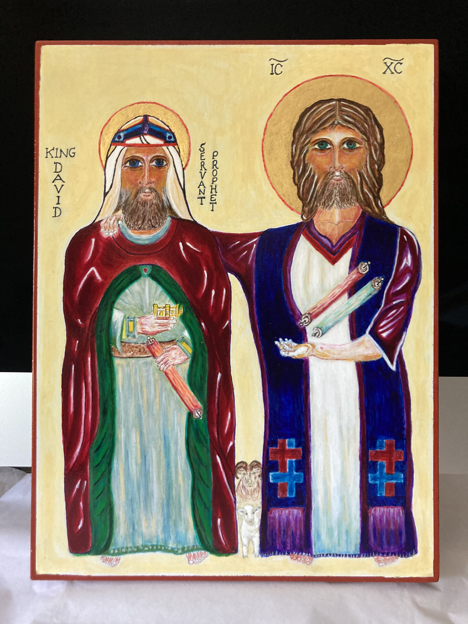
The second sacred image is my original composition. It is painted in archival ink, acrylic paint, and the halos are 23 karat gold leaf. My style slightly follows the Coptic in that it portrays figures that are not intimidating, are easily understandable, and act as a teaching tool for children and adults. It does present additional symbolism which further explains key theological truths of our faith.
Symbolism of the second sacred image:
The IC XC is the Greek abbreviation for Jesus Christ.
The slightly larger than normal eyes represents holiness, spiritual wisdom, and maturity.
Jesus’ white alb (tunic): purity; King David’s light green alb: hope for spiritual growth and friendship with God.
Jesus’ outer garments consist of two parts: robe and stole which are painted in various shades of royal purple. Royal purple indicates kingly authority. The tassels of His stole are multicolored representing the intersection of purity and kingship. Christ’s lower stole’s has an intersecting weave representing Jesus’ blood and water shed for us on the Holy Cross. Liturgically, deacons, priests, and bishops all wear albs, cinctures (belts), stoles, and outer garments (dalmatic or chasuble). These articles of clothing each symbolize different aspects of Jesus’ Passion and ministry.
Elevated above Jesus’ left hand are the scrolls of the Old (Hebrew) and New (Christian) Testaments. The color symbolism for the Hebrew Scriptures’ scroll: green, which represents hope, expectation of the Messiah, and devotion to God. The Christian Scriptures‘ scroll: red, representing Jesus divine and human energy, love, Redemptive sacrifice, and His mercy and justice.
Jesus’ arm is around David’s shoulder. His gesture to David expresses His love, affection, and mercy which are evident and available to everyone. However, the expression that I put on Jesus’ face, especially His eyes, conveys the severe justice that Jesus’ renders to all non repentant sinners. David committed murder and adultery yet ultimately becomes aware of the enormity of his sins. His Psalms were written to plead for mercy, express sorrow for sins, and give praise and thanksgiving to God (see especially: Psalms: 1, 51, 56, 65, and 117). David’s crimson coat symbolizes human life and energy, it is trimmed in dark green symbolizing his hope for mercy.
Circa 1000 BC, David and his armies captured Jerusalem and brought the Ark of the Covenant into the city (1 & 2 Samuel). King David is holding the city of Jerusalem in his right hand; and in his left the book of Psalms. David’s son Solomon built the First Temple to house the Ark of the Covenant (1 & 2 Kings).
Between David and Jesus are a ram and a new born lamb.
The ram refers to the sacrifice by Abram (Abraham) of a ram caught in a thicket in substitution for the sacrifice of his son Isaac (Genesis 22). Jesus and David are members of the same genealogical family, stretching all the way back to Abraham and Isaac and Isaac’s son Jacob.
The newborn lamb represents Jesus Christ, the “lamb of God” (John 1: 29). He was given in sacrifice by the Holy Trinity for the Redemption of mankind from their sins. That Redemptive act by Our Lord and Savior, Jesus the Christ, instituted the New Covenant which was sealed with His, the Lamb of God’s, blood.
The New Covenant does not replace the Old Covenant God made with the Hebrews. The New Covenant of Christ’s sacrifice (as described in the 27 books of the Christian Scriptures) fulfills the Old Covenant promise of a Savior found within the 45 books of the Hebrew Scriptures. The ram and the lamb provide the visible connection between the Hebrew Scriptures (Old Covenant) and Christian Scriptures (New Covenant).
The New Covenant is continued down through the centuries by the un-bloody sacrifice of Holy Mass. Selections from the Hebrew and Christian Scriptures are read. The Gospel is proclaimed prior to the priest representing Christ, in Persona Christi, transubstantiating the host and wine into the Body, Blood, Soul and Divinity of Jesus Christ.
In faith and action Catholics consume His Body and Blood toward the end of Holy Mass. This consumption does not transform Him, as simple food, into ourselves. Rather, we (as repentant sinners) are transformed by Him (through Sanctifying Grace) into Himself. He doesn’t become part of us, rather, we become part of Him. This is an article of faith believed by all Catholic Christians of the Western an Eastern Rites of the Church. The reception of Holy Communion by Catholics is not a “right,” it is a privilege given by Jesus Christ to worthy (repentant and Reconciled) recipients (culminating in our giving eternal thanks and praise to Him in Heaven; see Matthew 26: 29).
Therefore, in this non-intimidating sacred image you have a teaching tool that includes elements of Sacred Scripture and Sacred Tradition. It is simple grist for any informed catechist’s mill.
UPDATE:If you find this subject interesting I recommend you read my post on CatechesisandNaive Sacred Art: St. Peter – A Lesson Plan, published on January 25, 2022. Thanks!
Can you pick out the seven similarities between the two sacred icons of Church Apologists that are below? The differences?
St. Irenaeus of Lyons (died circa 201). Famous for his manuscripts Against Heresies. He used 21 out of the 27 books of the New Testament in his writings and sermons.
St. Clement of Alexandria, Egypt. Born AD 150, died AD 215. Famous for his manuscripts on the Blessed Mother Mary as the New Eve, the significance of the Holy Eucharist, and other catechetical works.
Let’s take a look at the two icons above.
Both are correct in the way they are represented. From an artistic and symbolic point-of-view there are distinct similarities.
They have seven similarities: the beard (signifying experience, authority, and that the saint is an elder); a large, highforehead (signifying Christian wisdom as influenced by the Holy Spirit which is visualized through the saint’s works and knowledge); the Holy Cross upon the priest’s stole (it appears as a garment that circles the neck and extends down the torso which signifies Christ’s Redemptive suffering and the saint’s willingness to give witness and suffer for Christ); the presence of the book of the Gospels (the revealed truth of God through His Son, Jesus Christ); the script of the saint’s name at the top or side of the icon; and the halo circling the head (representing the sanctity of the saint).
There are twoabsolutelynecessary and critical indicators that designate a valid orthodox icon or sacred image: the artist must distinguish the person represented with his or her name, and, the icon must give witness to their life and ministry to the Church.
How does the sacred artist accomplish this requirement?
The artist needs to follow this rule: if the person(s) represented is/are a cleric (deacon, priest, or bishop) they need to be clothed with the proper vestments of their rank, and prototypical appearance. If their physical appearance is known (such as St. Therese of Lisieux or St. Maximillian Kolbe) they must be represented in a correct and accurate manner. The artist must also represent some aspect that distinguishes their ministry, such as the Book of the Gospels.
This is also true if the person(s) is/are a martyr, holy man or woman, monk, etc. This is, again, necessary since the faithful need to know the name of the saint so they “may honor, revere, and give salutation to them and aspire after them” (from The Seventh Ecumenical Council: Concerning the Holy Icons).
The differences between these two icons of Church Fathers are primarily in the icons’ age, the colors used by each sacred artist, the adornment of the garments and book of the Gospels, and whether or not the halo, and area surrounding the figure is gilded. Many of these differences reflect the specific culture the sacred artist lived in, the time period of the artist’s life, and the artistic resources (such as pigments) that were available.
Historically, violent disputes broke out between icon supporters and icon destroyers. The situation came to a head in October AD 787, when the 2nd Council of Nicaea, among other issues, reinstated the validity and necessity of the veneration of holy icons/images. It specifically quoted: Genesis 31: 34; Exodus 25: 19 ff; Numbers 7: 89; and Hebrews 9: 5 ff;) in support of their position. The Council Fathers especially cited various passages of the Fathers of the Church which proved to be critical in the authority of their proclamation. They were also heavily influenced by the writings of St. John Damascene. The Council documents were signed by the Byzantine Empress Irene, as many as (or more than) 300 bishops, and two legates of the Pope.
Sacred icons, sacred images, statues, etc are never worshipped. Worship belongs to God alone as represented in the Holy Trinity. The holy personalities represented give witness to unity with Christ and point us in the truthful – orthodox – direction. We venerate sacred statues, icons, and sacred images – never worship them. (See the documents of the 7th Ecumenical Council of the Church (AD 787) to reiterate this position).
Church tradition also warns the sacred artist who paints sacred icons to guard against unnecessary innovations and artistic flourishes. Please remember that in my blog I make a distinction between sacred icons and sacred images. My articles on this subject can be found in the Category window found on the top, right hand side, of my Home Page. You may find that my article A Canon for Catholic Sacred Artists, found in the Category: Sacred Artists, in the month April, 2018 (once there, scroll down to April 2, 2018 and you’ll find the article). That article has a short section in the Notes following the ten elements of my suggested “Canon” that express my opinion on the differences between sacred icons and sacred images.
Thanks for visiting with me. My best wishes for a relaxing weekend.




 The Fra Angelico Institute for Sacred Art
You must be logged in to post a comment.