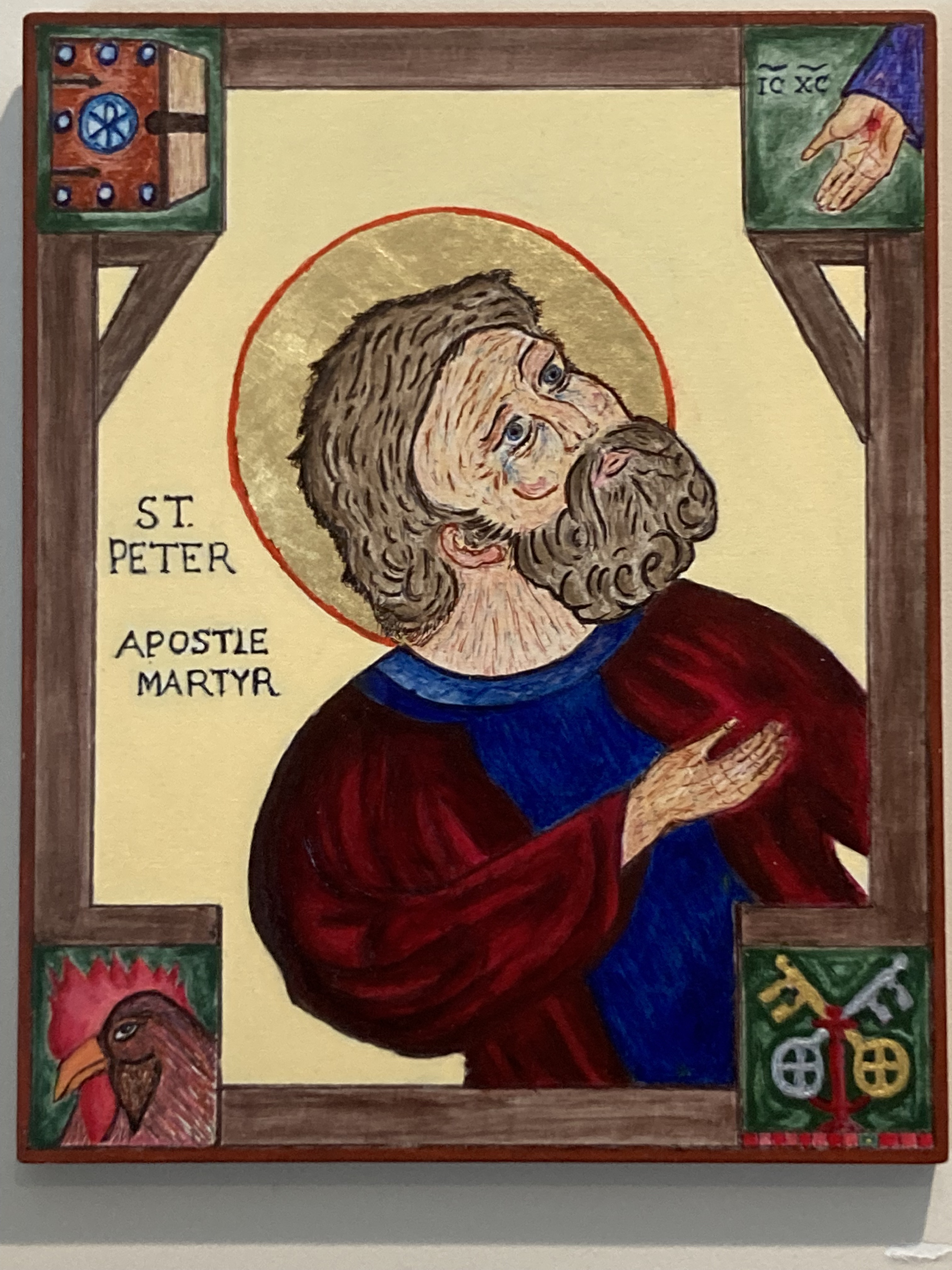
One of my goals in painting the above image of St. Peter was to provide a catechist/observer with seven focus ideas within one image. This sacred image also presents some of the life events of the “Rock” on which Jesus Christ built His Church. I have painted this image with the approach of the Naive/Folk Art genre or “school.” I will discuss the Naive/Folk art approach in my next post. Below are my seven fundamental ideas that can be used as a lesson plan(s) for the above image:
The image is based on Christ’s words and Peter’s actions within the New Testament (have the students look up the verses found within the Gospels and Epistles).
The image itself presents the presence of Peter who is suffering (his posture, body movement, expression, tears, and the extension of his hand). He is requesting Christ’s forgiveness.
Christ is identified by the label IC XC (the Greek abbreviation for the name Jesus Christ). Christ is extending His hand in forgiveness and to raise Peter’s spirit.
The rooster in the bottom left corner is harkening back to its crowing after Peter denies Jesus (Scripturally predicted by Christ). The rooster is also looking at the viewer, reminding us of our personal sins.
Papal authority. Peter is the first pope. He is the first bishop of Rome, the spiritual leader of the Church, and is symbolized by the two keys that are given to him, echoing Christ’s words of “you are Peter (Petros) and on this rock/stone (Petra) I will build my Church.” The keys are painted in gold and silver. Gold represents spiritual authority in union with the Church’s bishops. The silver key represents the papal influence within the world for issues that would affect the good of the Church and people as a whole. The keys are united by a red anchor (symbol of hope and steadfastness – found in the catacombs and the Epistle to the Hebrews). The sufferings of the clergy and laity are built upon the sufferings of Christ and the ministry/martyrdom of the first Apostles (12 squares under the keys; the green square represents St. John who was not martyred). The brown border encapsulating St. Peter reminds us of the cross on which he was martyred as well as the Cross of Christ.
Diagonal lines could be visually drawn through Peter from the upper left corner of the books of the Holy Scriptures to the lower right representing the teaching authority of the pope (Peter’s successors); as well as the upper right of Christ’s hand to the rooster on the lower left reminding us of Peter’s denial and Christ’s forgiveness.
This denial by Peter is not the denial of Judas Iscariot who was also an Apostle. Throughout the Catholic Church’s history we have had both clergy and lay people deny Christ through their words and actions. It all began with the Apostles; however the difference between Peter and Judas is that Peter despaired, pleaded for forgiveness, and was picked up through Christ’s forgiveness. Judas despaired, did not plead for forgiveness, and threw himself down on the end of a rope.
If you find this subject interesting I recommend you read my post on Catechesis and Catholic Art published on June 26, 2021. Thanks.
A photo of the inside of the Aya Sofya (Hagia Sophia) church in what is the present-day city of Iznik, Turkey. Iznik was called Nicaea prior to the rule of the Ottoman Turks . This photo shows the interior of one of the rooms in the building complex that served as the location for the First Council of Nicaea (AD 325). Also, in the late 8th century the Seventh Ecumenical Council met in this building, too. That Council met to debate and decide the issue of iconoclasm (should sacred icons and images be prohibited and destroyed). The written arguments of St. John Damascene (Damascus) won the day and sacred icons were allowed to continue to be made. Iconoclasm was to raise its ugly head again in later years, and came to full fruition during the Protestant rebellion/reformation, the French Revolution, and worldwide Communism in all its cultural forms. This photo of the inside of the Nicaean building is from Bryan Cross’ website: calledtocommunion.com. It was posted in May, 2010. Thanks Bryan!
I would like to thank one of my readers who identified the contemporary icon of St. Spyridon (thanks Carol!). The iconographer is the Catholic priest William Hart McNichols. He is a very talented artist who paints traditional icons and sacred images. At times, he steps out of the bounds of the traditional approach and adds his own personal interpretation of the person he is portraying. His artistic vision is unique.
John Daly from Australia emailed me this morning to provide further grist for our mill concerning St. Athanasius, St. Spyridon, and the Council of Nicaea. One of the participants in his iconography school is a Greek Orthodox lady who is the sister-in-law of an Orthodox priest. He is coincidentally named Athanasius.
John had the opportunity to discuss with her the icons that we were analyzing in my posts of the last few days. She provided John some valuable information by explaining that her mother had given her a beautiful sacred image of the First Council of Nicaea and specifically St. Spyridon’s role in the debate with the heretic Arius. The sacred image is below.
Greek Orthodox sacred image of the First Council of Nicaea. Notice St. Nicholas on the lower right about to possibly physically strike Arius who reacts by pulling away. On the left you see St. Spyridon, holding a brick with flames streaming upward and water puddling below it to the floor (confer yesterday’s post of April 16th to obtain the explanation of that imagery). The room of the actual Council, as portrayed in this sacred image is quite ornate.
Also, like the sacred icon we examined in yesterday’s post we see the Emperor Constantine, dressed in the royal robes of Byzantine reddish purple (almost a maroon) sitting on the right. On the Emperor’s right we again observe a bishop, maybe its Bishop Alexander of Alexandria, Egypt. In front of him we again see a deacon, dressed in what is either an alb or dalmatic (he would have to stand up to see all the garments).
In the above sacred image, the deacon is again seated at the scribe’s desk. This makes sense, since a deacon serves the administrative needs and report’s directly to his bishop. That is true to this day; yet, throughout the world today the local bishop has his deacons serving in parishes, hospitals, prisons, etc. rather than in an administrative capacity in the local chancery. Notice the bishop is behind the deacon scribe to facilitate accurate communication.
The above sacred image, which I have never seen before John Daly sending it to me, is very well done. The painter has captured the meaning of the Council as a whole and two of its major participants: St. Nicholas’, in his famous interaction with the heretic Arius, and the great oratorical and mystical abilities of St. Spyridon challenging Arius, too.
Is the deacon pictured in the painting from the Latin Rite or is he Orthodox? Truly, there is no way to accurately tell because the deacon is seated, and what is showing of the deacon’s stole is inconclusive. Depending on the angle of view both the Western and Eastern Rites’ deacon’s stole placement looks the same.
In today’s painting and in yesterday’s post of the icon, the deacon is seated and the possible vertical panel on the Eastern Rite and Orthodox stole is in shadow or not detectable, yet, the panel that drapes from left shoulder and gathers at the waist is visible, and would appear, as you see below, in both Latin, Eastern, and Orthodox Rites!
Just between you and me, I think the deacon depicted in the icon, from my April 16, 2019 post and today’s, is St. Athanasius from Alexandria, Egypt. The Catholic Church, the Eastern Rites in union with Rome, and all the Orthodox Churches venerate St. Athanasius as a great saint and designate specific feast days for him. He belongs to all of us.
The deacon’s stole in the Eastern Rites of the Catholic Church that are in union with Rome; and, the Greek Orthodox, the Russian Orthodox, and Coptic Orthodox deacon stoles look like this:
Orthodox deacon’s stole in a royal Byzantine fabric (in what appears to be a royal maroon purple) is bordered in gold thread with gold crosses. Originating at the left shoulder, gathered at the waist, with the fabric of the stole hanging vertically on the left shoulder both in the front and the back. The stole is worn on top of the ornate gold and white dalmatic.
The cassock, alb, stole, and dalmatic all have the same meaning and functions in both the Western and Eastern Rites of the Church. In today’s Western, that is, the Latin Rite (Roman Catholic) tradition, a deacon wears the rank of his ministry and ordination, the stole, over the alb but under the dalmatic. Latin Rite deacons would wear their stole’s in this manner:
A Roman Catholic deacon’s stole running from the left shoulder and gathered at the waist, then hangs vertically under the right arm. It is worn on top of a white alb, and undera dalmatic. The dalmatic is only worn during Holy Mass. When the deacon performs baptisms, marriage and funeral services, liturgical prayer services, and formal blessings, etc. the deacon would not wear a dalmatic, so the deacon would appear as in the above photo wearing a simple white or cream colored alb and a stole in the appropriate color.. The stole’s fabric in the photo above is dyed dark purple for Lent; during the season of Advent a purple stole is used, too; sometimes, it is of a lighter purple than the Lenten penitential purple. A white stole would be used for Baptisms. Marriages, Funerals, Holy Thursday services, and during the Easter and Christmas season. Red stoles would be worn at Palm Sunday and Good Friday services, Pentecost, and on the feast days of martyrs.
A Roman Catholic deacon’s dalmatic which is worn over the white alband the stole. The dalmatic is in the corresponding color to the stole. The color green is worn during “Ordinary” time (which is the liturgical period that borders the great seasons of Advent, Christmas, Lent, and Easter).
I’ve really enjoyed this lively information exchange. Thanks to all who participated in it!
May you have a blessed Easter Tridiuum of the Passion and Resurrection of Our Lord Jesus Christ.


 The Fra Angelico Institute for Sacred Art
You must be logged in to post a comment.