The Virtues of St. Francis of Assisi – A Model For Sacred Artists, October 4th

In our celebration of the memorial of St. Francis of Assisi we must pause for a moment and examine the virtues that motivated and energized his life.

We can begin by saying that he was a simple man. He pursued simplicity. This does not mean that he was of limited intelligence, or that he pursued simplicity for simplicity sake, rather, it means that he was successful at eliminating everything from his life that did not enhance his understanding and love of Jesus.

In other words, he kept to what was essential in life: “God, the state of our soul, judgment and eternal life.” He realized that “to be simple is to see things with the eyes of God. St. Francis pursued simplicity because he innately knew that God Himself is simple” (from a sermon by Fr. Ronald Knox, 1936).

Other characteristics of Francis’ life are the virtues of faith and love. St. Francis understood that by praying  for faith, by acting faithfully and lovingly, his spiritual muscles would be stressed, making him  grow stronger in faith and love of God. He knew that God’s grace would assist him in this spiritual exercise if he committed himself to it.

Thus we see his extraordinary reaction to his father’s demand for repayment for the fabrics he took, and sold, to benefit the poor. How did he react when accused? He publicly disrobed; a humble nude standing majestically in the town square. Michelangelo should have attempted to sculpt that scene in marble. For what was the scene?

It was the image of the young Francis, not confronting the Goliath of military invasion, rather, the Goliath of a garden serpent who tempted him to return to the sweet life, la dolce vita. It was the image of the grace of a God given vision to live a virtuous life. Its simple grace would be the stone that would bring down the giant of his own ego and worldliness.

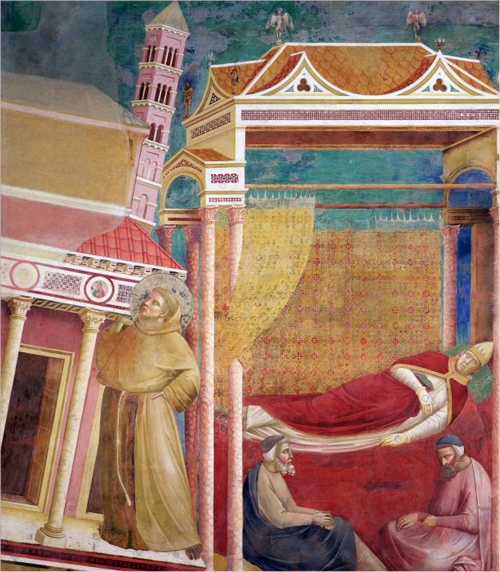
The magnificent Florentine painter, Giotto (1226-1337), born the same year St. Francis died, painted these virtues of St. Francis at work when he portrayed Pope Innocent III’s dream of Francis holding up the pillars of the Church.

It was St. Francis, and his fellow friars that would live in their daily lives the virtues of poverty, chastity, and obedience. These virtues, within the Franciscan perspective, would sweep the imagination of Europe and even gain respect in the Mid East.

How does this apply to an artist? Sacred artists must strive for balance in their spiritual and artistic life. Giotto is a wonderful example for us because he combines the principles of action and contemplation. Like Francis, Giotto was balanced. He achieved simplicity in his portrayal of spiritual truths, and was able to witness  continual dedication to combining action (art) with contemplation (prayer during the creative process).

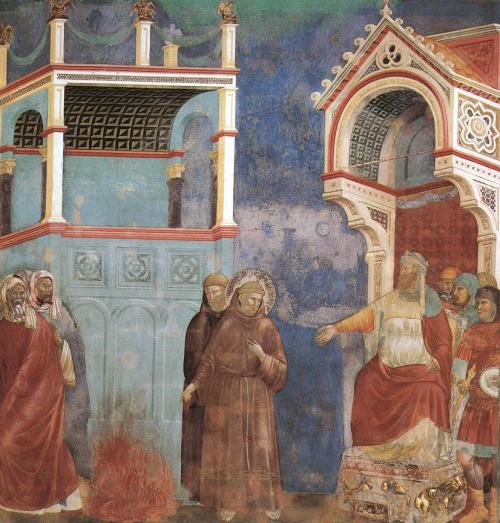
Giotto was a master of painting sacred images that made St. Francis’ life come alive. For example, he captures the spirit of Francis in the Holy Land and brings a favorite story about him to life. In the year 1219 during the Fifth Crusade, Francis traveled to the Holy Land, where he was captured and beaten by the Muslims.

St. Bonaventure tells us in his history of the Franciscan Order that St. Francis was brought before the sultan Al Kamil, and he preached to him about love and the meaning of Jesus’ life. When Francis finished his sermon he then challenged the Sultan’s imams to a religious test to determine which was the true religion – Islam or Catholicism. The painting below, entitled Trial by Fire by Giotto, illustrates the drama of that moment.

“Francis said to the Sultan: “Please have a bonfire lit, and have your imam, along with me, enter the fire – so let it be that his God is the true God whoever emerges from the flames unhurt.”

The Sultan’s eyes lit up – now this is a man of faith!

His imams, however, felt that they had better things to do.

But from that moment on Al Kamil was so impressed with Francis that he gave the Franciscans safe passage to travel and stay unhindered, anywhere, in Muslim occupied territories; and as a direct result of this act, eight hundred years later, if you go to Jerusalem you will see that the Franciscans are still the Catholic Religious Order responsible for the maintenance of the holy shrines.

Theologian Dr. Marcellino D’Ambrosio teaches us that “St. Thomas Aquinas explains that a virtue, like a physical muscle, is a habit – a power or capacity – that gets stronger when its exercised – and atrophies – when it is not.” St. Francis shows us that faith and love, prayer and service are the main muscles in our spiritual body; and for artists they are the virtues that keep our lives balanced. Are we not all artists?

The life of St. Francis of Assisi was, itself, a work of art. For it was one in which the person, Francis, cooperated with the grace of God and allowed himself to be sculpted by the Divine Artist Himself; may we all be as courageous to do the same.

*Readers are welcome to read all my posts on St. Francis, and a relatively new one, entitled St. Francis of Assisi: A Nice Man or a Soldier of Christ? https://fraangelicoinstitute.com/2021/03/04/st-francis-of-assisi-a-nice-man-or-a-soldier-of-christ/

Copyright © 2011- 2024, Deacon Paul O. Iacono – All Rights Reserved. Permission to reprint must be obtained from the author through making comment on this post in its comment section. Students, and those interested, may quote small sections of the article as long as the proper credit and notation is given. Thank you.

Christian Witness and Sacred Art – The Early Church Fathers – Part 7

A Challenge: Are you as a Christian artist willing to internalize the message of the saint, scene, or Scripture passage you are artistically representing, and then, correctly portray it according to Church tradition?

Sacred artists must have more than just an awarenesses of Jesus, His Mother, angels and  saints because their witness provides us with the foundation stones of our Faith. Sacred artists must be more than artists who propose “Art for art’s sake”.

If we do this what do we become? We become evangelists to the truth, goodness, and beauty of God, through the witness of Jesus Christ and the holy men and women who called Him the Son of God.

In the years immediately following St. Polycarp’s martyrdom (died, circa AD 155, and remembered yesterday, February 22nd, in the Roman Breviary and Missal) a group of eight Western and Eastern Rite scholars and clerics arose known as the Apologists (Defenders of the Faith).

The Apologists defended the beliefs and traditions of the Church that passed down to them, in an uninterrupted line, directly from the Apostles and Apostolic Fathers.  This occurred during the years of continued persecution – AD 155 through AD 313.

The works and ministerial witness of the Apologists provide evidence for the continuity of beliefs and dogmas in the Early Christian Church. It is through this historic development, and the literary and physical witness of their efforts, that we have  religious and cultural traditions which dramatically affected the growth of sacred art. These clerics and scholars desired to unify and establish the beliefs of the Western and Eastern Rites of the Church.

Church artists, and the later group of clerics and scholars known as the Nicene Fathers (who I will cover in later posts), were heavily influenced by their efforts. These two groups, the Ante Nicene and Nicene Fathers all desired to make concrete and visible the correct teaching – the orthodoxy – of the Church. These efforts ultimately produced artistic representations of these early spiritual heroes – a visible sign of the truths of the Gospels being preached – and in some cases, their witness in blood.

The Apologists have also been termed The Ante (Before) Nicene Fathers because they lived and died prior to the establishment of the  Creed of the Catholic Faith, ultimately to be known as the Nicene Creed.

Let us briefly review two of the Apologists: St. Irenaeus of Lyons, and St. Clement of Alexandria. In a subsequent post you will have the opportunity to read three or four sentence descriptions of the contributions of the other six  Apologists.

St. Irenaeus of Lyons was born in AD 130 and died circa AD 202. He speaks of the four Gospels as being the “Four Pillars of the Church,” and was in a position to know that since he heard St. Polycarp (a friend and disciple of the Apostle John) preach. He was steadfast in supporting the belief in Apostolic Tradition. He taught that the true Faith is the one imparted by the bishops of the Church who, in turn, received it directly in an uninterrupted set of teachings from the Apostles. St. Irenaeus was tenacious in his fight against heterodoxy, specifically the Gnostic heresy.

St. Irenaeus understood the value of St. Polycarp’s New Testament scholarship and his emphasis on the Church’s sacred Tradition. He spoke with authority on Mary as the New Eve, and the Holy Eucharist. St. Irenaeus barely escaped death during the persecution of Emperor Marcus Aurelius, however during the round-up approximately 50 other Christians had the joy of earning the holy crown of martyrdom. He may have eventually died a martyr, yet, there is not sufficient evidence to support it.

IconPM-Irenaeus-2
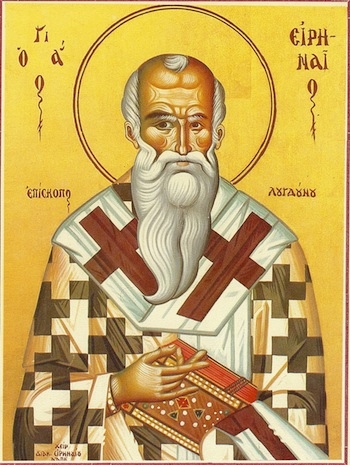
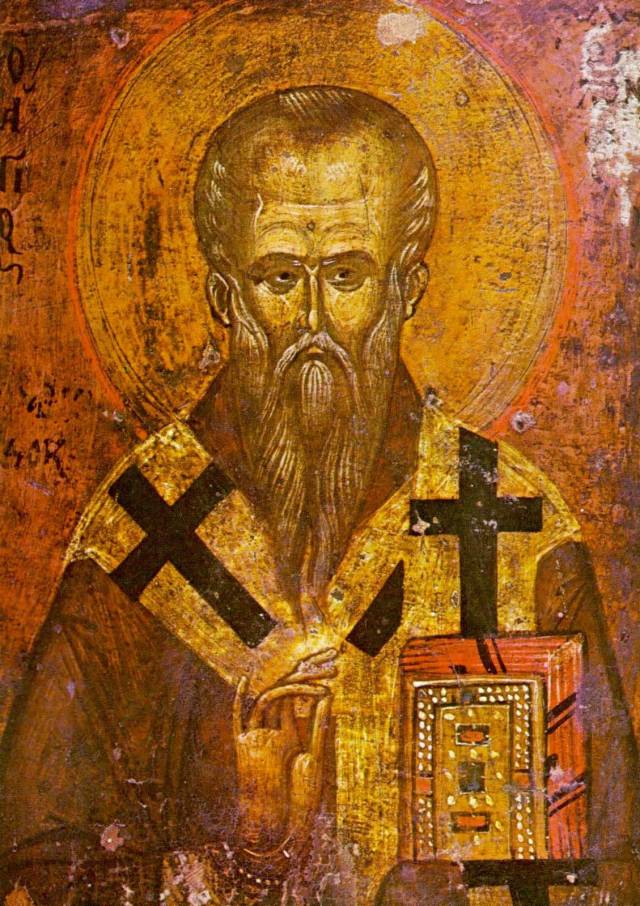
St. Irenaeus of Lyons (died circa 202). Famous for his manuscripts Against Heresies. He used 21 out of the 27 books of the New Testament in his writings and sermons.

Another critical Apologist is St. Clement of Alexandria (born circa AD 150, died circa 215). He led a major catechetical school in Alexandria, Egypt and agreed with St. Irenaeus that the truth and knowledge of the holy Gospels proceed through the bishops and are for the population as a whole and not for any secret society (thus, he fought against the Gnostic heresy).

He taught that in order to understand the truths of the Gospels you must have faith in unison with reason. He is also known for three major catechetical works which are still in existence. These works were meant to accompany catechumens and those baptized into the Christian faith as an aid to their spiritual development. He was not martyred.

SAINT-CLEMENT-I
St. Clement of Alexandria – an Apologist of the Early Church – as represented by an early iconographer of the Eastern Rite of the Catholic Church.


Thanks for stopping by the Institute. I hope you have a relaxing weekend.

Copyright © 2011- 2019 Deacon Paul O. Iacono All Rights Reserved. Permission to reprint must be obtained from the author in writing. Students may quote small sections of the article as long as the proper credit and notation is given. Thank you. Permission to copy these posts must be obtained from Deacon Paul Iacono at deaconiacono@icloud.com.

St. Joseph’s Art Workshop – Lesson 3 – Applying Pigment

To all those that have expressed interest in the FREE on-line sacred art workshop that I am offering here at fraangelicoinstitute.com please note that yesterday I posted Lesson 3 in Exercise 1: Painting an Image of St. Rose of Lima.

Just click on the St. Joseph’s Art Workshop Tab on top of the image of St. Gabriel and the Virgin Mary and you will see the first Workshop page.

If you have already visited the Workshop Tab then just continue to scroll down to find the Lessons that I have posted so far. I am putting all the Lessons in one place because it will be easier for you to scroll up and down to refer back and forth to other Lessons for Exercise 1.

More lessons will be posted in the upcoming weeks. You have enough to read and keep you busy for now!

Feel free to participate and enjoy the process of creating art!

Lesley Green – A Rhode Island Sacred Artist

One of the great blessings the Lord has granted me is the privilege of meeting so many wonderful people who are interested in studying and creating sacred art. An example of this is the fine Rhode Island artist, Lesley Green.

Lesley is no stranger to art. She has been interested in it since adolescence and received a BFA from the Rhode Island School of Design. She continued to pursue her studies while taking time out to marry and raise a family.

I first met Lesley a number of years ago, when my wife and I started the Fra Angelico Institute for the Sacred Arts.  We invited people from around the Diocese of Providence to come to our first informational meeting. I could tell upon first meeting her that she was highly motivated to consider studying and prayerfully create sacred art.

My first workshop in sacred art soon followed that meeting and Lesley came to learn the basics of how to paint a sacred icon. Her excitement and interest were, and still are, gratifying to see. She continued to make rapid progress with me and took the advice that I give to all of my students: “Branch out, and study with as many other sacred artists as you can.”

I firmly believe that a sacred artist needs to be exposed to, not only a variety of artistic talents and skills, but to the prayerfulness of other iconographers as they practice their ministry in sacred art. As a result, she has since enjoyed studying with Rev. Peter Pearson and Michael Kapeluck, two artists from Pennsylvania who paint in the Russian Orthodox style.

Lesley realizes that her art is more than art for art’s sake. As a committed Roman Catholic she understands that her art is a dramatic form of silent evangelization of the Word of God. She takes seriously the invitation of St. John Paul 2’s 1999 Letter to Artists to participate in the “call” to the vocation of a sacred artist. He tells us that in doing so we fulfill our personal responsibility to do our part in spreading the Good News of Christ. He says,

“In order to communicate the message entrusted to her by Christ, the Church needs art.  Art must make perceptible, and as far as possible attractive, the world of the spirit, of the invisible, of God.  It must therefore translate into meaningful terms, which is in itself ineffable.

Art has a unique capacity to take one or other facet of the message and translate it into colors, shapes and sounds, which nourish the intuition of those who look or listen. It does so without emptying the message itself of its transcendent value and its aura of mystery.” 

It is this “aura of mystery” that Lesley is prayerfully attempting to make visible to the viewer of her art. For, as sacred artists, we are all called to make visible the “ineffable mystery” that is God, His angels, and His saints.

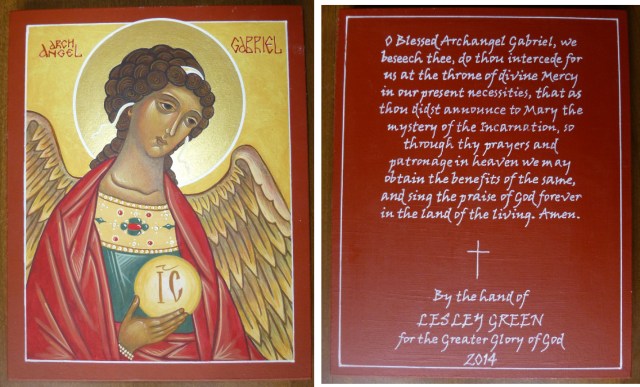
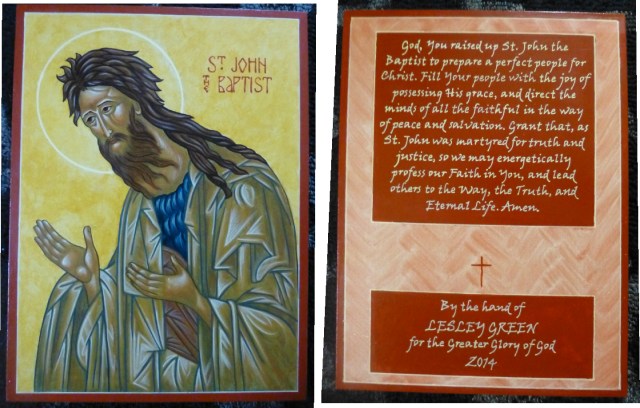
Lesley’s most recent completed icons of Saint Gabriel and St. John the Baptist are quite lovely. I especially like the fact that St. Gabriel is shown holding the Holy Eucharist. As you know, the Archangel Gabriel was depicted in the Hebrew Scriptures as being a healer, especially of the eyes. This sacred icon aptly shows that the source of the Archangel’s power is Christ Himself. The second icon showing St. John the Baptist in a prayerful pose indicates that even in Heaven he continues his mission of imploring us to repent of our sins.

St. Gabriel the Archangel and St. John the Baptist, pray for us.

image description


image description

Copyright © 2011- 2014 Deacon Paul O. Iacono All Rights Reserved


The Messages of St. Joseph – His Predestination and Preeminence

Readers: 

The statement below proclaims that the apparitions and messages have been approved by a few Roman Catholic bishops. I provide them here for your edification and prayerful consideration in light of the approaching feast day of St. Joseph.  I have never heard of these messages and found them to be a fascinating expression of the witness of St. Joseph. I also recommend to you the wonderful article by Dominican scholar Fr. Reginald Garrigou-Lagrange, O.P. on the Predestination of St. Joseph and his preeminence among the saints.  (Deacon P.I. 3/15/2014). I have reblogged this from the following website: http://www.motherofallpeoples.com/2010/10/the-messages-of-st-joseph-in-our-lady-of-america/

The Messages of St. Joseph in Our Lady of America

Published on October 29, 2010 by  in Marian Private Revelation

“The following are messages of St. Joseph as contained in the messages of Our Lady of America. Cardinal Raymond Burke (then Bishop Burke) wrote a letter to the United States Conference of Catholic Bishops on May 31, 1997. He establishes that, in his canonical opinion, these apparitions are already approved in virtue of the repeated support of Archbishop Paul F. Leibold, spiritual of the visionary Sr. Mary Ephrem. These messages of St. Joseph comprise one of the most extraordinary and profound revelations regarding the truth that, after Our Lady, St. Joseph is the greatest saint of all time. – Editor of the source website.

Message of Early October, 1956

In early October, 1956, about a week after Our Lady’s first appearance, St, Joseph, though I did not see him at this time, spoke to me the following words; “It is true, my daughter, that immediately after my conception I was, through the future merits of Jesus and because of my exceptional role of future Virgin-Father, cleansed from the stain of original sin. I was from that moment confirmed in grace and never had the slightest stain on my soul. This is my unique privilege among men.

My pure heart also was from the first moment of existence inflamed with love for God. Immediately, at the moment when my soul was cleansed from original sin, grace was infused into it in such abundance that, excluding my holy spouse, I surpassed the holiness of the highest angel in the angelic choir. My heart suffered with the Hearts of Jesus and Mary. Mine was a silent suffering, for it was my special vocation to hide and shield, as long as God willed, the Virgin Mother and Son from the malice and hatred of men.

The most painful of my sorrows was that I knew beforehand of their passion, yet would not be there to console them. Their future suffering was ever present to me and became my daily cross, so I became, in union with my holy spouse, co-redemptor of the human race. Through compassion for the sufferings of Jesus and Mary I co-operated, as no other, in the salvation of the world.

St. Joseph    Message of March 11, 1958

On March 11, 1958, Our Lady said to me: “St. Joseph will come on the eve of his feast. Prepare yourself well. There will be a special message. My holy spouse has an important part to play in bringing peace to the world.” St. Joseph came as was promised, and these are the words he spoke at this time:

“Kneel down, my daughter, for what you will hear and what you will write will bring countless souls to a new way of life. Through you, small one, the Trinity desires to make known to souls Its desire to be adored, honored, and loved within the kingdom, the interior kingdom of their hearts. I bring to souls the purity of my life and the obedience that crowned it. All fatherhood is blest in me whom the Eternal Father chose as His representative on earth, the Virgin-Father of His own Divine Son. Through me the Heavenly Father has blessed all fatherhood, and through me He continues and will continue to do so till the end of time. My spiritual fatherhood extends to all God’s children, and together with my Virgin Spouse I watch over them with great love and solicitude. Fathers must come to me, small one, to learn obedience to authority: to the Church always, as the mouthpiece of God, to the laws of the country in which they live, insofar as these do not go against God and their neighbor. Mine was perfect obedience to the Divine Will, as it was shown and made known to me by the Jewish law and religion. To be careless in this is most displeasing to God and will be severely punished in the next world. Let fathers also imitate my great purity of life and the deep respect I held for my Immaculate Spouse. Let them be an example to their children and fellowmen, never willfully doing anything that would cause scandal among God’s people. Fatherhood is from God, and it must take once again its rightful place among men.”

As St. Joseph ceased speaking I saw his most pure heart. It seemed to be lying on a cross which was of brown color. It appeared to me that at the top of the heart, in the midst of the flames pouring out, was a pure white lily. Then I heard these words: “Behold this pure heart so pleasing to Him Who made it.”  St. Joseph then continued:

“The cross, my little one, upon which my heart rests is the cross of the Passion, which was ever present before me, causing me intense suffering. I desire souls to come to my heart that they may learn true union with the Divine Will. It is enough, my child; I will come again tomorrow. Then I will make known to you how God wishes me to be honored in union with Jesus and Mary to obtain peace among men and nations. Good night, my little one.”

Message of March 19, 1958

On the evening of the next day, March 19, 1958, St. Joseph again appeared to me as he had promised and addressed me in these words:

“My child, I desire a day to be set aside to honor my fatherhood. The privilege of being chosen by God to be the Virgin-Father of His Son was mine alone, and no honor, excluding that bestowed upon my Holy Spouse, was ever, or will ever, be as sublime or as high as this. The Holy Trinity desires thus to honor me that in my unique fatherhood all fatherhood might be blessed. Dear child, I was king in the little home of Nazareth, for I sheltered within it the Prince of Peace and the Queen of Heaven. To me they looked for protection and sustenance, and I did not fail them. I received from them the deepest love and reverence, for in me they saw Him Whose place I took over them. So the head of the family must be loved, obeyed, and respected, and in return be a true father and protector to those under his care. In honoring in a special way my fatherhood, you also honor Jesus and Mary. The Divine Trinity has placed into our keeping the peace of the world. The imitation of the Holy Family, my child, of the virtues we practiced in our little home at Nazareth is the way for all souls to that peace which comes from God alone and which none other can give.”

Then suddenly, as he ceased speaking, I was favored with a unique and marvelous vision of the glorious St. Joseph, He seemed suspended, as it were, a short distance above what had the appearance of a large globe with clouds moving about it. His head was slightly raised, the eyes gazing upward as if in ecstasy. The hands were in a position similar to that of the priest during the celebration of Holy Mass, only they extended upward somewhat. The color of his hair, as also of his rather small and slightly forked beard, seemed a very dark brown. His eyes resembled in color the hair and beard. He was clothed in a white robe that reached to his ankles. Over this he wore a sort of cloak which did not come together at the throat, but covering the shoulders and draped gracefully over each arm, reached to the hem of the robe. The cloak at times had, or seemed to have, the appearance of a brown, sometimes a purple, hue, or perhaps a slight blending of the two. The belt about his waist was of a gold color, as were his sandals. His appearance, though quite youthful, gave at the same time the impression of rare maturity combined with great strength. He seemed a bit taller than medium height. The lines of his face appeared strong and purposeful, softened somewhat by a gentle serenity. I also saw his most pure heart at this time. Moreover, I saw the Holy Spirit in the form of a dove hovering above his head. Standing sideways, facing each other, were two angels, one on the right, the other on the left. Each carried what appeared to be a small pillow in a satin covering, the pillow on the right bearing a gold crown, the one on the left, a gold scepter. The angels were all white, ever their faces and hair. It was a beautiful whiteness that reminded me of the stainlessness of heaven. Then I heard these words:

“Thus should he be honored whom the King desires to honor.”

When the vision ended, St. Joseph before taking leave spoke to me in the following manner:

“The Holy Father need have no fear, for I have been appointed his special protector. As God chose me to be the special guardian of His Son, so has He chosen me as the special guardian of him who in Christ’s Name is head of the Mystical Body of that same Son on earth. My special protection of the Holy Father and the Church should be made known to him. God wishes to make this known to him that he may receive thereby renewed consolation and encouragement. During the war, little daughter, it was I who saved him from death at the hands of his enemies. Continually I watch over him and the Church, and I desire this to be acknowledged for the greater glory of God and the good of souls. Lovely child, precious to the heart of your spiritual father, I will come again on the last Sunday of this month. Jesus and Mary will come also in a special visit. Receive my blessing.”

As I knelt down to receive it, I felt his hands on my head and heard the words: “May Jesus and Mary through my hands bestow upon you eternal peace.”

Message of March 30, 1958

As he had promised, St. Joseph came again on March 30. His requests were similar to those of Our Lady and the First Saturday. The Sacred Hearts of Jesus, Mary, and Joseph have been chosen by the Most Holy Trinity to bring peace to the world; hence, their request for special love and honor, also, in particular, reparation and imitation. These are the words of St. Joseph as recorded on March 30:

“I am the protector of the Church and the home, as I was the protector of Christ and His Mother while I lived upon earth. Jesus and Mary desire that my pure heart, so long hidden and unknown, be now honored in a special way. Let my children honor my most pure heart in a special manner on the First Wednesday of the month by reciting the Joyful Mysteries of the rosary in memory of my life with Jesus and Mary and the love I bore them, the sorrow I suffered with them. Let them receive Holy Communion in union with the love with which I received the Savior for the first time and each time I held Him in my arms. Those who honor me in this way will be consoled by my presence at their death, and I myself will conduct them safely into the presence of Jesus and Mary. I will come again, little child of my most pure heart. Until then, continue in patience and humility, which is so pleasing to God.”

As St. Joseph had promised, Jesus and Mary also came on March 30. Jesus had the appearance of a boy about fifteen or sixteen year old. He spoke to me first. It was about the sanctification of the family and other matters. He said it would not be required of me to write it at this time, as He would ask this of me at a later date. Our Lady and St. Joseph also spoke to me concerning the same subject and also about the Divine Indwelling.”

+++++++++++++++++++++++

My thanks again to voxpopuli@voxpopuli.org at http://www.motherofallpeoples.com/2010/10/the-messages-of-st-joseph-in-our-lady-of-america/ for providing this information. Happy St. Joseph and St. Patrick’s Day!
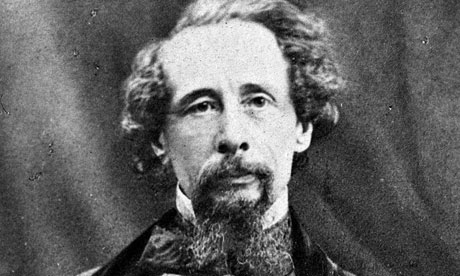
What Does Charles Dickens Have To Do With St. Francis Xavier?!

The novels of Charles Dickens have always been a favorite of mine, for contained within them are so many marvelous and accurate observations of human nature.

For example, in his novel The Christmas Carol, Dickens knew that each of us carries within our hearts and memories an accumulation of past Advent and Christmas seasons – seasons that dramatically influence the way we prepare and celebrate the birth of Jesus.

All of our past and present preparations for the Solemnity of Christmas either enriches or diminishes our love for our Lord and for those who will share in His birthday with us.

With this in mind, possibly we can admit that our past Advent preparations have not been as good as they should have been; maybe we were more concerned with the sights, sounds, tastes, and smells of the season rather than the state of our hearts and souls.

If this is so, then we should joyfully take the prophet Isaiah’s advice and “Climb the Lord’s mountain, to the house of the God of Jacob, that He may instruct us in His ways and we may walk in His paths.” (Isaiah 2: 3).

The prophet’s instruction in this morning’s reading  demand that we remain alert and awake, to the promptings of His voice and the movement of His Spirit.

Perhaps, most importantly, he demands that we spend time in prayer – learning and reflecting on the fact that Advent is a time of penitentially preparing for Jesus to enter our lives right now by being born into our hearts.

If Christmas Day is to be especially meaningful for us this year, we need to embrace Jesus not just as the past babe in the manger or the future righteous king; but as the present healer, Savior, and teacher who alone is capable of touching our hearts and bringing joy into our lives.

It is in this spirit of healer and teacher that we also remember today, the witness of one of the founding members of the Jesuit Order, St. Francis Xavier, who preached throughout Asia and brought the love and hope of Christ to those who lived in darkness and ignorance of the Redemptive sacrifice of Christ.

st-francisxavierbody-7128321

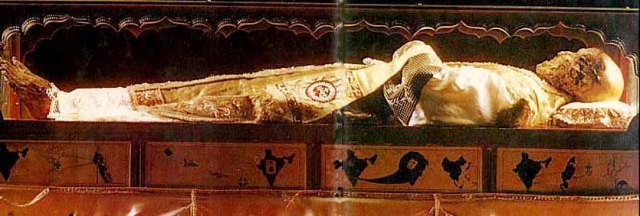
The above photograph is of the incorrupt body of St. Francis Xavier S.J. He died on this day in 1552. Forensic pathologists have examined his body and have concluded that while it is decomposed in spots, the body is, for the most part, incorrupt. It presently resides in the Church of the Baby Jesus in Goa, India. Xavier possessed indefatigable zeal, extraordinary and heroic faith, and desire to spur others to see themselves as missionaries; because of this he is known as the patron saint of all missionaries.

Charles Dickens, the 19th century English writer has captivated many people with his extraordinary ability to paint word pictures of unforgettable characters and scenes. But, what is it that links St. Francis Xavier with Charles Dickens?

Charles Dickens

It could be said that they both, as very gifted men, had the ability to speak to the heart of their listeners. They desired to touch not just the emotions, but the will of their audience. By that I mean that they both desired to see that their listeners had an experience which took them beyond themselves into a realm that opened their minds, hearts, and wills to act on the message that was being given. Who can disagree with Xavier’s ability to sway the hearts and minds of the Indian people who desired to hear him and follow his call to turn their lives over to Christ?

And what of Dickens?  Because of their emotional and psychological impact he was known to have people faint at his public readings of his most loved stories. Who can forget the haunting and cutting words of the Ghost of Christmas Present when he says to Scrooge “Are there no poor houses? Are there no prisons?” after showing Ebenezer the scrawny bodies of Ignorance and Want.

As we begin this Advent Season, let us pray that we possess the faith, hope and love of St. Francis Xavier, and, yes, even the gift of a Charles Dickens’ story, to express that our Lord will quietly work in our own lives to prepare our hearts to be ready to hold and comfort Him on Christmas morning and throughout the year.

Copyright © 2012 Deacon Paul O. Iacono All Rights Reserved

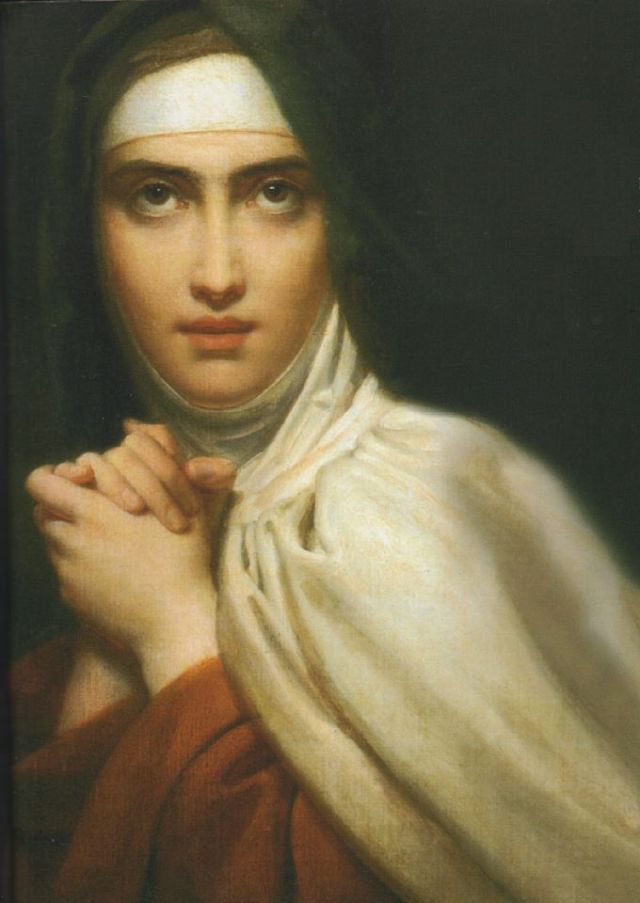
St. Teresa of Avila – On Love

On October 15th we celebrate the Memorial of the great Spanish saint and the first woman declared a “Doctor of the Church” – Teresa of Jesus, also known as Teresa of Avila.

Saint Teresa grew up in the early 1500’s and at the age of 20, entered the Carmelite convent in Avila. She freely admitted that for twenty years she had a very difficult time with prayer and distractions. Compounding the problem was the lifestyle of her fellow nuns. In the 16th century, Spanish convents were very relaxed places since a festive, vain, and worldly attitude was prevalent. The idea of strict discipline, contemplative prayer, and living a life of poverty and service was not a priority.

At the age of forty, Teresa’s life suddenly changed. While she was praying she had a profound religious experience. She fully realized the depth of the sacrifice God’s Son Jesus had made for humanity and vowed to pursue a life of spiritual perfection, centering on poverty and developing the art of mental prayer known as contemplation.

She realized that the Carmelite convent that she was living in was not contributing to her spiritual life; and with characteristic energy, she decided to break away from it. With her friend St. John of the Cross, she founded a reformed Carmelite order for friars and nuns known as the Discalced Carmelites. Her new order met with great hostility both from within the Church hierarchy, the regular Carmelite Order, and from the local parishioners, yet, she didn’t give up on her vision of reformation from within the Church.

What does her witness have to say to us today?

First she teaches us the value of perseverance. Both in prayer and in the vision we have been given by God to do whatever He asks us to do. Getting up, going to work every day, reforming a religious order or providing a home for your loved ones, completing your work for the Church – all of this – no matter how mundane or important, is fulfilling the will of God and is evidence of your love for Him.

Second, her life was a model of charitable patience. St. Teresa of Avila received a great deal of verbal, emotional, and spiritual abuse by fellow Catholics. This woman suffered both from physical and mental pain. The physical pain was caused by numerous ailments, however, her emotional pain was caused by people, fellow Catholics, that should have known better, yet, sadly, were far from practicing the cardinal virtues or willing to see the need for internal reformation.

But most importantly, her experiences give us a wonderful description of the art of contemplation and love of God.  In one of her books she says, “Mental prayer, in my opinion, is nothing other than an intimate sharing between friends – between Jesus and ourselves; it means frequently taking the time to be alone with Jesus whom we know loves us. The important thing is not to think much about saying a lot of words, but to love much, and do those actions which best stirs you to the love of our Lord. [What is this spiritual love?] Love is a desire to please God in everything.”

Saint Teresa of Jesus died in 1582 at the age of 67. She disliked gloom and always attempted to radiate joy, cheerfulness, and good spirits. In spite of her many physical ailments and emotional sufferings she kept her sense of humor and her vision of reformation: of self and of her beloved religious community. Her books are filled with optimism as well as a profound understanding of prayer, human nature, and spiritual warfare. We would be wise in applying to our own restless spirits the advice she gave to her fellow nuns, she said:  “Let nothing trouble you, let nothing make you afraid. All these things pass away. God never changes. Patience obtains everything. God alone is enough.”

Copyright © 2012 Deacon Paul O. Iacono All Rights Reserved.   Notes on the painting: The above painting is by one of the great painters of the early 19th century – Francois Gerard. Gerard, who died in 1837, painted this masterpiece of St. Teresa of Avila ten years earlier. It was commissioned for a hospital and before its placement was shown in the salons of Paris. It is one of the great masterpieces of French Romanticism. It is painted in oils, on canvas, and measures approximately 3 feet by 5.6 ft.

The Virtues of St. Francis of Assisi – A Model For Sacred Artists, October 4th

(This post is a reprint of my 2012 post on this topic).

In our celebration of the memorial of St. Francis of Assisi we must pause for a moment and examine the virtues that motivated and energized his life.

We can begin by saying that he was a simple man. He pursued simplicity. This does not mean that he was of limited intelligence, or that he pursued simplicity for simplicity sake, rather, it means that he was successful at eliminating everything from his life that did not enhance his understanding and love of Jesus.

In other words, he kept to what was essential in life: “God, the state of our soul, judgment and eternal life.” He realized that “to be simple is to see things with the eyes of God. St. Francis pursued simplicity because he innately knew that God Himself is simple” (from a sermon by Fr. Ronald Knox, 1936).

Other characteristics of Francis’ life are the virtues of faith and love. St. Francis understood that by praying  for faith, by acting faithfully and lovingly, his spiritual muscles would be stressed, making him  grow stronger in faith and love of God. He knew that God’s grace would assist him in this spiritual exercise if he committed himself to it.

Thus we see his extraordinary reaction to his father’s demand for repayment for the fabrics he took, and sold, to benefit the poor. How did he react when accused? He publicly disrobed; a humble nude standing majestically in the town square. Michelangelo should have attempted to sculpt that scene in marble. For what was the scene?

It was the image of the young Francis, not confronting the Goliath of military invasion, rather, the Goliath of a garden serpent who tempted him to return to the sweet life, la dolce vita. It was the image of the grace of a God given vision to live a virtuous life. Its simple grace would be the stone that would bring down the giant of his own ego and worldliness.

The magnificent Florentine painter, Giotto (1226-1337), born the same year St. Francis died, painted these virtues of St. Francis at work when he portrayed Pope Innocent III’s dream of Francis holding up the pillars of the Church.

It was St. Francis, and his fellow friars that would live in their daily lives the virtues of poverty, chastity, and obedience. These virtues, within the Franciscan perspective, would sweep the imagination of Europe and even gain respect in the Mid East.

How does this apply to an artist? Sacred artists must strive for balance in their spiritual and artistic life. Giotto is a wonderful example for us because he combines the principles of action and contemplation. Like Francis, Giotto was balanced. He achieved simplicity in his portrayal of spiritual truths, and was able to witness  continual dedication to combining action (art) with contemplation (prayer during the creative process).

Giotto was a master of painting sacred images that made St. Francis’ life come alive. For example, he captures the spirit of Francis in the Holy Land and brings a favorite story about him to life. In the year 1219 during the Fifth Crusade, Francis traveled to the Holy Land, where he was captured and beaten by the Muslims.

St. Bonaventure tells us in his history of the Franciscan Order that St. Francis was brought before the sultan Al Kamil, and he preached to him about love and the meaning of Jesus’ life. When Francis finished his sermon he then challenged the Sultan’s imams to a religious test to determine which was the true religion – Islam or Catholicism. The painting below, entitled Trial by Fire by Giotto, illustrates the drama of that moment.

“Francis said to the Sultan: “Please have a bonfire lit, and have your imam, along with me, enter the fire – so let it be that his God is the true God whoever emerges from the flames unhurt.”

The Sultan’s eyes lit up – now this is a man of faith!

His imams, however, felt that they had better things to do.

But from that moment on Al Kamil was so impressed with Francis that he gave the Franciscans safe passage to travel and stay unhindered, anywhere, in Muslim occupied territories; and as a direct result of this act, eight hundred years later, if you go to Jerusalem you will see that the Franciscans are still the Catholic Religious Order responsible for the maintenance of the holy shrines.

Theologian Dr. Marcellino D’Ambrosio teaches us that “St. Thomas Aquinas explains that a virtue, like a physical muscle, is a habit – a power or capacity – that gets stronger when its exercised – and atrophies – when it is not.” St. Francis shows us that faith and love, prayer and service are the main muscles in our spiritual body; and for artists they are the virtues that keep our lives balanced. Are we not all artists?

The life of St. Francis of Assisi was, itself, a work of art. For it was one in which the person, Francis, cooperated with the grace of God and allowed himself to be sculpted by the Divine Artist Himself; may we all be as courageous to do the same.

*Readers are welcome to read all my posts on St. Francis, and a relatively new one, entitled St. Francis of Assisi: A Nice Man or a Soldier of Christ? https://fraangelicoinstitute.com/2021/03/04/st-francis-of-assisi-a-nice-man-or-a-soldier-of-christ/

Copyright © 2011- 2021, Deacon Paul O. Iacono – All Rights Reserved. Permission to reprint must be obtained from the author through making comment on this post in its comment section. Students, and those interested, may quote small sections of the article as long as the proper credit and notation is given. Thank you.

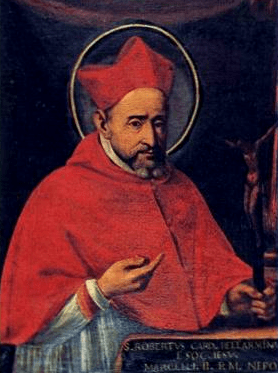
St. Robert Bellarmine, Galileo, and the Glory of God

Today, September 17th, the Church celebrates the memorial of Cardinal Robert Bellarmine. St. Robert was born into a noble Italian family during the crisis filled 16th century – a time of great artistic and scientific achievements and a time of heart breaking dissension within the Catholic Church.

In 1560, St. Robert entered the Society of Jesus, became a teacher, and was ordained ten years later. St. Robert’s Jesuit superiors sent him to the Catholic University in Louvain and there he developed a reputation for scholarship, disputation, and eloquence. When he returned to Rome in 1576, he became a professor of theology and began the systematic dismantling of the Protestant positions on faith and spirituality.

His book Disputations on the Controversies of the Christian Faith criticizing and refuting the Protestant errors was so effective, and caused such a stir throughout Europe, that special faculty positions were established in Protestant colleges in an attempt to refute Bellarmine’s positions.

So why is Saint Robert Bellarmine important for us today?

First, his witness as a scholar and cardinal expresses that the Church must always remain vigilant in its mission to promote the truth and protect its Apostolic and Sacred Tradition. Second, Robert Bellarmine as a Jesuit was loyal to its motto, which is “All for the greater glory of God.” In that motto, you have the structure of a Jesuit’s life, of Saint Bellarmine’s life, for through it he was able to weigh issues in the balance of whether or not they promoted the truth of God’s glory. Allow me to provide a very brief example.

Bellarmine was involved in the early stages of the astronomer Galileo’s difficulties with the Church. In 1615, Cardinal Bellarmine was interested in, and open to, various types of scientific research. He recognized that indeed, the Church’s own astronomers had validated many of Galileo’s scientific observations, and he was certainly knowledgeable of the fact that Cardinal Barberini (the future Pope Urban the 8th) had spoken with Galileo and gave Galileo his personal support.

So what was the problem?

Cardinal Bellarmine said in an open statement that, because Galileo’s scientific theories were not sufficiently supported with solid evidence, then Galileo should follow the position of the Church and call his theories a hypothesis and not scientific fact; and very importantly, he went on to say that, if Galileo’s theories were solidly proven to be true, then care must be taken to interpret Holy Scripture only in accordance with these new scientific truths.

Galileo rebelled against this common sense position. He demanded that his theories be acknowledged as scientific truth and publicly said so. The Holy Office, St. Bellarmine, and the other cardinals had no other choice than to censure him.

They did so not because they completely disagreed with his scientific theories, rather, the censure occurred because Galileo was promoting his ideas as scientific truth when, in reality, he did not have conclusive proof to do so. It should be remembered that St. Bellarmine, in dealing with Galileo, did so “in a sympathetic and not in a heavy handed way.” Bellarmine saw his duty to reason and ethics, and, the decision’s impact on a continent in social and religious turmoil.

Cardinal Bellarmine died in 1621. He was canonized in 1930 and made a Doctor of the Church  a year later.

Galileo had some virtues, however, prudence does not appear to be one of them. As the years went on he continued to do his research; but ultimately got himself into trouble again when he published a book which made his friend, Pope Urban 8th, look like a simpleton.

As a result of this insult, in 1632, he was called to Rome to stand trial for a second time. At that trial the ideas in his new book were examined, and sadly, the case was mishandled on both sides. It was unfortunate that Cardinal Bellarmine was not there to add his reason and judgement. Galileo died ten years later while under house arrest. Many of those years were spent in continued research and writing on various scientific topics.

Cardinal Bellarmine desired to see God glorified, and understood that science, music, art, and architecture were just a few of the ways to do it. He said in one of his essays: “May you consider truly good whatever leads to your goal of the glory of God and your eternal salvation with Him. May you consider truly evil whatever makes you fall away from it.”

Copyright © 2012 Deacon Paul O. Iacono All Rights Reserved

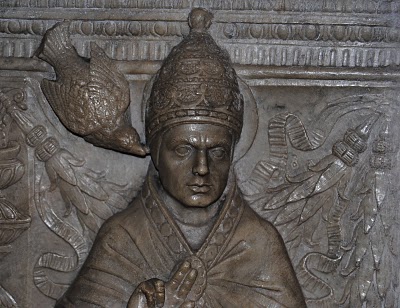
St. Gregory the Great – Laborer in Christ’s Vineyard

Today is the feast day of Saint Gregory the Great, pope and doctor of the Church.

Gregory was born in the year 540 of a noble Roman family who believed in the value of education and public service.

At the age of thirty he was appointed mayor of Rome; but after his father’s death, he decided to leave politics and become a Benedictine monk. Around the year 575, he transformed his family’s home into a monastery dedicated to the Apostle St. Andrew; he also established several monasteries on his father’s estates in Sicily. But in the year 579, he was ordained a deacon. Historians have mentioned that ordination was not really what Gregory wanted for his life. He enjoyed studying Scripture and music, writing, praying, and living the life of a Benedictine monk.  At that point in Church history, to be ordained a deacon meant that you were going to have a very public life assisting the local bishop in political, economic, and ecclesiastical affairs.

Pope Pelagius 2 saw Gregory’s talents and tapped him to become his papal ambassador to the imperial city of Constantinople. In Constantinople he gained a great deal of experience in both secular and ecclesiastical politics. Seven years later he was recalled to Rome and was appointed Deacon of Rome and acted as the Pope’s counselor. In 590 when Pope Pelagius died from the plague, the people elected Gregory to be the new pope.

Saint Gregory the Great is a model for all of us. For he, as today’s Gospel (Luke 4: 16-30) implies, also had the Spirit of God upon him. The Lord had anointed him as “the servant of the servants of God” to bring glad tidings to the poor and announce liberty to those captured by sin. The histories tell us that Gregory did not seek to be ordained a deacon or elected a pope; yet, once in those positions he valiantly labored in Christ’s vineyard to perform God’s will as he understood it.

He wrote beautiful and insightful works on theology and the pastoral care of  souls. He implemented some liturgical reforms especially in the area of music. The music that we know today as Gregorian chant developed from his impetus; however, his true greatness is found in his humility, his gentleness in dealing with all types of people, his steadfast devotion and love of Christ, His Scriptures, and prayer. All of these traits, combined with God’s grace and Gregory’s love for the people, helped him solve the practical everyday problems of Christ’s Church in a manner that provided a path for others to follow.

St. Gregory the Great was able to establish a model of the papacy that we still have with us today – the model of the pope, yes, as a suffering servant, but one who is also filled with joy at the challenge of laboring for the people of God in all their various needs. St. Gregory the Great, pray for us.

The image of Pope St. Gregory the Great is from the Vatican grottos and is made available through the courtesy of orbiscatholicussecundus.blogspot.com.

Copyright © 2012 Deacon Paul O. Iacono All Rights Reserved

Saint Monica – Patron of Mothers

Today is the memorial of St. Monica, the extraordinarily faith-filled mother of St. Augustine.

In the year 321, Monica was born in Algeria into a family that was devoutly Christian. As a child she was baptized a Christian and was raised to be a dutiful wife. She was given in marriage to a bad tempered, adulterous pagan official, by the name of Patricius.

In examining the life of Saint Monica one is struck by the extent of the abuse she and other women endured throughout their marriage. Under the laws of the time Monica’s husband could physically and emotionally abuse his wife. Compounding the problem was the fact that Patricius’ mother also lived with them and she, like her son, ridiculed his young wife. Monica had three children with this man and, of course the most famous was her oldest, the man that history now knows as Saint Augustine.

But it is important to reflect for a moment on how she dealt with all the stresses of her life: family relations that mistreated her, children that ignored her model of conduct and faith, a culture that looked the other way when her husband abused her. The circumstances of St. Monica’s life could easily have made her a miserable woman, a sour daughter-in-law, and a depressed parent, yet she didn’t become any of these; instead, she became a saint. A saint that is known for two major personal qualities: her love of Jesus Christ and her prayerful persistence in bringing her physical family into the family of God. This beautiful painting, by artist John Nava, (http://johnnava.com) eloquently captures her spirituality and desire for prayer and union with Christ.

Monica was upset to learn that Augustine had accepted the Manichean heresy and was also living an immoral life. Manichaeism stated, among other things, that there is no all knowing good power, so there is neither lord nor savior. She was so angered by his beliefs that she refused to let him eat or sleep in her house and became enraged when he explained to her that his belief trumped her faith in Jesus Christ. She threw him out of the house, but later pursued him and attempted to reason with him.

Monica took comfort in the fact that she had a dream that assured her Augustine would return to the faith. From that moment she vowed to continually pray and fast for her son and to remain close to him so that she would have the opportunity to discuss her faith with him. The histories tell us that she in fact stayed much closer than Augustine wanted.

One night Augustine told Monica that he was going to the docks to say goodbye to a friend. Instead, he himself set sail for Rome. Monica was stunned when she learned of Augustine’s trick, but she booked passage on the next boat. When she arrived in Rome, she learned that he had left to travel to the city of Milan in northern Italy where he hoped to obtain a teaching post. Monica pursued him to Milan, and it is in Milan that both mother and son came under the influence of the great saint Ambrose who was bishop of Milan.

Bishop Ambrose became Monica’s spiritual director, and ultimately, she accepted Ambrose’s advice. He advised her that what she was doing was correct – that prayer and fasting would have its affect on the situation. He commended her persistence and directed her to keep the faith, and in humility, accept her circumstances. Monica did exactly that, and in Milan, became a leader of devout women, some of whom were also being abused by their husbands.

Ultimately, Saint Monica won the day; her abusive husband, mother in law, and her youngest son and daughter were all baptized into the faith. Augustine, too, eventually saw the logic of his mother’s faith, became a catechumen, and took religious instruction from Ambrose. In the year 387, Bishop Ambrose baptized Augustine into the Catholic faith in Milan’s cathedral.

Saint Monica was an exemplary mother; a woman who perseveringly pursued her wayward family not with threats but with prayerful cries to heaven. Let us pray that she intercedes for all mothers in our day so that they may learn to guide their children to God. Let us also pray that she teaches mothers, through her example of prayer and fasting, to remain close to their children, even prodigal sons and daughters, who have sadly gone astray.

St. Monica, pray for us.

Copyright © 2012 Deacon Paul O. Iacono All Rights Reserved. Painting of St. Monica is copyrighted by John Nava. All Rights Reserved.

Saints Pontian and Hippolytus and Our Call to Duty

Today we celebrate the martyrdom of Saint Pontian, who was the lawfully elected successor pope to St. Callistus during the early 3rd century. St. Pontian was considered a criminal by the emperor Maximinius and banished to the silver mines in Sardinia – an exile which meant certain death. We also celebrate today a saint by the name of Hippolytus, who was a priest in the Church of Rome at this same moment in time.

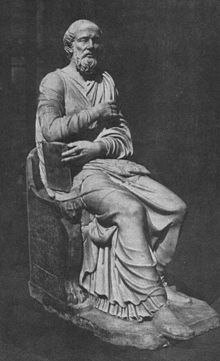
Saint Hippolytus is recognized because of his brilliance and profound scholarship. He is considered to be one of the finest theologians of the 3rd century, and is the source of the 2nd Eucharistic Prayer recited at Mass. Hippolytus’ most important work is a treatise known as The Apostolic Tradition; and scholars such as Dr. Marcellino D’Ambrosio, (at http://www.crossroadsinitiative.com) tell us that it provides “an enlightening and extensive glimpse into the liturgical and devotional life of Roman Christians around the year 200.” The statue found below is of Roman origin, found in the mid 16th century. It has the name Hippolytus carved into it as well as references to works of other Apostolic Fathers. The image is presented through the courtesy of Dr. D’Ambrosio.

Controversy, however, erupted when St. Callistus, was elected to the papacy. St. Hippolytus considered Callistus to be a liberal since Callistus extended absolution to new converts who had committed mortal sins such as adultery and murder. Hippolytus contested the election, violently disagreed when Callistus was affirmed, and then made history by declaring himself pope, thus becoming the first anti-pope in the history of the Church!

As a result of his action he divorced himself from full communion with the Church. When Pope Callistus was martyred, in the year 222, Hippolytus began disagreeing with his successors – the last being Pope Pontian.  Hippolytus’ theological differences and self-imposed actions didn’t mean anything to the Romans for they arrested him, too, and exiled him off to Sardinia; and there, St. Hippolytus – the anti-pope met St Pontian, the true pope and lawful successor to Pope Callistus.

In the silver mines of Sardinia, Pope Pontian abdicated his office, making way for a lawful successor to be elected, and Hippolytus renounced his anti-papacy and was absolved of his sins by Pontian. Fully reconciled they died together for the faith in the year 235.

So, what does this have to do with us?!

Our Gospel today (Matt 17: 22 – 27) provides the answer, for in it our Lord and the Apostles were confronted with the arrogance of the officials who implied they were evading the local taxes.  Jesus attempts to clarify His position not only for St. Peter but for the officials as well.

Jesus is basically saying that, yes, they must pay the tax; the reason being they must not do anything to put a stumbling block in the way of people understanding His ministry and message. Again we see Christ not getting political. He is not ranting about the just or unjust qualities of the Temple tax, or Roman occupation. He is beyond that, and demands that the Apostles, as His successors, not give a bad example to the people.

This is a lesson that St. Hippolytus, for all of his brilliance never learned. He did give bad example to the Church of Rome in declaring himself an anti-pope. His dissension and attacks were not productive or helpful in a highly charged environment which constantly witnessed Roman persecution.

Yet, St. Hippolytus ultimately saw his sin, repented of it, and along with Pope St. Pontian, did his duty and defended the true faith with his life. We must always do the same, and whatever our calling or ministry may be, we must never become a stumbling block that prevents others from seeing and believing in Jesus and His Church.

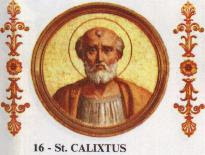
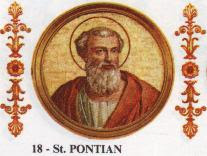
Copyright © 2012 Deacon Paul O. Iacono All Rights Reserved   Images of all the popes are found in the Basilica of St. Paul Outside the Walls in Rome, Italy. The custom of having a mosaic of a deceased pope put on display was started by Pope Leo the Great.

St. Clare – Our Holy Friend and Lover of God

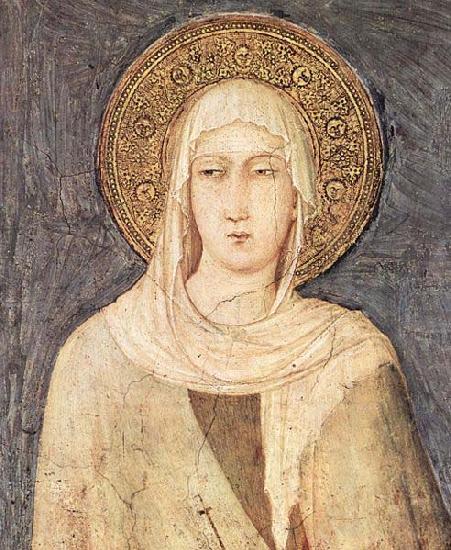
The Church honors today, August 11th, the holy woman, consecrated virgin, founder and Abbess of the religious order known as the Poor Clares, and dear friend of St. Francis of Assisi. We know her by her Anglicized name: Clare.

She was, however, born Chiara Offreduccio in Assisi, Italy on July 16, 1194.

The Italian language has always been especially tuned to convey, through words and sounds, a delicacy and refinement of spirit. Her Italian name, Chiara, gives witness to this observation, since its English equivalent means – clear.

The image above by Simone Martini (1283 – 1344) conveys this quiet asceticism in his lovely fresco of her completed between the years 1312 and 1320 and found in the lower basilica of San Francesco in Assisi (image courtesy of  www.berthemorisot.org/index.htm ).  To the historical and spiritual observer, St. Chiara’s life is very clear in its direction and goal. It is well known that she was influenced by her fellow citizen of Assisi, Francis, yet, an examination of her life shows that she was directed and formed by her profound love for Jesus in Scripture and in His real presence in the Eucharist.

A letter from her to a close friend, Blessed Agnes of Prague, shows the depth of her own mysticism and the clear guidance that directs another onto the correct path: “Happy indeed is she who is granted a place at the divine banquet, for she may cling with her inmost heart to Him whose beauty eternally awes the blessed hosts of heaven; to Him whose love inspires love, whose contemplation, refreshes, who generously satisfies, whose gentleness delights, whose memory shines sweetly as the dawn, to Him whose fragrance revives the dead, and whose glorious vision will bless all the citizens of that heavenly Jerusalem. For He is the splendor of eternal glory, the brightness of eternal light, and the mirror without cloud.”

This great mystic of the Church also led a life of austere poverty, chastity, and obedience, yet, her life, as the Divine Office tells us, was “rich in works of charity and piety.”

St. Chiara, passed on to the heavenly banquet on August 11, 1253.

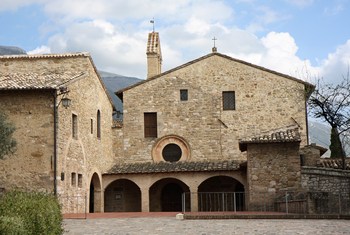
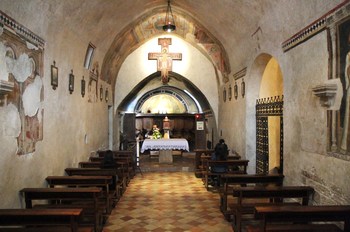
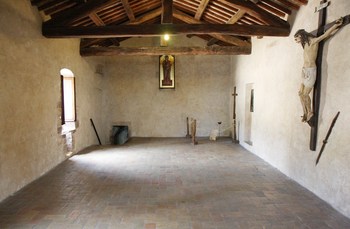
The following beautiful images are from the excellent website: http://www.sacred-destinations.com  I thank them for the courtesy of providing the images.

The first photo is the church of San Damiano, which St. Francis restored when, after praying before the crucifix within its broken down walls, heard the Lord’s voice saying “Francis, rebuild My Church.”

The second photo is the image of the interior of San Damiano Church. It is this crucifix, painted in a unique Byzantine icon style and which is known as the San Damiano Crucifix, that spoke the words that changed the direction of Francis’ life, and, the life of the Church.

The third photo shows the interior of the room that St. Clare died in on this day 759 years ago. Tradition states that her bed was in the upper right corner of the room.

Copyright © 2012 Deacon Paul O. Iacono All Rights Reserved

St. Peter Chrysologus’ Appeal By Christ To Be Transformed

Today is the memorial of Saint Peter Chrysologus.

Peter was born in the late 4th century in northern Italy. In 424, after serving as a deacon and priest in Emilia, he became bishop of the Italian city of Ravenna. Little reliable information about St. Peter’s life survives, except that he successfully drove heresy and the remnants of Roman paganism from his diocese by doing two things: providing exceptional pastoral care to the people and by giving practical yet passionate sermons. St. Peter’s brief sermons were so inspiring that he was given the title “Chrysologus” which means “of golden speech.”

He was declared a Doctor of the Church in the 18th century. In order to be called a Doctor of the Church the Pope and Cardinals must agree that the individual possessed three main characteristics during his or her life: truly outstanding holiness; a depth of doctrinal insight; and a body of writings which the Church recommends to people as authentic and life giving. These three qualities contributed to Peter’s success in ministering to the people of his diocese.

Our Gospel today speaks of the tiny mustard seed growing into a large bush, or the tiny yeast germ enabling the flour to rise. This theme of transformation is at the center of the story of the Incarnation. In a homily on this theme, St. Peter beautifully describes how Jesus is able, through His two natures, to touch and transform us. Christ meets us on a daily basis in prayer, and especially through the Scriptures and His real presence in the Holy Eucharist.

By means of these two marvelous gifts St Peter explains that we are able to identify with Jesus and be converted like the mustard seed and yeast germ, into something so much greater –  we are transformed and divinized into the life of Christ Himself. In one of his homilies, he has the Lord speaking and appealing to His people. He says,

“Listen to the Lord’s appeal: In me, [your Lord] I want you to see your own body, your members, your heart, your bones, your blood. You may fear what is divine, but why not love what is human? You may run away from me as the Lord, but why not run to me as your father? Perhaps you are filled with shame for causing my bitter passion. Do not be afraid. This cross inflicts a mortal injury, not on me, but on death.

These nails no longer pain me, but only deepen your love for me. I do not cry out because of these wounds, but through them I draw you into my heart. My body was stretched on the cross as an icon, not of how much I suffered, but of my all-embracing love. I count it no less to shed my blood: it is the price I have paid for your ransom. Come, then, return to me and learn to know me as your father, who repays good for evil, love for injury, and boundless charity for piercing wounds.”

May the Lord continue to raise up men and women with St. Peter Chyrsologus’ gifts to feed and care for His people.

Copyright © 2012 Deacon Paul O. Iacono All Rights Reserved.

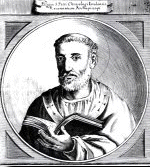
Image of St. Peter Chrysologus courtesy of info@crossroadsinitiative.com


St. Matthias and the Renewal of Easter Hope – The Lord Loves His Friends

Today is the feast day of St. Matthias. The Acts of the Apostles relate that Matthias was chosen by lot to replace the disciple who had betrayed Jesus in the garden.

In chapter 18 of our Gospel, St. John speaks of Judas, who was in collusion with the Romans and the Jewish elders, and brought them to the place where Jesus was staying in the garden; the betrayal took place and the deaths occurred.

In the period after Jesus’ death the Apostles were known as the Eleven.

The Eleven. A title which causes us to pause, even today, two thousand years later. They were twelve, but then the betrayal took place. Judas hung himself; and the Romans hung Jesus on a cross. Even in those anxiety filled days after the death of Jesus, and before His resurrection, the Eleven knew in their hearts that Judas was not the only one, who had betrayed Jesus. For in cold terror they ran from the garden – they ran from the Cross – abandoning their Master and betraying His friendship.

It was only John, and the women, who had the courage to stand there and minister in silence, in tears and sobs, to their dying master. We wonder, that as they stood before the Cross, was there a crisis of trust in their own hearts? Did they wonder about the other ten who were not there? Did they wonder about their own possible betrayal? Yet, all of their self doubts and agony would be washed away through the truth of the Resurrection.

Today’s feast of St. Matthias gives us renewed hope in this, the sixth week, of the Easter season; for it directs us to the great love of God for His friends. It also reminds us that He never leaves His friends alone in their mission of building His Church.

After the Ascension of Jesus into Heaven, Peter, as the great leader of this little group of friends, realized that something had to be done to fill the hole, the gaping hole, that echoed with the cries caused by the betrayal of trust,  friendship, and fidelity to God Himself.

Peter knew that this cavity had to be repaired because Jesus Himself had filled the hole in Peter’s heart. It was Peter’s realization and trust that Jesus could heal him that led to his putting the mantle of leadership back on.

Peter knew that the grace of Jesus could heal them,too, and that they could become the ambassadors of the Good News who would carry out Jesus’ commands. Their group of twelve, by mirroring the twelve tribes of Israel, could evangelize Israel itself.

So, they cast lots – because they did not think themselves worthy to make the choice of their own accord, and wanted some sign [from the Holy Spirit] for their instruction.

Matthias was chosen.

St. Matthias was a disciple of Jesus who loved much, he witnessed the resurrection, he lived in the Father’s love, he followed Jesus’ commands, and was willing to lay down his life for the Lord and His Mission.

May God grant that we have Matthias’ courage to be open to the grace of Christ and use it to  build-up His Church.

Quote taken from a 4th century homily by St. John Chrysostom on the Acts of the Apostles found on pages 1822-24 of The Divine Office volume 2.

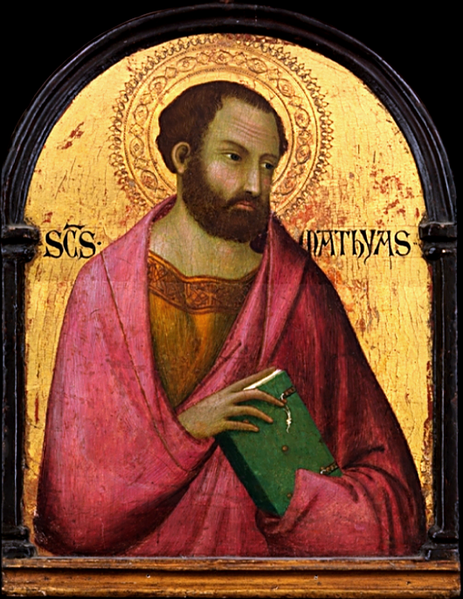
The sacred image of St. Matthias is from the workshop of Simone Martini the 14th century painter from Siena whose style influenced the Gothic movement. Martini portrays Matthias wrapped in the red mantle of martyrdom holding  a book that is painted green. Green is the color used by sacred iconographers and sacred artists to represent hope, life, and renewal. The book he is holding is a  reference to the truth of Christ’s Gospel preached by St. Matthias. This painting is dated between 1317-1319. Maestro Martini died in France at the age of 60 in 1344.

Copyright © 2012 Deacon Paul O. Iacono All Rights Reserved

St. Vincent of Saragossa – Martyr – And An Artistic Challenge!

Today, January 23rd, is the Feast Day of Saint Vincent of Saragossa.  St. Vincent was a deacon and served as a minister and trustworthy pastoral assistant of Bishop Valerius, of Saragossa, Spain. He was martyred in the year 304 during the ferocious persecution of the Roman Emperor Diocletian. Saint Vincent is the most famous martyr of Spain, and St. Augustine testifies to this in his sermons that Vincent’s acts of love and loyalty to Jesus Christ, and service to the Catholic faith, were so respected that they were read and discussed in all the churches of North Africa.

Owing to the fact that Bishop Valerius had a speech impediment, Deacon Vincent was given the faculty to do all the preaching in their diocese. When the persecutions resumed, the Roman governor Dacian had Vincent and the bishop dragged in chains to Valencia where they were imprisoned. Bishop Valerius was subsequently banished, but Deacon Vincent, as a result of his preaching, was subjected to many cruel tortures such as the rack, the gridiron, and frequent scourging, all of which ultimately led to his martyrdom.

Legend tells us that even in death his murderers were not satisfied, for they threw his corpse into a field to be devoured by vultures; but, according to eyewitnes- ses, a raven defended his body by successfully fighting off the scavengers. His body was later buried and a chapel built over it.

In Vincent’s story we have the witness of a man who stood up, in Christian love and faith, to the might of a Roman imperial government that did all it could to destroy him in life and in death. They were so outraged by him because Saint Vincent would not renounce his sacred ordination to the diaconate, would not renounce the truth of the Church, and would not renounce Jesus Christ even in the face of unspeakable and savage tortures.

St. Vincent of Saragossa is a man who deserves to be recognized. If we review the images of this early Spanish saint, we see  a number that are sensitive and well-done, but it really is time to produce a new icon, or sacred image, of this great witness to the truth, love, and mercy of Jesus Christ. If you are a sacred artist or iconographer, and are interested in producing an icon or sacred image of St. Vincent, I will happily post it (with your permission of course) on this blog. He is a great model for all Christian young people today and we need an image of him that is contemporary to our age.

Come and join us, and like St. Vincent of Saragossa, have some of your art, or all of it, spread the Good News that the love, life, death, and resurrection of Jesus Christ has healed our broken relationship with God the Father!

Copyright © 2012 Deacon Paul O. Iacono All Rights Reserved