by Deacon Paul O. Iacono, Diocese of Providence, Rhode Island USA
The author of the interesting and challenging blog site on sacred art and its analysis called Catchlight sent me two questions yesterday. They related to my last post which was entitled Fatima Messages, Pagans in the Vatican, and the End Times.
“Paul, your protestations begs the question, do pagans go to Heaven? If so, why? If not, why not?” from Bernard Gallagher
These are excellent questions.
Before I attempt to answer them my readers should understand that I am a committed and Traditional Roman Catholic. His questions will be answered through the lens of the teachings of my Faith. That Faith is based on a foundation of Holy Scripture, Sacred Tradition, and two thousand years of Catholic scholarship.
Allow me to also mention that we need to understand that two Councils of the Church, the Councils of Orange and Trent (1000 years later), are critical in forming a correct answer to Mr. Gallagher’s questions. The Councils of Orange are significant (both of them were held in the city of Orange in Southern France, AD 441 and 529). The more important Second Council of Orange’s episcopal deliberations were sent to Rome and approved by Pope Boniface II in AD 531. That Council specifically proclaimed that everyone (who has reached the “age of reason”) is given sufficient Grace to be saved from eternal damnation. God will give, and has given all people, Actual Grace. If a person accepts and acts on that Grace, they will be saved.
What is Actual Grace? Actual Grace is an admonition by God for a person to correct their way of life, desire, search after, and make the sincere effort to obtain the Sanctifying Grace provided by the Catholic Church. The key action which achieves salvation and eternal life with God is the Holy Sacrament of Baptism. This allows the person to enter into God’s family. The Sacrament of Baptism removes Original Sin from an individual’s soul and enables it to receive additional Sacramental Sanctifying Grace. All Grace enables a person to become holy in God’s eyes. The other six Sacraments flow from the waters of Baptism. Pope Pius 9th (papal reign 1846 -1878) proclaimed that it would be extraordinary for an unbaptized person to achieve the eternal salvation and reward of Heaven.
First principle,
a) The Roman Catholic Church, the ethnic church Rites that are in union with Rome, the Greek and Russian Orthodox Churches, and some of the Protestant churches say that Jesus Christ, is the Word of God, the Son of the Father, begotten not made and consubstantial with Him. He is the Messiah, the Savior. His human life, ministry, passion, death, and resurrection redeemed mankind from their sins. His divinity is expressed through His position as the Second Person of the Blessed Trinity.
b) He is known to mankind through the historical Gospels and Epistles of the Apostles, the witness of His Mother, the Virgin Mary (especially at her apparition at Fatima, Portugal in 1917. When asked what sin was most harmful and condemned unrepentant people to Hell she responded: ‘The sins of impurity are one of the major reasons why men and women are condemned to Hell.'” We cannot ignore our sins or consider them unimportant because of the current worldview. Also, the erudition of the Catholic Church Fathers, Doctors of the Church, Saints, and the historical teaching authority of the Church have all provided the scholarship and analysis that is sufficient for humanity to understand God’d Revelation and laws.
c) He is also known through the extraordinary scholarship of St. Augustine and St. Thomas Aquinas. The teaching authority of the Church, (as found in its Magisterium), is the Church’s responsibility to give to the world an authentic interpretation of the Revelation of God as found in Sacred Scripture and Sacred Tradition.
d) Additionally, let us not forget the importance of the testimony of the angels found in Holy Scripture, and the saints, of whom Jesus’ Mother Mary is the greatest of saints. All of these facts contribute to mankind’s understanding and witness of our Savior Jesus Christ.
e) Jesus commissioned His Apostles (the first bishops) to make known the free gift of His Redemption and graces. These critical graces are found in the Seven Sacraments of the Church, beginning with the keystone Sacrament, Baptism.
An icon of Jesus Christ. It is found within the former Eastern Rite Church of Hagia Sophia (Holy Wisdom). The Church was built in the early 6th century and is located in Istanbul, Turkey (formerly Constantinople). It was a mosque, then was a museum since 1935, but recently it was converted back into a mosque.
Second, let’s refer to what Jesus Christ says in response to Nicodemus’ questions concerning eternal life in the Gospel of St. John, John 3: 1-21: “Amen, amen, I say to you, unless a man be born again, he cannot see the kingdom of God.” Nicodemus continues to question Him, and Jesus responds, “Amen, amen, I say to you, unless a man be born again of water and the Spirit, he cannot enter the kingdom of God…You must be born again.”
The great significance of the necessity of Baptism into the Christian faith is again stressed in another passage of the Gospels. The Gospel of St. Matthew, in its very last passage deals with the commissioning of the Apostles which occurred after His resurrection and before His Ascension back to the Father. Jesus emphasizes that combined with their preaching and works they mustbaptize faith-filled individuals because of Adam and Eve’s sin. Humanity’s broken relationship with God must be healed. It was healed through the death and resurrection of the Father’s Son Jesus the Christ. Jesus death, on our behalf allowed the formation of the Church and the Sacraments to be instituted to provide the grace to a broken humanity. Baptism is the Sacrament that makes this happen. It makes an individual’s body and soul a member of God’s family. Matthew 28: 18-20:“Jesus drew near and spoke to them saying, “all power in Heaven and on earth has been given to me. Go, therefore, and make disciples of all nations, baptizing them in the name of the Father, and the Son, and the Holy Spirit, teaching them to observe all that I have commanded you; and behold, I am with you always, to the close of the age.”
Third, it appears, within the Christian faith, that we can come to specific conclusions that will provide a springboard for my response to Mr. Gallagher:
If the human race was alienated from God, and the spiritual relationship with Him was broken, then a loving and merciful God would not give up on His children. Thus, through the course of history God has slowly manifested and revealed Himself to humanity starting with our spiritual parents, Adam and Eve; then through the patriarchs, leaders, and prophets of the chosen Jewish tribes culminating in the Incarnation of His Son, Jesus the Christ. God desires us to love Him and conform to His Laws. He has given us reason and free will. He has given us the ability to think and act not like robots but as free men and women. His revealed truths and laws must be evangelized and faithfully kept by individuals and mankind as a whole. The “Good News” must be spread by the Church as a whole and individuals, too.
The First Commandment applies, as we see in Exodus 20: 1-6ff: “I, the Lord am your God, who brought you out of the land of Egypt, that place of slavery. You shall not have other gods besides Me. You shall not carve idols for yourselves…you shall not bow down to them or worship them. For I the Lord am a jealous God…inflicting punishment on those who are wicked and hate me…and mercy on those who love Me and keep My commandments.”
Through Scripture and study of the Catechisms of the Council of Trent and that of Pope St. John Paul II, united with faith we also know that Jesus Christ is the consubstantial only Son of God and the promised Savior. Now, have (for example) the Amazonian pagans that we recently observed in Rome, or the new pagans of the 20th and 21st centuries been exposed to that truth?
Christ freely offered Himself for our eternal salvation. This was accomplished through the words and actions of His human ministry and ultimately through His Passion, death, and resurrection. Jesus Christ is the Way, the Truth, and the Life. Have apostates, pagans, or other non believers been exposed to that truth?
We see God through faith in Him, participating in prayer, Scripture study, good works, and the Sanctifying Grace found in the Seven Sacraments. Have pagans, past and present, been exposed to and accept these truths?
Fourth, so, are pagans going to Heaven or Hell?
In a nutshell, I would never presume to know God’s mind, except from that which He revealed through Holy Scripture and Sacred Tradition. I would never make a judgement on another person’s soul as he or she are seen by God at the time of their death and individual judgement. Unknown to the world, even a great sinner may suddenly, in their last moments, repent of their sins and ask for God’s mercy. But, make no mistake about it, Scriptural Revelation, and the Sacred Tradition of the Catholic Church and specifically the words of Jesus in the Holy Scriptures, states that there is a Hell (Matthew 10: 28; 22: 13. Luke 16: 26; etc.); there is a Heaven, and, damnation into Hell for all eternity.
It is believed that there is also a place of natural happiness called Limbo. It is not within Heaven, nor is it in the fires of the Hell of the Damned. It is a state of natural happiness and joy. It is not supernatural happiness because its inhabitants do not have the Beatific Vision (see additional discussion in the Summa Theologica, Supplement 1, 3rd part article 2, by Fra Rainaldo da Piperino). The question of what happens to infants who die without the Sanctifying Grace of Baptism is a much debated issue. Many Traditionalists support the idea of Limbo; however, contemporary scholarship supports the idea that God, in His mercy, would not withdraw the vision of His glory to unbaptized infants who have died.
Some additional issues:
Let’s take a look at three major Greek philosophers: Socrates, Plato, and Aristotle. They were scholars who lived and died before the birth and ministry of Jesus Christ. They lived within a pagan/pantheistic society whose members believed in a multitude of gods Are Socrates, Plato, and Aristotle in Heaven or Hell?
The answer is, “I don’t know!”
But Jesus said, “I am the Way, and the Truth, and the Life. No one comes to the Father but through Me” (John 14: 6). Wouldn’t that statement preclude the unbaptized Greek philosophers entrance into Heaven?
The answer is “Not automatically.”
So, what do we know? We know that those three philosophers were men who searched for the truth, not only about themselves as individuals but about the world itself. They searched after the truth. They made the sincereeffort to find the truth by thinking, questioning, analyzing reality, both physical and metaphysical. They used all the evidence at their disposal to do so. They lived, before the Son of God was incarnated. They did not have the witness of Jesus Christ and to His specific and eternal revelation as the Son of God, both human and divine. They also probably did not have any exposure to the history of the Jewish people and God’s revelation to them. As per the the points made earlier, did they act on God’s Actual Grace to truly desire life with Him?
But, in the time after the Incarnation and Ascension of Jesus, a person who had the opportunity to be exposed to and Baptizedinto the Christian Faith (in the full expression of it in the Western and Eastern Rites of the Catholic Church, and some of the Protestant and Anglican churches if they use the Trinitarian formula), would have a critical free choice to make.
If they are pagan, agnostic, atheist, Catholic Christian, Deist, Protestant Christian, Satanist, Wiccan, etc, and they would then, after an effort to know the truth, reject Actual Grace and the witness of Jesus Christ out of intentional misunderstanding, intellectual arrogance, stubbornness, cultural and historic prejudices, selfishness, willful rejection of Christian Revelation, narcissistic impulses, apostasy, or some evil influence, they would be freely putting their eternal soul into mortal sin. They would be facing the eternal punishment of Hell because they chose the path, through their own free will of “definitive self-exclusion from communion with God and the blessed in Heaven” (confer page 269 in the Catechism of the Catholic Church, 2nd edition).
God is loving and compassionate. He is filled with mercy for those who sincerely repent their sins. God is merciful; however, our God is a God of Justice. Why would Jesus Christ be Incarnated to minister, suffer, die, and be resurrected if the Holy Trinity would give mortal sinners “A get into Heaven free pass?” The “Pass theory” doesn’t make sense, it is illogical, bogus, and yes it is a lie. There are dire consequences for freely turning your back on Jesus Christ: Hell.
But do today’s pagans turn their backs?
The answer to that question is: Have they made the effort to know the Truth? Have they been exposed to the truths of the Hebrew and Christian Scriptures? Have they been evangelized by courageous and selfless missionaries who are willing to undergo all sorts of hardships and possibly even martyrdom for the sake of their flocks’ eternal souls? Have they deliberately turned their backs on the truth and revelation of God through the Christian Scriptures, and the documents and witness of the Apostles, Saints, Church’s Doctors and Fathers, bishops and Pope as they present the truth on faith and morals? Have the pagans or people of other religions acted on the free gift of God’s Actual Grace?
The Church’s duty and responsibility is to bring, without arrogance or condescension, the Holy Scriptures, Sacred Traditions, and the Holy Sacraments to the world. If its bishops, priests, deacons, consecrated brothers and sisters in various religious orders, and laity shirk or compromise their duties and teaching authority, give bad example through public and private sin, then they possibly will be denied entrance into Heaven, too.
Is the Church giving sufficient resources to the missionaries in the field? Are we able to inspire young men and women in today’s world of the necessity and challenge to enter the life of a missionary? Have we thrown in the towel?
This is my great concern about what I see in the Church today (especially the recent blessing of the pagan Pachamama statue in Rome; (by the way, all of the Amazonian Pachamama rituals were condemned by six Cardinals). The Christian churches should not be about assimilation of pagan cultures into the Faith in order “to learn from them,” or do so in a “spirit of dialogue” and accommodation.
The Western and Eastern Rites of the Catholic Church have the complete and total revelation of God to humanity. We have the complete revealed truth of The Trinity. We have the example of what it means to live in the heart of the Father through the life of Jesus Christ. Christ’s life, redemptive death, and resurrection made possible our entrance into God’s family. This entrance is accomplished through the Sacrament of Baptism (using the Trinitarian formula), and individuals’ growth in faith and good works.
Matthew 28: 18-20, relates Jesus’ specific command. Our duty is to compassionately and without arrogance teach pagans and other non-believers about Jesus Christ, baptizing them in the name of the Father, and the Son, and the Holy Spirit.
It is intellectually and morally irresponsible to give the impression that apostates, heretics, pagan/polytheistic cultures, and people of other faiths can add to the Deposit of Faith.We either understand the gift of the Deposit of the Faith or we don’t. There should be no waffling.
We either proclaim His truth effectively and with conviction or we will see the Church continue to decline, make compromises, cause confusion, anxiety, division, and resentment among its faithful. Hell is a reality. It is our responsibility to act with courage and truthfulness to ensure that a person’s eternal salvation is not compromised through confused or false teachings.
The Gospel of Luke18: 8 challenges us to examine our own hearts: “When the Son of Man comes will He find faith on the earth?”
To paraphrase Peter Kreeft, Ph.D and Rev. Ronald Tacelli S.J. “if we have a diamond of immense and extraordinary value (our Catholic/Christian Faith) why would we go about the world seeking additional baubles?
Refer also to the Catechism of the Catholic Church (2nd edition, 1997, pages 311-324) which has an excellent section on the Sacrament of Baptism.
A photo of the inside of the Aya Sofya (Hagia Sophia) church in what is the present-day city of Iznik, Turkey. Iznik was called Nicaea prior to the rule of the Ottoman Turks . This photo shows the interior of one of the rooms in the building complex that served as the location for the First Council of Nicaea (AD 325). Also, in the late 8th century the Seventh Ecumenical Council met in this building, too. That Council met to debate and decide the issue of iconoclasm (should sacred icons and images be prohibited and destroyed). The written arguments of St. John Damascene (Damascus) won the day and sacred icons were allowed to continue to be made. Iconoclasm was to raise its ugly head again in later years, and came to full fruition during the Protestant rebellion/reformation, the French Revolution, and worldwide Communism in all its cultural forms. This photo of the inside of the Nicaean building is from Bryan Cross’ website: calledtocommunion.com. It was posted in May, 2010. Thanks Bryan!
I would like to thank one of my readers who identified the contemporary icon of St. Spyridon (thanks Carol!). The iconographer is the Catholic priest William Hart McNichols. He is a very talented artist who paints traditional icons and sacred images. At times, he steps out of the bounds of the traditional approach and adds his own personal interpretation of the person he is portraying. His artistic vision is unique.
John Daly from Australia emailed me this morning to provide further grist for our mill concerning St. Athanasius, St. Spyridon, and the Council of Nicaea. One of the participants in his iconography school is a Greek Orthodox lady who is the sister-in-law of an Orthodox priest. He is coincidentally named Athanasius.
John had the opportunity to discuss with her the icons that we were analyzing in my posts of the last few days. She provided John some valuable information by explaining that her mother had given her a beautiful sacred image of the First Council of Nicaea and specifically St. Spyridon’s role in the debate with the heretic Arius. The sacred image is below.
Greek Orthodox sacred image of the First Council of Nicaea. Notice St. Nicholas on the lower right about to possibly physically strike Arius who reacts by pulling away. On the left you see St. Spyridon, holding a brick with flames streaming upward and water puddling below it to the floor (confer yesterday’s post of April 16th to obtain the explanation of that imagery). The room of the actual Council, as portrayed in this sacred image is quite ornate.
Also, like the sacred icon we examined in yesterday’s post we see the Emperor Constantine, dressed in the royal robes of Byzantine reddish purple (almost a maroon) sitting on the right. On the Emperor’s right we again observe a bishop, maybe its Bishop Alexander of Alexandria, Egypt. In front of him we again see a deacon, dressed in what is either an alb or dalmatic (he would have to stand up to see all the garments).
In the above sacred image, the deacon is again seated at the scribe’s desk. This makes sense, since a deacon serves the administrative needs and report’s directly to his bishop. That is true to this day; yet, throughout the world today the local bishop has his deacons serving in parishes, hospitals, prisons, etc. rather than in an administrative capacity in the local chancery. Notice the bishop is behind the deacon scribe to facilitate accurate communication.
The above sacred image, which I have never seen before John Daly sending it to me, is very well done. The painter has captured the meaning of the Council as a whole and two of its major participants: St. Nicholas’, in his famous interaction with the heretic Arius, and the great oratorical and mystical abilities of St. Spyridon challenging Arius, too.
Is the deacon pictured in the painting from the Latin Rite or is he Orthodox? Truly, there is no way to accurately tell because the deacon is seated, and what is showing of the deacon’s stole is inconclusive. Depending on the angle of view both the Western and Eastern Rites’ deacon’s stole placement looks the same.
In today’s painting and in yesterday’s post of the icon, the deacon is seated and the possible vertical panel on the Eastern Rite and Orthodox stole is in shadow or not detectable, yet, the panel that drapes from left shoulder and gathers at the waist is visible, and would appear, as you see below, in both Latin, Eastern, and Orthodox Rites!
Just between you and me, I think the deacon depicted in the icon, from my April 16, 2019 post and today’s, is St. Athanasius from Alexandria, Egypt. The Catholic Church, the Eastern Rites in union with Rome, and all the Orthodox Churches venerate St. Athanasius as a great saint and designate specific feast days for him. He belongs to all of us.
The deacon’s stole in the Eastern Rites of the Catholic Church that are in union with Rome; and, the Greek Orthodox, the Russian Orthodox, and Coptic Orthodox deacon stoles look like this:
Orthodox deacon’s stole in a royal Byzantine fabric (in what appears to be a royal maroon purple) is bordered in gold thread with gold crosses. Originating at the left shoulder, gathered at the waist, with the fabric of the stole hanging vertically on the left shoulder both in the front and the back. The stole is worn on top of the ornate gold and white dalmatic.
The cassock, alb, stole, and dalmatic all have the same meaning and functions in both the Western and Eastern Rites of the Church. In today’s Western, that is, the Latin Rite (Roman Catholic) tradition, a deacon wears the rank of his ministry and ordination, the stole, over the alb but under the dalmatic. Latin Rite deacons would wear their stole’s in this manner:
A Roman Catholic deacon’s stole running from the left shoulder and gathered at the waist, then hangs vertically under the right arm. It is worn on top of a white alb, and undera dalmatic. The dalmatic is only worn during Holy Mass. When the deacon performs baptisms, marriage and funeral services, liturgical prayer services, and formal blessings, etc. the deacon would not wear a dalmatic, so the deacon would appear as in the above photo wearing a simple white or cream colored alb and a stole in the appropriate color.. The stole’s fabric in the photo above is dyed dark purple for Lent; during the season of Advent a purple stole is used, too; sometimes, it is of a lighter purple than the Lenten penitential purple. A white stole would be used for Baptisms. Marriages, Funerals, Holy Thursday services, and during the Easter and Christmas season. Red stoles would be worn at Palm Sunday and Good Friday services, Pentecost, and on the feast days of martyrs.
A Roman Catholic deacon’s dalmatic which is worn over the white alband the stole. The dalmatic is in the corresponding color to the stole. The color green is worn during “Ordinary” time (which is the liturgical period that borders the great seasons of Advent, Christmas, Lent, and Easter).
I’ve really enjoyed this lively information exchange. Thanks to all who participated in it!
May you have a blessed Easter Tridiuum of the Passion and Resurrection of Our Lord Jesus Christ.
I am always very appreciative of my readers writing to me and providing new information and interpretations of sacred icons and images. Happily, that occurred last evening when a reader, Mr. John Daly from Australia, provided me with information on the second icon that was in yesterday’s post on St. Athanasius. Let me provide you with that image so we will have a reference point:
This is the sacred icon of a bishop confronting a heretic at the Council of Nicaea (AD 325). Mr. John Daly of Melbourne, Australia informed me that we should take a closer look at the details of this icon because of how it depicts the bishop’s castigation of the heretic. I concluded erroneously that it must be St. Athanasius since he was a pivotal orthodox figure at the Council. Even though he was a deacon at that time, and not a bishop at the Council, he was ordained a priest and bishop about three years later, so the iconographer just inserted him as a bishop. Mr. Daly recommends a closer look to discover that it is St. Spyridon of Cyprus.
Mr. Daly is correct – it is St. Spyridon (born AD 270, died 340).
Let’s take a look at the reasons for this correction:
The bishop castigating the heretic Arius is wearing a distinctive hat. The hat is unique. It is shaped like a beehive. It is made of woven straw and was traditionally worn by Cypriot and other shepherds tending their flocks – an apt metaphor for a bishop caring for the flock of his faithful.
St. Spyridon was from the island of Cyprus, and eventually became a bishop serving the people of Trimythous, thus, he would have been invited to the First Council of Nicaea as were all the other bishops in Christendom.
At another time, possibly in Cyprus, St. Spyridon was involved in a debate with a pagan philosopher whom he ultimately converted to Christianity. Besides his theological arguments about the Holy Trinity, the good bishop used a piece of pottery or a brick, to demonstrate to the philosopher how you could have one single substance be also composed of three separate substances (pottery and bricks consist of clay, water, and are unified by the substance of fire).
The story of his discussion with the pagan philosopher continues and says that as soon as St. Spyridon finished speaking the piece of pottery or brick burst into flame, water dripped from it, and clay ash remained in his hand. Well that would have been enough to place me on the road to conversion, and so it was with the philosopher, too. If you look closely at the icon above you can perceive the fire bursting out of the brick and the water puddling beneath it. Hmm, I didn’t see that! As Sherlock Holmes once said, “Watson, you see, but you do not observe” (taken from the story A Scandal in Bohemia by Sir A.C. Doyle). Wise advice.
Mr. Daly also relates that it was [and probably still is] common for an iconographer to fuse the two incidents of St. Spyridon converting a pagan, and St. Spyridon at the Council of Nicaea debating with the heretic Arius.
There it is: the beehive woven straw hat, the bishop’s vestments, the water, fire and ash metaphor, the confrontation with an individual that has an opposite argument, and the public venue for both incidents.
So where is St. Athanasius in this icon? Mr. Daly offers that in the upper left corner of the icon, we see an individual portrayed as listening intently to St. Spyridon. He is dressed in a dark alb with a white collar. He suggests that this is St. Athanasius. That argument makes some sense because, as a deacon, Athanasius may not have been up front with the bishops, rather he possibly would be located near the altar ready to perform his diaconal duties. At the same time he is still involved in the proceedings, and/or ready to respond to the needs of his bishop – Alexander of Alexandria. You notice the priests and monks in the back of the room, too, in dark conical monastic hats and cassocks.
My only issue with that interpretation is that the figure portrayed in the upper left does not have a nimbus (halo) circling his head, nor is he wearing his deacon’s stole; however, the scribe in the lower left corner is wearing a deacon’s stole. My stole comes across my chest from the left shoulder and is gathered at the right hip; and the scribe’s stole does the same thing. Is this individual St. Athanasius? There appears to be writing on his stole. I have no proficiency in Greek so I cannot be of help there.
The scribe in the lower left corner has a halo, too, and so do all the bishops. Did the iconographer think that all the bishops present were saints? This is not unlikely, since they produced a Creed for Christendom in three months. Truly, a stunning achievement. It indicates that the assembled bishops were very clear in their own minds what the Faith, based on Scripture and Apostolic Tradition, was all about. The bishops all appear very animated and involved in the Council proceedings. It’s obvious that the Holy Spirit was working within that Council!
There is a lot going on in the upper part of this icon, too. Christ, as a young child, is found walking across what appears to be an altar towards another bishop. That bishop on the upper right is seen discussing some issue with, possibly, another dissenter (a priest, or deacon; even though the priests and deacons in attendance didn’t vote, they certainly could influence the bishop of their diocese on issues and arguments).
Sadly, I believe that the only existing documents that we have concerning this Council that are still in existence are the Nicene Creed itself, the procedural rules of the Council, and Emperor Constantine’s address to the assembled bishops. It is said that many of the bishops came, returned to their dioceses, and then came back to the Council. This probably contributes to the fact that we don’t have all the names of the participating bishops, just those mentioned in other documents or in the stories that were passed on through to the faithful (confer Anna Erakhtina’s article The “Model of Meekness,” and Slapping Arius, at http://www.orthochristian.com, May 22, 2016, specifically the contribution by Archpriest Vladislav Tsypin. He discusses the documents available to us today). If anyone has additional information on the actual participants please tell me your source, and the participants, and I will spread the information through a post.
St. Spyridon was also known as a miracle worker, especially for his successful intervention (caused by the prayers of the soldiers and sailors of the Catholic Rites) in the 1716 battles with the invading Ottoman Turks on the Greek island of Corfu.
John, thanks again; this was a fun interaction.
Additional images of St. Spyridon:
A contemporary Sacred Icon of St. Spyridon showing his beehive woven straw hat, his bishops stole, the blazing potsherd or brick with water dripping from it, and his holding the book of the Gospels (dogmatic truth based on the Holy Scriptures and the Sacred Apostolic Traditions of the Western and Eastern Rites of the Catholic Church. If anyone knows that artist that is responsible for this beautiful icon please tell me and I will credit him/her in this post. Icon found on Wikipedia and originates at St. Spyridon Orthodox Church in Loveland, Colorado (thanks to them for posting the image of this magnificent icon).
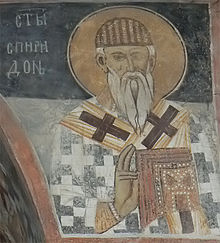
A medieval icon of St. Spyridon, wall fresco, Bulgarian Orthodox, found in the Zemen Monastery, Bulgaria. Photograph may have been taken by I.E. Stankov in 2012 using a Canon EOS 600D camera.
In the Roman Catholic Church, St. Spyridon is venerated on his feast day, December 14th; and on December 12th in the Eastern Rites and the Orthodox Church.



 The Fra Angelico Institute for Sacred Art
“Paul, your protestations begs the question, do pagans go to Heaven? If so, why? If not, why not?” from Bernard Gallagher
These are excellent questions.
Before I attempt to answer them my readers should understand that I am a committed and Traditional Roman Catholic. His questions will be answered through the lens of the teachings of my Faith. That Faith is based on a foundation of Holy Scripture, Sacred Tradition, and two thousand years of Catholic scholarship.
Allow me to also mention that we need to understand that two Councils of the Church, the Councils of Orange and Trent (1000 years later), are critical in forming a correct answer to Mr. Gallagher’s questions. The Councils of Orange are significant (both of them were held in the city of Orange in Southern France, AD 441 and 529). The more important Second Council of Orange’s episcopal deliberations were sent to Rome and approved by Pope Boniface II in AD 531. That Council specifically proclaimed that everyone (who has reached the “age of reason”) is given sufficient Grace to be saved from eternal damnation. God will give, and has given all people, Actual Grace. If a person accepts and acts on that Grace, they will be saved.
What is Actual Grace? Actual Grace is an admonition by God for a person to correct their way of life, desire, search after, and make the sincere effort to obtain the Sanctifying Grace provided by the Catholic Church. The key action which achieves salvation and eternal life with God is the Holy Sacrament of Baptism. This allows the person to enter into God’s family. The Sacrament of Baptism removes Original Sin from an individual’s soul and enables it to receive additional Sacramental Sanctifying Grace. All Grace enables a person to become holy in God’s eyes. The other six Sacraments flow from the waters of Baptism. Pope Pius 9th (papal reign 1846 -1878) proclaimed that it would be extraordinary for an unbaptized person to achieve the eternal salvation and reward of Heaven.
First principle,
a) The Roman Catholic Church, the ethnic church Rites that are in union with Rome, the Greek and Russian Orthodox Churches, and some of the Protestant churches say that Jesus Christ, is the Word of God, the Son of the Father, begotten not made and consubstantial with Him. He is the Messiah, the Savior. His human life, ministry, passion, death, and resurrection redeemed mankind from their sins. His divinity is expressed through His position as the Second Person of the Blessed Trinity.
b) He is known to mankind through the historical Gospels and Epistles of the Apostles, the witness of His Mother, the Virgin Mary (especially at her apparition at Fatima, Portugal in 1917. When asked what sin was most harmful and condemned unrepentant people to Hell she responded: ‘The sins of impurity are one of the major reasons why men and women are condemned to Hell.'” We cannot ignore our sins or consider them unimportant because of the current worldview. Also, the erudition of the Catholic Church Fathers, Doctors of the Church, Saints, and the historical teaching authority of the Church have all provided the scholarship and analysis that is sufficient for humanity to understand God’d Revelation and laws.
c) He is also known through the extraordinary scholarship of St. Augustine and St. Thomas Aquinas. The teaching authority of the Church, (as found in its Magisterium), is the Church’s responsibility to give to the world an authentic interpretation of the Revelation of God as found in Sacred Scripture and Sacred Tradition.
d) Additionally, let us not forget the importance of the testimony of the angels found in Holy Scripture, and the saints, of whom Jesus’ Mother Mary is the greatest of saints. All of these facts contribute to mankind’s understanding and witness of our Savior Jesus Christ.
e) Jesus commissioned His Apostles (the first bishops) to make known the free gift of His Redemption and graces. These critical graces are found in the Seven Sacraments of the Church, beginning with the keystone Sacrament, Baptism.
Second, let’s refer to what Jesus Christ says in response to Nicodemus’ questions concerning eternal life in the Gospel of St. John, John 3: 1-21: “Amen, amen, I say to you, unless a man be born again, he cannot see the kingdom of God.” Nicodemus continues to question Him, and Jesus responds, “Amen, amen, I say to you, unless a man be born again of water and the Spirit, he cannot enter the kingdom of God…You must be born again.”
The great significance of the necessity of Baptism into the Christian faith is again stressed in another passage of the Gospels. The Gospel of St. Matthew, in its very last passage deals with the commissioning of the Apostles which occurred after His resurrection and before His Ascension back to the Father. Jesus emphasizes that combined with their preaching and works they must baptize faith-filled individuals because of Adam and Eve’s sin. Humanity’s broken relationship with God must be healed. It was healed through the death and resurrection of the Father’s Son Jesus the Christ. Jesus death, on our behalf allowed the formation of the Church and the Sacraments to be instituted to provide the grace to a broken humanity. Baptism is the Sacrament that makes this happen. It makes an individual’s body and soul a member of God’s family. Matthew 28: 18-20: “Jesus drew near and spoke to them saying, “all power in Heaven and on earth has been given to me. Go, therefore, and make disciples of all nations, baptizing them in the name of the Father, and the Son, and the Holy Spirit, teaching them to observe all that I have commanded you; and behold, I am with you always, to the close of the age.”
Third, it appears, within the Christian faith, that we can come to specific conclusions that will provide a springboard for my response to Mr. Gallagher:
Fourth, so, are pagans going to Heaven or Hell?
In a nutshell, I would never presume to know God’s mind, except from that which He revealed through Holy Scripture and Sacred Tradition. I would never make a judgement on another person’s soul as he or she are seen by God at the time of their death and individual judgement. Unknown to the world, even a great sinner may suddenly, in their last moments, repent of their sins and ask for God’s mercy. But, make no mistake about it, Scriptural Revelation, and the Sacred Tradition of the Catholic Church and specifically the words of Jesus in the Holy Scriptures, states that there is a Hell (Matthew 10: 28; 22: 13. Luke 16: 26; etc.); there is a Heaven, and, damnation into Hell for all eternity.
It is believed that there is also a place of natural happiness called Limbo. It is not within Heaven, nor is it in the fires of the Hell of the Damned. It is a state of natural happiness and joy. It is not supernatural happiness because its inhabitants do not have the Beatific Vision (see additional discussion in the Summa Theologica, Supplement 1, 3rd part article 2, by Fra Rainaldo da Piperino). The question of what happens to infants who die without the Sanctifying Grace of Baptism is a much debated issue. Many Traditionalists support the idea of Limbo; however, contemporary scholarship supports the idea that God, in His mercy, would not withdraw the vision of His glory to unbaptized infants who have died.
Some additional issues:
Copyright © 2011- 2019, Deacon Paul O. Iacono – All Rights Reserved. Permission to reprint must be obtained (through the Comments section below) from the author in writing. Students, and those interested, may quote small sections of the article as long as the proper credit and notation is given. Thank you