Sacred Art – Its Fate When a Catholic Church Closes Its Doors

A subscriber recently asked me about the process of the movement of sacred art from a local church or cathedral into a secular or religiously affiliated museum and is there a specific “Rite” of the Church that applies to this situation?

Before I answer the question allow me to provide a quick review in reference to the word “Rite/rite.”

When a capital “R” is used it refers to specific Rites, such as the Rite of Christian Initiation of Adults, the Rite of Baptism, the Rite of Anointing of the Sick, etc.

Also, a capital R is used when referring to the Rite of the Western (Latin/Roman) Catholic Church, the Eastern Catholic Rites in union with Rome (there are 5), and the liturgical subsets of these five Eastern Catholic Rites. These liturgical subsets, which are all in union with Rome, number more than twenty specific cultural groups.

If the word “rite” is not capitalized it refers to the basic definition, which is: “the ceremonial practices of a Church governing the words and actions for a specific liturgical ceremony.

We may also look at the basic question from three different angles or categories.

In reference to the question asked by the subscriber: The first category is when a piece or pieces of sacred art is owned by one, or many, dioceses and are collected to be shown in a secular or religiously affiliated museum. The local Roman Catholic Bishop may allow this because the sacred art is  considered an opportunity and expression of beauty and catechesis for its viewers. This is especially important  since numerous faithful might never see the art because of personal circumstances or its public availability. An example of this was the opportunity I had to view some of Fra Angelico’s extraordinary paintings in Boston during the late winter and spring of 2018.

I posted some of my observations of these masterpieces in the exhibition “Fra Angelico – Heaven on Earth” that were loaned to Boston’s Isabella Stewart Gardner Museum. I would have never been able to see many of these paintings if they hadn’t been loaned to that Museum. That viewing, presented in a very respectful way by the Museum staff, became a spiritual and artistic experience for many people. It provided an opportunity to appreciate Fra Angelico’s enormous talent and the paintings ability to express Scriptural and Traditional truths of the Church. I am not aware of any blessing “rite” that occurred prior to their removal and/or reception as a loan to the Gardner exhibition, however, if the paintings were part of a specific diocesan collection, here or abroad, the local Bishop/Cardinal, may have supported such a blessing.

In another case, if a particular piece of sacred art was desecrated as a result of a museum’s irresponsibility or their insufficient security, I am sure the sacred art in question would be blessed prior to its being reinstalled in its original diocesan location. A specific blessing may be used; such a blessing may be found in the Roman Catholic “Book of Blessings” (numerous blessings for specific occasions). It would be given by the local bishop or his designee in a specified and prescribed form.

The second category is the sacred art that was/is created for a specific patron. This art is created to be venerated or simply enjoyed by the patron and his/her family and friends.

For the last 1,500 years wealthy patrons throughout the world  have commissioned and placed sacred art in their private chapels or rooms dedicated to it. Kings, queens, and other wealthy secular patrons (such as the Medici) may have had a deacon, priest, or normally the bishop bless the sacred art. The bishop may have used a particular blessing current at that point in history, or in contemporary times, within the “Book of Blessings” or other manuals, that every diocese possesses and its bishops, priests and deacons use.

Upon the death of the original patron the piece would probably be passed from one family generation to another until funds were needed and it was sold to another secular patron, or the piece was sold or donated to the Church or a museum.

There is a third category. If a diocese or a cleric commissions or purchases sacred art to hang within their basilica, cathedral, or parish church and uses diocesan or parish funds to do so, and eventually that cathedral or church is, for whatever reason closed, then, as in all of the above categories the question can be asked, “What happens to the sacred art?”

The answer is straightforward and the following process would normally occur (note well, the local bishop must always agree to the process undertaken whatever form it may take):

1. If a specific diocesan cleric commissioned the art for their parish church (legally a religious corporation) that parish, within a specific diocese, is the legal owner of the sacred art. It is not owned by the individual cleric but by the parish and diocese as a whole. If it was received by the parish or diocese as a gift  from the sacred artist it would normally receive a blessing when it was installed in the cathedral or parish church.

2. A privately or museum owned piece of sacred art would not fall under the category of requiring a Church blessing since it was probably blessed when it was in the possession of a Catholic patron, or a Catholic church that used it within a liturgical or sacred setting. If a secular museum, or non Catholic patron, acquires a piece of sacred art the Church would not require the non Catholic patron or museum to have the art blessed.

3. In the case of a church being closed, the local diocese would in turn transfer the art, based on need, to a parish church within their jurisdiction. Normally, it would never be sold to an individual; however, in a financial crisis the Bishop might sell a particular piece(s) to another Catholic diocese outside of his jurisdiction or a secular museum.

4. Diocesan pastors would be notified of the closing of a particular church and the distribution of its sacred items such as crucifixes, liturgical vessels, sacramentary, lectionaries, monstrances, thuribles, sacred paintings, sculptures, etc. These items would be available based on the need of another diocesan parish church. I am aware of such transfer of items having occurred within my own diocese from a parish church that closed to an active church.

5. Each case, especially when the sacred art is of great value (such as gold chalices, ciboria, stained glass, etc), has to be appropriately evaluated by the Bishop and/or individuals within his chancery office. The local bishop must always agree to the process undertaken.

Copyright © 2011- 2020, Deacon Paul O. Iacono – All Rights Reserved. Permission to reprint must be obtained from the author in writing. Students, and those interested, may quote small sections of the article as long as the proper credit and notation is given. Thank you.
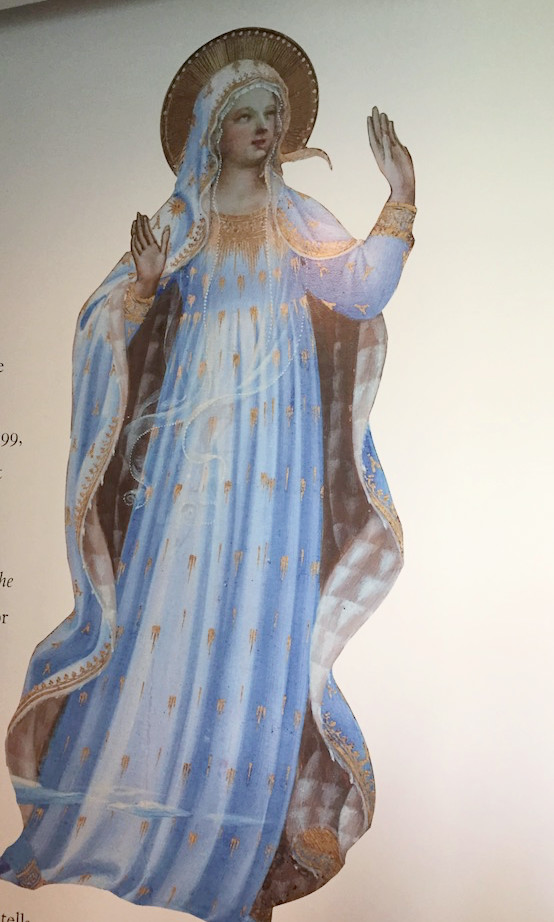
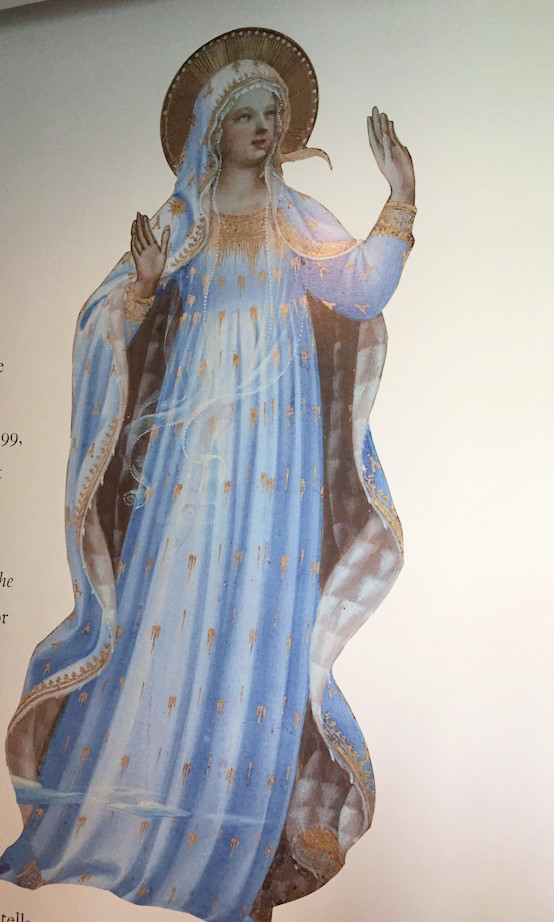
The Assumption by Fra Angelico
One of Fra Angelico’s reliquary paintings. This small segment, greatly increased in size, shows the detail of the Virgin Mary entering Heaven at the moment of her Assumption. It was part of the very large poster that a visitor would first see as they entered the 2018 exhibition at the Isabella Stewart Gardner Museum in Boston. The reliquaries on display all showed different scenes of the Blessed Virgin. They are stunning to behold.
IMG_1704
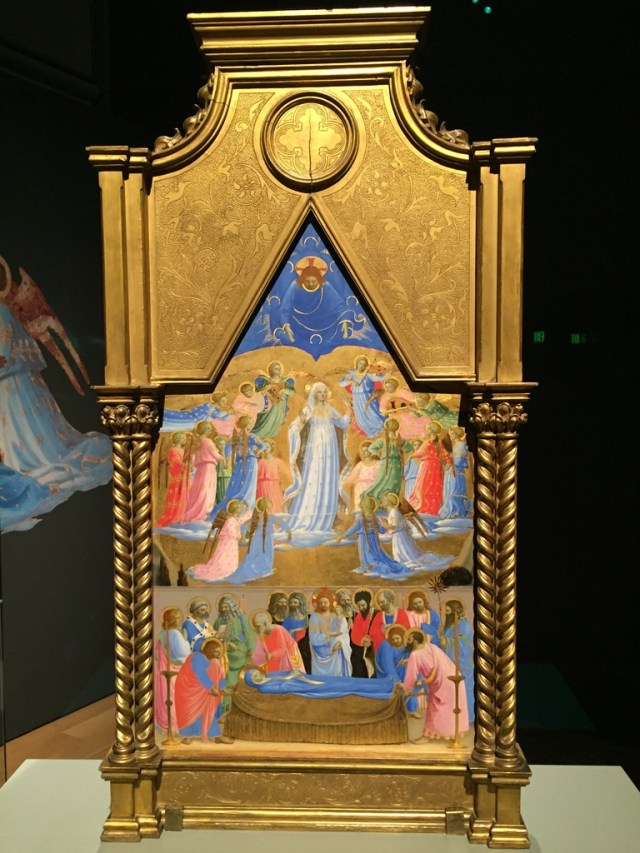
One of Fra Angelico ‘s reliquary paintings – The Dormition and Assumption of Mary – on display at the Isabella Stewart Gardner Museum in 2018. It shows the Dormition of Mary (her “falling asleep” at the end of her human life), her Assumption into Heaven and being welcomed by God. You can see the image of the Blessed Virgin greatly increased in size in the above poster. The reliquary is small, approximately 2 1/2 ft high.

St. Athanasius and St. Spyridon: A Correction and Another Interpretation – Let’s Take A Closer Look!

I am always very appreciative of my readers writing to me and providing new information and interpretations of sacred icons and images. Happily, that occurred last evening when a reader, Mr. John Daly from Australia, provided me with information on the second icon that was in yesterday’s post on St. Athanasius. Let me provide you with that image so we will have a reference point:

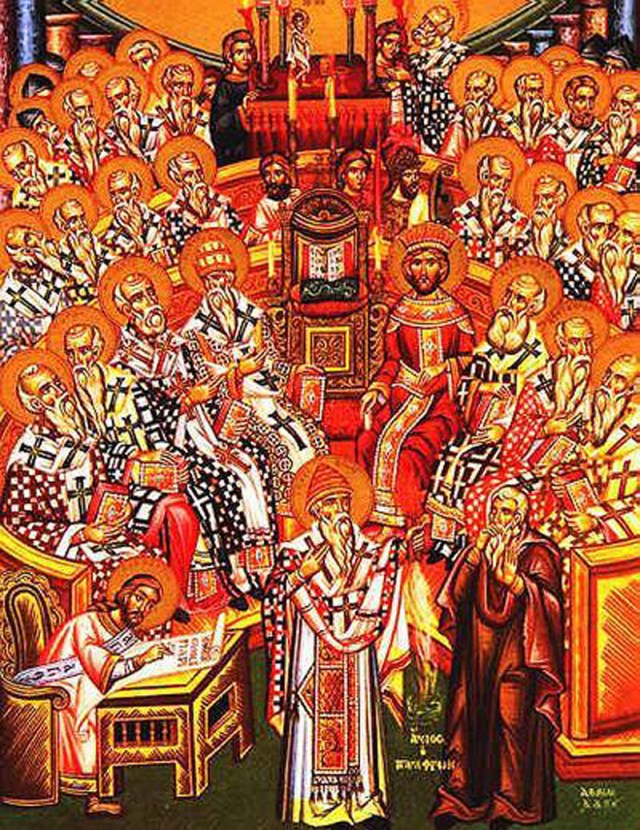
THE_FIRST_COUNCIL_OF_NICEA
This is the sacred icon of a bishop confronting a heretic at the Council of Nicaea (AD 325). Mr. John Daly of Melbourne, Australia informed me that we should take a closer look at the details of this icon because of how it depicts the bishop’s castigation of the heretic. I concluded erroneously that it must be St. Athanasius since he was a pivotal orthodox figure at the Council. Even though he was a deacon at that time, and not a bishop at the Council, he was ordained a priest and bishop about three years later, so the iconographer just inserted him as a bishop. Mr. Daly recommends a closer look to discover that it is St. Spyridon of Cyprus.

Mr. Daly is correct – it is St. Spyridon (born AD 270, died 340).

Let’s take a look at the reasons for this correction:

  1. The bishop castigating the heretic Arius is wearing a distinctive hat. The hat is unique. It is shaped like a beehive. It is made of woven straw and was traditionally worn by Cypriot and other shepherds tending their flocks – an apt metaphor for a bishop caring for the flock of his faithful.
  2. St. Spyridon was from the island of Cyprus, and eventually became a bishop serving the people of Trimythous, thus, he would have been invited to the First Council of Nicaea as were all the other bishops in Christendom.
  3. At another time, possibly in Cyprus, St. Spyridon was involved in a debate with a pagan philosopher whom he ultimately converted to Christianity. Besides his theological arguments about the Holy Trinity, the good bishop used a piece of pottery or a brick, to demonstrate to the philosopher how you could have one single substance be also composed of three separate substances (pottery and bricks consist of clay, water, and are unified by the substance of fire).
  4. The story of his discussion with the pagan philosopher continues and says that as soon as St. Spyridon finished speaking the piece of pottery or brick burst into flame, water dripped from it, and clay ash remained in his hand. Well that would have been enough to place me on the road to conversion, and so it was with the philosopher, too. If you look closely at the icon above you can perceive the fire bursting out of the brick and the water puddling beneath it. Hmm, I didn’t see that! As Sherlock Holmes once said, “Watson, you see, but you do not  observe” (taken from the story A Scandal in Bohemia by Sir A.C. Doyle).  Wise advice.
  5. Mr. Daly also relates that it was [and probably still is] common for an iconographer to fuse the two incidents of St. Spyridon converting a pagan, and St. Spyridon at the Council of Nicaea debating with the heretic Arius.
  6. There it is: the beehive woven straw hat, the bishop’s vestments, the water, fire and ash metaphor, the confrontation with an individual that has an opposite argument, and the public venue for both incidents.
  7. So where is St. Athanasius in this icon? Mr. Daly offers that in the upper left corner of the icon, we see an individual portrayed as listening intently to St. Spyridon. He is dressed in a dark alb with a white collar. He suggests that this is St. Athanasius. That argument makes some sense because, as a deacon, Athanasius may not have been up front with the bishops, rather he possibly would be located near the altar ready to perform his diaconal duties. At the same time he is still involved in the proceedings, and/or ready to respond to the needs of his bishop – Alexander of Alexandria.  You notice the priests and monks in the back of the room, too, in dark conical monastic hats and cassocks.
  8. My only issue with that interpretation is that the figure portrayed in the upper left does not have a nimbus (halo) circling his head, nor is he wearing his deacon’s stole; however, the scribe in the lower left corner is wearing a deacon’s stole. My stole comes across my chest from the left shoulder and is gathered at the right hip; and the scribe’s stole does the same thing. Is this individual St. Athanasius? There appears to be writing on his stole. I have no proficiency in Greek so I cannot be of help there.
  9. The scribe in the lower left corner has a halo, too, and so do all the bishops. Did the iconographer think that all the bishops present were saints?  This is not unlikely, since they produced a Creed for Christendom in three months. Truly, a stunning achievement. It indicates that the assembled bishops were very clear in their own minds what the Faith, based on Scripture and Apostolic Tradition, was all about. The bishops all appear very animated and involved in the Council proceedings. It’s obvious that the Holy Spirit was working within that Council!
  10. There is a lot going on in the upper part of this icon, too. Christ, as a young child, is found walking across what appears to be an altar towards another bishop. That bishop on the upper right is seen discussing some issue with, possibly, another dissenter (a priest, or deacon; even though the priests and deacons in attendance didn’t vote, they certainly could influence the bishop of their diocese on issues and arguments).
  11. Sadly, I believe that the only existing documents that we have concerning this Council that are still in existence are the Nicene Creed itself, the procedural rules of the Council, and Emperor Constantine’s address to the assembled bishops. It is said that many of the bishops came, returned to their dioceses, and then came back to the Council. This probably contributes to the fact that we don’t have all the names of the participating bishops, just those mentioned in other documents or in the stories that were passed on through to the faithful (confer Anna Erakhtina’s article The “Model of Meekness,” and Slapping Arius, at http://www.orthochristian.com, May 22, 2016, specifically the contribution by Archpriest Vladislav Tsypin. He discusses the documents available to us today). If anyone has additional information on the actual participants please tell me your source, and the participants, and I will spread the information through a post.
  12. St. Spyridon was also known as a miracle worker, especially for his successful intervention (caused by the prayers of the soldiers and sailors of the Catholic Rites) in the 1716 battles with the invading Ottoman Turks on the Greek island of Corfu.

John, thanks again; this was a fun interaction.

Additional images of St. Spyridon:

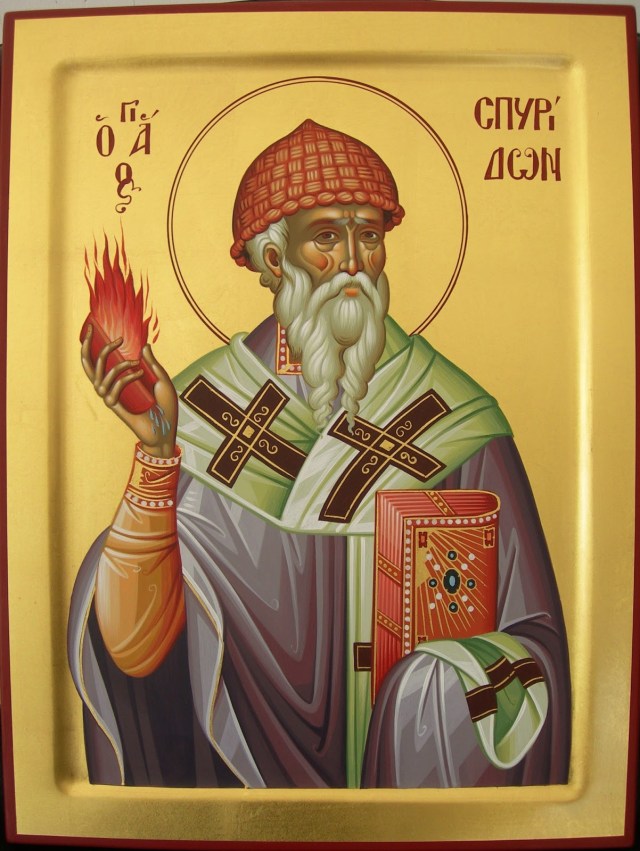
ST. Spyridon Orthodox
A contemporary Sacred Icon of St. Spyridon showing his beehive woven straw hat, his bishops stole, the blazing potsherd or brick with water dripping from it, and his holding the book of the Gospels (dogmatic truth based on the Holy Scriptures and the Sacred Apostolic Traditions of the Western and Eastern Rites of the Catholic Church. If anyone knows that artist that is responsible for this beautiful icon please tell me and I will credit him/her in this post. Icon found on Wikipedia and originates at St. Spyridon Orthodox Church in Loveland, Colorado (thanks to them for posting the image of this magnificent icon).
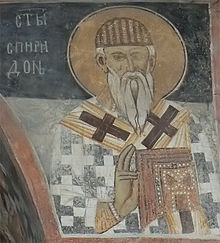
220px-Zemen-monastery-st-spiridon
A medieval icon of St. Spyridon, wall fresco, Bulgarian Orthodox, found in the  Zemen Monastery, Bulgaria. Photograph may have been taken by I.E. Stankov in 2012 using a Canon EOS 600D camera.

In the Roman Catholic Church, St. Spyridon is venerated on his feast day, December 14th; and on December 12th in the Eastern Rites and the Orthodox Church.

Thanks for stopping by and reading this post.

Copyright © 2011- 2019, Deacon Paul O. Iacono – All Rights Reserved. Permission to reprint must be obtained from the author in writing. Students, and those interested, may quote small sections of the article as long as the proper credit and notation is given. Thank you.

Fra Angelico – The “Heaven on Earth” Exhibition – Part 1

The Isabella Stewart Gardner Museum in Boston, Massachusetts is the only venue in America for the extraordinary “Fra Angelico: Heaven on Earth” exhibition. This amazing collection of reliquaries which express the life of the Virgin Mary, and other paintings of the greatest painter of the Early Renaissance, will be on display until this Sunday May 20th, 2018. Earlier incorrect media reports had the last day as May 28th.

I will be posting my photos of the Gardner Museum’s exhibit starting with this post and continuing on through the upcoming weeks and months. The exhibit consists of more than just the exquisite four reliquaries and it will be my pleasure to bring to you my photos of all of it. I am grateful to the Isabella Stewart Gardner Museum for allowing me to take photographs of the exhibit.

I will proceed with the first photo showing the image that you see as you climb the stairs of the Museum to the second floor where the exhibit is located. That image is of the Assumption of the Virgin Mary, surrounded by angels as she ascends in a vortex-like movement, toward God the Father. The reliquary containing the complete image was acquired by Isabella Stewart Gardner in 1899. This is the first time in history that all four reliquaries are reunited since they were split up and acquired by collectors and museums around the world.

My wife and I were privileged to visit the Museum and exhibition last week. Words cannot describe the restored reliquaries and paintings in this display.  I am not embarrassed to say that at one point I was choked up with emotion as to the beauty, technical skill, narrative brilliance in explaining Sacred Scripture, and the theological depth that Fra Angelico expressed in these sacred images.

Beato Fra Angelico (birth name Guido di Pietro) was a Dominican friar and known by his religious name as Brother John of Fiesole. The first historical record of Fra Angelico as a painter is the 1418 record of payment for a painting commissioned by the church of Santo Stefano al Ponte in Florence. Fra Angelico is believed to have been born in the late 1390’s and died in 1455. He is buried in Rome at the church of Santa Maria sopra Minerva. He was beatified (beato) by Pope Saint John Paul 2 on October 3, 1982, and in 1984 the Pope declared that Fra Angelico was the patron of Catholic artists (that is why I named this blog after him). Beato Fra Angelico’s feast day is celebrated every year on February 18th.

As you come up the stairs  leading to the second floor of the Museum and turn the corner you first see an enlarged version of Fra Angelico’s Dormition and Assumption of the Virgin located below. This image is showcased because it is found within the reliquary acquired by Isabella Stewart Gardner in 1899.

Adj ASSUMPTION FRA A.

This enlarged version of the Virgin Mary is found within the reliquary, and is its centerpiece, seen below.Dormition and Assumption

The above outer frame and base, which contains Fra Angelico’s painting, is known as a   reliquary. A reliquary is a container which holds the relics (bones, hair, etc) of deceased holy people or declared saints of the Roman Catholic Church. The reliquary allows the faithful to venerate, not worship, the life, deeds, and mortal remains of the person whose relics it contains. Fra Angelico painted the four reliquaries’ images specifically for the church of Santa Maria Novella in Florence between the years 1424 through 1434 The painting is rendered in egg tempera, oil glazes, and gold. It is simply stunning.

There is another separate painting in the exhibit which concentrates just on the dormition of the Virgin Mary. I will show that to you in the next post.

The “Heaven on Earth” exhibition is made possible with the support, in part, by the Robert Lehman Foundation and the Massachusetts Cultural Council (the Council receives its funding from the State of Massachusetts and the National Endowment for the Arts). The media sponsor is WBUR in Boston. The Museum’s Executive Director, chief conservator, curators, conservators, and support staff brilliantly provided the technical expertise and planning for this exhibit. The companion book, edited by Dr. Nathaniel Silver (with contributions by more than ten experts) is also very well done and a worthy addition to your library.

Photos and text © Deacon Paul O. Iacono 2011-2018. Thanks again to the Isabella Stewart Gardner Museum for this beautiful exhibit and enabling the public to enjoy, be edified, and to take photos of it.

Ken Jan Woo – sacred artist

Please see my post of July 9, 2020 entitled Chinese Martyrs and the Art of Ken Jan Woo. Thank you.