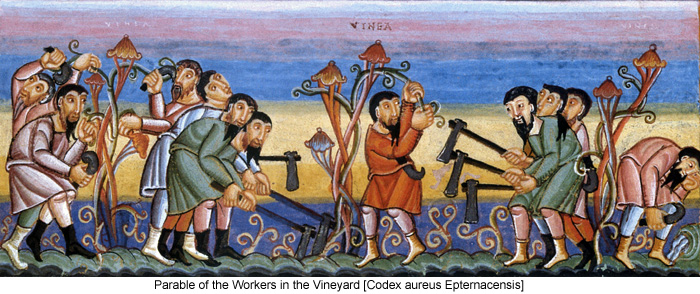
In this Gospel passage from Matthew 20: 1-16, the Lord explains that the last workers called (a veiled reference to the Gentiles) were paid the same as the first (Israel) because they made the effort, even though it was late in the day, to work in His vineyard.
On a personal level this applies to us, too.
God’s call: don’t delay in responding to His invitation.
God’s payment: the abundant generosity of His mercy, forgiveness, and Sacramental grace.
Our response to God: love, praise, and thanksgiving.
Even though we may understand this, there is still the nagging question: “Have I responded to Christ’s call to work in the vineyard of my own soul?”
How fruitful have I been?
How fruitful will I be?
Christ’s efforts on our behalf takes us by surprise; but as the prophet Isaiah reminds us: God’s thoughts are not our thoughts, nor are our ways God’s ways.
Notes on the images: The Parable of the Workers in the Vineyard image is from the Codex Aureus Epternacensis. It is an illuminated book of the Gospels (Latin Vulgate). The Codex Aureus was written/illuminated by monks of the Benedictine Abbey of Echternach (within Luxembourg) circa AD 1040. It is presently located in the National Museum in Nuremberg, Germany. The image below is the portrait of St. Matthew which appears in the pages preceding the Codex’s text of the Gospel of St. Matthew.
Sacred Scripture has always celebrated the beauty and significance of the mountain in Israel called Carmel.
It is significant for two reasons:
In a dramatic contest with the priests of the pagan god Baal, Elijah fought the false gods of King Ahab and Queen Jezebel of Israel; a king and queen who were dramatically attempting to turn the Israelites away from the belief of monotheism to polytheism. It is believed that the base of the mountain is where the Hebrew prophet Elijah prayed, contemplated God, defeated the priests of Baal, and defended the purity of Israel’s faith (confer 1 Kgs 18:17–46).
It is also the site of the Stella Maris Monastery, the world headquarters of the Carmelites, a Catholic contemplative religious order. Three great saints of the Carmelite Order are St. Theresa of Avila, St. John of the Cross, and St. Therese of Lisieux. Through their witness and books they continue to make significant contributions to the mystical life and contemplative prayer of clergy and laity alike.
During the 12th century Catholic hermits withdrew to the mountain of Carmel to form a small community of religious brothers. Near a spring that was named after the prophet Elijah they founded their society desiring to devote themselves to contemplative prayer and Holy Scripture. These men called themselves “the Brothers of the Blessed Virgin Mary of Mount Carmel.” This society was the seed of the present world-wide Carmelite Order. According to the Carmelite Rule of St. Albert “Carmelites are devoted to the contemplative life under the patronage of Mary, the Holy Mother of God.”
The charism of present day Carmelite monks and contemplative sisters is to share the fruits of their contemplative prayer life with others. Contemplation and ministerial action are not contradictory forces within this Order.
The Carmelite Order is also associated with the Brown Scapular of Our Lady of Mt. Carmel. A scapular, in many religious societies, is a piece of clothing that a monk or religious sister wears over their regular habit when they are working at various communal tasks. Today, laity, deacons, priests, and bishops may wear the Brown Scapular, too.
A scapular is a “sacramental,” it is not a charm or superstitious trinket. As a sacramental it assists in a person’s prayer life by turning the mind and soul toward the beauty and love of God. The scapular associated with the Carmelites is called the Brown Scapular.
The Brown Scapular is two pieces of small cloth, about 2 by 2 inches, that are attached by a cord which is paced around the neck. One side of the cloth rests on the back and the other on the chest. This scapular has images of the Blessed Mother with the baby Jesus on one cloth, and St. Simon Stock on the other. Roman Catholics believe that St. Simon Stock, who was a 13th century English Carmelite, received the first Brown Scapular from our Blessed Mother.
The Church of Saints Peter and Paul in Singapore has a lovely summary of the significance of the Brown Scapular on their website: “By the wearing of the scapular, we express our commitment to be disciples of Christ, and following the example of Mary, the perfect disciple, we learn:
To be open to God’s will;
To listen to the word of God, and put it into practice.
To pray at all times, as a way of discovering the presence of God in all that is happening around us.
To share in the paschal mystery of Christ by means of voluntary penance.
The Brown Scapular has become a sign and symbol of the special dedication of the Blessed Mother’s protection. This spiritual meaning has been approved by the Church.
The devotion of wearing the Scapular has become, like other devotions to Mary, a rich treasure for the whole Church – an expression of love and trust in her motherly intercession.”
It is recommended that you purchase the Brown Scapular of Mt. Carmel. Have it blessed by a priest or deacon, and wear or carry it with you. In these days of social unrest and apostasy it is very beneficial to have our Blessed Mother close to us.
Please remember that Roman Catholics, Catholics of the Middle Eastern Rites, and the Greek and Russian Orthodox, venerate the Virgin Mary. We do not worship her. We worship only God.
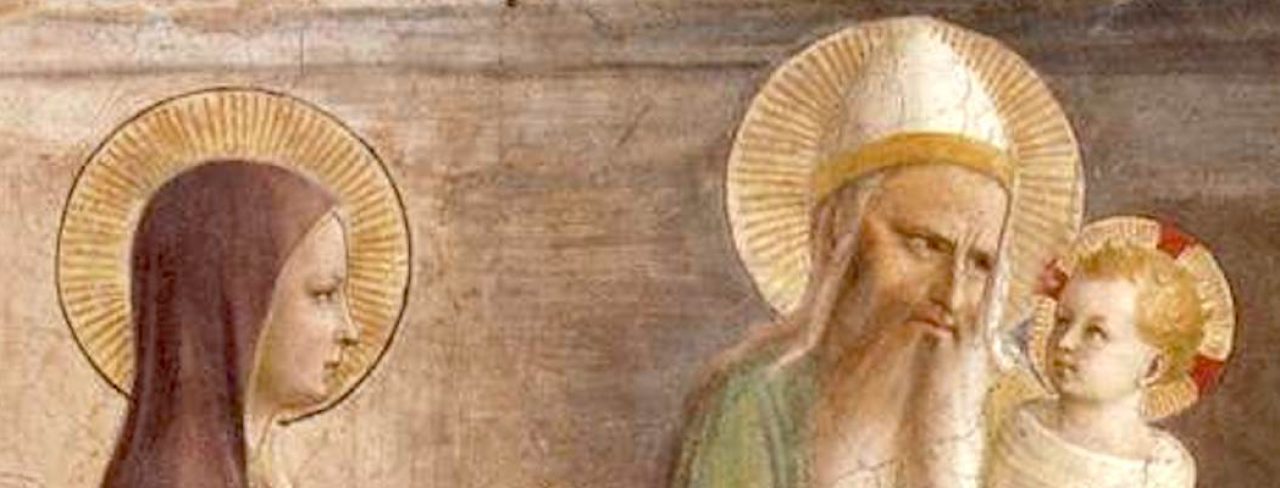
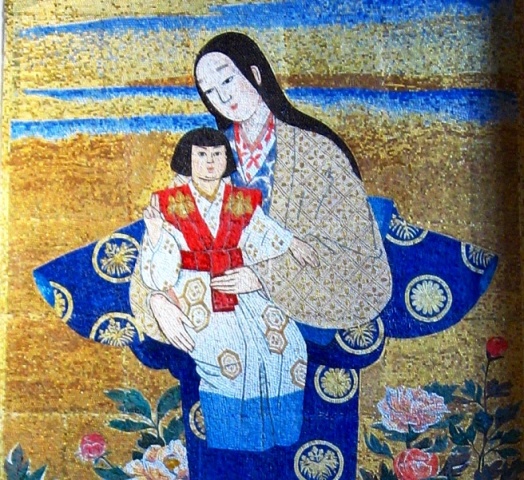
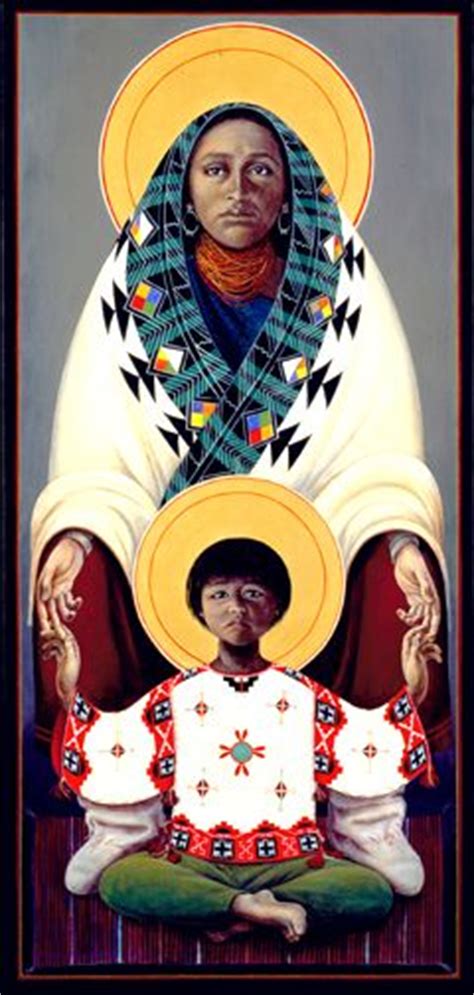
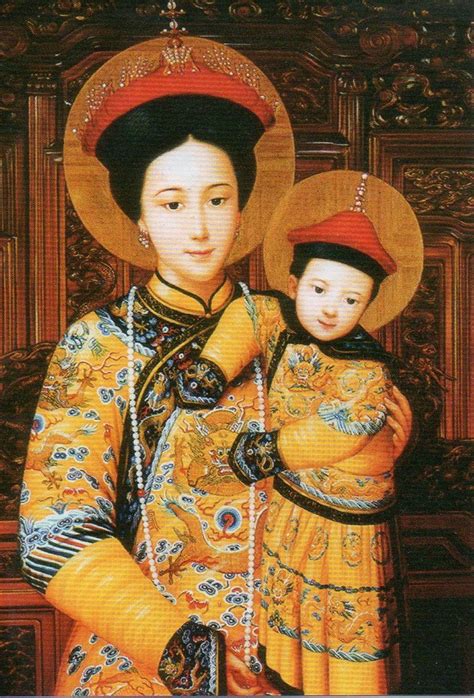
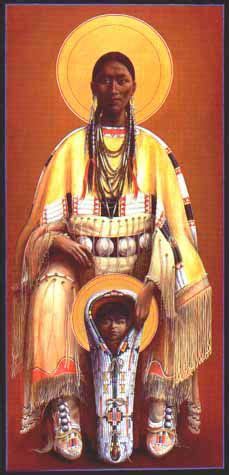
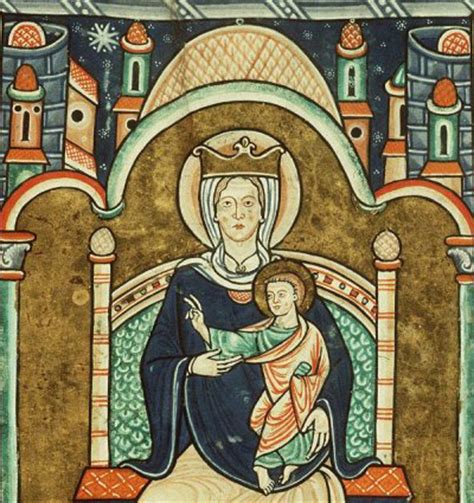
Artistic images of the Blessed Mother of Jesus, as portrayed by different cultures within historical periods, have been part of world history for centuries. Below are a few examples of these images.
The various images of Jesus and His Mother portrayed by each ethnic group are beautiful and have spiritual meaning. Are the artists of these works prejudiced or racist?
Because of the controversy over comments made by political activists over the last few weeks it would appear that the motive of cultural artistic contributions is based on racial superiority. Their opinion points to the obvious truth that in our social and political climate confusion is very possible.
A debate is occurring within the fields of physical anthropology, genetics, and evolutionary biology concerning the issues of race and racial supremacy. Some scholars have concluded that racial supremacy and even the various categories of human races do not exist.
“Races are highly genetically differentiated populations with sharp geographical boundaries.
Alternatively, races can be distinct evolutionary lineages within a species.
By either definition, races do not exist in humans but doexist in chimpanzees. [italics mine, P.O.I]
Adaptive traits such as skin color do not define races and are often discordant with one another.
Human populations are interwoven by genetic interchanges; there is no tree of populations.”
Thus, in the grand scheme of things superficial traits are what separate us not genetic differences. Valid scientific evidence may be proving that the concept of five races is outmoded and not substantiated by modern genetic research. It is correct to say that specific ethnic groups, with superficial physical traits, living within specific geographical areas, do exist.
If American or European “white” artists portray Jesus and all the individuals found in Holy Scripture as members of Caucasian ethnic groups, they would in the majority of cases, be artistically portrayed as having the superficial physical genetic traits of European/Middle Eastern populations.
The images above certainly portray that the artists within another culture, or dominant ethnic group/cultures in specific regions of the world, do the same thing. This is logical because the artist of a specific ethnicity paints or sculpts to meet their group’s spiritual needs, or, the patron’s specific request. That is not an act of ethnic supremacy or racism.
Genetically, can we say with any assurance what the genetic make-up of Jesus, Mary, and His fellow Hebrews were when they existed? There is historical evidence to contribute to the answer.
Since the time of the Patriarch Abraham’s son Isaac, and Isaac’s son Jacob, there occurred the development of the twelve tribes of Israel.
These tribes definitely took shape and became a cultural, military, and political force by circa 1925 BC. Tribal leaders were very strict about intermarriage with other populations. Under Moses’ leadership, circa 1250 BC, they did not allow it at all. They were a large enough population to marry within the system of their tribes, and their members conformed to the demands of God and their leaders.
Abram (Abraham) and his flock of followers originated within the city of Ur, which was a Chaldean city-state of the Sumerian civilization. Today the archeological remains of the city of Ur are located in Southern Iraq. Ur was Abram’s home before he, his family, and followers were given the order by God to travel to the land of Canaan.
Abram would later be given the name Abraham by God. “In various sources, “Canaan” refers to an area encompassing parts of Syria, Lebanon, Jordan, and Israel. The Israelites occupied and conquered Palestine, or Canaan, beginning around 1750 BC, or perhaps earlier. The Bible justifies such occupation by identifying Canaan with the Promised Land, the land promised to the Israelites by God” (source: https://www.britannica.com/place/Ur
Bottom line, Jesus, Mary, and “His friends” were ethnic Israelite/Hebrews. They were Hebrews from the genetic line of King David. David’s genetic line originated from Abraham’s son, Isaac, and grandson Jacob. There is no way to prove that Abraham, Isaac, and Jacob’s genetics are related to the people of today’s southern Iraq, or any other ethnic group.
If a person believes in the truth of the Holy Scriptures then the answer is that Jesus, His family, and Apostles, were all of the genetic line of Israelite/Hebrews with the superficial physical traits of that ethnic group.
Ultimately, Roman Catholic, Orthodox, and Anglican Biblical sacred art is not about race or superficial physical traits. The entire Hebrew and Christian Scriptures point to the truth that the human nature of the Son of God, Jesus the Christ, was born of Mary within Roman occupied Israel. The spiritual union of the power of the Holy Spirit with the consent of Mary led to the birth of Jesus, the Redeemer of mankind.
Supremacy is not found in race, ethnic group, or prejudice/bigotry. It is only found in the authority and power of the Holy Trinity.
On this solemnity of the Annunciation, March 25th, we remember St. Luke’s account of the Annunciation:
“Now in the sixth month the angel Gabriel was sent from God to a town of Galilee called Nazareth, to a virgin betrothed to a man named Joseph, of the house of David, and the virgin’s name was Mary.”
“And when the angel had come to her, he said, “Hail, full of grace, the Lord is with thee. Blessed art thou among women.” When she had heard him she was troubled at his word and kept pondering what manner of greeting this might be.
And the angel said to her, “Do not be afraid, Mary, for thou hast found grace with God. Behold, thou shalt conceive in thy womb and shalt bring forth a son; and thou shalt call his name Jesus. He shall be great, and shall be called the Son of the Most High; and the Lord God will give him the throne of David his father, and he shall be king over the house of Jacob forever; and of his kingdom there shall be no end”
“But Mary said to the angel, “How shall this happen, since I do not know man?”
“And the angel answered and said to her, “The Holy Spirit shall come upon thee and the power of the Most High shall overshadow thee; and therefore the Holy One to be born shall be called the Son of God. And behold, Elizabeth thy kinswoman also has conceived a son in her old age, and she who was called barren is now in her sixth month; for nothing shall be impossible with God.”
And Mary said, “Behold the handmaid of the Lord; be it done to me according to thy word.” And the angel departed from her.” (Luke 1: 26-38)
Mary, the Blessed Mother, the Theotokos – “the God bearer” at first, questions Gabriel, “How shall this happen…” Upon his explanation Mary undertakes her all important journey with perfect trust and obedience to God’s will. She accepts her eternal role not in fear but in love. Mary will be the God Bearer, the bearer of her Son Jesus, our Savior, the Second Person of the Holy Trinity.
Jesus, at the moment of His conception, is both true God and true man: two natures in one Person.
Icon of Mary: it is the icon called The Madonna of Saint Sisto, located in Rome in the Dominican convent of Monte Mario. It is one of the oldest and most beautiful icons of the Virgin from antiquity.
Mary is the perfect disciple of God. She provides us with the model of love, obedience, and trust in Him. There were many times throughout her life that she had to express her trust and obedience, and at times not knowing where the journey would lead. It led from the great joy of her pregnancy, Jesus’ birth, family life, through to His ministry, and her motherly presence before the Holy Cross.
A few verses later, in her beautiful canticle the Magnificat, she exclaimed to her kinswoman Elizabeth her lack of doubt in what has happened. She praises the mercy of God and her willingness to be the servant of Him who is faithful to His word. In her humility, trust, love, and obedience to God, Mary, as the New Eve, will be given the privilege of crushing Satan at the end of time.
From the beginning, the Catholic Church has neverworshipped Mary. The Church venerates her as the first disciple and its greatest saint.
On this beautiful Solemnity of the Annunciation let us join with the great St. John Henry Cardinal Newman in his prayer to Jesus: “Dear Jesus, Your Holy Mother cooperated with the divine plan for the human race. Let me try to imitate her in her obedience and service to You.” Thank you, Jesus.
Note: The sacred image that appears at the top of all of my posts is The Annunciation by Fra Angelico.
The extensive Gospel reading for Palm Sunday relates the Scriptural and historical truth that Jesus triumphantly entered Jerusalem, yet, five days later He was arrested, put on trial, tortured, and executed.
As you know, the religious and secular leaders of Israel did not accept Jesus as the Messiah and Son of God. They were adamant about the fact that Jesus was just a man and that His claims, teachings, and healings were all fraudulent. Their disbelief took place during the first century, yet, two hundred years later there were Christians saying the same thing.
The questions came down to, “Who is Jesus Christ? Is He a man? Is He God? Is He both?”
These were the same questions that the people of Jerusalem, some of them waving palm branches, and their leaders were asking each other.
In the year 325 scholars and clerics were still grappling with those questions, too.
Many deacons, priests, and bishops of the Church had settled the question in their own mind, yet, all of Christendom was not in agreement. Emperor Constantine was worried; as a military man he knew trouble when he saw it. Religious disagreements could easily spread into civil war. Something had to be done.
Stories have come down to us through the centuries that St. Nicholas of Myra, a faith-filled bishop, decided to defend Sacred Tradition and the Scriptural interpretation of the reality of Jesus as the Son of God the Father. The story relates that he not only vigorously defended Sacred Tradition but became so worked up that during one of the debates he slapped the author of this heresy which was called Arianism.
But, was it a verbal or physical slap?
Let’s take a brief look at some of the details:
Partial icon of the “incident” at the 1st Council of Nicaea. Immortalized in an early icon. The Early Church was well aware of the importance of this Council in debating and agreeing to the specific dogmas of the Church that would be ultimately proclaimed in the Nicene Creed. All catechumens that enter the Church at the Easter Vigil Mass proclaim their belief in the great Sacred Mysteries and historical truths of the Nicene Creed.
Who: Saint Nicholas of Myra, Bishop, (Myra, an Ancient Greek city on the coast of present day Turkey), vs. Arius, priest from the diocese of Alexandria, (Alexandria, a city on Egypt’s Mediterranean coastline). Emperor Constantine, Roman Empire, centered in the new city named in his honor: Constantinople (present day Istanbul, Turkey). Constantine convenes an ecumenical council of bishops from the five major patriarchies of Christendom (Alexandria, Antioch, Constantinople, Jerusalem, and Rome).
What: Supposed incident of Bishop Nicholas “slapping” the priest Arius, at the first ecumenical Council of Bishops: the Council of Nicaea. This was the first Council since the Council of Jerusalem (held in the first century and was attended by luminaries such as St. Peter and St. James).
When: Late Spring and early Summer of the year 325.
Why: The incident concerned the critical issue of who is Jesus Christ, and whether Jesus Christ is “the same in being and the same in essence” as God the Father. Arius was promoting the heresy that Jesus Christ was “just a creature” of God and not a divine Person of the Holy Trinity.
Where: Nicaea, an ancient city in Asia Minor; it is the present day city of Iznik, Turkey.
As it applies to sacred art, the Council of Nicaea provided a specific creed: a set of theological proclamations that impacted sacred artists from the 4th century to the present day. It is stated clearly in this Creed that God the Father has communicated His love, mercy, and laws to humanity through His revealed word in the Hebrew and Christian Scriptures. This action culminated in the ministry, passion, death, and resurrection of His incarnated Word, His Son Jesus Christ.
The Nicene Creed definitivelyproclaimed that Jesus Christ is the same in essence, and the same in being, as God the Father and God the Holy Spirit. So we have the great Mystery of the Incarnation, the nature of Jesus Christ: He is both human and divine – the Son of God – One Person with two natures – human and divine.
The above is a 6th century sacred icon of Jesus as Pantocrator. Pantocrator is a Greek word describing the all knowing, all powerful Son of God: Jesus Christ. The Council of Nicaea declared that Christ, as God, is consubstantial: Jesus is the same in essence (substance) and in being as the Father and the Holy Spirit. Also, Jesus possesses two natures: human and divine. This is truly a great Mystery of the Church. The sacred artist of the above icon, probably a monk, used hot pigmented wax (the encaustic method) to render this likeness. This sacred icon is currently located in St. Catherine’s Monastery, Sinai Peninsula, Egypt. The face has a striking resemblance to the face on the Holy Shroud of Turin.
The day-to-day proceedings and debate notes of the Council have been lost to history, so we will never know if St. Nicholas gave Arius a physical or just a verbal “slap.” Regardless, St. Nicholas made his point and contributed to giving us the gift of the Nicene Creed.
In AD 381, the Nicene Creed was edited and amended at the First Council of Constantinople (thus, the Creed is called the Niceno-Constantinopolitan Creed. Try to say that phrase fast, three times!😃).
Thanks for visiting with me. May you have a prayer-filled Holy Week.
Sources for the above post are found in my bibliography post, entitled Early Church Fathers – A Short bibliography of February 8, 2019. I relied primarily on Pope Emeritus Benedict XVI’s works, also Aquilina and D’Ambrosio’s volumes.
I once heard a friend repeat a quote by the author Katherine Mansfield: If you wish to live, you must first attend your own funeral.”
How true. We begin to live life perceptively only when we project ourselves to the time of our own death, imagining how we’ve lived our life and wondering whether we’ve met the mark.
Depending on our frame of mind, and perspective on life, we may not include the spiritual in our self-assessment, or, only give it a passing thought. That is why Mansfield’s phrase may be viewed as spiritually deficient.
In today’s Gospel on the parable of the Prodigal Son there are family members that Jesus is requiring us to understand. The behavior of these people, the father and the two sons, provokes four questions. Questions not so much about our secular situation but our spiritual – our relation to God, and, each other.
At first glance, the younger son impresses us as an individual who is quite selfish. When he requests his inheritance from his father, he isn’t just asking for the cash, he is in effect saying to his father: “I want to live my life now and without any strings attached. To me you’re unimportant, this family is unimportant. Just let me get on with my life and give me my share right now.”
Are we living in a way that categorizes God? Are we willing to acknowledge Him only because we want to get something out of Him? Do we play upon His charity and generosity?
If this is so, if we have the younger son’s attitude, we end up like him – swimming with the pigs. What will be our inheritance? It will undoubtedly be spiritual poverty and secular discontent. Sadly, sometimes people understand this only in the last few months of their life, or, in the moments right before their death.
Jesus is teaching us that the prodigal son was only able to enter into a state of recovery when he “attended his own funeral.” When he was able to perceive his own personal endpoint, his own material and spiritual poverty. He was finally able to admit that he was grievously wrong only when this realization slammed into his consciousness.
His new perception demanded that he learn the root causes of his problem, reject his worldly self, and humbly ask for repentance. He needed to realize that his father and family were all important to his happiness. This required acceptance of and humbly requesting his father’s mercy and love.
This perception did not demand psychoanalysis. He did not need years of therapy on a psychologist’s couch. He had the intelligence to figure it out because he confronted himself as he truly was and extended that personal analysis to his family and surroundings. He acknowledged his sins, and how truly needy he was of his father’s love and mercy.
We are half way through the Season of Lent. Like the younger son, have we confronted our own faults, our lack of perception, and yes – our own sins?
The Prodigal says: “I will arise and go to my father, and will say unto him, father, I have sinned against heaven, and before you.”
This is the turning point in the Prodigal’s life. It can also be ours.
Improvement begins with a decision to change the way we do things, the way we behave and perceive reality, both in a secular and spiritual sense. If you are a Western Rite Catholic, this is accomplished in three ways: Sacramental Confession, prayer, and resolution of purpose. Reconciliation is always possible. Our God is a God of justice, but also, a God of infinite familial love and mercy.
Do we behave like the younger son or the elder son? Are our hearts cold?
What the younger son ultimately accepts the elder son initially rejects. At first, the elder son resents the generosity of the father’s love – he resents the generosity of the act of forgiveness. It appears that he is unable to accept his repentant brother or his generous father.
Does this, in any way, apply to us? Do we ignore the Father, Son, and Holy Spirit’s love for us; do we resent people who have converted, changed their spiritual way of life? Or do we continue to judge them as if they were still enveloped by their sins? Do we verbalize our resentment or question their repentance? Are we unwilling to repent of these attitudes? Are our hearts cold?
I am a sinner and you are a sinner. There are very few people on this earth that are living saints. Regardless of whether our sins are small or large, visible or hidden, it is paramount that we remember the words of St. Paul: God the Father “reconciles us to Himself [through the passion and death of His Son] and has given us the ministry of reconciliation. Be reconciled to God. For our sake He made Him [Jesus Christ] to be sin who did not know sin, so that we might become the righteousness of God in Him” (2 Corinthians 5: 17-21).
We need to take stock of ourselves this Lenten season, repent and return to the Father’s embrace. This can only be done through the Sacrament of Confession/Reconciliation – a Sacrament made possible through the life, death, and resurrection of Jesus Christ, our Lord and Savior.
Painting by James Tissot (French; 1836 – 1902). “Return of the Prodigal Son.”
Is communication just a trait of human beings? Is it a trait of God?
The Dogma of the Holy Trinity is one of the great Mysteries of the Christian Faith. All Christians acknowledge and accept that The One True God, the divine Holy Trinity, are three separate and distinct Persons of the Father, Son, and Holy Spirit. The Holy Trinity is not three separate Gods. They are one God in three Divine Persons. This is known as the dogma of the “consubstantial” Trinity: each of the three Persons is God – completely and entirely.
These ideas were debated and verified by the assembled bishops at the First Council of Nicaea in AD 325 and subsequent Councils (specifically the ecumenical Council of Nicaea/Constantinople in AD 381).
In the 13th century the Fourth Lateran Council stated: “Each of the Persons is that supreme reality (nature, essence, and substance) of God” (confer Catechism of the Catholic Church, 2nd edition, paragraphs 198 through 315, pp. 54-84).
These three Divine Persons relate and communicate among themselves and desire to communicate and relate with Their creation. This is verified through Holy Scripture, Sacred Tradition, and the historic teachings of the Apostles, the Ecumenical Councils, and the saints of the Church.
The first of Their creation, the nine choirs of angels, communicate with God and each other, too.
Obviously, human beings communicate and relate through speech, behavior, and the written word, though at times, not very well. To a much lesser extent, there is “communication” in the other members of the animal kingdom (by instinct, chemical, and behavioral signals) and in the plant kingdom (through chemical signals).
God the Father has communicated specifically through His Word, the incarnated Son, Jesus Christ. In accordance with the Father’s will the human Jesus is “born of a woman” into space and time through the great Mystery of the Incarnation of Christ.
Jesus agreed to humbly obey His Father’s will. Through His Incarnation the Divine Son Jesus expresses His two natures: human and divine. He does this while “hiding” the full majesty of His divinity (except for the moments of His Transfiguration, Resurrection, and subsequent appearances to His Apostles).
The Holy Spirit (as the Council of Florence stated in 1439) “Is eternally from the Father and Son; He has His nature and subsistence at once from the Father and the Son. He proceeds eternally from both as from one principle and through one spiration (the life-giving breath of God).”
“When the Father sends His Word to His Creation He also sends His Breath. “Jesus and the Holy Spirit are on a joint mission, while at the same time being distinct but inseparable. It is the Son who is seen, the visible image of the invisible God, while it is the Holy Spirit that reveals Him.” (please refer to page 181 of the Catechism of the Catholic Church, 2nd edition, also pages 54 through 90).
The Holy Spirit communicates and spiritually shapes us through the Holy Scriptures, liturgical and private prayer, the teachings of the Western and Eastern Rites of the Church, and with the Father and Son in the seven Holy Sacraments (in the Eastern Rites – the Holy Mysteries).
The solemnity of Pentecost recalls the full expression of the Holy Spirit’s “Fruits and Gifts” to the Apostles, and through the Holy Sacraments to us, too (refer in the Christian Scriptures to the Acts of the Apostles chapter 2, verses 1 – 42; and in St. Paul’s letters to the Galatians chapter 5: verses 22 ff; and 1st Corinthians chapter 12, verses 4 ff; also refer in the Hebrew Scriptures to the book of the prophet Isaiah chapter 11, versus 2 – 3).
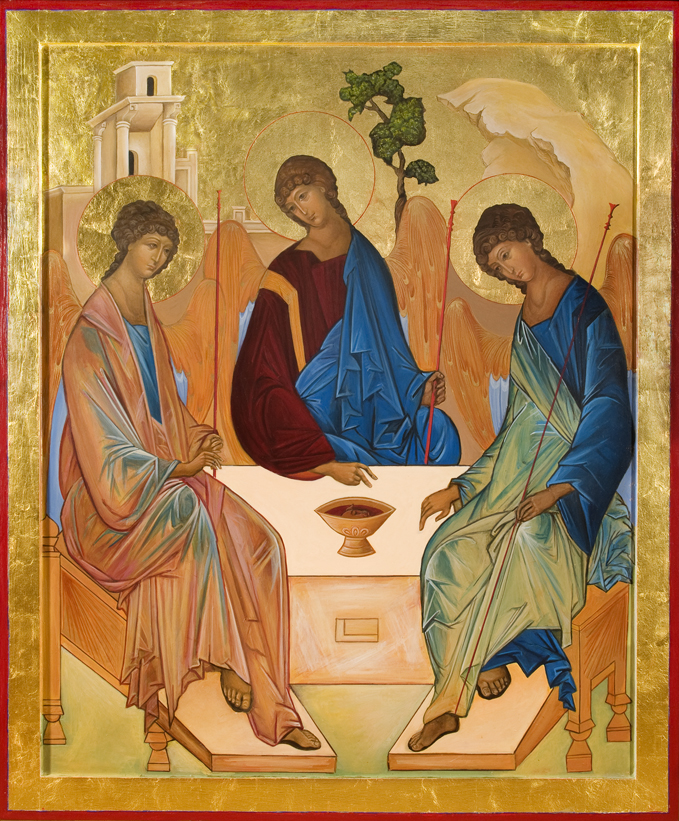
“The Trinity”: early 15th century; egg tempera and gold on wood panel by St. Andrei Rublev (1370 – 1430). St. Rublev was a Russian Orthodox monk. He resided and “wrote” with egg tempera paint to produce images of God, the angels, and the saints in sacred icons. He lived at St. Sergius Monastery in Moscow, Russia. His sacred icon above captures some of the truth of the Three Persons of the Holy Trinity communicating with each other. God the Son, Jesus Christ, is the figure in the center of this painting. You see two of His fingers extended to express His human and divine nature, and in a pointing gesture, to the “Cup of His Blood” made manifest through His Redemptive sacrifice. In this masterpiece you observe the colors blue representing divine life and purple madder/burgundy signifying Christ’s humanity. God the Father is on your left and God the Holy Spirit is on your right. The Holy Spirit is garbed in blue and in green as a symbol of new life and spiritual growth through prayer and the Holy Sacraments (Holy Mysteries). God the Father is painted in both blue, green, and a very light, transparent gold ochre. The First Council of Nicaea (AD 325) verified and promoted the Dogma of the Holy Trinity. This Dogma was reaffirmed, and further explained by the Council of Nicaea/Constantinople in AD 381.
A contemporary copy of the original Trinity by Rublev.
God the Father sent His Son to be born of a woman through the fecundity of the Holy Spirit. The Incarnation of Jesus Christ changed the Universe. God became flesh and walked among us. Why? In order to teach, heal, and redeem us from our sins. The New Covenant with His creation is written in His Blood. There is, if you have the gift of faith, ample proof that God wants to communicate with you.
It is up to each man and woman to honestly determine whether or not they are ignoring Him, and if so, to decide what to do about it. Time is short.
Jesus, full of the Holy Spirit, returned from the Jordan and was led by the Spirit into the wilderness, where for forty days He was tempted by the devil. He ate nothing at all during those days, and when they were over, He was famished. (Gospel of Luke chapter 4: verses 1-2)
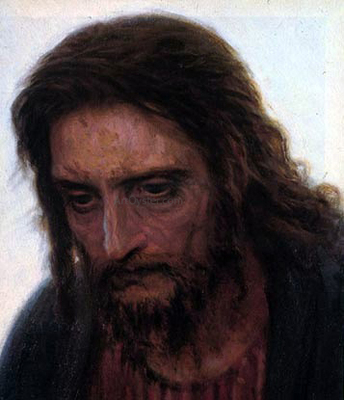
In the extraordinary painting below, we see Jesus after He was led into the desert wilderness by the Holy Spirit. He is surrounded by rocks and sand. He sits on a boulder, hands in front of Him. His eyes are filled with the knowledge of reality, of passions, power, and pain, ego and emptiness, sin and self aggrandizement.
This painting may move us from the awareness that in the desert wilderness Jesus is not only thinking through His ministry, Passion, and death but is also viewing our lives – our ministries, our passions, our death.
What do we see?
Let us examine His face.
We see the seriousness of the forthcoming temptations; the physical, mental, and the spiritually violent struggle with the devil. It is written plainly upon His emaciated face.
We see the irrefutable fact of Jesus’ humanity.
We see that He is like unto us, except for sin.
This is the face of our Savior; but the victory is not His, yet.
His temptations, public ministry, Passion, and death are still to occur.
What do we see?
We see a man who knows His Mind. He knows His Body, Soul, and Spirit.
He knows His freely accepted duty to accomplish His Father’s will.
This is not the face of a defeated man. It is the face of a determined man who is also Lord and Savior.
Observe Christ’s clenched hands, gaze deeply into His eyes, and you will see the artist’s portrayal of a Savior that is already, at the beginning of His ministry, aware of the viciousness of the tempter and the burden of our sins. Sins accepted by Him, and through His Passion and death, makes all things new.
Jesus had to confront in that desert assault whether or not He was going to be faithful to His mission.
The Gospel passage above challenges us with the same questions: are we going to be faithful to the Commandments, to our Baptismal promises, to the mission given us in Confirmation to live and practice the truths that He taught us?
Are we going to be faithful to the spiritual power and grace given to us, not just when we feel like it, but even in the most difficult of circumstances?
As disciples of Christ we are on a daily basis constantly revolving around the axis of temptation and sin – faith and grace. We understand that temptation, in and of itself, is a test – it is not sin. It is only sin when we willfully place ourselves in its shackles, when we give into its fueled power to overwhelm our body and soul. That power – a deadly power – obtains its animus and energy from the original tempter and liar – Lucifer himself.
Hell is real. It is not a mental construct. To say that it doesn’t exist is to call Jesus a liar, and His Passion, death, and Resurrection meaningless.
Jesus the Christ lived heroically in the face of Hell’s demons and witnessed to the power of God’s grace.
But you say, I am not Jesus Christ, I am a weak man or woman, boy or girl.
I say true, we all are; but by virtue of our faithful reception of the Holy Sacraments (Holy Mysteries) of Reconciliation (Penance/Confession) and the Holy Eucharist we have the power of Christ’s grace within us. A power, freely given by God and unmerited by us, to resist and overcome temptation and sin.
If we do sin – if we do “miss the mark” – we have a remedy. We follow St. Paul’s advice: pick yourself up, dust yourself off (confess your sins), and confidently continue on your journey. We must do our part in cooperation with God’s love and mercy.
The Season of Lent is a time of joyful repentance, prayer, and fasting.
Let’s remember the words of Nehemiah, who in the Hebrew Scriptures says: Today is holy to the Lord your God. Do not be sad, and do not weep; for today is holy to our Lord. Do not be saddened this day, for rejoicing in the Lord must be your strength! (Nehemiah 8: 9-10. 5th century BC)
***
The painting above was created and completed in the late 19th century by Ivan Kramskoi. He was a gifted Russian painter, noted portraitist, draughtsman, and teacher. The painting is entitled Christ in the Wilderness.









 The Fra Angelico Institute for Sacred Art

You must be logged in to post a comment.