Chinese Martyrs and the Beautiful Art of Ken Jan Woo

We remember today, July 9th, the 120 martyrs who died in China between the years 1648 and 1930. Eighty-seven of these were native born Chinese and were children, parents, catechists, and simple laborers ranging in age from nine to seventy-two.

In the early 19th century, St. Augustine Zhao Rong was a Chinese soldier who accompanied French missionary Bishop John Gabriel Taurin Dufresse to his martyrdom in Bejiing.  He was profoundly touched by the Bishop’s courage in the face of great trials, humiliation, and eventual death. As a result, Zhao Rong sought baptism, was given the baptismal name of Augustine, and soon ordained a diocesan priest. He spoke often of Bishop Dufresse’s sense of hope, love of Christ, and confidence.

In 1815 the Chinese government martyred Father Augustine Zhao Rong.

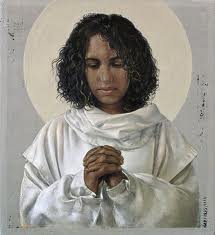
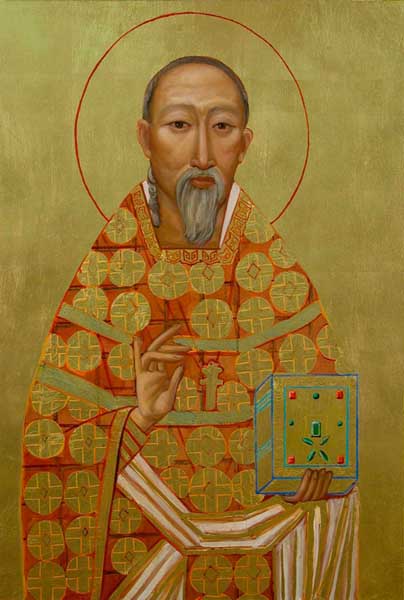
An icon of Father Zhao Rong was completed by the brilliant Chinese artist Ken Jan Woo. Many of his icons and sacred art can be seen at his website http://www.kenwooart.com/index.html. Classically trained, Ken brings a new contemporary spirit to the sacred images of the Church’s past history. His exquisite rendering of this saint, in a typical icon format, is powerful in its simplicity and harmony.
The witness of these Chinese saints, in association with the Gospel passage of Matthew 9: 18-26, begs a question: What sets St. Zhao Rong, his martyred companions, and the people in the Gospel apart from many in our society?

Jesus provided the people with faith-filled hope even when circumstances dictated that their situation was hopeless. Why is this?  It is because Jesus’ love for them, and willingness to share The Truth, was always directed back to His Father. Jesus tells us, “With God, all things are possible to those who believe.”

Jesus’ words were incendiary; for He said to the woman “Take heart, daughter – your faith has made you well.” That phrase “Take heart” ignited the woman’s expectant faith. Her belief allowed her to cooperate with the healing process.

Matthew’s Gospel passage provides witness to the local ruler’s spiritual courage to request Jesus’ help. The girl was already considered dead.  Professional mourners had already been hired to demonstrate the family’s public grief. The mourners and others in the crowd scornfully laughed at Jesus. Their grief was as bogus as their lack of faith. Jesus’ was ready to heal, teach, and be open to the needs of that family. It gave them a glimpse into the mind and heart of God; and it provides us with a model to follow, too.

Let our prayer be the prayer of the martyrs: Lord, you love each of us with a unique and personal love. As we face our troubles with confident hope, touch our souls with your saving power, and restore us to the fullness of your eternal life. Amen

Artwork Copyright © Ken Jan Woo. All Rights Reserved.

Copyright © 2011- 2020, Deacon Paul O. Iacono – All Rights Reserved. Permission to reprint must be obtained from the author in email/writing. Students, and those interested, may quote small sections of the article as long as the proper credit and notation is given. Thank you.

Luke 15: 1-3, 11-32. The Prodigal: Which Brother Are We?

I once heard a friend repeat a quote by the author Katherine Mansfield: If you wish to live, you must first attend your own funeral.”

How true. We begin to live life perceptively only when we project ourselves to the time of our own death, imagining how we’ve lived our life and wondering whether we’ve met the mark.

Depending on our frame of mind, and perspective on life, we may not include the spiritual in our self-assessment, or, only give it a passing thought. That is why Mansfield’s phrase may be viewed as spiritually deficient.

In today’s Gospel on the parable of the Prodigal Son there are family members that Jesus is requiring us to understand. The behavior of these people, the father and the two sons, provokes four questions. Questions not so much about our secular situation but our spiritual – our relation to God, and, each other.

At first glance, the younger son impresses us as an individual who is quite selfish. When he requests his inheritance from his father, he isn’t just asking for the cash, he is in effect saying to his father: “I want to live my life now and without any strings attached. To me you’re unimportant, this family is unimportant. Just let me get on with my life and give me my share right now.”

Are we living in  a way that categorizes God? Are we willing to acknowledge  Him only because we want to get something out of Him? Do we play upon His charity and generosity?

If this is so, if we have the younger son’s attitude, we end up like him – swimming with the pigs.  What will be our inheritance? It will undoubtedly be spiritual poverty and secular discontent. Sadly, sometimes people understand this only in the last few months of their life, or, in the moments right before their death.

Jesus is teaching us that the prodigal son was only able to enter into a state of recovery when he “attended his own funeral.” When he was able to perceive his own personal endpoint, his own material and spiritual poverty. He was finally able to admit that he was grievously wrong only when this realization slammed into his consciousness.

His new perception demanded that he learn the root causes of his problem, reject his worldly self, and humbly ask for repentance. He needed to realize that his father and family were all important to his happiness. This required acceptance of and humbly requesting his father’s mercy and love.

This perception did not demand psychoanalysis. He did not need years of therapy on a psychologist’s couch. He had the intelligence to figure it out because he confronted himself as he truly was and extended that personal analysis to his family and surroundings. He acknowledged his sins, and how truly needy he was of his father’s love and mercy.

We are half way through the Season of Lent. Like the younger son, have we confronted our own faults, our lack of perception, and yes – our own sins?

The Prodigal says: “I will arise and go to my father, and will say unto him, father, I have sinned against heaven, and before you.”

This is the turning point in the Prodigal’s life. It can also be ours.

Improvement begins with a decision to change the way we do things, the way we behave and perceive reality, both in a secular and spiritual sense. If you are a Western Rite Catholic, this is accomplished in three ways: Sacramental Confession, prayer, and resolution of purpose. Reconciliation is always possible. Our God is a God of justice, but also, a God of infinite familial love and mercy.

Do we behave like the younger son or the elder son? Are our hearts cold?

What the younger son ultimately accepts the elder son initially rejects. At first, the elder son resents the generosity of the father’s love – he resents the generosity of the act of forgiveness. It appears that he is unable to accept his repentant brother or his generous father.

Does this, in any way, apply to us? Do we ignore the Father, Son, and Holy Spirit’s love for us; do we resent people who have converted, changed their spiritual way of life? Or do we continue to judge them as if they were still enveloped by their sins? Do we verbalize our resentment or question their repentance? Are we unwilling to repent of these attitudes? Are our hearts cold?

I am a sinner and you are a sinner. There are very few people on this earth that are living saints. Regardless of whether our sins are small or large, visible or hidden, it is paramount that we remember the words of St. Paul: God the Father “reconciles us to Himself [through the passion and death of His Son] and has given us the ministry of reconciliation. Be reconciled to God. For our sake He made Him [Jesus Christ] to be sin who did not know sin, so that we might become the righteousness of God in Him” (2 Corinthians 5: 17-21).

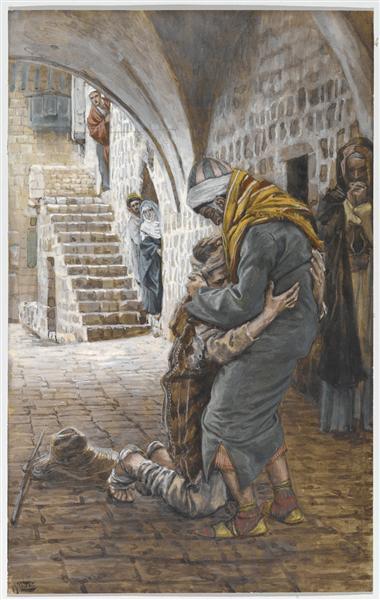
We need to take stock of ourselves this Lenten season, repent and return to the Father’s embrace. This can only be done through the Sacrament of Confession/Reconciliation – a Sacrament made possible through the life, death, and resurrection of Jesus Christ, our Lord and Savior.

the-return-of-the-prodigal-son-illustration-for-the-life-of-christ1.jpglarge
Painting by James Tissot (French; 1836 – 1902). “Return of the Prodigal Son.”

Thank you for reading this post.

 Copyright © 2011- 2019, Deacon Paul O. Iacono – All Rights Reserved. Permission to reprint must be obtained from the author in writing. Students, and those interested, may quote small sections of the article as long as the proper credit and notation is given. Thank you.


The Holy Trinity – Communication Through Word and Art

Is communication just a trait of human beings? Is it a trait of God?

The Dogma of the Holy Trinity is one of the great Mysteries of the Christian Faith.  All Christians acknowledge and accept that The One True God, the divine Holy Trinity, are three separate and distinct Persons of the Father, Son, and Holy Spirit. The Holy Trinity is not three separate Gods. They are one God in three Divine Persons. This is known as the dogma of the “consubstantial” Trinity: each of the three Persons is God – completely and entirely.

These ideas were debated and verified by the assembled bishops at the First Council of Nicaea in AD 325 and subsequent Councils (specifically the ecumenical Council of Nicaea/Constantinople in AD 381).

In the 13th century the Fourth Lateran Council stated: “Each of the Persons is that supreme reality (nature, essence, and substance) of God” (confer Catechism of the Catholic Church, 2nd edition, paragraphs 198 through 315, pp. 54-84).

These three Divine Persons relate and communicate among themselves and desire to communicate and relate with Their creation. This is verified through Holy Scripture, Sacred Tradition, and the historic teachings of the Apostles, the Ecumenical Councils, and the saints of the Church.

The  first of Their creation, the nine choirs of angels, communicate with God and each other, too.

Obviously, human beings communicate and relate through speech, behavior, and the written word, though at times, not very well. To a much lesser extent, there is “communication” in the other members of the animal kingdom (by instinct, chemical, and behavioral signals) and in the plant kingdom (through chemical signals).

God the Father has communicated specifically through His Word, the incarnated Son, Jesus Christ. In accordance with the Father’s will the human Jesus is “born of a woman” into space and time through the great Mystery of the Incarnation of Christ.

Jesus agreed to humbly obey His Father’s will. Through His Incarnation the Divine Son Jesus expresses His two natures: human and divine. He does this while “hiding” the full majesty of His divinity (except for the moments of His Transfiguration, Resurrection, and subsequent appearances to His Apostles).

The Holy Spirit (as the Council of Florence stated in 1439) “Is eternally from the Father and Son; He has His nature and subsistence at once from the Father and the Son. He proceeds eternally from both as from one principle and through one spiration (the life-giving breath of God).”

“When the Father sends His Word to His Creation He also sends His Breath. “Jesus and the Holy Spirit are on a joint mission, while at the same time being distinct but inseparable. It is the Son who is seen, the visible image of the invisible God, while it is the Holy Spirit that reveals Him.” (please refer to page 181 of the Catechism of the Catholic Church, 2nd edition, also pages 54 through 90).

The Holy Spirit communicates and spiritually shapes us through the Holy Scriptures, liturgical and private prayer, the teachings of the Western and Eastern Rites of the Church, and with the Father and Son in the seven Holy Sacraments (in the Eastern Rites – the Holy Mysteries).

The solemnity of Pentecost recalls the full expression of the Holy Spirit’s “Fruits and Gifts” to the Apostles, and through the Holy Sacraments to us, too  (refer in the Christian Scriptures to the Acts of the Apostles chapter 2, verses 1 – 42; and in St. Paul’s letters to the Galatians chapter 5: verses 22 ff; and 1st Corinthians chapter 12, verses 4 ff; also refer in the Hebrew Scriptures  to the book of the prophet Isaiah chapter 11, versus 2 – 3).

iconorininal
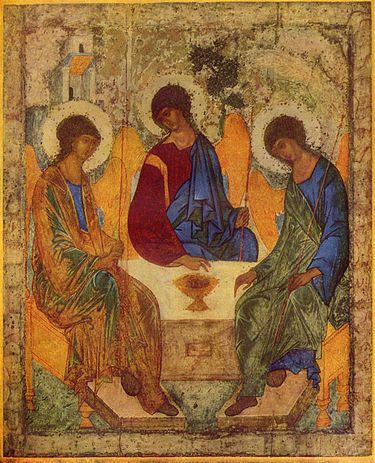
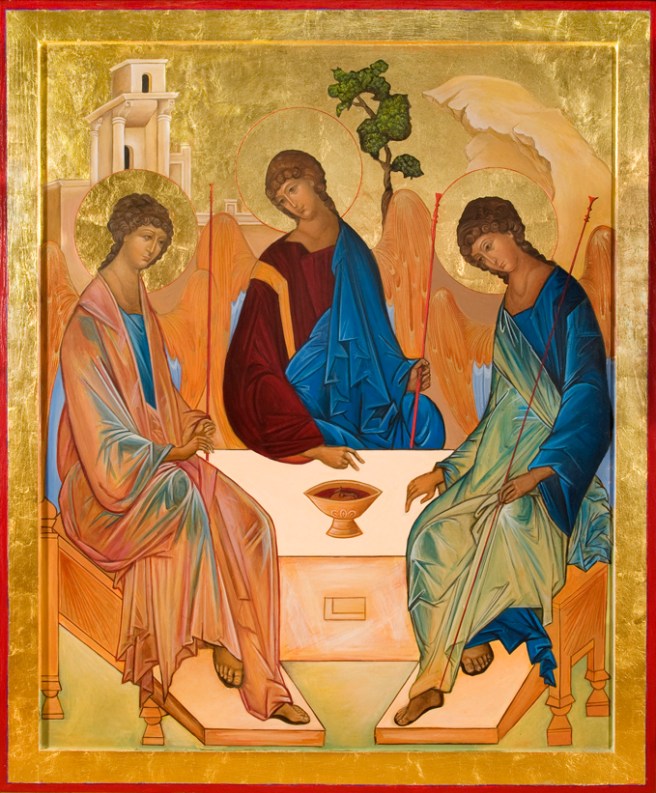
“The Trinity”: early 15th century; egg tempera and gold on wood panel by St. Andrei Rublev (1370 – 1430).  St. Rublev was a Russian Orthodox monk. He resided and “wrote” with egg tempera paint to produce images of God, the angels, and the saints in sacred  icons. He lived at St. Sergius Monastery in Moscow, Russia. His sacred icon above captures some of  the truth of the Three Persons of the Holy Trinity communicating with each other. God the Son, Jesus Christ, is the figure in the center of this painting.  You see two of His fingers extended to express His human and divine nature, and in a pointing gesture, to the “Cup of His Blood”  made manifest through His Redemptive sacrifice. In this masterpiece you observe the colors blue representing divine life and purple madder/burgundy signifying Christ’s humanity. God the Father is on your left and God the Holy Spirit is on your right. The Holy Spirit is garbed in blue and in green as a symbol of new life and spiritual growth through prayer and the Holy Sacraments (Holy Mysteries). God the Father is painted in both blue, green, and a very light, transparent gold ochre. The First Council of Nicaea (AD 325) verified and promoted the Dogma of the Holy Trinity. This Dogma was reaffirmed, and further explained by the Council of Nicaea/Constantinople in AD 381.


trinityicon
A contemporary copy of the original Trinity by Rublev.

God the Father sent His Son to be born of a woman through the fecundity of the Holy Spirit. The Incarnation of Jesus Christ changed the Universe. God became flesh and walked among us. Why?  In order to teach, heal, and redeem us from our sins. The New Covenant with His creation is written in His Blood. There is, if you have the gift of faith, ample proof that God wants to communicate with you.

It is up to each man and woman to honestly determine whether or not they are ignoring Him, and if so, to decide what to do about it. Time is short.

Copyright © 2011- 2019 Deacon Paul O. Iacono All Rights Reserved.

God is a God of Compassion

“God of all compassion, Father of all goodness,

to heal the wounds our sins and selfishness bring upon us

You bid us turn to fasting, prayer, and sharing with our brothers and sisters.

We acknowledge our sinfulness, our guilt is ever before us;

when our weakness causes discouragement,

let your compassion fill us with hope

and lead us through a Lent of repentance to the beauty of Easter joy.

Grant this through Christ our Lord.”*    Amen.


*Roman Breviary – Vol. 2; Third Sunday of Lent, Evening Prayer I, Closing Prayer, pg. 210.

Rembrandt_Harmensz._van_Rijn_-_The_Return_of_the_Prodigal_Son_-_Detail_Father_Son

Rembrandt-The_return_of_the_prodigal_son
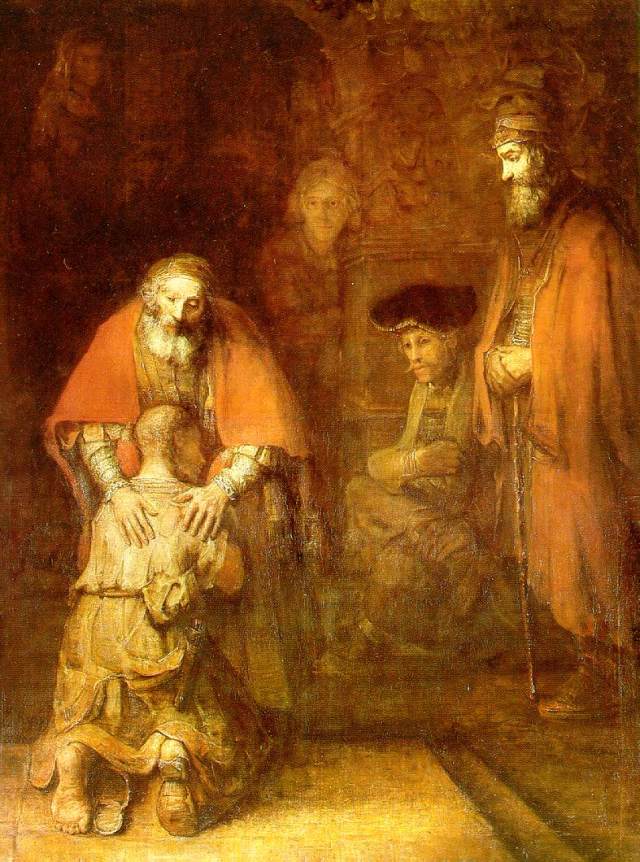
Rembrandt van Rijn, The Return of the Prodigal Son, c. 1661–1669.

Luke: 16: 19-31 – Is Lazarus in Your House?

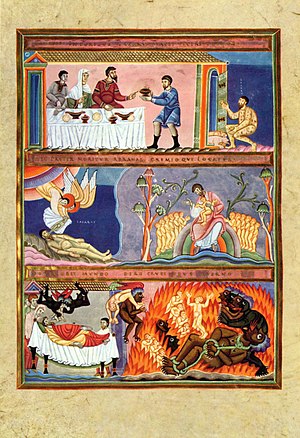
This passage from the Gospel of St. Luke is a parable about a destitute man named Lazarus and a rich man, who at times is called by the name Dives (the word dives in the Latin Bible refers to a “rich man”).

Jesus places Lazarus sitting day after day by the rich man’s front door. Lazarus is sick. He is at Dives’ home hoping to receive a scrap of food from his table. The food never comes.

Jesus continues to tell the story which culminates in the death of both men and their subsequent judgment.  Lazarus is welcomed into Paradise and is seen talking to Abraham, while Dives is condemned to the flames of Hell hoping for a drop of water to quench his thirst.

The parable concludes with Abraham rejecting Dives’ wish that someone from Paradise will inform his relatives of his eternal sentence in an attempt to get them to change their way of life.

Abraham says that it is fruitless: “‘If they do not listen to Moses and the prophets, neither will they be convinced even if someone rises from the dead.'”

You see its not just the issue of Dives, as a fellow human being, not providing nourishment and solace to Lazarus. It is the fact that Dives does not even acknowledge Lazarus. He and his servants pass him every day with no perception, no acknowledgement, no understanding, no charity.

How many times have we done that to men and women standing at intersections, asking for a scrap that falls from our table. We get uncomfortable at the thought that they are there. Irritated at bad government decisions that pushed them out on the street, supposedly to be helped by the social justice safety nets; nets filled with holes. I saw a woman today holding a sign that said “I need a miracle.” There was no exclamation point or happy face penned next to it.

Lazarus may be outside our front door, or, even in the house.

Question: are we passing by people in our own family who are in need? The neighbor who lives next door? A member of our parish? Are we passing by Jesus Christ?

Lent is the natural time to reflect on how well we remember and assist, in some small way, those around us who are in need. It may be financial help, or it might just be they need someone to talk to.

Upon reflection, we may find ourselves missing the mark, even committing sins of omission. Let’s remember that, unlike Dives, we still have time to do something about it.

300px-Meister_des_Codex_Aureus_Epternacensis_001
“Meister des Codex Aureus of Echternach” (the Master’s Golden Book of Echternach) – a page from this illuminated Gospel created in the mid 11th century. When seen by the Holy Roman Emperor, Henry III, it stimulated him to commission similar manuscripts from the Abbey of Echternach (Germany).


My thanks to Rev. Msgr. Anthony Mancini, Pastor of the Cathedral of St. Peter and Paul, Providence, Rhode Island USA, for stimulating this blog post.

Copyright © 2011- 2019 Deacon Paul O. Iacono – All Rights Reserved.

Christ in the Wilderness: Lent – the Season of Preparation – Luke 4: 1-2.

Jesus, full of the Holy Spirit, returned from the Jordan and was led by the Spirit into the wilderness, where for forty days He was tempted by the devil. He ate nothing at all during those days, and when they were over, He was famished. (Gospel of Luke chapter 4: verses 1-2)

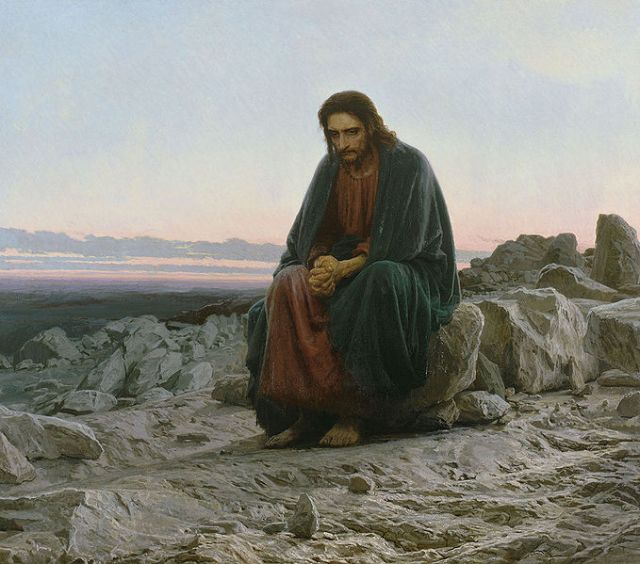
In the extraordinary painting  below, we see Jesus after He was led into the desert wilderness by the Holy Spirit. He is surrounded by rocks and sand. He sits on a boulder, hands in front of Him. His eyes are filled with the knowledge of reality, of passions, power, and pain, ego and emptiness, sin and self aggrandizement.

This painting may move us from the awareness that in the desert wilderness Jesus is not only thinking through His ministry, Passion, and death but is also viewing our lives – our ministries, our passions, our death.

What do we see?

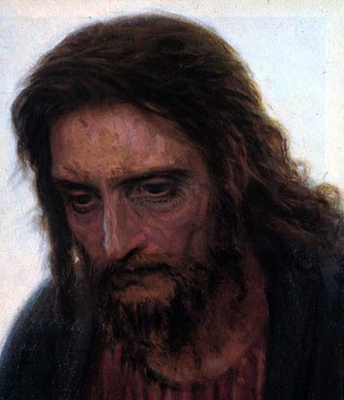
Let us examine His face.

christ_in_the_wilderness_detail_400

We see the seriousness of the forthcoming temptations; the physical, mental, and the spiritually violent struggle with the devil. It is written plainly upon His emaciated face.

We see the irrefutable fact of Jesus’ humanity.

We see that He is like unto us, except for sin.

This is the face of our Savior; but the victory is not His, yet.

His temptations, public ministry, Passion, and death are still to occur.

What do we see?

We see a man who knows His Mind. He knows His Body, Soul, and Spirit.

He knows His freely accepted duty to accomplish His Father’s will.

This is not the face of a defeated man. It is the face of a determined man who is also Lord and Savior.

**679px-Kramskoi_Christ_dans_le_désert

Observe Christ’s clenched hands, gaze deeply into His eyes, and you will see the artist’s portrayal of a Savior that is already, at the beginning of His ministry, aware of the viciousness of the tempter and the burden of our sins. Sins accepted by Him, and through His Passion and death, makes all things new.

christ_in_the_wilderness_detail_400

Jesus had to confront in that desert assault whether or not He was going to be faithful to His mission.

The Gospel passage above challenges us with the same questions: are we going to be faithful to the Commandments, to our Baptismal promises, to the mission given us in Confirmation to live and practice the truths that He taught us?

Are we going to be faithful to the spiritual power and grace given to us, not just when we feel like it, but even in the most difficult of circumstances?

As disciples of Christ we are on a daily basis constantly revolving around the axis of temptation and sin – faith and grace. We understand that temptation, in and of itself, is a test – it is not sin. It is only sin when we willfully place ourselves in its shackles, when we give into its fueled power to overwhelm our body and soul. That power  – a deadly power – obtains its animus and energy from the original tempter and liar – Lucifer himself.

Hell is real. It is not a mental construct. To say that it doesn’t exist is to call Jesus a liar, and His Passion, death, and Resurrection meaningless.

Jesus the Christ lived heroically in the face of Hell’s demons and witnessed to the power of God’s grace.

But you say, I am not Jesus Christ, I am a weak man or woman, boy or girl.

I say true, we all are; but by virtue of our faithful reception of the Holy Sacraments (Holy Mysteries) of Reconciliation (Penance/Confession) and the Holy Eucharist we have the power of Christ’s grace within us. A power, freely given by God and unmerited by us, to resist and overcome temptation and sin.

If we do sin – if we do “miss the mark” – we have a remedy.  We follow St. Paul’s advice: pick yourself up, dust yourself off (confess your sins), and confidently continue on your journey. We must do our part in cooperation with God’s love and mercy.

The Season of Lent is a time of joyful repentance, prayer, and fasting.

Let’s remember the  words of Nehemiah, who in the Hebrew Scriptures says: Today is holy to the Lord your God. Do not be sad, and do not weep; for today is holy to our Lord. Do not be saddened this day, for rejoicing in the Lord must be your strength! (Nehemiah 8: 9-10. 5th century BC)

***

The painting above was created and completed in the late 19th century by Ivan Kramskoi. He was a gifted Russian painter, noted portraitist, draughtsman, and teacher. The painting is entitled Christ in the Wilderness.

Copyright © 2011- 2019 Deacon Paul O. Iacono All Rights Reserved. Portions of this essay may be used in accordance with correct notation and bibliographical insertion; contact deaconiacono@icloud.com for more information or questions.

Fra Angelico – “Heaven on Earth” Exhibition – Part 2 – Ascension, Pentecost, the Last Judgement

I hope you had a blessed Feast of Pentecost!

Please read Part 1 of “Fra Angelico – Heaven on Earth” (posted here on May 16, 2018) in order to receive a proper introduction to the Isabella Stewart Gardner Museum’s extraordinary exhibition that, unfortunately, closed this weekend..

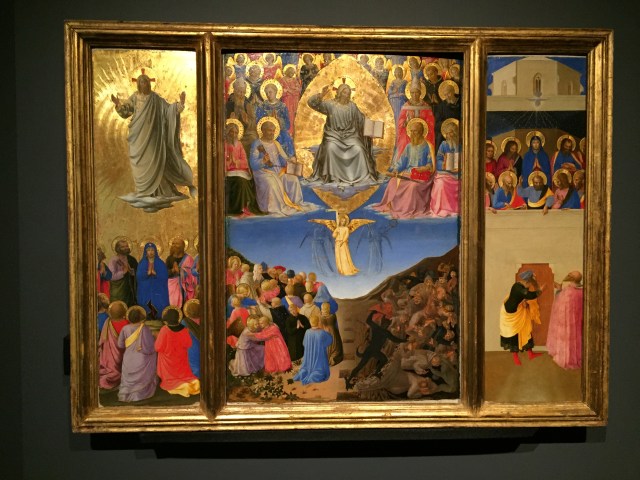
As you moved into the gallery that exhibited this once in a lifetime collection of Fra Angelico paintings you first saw the beautiful painting entitled The Ascension of Christ, The Last Judgement, and Pentecost (the Corsini Triptych). It is painted in egg tempera with gold leaf on a wood panel. Fra Angelico painted it during the years 1447-1448, seven years before his death in 1455. It was loaned to the Gardner Museum from the Galleria Nazionali d’Arte Antica di Roma – Galerie Barberini Corsini, Palazzo Corsini.

My photographic images of that painting are found below:

The Ascension, Last Judgement, and PentecostIMG_1686

The following quotation is taken from the Exhibition’s commentary found on the right side of the painting. Mesmerizing in its detail, Fra Angelico’s painting pictures three biblical events. At left, Christ ascends into heaven over the heads of the Virgin Mary and the  Apostles. At right, a masterfully foreshortened dove – the Holy Spirit – descends to earth. The story culminates in the center. Christ passes judgment over the living and the dead, saving the worthy (left) and condemning the wicked (right). While the damned cower from fearsome devils who attack the poor souls with claws, angels embrace the blessed.

“This small devotional triptych – a painting with three parts – served a cultivated individual, probably a cleric (deacon, priest, or bishop) in Rome.” Please compare its three episodes to others in my upcoming posts. In the above painting Fra Angelico adopts a vertical presentation. This energizes the connection and communication between heaven and earth. The Gardner Museum’s curator remarked that this technique “enlarges the central scene, and emphasizes” the Catholic Church’s spiritual power.

Fra Angelico, as a Dominican priest, desired to present that Jesus’ act of Redemption (passion, death, and resurrection), and His Ascension back to the Father, made possible the moment of Pentecost. Christ’s actions enabled the eventual opportunity for our free will to choose to accept His Truth and be fed by the Spirit’s power. It is the Father and the Son’s will to have the Holy Spirit nourish us through His grace. This grace is available to us through the proper administration and worthy reception of the Holy Sacraments. Thus, we come to the central panel –  the Last Judgement. Did we freely accept His Sacramental grace or did we ignore, and thereby, reject it? At that moment will we be on the right or the left of Christ?

Allow me to make some personal points on the three close-up photos below. In the first panel of this painting, notice the gold work around the body of Christ. I was allowed to closely examine it. I have never seen a painting’s gold work done with such precision and delicacy. It is not just gold leaf that is applied in a flat manner to the panel. It appears to be actual raised strands, or threads of gold, all applied with great precision. As you slowly move left or right around that part of the painting you notice the light catching the gold and literally radiating and shimmering around the image of Christ. IMG_1745

The Ascension, with Pentecost below.

Second, the image of Pentecost, with the Blessed Mother in the center of the Apostles as the dove hovers and the fire of the Holy Spirit descends upon them and gives them the gifts and fruits of the Holy Spirit (Isaiah 11:23; 1st Corinthians 12: 4 ff; Galatians 5: 22 ff).

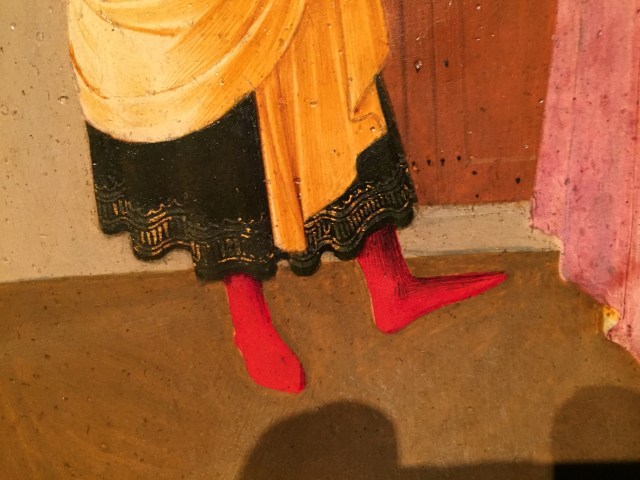
Notice St. Peter, filled with conviction, speaking to the assembly of men below (“Peter’s Discourse” found in the Acts of the Apostles chapter 2, verses 14 ff.). Also, notice the clothing on one of the men who gather outside of the upper room listening to Peter: the detail of the lace work on the bottom of one of his garments, and the shadows on the man’s red leotard/shoe. If you stand away from the painting at approximately eight to ten feet to take it all in (as you see in the panoramic top photo) you don’t notice all the detail; but the blessed Fra with his extraordinary perception, noticed the need for it, and he painted it in. A master of detail, and as a true maestro, he knew how to successfully accomplish it. Wonderful!     The last two close-up pictures are below.

IMG_1748

IMG_1749

My photos (through the kindness of the Isabella Stewart Gardner Museum), and            my text © Deacon Paul O. Iacono 2011-2018. Photos taken with an iPhone 6, no flash.


Fra Angelico – The “Heaven on Earth” Exhibition – Part 1

The Isabella Stewart Gardner Museum in Boston, Massachusetts is the only venue in America for the extraordinary “Fra Angelico: Heaven on Earth” exhibition. This amazing collection of reliquaries which express the life of the Virgin Mary, and other paintings of the greatest painter of the Early Renaissance, will be on display until this Sunday May 20th, 2018. Earlier incorrect media reports had the last day as May 28th.

I will be posting my photos of the Gardner Museum’s exhibit starting with this post and continuing on through the upcoming weeks and months. The exhibit consists of more than just the exquisite four reliquaries and it will be my pleasure to bring to you my photos of all of it. I am grateful to the Isabella Stewart Gardner Museum for allowing me to take photographs of the exhibit.

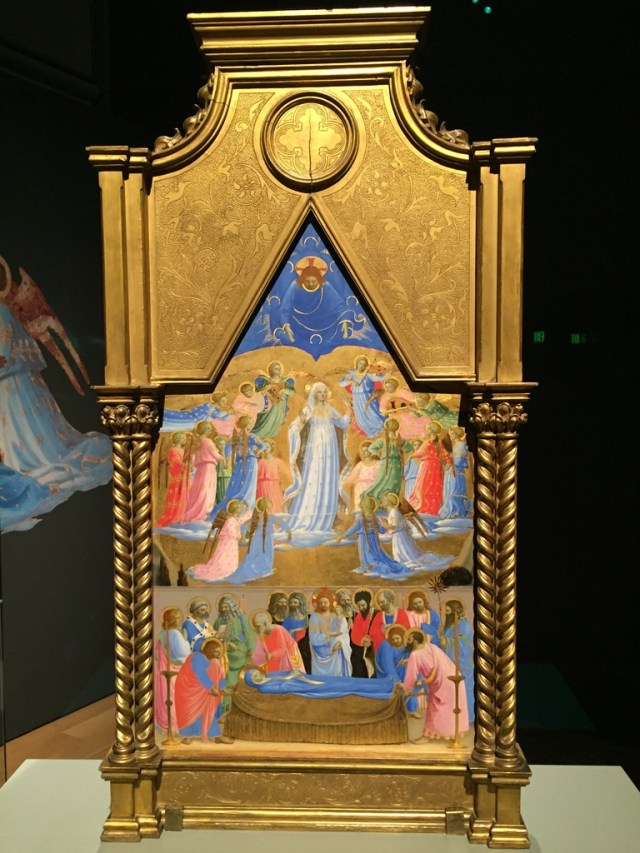
I will proceed with the first photo showing the image that you see as you climb the stairs of the Museum to the second floor where the exhibit is located. That image is of the Assumption of the Virgin Mary, surrounded by angels as she ascends in a vortex-like movement, toward God the Father. The reliquary containing the complete image was acquired by Isabella Stewart Gardner in 1899. This is the first time in history that all four reliquaries are reunited since they were split up and acquired by collectors and museums around the world.

My wife and I were privileged to visit the Museum and exhibition last week. Words cannot describe the restored reliquaries and paintings in this display.  I am not embarrassed to say that at one point I was choked up with emotion as to the beauty, technical skill, narrative brilliance in explaining Sacred Scripture, and the theological depth that Fra Angelico expressed in these sacred images.

Beato Fra Angelico (birth name Guido di Pietro) was a Dominican friar and known by his religious name as Brother John of Fiesole. The first historical record of Fra Angelico as a painter is the 1418 record of payment for a painting commissioned by the church of Santo Stefano al Ponte in Florence. Fra Angelico is believed to have been born in the late 1390’s and died in 1455. He is buried in Rome at the church of Santa Maria sopra Minerva. He was beatified (beato) by Pope Saint John Paul 2 on October 3, 1982, and in 1984 the Pope declared that Fra Angelico was the patron of Catholic artists (that is why I named this blog after him). Beato Fra Angelico’s feast day is celebrated every year on February 18th.

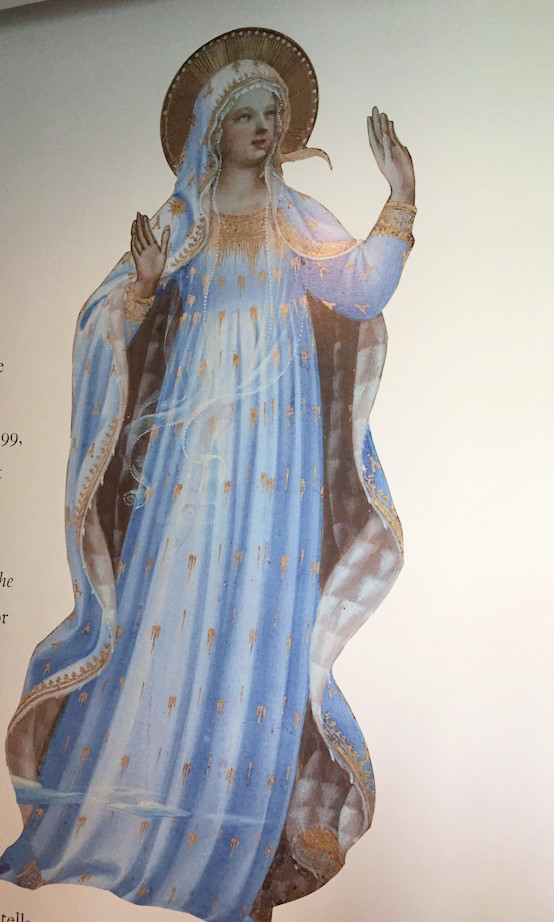
As you come up the stairs  leading to the second floor of the Museum and turn the corner you first see an enlarged version of Fra Angelico’s Dormition and Assumption of the Virgin located below. This image is showcased because it is found within the reliquary acquired by Isabella Stewart Gardner in 1899.

Adj ASSUMPTION FRA A.

This enlarged version of the Virgin Mary is found within the reliquary, and is its centerpiece, seen below.Dormition and Assumption

The above outer frame and base, which contains Fra Angelico’s painting, is known as a   reliquary. A reliquary is a container which holds the relics (bones, hair, etc) of deceased holy people or declared saints of the Roman Catholic Church. The reliquary allows the faithful to venerate, not worship, the life, deeds, and mortal remains of the person whose relics it contains. Fra Angelico painted the four reliquaries’ images specifically for the church of Santa Maria Novella in Florence between the years 1424 through 1434 The painting is rendered in egg tempera, oil glazes, and gold. It is simply stunning.

There is another separate painting in the exhibit which concentrates just on the dormition of the Virgin Mary. I will show that to you in the next post.

The “Heaven on Earth” exhibition is made possible with the support, in part, by the Robert Lehman Foundation and the Massachusetts Cultural Council (the Council receives its funding from the State of Massachusetts and the National Endowment for the Arts). The media sponsor is WBUR in Boston. The Museum’s Executive Director, chief conservator, curators, conservators, and support staff brilliantly provided the technical expertise and planning for this exhibit. The companion book, edited by Dr. Nathaniel Silver (with contributions by more than ten experts) is also very well done and a worthy addition to your library.

Photos and text © Deacon Paul O. Iacono 2011-2018. Thanks again to the Isabella Stewart Gardner Museum for this beautiful exhibit and enabling the public to enjoy, be edified, and to take photos of it.

Mary and Joseph’s “Yes” – The Risk of an Open Heart

Our Gospel today (4th Sunday of Advent, Matthew 1: 18-24)) provides us with the story of a young couple, Mary and Joseph, who through their pondering of God’s request for understanding and trust provide humanity with the opportunity for divine Redemption. It is in their collective “Yes” to the angel’s request, that God’s plan could be fulfilled. His strategy for humanity’s Redemption was patiently planned and executed. It was a plan, seen in the Holy Scriptures, that shows Him searching for His broken human family, seeking ways in which He can communicate His desire for love and friendship.

God is very methodical in His attempts to search for His lost children. The first question ever asked in Holy Scripture is found in the book of Genesis. It is there that God asks the question: “Where are you?” He asks of the first family, Adam and Eve, “Where are you hiding?”  We know that they were hiding because of their sin; because of their collective “No” to God’s request of them to stay away from the Tree of Knowledge of Good and Evil.

With their sinful actions, God set into motion His plan for our Redemption – a plan that ultimately saw His entrance into human history to teach, heal, and redeem it from the sins of our spiritual parents. At the birth of Christ, the seven hundred year old messianic prophecies of Isaiah became a historic reality; and on a yearly basis, we celebrate that moment at Christmas.

But today we also need, in light of our Gospel, to pause and rejoice in remembrance of Mary and Joseph’s courage and willingness to say, “Yes,” to God. We need to consider that their “Yes” was not a simple act – it contained enormous risks since Mary’s circumstances after that “Yes” were at the very least – precarious.

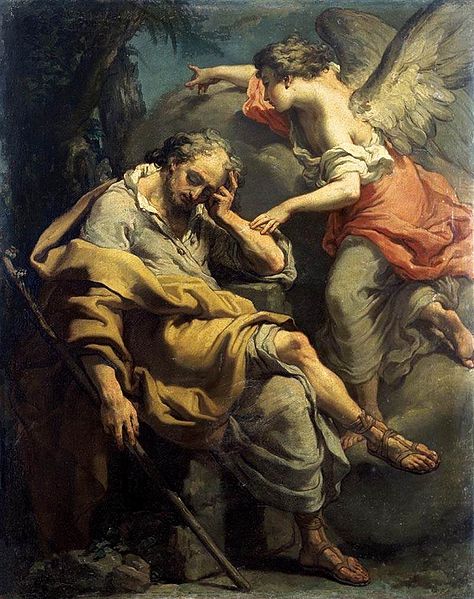
She was a young woman, probably in her mid teens, engaged to be married, and is suddenly pregnant, not from the man she loves, but, by an unseen Holy Spirit of God; moreover, what about Joseph? He was a successful carpenter in Nazareth who had fallen deeply in love with Mary, was publicly betrothed and ready to live a happy life with her. Then the news: “I’m pregnant.” As a result under Jewish law, Mary faced a public humiliation and stoning and Joseph, stunned and confused, faced feelings of betrayal, pain, and anger. Understandably, at first, he is not ready to say “yes” to Mary and her story of divine intervention, there are few men that would.

But through divine intercession you have God, through His angel, making another request:

474px-'Joseph's_Dream',_painting_by_Gaetano_Gandolfi,_c._1790

“Joseph, Joseph, do not be afraid to take Mary your wife into your home.” With Joseph’s “Yes,” to this request his pain and anger subside and are replaced with a joyful nurturing spirit that enables him to take leadership of the situation and begin acting as a faith-filled stepfather. So the collective “No” by our spiritual parents Adam and Eve, is now trumped by the collective “Yes” of the first Christian family: Mary and Joseph.

Now it may be hard for us to relate to this Gospel. Our lives may be filled with anger, worry, family resentments, and disappointments. We may conclude that this story really doesn’t relate to us because the sharp axe of pain and frustration has severed the roots of our own sense of joy, hope, and love. If that is our dilemma, we must call out to God for His direction and try to remember, that in this Christmas season we can, with His help, change our focus. We can say, maybe for the first time with maturity, “Yes” to God and His call to us. You see the story of Mary and Joseph and the Christ child is absolutely relevant. For the angel’s request to Joseph of “Be not afraid” applies to us, too.

The request of  “Be not afraid” involves many different opportunities: the opportunity of forgiving others who have hurt us; or confronting our own sinfulness and unburdening ourselves of our sins, or the opportunity of being a person who desires to seriously investigate their faith and explore the reasons why we believe.

You see all of this involves the same risk that Mary and Joseph experienced: the risk of exposing our mind, heart, and soul to God’s love and allowing Jesus, through His sacramental grace, to be joyfully born into our own hearts and to give us the courage to truly live as a Catholic Christian.

So my brothers and sisters, as we make our final preparations for the celebration of Christmas, let us make every effort to imitate Mary and Joseph by saying “Yes” to God’s call, and in so doing, open the doors of our own hearts to provide a loving home for the Lord.

hol fam-1

Copyright © 2011- 2013 Deacon Paul O. Iacono All Rights Reserved. This is a homily that Deacon Paul O. Iacono delivered at the 8 and 10 AM Masses at St. Francis of Assisi Church in Wakefield, Rhode Island USA on Sunday December 22, 2013. Information on the painting: This painting was completed by Gaetano Gandolfi (1734 – 1802). It is entitled Joseph’s Dream, is oil on canvas, and is approximately 37 inches high by 30 inches wide. It was completed in 1790.  Information on the mosaic: Detail of the apse mosaic in the St Joseph’s chapel of Westminster Cathedral. It was installed in 2003, and the designer is Christopher Hobbs who worked with mosaic artist, Tessa Hunkin. – See more at: http://elmiradominicans.blogspot.com/2011/12/holy-family-of-jesus-mary-and-joseph.html#sthash.vVewiGgP.dpuf

Saint Monica – Patron of Mothers

Today is the memorial of St. Monica, the extraordinarily faith-filled mother of St. Augustine.

In the year 321, Monica was born in Algeria into a family that was devoutly Christian. As a child she was baptized a Christian and was raised to be a dutiful wife. She was given in marriage to a bad tempered, adulterous pagan official, by the name of Patricius.

In examining the life of Saint Monica one is struck by the extent of the abuse she and other women endured throughout their marriage. Under the laws of the time Monica’s husband could physically and emotionally abuse his wife. Compounding the problem was the fact that Patricius’ mother also lived with them and she, like her son, ridiculed his young wife. Monica had three children with this man and, of course the most famous was her oldest, the man that history now knows as Saint Augustine.

But it is important to reflect for a moment on how she dealt with all the stresses of her life: family relations that mistreated her, children that ignored her model of conduct and faith, a culture that looked the other way when her husband abused her. The circumstances of St. Monica’s life could easily have made her a miserable woman, a sour daughter-in-law, and a depressed parent, yet she didn’t become any of these; instead, she became a saint. A saint that is known for two major personal qualities: her love of Jesus Christ and her prayerful persistence in bringing her physical family into the family of God. This beautiful painting, by artist John Nava, (http://johnnava.com) eloquently captures her spirituality and desire for prayer and union with Christ.

Monica was upset to learn that Augustine had accepted the Manichean heresy and was also living an immoral life. Manichaeism stated, among other things, that there is no all knowing good power, so there is neither lord nor savior. She was so angered by his beliefs that she refused to let him eat or sleep in her house and became enraged when he explained to her that his belief trumped her faith in Jesus Christ. She threw him out of the house, but later pursued him and attempted to reason with him.

Monica took comfort in the fact that she had a dream that assured her Augustine would return to the faith. From that moment she vowed to continually pray and fast for her son and to remain close to him so that she would have the opportunity to discuss her faith with him. The histories tell us that she in fact stayed much closer than Augustine wanted.

One night Augustine told Monica that he was going to the docks to say goodbye to a friend. Instead, he himself set sail for Rome. Monica was stunned when she learned of Augustine’s trick, but she booked passage on the next boat. When she arrived in Rome, she learned that he had left to travel to the city of Milan in northern Italy where he hoped to obtain a teaching post. Monica pursued him to Milan, and it is in Milan that both mother and son came under the influence of the great saint Ambrose who was bishop of Milan.

Bishop Ambrose became Monica’s spiritual director, and ultimately, she accepted Ambrose’s advice. He advised her that what she was doing was correct – that prayer and fasting would have its affect on the situation. He commended her persistence and directed her to keep the faith, and in humility, accept her circumstances. Monica did exactly that, and in Milan, became a leader of devout women, some of whom were also being abused by their husbands.

Ultimately, Saint Monica won the day; her abusive husband, mother in law, and her youngest son and daughter were all baptized into the faith. Augustine, too, eventually saw the logic of his mother’s faith, became a catechumen, and took religious instruction from Ambrose. In the year 387, Bishop Ambrose baptized Augustine into the Catholic faith in Milan’s cathedral.

Saint Monica was an exemplary mother; a woman who perseveringly pursued her wayward family not with threats but with prayerful cries to heaven. Let us pray that she intercedes for all mothers in our day so that they may learn to guide their children to God. Let us also pray that she teaches mothers, through her example of prayer and fasting, to remain close to their children, even prodigal sons and daughters, who have sadly gone astray.

St. Monica, pray for us.

Copyright © 2012 Deacon Paul O. Iacono All Rights Reserved. Painting of St. Monica is copyrighted by John Nava. All Rights Reserved.

Ken Jan Woo – sacred artist

Please see my post of July 9, 2020 entitled Chinese Martyrs and the Art of Ken Jan Woo. Thank you.


Our Living Hope: The Tomb Cannot Hold Us

Catholics, Orthodox, and Protestants  – we are all an Easter people. For two thousand years we have – through faith in historical documents and human witness – been invited to believe in a divine act of revelation: the Easter resurrection of our Lord and Savior; for it is in that act that our God shows us who He truly is.

We believe that the resurrection of Jesus is a historical and spiritual fact; and that the resurrection of Jesus not only explains the truth of His promises but it demonstrates what has been promised to us.

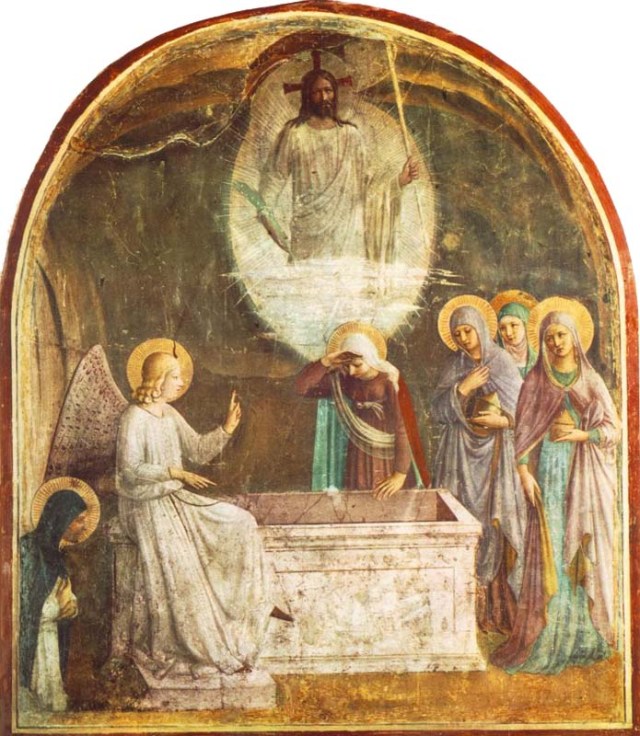
On the first Easter morning, Mary Magdalene, Peter, and John saw that the stone had been rolled away from Jesus’ tomb; and as they looked in  – they came face to face with their eternal destiny. Since no stone could have stopped the resurrected Jesus, it was pushed away not to let Jesus out – but to let them – and us – in.

Like Mary, Peter, and John, and all the others, we come to realize that we are an Easter people – which means that we are an eternal people – members, through our holy baptism, of the family of the eternal high God. The tomb could never hold the resurrected Jesus, and – as a people of faith – it cannot hold us.

St. Paul tells us in his epistle to the Hebrews that “faith is the assurance of things hoped for, the conviction of things not seen.” (11: 1)

But what is hope? Hope is trust based on a divine promise. We have hope because we trust the words and deeds of Jesus Christ. We trust in His promises to us.

Our hope interacts with our faith in Him – and we are forever changed because of it. You and I are certain of our faith, because we understand and rejoice in the hope that our God does not lie – our Scriptures do not lie  – our Sacred Tradition does not lie; so as an Easter people we possess the hope that St. Peter speaks of when he says: “…we have been born anew to a living hope through the resurrection of Jesus Christ from the dead.   (1 Peter 1:3).

As we celebrate the Easter season, let us – as our Lord tells us today – “Be not afraid”  – let us be joyful and thankful for the gift of faith and the willingness, in the face of all odds, to share our faith and joy with others.

May God grant you a joyous and creative Easter season!

The attached sacred image was painted by Fra Angelico in 1441 and is entitled “The Women at the Tomb.”       Copyright © 2012 Deacon Paul O. Iacono All Rights Reserved