Sacred Icons and Sacred Images – the Nicene Debate Continues!

AyaSofya
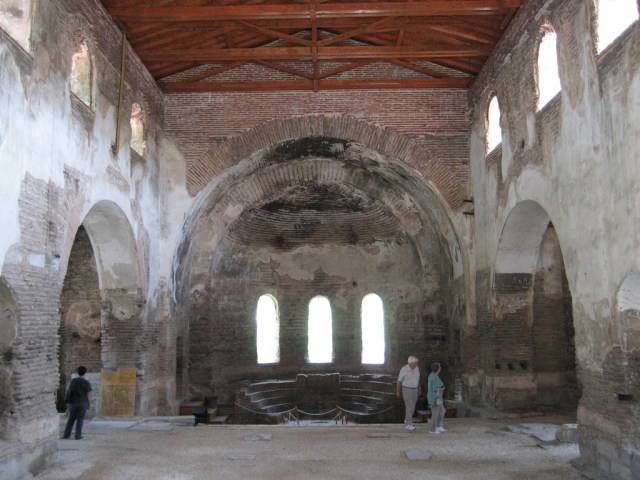
A photo of the inside of the Aya Sofya (Hagia Sophia) church in what is the present-day city of Iznik, Turkey. Iznik was called Nicaea prior to the rule of the Ottoman Turks . This photo shows the interior of one of the rooms in the  building complex that served as the location for the First Council of Nicaea (AD 325). Also, in the late 8th century the Seventh Ecumenical Council met in this building, too. That Council met to debate and decide the issue of iconoclasm (should sacred icons and images be prohibited and destroyed). The written arguments of St. John Damascene (Damascus) won the day and sacred icons were allowed to continue to be made. Iconoclasm was to raise its ugly head again in later years, and came to full fruition during the Protestant rebellion/reformation, the French Revolution, and worldwide Communism in all its cultural forms.  This photo of the inside of the Nicaean building is from Bryan Cross’ website: calledtocommunion.com. It was posted in May, 2010. Thanks Bryan!

I would like to thank one of my readers who identified the  contemporary icon of St. Spyridon (thanks Carol!). The iconographer is the Catholic priest William Hart McNichols. He is a very talented artist who paints traditional icons and sacred images. At times, he steps out of the bounds of the traditional approach and adds his own personal interpretation of the person he is portraying. His artistic vision is unique.

John Daly from Australia emailed me this morning to provide further grist for our mill concerning St. Athanasius, St. Spyridon, and the Council of Nicaea. One of the participants in his iconography school is a Greek Orthodox lady who is the sister-in-law of an Orthodox priest. He is coincidentally named Athanasius.

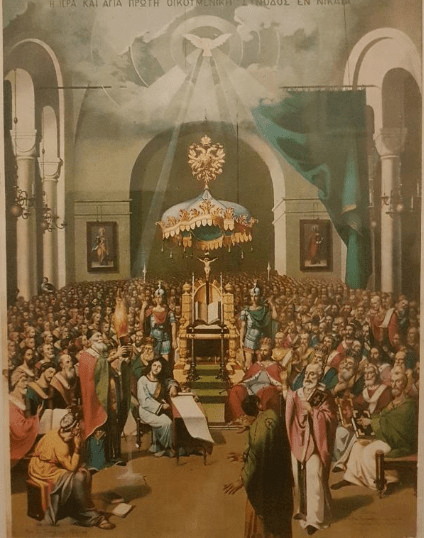
John had the opportunity to discuss with her the icons that we were analyzing in my posts of the last few days. She provided John some valuable information by explaining  that her mother had given her a beautiful sacred image of the First Council of Nicaea and specifically St. Spyridon’s role in the debate with the heretic Arius. The sacred image is below.
1555507279899blob.png
Greek Orthodox sacred image of the First Council of Nicaea. Notice St. Nicholas on the lower right about to possibly physically strike Arius who reacts by pulling away. On the left you see St. Spyridon, holding a brick with flames streaming upward and water puddling below it to the floor (confer yesterday’s post of April 16th to obtain the explanation of that imagery). The room of the actual Council, as portrayed in this sacred image is quite ornate.

Also, like the sacred icon we examined in yesterday’s post we see the Emperor Constantine, dressed in the royal robes of Byzantine reddish purple (almost a maroon) sitting on the right. On the Emperor’s right we again observe a bishop, maybe its Bishop Alexander of Alexandria, Egypt. In front of him we again see a deacon, dressed in what is either an alb or dalmatic (he would have to stand up to see all the garments).

In the above sacred image, the deacon is again seated at the scribe’s desk. This makes sense, since a deacon serves the administrative needs and report’s directly to his bishop. That is true to this day; yet, throughout the world today the local bishop has his deacons serving in parishes, hospitals, prisons, etc. rather than in an administrative capacity in the local chancery. Notice the bishop is behind the deacon scribe to facilitate accurate communication.

The above sacred  image, which I have never seen before John Daly sending it to me, is very well done. The painter has captured the meaning of the Council as a whole and two of its major participants: St. Nicholas’, in his famous interaction with the heretic Arius, and the great oratorical and mystical abilities of St. Spyridon challenging Arius, too.

Is the deacon pictured in the painting from the Latin Rite or is he Orthodox? Truly, there is no way to accurately tell because the deacon is seated, and what is showing of the deacon’s stole is inconclusive. Depending on the angle of view both the Western and Eastern Rites’ deacon’s stole placement looks the same.

In today’s painting and in yesterday’s post of the icon, the deacon is seated and the possible vertical panel on the Eastern Rite and Orthodox stole is in shadow or not detectable, yet, the panel that drapes from left shoulder and gathers at the waist is visible, and would appear, as you see below, in both Latin, Eastern, and Orthodox Rites!

Just between you and me, I think the deacon depicted in the icon, from my April 16, 2019 post and today’s, is St. Athanasius from Alexandria, Egypt. The Catholic Church, the Eastern Rites in union with Rome, and all the Orthodox Churches venerate St. Athanasius as a great saint and designate specific feast days for him. He belongs to all of us.

The deacon’s stole in the Eastern Rites of the Catholic Church that are in union with Rome; and, the Greek Orthodox, the Russian Orthodox, and Coptic Orthodox deacon stoles look like this:

Unknown
Orthodox deacon’s stole in a royal Byzantine fabric (in  what appears to be a royal maroon purple) is bordered in gold thread with gold crosses. Originating at the left shoulder, gathered at the waist, with the fabric of the stole hanging vertically on the left shoulder both in the front and the back. The stole is worn on top of  the ornate gold and white dalmatic.

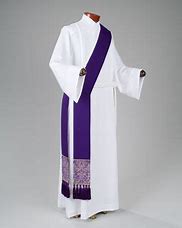
The cassock, alb, stole, and dalmatic all have the same meaning and functions in both the Western and Eastern Rites of the Church. In today’s Western, that is, the Latin Rite (Roman Catholic) tradition, a deacon wears the rank of his ministry and ordination, the stole, over the alb but under the dalmatic. Latin Rite deacons would wear their stole’s in this manner:
th-3
A Roman Catholic deacon’s stole running from the left shoulder and gathered at the waist, then hangs vertically under the right arm. It is worn on top of a white alb, and under a dalmatic. The dalmatic is only worn during Holy Mass. When the deacon performs baptisms, marriage and funeral services, liturgical prayer services, and formal blessings, etc. the deacon would not wear a dalmatic, so the deacon would appear as in the above photo wearing a simple white or cream colored alb and a stole in the appropriate color..  The stole’s fabric in the photo above is dyed dark purple for Lent; during the season of Advent a purple stole is used, too; sometimes, it is of a lighter purple than the Lenten penitential purple. A white stole would be used for Baptisms. Marriages, Funerals, Holy Thursday services, and during the Easter and Christmas season. Red stoles would be worn at Palm Sunday and Good Friday services, Pentecost, and on the feast days of martyrs.
th-5
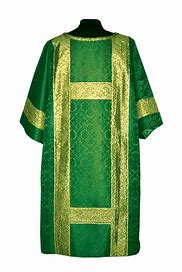
A Roman Catholic deacon’s dalmatic which is worn over the white alb and the stole. The dalmatic is in the corresponding color to the stole. The color green is worn during “Ordinary” time (which is the liturgical period that borders the great seasons of Advent, Christmas, Lent, and Easter).

I’ve really enjoyed this lively information exchange. Thanks to all who participated in it!

May you have a blessed Easter Tridiuum of the Passion and Resurrection of Our Lord Jesus Christ.

Peace be with you.

Copyright © 2011- 2019, Deacon Paul O. Iacono – All Rights Reserved. Permission to reprint must be obtained from the author in writing. Students, and those interested, may quote small sections of the article as long as the proper credit and notation is given. Thank you.

The Holy Trinity – Communication Through Word and Art

Is communication just a trait of human beings? Is it a trait of God?

The Dogma of the Holy Trinity is one of the great Mysteries of the Christian Faith.  All Christians acknowledge and accept that The One True God, the divine Holy Trinity, are three separate and distinct Persons of the Father, Son, and Holy Spirit. The Holy Trinity is not three separate Gods. They are one God in three Divine Persons. This is known as the dogma of the “consubstantial” Trinity: each of the three Persons is God – completely and entirely.

These ideas were debated and verified by the assembled bishops at the First Council of Nicaea in AD 325 and subsequent Councils (specifically the ecumenical Council of Nicaea/Constantinople in AD 381).

In the 13th century the Fourth Lateran Council stated: “Each of the Persons is that supreme reality (nature, essence, and substance) of God” (confer Catechism of the Catholic Church, 2nd edition, paragraphs 198 through 315, pp. 54-84).

These three Divine Persons relate and communicate among themselves and desire to communicate and relate with Their creation. This is verified through Holy Scripture, Sacred Tradition, and the historic teachings of the Apostles, the Ecumenical Councils, and the saints of the Church.

The  first of Their creation, the nine choirs of angels, communicate with God and each other, too.

Obviously, human beings communicate and relate through speech, behavior, and the written word, though at times, not very well. To a much lesser extent, there is “communication” in the other members of the animal kingdom (by instinct, chemical, and behavioral signals) and in the plant kingdom (through chemical signals).

God the Father has communicated specifically through His Word, the incarnated Son, Jesus Christ. In accordance with the Father’s will the human Jesus is “born of a woman” into space and time through the great Mystery of the Incarnation of Christ.

Jesus agreed to humbly obey His Father’s will. Through His Incarnation the Divine Son Jesus expresses His two natures: human and divine. He does this while “hiding” the full majesty of His divinity (except for the moments of His Transfiguration, Resurrection, and subsequent appearances to His Apostles).

The Holy Spirit (as the Council of Florence stated in 1439) “Is eternally from the Father and Son; He has His nature and subsistence at once from the Father and the Son. He proceeds eternally from both as from one principle and through one spiration (the life-giving breath of God).”

“When the Father sends His Word to His Creation He also sends His Breath. “Jesus and the Holy Spirit are on a joint mission, while at the same time being distinct but inseparable. It is the Son who is seen, the visible image of the invisible God, while it is the Holy Spirit that reveals Him.” (please refer to page 181 of the Catechism of the Catholic Church, 2nd edition, also pages 54 through 90).

The Holy Spirit communicates and spiritually shapes us through the Holy Scriptures, liturgical and private prayer, the teachings of the Western and Eastern Rites of the Church, and with the Father and Son in the seven Holy Sacraments (in the Eastern Rites – the Holy Mysteries).

The solemnity of Pentecost recalls the full expression of the Holy Spirit’s “Fruits and Gifts” to the Apostles, and through the Holy Sacraments to us, too  (refer in the Christian Scriptures to the Acts of the Apostles chapter 2, verses 1 – 42; and in St. Paul’s letters to the Galatians chapter 5: verses 22 ff; and 1st Corinthians chapter 12, verses 4 ff; also refer in the Hebrew Scriptures  to the book of the prophet Isaiah chapter 11, versus 2 – 3).

iconorininal
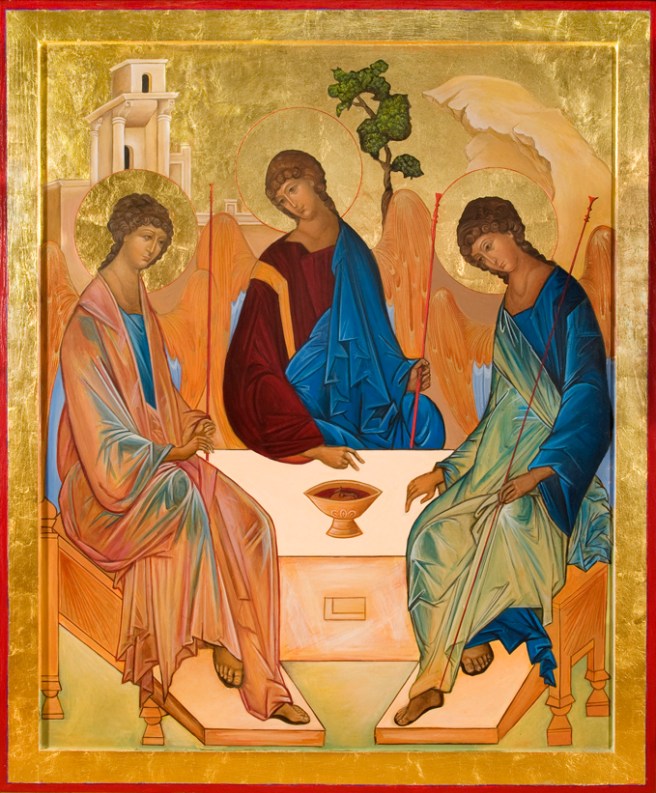
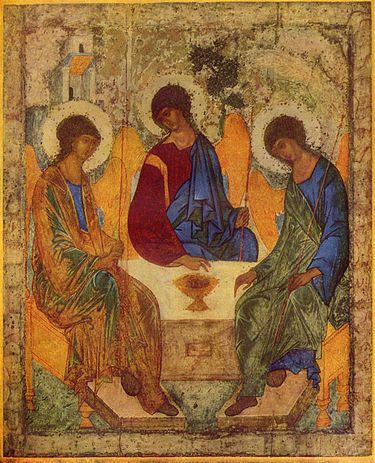
“The Trinity”: early 15th century; egg tempera and gold on wood panel by St. Andrei Rublev (1370 – 1430).  St. Rublev was a Russian Orthodox monk. He resided and “wrote” with egg tempera paint to produce images of God, the angels, and the saints in sacred  icons. He lived at St. Sergius Monastery in Moscow, Russia. His sacred icon above captures some of  the truth of the Three Persons of the Holy Trinity communicating with each other. God the Son, Jesus Christ, is the figure in the center of this painting.  You see two of His fingers extended to express His human and divine nature, and in a pointing gesture, to the “Cup of His Blood”  made manifest through His Redemptive sacrifice. In this masterpiece you observe the colors blue representing divine life and purple madder/burgundy signifying Christ’s humanity. God the Father is on your left and God the Holy Spirit is on your right. The Holy Spirit is garbed in blue and in green as a symbol of new life and spiritual growth through prayer and the Holy Sacraments (Holy Mysteries). God the Father is painted in both blue, green, and a very light, transparent gold ochre. The First Council of Nicaea (AD 325) verified and promoted the Dogma of the Holy Trinity. This Dogma was reaffirmed, and further explained by the Council of Nicaea/Constantinople in AD 381.


trinityicon
A contemporary copy of the original Trinity by Rublev.

God the Father sent His Son to be born of a woman through the fecundity of the Holy Spirit. The Incarnation of Jesus Christ changed the Universe. God became flesh and walked among us. Why?  In order to teach, heal, and redeem us from our sins. The New Covenant with His creation is written in His Blood. There is, if you have the gift of faith, ample proof that God wants to communicate with you.

It is up to each man and woman to honestly determine whether or not they are ignoring Him, and if so, to decide what to do about it. Time is short.

Copyright © 2011- 2019 Deacon Paul O. Iacono All Rights Reserved.

Christ in the Wilderness: Lent – the Season of Preparation – Luke 4: 1-2.

Jesus, full of the Holy Spirit, returned from the Jordan and was led by the Spirit into the wilderness, where for forty days He was tempted by the devil. He ate nothing at all during those days, and when they were over, He was famished. (Gospel of Luke chapter 4: verses 1-2)

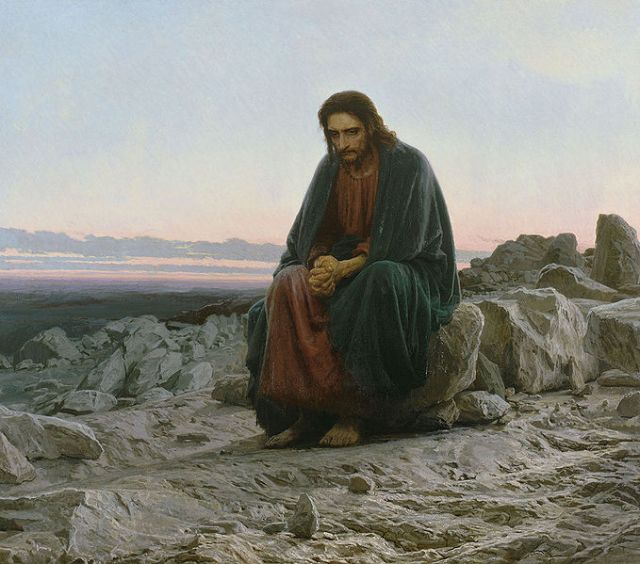
In the extraordinary painting  below, we see Jesus after He was led into the desert wilderness by the Holy Spirit. He is surrounded by rocks and sand. He sits on a boulder, hands in front of Him. His eyes are filled with the knowledge of reality, of passions, power, and pain, ego and emptiness, sin and self aggrandizement.

This painting may move us from the awareness that in the desert wilderness Jesus is not only thinking through His ministry, Passion, and death but is also viewing our lives – our ministries, our passions, our death.

What do we see?

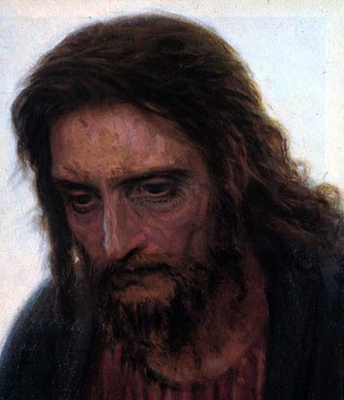
Let us examine His face.

christ_in_the_wilderness_detail_400

We see the seriousness of the forthcoming temptations; the physical, mental, and the spiritually violent struggle with the devil. It is written plainly upon His emaciated face.

We see the irrefutable fact of Jesus’ humanity.

We see that He is like unto us, except for sin.

This is the face of our Savior; but the victory is not His, yet.

His temptations, public ministry, Passion, and death are still to occur.

What do we see?

We see a man who knows His Mind. He knows His Body, Soul, and Spirit.

He knows His freely accepted duty to accomplish His Father’s will.

This is not the face of a defeated man. It is the face of a determined man who is also Lord and Savior.

**679px-Kramskoi_Christ_dans_le_désert

Observe Christ’s clenched hands, gaze deeply into His eyes, and you will see the artist’s portrayal of a Savior that is already, at the beginning of His ministry, aware of the viciousness of the tempter and the burden of our sins. Sins accepted by Him, and through His Passion and death, makes all things new.

christ_in_the_wilderness_detail_400

Jesus had to confront in that desert assault whether or not He was going to be faithful to His mission.

The Gospel passage above challenges us with the same questions: are we going to be faithful to the Commandments, to our Baptismal promises, to the mission given us in Confirmation to live and practice the truths that He taught us?

Are we going to be faithful to the spiritual power and grace given to us, not just when we feel like it, but even in the most difficult of circumstances?

As disciples of Christ we are on a daily basis constantly revolving around the axis of temptation and sin – faith and grace. We understand that temptation, in and of itself, is a test – it is not sin. It is only sin when we willfully place ourselves in its shackles, when we give into its fueled power to overwhelm our body and soul. That power  – a deadly power – obtains its animus and energy from the original tempter and liar – Lucifer himself.

Hell is real. It is not a mental construct. To say that it doesn’t exist is to call Jesus a liar, and His Passion, death, and Resurrection meaningless.

Jesus the Christ lived heroically in the face of Hell’s demons and witnessed to the power of God’s grace.

But you say, I am not Jesus Christ, I am a weak man or woman, boy or girl.

I say true, we all are; but by virtue of our faithful reception of the Holy Sacraments (Holy Mysteries) of Reconciliation (Penance/Confession) and the Holy Eucharist we have the power of Christ’s grace within us. A power, freely given by God and unmerited by us, to resist and overcome temptation and sin.

If we do sin – if we do “miss the mark” – we have a remedy.  We follow St. Paul’s advice: pick yourself up, dust yourself off (confess your sins), and confidently continue on your journey. We must do our part in cooperation with God’s love and mercy.

The Season of Lent is a time of joyful repentance, prayer, and fasting.

Let’s remember the  words of Nehemiah, who in the Hebrew Scriptures says: Today is holy to the Lord your God. Do not be sad, and do not weep; for today is holy to our Lord. Do not be saddened this day, for rejoicing in the Lord must be your strength! (Nehemiah 8: 9-10. 5th century BC)

***

The painting above was created and completed in the late 19th century by Ivan Kramskoi. He was a gifted Russian painter, noted portraitist, draughtsman, and teacher. The painting is entitled Christ in the Wilderness.

Copyright © 2011- 2019 Deacon Paul O. Iacono All Rights Reserved. Portions of this essay may be used in accordance with correct notation and bibliographical insertion; contact deaconiacono@icloud.com for more information or questions.

Beautiful Russian Sacred Icons at the New Haven Knights of Columbus Museum

If you are in the vicinity of New Haven, Connecticut within the next two weeks take the opportunity to stop by the Knights of Columbus Museum for their magnificent exhibit entitled “Windows into Heaven – Russian Icons and Treasures.”

The Museum is located at One State Street, New Haven, and offers free admission and parking. They are open from 10 to 5 pm.

For the past year it has hosted a private collection of spectacular Russian sacred icons and liturgical artifacts. It is the finest collection of Russian sacred icons that I have observed in the Northeast owing to the fact that each of the icons and treasures are in excellent condition.

You will enjoy artifacts such as a 7th century Byzantine Reliquary (bronze, traces of gold plate, and blue enamel) and three rooms of sacred icons encompassing the portrayal of Jesus Christ, His Mother – the Blessed Theotokos, much loved saints, and angels.

Their website,  www.kofcmuseum.org/en/index.html provides a wonderful overview of the 225 pieces that are on exhibit. They mention that “few customs or traditions have endured for longer than a millennium, but the use of icons in Russia is among them. In this exhibition, the Knights of Columbus Museum is pleased to share more than examples of Russian Orthodox iconography, along with other liturgical and devotional items.

windows2

Icons are often called windows into heaven because they are said to give the viewer a glimpse of the eternal realm. Many of the items are more than 100 years old, predating the Bolshevik Revolution (1917).

In AD 988 Prince Vladimir of Kiev converted to Orthodox Christianity, and he persuaded his countrymen and women to do the same. Thus, iconography was introduced as a means of fostering religious understanding and devotion among all the people of Kievan Rus (present day Ukraine, Belarus and northwest Russia).

The artistic traditon followed the strict models and formulas of the Byzantine Greek Orthodox tradition (these artistic practices developed in Constantinople and Greece and spread both East and West). Ultimately, the Russian sacred art tradition developed its own distinctive styles within each major city of Russia.

As a form of sacred art, iconographers historically prayed or fasted before and during the creation of an icon. Traditionally, icons were painted in egg tempera on wood and often accented with gold leaf or covered with ornately gilt metal covers called rizas. Rich in symbolism, they are still used extensively in Orthodox churches and monasteries, and many Russian homes have icons hanging on the wall in a “beautiful” (or prayer) corner.”

“Icons have been synonymous with Christian prayer and practice for centuries,” said Supreme Knight Carl Anderson. “One of the great traditions of Eastern Christianity, icons are less well known here, and we are pleased that this exhibit will enable residents of the Northeast to grow in their understanding of the history and religious significance of these windows into heaven.” This exhibit concludes on April 27, 2014.

windows1

Viewing this exhibit during Holy Week or the First Week of Easter leading up to Divine Mercy Sunday and the canonization of Pope John 23rd and Pope John Paul 2 on April 27th would be of great assistance in your joyful experience of the reality of the resurrected Christ. My prayers are with you for a prayerful Holy Week and a blessed Easter Season!

Copyright © 2011- 2014 Deacon Paul O. Iacono All Rights Reserved. The sacred icons shown are taken from the Knights of Columbus website which offers a history of each sacred image or artifact exhibited.


Christ in the Wilderness, a Russian Artist, and a Challenge

In the late 19th century a Russian painter, the noted portraitist, draughtsman, and teacher Ivan Kramskoi painted a haunting image of Jesus alone in the desert. It is a painting which expresses the internal struggle of the flesh versus the spirit. It portrays Jesus, in the early morning hours and the cold air of the dawn, with the sun rising over His back.

He is surrounded by small boulders and sits on a rock, hands in front of him, eyes filled with anguish and pain. This portrait of Christ in the desert is not one of victory; looking closely at His face you recognize the seriousness of the struggle and the irrefutable fact of Jesus’ humanity.

christ_in_the_wilderness_detail_400

Observe Christ’s clenched hands, gaze deeply into His eyes, and you will see the artist’s portrayal of a Savior that is already at the beginning of His ministry aware of the viciousness of the tempter and the burden of our sins that will weigh upon Him.

Kramskoi’s painting is so powerful because it shows not the physical tearing that was to come in the scourging and crucifixion, but the sensual, psychological, and spiritual battles that would challenge the mission and authority of Jesus Christ.

**679px-Kramskoi_Christ_dans_le_désert

Jesus had to confront, in that very first desert assault, whether or not He was going to be faithful to His mission; was He going to be faithful to the anointing that He received from the Father and the Spirit at His baptism?

The Gospel challenges us with the same questions: are we faithful to our Baptismal promises? Are we faithful to the Commandments? Are we faithful to the call that we received at our Confirmation to live and practice the truths that He taught us, not just when we feel like it, but everyday – even in the most difficult of circumstances?

As disciples of Christ we are on a daily basis constantly revolving around the axis of temptation and sin – faith and grace. We understand that temptation, in and of itself, is a test – it is not sin. It is only sin when we willfully place ourselves in its power, when we give into its power to overwhelm our body and soul, – a deadly power that obtains its animus and energy from the original tempter – Satan himself.

Christ lived blamelessly in the face of evil, but you say, I am not Christ, I am a weak man or woman, boy or girl. I say true, we all are, but by virtue of our faithful reception of the Sacraments we have the power of Christ’s grace within us.

Unlike Christ we don’t enter the wilderness of our own temptations alone. When we do face the anguish of our own sin, our own desolation in the face of Satan’s onslaughts, when we peer over the edge of the pit of sin – Christ’s witness tells us “Do not despair. Do not dwell in the pit. Do not accept the pit of sin as being permanent.” Jesus Christ tells us that He has instituted a Church that, with all its human sins and imperfections, still exists – in purity – to convey through its clergy the grace of God.

One of the first things that you notice about Christ in this portrait is that here, at the beginning of Jesus’ ministry, the artist has Jesus’ hands clasped together. Yet, when you walk into a Catholic or Orthodox Church, and look at the crucifix or an icon of one, you see Jesus as He ends His ministry on the Cross, with His hands unclasped, and stretched out, stretched out for each one of us.

This Lenten season we need to reach out our hands to the One, who 2000 years ago, stretched out His hands for our Redemption – and who still reaches out for us today. Reach out to Him in prayer and the Sacrament of Reconciliation, and through Jesus, reach out to those around you who are suffering in the same way, and lead them back to the love of Christ.

Copyright © 2011- 2014 Deacon Paul O. Iacono All Rights Reserved

Evgeny Baranov’s Miniature Icons and Rashid and Inessa Azbuhanov Icon Carvings

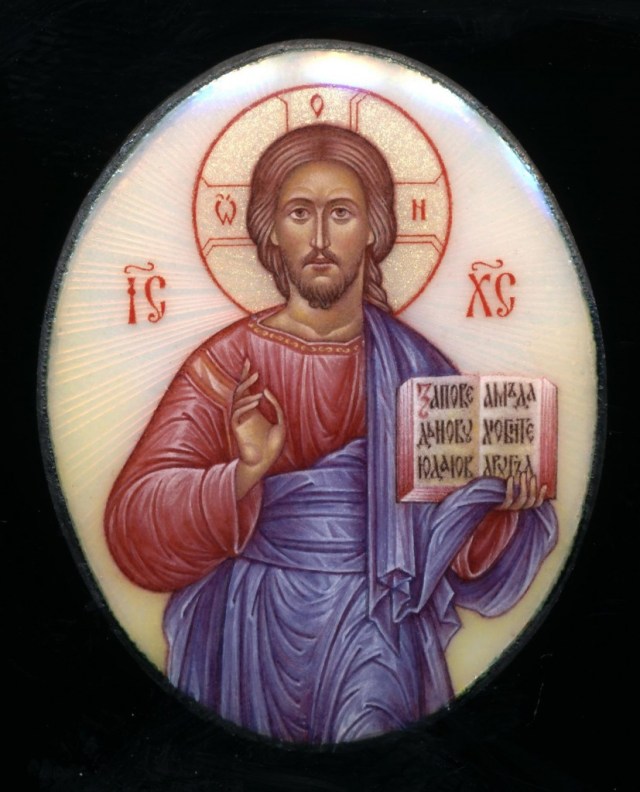
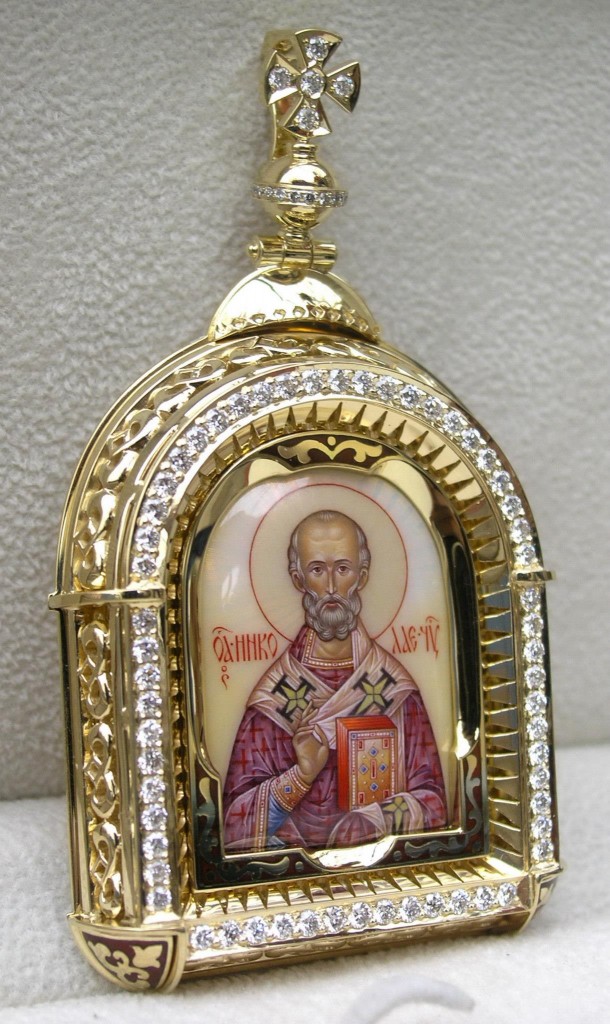
My sincere thanks to Jonathan Pageau at the Orthodox Arts Journal,  http://www.orthodoxartsjournal.org/, for permission to repost his wonderful presentation of the sacred icon miniatures of Russian artist Evgeny Baranov and the spectacular icon wood carvings by Rashid and Inessa Azbuhanov.

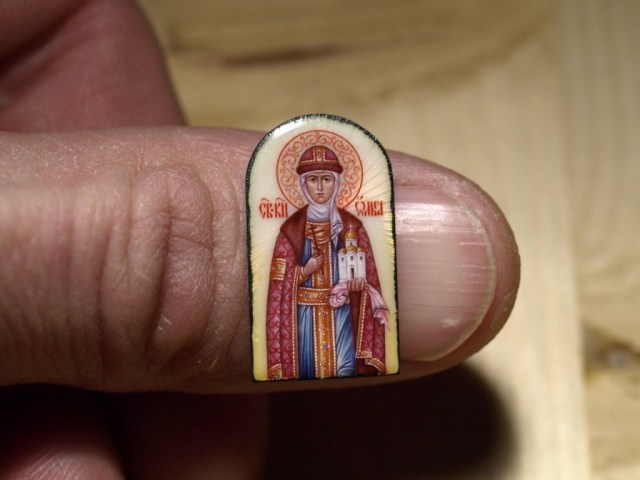
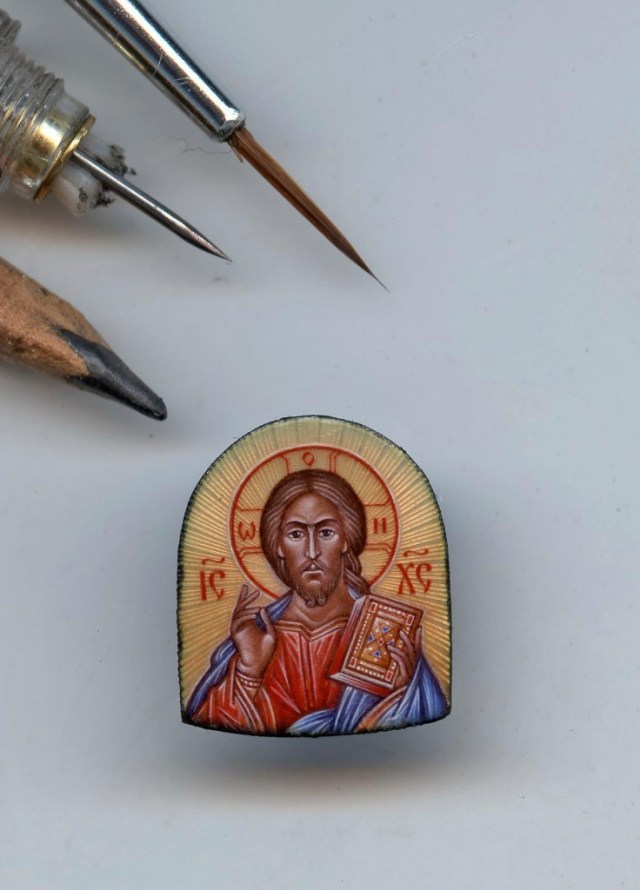
We must take care when we paint/”write” large icons, yet, to complete an icon miniature or a wood carving, with such grace and spiritual truth, demands in my humble opinion, even more skill and patience! Enjoy, and be filled with astonishment!

To see all of Baranov’s miniatures please visit their site:www.orthodoxartsjournal.org/miniature-icons-by-evgeny-baranov/ .

To see the lovely icon wood carvings of the Asbuhanov’s please take a look at the last two images in this post, if you would like to see all of their work please visit this site: /www.orthodoxartsjournal.org/the-russian-master-icon-carvers/

Miniature Icons by Evgeny Baranov and Russian Master Icon Carvers

April 9th and 10th, 2013

By 

Here are some of the most astounding miniature icons I have seen.  They are made by a Russian artisan named Evgeny Baranov who is also a very good goldsmith as you will see below.   These pictures were taken from his facebook page.  I have been trying to get a short interview with some more details, and my lack of Russian seems to stand in the way…  but really, the work stands on its own.

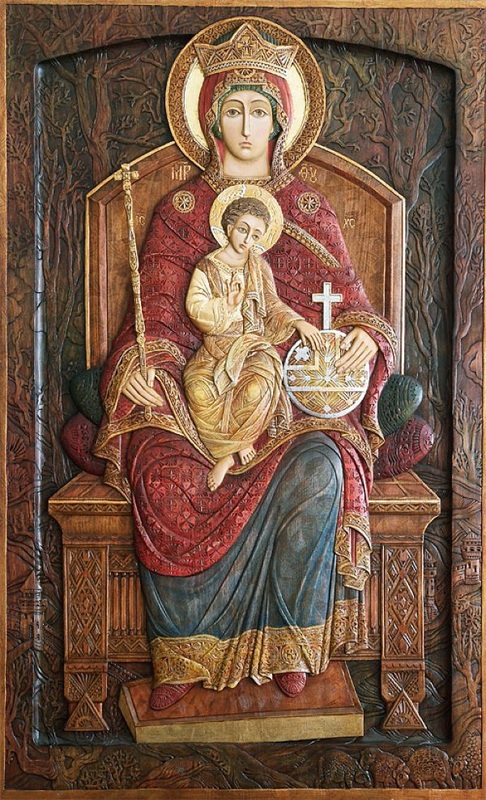
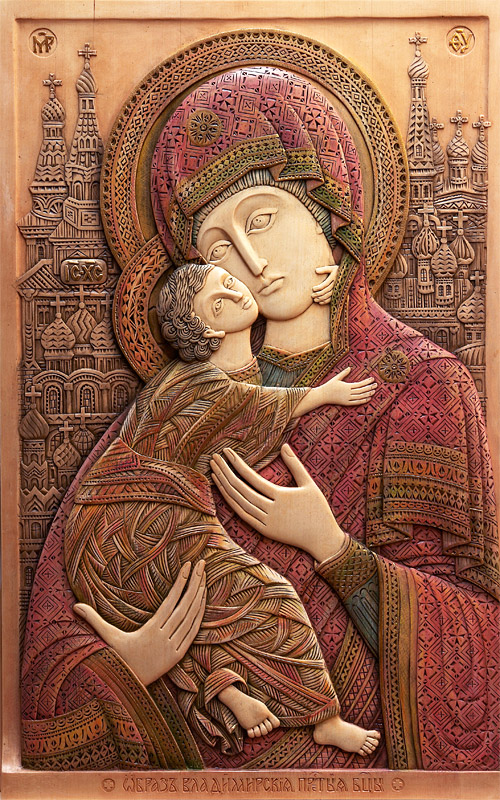
Rashid and Inessa Azbuhanov are a Russian couple who are leading the rediscovery of icon carving in the Russian Church.  Their works grace the collections of Russian politicians from Gorbachev to Putin, European royal families and church authorities from the Russian Patriarch to the Pope of Rome. 

Their works are often large and highly detailed, like wooden lace as they include much chip carving into the patterns of clothing, backgrounds and frames.   There is a certain folk aspect to their work, especially in some of the faces which do not follow the more usual formal tradition of icon carving but are often effective nonetheless.  They recently had a show of their work in Moscow and so I thought it a good opportunity to put up some of their icons.

Despite their great success, they are warm and quite generous, just like their carvings.

More pictures can be found on their website:  http://www.azbuhanov.ru/

Here  also is a detailed article on their recent Moscow show.

[The first five images below are the work of Evgeny Baranov and the last two wood carvings are the work of Rashid and Inessa Azbuhanov.]

860865_521439324567156_763328432_o-1024x768

860752_521110697933352_1170790055_o-736x1024

841144_509812712396484_2096937401_o-827x1024  856099_522478041129951_543035943_o

793738_509808235730265_2014731202_o-610x1024

3686569_orig

2280142_orig

Mary, The Holy Mother of God – The Sign of Our Unity

We celebrate on this the first day of the New Year the Solemnity of Mary, the Holy Mother of God.

Mary, by this very title, is the Holy Mother of the human nature of Jesus Christ. We receive insights on how the Church came to this title within the Holy Scriptures; for through a prayerful reading of them we come to an understanding of who this remarkable young woman was and what she means for us today. Three evangelists, Matthew, Luke, and John help us with this in their presentation of Mary as a woman who was clear minded, humble, intelligent, devout, loving, immensely strong, and quietly, yet fiercely, devoted to her Son.

Our beautiful Scriptural readings for this Solemnity (Numbers 6: 22-27, Galatians 4: 4-7, and Luke 2: 16-21) help us  approach today’s celebration through the perception of Mary herself. Today’s Scriptures remind us that Mary and  Joseph were devout Jews who understood the importance of faith, family devotion, tradition, and the fulfillment of the Jewish Law itself. It was with Holy Scripture – Hebrew and Christian – in mind, and the sacred tradition provided by the Apostolic fathers, that the debate over Mary’s title rested upon.

The designation of Mary, as the Holy Mother of God was debated and decided upon at the third Ecumenical Council of the Church. It was held in the year 431 at the city of Ephesus in Asia Minor. This Church Council was known as the First Council of Ephesus and was attended by over 250 bishops from the four (soon to be five) patriarchates of the Catholic Church: Rome, Alexandria, Antioch, Constantinople, and eventually, in 451, Jerusalem (Jerusalem, at the time of the First Council of Ephesus was part of the Patriarchate of Antioch, Syria). Now that the formal persecutions by the Roman Empire had ended, the fifth century saw much activity within the Church to formally secure theological positions on both Christ and the role of His mother in salvation history. The catechesis of the people was paramount. Using their gifts of reason and the Holy Spirit, combined with the Holy Scriptures, and the sacred Tradition of the early Church the assembled bishops determined to safeguard the Truth of the Church while simultaneously further establishing the foundations for the  catechesis of its clergy and laity.

But at the heart of the matter, for all Christians, Jesus is the human incarnation of God Almighty. He presents to us in His Person, the true, physical Presence, of God; and with His Divine Nature intact, He in turn with a true human nature, could then call us His brothers and sisters. We are, through Him, and Mary’s maternity, adopted sons and daughters of our Father in Heaven. Mary is the Mother of Jesus’ human nature, and, she is the Mother of the Church.

How do we know this?

We know it because Jesus said it was so: “Whatever you did for the least of My brothers and sisters, you did for Me” Matthew 25:40; and let us not forget John 19: 26-27: Jesus saw His own mother, and the disciple [John] standing near whom He loved; He said to His mother, “Woman, behold your son.” Then He said to the disciple, “Behold your mother.” And from that hour, he took his mother into his family.” 

Such is the love of God for His creation.

Theotokos

While doing some other research a few weeks ago, I was struck  by some quotes from the three main leaders of the 16th century Protestant revolt. While certainly these men steered their new churches along a different path from the Tradition of the Western and Eastern Rites, the quotes provided below show them to have an understanding and love for Mary as the Holy Mother of God and the significance of her perpetual virginity.

Martin Luther: “It is an article of faith that Mary is Mother of the Lord and still a virgin… Christ, we believe, came forth from a womb left perfectly intact.” (Works of Luther, Vol. 11, pages 319-320; Vol. 6, page 510.)

John Calvin: “There have been certain folk who have wished to suggest from this passage [Matthew 1:25] that the Virgin Mary had other children than the Son of God, and that Joseph had then dwelt with her later; but what folly this is! For the gospel writer did not wish to record what happened afterwards; he simply wished to make clear Joseph’s obedience and to show that Joseph had been well and truly assured that it was God who had sent His angel to Mary. He had therefore never dwelt with her nor had he shared her company… And beside this Our Lord Jesus Christ is called the first-born. This is not because there was a second or a third, but because the gospel writer is paying regard to the precedence. Scripture speaks thus of naming the first-born whether or no there was any question of the second.” (Sermon on Matthew 1:22-25. Published in 1562.)

Ulrich Zwingli: “I firmly believe that Mary, according to the words of the gospel, as a pure Virgin brought forth for us the Son of God and in childbirth and after childbirth forever remained a pure, intact Virgin.” (Zwingli Opera, Vol. 1, page 424.)

Perhaps, in God’s Divine Plan, the beautiful and holy virgin Mary – the Holy Mother of God – will be the cause for the reunification of all the Christian Churches: Catholic, Orthodox, and Protestant.

As a fellow Christian, please consider making the following prayer that I wrote a few hours ago part of your own prayer arsenal for the New Year: “Holy Mary, Mother of God, keep us within your most precious and immaculate heart. Through your maternal love, intercede with your Son to remove the painful scars of division and hurt that lie within our own hardened hearts. We implore you to ask your Son to strengthen us with His Truth, Goodness, and Beauty so that we may always fulfill His Divine Will. Amen.”

Copyright © 2013 Deacon Paul O. Iacono All Rights Reserved

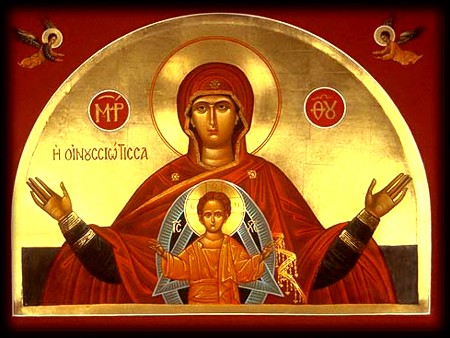
Notes: Source of the sacred icon of the Holy Theotokos with the Christ: http://en.lpj.org/2011/12/30/solennite-de-marie-mere-de-dieu/ 

Protestant leader quotations taken from http://blackieschurchmilitant-apocalypsis.blogspot.com/2008/01/perpetual-viginity-of-blessed-virgin.html


Saints Pontian and Hippolytus and Our Call to Duty

Today we celebrate the martyrdom of Saint Pontian, who was the lawfully elected successor pope to St. Callistus during the early 3rd century. St. Pontian was considered a criminal by the emperor Maximinius and banished to the silver mines in Sardinia – an exile which meant certain death. We also celebrate today a saint by the name of Hippolytus, who was a priest in the Church of Rome at this same moment in time.

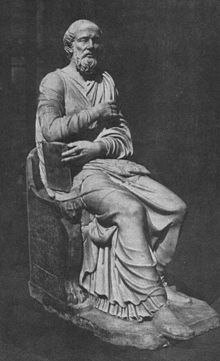
Saint Hippolytus is recognized because of his brilliance and profound scholarship. He is considered to be one of the finest theologians of the 3rd century, and is the source of the 2nd Eucharistic Prayer recited at Mass. Hippolytus’ most important work is a treatise known as The Apostolic Tradition; and scholars such as Dr. Marcellino D’Ambrosio, (at http://www.crossroadsinitiative.com) tell us that it provides “an enlightening and extensive glimpse into the liturgical and devotional life of Roman Christians around the year 200.” The statue found below is of Roman origin, found in the mid 16th century. It has the name Hippolytus carved into it as well as references to works of other Apostolic Fathers. The image is presented through the courtesy of Dr. D’Ambrosio.

Controversy, however, erupted when St. Callistus, was elected to the papacy. St. Hippolytus considered Callistus to be a liberal since Callistus extended absolution to new converts who had committed mortal sins such as adultery and murder. Hippolytus contested the election, violently disagreed when Callistus was affirmed, and then made history by declaring himself pope, thus becoming the first anti-pope in the history of the Church!

As a result of his action he divorced himself from full communion with the Church. When Pope Callistus was martyred, in the year 222, Hippolytus began disagreeing with his successors – the last being Pope Pontian.  Hippolytus’ theological differences and self-imposed actions didn’t mean anything to the Romans for they arrested him, too, and exiled him off to Sardinia; and there, St. Hippolytus – the anti-pope met St Pontian, the true pope and lawful successor to Pope Callistus.

In the silver mines of Sardinia, Pope Pontian abdicated his office, making way for a lawful successor to be elected, and Hippolytus renounced his anti-papacy and was absolved of his sins by Pontian. Fully reconciled they died together for the faith in the year 235.

So, what does this have to do with us?!

Our Gospel today (Matt 17: 22 – 27) provides the answer, for in it our Lord and the Apostles were confronted with the arrogance of the officials who implied they were evading the local taxes.  Jesus attempts to clarify His position not only for St. Peter but for the officials as well.

Jesus is basically saying that, yes, they must pay the tax; the reason being they must not do anything to put a stumbling block in the way of people understanding His ministry and message. Again we see Christ not getting political. He is not ranting about the just or unjust qualities of the Temple tax, or Roman occupation. He is beyond that, and demands that the Apostles, as His successors, not give a bad example to the people.

This is a lesson that St. Hippolytus, for all of his brilliance never learned. He did give bad example to the Church of Rome in declaring himself an anti-pope. His dissension and attacks were not productive or helpful in a highly charged environment which constantly witnessed Roman persecution.

Yet, St. Hippolytus ultimately saw his sin, repented of it, and along with Pope St. Pontian, did his duty and defended the true faith with his life. We must always do the same, and whatever our calling or ministry may be, we must never become a stumbling block that prevents others from seeing and believing in Jesus and His Church.

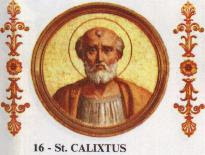
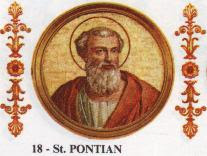
Copyright © 2012 Deacon Paul O. Iacono All Rights Reserved   Images of all the popes are found in the Basilica of St. Paul Outside the Walls in Rome, Italy. The custom of having a mosaic of a deceased pope put on display was started by Pope Leo the Great.

Icons, Icon Painters, and Praying With Sacred Icons: PART 3

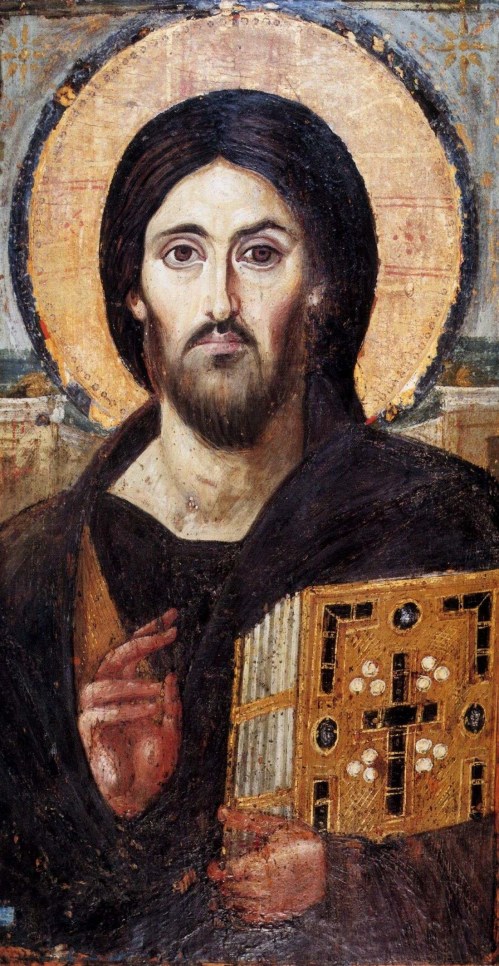
My favorite sacred icon of  Our Lord Jesus Christ is the 6th century encaustic icon of Christ Pantocrator (Christ The Almighty One) from St. Catherine’s Monastery in the Sinai Peninsula.

This sacred image was a paradigm shift in the way early Christians viewed and portrayed Jesus Christ. This icon (shown below) is not the thin young  Messiah of the Catacombs, or the Roman nobleman presentation of the first four centuries of Church art (for examples confer Pierre du Bourguet’s book on Early Christian Painting). The Sinai Christ Pantocrator is portrayed as a robust Semitic man, who knows exactly what He is about, what His mission is, and what He expects of His followers in their living out of His Gospel life.

Interestingly, recent research has shown that when the image from the Shroud of Turin is compared to the image of Christ in this icon of Christ Pantocrator there are many points of similarity between the two images; possibly implying that the painter of Christ Pantocrator had seen the facial image found on the Shroud of Turin.

Allow me to suggest that when we are painting a sacred image/icon we must prayerfully enter into conversation with the Heavenly person we are representing, we must research his or her life, and then view what the Traditional forms of their representation has been in the history of sacred iconography.

We should then explore how we could make the truth of the Lord’s or a saint’s holy witness speak – using the language of the palette – to the 21st century. We should learn from the past, and absorb and pass on the beauty that is found within Holy Tradition.

Yet, at the same time, we need to constantly examine the work of some of the fine icon painters in the world today, people like my teachers: Peter Pearson, Marek Czarnecki, Anna Gouriev Pokrovsky, and Dimitri Andreyev. I have recently been influenced by the work of  Ksenia (Xenia) Mikhailovna Pokrovskaya, originally from Moscow, and now living in Massachusetts. Not to be missed is the work of Vladimir Grygorenko from Dallas, Texas. His sacred icons have a richness and luminous quality that is very beautiful and spiritual. We must also become familiar with the work of British iconographers Brother Aidan Hart, and David Clayton; the Norwegian Solrunn Nes, and the Russians: Archimandrite Zinon from the Pskov-Caves Monastery, and Philip Davydov and Olga Shalymova from St. Petersburg, Russia –  all of these people, and many others, prayerfully create beautiful icons that speak to 21st century people who are willing to listen. The wonderful news is that there are many sacred artists and iconographers – known and unknown – that are prayerfully engaging the ancient traditions of Catholic and Orthodox art, and prayer from the heart, throughout the world.

As we enter into our study of sacred art and iconography we need to first start with a survey book which gives us an overview of the sacred artistic tradition of the Eastern Church. We should first examine the great little book Icons and Saints of the Eastern Orthodox Church (ISBN 0-89236-845-4; translated by Stephen Sartarelli and published by the J. Paul-Getty Museum, 2004) and use it as a starting point to observe the styles and techniques of the various regional traditions over the last 1500 years.

We don’t have to “like” all the styles of the images that icon painters, from various cultures, have portrayed down through the centuries. But, we must respect their efforts because, hopefully, they were created in the true spirit of prayer, and each of them can teach us something about technique, color, symbol and theology.

When we begin our studies with a teacher of iconography, and sit down to draw the sacred image and apply the paint and gold-leaf, we must remember that we have a sacred responsibility to the faithful who view our sacred icons and images. These images must be correct from a theological, semantic, and aesthetic point-of-view. Our call, our ministry, is to lead the viewer to prayer and communion with Christ and His Saints, not to a secular admiration for an avant-garde or cavalier attitude toward our Holy Faith, or the people who died witnessing to it.

Copyright © 2012 Deacon Paul O. Iacono All Rights Reserved

Part Two: Icons, Icon Painters, and Praying With Sacred Icons

The sacred icon is a visual aid that helps the person enter into a conversation with God, an angel, or a saint. If a sacred icon is to be painted with this purpose in mind then it it is a major responsibility of the sacred artist to construct the icon so that it may serve, rather than interfere with or destroy, that purpose. Thus, it is necessary for the sacred artist to curb the desire for ornateness, since it might detract from the prayer itself by focusing the viewer’s eyes on embellishment versus Person, or saint. 

Of all the physical features in an icon, in my opinion, the most important are the eyes. The eyes of the person represented in the icon – Our Lord, the angels, or the saints – are critical. They normally look out at the viewer. They are painted this way because icons, which should be painted in a spirit of deep prayer, are trying to establish or renew our relationship with the Heavenly person portrayed. So, as in typical conversation, we look at the person and they look at us. Yet, in many cases the eyes of the Blessed Mother, as the greatest of the saints, do not look at us; they are usually looking at her Son, or, are looking away from the viewer, or present us with  a “distant gaze.” These particular types of steady and intense looks of the Blessed Mother may also be seen in statues – especially those of medieval France. Please note the following link to an excellent site which shows some of these gazes in statues of Mother Mary and the Christ Child:

vialucispress.wordpress.com/2012/05/04/the-thrones-of-wisdom-dennis-aubrey/  By the way, I highly recommend Dennis Aubrey and PJ McKey’s site for your subscription.

Sacred icons are the traditional form of artistic expression of the Eastern and Western Rites of  the Catholic Church from approximately the 6th century on. The Western Rite moved away from purely painting sacred icons in approximately the 12th century and moved into the Gothic Period of sacred art. The Eastern Rite continued to develop its devotion to sacred icons with differences being seen within the various cultural areas of Orthodoxy – from Greece, to Serbia, Russia, Crete, etc.

As mentioned above, the use of a sacred icon is of practical spiritual value in that it is an aid in prayer. On an additional note, when we pray with a sacred icon, we are doing the same thing as when we speak to someone that we know and love. We speak to them, we may be in their physical presence, or we may be on a phone or computer connection with them, but we are with them in the sense that we are focusing on them at that moment in time – either physically facing them – or –  on a phone or computer screen. So when we pray to an icon we are looking at it in the same way we would look at someone in a face-to-face conversation; for that is what prayer is: conversation with God, Our Blessed Mother, the angels, or a particular saint.

Some people have a tendency to get themselves upset over the use of the term iconographer (icon writer) versus icon painter. The word graphein in Greek means “to write,” and it also means, “to paint.” A linguist and museum curator by the name of David Coomler informs us that in the Russian language the English word “write” is pisat, and the word “paint” is pisat. So, in Greek and Russian we have a double meaning for one word that represents both “to paint” and “to write;” however, this doesn’t transfer into the English language since in English we obviously have two different words to express graphein and pisat: write and paint.

I have no problem with people saying “I am a sacred icon painter.” The reason being – it is correct English. The term iconographer, however, is used and you see it in numerous books and in conversation in non-Russian or Greek formats. When people ask me how I identify myself – as an icon painter or an icon writer – I respond that I am a simple “sacred artist”!

Yet, we have an obligation to be truthful to our Holy Faith, so, when we paint icons we need to be attentive to and follow Sacred Scripture and Sacred Tradition. In that sense, we are “writing” icons because we are scribing into visual form – using paint rather than just ink – the images from Sacred Scripture and Tradition. I may be breaking a grammatical rule in saying that; yet, I feel that it is appropriate owing to the nature of what we are trying to do in painting sacred icons.

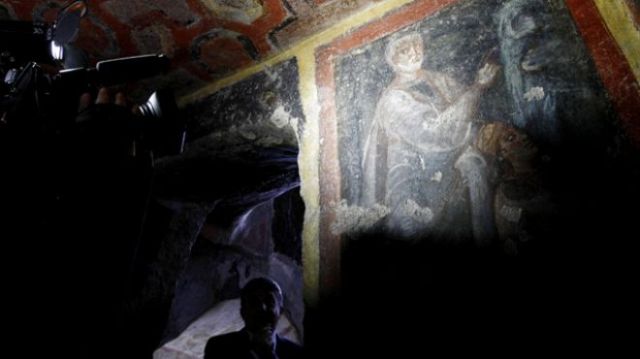
May I suggest that as icon painters we must be conscious of the truth that the images that we copy of Our Lord, Our Blessed Mother, the angels, and the saints (saints prior to the 14th century) were and are built on our human imagination, for we do not have an actual authentic portrait of Our Lord, or Our Blessed Mother. There is consensus that St. Peter had a full head of hair and full beard, while St. Paul had a bald or balding head and full beard. I can say that because recent archaeological discoveries in Rome have continued to show those pictorial images for these two saints.

Still, that being said, we cannot be absolutely sure of this because we have no photographs, or, first century portraits of them; but, we do have a sacred tradition that portrays them that way; but this is not true for many of the saints – unfortunately, we just don’t know what they looked like. So we have to be very careful in our portrayal of saints, and remember, that basic cultural and historic research will help us in painting a quality sacred icon or image.

The above photo shows a recent interesting archaeological discovery that occurred in June 2010: The link below shows the cameraman filming  paintings of some of the earliest known images of the Apostles Peter and Paul (these ceiling paintings date from between AD 350 and 400) in a catacomb located under a modern office building in Rome. The images were uncovered using lasers and were under thick deposits of calcium carbonate. ((AP Photo/Pier Paolo Cito)) Click on this link below to see more photos:

http://www.foxnews.com/scitech/2010/06/22/ancient-icons-apostles-peter-paul-rome/#ixzz1voqaPpKJ  Thanks to this site for the information.

 Copyright © 2012 Deacon Paul O. Iacono All Rights Reserved

Icons, Icon Painters, and Praying With Sacred Icons: Part One

A few issues have come up in discussing some basic terms with people. I would like to be clear on how I have come to understand these words because it may affect how we view our “ministry” to be painters of sacred icons and or sacred images.

From my understanding, the word icon in English, Greek, and Latin, is the word for image. In our usage as sacred artists, it refers to a sacred image of Our Lord, Our Blessed Mother, angels, or specific saints. The purpose of a  sacred icon is that, as a piece of sacred art, it  focuses an individual in prayer.  A sacred icon is a specific type of sacred art. It is created following certain traditions – tradition with a small “t” and a large “T.”

Many sacred icons are presented with a simplicity of style, the use of color, the types of colors used, the use of symbols, etc. A sacred icon is different from a sacred image, in that the sole purpose of the sacred icon is that it is to be used as a focal point for personal or communal prayer.

A sacred image, however, may have been commissioned by a patron for personal prayer, but it may also have been commissioned for the pure enjoyment of its beauty. In the case of Renaissance sacred art, the Roman Catholic Church became the patron of many pieces of sacred art in order to affect the communal prayer of the faithful who came to the small churches and the great basilicas for Holy Mass.

With a sacred image (such as a religious image painted by Michelangelo or Leonardo) you have the artist’s personal imagination heavily influencing and entering into the creation of the beauty of the image, possibly even manipulating and combining Scriptural passages for the purpose of the story the artist would like to tell. Yet, even though I have just made that statement, the truth of the matter is that it is not always so clear cut. We do have icons, such as the famous Nativity icon of the birth of Christ, in which you have numerous Scriptural passages – conveying different events – being used to convey a catechetical sequence surrounding the birth of Our Lord – and all of this is done on the same icon panel!

In a sacred icon, the imagination of the artist is present, yet, it is supposed to be subordinate to his/her faith’s perception of Sacred Scripture and Sacred Tradition (how the early Church viewed their beliefs and expressed them within their specific cultural tradition). So, if a sacred artist is painting a sacred icon, he or she is aware of the theological, aesthetic, and semantic rules that have been developed and followed through the centuries. These rules – “the Canon of Iconography” – are affected by cultural area and religious Sacred Tradition.

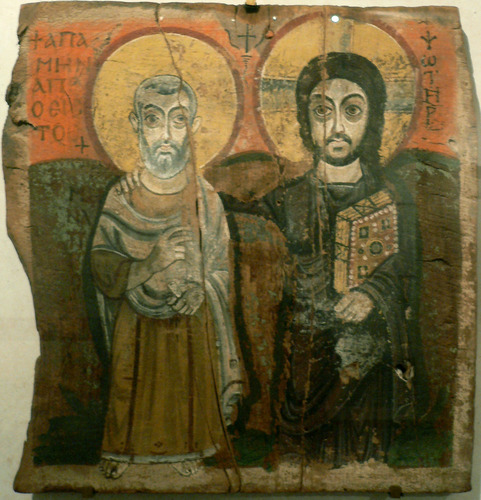
For example, a Coptic sacred icon (see image below), by a painter of the Egyptian Coptic Church will express the image of Christ and a saint (in the icon below an abbot of the Coptic Christian Church) somewhat differently than a Greek or Russian Orthodox painter; and yet, there is nothing wrong with this, as long as the painter is not fomenting apostasy or heresy.

All of that being said, sacred images, for example, by Renaissance painters, can certainly be used to focus an individual in their personal prayer, as do the beautiful stained glass windows of the great Gothic cathedrals. Care must be taken, however, in selecting appropriate images for use in personal prayer. It is my perception that the type of image a soul uses in personal prayer – sacred icons (from the Eastern Rite) or sacred images (from the Western Rite) – is a matter of personal preference and certainly does not  indicate that one type is better or “more truthful” than another. Eastern and Western sacred artists are both working off of their own perceptions and spirituality; there are disagreements with this, but we must always remain charitable with each other.

Within the last twenty years there have been many Western sacred artists that have rediscovered the beauty of painting sacred icons, and are trying to be sensitive to the Eastern Rites’ traditions,  as they bring it back into the consciousness of the Roman Catholic Church. The Eastern Orthodox Churches, thankfully, never lost appreciation for their tradition.

I will post Parts Two and Three on this same theme in the upcoming days. Be sure to look for them on-line or in the archives. Thanks.

Copyright © 2012 Deacon Paul O. Iacono All Rights Reserved

The image of Christ and the Abbot – a panel depicting a monk with Christ. It was excavated in the early 20th century from a monastery in Egypt and is located in the Bawit room at the Louvre. Thanks to: Photo by Clio 20, CC attribution share-alike 3.0. I believe the icon dates to about the 7th century.