St. Thérèse of the Child Jesus (of Lisieux) died, a victim of tuberculosis, at the age of 24 on September 30, 1897. Every year her Memorial is celebrated in the Roman Catholic Church on October 1st. She was later named a Doctor of the Church because of her extraordinary spiritual insights and witness to God’s love for us.
Those drawn to her life and spiritual perceptions desire to know the basics of her “Little Way” to union with Jesus. Many desire to understand her procedure to “the arms of Jesus'” love before they read her short autobiography entitled The Story of a Soul.
John Nelson in his excellent book and fine introduction to the Little Way of St. Thérèse provides us with some very helpful steps. He says, “The core elements of the Little Way are:
Joyful humility as a little child of God [that is, understanding of the need for our awe of God, and persistent love of God and neighbor; our willingness to work and pray to achieve the virtue of humility];
Bold confidence in God’s mercy and loving kindness;
Tranquil trust in the actions of God’s limitless love;
Persistence in prayer as a simple raising of the heart to God;
Daily practice of the little way of love.”
He continues,“The Little Way to spiritual health is that of a child of God who humbly welcomes its utter inability, weakness, and poverty as a little one.”
The phrase “little one” refers to the person as a spiritual child that needs to learn from Jesus as they continually seek to be embraced within His loving arms.
The soul that commits to this process “…is boldly confident in its total dependence on the goodness, limitless love, and action of its Heavenly Father. Such a child of God desires only His Will, and to live solely through love [of Jesus] and for love” [of God and neighbor].
“Since love drives out fear [fear is the foundation of all anxiety], it never fears the justice of God, knowing that He comes to save His little ones.” (all quotes above are from the book by John Nelson, The Little Way of St. Therese of Lisieux – Into the Arms of Love. Liguori Press, 1997).
As a Carmelite nun, St. Thérèse of Lisieux lived an extremely virtuous life of humility, evangelical simplicity, and trust in God. Besides her contemplative prayer, and communal obligations, she devoted her short life to teaching these virtues to the novices in her community.
The late 15th century contemplative, Thomas à Kempis, in his masterpiece on spirituality and the path to God, The Imitation of Christ, also helps us understand how to put the “love” that St. Therese speaks of into practice: “A good deed done without love goes for nothing, but if anything is done for love, however small and inconsiderable it may be, every bit of it is counted. God considers what lies behind the deed, and not what is actually done” [that is, accomplished]. (Book 1, section 15, page 48; edited by H.C. Gardiner, S.J.; Doubleday Image Book, 1955).
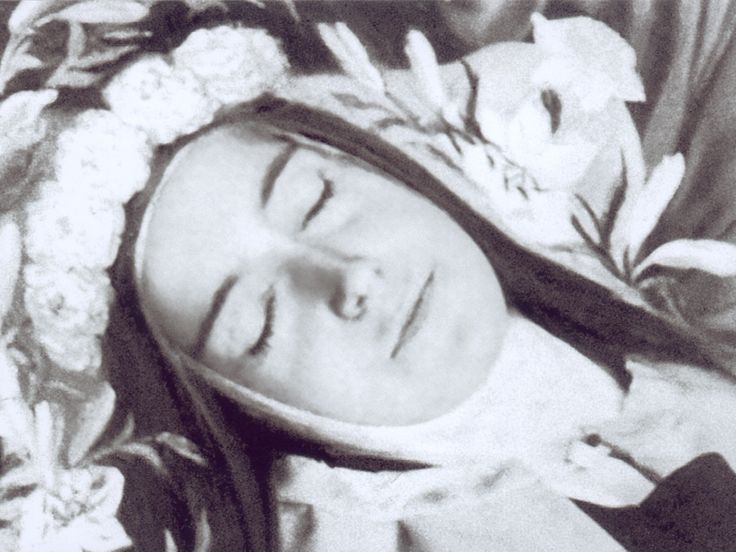
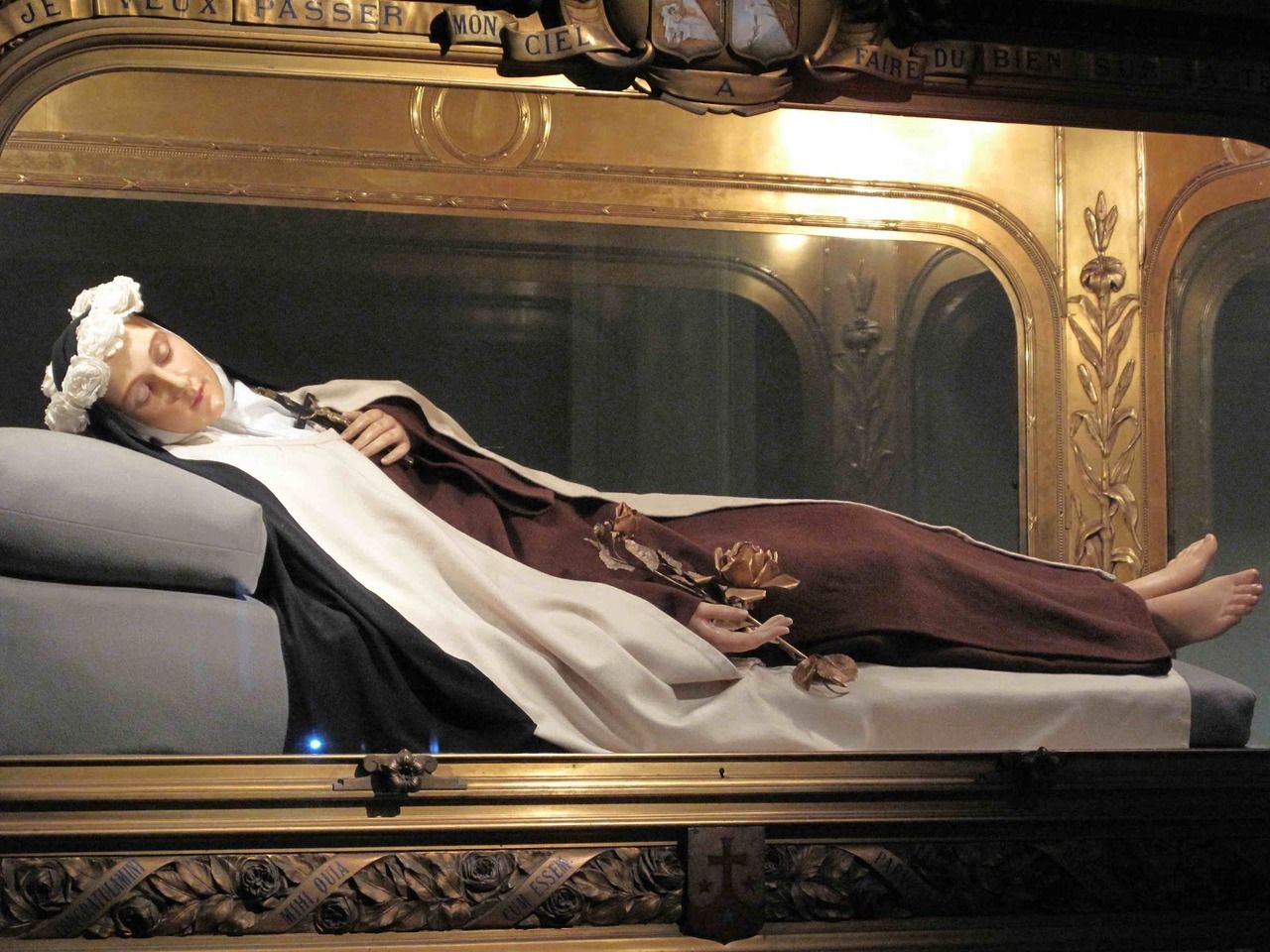
Close-up of her face – incorrupt body of St. Therese of Lisieux. She died in 1897.
Is communication just a trait of human beings? Is it a trait of God?
The Dogma of the Holy Trinity is one of the great Mysteries of the Christian Faith. All Christians acknowledge and accept that The One True God, the divine Holy Trinity, are three separate and distinct Persons of the Father, Son, and Holy Spirit. The Holy Trinity is not three separate Gods. They are one God in three Divine Persons. This is known as the dogma of the “consubstantial” Trinity: each of the three Persons is God – completely and entirely.
These ideas were debated and verified by the assembled bishops at the First Council of Nicaea in AD 325 and subsequent Councils (specifically the ecumenical Council of Nicaea/Constantinople in AD 381).
In the 13th century the Fourth Lateran Council stated: “Each of the Persons is that supreme reality (nature, essence, and substance) of God” (confer Catechism of the Catholic Church, 2nd edition, paragraphs 198 through 315, pp. 54-84).
These three Divine Persons relate and communicate among themselves and desire to communicate and relate with Their creation. This is verified through Holy Scripture, Sacred Tradition, and the historic teachings of the Apostles, the Ecumenical Councils, and the saints of the Church.
The first of Their creation, the nine choirs of angels, communicate with God and each other, too.
Obviously, human beings communicate and relate through speech, behavior, and the written word, though at times, not very well. To a much lesser extent, there is “communication” in the other members of the animal kingdom (by instinct, chemical, and behavioral signals) and in the plant kingdom (through chemical signals).
God the Father has communicated specifically through His Word, the incarnated Son, Jesus Christ. In accordance with the Father’s will the human Jesus is “born of a woman” into space and time through the great Mystery of the Incarnation of Christ.
Jesus agreed to humbly obey His Father’s will. Through His Incarnation the Divine Son Jesus expresses His two natures: human and divine. He does this while “hiding” the full majesty of His divinity (except for the moments of His Transfiguration, Resurrection, and subsequent appearances to His Apostles).
The Holy Spirit (as the Council of Florence stated in 1439) “Is eternally from the Father and Son; He has His nature and subsistence at once from the Father and the Son. He proceeds eternally from both as from one principle and through one spiration (the life-giving breath of God).”
“When the Father sends His Word to His Creation He also sends His Breath. “Jesus and the Holy Spirit are on a joint mission, while at the same time being distinct but inseparable. It is the Son who is seen, the visible image of the invisible God, while it is the Holy Spirit that reveals Him.” (please refer to page 181 of the Catechism of the Catholic Church, 2nd edition, also pages 54 through 90).
The Holy Spirit communicates and spiritually shapes us through the Holy Scriptures, liturgical and private prayer, the teachings of the Western and Eastern Rites of the Church, and with the Father and Son in the seven Holy Sacraments (in the Eastern Rites – the Holy Mysteries).
The solemnity of Pentecost recalls the full expression of the Holy Spirit’s “Fruits and Gifts” to the Apostles, and through the Holy Sacraments to us, too (refer in the Christian Scriptures to the Acts of the Apostles chapter 2, verses 1 – 42; and in St. Paul’s letters to the Galatians chapter 5: verses 22 ff; and 1st Corinthians chapter 12, verses 4 ff; also refer in the Hebrew Scriptures to the book of the prophet Isaiah chapter 11, versus 2 – 3).
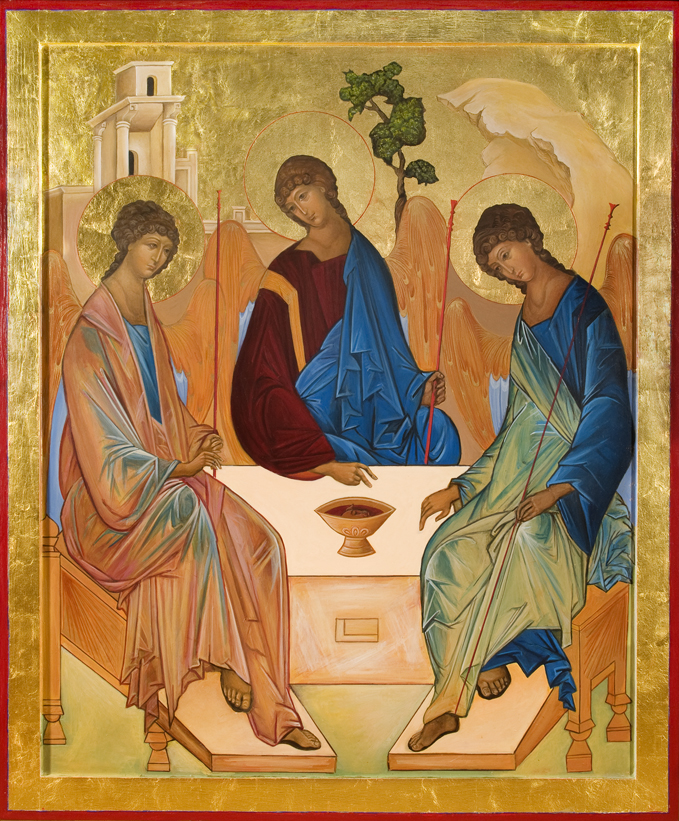
“The Trinity”: early 15th century; egg tempera and gold on wood panel by St. Andrei Rublev (1370 – 1430). St. Rublev was a Russian Orthodox monk. He resided and “wrote” with egg tempera paint to produce images of God, the angels, and the saints in sacred icons. He lived at St. Sergius Monastery in Moscow, Russia. His sacred icon above captures some of the truth of the Three Persons of the Holy Trinity communicating with each other. God the Son, Jesus Christ, is the figure in the center of this painting. You see two of His fingers extended to express His human and divine nature, and in a pointing gesture, to the “Cup of His Blood” made manifest through His Redemptive sacrifice. In this masterpiece you observe the colors blue representing divine life and purple madder/burgundy signifying Christ’s humanity. God the Father is on your left and God the Holy Spirit is on your right. The Holy Spirit is garbed in blue and in green as a symbol of new life and spiritual growth through prayer and the Holy Sacraments (Holy Mysteries). God the Father is painted in both blue, green, and a very light, transparent gold ochre. The First Council of Nicaea (AD 325) verified and promoted the Dogma of the Holy Trinity. This Dogma was reaffirmed, and further explained by the Council of Nicaea/Constantinople in AD 381.
A contemporary copy of the original Trinity by Rublev.
God the Father sent His Son to be born of a woman through the fecundity of the Holy Spirit. The Incarnation of Jesus Christ changed the Universe. God became flesh and walked among us. Why? In order to teach, heal, and redeem us from our sins. The New Covenant with His creation is written in His Blood. There is, if you have the gift of faith, ample proof that God wants to communicate with you.
It is up to each man and woman to honestly determine whether or not they are ignoring Him, and if so, to decide what to do about it. Time is short.
A Challenge: Are you as a Christian artist willing to internalize the message of the saint, scene, or Scripture passage you are artistically representing, and then, correctly portray it according to Church tradition?
Sacred artists must have more than just an awarenesses of Jesus, His Mother, angels and saints because their witness provides us with the foundation stones of our Faith. Sacred artists must be more than artists who propose “Art for art’s sake”.
If we do this what do we become? We become evangelists to the truth, goodness, and beauty of God, through the witness of Jesus Christ and the holy men and women who called Him the Son of God.
In the years immediately following St. Polycarp’s martyrdom (died, circa AD 155, and remembered yesterday, February 22nd, in the Roman Breviary and Missal) a group of eight Western and Eastern Rite scholars and clerics arose known as the Apologists (Defenders of the Faith).
The Apologists defended the beliefs and traditions of the Church that passed down to them, in an uninterrupted line, directly from the Apostles and Apostolic Fathers. This occurred during the years of continued persecution – AD 155 through AD 313.
The works and ministerial witness of the Apologists provide evidence for the continuity of beliefs and dogmas in the Early Christian Church. It is through this historic development, and the literary and physical witness of their efforts, that we have religious and cultural traditions which dramatically affected the growth of sacred art. These clerics and scholars desired to unify and establish the beliefs of the Western and Eastern Rites of the Church.
Church artists, and the later group of clerics and scholars known as the Nicene Fathers (who I will cover in later posts), were heavily influenced by their efforts. These two groups, the Ante Nicene and Nicene Fathers all desired to make concrete and visible the correct teaching – the orthodoxy – of the Church. These efforts ultimately produced artistic representations of these early spiritual heroes – a visible sign of the truths of the Gospels being preached – and in some cases, their witness in blood.
The Apologists have also been termed The Ante (Before) Nicene Fathers because they lived and died prior to the establishment of the Creed of the Catholic Faith, ultimately to be known as the Nicene Creed.
Let us briefly review two of the Apologists: St. Irenaeus of Lyons, and St. Clement of Alexandria. In a subsequent post you will have the opportunity to read three or four sentence descriptions of the contributions of the other six Apologists.
St. Irenaeus of Lyons was born in AD 130 and died circa AD 202. He speaks of the four Gospels as being the “Four Pillars of the Church,” and was in a position to know that since he heard St. Polycarp (a friend and disciple of the Apostle John) preach. He was steadfast in supporting the belief in Apostolic Tradition. He taught that the true Faith is the one imparted by the bishops of the Church who, in turn, received it directly in an uninterrupted set of teachings from the Apostles. St. Irenaeus was tenacious in his fight against heterodoxy, specifically the Gnostic heresy.
St. Irenaeus understood the value of St. Polycarp’s New Testament scholarship and his emphasis on the Church’s sacred Tradition. He spoke with authority on Mary as the New Eve, and the Holy Eucharist. St. Irenaeus barely escaped death during the persecution of Emperor Marcus Aurelius, however during the round-up approximately 50 other Christians had the joy of earning the holy crown of martyrdom. He may have eventually died a martyr, yet, there is not sufficient evidence to support it.
St. Irenaeus of Lyons (died circa 202). Famous for his manuscripts Against Heresies. He used 21 out of the 27 books of the New Testament in his writings and sermons.
Another critical Apologist is St. Clement of Alexandria (born circa AD 150, died circa 215). He led a major catechetical school in Alexandria, Egypt and agreed with St. Irenaeus that the truth and knowledge of the holy Gospels proceed through the bishops and are for the population as a whole and not for any secret society (thus, he fought against the Gnostic heresy).
He taught that in order to understand the truths of the Gospels you must have faith in unison with reason. He is also known for three major catechetical works which are still in existence. These works were meant to accompany catechumens and those baptized into the Christian faith as an aid to their spiritual development. He was not martyred.
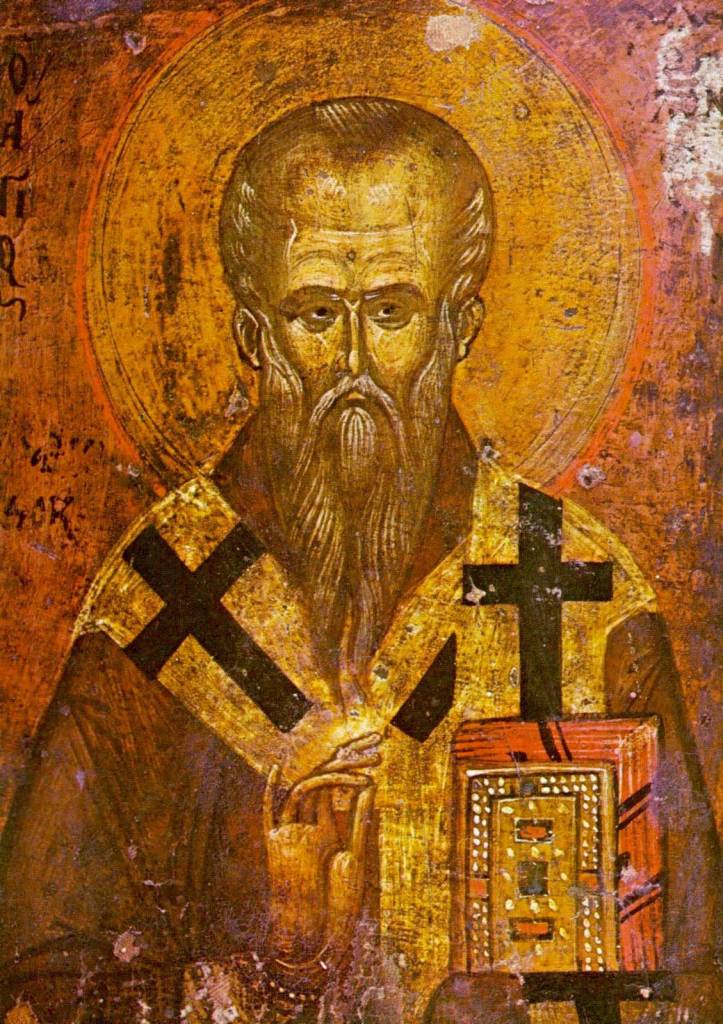
St. Clement of Alexandria – an Apologist of the Early Church – as represented by an early iconographer of the Eastern Rite of the Catholic Church.
Thanks for stopping by the Institute. I hope you have a relaxing weekend.
I have the happy service of presenting a new workshop to interested adults from Massachusetts and Rhode Island beginning on Saturday February 14th, 2015.
In an attempt to give everyone individual attention the class is currently filled at a limit of ten people. We will be pursuing our studies of painting sacred images in the Latin iconographic tradition. I hope to make the artists aware of the importance of studying the Latin and Byzantine origins of sacred images and its inevitable blossoming within the Greek and Russian civilizations.
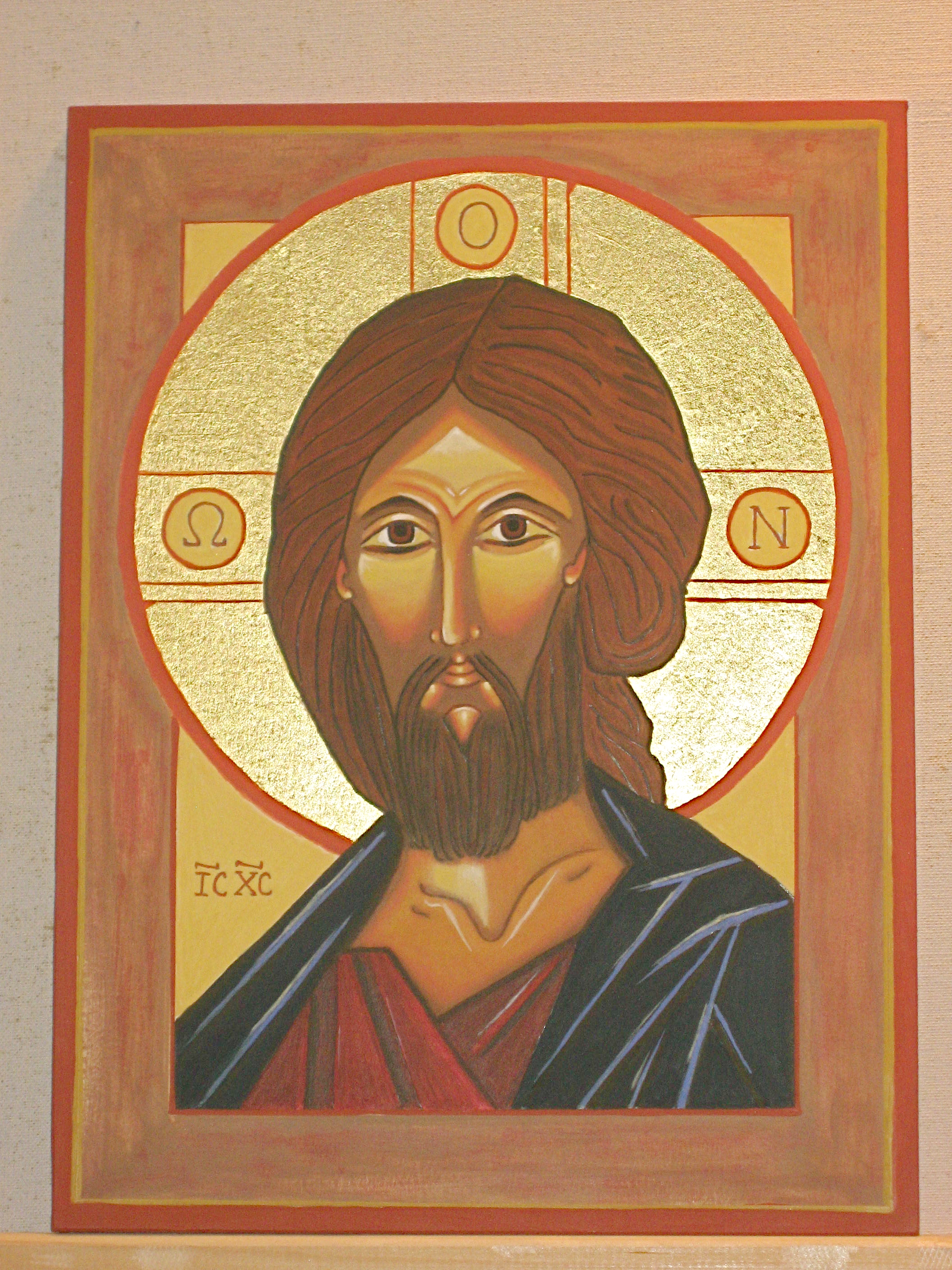
The workshop will run over a five-week period, for a total of twenty hours of class time. While they will not be painting the sacred image that is found below of Jesus Our Savior, the technique that I used to paint this image will be taught to the artists. Note that the image is painted using acrylic paints; however, I have developed a different approach in manipulating the layers of the paints. This approach evolved out of studying the work of the 12th century Benedictine monk, Theophilus the Presbyter (whom I have written about in previous essays on this blog), and my own experiments over the past few years of working with egg tempera and acrylic paints.
I specialize in painting personal prayer images (9 by 12 inches, or 12 by 16 inches) rather than images that would be found in large church or chapel applications. The image found below (95% finished) is typical of my approach. It is an image that the person in prayer can relate to, yet, it also carries a sense of transcendence. This approach will be taught in the upcoming workshop. I attempt to teach simplicity in both technique and spirituality. I avoid flourishes and excessive naturalism in facial or garment representation. In this way I have ignored the typical approach of many Latin Rite sacred artists from the mid 14th century onward. I am attempting to rediscover, or reestablish, the Latin Rite techniques of painting sacred icons. This endeavor is a work in progress!
In the upcoming workshop the students will be studying my technique and actually paint an image of St. Michael the Archangel. Upon completion of that sacred image, they will eventually move on to painting an image of the Holy Theotokos, the Blessed Mother, and then complete the sequence in studying and painting a sacred image of Jesus Christ. In upcoming posts I will be blogging about their experience and the steps that they will take in completing the sacred image of St. Michael.
My approach to the painting of sacred images in the iconographic tradition owes a debt of gratitude to my many teachers in the Byzantine and secular artistic traditions. I also owe a profound thank you to the Holy Spirit, whose grace has enabled my hands to paint sacred images. I pray that my sacred art has not offended Him. The image below appears slightly brighter than it actually is as a result of the flash.
In our Gospel today we hear John the Baptist proclaim “Behold the Lamb of God.”
We see in our mind’s eye, Andrew and another disciple, probably St. John, listening to the Baptist say those words.
Immediately after Jesus walks by they look at one another and, without saying a word, begin to follow Jesus.
Jesus, sensing their presence, turns and seeing them says,
“What are you looking for?”
They say: “Rabbi where do you live?”
They didn’t presume to say, “Rabbi we want to be your companions – we want to learn from you.” Rather they instinctually knew that this man, whom John the Baptist had proclaimed “The Lamb of God,” was the Lamb of God – the promised Messiah; and they wanted to be with Him.
In what must have been an astonishing moment for them, Jesus in turn says, “Come, and you will see.”
What did they see in those three years they spent with Him? That is what John believed he had to write down.
Those three years, and then the following years of John’s own ministry, had to be written down.
Two thousand years later we experience his excitement in the short clips of his memory as we read the significant facts and unique moments of what he experienced.
For in those facts and moments are contained the unique vision of John’s Gospel and Epistles.
They proclaim his experience of the truth that the Word of God – the Mind of God – was incarnated into the man Jesus, the Son of God.
This was done so that the Father could fully express the meaning of His love and His desire to share that love with His creation.
“Rabbi, where do you live?”
“Come and you will see.”
But this is the 21st century; and many of us do not hear the call of God to “Come and see.”
Maybe Jesus is calling to us and we are too distracted, or hurt, or swallowed up by life’s events; or maybe we don’t know how to see or listen to His message, or are just not listening at all.
But the message of this Gospel is that Jesus’ call – His invitation – is always open.
He invites us, like Andrew and John, to join Him for the afternoon and share a simple meal of bread and wine.
He invites us to be baptised into His family so we can receive the many gifts He desires to give us.
He invites us to know His laughter and joy; and He invites us to suffer with Him by knowing loneliness, sickness, heartache, and loss.
“Rabbi, where do you live?”
“Come and you will see.”
Our imagination can visualize a small Hebrew home, with a low doorway so large animals would not wander in.
We can imagine that this is where Jesus lived: in a small but adequate house on a simple Hebrew street.
Jesus, and any visitors, would have to bend down to get through the door.
We are asked to bend down, too.
We are to lower ourselves in humility, patience, reconciliation, and love.
For how are we to live with the Creator of the Universe if we, in the light of the One who loves us, are unwilling to honestly look at our own souls, ask for the forgiveness of our sins, and implore His mercy?
Ultimately, we respond to Jesus’ call by inviting Him into our heart. For that is where He truly wants to live, and rest, and share a simple meal of bread and wine.
In the late 19th century a Russian painter, the noted portraitist, draughtsman, and teacher Ivan Kramskoi painted a haunting image of Jesus alone in the desert. It is a painting which expresses the internal struggle of the flesh versus the spirit. It portrays Jesus, in the early morning hours and the cold air of the dawn, with the sun rising over His back.
He is surrounded by small boulders and sits on a rock, hands in front of him, eyes filled with anguish and pain. This portrait of Christ in the desert is not one of victory; looking closely at His face you recognize the seriousness of the struggle and the irrefutable fact of Jesus’ humanity.
Observe Christ’s clenched hands, gaze deeply into His eyes, and you will see the artist’s portrayal of a Savior that is already at the beginning of His ministry aware of the viciousness of the tempter and the burden of our sins that will weigh upon Him.
Kramskoi’s painting is so powerful because it shows not the physical tearing that was to come in the scourging and crucifixion, but the sensual, psychological, and spiritual battles that would challenge the mission and authority of Jesus Christ.
Jesus had to confront, in that very first desert assault, whether or not He was going to be faithful to His mission; was He going to be faithful to the anointing that He received from the Father and the Spirit at His baptism?
The Gospel challenges us with the same questions: are we faithful to our Baptismal promises? Are we faithful to the Commandments? Are we faithful to the call that we received at our Confirmation to live and practice the truths that He taught us, not just when we feel like it, but everyday – even in the most difficult of circumstances?
As disciples of Christ we are on a daily basis constantly revolving around the axis of temptation and sin – faith and grace. We understand that temptation, in and of itself, is a test – it is not sin. It is only sin when we willfully place ourselves in its power, when we give into its power to overwhelm our body and soul, – a deadly power that obtains its animus and energy from the original tempter – Satan himself.
Christ lived blamelessly in the face of evil, but you say, I am not Christ, I am a weak man or woman, boy or girl. I say true, we all are, but by virtue of our faithful reception of the Sacraments we have the power of Christ’s grace within us.
Unlike Christ we don’t enter the wilderness of our own temptations alone. When we do face the anguish of our own sin, our own desolation in the face of Satan’s onslaughts, when we peer over the edge of the pit of sin – Christ’s witness tells us “Do not despair. Do not dwell in the pit. Do not accept the pit of sin as being permanent.” Jesus Christ tells us that He has instituted a Church that, with all its human sins and imperfections, still exists – in purity – to convey through its clergy the grace of God.
One of the first things that you notice about Christ in this portrait is that here, at the beginning of Jesus’ ministry, the artist has Jesus’ hands clasped together. Yet, when you walk into a Catholic or Orthodox Church, and look at the crucifix or an icon of one, you see Jesus as He ends His ministry on the Cross, with His hands unclasped, and stretched out, stretched out for each one of us.
This Lenten season we need to reach out our hands to the One, who 2000 years ago, stretched out His hands for our Redemption – and who still reaches out for us today. Reach out to Him in prayer and the Sacrament of Reconciliation, and through Jesus, reach out to those around you who are suffering in the same way, and lead them back to the love of Christ.
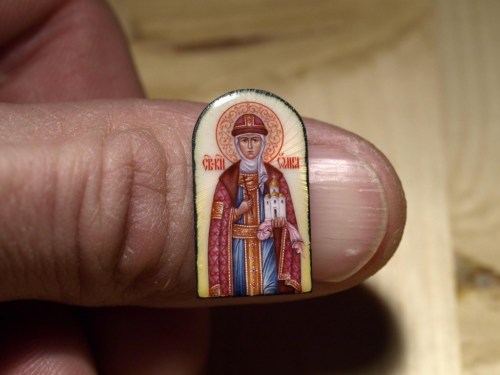
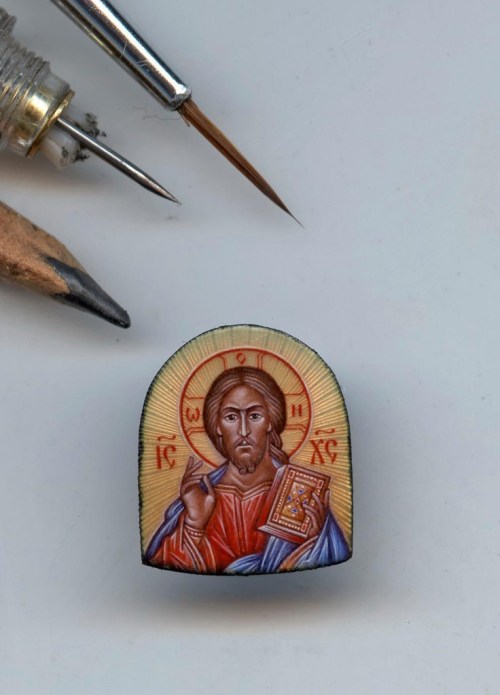
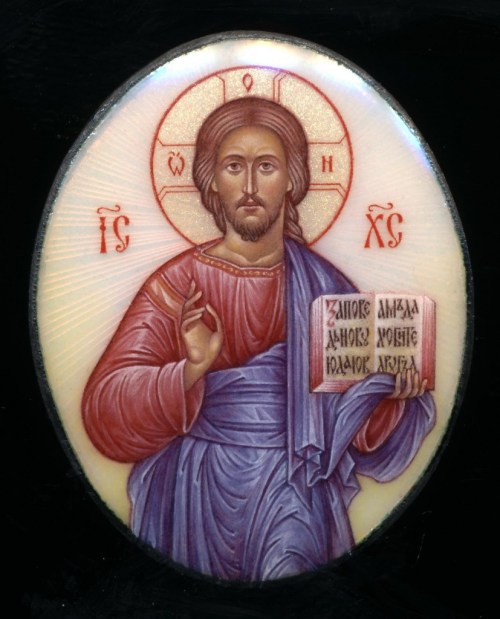
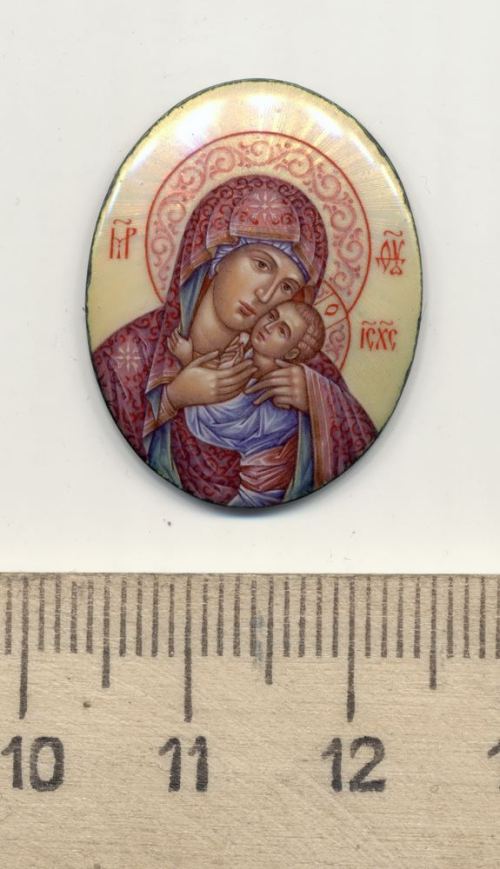
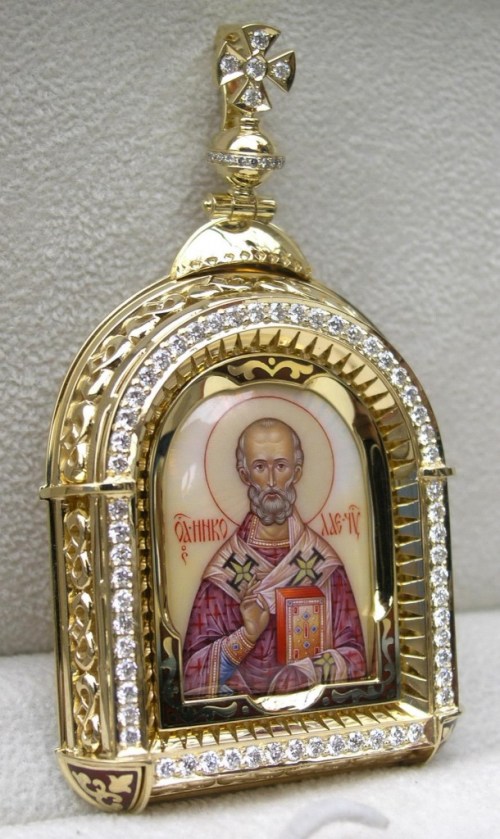
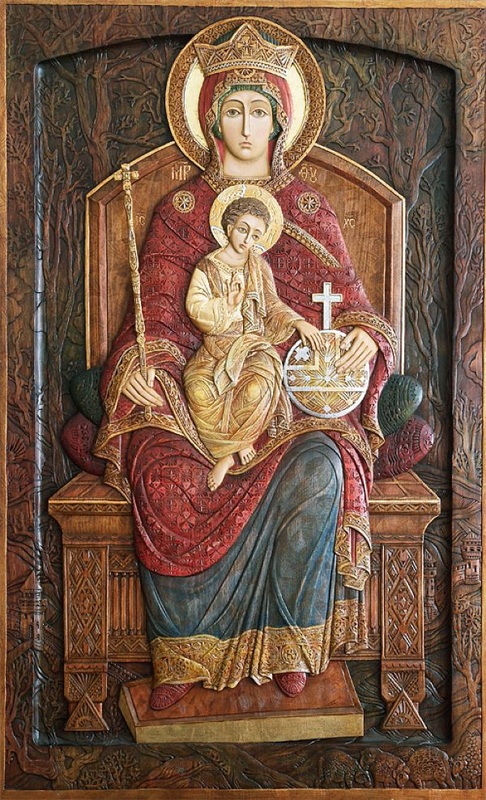
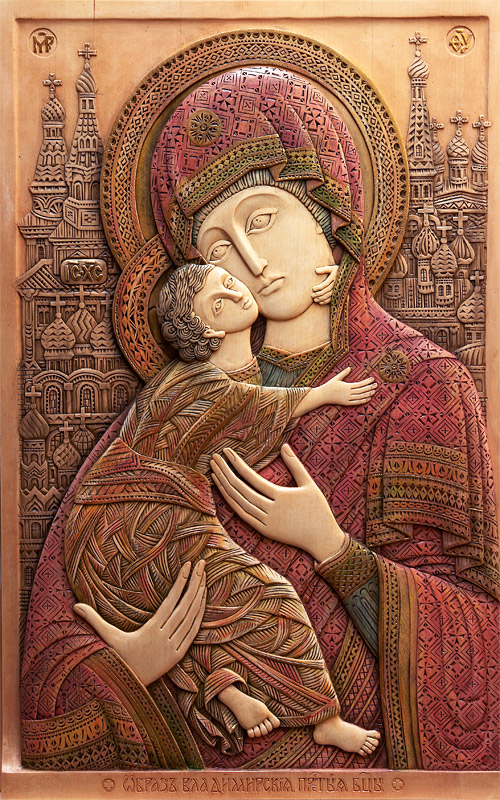
My sincere thanks to Jonathan Pageau at the Orthodox Arts Journal, http://www.orthodoxartsjournal.org/, for permission to repost his wonderful presentation of the sacred icon miniatures of Russian artist Evgeny Baranov and the spectacular icon wood carvings by Rashid and Inessa Azbuhanov.
We must take care when we paint/”write” large icons, yet, to complete an icon miniature or a wood carving, with such grace and spiritual truth, demands in my humble opinion, even more skill and patience! Enjoy, and be filled with astonishment!
Here are some of the most astounding miniature icons I have seen. They are made by a Russian artisan named Evgeny Baranov who is also a very good goldsmith as you will see below. These pictures were taken from his facebook page. I have been trying to get a short interview with some more details, and my lack of Russian seems to stand in the way… but really, the work stands on its own.
Rashid and Inessa Azbuhanov are a Russian couple who are leading the rediscovery of icon carving in the Russian Church. Their works grace the collections of Russian politicians from Gorbachev to Putin, European royal families and church authorities from the Russian Patriarch to the Pope of Rome.
Their works are often large and highly detailed, like wooden lace as they include much chip carving into the patterns of clothing, backgrounds and frames. There is a certain folk aspect to their work, especially in some of the faces which do not follow the more usual formal tradition of icon carving but are often effective nonetheless. They recently had a show of their work in Moscow and so I thought it a good opportunity to put up some of their icons.
Despite their great success, they are warm and quite generous, just like their carvings.
The following is a homily that was delivered at St. Francis of Assisi Church and St. Romuald Chapel in Wakefield, Rhode Island USA by Deacon Paul O. Iacono on the weekend of the 5th Sunday of Lent – March 16/17, 2013.
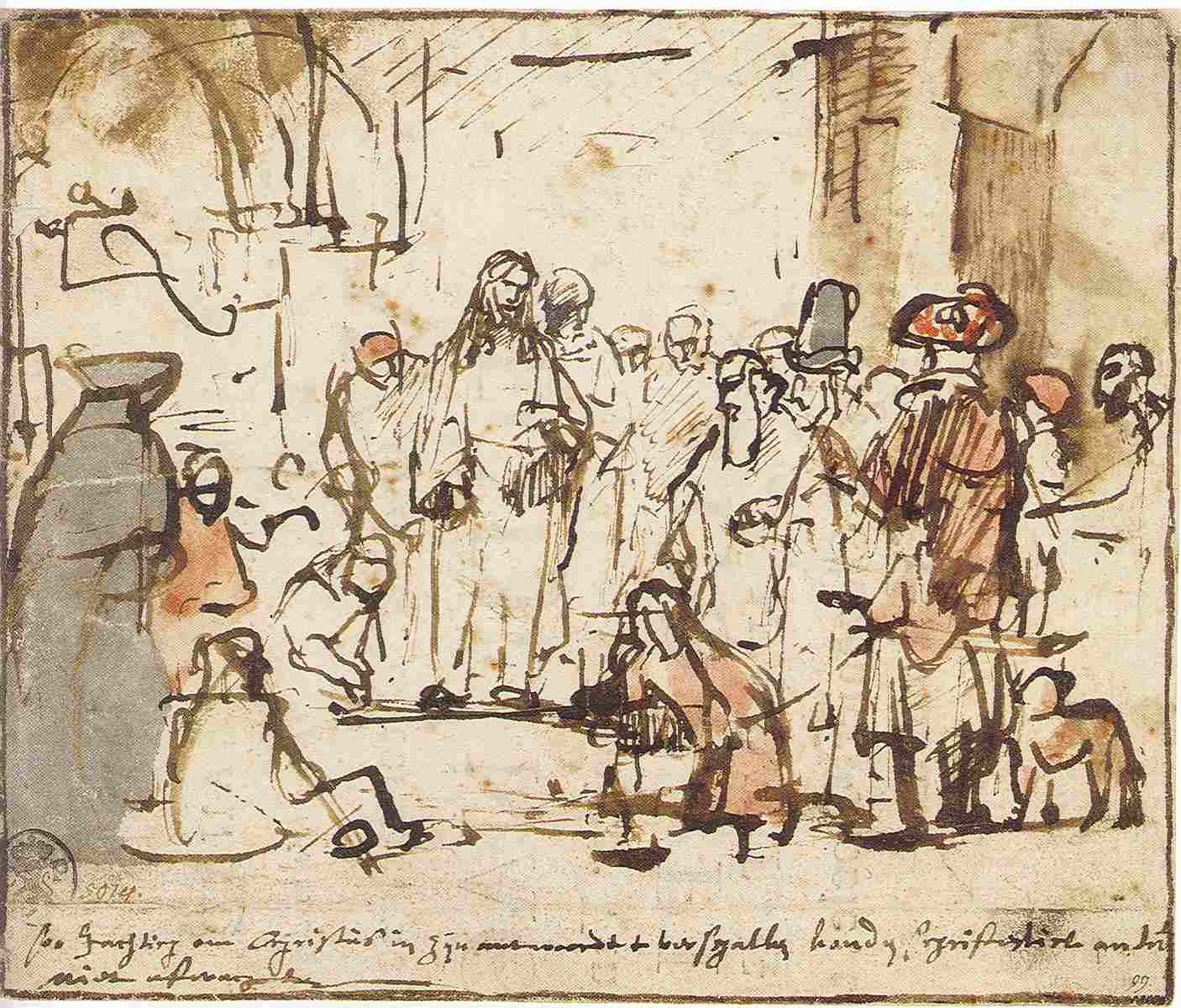
Last week’s Gospel related the story of the prodigal son; this week the prodigal daughter stands before us.
These two people start with dissent against authority and its commands. Their actions led to life altering, almost near death experiences. They end their self-destructive journey with a conversion that speaks to all repentant sinners of the availability of the astonishing love, mercy, and forgiveness of God.
In last week’s Gospel, the merciful father pardons his prodigal son; today, God’s merciful Son pardons the sinful daughter.
Last week, the oldest son questioned the father’s reasoning; today, the Jewish elders question Jesus’ reasoning, and He responds to this challenge with questions of His own.
Jesus’ first challenge is to the mob: “Let the one among you who is without sin be the first to throw a stone at her.”
This inquisitive command forces even the most proud and dogmatic of them into uncomfortable moments of self-reflection, and to see in that mirror their own sins – which results in their silently walking away.
Then Jesus turns, and looks at the woman – twenty-four hours earlier she was beautiful and appealing. What does He see now? A woman whose feet were bloodied from running in panic through the streets, clothes torn, hair askew, mind and heart filled with panic at her impending death.
Her defiance of the 6th Commandment was gone; as she was running for her life defiance gave way to abject terror and remorse, and when finally caught, her grief gave way to despair.
In lust’s name, she had betrayed married love – publicly humiliated and publicly condemned – she stood surrounded by the mob – waiting for the first rock to be thrown – staring alternately at Jesus and the ground.
But, Jesus’ second challenge is to the woman herself. His challenge doesn’t wound her, rather, she comes into full contact with Jesus’ Sacred Heart. His words, spoken from His heart – caresses her heart; and as their eyes meet He says: “Neither do I condemn you. Go, and sin no more.”
Stunned with disbelief she must have stood there for a few moments, staring into Jesus’ eyes, the realization of His forgiveness washing over her – her heart filled with a new sense of hope and an overwhelming awareness of the invitation to live in His love and mercy.
The woman caught in adultery was blinded by her own lust, caught in the web of darkness she was unable to hear and speak to God, yet, what does Jesus do?
He opens her eyes and ears; He gives her interior light; He covers her nakedness with a mantle of love and mercy and renews her ability to live a life that respects the laws of God.
At that moment Jesus blessed the adulterous woman with all the graces that are available to us in the Sacrament of Reconciliation
In the stories of the prodigal son and daughter, we have a new awareness that in our own ways, we too, are prodigals; and relief – relief in the knowledge that when we do Sacramentally repent, and attempt to sin no more, we receive extraordinary graces and the invitation to live in the love of divine mercy.
This is the meaning of Lent my brothers and sisters. For it teaches us that we have no reason to fear Christ – no reason to fear reconciliation with Him – for He freely offers us His Sacramental strength so that we may walk in His freedom, be renewed, and become more like Him.
Like the prodigal son and daughter, let us put aside our sinful ways, and grasp the hand of our merciful God in Sacramental Confession. Let us trust in Him; for Jesus’ love is vast and the waters of His mercy, to those who repent, continually refresh and satisfy our deepest longings to rest in Him.
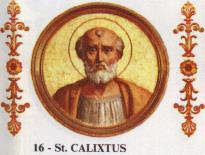
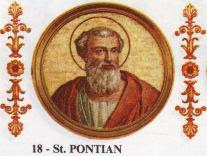
Today we celebrate the martyrdom of Saint Pontian, who was the lawfully elected successor pope to St. Callistus during the early 3rd century. St. Pontian was considered a criminal by the emperor Maximinius and banished to the silver mines in Sardinia – an exile which meant certain death. We also celebrate today a saint by the name of Hippolytus, who was a priest in the Church of Rome at this same moment in time.
Saint Hippolytus is recognized because of his brilliance and profound scholarship. He is considered to be one of the finest theologians of the 3rd century, and is the source of the 2nd Eucharistic Prayer recited at Mass. Hippolytus’ most important work is a treatise known as The Apostolic Tradition; and scholars such as Dr. Marcellino D’Ambrosio, (at http://www.crossroadsinitiative.com) tell us that it provides “an enlightening and extensive glimpse into the liturgical and devotional life of Roman Christians around the year 200.” The statue found below is of Roman origin, found in the mid 16th century. It has the name Hippolytus carved into it as well as references to works of other Apostolic Fathers. The image is presented through the courtesy of Dr. D’Ambrosio.
Controversy, however, erupted when St. Callistus, was elected to the papacy. St. Hippolytus considered Callistus to be a liberal since Callistus extended absolution to new converts who had committed mortal sins such as adultery and murder. Hippolytus contested the election, violently disagreed when Callistus was affirmed, and then made history by declaring himself pope, thus becoming the first anti-pope in the history of the Church!
As a result of his action he divorced himself from full communion with the Church. When Pope Callistus was martyred, in the year 222, Hippolytus began disagreeing with his successors – the last being Pope Pontian. Hippolytus’ theological differences and self-imposed actions didn’t mean anything to the Romans for they arrested him, too, and exiled him off to Sardinia; and there, St. Hippolytus – the anti-pope met St Pontian, the true pope and lawful successor to Pope Callistus.
In the silver mines of Sardinia, Pope Pontian abdicated his office, making way for a lawful successor to be elected, and Hippolytus renounced his anti-papacy and was absolved of his sins by Pontian. Fully reconciled they died together for the faith in the year 235.
So, what does this have to do with us?!
Our Gospel today (Matt 17: 22 – 27) provides the answer, for in it our Lord and the Apostles were confronted with the arrogance of the officials who implied they were evading the local taxes. Jesus attempts to clarify His position not only for St. Peter but for the officials as well.
Jesus is basically saying that, yes, they must pay the tax; the reason being they must not do anything to put a stumbling block in the way of people understanding His ministry and message. Again we see Christ not getting political. He is not ranting about the just or unjust qualities of the Temple tax, or Roman occupation. He is beyond that, and demands that the Apostles, as His successors, not give a bad example to the people.
This is a lesson that St. Hippolytus, for all of his brilliance never learned. He did give bad example to the Church of Rome in declaring himself an anti-pope. His dissension and attacks were not productive or helpful in a highly charged environment which constantly witnessed Roman persecution.
Yet, St. Hippolytus ultimately saw his sin, repented of it, and along with Pope St. Pontian, did his duty and defended the true faith with his life. We must always do the same, and whatever our calling or ministry may be, we must never become a stumbling block that prevents others from seeing and believing in Jesus and His Church.
Peter was born in the late 4th century in northern Italy. In 424, after serving as a deacon and priest in Emilia, he became bishop of the Italian city of Ravenna. Little reliable information about St. Peter’s life survives, except that he successfully drove heresy and the remnants of Roman paganism from his diocese by doing two things: providing exceptional pastoral care to the people and by giving practical yet passionate sermons. St. Peter’s brief sermons were so inspiring that he was given the title “Chrysologus” which means “of golden speech.”
He was declared a Doctor of the Church in the 18th century. In order to be called a Doctor of the Church the Pope and Cardinals must agree that the individual possessed three main characteristics during his or her life: truly outstanding holiness; a depth of doctrinal insight; and a body of writings which the Church recommends to people as authentic and life giving. These three qualities contributed to Peter’s success in ministering to the people of his diocese.
Our Gospel today speaks of the tiny mustard seed growing into a large bush, or the tiny yeast germ enabling the flour to rise. This theme of transformation is at the center of the story of the Incarnation. In a homily on this theme, St. Peter beautifully describes how Jesus is able, through His two natures, to touch and transform us. Christ meets us on a daily basis in prayer, and especially through the Scriptures and His real presence in the Holy Eucharist.
By means of these two marvelous gifts St Peter explains that we are able to identify with Jesus and be converted like the mustard seed and yeast germ, into something so much greater – we are transformed and divinized into the life of Christ Himself. In one of his homilies, he has the Lord speaking and appealing to His people. He says,
“Listen to the Lord’s appeal: In me, [your Lord] I want you to see your own body, your members, your heart, your bones, your blood. You may fear what is divine, but why not love what is human? You may run away from me as the Lord, but why not run to me as your father? Perhaps you are filled with shame for causing my bitter passion. Do not be afraid. This cross inflicts a mortal injury, not on me, but on death.
These nails no longer pain me, but only deepen your love for me. I do not cry out because of these wounds, but through them I draw you into my heart. My body was stretched on the cross as an icon, not of how much I suffered, but of my all-embracing love. I count it no less to shed my blood: it is the price I have paid for your ransom. Come, then, return to me and learn to know me as your father, who repays good for evil, love for injury, and boundless charity for piercing wounds.”
May the Lord continue to raise up men and women with St. Peter Chyrsologus’ gifts to feed and care for His people.
You are probably thinking, the poor old fellow has made a mistake in his spelling. Shouldn’t the title read “Son” of Justice?
One evening a passage from Evening Prayer in the Divine Office caught my attention. It was the final prayer and it read: “Father, yours is the morning and yours is the evening. Let the Sun of Justice, Jesus Christ, shine for ever in our hearts and draw us to that light where you live in radiant glory.” That phrase provided this image’s title: Sun of Justice, Jesus Christ.
My intent was to have the image direct the prayerful observer to meditate on the truth that Jesus Christ is metaphorically the Sun, which as a result of His obedient and willing sacrifice on the holy wood of the Cross, shines in our hearts. It is up to us to prevent its eclipse in our soul.
Through his death and resurrection He redeemed us of our sins and guides us back to the Father. He is the Son and the Word of the Father. He is the Light of the World. He is also the Sun of Justice, in that we as individuals will all surely have His light illumine our souls and be judged by His standards.
The face and garments of the sacred image are not painted in the artistic language of traditional iconography. I made preliminary sketches and based them on the drawings and wood carvings of Brother Martin Erspamer, O.S.B. I attempted to emulate woodcarving methods.
I am happy to say that when you are praying in its presence it does provide comfort to your soul.
This sacred image of TheSun of Justice, Jesus Christ was a gift to Fr. Joseph R. Upton. He is a wonderful and holy priest who serves as the Chaplain of the Fra Angelico Institute for Sacred Art.
All of us struggle with the reality that the experiences of our life may harden our hearts and deafen our ears to God’s truth. We may be similar to the disciples in this past Sunday’s Gospel (Luke 24: 35-48), who were filled with anxiety – until – – the moment “Heopened their minds to understand the Scriptures.”
Jesus shows them the nail wounds in His hands and feet. He explains to them that the Scriptures teach that we cannot have glory and honor without the willingness to suffer and die to our own sinful will and perceptions.
He teaches them that they need to see the connection between His passion and death with His resurrection. He explains this so that they can understand what He is truly about, and that their mission, “as witnesses to these things” is to go out and preach the truth of His words and resurrection. Jesus explains, ifthey cooperate with and are open to His teaching, then they will realize that life’s events will shape them into what they are truly meant to be and the Father’s plan will end in glory for them, too.
We can relate the shaping and opening of the disciples’ minds to the creation of a beautiful piece of pottery or a favorite coffee mug or tea cup that we may own. That cup started out as a simple lump of clay. Its creator – the artist – put it on a potter’s wheel, moistened his or her hands, and began to firmly and patiently mold the lump of clay into a cup.
The cup had to be put into a kiln and heated – then taken out, allowed to cool – painted – put back into the kiln again – and then, at the right moment – taken out of the heat and allowed to cool – to eventually be used for the purpose it was created.
The cup – a few days or weeks before – was just a soggy lump of clay – all closed in on itself; but now, after all the pounding, shaping, heat, and stress of its experience – it is opento serve the purpose intended for it by its creator – its ceramic arms now open to embrace and hold what it was intended to receive – and thus, be a useful instrument – a good and faithful servant.
This analogy helps to explain a thread running through the fabric of Holy Scripture, a thread, Jesus probably repeated to His disciples which is from the prophet Jeremiah, it says “As clay in the potter’s hand, so are you in My hand…” (Jer.18.6);
Our creator, God the Father – has spoken to us through His Son and laid His potter’s hands on us – His chosen vessels. We are all lumps of clay. We have all been pounded and shaped on the wheel of life.
We are a people who have been put into the furnace of life’s circumstances, suffered through sickness or various types of torments and troubles, and who sometimes find ourselves hanging on by a mere thread, but with Jesus’ help – in the end – even though we have suffered much – we are made stronger in our faith – and are viewed as beautiful in the eyes of God because we have not given up. The clay of our life has been moistened by God’s Holy Scriptures and Sacraments – and because we have patiently kept the faith – we have not cracked in the heat of the kiln of life.
Like the disciples in today’s Gospel let us be willing during this Easter season, to have our hearts and minds opened, shaped, and molded through the patient and loving hands of Our Lord in His Words and Sacraments. If we allow Him to do this, even though we have experienced the wheel of life and the kiln of adversity, we will emerge as beautiful and faithful servants of our Lord.
Catholics, Orthodox, and Protestants – we are all an Easter people. For two thousand years we have – through faith in historical documents and human witness – been invited to believe in a divine act of revelation: the Easter resurrection of our Lord and Savior; for it is inthat act that our God shows us who He truly is.
We believe that the resurrection of Jesus is a historical and spiritual fact; and that the resurrection of Jesus not only explainsthe truth of His promises but it demonstrates what has been promised to us.
On the first Easter morning, Mary Magdalene, Peter, and John saw that the stone had been rolled away from Jesus’ tomb; and as they looked in – they came face to face with their eternal destiny. Since no stone could have stopped the resurrected Jesus, itwas pushed away not to let Jesus out – but to let them – and us – in.
Like Mary, Peter, and John, and all the others, we come to realize that we are an Easter people – which means that we are an eternal people – members, through our holy baptism, of the family of the eternal high God. The tomb could never hold the resurrected Jesus, and – as a people of faith – it cannot hold us.
St. Paul tells us in his epistle to the Hebrews that “faith is the assurance of things hoped for, the conviction of things not seen.” (11: 1)
But what is hope? Hope is trust based on a divine promise. We have hope because we trust the words and deeds of Jesus Christ. We trust in His promises to us.
Our hope interacts with our faith in Him – and we are forever changed because of it. You and I are certain of our faith, because we understand and rejoice in the hope that our God does not lie – our Scriptures do not lie – our Sacred Tradition does not lie; so as an Easter people we possess the hope that St. Peter speaks of when he says: “…we have been born anew to a living hope through the resurrection of Jesus Christ from the dead. (1 Peter 1:3).
As we celebrate the Easter season, let us – as our Lord tells us today – “Be not afraid” – let us be joyful and thankful for the gift of faith and the willingness, in the face of all odds, to share our faith and joy with others.
May God grant you a joyous and creative Easter season!
“Something strange is happening – there is a great silence on the earth today, a great silence and stillness. The whole earth keeps silence because the King is asleep. The earth trembled and is still because God has fallen asleep in the flesh and he has raised up all who have slept ever since the world began. God has died in the flesh and hell trembles with fear.
He has gone to search for our first parent, as for a lost sheep. Greatly desiring to visit those who live in darkness and in the shadow of death, he has gone to free from sorrow the captives Adam and Eve, he who is both God and the son of Eve.
The Lord approached them bearing the cross, the weapon that had won Him the victory. At the sight of Him Adam, the first man He had created, struck his breast in terror and cried out to everyone: “My Lord be with you all.” Christ answered him: “And with your spirit.” He took him by the hand and raised him up, saying: “Awake, O sleeper, and rise from the dead, and Christ will give you light.”
I am your God, who for your sake have become your son. Out of love for you and for your descendants I now by my own authority command all who are held in bondage to come forth, all who are in darkness to be enlightened, all who are sleeping to arise. I order you, O sleeper to awake. I did not create you to be held a prisoner in hell. Rise from the dead, for I am the life of the dead. Rise up, work of my hands, you who were created in my image. Rise, let us leave this place, for you are in me and I am in you; together we form only one person and we cannot be separated.
…For the sake of you, who left a garden, I was betrayed to the Jews in a garden, and I was crucified in a garden.
See on my face the spittle I received in order to restore to you the life I once breathed into you. See there the marks of the blows I received in order to refashion your warped nature in my image. On my back see the marks of the scourging I endured to remove the burden of sin that weighs upon your back. See my hands, nailed firmly to a tree, for you who once wickedly stretched out your hand to a tree.
…a sword pierced my side for you who slept in paradise and brought forth Eve from your side. My side has healed the pain in yours. My sleep will rouse you from your sleep in hell. The sword that pierced me has sheathed the sword that was turned against you.
Rise, let us leave this place. The enemy led you out of the earthly paradise. I will not restore you to that paradise, but I will enthrone you in heaven… the kingdom of heaven has been prepared for you from all eternity.”
The above quotation is from an ancient homily of the Catholic Church from its earliest centuries and is found within the Divine Office of the Roman Catholic Church. It is taken from the Office of Readings for Holy Saturday.
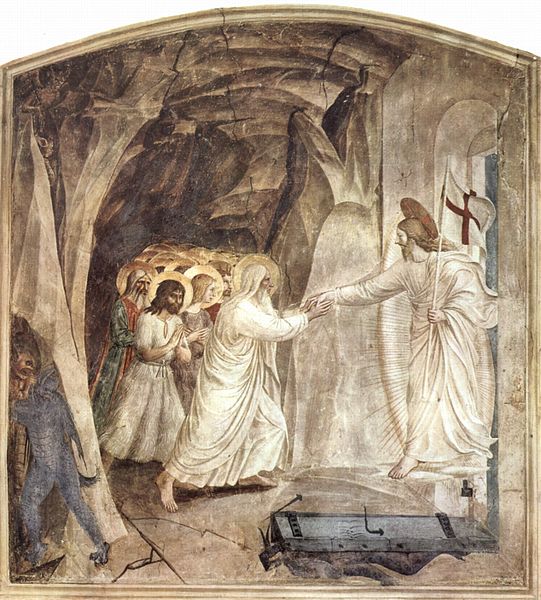
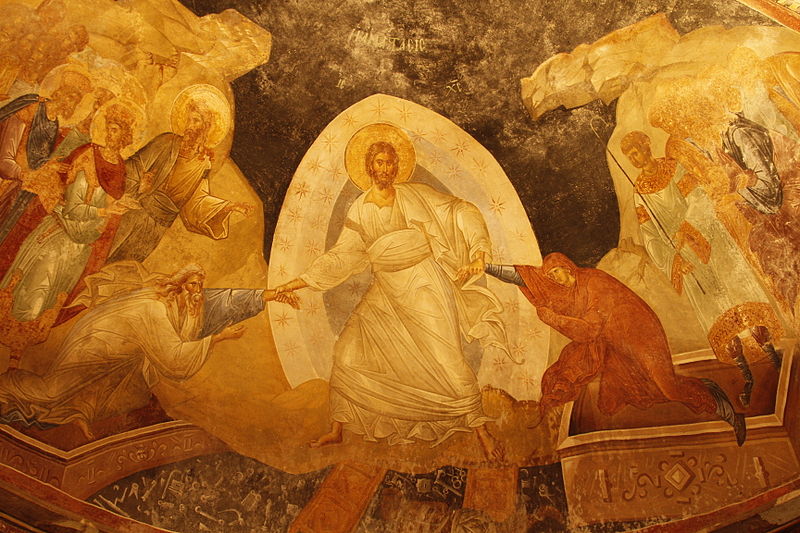
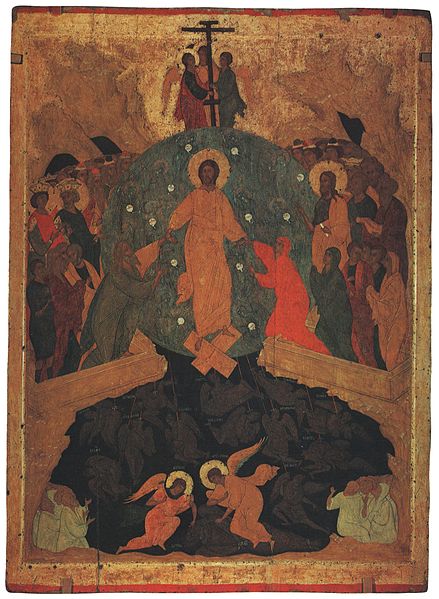
The first image of “The Harrowing of Hell” was painted by the Florentine painter Fra Angelico between the years 1437-46. The second image on this same subject was completed around the year 1315 by an artist of the Orthodox Church who painted this wall icon in fresco. It is presently found in the Chora Church in Istanbul, Turkey. The third image of the “Harrowing of Hell” is by the head of the Moscow school of icon painters from the late 15th century – the master Dionysius. This Russian Orthodox icon was completed around 1481.
It was about nine in the morning when they nailed Jesus to the cross.
From noon until three o’clock there was darkness over the whole world.
At three o’clock, Jesus cried out in a loud voice: My God, my God, why have you forsaken me?
It is finished.
When we were His enemies, God reconciled us to Himself by the death of His Son.
Realize that you were delivered from the futile way of life your fathers handed on to you, not by any diminishable sum of silver or gold, but by Christ’s blood beyond all price: the blood of a spotless, unblemished lamb chosen before the world’s foundation and revealed for your sake in these last days. It is through Him that you are believers in God, the God who raised Him from the dead and gave Him glory. Your faith and hope, then, are centered in God. (1 Peter 1: 18-21)
“Awake, O Sleeper, and rise from the dead, and Christ will give you light.”
The painting, Christ’s Crucifixion, is by the Spanish master Diego Velazquez (1599 – 1660); it was completed between 1631 – 32. All the Scriptural quotations are taken from The New American Bible (1970) Confraternity of Christian Doctrine, Washington, D.C. The “Awake, O sleeper…” verse is taken from an ancient homily from the first centuries of the Church.
In the passage from the first Epistle of Peter known as the Canticle of Peter (1 Peter 2: 21-24) Peter describes Jesus’ acceptance of His passion. He explains:
“Christ suffered for you, and left you an example to have you follow in His footsteps. He did no wrong; no deceit was found in His mouth. When He was insulted He returned no insult. When He was made to suffer, He did not counter with threats. Instead He delivered Himself up to the One who judges justly. In His own body He brought your sins to the cross, so that all of us, dead to sin, could live in accord with God’s will. By His wounds you were healed.”
In this morning’s first reading we have Isaiah tell us, “He [the suffering servant] does not cry out or shout aloud, or make his voice heard in the streets.”
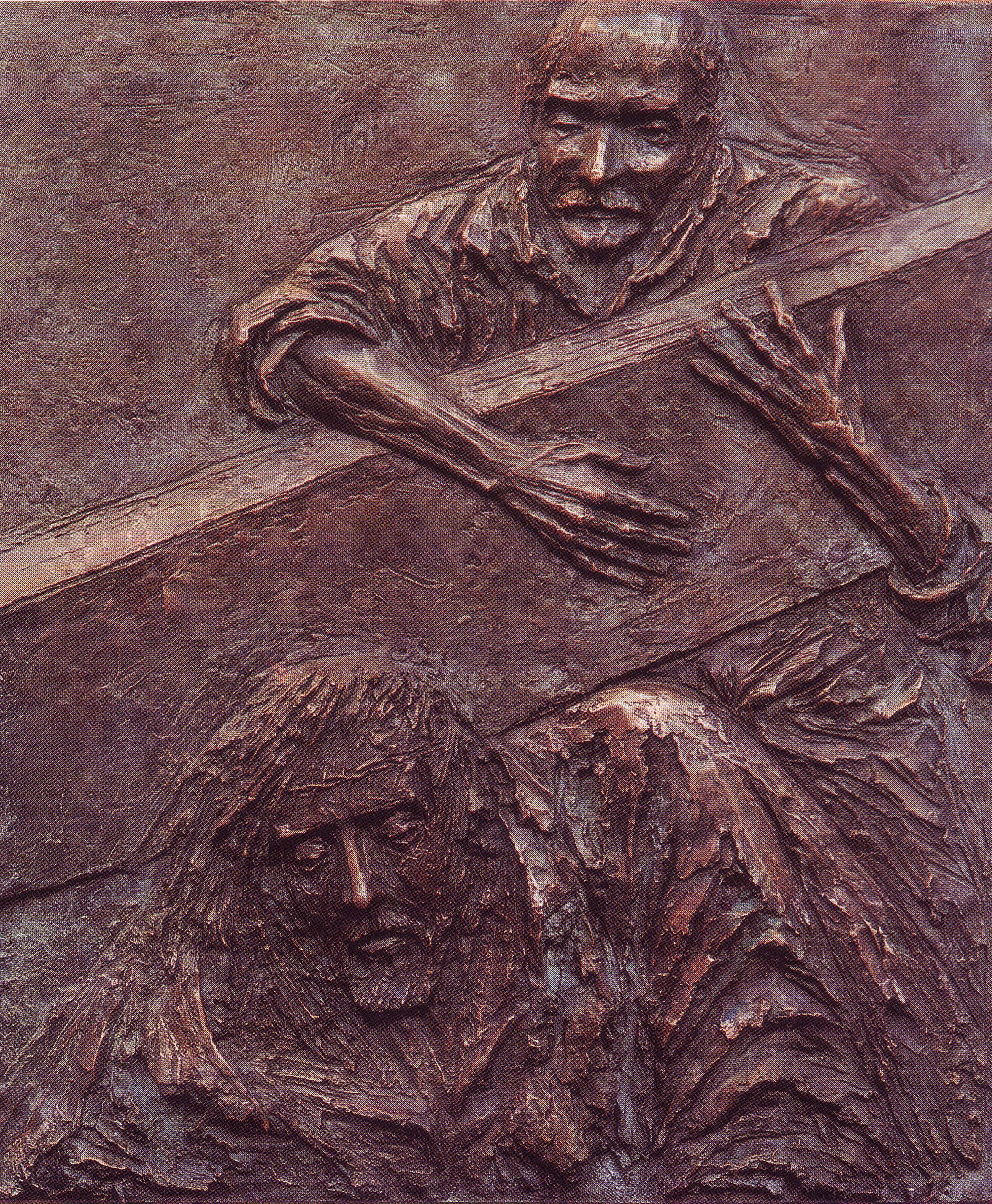
We can picture Jesus carrying the Cross, carrying the weight of our sins through the streets of Jerusalem to His place of execution.
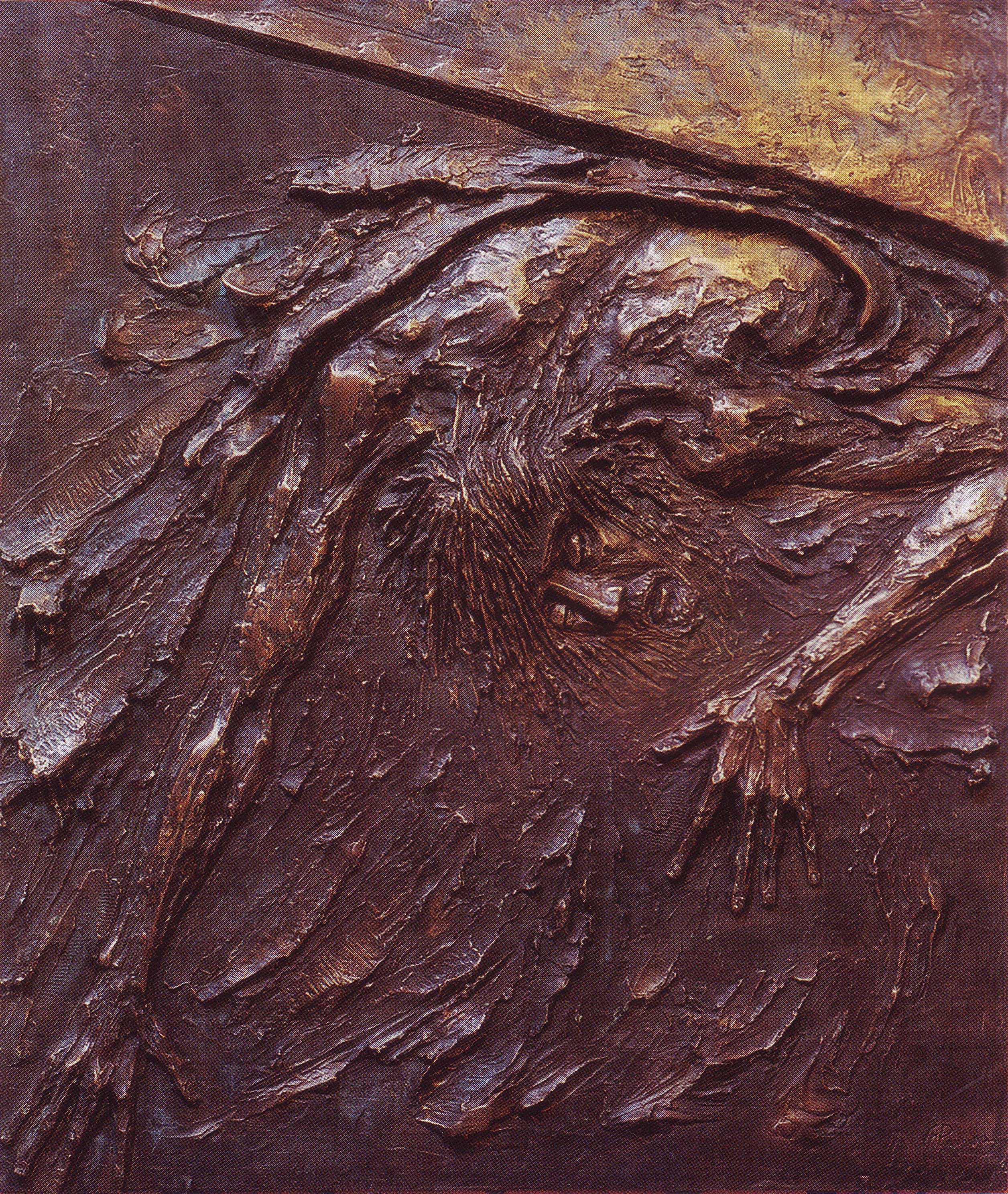
After receiving a savage beating and scourging at the hands of the Roman soldiers, He said nothing; after having the weight of the Cross thrust upon His raw and bleeding shoulders – He said nothing; as He stumbled and zigzagged through the streets of Jerusalem, being hounded every step of the way by sadistic soldiers and a callous mob, He said — nothing.
What does His silence say to us?
Possibly, if we unite ourselves to His sufferings, we can see that our own life consists of spiritual, physical, and emotional beatings, scourgings, sufferings, and crosses that are thrust upon us.
Like Jesus, we may feel that we are being ground into the street by the suffering we are experiencing – but like Him – we must rise up – to carry our personal cross as best we can.
As Catholic Christians – actually, all Christians regardless of denomination – have as our calling the duty to carry our trials and troubles in the same way that Jesus did. Like Him, we will zigzag through the streets, we too, will stumble and fall; but Holy Week reminds us that we must always see Jesus’ composure, humility and strength in the face of unbelievable pain and extraordinary adversity as a model that we must strive to emulate.
Jesus was not a masochist; nor are we. But we understand that the mystery of suffering contains within it the seed of our redemption – the seed of our spiritual rebirth – for a seed must fall to the ground and have its outer shell stressed, broken, and yes, pulverized, so that its center may take root and give birth to new life.
This week we must make a silent prayer, to join our trials and sufferings, those of our loved ones, and those of our nation – to His, and to implore the Father to help us raise up our nation, family, and ourselves as best we can, so that we may, as Saint Peter tells us, “follow in His footsteps” and silently and without complaint, carry our own cross – as well as the crosses of others.
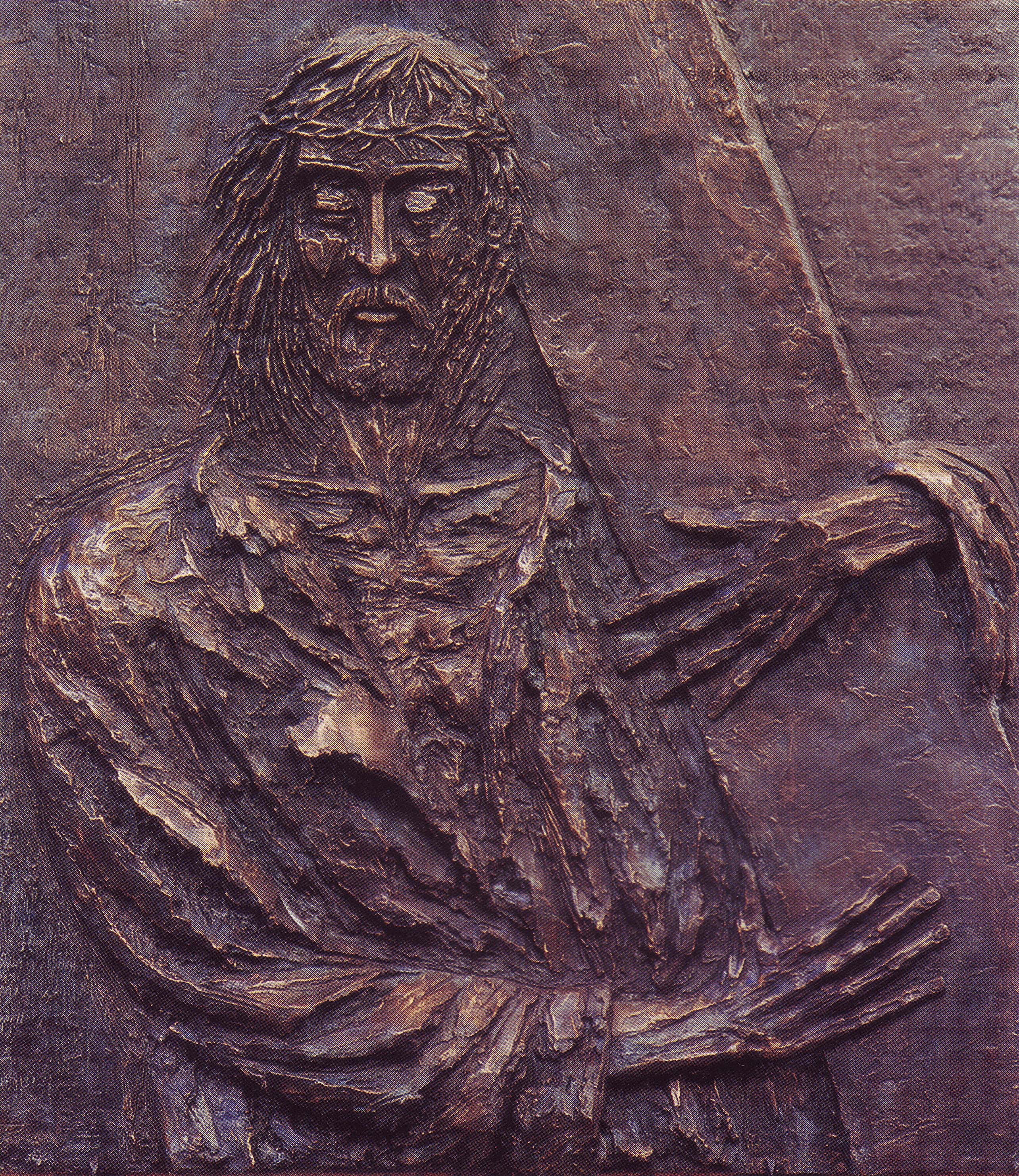
Special thanks to Fernando Mario Paonessa a contemporary artist for providing the images of Jesus suffering the Way of the Cross. Fernando created these stunning sculptures (reliefs); more images may be found on his website: http://fernandomariopaonessa.eu/pages/via_crucis.htm
St. Thomas, in his Summa Theologiae, has a wonderful meditation on today’s Solemnity of the Epiphany. He says that “Salvation was to be through Christ and apply to all sorts and conditions of men because in Christ Jesus there cannot be Greek or Jew, slave and free man. In order that this should be foreshadowed in Christ’s birth, he was made known to men and women of all conditions, because as St. Augustine says, the shepherds were Israelites, the Magi were Gentiles, the first were near, the latter from afar: both hastened to Christ the cornerstone…. The Magi were wise and powerful, the shepherds, simple and lowly. He was also manifested to the just, Simon and Anna, and to sinners, namely the Magi. And also both to men and to women… so as to show that no human condition was barred from His salvation.”
Dominican Father Andrew Carl Wisdom, OP adds to these observations the following prayer: “Newborn King, you show no partiality in your love for us. Young or old, rich or poor, educated or uneducated, you could not love us any more in the next moment than you do in this moment. But my witness wavers at times, Lord. I lose track of the real Star, caught up in becoming one myself. Help me to once again kneel before you like a little child and open up my treasuries of time and talent on behalf of the work which I was sent.”
As you know, this blog is dedicated to evangelizing the truth, goodness, and beauty of God through the study and creation of sacred art in His honor. As artists the meaning of the Epiphany is very important solemnity to us. Why? Because it reminds us and redirects our creative efforts away from following the supposed light and friendship of the secular world, the television, the political party, or the glow of the computer screen, to the true Light – the Light emanating from the face of Christ.
Yes, we have to exist within our particular culture. We have to make a living and provide for ourselves and our loved ones. Yet, as Christians, Jesus Christ’s manifestation to the Magi asks us to remember that we must live in the world but not have our souls be overcome or compromised by it. The shepherds and Magi were changed by the Light of Christ’s face – may His Light and Presence change us, too.
Image of Jesus Christ by Blessed Fra Angelico (1387 – 1455).
Today we celebrate the feast of the Exaltation – or Triumph – of the Holy Cross.
The early Catholic Church was intensely persecuted during the first 280 years of its life – so the symbol of the Cross – the symbol of public humiliation and excruciating death – was rarely used in our Christian iconography. But this doesn’t mean that the early Christians were reluctant to express their devotion to the Cross. Writing in the year 204, the Christian theologian Tertullian said: “At every going in and out, when we put on our clothes, when we sit at table, in all the ordinary actions of daily life, we trace upon our forehead the sign [of the Cross].”
In the year 313, the Emperor Constantine signed the Edict of Milan, which proclaimed toleration for the Christian faith within the Roman Empire. Constantine’s mother, Helena, made a pilgrimage to the Holy Land, and with the support of the local bishop – excavated the area known as the site of Golgotha. Tradition states that portions of the true Cross, with a partial nameplate still attached was found, resulting in Constantine ordering that the Church of the Holy Sepulcher be built over the site. The church was dedicated nine years later, with a portion of the Cross placed inside it. So the feast that we celebrate today marks the dedication of the Church of the Holy Sepulcher in the year 335. That Church was unfortunately destroyed by the Muslims in the year 1009, only to be rebuilt centuries later, with the new occupants – all Christians – vying for control of the site! Unfortunately even among our brother Christian Churches there have been numerous clashes and conflicts over the control of this holy site. It is as if all of us – as guardians of the Church’s holiest site – had not internalized the meaning of the true Cross – the meaning of what happened on that site 2000 years ago – the meaning of the Father’s supreme sacrifice of His Son for the sake of His creation. God’s love was raised up on Golgotha that day and Satan’s venom was forever neutralized, but the sting of Satan’s original bite in the Garden of Eden still remains.
The truth of our Scripture readings tell us that Moses lifted up the bronze serpent, a sign of sin, and the people were healed. Jesus makes an analogy of the serpent with the healing power of the Cross – since it is a sign of our sin and our redemption. When the Father, through the Holy Spirit, lifted up Jesus in the resurrection, the Holy Cross was no longer viewed as a sign of evil and sin – rather it became a sign of Christ’s victory and our salvation.
Our Savior, through the instrument of the Holy Cross, shows us the level of His love for His creation. The Father shows His love for us by giving us the best He has – His Son – and His Son shows His obedience and trust in the Father – through His willingness to take upon Himself all sin and become a perfect offering back to the Father on our behalf. The Fra Angelico Institute for the Sacred Arts chaplain, Fr. Joseph Upton, gave a beautiful homily today at morning Mass in which he emphasized that every day, we too raise up Jesus on the Cross. In every Mass, we have re-presented the sacrifice of Jesus for us. We commemorate His act and we thank Him for it in His gift of Himself to us in the Eucharist. We unite ourselves to the Triumph of the Cross through the Mass.
As sacred artists, on a daily basis, we must attempt to imitate this profound love of God in our creation of artistic works, and in our families and community. Our love must be strengthened by the truth of our faith – and by the triumph of the Cross; when we do this we will understand that the crosses that we carry, and the sufferings that we endure, unite us to the Lord, and help us transform our lives into His. Our Blessed Mother is our model for this transformation.
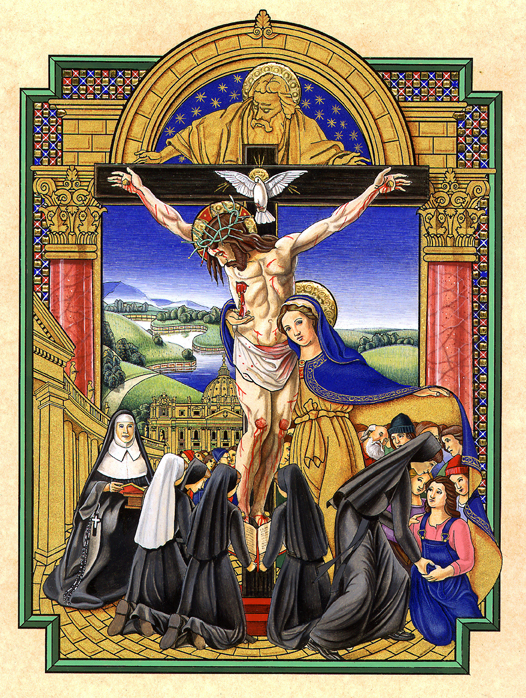
Tomorrow, September 15th, is the memorial of Our Lady of Sorrows. The Invitatory prayer that begins the Office of Readings in the Liturgy of the Hours says, “Let us adore Christ, the Savior of the world, who called his mother to share in his passion.” Those words reminded me of a beautiful illuminated miniature by Jed Gibbons, a very fine artist from Chicago. I met Jed when he was teaching at the St. Michael’s Institute for the Sacred Arts at Enders Island in Mystic, CT. Jed has produced some truly inspirational work (his Stations of the Cross in the chapel on Enders Island are exquisite) and this piece that you see below captures not only the theme of the Triumph of the Cross but the truth of the Church’s teaching that Mary shared in the passion of her Son. This piece is entitled Maria, Mater Misericordiae (Mary, Mother of Mercy); it was completed in 2006, and was done in historic earth pigments and 23 karat gold. It measures 6.75 by 9.25 inches. I thank the Foundation for the Sacred Arts website for the image.



















 The Fra Angelico Institute for Sacred Art
You must be logged in to post a comment.