By this time the majority of the 2.3 billion Christians that live on the face of the earth have probably heard of the outrageous and blasphemous opening act of the 2024 Olympics.
One part of the three plus hours of the show presented LGBTQ+ people depicting what appeared to be the Last Supper Jesus celebrated with His Apostles on the night before His torture and crucifixion.
Below you see a woman, representing Jesus, sitting at the center of a long table.
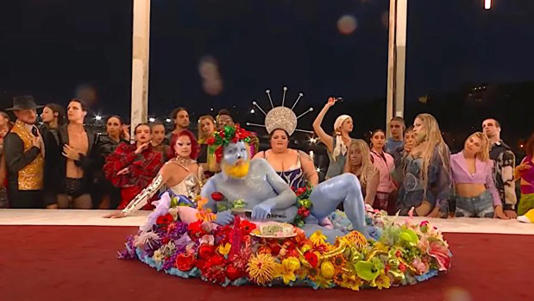
Is the center figure a priestess? The woman makes a heart shape with her hands. Is that supposed to be a veiled reflection of the love of Christ for His Apostles, or the Sacred Heart of Jesus? She has what appears to be either a headdress, halo, or possibly a Eucharistic host above her head.

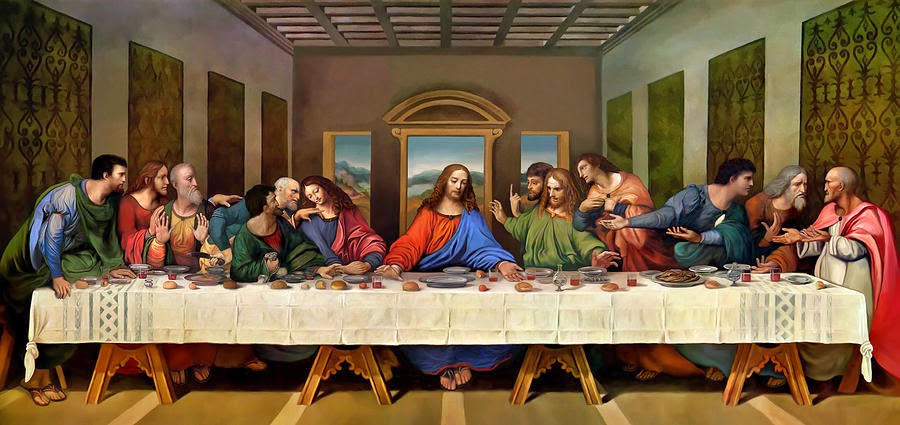
The Da Vinci painting of the Last Supper shows the moment immediately after Jesus pronounces the words (as found in the Holy Gospels) of consecration and transubstantiation of the bread and wine into His Body and Blood. That moment, re-presented in every Holy Mass, is the source and summit of the Catholic, Orthodox, and the Eastern Rite Churches. It is the institution of the Sacrament of Holy Communion – all Roman Catholics, the 26 cultural Rites in union with Rome, and the Greek and Russian Orthodox Churches believe it to be true.
The “blue man,” at the front center was intended to represent Dionysus. Or was he intended to represent the resurrected Jesus Christ?
In Greek mythology, Dionysus is the Greek god of wine. Dionysian consumption of wine brings a person to spiritual and physical ecstasy. Dionysus is known as a dying-and-rising god (resurrection). He also acts as the divine communicant between the living and the dead, and is known as a god of epiphany. Is this another veiled reference? The feast of Epiphany in the Roman Catholic Church is the celebration of the divine manifestation of the child Jesus to the world represented by the three wise men (Magi).
The blue man ascends (resurrection) in front of the female at the center of the table. A female Jesus, at the Last Supper before His death, then changes into the blue man. He was on a platter, presumably dead, then rises up, resurrected. He gives us the peace sign. He is also specifically transformed into a man. A reference to a transvestite? How could the IOC not see the intentional mockery?

The color blue in Christian sacred art represents divinity, transcendence, and the guidance of a soul to divine life. Dionysus is the god of wine, health, and love. The blue man is surrounded by flowers. Red, in Christian iconography has many meanings, but is especially associated with wine, health, and love (wine -the consecrated body, blood, soul, and divinity of Christ transubstantiated by a priest during Holy Mass; health – when consumed the transubstantiated wine provides the communicant with the divine life of Christ, love – the redemptive love of Jesus Christ given to His creation).
Some commentators said that the performance represented the “kitsch” that the city of Paris has embraced since the beginning of the 20th century. I disagree. The performance not only represented kitsch, it represented the contempt, willingness to insult all Christians, and specifically the Roman Catholic, Orthodox, and Rites in union with Rome. It also represented the stupidity of the IOC and all public and private individuals associated with it.
Thomas Jolly, the artistic director for the ceremony, said that he didn’t see a problem with the act because it was not meant to offend but unify people.
Hah!
For Mr. Jolly, his assistants, and many of the world’s correspondents to say that there is no relation of that Olympic act to the Christian faith is bogus. They are either grossly (and happily?) ignorant of the basic tenets of Christianity or they just don’t care that it was a direct act of contemptuous ridicule of the Christian religion and the Lord our God, Jesus Christ.
I saw a reporter interview Olympic attendees and asked them about the Dionysian performance. The eight people interviewed said they saw nothing wrong with it. They gave either woke answers or were completely oblivious to the symbolic meaning. I wonder if they would say that if the act portrayed a holy moment within the faith of Jews or Muslims. I’m sure Jews and Muslims would be in the streets protesting the blasphemy and rightly so. No faith should be mocked.
Christians of all faiths must be willing to speak out and protest such contemptuous insults to God and faith. What are we, and our clerics, waiting for?
Our Lord promised a winnowing. It will surely come. May God have mercy on our souls.
Copyright © 2011- 2024 by Deacon Paul O. Iacono – All Rights Reserved. Permission to reprint essays in their entirety and/or my personal paintings must be obtained from me by using the comment box and making a comment/request on the post. I will respond to you through answering in the comment box. Students, and those interested, may quote small sections of my essays as long as the proper credit and notation is given. Thanks.




















 The Fra Angelico Institute for Sacred Art
“Paul, your protestations begs the question, do pagans go to Heaven? If so, why? If not, why not?” from Bernard Gallagher
These are excellent questions.
Before I attempt to answer them my readers should understand that I am a committed and Traditional Roman Catholic. His questions will be answered through the lens of the teachings of my Faith. That Faith is based on a foundation of Holy Scripture, Sacred Tradition, and two thousand years of Catholic scholarship.
Allow me to also mention that we need to understand that two Councils of the Church, the Councils of Orange and Trent (1000 years later), are critical in forming a correct answer to Mr. Gallagher’s questions. The Councils of Orange are significant (both of them were held in the city of Orange in Southern France, AD 441 and 529). The more important Second Council of Orange’s episcopal deliberations were sent to Rome and approved by Pope Boniface II in AD 531. That Council specifically proclaimed that everyone (who has reached the “age of reason”) is given sufficient Grace to be saved from eternal damnation. God will give, and has given all people, Actual Grace. If a person accepts and acts on that Grace, they will be saved.
What is Actual Grace? Actual Grace is an admonition by God for a person to correct their way of life, desire, search after, and make the sincere effort to obtain the Sanctifying Grace provided by the Catholic Church. The key action which achieves salvation and eternal life with God is the Holy Sacrament of Baptism. This allows the person to enter into God’s family. The Sacrament of Baptism removes Original Sin from an individual’s soul and enables it to receive additional Sacramental Sanctifying Grace. All Grace enables a person to become holy in God’s eyes. The other six Sacraments flow from the waters of Baptism. Pope Pius 9th (papal reign 1846 -1878) proclaimed that it would be extraordinary for an unbaptized person to achieve the eternal salvation and reward of Heaven.
First principle,
a) The Roman Catholic Church, the ethnic church Rites that are in union with Rome, the Greek and Russian Orthodox Churches, and some of the Protestant churches say that Jesus Christ, is the Word of God, the Son of the Father, begotten not made and consubstantial with Him. He is the Messiah, the Savior. His human life, ministry, passion, death, and resurrection redeemed mankind from their sins. His divinity is expressed through His position as the Second Person of the Blessed Trinity.
b) He is known to mankind through the historical Gospels and Epistles of the Apostles, the witness of His Mother, the Virgin Mary (especially at her apparition at Fatima, Portugal in 1917. When asked what sin was most harmful and condemned unrepentant people to Hell she responded: ‘The sins of impurity are one of the major reasons why men and women are condemned to Hell.'” We cannot ignore our sins or consider them unimportant because of the current worldview. Also, the erudition of the Catholic Church Fathers, Doctors of the Church, Saints, and the historical teaching authority of the Church have all provided the scholarship and analysis that is sufficient for humanity to understand God’d Revelation and laws.
c) He is also known through the extraordinary scholarship of St. Augustine and St. Thomas Aquinas. The teaching authority of the Church, (as found in its Magisterium), is the Church’s responsibility to give to the world an authentic interpretation of the Revelation of God as found in Sacred Scripture and Sacred Tradition.
d) Additionally, let us not forget the importance of the testimony of the angels found in Holy Scripture, and the saints, of whom Jesus’ Mother Mary is the greatest of saints. All of these facts contribute to mankind’s understanding and witness of our Savior Jesus Christ.
e) Jesus commissioned His Apostles (the first bishops) to make known the free gift of His Redemption and graces. These critical graces are found in the Seven Sacraments of the Church, beginning with the keystone Sacrament, Baptism.
Second, let’s refer to what Jesus Christ says in response to Nicodemus’ questions concerning eternal life in the Gospel of St. John, John 3: 1-21: “Amen, amen, I say to you, unless a man be born again, he cannot see the kingdom of God.” Nicodemus continues to question Him, and Jesus responds, “Amen, amen, I say to you, unless a man be born again of water and the Spirit, he cannot enter the kingdom of God…You must be born again.”
The great significance of the necessity of Baptism into the Christian faith is again stressed in another passage of the Gospels. The Gospel of St. Matthew, in its very last passage deals with the commissioning of the Apostles which occurred after His resurrection and before His Ascension back to the Father. Jesus emphasizes that combined with their preaching and works they must baptize faith-filled individuals because of Adam and Eve’s sin. Humanity’s broken relationship with God must be healed. It was healed through the death and resurrection of the Father’s Son Jesus the Christ. Jesus death, on our behalf allowed the formation of the Church and the Sacraments to be instituted to provide the grace to a broken humanity. Baptism is the Sacrament that makes this happen. It makes an individual’s body and soul a member of God’s family. Matthew 28: 18-20: “Jesus drew near and spoke to them saying, “all power in Heaven and on earth has been given to me. Go, therefore, and make disciples of all nations, baptizing them in the name of the Father, and the Son, and the Holy Spirit, teaching them to observe all that I have commanded you; and behold, I am with you always, to the close of the age.”
Third, it appears, within the Christian faith, that we can come to specific conclusions that will provide a springboard for my response to Mr. Gallagher:
Fourth, so, are pagans going to Heaven or Hell?
In a nutshell, I would never presume to know God’s mind, except from that which He revealed through Holy Scripture and Sacred Tradition. I would never make a judgement on another person’s soul as he or she are seen by God at the time of their death and individual judgement. Unknown to the world, even a great sinner may suddenly, in their last moments, repent of their sins and ask for God’s mercy. But, make no mistake about it, Scriptural Revelation, and the Sacred Tradition of the Catholic Church and specifically the words of Jesus in the Holy Scriptures, states that there is a Hell (Matthew 10: 28; 22: 13. Luke 16: 26; etc.); there is a Heaven, and, damnation into Hell for all eternity.
It is believed that there is also a place of natural happiness called Limbo. It is not within Heaven, nor is it in the fires of the Hell of the Damned. It is a state of natural happiness and joy. It is not supernatural happiness because its inhabitants do not have the Beatific Vision (see additional discussion in the Summa Theologica, Supplement 1, 3rd part article 2, by Fra Rainaldo da Piperino). The question of what happens to infants who die without the Sanctifying Grace of Baptism is a much debated issue. Many Traditionalists support the idea of Limbo; however, contemporary scholarship supports the idea that God, in His mercy, would not withdraw the vision of His glory to unbaptized infants who have died.
Some additional issues:
Copyright © 2011- 2019, Deacon Paul O. Iacono – All Rights Reserved. Permission to reprint must be obtained (through the Comments section below) from the author in writing. Students, and those interested, may quote small sections of the article as long as the proper credit and notation is given. Thank you