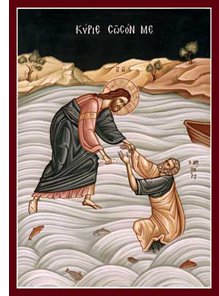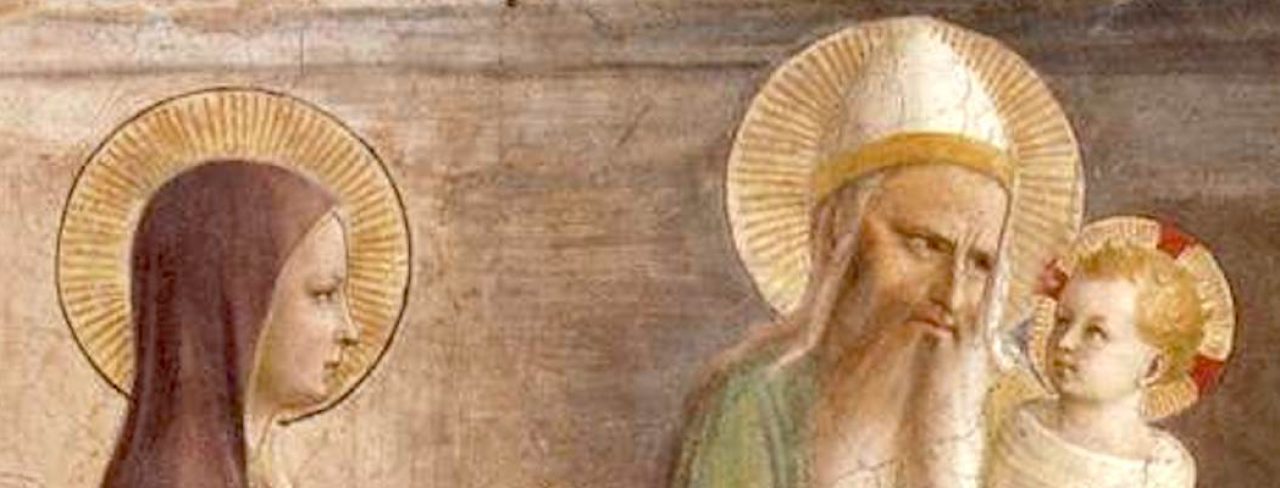
Catechesis and Catholic Art

Sacred art, by its very nature, is catechetical. The purpose of this art was and continues to be a method of instruction. The Catholic Church, in its Latin and Greek Rites, and the twenty-six Catholic Rites that are in union with Rome, have all produced magnificent sacred calligraphy and art; non-Catholic faiths have done this, too.

Two thousand years ago Christians hiding in Rome inscribed images of Christ, the Blessed Mother and with the Christ child, and other Scriptural images on the walls of the catacombs. That art contributed to the catechesis of the early Christians. Two millennia later, Pope St. John Paul II in paragraph 18 of his Apostolic Exhortation, Catachesi tradendae, speaks of this function: it is “an education in the faith… in an organic and systematic way, with a view to initiating the hearers into the fullness of Christian life.”

Sacred art, in tandem with scholarship, edifies and makes beautiful the truth, goodness, and beauty of God. One of my favorite forms of sacred art is that of the Coptic Christian Church (historically based in Alexandria, Egypt). Coptic art is presented in an especially down to earth way. It is beautiful and humble at the same time. It is catechetical and colorful. It possesses a fine palette, yet the viewer does not get caught up in the colors to the detriment of catechesis. 

The Coptic faith’s icons are simple, yet, profound. They convey theological truths in a way that can be understood by all age groups and are excellent sources of catechesis. 

The first image above is a 7th century Coptic icon. It was discovered at the Monastery of Bawit (Egypt) in the early 20th century by two French archaeologists who brought it, and other Monastery artifacts, back to Paris. Currently located in the Byzantine wing of the Louvre it is unique because it presents Jesus affectionately putting his arm around the Monastery’s abbot – Abbot Mena.

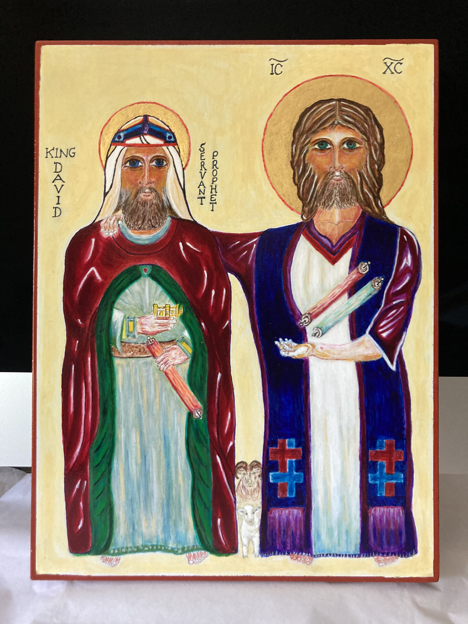
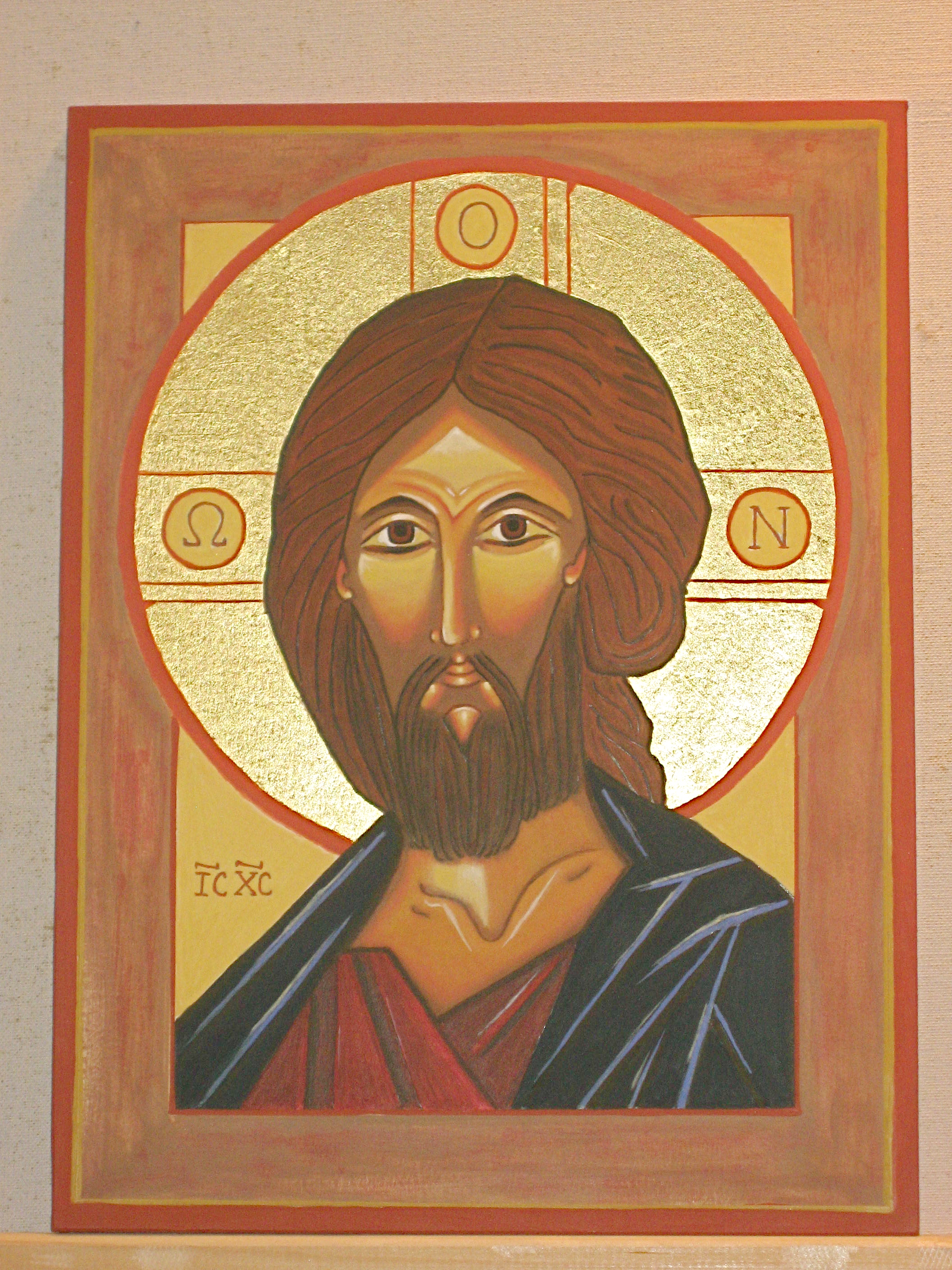
The second sacred image is my original composition. It is painted in archival ink, acrylic paint, and the halos are 23 karat gold leaf. My style slightly follows the Coptic in that it portrays figures that are not intimidating, are easily understandable, and act as a teaching tool for children and adults. It does present additional symbolism which further explains key theological truths of our faith.

Symbolism of the second sacred image:

The IC XC is the Greek abbreviation for Jesus Christ. 

The slightly larger than normal eyes represents holiness, spiritual wisdom, and maturity.  

Jesus’ white alb (tunic): purity; King David’s light green alb: hope for spiritual growth and friendship with God. 

Jesus’ outer garments consist of two parts: robe and stole which are painted in various shades of royal purple. Royal purple indicates kingly authority. The tassels of His stole are multicolored representing the intersection of purity and kingship. Christ’s lower stole’s has an intersecting weave representing Jesus’ blood and water shed for us on the Holy Cross. Liturgically, deacons, priests, and bishops all wear albs, cinctures (belts), stoles, and outer garments (dalmatic or chasuble). These articles of clothing each symbolize different aspects of Jesus’ Passion and ministry.

Elevated above Jesus’ left hand are the scrolls of the Old (Hebrew) and New (Christian) Testaments. The color symbolism for the Hebrew Scriptures’ scroll: green, which represents hope, expectation of the Messiah, and devotion to God. The Christian Scriptures‘ scroll: red, representing Jesus divine and human energy, love, Redemptive sacrifice, and His mercy and justice.

Jesus’ arm is around David’s shoulder. His gesture to David expresses His love, affection, and mercy which are evident and available to everyone. However, the expression that I put on Jesus’ face, especially His eyes, conveys the severe justice that Jesus’ renders to all non repentant sinners. David committed murder and adultery yet ultimately becomes aware of the enormity of his sins. His Psalms were written to plead for mercy, express sorrow for sins, and give praise and thanksgiving to God (see especially: Psalms: 1, 51, 56, 65, and 117). David’s crimson coat symbolizes human life and energy, it is trimmed in dark green symbolizing his hope for mercy.

Circa 1000 BC, David and his armies captured Jerusalem and brought the Ark of the Covenant into the city (1 & 2 Samuel). King David is holding the city of Jerusalem in his right hand; and in his left the book of Psalms. David’s son Solomon built the First Temple to house the Ark of the Covenant (1 & 2 Kings). 

Between David and Jesus are a ram and a new born lamb.

The ram refers to the sacrifice by Abram (Abraham) of a ram caught in a thicket in substitution for the sacrifice of his son Isaac (Genesis 22). Jesus and David are members of the same genealogical family, stretching all the way back to Abraham and Isaac and Isaac’s son Jacob.

The newborn lamb represents Jesus Christ, the “lamb of God” (John 1: 29). He was given in sacrifice by the Holy Trinity for the Redemption of mankind from their sins. That Redemptive act by Our Lord and Savior, Jesus the Christ, instituted the New Covenant which was sealed with His, the Lamb of God’s, blood.

The New Covenant does not replace the Old Covenant God made with the Hebrews. The New Covenant of Christ’s sacrifice (as described in the 27 books of the Christian Scriptures) fulfills the Old Covenant promise of a Savior found within the 45 books of the Hebrew Scriptures. The ram and the lamb provide the visible connection between the Hebrew Scriptures (Old Covenant) and Christian Scriptures (New Covenant).

The New Covenant is continued down through the centuries by the un-bloody sacrifice of Holy Mass. Selections from the Hebrew and Christian Scriptures are read. The Gospel is proclaimed prior to the priest representing Christ, in Persona Christi, transubstantiating the host and wine into the Body, Blood, Soul and Divinity of Jesus Christ.

In faith and action Catholics consume His Body and Blood toward the end of Holy Mass. This consumption does not transform Him, as simple food, into ourselves. Rather, we (as repentant sinners) are transformed by Him (through Sanctifying Grace) into Himself.  He doesn’t become part of us, rather, we become part of Him. This is an article of faith believed by all Catholic Christians of the Western an Eastern Rites of the Church. The reception of Holy Communion by Catholics is not a “right,” it is a privilege given by Jesus Christ to worthy (repentant and Reconciled) recipients (culminating in our giving eternal thanks and praise to Him in Heaven; see Matthew 26: 29).

Therefore, in this non-intimidating sacred image you have a teaching tool that includes elements of Sacred Scripture and Sacred Tradition. It is simple grist for any informed catechist’s mill.

UPDATE: If you find this subject interesting I recommend you read my post on Catechesis and Naive Sacred Art: St. Peter – A Lesson Plan, published on January 25, 2022. Thanks!

Copyright © 2011- 2021 by Deacon Paul O. Iacono – All Rights Reserved. Permission to reprint essays and/or my paintings must be obtained from me by, using the comment box and making a comment/request on this post. I will respond to you through answering in the comment box. Students, and those interested, may quote small sections of my essays as long as the proper credit and notation are given. Thank you.


Holy Triduum: A Video Pilgrimage to Jerusalem

This is a magnificent 30 minute overview of the places in Jerusalem in which Our Lord spent His last hours. 

Please share with your families and others who would benefit from it.

It is beautifully presented without the poor production values of other similar attempts. 

This production was filmed, edited, and narrated by members of the Augustine Institute in Colorado..

Thanks.

May you and your loved ones be blessed by Our Lord Jesus Christ and have a Holy and Blessed Easter season.

https://watch.formed.org/holy-thursday/videos/triduum

Iconoclasm and Shaun King

In the June 22, 2020 issue of Newsweek an on-line article by Aila Slisco reported some statements by political activist Mr. Shaun King. 

She states: “He [King] also remarked that stained glass windows and other images of a white Jesus, his European mother and their white friends should all be destroyed, insisting they are racist, examples of ethnic propaganda, and “a form of white supremacy. “They should all come down.” (I’ll comment on these statements by Mr. King in another post).

King’s comments came in association with Black Lives Matter protests against the brutality of some police officers toward minorities. These protests quickly moved away from the issue of police brutality in some major cites and expanded into protests against historic and artistic representations of American/European civilization and the “white supremacy” that it allegedly represented. 

We have observed over the last two weeks examples of the new iconoclasm. 

Rhetoric like Mr. King’s and other activists could be passed off as uninformed except for the fact that two California mobs tore down and desecrated a statue of the Spanish missionary Fr. Serra. In the process they also harassed Catholic college students, laity, and a priest who were defending it.

Legitimate non-violent protests are protected by the U.S. Constitution, however, the destruction of public or private property is not. 

Public religious, military and political statues are the property of the local churches and governments. What happened to the government’s responsibility to protect them? Churches, and whatever articles they contain, are the property of the church regardless of denomination. Will the governments across the nation protect them?

Religious statues, sacred art, stained glass windows, etc, are defended by the 1st amendment of the U. S. Constitution. Is Mr. King saying that a Satanic statue of Baphomet can be placed in a public square but a statue of a Roman Catholic saint, who is specifically honored for his cultural contributions, cannot? 

Are the representations of the God and saints of the Roman Catholic Church, who has been a major contributor to world civilization, to be torn down because a segment of the population believe that they, without taking into account time period or cultural conditions, have been historically ethnocentric and intolerant of other cultures? Are these legitimate religious statues equivalent to the statues of Lenin, Stalin, Mao or Saddam Hussein?

What happened to Martin Luther King Jr.’s call for positive non violent change and tolerance in America?

Today, July 1st, is the Roman Catholic Church’s memorial of the missionary efforts of Fr. Junipero Serra, an 18th century Spanish missionary priest. Fr. Serra’s leadership and contributions to improving the educational and technological life of Native Americans and development of California is recognized as a public act and not just a religious effort; this is why his statues were erected by the state of California. His statue also stands in Statuary Hall in the U. S. Capitol building in Washington, D. C.  At various times national and state politicians, of both political parties, were present to honor him.

Fr. Serra’s main goal was to be an effective Christian missionary. He was following the Gospel injunction of Christ Himself in the 28th chapter of the Gospel of Matthew: “All power in heaven and earth has been given to me. Go, therefore, and make disciples of all nations, baptizing them in the name of the Father, and of the Son, and the Holy Ghost, teaching them to observe all that I have commanded you. And behold, I am with you always, until the end of the age.”

The new iconoclasm appears to be intolerant, or unaware, of history. The adherents public efforts, both in word and deed, are clearly seen in the mobs in California and specifically in St. Louis, Missouri where they beat Catholics who were praying in front of a monument of St. Louis IX. In both cases mob action desires to vent its anger, ideology, and psychological wounds against historic personalities. The mob desires to sponge away the past rather than continue to lawfully, peacefully, and vigorously work for social change. 

Is significant change necessary in the way some police departments train their recruits? Absolutely. Productive change can occur. It cannot occur when the structures of Constitutional democracy are trampled upon. Polarization has never accomplished anything; positive social change has never occurred through a mob’s physical or verbal violence.

The past cannot be rewritten. In America, many times statues regardless of being religious, political, or military, celebrate the good that people have accomplished, not their ethnocentrism. If small groups through mob action tear down public property, or Church property, then they are no better than many other mobs, tyrants and demagogues through history; such as Mao Zedong’s actions during the ten years of China’s Cultural Revolution, Lenin and Stalin’s iconoclasm and political/religious oppression during the 70 odd years of their Communist debacle, Hitler’s 13 year rampage of mass destruction and inhumanity, or present day Isil and their damage of populations and  archaeological sites in the name of religious ideology.

As civilizations are we still unable to learn from the lessons of history? Is it too late?

Copyright © 2011- 2020, Deacon Paul O. Iacono – All Rights Reserved. Permission to reprint must be obtained from the author in writing. Students, and those interested, may quote small sections of the article as long as the proper credit and notation is given. Thank you.

Do Pagans Go To Heaven or Hell?

by Deacon Paul O. Iacono, Diocese of Providence, Rhode Island USA

The author of the interesting and challenging blog site on sacred art and its analysis called Catchlight sent me two questions yesterday. They related to my last post which was entitled Fatima Messages, Pagans in the Vatican, and the End Times.

“Paul, your protestations begs the question, do pagans go to Heaven? If so, why? If not, why not?”      from Bernard Gallagher

These are excellent questions.

Before I attempt to answer them my readers should understand that I am a committed and Traditional Roman Catholic. His questions will be answered through the lens of the teachings of my Faith. That Faith is based on a foundation of Holy Scripture, Sacred Tradition, and two thousand years of Catholic scholarship.

Allow me to also mention that we need to understand that two Councils of the Church, the Councils of Orange and Trent (1000 years later), are critical in forming a correct answer to Mr. Gallagher’s questions. The Councils of Orange are significant (both of them were held in the city of Orange in Southern France, AD 441 and 529). The more important Second Council of Orange’s episcopal deliberations were sent to Rome and approved by Pope Boniface II in AD 531. That Council specifically proclaimed that everyone (who has reached the “age of reason”) is given sufficient Grace to be saved from eternal damnation. God will give, and has given all people, Actual Grace. If a person accepts and acts on that Grace, they will be saved.

What is Actual Grace? Actual Grace is an admonition by God for a person to correct their way of life, desire, search after, and make the sincere effort to obtain the Sanctifying Grace provided by the Catholic ChurchThe key action which achieves salvation and eternal life with God is the Holy Sacrament of Baptism. This allows the person to enter into God’s family. The Sacrament of Baptism removes Original Sin from an individual’s soul and enables it to receive additional Sacramental Sanctifying Grace. All Grace enables a person to become holy in God’s eyes. The other six Sacraments flow from the waters of Baptism. Pope Pius 9th (papal reign 1846 -1878) proclaimed that it would be extraordinary for an unbaptized person to achieve the eternal salvation and reward of Heaven.

First principle,

a) The Roman Catholic Church, the ethnic church Rites that are in union with Rome, the Greek and Russian Orthodox Churches, and some of the Protestant churches say that Jesus Christ, is the Word of God, the Son of the Father, begotten not made and consubstantial with Him. He is the Messiah, the Savior.  His human life, ministry, passion, death, and resurrection redeemed mankind from their sins. His divinity is expressed through His position as the Second Person of the Blessed Trinity.

b) He is known to mankind through the historical Gospels and Epistles of the Apostles, the witness of His Mother, the Virgin Mary (especially at her apparition at Fatima, Portugal in 1917. When asked what sin was most harmful and condemned unrepentant people to Hell she responded: ‘The sins of impurity are one of the major reasons why men and women are condemned to Hell.'” We cannot ignore our sins or consider them unimportant because of the current worldview. Also, the erudition of the Catholic Church Fathers, Doctors of the Church, Saints, and the historical teaching authority of the Church have all provided the scholarship and analysis that is sufficient for humanity to understand God’d Revelation and laws.

c) He is also known through the extraordinary scholarship of St. Augustine and St. Thomas Aquinas. The teaching authority of the Church, (as found in its Magisterium), is the Church’s responsibility to give to the world an authentic interpretation of the Revelation of God as found in Sacred Scripture and Sacred Tradition.

d) Additionally, let us not forget the importance of the testimony of the angels found in Holy Scripture, and the saints, of whom Jesus’ Mother Mary is the greatest of saints. All of these facts contribute to mankind’s understanding and witness of our Savior Jesus Christ.

e) Jesus commissioned His Apostles (the first bishops) to make known the free gift of His Redemption and graces. These critical graces are found in the Seven Sacraments of the Church, beginning with the keystone Sacrament, Baptism.

Hagiasophia-christ-1
An icon of Jesus Christ. It is found within the former Eastern Rite Church of Hagia Sophia (Holy Wisdom). The Church was built in the early 6th century and is located in Istanbul, Turkey (formerly Constantinople). It was a mosque, then was a museum since 1935, but recently it was converted back into a mosque.

Second, let’s refer to what Jesus Christ says in response to Nicodemus’ questions concerning eternal life in the Gospel of St. John, John 3: 1-21: “Amen, amen, I say to you, unless a man be born again, he cannot see the kingdom of God.” Nicodemus continues to question Him, and Jesus responds, “Amen, amen, I say to you, unless a man be born again of water and the Spirit, he cannot enter the kingdom of God…You must be born again.”

The great significance of the necessity of Baptism into the Christian faith is again stressed in another passage of the Gospels. The Gospel of St. Matthew, in its very last passage deals with the commissioning of the Apostles which occurred after His resurrection and before His Ascension back to the Father. Jesus emphasizes that combined with their preaching and works they must baptize faith-filled individuals because of Adam and Eve’s sin. Humanity’s broken relationship with God must be healed. It was healed through the death and resurrection of the Father’s Son Jesus the Christ. Jesus death, on our behalf allowed the formation of the Church and the Sacraments to be instituted to provide the grace to a broken humanity. Baptism is the Sacrament that makes this happen. It makes an individual’s body and soul a member of God’s family. Matthew 28: 18-20: “Jesus drew near and spoke to them saying, “all power in Heaven and on earth has been given to me. Go, therefore, and make disciples of all nations, baptizing them in the name of the Father, and the Son, and the Holy Spirit, teaching them to observe all that I have commanded you; and behold, I am with you always, to the close of the age.” 

Third, it appears, within the Christian faith, that we can come to specific conclusions that will provide a springboard for my response to Mr. Gallagher:

  1. If the human race was alienated from God, and the spiritual relationship with Him was broken, then a loving and merciful God would not give up on His children. Thus, through the course of history God has slowly manifested and revealed Himself to humanity starting with our spiritual parents, Adam and Eve; then through the patriarchs, leaders, and prophets of the chosen Jewish tribes culminating in the Incarnation of His Son, Jesus the Christ. God desires us to love Him and conform to His Laws. He has given us reason and free will. He has given us the ability to think and act not like robots but as free men and women. His revealed truths and laws must be evangelized and faithfully kept by individuals and mankind as a whole. The “Good News” must be spread by the Church as a whole and individuals, too.
  2. The First Commandment applies, as we see in Exodus 20: 1-6ff: “I, the Lord am your God, who brought you out of the land of Egypt, that place of slavery. You shall not have other gods besides Me. You shall not carve idols for yourselves…you shall not bow down to them or worship them. For I the Lord am a jealous God…inflicting punishment on those who are wicked and hate me…and mercy on those who love Me and keep My commandments.”
  3. Through Scripture and study of the Catechisms of the Council of Trent and that of Pope St. John Paul II, united with faith we also know that Jesus Christ is the consubstantial only Son of God and the promised Savior. Now, have (for example) the Amazonian pagans that we recently observed in Rome, or the new pagans of the 20th and 21st centuries been exposed to that truth?
  4. Christ freely offered Himself for our eternal salvation. This was accomplished through the words and actions of His human ministry and ultimately through His Passion, death, and resurrection. Jesus Christ is the Way, the Truth, and the Life. Have apostates, pagans, or other non believers been exposed to that truth?
  5. We see God through faith in Him, participating in prayer, Scripture study, good works, and the Sanctifying Grace found in the Seven Sacraments. Have pagans, past and present, been exposed to and accept these truths?

Fourth, so,  are pagans going to Heaven or Hell?

In a nutshell, I would never presume to know God’s mind, except from that which He revealed through Holy Scripture and Sacred Tradition. I would never make a judgement on another person’s soul as he or she are seen by God at the time of their death and individual judgement. Unknown to the world, even a great sinner may suddenly, in their last moments, repent of their sins and ask for God’s mercy. But, make no mistake about it, Scriptural Revelation, and the Sacred Tradition of the Catholic Church and specifically the words of Jesus in the Holy Scriptures, states that there is a Hell (Matthew 10: 28; 22: 13. Luke 16: 26; etc.); there is a Heaven, and, damnation into Hell for all eternity. 

It is believed that there is also a place of natural happiness called Limbo. It is not within Heaven, nor is it in the fires of the Hell of the Damned. It is a state of natural happiness and joy. It is not supernatural happiness because its inhabitants do not have the Beatific Vision (see additional discussion in the Summa Theologica, Supplement 1, 3rd part article 2, by Fra Rainaldo da Piperino). The question of what happens to infants who die without the Sanctifying Grace of Baptism is a much debated issue. Many Traditionalists support the idea of Limbo; however, contemporary scholarship supports the idea that God, in His mercy, would not withdraw the vision of His glory to unbaptized infants who have died.

Some additional issues:

  1. Let’s take a look at three major Greek philosophers: Socrates, Plato, and Aristotle. They were scholars who lived and died before the birth and ministry of  Jesus Christ. They lived within a pagan/pantheistic society whose members believed in a multitude of gods  Are Socrates, Plato, and Aristotle in Heaven or Hell?
  2. The answer is, “I don’t know!”
  3. But Jesus said, “I am the Way, and the Truth, and the Life. No one comes to the Father but through Me” (John 14: 6). Wouldn’t that statement preclude the unbaptized Greek philosophers entrance into Heaven?
  4. The answer is “Not automatically.”
  5. So, what do we know? We know that those three philosophers were men who searched for the truth, not only about  themselves as individuals but about the world itself. They searched after the truth. They made the sincere effort to find the truth by thinking, questioning, analyzing reality, both physical and metaphysical. They used all the evidence at their disposal to do so. They lived, before the Son of God was incarnated. They did not have the witness of Jesus Christ and to His specific and eternal revelation as the Son of God, both human and divine. They also probably did not have any exposure to the history of the Jewish people and God’s revelation to them. As per the the points made earlier, did they act on God’s Actual Grace to truly desire life with Him?
  6. But, in the time after the Incarnation and Ascension of Jesus, a person who had the opportunity to be exposed to and Baptized into the  Christian Faith (in the full expression of it in the Western and Eastern Rites of the Catholic Church, and some of the Protestant and Anglican churches if they use the Trinitarian formula), would have a critical free choice to make.
  7. If they are pagan, agnostic, atheist, Catholic Christian, Deist, Protestant Christian, Satanist, Wiccan, etc, and they would then, after an effort to know the truth, reject Actual Grace and the witness of Jesus Christ out of intentional misunderstanding, intellectual arrogance, stubbornness, cultural and historic prejudices, selfishness, willful rejection of Christian Revelation, narcissistic impulses, apostasy, or some evil influence, they would be freely putting their eternal soul into mortal sin. They would be facing the eternal punishment of Hell because they chose the path, through their own free will of “definitive self-exclusion from communion with God and the blessed in Heaven” (confer page 269 in the Catechism of the Catholic Church,  2nd edition).
  8. God is loving and compassionate. He is filled with mercy for those who sincerely repent their sins. God is merciful; however, our God is a God of Justice. Why would Jesus Christ be Incarnated to minister, suffer, die, and be resurrected if the Holy Trinity would give mortal sinners “A get into Heaven free pass?” The “Pass theory” doesn’t make sense, it is illogical, bogus, and yes it is a lie. There are dire consequences for freely turning your back on Jesus Christ: Hell.
  9. But do today’s pagans turn their backs?
  10. The answer to that question is: Have they made the effort to know the Truth? Have they been exposed to the truths of the Hebrew and Christian Scriptures? Have they been evangelized by courageous and selfless missionaries who are willing to undergo all sorts of hardships and possibly even martyrdom for the sake of their flocks’ eternal souls? Have they deliberately turned their backs on the truth and revelation of God through the Christian Scriptures, and the documents and witness of the Apostles, Saints, Church’s Doctors and Fathers, bishops and Pope as they present the truth on faith and morals? Have the pagans or people of other religions acted on the free gift of God’s Actual Grace?
  11. The Church’s duty and responsibility is to bring, without arrogance or condescension, the Holy Scriptures, Sacred Traditions, and the Holy Sacraments to the world. If its bishops, priests, deacons, consecrated brothers and sisters in various religious orders, and laity shirk or compromise their duties and teaching authority, give bad example through public and private sin, then they possibly will be denied entrance into Heaven, too.
  12. Is the Church giving sufficient resources to the missionaries in the field? Are we able to inspire young men and women in today’s world of the necessity and challenge to enter the life of a missionary? Have we thrown in the towel?
  13. This is my great concern about what I see in the Church today (especially the recent blessing of the pagan Pachamama statue in Rome; (by the way, all of the Amazonian Pachamama rituals were condemned by six Cardinals). The Christian churches should not be about assimilation of pagan cultures into the Faith in order “to learn from them,” or do so in a “spirit of dialogue” and accommodation.
  14.  The Western and Eastern Rites of the Catholic Church have the complete and total revelation of God to humanity. We have the complete revealed truth of The Trinity. We have the example of what it means to live in the heart of the Father through the life of Jesus Christ. Christ’s life, redemptive death, and resurrection made possible our entrance into God’s family. This entrance is accomplished through the Sacrament of Baptism (using the Trinitarian formula), and individuals’ growth in faith and good works.
  15. Matthew 28: 18-20, relates Jesus’ specific command. Our duty is to compassionately and without arrogance teach pagans and other non-believers about Jesus Christ, baptizing them in the name of the Father, and the Son, and the Holy Spirit.
  16. It is intellectually and morally irresponsible to give the impression that apostates, heretics, pagan/polytheistic cultures, and people of other faiths can add to the Deposit of Faith.We either understand the gift of the Deposit of the Faith or we don’t. There should be no waffling.
  17. We either proclaim His truth effectively and with conviction or we will see the Church continue to decline, make compromises, cause confusion, anxiety, division, and resentment among its faithful. Hell is a reality. It is our responsibility to act with courage and truthfulness to ensure that a person’s eternal salvation is not compromised through confused or false teachings.
  18. The Gospel of Luke 18: 8 challenges us to examine our own hearts: “When the Son of Man comes will He find faith on the earth?” 
  19. To paraphrase Peter Kreeft, Ph.D and Rev. Ronald Tacelli S.J. “if we have a diamond of immense and extraordinary value (our Catholic/Christian Faith) why would we go about the world seeking additional baubles?
  20. Refer also to the Catechism of the Catholic Church (2nd edition, 1997, pages 311-324) which has an excellent section on the Sacrament of Baptism.

Copyright © 2011- 2019, Deacon Paul O. Iacono – All Rights Reserved. Permission to reprint must be obtained (through the Comments section below) from the author in writing. Students, and those interested, may quote small sections of the article as long as the proper credit and notation is given. Thank you

Luke: 16: 19-31 – Is Lazarus in Your House?

This passage from the Gospel of St. Luke is a parable about a destitute man named Lazarus and a rich man, who at times is called by the name Dives (the word dives in the Latin Bible refers to a “rich man”).

Jesus places Lazarus sitting day after day by the rich man’s front door. Lazarus is sick. He is at Dives’ home hoping to receive a scrap of food from his table. The food never comes.

Jesus continues to tell the story which culminates in the death of both men and their subsequent judgment.  Lazarus is welcomed into Paradise and is seen talking to Abraham, while Dives is condemned to the flames of Hell hoping for a drop of water to quench his thirst.

The parable concludes with Abraham rejecting Dives’ wish that someone from Paradise will inform his relatives of his eternal sentence in an attempt to get them to change their way of life.

Abraham says that it is fruitless: “‘If they do not listen to Moses and the prophets, neither will they be convinced even if someone rises from the dead.'”

You see its not just the issue of Dives, as a fellow human being, not providing nourishment and solace to Lazarus. It is the fact that Dives does not even acknowledge Lazarus. He and his servants pass him every day with no perception, no acknowledgement, no understanding, no charity.

How many times have we done that to men and women standing at intersections, asking for a scrap that falls from our table. We get uncomfortable at the thought that they are there. Irritated at bad government decisions that pushed them out on the street, supposedly to be helped by the social justice safety nets; nets filled with holes. I saw a woman today holding a sign that said “I need a miracle.” There was no exclamation point or happy face penned next to it.

Lazarus may be outside our front door, or, even in the house.

Question: are we passing by people in our own family who are in need? The neighbor who lives next door? A member of our parish? Are we passing by Jesus Christ?

Lent is the natural time to reflect on how well we remember and assist, in some small way, those around us who are in need. It may be financial help, or it might just be they need someone to talk to.

Upon reflection, we may find ourselves missing the mark, even committing sins of omission. Let’s remember that, unlike Dives, we still have time to do something about it.

300px-Meister_des_Codex_Aureus_Epternacensis_001
“Meister des Codex Aureus of Echternach” (the Master’s Golden Book of Echternach) – a page from this illuminated Gospel created in the mid 11th century. When seen by the Holy Roman Emperor, Henry III, it stimulated him to commission similar manuscripts from the Abbey of Echternach (Germany).


My thanks to Rev. Msgr. Anthony Mancini, Pastor of the Cathedral of St. Peter and Paul, Providence, Rhode Island USA, for stimulating this blog post.

Copyright © 2011- 2019 Deacon Paul O. Iacono – All Rights Reserved.

Fra Angelico and the Armadio degli Argenti – Part 3 of the “Heaven on Earth” Exhibition

Today’s post is Part 3 in my series that began on May 16, 2018 concerning the recently concluded exhibition of extraordinary egg tempera paintings by Fra Angelico. The exhibition was held at the Isabella Stewart Gardner Museum in Boston, Massachusetts and entitled Fra Angelico – Heaven on Earth.

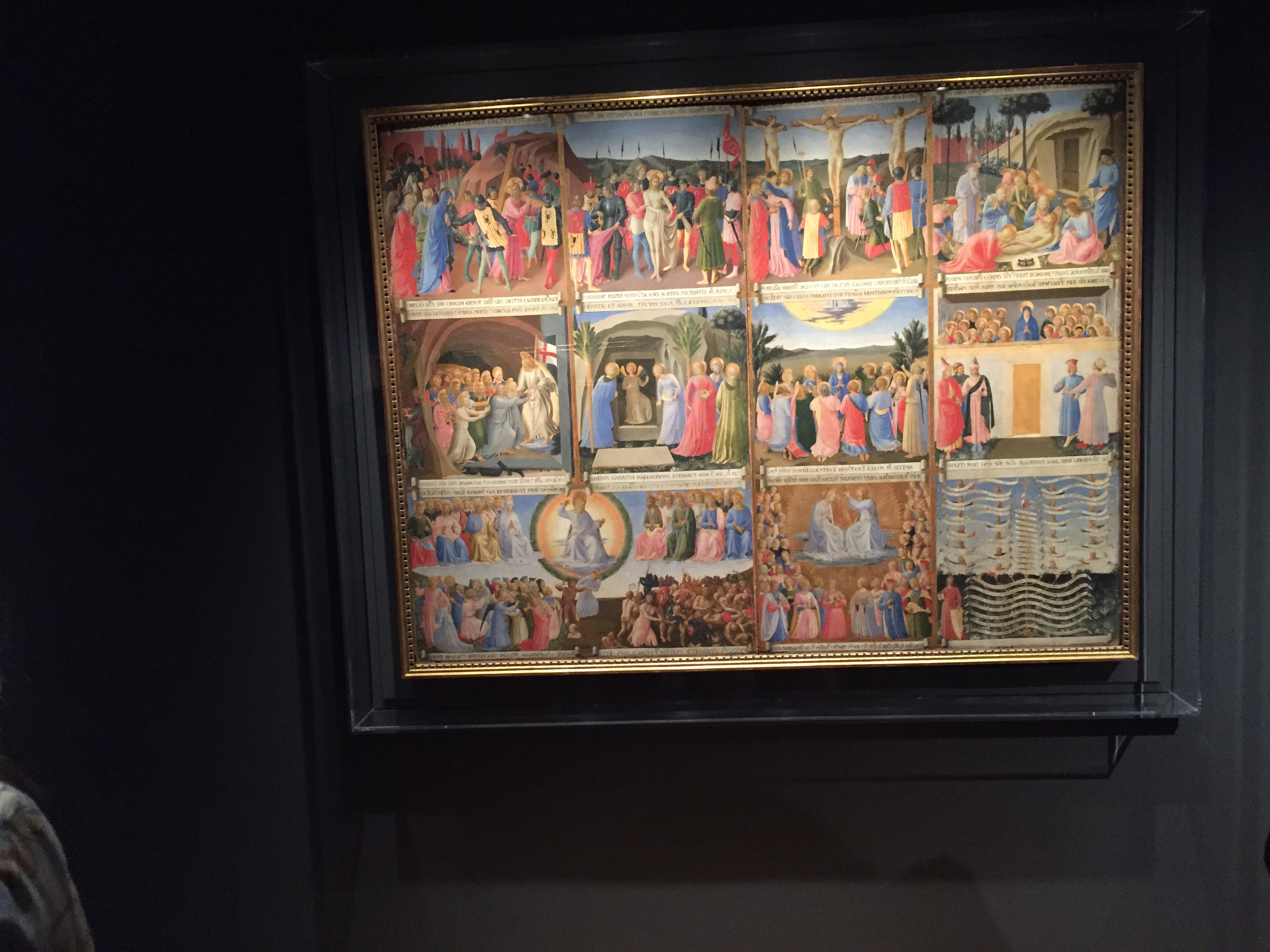
Today’s  painting concerns a major piece of the exhibition – the Armadio degli Argenti.  The four panels of which the Gardner Museum only showed one is also known as the “Silver Chest.” It was commissioned in 1450 and completed in 1452, three years before Fra Angelico’s death.

This panel (123 x 160 cm) includes eleven compartments: The Road to Calvary, The Disrobing of Christ, The Crucifixion of Christ, the Entombment of Christ, The Descent into Limbo, The Three Marys at Christ’s Tomb, The Ascension of Christ, Pentecost, The Last Judgment, The Coronation of the Virgin, and the Lex Amoris (Law of Love). The panel is seen below.

IMG_1759

This panel is one of four that decorated a large cupboard-like chest. The chest contained highly valuable silver votive offerings that were donated by the faithful of Florence to the Church of Santissima Annunziata. Their donations were in honor of a miracle working fresco of the Annunciation of Mary in a side chapel of that church.

The entire chest was commissioned by Piero di Cosimo de’Medici during the church’s restoration. The paintings within the thirty-six “compartments” are painted in egg tempera and gold on a wood panel (The Last Judgement occupies two compartments).

In 1782, the panels were separated from the chest in, thankfully, an unsuccessful attempt to sell them. In 1812 they began their journey to the Galleria dell’Academia, and finally to their current resting place – the Museo di San Marco.

Some close-ups of the panel are found below.

IMG_1763

The “compartment” above was entitled Lex Amoris (Law of Love) by Fra Angelico. It shows a menorah covered with scrolls on which are written items relating to the New and Old Law, and emphasizing the New Law as superior. The scrolls specifically relate to the Sacraments of the Church and specifics of the faith. We also see the twelve Apostles and the twelve Hebrew prophets on each side of the menorah showing that they are all connected through the holy Cross of Christ (top center with red and white standard). The purpose of this panel is to explain that in the coming of Jesus Christ you see the fulfillment of the Biblical prophecy of the Messiah, which does not stand alone, but is related to other events in Jewish history. Notice the female in the lower left corner holding a shield which proclaims “Lex Amoris” (Law of Love) versus the Jewish tradition of “Lex Timoris” (Law of Fear). In her right hand she holds an open book. A beautiful allegory of faith that is beautifully executed by Fra Angelico.

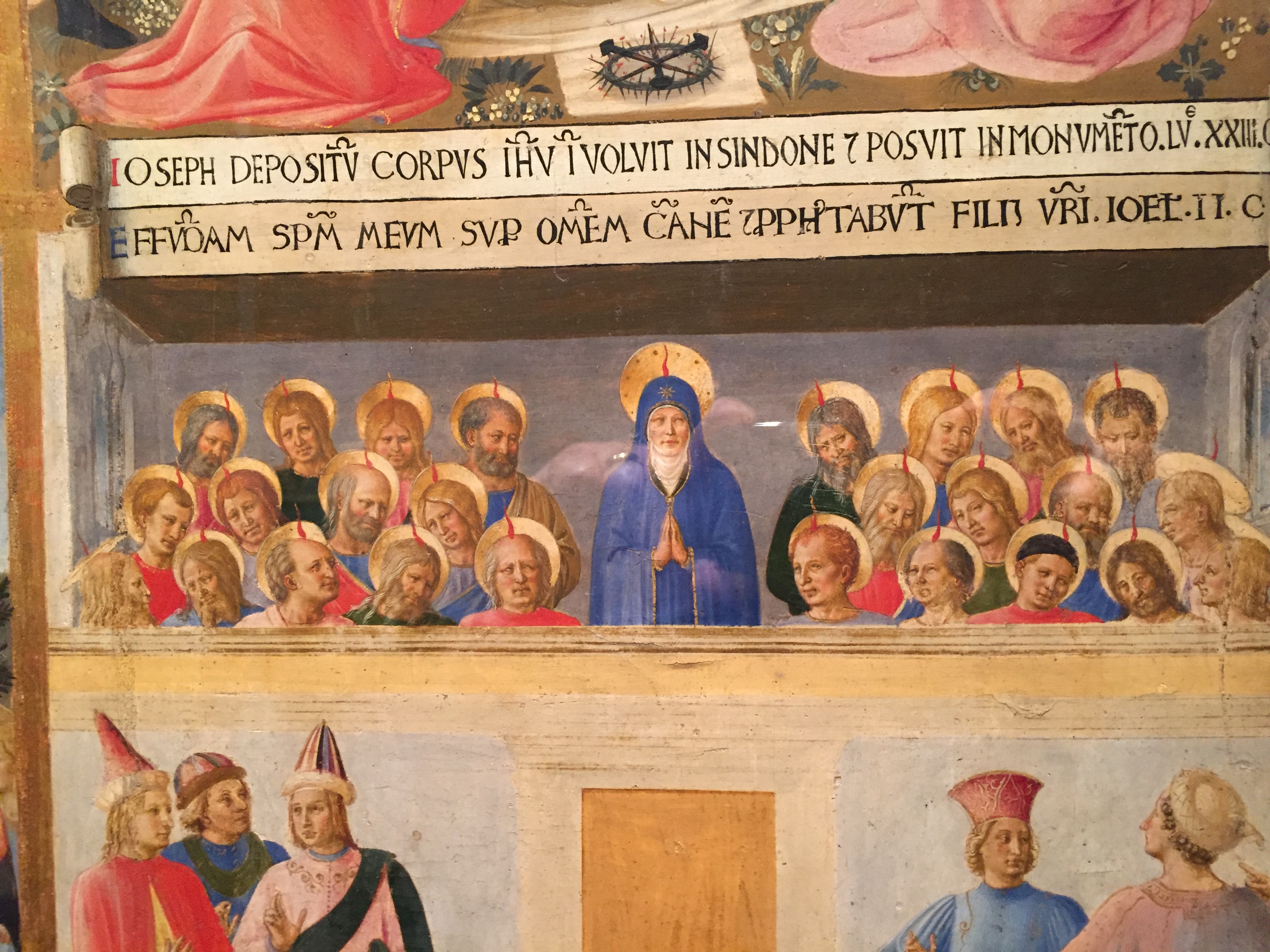
IMG_1762The above photo is one of the thirty-six panels describing events of the New Testament, in this case the Coming of the Holy Spirit at Pentecost. Notice Jesus’ mother Mary at the top center of the image with the Apostles and disciples (Peter is on her top right, and John is on her top left). They are receiving the Gifts and Fruits of the Holy Spirit symbolized by the tongues of fire. A curious crowd gathers below the upper room as described in the Acts of the Apostles. IMG_1760

This is a close-up photo of one of panels in the Armadio degli Argenti in this case showing part of the image of the Last Judgment. Notice one of the angels dragging a sinner from the right side of Christ, the abode of the saved – to the left side of Christ, the abode of the damned prior to their being cast into hell.

The beautiful book, published in union with the Gardner Exhibition, Fra Angelico – Heaven on Earth – was edited by Nathaniel Silver and published in 2018 (Boston, London). It was extremely helpful (pages 210 – 215) in my commentary.

photos (iPhone 6, no flash) and text © Deacon Paul O. Iacono 2011-2018

Fra Angelico – The “Heaven on Earth” Exhibition – Part 1

The Isabella Stewart Gardner Museum in Boston, Massachusetts is the only venue in America for the extraordinary “Fra Angelico: Heaven on Earth” exhibition. This amazing collection of reliquaries which express the life of the Virgin Mary, and other paintings of the greatest painter of the Early Renaissance, will be on display until this Sunday May 20th, 2018. Earlier incorrect media reports had the last day as May 28th.

I will be posting my photos of the Gardner Museum’s exhibit starting with this post and continuing on through the upcoming weeks and months. The exhibit consists of more than just the exquisite four reliquaries and it will be my pleasure to bring to you my photos of all of it. I am grateful to the Isabella Stewart Gardner Museum for allowing me to take photographs of the exhibit.

I will proceed with the first photo showing the image that you see as you climb the stairs of the Museum to the second floor where the exhibit is located. That image is of the Assumption of the Virgin Mary, surrounded by angels as she ascends in a vortex-like movement, toward God the Father. The reliquary containing the complete image was acquired by Isabella Stewart Gardner in 1899. This is the first time in history that all four reliquaries are reunited since they were split up and acquired by collectors and museums around the world.

My wife and I were privileged to visit the Museum and exhibition last week. Words cannot describe the restored reliquaries and paintings in this display.  I am not embarrassed to say that at one point I was choked up with emotion as to the beauty, technical skill, narrative brilliance in explaining Sacred Scripture, and the theological depth that Fra Angelico expressed in these sacred images.

Beato Fra Angelico (birth name Guido di Pietro) was a Dominican friar and known by his religious name as Brother John of Fiesole. The first historical record of Fra Angelico as a painter is the 1418 record of payment for a painting commissioned by the church of Santo Stefano al Ponte in Florence. Fra Angelico is believed to have been born in the late 1390’s and died in 1455. He is buried in Rome at the church of Santa Maria sopra Minerva. He was beatified (beato) by Pope Saint John Paul 2 on October 3, 1982, and in 1984 the Pope declared that Fra Angelico was the patron of Catholic artists (that is why I named this blog after him). Beato Fra Angelico’s feast day is celebrated every year on February 18th.

As you come up the stairs  leading to the second floor of the Museum and turn the corner you first see an enlarged version of Fra Angelico’s Dormition and Assumption of the Virgin located below. This image is showcased because it is found within the reliquary acquired by Isabella Stewart Gardner in 1899.

Adj ASSUMPTION FRA A.

This enlarged version of the Virgin Mary is found within the reliquary, and is its centerpiece, seen below.Dormition and Assumption

The above outer frame and base, which contains Fra Angelico’s painting, is known as a   reliquary. A reliquary is a container which holds the relics (bones, hair, etc) of deceased holy people or declared saints of the Roman Catholic Church. The reliquary allows the faithful to venerate, not worship, the life, deeds, and mortal remains of the person whose relics it contains. Fra Angelico painted the four reliquaries’ images specifically for the church of Santa Maria Novella in Florence between the years 1424 through 1434 The painting is rendered in egg tempera, oil glazes, and gold. It is simply stunning.

There is another separate painting in the exhibit which concentrates just on the dormition of the Virgin Mary. I will show that to you in the next post.

The “Heaven on Earth” exhibition is made possible with the support, in part, by the Robert Lehman Foundation and the Massachusetts Cultural Council (the Council receives its funding from the State of Massachusetts and the National Endowment for the Arts). The media sponsor is WBUR in Boston. The Museum’s Executive Director, chief conservator, curators, conservators, and support staff brilliantly provided the technical expertise and planning for this exhibit. The companion book, edited by Dr. Nathaniel Silver (with contributions by more than ten experts) is also very well done and a worthy addition to your library.

Photos and text © Deacon Paul O. Iacono 2011-2018. Thanks again to the Isabella Stewart Gardner Museum for this beautiful exhibit and enabling the public to enjoy, be edified, and to take photos of it.

The Gospel of John 1:35-42 – An Invitation to Follow Jesus

In our Gospel today we hear John the Baptist proclaim “Behold the Lamb of God.”

We see in our mind’s eye, Andrew and another disciple, probably St. John, listening to the Baptist say those words.

Immediately after Jesus walks by they look at one another and, without saying a word, begin to follow Jesus.

Jesus, sensing their presence, turns and seeing them says,

“What are you looking for?”

They say: “Rabbi where do you live?”

They didn’t presume to say, “Rabbi we want to be your companions – we want to learn from you.” Rather they instinctually knew that this man, whom John the Baptist had proclaimed “The Lamb of God,” was the Lamb of God – the promised Messiah; and they wanted to be with Him.

In what must have been an astonishing moment for them, Jesus in turn says, “Come, and you will see.”

What did they see in those three years they spent with Him? That is what John believed he had to write down.

Those three years, and then the following years of John’s own ministry, had to be written down.

Two thousand years later we experience his excitement in the short clips of his memory as we read the significant facts and unique moments of what he experienced.

For in those facts and moments are contained the unique vision of John’s Gospel and Epistles.

They proclaim his experience of the truth that the Word of God – the Mind of God – was incarnated into the man Jesus, the Son of God.

This was done so that the Father could fully express the meaning of His love and His desire to share that love with His creation.

“Rabbi, where do you live?”

“Come and you will see.”

But this is the 21st century; and many of us do not hear the call of God to “Come and see.”

Maybe Jesus is calling to us and we are too distracted, or hurt, or swallowed up by life’s events; or maybe we don’t know how to see or listen to His message, or are just not listening at all.

But the message of this Gospel is that Jesus’ call – His invitation – is always open.

He invites us, like Andrew and John, to join Him for the afternoon and share a simple meal of bread and wine.

He invites us to be baptised into His family so we can receive the many gifts He desires to give us.

He invites us to know His laughter and joy; and He invites us to suffer with Him by knowing loneliness, sickness, heartache, and loss.

“Rabbi, where do you live?”

“Come and you will see.”

Our imagination can visualize a small Hebrew home, with a low doorway so large animals would not wander in.

IEC-exhibition

We can imagine that this is where Jesus lived: in a small but adequate house on a simple Hebrew street.

Jesus, and any visitors, would have to bend down to get through the door.

We are asked to bend down, too.

We are to lower ourselves in humility, patience, reconciliation, and love.

For how are we to live with the Creator of the Universe if we, in the light of the One who loves us, are unwilling to honestly look at our own souls, ask for the forgiveness of our sins, and implore His mercy?

Ultimately, we respond to Jesus’ call by inviting Him into our heart. For that is where He truly wants to live, and rest, and share a simple meal of bread and wine.

++++++++++++++++++++++++++++++

The above post is my homily for the 2nd Sunday of Ordinary Time. Year B. I delivered this homily at St. Francis of Assisi Church in Wakefield, Rhode Island on January 18. 2015 at the 8 AM and 10 AM Masses. It was updated on January 11, 2019.  Copyright © 2011- 2019, Deacon Paul O. Iacono All Rights Reserved  Thanks to the blog Clerical Whispers for the photograph of a typical Hebrew street scene. Their site can be located at: http://clericalwhispers.blogspot.com/2012/05/exhibition-recreates-gospel-village-for.html


Sin and the Sacred Artist

Our society is quite adept at pointing out the sins and foolishness of others. Cable TV, radio talk shows, and various web sites love to dwell on the ignorant and immoral actions of politicians, celebrities, and the man in the street. But, as sacred artists within the Christian Tradition, what does Jesus require of us?

Jesus demands that we become countercultural. He requires us to be more concerned with our own sinfulness rather than the sins or inadequacies of others.

th

When we first heard it years ago, last Sunday’s Gospel of Matthew 5: 17-37 must have caught us off guard – with talk of plucking out of eyes and cutting off of hands. Today, as adults and sacred artists, we certainly would have a difficult time practicing our craft if we took Jesus at His word. As you know the graphic figures of speech that Jesus uses are meant to shake us up – to provoke a reaction in us by vividly describing what we should figuratively do rather than falling into certain types of sin.

The vivid images that He uses emphasizes the truth of how dangerous these sins are to our souls. He uses this phrase twice: “it would be better to lose one of your members than to have your whole body thrown into Gehenna.”

What is He saying?

Human nature, combined with the age that we live in, contribute to our forgetting the essence of this Gospel and reflecting on its purpose. It is apparent that Jesus is emphasizing the following three truths: 1) Sin is real; 2) We will be judged on our sins; and 3) Gehenna, that is, Hell, is a real place: the place of eternal sorrow and separation from God.

Now, in the last fifty years, there exists some Catholic and non-Catholic theologians that would disagree with all or some of these three Scriptural truths; in fact, some of them would even cast doubt on the authenticity of the Holy Scriptures. But make no mistake; it is the doctrine of the Holy Catholic Church that we will be personally judged, not by these theologians, but by Jesus Himself.

So, it is wise and prudent for us to understand that Jesus is not mincing any words in this section of Matthew’s Gospel. For Jesus is challenging us to take seriously God’s perception of reality, and the truth that we can, through our personal and social sinful acts, be separated from God not only in this life but for all eternity, too.

Jesus’ words are timeless because He cites pride, anger, vengeance, unlawful divorce, lust, and lying as problems that affect not only the Jewish community – but our community as well. Jesus knows our hearts; and He knew the hearts of the men and women that stood before Him. His goal was to teach and heal us, and most importantly, willfully sacrifice Himself so that we would be redeemed of the stain of Original Sin and the subsequent sins of our life.

Jesus-Picture-Carrying-Cross-The-Passion-Of-Christ-Movie

So Jesus is presenting us with an opportunity to be a student in His school of discipleship. Jesus’ school, however, demands that we be honest with ourselves, as artists and as Christians, and recognize and strive to eliminate all sins –  all  barriers – to being His disciple. For how can we produce sacred art in the Tradition of the Church if we are carrying the burden of unrepented sin?

We pray that the Holy Spirit uses us as His instruments to promote the truth, goodness, and beauty of God, His angels and His saints. It follows then that if we are His instruments we must make every effort to model ourselves after Him.  Rather than just copying the image of the sacred model, as a fellow artist Jesus desires us to become the model – alter Christus – another Christ.

I don’t need to tell you that, over the last fifty years within the Latin Rite of the Catholic Church in certain parts of the world, the Sacrament of Reconciliation is widely ignored as a throw back to the Middle Ages. This attitude by American and European Catholics is based on poor catechesis and, possibly, an unwillingness to accept and repent of their own faults and sins. We may have forgotten the reality of sin, but  Jesus, our Judge, has not; and why hasn’t He?

It is because sin is the reality of our separation from Him – and He is always aware of it. It is the reason why He suffered and died for us; however, along with this is His desire to share His mercy with us – if – we want it. Christ’s mercy is always available to us; and as Catholics we are blessed to have the Sacrament of Reconciliation to spiritually cleanse us from our sins. Why would we cast aside such a valuable gift?

Today, Jesus is calling us to repent – let us not turn a deaf ear, and a hard heart, to Him.

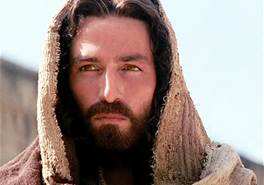
Copyright © 2011- 2014 Deacon Paul O. Iacono All Rights Reserved. This essay is a modified form of a homily I delivered last week at St. Francis of Assisi Parish in Wakefield, Rhode Island, USA. Photo Credits: “Jesus,” and “Jesus Carrying the Cross” from Mel Gibson’s classic film: The Passion of the Christ.

Mary and Joseph’s “Yes” – The Risk of an Open Heart

Our Gospel today (4th Sunday of Advent, Matthew 1: 18-24)) provides us with the story of a young couple, Mary and Joseph, who through their pondering of God’s request for understanding and trust provide humanity with the opportunity for divine Redemption. It is in their collective “Yes” to the angel’s request, that God’s plan could be fulfilled. His strategy for humanity’s Redemption was patiently planned and executed. It was a plan, seen in the Holy Scriptures, that shows Him searching for His broken human family, seeking ways in which He can communicate His desire for love and friendship.

God is very methodical in His attempts to search for His lost children. The first question ever asked in Holy Scripture is found in the book of Genesis. It is there that God asks the question: “Where are you?” He asks of the first family, Adam and Eve, “Where are you hiding?”  We know that they were hiding because of their sin; because of their collective “No” to God’s request of them to stay away from the Tree of Knowledge of Good and Evil.

With their sinful actions, God set into motion His plan for our Redemption – a plan that ultimately saw His entrance into human history to teach, heal, and redeem it from the sins of our spiritual parents. At the birth of Christ, the seven hundred year old messianic prophecies of Isaiah became a historic reality; and on a yearly basis, we celebrate that moment at Christmas.

But today we also need, in light of our Gospel, to pause and rejoice in remembrance of Mary and Joseph’s courage and willingness to say, “Yes,” to God. We need to consider that their “Yes” was not a simple act – it contained enormous risks since Mary’s circumstances after that “Yes” were at the very least – precarious.

She was a young woman, probably in her mid teens, engaged to be married, and is suddenly pregnant, not from the man she loves, but, by an unseen Holy Spirit of God; moreover, what about Joseph? He was a successful carpenter in Nazareth who had fallen deeply in love with Mary, was publicly betrothed and ready to live a happy life with her. Then the news: “I’m pregnant.” As a result under Jewish law, Mary faced a public humiliation and stoning and Joseph, stunned and confused, faced feelings of betrayal, pain, and anger. Understandably, at first, he is not ready to say “yes” to Mary and her story of divine intervention, there are few men that would.

But through divine intercession you have God, through His angel, making another request:

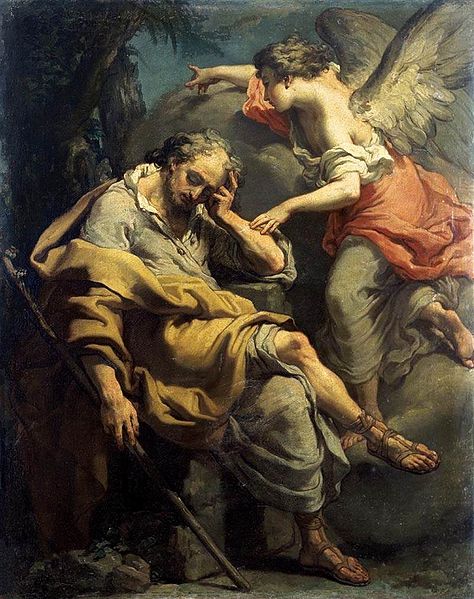
474px-'Joseph's_Dream',_painting_by_Gaetano_Gandolfi,_c._1790

“Joseph, Joseph, do not be afraid to take Mary your wife into your home.” With Joseph’s “Yes,” to this request his pain and anger subside and are replaced with a joyful nurturing spirit that enables him to take leadership of the situation and begin acting as a faith-filled stepfather. So the collective “No” by our spiritual parents Adam and Eve, is now trumped by the collective “Yes” of the first Christian family: Mary and Joseph.

Now it may be hard for us to relate to this Gospel. Our lives may be filled with anger, worry, family resentments, and disappointments. We may conclude that this story really doesn’t relate to us because the sharp axe of pain and frustration has severed the roots of our own sense of joy, hope, and love. If that is our dilemma, we must call out to God for His direction and try to remember, that in this Christmas season we can, with His help, change our focus. We can say, maybe for the first time with maturity, “Yes” to God and His call to us. You see the story of Mary and Joseph and the Christ child is absolutely relevant. For the angel’s request to Joseph of “Be not afraid” applies to us, too.

The request of  “Be not afraid” involves many different opportunities: the opportunity of forgiving others who have hurt us; or confronting our own sinfulness and unburdening ourselves of our sins, or the opportunity of being a person who desires to seriously investigate their faith and explore the reasons why we believe.

You see all of this involves the same risk that Mary and Joseph experienced: the risk of exposing our mind, heart, and soul to God’s love and allowing Jesus, through His sacramental grace, to be joyfully born into our own hearts and to give us the courage to truly live as a Catholic Christian.

So my brothers and sisters, as we make our final preparations for the celebration of Christmas, let us make every effort to imitate Mary and Joseph by saying “Yes” to God’s call, and in so doing, open the doors of our own hearts to provide a loving home for the Lord.

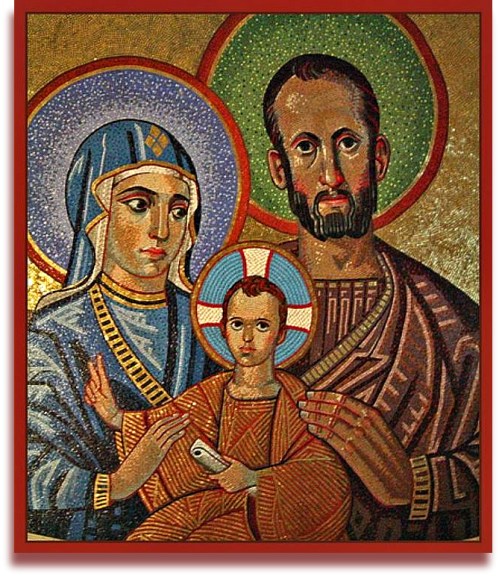
hol fam-1

Copyright © 2011- 2013 Deacon Paul O. Iacono All Rights Reserved. This is a homily that Deacon Paul O. Iacono delivered at the 8 and 10 AM Masses at St. Francis of Assisi Church in Wakefield, Rhode Island USA on Sunday December 22, 2013. Information on the painting: This painting was completed by Gaetano Gandolfi (1734 – 1802). It is entitled Joseph’s Dream, is oil on canvas, and is approximately 37 inches high by 30 inches wide. It was completed in 1790.  Information on the mosaic: Detail of the apse mosaic in the St Joseph’s chapel of Westminster Cathedral. It was installed in 2003, and the designer is Christopher Hobbs who worked with mosaic artist, Tessa Hunkin. – See more at: http://elmiradominicans.blogspot.com/2011/12/holy-family-of-jesus-mary-and-joseph.html#sthash.vVewiGgP.dpuf

The Apocalypse and Christian Duty – 33rd Sunday in Ordinary Time

It has been said that we are living between times – between Advents – in the times between Christ’s first coming – as an infant in the manger, and His second coming – as Lord and Judge of this earth. Our Scriptures challenge us today – the 33rd Sunday in Ordinary Time – with an important question: “Do my actions in public and private indicate that I am a disciple of Christ, dutifully preparing to meet the Lord?”

You see, we could spend a lot of time and effort trying to figure out the signs of the times, discussing this visionary and that seer, trying to determine whether or not we are in the actual last days before the Second Coming. We could speculate on how various personalities in the media discuss the deterioration of political effectiveness, the degradation of cultural discourse, or our precarious economic situation. We could also become unsettled over the apocalyptic scenario of what continues to occur at the destroyed Fukushima nuclear plant in Japan, the possible demise of its nuclear core, and the resulting catastrophic impact on the Pacific region.

Troubled times were also prevalent two thousand years ago when St. Paul penned his letters to the Greeks of Thessaly. St. Paul was alarmed that the gossiping about current events and apocalyptic speculations were causing disruptive behavior. The Greek word that Paul uses to describe their behavior refers “to actions that interrupt the truthful announcement and living out” of the Good News of Christ. He carefully tells us that these alarmists are false prophets if they are causing such unease as to reduce the effectiveness and the realization of the Gospel in the lives of the people.

So what does Jesus and St. Paul suggest?

First, we need to take them seriously and not be overly concerned about when the last days will come. Christians should be alert – but not worry; rather, like Noah upon hearing the word of God, they should prepare and rejoice. We need not worry because we have plenty to do in the interim by concentrating our attention on our duties to love God with our whole heart and our whole soul, repent of our sins, and love and assist our neighbors, too.

St. Paul, echoing Christ, is very specific on this point, he says, “Your love must be sincere. Detest what is evil, cling to what is good. Love one another with the affection of brothers and sisters. Anticipate each other in showing respect. Do not grow slack but be fervent in spirit; He whom you serve is the Lord. Rejoice in hope, be patient under trial, and persevere in prayer.” (Romans 12: 9-12)

Let us pray that whatever the role we find ourselves in, we faithfully carry out the duties the Holy Spirit has asked us to complete. Each of our jobs and duties are important in the eyes of God. How, and in what spirit we perform them affects our life, and the lives of others, both on earth and in eternity. So let us be worthy of the trust, love, and friendship that Jesus has for us. If we do that, and live in the prayer and grace-filled life of His Word and Sacraments, we will have nothing to fear.

Copyright © 2011- 2013 Deacon Paul O. Iacono All Rights Reserved. I will deliver this homily at St. Francis of Assisi Church in Wakefield, Rhode Island on Sunday November 17, 2013.

St. Francis of Assisi, Faith, and Grace

The following is my homily for the 27th Week in Ordinary time delivered at St. Francis of Assisi Church Wakefield, Rhode Island USA, October 6, 2013. The memorial of St. Francis of Assisi was celebrated on October 4th. 

St_Francis_394233c

This weekend, as the Church remembers the life of St. Francis of Assisi, let’s pause for a moment and examine the virtues that energized Francis’ life.

We can begin by saying that he was a simple man. He pursued simplicity. This does not mean that he was of limited intelligence, or that he pursued simplicity for simplicity sake, rather, it means that he was successful at eliminating everything from his life that did not enhance his love of Jesus and service to his fellow man.

In other words, he was continually aware of the four eternal goals of life: keeping our soul in the state of grace, awareness of judgment by God, eternal life, and companionship with God Himself.

He realized that “to be simple is to see things with the eyes of God. St. Francis pursued simplicity because he innately knew that God Himself is simple.”

Other characteristics of Francis’ life are the virtues of faith and love. St. Francis understood that by praying for faith, by acting faithfully and lovingly, his spiritual life would be stressed – like an athlete preparing for a match – enabling him grow stronger in faith and love of God. He knew that if he committed himself to it God’s grace would assist him in this spiritual exercise.

In St. Francis’ life story we see his extraordinary reaction to his father’s demand for repayment for the fabrics he took, and sold, to benefit the poor.

How did he react when accused by his father?

In innocence and detachment he publicly disrobed –  a humble nude standing majestically in the Assisi town square.

Michelangelo should have attempted to sculpt that scene in marble. For what was the scene?

It was the image of the young Francis, not confronting the Goliath of military invasion, rather, the Goliath of a garden serpent (in the form of acceptance by society and his father’s love) who tempted him to return to the sweet life, “la dolce vita”.

But it was also the image of the grace of a Divine call to live a virtuous and detached life, filled with love for God and His creation.

The simple grace of Francis’ vision would be the stone that would bring down the giant of his own ego and worldliness.

Now let’s apply this to our Gospel (Luke 17: 5-10).

In today’s parable Jesus demonstrates the power of faith for overcoming temptation and obstacles.

But what did Jesus mean when He said that our faith could move trees and mountains? (see  also Matt.17: 20; Mark 11:23)

In the Middle East  – even to this day – the term “mountain mover” is used for someone who could provide the solutions to great difficulties.
So when Jesus tells us that if our faith was just the size of a mustard seed we could “uproot trees and mountains,” His emphasis is on His grace working in conjunction with our faith.

The gift of His grace is sufficient to assist us in dealing with our problems. Jesus doesn’t say that all our problems will instantly go away, rather, He says that we will be able to endure them, and yes, like Christ Himself, even overcome them.

So, we know St. Francis of Assisi today because he responded, in a heroic way, to the specific grace that he was given as a disciple of Christ.

Faith and grace was infused into his soul, and ours, at the moment of Baptism. If we choose to participate in Christ’s Sacraments, and do so on a regular basis, grace will build upon grace, and like Francis, our perception will become clearer, we will understand our personal Christian duty, and know how to respond to it.

With today’s Gospel, and St Francis in mind, we can say that God wants us to respond to His grace and scale the mountains of our own difficulties – to climb upon the crosses of our everyday life – because it is through this effort that we receive, in His love, the ability to be His partners in eternity.

At the end of his life, if St. Francis had been asked the question of what did he accomplish, he would have probably answered that he accomplished – nothing.

Rather, he may have said that it was as a loving disciple of Christ that he responded to the gift of God’s grace – and that it was God’s grace working through him that enabled him to perform good deeds and loving actions.

Let us pray that, in the spirit of St. Francis, we respond to God’s grace with the same faith, love, and generosity of spirit.

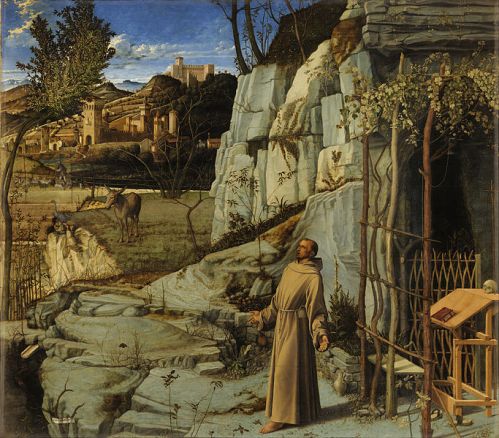
683px-Giovanni_Bellini_-_Saint_Francis_in_the_Desert_-_Google_Art_Project

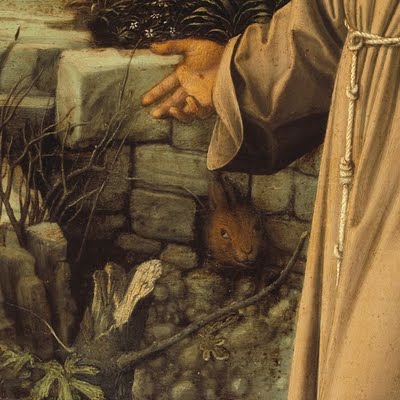
hand of st francis bellini

r

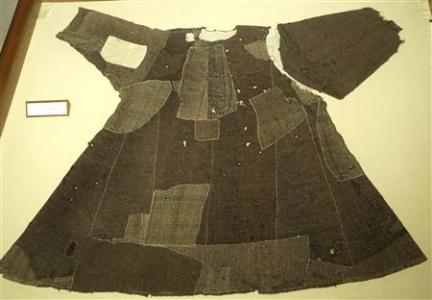
Copyright © 2011- 2013 Deacon Paul O. Iacono All Rights Reserved. Notes on the art: The first image of St. Francis is a 13th century contemporary image of him. It is found in the Benedictine Monastery in Subiaco, Italy. Thanks to Digitalnun at www.ibenedictines.org. The second and third paintings are by Giovanni Bellini (1430-1516). Bellini painted this around 1480. The third painting is a close-up of a section of this painting by Bellini which shows a curious and loving rabbit peeking out of his den just as St. Francis receives the stigmata. The last photo is of a cloak that was worn by St. Francis. You may observe it and other personal items of St. Francis, such as his prayer book, slipper, and a cincture in the Basilica of St. Francis in Assisi, Italy. Quotations on simplicity based on a 1936 sermon by Fr. Ronald Knox. The reference to “mountain mover” and its usage in the Middle East was provided by D. Schwager. My thanks to him.

The Virtue of Christian Responsibility

This weekend’s Gospel (26th Week in Ordinary Time) about Lazarus, and a rich man by the name of Dives, is filled with very concrete images about the virtue of Christian responsibility.

Jesus’ message is twofold: first, He is saying that during his earthly life the rich man was not applying the teaching of the first five books of the Hebrew Scriptures which speak of the obligation to hospitably help those around us.

Jesus is also challenging us by mentioning that the rich man sinned. In the Hebrew language the word sin means to “miss the mark” and the rich man Dives clearly missed the mark.

diveslazarusdrawn by an unknown illustrator of petrus comestar's biblehistorialecrop

Father Ron Rolheiser tells us that the Hebrew Scriptures are filled with the concept that giving to the poor was never a negotiable moral option. Rather “it was an obligation” which stated  “giving a certain amount to the poor” in your community was “prescribed by law.”

For example, in the book of Leviticus (25:23) Moses clearly states that nothing is really ours because everything belongs to God. “We are only its stewards and guardians.” We may enjoy it because we worked for it, but with the understanding that our enjoyment is possible because God Himself allows us to earn and take pleasure from it, yet, everything ultimately belongs to God.

How does this apply to us?

The answer brings us to the second part – the silent challenge within Jesus’ parable. Missing the mark, that is, sin, is a deliberate human act that denies or defies the teachings of God. Ultimately, it is an act of narcissism – an act of self-absorption – an act of self-will that puts “the almighty me” first, and the laws of God and His Church, second.

Jesus challenges us to examine how we put our trust in other things: pleasure, pride, power, or possessions – to the neglect of God. What did Dives – the rich man – trust? From the parable we see that he trusted in his wealth. Now, there is nothing wrong with wealth; wealth, however, can become a problem – and lead to sinful behavior – when we as its stewards fulfill only our own needs to the detriment of those suffering around us.

The rich man committed a sin of omission in that he failed to help a needy person that was right in front of him; so the rich man’s wealth, which in itself was morally neutral, enabled him to make the decision to become gluttonous, avaricious, and selfish. This leads us to understand that the root of all sin is pride and the inability to consistently act with humility before the Lord.

Jesus’ challenge in this story is extremely applicable, for we need to determine whether we are going through our lives committing sinful acts with little regard for the consequences of our behavior. When this happens – we – like Dives – miss the mark, and ultimately, we will go unfulfilled in this life, and like him, unfulfilled in the next so, what must we do?

Well, if Dives – the rich man – trusted in his wealth, Lazarus – the poor man – trusted in God. In fact, the name Lazarus means God is my help. Despite a life of misfortune and suffering, Lazarus, in humility, did not lose hope in God.

Like Lazarus we must rediscover, or discover for the first time, the joy and freedom of completely trusting in God.

And what does this mean?

It means that the virtue of Christian responsibility demands that  we perform our work, worship God alone, and acknowledge that He is our only lasting treasure. By doing that we will escape the deadly trap that befell the rich man – for when we love God with all our heart we never forget to help those in need.

Let our prayer be: Lord, increase my thirst for You and for Your way of happiness. Give me a generous heart so I may responsibly share with others the wealth you have given to me.

Copyright © 2011- 2013 Deacon Paul O. Iacono All Rights Reserved The above is a homily that was delivered by Deacon Paul O. Iacono on the weekend of September 28/29, 2013 at St. Francis of Assisi Church in Wakefield, Rhode Island USA. Notes on the painting: The painting above is an illustration drawn by an anonymous illustrator for the Petrus Comestar (Peter Comestor) Commentaries on the Gospels. Peter Comestor, a French priest and scholar, died in Paris in 1178. He was considered one of the three most learned men in France during his lifetime.

The Gospel of St. Luke 12: 49-53 – The Sword of Christ

The following is a homily that will be delivered by Deacon Paul O. Iacono at St. Francis of Assisi Church, South Kingstown, Rhode Island on the weekend of August 17/18 2013.

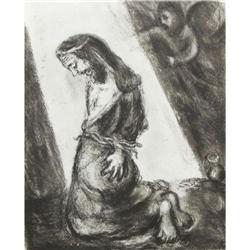
In our first Scriptural reading for this weekend (Jeremiah 38: 4-6, 8-10) we see the prophet Jeremiah thrown into a well as a result of his faith-filled preaching. He was lowered into a mud filled cistern in an attempt to shut him up and tame his ability to disturb the people’s apathy.

8303777_1m

A month ago we witnessed the spiritually uplifting events of Steubenville East held here in South Kingstown, in which Catholic teenagers and young adults from all over the Northeast gathered together to worship God and share experiences in a faith-filled setting.

The following week we saw Pope Francis travel to Brazil, express his love, teach, and witness to as many as three million people at World Youth Day.

But when these young people returned home you can be sure that advice was given to some of them, by well meaning people, who said, “Its great that you had an uplifting experience but don’t get carried away and go off the deep end.”

What does that kind of talk do?

It throws cold water on the fire of enthusiasm – it attempts to tame and control a person’s faith.

All people, regardless of age, who desire to live out and practice the Holy Scriptures in their daily lives must guard against being tamed by the world, and even at times, by some well meaning people within the Church.

jeremiah_pit

The message of this weekend’s Gospel (Luke 12: 49-53) is counter cultural. The Gospel does, at times, cause trouble. It can set a soul on fire with love for God and fellow man, and that soul then understands through wise spiritual counseling, the mission it has been given by the Lord to continue His work here on earth.

The saints all experienced this fire, this blaze of mystical love and desire for God that not only consumed them, but – by their witness –  those around them, too.

Jesus tells us in St. Luke’s Gospel that He wants to inspire a mystical fire – a blaze of faith, love, and action, and yet, He knows this will cause division; Jesus is exclaiming that His peace is not the peace of the world.

The peace and love that Jesus offers to us is often at odds with the frauds, shams, and counterfeits of this world: the politics, economics, and religious expressions that do not lift people up in love, unity of purpose, and individual liberty, but tear them apart, in anger, stress, and confusion.

When the Gospel of Jesus Christ becomes a blaze roaring in our souls the Holy Spirit gives us the gifts of fortitude and perseverance. These gifts strengthen us to stand up to pagan society both in a public and private way. This strength makes us dangerous, and historically has been a cause for division in the eyes of societies – from the time of the Roman Empire to the world today. Why else would members of the entertainment world and the news media attack the Catholic Church’s beliefs, its clergy, religious, and laity alike?

They attack a Church weakened by the public and private sins of her people but still bold enough to proclaim the Gospel.

They attack because they know the Gospel message is dangerous to their agenda.

They attack because they know that a core group of faithful followers, that cross denominational lines and who truly still number in the millions, cannot be bought off or intimidated. 

My brothers and sisters, Jesus Christ’s Redemption of mankind brought us salvation, peace, and love; but the sword He carries does have two sides – for it sharply divides those who take the Cross and the Gospel seriously from those who do not.

Today’s Gospel challenges us to know that like Jesus, Jeremiah, and the saints we must expect misunderstanding, ill treatment, and possibly even death when we glorify God by living a Gospel centered life.

Our faith provides us with the grace and love of God. Yet, the Cross refines our perspective to see that God’s love is a purifying fire of salvation and covenant that demands that  His people not compromise with the world, or declare a bogus truce with evil. So when you stand before society proclaiming your faith – do not be afraid. Keep your eyes fixed on Jesus and the witness of His Blessed Mother and the saints – in the end all will be well.

Copyright © 2011- 2013 Deacon Paul O. Iacono All Rights Reserved. The first image of Jeremiah in the cistern was painted by the artist Marc Chagall; the second image is by Paul Hardy. Thanks to Wikipaintings for the images.

Pentecost 2013

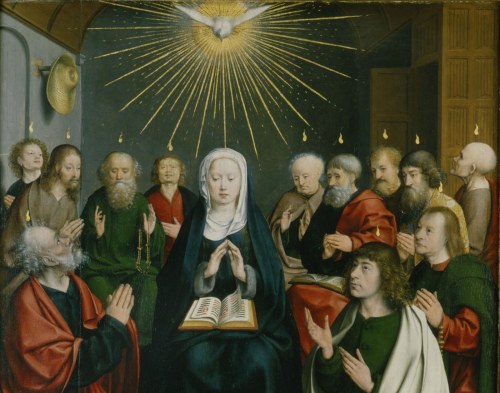
As we celebrate the birth of the Church at Pentecost (confer the Acts of the Apostles, Chapter 2 ff), we should be filled with an urgent need to obtain and, most importantly, use the Seven Gifts of the Holy Spirit that are available to us.

Our Scriptures tells us that the Seven Gifts of the Holy Spirit are: fear of the Lord (which means that we desire not to offend God in any way), understanding, counsel (which is supernatural prudence), fortitude, knowledge, piety, and wisdom. These Seven Gifts are received as a grace of God at the moment of our Baptism; and they are strengthened and completed at the moment of our Confirmation.

pentecost 2 detail

In our Gospels, Jesus explains these Gifts by using the two analogies of breath and water. Jesus tells His disci- ples: “Let anyone who thirsts come to me and drink. Rivers of living water will flow from within him who believes in me”  – and – “the water that I shall give will become in him a fountain of living water, welling up into eternal life.”

Jesus explains that this new water, “the living water” of the Holy Spirit, is a new kind of water because it is given to those who are worthy to receive it.

Christ uses the analogy of living water to express the grace of the Spirit, because all things are fundamentally dependent on water, and all plants and animals have their origins in water.

One of the early Fathers of the Church, St. Cyril of Jerusalem, tells us: “When water comes down from the heavens as rain, it is always the same in itself, yet, it produces different effects – one in a flower, another in a tree, and yet a third and fourth in an animal or person. So the grace of the Holy Spirit,  like water, adapts itself to the needs of every creature that receives it. In the same way the Holy Spirit, whose nature is always the same, simple, and indivisible, gives grace to each man [or woman] as  He, [the Holy Spirit] wills.” (St Cyril of Jerusalem)

We have all received the saving grace, and the Seven Gifts of the Holy Spirit at Baptism, but there comes a moment, usually around the age of our Confirmation, in which we are asked to recognize, develop, and use those seven Gifts.

But there is a condition, my brothers and sisters for this to happen: like a dry plant in your garden, the soul is able to produce the many flowers of holiness only when the soil of the soul has been raked and fertilized through repentance, and Sacramental reconciliation. This act of repentance is both an intellectual and spiritual action. Repentance has made your soul ready to effectively use the water, the grace, the Gifts of the Holy Spirit.

St. Paul and St. Cyril remind us that “the Holy Spirit makes one person a teacher, another a healer, a third a prophet, and a fourth a pastor. Scripture tells us that in each person [who is free from serious sin] the Spirit reveals His presence in a particular way for the common good.” (St. Cyril of Jerusalem)

Ultimately, if we actively apply these truths we are able to impact the spiritual life of those around us. How does this happen? It happens by virtue of our own dedication to holiness as we live out the Seven Gifts of the Holy Spirit.

Pentecost Sunday reminds us that we were Sacramen- tally Baptized and Confirmed to be apostles – to go forth and use these Seven Gifts that God has given us – to work on behalf of the family of God.

Let us be joyous on this Pentecost Sunday; let us rejoice in the truth that the Holy Spirit will always remain with our Church and sanctify us with His many graces; and let us recommit ourselves to allowing the Holy Spirit, through the graces of all the Sacraments, to energize us, and if necessary, change our natures for the better – so that we, too, may be fruitful apostles for Christ.

Copyright © 2011- 2013 Deacon Paul O. Iacono All Rights Reserved This essay was delivered as a homily by Deacon Iacono at St. Francis of Assisi Church, Wakefield, RI USA on Pentecost Sunday May 19, 2013.  Notes on painting: Jan Joest van Kalkar (c. 1450 – 1519). Pentecost (Pfingsten) 1505 – 1508, Oil on wood, 41 x 28 1/4 inches, location: St. Nicholai’s Church (Katholische Pfarrkirche Sankt Nikolai), Kalkar Kreis Kleve. Link to the source of this information: http://idlespeculations-terryprest.blogspot.com/2011/06/pentecost.html Thanks to Terry Prest for providing the image and its source.


Good Friday

“Come, let us worship Jesus Christ, the Son of God, who redeemed us with His Precious Blood.”

“If we wish to  understand the power of Christ’s blood, we should go back to the ancient account of its prefiguration in Egypt. Sacrifice a lamb without blemish, a one year old male, commanded Moses, and sprinkle its blood on your doors. If we were to ask him what he meant, and how the blood of an irrational beast could possible save men endowed with reason, his answer would be that the saving power lies not in the blood itself, but in the fact that it is a sign of the Lord’s blood. In those days, when the destroying angel saw the blood on the doors he did not dare to enter, so how much less will the devil approach now when he sees, not that figurative blood on the doors, but the true blood on the lips of believers, the doors of the temple of Christ.

If you desire further proof of the power of this blood, remember where it came from, how it ran down from the cross, flowing from the Master’s side. The gospel records that when Christ was dead, but still hung on the cross, a soldier came and pierced his side with a lance and immediately there poured out water and blood. Now the water was a symbol of baptism and the blood, of the holy eucharist. The soldier pierced the Lord’s side, he breached the wall of  the sacred temple, and I have found the treasure and made it my own. So also with the lamb: the Jews sacrificed the victim and I have been saved by it.”

It was about nine in the morning when they nailed Jesus to the cross.

From noon until three o’clock there was darkness over the whole world.

christ_cross

At three o’clock, Jesus cried out in a loud voice: My God, my God, why have you forsaken me?

It is finished.

When we were His enemies, God reconciled us to Himself by the death of His Son Jesus Christ.

An innocent Jesus sacrificed for us, the guilty.

Realize that you were delivered from the futile way of life your fathers handed on to you, not by any diminishable sum of silver or gold, but by Christ’s blood beyond all price: the blood of a spotless, unblemished lamb chosen before the world’s foundation and revealed for your sake in these last days. It is through Him that you are believers in God, the God who raised Him from the dead and gave Him glory. Your faith and hope, then, are centered in God.  (1 Peter 1: 18-21)

“Awake, O Sleeper, and rise from the dead, and Christ will give you light.”

Copyright © 2013 Deacon Paul O. Iacono All Rights Reserved

Notes on the painting: Christ’s Crucifixion, is by the Spanish master Diego Velazquez (1599 – 1660); it was completed between 1631 – 32.

All the Scriptural quotations are taken from The New American Bible (1970) Confraternity of Christian Doctrine, Washington, D.C. The “Awake, O sleeper…” verse is taken from an ancient homily from the first centuries of the Church. First quotation is from The Roman Breviary: The Divine Office, volume 2, page 467. The second quotation is from The Catecheses by Saint John Chrysostom (AD 347-407), archbishop of Constantinople, Byzantium (present day Istanbul, Turkey). His Catecheses is also found in volume 2 of the Breviary, pages 473-475.

The Christmas Star of Bethlehem – Merry Christmas, Everyone!

Even though the vast majority of us are not astronomers, the famous star of Bethlehem still has a great ability to intrigue us especially as it relates to its actual astronomical occurrence. As Christians we believe in the Christmas story, not as legend or myth, but as an actual historical occurrence which led to the Redemption of mankind by the Son of God – Jesus Christ.

There are many elements of the Nativity of Christ that are expressed by the evangelists, and one of the most interesting is the illumination of Israel by a brilliant star at the time of the actual birth of Jesus. The Christmas Star has intrigued artists and poets in its ability to shed light on the truth of the cosmic meaning of Christmas; and in recent years some research has been done using computer animation and astronomical programs to determine if, when, and where it actually occurred.

The EWTN network usually airs a contemporary and extremely popular documentary entitled The Star  (of Bethlehem) (please examine the filmmaker – Rick Larson’s site – for a wonderful, multipart, overview of his documentary: www.bethlehemstar.net/

The following post attempts to determine the birth date of Jesus Christ in light of the astronomical evidence. The quotes I provide are taken from a fascinating study entitled Probable Date of Birth of Christ found in this website: www: copiosa.org/christmas/birth_date.htm by Father William G. Most (Fr. Most’s article offers a summary of the work done by  E. L. Martin, in his book The Star That Astonished the World, ASK Publications).

“In the evening of June 17, 2 BC, there was a spectacular astronomical event in the western sky. Venus moved eastward seemingly going to collide with Jupiter. They appeared as one star, not two, dominating the twilight of the western sky in the direction of Palestine. This conjunction had not happened for centuries, and would not happen again for more centuries. Jupiter was considered the Father, Venus the Mother.

Then not many days later, Venus came within 0.36 degrees of Mercury. On September 11 came the New Moon, the Jewish New Year. This happened when Jupiter, the King planet was approaching Regulus, the King star. Further, there were three conjunctions of Jupiter and Regulus within the constellation of Leo, the lion, which was considered the head of the Zodiac.

Now Genesis 49:10 had foretold there would always be a ruler from Judah, whom Jacob called the lion, until the time of the Messiah. The star Regulus, which astronomers called the King Star, dominated Leo.

The Magi, being astronomers and astrologers, would surely read these signs. (The three conjunctions with Regulus were August 12, 3 BC; February 17, 2 BC, and May 8/9, 2 BC). In Hebrew, Jupiter was called sedeq = “righteous,” a term especially pertaining to the Messiah.

On September 11, Jupiter was close in the constellation of Virgo, the virgin. On September 3rd of 3 BC Jupiter was in conjunction with Regulus, the brightest star in the constellation of Leo — Leo the Lion, which was associated with Kings, and the Lion of Judah, as foretold by the dying Jacob in Egypt in Genesis 49:10.

Also, on December 25 of 2 BC, Jupiter stopped for 6 days over Bethlehem. This is a normal motion for Jupiter; it stops twice, and reverses its seeming movement. This may have been the very time the Magi came with their gifts. This was also the time of the Hanukkah festival, during which it was customary for Jewish Fathers to give gifts to their children.

The shepherds watching their flocks in the fields indicate a date either in late summer or early fall.

E.L. Martin [whose research this article is based on] thinks the birth of Jesus was in September, 3 BC (Jupiter in conjunction with Regulus), and the probable date of the Magi was December 25, 2 BC (Jupiter stopped for 6 days over Bethlehem).”

Please don’t forget when we speak in BC time, the “ladder of time” comes down from let us say 10,000 BC to 1 BC, in a descending order, so 3 BC comes before 2 BC.

In AD time (Anno Domini, a Latin phrase which means “the year of Our Lord” the “ladder of time” is ascending, so, we are currently in the year 2012, but as of midnight December 31st, we will then be in the year 2013, or two thousand and thirteen years since the birth of Christ. When this Gregorian Calendar system was developed and applied to western Europe, approximately five hundred years ago, they did not have the sophistication of computer/astronomical observations to correct the date of Christ’s birth, if we agree with Martin’s research, to the year 3 BC.

“The above span of dates (approx. 16 months) coincides with The Slaughter of the Innocents, where Herod killed all males under the age of two years. Herod died shortly thereafter. Interestingly, More than 600 planetariums here and in Europe have revised their Christmas star show to match this work of E. L. Martin.”

594px-Giotto_-_Scrovegni_-_-18-_-_Adoration_of_the_Magi

The above painting is entitled the Adoration of the Magi by Florentine painter Giotto di Bondone (1267–1337). The Star of Bethlehem is shown as a comet above the child. Giotto witnessed an appearance of Halley’s Comet in 1301.

“Magi were not really just astrologers. They served as court advisors, going from one royal court to another. It would not then be difficult to suppose they had come from a great distance with gifts. In those days all astronomers were acquainted with astrology. They were also mathematicians.” This is the end of Fr. Most’s article.

For more information check out Fr. Most’s website: copiosa.org/christmas/index.htm. As you go down this index on the left hand side you will see Fr. Most’s complete article on the Probable Date of the Birth of Christ. His site has some very interesting articles that can be very helpful in explaining to people – especially children – the origins of Catholic Christmas traditions.

220px-Nativity_Icon

The above icon was written (painted) in Russia and displays, in a lovely catechetical way, the entire Nativity narrative: the angel’s appearance to the shepherds, the Star of Bethlehem (appearing as a disk with a shaft of light coming down to the cave of the birth, the actual birth of the child Jesus being wrapped in swaddling clothes by His Blessed Mother – Mary, the coming of the Magi, the washing of the child Jesus, and St. Joseph being visited by an old man in furs (some refer to this last image as the temptation to doubt that confronted Joseph.

Soon after the dream visitation by an angel, St. Joseph realizes the nature of this Child. He understands that he is given the responsibility to care for Him and His mother and raise the child as if He was his very own. St. Joseph does exactly that; he is the epitome of quiet, loving leadership, and a model for all fathers.

St. Joseph is silent throughout the entire Gospel narrative. Yet, his actions speak louder than words. We see in St. Matthew’s Gospel (Chapter 1: 18ff) that he ultimately had a thoughtful plan to quietly divorce Mary when he learns that she is pregnant; however, he is not stubborn or hard of heart, for when the angel Gabriel visits him and tells him what is happening he does not rebel and say “No, I will not do it” out of pride or ego. Rather, he changes his plan and trusts the angel’s message which was sent by God to him.

This is so important – and it should speak volumes to us – if we, too, have open hearts and minds to hear what God is telling us in prayer, Scripture, and the grace of the Holy Sacraments. These three sacred tools, along with a holy orthodox spiritual director, will assist us on our path – and like the Star of Bethlehem – lead us to the Christ.

In the immortal words of Tiny Tim Cratchit: “… and a Merry Christmas, everyone!”

Copyright © 2012 Deacon Paul O. Iacono All Rights Reserved

The Magnificat of Mary – A Beautiful Analysis By The Venerable Bede

This morning’s selection from the Office of Readings in the Roman Breviary is written by an English monk named “the Venerable Bede.” It discusses Mary’s joy-filled song – The Magnificat.

Bede was born in the year 673 and died in 735. He lived in Northumbria, primarily in the two monasteries of Saint Peter and Saint Paul. These monasteries had accumulated a wonderful collection of Greek, Latin, and early Church manuscripts. Bede spent his life studying, writing, and dictating the results of his research and prayer. He is known primarily for his most famous tome which is The Ecclesiastsical History of the English People. This work resulted in later generations giving him the title “The Father of English History.”

In 1899, Pope Leo 13th made Bede a Doctor of the Church. Bede was a skilled translator, linguist, and writer. His ability to compose insightful spiritual essays, and skill in making the writings of the Early Church Fathers accessible to his fellow Anglo-Saxons, significantly contributed to the growth of Roman Catholicism in England.

Let us take a moment today to dwell upon one of his perceptive and rich essays on the Blessed Mother. In the selection below, Bede provides us with an essay on Mary’s response to the knowledge that she will be the mother of the Savior. Her poetic song is known as The Magnificat, said in the presence of her cousin Elizabeth (and possibly Elizabeth’s husband Zechariah). They mutually rejoice in the knowledge that they are both pregnant (The Visitation).

visitation

Mary’s song of joy, faith, and trust is here separated by Bede and analyzed for our prayerful consideration. Mary’s words appear in bold italics, Scriptural references are in plain italics, Bede’s are in regular print. The entire Magnificat can be found in the first chapter of the Gospel of St. Luke, verses 46 – 55.

00.159.19_PS1

Mary said: My soul proclaims the greatness of the Lord, my spirit rejoices in God my Savior.

Bede’s comments have Mary thinking these thoughts: “The Lord has exalted me by a gift so great, so unheard of, that language is useless to describe it, and the depths of love in my heart can scarcely grasp it. I offer then all the powers of my soul in praise and thanksgiving. As I contemplate his greatness, which knows no limits, I joyfully surrender my whole life, my senses, my judgment, for my spirit rejoices in the eternal Godhead of that Jesus, that Savior, whom I have conceived in this world of time.”

The Almighty has done great things for me, and holy is his name.

“Mary looks back to the beginning of her song, where she said: My soul proclaims the greatness of the Lord. Only that soul for whom the Lord in His love does great things can proclaim his greatness with fitting praise and encourage those who share her desire and purpose, saying: Join with me in proclaiming the greatness of the Lord; let us extol His name together.”

“Those who know the Lord, yet refuse to proclaim His greatness and sanctify His name to the limit of their power, will be called least in the kingdom of Heaven. His name is called holy because in the sublimity of his unique power He surpasses every creature and is far removed from all that He has made.”

He has come to the help of His servant Israel, for He has remembered His promise of mercy.

“In a beautiful phrase Mary calls Israel the servant of the Lord. The Lord came to his aid to save him. Israel is an obedient and humble servant, in the words of Hosea: Israel was a servant, and I loved him.”

“Those who refuse to be humble cannot be saved. They cannot say with the prophet: See, God comes to my aid; the Lord is the helper of my soul. But anyone who makes himself humble like a little child is greater in the kingdom of Heaven.”

The promise He made to our fathers, to Abraham and his children for ever.

“This does not refer to the physical descendants of Abraham, but to his spiritual children. These are his descendants, sprung not from the flesh only, but who, whether circumcised or not, have followed him in faith. Circumcised as he was, Abraham believed, and this was credited to him as an act of righteousness.

The coming of the Savior was promised to Abraham and to his descendants forever. These are the children of promise, to whom it is said: If you belong to Christ, then you are descendants of Abraham, heirs in accordance with the promise.”

The Responsory Prayer (Luke 1: 48 – 50) follows this reading:

“From this day all generations will call me blessed. The Almighty has done great things for me, holy is His name. He has mercy on those who fear Him in every generation.”

Bede’s words are beautiful words and the sacred images shown may be very helpful to you as we enter the eve of Christmas. May you all have a holy and joy filled Christmas day and good fortune in the New Year! You are in my prayers. Thank you for reading my post.

Copyright © 2012 Deacon Paul O. Iacono All Rights Reserved. Notes on the paintings: The first sacred image is a contemporary sacred image written/painted in the iconographic style; I do not know its author. The second sacred image of Mary lost in ecstasy as she sang The Magnificat, was completed by James J. Tissot, a French painter (1836 – 1902). This painting currently hangs in the Brooklyn Museum. The medium is opaque watercolor over graphite on gray woven paper. It is approximately five by ten inches in size. Bede’s commentary is taken from The Liturgy of the Hours, Volume 1. Catholic Book Publishing Co., New York, 1975, page 362.


December 21, 2012 – The Archangel Gabriel’s Greeting to Zechariah

A very clear narrative greets us in the Gospel by St. Luke. He tells us that both Zechariah and his wife Elizabeth were both righteous before God: walking in all the commandments and ordinances of the Lord – they were blameless; but they have no child. Elizabeth was barren and both were elderly. We read of Zechariah silently bringing his heavy heart before the Lord – even after all those years – it was still burdened with disappointment. The couple probably remembered Psalm 112 which says:

“Happy the man who fears the Lord, who takes delight in his commands. His sons will be powerful on earth; the children of the upright are blessed.”

Zechariah was a priest, and on that day – by lot – it was his turn to enter the chamber within the Temple called the Holy Place and burn incense on the special altar. The Holy Place was a small chamber that led to the Holy of Holies, which housed the Ark of the Covenant.

For whatever reason, Zechariah that morning carried his disappointment with him into the Holy Place; and while he was there the archangel, Gabriel, appeared on the right side of the Altar of Incense. Gabriel tells Zechariah not to be afraid and that his prayer was heard before the throne of God. Gabriel continues with the joyous news that Elizabeth will bear a son, and that he will be called John – which in Hebrew means – “the Lord is gracious.” This child will grow and be great before the Lord, and even from his mother’s womb – he will be filled with the Holy Spirit.

But, in a typically human way, Zechariah questions the archangel’s announcement. His query must have been different in tone. It must have had the typical masculine attitude of “Are you kidding me!” Zechariah’s tenor makes Gabriel, and possibly God, indignant – and Zechariah is struck speechless for his insolence.

In Scripture, few lines later, we see Gabriel’s announcement to Mary. She questions him, too, as “How can this be since I do not know man? But Gabriel does not strike her speechless. We have to be struck by this difference. What does it teach us?

It is clear that God knows our hearts. God knew what was on Zechariah’s heart when he was in the Holy Place. Zechariah does not trust the message or the messenger, and by inference – he does not trust God. God knows his heart; and disciplines this good man. Like Zechariah, we, too, may disbelieve God. In our sophistication or position in life we may say “Well that’s fine, but, the Scriptures don’t apply to our situation, or this specific teaching was acceptable years ago, but, too much time has passed and it doesn’t apply to my problems.

The Gospel says that Zechariah and his wife were good and righteous people. It was mentioned that he kept all the Commandments and ordinances. Yet, when his big moment comes – where is all that goodness and righteousness? It might still be there in his heart, but, there was also a pocket of doubt – a crevice of skepticism – that was significant enough for him, as a priest of the Almighty God, to be struck speechless in punishment for not trusting Gabriel’s message.

As sacred artists, as Christians, this Gospel asks us to stop, and check our souls in this last week of Advent. It asks us how patient, confident, and trusting have we been of the Lord’s message to our hearts, and have we allowed this to carry over into our actions? Have we become more interested in all the hype about the end of the world from a pagan culture, or, have we trusted in the Word of the Lord and His messengers?

Zechariah learned the hard way that when the Lord prepares us for His coming He desires us to be alive, awake, and alert to His call and to trust His message. So, our prayer in these last days of Advent should echo that of Zechariah, who in the months of speechless waiting, most likely in his mental prayer said,  “Lord, I believe; cleanse me of my disbelief. Lord, I trust, heal me of my distrust;” and it should also echo that of Mary – who in humility and expectation waited patiently for the graciousness of the Lord to take fruit in her womb.

Copyright © 2012 Deacon Paul O. Iacono All Rights Reserved

Thanks to angels-angelology.com for stained glass window image

Gaudete Sunday In Light of the Tragedy in Newtown, Connecticut

Today we celebrate Gaudete Sunday. Gaudete means, “Rejoice!” – and we visualize this by the rose-colored vestments and candle in the Advent wreath.

Yet, it is so difficult to rejoice in light of the unspeakable horror and evil that befell the 27 innocent children and adults in Newtown, Connecticut, or the 22 children and an adult who were slashed by a man wielding a knife in a city in China, or the teenager arrested in Oklahoma for plotting to kill his fellow students and bomb his high school; and this all occurred on the morning of December 14th.

Connecticut Governor Dan Malloy, at the Vigil service at St. Rose of Lima Church on Friday night, spoke of the fact that true evil had touched the community of Newtown and that this evil would continue to have repercussions for many years.

Its consequences would be long lasting because it would continue to test the faith of the children and all those families and residents affected by this tragedy. He went on to say that it would be “a test not only of our faith in God, but faith in our fellow man – our community.”

He was right in saying that, given that the forces of darkness have always preyed upon mankind in an attempt to subvert and infect the beauty of the most significant element of God’s creation – our fellow human beings.

Through distortion of the good, and the promotion of rage and evil, the forces of darkness attempt to drag mankind down into the despair, and loss of God, that they themselves feel.

But, the knowledge of that ancient cosmic distortion of God’s creation, perpetrated by Satan himself, on a spiritual and historical level, is the exact reason for our celebration of the solemnity of Christmas. It is the reason for our rejoicing – for the moment of the birth of the innocent Savior marks the beginning of the end of the period of time that evil will reign on this earth.

We cannot help but remember another madman, King Herod, who upon learning from the Magi of the birth of this innocent child, gave the order to kill over a hundred children, and their parents, if they attempted to get in the way of his psychotic depravity. And we remember another grieving mother, Our Blessed Mother, who witnessed the horror of the killing of her child – and the tears that must have flowed from her.

Rage against motherhood, rage against childhood, rage against innocence: in two thousand years of Christian history this has become the sad spectacle of man’s inhumanity to man; it appears nothing has changed.

But, if we are a people of faith, we have opened our minds and hearts to understand that the birth and death of Jesus Christ – has, in reality, changed everything.

Today, Gaudete Sunday, we are called to rejoice, as St. Paul tells us “Rejoice in the Lord always” – not just in good times but in bad, as well.

How do we do that?

How do the parents, and husbands, and wives, the teachers and children, the communities of Newtown, Columbine, Aurora, and many other cities and towns in America, and the world, surrounded by the darkness of evil and senseless violence – do that?

To a secular person the answer would come simply from psychological and grief counseling that would occur over many years. Yet important as that is, it is not the only answer.

A close reading of the letters of St. Paul show us that it was St. Paul’s faith – the knowledge in his mind and heart that he shared a deep personal relationship with the Savior of the world – that enabled him to withstand all sorts of evil.

It was that mental memory of who Jesus was – what He preached – how He suffered and died – and the truth that Jesus – the Word of God and the Light of the World – had resurrected from the dead and had appeared to him – face to face – mind to mind – to express His love for all of us and to say that evil would never endure – it would never in the end – win.

It is this focus, this trust, this faith that enabled St. Paul to deal with his problems and maintain joy in the knowledge that all the evil that he faced, and that ultimately would kill him, was overcome by the life, death, and resurrection of Jesus Christ.

St. Paul tells us today “Have no anxiety at all, but in everything by prayer and petition, with thanksgiving, make your requests known to God. Then the peace of God that surpasses all understanding will guard your hearts and minds in Christ Jesus.”

My brothers and sisters, the Apostle Paul does not speak empty words. They are there for us to hang on to with dear life in times of great trial and grief as we turn our heavy hearts over to Jesus and Our Blessed Mother.

It will be many, many years before the grieving parents, and the innocent children and adults heal from the trauma of Friday morning; yet, St. Paul tells us that healing is possible.  The Blessed Mother’s life – and Jesus Himself – tells us that healing is possible: through daily prayer, faith, trust, and the love of God Himself. When we pray we must not forget these families or the families throughout the world who suffer, and walk the path to Calvary, carrying their own crosses thrust upon them by a violent world.

It is at times like these that we truly understand our own fragility and brokenness – and realize that we are not able to survive without the grace of God and the support of the people in our own families and community.

So on this Gaudete Sunday, our hearts and prayers go out to all the grieving people of Newtown, and we remember that we are called to rejoice in the truth that, even though evil swirls all around us, Jesus our Savior loves us – was born and was killed for us – and He will never abandon us; with that knowledge, and His grace and strength, we can endure any tribulation.

Copyright © 2012 Deacon Paul O. Iacono All Rights Reserved.  Sermon delivered by Deacon Iacono on Sunday December 16, 2012 at St. Francis of Assisi Church and St. Romuald Chapel  Wakefield, Rhode Island USA

Our Blessed Mother’s Poverty of Spirit

Our Gospel today (Luke 21: 1-4) asks us to reflect on how we express our love for God.

At first glance, the poor woman in the Gospel looks reckless. Yet, love, regardless of whether it is for God or another person, doesn’t calculate all the percentages.

Many times, it just blissfully provides whatever the beloved needs, even to the point of true sacrifice on the part of the lover for the beloved. The lesson here is simple: love has greater value than material possessions.

This  Gospel reminded me of Our Blessed Mother Mary’s actions in a few Gospel accounts which speak about her presence, love, and the willingness to intercede with her Son; these actions reveal the condition and generosity of her heart.

So our Gospel is not just about what we contribute to the collection basket. It is all about the condition of our hearts – the state of our generosity to the Lord.

You see this Gospel challenges us to ask ourselves this question: “When we give to others, whether it is money, time, talent, or just a sympathetic ear, do we do it out of love or out of a sense of obligation?”

Mary and the poor woman’s witness is that our generosity should always be linked to God’s spirit of charity. These women show us that true selfless generosity must always come from the heart and that we must be willing to give of ourselves for the love of God.

This may not mean cleaning out our bank accounts and giving it all away, a few like St Francis of Assisi, were called to do that; but the vast majority of us are called to clean out our hearts of all those things that interfere with our witness to God’s spirit of love and generosity in our own lives.

As we conclude this liturgical year, and look forward to beginning a new one next weekend, let us pray to Mary to intercede with her Son so that we, too, may share in her poverty of spirit and love of God’s charity.

Copyright © 2012 Deacon Paul O. Iacono All Rights Reserved

Our Lord Jesus Christ, King of the Universe

Thought you might enjoy my homily for this weekend’s solemnity of Christ the King:

Today, the last Sunday of the liturgical year, we celebrate the solemnity of Our Lord Jesus Christ, King of the Universe; yet, our Gospel presents to us a scene that recalls Good Friday. For we again hear and visualize Pilate’s interrogation of Christ and His kingdom.

In the Book of Revelation Jesus is given the title King of Kings and Lord of Lords (Rev. 19:16); and today, at the heart of this Gospel, we are challenged to respond to that title.

It is a challenge that implores us to answer the most important question that we will ever confront:

Do I recognize – accept – and live my lifeas a witness to the truth that Jesus Christ is my Lord and King?” 

In 1925, when this solemnity of Christ the King was first instituted by Pope Pius 11th, the Pope realized that humanity was beset by all sorts of conflicting thoughts, ideologies, movements and distractions that continually cried out for attention and acceptance.

Pius 11th knew that the situation had to be addressed and that he needed to clearly state to the world that Jesus the Christ should be the only King of our hearts and souls.

“The Pope understood that “the claim of Christ came first: Pax Christi in regno Christi: the peace of Christ in the kingdom of Christ (as related by Fr. Ronald Knox).”  In other words – the peace of Christ comes only when we live our lives within and according to the kingdom of Christ.

We are here today because we know this to be true. Yet, there are many Catholics, and maybe even some of us – clergy and laity alike – who are similar to the people that Pope Pius was addressing in 1925.

We are conflicted. We are distracted. We are beset by numerous loyalties that, when examined are truly not of Christ – loyalties whether social, political, sexual, or financial that are more akin to the Kingdom of Darkness and Shadows – the Kingdom of Deception  – than the kingdom of Light and Truth.

We are beset by numerous confusions or lack of comprehension that affects our entire understanding of who Jesus is, what He accomplished on the Cross, and is capable of doing  for us in our own lives.

We shouldn’t be surprised by the statistics. There are approximately 68 million Catholics in this nation, but only 30% – or 21 million of them – actually practice their faith on a weekly basis and these numbers hold true for even our own parish.  (Gallup Poll, Parish census)

Based on these numbers alone, we must again ask the question: “Is Christ our King?”

If Catholics do not participate in the great prayer of the Kingdom of God – which is the Holy Mass – and have no understanding of the reality of Christ’s true presence in Holy Communion, and rarely receive the Sacrament of Reconciliation because they have lost all awareness of the concept of sin and have convinced themselves that they do not sin – will they receive the welcome of God’s love and fellowship at the time of their deaths?

My brothers and sisters – Jesus Christ is truly our Lord and King – but He will never force Himself on us. He gave all of us, repentant and unrepentant, the gifts of reason and free will; and through the Sacraments He freely gives to us the gifts of His saving grace.

Jesus does not want mankind to be robotic in their love and worship of Him; we can freely choose to be members of the Kingdom of Light  – or  –  the Kingdom of Darkness.

Remember Christ’s words in His Gospel – ‘Choose one Kingdom or the other’ – regardless of what the pundits say – there is no middle ground.

Next weekend we begin a new liturgical year, and as we do so it is incumbent upon us, in this Year of Faith, to evaluate ourselves and do everything we can to accept, practice, and proclaim that Jesus Christ is the king of our lives and souls – not just for an hour on Sunday – but for all eternity.

Copyright © 2012 Deacon Paul O. Iacono All Rights Reserved.

Thanks to livingscripture.wordpress.com for the icon of Jesus Christ, King of the Universe. The artist of this image was not listed.

Mary – The Mystical Spouse of the Holy Spirit and the Wife of Joseph

The question may be asked “How is the word “spouse” used in reference to Mary and the Holy Spirit?

We have all read the nativity accounts of St. Matthew and St. Luke and if you are a Roman Catholic you believe that Sacred Scripture is the foundation on which we build our theology; however, Sacred Tradition and the scholarship and teaching of the Magisterium of the Church are also very important.

Sacred Tradition, scholarship, and the Magisterium (the teaching authority of the Church) act as the counterbalance for our understanding of God’s Truth in Scripture. These elements, together with Sacramental grace, prayer, and good works help us live our life in Christ.

Theologians, saints, and mystics have used marital language to express the love of God for His Church and the mystical relationship between our Blessed Mother and the Holy Spirit. The use of marital language in relation to Mary, the Holy Spirit, and the Church has a long and varied history. A few recent examples of a pope and documents of the Church using this language are Pope John Paul 2 in numerous homilies and encyclicals, and the very important document that resulted from the Second Vatican Council entitled The Dogmatic Constitution of the Church – Lumen Gentium.

If we go back to the earliest writings of the Church, and quickly examine some sources, we see the “marital and spousal” aspect of this mystical language used in a second century AD document called the Odes of Solomon; and as we proceed up through history we see mention of it in the writings of St. Augustine (4th century), St. Ildephonsus, archbishop of Toledo, Spain (7th century), St. Germanus, patriarch of Constantinople (7th century), Cardinal St. Peter Damian (11th century), St. Bonaventure (13th century), Emmanuel d’Alzon (19th century), and, in the many scholars of the 20th century, such as Cardinal Joseph Suenens, Karl Rahner, Pope John Paul 2, Rev. Peter Damian M. Fehlner, F.F.I., and Pope Benedict 16th.

A few examples of how the word “spouse” is used in these theological contexts may be helpful. In 1979, on Pope John Paul 2 first pilgrimage to the United States, he gave a sermon on our Blessed Mother at the National Shrine of the Immaculate Conception and made this point in relation to Mary:

“…Through her, the Sun of Justice was to rise in the world. Through her, the great healer of humanity, the reconciler of hearts and consciences, her Son, the God-Man, Jesus Christ, was to transform the human condition and by his death and resurrection, uplift the entire human family. As a great sign that appeared in the heavens, in the fullness of time, this woman dominates all history as the Virgin Mother of the Son, as the Spouse of the Holy Spirit, and as the Handmaid of humanity.” (excerpted from Mary’s Yes – Meditations on Mary Through The Ages, edited by John Rotelle, O.S.A., Servant Press, Ann Arbor, 1988)

In his important 1986 encyclical on the Holy Spirit  “The Lord and Giver of Life” (Dominum et Vivificantem) Pope John Paul 2 continues to use these expressions to help explain his insights:

“…It is the [2nd Vatican] Council that says to us: “The Blessed Virgin…overshadowed by the Holy Spirit…brought forth…the Son…, he whom God placed as the first-born among many brethren namely the faithful (cf. Romans 8: 29). In their birth and development she cooperates with a maternal love”; she is through “his singular graces and offices…intimately united with the Church…. [She/Mary] is a model of the Church” (Lumen Gentium, note 63). “The Church, moreover, contemplating Mary’s mysterious sanctity, imitating her charity,…becomes herself a mother” and “herself a virgin, who keeps…the fidelity she has pledged to her Spouse. Imitating the Mother of the Lord, and by the power of the Holy Spirit, she preserves with a virginal purity an integral faith, a firm hope, and a sincere charity” (Lumen Gentium note 64).

Pope John Paul 2 continues, “Thus one can understand the profound reason why the Church, united with the Virgin Mother, prays unceasingly as the Bride to her Divine Spouse, as the words of the Book of Revelation, quoted by the [2nd Vatican] Council, attest: “The Spirit and the bride say to the Lord Jesus Christ: Come!” (Rev. 22: 17).

The Church’s prayer is this unceasing invocation, in which “the Spirit himself intercedes for us”: in a certain sense, the Spirit himself utters it with the Church and in the Church.”

So, we see in these few examples that the Church has used this type of mystical language to help express and make meaningful the divine union of Mary and the Holy Spirit. This, of course, was made possible by Mary’s humility, and the grace of the Holy Spirit which fashioned Mary from the moment of her conception.

God has given Himself as a divine Gift to mankind. This mirrors the gift of self that a husband and wife make of themselves to each other; or, the gift that a consecrated virgin makes of him or herself to God. Our eternal destiny has been played out on this field, for with mystical insight we understand that a divine proposal was made to this young woman Mary, and using her free will and reason, she consented to the request to become the Theotokos – the Mother of God. It is important to remember that she consented, in humility, and out of her profound sense of love, service, and faith in God. These are the characteristics of all consecrated virgins, and the characteristics of all faith-filled wives and husbands who freely give the gift of themselves to their spouse in recognition of their marriage covenant.

At the moment of her “Let it be done to me according to your word,” her Spouse, the Holy Spirit, dwelt within her and uniting with her blood conceived the child Jesus in her womb. This was the divine act of conception – the miracle of  the Incarnation – resulting in a natural child and the full flowering of Mary’s motherhood. In practical terms, her consecrated virginity was not disturbed. She was an immaculate virgin before, during, and after her pregnancy. During her pregnancy and after the birth of Jesus, the Holy Family was exactly that – a holy family. Her legal husband Joseph understood and respected her vow of consecrated virginity, and she dedicated herself to being a model wife and mother – a woman who supported her husband Joseph in his work and her Son, Jesus, in His future ministry.

Glory and Praise to God! Praise be to the Mother of God, Mary, most holy! May she always intercede with her Son for mercy on our behalf!

Notes on the paintings: The first painting of the Annunciation is by Fra Angelico (Brother John of Fiesole, died 1455) and is done in egg tempera on wood; completed between 1430-32 it is found in the Museo Diocesano in Cortona, Italy. The second painting is also by Fra Angelico it was painted between 1430-32 and is done in egg tempera on wood. It measures approximately 76 inches by 76 inches and hangs in the Prado Museum in Madrid. The third painting is by Benozzo Gozzoli entitled Madonna and Child Giving Blessings.  Painted in 1449, it is egg tempera on silk and mounted on wood. It is currently located in the church of Santa Maria Sopra Minerva in Rome. It is approximately 100 inches high by 51 inches wide.

Copyright © 2012 Deacon Paul O. Iacono All Rights Reserved.

Saints Pontian and Hippolytus and Our Call to Duty

Today we celebrate the martyrdom of Saint Pontian, who was the lawfully elected successor pope to St. Callistus during the early 3rd century. St. Pontian was considered a criminal by the emperor Maximinius and banished to the silver mines in Sardinia – an exile which meant certain death. We also celebrate today a saint by the name of Hippolytus, who was a priest in the Church of Rome at this same moment in time.

Saint Hippolytus is recognized because of his brilliance and profound scholarship. He is considered to be one of the finest theologians of the 3rd century, and is the source of the 2nd Eucharistic Prayer recited at Mass. Hippolytus’ most important work is a treatise known as The Apostolic Tradition; and scholars such as Dr. Marcellino D’Ambrosio, (at http://www.crossroadsinitiative.com) tell us that it provides “an enlightening and extensive glimpse into the liturgical and devotional life of Roman Christians around the year 200.” The statue found below is of Roman origin, found in the mid 16th century. It has the name Hippolytus carved into it as well as references to works of other Apostolic Fathers. The image is presented through the courtesy of Dr. D’Ambrosio.

Controversy, however, erupted when St. Callistus, was elected to the papacy. St. Hippolytus considered Callistus to be a liberal since Callistus extended absolution to new converts who had committed mortal sins such as adultery and murder. Hippolytus contested the election, violently disagreed when Callistus was affirmed, and then made history by declaring himself pope, thus becoming the first anti-pope in the history of the Church!

As a result of his action he divorced himself from full communion with the Church. When Pope Callistus was martyred, in the year 222, Hippolytus began disagreeing with his successors – the last being Pope Pontian.  Hippolytus’ theological differences and self-imposed actions didn’t mean anything to the Romans for they arrested him, too, and exiled him off to Sardinia; and there, St. Hippolytus – the anti-pope met St Pontian, the true pope and lawful successor to Pope Callistus.

In the silver mines of Sardinia, Pope Pontian abdicated his office, making way for a lawful successor to be elected, and Hippolytus renounced his anti-papacy and was absolved of his sins by Pontian. Fully reconciled they died together for the faith in the year 235.

So, what does this have to do with us?!

Our Gospel today (Matt 17: 22 – 27) provides the answer, for in it our Lord and the Apostles were confronted with the arrogance of the officials who implied they were evading the local taxes.  Jesus attempts to clarify His position not only for St. Peter but for the officials as well.

Jesus is basically saying that, yes, they must pay the tax; the reason being they must not do anything to put a stumbling block in the way of people understanding His ministry and message. Again we see Christ not getting political. He is not ranting about the just or unjust qualities of the Temple tax, or Roman occupation. He is beyond that, and demands that the Apostles, as His successors, not give a bad example to the people.

This is a lesson that St. Hippolytus, for all of his brilliance never learned. He did give bad example to the Church of Rome in declaring himself an anti-pope. His dissension and attacks were not productive or helpful in a highly charged environment which constantly witnessed Roman persecution.

Yet, St. Hippolytus ultimately saw his sin, repented of it, and along with Pope St. Pontian, did his duty and defended the true faith with his life. We must always do the same, and whatever our calling or ministry may be, we must never become a stumbling block that prevents others from seeing and believing in Jesus and His Church.

Copyright © 2012 Deacon Paul O. Iacono All Rights Reserved   Images of all the popes are found in the Basilica of St. Paul Outside the Walls in Rome, Italy. The custom of having a mosaic of a deceased pope put on display was started by Pope Leo the Great.

The Transfiguration of Christ

Today we celebrate the feast of the Transfiguration of the Lord. This feast has been celebrated since the 5th century.          It was inserted into the general calendar of the Church in 1457 by Pope Callistus III in order to celebrate the defeat of the advancing Moslem army in the Serbian city of Belgrade. Today’s feast was announced in Rome on August 6, 1457, and was placed in the calendar to occur forty days before the feast of the Triumph of the Cross, on September 14.

Let’s reflect for a moment on today’s Gospel account (Mark 9: 2-10). Jesus knew exactly what He was doing when He took Peter, James, and John to the top of Mount Tabor. He knew that His Passion and Crucifixion would be so absolutely terrifying, that when the complete horror of the crucifixion settled in over those three Apostles that they needed to have, in the back of their minds, this moment, this glorious moment, of the Transfiguration.

By remembering its truth, beauty, and power they would understand that Jesus walked to His death under His own free will.  No government, no authority – religious or secular – forced Him to go to the Cross. He went under His own power – a power that was completely obedient to His Father’s will. The Father sent Jesus to call and redeem humanity so that we, under our own power – under our own free will, could choose to enter back into relationship with the Father. After the Redemption occurred, Jesus in turn, sent the Holy Spirit to defend us, from all the various worldly and demonic forces arrayed against us.

The Transfiguration is so important to all of us because at the moment in which Jesus’ glory is manifested the identity of Jesus becomes clear not only for the Apostles but for us, too. When we reflect on this moment we recognize what the Apostles came to understand: that the Crossis not the end of the story. There is something more that lies beyond the Cross – not only for Jesus – but for all who believe in Him and are baptized in the name of His Divine Family.

There is an ancient Church hymn, called the Kontakion of the Transfiguration, which has been sung in Greek for thousands of years, it declares:

“You were transfigured on the mount, and Your disciples beheld Your glory as far as they could bear it O Christ our God, so that when they should see You crucified, they would remember that Your suffering was voluntary, and could declare to all the world that You are truly  the radiant splendor of the Father.”

The glory of our faith is that the Holy Trinity desires  this transfiguration for us, too. If we cooperate with God’s grace, spend time with the Lord, and walk the narrow path of holiness, we too, will be resurrected and experience the power of His transfiguration.

Copyright © 2012 Deacon Paul O. Iacono All Rights Reserved. The icon of the Transfiguration is through the courtesy of Fr. Richard Reiser, St. James Roman Catholic Church Omaha, Nebraska – Copyright © Richard Reiser.

St. Peter Chrysologus’ Appeal By Christ To Be Transformed

Today is the memorial of Saint Peter Chrysologus.

Peter was born in the late 4th century in northern Italy. In 424, after serving as a deacon and priest in Emilia, he became bishop of the Italian city of Ravenna. Little reliable information about St. Peter’s life survives, except that he successfully drove heresy and the remnants of Roman paganism from his diocese by doing two things: providing exceptional pastoral care to the people and by giving practical yet passionate sermons. St. Peter’s brief sermons were so inspiring that he was given the title “Chrysologus” which means “of golden speech.”

He was declared a Doctor of the Church in the 18th century. In order to be called a Doctor of the Church the Pope and Cardinals must agree that the individual possessed three main characteristics during his or her life: truly outstanding holiness; a depth of doctrinal insight; and a body of writings which the Church recommends to people as authentic and life giving. These three qualities contributed to Peter’s success in ministering to the people of his diocese.

Our Gospel today speaks of the tiny mustard seed growing into a large bush, or the tiny yeast germ enabling the flour to rise. This theme of transformation is at the center of the story of the Incarnation. In a homily on this theme, St. Peter beautifully describes how Jesus is able, through His two natures, to touch and transform us. Christ meets us on a daily basis in prayer, and especially through the Scriptures and His real presence in the Holy Eucharist.

By means of these two marvelous gifts St Peter explains that we are able to identify with Jesus and be converted like the mustard seed and yeast germ, into something so much greater –  we are transformed and divinized into the life of Christ Himself. In one of his homilies, he has the Lord speaking and appealing to His people. He says,

“Listen to the Lord’s appeal: In me, [your Lord] I want you to see your own body, your members, your heart, your bones, your blood. You may fear what is divine, but why not love what is human? You may run away from me as the Lord, but why not run to me as your father? Perhaps you are filled with shame for causing my bitter passion. Do not be afraid. This cross inflicts a mortal injury, not on me, but on death.

These nails no longer pain me, but only deepen your love for me. I do not cry out because of these wounds, but through them I draw you into my heart. My body was stretched on the cross as an icon, not of how much I suffered, but of my all-embracing love. I count it no less to shed my blood: it is the price I have paid for your ransom. Come, then, return to me and learn to know me as your father, who repays good for evil, love for injury, and boundless charity for piercing wounds.”

May the Lord continue to raise up men and women with St. Peter Chyrsologus’ gifts to feed and care for His people.

Copyright © 2012 Deacon Paul O. Iacono All Rights Reserved.

Image of St. Peter Chrysologus courtesy of info@crossroadsinitiative.com


A Sacred Image – The Sun of Justice, Jesus Christ

You are probably thinking, the poor old fellow has made a mistake in his spelling. Shouldn’t the title read “Son” of Justice?

One evening a passage from Evening Prayer in the Divine Office caught my attention. It was the final prayer and it read: “Father, yours is the morning and yours is the evening. Let the Sun of Justice, Jesus Christ, shine for ever in our hearts and draw us to that light where you live in radiant glory.” That phrase provided this image’s title: Sun of Justice, Jesus Christ.

My intent was to have the image direct the prayerful observer to meditate on the truth that Jesus Christ is metaphorically the Sun, which as a result of His obedient and willing sacrifice on the holy wood of the Cross, shines in our hearts. It is up to us to prevent its eclipse in our soul.

Through his death and resurrection He redeemed us of our sins and guides us back to the Father. He is the Son and the Word of the Father. He is the Light of the World. He is also the Sun of Justice, in that we as individuals will all surely have His light illumine our souls and be judged by His standards.

The face and garments of the sacred image are not  painted in the artistic language of traditional iconography. I made preliminary sketches and based them on the drawings and wood carvings of Brother Martin Erspamer, O.S.B.      I attempted to emulate woodcarving methods.

I am happy to say that when you are praying in its presence it does provide comfort to your soul.

This sacred image of The Sun of Justice, Jesus Christ was a gift to Fr. Joseph R. Upton. He is a wonderful and holy priest who serves as the Chaplain of the Fra Angelico Institute for Sacred Art.

Essay and photo of the above sacred image – Copyright © 2012. Deacon Paul O. Iacono All Rights Reserved

When People Or Governments Get In Our Face

Recently I received a rather funny email from a friend concerning a God loving Marine coming to terms with an atheist professor. It triggered, however, a serious reflection on how we, as Christians, are to confront those who “get in our face” about issues of spiritual beliefs, sacred art, religious freedom, and personal liberty.

The passage from St. Matthew’s Gospel, chapter 5: 38-42, on “an eye for an eye and a tooth for a tooth” gives us an insight into who Jesus is as God. The behaviors that He explains, and asks us to imitate, are actions that He would perform; so in this passage on “an eye for an eye” we are getting a glimpse into the personality of God.

Jesus explains that the old Jewish law of “an eye for an eye and a tooth for a tooth” is no longer appropriate or virtuous in God’s eyes, it doesn’t reflect the behavior and actions that the Lord is trying to teach His people to follow, actions which reflect the Lord’s own mind and heart.

The following photo by talented photographer Kenny Lindstrom found at www.flickr.com/photos/kennylindstrom/ provides meaning, visual imagery, and the clarity of a typical traffic stop sign. We instantly recognize what the creator of this sculpture is trying to say (by the way, is this image done in sand, stone, or clay?). We get the message; but, as in all art, its interpretation depends on the values and beliefs of the viewer. Lindstrom’s photograph is a wonderful example of how a piece of art can display an impression that is both a teaching and reflective moment for the viewer.

The Holy Scriptures, however, are not to be viewed as artistic reflections or suggestions to the reader and listener. The Holy Spirit divinely inspired the Bible; thus, the faithful understand (sometimes better than many of the academics) that Jesus, as the Son of God, came to teach, preach, and heal mankind. His words are not suggestions, they are directions for living within His Sacred Heart; and that demands fortitude, perseverance, and most importantly, His grace.

Over the last two thousand years the Catholic Church has taught that we have a right to defend ourselves – a right to resist the evil that is done to us. But Jesus teaches that we should not resist evil with an evil response or by an evil means  – in other words we should not resist evil with a spirit of vengeance, rage, anger or with an unlawful or excessive physical or verbal response.

So, Jesus is teaching us that the tribal law of an “an eye for an eye and a tooth for a tooth” is destructive and directly opposed to the Father’s plan of a loving spiritual family living within a shared community.  Yet, not everyone in the world is a Christian; and the 20th and 21st centuries are showing themselves to be much more personally and collectively violent than many of the other centuries combined.

So what do we do? Jesus teaches us that our response to evil and insult, as difficult as this may be, should be measured; that is, it should be filled with patience and grace. For if we confront and attempt to defeat evil with an evil or vengeful response, then, we are weakening ourselves and empowering that which we hope to defeat. This does not mean, however, that we are to deny a sense of righteous and justifiable anger over injustices that are done – the Lord Himself gave witness to that when He drove the moneychangers and polluters of His Father’s Temple into the street.

The world can slap us on the cheek, it can take our belongings, it can take away our religious, political, and artistic freedoms and prevent us from speaking out against injustice, and it can even take our lives, but it can never touch our hearts or souls because the Lord God Himself has forever claimed us as His own children.

Let us pray that when we do have to correct our own actions or those of another, we do it based on Jesus’ spirit of graceful moderation, love, and kindness.

Copyright © 2012 Deacon Paul O. Iacono All Rights Reserved

Seeds of Faith and Art

In our Gospel today, from St. Mark Chapter 4: 26-34, we have two important parables concerning the reign of God: the first concerns the farmer’s sowing of seed and the second refers to the growth of the seed.

When we examine the threads running through these parables we hear  Jesus explaining not only the functions that the farmer performs, but the nature of the seed that is sown, as well. This first parable is found only in Mark’s Gospel and explains that through the ministry of Jesus, God’s sovereign and all-powerful rule over mankind is made visible.

This is similar to a passage from the book of Ezekiel, chapter 17: 22-24, where we hear God asserting His sovereignty; the prophet Ezekiel concludes his passage with God saying, “As I, the Lord, have spoken, so will I do.” God is telling the ancient Hebrews that they will see what He can do – He will manifest and make Himself visible to them.

In the first parable the evangelist Mark explains that God is the Divine Sower, the Divine farmer, and that God’s power and fruitfulness appears throughout the history of the Jewish people. Mysteriously, at a time known only to God, His reign would suddenly be made visible and manifest – like a seed which was nestled in the warm soil, suddenly appearing one morning as a young shoot – ready to grow into a fruitful plant.

Jesus is that fruitful plant – that vine – that cedar – that shoot of Jesse that developed out of  the family of King David, and suddenly appeared in ministry to all of Israel.

If we are open to its influence, spiritual and natural growth in the life of Jesus Christ is the process  of entering into the rhythm of God’s beating Sacred Heart; with every beat there is growth. We may be unaware of it – but it occurs – it goes on all around us – it sustains us in our very being –  it sustains the very existence  of the universe.

In the second parable from this passage from Mark’s Gospel, we again hear Jesus speak of a growing plant and tell His disciples that the Kingdom of God works like the natural growth process of a typical mustard seed.

Jesus is emphasizing that the growth of the Kingdom of God, and the reign of God in our individual hearts through faith in Him, is exactly like a natural process. A mustard seed is small but when it matures it becomes a large shrub – and the same is true with faith.

When I was younger, my wife and I enjoyed planting a  large garden. we quickly learned that in order to have a successful garden, we needed to thoroughly pastor the soil, sow the seed in a specific way to allow it to germinate, and then water and feed the plants when they sprouted.

I mention this because the Divine Sower must also pastor the seed of faith in order for it to grow. St. Mark explains that Jesus tells His disciples that the Kingdom of God will sprout and  grow in their hearts. Like a garden, their hearts, as well as  ours – must be tilled, warmed, and watered, to receive the seed of His Son who is Sower, Servant  and Savior. Once that is done, the people of the Kingdom of God – the Church – will grow into a mighty plant, a mighty tree, one in which there will be many branches. That tree, as Ezekiel tells us, will be fed and watered with God’s graces.

So, how does this Gospel challenge us – especially those of us who are artists?

Our faith is like an unmarked packet of seeds – God sows – we grow; and sometimes we stand in astonishment at what has – or has not – taken root. As the faith of a child grows and receives the good, or, bad food that the family, Church, and society provides, he or she ultimately begins to make choices – choices which may, unbeknownst at the time, have a dramatic impact on whether their faith bears fruit abundantly, moderately, or not at all.

God is the Divine Sower of the seeds of faith. Each seed that He sows is good, each soul that receives it is good – and we, as pastors of that seed, must do all that we can to assist God in its growth in our own hearts and the hearts of those around us. If you are Christian, you may have been taught to believe that we must never tire of carefully tending the vine of faith that has enwrapped our hearts. God the Father’s witness is our model. He continuously gives of Himself to His Son, who in turn, gives of Himself to us through Scripture and Sacrament, and sends the Spirit to shower His Gifts upon our hearts.

But this blog reaches many people throughout the world. As of the last count, people in 65 different nations have stopped by and read some of these posts. I am sure that there may be many people who are not Christian who read this blog for one reason or another, Some artists may be  attracted to it because of a “prompting” within their soul to see and read about the truth, goodness, and beauty of God, others may just be curious, and that’s fine, too.

So as artists, I believe that the promptings that we follow to create something new, to experiment with color, clay, sound or image, are sprouts of the divine vine that blooms within our own soul. Our art, whether we realize it or not, is an expression of the fruitfulness of that seed that Jesus speaks of in His parable. The problem that many of us face is that we want the vine to “fruit” as quickly as possible. The virtue of Patience is an absolute necessity for the successful artist. We are not born with this virtue, it must be developed, and cultivated. How many artists have been frustrated and irritated by the fact that some thing, some person, some event has gotten in their way to start or finish a project or piece – whatever it might be. Yet, many times, it is the artist him or herself, that is the cause of the delay. For we forget that the seed, when planted, is a good seed. The concept, the idea, the score or sculpture, is a good idea – we just have to follow through with it and have confidence in our own abilities, that it will “sprout.”

So if the Lord is the Divine Sower, who has planted and enabled the seed to germinate, sprout, and take root, it is now our job – as His servants, to model His work, and tend the seed, tend the gift of our faith and our art, as well as we can; and then, know when to get out of the way, and trust God to do the rest.

Copyright © 2012 Deacon Paul O. Iacono All Rights Reserved.     The painting of The Sower is by Harold Copping. Copping was a British artist who was born in 1863 and died in 1932. He was especially known for his Biblical scenes and travelled to the Middle East on a number of occasions to study the people and places of the Bible. Thanks to Bing images and Wikipedia for the reference.

St. Matthias and the Renewal of Easter Hope – The Lord Loves His Friends

Today is the feast day of St. Matthias. The Acts of the Apostles relate that Matthias was chosen by lot to replace the disciple who had betrayed Jesus in the garden.

In chapter 18 of our Gospel, St. John speaks of Judas, who was in collusion with the Romans and the Jewish elders, and brought them to the place where Jesus was staying in the garden; the betrayal took place and the deaths occurred.

In the period after Jesus’ death the Apostles were known as the Eleven.

The Eleven. A title which causes us to pause, even today, two thousand years later. They were twelve, but then the betrayal took place. Judas hung himself; and the Romans hung Jesus on a cross. Even in those anxiety filled days after the death of Jesus, and before His resurrection, the Eleven knew in their hearts that Judas was not the only one, who had betrayed Jesus. For in cold terror they ran from the garden – they ran from the Cross – abandoning their Master and betraying His friendship.

It was only John, and the women, who had the courage to stand there and minister in silence, in tears and sobs, to their dying master. We wonder, that as they stood before the Cross, was there a crisis of trust in their own hearts? Did they wonder about the other ten who were not there? Did they wonder about their own possible betrayal? Yet, all of their self doubts and agony would be washed away through the truth of the Resurrection.

Today’s feast of St. Matthias gives us renewed hope in this, the sixth week, of the Easter season; for it directs us to the great love of God for His friends. It also reminds us that He never leaves His friends alone in their mission of building His Church.

After the Ascension of Jesus into Heaven, Peter, as the great leader of this little group of friends, realized that something had to be done to fill the hole, the gaping hole, that echoed with the cries caused by the betrayal of trust,  friendship, and fidelity to God Himself.

Peter knew that this cavity had to be repaired because Jesus Himself had filled the hole in Peter’s heart. It was Peter’s realization and trust that Jesus could heal him that led to his putting the mantle of leadership back on.

Peter knew that the grace of Jesus could heal them,too, and that they could become the ambassadors of the Good News who would carry out Jesus’ commands. Their group of twelve, by mirroring the twelve tribes of Israel, could evangelize Israel itself.

So, they cast lots – because they did not think themselves worthy to make the choice of their own accord, and wanted some sign [from the Holy Spirit] for their instruction.

Matthias was chosen.

St. Matthias was a disciple of Jesus who loved much, he witnessed the resurrection, he lived in the Father’s love, he followed Jesus’ commands, and was willing to lay down his life for the Lord and His Mission.

May God grant that we have Matthias’ courage to be open to the grace of Christ and use it to  build-up His Church.

Quote taken from a 4th century homily by St. John Chrysostom on the Acts of the Apostles found on pages 1822-24 of The Divine Office volume 2.

The sacred image of St. Matthias is from the workshop of Simone Martini the 14th century painter from Siena whose style influenced the Gothic movement. Martini portrays Matthias wrapped in the red mantle of martyrdom holding  a book that is painted green. Green is the color used by sacred iconographers and sacred artists to represent hope, life, and renewal. The book he is holding is a  reference to the truth of Christ’s Gospel preached by St. Matthias. This painting is dated between 1317-1319. Maestro Martini died in France at the age of 60 in 1344.

Copyright © 2012 Deacon Paul O. Iacono All Rights Reserved

Shaped By The Potter’s Hands

All of us struggle with the reality that the experiences of our life may harden our hearts and deafen our ears to God’s truth. We may be similar to the  disciples in this past Sunday’s Gospel (Luke 24: 35-48), who were filled with anxiety – until – – the moment “He opened their minds to understand the Scriptures.”

Jesus shows them the nail wounds in His hands and feet. He explains to them that the Scriptures teach that we cannot have glory and honor without the willingness to suffer and die to our own sinful will and perceptions.

He teaches them that they need to see the connection between His passion and death with His resurrection. He explains this so that they can understand what He is truly about, and that their mission, “as witnesses to these things” is to go out and preach the truth of His words and resurrection. Jesus explains, if they cooperate with and are open to His teaching, then they will realize that life’s events will shape them into what they are truly meant to be and the Father’s plan will end in glory for them, too.

We can relate the shaping and opening of the disciples’ minds to the creation of a beautiful piece of pottery or a favorite coffee mug or tea cup that we may own. That cup started out as a simple lump of clay. Its creator – the artist – put it on a potter’s wheel, moistened his or her hands, and began to firmly and patiently mold the lump of clay into a cup.

The cup had to be put into a kiln and heated – then taken out, allowed to cool – painted – put back into the kiln again – and then, at the right moment – taken out of the heat and allowed to cool – to eventually be used for the purpose it was created.

The cup – a few days or weeks before – was just a soggy lump of clay – all closed in on itself; but now, after all the pounding, shaping, heat, and stress of its experience – it is open to serve the purpose intended for it by its creator – its ceramic arms now open to embrace and hold what it was intended to receive – and thus, be a useful instrument – a good and faithful servant.

This analogy helps to explain a thread running through the fabric of Holy Scripture, a thread, Jesus probably repeated to His disciples which is from the prophet Jeremiah, it says “As clay in the potter’s hand, so are you in My hand…” (Jer.18.6);

Our creator, God the Father – has spoken to us through His Son and laid His potter’s hands on us – His chosen vessels. We are all lumps of clay. We have all been pounded and shaped on the wheel of life.

We are a people who have been put into the furnace of life’s circumstances, suffered through sickness or various types of torments and troubles, and who sometimes find ourselves hanging on by a mere thread, but with Jesus’ help – in the end – even though we have suffered much – we are made stronger in our faith – and are viewed as beautiful in the eyes of God because we have not given up.  The clay of our life has been moistened by God’s Holy Scriptures and Sacraments – and because we have patiently kept the faith – we have not cracked in the heat of the kiln of life.

Like the disciples in today’s Gospel let us be willing during this Easter season, to have our hearts and minds opened, shaped, and molded through the patient and loving hands of Our Lord in His Words and Sacraments. If we allow Him to do this, even though we have experienced the wheel of life and the kiln of adversity, we will emerge as beautiful and faithful servants of our Lord.

Special thanks to http://blog.lablanchepoterie.com/ for providing the image of the potter cutting the cup away from its base.

Copyright © 2012 Deacon Paul O. Iacono All Rights Reserved

Making Room In Your Heart for God, Prayer, and Creativity

The Gospel of St Mark, chapter 9: 14-29, challenges us to ask ourselves the question “How does the effective disciple of Jesus live his or her life?” Clearly the ineffectiveness of Jesus’ disciples in doing His work is evidenced when the father of the possessed boy complains to Jesus that His disciples were unable to help his son, and even questions the power of Jesus to intervene on his son’s behalf.

Jesus responds with disappointment tinged with anger over the actions of some of His disciples; people who took it upon themselves to act in Jesus’ name but were not prepared to do so – for they did not ready themselves through prayer, fasting, and good works.

Jesus was upset with them for their lack of preparation. He implies that they were not effective co-workers. They were not ready to share His mission because they believed  they could remain who they were and still carry out the work of Jesus.

At that point in Christ’s ministry they didn’t realize that they had to be willing to cooperate with Him and transform themselves into His Life; a transformation, which accompanied by the grace of God, demanded great effort on their part.

In private, Jesus’ disciples asked Him why they didn’t have any success. He said, referring to the evil spirits,  “This kind can only come out through prayer.”

An Internet friend of mine from West Virginia, Fr. Paul Wharton recently said, “the transcendent knowing of God in prayer is making room in myself for an experience of His loving presence deep within me and all around me.”

This is such an important point, for we must make room for God deep within ourselves. As spiritual people we must guard against the weakness evidenced by the disciples in this Gospel. They thought they were acting like Christ, they thought they had His power in their lives, but they had not made room for Jesus in their hearts, and when faced with the enemy they were unprepared – they were helpless and impotent.

So, as creative people – as artists in our various fields – how do we become effective disciples of Jesus Christ? I believe our effectiveness is based on four concepts: 1) the grace of God coming to our hearts and souls through Christ’s Holy Sacraments; 2) our willingness to open our hearts and allow God to go deep within our souls so that He may evangelize us; 3)  our personal effort to be transformed into His Gospel Life through prayer, Scripture study, and our  unique approach to the creation of sacred art; and, 4) our faith and trust in His ability to lift us up, like the possessed boy, out of our suffering – or to give us the strength to bear what we are asked to endure.

These four concepts have an important part to play in our creativity and productivity as sacred artists. We must see ourselves, and the various arts that we produce, as part of His divine mission to first, evangelize ourselves, and then, through our art, those around us.

As we approach Ash Wednesday and the first week of Lent, I would like to raise your attention to a series of posts that I will publish during Lent dealing with the idea of prayer as it applies to our creativity. I will explain and explore with you a few valuable methods that I have learned over the years and one that I have recently been made aware of by a fellow member of the Fra Angelico Institute for the Sacred Arts.

I pray that you will profit from these upcoming posts and that they may help you in your process of becoming an effective disciple of Christ and an even more creative and Spirit filled person! May the Lord bless you with a happy and creative Lent.

Copyright © 2012 Deacon Paul O. Iacono All Rights Reserved     Thanks to starrymantle.blogspot for the sacred art rendition of today’s Gospel; and if you have a chance check out Fr. Paul Wharton’s blog at http://heartsonfire33.wordpress.com/2012/02/17/adrian-van-kaam-1920-2007-on-prayer/

The Joy Filled Christian – A Sermon on Survival in the Face of Tribulation

Today is Gaudete Sunday. Gaudete means “Rejoice!” The Church has us  visualize this by the rose colored candle in the Advent wreath and the rose colored vestments. Gaudete Sunday appears at the midpoint of the Advent season, and we pause to rejoice and reflect on the marvelous work of God and His plan of salvation for us.

Our readings show us Isaiah speaking of the splendid work of God – – St. Paul telling us to “give thanks and rejoice always,” not just in good times, but in all circumstances, and our Gospel describes St. John the Baptist testifying that the Light of the World would soon begin His ministry.

But today’s reading from St. Paul may have given you pause and trouble: you may say:  “You mean I’m to rejoice even if I have just lost my job, even if corporate and governmental corruption has destroyed my retirement income, even if I am mourning a deceased loved one, even if my husband, wife, or child is sick, or has abandoned me, or wants nothing to do with me?

Remarkably, St. Paul’s message is “Yes, give thanks, and rejoice!” 

Although, let’s be careful, he is not saying for us to put on blinders and act like Pollyanna. St. Paul knew what trouble was. He had plenty of trials to deal with, his letters to the various churches of Asia Minor, Greece, and Italy are filled with numerous personal problems and tribulations.

Yet, through all of that, he kept his vision focused firmly on Jesus. It was that mental memory of who Jesus was, what He preached, how He suffered and died; and the truth that was well known to St. Paul and many others that Jesus the Word of God and the Light of the World had resurrected from the dead and had appeared to him, face to face, mind to mind, to express His love for those Paul was persecuting, and to ask him to stop, and to follow Him as Lord.

It is this focus, this trust, this faith that enabled St. Paul to deal with his problems.  

It is this focus, this trust, this faith that enabled him to maintain joy in the knowledge that his eternal salvation was certain through faith in Jesus Christ.

St. Paul’s focus was on his eternal salvation through Jesus – not on the trials of this world.

But how does St. Paul keep his focus?

You see, Paul links the ability to possess sincere joy with praying; because joy is a gift from God. It comes to us through His grace – it is a specific fruit of the Holy Spirit.

So, joy enters our world when we humble ourselves to receive God’s grace and see the real meaning of our life as a child of God – when we look at our own fragility and brokenness – and realize that we are not able to survive without the help of God.

Joy will come into our life when we realize that survival depends on our developing a prayer filled and Sacramental relationship with Christ – which leads to our being sanctified by His grace. This relationship can only occur when we seriously view our prayer life – and Christ’s Sacraments – through the eyes of a trusting and knowledgeable child – rather than that of a worldly wise adult.

We must be humble enough to start with daily traditional prayer; however, there will come a moment in which these prayers move us into a dialogue, a conversation with our Lord, and this is the heart of prayer.  Saints Paul, John the Baptist, and Isaiah all spent time in deep conversation with God. It is through their prayer life that the gift of God’s joy was able to fill their hearts.

So on this Gaudete Sunday we remember that we are called to rejoice through prayer in the truth that, regardless of how dismal our personal circumstances, Jesus our Savior loves us – and will never abandon us.

Let us remember that our lives should be a testimony, not to sorrow, guilt, or fear, but to the mature trust and joy that delights in the knowledge that – by virtue of the saving power of Jesus Christ and His Sacramental grace – we are redeemed children of God, who with His grace and strength, can endure any tribulation.

Copyright © 2011 Deacon Paul O. Iacono All Rights Reserved

The above is a sermon Deacon Paul O. Iacono gave at St. Francis of Assisi Church in Wakefield, Rhode Island on the weekend of December 10/11, 2011 Scriptural references referred to in this, the 3rd Sunday of Advent, were from Isaiah 61: 1-2, 10-11; 1st Thessalonians. 5: 16-24;  John. 1: 6 -8, 19-28.

The Immaculate Conception – A Time To Reflect On The Meaning of Mary

1) Mary’s Personal History

Tradition tells us that Mary was the daughter of Saints Joachim and Anne. They were devoted Jews who raised their child to be loyal and pure within the Jewish holy tradition. Mary was born within the royal line of King David and was betrothed and later married Joseph, a respected Jewish carpenter from Nazareth. Little is known of Mary’s day-to-day life other than the references to her in the Gospels. Those early references indicate that she was a loving, concerned, and devoted person. During her Son’s ministry she attended the wedding feast at Cana, was present at Jesus’ crucifixion, and was most likely with the Apostles at the coming of the Holy Spirit on Pentecost.

 2) Mary Prefigured in the Hebrew Scriptures

“The most famous Old Testament prophecies concerning the coming of the Messiah are Genesis 3:15, Isaiah 7:14 and Micah 5:1-4. In all three prophecies the Mother of the Messiah plays a prominent role. “Therefore the Lord Himself shall give you a sign; Behold, a virgin shall conceive, and bear a son, and shall call his name Immanuel.” [Isaiah 7:10-14].  The name Immanuel in Hebrew means “God is with us.”

 3) Mary as Mother and Saint

As the mother of Jesus, and the wife of Saint Joseph, Mary is the greatest saint. She is the model of faith, purity, and maternal devotion for all Christians. Mary is called the Blessed Virgin because she conceived Jesus by the power of the Holy Spirit (this is part of the Mystery of the Incarnation).  Saint Joseph is the foster father, not the biological father, of Jesus.

To become the mother of the Savior, Mary was “enriched by God with gifts appropriate to such a role.” (Lumen Gentium). Mary freely gave herself to God (confer Chapter 1 in the Gospels of Luke and Matthew), with complete trust even in the face of possible confusion about what was happening to her, and she freely responded and consented to God’s Will for her life.  Mary’s “Yes” to God’s request that she become the Mother of the Incarnate Son of God, Jesus, enabled our Redemption to occur.

What is the Dogma of the Immaculate Conception? The Church teaches that Mary was conceived without sin.  This is the Dogma of the Immaculate Conception which we celebrate today.

As The Catechism of the Catholic Church states in paragraph 491, the Dogma of the Immaculate Conception means that “Mary was redeemed from the moment of her conception.”  Pope Pius 9th announced this Dogma when he said: “Mary was preserved immune from all stain of original sin.” This was accomplished through the power of God. He willed and acted so that Mary should be free from the stain of sin. Mary, as the angel Gabriel described is “full of grace”… “Hail Full of Grace / Rejoice Highly Favored One.” The Fathers of the Eastern Catholic Church also agree with this truth and verify it when they address the Mother of God as “the All-Holy” (Panagia) and celebrate her as free from any stain of sin.

An interesting article entitled Mary in Scripture explains “The angel Gabriel’s greeting to Mary is of great consequence for our understanding of Mary and Marian doctrine. The greeting has been variously translated as “Rejoice highly favored” and “Hail full of grace.” The object of the varied translations is the Greek word kecharitomene which refers to one who has been transformed by God’s grace. The word is used only one other time in the New Testament and that is in the Epistle to the Ephesians where Paul is addressing those who, by becoming Christians, are transformed by grace and receive the remission of sins. It is clearly significant that Mary is considered to already have been transformed by grace before the birth of Christ.” ( Confer the article “Mary in Scripture” at this site: http://www.ewtn.com/library/MARY/MARYINSC.htm

So, we see that God intervened and did not allow the stain of Original Sin to be passed to Mary. She – as the pure vessel – would receive the redemptive grace of God before the actual Redemption took place. This is logical and filled with common sense. Why would God the Father have His Incarnate Son be conceived in a woman who was tainted by the stain of Original Sin? As the Scriptures state – we do not put new wine into old wineskins. To make a commonplace analogy: would any self respecting surgeon, cook, artist, or musician use soiled instruments as they were healing, creating, or performing a masterpiece in their art?

The scholar Origen (AD 185 -254) made a very interesting observation, he said,  “Because the angel greeted Mary with new expressions, which I have never encountered elsewhere in the Scriptures, it is necessary to comment on this. I do not, in fact, recall having read in any other place in the Sacred Scriptures these words: “Rejoice highly favored one, O Full of Grace. ” Neither of these expressions is ever addressed to a man: such a special greeting was reserved only for Mary.” (This quote is also taken from the article referenced above – “Mary in Scripture.”)

 4) Some of the Titles of Mary

In the year AD 431, at the Council of Ephesus (attended by over 200 bishops from throughout Christendom), Mary was named Theotokos (the God Bearer) and a model of Christian living. “Mary is truly “Mother of God” since she is the mother of the eternal Son of God made man, who is God Himself.” (Catechism of the Catholic Church, 2nd edition, #509).

She is called the New Eve because just as the original Eve brought sin and death into the world, Mary, as the bearer of spiritual life, brought Jesus (the New Adam) into the world. This provided the opportunity for grace, redemption, and salvation to impact and transform mankind for all eternity.

Since 1964, Mary has been honored as the Mother of the Church.  She is called The Mother of the Church because through her free choice she cooperated with God’s plan to build a new “arc of salvation” (the Church) for His people.

By the eighth century (700’s) the Catholic Church celebrated the Annunciation (Gabriel’s announcement to Mary that she would be the Mother of the Savior), the Presentation of Mary in the Temple, the Assumption of Mary, and the Birthday of Mary. The Immaculate Conception became popular by the tenth century (900’s). Saint Bernard of Clairvaux, Saint Louis de Montfort, Pope John Paul II and many other saints of the Church have written extensively on Mary and her role in the Church and in the lives of individuals. The Church teaches that Mary was assumed into heaven with body and soul united.  This is the Dogma of the Assumption of Mary.

5) Mary as Intercessor

Roman Catholics, Greek Orthodox, Russian Orthodox, and any of the Eastern Rite Catholic Churches DO NOT worship Mary. WORSHIP IS RESERVED FOR GOD ALONE. These Churches pay respect and reverence to Mary but never worship her.

The meaning of Our Blessed Mother Mary for us today is that, especially at this time in history, we must remember that she spiritually intercedes (pleads for mercy on behalf of us – the Church) before the throne of God. She does this in the same way that a mother would intercede with the father on behalf of her children. She loves us with the love of a true mother – for she sees not only our faults but our inherent goodness, too. Please God that we respond to the graces she has to offer us. Hail Mary, full of grace. The Lord is with you. Blessed are you among women, and blessed is the fruit of your womb, Jesus.

This painting is by Sano di Pietro an early Renaissance painter. It is entitled Our Lady of Mercy and was painted in the 1440’s. Sano di Pietro was from Siena.

Copyright © 2011 Deacon Paul O. Iacono All Rights Reserved


Our Lady of the Rosary

All the events of human history have to be backlit by the reality of our faith that God does not abandon His people. An example of this truth is today’s memorial of Our Lady of the Rosary. This memorial was established by Pope St. Pius 5th in thanksgiving for the Catholic victory over the Muslim army and navy at the famous battle of Lepanto on October 7, 1571. Many rosaries were said by the European faithful during the battle to stem the tide of the Islamic invasion. The admiral for the Catholic Fleet, Andrea Doria, had the miraculous image of Our Lady of Guadalupe (seen below) in the stateroom of his flagship. Prior to the battle King Philip 2nd of Spain had given the Mexican icon of the Blessed Mother to Admiral Doria.

Our Gospel today tells us that our Lord God chose Mary, a humble Hebrew teenager, to be the finest being within His creation. She was offered the opportunity to be the counterpoint to the sin and evil that consumed the world. She was offered the opportunity to be the Theotokos- – the Bearer of God – the Mother of the Messiah.

It is God’s will to have beauty and purity, mercy and justice, exist along side the evil that Satan – with man’s complicity – brought into the world; and it is the Father’s will, through the actions of Jesus and His mother Mary, that they overcome and defeat the evil that Satan spawned.

God is an artist. His palette consists of many different colors. He uses the darks as well as the lights to achieve His end. We too, are artists. Like Mary we have a choice. Mary chose to humbly accept the will of God for her life, even though she did not foresee and understand all that was to take place. She decided to paint the structure of her life – and the life of her family – with the colors of faith, humility, love, and joy. Did the masterpiece of her life include the darkness of suffering, pain, and loss; yes, of course it did, but those dark shadows did not muddy the joy and happiness she was to know in doing the will of God – it was not to interfere with her accomplishing her grace filled mission for the family of God.

It is through the humble statement of Mary to the angel Gabriel, “Behold, I am the handmaid of the Lord. May it be done to me according to your word,” that our salvation was made possible. It is through Mary’s “Yes” that the Holy Spirit, in an intimate and personal encounter with her, was able to accomplish the pledge made to King David that “the time of the fulfillment of God’s promises and preparations [will begin].” (CCC # 484).

As Catholic Christians we understand that the prayer that we call the Holy Rosary was given to St. Domenic (Domingo de Guzman) in 1208 by the Blessed Mother. If prayed with reverence and attention, the Holy Rosary through the recitation of the four great Mysteries: Joyful, Luminous, Sorrowful, and Glorious, recount the entire life of our Lord and His ministry to us. Mary gave this prayer to St. Domenic so that it might become a vehicle for meditation and contemplation on all that her Son did for us. It is not meant to be a tool of mindless recitation. To say that would be as callous as saying that Michelangelo used his sculptor’s tools to just break marble.

Mary understood – and understands – that we need a process in which we can reflect on the saving actions of her Son, while at the same time, intoning – either privately in silence or audibly in a group – the beautiful prayer of the angel Gabriel at her Annunciation, the prayer that Jesus Himself taught us, and the famous doxology of the Glory be.

Faith, humility, love, and joy – these virtues will help us become better sacred artists – and better people, and the Holy Rosary is an important tool to help us achieve our goal.

The painting below is by Fra Angelico and shows St. Dominic, the Blessed Mother, and St. John the Evangelist. Fra Angelico inserted St. Dominic into the scene in an attempt to suggest to his fellow friars that Dominic’s prayer was so mystical and so intimate that he united himself to the Cross of Christ – and that he embraced the Cross in faith, humility, love, and joy. It is a worthy suggestion for us to contemplate, too.

Copyright © 2011 Deacon Paul O. Iacono All Rights Reserved

Sacred Artists Must Be Empty Vessels

In this morning’s Gospel St. Luke is clear that Jesus is carefully listening to the argument that breaks out among His disciples as to who is the greatest among them. One translation has St. Luke saying, “He perceives the thoughts in their hearts.” 

It would be prudent to say that we are all psychologically and theologically hardwired to look for approval. King David wrote of this in the Psalms when he said:  “You have made them a little lower than God, and crowned them with honor and glory.”  David recognized the fact that we are something special in the grand scheme of creation, but Jesus has come to set even the wisdom of King David straight. (Psalm 8 verse 5).

He tells His disciples,  “… for he who is the least among you – is the one who is great.” The disciples must have done a double take when He said this, for it went counter to their understanding of reality. But Jesus uses a child to demonstrate this truth; for  children in ancient times were socially at the bottom of the barrel, they had no rights, and basically were – if a family was lucky enough to have them – equivalent to  domestic staff and servants. Children were expected to be seen and not heard – the watchwords for them were humility, listening, and service. An honorable Jewish child of the first century AD would not be bold enough to assert any supposed rights, or demand anything of their parents. There was no self-seeking here, there was no expectation of a mandatory trophy given to raise self-esteem.

Jesus is telling His disciples to see in the child standing next to Him the model for their own behavior. For they, too, should view themselves as servants; as James would say in a later epistle “God opposes the proud, but gives grace to the humble.” (James 4:6).  Jesus explains that we must eliminate from our life everything that blocks our spiritual progress – vanity, self-aggrandizement, power-grabs – and the greatest of all sins – pride. St. Paul tells us very clearly in the 2nd epistle to the Corinthians that the Lord wants us to be empty vessels so that He can fill us up with His love, grace, and power.

We cannot leave this day without mentioning two men who were “empty vessels” for the Lord. They were early martyrs of the Church – Sts. Cosmas and Damian – excellent models for all of us who aspire to be sacred artists. They met their death at the hands of the Emperor Diocletian in the late 3rd century BC.

The above two icons are of the twin brothers Saints Cosmas and Damian. The very top icon was done many centuries ago, and the icon right above these lines is a more contemporary interpretation.  Unfortunately I was not able to locate the names of the artists that “wrote” these two beautiful icons.

Sts. Cosmas and Damian are models for us because they were not interested in making a name for themselves (even though because of their medical skills they were known throughout the Eastern Roman Empire). They were not interested in making money in return for their remedies (they were called the “moneyless ones” since they did not accept money for their services).

The above image is by Fra Angelico. It is his interpretation of Saints Cosmas and Damian miraculously treating the emperor Justinian after he prayed for their help, three hundred years after their death. The leg was healed, and Justinian attributed it to his prayers for their intercession. The icon shows them practicing their skills, following through and using their knowledge (they studied at the famous medical centers in Arabia). As artists (for we can say “the art of medicine”) they confronted all illness head on and relieved suffering, not by just turning to past remedies, but willingly using their common sense and their ability to adapt remedies to new situations. They were “with-it” as the current parlance would say. Yet, they were novel in their approach since they were practical men who “emptied themselves of self,” had a deep love and faith in Jesus, while at the same time, doing all they could to increase their skills for the benefit of their fellow man.

Thus, they apply to our desire to be sacred artists by showing us that we must make the effort, as St. Paul says, to be empty vessels: to allow our own ego to be overwhelmed by the power of the Lord, to confidently go about the process of learning the art form(s) that we are called to concentrate on, keeping our sense of humor as to the rate of our improvement, steadily practicing the art, and prayerfully putting our trust in Jesus to help us be the best artists we can be.

Sts. Cosmas and Damian were committed Christians, and the early Church regarded them with great honor from the moment of their martyrdom. They truly are a symbol of what our Gospel speaks about this morning – for they made it their duty – especially in the manner of their deaths – to empty themselves – and be filled beyond measure with God’s gifts.

Copyright © 2011 Deacon Paul O. Iacono All Rights Reserved

The Birth of Mary – The Pure Disciple Who Shows Us the Way

We cannot allow this day, September 8th, to slip by without celebrating the nativity of  our Blessed Mother. For as the Invitatory in the Roman Breviary says for today’s feast: “Come, let us celebrate the birth of the Virgin Mary, let us worship her Son, Christ the Lord.”

It is right, and proper, and good that we do this. Inspired by divine Wisdom, the Holy Church of Jesus Christ, has through the years been fractured, tempted, and bruised by the assaults of Satan. Yet, in this feast we remember that we are saved, that Satan, ultimately, has been defeated by the willingness of a young woman to be the Mother of our Savior. It is through the grace filled moment of Mary’s conception and birth that we have the Scriptural road diverge toward final fulfillment of the Divine Will.

As Saint Luke tells us in chapter 1 of his gospel verses 26 ff., her birth began the dramatic shift in the theological paradigm since it provided the opportunity for her to ultimately see, understand, and say a quiet “Yes” to the truths that Gabriel announced to her. Mary, is the pure disciple, and because of that she “… found favor with God… the Holy Spirit will come upon you and the power of the most high will overshadow you.”  For what end? The end is clear, Gabriel tells her “You shall conceive and bear a son and give him the name of Jesus. Great will be His dignity and he will be called Son of the Most High… hence, the holy offspring to be born will be called the Son of God.”

The sacred image below is by the late 19th century American artist Henry Ossawa Tanner. Of all the sacred art that has been done through the centuries, I believe, this is the best image of that moment of the Annunciation, the moment in which the Old Testament became the New, because it is correct in the manner in which it presents the theological, symbolic (semantic) and artistic truth of that instant in historic time (I thank freechristimages.org/index.htm for the clarity of Tanner’s painting). 

So it is at her birth that we have the road of our spiritual journey fork to the right. Mary’s decisions and actions allowed us to ultimately come to the point in our own life in which we, too, must make a decision. Mary shows us the way (as our Orthodox brothers and sisters would say – hodegetria) to Christ her Son, as she lovingly holds Him in her arms.

The ancient sacred icon, that you see below, is the earliest image of the Blessed Mother holding the Christ child. It is found in the catacombs of Priscilla, on the Via Saleria in Rome, and is dated to circa AD 225.

The sacred art of the early Church desired to express the beauty of the Scriptural truth. As you can see from the following two images – the first a Byzantine icon, and the second a painting by the great 13th century master painter – Duccio, from Siena, Italy. Duccio led a school of painters to infuse a strong sense of the humanity of Jesus and Mary into their figures.

These images, and others like them, continue to have an impact on the hearts and minds of those who are open to their Truth. As simple human beings, and as Catholic artists, it is our delight to not only appreciate them, but, to venerate and delight in the Truth that they convey – all of which was made possible by the birth of a humble Hebrew teenager two thousand years ago.

May she continue to show us the way.

Copyright © 2011 Deacon Paul O. Iacono All Rights Reserved

The Eternal Now and the Coronation of the Blessed Virgin Mary

Today is the memorial of the Coronation of our Blessed Mother. Sacred icons and images have expressed the Queenship and Coronation of the Holy Theotokos – the Mother of God – for at least 1500 years. The icon The Virgin Salus Populi Romani, a 5th century icon, displayed in the Church of Saint Mary Major in Rome, and seen below, shows the Blessed Mother dressed in typical first century Middle Eastern garb as she holds her Son who gives a blessing. This icon reputed to

be a copy of one that was painted by St. Luke the evangelist who tradition states knew the Blessed Mother and spoke and listened to her .

A 6th century icon of the Blessed Mother and Child displays a coronation theme – in which the Blessed Mother and her Son are in Heaven. Mary sits on her throne with Her Son on her lap, surrounded by St. Theodore on the left and St. George on the right, while two angels look up as the hand of the Father gives a blessing. This icon is found in the Monastery of St. Catherine in the Sinai Peninsula.

Our iconic images painted (“written”) by orthodox iconographers of both the Latin, Greek, Russian, Coptic, and other Rites agree with the ideas found within our Holy Scriptures. For example, today’s Gospel passage tells us “… the Lord God will give to Him the throne of His father David; and He will reign over the house of Jacob forever, and of His kingdom there will be no end.” This Scripture explains that the Lord willingly takes the initiative to come forth – with hands extended – to meet us and share the reign of His kingdom.

In sacred art we visualize this not only in the extension of Christ’s hands on the cross – but also, in the extension of the infant Jesus’ hands, to give us a blessing, as He sits in His mother’s lap – or is caressed in her arms – an image that is found not only in the above icons but in numerous statues found in Latin Rite churches throughout the world.

Our first reading – from Isaiah – also speaks of Christ in regal terms – as Emmanuel (God is with us) – the “Prince of Peace.” And we can even get apocalyptic and speak of the Books of Daniel and Revelation which recall the truth that the world will be transformed through the birth of the Redeemer, made possible by Mary, (“a woman clothed with the sun, with the moon under her feet, and on her head a crown of twelve stars… who gave birth to a son – a boy destined to shepherd all the nations with an iron rod. Her child was caught up to God and His throne”). – This woman, our Blessed Mother, enables the incorporation of the reign of God into the world. She is the  woman destined to crush the head of the apocalyptic serpent.

St. John of Damascus speaks about this in the 8th century when he says of the Blessed Mother that she “has become the terror of demons, the city of refuge for those who turn to her. [He has her say:] Come to me in faith, O people, and draw as from a river of grace. Come to me in faith, without doubt, and draw from the mighty and certain source of grace.”

On the solemnity of the Assumption – we recalled Blessed John Paul 2nd saying “…the Assumption of the Mother of Christ in Heaven forms part of the [Lord’s teaching about] His victory over death – the beginning of which is found in the death and resurrection of Christ.”

So in today’s memorial – Mary, the humble daughter of our Heavenly Father, garbed in the majestic robes of a queen takes her place next to the throne of her resurrected and ascended Son.

Why? 

Because the Church desires to teach us that Mary is privileged – beyond all other women and men – to be the first and most significant human being to participate in the glory, triumph, and reign of God. By her very willingness to become the Mother of God – the Theotokos – she agreed to become our spiritual Mother, too.

In this beautiful sacred image by Blessed John of Fiesole, also known as Fra Angelico, the great Dominican artist of 15th century Florence, portrays the moment of Our Lady’s Coronation – with the Heavenly court surrounding her. Interestingly, you see men and women saints that were alive thousands of years after Mary’s assumption observing the event. Why did the good Friar do that? He is expressing the fact that Heaven is within the eternal now of the Trinity – the knowledge of that coronation moment is known by St. Thomas Aquinas – who looks out at the observer (in the lower left corner) – and notes the truth, goodness, and beauty of God in desiring this for His beloved and humble human daughter – the Queen of Heaven.

The Blessed Mother, in her regal beauty, authority, and power, has not left us orphans – for she is “the Living Temple of the Holy Spirit, the Inviolate Mountain, the ladder” that joins Heaven and earth – the “One who Shows the Way” (Hodigitria) to her Son and to our Heavenly reward.

If we remain faithful and loyal to the teachings of Christ – as expressed through our Sacred Scriptures and our Church – and as the Epistle of St. James teaches – “Act on that faith…” then we, too, will reign alongside our Heavenly Mother as we give praise and glory to God.

Our Lady – Queen of Heaven – pray for us.        Sources: John Paul 2, L’Osservatore Romano, August 15, 1983; Pope Pius 12th – encyclical Ad Caeli Reginam, October 11, 1954.

Copyright © 2011 Deacon Paul O. Iacono All Rights Reserved

The Dormition – Assumption of Mary

Over the past two weeks, our Sunday Gospels have stressed the truth that to be a faithful disciple of Christ we must keep our focus – in good times and bad – on Jesus. On August 15th, the solemnity of the Assumption/Dormition of Mary, the Church again directs our gaze – for in focusing on Mary we see not only our Queen – but the one true sign – the Great Sign – who points the way to her Son.

Her signature was that of a perfect disciple – for she possessed the confident competence and the courageous commitment – of true faith.

In the “fullness of time” – after millennia of human history – the Father of Mercies saw in Mary – a loving and lovable woman who possessed great courage – the person – who in her simplicity and purity would be completely open, totally surrendering, and free from the pollution of pride or self-will.  She was the woman who would be the New Eve – the mother of the living – the mother of a new creation. She is, as the Eastern Rite proclaims, the All Holy Onethe Panagia, who as our spiritual mother shows us the way by guiding us to her Son – and through His grace – enables us to be reborn into eternal life.

It is through our own rebirth, through water and the Spirit, that we are able to bear fruit and imitate Mary in bringing the newborn Christ to others. St. Maximus the Confessor speaks of this when he says “Every soul that believes, conceives and gives birth to the Word of God according to faith. Christ is the fruit – and all of us – are mothers of the Christ.” (quote found in Vladimir Zelinsky’s  “Mary in the Mystery of the Church: The Orthodox Search for Unity” which is contained in Mary CoRedmptrix, Mediatrix, Advocate – Theological Foundations II. M.I. Miravalle, S.T.D., editor).

This beautiful sacred icon was done by one of my teachers – the master Marek Czarnecki of Seraphic Restoration Studio in Meriden, Connecticut. It is done in the traditional egg tempera and measures 13 by 17 inches. It is different from one of the most famous sacred images of  the Italian Renaissance – The Assunta by the master – Titian – yet Czarnecki’s sacred icon is theologically, aesthetically, and semantically correct. Titian painted his Assunta between 1516-18.

Our Catechism (of the Catholic Church, paragraph 966), proclaims that “The Immaculate Virgin, when the course of her earthly life was finished, was taken up – body and soul – into heavenly glory, and exalted by the Lord as Queen over all things, so that she might be the more fully conformed to her Son, the Lord of lords, and the conqueror of sin and death”

This proclaims the wonderful news that the Assumption of Mary is a participation in the act of her Son being raised from the dead – and so is a Sign – a Sign that points to our own resurrection and union with God. The Eastern Rite liturgy says on its August 15th celebration of this solemnity: “In giving birth you kept your virginity; in your Dormition you did not leave the world, O Mother of God, but were joined to the Source of Life.”

Our Blessed Mother’s words in her beautiful Canticle, and her personal destiny, are inseparably linked to our own – for she is one of us; and by keeping our focus on her Son  – we too – through the grace of God – will experience His mercy which lasts from age to age on those who fear Him.


Below Titian’s masterpiece is a traditional Orthodox icon of the Dormition (or falling asleep) of Mary with the grieving apostles surrounding her bed. This icon was painted (“written”) by Irina Kolbneva.

One of the purposes of this blog is that we will explore how a sacred icon is painted (“written”) in the Eastern Church’s tradition and how the Western Church began to explore new avenues of visual expression after being in harmony with the Eastern Church for the first thousand years of our existence.

(Additional sources: The Book of Revelation, Chapter 19; Lumen Gentium, 59; and Pope Pius 12th in his Munificentissimus Deus (November, 1950).  Our Lady of the Assumption, pray for us.

Copyright © 2011 Deacon Paul O. Iacono All Rights Reserved.


A Reflection on St. Matthew 14: 22-33

Today’s Gospel reading cuts right to the heart of the matter – and asks the question: do we have faith in our Lord Jesus Christ?

St. Peter certainly came face-to-face with that question. As a commercial fisherman he knew how dangerous that storm was and that his boat and companions could easily perish in its waves. Then, suddenly, Jesus appears – walking on the water. The companions respond – “It’s a ghost!” Jesus calms them and says “Get a hold of yourselves! It is I. Do not be afraid!” Peter speaks up and says, “Lord, if it is really you, tell me to come to you across the water.” Jesus responds “Come.”

Peter gets out of the boat and begins to walk toward Jesus, but when the wind begins to buffet him he becomes frightened and begins to sink. He cries out “Lord, save me!” Jesus at once stretched out His hand and caught him.”

Jesus wants us all to walk toward Him – in faith – on the “water” of our life. He wants us to cast aside our fears and commit to Him with a radical faith. We are all like St. Peter. We want to walk on the water toward Jesus but the waves of doubt mingle with the inner turmoil of our own hearts, and the circumstances of our own life. That truth continually affects our heart and our faith.

Peter’s faith was tested – as is ours – everyday. His example of calling out to the Lord – in faith – should be our prayer, too. This is especially true when we pick up the tools of our art and begin to feel the winds of self-doubt and dissatisfaction brush against our cheeks.

Copyright © 2011 Deacon Paul O. Iacono All Rights Reserved