Jesus, full of the Holy Spirit, returned from the Jordan and was led by the Spirit into the wilderness, where for forty days He was tempted by the devil. He ate nothing at all during those days, and when they were over, He was famished. (Gospel of Luke chapter 4: verses 1-2)
In the extraordinary painting below, we see Jesus after He was led into the desert wilderness by the Holy Spirit. He is surrounded by rocks and sand. He sits on a boulder, hands in front of Him. His eyes are filled with the knowledge of reality, of passions, power, and pain, ego and emptiness, sin and self aggrandizement.
This painting may move us from the awareness that in the desert wilderness Jesus is not only thinking through His ministry, Passion, and death but is also viewing our lives – our ministries, our passions, our death.
What do we see?
Let us examine His face.
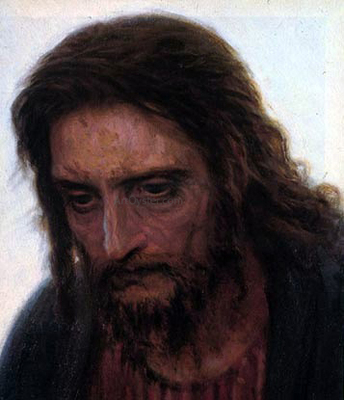
We see the seriousness of the forthcoming temptations; the physical, mental, and the spiritually violent struggle with the devil. It is written plainly upon His emaciated face.
We see the irrefutable fact of Jesus’ humanity.
We see that He is like unto us, except for sin.
This is the face of our Savior; but the victory is not His, yet.
His temptations, public ministry, Passion, and death are still to occur.
What do we see?
We see a man who knows His Mind. He knows His Body, Soul, and Spirit.
He knows His freely accepted duty to accomplish His Father’s will.
This is not the face of a defeated man. It is the face of a determined man who is also Lord and Savior.

Observe Christ’s clenched hands, gaze deeply into His eyes, and you will see the artist’s portrayal of a Savior that is already, at the beginning of His ministry, aware of the viciousness of the tempter and the burden of our sins. Sins accepted by Him, and through His Passion and death, makes all things new.

Jesus had to confront in that desert assault whether or not He was going to be faithful to His mission.
The Gospel passage above challenges us with the same questions: are we going to be faithful to the Commandments, to our Baptismal promises, to the mission given us in Confirmation to live and practice the truths that He taught us?
Are we going to be faithful to the spiritual power and grace given to us, not just when we feel like it, but even in the most difficult of circumstances?
As disciples of Christ we are on a daily basis constantly revolving around the axis of temptation and sin – faith and grace. We understand that temptation, in and of itself, is a test – it is not sin. It is only sin when we willfully place ourselves in its shackles, when we give into its fueled power to overwhelm our body and soul. That power – a deadly power – obtains its animus and energy from the original tempter and liar – Lucifer himself.
Hell is real. It is not a mental construct. To say that it doesn’t exist is to call Jesus a liar, and His Passion, death, and Resurrection meaningless.
Jesus the Christ lived heroically in the face of Hell’s demons and witnessed to the power of God’s grace.
But you say, I am not Jesus Christ, I am a weak man or woman, boy or girl.
I say true, we all are; but by virtue of our faithful reception of the Holy Sacraments (Holy Mysteries) of Reconciliation (Penance/Confession) and the Holy Eucharist we have the power of Christ’s grace within us. A power, freely given by God and unmerited by us, to resist and overcome temptation and sin.
If we do sin – if we do “miss the mark” – we have a remedy. We follow St. Paul’s advice: pick yourself up, dust yourself off (confess your sins), and confidently continue on your journey. We must do our part in cooperation with God’s love and mercy.
The Season of Lent is a time of joyful repentance, prayer, and fasting.
Let’s remember the words of Nehemiah, who in the Hebrew Scriptures says: Today is holy to the Lord your God. Do not be sad, and do not weep; for today is holy to our Lord. Do not be saddened this day, for rejoicing in the Lord must be your strength! (Nehemiah 8: 9-10. 5th century BC)
***
The painting above was created and completed in the late 19th century by Ivan Kramskoi. He was a gifted Russian painter, noted portraitist, draughtsman, and teacher. The painting is entitled Christ in the Wilderness.
Copyright © 2011- 2019 Deacon Paul O. Iacono All Rights Reserved. Portions of this essay may be used in accordance with correct notation and bibliographical insertion; contact deaconiacono@icloud.com for more information or questions.




 The Fra Angelico Institute for Sacred Art
“Paul, your protestations begs the question, do pagans go to Heaven? If so, why? If not, why not?” from Bernard Gallagher
These are excellent questions.
Before I attempt to answer them my readers should understand that I am a committed and Traditional Roman Catholic. His questions will be answered through the lens of the teachings of my Faith. That Faith is based on a foundation of Holy Scripture, Sacred Tradition, and two thousand years of Catholic scholarship.
Allow me to also mention that we need to understand that two Councils of the Church, the Councils of Orange and Trent (1000 years later), are critical in forming a correct answer to Mr. Gallagher’s questions. The Councils of Orange are significant (both of them were held in the city of Orange in Southern France, AD 441 and 529). The more important Second Council of Orange’s episcopal deliberations were sent to Rome and approved by Pope Boniface II in AD 531. That Council specifically proclaimed that everyone (who has reached the “age of reason”) is given sufficient Grace to be saved from eternal damnation. God will give, and has given all people, Actual Grace. If a person accepts and acts on that Grace, they will be saved.
What is Actual Grace? Actual Grace is an admonition by God for a person to correct their way of life, desire, search after, and make the sincere effort to obtain the Sanctifying Grace provided by the Catholic Church. The key action which achieves salvation and eternal life with God is the Holy Sacrament of Baptism. This allows the person to enter into God’s family. The Sacrament of Baptism removes Original Sin from an individual’s soul and enables it to receive additional Sacramental Sanctifying Grace. All Grace enables a person to become holy in God’s eyes. The other six Sacraments flow from the waters of Baptism. Pope Pius 9th (papal reign 1846 -1878) proclaimed that it would be extraordinary for an unbaptized person to achieve the eternal salvation and reward of Heaven.
First principle,
a) The Roman Catholic Church, the ethnic church Rites that are in union with Rome, the Greek and Russian Orthodox Churches, and some of the Protestant churches say that Jesus Christ, is the Word of God, the Son of the Father, begotten not made and consubstantial with Him. He is the Messiah, the Savior. His human life, ministry, passion, death, and resurrection redeemed mankind from their sins. His divinity is expressed through His position as the Second Person of the Blessed Trinity.
b) He is known to mankind through the historical Gospels and Epistles of the Apostles, the witness of His Mother, the Virgin Mary (especially at her apparition at Fatima, Portugal in 1917. When asked what sin was most harmful and condemned unrepentant people to Hell she responded: ‘The sins of impurity are one of the major reasons why men and women are condemned to Hell.'” We cannot ignore our sins or consider them unimportant because of the current worldview. Also, the erudition of the Catholic Church Fathers, Doctors of the Church, Saints, and the historical teaching authority of the Church have all provided the scholarship and analysis that is sufficient for humanity to understand God’d Revelation and laws.
c) He is also known through the extraordinary scholarship of St. Augustine and St. Thomas Aquinas. The teaching authority of the Church, (as found in its Magisterium), is the Church’s responsibility to give to the world an authentic interpretation of the Revelation of God as found in Sacred Scripture and Sacred Tradition.
d) Additionally, let us not forget the importance of the testimony of the angels found in Holy Scripture, and the saints, of whom Jesus’ Mother Mary is the greatest of saints. All of these facts contribute to mankind’s understanding and witness of our Savior Jesus Christ.
e) Jesus commissioned His Apostles (the first bishops) to make known the free gift of His Redemption and graces. These critical graces are found in the Seven Sacraments of the Church, beginning with the keystone Sacrament, Baptism.
Second, let’s refer to what Jesus Christ says in response to Nicodemus’ questions concerning eternal life in the Gospel of St. John, John 3: 1-21: “Amen, amen, I say to you, unless a man be born again, he cannot see the kingdom of God.” Nicodemus continues to question Him, and Jesus responds, “Amen, amen, I say to you, unless a man be born again of water and the Spirit, he cannot enter the kingdom of God…You must be born again.”
The great significance of the necessity of Baptism into the Christian faith is again stressed in another passage of the Gospels. The Gospel of St. Matthew, in its very last passage deals with the commissioning of the Apostles which occurred after His resurrection and before His Ascension back to the Father. Jesus emphasizes that combined with their preaching and works they must baptize faith-filled individuals because of Adam and Eve’s sin. Humanity’s broken relationship with God must be healed. It was healed through the death and resurrection of the Father’s Son Jesus the Christ. Jesus death, on our behalf allowed the formation of the Church and the Sacraments to be instituted to provide the grace to a broken humanity. Baptism is the Sacrament that makes this happen. It makes an individual’s body and soul a member of God’s family. Matthew 28: 18-20: “Jesus drew near and spoke to them saying, “all power in Heaven and on earth has been given to me. Go, therefore, and make disciples of all nations, baptizing them in the name of the Father, and the Son, and the Holy Spirit, teaching them to observe all that I have commanded you; and behold, I am with you always, to the close of the age.”
Third, it appears, within the Christian faith, that we can come to specific conclusions that will provide a springboard for my response to Mr. Gallagher:
Fourth, so, are pagans going to Heaven or Hell?
In a nutshell, I would never presume to know God’s mind, except from that which He revealed through Holy Scripture and Sacred Tradition. I would never make a judgement on another person’s soul as he or she are seen by God at the time of their death and individual judgement. Unknown to the world, even a great sinner may suddenly, in their last moments, repent of their sins and ask for God’s mercy. But, make no mistake about it, Scriptural Revelation, and the Sacred Tradition of the Catholic Church and specifically the words of Jesus in the Holy Scriptures, states that there is a Hell (Matthew 10: 28; 22: 13. Luke 16: 26; etc.); there is a Heaven, and, damnation into Hell for all eternity.
It is believed that there is also a place of natural happiness called Limbo. It is not within Heaven, nor is it in the fires of the Hell of the Damned. It is a state of natural happiness and joy. It is not supernatural happiness because its inhabitants do not have the Beatific Vision (see additional discussion in the Summa Theologica, Supplement 1, 3rd part article 2, by Fra Rainaldo da Piperino). The question of what happens to infants who die without the Sanctifying Grace of Baptism is a much debated issue. Many Traditionalists support the idea of Limbo; however, contemporary scholarship supports the idea that God, in His mercy, would not withdraw the vision of His glory to unbaptized infants who have died.
Some additional issues:
Copyright © 2011- 2019, Deacon Paul O. Iacono – All Rights Reserved. Permission to reprint must be obtained (through the Comments section below) from the author in writing. Students, and those interested, may quote small sections of the article as long as the proper credit and notation is given. Thank you