Waldemar Januszczak Is Wrong About the Shroud of Turin

The other night I watched the popular, opinionated, and entertaining BBC art historian Waldemar Januszczak discuss Medieval and Renaissance art. Over the years he has presented many shows on various artists and artistic movements. His programs, while informative, are distinctly opinionated. That’s fine, there is no law saying that you can’t present your own opinions (the exception, of course, being social media).

In one of his shows Mr. Januszczak briefly mentioned the Shroud of Turin. He said that the Shroud is a fake, a forgery, a bogus remnant of Medieval skullduggery. Yet, based on over fifty years of scientific research one can say that Mr. Januszczak’s opinion and conclusion  is undoubtedly wrong.

It is my informed opinion that the Shroud is more than a just an interesting cultural artifact. I believe that it is a relic of the passion, death, and resurrection of Jesus Christ. My belief is based on faith and scientific evidence.

The Shroud of Turin is a linen herringbone weave cloth. It is 14 ft. 3 in. long by 3 ft. 7 in. wide. It appears to have served as the burial cloth of a man (5 ft. 11 in. tall and of muscular build) who had been severely beaten, scourged with a Roman flagrum, his scalp pierced with thorns or slivers of bone, who fell numerous times on a pavement, and was crucified in the Roman fashion.

Since the 1950’s significant and serious investigations have been completed by reputable physicians, scientists, and specialists on the Shroud.

Research is ongoing. Current results certainly lead the unbiased observer to conclude that the Shroud is not a fake. There are, however, commentators that continue to bang the drum and receive headlines claiming that the Shroud is bogus.

Science can never prove that the Shroud of Turin is the burial cloth of Jesus. That is not its job. It can, however, determine and clearly pronounce the scientific and historical evidence contained within it. Valid research results point to specific conclusions. In the case of the Shroud of Turin science, logic, reason and ultimately faith will lead a Christian to conclude that the Shroud of Turin is the true burial cloth of Jesus.

The responsibility of scientists and specialists gleaning the Shroud is to follow the Scientific Method of establishing a hypothesis, produce correct models of investigation and data collection, accurately and without bias thoroughly investigate, check for error, and publish their conclusions for peer review. Impartial scientists, anthropologists, and historians of the Shroud should have no agendas secret or public.
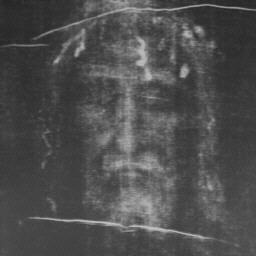
shroud
Face of the man found on the Shroud of Turin. Notice the blood stains (white blotches and lines), broken nose, swollen eyes. This image is a photographic negative.

The following points are a minuscule portion of the available scientific and historical results related to the Shroud of Turin:

  1. The “Hungarian Pray” Manuscript (1192 – 1195 AD) contains a painting of the burial cloth of Jesus Christ that had, at one time, resided in the city of Constantinople. Interestingly, it clearly shows a herringbone weave, the lack of visible thumbs on the body, L-shaped burn holes that are also on the Turin shroud, etc. The date of that manuscript provides a clear discrepancy with the 1988 Oxford C 14 date of 1260 – 1390 AD.
  2. The Shroud shows over 100 scourge marks on the man’s body resulting from a Roman scourging tool called a flagrum. It is a whip of two or three leather strips with lead balls or pieces of splintered bone attached at the end. Its purpose was to tear pieces of flesh off of the chest, back, thighs, and calves. The man in the Shroud was simultaneously scourged by two men.
  3. There are deep abrasions on the man’s shoulders from carrying a heavy object.
  4.  There are 141 different pollens found within the fibers of the Shroud. Forty-five of them are specifically from the area in and around Jerusalem, and thirteen from the area within and around Constantinople (present day Istanbul, Turkey).
  5. The coloration of the entire image goes only one or two fibers deep into the thread structure. It has been determined that no paint was used to discolor the fibers. The fibers were scorched by some unknown process which contributed to the image being formed of the crucified man.
  6. The facial features of an icon of Christ (known as Christ Pantocrator), found in St. Catherine’s Monastery in Egypt, perfectly corresponds to the facial image found on the Shroud of Turin and the Sudarium of Oviedo (the face cloth that covered the face of a man who was severely beaten). That specific icon of Jesus Christ is dated to the 500’s, not the Middle Ages.
  7. Human blood is found throughout the Shroud. It is type AB. “The blood has a high bilirubin content and nanoparticles of creatinine bound to ferritin” indicating that the man on the Shroud was severely tortured (quotation of research by scientist Robert Rucker which is found on-line).
  8. The Shroud shows the location of nail wounds possibly through the wrist. The nails may have extended up through the palm; this would allow the nails to suspend the man without having his body’s weight tearing him away from the cross/tree.
  9. Photographs taken in 1988 show Giovanni Riggi cutting samples from a part of the Shroud that would be Carbon 14 tested that year. Riggi is not wearing protective gloves or face mask. Cardinal Ballestrero is leaning on the table over the Shroud, and another technician has his ungloved hand on the table right next to the area that was being sampled. How can we conclude that this sampling was pure since its data collection methodology was so flawed and sloppy? This provides another fact that throws the 1988 C-14 date into question
  10. Pope Stephen III (768 – 772 AD) specifically discusses the Shroud and how the “Lord’s face and entire body …was transfigured on the cloth so that those who could not see Him bodily were able to see Him divinely transfigured on the cloth” (quotation found in Ian Wilson’s The Shroud of Turin. Image Books, 1979). Other Popes, prior to 1200 also speak publicly about the Shroud.

If you are interested in this subject you should seek out additional research papers and books (that are legitimate) to help you form your own conclusions (start with Vittorio Guerrera’s book – The Shroud of Turin, published 2001. He provided the basis for the above ten points). Ultimately,  for many Christians, belief in the Shroud as the burial cloth of Jesus, comes down to scientific evidence, personal faith, and the realization that Jesus Christ’s savage death led to our Redemption and the joy of His glorious resurrection.

Copyright © 2011- 2022 by Deacon Paul O. Iacono – All Rights Reserved. Permission to reprint essays and/or my paintings must be obtained from me by, using the comment box and making a comment/request on the post. I will respond to you through answering in the comment box. Students, and those interested, may quote small sections of my essays as long as the proper credit and notation is given. Thank you.


Suicide of a Nation

This list is not a typical statement for my blog owing to the fact that it normally concerns sacred art and catechesis; however, I felt I needed to compose and share my thoughts with you. The views below are solely mine and are not meant to imply they have the endorsement of my Diocese (Providence, RI, USA).

The United States of America consists of fifty states that are ruled by a National (and an individual State) Constitution. My views certainly may be applied to other world governments.

  1. Any nation that allows and supports the destruction of established truth for the sake of educational indoctrination, political expediency and partisanship is on the road to national suicide.
  2. Any nation that supports, allows, or turns a blind eye to destructive and prejudiced mobs, some of which have the specific desire to destroy the political, economic, and religious systems of the nation, is on the road to national suicide.
  3. Any nation, wherever in the world, that supports the killing of its unborn (as of today, 1.72 billion worldwide abortion deaths since 1980; and in the United States 61,628,584 abortion deaths since 1973), ignores the worship of God, profanes His name and laws, and refuses to accept that the husband/wife family is the cornerstone of society is on the road to national suicide.
  4. Any nation that allows the abuse of children and deprives its citizens the opportunities to improve their plight through unbiased education and hard-work is on the road to national suicide.
  5. Any nation that ignores and discriminates against its poor and culturally indigenous people is on the road to national suicide.
  6. Any nation that ignores its established historical citizenry to then welcome and support individual immigrants that have no desire to assimilate into the nation’s established political, economic, and historical culture, is on the road to national suicide.
  7. Any nation that prevents its citizens from receiving appropriate health care, that is efficient and economically fair, is on the road to national suicide.
  8. Any nation that allows its citizens to discriminate and attack its own history or an individual’s religious beliefs, ancestral, and national history is on the road to national suicide.
  9. Any state or nation that allows its national and local press, except for its editorials, to become instruments of propaganda rather than truthful news dissemination is on the road to national suicide.
  10. Any nation that ignores or discriminates against the rights of: life, liberty, the pursuit of happiness, the freedom of economic well being through the preservation of jobs within the nation, and the freedom of productive opportunity, is on the road to national suicide.
  11. Any nation that demoralizes its citizenry by fomenting confusion and fear, limits or eradicates freedom of speech, freedom to peacefully assemble, freedom of the press, freedom to peacefully petition the government for redress of grievances, freedom of religion, and the freedom to keep and bear arms, is on the road to national suicide.
  12. Any nation that prevents its duly constituted political citizenry the right to have their votes legitimately counted, allows electoral fraud, does not preserve the privilege of one person-one vote in its elections, ignores the principles of compromise, and is politically corrupt, is on the road to national suicide.

A state and nation, that is a representative democracy, is its people. A free people determine their state and nation’s future by critically examining, and if necessary, vociferously removing elected politicians that are scoundrels, oligarchs, elitists and who willfully ignore their national Constitution and its documents of freedom. If citizens refuse to do so, or are ignorant of their responsibility, they are providing the foundation for tyranny.

What legacy will we leave our children?

Paul O. Iacono

Rhode Island/Massachusetts

Copyright © 2011- 2020, Deacon Paul O. Iacono – All Rights Reserved. The above views are mine and are not meant to imply they have the endorsement of my Diocese (Providence, RI). Permission to reprint must be obtained from the author in writing. Students, and those interested, may quote small sections of the article as long as the proper credit and notation is given. Thank you.

Holy War: The Battle for Our Souls and the Soul of the Church

What is our strategic plan in the Holy War to save our personal faith?

The overall plan is simple: it is to win the war for our soul.

Our tactics are paramount. For they must be in sync with the truth that God has given us Free Will (the ability to make decisions) and Reason (the ability to think through and logically make those decisions in the light of Scripture and Tradition).

What are the tactics that support our efforts? The first is to realize that we are not powerless. Our God-given freedom allows us to make personal decisions for good or bad. For example, the decision to agree with our Catechism which explains our ultimate goal of  personal and eternal union with Christ.

Our tactics are varied: the Western and Eastern Rites of the Catholic Church, and the Orthodox Church believe in the need for prayer, fasting, almsgiving, reception of Holy Eucharist, and the frequent (preferably monthly) reception of the Sacrament of Confession. This Sacrament, once avidly used by the faithful, is now sadly ignored. It is critical in our personal war, and through prayer, the goal of purifying our Church. A Church suffering from the effects of clerical sins and the heresy of Modernism.

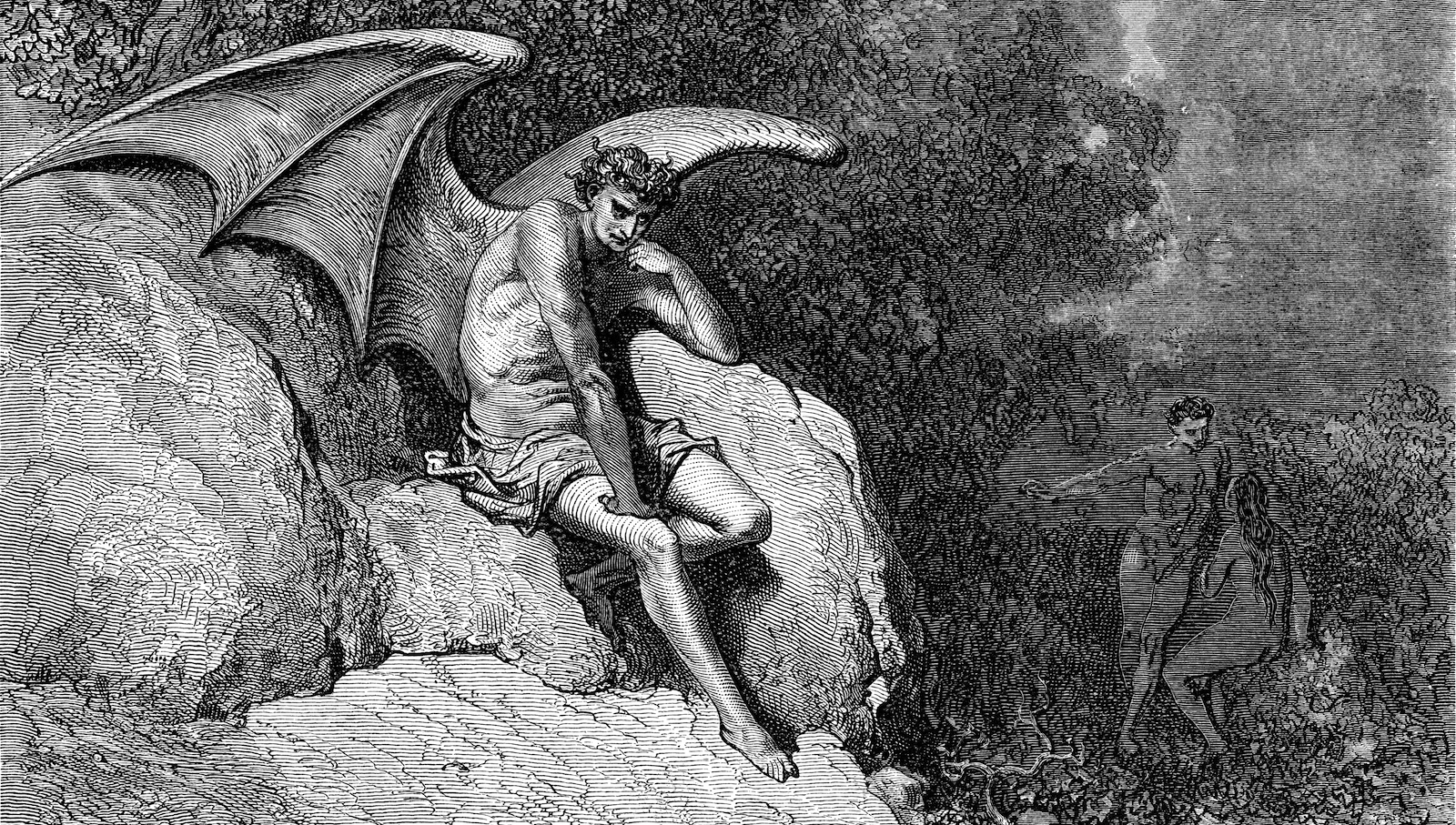
Satan planning his strategy, from engravings by Gustave Dore. From Milton’s Paradise Lost by Robert Vaughan, D.D. Chicago and New York 1885

The Sacrament of Confession is proclaimed in the Epistle of St. James (5: 16), St. Paul’s 2nd Letter to the Corinthians (5: 18),  St. Luke’s Acts of the Apostles (19:18), Jesus’ words in the Gospel of John (20: 21-23), and the proclamations of the Early Church Fathers. It is not a Sacrament that the post-Reformation Church thought up during the Council of Trent. Through history was this Sacrament clarified and given appropriate form to meet the needs of growing Christian civilization? Yes, of course, but that doesn’t mean that it didn’t exist in the early Church or was given witness to in the Christian Scriptures.

If we ignore Grace we have removed many of the foundation stones of our personal faith. Ignorance or belittling the truth of Holy Scripture, or the Sacramental weapons of Grace, effectively renders us defenseless in this Holy War for our souls.

As you will see, Greek Orthodox monk, Elder Paisios’, words ring like a bell of prophecy. They are especially poignant since he wrote them before his death in 1994.

Holy War is upon us. We have witnessed it since Eve handed the apple to Adam. Our enemies are clear: Satan, his demons, false teachers, and our own tranquil indifference.

9fb4864f7592abd9e000ea904250598c
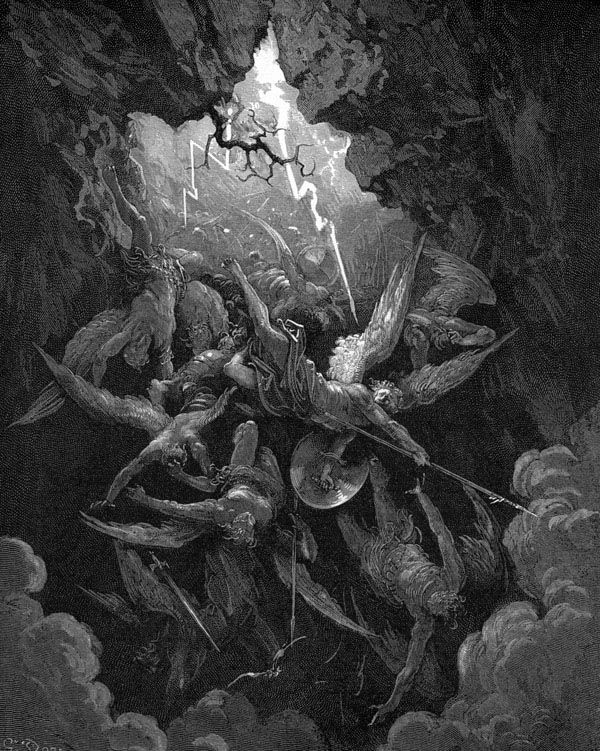
The War in Heaven – Fallen Angels by Gustave Dore.


The words of a Greek Orthodox monk, Elder Paisios:


“What unsettles me is the reigning mood of tranquility. Something is in the works. We still haven’t understood properly either what’s going on, or the fact that we will die. I don’t know what will come of this. The situation is very complicated. The fate of the world depends on just a few people, but God is still putting on the brakes. We have to pray a lot, and with pain in our hearts, so that God will intervene: our times are very hard to understand. A lot of ash, rubbish, and indifference has accumulated, and a strong wind will be needed to blow it all away. It’s frightening! The Tower of Babel is upon us! Divine intervention is needed: Great upheavals are happening. What a bedlam! The minds of whole nations are in confusion. But in spite of the ferment I feel a certain consolation inside, a certain confidence. God still dwells in a part of the Christians. God’s people, people of prayer, still remain, and God in his all-goodness still tolerates us and will put everything in order. Don’t be afraid! We’ve gone through many storms, and still haven’t perished. So should we be afraid of the storm which is now gathering? We’ll not perish this time either! God loves us. In Man there’s a hidden power which comes out when necessary. The difficult years will be few. Just a lot of thunder. Don’t get upset in the least, for God is above everything. He rules everyone and will bring all to the defendant’s bench to answer for what they’ve done, according to which each will receive his just desserts from God. Those who’ve in some way helped the cause of good will be rewarded, and those who do evil will be punished. God will put everyone in their place in the end, but each of us will answer for what they did in these difficult years, both in prayer and in deeds. Today they’re trying to destroy faith, and for the edifice of faith to fall they quietly pull out one stone, then another. But we’re all responsible for the destruction; not just those who destroy but we who see how faith is being undermined and make no effort to strengthen it.

As a result the seducers are emboldened to create even greater difficulties for us, and their rage against the Church and the monastic life increases. Today’s situation can be resisted only spiritually, not by worldly means. The storm will continue to rage a bit, will throw all the flotsam, everything unnecessary, onto the shore, and then the situation will become clearer. Some will receive their reward, while others will have to pay their debts. Today there are many who strive to corrupt everything: the family, the youth, the Church. In our day it’s a true witness to speak up for one’s people, for the state is waging war against divine law. Its laws are directed against the Law of God. But we are responsible for not letting the enemies of the Church corrupt everything. Though I’ve heard even priests say: “Don’t get involved in that. It’s none of your business!” If they had reached such a non-striving condition through prayer I would kiss their feet. But no! They’re indifferent because they want to please everyone and live in comfort. Indifference is unacceptable even for laymen, and all the more so for the clergy. An honest, spiritual man doesn’t do anything with indifference. “Cursed be he that doeth the work of the Lord deceitfully”, says the Prophet Jeremiah (Jer. 48:10).

There’s a war on today, a holy war. I must be on the front lines. There are so many Marxists, so many Masons, so many Satanists and assorted others! So many possessed, anarchists and seduced ones! I see what awaits us, and it’s painful for me. The bitter taste of human pain is in my mouth”

paisios-of-mount-athos


Copyright © 2011- 2020, Deacon Paul O. Iacono – All Rights Reserved. Permission to reprint must be obtained from the author in writing. Students, and those interested, may quote small sections of the article as long as the proper credit and notation is given. Thank you.
Elijah, Pagans, and Our Lady of Mt Carmel

 Sacred Scripture has always celebrated the beauty and significance of the mountain in Israel called Carmel.

It is significant for two reasons:

  1. In a dramatic contest with the priests of the pagan god Baal, Elijah fought the false gods of King Ahab and  Queen Jezebel of Israel; a king and queen who were dramatically attempting to turn the Israelites away from the belief of monotheism to polytheism. It is believed that the base of the mountain is where the Hebrew prophet Elijah prayed, contemplated God, defeated the priests of Baal, and  defended the purity of Israel’s faith (confer 1 Kgs 18:17–46).
  2. It is also the site of the Stella Maris Monastery, the world headquarters of the Carmelites, a Catholic contemplative religious order. Three great saints of the Carmelite Order are St. Theresa of Avila, St. John of the Cross, and St. Therese of Lisieux.  Through their witness and books they continue to make significant contributions to the mystical life and contemplative prayer of clergy and laity alike.

During the 12th century Catholic hermits withdrew to the mountain of Carmel to form a small community of religious brothers. Near a spring that was named after the prophet Elijah they founded their society desiring to devote themselves to contemplative prayer and Holy Scripture. These men called themselves “the Brothers of the Blessed Virgin Mary of Mount Carmel.” This society was the seed of the present world-wide Carmelite Order. According to the Carmelite Rule of St. Albert “Carmelites are devoted to the contemplative life under the patronage of Mary, the Holy Mother of God.”

The charism of present day Carmelite monks and contemplative sisters is to  share the fruits of their contemplative prayer life with others. Contemplation and ministerial action are not contradictory forces within this Order.

The Carmelite Order is also associated with the Brown Scapular of Our Lady of Mt. Carmel. A scapular, in many religious societies, is a piece of clothing that a monk or religious sister wears over their regular habit when they are working at various communal tasks. Today, laity, deacons, priests, and bishops may wear the Brown Scapular, too.

A scapular is a “sacramental,” it is not a charm or superstitious trinket. As a sacramental it assists in a person’s prayer life by turning the mind and soul toward the beauty and love of God. The scapular associated with the Carmelites is called the Brown Scapular.

The Brown Scapular is two pieces of small cloth, about 2 by 2 inches, that are attached by a cord which is paced around the neck. One side of the cloth rests on the back and the other on the chest. This scapular has images of the Blessed Mother with the baby Jesus on one cloth, and St. Simon Stock on the other. Roman Catholics believe that St. Simon Stock, who was a 13th century English Carmelite, received the first Brown Scapular from our Blessed Mother.

The Church of Saints Peter and Paul in Singapore has a lovely summary of the significance of the Brown Scapular on their website: “By the wearing of the scapular, we express our commitment to be disciples of Christ, and following the example of Mary, the perfect disciple, we learn:

  1. To be open to God’s will;
  2. To listen to the word of God, and put it into practice.
  3. To pray at all times, as a way of discovering the presence of God in all that is happening around us.
  4. To share in the paschal mystery of Christ by means of voluntary penance.
  5. The Brown Scapular has become a sign and symbol of the special dedication of the Blessed Mother’s protection. This spiritual meaning has been approved by the Church.
  6. The devotion of wearing the Scapular has become, like other devotions to Mary, a rich treasure for the whole Church – an expression of love and trust in her motherly intercession.”

It is recommended that you purchase the Brown Scapular of Mt. Carmel. Have it blessed by a priest or deacon, and wear or carry it with you. In these days of social unrest and apostasy it is very beneficial to have our Blessed Mother close to us.

Please remember that Roman Catholics, Catholics of the Middle Eastern Rites, and the Greek and Russian Orthodox, venerate the Virgin Mary. We do not worship her. We worship only God.

Our Lady of Mt. Carmel pray for us.

Our Lady of Mt. Carmel
Personally, I think this is the most beautiful of all the sacred images of Our Lady of Mt. Carmel. The source of this image is: http://www.museumofdivinestatues.com/mods/our-lady-of-mount-carmel-mount-carmel.html


Copyright © 2011- 2020, Deacon Paul O. Iacono – All Rights Reserved. Permission to reprint must be obtained from the author in writing. Students, and those interested, may quote small sections of the article as long as the proper credit and notation is given. Thank you.


The Virgin Mary – Racial Supremacy and Artistic Diversity

Artistic images of the Blessed Mother of Jesus, as portrayed by different cultures within historical periods, have been part of world history for centuries. Below are a few examples of these images.

Attachment-1
Japanese Courtesy of: https://blogofthecourtierdotcom.files.wordpress.com/2013/01/japan.jpg

iu-6
Native American – Hopi

iu-7
Chinese

iu-8
Native American – Cheyenne

iu-9
Mexican

iu-10
Italian – Baroque Period

iu-18
African

iu-19
Medieval Europe

iu-22
European (Polish)

The various images of Jesus and His Mother portrayed by each ethnic group are beautiful and have spiritual meaning. Are the artists of these works prejudiced or racist?

Because of the controversy over comments made by political activists over the last few weeks it would appear that the motive of cultural artistic contributions is based on racial superiority. Their opinion  points to the obvious truth that in our social and political climate confusion is very possible.

A debate is occurring within the fields of physical anthropology, genetics, and evolutionary biology concerning the issues of race and racial supremacy. Some scholars have concluded that racial supremacy and even the various categories of human races do not exist.

Evolutionary biologist, Alan R. Templeton’s recent genetic research contributes to the discussion. The abstract of his research is published in final form as: Stud Hist Philos Biol Biomed Sci. 2013 Sep; 44(3): 262–271.

Highlights of Templeton’s research:

  1. “Races are highly genetically differentiated populations with sharp geographical boundaries.
  2. Alternatively, races can be distinct evolutionary lineages within a species.
  3. By either definition, races do not exist in humans but do exist in chimpanzees. [italics mine, P.O.I]
  4. Adaptive traits such as skin color do not define races and are often discordant with one another.
  5. Human populations are interwoven by genetic interchanges; there is no tree of populations.”

Thus, in the grand scheme of things superficial traits are what separate us not genetic differences. Valid scientific evidence may be proving that the concept of five races is outmoded and not substantiated by modern genetic research. It is correct to say that specific ethnic groups, with superficial physical traits, living within specific geographical areas, do exist.

If American or European “white” artists portray Jesus and all the individuals found in Holy Scripture as members of Caucasian ethnic groups, they would in the majority of cases, be artistically portrayed as having the superficial physical genetic traits of European/Middle Eastern populations.

The images above certainly portray that the artists within another culture, or dominant ethnic group/cultures in specific regions of the world, do the same thing. This is logical because the artist of a specific ethnicity paints or sculpts to meet their group’s spiritual needs, or, the patron’s specific request. That is not an act of ethnic supremacy or racism.

Genetically, can we say with any assurance what the genetic make-up of Jesus, Mary, and His fellow Hebrews were when they existed? There is historical evidence to contribute to the answer.

Since the time of the Patriarch Abraham’s son Isaac, and Isaac’s son Jacob, there occurred the development of the twelve tribes of Israel.

These tribes definitely took shape and became a cultural, military, and political force by circa 1925 BC. Tribal leaders were very strict about intermarriage with other populations. Under Moses’ leadership, circa 1250 BC, they did not allow it at all. They were a large enough population to marry within the system of their tribes, and their members conformed to the demands of God and their leaders.

Abram (Abraham) and his flock of followers originated within the city of Ur, which was a Chaldean city-state of the Sumerian civilization. Today the archeological remains of the  city of Ur are located in Southern Iraq. Ur was Abram’s home before he, his family, and followers were given the order by God to travel to the land of Canaan.

Abram would later be given the name Abraham by God. “In various sources, “Canaan” refers to an area encompassing parts of Syria, Lebanon, Jordan, and Israel. The Israelites occupied and conquered Palestine, or Canaan, beginning around 1750 BC, or perhaps earlier. The Bible justifies such occupation by identifying Canaan with the Promised Land, the land promised to the Israelites by God” (source: https://www.britannica.com/place/Ur

Bottom line, Jesus, Mary, and “His friends” were ethnic Israelite/Hebrews. They were Hebrews from the genetic line of King David. David’s genetic line originated from Abraham’s son, Isaac, and grandson Jacob. There is no way to prove that Abraham, Isaac, and Jacob’s genetics are related to the people of today’s southern Iraq, or any other ethnic group.

If a person believes in the truth of the Holy Scriptures then the answer is that Jesus, His family, and Apostles, were all of the genetic line of Israelite/Hebrews with the superficial physical traits of that ethnic group.

Ultimately, Roman Catholic, Orthodox, and Anglican Biblical sacred art is not about race or superficial physical traits. The entire Hebrew and Christian Scriptures point to the truth that the human nature of the Son of God, Jesus the Christ, was born of Mary within Roman occupied Israel. The spiritual union of the power of the Holy Spirit with the consent of Mary  led to the birth of Jesus, the Redeemer of mankind.

Supremacy is not found in race, ethnic group, or prejudice/bigotry. It is only found in the authority and power of the Holy Trinity.

Praise be the name of Our Lord Jesus Christ.

Copyright © 2011- 2020, Deacon Paul O. Iacono – All Rights Reserved. Permission to reprint must be obtained from the author in writing. Students, and those interested, may quote small sections of the article as long as the proper credit and notation is given. Thank you.

Iconoclasm and Shaun King

In the June 22, 2020 issue of Newsweek an on-line article by Aila Slisco reported some statements by political activist Mr. Shaun King. 

She states: “He [King] also remarked that stained glass windows and other images of a white Jesus, his European mother and their white friends should all be destroyed, insisting they are racist, examples of ethnic propaganda, and “a form of white supremacy. “They should all come down.” (I’ll comment on these statements by Mr. King in another post).

King’s comments came in association with Black Lives Matter protests against the brutality of some police officers toward minorities. These protests quickly moved away from the issue of police brutality in some major cites and expanded into protests against historic and artistic representations of American/European civilization and the “white supremacy” that it allegedly represented. 

We have observed over the last two weeks examples of the new iconoclasm. 

Rhetoric like Mr. King’s and other activists could be passed off as uninformed except for the fact that two California mobs tore down and desecrated a statue of the Spanish missionary Fr. Serra. In the process they also harassed Catholic college students, laity, and a priest who were defending it.

Legitimate non-violent protests are protected by the U.S. Constitution, however, the destruction of public or private property is not. 

Public religious, military and political statues are the property of the local churches and governments. What happened to the government’s responsibility to protect them? Churches, and whatever articles they contain, are the property of the church regardless of denomination. Will the governments across the nation protect them?

Religious statues, sacred art, stained glass windows, etc, are defended by the 1st amendment of the U. S. Constitution. Is Mr. King saying that a Satanic statue of Baphomet can be placed in a public square but a statue of a Roman Catholic saint, who is specifically honored for his cultural contributions, cannot? 

Are the representations of the God and saints of the Roman Catholic Church, who has been a major contributor to world civilization, to be torn down because a segment of the population believe that they, without taking into account time period or cultural conditions, have been historically ethnocentric and intolerant of other cultures? Are these legitimate religious statues equivalent to the statues of Lenin, Stalin, Mao or Saddam Hussein?

What happened to Martin Luther King Jr.’s call for positive non violent change and tolerance in America?

Today, July 1st, is the Roman Catholic Church’s memorial of the missionary efforts of Fr. Junipero Serra, an 18th century Spanish missionary priest. Fr. Serra’s leadership and contributions to improving the educational and technological life of Native Americans and development of California is recognized as a public act and not just a religious effort; this is why his statues were erected by the state of California. His statue also stands in Statuary Hall in the U. S. Capitol building in Washington, D. C.  At various times national and state politicians, of both political parties, were present to honor him.

Fr. Serra’s main goal was to be an effective Christian missionary. He was following the Gospel injunction of Christ Himself in the 28th chapter of the Gospel of Matthew: “All power in heaven and earth has been given to me. Go, therefore, and make disciples of all nations, baptizing them in the name of the Father, and of the Son, and the Holy Ghost, teaching them to observe all that I have commanded you. And behold, I am with you always, until the end of the age.”

The new iconoclasm appears to be intolerant, or unaware, of history. The adherents public efforts, both in word and deed, are clearly seen in the mobs in California and specifically in St. Louis, Missouri where they beat Catholics who were praying in front of a monument of St. Louis IX. In both cases mob action desires to vent its anger, ideology, and psychological wounds against historic personalities. The mob desires to sponge away the past rather than continue to lawfully, peacefully, and vigorously work for social change. 

Is significant change necessary in the way some police departments train their recruits? Absolutely. Productive change can occur. It cannot occur when the structures of Constitutional democracy are trampled upon. Polarization has never accomplished anything; positive social change has never occurred through a mob’s physical or verbal violence.

The past cannot be rewritten. In America, many times statues regardless of being religious, political, or military, celebrate the good that people have accomplished, not their ethnocentrism. If small groups through mob action tear down public property, or Church property, then they are no better than many other mobs, tyrants and demagogues through history; such as Mao Zedong’s actions during the ten years of China’s Cultural Revolution, Lenin and Stalin’s iconoclasm and political/religious oppression during the 70 odd years of their Communist debacle, Hitler’s 13 year rampage of mass destruction and inhumanity, or present day Isil and their damage of populations and  archaeological sites in the name of religious ideology.

As civilizations are we still unable to learn from the lessons of history? Is it too late?

Copyright © 2011- 2020, Deacon Paul O. Iacono – All Rights Reserved. Permission to reprint must be obtained from the author in writing. Students, and those interested, may quote small sections of the article as long as the proper credit and notation is given. Thank you.

Do Pagans Go To Heaven or Hell?

by Deacon Paul O. Iacono, Diocese of Providence, Rhode Island USA

The author of the interesting and challenging blog site on sacred art and its analysis called Catchlight sent me two questions yesterday. They related to my last post which was entitled Fatima Messages, Pagans in the Vatican, and the End Times.

“Paul, your protestations begs the question, do pagans go to Heaven? If so, why? If not, why not?”      from Bernard Gallagher

These are excellent questions.

Before I attempt to answer them my readers should understand that I am a committed and Traditional Roman Catholic. His questions will be answered through the lens of the teachings of my Faith. That Faith is based on a foundation of Holy Scripture, Sacred Tradition, and two thousand years of Catholic scholarship.

Allow me to also mention that we need to understand that two Councils of the Church, the Councils of Orange and Trent (1000 years later), are critical in forming a correct answer to Mr. Gallagher’s questions. The Councils of Orange are significant (both of them were held in the city of Orange in Southern France, AD 441 and 529). The more important Second Council of Orange’s episcopal deliberations were sent to Rome and approved by Pope Boniface II in AD 531. That Council specifically proclaimed that everyone (who has reached the “age of reason”) is given sufficient Grace to be saved from eternal damnation. God will give, and has given all people, Actual Grace. If a person accepts and acts on that Grace, they will be saved.

What is Actual Grace? Actual Grace is an admonition by God for a person to correct their way of life, desire, search after, and make the sincere effort to obtain the Sanctifying Grace provided by the Catholic ChurchThe key action which achieves salvation and eternal life with God is the Holy Sacrament of Baptism. This allows the person to enter into God’s family. The Sacrament of Baptism removes Original Sin from an individual’s soul and enables it to receive additional Sacramental Sanctifying Grace. All Grace enables a person to become holy in God’s eyes. The other six Sacraments flow from the waters of Baptism. Pope Pius 9th (papal reign 1846 -1878) proclaimed that it would be extraordinary for an unbaptized person to achieve the eternal salvation and reward of Heaven.

First principle,

a) The Roman Catholic Church, the ethnic church Rites that are in union with Rome, the Greek and Russian Orthodox Churches, and some of the Protestant churches say that Jesus Christ, is the Word of God, the Son of the Father, begotten not made and consubstantial with Him. He is the Messiah, the Savior.  His human life, ministry, passion, death, and resurrection redeemed mankind from their sins. His divinity is expressed through His position as the Second Person of the Blessed Trinity.

b) He is known to mankind through the historical Gospels and Epistles of the Apostles, the witness of His Mother, the Virgin Mary (especially at her apparition at Fatima, Portugal in 1917. When asked what sin was most harmful and condemned unrepentant people to Hell she responded: ‘The sins of impurity are one of the major reasons why men and women are condemned to Hell.'” We cannot ignore our sins or consider them unimportant because of the current worldview. Also, the erudition of the Catholic Church Fathers, Doctors of the Church, Saints, and the historical teaching authority of the Church have all provided the scholarship and analysis that is sufficient for humanity to understand God’d Revelation and laws.

c) He is also known through the extraordinary scholarship of St. Augustine and St. Thomas Aquinas. The teaching authority of the Church, (as found in its Magisterium), is the Church’s responsibility to give to the world an authentic interpretation of the Revelation of God as found in Sacred Scripture and Sacred Tradition.

d) Additionally, let us not forget the importance of the testimony of the angels found in Holy Scripture, and the saints, of whom Jesus’ Mother Mary is the greatest of saints. All of these facts contribute to mankind’s understanding and witness of our Savior Jesus Christ.

e) Jesus commissioned His Apostles (the first bishops) to make known the free gift of His Redemption and graces. These critical graces are found in the Seven Sacraments of the Church, beginning with the keystone Sacrament, Baptism.

Hagiasophia-christ-1
An icon of Jesus Christ. It is found within the former Eastern Rite Church of Hagia Sophia (Holy Wisdom). The Church was built in the early 6th century and is located in Istanbul, Turkey (formerly Constantinople). It was a mosque, then was a museum since 1935, but recently it was converted back into a mosque.

Second, let’s refer to what Jesus Christ says in response to Nicodemus’ questions concerning eternal life in the Gospel of St. John, John 3: 1-21: “Amen, amen, I say to you, unless a man be born again, he cannot see the kingdom of God.” Nicodemus continues to question Him, and Jesus responds, “Amen, amen, I say to you, unless a man be born again of water and the Spirit, he cannot enter the kingdom of God…You must be born again.”

The great significance of the necessity of Baptism into the Christian faith is again stressed in another passage of the Gospels. The Gospel of St. Matthew, in its very last passage deals with the commissioning of the Apostles which occurred after His resurrection and before His Ascension back to the Father. Jesus emphasizes that combined with their preaching and works they must baptize faith-filled individuals because of Adam and Eve’s sin. Humanity’s broken relationship with God must be healed. It was healed through the death and resurrection of the Father’s Son Jesus the Christ. Jesus death, on our behalf allowed the formation of the Church and the Sacraments to be instituted to provide the grace to a broken humanity. Baptism is the Sacrament that makes this happen. It makes an individual’s body and soul a member of God’s family. Matthew 28: 18-20: “Jesus drew near and spoke to them saying, “all power in Heaven and on earth has been given to me. Go, therefore, and make disciples of all nations, baptizing them in the name of the Father, and the Son, and the Holy Spirit, teaching them to observe all that I have commanded you; and behold, I am with you always, to the close of the age.” 

Third, it appears, within the Christian faith, that we can come to specific conclusions that will provide a springboard for my response to Mr. Gallagher:

  1. If the human race was alienated from God, and the spiritual relationship with Him was broken, then a loving and merciful God would not give up on His children. Thus, through the course of history God has slowly manifested and revealed Himself to humanity starting with our spiritual parents, Adam and Eve; then through the patriarchs, leaders, and prophets of the chosen Jewish tribes culminating in the Incarnation of His Son, Jesus the Christ. God desires us to love Him and conform to His Laws. He has given us reason and free will. He has given us the ability to think and act not like robots but as free men and women. His revealed truths and laws must be evangelized and faithfully kept by individuals and mankind as a whole. The “Good News” must be spread by the Church as a whole and individuals, too.
  2. The First Commandment applies, as we see in Exodus 20: 1-6ff: “I, the Lord am your God, who brought you out of the land of Egypt, that place of slavery. You shall not have other gods besides Me. You shall not carve idols for yourselves…you shall not bow down to them or worship them. For I the Lord am a jealous God…inflicting punishment on those who are wicked and hate me…and mercy on those who love Me and keep My commandments.”
  3. Through Scripture and study of the Catechisms of the Council of Trent and that of Pope St. John Paul II, united with faith we also know that Jesus Christ is the consubstantial only Son of God and the promised Savior. Now, have (for example) the Amazonian pagans that we recently observed in Rome, or the new pagans of the 20th and 21st centuries been exposed to that truth?
  4. Christ freely offered Himself for our eternal salvation. This was accomplished through the words and actions of His human ministry and ultimately through His Passion, death, and resurrection. Jesus Christ is the Way, the Truth, and the Life. Have apostates, pagans, or other non believers been exposed to that truth?
  5. We see God through faith in Him, participating in prayer, Scripture study, good works, and the Sanctifying Grace found in the Seven Sacraments. Have pagans, past and present, been exposed to and accept these truths?

Fourth, so,  are pagans going to Heaven or Hell?

In a nutshell, I would never presume to know God’s mind, except from that which He revealed through Holy Scripture and Sacred Tradition. I would never make a judgement on another person’s soul as he or she are seen by God at the time of their death and individual judgement. Unknown to the world, even a great sinner may suddenly, in their last moments, repent of their sins and ask for God’s mercy. But, make no mistake about it, Scriptural Revelation, and the Sacred Tradition of the Catholic Church and specifically the words of Jesus in the Holy Scriptures, states that there is a Hell (Matthew 10: 28; 22: 13. Luke 16: 26; etc.); there is a Heaven, and, damnation into Hell for all eternity. 

It is believed that there is also a place of natural happiness called Limbo. It is not within Heaven, nor is it in the fires of the Hell of the Damned. It is a state of natural happiness and joy. It is not supernatural happiness because its inhabitants do not have the Beatific Vision (see additional discussion in the Summa Theologica, Supplement 1, 3rd part article 2, by Fra Rainaldo da Piperino). The question of what happens to infants who die without the Sanctifying Grace of Baptism is a much debated issue. Many Traditionalists support the idea of Limbo; however, contemporary scholarship supports the idea that God, in His mercy, would not withdraw the vision of His glory to unbaptized infants who have died.

Some additional issues:

  1. Let’s take a look at three major Greek philosophers: Socrates, Plato, and Aristotle. They were scholars who lived and died before the birth and ministry of  Jesus Christ. They lived within a pagan/pantheistic society whose members believed in a multitude of gods  Are Socrates, Plato, and Aristotle in Heaven or Hell?
  2. The answer is, “I don’t know!”
  3. But Jesus said, “I am the Way, and the Truth, and the Life. No one comes to the Father but through Me” (John 14: 6). Wouldn’t that statement preclude the unbaptized Greek philosophers entrance into Heaven?
  4. The answer is “Not automatically.”
  5. So, what do we know? We know that those three philosophers were men who searched for the truth, not only about  themselves as individuals but about the world itself. They searched after the truth. They made the sincere effort to find the truth by thinking, questioning, analyzing reality, both physical and metaphysical. They used all the evidence at their disposal to do so. They lived, before the Son of God was incarnated. They did not have the witness of Jesus Christ and to His specific and eternal revelation as the Son of God, both human and divine. They also probably did not have any exposure to the history of the Jewish people and God’s revelation to them. As per the the points made earlier, did they act on God’s Actual Grace to truly desire life with Him?
  6. But, in the time after the Incarnation and Ascension of Jesus, a person who had the opportunity to be exposed to and Baptized into the  Christian Faith (in the full expression of it in the Western and Eastern Rites of the Catholic Church, and some of the Protestant and Anglican churches if they use the Trinitarian formula), would have a critical free choice to make.
  7. If they are pagan, agnostic, atheist, Catholic Christian, Deist, Protestant Christian, Satanist, Wiccan, etc, and they would then, after an effort to know the truth, reject Actual Grace and the witness of Jesus Christ out of intentional misunderstanding, intellectual arrogance, stubbornness, cultural and historic prejudices, selfishness, willful rejection of Christian Revelation, narcissistic impulses, apostasy, or some evil influence, they would be freely putting their eternal soul into mortal sin. They would be facing the eternal punishment of Hell because they chose the path, through their own free will of “definitive self-exclusion from communion with God and the blessed in Heaven” (confer page 269 in the Catechism of the Catholic Church,  2nd edition).
  8. God is loving and compassionate. He is filled with mercy for those who sincerely repent their sins. God is merciful; however, our God is a God of Justice. Why would Jesus Christ be Incarnated to minister, suffer, die, and be resurrected if the Holy Trinity would give mortal sinners “A get into Heaven free pass?” The “Pass theory” doesn’t make sense, it is illogical, bogus, and yes it is a lie. There are dire consequences for freely turning your back on Jesus Christ: Hell.
  9. But do today’s pagans turn their backs?
  10. The answer to that question is: Have they made the effort to know the Truth? Have they been exposed to the truths of the Hebrew and Christian Scriptures? Have they been evangelized by courageous and selfless missionaries who are willing to undergo all sorts of hardships and possibly even martyrdom for the sake of their flocks’ eternal souls? Have they deliberately turned their backs on the truth and revelation of God through the Christian Scriptures, and the documents and witness of the Apostles, Saints, Church’s Doctors and Fathers, bishops and Pope as they present the truth on faith and morals? Have the pagans or people of other religions acted on the free gift of God’s Actual Grace?
  11. The Church’s duty and responsibility is to bring, without arrogance or condescension, the Holy Scriptures, Sacred Traditions, and the Holy Sacraments to the world. If its bishops, priests, deacons, consecrated brothers and sisters in various religious orders, and laity shirk or compromise their duties and teaching authority, give bad example through public and private sin, then they possibly will be denied entrance into Heaven, too.
  12. Is the Church giving sufficient resources to the missionaries in the field? Are we able to inspire young men and women in today’s world of the necessity and challenge to enter the life of a missionary? Have we thrown in the towel?
  13. This is my great concern about what I see in the Church today (especially the recent blessing of the pagan Pachamama statue in Rome; (by the way, all of the Amazonian Pachamama rituals were condemned by six Cardinals). The Christian churches should not be about assimilation of pagan cultures into the Faith in order “to learn from them,” or do so in a “spirit of dialogue” and accommodation.
  14.  The Western and Eastern Rites of the Catholic Church have the complete and total revelation of God to humanity. We have the complete revealed truth of The Trinity. We have the example of what it means to live in the heart of the Father through the life of Jesus Christ. Christ’s life, redemptive death, and resurrection made possible our entrance into God’s family. This entrance is accomplished through the Sacrament of Baptism (using the Trinitarian formula), and individuals’ growth in faith and good works.
  15. Matthew 28: 18-20, relates Jesus’ specific command. Our duty is to compassionately and without arrogance teach pagans and other non-believers about Jesus Christ, baptizing them in the name of the Father, and the Son, and the Holy Spirit.
  16. It is intellectually and morally irresponsible to give the impression that apostates, heretics, pagan/polytheistic cultures, and people of other faiths can add to the Deposit of Faith.We either understand the gift of the Deposit of the Faith or we don’t. There should be no waffling.
  17. We either proclaim His truth effectively and with conviction or we will see the Church continue to decline, make compromises, cause confusion, anxiety, division, and resentment among its faithful. Hell is a reality. It is our responsibility to act with courage and truthfulness to ensure that a person’s eternal salvation is not compromised through confused or false teachings.
  18. The Gospel of Luke 18: 8 challenges us to examine our own hearts: “When the Son of Man comes will He find faith on the earth?” 
  19. To paraphrase Peter Kreeft, Ph.D and Rev. Ronald Tacelli S.J. “if we have a diamond of immense and extraordinary value (our Catholic/Christian Faith) why would we go about the world seeking additional baubles?
  20. Refer also to the Catechism of the Catholic Church (2nd edition, 1997, pages 311-324) which has an excellent section on the Sacrament of Baptism.

Copyright © 2011- 2019, Deacon Paul O. Iacono – All Rights Reserved. Permission to reprint must be obtained (through the Comments section below) from the author in writing. Students, and those interested, may quote small sections of the article as long as the proper credit and notation is given. Thank you

Fatima Messages, Pagans in the Vatican, and the End Times

October 13, 2019 commemorates the last message in the apparitions of the Blessed Virgin Mary by three Portuguese children. The children’s ages were six through nine, and they lived in the town of Fatima, Portugal. The apparitions occurred over a five month period which began on May 13th and ended on October 13, 1917.

The Roman Catholic Church, after a period of study, formally declared in 1930 that these apparitions are worthy of belief by the faithful. It is wise to remember that many supposed apparitions have occurred over the centuries that have not been approved by Church authorities.

In this post let us pursue a quick review of who Mary is in the teachings of the Church, the three parts of the message of Fatima, and the ramifications of what the Blessed Virgin Mary told the children over that five month period.

Who is Mary?

  1. Mary was a human being, born during the early first century in Israel, her parents were named Anne and Joachim.
  2. Mary was engaged to a man named Joseph, whom she eventually married. The Sacred Scriptures and the Traditions of the Church teach us that prior to the marriage she conceived, through the power of the Holy Spirit, the Messiah, Jesus of Nazareth. Joseph became the stepfather of Jesus. He was not His biological father. Mary remained immaculate from the stain of sin and a virgin prior, during, and after the birth of Jesus.
  3. As the Gospels clearly state, Jesus’ Mother appears at very critical times in His ministry; she was present at the Crucifixion, and at Pentecost.  The Fathers of the Roman Catholic and Greek Orthodox Rites of the Catholic Church clearly discuss and formally state Mary’s role in Salvation History in their scholarship from the first through fifth centuries.
  4. The Fathers of the Church, at the Councils of Nicaea, Ephesus, and Chalcedon in the 4th and 5th century discuss these basic points. The Council of Ephesus clearly proclaims and defines Mary as the Theotokos, the Mother of God – “the one who gave birth to God”.
  5. The Holy Trinity could have chosen any method for our Redemption. The Father chose the Son’s Incarnation through the means of a human birth to be the instrument through which the Redemption occurred. This was accomplished through the ministry, suffering, death, and resurrection of His Son, Jesus the Christ.
  6. Mary’s “Yes” in response to the angel Gabriel’s invitation during the Annunciation allowed the Incarnation of Jesus to occur. The Council of Nicaea defines very specifically that Jesus, as the Son of God, has dual natures: human and divine. The human woman, Mary, gave birth to the human nature of Jesus. Yet, the two natures of Jesus – human and divine – are united in Him. Jesus has a direct human relationship and unity with us through His Blessed Mother; and He has a spiritual relationship to us through His Redemptive Act and as the 2nd Person of the Holy Trinity.
  7. Early heretics denied these ideas. But the early Councils clearly refuted the heretics. The Gospel writers, and specifically St. Paul in his Epistles, stated these truths in their writings.
  8. We should always remember that our Blessed Mother Mary, was never considered by the Roman Catholic and the Orthodox Churches, to be a goddess.  We worship One God who is known through the three Persons of the Holy Trinity. We venerate Mary as the greatest of the saints. She is the perfect and most virtuous of women. She is our spiritual mother.

Mary, is the “without which nothing,” the sine qua non, of our Redemption. Of course, Jesus, as the Second Person of the Blessed Trinity, accomplished the healing of the separation that occurred as a result of the sins of Adam and Eve. The Holy Trinity willed it, Jesus fulfilled it, but the instrument that started the process was the woman, Mary; this is why we call her the Blessed Mother.

Now, what does this have to do with the messages of Mary at Fatima? As our spiritual mother Mary warns us that we need to rise from our spiritual slumber and take seriously her messages to us. Below are the three basic parts of the Fatima message conveyed during the summer of 1917:

The Message of Fatima:

  1. The First Part: Heaven is real, and Hell is real, too. The extraordinary fearful vision of Hell was received by Lucia, the oldest of the children, on July 13, 1917. She saw a “lake of fire” with demons and humans within it. The Church Fathers and St. Thomas Aquinas discuss and assert the reality of Hell. It was clearly stated that many people, including members of the clergy, are going to Hell as a result of their lifestyle and  unrepented sins. Lucia, who ultimately became a religious sister, was not known to be, as a child or adult, a liar. The reality of Hell was seriously questioned by some theologians and some members of the clergy during the 20th century and it continues into the 21st century. The question can be asked “If we don’t admit to the reality of Hell, then why do we need the Sacraments? Why did Jesus need to suffer and die for us?” Jesus Himself stated and exhibited the need to fight the demons, their temptations, and the possibility of spending eternity in Hell. If we don’t believe this then we are calling Jesus a liar, and the Sacred Scriptures nothing but a collection of pious stories. The life of the average Catholic has been dramatically affected by many clergy, over the past sixty years, not preaching the doctrine of Hell. What are the spiritual consequences of unrepented sinful acts if there is no Hell? In the first message of Fatima, Mary warns us about the reality of Hell, and the fact that many in the 20th and 21st century would deny it – to their peril.
  2. The Second Part: Mary told the three children to inform the Pope that he needed to consecrate Russia to her Immaculate Heart. Russia would soon be renamed the Soviet Union through the Communist Revolution in  November 1917. Through this consecration to Mary’s heart, Russia would be converted and become a sensible member of the community of nations. I learned in high school, fifty-seven years ago, the phrase “To Jesus through Mary.” The Lord does not want mankind to suffer damnation or turmoil.  Mary was warning that Russia, if it wasn’t consecrated to her Immaculate Heart, would become a major cause of war, famine, turmoil and suffering during the 20th century. There is continuous discussion and debate whether or not the Popes of the 20th century formally and correctly performed this consecration, or, if it was ignored and/or performed in an incomplete way.
  3. The Third Part: This part is the most discussed, furiously debated, and controversial of the three messages of the Blessed Mother. Some declare that the entire Third Part of the message of Fatima has not been released. This part of message has been reviewed in great detail on the internet and in video on YouTube. When you view these videos make sure you are on a Catholic site, but understand that even Catholics disagree on this part of the message of Fatima. The Third part is indirectly related to the approved apparition of the Blessed Mother in Akita, Japan. Pope Benedict XVI when he was known as Cardinal Ratzinger, the head of the Congregation of the Faith and a direct advisor to St. Pope John Paul II, said that the messages of Mary in Akita, Japan are related to the Third Message of Fatima. It has been recommended that you review Mary’s message at Akita, Japan for a clear understanding of many of the elements of the third part of the Fatima message. Mary repeated her warnings at Akita to again emphasize to the world that the time is short. She tells us to be on our guard. To be ready and watchful, to repent, prepare, and pray the Holy Rosary.

The Blessed Mother, as our spiritual mother, has warned mankind of the reality of Hell, the significance of Russia, and the entrance of Satan and turmoil into the Catholic Church. Did the world take her warning seriously? Did the Church?

In Rome the Amazon Synod this past week produced a series of  events that were egregious and flagrantly offensive to the theology, sacred traditions and dignity of the Church. October 4th produced the spectacle of pagan idol worship ceremonies by Amazonian shamans and tribesman in the Vatican Gardens. The Pope, certain clergy associated with the Synod, lay men and women from the nations of the Amazon region, and a Franciscan friar were present. The shaman performed ritual pagan blessings and was accompanied by two fertility symbols of naked women. The purpose of this disgraceful event was to show the Amazonian cultures’ pantheism, love of the earth and the interrelationship of all the elements of nature.

Have men forgotten the first Commandment, the preeminence of God the Father, Christ’s Redemptive Act, and the role of the Holy Spirit? Have they forgotten the dogmas of the Nicene Creed?

Hopefully, the clergy that organized the event would say that they did not forget any of these basic principles. Yet, is it not fair to say that in the case mentioned their theological judgement, pastoral sense, ignorance of the “optics” of the situation, and defiance of the dignity and sacredness of a church and its gardens was totally lacking?

Some of the Synod leaders and supporters said that we can “learn” from these cultures. Have they forgotten that their evangelization efforts are to bring the truths of Jesus Christ, His redemptive act as Savior, the grace of the Sacraments, and the truths of Sacred Scripture to the world?

God does not come from within us. God’s transcendent truths have been made immanent through the events found within Holy Scripture and specifically through the life, death, and resurrection of Jesus Christ. God’s truths have been revealed to us. We have the free will and reason to accept or reject it. We do not need to learn and adapt the theological truths of pantheistic cultures to our Faith.

To add insult to injury, during this past week at the church of Santa Maria in Traspontina  (close to the front piazza of St. Peter’s Basilica) what appeared to be an additional pagan like “nature” ceremony took place in front of the sanctuary and the tabernacle. Also, contained within that church were exhibits showing the tribal cultures of the Amazonian rainforest region of South America. A Brazilian guide  explained a large poster of the “nature relationships” of the Amazonian tribes to the earth. One photo portrayed a woman suckling a human infant on one breast and a dog, yes, a dog, on the other breast. See journalist George Neumayr’s (he writes for the American Spectator) video report of this event on Taylor Marshall’s podcast of October 11th, it is entitled “Dog Nursing Story & Cardinals in Rome” warning: this video is a very frank discussion of what happened).

Are the current troubles and sins a potential precursor of the “end times”? Only God the Father knows the “time and the date,” but the events of the last 102 years, 1917 – 2019, certainly indicate that it may be right around the corner.

Let us pray, Jesus, I trust in you. Lord Jesus Christ, Son of God, have mercy on me a sinner. Mary, conceived without sin, pray for us. St. Michael protect us from the snares of the devil.

annunciation-1434our-lady-of-sorrows


Copyright © 2011- 2019, Deacon Paul O. Iacono – All Rights Reserved. Permission to reprint must be obtained from the author in writing. Students, and those interested, may quote small sections of the article as long as the proper credit and notation is given. Thank you


Bernini’s Bronze Sculpture of Four “Giants” of the Church

Today, May 2nd, is the “Memorial” day of St. Athanasius, a Doctor (profound theologian) of the Church.

There are four “giants” of the Nicene  and Post Nicene period, all are known as “Doctors” of the Church: St. Athanasius, St. Ambrose, St. John Chrysostom, and St. Augustine. They are immortalized in bronze by  the Renaissance sculptor, Bernini, and are portrayed in his magnificent sculpture of the Throne of St. Peter found in the sanctuary of St. Peter’s Basilica.

St. Athanasius and St. John Chrysostom are saints of both the Latin and the Greek Rites of the Church. Both were bishops. Yet, Bernini does not put the Bishop’s mitre on their heads. Sadly, the sting of the Great Schism of 1054 between the Latin and Greek Rites still stung in the 17th century.

Thus, these two Greek Fathers of the Church were slighted, not because of anything that they did (they were profound shepherds and theologians), but because Bernini wanted the authority of and preeminence of St. Peter’s position of “first among many” and the importance of two of the Latin Rite Fathers, to be showcased in bronze and remembered in the centuries to come.

e80a2ad5a5ec983a87fa7030ac16c092

The above photo is the “Chair of St. Peter” and is found in St. Peter’s Basilica (Chair created 1656 – 1665). It is an extraordinary masterpiece by Gian Lorenzo Bernini (1598 – 1680) which he made for Pope Alexander VII (Chigi family, 1655/67). Bernini was a child prodigy and polymath. This Chair proved to be a wooden throne dating to the year 875. It was donated by Charles the Bald to Pope John VIII (served AD 872/882) on the occasion of his coronation to the papacy. Four humongous bronze statues of Doctors of the Church flank the chair: In front to the right “St. Augustine”, to the left “St. Ambrose” (Latin Rite). Behind to the left “St. Athanasius”, to the right “St. John Chrysostom” (Greek Rite). The entire bronze structure’s weight is 74 tonnes (81.5 tons). The height is 14.74 m (48.3 feet). The statues of the Doctors of the Church are 5.35 m (17.5 feet) high. Above the four saints is located a stained glass window: “Dove of the Holy Spirit,” dated 1911 by the German glassmaker Hagle from the original design of Giovanni Paolo Schor (1615/74). These facts are from https://romapedia.blogspot.com/2013/10/basilica-of-st-peter-second-part_3.html. That blog is edited by David Macch. This is an excellent website about all aspects of the art, architecture, and history of Rome.

There are five Councils of the Church that had major impact on the development of the Church’s sacred art: the Council of Nicaea, the First Council of Nicaea/Constantinople, the Council of Ephesus, the Council of Chalcedon, and the 2nd Council of Nicaea (2nd Nicaea met in AD 787 and is the last of the Seven Ecumenical Councils). Besides these Councils all the Church Fathers through their scholarship, pastoral zeal, and extraordinary homilies, witnessed to the truth, beauty, and goodness of the Holy Trinity.

The list below provides the names and birth/death dates of the Fathers of the Church within the “Post Nicene” (that is, the time after the Council of Nicaea, AD 325) period of Church history. A quick review of each of their contributions will prove to be beneficial to you if you decide to paint a sacred image of them. How can you truly benefit from painting a sacred image of a person that you don’t know! 🙂

I recommend that you refer to my bibliography (“Early Church Fathers”) provided in my post of February 8, 2019. There are a number of different books in that bibliography that will prove to be helpful to you.

The Post Nicene Church Fathers born within the Western (Latin) Rite are:

St. Ambrose (AD 340-397),

St. Jerome (AD 345 – 420),

St. Augustine (AD 345-430),

Pope St. Leo the Great (AD 400 – AD 461),

St. Benedict of Nursia (AD 480 – 547) and

Pope St. Gregory the Great (AD 540 – 604);

the Post Nicene Fathers born within the Eastern (Greek) Rite are:

St. Athanasius (AD 295 -373) – (he straddles the Nicene and Post Nicene Periods),

St. Basil the Great (AD 330 – 379),

St. Gregory of Nazianzus (AD 330 – 390),

St. Gregory of Nyssa (AD 330 – 395)

St. John Chrysostom (AD 345 – 407),

and St. John Damascene (Damascus) (AD 675 – 749) 

All of the saints listed, including those in the Greek Rite, are venerated within the Western Rite of the Catholic Church.

Ciao!

Copyright © 2011- 2019, Deacon Paul O. Iacono – All Rights Reserved. Permission to reprint must be obtained from the author in writing. Students, and those interested, may quote small sections of the article as long as the proper credit and notation is given. Thank you.

Sacred Icons and Sacred Images – the Nicene Debate Continues!

AyaSofya
A photo of the inside of the Aya Sofya (Hagia Sophia) church in what is the present-day city of Iznik, Turkey. Iznik was called Nicaea prior to the rule of the Ottoman Turks . This photo shows the interior of one of the rooms in the  building complex that served as the location for the First Council of Nicaea (AD 325). Also, in the late 8th century the Seventh Ecumenical Council met in this building, too. That Council met to debate and decide the issue of iconoclasm (should sacred icons and images be prohibited and destroyed). The written arguments of St. John Damascene (Damascus) won the day and sacred icons were allowed to continue to be made. Iconoclasm was to raise its ugly head again in later years, and came to full fruition during the Protestant rebellion/reformation, the French Revolution, and worldwide Communism in all its cultural forms.  This photo of the inside of the Nicaean building is from Bryan Cross’ website: calledtocommunion.com. It was posted in May, 2010. Thanks Bryan!

I would like to thank one of my readers who identified the  contemporary icon of St. Spyridon (thanks Carol!). The iconographer is the Catholic priest William Hart McNichols. He is a very talented artist who paints traditional icons and sacred images. At times, he steps out of the bounds of the traditional approach and adds his own personal interpretation of the person he is portraying. His artistic vision is unique.

John Daly from Australia emailed me this morning to provide further grist for our mill concerning St. Athanasius, St. Spyridon, and the Council of Nicaea. One of the participants in his iconography school is a Greek Orthodox lady who is the sister-in-law of an Orthodox priest. He is coincidentally named Athanasius.

John had the opportunity to discuss with her the icons that we were analyzing in my posts of the last few days. She provided John some valuable information by explaining  that her mother had given her a beautiful sacred image of the First Council of Nicaea and specifically St. Spyridon’s role in the debate with the heretic Arius. The sacred image is below.

1555507279899blob.png
Greek Orthodox sacred image of the First Council of Nicaea. Notice St. Nicholas on the lower right about to possibly physically strike Arius who reacts by pulling away. On the left you see St. Spyridon, holding a brick with flames streaming upward and water puddling below it to the floor (confer yesterday’s post of April 16th to obtain the explanation of that imagery). The room of the actual Council, as portrayed in this sacred image is quite ornate.

Also, like the sacred icon we examined in yesterday’s post we see the Emperor Constantine, dressed in the royal robes of Byzantine reddish purple (almost a maroon) sitting on the right. On the Emperor’s right we again observe a bishop, maybe its Bishop Alexander of Alexandria, Egypt. In front of him we again see a deacon, dressed in what is either an alb or dalmatic (he would have to stand up to see all the garments).

In the above sacred image, the deacon is again seated at the scribe’s desk. This makes sense, since a deacon serves the administrative needs and report’s directly to his bishop. That is true to this day; yet, throughout the world today the local bishop has his deacons serving in parishes, hospitals, prisons, etc. rather than in an administrative capacity in the local chancery. Notice the bishop is behind the deacon scribe to facilitate accurate communication.

The above sacred  image, which I have never seen before John Daly sending it to me, is very well done. The painter has captured the meaning of the Council as a whole and two of its major participants: St. Nicholas’, in his famous interaction with the heretic Arius, and the great oratorical and mystical abilities of St. Spyridon challenging Arius, too.

Is the deacon pictured in the painting from the Latin Rite or is he Orthodox? Truly, there is no way to accurately tell because the deacon is seated, and what is showing of the deacon’s stole is inconclusive. Depending on the angle of view both the Western and Eastern Rites’ deacon’s stole placement looks the same.

In today’s painting and in yesterday’s post of the icon, the deacon is seated and the possible vertical panel on the Eastern Rite and Orthodox stole is in shadow or not detectable, yet, the panel that drapes from left shoulder and gathers at the waist is visible, and would appear, as you see below, in both Latin, Eastern, and Orthodox Rites!

Just between you and me, I think the deacon depicted in the icon, from my April 16, 2019 post and today’s, is St. Athanasius from Alexandria, Egypt. The Catholic Church, the Eastern Rites in union with Rome, and all the Orthodox Churches venerate St. Athanasius as a great saint and designate specific feast days for him. He belongs to all of us.

The deacon’s stole in the Eastern Rites of the Catholic Church that are in union with Rome; and, the Greek Orthodox, the Russian Orthodox, and Coptic Orthodox deacon stoles look like this:

Unknown
Orthodox deacon’s stole in a royal Byzantine fabric (in  what appears to be a royal maroon purple) is bordered in gold thread with gold crosses. Originating at the left shoulder, gathered at the waist, with the fabric of the stole hanging vertically on the left shoulder both in the front and the back. The stole is worn on top of  the ornate gold and white dalmatic.

The cassock, alb, stole, and dalmatic all have the same meaning and functions in both the Western and Eastern Rites of the Church. In today’s Western, that is, the Latin Rite (Roman Catholic) tradition, a deacon wears the rank of his ministry and ordination, the stole, over the alb but under the dalmatic. Latin Rite deacons would wear their stole’s in this manner:

th-3
A Roman Catholic deacon’s stole running from the left shoulder and gathered at the waist, then hangs vertically under the right arm. It is worn on top of a white alb, and under a dalmatic. The dalmatic is only worn during Holy Mass. When the deacon performs baptisms, marriage and funeral services, liturgical prayer services, and formal blessings, etc. the deacon would not wear a dalmatic, so the deacon would appear as in the above photo wearing a simple white or cream colored alb and a stole in the appropriate color..  The stole’s fabric in the photo above is dyed dark purple for Lent; during the season of Advent a purple stole is used, too; sometimes, it is of a lighter purple than the Lenten penitential purple. A white stole would be used for Baptisms. Marriages, Funerals, Holy Thursday services, and during the Easter and Christmas season. Red stoles would be worn at Palm Sunday and Good Friday services, Pentecost, and on the feast days of martyrs.

th-5
A Roman Catholic deacon’s dalmatic which is worn over the white alb and the stole. The dalmatic is in the corresponding color to the stole. The color green is worn during “Ordinary” time (which is the liturgical period that borders the great seasons of Advent, Christmas, Lent, and Easter).

I’ve really enjoyed this lively information exchange. Thanks to all who participated in it!

May you have a blessed Easter Tridiuum of the Passion and Resurrection of Our Lord Jesus Christ.

Peace be with you.

Copyright © 2011- 2019, Deacon Paul O. Iacono – All Rights Reserved. Permission to reprint must be obtained from the author in writing. Students, and those interested, may quote small sections of the article as long as the proper credit and notation is given. Thank you.

St. Athanasius and St. Spyridon: A Correction and Another Interpretation – Let’s Take A Closer Look!

I am always very appreciative of my readers writing to me and providing new information and interpretations of sacred icons and images. Happily, that occurred last evening when a reader, Mr. John Daly from Australia, provided me with information on the second icon that was in yesterday’s post on St. Athanasius. Let me provide you with that image so we will have a reference point:

THE_FIRST_COUNCIL_OF_NICEA
This is the sacred icon of a bishop confronting a heretic at the Council of Nicaea (AD 325). Mr. John Daly of Melbourne, Australia informed me that we should take a closer look at the details of this icon because of how it depicts the bishop’s castigation of the heretic. I concluded erroneously that it must be St. Athanasius since he was a pivotal orthodox figure at the Council. Even though he was a deacon at that time, and not a bishop at the Council, he was ordained a priest and bishop about three years later, so the iconographer just inserted him as a bishop. Mr. Daly recommends a closer look to discover that it is St. Spyridon of Cyprus.

Mr. Daly is correct – it is St. Spyridon (born AD 270, died 340).

Let’s take a look at the reasons for this correction:

  1. The bishop castigating the heretic Arius is wearing a distinctive hat. The hat is unique. It is shaped like a beehive. It is made of woven straw and was traditionally worn by Cypriot and other shepherds tending their flocks – an apt metaphor for a bishop caring for the flock of his faithful.
  2. St. Spyridon was from the island of Cyprus, and eventually became a bishop serving the people of Trimythous, thus, he would have been invited to the First Council of Nicaea as were all the other bishops in Christendom.
  3. At another time, possibly in Cyprus, St. Spyridon was involved in a debate with a pagan philosopher whom he ultimately converted to Christianity. Besides his theological arguments about the Holy Trinity, the good bishop used a piece of pottery or a brick, to demonstrate to the philosopher how you could have one single substance be also composed of three separate substances (pottery and bricks consist of clay, water, and are unified by the substance of fire).
  4. The story of his discussion with the pagan philosopher continues and says that as soon as St. Spyridon finished speaking the piece of pottery or brick burst into flame, water dripped from it, and clay ash remained in his hand. Well that would have been enough to place me on the road to conversion, and so it was with the philosopher, too. If you look closely at the icon above you can perceive the fire bursting out of the brick and the water puddling beneath it. Hmm, I didn’t see that! As Sherlock Holmes once said, “Watson, you see, but you do not  observe” (taken from the story A Scandal in Bohemia by Sir A.C. Doyle).  Wise advice.
  5. Mr. Daly also relates that it was [and probably still is] common for an iconographer to fuse the two incidents of St. Spyridon converting a pagan, and St. Spyridon at the Council of Nicaea debating with the heretic Arius.
  6. There it is: the beehive woven straw hat, the bishop’s vestments, the water, fire and ash metaphor, the confrontation with an individual that has an opposite argument, and the public venue for both incidents.
  7. So where is St. Athanasius in this icon? Mr. Daly offers that in the upper left corner of the icon, we see an individual portrayed as listening intently to St. Spyridon. He is dressed in a dark alb with a white collar. He suggests that this is St. Athanasius. That argument makes some sense because, as a deacon, Athanasius may not have been up front with the bishops, rather he possibly would be located near the altar ready to perform his diaconal duties. At the same time he is still involved in the proceedings, and/or ready to respond to the needs of his bishop – Alexander of Alexandria.  You notice the priests and monks in the back of the room, too, in dark conical monastic hats and cassocks.
  8. My only issue with that interpretation is that the figure portrayed in the upper left does not have a nimbus (halo) circling his head, nor is he wearing his deacon’s stole; however, the scribe in the lower left corner is wearing a deacon’s stole. My stole comes across my chest from the left shoulder and is gathered at the right hip; and the scribe’s stole does the same thing. Is this individual St. Athanasius? There appears to be writing on his stole. I have no proficiency in Greek so I cannot be of help there.
  9. The scribe in the lower left corner has a halo, too, and so do all the bishops. Did the iconographer think that all the bishops present were saints?  This is not unlikely, since they produced a Creed for Christendom in three months. Truly, a stunning achievement. It indicates that the assembled bishops were very clear in their own minds what the Faith, based on Scripture and Apostolic Tradition, was all about. The bishops all appear very animated and involved in the Council proceedings. It’s obvious that the Holy Spirit was working within that Council!
  10. There is a lot going on in the upper part of this icon, too. Christ, as a young child, is found walking across what appears to be an altar towards another bishop. That bishop on the upper right is seen discussing some issue with, possibly, another dissenter (a priest, or deacon; even though the priests and deacons in attendance didn’t vote, they certainly could influence the bishop of their diocese on issues and arguments).
  11. Sadly, I believe that the only existing documents that we have concerning this Council that are still in existence are the Nicene Creed itself, the procedural rules of the Council, and Emperor Constantine’s address to the assembled bishops. It is said that many of the bishops came, returned to their dioceses, and then came back to the Council. This probably contributes to the fact that we don’t have all the names of the participating bishops, just those mentioned in other documents or in the stories that were passed on through to the faithful (confer Anna Erakhtina’s article The “Model of Meekness,” and Slapping Arius, at http://www.orthochristian.com, May 22, 2016, specifically the contribution by Archpriest Vladislav Tsypin. He discusses the documents available to us today). If anyone has additional information on the actual participants please tell me your source, and the participants, and I will spread the information through a post.
  12. St. Spyridon was also known as a miracle worker, especially for his successful intervention (caused by the prayers of the soldiers and sailors of the Catholic Rites) in the 1716 battles with the invading Ottoman Turks on the Greek island of Corfu.

John, thanks again; this was a fun interaction.

Additional images of St. Spyridon:

ST. Spyridon Orthodox
A contemporary Sacred Icon of St. Spyridon showing his beehive woven straw hat, his bishops stole, the blazing potsherd or brick with water dripping from it, and his holding the book of the Gospels (dogmatic truth based on the Holy Scriptures and the Sacred Apostolic Traditions of the Western and Eastern Rites of the Catholic Church. If anyone knows that artist that is responsible for this beautiful icon please tell me and I will credit him/her in this post. Icon found on Wikipedia and originates at St. Spyridon Orthodox Church in Loveland, Colorado (thanks to them for posting the image of this magnificent icon).

220px-Zemen-monastery-st-spiridon
A medieval icon of St. Spyridon, wall fresco, Bulgarian Orthodox, found in the  Zemen Monastery, Bulgaria. Photograph may have been taken by I.E. Stankov in 2012 using a Canon EOS 600D camera.

In the Roman Catholic Church, St. Spyridon is venerated on his feast day, December 14th; and on December 12th in the Eastern Rites and the Orthodox Church.

Thanks for stopping by and reading this post.

Copyright © 2011- 2019, Deacon Paul O. Iacono – All Rights Reserved. Permission to reprint must be obtained from the author in writing. Students, and those interested, may quote small sections of the article as long as the proper credit and notation is given. Thank you.
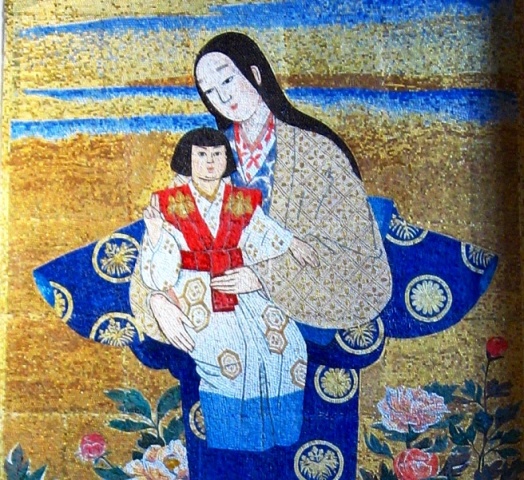
St. Athanasius – Coptic and Eastern Orthodox Icons

St. Athanasius of Alexandria was “the Lion” of the Council of Nicaea. He was instrumental in providing well argued testimony rebuking the heretic Arius during the Council’s debates. His verbal skills, as powerful and commanding as a lion, shredded Arius’ arguments. His eloquence convinced the assembled bishops of the correct dogma that Jesus Christ has two, separate and distinct, natures (divine and human), and that Jesus Christ is fully human and fully divine. The heretic Arius insisted that Jesus was “just a creature” of God.

Icon-St.-Athanaius-the-Great
A contemporary icon, completed in The Egyptian Christian Coptic style, of St. Athanasius of Alexandria standing on the back of the heretic Arius (seen in very dark colored clothing) at the Council of Nicaea (AD 325). Athanasius is seen in front of the assembled bishops from the Eastern and Western Rites of the Catholic Church. He is holding the Council’s accepted conclusions in the document known as the Nicene Creed. Notice that he does not have a bishop’s mitre on his head similar to the bishops sitting in attendance behind him, and is dressed in what appears to be a deacon’s dalmatic with cape. The style of this sacred icon is very similar to the style of the Coptic (Egyptian) Orthodox Church’s sacred art; yet, the inscription above his head is in Greek rather than Coptic. Image found at churchofourladyofkazan.org; (thanks to them) throughWikipedia images.

The Council’s main purpose was to address the divine nature of Jesus Christ and the concept of HIs being the Son of God the Father. This had to be done in order to squash the Arian heresy once and for all. It was also to establish a date for the celebration of Easter, resolve organizational and clerical issues, and the development of Church law (what today is called Canon Law). They were also attempting  to settle a schism that had occurred in Egypt. That schism was being fomented by another bishop who had enlisted with the heretic Arius.

The Council was also tasked with development of a Christian Creed that would provide unity of belief for both the Eastern and Western Rites of the Church. This unity of belief was critical since the Church needed a formal set of beliefs  that could be used as a catechetical tool and a binder that kept all the cultural and geographical “Catholic” churches together.

The Council of Nicaea basically resolved all the main issues of its agenda. It was a stunning achievement. The priest Arius was banished for promoting heresy and his ideas declared anathema. Yet, the problem the Council still faced was convincing Arius’ followers of their heretical errors. Banishment or not, an unrepentant Arius continued to spread  his opinions fomenting confusion throughout the Empire.

THE_FIRST_COUNCIL_OF_NICEA
The above image is another example of a sacred icon, however, it is not completed in the Coptic style which originated in Egypt. It is an Eastern Orthodox icon (Greek, Russian, or one of the many other Eastern Rites of the Church), completed centuries after the Council ended in the summer of the year 325. It shows a non-heretical bishop castigating the heretic priest Arius (who is raising his hand in an attempt to stop the speaker). The bishop, because of his hat (mitre), appears to be labeled with Athanasius’ name found at the bottom); however, he is not clothed in a deacon’s dalmatic, nor did deacon’s wear that style of hat. It is believed that Athanasius was not ordained a priest and bishop until after the Council ended. The Emperor Constantine sits on the right dressed in imperial clothes and it may be surmised that it is Bishop Alexander of Alexandria (the bishop of Arius’ and Athanasius’ diocese) who sits to the immediate right of the Emperor.

The Eastern and Western Rites of the Catholic and Orthodox Church have always believed that sacred icons and sacred images are always venerated by the faithful; they have never and are never worshipped.To worship sacred icons, sacred images, statues, and other visual reminders of the glory of God and His saints is against the 1st Commandment (confer Exodus 20: 2-17, and Deuteronomy 5: 6 – 21). If anyone worshipped those visual images they would correctly be called idolaters. Worship is for God alone, that is, the Holy Trinity – the Father, the Son, and the Holy Spirit; Three Divine Persons in One God.

Our Savior Jesus Christ is One Person with two natures: human and divine; that is a state of being which is part of the great Mystery of the Incarnation of God into human existence.

Jesus Christ is the Lamb of God, sacrificed in Jerusalem through His Passion, Crucifixion, and death. Jesus, following His Father’s will, suffered and died for us in order to atone for all of humanity’s sins (past, present, future). God the Father and God the Holy Spirit responded by raising Jesus from the dead on the third day, ultimately enabling Jesus to interact and be seen by His Apostles and hundreds of disciples.

Truth, Goodness, Beauty, and Love, incarnate in our Savior.

Thanks for stopping by.

May you continue to have a prayerful Holy Week and a joyous Easter Season.

Copyright © 2011- 2019, Deacon Paul O. Iacono – All Rights Reserved. Permission to reprint must be obtained from the author in writing. Students, and those interested, may quote small sections of the article as long as the proper credit and notation is given. Thank you.
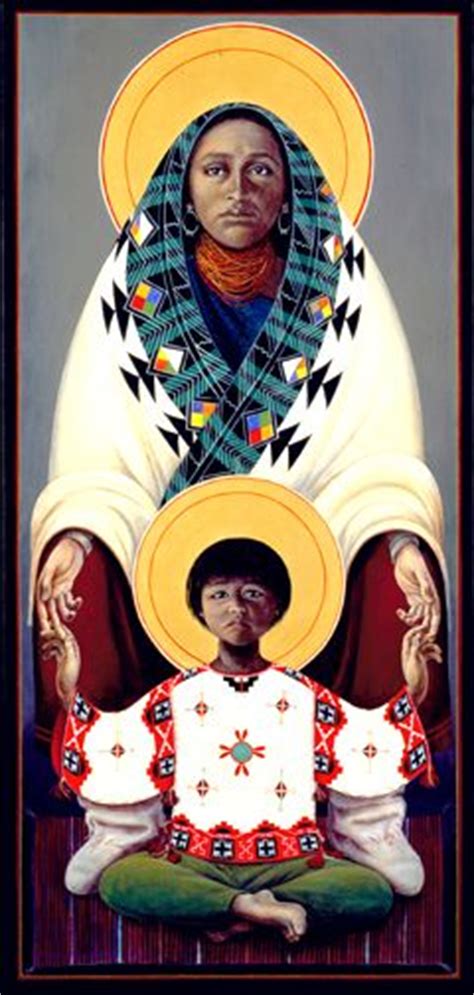
 

Saint Nicholas Slaps a Heretic! A Reflection Appropriate for Palm Sunday

The extensive Gospel reading for Palm Sunday relates the Scriptural and historical truth that Jesus  triumphantly entered Jerusalem, yet, five days later He was arrested, put on trial, tortured, and executed.

As you know, the religious and secular leaders of Israel did not accept Jesus as the Messiah and Son of God. They were adamant about the fact that Jesus was just a man and that His claims, teachings, and healings were all fraudulent.  Their disbelief took place during the first century, yet, two hundred years later there were Christians saying the same thing.

The questions came down to, “Who is Jesus Christ? Is He a man? Is He God? Is He both?”

These were the same questions that the people of Jerusalem, some of them waving palm branches, and their leaders were asking each other.

In the year 325 scholars and clerics were still grappling with those questions, too.

Many deacons, priests, and bishops of the Church had settled the question in their own mind, yet, all of Christendom was not in agreement. Emperor Constantine was worried; as a military man he knew trouble when he saw it. Religious disagreements could easily spread into civil war. Something had to be done.

Stories have come down to us through the centuries that St. Nicholas of Myra, a faith-filled bishop, decided to defend Sacred Tradition and the Scriptural interpretation of the reality of Jesus as the Son of God the Father. The story relates that he not only vigorously defended Sacred Tradition but became so worked up that during one of the debates he slapped the author of this heresy which was called Arianism.

But, was it a verbal or physical slap?

Let’s take a brief look at some of the details:

th
Partial icon of the “incident” at the 1st Council of Nicaea. Immortalized in an early icon. The Early Church was well aware of the importance of this Council in debating and agreeing to the specific dogmas of the Church that would be ultimately proclaimed in the Nicene Creed. All catechumens that enter the Church at the Easter Vigil Mass proclaim their belief in the great Sacred Mysteries and historical truths of the Nicene Creed.

Who: Saint Nicholas of Myra, Bishop, (Myra, an Ancient Greek city on the coast of present day Turkey),  vs.  Arius, priest from the diocese of Alexandria, (Alexandria, a city on Egypt’s Mediterranean coastline). Emperor Constantine, Roman Empire, centered in the new city named in his honor: Constantinople (present day Istanbul, Turkey). Constantine convenes an ecumenical council of bishops from the five major patriarchies of Christendom (Alexandria, Antioch, Constantinople, Jerusalem, and Rome).

What: Supposed incident of Bishop Nicholas “slapping” the priest Arius, at the first ecumenical Council of Bishops: the Council of Nicaea. This was the first Council since the Council of Jerusalem (held in the first century and was attended by luminaries such as St. Peter and St. James).

When: Late Spring and early Summer of the year 325.

Why: The incident concerned the critical issue of who is Jesus Christ, and whether Jesus Christ is “the same in being and the same in essence” as God the Father. Arius was promoting the heresy that Jesus Christ was “just a creature” of God and not a divine Person of the Holy Trinity.

Where: Nicaea, an ancient city in Asia Minor; it is the present day city of Iznik, Turkey.

As it applies to sacred art, the Council of Nicaea provided a specific creed: a set of theological proclamations that impacted  sacred artists from the 4th century to the present day. It is stated clearly in this Creed that God the Father has communicated His love, mercy, and laws to humanity through His revealed word in the Hebrew and Christian Scriptures. This action culminated in the ministry, passion, death, and resurrection of His incarnated Word, His Son Jesus Christ.

The Nicene Creed definitively proclaimed that Jesus Christ is the same in essence, and the same in being, as God the Father and God the Holy Spirit. So we have the great Mystery of the Incarnation, the nature of Jesus Christ: He is both human and divine – the Son of God – One Person with two natures – human and divine.

orthodox_icon_of_our_jesus_pantocrator_of_sinai._large
The above is a 6th century sacred icon of Jesus as Pantocrator. Pantocrator is a Greek word describing the all knowing, all powerful Son of God: Jesus Christ. The Council of Nicaea declared that Christ, as God, is consubstantial: Jesus is the same in essence (substance) and in being as the Father and the Holy Spirit. Also, Jesus possesses two natures: human and divine. This is truly a great Mystery of the Church. The sacred artist of the above icon, probably a monk, used hot pigmented wax (the encaustic method) to render this likeness. This sacred icon is currently located in St. Catherine’s Monastery, Sinai Peninsula, Egypt. The face has a striking resemblance to the face on the Holy Shroud of Turin.

The day-to-day proceedings and debate notes of the Council have been lost to history, so we will never know if St. Nicholas gave Arius a physical or just a verbal “slap.” Regardless, St. Nicholas made his point and contributed to giving us the gift of the Nicene Creed.

In AD 381, the Nicene Creed was edited and amended at the First Council of Constantinople (thus, the Creed is called the Niceno-Constantinopolitan Creed. Try to say that phrase fast, three times!😃).

Thanks for visiting with me. May you have a prayer-filled Holy Week.

Sources for the above post are found in my bibliography post, entitled Early Church Fathers – A Short bibliography of February 8, 2019. I relied primarily on Pope Emeritus Benedict XVI’s works, also Aquilina and D’Ambrosio’s volumes.

Copyright © 2011- 2019, Deacon Paul O. Iacono – All Rights Reserved. Permission to reprint must be obtained from the author in writing. Students may quote small sections of the article as long as the proper credit and notation is given. Thank you.
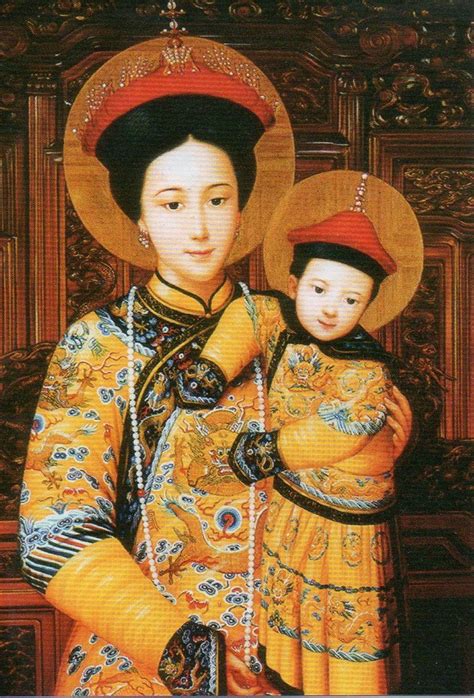


Luke 15: 1-3, 11-32. The Prodigal: Which Brother Are We?

I once heard a friend repeat a quote by the author Katherine Mansfield: If you wish to live, you must first attend your own funeral.”

How true. We begin to live life perceptively only when we project ourselves to the time of our own death, imagining how we’ve lived our life and wondering whether we’ve met the mark.

Depending on our frame of mind, and perspective on life, we may not include the spiritual in our self-assessment, or, only give it a passing thought. That is why Mansfield’s phrase may be viewed as spiritually deficient.

In today’s Gospel on the parable of the Prodigal Son there are family members that Jesus is requiring us to understand. The behavior of these people, the father and the two sons, provokes four questions. Questions not so much about our secular situation but our spiritual – our relation to God, and, each other.

At first glance, the younger son impresses us as an individual who is quite selfish. When he requests his inheritance from his father, he isn’t just asking for the cash, he is in effect saying to his father: “I want to live my life now and without any strings attached. To me you’re unimportant, this family is unimportant. Just let me get on with my life and give me my share right now.”

Are we living in  a way that categorizes God? Are we willing to acknowledge  Him only because we want to get something out of Him? Do we play upon His charity and generosity?

If this is so, if we have the younger son’s attitude, we end up like him – swimming with the pigs.  What will be our inheritance? It will undoubtedly be spiritual poverty and secular discontent. Sadly, sometimes people understand this only in the last few months of their life, or, in the moments right before their death.

Jesus is teaching us that the prodigal son was only able to enter into a state of recovery when he “attended his own funeral.” When he was able to perceive his own personal endpoint, his own material and spiritual poverty. He was finally able to admit that he was grievously wrong only when this realization slammed into his consciousness.

His new perception demanded that he learn the root causes of his problem, reject his worldly self, and humbly ask for repentance. He needed to realize that his father and family were all important to his happiness. This required acceptance of and humbly requesting his father’s mercy and love.

This perception did not demand psychoanalysis. He did not need years of therapy on a psychologist’s couch. He had the intelligence to figure it out because he confronted himself as he truly was and extended that personal analysis to his family and surroundings. He acknowledged his sins, and how truly needy he was of his father’s love and mercy.

We are half way through the Season of Lent. Like the younger son, have we confronted our own faults, our lack of perception, and yes – our own sins?

The Prodigal says: “I will arise and go to my father, and will say unto him, father, I have sinned against heaven, and before you.”

This is the turning point in the Prodigal’s life. It can also be ours.

Improvement begins with a decision to change the way we do things, the way we behave and perceive reality, both in a secular and spiritual sense. If you are a Western Rite Catholic, this is accomplished in three ways: Sacramental Confession, prayer, and resolution of purpose. Reconciliation is always possible. Our God is a God of justice, but also, a God of infinite familial love and mercy.

Do we behave like the younger son or the elder son? Are our hearts cold?

What the younger son ultimately accepts the elder son initially rejects. At first, the elder son resents the generosity of the father’s love – he resents the generosity of the act of forgiveness. It appears that he is unable to accept his repentant brother or his generous father.

Does this, in any way, apply to us? Do we ignore the Father, Son, and Holy Spirit’s love for us; do we resent people who have converted, changed their spiritual way of life? Or do we continue to judge them as if they were still enveloped by their sins? Do we verbalize our resentment or question their repentance? Are we unwilling to repent of these attitudes? Are our hearts cold?

I am a sinner and you are a sinner. There are very few people on this earth that are living saints. Regardless of whether our sins are small or large, visible or hidden, it is paramount that we remember the words of St. Paul: God the Father “reconciles us to Himself [through the passion and death of His Son] and has given us the ministry of reconciliation. Be reconciled to God. For our sake He made Him [Jesus Christ] to be sin who did not know sin, so that we might become the righteousness of God in Him” (2 Corinthians 5: 17-21).

We need to take stock of ourselves this Lenten season, repent and return to the Father’s embrace. This can only be done through the Sacrament of Confession/Reconciliation – a Sacrament made possible through the life, death, and resurrection of Jesus Christ, our Lord and Savior.

the-return-of-the-prodigal-son-illustration-for-the-life-of-christ1.jpglarge
Painting by James Tissot (French; 1836 – 1902). “Return of the Prodigal Son.”

Thank you for reading this post.

 Copyright © 2011- 2019, Deacon Paul O. Iacono – All Rights Reserved. Permission to reprint must be obtained from the author in writing. Students, and those interested, may quote small sections of the article as long as the proper credit and notation is given. Thank you.
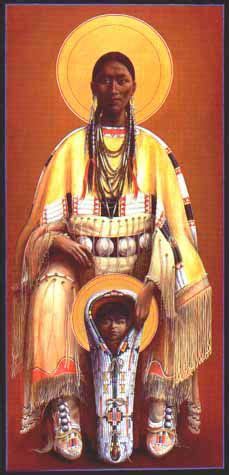


The Holy Trinity – Communication Through Word and Art

Is communication just a trait of human beings? Is it a trait of God?

The Dogma of the Holy Trinity is one of the great Mysteries of the Christian Faith.  All Christians acknowledge and accept that The One True God, the divine Holy Trinity, are three separate and distinct Persons of the Father, Son, and Holy Spirit. The Holy Trinity is not three separate Gods. They are one God in three Divine Persons. This is known as the dogma of the “consubstantial” Trinity: each of the three Persons is God – completely and entirely.

These ideas were debated and verified by the assembled bishops at the First Council of Nicaea in AD 325 and subsequent Councils (specifically the ecumenical Council of Nicaea/Constantinople in AD 381).

In the 13th century the Fourth Lateran Council stated: “Each of the Persons is that supreme reality (nature, essence, and substance) of God” (confer Catechism of the Catholic Church, 2nd edition, paragraphs 198 through 315, pp. 54-84).

These three Divine Persons relate and communicate among themselves and desire to communicate and relate with Their creation. This is verified through Holy Scripture, Sacred Tradition, and the historic teachings of the Apostles, the Ecumenical Councils, and the saints of the Church.

The  first of Their creation, the nine choirs of angels, communicate with God and each other, too.

Obviously, human beings communicate and relate through speech, behavior, and the written word, though at times, not very well. To a much lesser extent, there is “communication” in the other members of the animal kingdom (by instinct, chemical, and behavioral signals) and in the plant kingdom (through chemical signals).

God the Father has communicated specifically through His Word, the incarnated Son, Jesus Christ. In accordance with the Father’s will the human Jesus is “born of a woman” into space and time through the great Mystery of the Incarnation of Christ.

Jesus agreed to humbly obey His Father’s will. Through His Incarnation the Divine Son Jesus expresses His two natures: human and divine. He does this while “hiding” the full majesty of His divinity (except for the moments of His Transfiguration, Resurrection, and subsequent appearances to His Apostles).

The Holy Spirit (as the Council of Florence stated in 1439) “Is eternally from the Father and Son; He has His nature and subsistence at once from the Father and the Son. He proceeds eternally from both as from one principle and through one spiration (the life-giving breath of God).”

“When the Father sends His Word to His Creation He also sends His Breath. “Jesus and the Holy Spirit are on a joint mission, while at the same time being distinct but inseparable. It is the Son who is seen, the visible image of the invisible God, while it is the Holy Spirit that reveals Him.” (please refer to page 181 of the Catechism of the Catholic Church, 2nd edition, also pages 54 through 90).

The Holy Spirit communicates and spiritually shapes us through the Holy Scriptures, liturgical and private prayer, the teachings of the Western and Eastern Rites of the Church, and with the Father and Son in the seven Holy Sacraments (in the Eastern Rites – the Holy Mysteries).

The solemnity of Pentecost recalls the full expression of the Holy Spirit’s “Fruits and Gifts” to the Apostles, and through the Holy Sacraments to us, too  (refer in the Christian Scriptures to the Acts of the Apostles chapter 2, verses 1 – 42; and in St. Paul’s letters to the Galatians chapter 5: verses 22 ff; and 1st Corinthians chapter 12, verses 4 ff; also refer in the Hebrew Scriptures  to the book of the prophet Isaiah chapter 11, versus 2 – 3).

iconorininal
“The Trinity”: early 15th century; egg tempera and gold on wood panel by St. Andrei Rublev (1370 – 1430).  St. Rublev was a Russian Orthodox monk. He resided and “wrote” with egg tempera paint to produce images of God, the angels, and the saints in sacred  icons. He lived at St. Sergius Monastery in Moscow, Russia. His sacred icon above captures some of  the truth of the Three Persons of the Holy Trinity communicating with each other. God the Son, Jesus Christ, is the figure in the center of this painting.  You see two of His fingers extended to express His human and divine nature, and in a pointing gesture, to the “Cup of His Blood”  made manifest through His Redemptive sacrifice. In this masterpiece you observe the colors blue representing divine life and purple madder/burgundy signifying Christ’s humanity. God the Father is on your left and God the Holy Spirit is on your right. The Holy Spirit is garbed in blue and in green as a symbol of new life and spiritual growth through prayer and the Holy Sacraments (Holy Mysteries). God the Father is painted in both blue, green, and a very light, transparent gold ochre. The First Council of Nicaea (AD 325) verified and promoted the Dogma of the Holy Trinity. This Dogma was reaffirmed, and further explained by the Council of Nicaea/Constantinople in AD 381.


trinityicon
A contemporary copy of the original Trinity by Rublev.

God the Father sent His Son to be born of a woman through the fecundity of the Holy Spirit. The Incarnation of Jesus Christ changed the Universe. God became flesh and walked among us. Why?  In order to teach, heal, and redeem us from our sins. The New Covenant with His creation is written in His Blood. There is, if you have the gift of faith, ample proof that God wants to communicate with you.

It is up to each man and woman to honestly determine whether or not they are ignoring Him, and if so, to decide what to do about it. Time is short.

Copyright © 2011- 2019 Deacon Paul O. Iacono All Rights Reserved.

Luke: 16: 19-31 – Is Lazarus in Your House?

This passage from the Gospel of St. Luke is a parable about a destitute man named Lazarus and a rich man, who at times is called by the name Dives (the word dives in the Latin Bible refers to a “rich man”).

Jesus places Lazarus sitting day after day by the rich man’s front door. Lazarus is sick. He is at Dives’ home hoping to receive a scrap of food from his table. The food never comes.

Jesus continues to tell the story which culminates in the death of both men and their subsequent judgment.  Lazarus is welcomed into Paradise and is seen talking to Abraham, while Dives is condemned to the flames of Hell hoping for a drop of water to quench his thirst.

The parable concludes with Abraham rejecting Dives’ wish that someone from Paradise will inform his relatives of his eternal sentence in an attempt to get them to change their way of life.

Abraham says that it is fruitless: “‘If they do not listen to Moses and the prophets, neither will they be convinced even if someone rises from the dead.'”

You see its not just the issue of Dives, as a fellow human being, not providing nourishment and solace to Lazarus. It is the fact that Dives does not even acknowledge Lazarus. He and his servants pass him every day with no perception, no acknowledgement, no understanding, no charity.

How many times have we done that to men and women standing at intersections, asking for a scrap that falls from our table. We get uncomfortable at the thought that they are there. Irritated at bad government decisions that pushed them out on the street, supposedly to be helped by the social justice safety nets; nets filled with holes. I saw a woman today holding a sign that said “I need a miracle.” There was no exclamation point or happy face penned next to it.

Lazarus may be outside our front door, or, even in the house.

Question: are we passing by people in our own family who are in need? The neighbor who lives next door? A member of our parish? Are we passing by Jesus Christ?

Lent is the natural time to reflect on how well we remember and assist, in some small way, those around us who are in need. It may be financial help, or it might just be they need someone to talk to.

Upon reflection, we may find ourselves missing the mark, even committing sins of omission. Let’s remember that, unlike Dives, we still have time to do something about it.

300px-Meister_des_Codex_Aureus_Epternacensis_001
“Meister des Codex Aureus of Echternach” (the Master’s Golden Book of Echternach) – a page from this illuminated Gospel created in the mid 11th century. When seen by the Holy Roman Emperor, Henry III, it stimulated him to commission similar manuscripts from the Abbey of Echternach (Germany).


My thanks to Rev. Msgr. Anthony Mancini, Pastor of the Cathedral of St. Peter and Paul, Providence, Rhode Island USA, for stimulating this blog post.

Copyright © 2011- 2019 Deacon Paul O. Iacono – All Rights Reserved.

Christ in the Wilderness: Lent – the Season of Preparation – Luke 4: 1-2.

Jesus, full of the Holy Spirit, returned from the Jordan and was led by the Spirit into the wilderness, where for forty days He was tempted by the devil. He ate nothing at all during those days, and when they were over, He was famished. (Gospel of Luke chapter 4: verses 1-2)

In the extraordinary painting  below, we see Jesus after He was led into the desert wilderness by the Holy Spirit. He is surrounded by rocks and sand. He sits on a boulder, hands in front of Him. His eyes are filled with the knowledge of reality, of passions, power, and pain, ego and emptiness, sin and self aggrandizement.

This painting may move us from the awareness that in the desert wilderness Jesus is not only thinking through His ministry, Passion, and death but is also viewing our lives – our ministries, our passions, our death.

What do we see?

Let us examine His face.

christ_in_the_wilderness_detail_400

We see the seriousness of the forthcoming temptations; the physical, mental, and the spiritually violent struggle with the devil. It is written plainly upon His emaciated face.

We see the irrefutable fact of Jesus’ humanity.

We see that He is like unto us, except for sin.

This is the face of our Savior; but the victory is not His, yet.

His temptations, public ministry, Passion, and death are still to occur.

What do we see?

We see a man who knows His Mind. He knows His Body, Soul, and Spirit.

He knows His freely accepted duty to accomplish His Father’s will.

This is not the face of a defeated man. It is the face of a determined man who is also Lord and Savior.

**679px-Kramskoi_Christ_dans_le_désert

Observe Christ’s clenched hands, gaze deeply into His eyes, and you will see the artist’s portrayal of a Savior that is already, at the beginning of His ministry, aware of the viciousness of the tempter and the burden of our sins. Sins accepted by Him, and through His Passion and death, makes all things new.

christ_in_the_wilderness_detail_400

Jesus had to confront in that desert assault whether or not He was going to be faithful to His mission.

The Gospel passage above challenges us with the same questions: are we going to be faithful to the Commandments, to our Baptismal promises, to the mission given us in Confirmation to live and practice the truths that He taught us?

Are we going to be faithful to the spiritual power and grace given to us, not just when we feel like it, but even in the most difficult of circumstances?

As disciples of Christ we are on a daily basis constantly revolving around the axis of temptation and sin – faith and grace. We understand that temptation, in and of itself, is a test – it is not sin. It is only sin when we willfully place ourselves in its shackles, when we give into its fueled power to overwhelm our body and soul. That power  – a deadly power – obtains its animus and energy from the original tempter and liar – Lucifer himself.

Hell is real. It is not a mental construct. To say that it doesn’t exist is to call Jesus a liar, and His Passion, death, and Resurrection meaningless.

Jesus the Christ lived heroically in the face of Hell’s demons and witnessed to the power of God’s grace.

But you say, I am not Jesus Christ, I am a weak man or woman, boy or girl.

I say true, we all are; but by virtue of our faithful reception of the Holy Sacraments (Holy Mysteries) of Reconciliation (Penance/Confession) and the Holy Eucharist we have the power of Christ’s grace within us. A power, freely given by God and unmerited by us, to resist and overcome temptation and sin.

If we do sin – if we do “miss the mark” – we have a remedy.  We follow St. Paul’s advice: pick yourself up, dust yourself off (confess your sins), and confidently continue on your journey. We must do our part in cooperation with God’s love and mercy.

The Season of Lent is a time of joyful repentance, prayer, and fasting.

Let’s remember the  words of Nehemiah, who in the Hebrew Scriptures says: Today is holy to the Lord your God. Do not be sad, and do not weep; for today is holy to our Lord. Do not be saddened this day, for rejoicing in the Lord must be your strength! (Nehemiah 8: 9-10. 5th century BC)

***

The painting above was created and completed in the late 19th century by Ivan Kramskoi. He was a gifted Russian painter, noted portraitist, draughtsman, and teacher. The painting is entitled Christ in the Wilderness.

Copyright © 2011- 2019 Deacon Paul O. Iacono All Rights Reserved. Portions of this essay may be used in accordance with correct notation and bibliographical insertion; contact deaconiacono@icloud.com for more information or questions.

Apologists – Additional Saints Prior to the Council of Nicaea

Today’s post will continue to add to my two previous posts: The Apologists (Defenders of the Faith) – Part 7, and The Apologists – Comparing Icons. 

The men below are also known as the Ante Nicene Fathers. The word Ante (before) refers to the fact that they defended the Faith during the terrible persecutions of the first three centuries of the Church (the Domitian, Decian, Valerian, and Diocletian persecutions). These persecutions occurred prior to the Council of Nicaea (AD 325).

The Council of Nicaea was called by the Emperor Constantine in order for the assembled bishops, and their representatives from throughout the Empire, to discuss, debate, and establish the basic elements of a Creed for the Catholic Church (Eastern and Western Rites).

Prior to calling this Council, Constantine had proclaimed the toleration of Christianity throughout the Roman Empire. He accomplished this through the Edict of Milan. This Edict (AD 313) did not mandate that Christianity was the official religion of the Roman Empire, that was to be done by a later Emperor – Theodosius I – in AD 380. The Edict just allowed for Christianity’s toleration as a religion.

The list below provides the additional Apologists who significantly contributed to the defense of all the aspects of the Early Christian Faith, such as the Real Presence of Christ in the Eucharist, the Seven Sacraments, the Holy Sacrifice of the Mass, etc.:

St. Justin Martyr, (born circa AD 100), an excellent writer, debater and teacher. He defended the Sacraments of the Church, especially the Real Presence of Christ in the Eucharist, the genuineness and inerrancy of the four Gospels, the Trinity, the two natures of Christ, how reason can come to know God, the Sacraments, God’s revelation and inspiration, etc. He also saw some aspects of ancient philosophy as a precursor of the Christian faith, and wrote two powerful defenses of the Faith to the Emperor and the Roman Senate. He was martyred, along with six other Christians, in AD 165.

St. Justin Martyr is a very important witness to the developing beliefs of the Catholic Church (Western and Eastern Rites) because he is discussing and describing many of the primary dogmatic and doctrinal beliefs of the Church which would be established over one hundred and fifty years later in the Nicene Creed (AD 325), and clarified and confirmed in the Council of Constantinople in AD 381.

St-Justin-Martyr-e1464838721698
A sacred icon of St Justin Martyr, martyred AD 165. He was a powerful teacher, writer, and Defender of the Faith as it was passed down to him from Apostolic Times.

St. Melito of Sardis, (died circa AD 185),  a scholar who saw the immense value and importance of the Hebrew Scriptures and how they contributed to the Christian Scriptures; in AD 175, wrote a defense of the Christian Faith which was published in a letter to Emperor Marcus Aurelius. He was also instrumental in teaching and explaining the two natures of Jesus Christ: one divine and one human. His explanations kept the two natures separate, and teaches that Jesus was truly human and truly divine. He fought the Christological heresies that were developing at this time (especially Marcion’s heresy concerning Jesus’ physical body).

Tertullian, (died circa AD 222) a powerful, yet, at times, tactless writer and lawyer. He wrote on many aspects of early Church theology. He also wrote a spirited defense of the Christian Faith in a letter to the Roman Emperor. Interestingly, he is known for his description of the members of the Christian Faith: “See those Christians, how they love one another,” and “The blood of Christians is [the] seed [of the Church].”

St. Hippolytus of Rome, (died circa AD 236) in his book – The Apostolic Tradition – sets down a manual of liturgical prayers and tradition and it refers to an order of the Holy Mass. The current Eucharistic Prayer 2, in the Sacramentary (liturgical missal) used in the Western Rite, is attributed to the central prayer found in his The Apostolic Tradition.

Origen of Alexandria, (died AD 254), a genius in speculative theology who wrote extensively on subjects such as the belief in One God, the Three Persons of the Holy Trinity, the Holy Sacraments of the Church, etc. He was a voluminous writer and died a martyr.

St. Cyprian of Carthage, (born circa AD 200); he was a student of Tertullian. St. Cyprian was a tireless theologian and worker for unity within the Church, and through his patient and good-hearted efforts solved many controversies and squabbles. As a bishop he proclaimed that he was willing to welcome any pagan or heretic into the Church who confessed their sins, were willing to do penance, and were baptized. His defense and scholarship on the Holy Sacraments is considered important. He died a martyr in AD 258.

In my next post, Part 8, I will briefly discuss the Golden Era of the Apostolic Fathers (AD 325 – 430) whose blossoming occurred after the Council of Nicaea; also in that post, I will discuss and list the Post Nicene Fathers (circa AD 430 – AD 800). In Part 9, I will briefly list some of the important Church Councils of the 5th century and how they affected the Church’s sacred art.

Please review the bibliography page (found at the post of February 8, 2019). It provides the sources that I have been using in this specific sequence of posts on Church history.

Thanks for visiting with me. On this Ash Wednesday allow me to offer you my best wishes for a productive and prayerful Lenten Season.

Copyright © 2011- 2019, Deacon Paul O. Iacono – All Rights Reserved. Permission to reprint must be obtained from the author in writing. Students may quote small sections of the article as long as the proper credit and notation is given. Thank you.


Icons – Important Similarities/Differences

Can you pick out the seven similarities between the two sacred icons of Church Apologists that are below? The differences?

IconPM-Irenaeus-2
St. Irenaeus of Lyons (died circa 201). Famous for his manuscripts Against Heresies. He used 21 out of the 27 books of the New Testament in his writings and sermons.


SAINT-CLEMENT-I
St. Clement of Alexandria, Egypt.  Born AD 150, died AD 215.                                                               Famous for his manuscripts on the Blessed Mother Mary as the New Eve, the significance of the Holy Eucharist, and other catechetical works.

Let’s take a look at the two icons above.

Both are correct in the way they are represented. From an artistic and symbolic point-of-view there are distinct similarities.

They have seven similarities: the beard (signifying experience, authority, and that the saint is an elder); a large, high forehead (signifying Christian wisdom as influenced by the Holy Spirit which is visualized through the saint’s works and knowledge); the Holy Cross upon the priest’s stole (it appears as a garment that circles the neck and extends down the torso which signifies Christ’s Redemptive suffering and the saint’s  willingness to give witness and suffer for Christ); the presence of the book of the Gospels (the revealed truth of God through His Son, Jesus Christ); the script of the saint’s name at the top or side of the icon; and the halo circling the head (representing the sanctity of the saint).

There are two absolutely necessary and critical indicators that designate a valid orthodox icon or sacred image: the artist must distinguish the person represented with his or her name, and, the icon must give witness to their life and ministry to the Church.

How does the sacred artist accomplish this requirement?

The artist needs to follow this rule: if the person(s) represented is/are a cleric (deacon, priest, or bishop) they need to be clothed with the proper vestments of their rank, and prototypical appearance. If their physical appearance is known (such as St. Therese of Lisieux or St. Maximillian Kolbe) they must be represented in a correct and accurate manner. The artist must also represent some aspect that distinguishes their ministry, such as the Book of the Gospels.

This is also true if the person(s) is/are a martyr, holy man or woman, monk, etc. This is, again, necessary since  the faithful need to know the name of the saint so they “may honor, revere, and give salutation to them and aspire after them” (from The Seventh Ecumenical Council: Concerning the Holy Icons).

The differences between these two icons of Church Fathers are primarily in the icons’ age, the colors used by each sacred artist, the adornment of the garments and book of the Gospels, and whether or not the halo, and area surrounding the figure is gilded. Many of these differences reflect the specific culture the sacred artist lived in, the time period of the artist’s life, and the artistic resources (such as pigments) that were available.

Historically, violent disputes broke out between icon supporters and icon destroyers. The situation came to a head in October AD 787, when the 2nd Council of Nicaea, among other issues, reinstated the validity and necessity of the veneration of holy icons/images. It specifically quoted: Genesis 31: 34; Exodus 25: 19 ff; Numbers 7: 89; and Hebrews 9: 5 ff;) in support of their position. The Council Fathers especially cited various passages of the Fathers of the Church which proved to be critical in the authority of their proclamation. They were also heavily influenced by the writings of St. John Damascene. The Council documents were signed by the Byzantine Empress Irene, as many as (or more than) 300 bishops, and two legates of the Pope.

Sacred icons, sacred images, statues, etc are never worshipped. Worship belongs to God alone as represented in the Holy Trinity. The holy personalities represented give witness to unity with Christ and point us in the truthful –  orthodox –  direction. We venerate sacred statues, icons, and sacred images – never worship them. (See the documents of the 7th Ecumenical Council of the Church (AD 787) to reiterate this position).

Church tradition also warns the sacred artist who paints sacred icons to guard against unnecessary innovations and artistic flourishes. Please remember that in my blog I make a distinction between sacred icons and sacred images. My articles on this subject can be found in the Category window found on the top, right hand side, of my Home Page. You may find that my article A Canon for Catholic Sacred Artists, found in the Category: Sacred Artists, in the month April, 2018 (once there, scroll down to April 2, 2018 and you’ll find the article). That article has a short section in the Notes following the ten elements of my suggested “Canon” that express my opinion on the differences between sacred icons and sacred images.

Thanks for visiting with me. My best wishes for a relaxing weekend.

Copyright © 2011- 2019 Deacon Paul O. Iacono All Rights Reserved. Permission to reprint must be obtained from the author in writing. Students may quote small sections of the article as long as the proper credit and notation is given. Thank you. Deacon Paul Iacono, at deaconiacono@icloud.com.


Christian Witness and Sacred Art – The Early Church Fathers – Part 7

A Challenge: Are you as a Christian artist willing to internalize the message of the saint, scene, or Scripture passage you are artistically representing, and then, correctly portray it according to Church tradition?

Sacred artists must have more than just an awarenesses of Jesus, His Mother, angels and  saints because their witness provides us with the foundation stones of our Faith. Sacred artists must be more than artists who propose “Art for art’s sake”.

If we do this what do we become? We become evangelists to the truth, goodness, and beauty of God, through the witness of Jesus Christ and the holy men and women who called Him the Son of God.

In the years immediately following St. Polycarp’s martyrdom (died, circa AD 155, and remembered yesterday, February 22nd, in the Roman Breviary and Missal) a group of eight Western and Eastern Rite scholars and clerics arose known as the Apologists (Defenders of the Faith).

The Apologists defended the beliefs and traditions of the Church that passed down to them, in an uninterrupted line, directly from the Apostles and Apostolic Fathers.  This occurred during the years of continued persecution – AD 155 through AD 313.

The works and ministerial witness of the Apologists provide evidence for the continuity of beliefs and dogmas in the Early Christian Church. It is through this historic development, and the literary and physical witness of their efforts, that we have  religious and cultural traditions which dramatically affected the growth of sacred art. These clerics and scholars desired to unify and establish the beliefs of the Western and Eastern Rites of the Church.

Church artists, and the later group of clerics and scholars known as the Nicene Fathers (who I will cover in later posts), were heavily influenced by their efforts. These two groups, the Ante Nicene and Nicene Fathers all desired to make concrete and visible the correct teaching – the orthodoxy – of the Church. These efforts ultimately produced artistic representations of these early spiritual heroes – a visible sign of the truths of the Gospels being preached – and in some cases, their witness in blood.

The Apologists have also been termed The Ante (Before) Nicene Fathers because they lived and died prior to the establishment of the  Creed of the Catholic Faith, ultimately to be known as the Nicene Creed.

Let us briefly review two of the Apologists: St. Irenaeus of Lyons, and St. Clement of Alexandria. In a subsequent post you will have the opportunity to read three or four sentence descriptions of the contributions of the other six  Apologists.

St. Irenaeus of Lyons was born in AD 130 and died circa AD 202. He speaks of the four Gospels as being the “Four Pillars of the Church,” and was in a position to know that since he heard St. Polycarp (a friend and disciple of the Apostle John) preach. He was steadfast in supporting the belief in Apostolic Tradition. He taught that the true Faith is the one imparted by the bishops of the Church who, in turn, received it directly in an uninterrupted set of teachings from the Apostles. St. Irenaeus was tenacious in his fight against heterodoxy, specifically the Gnostic heresy.

St. Irenaeus understood the value of St. Polycarp’s New Testament scholarship and his emphasis on the Church’s sacred Tradition. He spoke with authority on Mary as the New Eve, and the Holy Eucharist. St. Irenaeus barely escaped death during the persecution of Emperor Marcus Aurelius, however during the round-up approximately 50 other Christians had the joy of earning the holy crown of martyrdom. He may have eventually died a martyr, yet, there is not sufficient evidence to support it.

IconPM-Irenaeus-2
St. Irenaeus of Lyons (died circa 202). Famous for his manuscripts Against Heresies. He used 21 out of the 27 books of the New Testament in his writings and sermons.

Another critical Apologist is St. Clement of Alexandria (born circa AD 150, died circa 215). He led a major catechetical school in Alexandria, Egypt and agreed with St. Irenaeus that the truth and knowledge of the holy Gospels proceed through the bishops and are for the population as a whole and not for any secret society (thus, he fought against the Gnostic heresy).

He taught that in order to understand the truths of the Gospels you must have faith in unison with reason. He is also known for three major catechetical works which are still in existence. These works were meant to accompany catechumens and those baptized into the Christian faith as an aid to their spiritual development. He was not martyred.

SAINT-CLEMENT-I
St. Clement of Alexandria – an Apologist of the Early Church – as represented by an early iconographer of the Eastern Rite of the Catholic Church.


Thanks for stopping by the Institute. I hope you have a relaxing weekend.

Copyright © 2011- 2019 Deacon Paul O. Iacono All Rights Reserved. Permission to reprint must be obtained from the author in writing. Students may quote small sections of the article as long as the proper credit and notation is given. Thank you. Permission to copy these posts must be obtained from Deacon Paul Iacono at deaconiacono@icloud.com.

Amazing Grace – Amazing Piano!

Okay, we have reached Wednesday, the supposed day that if we can just get through it we will be on the downward slide toward the weekend.

In an attempt to put a little pick-me-up in your afternoon I ask you to put aside your pencils, pens, and paint brushes and take 4 minutes and 9 seconds to listen to a “Dude Rocks Out Amazing Grace on the Piano.”

The “Dude” in the green jacket and rose colored glasses is Terry Miles. He is an accomplished pianist, yet, this day he sits down to a public piano in a London train station and puts a little joy into peoples’ hearts.

The song starts out as usual and then slowly, with a little flutter, breaks into Terry’s personal interpretation; but, then at approximately 1 minute 20 seconds into the piece, he takes off! The style is called “Boogie Woogie;” and believe it or not, it is one of my favorite types of music from my teen age years.

Click on the red or blue site address below (which gives a short description), click on the red and white arrow (depending on how it loads, at the top or bottom of the page), and enjoy!!

I hope I linked it correctly. If it doesn’t pop up for you use the address below in your search engine. For those unfamiliar with searching YouTube – enter youtube.com for “Terry Miles Amazing Grace” in your search box, click on it, and it should pop-up for you.

Thanks to godtube.com for posting Terry’s video.

https://www.godtube.com/watch/?v=YYYGG7NX

Roman Catholic Sacred Art: A Prayer to Accompany The First Theological Theme

“And only where God is seen does life truly begin.

Only when we meet the living God in Christ do we know what life is.

We are not some casual and meaningless product of evolution.

Each of us is the result of a thought of God.

Each of us is willed, each of us is loved, each of us is necessary.

There is nothing more beautiful than to be surprised by the Gospel, by the encounter with Christ.

There is nothing more beautiful than to know Him and to speak to others of our friendship with Him.”

          The above was written by Pope Emeritus Benedict XVI

If I may add just a few lines inspired by his thoughts:

There is nothing more beautiful than to become aware of what Jesus sacrificed for us in order to make us members of His family.

There is nothing more beautiful than when we repent of our sins, implore His mercy, and amend our lives, in love for Him.

There is nothing more beautiful than an innocent child in their mother’s womb and  being cared for by a loving parent(s).

A relevant theme: as Americans, regardless of religious creed, we need to remember the sixty million nine hundred and ninety-six thousand, nine hundred and ninety-four abortions, that is, the murder of 60 million, 996 thousand, 994 innocent children, that have been surgically murdered since the Roe vs, Wade U.S. Supreme Court decision of 1/22/1973. This number does not include those abortions that have been chemically induced. The estimate for chemically induced abortions in the United States is approximately 250 million children.

In the United States today one abortion is performed every 20 seconds.

World statistics, which began being tabulated in 1980, total: 1,522,353,500. murdered children.

In the world today one abortion is surgically performed every second.

The source for these statistics is a non partisan reproductive health and family planning organization known as the Guttmacher Institute. These statistics, tabulated minute-by-minute, can be found at: http://www.numberofabortions.com

What can Americans do? Those that are against abortion can do three things: physically protest by legally, prayerfully, and peacefully demonstrating in front of abortion clinics and through legal and peaceful mass demonstrations. Catholic Americans that are unable to do so because of age, employment, or health concerns can prayerfully say the Holy Rosary every day. The Rosary can be found on-line by just entering the title – Holy Land Rosary. This will take you to a number of sites, some contain music, others such as the one (which I find very beautiful in its pace and view of Holy Land sites), linked here, is prayed by a Canadian Catholic priest and his Holy Land Tour group: https://youtu.be/a3Z3Sfp_0bA

You can say a prayerful Glorious, Joyful, Sorrowful, and Luminous Rosary at this site. An entire Mystery of five decades can be prayed in under 20 minutes. Save it to your phone, say it while driving or performing other tasks with the intention of interceding with Jesus and His Blessed Mother to touch the hearts of mothers and medical personnel so they do not proceed with the abortions.

A child or children’s lives depend on our prayers.

God bless your daily efforts to end this Satanic scourge of the world’s children.

Thank you.

maxresdefault
Closeup of the face on the Holy Shroud of Turin. At right is a forensic artist’s recreation of a potential human likeness of the image found on the Shroud.


Copyright © 2011- 2019 Deacon Paul O. Iacono All Rights Reserved