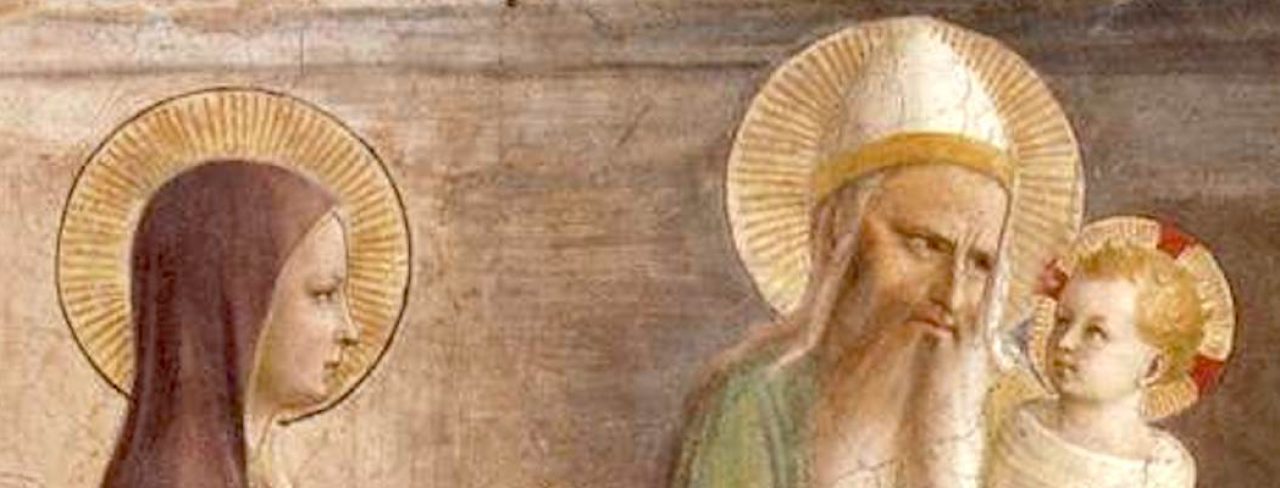
Catechesis and Catholic Art

Sacred art, by its very nature, is catechetical. The purpose of this art was and continues to be a method of instruction. The Catholic Church, in its Latin and Greek Rites, and the twenty-six Catholic Rites that are in union with Rome, have all produced magnificent sacred calligraphy and art; non-Catholic faiths have done this, too.

Two thousand years ago Christians hiding in Rome inscribed images of Christ, the Blessed Mother and with the Christ child, and other Scriptural images on the walls of the catacombs. That art contributed to the catechesis of the early Christians. Two millennia later, Pope St. John Paul II in paragraph 18 of his Apostolic Exhortation, Catachesi tradendae, speaks of this function: it is “an education in the faith… in an organic and systematic way, with a view to initiating the hearers into the fullness of Christian life.”

Sacred art, in tandem with scholarship, edifies and makes beautiful the truth, goodness, and beauty of God. One of my favorite forms of sacred art is that of the Coptic Christian Church (historically based in Alexandria, Egypt). Coptic art is presented in an especially down to earth way. It is beautiful and humble at the same time. It is catechetical and colorful. It possesses a fine palette, yet the viewer does not get caught up in the colors to the detriment of catechesis. 

The Coptic faith’s icons are simple, yet, profound. They convey theological truths in a way that can be understood by all age groups and are excellent sources of catechesis. 

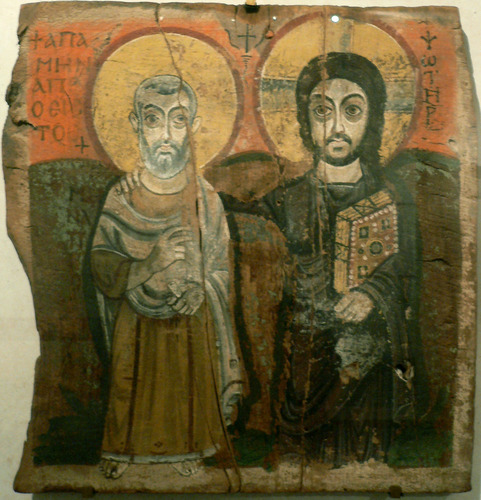
The first image above is a 7th century Coptic icon. It was discovered at the Monastery of Bawit (Egypt) in the early 20th century by two French archaeologists who brought it, and other Monastery artifacts, back to Paris. Currently located in the Byzantine wing of the Louvre it is unique because it presents Jesus affectionately putting his arm around the Monastery’s abbot – Abbot Mena.

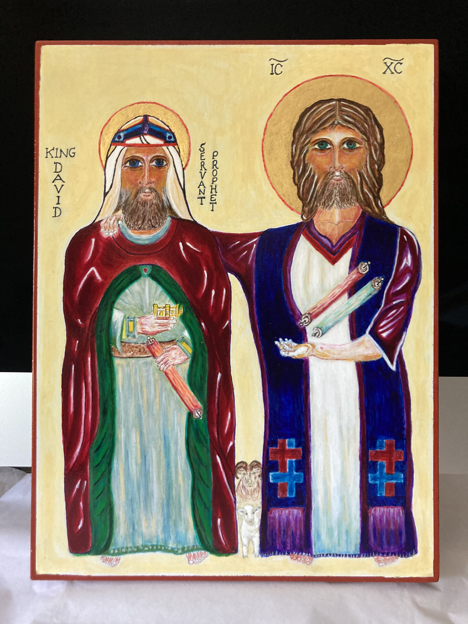
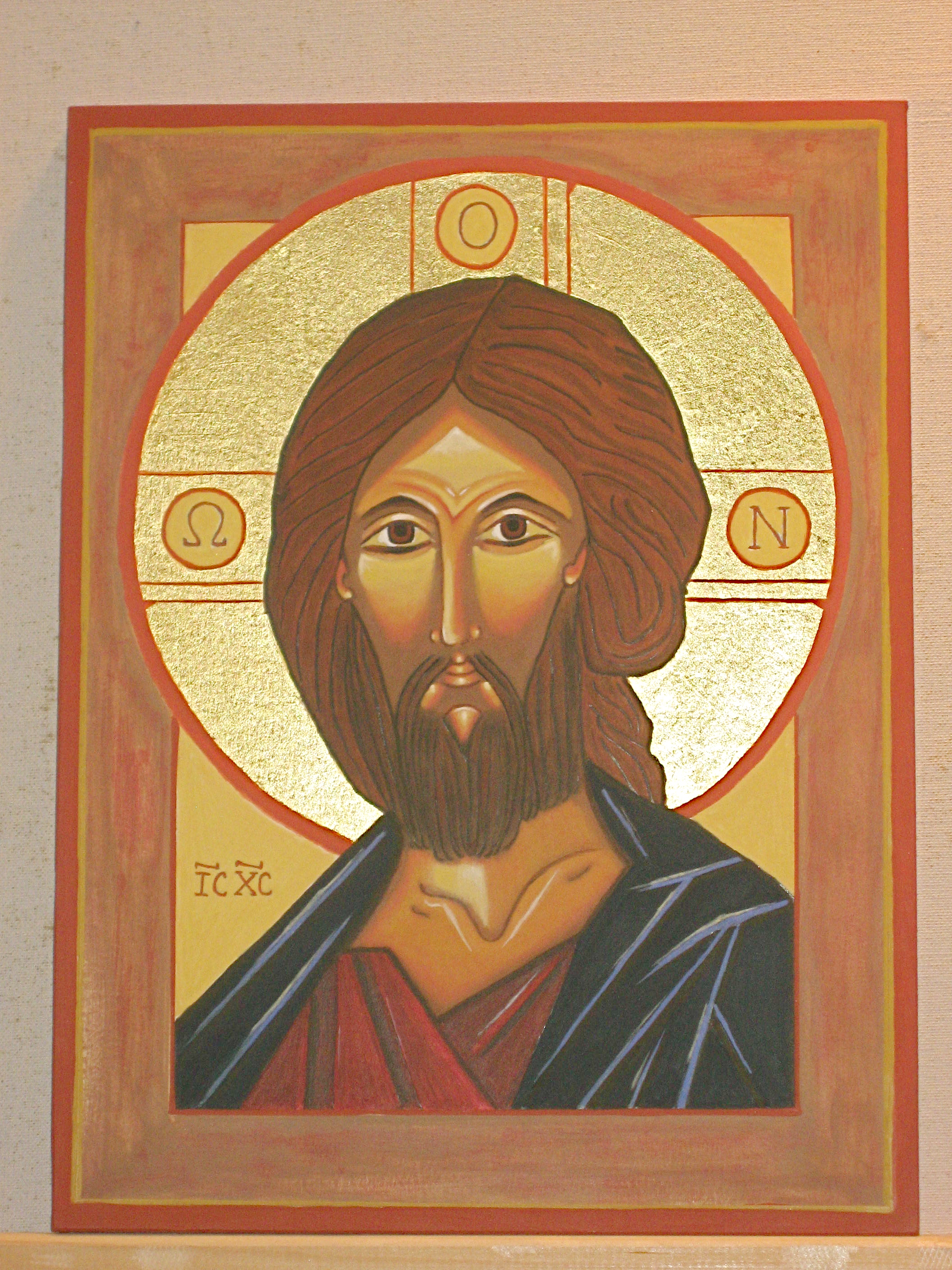
The second sacred image is my original composition. It is painted in archival ink, acrylic paint, and the halos are 23 karat gold leaf. My style slightly follows the Coptic in that it portrays figures that are not intimidating, are easily understandable, and act as a teaching tool for children and adults. It does present additional symbolism which further explains key theological truths of our faith.

Symbolism of the second sacred image:

The IC XC is the Greek abbreviation for Jesus Christ. 

The slightly larger than normal eyes represents holiness, spiritual wisdom, and maturity.  

Jesus’ white alb (tunic): purity; King David’s light green alb: hope for spiritual growth and friendship with God. 

Jesus’ outer garments consist of two parts: robe and stole which are painted in various shades of royal purple. Royal purple indicates kingly authority. The tassels of His stole are multicolored representing the intersection of purity and kingship. Christ’s lower stole’s has an intersecting weave representing Jesus’ blood and water shed for us on the Holy Cross. Liturgically, deacons, priests, and bishops all wear albs, cinctures (belts), stoles, and outer garments (dalmatic or chasuble). These articles of clothing each symbolize different aspects of Jesus’ Passion and ministry.

Elevated above Jesus’ left hand are the scrolls of the Old (Hebrew) and New (Christian) Testaments. The color symbolism for the Hebrew Scriptures’ scroll: green, which represents hope, expectation of the Messiah, and devotion to God. The Christian Scriptures‘ scroll: red, representing Jesus divine and human energy, love, Redemptive sacrifice, and His mercy and justice.

Jesus’ arm is around David’s shoulder. His gesture to David expresses His love, affection, and mercy which are evident and available to everyone. However, the expression that I put on Jesus’ face, especially His eyes, conveys the severe justice that Jesus’ renders to all non repentant sinners. David committed murder and adultery yet ultimately becomes aware of the enormity of his sins. His Psalms were written to plead for mercy, express sorrow for sins, and give praise and thanksgiving to God (see especially: Psalms: 1, 51, 56, 65, and 117). David’s crimson coat symbolizes human life and energy, it is trimmed in dark green symbolizing his hope for mercy.

Circa 1000 BC, David and his armies captured Jerusalem and brought the Ark of the Covenant into the city (1 & 2 Samuel). King David is holding the city of Jerusalem in his right hand; and in his left the book of Psalms. David’s son Solomon built the First Temple to house the Ark of the Covenant (1 & 2 Kings). 

Between David and Jesus are a ram and a new born lamb.

The ram refers to the sacrifice by Abram (Abraham) of a ram caught in a thicket in substitution for the sacrifice of his son Isaac (Genesis 22). Jesus and David are members of the same genealogical family, stretching all the way back to Abraham and Isaac and Isaac’s son Jacob.

The newborn lamb represents Jesus Christ, the “lamb of God” (John 1: 29). He was given in sacrifice by the Holy Trinity for the Redemption of mankind from their sins. That Redemptive act by Our Lord and Savior, Jesus the Christ, instituted the New Covenant which was sealed with His, the Lamb of God’s, blood.

The New Covenant does not replace the Old Covenant God made with the Hebrews. The New Covenant of Christ’s sacrifice (as described in the 27 books of the Christian Scriptures) fulfills the Old Covenant promise of a Savior found within the 45 books of the Hebrew Scriptures. The ram and the lamb provide the visible connection between the Hebrew Scriptures (Old Covenant) and Christian Scriptures (New Covenant).

The New Covenant is continued down through the centuries by the un-bloody sacrifice of Holy Mass. Selections from the Hebrew and Christian Scriptures are read. The Gospel is proclaimed prior to the priest representing Christ, in Persona Christi, transubstantiating the host and wine into the Body, Blood, Soul and Divinity of Jesus Christ.

In faith and action Catholics consume His Body and Blood toward the end of Holy Mass. This consumption does not transform Him, as simple food, into ourselves. Rather, we (as repentant sinners) are transformed by Him (through Sanctifying Grace) into Himself.  He doesn’t become part of us, rather, we become part of Him. This is an article of faith believed by all Catholic Christians of the Western an Eastern Rites of the Church. The reception of Holy Communion by Catholics is not a “right,” it is a privilege given by Jesus Christ to worthy (repentant and Reconciled) recipients (culminating in our giving eternal thanks and praise to Him in Heaven; see Matthew 26: 29).

Therefore, in this non-intimidating sacred image you have a teaching tool that includes elements of Sacred Scripture and Sacred Tradition. It is simple grist for any informed catechist’s mill.

UPDATE: If you find this subject interesting I recommend you read my post on Catechesis and Naive Sacred Art: St. Peter – A Lesson Plan, published on January 25, 2022. Thanks!

Copyright © 2011- 2021 by Deacon Paul O. Iacono – All Rights Reserved. Permission to reprint essays and/or my paintings must be obtained from me by, using the comment box and making a comment/request on this post. I will respond to you through answering in the comment box. Students, and those interested, may quote small sections of my essays as long as the proper credit and notation are given. Thank you.


Holy Triduum: A Video Pilgrimage to Jerusalem

This is a magnificent 30 minute overview of the places in Jerusalem in which Our Lord spent His last hours. 

Please share with your families and others who would benefit from it.

It is beautifully presented without the poor production values of other similar attempts. 

This production was filmed, edited, and narrated by members of the Augustine Institute in Colorado..

Thanks.

May you and your loved ones be blessed by Our Lord Jesus Christ and have a Holy and Blessed Easter season.

https://watch.formed.org/holy-thursday/videos/triduum

Chinese Martyrs and the Beautiful Art of Ken Jan Woo

We remember today, July 9th, the 120 martyrs who died in China between the years 1648 and 1930. Eighty-seven of these were native born Chinese and were children, parents, catechists, and simple laborers ranging in age from nine to seventy-two.

In the early 19th century, St. Augustine Zhao Rong was a Chinese soldier who accompanied French missionary Bishop John Gabriel Taurin Dufresse to his martyrdom in Bejiing.  He was profoundly touched by the Bishop’s courage in the face of great trials, humiliation, and eventual death. As a result, Zhao Rong sought baptism, was given the baptismal name of Augustine, and soon ordained a diocesan priest. He spoke often of Bishop Dufresse’s sense of hope, love of Christ, and confidence.

In 1815 the Chinese government martyred Father Augustine Zhao Rong.

An icon of Father Zhao Rong was completed by the brilliant Chinese artist Ken Jan Woo. Many of his icons and sacred art can be seen at his website http://www.kenwooart.com/index.html. Classically trained, Ken brings a new contemporary spirit to the sacred images of the Church’s past history. His exquisite rendering of this saint, in a typical icon format, is powerful in its simplicity and harmony.

The witness of these Chinese saints, in association with the Gospel passage of Matthew 9: 18-26, begs a question: What sets St. Zhao Rong, his martyred companions, and the people in the Gospel apart from many in our society?

Jesus provided the people with faith-filled hope even when circumstances dictated that their situation was hopeless. Why is this?  It is because Jesus’ love for them, and willingness to share The Truth, was always directed back to His Father. Jesus tells us, “With God, all things are possible to those who believe.”

Jesus’ words were incendiary; for He said to the woman “Take heart, daughter – your faith has made you well.” That phrase “Take heart” ignited the woman’s expectant faith. Her belief allowed her to cooperate with the healing process.

Matthew’s Gospel passage provides witness to the local ruler’s spiritual courage to request Jesus’ help. The girl was already considered dead.  Professional mourners had already been hired to demonstrate the family’s public grief. The mourners and others in the crowd scornfully laughed at Jesus. Their grief was as bogus as their lack of faith. Jesus’ was ready to heal, teach, and be open to the needs of that family. It gave them a glimpse into the mind and heart of God; and it provides us with a model to follow, too.

Let our prayer be the prayer of the martyrs: Lord, you love each of us with a unique and personal love. As we face our troubles with confident hope, touch our souls with your saving power, and restore us to the fullness of your eternal life. Amen

Artwork Copyright © Ken Jan Woo. All Rights Reserved.

Copyright © 2011- 2020, Deacon Paul O. Iacono – All Rights Reserved. Permission to reprint must be obtained from the author in email/writing. Students, and those interested, may quote small sections of the article as long as the proper credit and notation is given. Thank you.

Virgin Mary: Trust and Obedience in the Lord

On this solemnity of the Annunciation, March 25th, we remember St. Luke’s account of the Annunciation:

“Now in the sixth month the angel Gabriel was sent from God to a town of Galilee called Nazareth, to a virgin betrothed to a man named Joseph, of the house of David, and the virgin’s name was Mary.”

“And when the angel had come to her, he said, “Hail, full of grace, the Lord is with thee. Blessed art thou among women.” When she had heard him she was troubled at his word and kept pondering what manner of greeting this might be.

And the angel said to her, “Do not be afraid, Mary, for thou hast found grace with God. Behold, thou shalt conceive in thy womb and shalt bring forth a son; and thou shalt call his name Jesus. He shall be great, and shall be called the Son of the Most High; and the Lord God will give him the throne of David his father, and he shall be king over the house of Jacob forever; and of his kingdom there shall be no end”

“But Mary said to the angel, “How shall this happen, since I do not know man?”

“And the angel answered and said to her, “The Holy Spirit shall come upon thee and the power of the Most High shall overshadow thee; and therefore the Holy One to be born shall be called the Son of God. And behold, Elizabeth thy kinswoman also has conceived a son in her old age, and she who was called barren is now in her sixth month; for nothing shall be impossible with God.”

And Mary said, “Behold the handmaid of the Lord; be it done to me according to thy word.” And the angel departed from her.” (Luke 1: 26-38)

Mary, the Blessed Mother, the Theotokos – “the God bearer” at first, questions Gabriel, “How shall this happen…” Upon his explanation Mary undertakes her all important journey with perfect trust and obedience to God’s will. She accepts her eternal role not in fear but in love. Mary will be the God Bearer, the bearer of her Son Jesus, our Savior, the Second Person of the Holy Trinity.

Jesus, at the moment of His conception, is both true God and true man: two natures in one Person.

iu-2
Icon of Mary: it is the icon called The Madonna of Saint Sisto, located in Rome in the Dominican convent of Monte Mario. It is one of the oldest and most beautiful icons of the Virgin from antiquity.


Mary is the perfect disciple of God. She provides us with the model of love, obedience, and trust in Him. There were many times throughout her life that she had to express her trust and obedience, and at times not knowing where the journey would lead. It led from the great joy of her pregnancy, Jesus’ birth, family life, through to His ministry, and her motherly presence before the Holy Cross.

A few verses later, in her beautiful canticle the Magnificat, she exclaimed to her kinswoman Elizabeth her lack of doubt in what has happened.  She praises the mercy of God and her willingness to be the servant of Him who is faithful to His word. In her humility, trust, love, and obedience to God, Mary, as the New Eve, will be given the privilege of crushing Satan at the end of time.

From the beginning, the Catholic Church has never worshipped Mary. The Church venerates her as the first disciple and its greatest saint.

On this beautiful Solemnity of the Annunciation let us join with the great St. John Henry Cardinal Newman in his prayer to Jesus: “Dear Jesus, Your Holy Mother cooperated with the divine plan for the human race. Let me try to imitate her in her obedience and service to You.” Thank you, Jesus.

Note: The sacred image that appears at the top of all of my posts is The Annunciation by Fra Angelico.

Copyright © 2011- 2020, Deacon Paul O. Iacono – All Rights Reserved. Permission to reprint must be obtained from the author in writing. Students, and those interested, may quote small sections of the article as long as the proper credit and notation is given. Thank you.

Sacred Icons and Sacred Images – the Nicene Debate Continues!

AyaSofya
A photo of the inside of the Aya Sofya (Hagia Sophia) church in what is the present-day city of Iznik, Turkey. Iznik was called Nicaea prior to the rule of the Ottoman Turks . This photo shows the interior of one of the rooms in the  building complex that served as the location for the First Council of Nicaea (AD 325). Also, in the late 8th century the Seventh Ecumenical Council met in this building, too. That Council met to debate and decide the issue of iconoclasm (should sacred icons and images be prohibited and destroyed). The written arguments of St. John Damascene (Damascus) won the day and sacred icons were allowed to continue to be made. Iconoclasm was to raise its ugly head again in later years, and came to full fruition during the Protestant rebellion/reformation, the French Revolution, and worldwide Communism in all its cultural forms.  This photo of the inside of the Nicaean building is from Bryan Cross’ website: calledtocommunion.com. It was posted in May, 2010. Thanks Bryan!

I would like to thank one of my readers who identified the  contemporary icon of St. Spyridon (thanks Carol!). The iconographer is the Catholic priest William Hart McNichols. He is a very talented artist who paints traditional icons and sacred images. At times, he steps out of the bounds of the traditional approach and adds his own personal interpretation of the person he is portraying. His artistic vision is unique.

John Daly from Australia emailed me this morning to provide further grist for our mill concerning St. Athanasius, St. Spyridon, and the Council of Nicaea. One of the participants in his iconography school is a Greek Orthodox lady who is the sister-in-law of an Orthodox priest. He is coincidentally named Athanasius.

John had the opportunity to discuss with her the icons that we were analyzing in my posts of the last few days. She provided John some valuable information by explaining  that her mother had given her a beautiful sacred image of the First Council of Nicaea and specifically St. Spyridon’s role in the debate with the heretic Arius. The sacred image is below.

1555507279899blob.png
Greek Orthodox sacred image of the First Council of Nicaea. Notice St. Nicholas on the lower right about to possibly physically strike Arius who reacts by pulling away. On the left you see St. Spyridon, holding a brick with flames streaming upward and water puddling below it to the floor (confer yesterday’s post of April 16th to obtain the explanation of that imagery). The room of the actual Council, as portrayed in this sacred image is quite ornate.

Also, like the sacred icon we examined in yesterday’s post we see the Emperor Constantine, dressed in the royal robes of Byzantine reddish purple (almost a maroon) sitting on the right. On the Emperor’s right we again observe a bishop, maybe its Bishop Alexander of Alexandria, Egypt. In front of him we again see a deacon, dressed in what is either an alb or dalmatic (he would have to stand up to see all the garments).

In the above sacred image, the deacon is again seated at the scribe’s desk. This makes sense, since a deacon serves the administrative needs and report’s directly to his bishop. That is true to this day; yet, throughout the world today the local bishop has his deacons serving in parishes, hospitals, prisons, etc. rather than in an administrative capacity in the local chancery. Notice the bishop is behind the deacon scribe to facilitate accurate communication.

The above sacred  image, which I have never seen before John Daly sending it to me, is very well done. The painter has captured the meaning of the Council as a whole and two of its major participants: St. Nicholas’, in his famous interaction with the heretic Arius, and the great oratorical and mystical abilities of St. Spyridon challenging Arius, too.

Is the deacon pictured in the painting from the Latin Rite or is he Orthodox? Truly, there is no way to accurately tell because the deacon is seated, and what is showing of the deacon’s stole is inconclusive. Depending on the angle of view both the Western and Eastern Rites’ deacon’s stole placement looks the same.

In today’s painting and in yesterday’s post of the icon, the deacon is seated and the possible vertical panel on the Eastern Rite and Orthodox stole is in shadow or not detectable, yet, the panel that drapes from left shoulder and gathers at the waist is visible, and would appear, as you see below, in both Latin, Eastern, and Orthodox Rites!

Just between you and me, I think the deacon depicted in the icon, from my April 16, 2019 post and today’s, is St. Athanasius from Alexandria, Egypt. The Catholic Church, the Eastern Rites in union with Rome, and all the Orthodox Churches venerate St. Athanasius as a great saint and designate specific feast days for him. He belongs to all of us.

The deacon’s stole in the Eastern Rites of the Catholic Church that are in union with Rome; and, the Greek Orthodox, the Russian Orthodox, and Coptic Orthodox deacon stoles look like this:

Unknown
Orthodox deacon’s stole in a royal Byzantine fabric (in  what appears to be a royal maroon purple) is bordered in gold thread with gold crosses. Originating at the left shoulder, gathered at the waist, with the fabric of the stole hanging vertically on the left shoulder both in the front and the back. The stole is worn on top of  the ornate gold and white dalmatic.

The cassock, alb, stole, and dalmatic all have the same meaning and functions in both the Western and Eastern Rites of the Church. In today’s Western, that is, the Latin Rite (Roman Catholic) tradition, a deacon wears the rank of his ministry and ordination, the stole, over the alb but under the dalmatic. Latin Rite deacons would wear their stole’s in this manner:

th-3
A Roman Catholic deacon’s stole running from the left shoulder and gathered at the waist, then hangs vertically under the right arm. It is worn on top of a white alb, and under a dalmatic. The dalmatic is only worn during Holy Mass. When the deacon performs baptisms, marriage and funeral services, liturgical prayer services, and formal blessings, etc. the deacon would not wear a dalmatic, so the deacon would appear as in the above photo wearing a simple white or cream colored alb and a stole in the appropriate color..  The stole’s fabric in the photo above is dyed dark purple for Lent; during the season of Advent a purple stole is used, too; sometimes, it is of a lighter purple than the Lenten penitential purple. A white stole would be used for Baptisms. Marriages, Funerals, Holy Thursday services, and during the Easter and Christmas season. Red stoles would be worn at Palm Sunday and Good Friday services, Pentecost, and on the feast days of martyrs.

th-5
A Roman Catholic deacon’s dalmatic which is worn over the white alb and the stole. The dalmatic is in the corresponding color to the stole. The color green is worn during “Ordinary” time (which is the liturgical period that borders the great seasons of Advent, Christmas, Lent, and Easter).

I’ve really enjoyed this lively information exchange. Thanks to all who participated in it!

May you have a blessed Easter Tridiuum of the Passion and Resurrection of Our Lord Jesus Christ.

Peace be with you.

Copyright © 2011- 2019, Deacon Paul O. Iacono – All Rights Reserved. Permission to reprint must be obtained from the author in writing. Students, and those interested, may quote small sections of the article as long as the proper credit and notation is given. Thank you.

St. Athanasius and St. Spyridon: A Correction and Another Interpretation – Let’s Take A Closer Look!

I am always very appreciative of my readers writing to me and providing new information and interpretations of sacred icons and images. Happily, that occurred last evening when a reader, Mr. John Daly from Australia, provided me with information on the second icon that was in yesterday’s post on St. Athanasius. Let me provide you with that image so we will have a reference point:

THE_FIRST_COUNCIL_OF_NICEA
This is the sacred icon of a bishop confronting a heretic at the Council of Nicaea (AD 325). Mr. John Daly of Melbourne, Australia informed me that we should take a closer look at the details of this icon because of how it depicts the bishop’s castigation of the heretic. I concluded erroneously that it must be St. Athanasius since he was a pivotal orthodox figure at the Council. Even though he was a deacon at that time, and not a bishop at the Council, he was ordained a priest and bishop about three years later, so the iconographer just inserted him as a bishop. Mr. Daly recommends a closer look to discover that it is St. Spyridon of Cyprus.

Mr. Daly is correct – it is St. Spyridon (born AD 270, died 340).

Let’s take a look at the reasons for this correction:

  1. The bishop castigating the heretic Arius is wearing a distinctive hat. The hat is unique. It is shaped like a beehive. It is made of woven straw and was traditionally worn by Cypriot and other shepherds tending their flocks – an apt metaphor for a bishop caring for the flock of his faithful.
  2. St. Spyridon was from the island of Cyprus, and eventually became a bishop serving the people of Trimythous, thus, he would have been invited to the First Council of Nicaea as were all the other bishops in Christendom.
  3. At another time, possibly in Cyprus, St. Spyridon was involved in a debate with a pagan philosopher whom he ultimately converted to Christianity. Besides his theological arguments about the Holy Trinity, the good bishop used a piece of pottery or a brick, to demonstrate to the philosopher how you could have one single substance be also composed of three separate substances (pottery and bricks consist of clay, water, and are unified by the substance of fire).
  4. The story of his discussion with the pagan philosopher continues and says that as soon as St. Spyridon finished speaking the piece of pottery or brick burst into flame, water dripped from it, and clay ash remained in his hand. Well that would have been enough to place me on the road to conversion, and so it was with the philosopher, too. If you look closely at the icon above you can perceive the fire bursting out of the brick and the water puddling beneath it. Hmm, I didn’t see that! As Sherlock Holmes once said, “Watson, you see, but you do not  observe” (taken from the story A Scandal in Bohemia by Sir A.C. Doyle).  Wise advice.
  5. Mr. Daly also relates that it was [and probably still is] common for an iconographer to fuse the two incidents of St. Spyridon converting a pagan, and St. Spyridon at the Council of Nicaea debating with the heretic Arius.
  6. There it is: the beehive woven straw hat, the bishop’s vestments, the water, fire and ash metaphor, the confrontation with an individual that has an opposite argument, and the public venue for both incidents.
  7. So where is St. Athanasius in this icon? Mr. Daly offers that in the upper left corner of the icon, we see an individual portrayed as listening intently to St. Spyridon. He is dressed in a dark alb with a white collar. He suggests that this is St. Athanasius. That argument makes some sense because, as a deacon, Athanasius may not have been up front with the bishops, rather he possibly would be located near the altar ready to perform his diaconal duties. At the same time he is still involved in the proceedings, and/or ready to respond to the needs of his bishop – Alexander of Alexandria.  You notice the priests and monks in the back of the room, too, in dark conical monastic hats and cassocks.
  8. My only issue with that interpretation is that the figure portrayed in the upper left does not have a nimbus (halo) circling his head, nor is he wearing his deacon’s stole; however, the scribe in the lower left corner is wearing a deacon’s stole. My stole comes across my chest from the left shoulder and is gathered at the right hip; and the scribe’s stole does the same thing. Is this individual St. Athanasius? There appears to be writing on his stole. I have no proficiency in Greek so I cannot be of help there.
  9. The scribe in the lower left corner has a halo, too, and so do all the bishops. Did the iconographer think that all the bishops present were saints?  This is not unlikely, since they produced a Creed for Christendom in three months. Truly, a stunning achievement. It indicates that the assembled bishops were very clear in their own minds what the Faith, based on Scripture and Apostolic Tradition, was all about. The bishops all appear very animated and involved in the Council proceedings. It’s obvious that the Holy Spirit was working within that Council!
  10. There is a lot going on in the upper part of this icon, too. Christ, as a young child, is found walking across what appears to be an altar towards another bishop. That bishop on the upper right is seen discussing some issue with, possibly, another dissenter (a priest, or deacon; even though the priests and deacons in attendance didn’t vote, they certainly could influence the bishop of their diocese on issues and arguments).
  11. Sadly, I believe that the only existing documents that we have concerning this Council that are still in existence are the Nicene Creed itself, the procedural rules of the Council, and Emperor Constantine’s address to the assembled bishops. It is said that many of the bishops came, returned to their dioceses, and then came back to the Council. This probably contributes to the fact that we don’t have all the names of the participating bishops, just those mentioned in other documents or in the stories that were passed on through to the faithful (confer Anna Erakhtina’s article The “Model of Meekness,” and Slapping Arius, at http://www.orthochristian.com, May 22, 2016, specifically the contribution by Archpriest Vladislav Tsypin. He discusses the documents available to us today). If anyone has additional information on the actual participants please tell me your source, and the participants, and I will spread the information through a post.
  12. St. Spyridon was also known as a miracle worker, especially for his successful intervention (caused by the prayers of the soldiers and sailors of the Catholic Rites) in the 1716 battles with the invading Ottoman Turks on the Greek island of Corfu.

John, thanks again; this was a fun interaction.

Additional images of St. Spyridon:

ST. Spyridon Orthodox
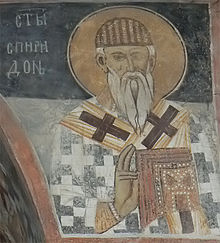
A contemporary Sacred Icon of St. Spyridon showing his beehive woven straw hat, his bishops stole, the blazing potsherd or brick with water dripping from it, and his holding the book of the Gospels (dogmatic truth based on the Holy Scriptures and the Sacred Apostolic Traditions of the Western and Eastern Rites of the Catholic Church. If anyone knows that artist that is responsible for this beautiful icon please tell me and I will credit him/her in this post. Icon found on Wikipedia and originates at St. Spyridon Orthodox Church in Loveland, Colorado (thanks to them for posting the image of this magnificent icon).

220px-Zemen-monastery-st-spiridon
A medieval icon of St. Spyridon, wall fresco, Bulgarian Orthodox, found in the  Zemen Monastery, Bulgaria. Photograph may have been taken by I.E. Stankov in 2012 using a Canon EOS 600D camera.

In the Roman Catholic Church, St. Spyridon is venerated on his feast day, December 14th; and on December 12th in the Eastern Rites and the Orthodox Church.

Thanks for stopping by and reading this post.

Copyright © 2011- 2019, Deacon Paul O. Iacono – All Rights Reserved. Permission to reprint must be obtained from the author in writing. Students, and those interested, may quote small sections of the article as long as the proper credit and notation is given. Thank you.

St. Athanasius – Coptic and Eastern Orthodox Icons

St. Athanasius of Alexandria was “the Lion” of the Council of Nicaea. He was instrumental in providing well argued testimony rebuking the heretic Arius during the Council’s debates. His verbal skills, as powerful and commanding as a lion, shredded Arius’ arguments. His eloquence convinced the assembled bishops of the correct dogma that Jesus Christ has two, separate and distinct, natures (divine and human), and that Jesus Christ is fully human and fully divine. The heretic Arius insisted that Jesus was “just a creature” of God.

Icon-St.-Athanaius-the-Great
A contemporary icon, completed in The Egyptian Christian Coptic style, of St. Athanasius of Alexandria standing on the back of the heretic Arius (seen in very dark colored clothing) at the Council of Nicaea (AD 325). Athanasius is seen in front of the assembled bishops from the Eastern and Western Rites of the Catholic Church. He is holding the Council’s accepted conclusions in the document known as the Nicene Creed. Notice that he does not have a bishop’s mitre on his head similar to the bishops sitting in attendance behind him, and is dressed in what appears to be a deacon’s dalmatic with cape. The style of this sacred icon is very similar to the style of the Coptic (Egyptian) Orthodox Church’s sacred art; yet, the inscription above his head is in Greek rather than Coptic. Image found at churchofourladyofkazan.org; (thanks to them) throughWikipedia images.

The Council’s main purpose was to address the divine nature of Jesus Christ and the concept of HIs being the Son of God the Father. This had to be done in order to squash the Arian heresy once and for all. It was also to establish a date for the celebration of Easter, resolve organizational and clerical issues, and the development of Church law (what today is called Canon Law). They were also attempting  to settle a schism that had occurred in Egypt. That schism was being fomented by another bishop who had enlisted with the heretic Arius.

The Council was also tasked with development of a Christian Creed that would provide unity of belief for both the Eastern and Western Rites of the Church. This unity of belief was critical since the Church needed a formal set of beliefs  that could be used as a catechetical tool and a binder that kept all the cultural and geographical “Catholic” churches together.

The Council of Nicaea basically resolved all the main issues of its agenda. It was a stunning achievement. The priest Arius was banished for promoting heresy and his ideas declared anathema. Yet, the problem the Council still faced was convincing Arius’ followers of their heretical errors. Banishment or not, an unrepentant Arius continued to spread  his opinions fomenting confusion throughout the Empire.

THE_FIRST_COUNCIL_OF_NICEA
The above image is another example of a sacred icon, however, it is not completed in the Coptic style which originated in Egypt. It is an Eastern Orthodox icon (Greek, Russian, or one of the many other Eastern Rites of the Church), completed centuries after the Council ended in the summer of the year 325. It shows a non-heretical bishop castigating the heretic priest Arius (who is raising his hand in an attempt to stop the speaker). The bishop, because of his hat (mitre), appears to be labeled with Athanasius’ name found at the bottom); however, he is not clothed in a deacon’s dalmatic, nor did deacon’s wear that style of hat. It is believed that Athanasius was not ordained a priest and bishop until after the Council ended. The Emperor Constantine sits on the right dressed in imperial clothes and it may be surmised that it is Bishop Alexander of Alexandria (the bishop of Arius’ and Athanasius’ diocese) who sits to the immediate right of the Emperor.

The Eastern and Western Rites of the Catholic and Orthodox Church have always believed that sacred icons and sacred images are always venerated by the faithful; they have never and are never worshipped.To worship sacred icons, sacred images, statues, and other visual reminders of the glory of God and His saints is against the 1st Commandment (confer Exodus 20: 2-17, and Deuteronomy 5: 6 – 21). If anyone worshipped those visual images they would correctly be called idolaters. Worship is for God alone, that is, the Holy Trinity – the Father, the Son, and the Holy Spirit; Three Divine Persons in One God.

Our Savior Jesus Christ is One Person with two natures: human and divine; that is a state of being which is part of the great Mystery of the Incarnation of God into human existence.

Jesus Christ is the Lamb of God, sacrificed in Jerusalem through His Passion, Crucifixion, and death. Jesus, following His Father’s will, suffered and died for us in order to atone for all of humanity’s sins (past, present, future). God the Father and God the Holy Spirit responded by raising Jesus from the dead on the third day, ultimately enabling Jesus to interact and be seen by His Apostles and hundreds of disciples.

Truth, Goodness, Beauty, and Love, incarnate in our Savior.

Thanks for stopping by.

May you continue to have a prayerful Holy Week and a joyous Easter Season.

Copyright © 2011- 2019, Deacon Paul O. Iacono – All Rights Reserved. Permission to reprint must be obtained from the author in writing. Students, and those interested, may quote small sections of the article as long as the proper credit and notation is given. Thank you.
 

The Holy Trinity – Communication Through Word and Art

Is communication just a trait of human beings? Is it a trait of God?

The Dogma of the Holy Trinity is one of the great Mysteries of the Christian Faith.  All Christians acknowledge and accept that The One True God, the divine Holy Trinity, are three separate and distinct Persons of the Father, Son, and Holy Spirit. The Holy Trinity is not three separate Gods. They are one God in three Divine Persons. This is known as the dogma of the “consubstantial” Trinity: each of the three Persons is God – completely and entirely.

These ideas were debated and verified by the assembled bishops at the First Council of Nicaea in AD 325 and subsequent Councils (specifically the ecumenical Council of Nicaea/Constantinople in AD 381).

In the 13th century the Fourth Lateran Council stated: “Each of the Persons is that supreme reality (nature, essence, and substance) of God” (confer Catechism of the Catholic Church, 2nd edition, paragraphs 198 through 315, pp. 54-84).

These three Divine Persons relate and communicate among themselves and desire to communicate and relate with Their creation. This is verified through Holy Scripture, Sacred Tradition, and the historic teachings of the Apostles, the Ecumenical Councils, and the saints of the Church.

The  first of Their creation, the nine choirs of angels, communicate with God and each other, too.

Obviously, human beings communicate and relate through speech, behavior, and the written word, though at times, not very well. To a much lesser extent, there is “communication” in the other members of the animal kingdom (by instinct, chemical, and behavioral signals) and in the plant kingdom (through chemical signals).

God the Father has communicated specifically through His Word, the incarnated Son, Jesus Christ. In accordance with the Father’s will the human Jesus is “born of a woman” into space and time through the great Mystery of the Incarnation of Christ.

Jesus agreed to humbly obey His Father’s will. Through His Incarnation the Divine Son Jesus expresses His two natures: human and divine. He does this while “hiding” the full majesty of His divinity (except for the moments of His Transfiguration, Resurrection, and subsequent appearances to His Apostles).

The Holy Spirit (as the Council of Florence stated in 1439) “Is eternally from the Father and Son; He has His nature and subsistence at once from the Father and the Son. He proceeds eternally from both as from one principle and through one spiration (the life-giving breath of God).”

“When the Father sends His Word to His Creation He also sends His Breath. “Jesus and the Holy Spirit are on a joint mission, while at the same time being distinct but inseparable. It is the Son who is seen, the visible image of the invisible God, while it is the Holy Spirit that reveals Him.” (please refer to page 181 of the Catechism of the Catholic Church, 2nd edition, also pages 54 through 90).

The Holy Spirit communicates and spiritually shapes us through the Holy Scriptures, liturgical and private prayer, the teachings of the Western and Eastern Rites of the Church, and with the Father and Son in the seven Holy Sacraments (in the Eastern Rites – the Holy Mysteries).

The solemnity of Pentecost recalls the full expression of the Holy Spirit’s “Fruits and Gifts” to the Apostles, and through the Holy Sacraments to us, too  (refer in the Christian Scriptures to the Acts of the Apostles chapter 2, verses 1 – 42; and in St. Paul’s letters to the Galatians chapter 5: verses 22 ff; and 1st Corinthians chapter 12, verses 4 ff; also refer in the Hebrew Scriptures  to the book of the prophet Isaiah chapter 11, versus 2 – 3).

iconorininal
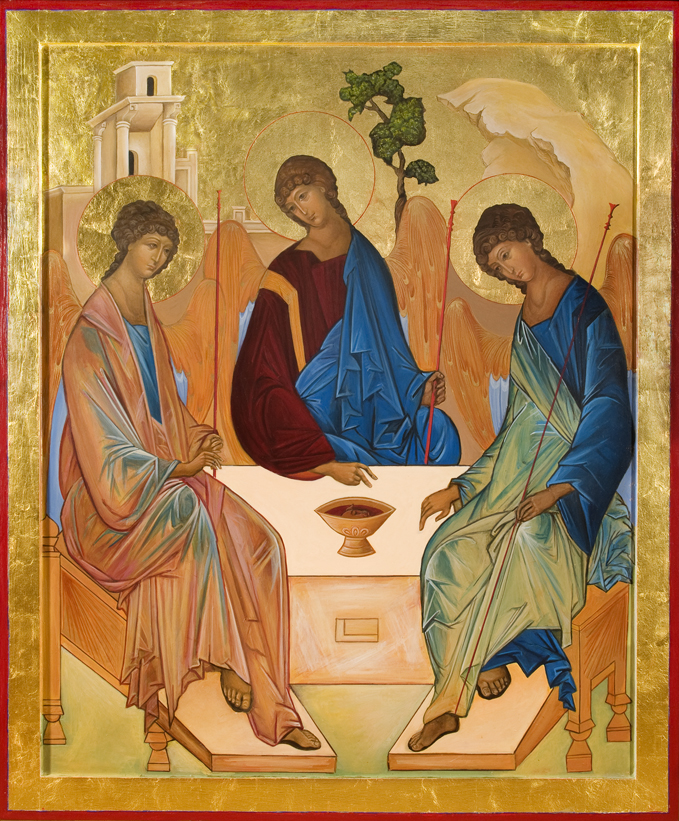
“The Trinity”: early 15th century; egg tempera and gold on wood panel by St. Andrei Rublev (1370 – 1430).  St. Rublev was a Russian Orthodox monk. He resided and “wrote” with egg tempera paint to produce images of God, the angels, and the saints in sacred  icons. He lived at St. Sergius Monastery in Moscow, Russia. His sacred icon above captures some of  the truth of the Three Persons of the Holy Trinity communicating with each other. God the Son, Jesus Christ, is the figure in the center of this painting.  You see two of His fingers extended to express His human and divine nature, and in a pointing gesture, to the “Cup of His Blood”  made manifest through His Redemptive sacrifice. In this masterpiece you observe the colors blue representing divine life and purple madder/burgundy signifying Christ’s humanity. God the Father is on your left and God the Holy Spirit is on your right. The Holy Spirit is garbed in blue and in green as a symbol of new life and spiritual growth through prayer and the Holy Sacraments (Holy Mysteries). God the Father is painted in both blue, green, and a very light, transparent gold ochre. The First Council of Nicaea (AD 325) verified and promoted the Dogma of the Holy Trinity. This Dogma was reaffirmed, and further explained by the Council of Nicaea/Constantinople in AD 381.


trinityicon
A contemporary copy of the original Trinity by Rublev.

God the Father sent His Son to be born of a woman through the fecundity of the Holy Spirit. The Incarnation of Jesus Christ changed the Universe. God became flesh and walked among us. Why?  In order to teach, heal, and redeem us from our sins. The New Covenant with His creation is written in His Blood. There is, if you have the gift of faith, ample proof that God wants to communicate with you.

It is up to each man and woman to honestly determine whether or not they are ignoring Him, and if so, to decide what to do about it. Time is short.

Copyright © 2011- 2019 Deacon Paul O. Iacono All Rights Reserved.

Icons – Important Similarities/Differences

Can you pick out the seven similarities between the two sacred icons of Church Apologists that are below? The differences?

IconPM-Irenaeus-2
St. Irenaeus of Lyons (died circa 201). Famous for his manuscripts Against Heresies. He used 21 out of the 27 books of the New Testament in his writings and sermons.


SAINT-CLEMENT-I
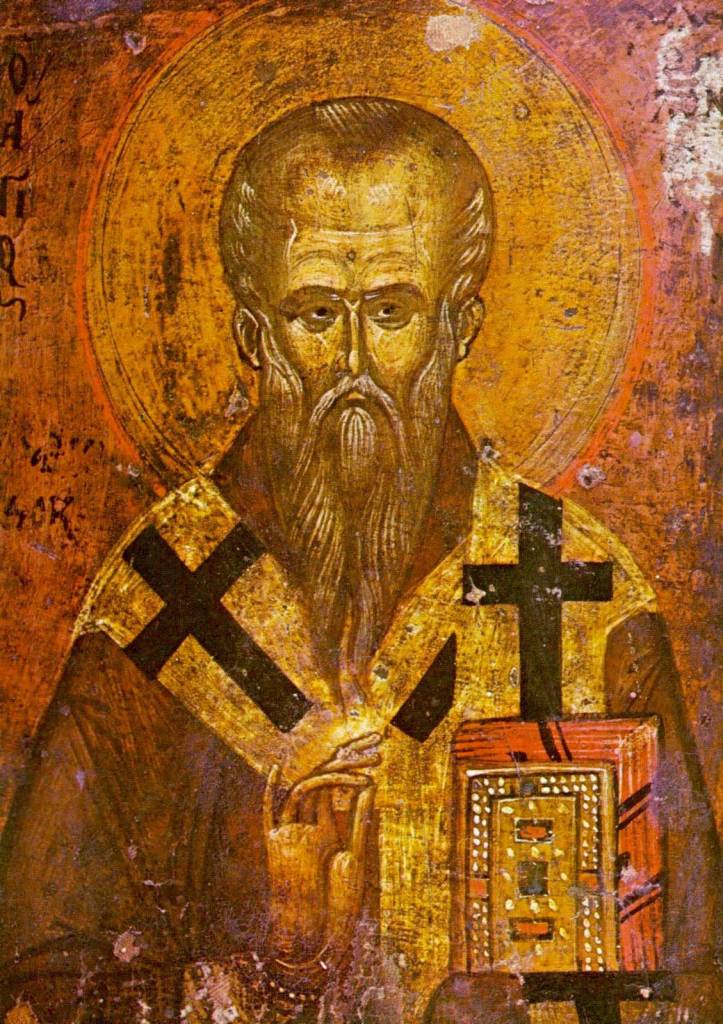
St. Clement of Alexandria, Egypt.  Born AD 150, died AD 215.                                                               Famous for his manuscripts on the Blessed Mother Mary as the New Eve, the significance of the Holy Eucharist, and other catechetical works.

Let’s take a look at the two icons above.

Both are correct in the way they are represented. From an artistic and symbolic point-of-view there are distinct similarities.

They have seven similarities: the beard (signifying experience, authority, and that the saint is an elder); a large, high forehead (signifying Christian wisdom as influenced by the Holy Spirit which is visualized through the saint’s works and knowledge); the Holy Cross upon the priest’s stole (it appears as a garment that circles the neck and extends down the torso which signifies Christ’s Redemptive suffering and the saint’s  willingness to give witness and suffer for Christ); the presence of the book of the Gospels (the revealed truth of God through His Son, Jesus Christ); the script of the saint’s name at the top or side of the icon; and the halo circling the head (representing the sanctity of the saint).

There are two absolutely necessary and critical indicators that designate a valid orthodox icon or sacred image: the artist must distinguish the person represented with his or her name, and, the icon must give witness to their life and ministry to the Church.

How does the sacred artist accomplish this requirement?

The artist needs to follow this rule: if the person(s) represented is/are a cleric (deacon, priest, or bishop) they need to be clothed with the proper vestments of their rank, and prototypical appearance. If their physical appearance is known (such as St. Therese of Lisieux or St. Maximillian Kolbe) they must be represented in a correct and accurate manner. The artist must also represent some aspect that distinguishes their ministry, such as the Book of the Gospels.

This is also true if the person(s) is/are a martyr, holy man or woman, monk, etc. This is, again, necessary since  the faithful need to know the name of the saint so they “may honor, revere, and give salutation to them and aspire after them” (from The Seventh Ecumenical Council: Concerning the Holy Icons).

The differences between these two icons of Church Fathers are primarily in the icons’ age, the colors used by each sacred artist, the adornment of the garments and book of the Gospels, and whether or not the halo, and area surrounding the figure is gilded. Many of these differences reflect the specific culture the sacred artist lived in, the time period of the artist’s life, and the artistic resources (such as pigments) that were available.

Historically, violent disputes broke out between icon supporters and icon destroyers. The situation came to a head in October AD 787, when the 2nd Council of Nicaea, among other issues, reinstated the validity and necessity of the veneration of holy icons/images. It specifically quoted: Genesis 31: 34; Exodus 25: 19 ff; Numbers 7: 89; and Hebrews 9: 5 ff;) in support of their position. The Council Fathers especially cited various passages of the Fathers of the Church which proved to be critical in the authority of their proclamation. They were also heavily influenced by the writings of St. John Damascene. The Council documents were signed by the Byzantine Empress Irene, as many as (or more than) 300 bishops, and two legates of the Pope.

Sacred icons, sacred images, statues, etc are never worshipped. Worship belongs to God alone as represented in the Holy Trinity. The holy personalities represented give witness to unity with Christ and point us in the truthful –  orthodox –  direction. We venerate sacred statues, icons, and sacred images – never worship them. (See the documents of the 7th Ecumenical Council of the Church (AD 787) to reiterate this position).

Church tradition also warns the sacred artist who paints sacred icons to guard against unnecessary innovations and artistic flourishes. Please remember that in my blog I make a distinction between sacred icons and sacred images. My articles on this subject can be found in the Category window found on the top, right hand side, of my Home Page. You may find that my article A Canon for Catholic Sacred Artists, found in the Category: Sacred Artists, in the month April, 2018 (once there, scroll down to April 2, 2018 and you’ll find the article). That article has a short section in the Notes following the ten elements of my suggested “Canon” that express my opinion on the differences between sacred icons and sacred images.

Thanks for visiting with me. My best wishes for a relaxing weekend.

Copyright © 2011- 2019 Deacon Paul O. Iacono All Rights Reserved. Permission to reprint must be obtained from the author in writing. Students may quote small sections of the article as long as the proper credit and notation is given. Thank you. Deacon Paul Iacono, at deaconiacono@icloud.com.


Christian Witness and Sacred Art – The Early Church Fathers – Part 7

A Challenge: Are you as a Christian artist willing to internalize the message of the saint, scene, or Scripture passage you are artistically representing, and then, correctly portray it according to Church tradition?

Sacred artists must have more than just an awarenesses of Jesus, His Mother, angels and  saints because their witness provides us with the foundation stones of our Faith. Sacred artists must be more than artists who propose “Art for art’s sake”.

If we do this what do we become? We become evangelists to the truth, goodness, and beauty of God, through the witness of Jesus Christ and the holy men and women who called Him the Son of God.

In the years immediately following St. Polycarp’s martyrdom (died, circa AD 155, and remembered yesterday, February 22nd, in the Roman Breviary and Missal) a group of eight Western and Eastern Rite scholars and clerics arose known as the Apologists (Defenders of the Faith).

The Apologists defended the beliefs and traditions of the Church that passed down to them, in an uninterrupted line, directly from the Apostles and Apostolic Fathers.  This occurred during the years of continued persecution – AD 155 through AD 313.

The works and ministerial witness of the Apologists provide evidence for the continuity of beliefs and dogmas in the Early Christian Church. It is through this historic development, and the literary and physical witness of their efforts, that we have  religious and cultural traditions which dramatically affected the growth of sacred art. These clerics and scholars desired to unify and establish the beliefs of the Western and Eastern Rites of the Church.

Church artists, and the later group of clerics and scholars known as the Nicene Fathers (who I will cover in later posts), were heavily influenced by their efforts. These two groups, the Ante Nicene and Nicene Fathers all desired to make concrete and visible the correct teaching – the orthodoxy – of the Church. These efforts ultimately produced artistic representations of these early spiritual heroes – a visible sign of the truths of the Gospels being preached – and in some cases, their witness in blood.

The Apologists have also been termed The Ante (Before) Nicene Fathers because they lived and died prior to the establishment of the  Creed of the Catholic Faith, ultimately to be known as the Nicene Creed.

Let us briefly review two of the Apologists: St. Irenaeus of Lyons, and St. Clement of Alexandria. In a subsequent post you will have the opportunity to read three or four sentence descriptions of the contributions of the other six  Apologists.

St. Irenaeus of Lyons was born in AD 130 and died circa AD 202. He speaks of the four Gospels as being the “Four Pillars of the Church,” and was in a position to know that since he heard St. Polycarp (a friend and disciple of the Apostle John) preach. He was steadfast in supporting the belief in Apostolic Tradition. He taught that the true Faith is the one imparted by the bishops of the Church who, in turn, received it directly in an uninterrupted set of teachings from the Apostles. St. Irenaeus was tenacious in his fight against heterodoxy, specifically the Gnostic heresy.

St. Irenaeus understood the value of St. Polycarp’s New Testament scholarship and his emphasis on the Church’s sacred Tradition. He spoke with authority on Mary as the New Eve, and the Holy Eucharist. St. Irenaeus barely escaped death during the persecution of Emperor Marcus Aurelius, however during the round-up approximately 50 other Christians had the joy of earning the holy crown of martyrdom. He may have eventually died a martyr, yet, there is not sufficient evidence to support it.

IconPM-Irenaeus-2
St. Irenaeus of Lyons (died circa 202). Famous for his manuscripts Against Heresies. He used 21 out of the 27 books of the New Testament in his writings and sermons.

Another critical Apologist is St. Clement of Alexandria (born circa AD 150, died circa 215). He led a major catechetical school in Alexandria, Egypt and agreed with St. Irenaeus that the truth and knowledge of the holy Gospels proceed through the bishops and are for the population as a whole and not for any secret society (thus, he fought against the Gnostic heresy).

He taught that in order to understand the truths of the Gospels you must have faith in unison with reason. He is also known for three major catechetical works which are still in existence. These works were meant to accompany catechumens and those baptized into the Christian faith as an aid to their spiritual development. He was not martyred.

SAINT-CLEMENT-I
St. Clement of Alexandria – an Apologist of the Early Church – as represented by an early iconographer of the Eastern Rite of the Catholic Church.


Thanks for stopping by the Institute. I hope you have a relaxing weekend.

Copyright © 2011- 2019 Deacon Paul O. Iacono All Rights Reserved. Permission to reprint must be obtained from the author in writing. Students may quote small sections of the article as long as the proper credit and notation is given. Thank you. Permission to copy these posts must be obtained from Deacon Paul Iacono at deaconiacono@icloud.com.

St. Joseph’s Art Workshop, Lesson 2: Obtaining, Drawing, and Applying the Sacred Image to A Panel

If you click on the Tab in the Menu titled St. Joseph’s Art Workshop, and scroll down, you will find my recent addition (as of April 26, 2018) on painting a sacred image. That new post – LESSON 2 – describes obtaining, drawing, and applying a sacred image to a wood panel. Enjoy!

April 26, 2018         © Deacon Paul O. Iacono 2011-2018

Jesus Our Savior – An Image that is a Work in Progress

I have the happy service of presenting a new workshop to interested adults from Massachusetts and Rhode Island beginning on Saturday February 14th, 2015.

In an attempt to give everyone individual attention the class is currently filled at a limit of ten people. We will be pursuing our studies of painting sacred images in the Latin iconographic tradition. I hope to make the artists aware of the importance of studying the Latin and Byzantine origins of sacred images and its inevitable blossoming within the Greek and Russian civilizations.

The workshop will run over a five-week period, for a total of twenty hours of class time. While they will not be painting the sacred image that is found below of Jesus Our Savior, the technique that I used to paint this image will be taught to the artists. Note that the image is painted using acrylic paints; however, I have developed a different approach in manipulating the layers of the paints. This approach evolved out of studying the work of the 12th century Benedictine monk, Theophilus the Presbyter (whom I have written about in previous essays on this blog), and my own experiments over the past few years of working with egg tempera and acrylic paints.

I specialize in painting personal prayer images (9 by 12 inches, or 12 by 16 inches) rather than images that would be found in large church or chapel applications. The image found below (95% finished) is typical of my approach. It is an image that the person in prayer can relate to, yet, it also carries a sense of transcendence. This approach will be taught in the upcoming workshop. I attempt to teach simplicity in both technique and spirituality. I  avoid flourishes and excessive naturalism in facial or garment representation. In this way I have ignored the typical approach of many Latin Rite sacred artists from the mid 14th century onward. I am attempting to rediscover, or reestablish, the Latin Rite techniques of painting sacred icons. This endeavor is a work in progress!

In the upcoming workshop the students will be studying my technique and actually paint an image of St. Michael the Archangel. Upon completion of that sacred image, they will eventually move on to painting an image of the Holy Theotokos, the Blessed Mother, and then complete the sequence in studying and painting a sacred image of Jesus Christ. In upcoming posts I will be blogging about their experience and the steps that they will take in completing the sacred image of St. Michael.

My approach to the painting of sacred images in the iconographic tradition owes a debt of gratitude to my many teachers in the Byzantine and secular artistic traditions. I also owe a profound thank you to the Holy Spirit, whose grace has enabled my hands to paint sacred images. I pray that my sacred art has not offended Him. The image below appears slightly brighter than it actually is as a result of the flash.

Jesus Our Savior by Deacon Paul O. Iacono, Fra Angelico Institute for the Sacred Arts, Copyright © 2011- 2015 Deacon Paul O. Iacono All Rights Reserved


Copyright © 2011- 2015 Deacon Paul O. Iacono All Rights Reserved

Albert Lapierre – Sacred Artist and Iconographer

This past July I had the pleasure of restoring an icon that was written by the fine artist, Albert Lapierre, from Attleboro, Massachusetts. It is a beautifully done and was commissioned by Joan O’Gara on the occasion of the birthday of her sister, Rosalind, in October, 1998.

Rosalind told me that her sister knew of her appreciation and devotion to the Gospel account of the Visitation of Mary to her cousin Elizabeth; however, Joan was not able to locate a print of this particular icon. In 1997 Joan decided to contact Albert Lapierre who was resposible for the creation of many religious objects, statues, and sacred images. Prior to his passing he had a store and studio in Attleboro, Massachusetts. There are many examples of his work at the LaSalette Shrine in Attleboro.

At the time of Joan’s request, Albert was busily engaged at the Shrine with many projects, and was reluctant to take on another commission. Joan persuaded him, however, to take on this project – telling him that “Our Lady really wanted him to paint this image.” I am told that he didn’t have a comeback for that request!

Mr. Lapierre was able to fit its creation into his busy schedule and it was varnished and ready to be delivered by October, 1998. Needless to say, Rosalind was thrilled by Joan’s gift and it remains to this day an important focal point in Rosalind’s prayer life.

Time does take its toll and the icon sustained some accidental damage over the years. Rosalind located me through a Google search and phoned for a consult. She was especially concerned about areas that had chipped and lost pigment. We met and discussed the damage and she requested that I try to repair it as best as possible.

The repair turned out to be an interesting challenge. First, I believe that it is absolutely essential that a restorer not impact or change the design, colors, or compositional elements of the piece being restored. Respect for the original artist, and what they created, is paramount. Ultimately, the viewer must be able look at the restored piece and be unaware of the fact that it has been restored. There should be no distractions from the original intent of the artist.

My biggest challenge in this restoration was matching the original colors. For this particular icon Mr. Lapierre used acrylics. Since the painting was only seventeen years old, and had not been kept in direct sunlight, the paint had not deteriorated or dulled to any great degree. Thus, my task was to repair the chips that could be restored and then blend in the pigment restoration. The restoration was a success and it was blessed, and delivered to a grateful Rosalind, at a Mass here in South Kingstown at St. Francis of Assisi Church in August 2014.

Albert Lapierre died a number of years ago. Sadly, I never met the man that created such a sensitive and dynamic icon. It was a distinct honor to work on it. I thank Joan and Rosalind O’Gara for the privilege of doing so.

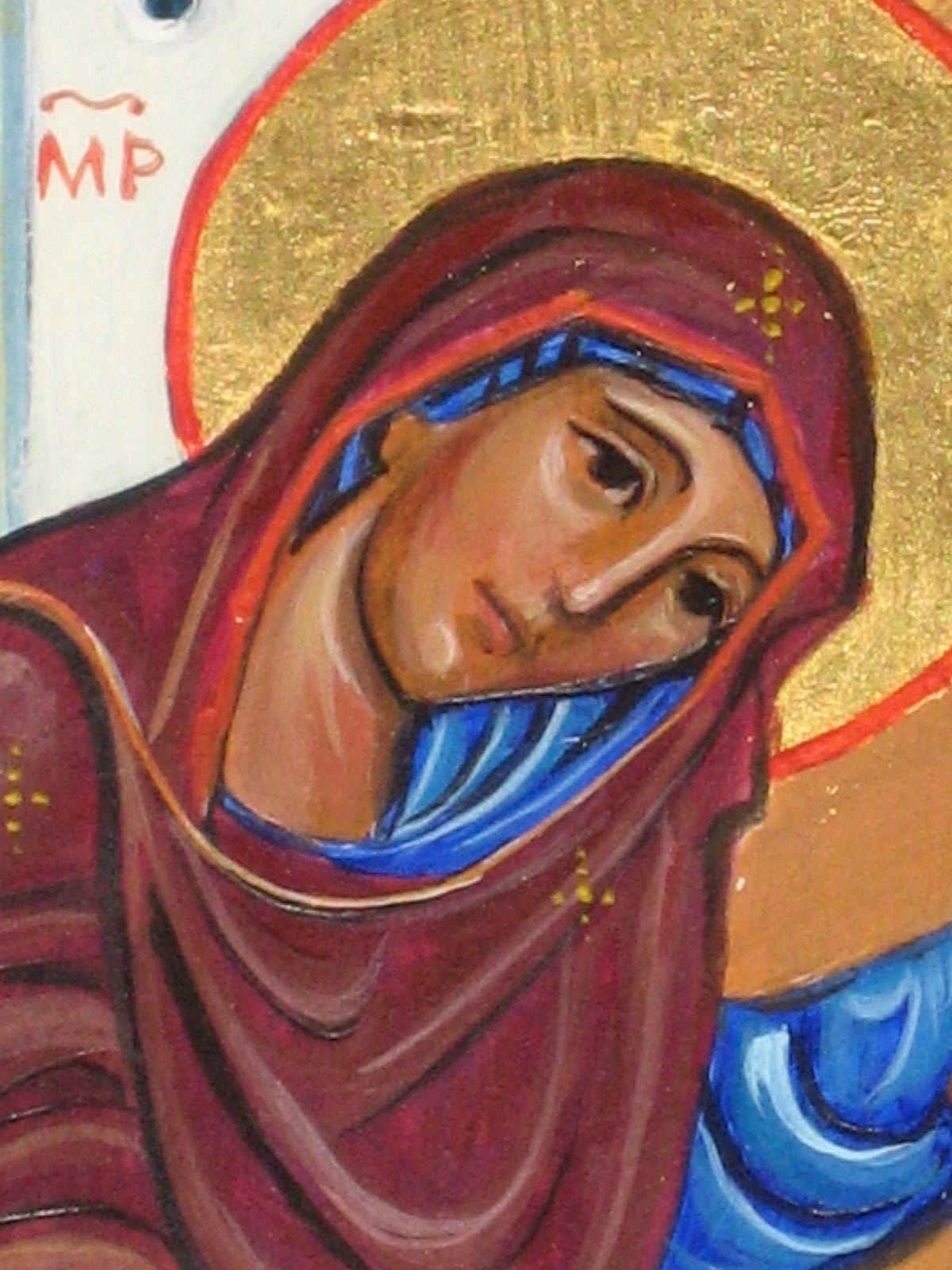
Below are a few images of the piece with a close-up of Mary’s face, and the beautiful catechetical scene of Elizabeth’s husband, Zechariah, praying in the Temple.

Copyright © 2011- 2014 Deacon Paul O. Iacono All Rights Reserved

IMG_3803


IMG_3805

IMG_3813

A Recent Art Workshop Leads to Another! – The Fra Angelico Institute

This past month the Fra Angelico Institute for the Sacred Arts was happy to sponsor a two day workshop. The purpose of this workshop was to introduce people to the idea that everyone has the capacity for expressing themselves in art. Using acrylic paints the participants were taught the process of “seeing” an image of a rose, breaking down its component parts, drawing the rose, applying and mixing pigments, painting the rose, etc.

Our desire was to ultimately interest people, who possibly never considered themselves as having artistic talent, to see that they could paint a good quality representation of an object. This would then lead to their participation in a sacred art workshop in which they would be learning how to reveal, through prayer, study, and artistic techniques, the spiritual message of sacred images painted in an iconographic style.

IMG_0119

I am happy to say that this workshop will lead to another sacred art workshop here at St. Francis of Assisi Church in Wakefield, Rhode Island. We will conduct our Spring 2014 workshop on Saturday mornings from 9:30 to 11:30 on March 29th, April 5th, 12th, and 26th. An assessment will be made on the 26th to determine if we need additional sessions. The cost of the workshop is $35.00.

Each participant will receive a photocopy of a sacred image, personal instruction, a brief “process” manual of steps, a 1/2 inch wooden board, and brushes. Tube acrylic paints will be provided.  If each participant desires their own tube of paints the cost will be higher. Members of the Institute, or others interested in the process of painting a sacred image in the iconographic tradition, are welcome to contact me by March 20th if they desire to participate in the Spring 2014 workshop. Members of the Institute who have participated in past sacred art workshops will be given the opportunity to paint a new sacred image in the iconographic style. If you are interested please email me at frainstitute@cox.net. 

Copyright © 2011- 2014 Deacon Paul O. Iacono All Rights Reserved

Aidan Hart’s New Book on Sacred Iconography

The article below is reblogged from the always informative Orthodox Arts Journal. The article is the 9th in a series about sacred iconography that was written by Brother Aidan Hart, a British iconographer. Brother Hart has written extensively on all aspects of sacred iconography and has recently published a very comprehensive book on the subject called Techniques of Icon and Wall Painting. The editor at the Orthodox Arts Journal highly recommends it. Brother Hart’s articles are available at his website and he also offers sacred iconography workshops in Britain. This nine part article is well worth the effort of perusing through all of it. His series contains many gems of information that will add to your knowledge of the sacred arts. Links to his site and the series are provided for you below.

Designing Icons (pt.9): Perspective Systems in Icons [from Orthodox Arts Journal]

April 16, 2013

By 

____________________________________________________________

 Editorial note:  We have convinced Aidan Hart to post a chapter from his new book. “Techniques of Icon and Wall Painting” which is being hailed as the most comprehensive book to date on practicing the art of Iconography.  At 450 pages, with 460 paintings, 150 drawings and covering everything from theology and design to gilding and varnishing, it is a prized possession for anyone interested in the traditional arts.  The chapter being serialized over the next weeks is called “Designing Icons”.  You will see why Archimandrate Vasileos of Iviron called this book the “Confessio of a man who epitomizes the liturgical beauty of the Orthodox Church”.  More details about the book on Aidan’s website.    

____________________________________________________________

In this section, Aidan discusses the different perspective systems used in icons.

This is part 9  of a series.  Part 1Part 2 Part 3Part 4Part 5Part 6Part 7Part 8

Inverse perspective.

With inverse perspective the lines of a building do not converge on a point on the horizon, inside the painting, but instead they converge on us, the viewers. This serves to include us in the action depicted. The Orthodox hymns make it plain that a sacred event in the past is still acting on us today: “Today Christ is born”, they say, “Today Christ is risen. Let us join with the angels in praising His third day resurrection!”

The Hospitality of Abraham / "Old Testament Trinity" by Fr. Silouan

An example of inverse perspective.  The Hospitality of Abraham / “Old Testament Trinity” by Fr. Silouan

Inverse perspective also gives us the sense that the persons depicted are looking out at us. It is as though the image is drawn not from our own point of view but theirs, and ultimately, God’s. We have already discussed the meaning of repentance as being a change of seeing. We could also explain it as a change of perspective, where we realize that we are not the centre of the universe, but God.

Inverse perspective also draws our attention to the real space between the image and ourselves. The emphasis is on the grace coming to us through real space, rather than us being drawn into an imaginary world or reconstructed scene within the picture. Iconography is above all a liturgical art, designed to be part of a larger sacred dance that involves the church building, the space within the building, the hymns sung within it, and the liturgical movements during services.  As Gervase Mathews puts it:

In the Renaissance system of perspective the picture is conceived as a window opening on to a space beyond…The Byzantine mosaic or picture opens onto the space before it. The ‘picture space’ of Byzantine art was primarily that of the church or palace room in which it was placed, since art was considered a function of architecture.[1]

Flatness

Icons do not attempt to create a great sense of depth. They do use enough highlighting and perspective to affirm that the material world is real and good and part of the spiritual life. Nevertheless, things are kept somewhat more on a plane than in naturalistic painting. In a group icon, like that of Mid-Pentecost for example, people in the rear will be shown the same size, or sometimes even larger, than those closer. Every person is thus kept intimate with the viewer. The mystery of the person overcomes the limits of physical space and distance.

an example of flatness. Mid Pentecost, by Aidan Hart

an example of flatness. Mid Pentecost, by Aidan Hart

Why else do icons retain this flatness? It helps us to pass through the icon to the persons and the events depicted. The aim of the icon is not to replace the subjects depicted, but to bring us into living relationship with them. This explains why statues are not as a rule used in the icon tradition. Their three dimensionality makes them too self contained. Where sculpture is utilized it is kept to base relief.

Romanesque cross by Aidan Hart

Romanesque cross by Aidan Hart

Flatness can also be seen as a intentional weakness, a deliberate imperfection that constantly reminds us that this image is not the reality but a door to its prototype.

There is also an honesty in this flatness. There no attempt to make the picture plane what it can never be, a three dimensional object, let alone the real thing itself.  Incidentally it is this honesty to the picture plane that inspired the American art movement called colour field painting of the 1940’s and 1950’s.

Planarity also gives much greater freedom to arrange things according to their spiritual importance rather than being limited to their position in three-dimensional space. The figures within the icon of Christ’s birth, for example, are often arranged in three bands to represent the heavenly, earthly and unitary realms, and also in a circle centred on the Christ child

072Nativity 3 copy 2

This symbolic arrangement would not be possible if the event were depicted naturalistically, with figures receding toward the distance.

Multi-view perspective

Sometimes a building is shown as though seen simultaneously from left and right, below and above. This helps us to see things as God sees them, and as they are in themselves and not merely as they appear from our single view-point, limited as this is to one place at a time.

073IMG_3774 copy 2

The same multi-view perspective is sometimes applied to time, where the same person is depicted more than once in the same image, such as with Christ in the Nativity icon. The icon tradition can also place an important person in an event at which they were not historically present, but in which they later came to participate spiritually. Icons show things from the view of divine time (kairos  in Greek) and not merely chronological time (kronos). One example is Saint Paul in the Pentecost icon (fig. PentecostIMG copy.tif). He was not even a believer at the time of Pentecost, but later came to be great among the apostles and a pillar of the Church together with Peter, who is shown opposite him.

Isometry

In this approach the sides and edges of an object are depicted parallel, neither converging nor diverging. This affirms how a thing is in itself, rather than how it appears to us. All things have been called into unity in Christ, and this unity preserves and strengthens the integrity of each thing, rather than reducing it to a numerical one. Unity presupposes relationship which in turn presupposes otherness, though not separateness. Isometry affirms this otherness.

An example of isometry

An example of isometry

Hierarchical perspective

Often a personage who is more important than others will be enlarged. A typical example of this is the Virgin in the Nativity icon (see Nativity icon posted above). Conversely someone might be made particularly small to make a spiritual point. The Christ Child is often depicted thus in Nativity icons, to emphasize God the Word’s humility in becoming man for our sakes.

Vanishing point perspective

Although inverse perspective is more commonly used, we do also find instances where lines converge toward a point in the icon’s distance. This is not pursued in the systematic, mathematical way devised by the Renaissance painter, architect and sculptor Alberti Brunelleschi. In fact when this system is used you are likely to find as many convergence points as there are objects. This in itself transports the viewer out of the static vantage point assumed by mathematical perspective, and presupposes instead a much more dynamic experience – surely something closer to our actual experience of life.


[1] Gervase Mathews, page 30.

Theophilus, Iconography, and the Contemporary Sacred Artist – Part One

Today’s sacred artist within the Western tradition may have been exposed to many different artistic traditions. Artists may have been classically trained in a formal academy such as the Florence Academy of Art, or, they may have been educated at a secular institution that emphasizes a modern abstract expressionistic form of art. Other models are available, too. Some artists may have been self-taught, or, as in my case, study with specific masters of sacred art that offered intensive workshops to interested groups or individuals.

Upon my retirement from a career in education, I finally had the opportunity to study and actually make art. I knew that the form of art that I wanted to pursue was sacred art and sacred iconography spoke to me as a specific art form. Sacred art necessarily carried with it two elements that were critical for me: a devotion to conversation with God while making the art and an interest in a specific historical methodology for the creative process.

Between 2006 and 2010, I happily studied with four contemporary masters in the field of sacred iconography. They taught me different approaches, techniques, and the use of a variety of materials. This was all well and good, a necessary series of steps for a student artist to go through in order to develop some sense of familiarity and a working comfort level.

After spending time with the last two of my art teachers (Marek Czarnecki and Anna Pokrovsky Gouriev) an important question  had to be answered. They wisely asked all of us to eventually answer this question: “Do you want to paint sacred images in the Russian Orthodox or the Western Latin Rite tradition?”

You see, Marek is Roman Catholic and Anna is Russian Orthodox. They both paint/”write” sacred icons in the Russian Orthodox tradition. Anna’s mother, Ksenia Pokrovsky (marylowell.wix.com/hexaemeron-6#!__xenia-pokrovsky) is a master iconographer who has added a great deal to our understanding of the techniques of sacred iconography within the Russian Orthodox and earlier Byzantine traditions.

Ksenia founded the well known Izograph School of Iconography near Boston, MA, and Marek and Anna assist her with teaching, the creation of sacred icons, and restoration work. Their work is quite beautiful and I highly recommend them to you, your parish, or an educational institution that is interested in high quality iconographic work in the Byzantine tradition.

It is important for a contemporary sacred artist to understand the artistic approaches of the Byzantine/Russian tradition. I learned a great deal from them, not only about sacred art but about myself; yet, their question continued to haunt me. For the year or so after I studied with them I continued to paint in the Russian Orthodox tradition. My first teachers in this art form – Peter Pearson and Dimitryi Andreyev – had built a strong foundation for me. Dimitryi’s father Vladislav, founded the Prosopon School of Iconography, another influential school, in New York City (www.prosoponschool.org).

So, with all of this rich and fruitful tradition passed on to me by four wonderful and prayerful people, I was still left with the unanswered question: Orthodox or Latin Rite? My training had been in pure Orthodox tradition. Wonderful as it is, I still had not answered the question Marek and Anna had posed. Before I could answer it I had to discover if there was a Latin Rite tradition to painting sacred images/icons. This brought up the question of “Why is it that when we hear talk of “sacred icons” today it is always in the context of the Byzantine Catholic/Greek/Russian Orthodox Rite?”

The Western European/Latin (Roman) Rite of the Catholic Church had co-existed and was in communion with the Greek Orthodox/Byzantine/Eastern Rite since the first century. It was 900 years old prior to Russian Grand Prince Vladimir of Novgorod formally converting the Russian people to the Eastern Rite of the Catholic Church. So you would think that there would have been some communication between the Eastern and Western Rites of the Catholic Church and the sharing of information and ideas about sacred art.

So, why do we now just associate sacred icons with the Eastern Rite tradition? It is primarily because of the western European sense of artistic experimentation and creativity that developed around the 12th century. Different artistic, theological, and philosophical traditions developed within Western Europe that affected the Latin Rite of the Church and produced different artistic results. Yet the Byzantine Rite’s art continued to influence Latin Rite artists all the way up to the fourteenth century.

Whereas the Greek/Byzantine/Russian Orthodox approach to sacred art and icons remained steadfast to tradition. While there were different “schools” of sacred iconography within their tradition and different masters anchoring those schools, they always remained faithful to the basic tradition of painting/”writing” sacred icons. You begin to see a shift in thinking within this tradition in the early 18th century when influences from the Western European artistic tradition begin to seep into the Orthodox schools and workshops.

Usually when we think of Latin Rite sacred art we have the images of Giotto, Michelangelo, Leonardo, and Raphael immediately pop into our mind. As Pope Benedict XVI has said in his book The Spirit of the Liturgy the Latin Rite had three specific stages of sacred art develop in its history: the Iconographic, the Gothic, and the Baroque. Each one of these stages contributed to the liturgical life of the Church and had a unique catechetical message for the faithful. It is not to say that the Renaissance artists, many of them working with sacred themes, did not contribute to the artistic tradition of the Church. They certainly did, however, their emphasis, at times, was more on pleasing the patron then on fostering a sense of prayer in the individual penitent.

So, I spent the year 2012 investigating the sources of the Latin Rite’s artistic tradition. The next few posts will reveal what I found, and the fact that a very talented 12th century metalworker and artist, the Benedictine monk Roger of Helmarshausen (also known as Theophilus) was at the forefront of the Latin Rite’s artistic techniques.

It was what Theophilus taught me that finally allowed me to answer Marek and Anna’s question and change my artistic technique. The witness and work of the good Benedictine Theophilus continues to inspire me in the teaching of my own students the prayerful benefits of sacred art. More on Theophilus in the next few days!

Copyright © 2011- 2013 Deacon Paul O. Iacono All Rights Reserved

Our Lady of Guadalupe – An Icon of The Woman Who Will Crush The Serpent

Today’s feast of Our Lady of Guadalupe, the patroness of all the Americas, recalls the apparition of our Blessed Mother on the hill of Tepeyac in present day Mexico City. This approved apparition occurred from December 9th through the 12th 1531. Guadalupe is the Spanish translation of the Aztec phrase that Juan Diego heard Mary associate herself with – the name, interestingly, in Aztec means “she will crush the serpent of stone.”

In the same year as this Marian apparition, rebellion and protest against the Latin Rite of the Catholic Church was sweeping Germany, France, and England. While millions of people were leaving the faith in Europe, the  Blessed Mother, through the miraculous image that appeared on Juan Diego’s tilma, convinces millions of people to enter the Catholic faith in Central America.

As the European rebellion was tearing down millennia of Church theology and sacred tradition, Our Lady was building up the understanding of both the Spanish clergy in Mexico and the Native American population of the love of God and the assurance of her compassion and protection.

Our Lady spoke to Juan Diego in his native dialect. She identified herself and said:  “Juanito, the humblest of my children, know and understand that I am the ever virgin Mary, Mother of the true God through whom all things live. It is my ardent desire that a church be erected here so that in it I can show and bestow my love, compassion, help, and protection to all who inhabit this land and to those others who love me, that they might call upon and confide in me. Go to the Bishop of Mexico to make known to him what I greatly desire. Go and put all your efforts into this.” (footnote 1)

You probably know the rest of the story. The Bishop is told of this event, disbelieves Juan Diego, and then the bishop asks for a sign. Juan Diego reports back to Mary and is told by her to cut the Castilian roses that are growing and put them in his poncho which is called a tilma. The tilma is opened in front of the Bishop and other witnesses, the roses fall out, and the miraculous image of Our Lady appears on the tilma.

But is this story true?

Here are some of the historical facts:

1) The extraordinary conversion of multi-millions of Native Americans, and the Aztecs in particular, who, as a blood thirsty civilization, were known to kill as many as 20,000 human beings in one day to appease the blood lust of their primary god.

2) The roses that Juan Diego cut were native of Damascus, Syria, and did grow in Spain, but were unknown in Mexico at that time.

3) The tilma, or poncho, that Juan Diego wore was made of the agave fibers traditionally used by the Native Americans. These fibers were a natural substance that should have deteriorated within 35 years, and yet, today, the 481st anniversary of the event – this tilma is still in excellent condition.

4) Through scientific analysis done over the last forty years, it has been determined that the pigments used on the tilma are not of natural or man-made material, and there is no glue or sizing on the tilma to fix the pigment in place. Plus the colorization or iridescence of the image on this “icon not made with human hands” would not have been able to be produced by a human artist in the 16th century. This iridescent effect would have been seen only in nature.

5) Our Lady is represented in the colors and dress of a pregnant Aztec princess. Modern astronomical research has shown that the stars on Our Lady’s image are in the configuration of the stars in the heavens on the nights of the apparition in 1531.

6) Most remarkably, a microscopic analysis of Our Lady’s eyes was completed by Peruvian engineer and optical scientist Dr. Jose Aste Tonsmann (who trained at Cornell University and worked at IBM). He magnified the iris of the Virgin’s eyes 2,500 times and, through mathematical and optical calculations, was able to identify the witnesses of the Guadalupan miracle at the moment Juan Diego unfurled his tilma before the bishop and other witnesses [the bishop was Juan de Zumarraga, the Franciscan bishop of Mexico City.] (footnote 2)

But most importantly, these few miraculous facts about the icon of Our Lady of Guadalupe, do not stress the key issues of this apparition:

1) You see, Our Lady came to the Mexican people – as she comes to us this Advent season – as a pregnant young woman who is promoting life and her protection – not only for her unborn child – but for all of us.

2) Our Lady calls to us through this icon to stress that she loves us, has compassion for us, sees our tears, and desires to offer us her love and comfort.

3) As the Mother of the incarnate Son of God she also points to her Son, and desires a church to be built so He can be properly worshipped, the people receive His graces, and so she can be there to assist us in our prayers to God.

4) Mary has always reminded us that He is the One, True, All Powerful God who desires our love, respect, and obedience.

As the Roman Breviary says this morning: “Who is this that comes forth like the dawn, as beautiful as the moon, as resplendent as the sun? You are the glory of Jerusalem, the joy of Israel; you are the fairest honor of our race. O Virgin Mary, how great your cause for joy; God found you worthy to bear Christ our Savior.”

And as the Book of Revelation tells us, God has found Mary worthy to crush the head of the Serpent. All praise, honor, and glory be to God! And may the Blessed Virgin’s love help transform us into the image of Christ. Amen.

Copyright © 2012 Deacon Paul O. Iacono All Rights Reserved

Footnotes and  sites to investigate for more information:

(1) From a report by Don Antonio Valeriano, a Native American author of the 16th century; as published in the Supplement of the New Feasts and Memorials for the General Roman Calendar – The Liturgy of the Hours.

(2) “Science Sees What Mary Saw From Juan Diego’s Tilma”   Zenit News Service, 2001.

Zenit News Agency. Science Stunned by Virgin of Guadalupe’s Eyes. 1/14/2001

http://www.miraclehunter.com/marian_apparitions/index.html

Summer 2012 Workshop in Painting Sacred Images – A Few Reflections

Over the past six years I have participated in numerous workshops in sacred art and have produced a number of sacred images, each of which helped me understand the techniques of this sacred art.

In 2006, I participated in my first workshop at St. Michael’s Institute of Sacred Art at St. Edmund’s Retreat in Mystic, CT. The instructor was Peter Pearson, an Episcopal priest from Pennsylvania. He introduced the class to the beautiful and prayerful experience of painting a sacred image in the Russian Orthodox tradition; however, rather than using egg tempera paints (in which you mix the yolk of an egg with natural earth and mineral pigments) he taught the techniques using acrylic paints.

A note on acrylics versus egg tempera pigments. I personally believe that they are both valid materials to use. I have studied and painted images in each of these techniques and I personally do not have a solid preference, although, I believe it is helpful for a student to learn the techniques in acrylic first and then study sacred imagery using egg tempera pigments. I find both materials – natural or synthetic colors – enjoyable.

There are some people in the Internet community who become quite exercised over the fact that there are artists creating sacred images using acrylic paints. It is not necessary to get into, as Pearson would say, “the egg wars” debate, other than to mention that all sides are respectfully entitled to their opinion. Neither the Catholic or Orthodox faith exclusively owns sacred art, imagery, or iconography. Church art has always been (for at least the last 1500 years) an outgrowth of the Catholic and Orthodox creative spirit desiring to unite art with prayer. It was certainly part of the early tradition of the Roman Catholic Church prior to the winds of Western civilization moving the Catholic artists’ barque into Gothic, Renaissance, and Baroque ports of call.

In the late 20th and early 21st century, a growing element of the sacred art tradition of the Roman Catholic (and the Eastern Rites churches which are in union with Rome) has revolved around reestablishing traditional sacred imagery and iconography as part of the Catholic artistic heritage. Sacred iconography has always been a part of the Orthodox churches liturgical tradition, and they are to be saluted and commended for keeping the bright light of this sacred art tradition alive within the Church community.

It is probably part of the Western European/American mindset to accept and utilize new developments in artistic materials and techniques. This is why I believe some of us do not have any problem using acrylic paints. Acrylics are synthetic paints (composed in a lab) rather than natural earth or mineral pigments. My personal spirituality does not think that the Lord is concerned with the materials used in prayer, rather, He is interested in the intent and the creative outcome of that sincere prayer. You use what you think works, have fun with, and is readily available. There are many ways to catch a fish – as the Lord said to Peter – “throw out your nets again!”

So, on a practical level acrylic paint can be fun to work with, but it can also be problematical. Years ago Peter Pearson recommended a line of paints to us from the Chroma company called JoSonja. These paints are primarily used in the decorative crafts, yet, because of their color lines, they fit the bill for painting in a more traditional way – similar to the Russian tradition. By this I mean that the Russian Orthodox colors are primarily muted, unlike the Greek Orthodox who had a wide range of brilliant colors to choose from for their artwork. Geography and geology play an important part in understanding the color palette and artistic techniques of a civilization.

The nice thing about the JoSonja line of paints (available at DickBlick.com and other outlets such as Jerry’s Artarama) is that they are inexpensive but of surprisingly good quality. They also have an entire range of mediums, (such as flow medium and glazing medium) which are essential in getting the results you want, especially for the multi thin layering and highlights of the image’s face. The JoSonja line has also produced a polyurethane satin varnish that compliments the chemistry of the paints and mediums in their line. It was used on my sacred image for the recent workshop and went on without any problem. I applied this varnish with a one and one-half inch flat wash brush from Princeton Art and Brush Company (item # 4050 FW). It has very fine and soft bristles – perfect for streak free varnishing. I must give you a warning: work quickly as the varnish dries rapidly. It is non toxic and cleans up with soap and water.

I produced a manual for the workshop which explained each step, yet, found myself talking more than I really wanted to, owing to the fact that this was the participants first sacred image, and for many, their first venture into art in many years. A sacred image workshop should be a place in which the participants can enter into prayer while they paint; hopefully, the next workshop will more conducive to this necessary element.

All the adult participants were very good sports and reacted with quite a bit of patience to some of the more difficult parts of the process. They were all happy with the results and want to embark on another workshop – which is good news! Please find below a few photos from the workshop and the Mass at which the sacred images were blessed. You can see the images in the sanctuary in front of the altar. I am behind the altar to the left vested in a green dalmatic, and Father Joseph Upton the Institute’s chaplain, has his hands raised as he recites the blessing over the sacred images. Thanks again to everyone who participated and see you soon!

Copyright photos and images © 2012 Deacon Paul O. Iacono All Rights Reserved

A Sacred Image – The Sun of Justice, Jesus Christ

You are probably thinking, the poor old fellow has made a mistake in his spelling. Shouldn’t the title read “Son” of Justice?

One evening a passage from Evening Prayer in the Divine Office caught my attention. It was the final prayer and it read: “Father, yours is the morning and yours is the evening. Let the Sun of Justice, Jesus Christ, shine for ever in our hearts and draw us to that light where you live in radiant glory.” That phrase provided this image’s title: Sun of Justice, Jesus Christ.

My intent was to have the image direct the prayerful observer to meditate on the truth that Jesus Christ is metaphorically the Sun, which as a result of His obedient and willing sacrifice on the holy wood of the Cross, shines in our hearts. It is up to us to prevent its eclipse in our soul.

Through his death and resurrection He redeemed us of our sins and guides us back to the Father. He is the Son and the Word of the Father. He is the Light of the World. He is also the Sun of Justice, in that we as individuals will all surely have His light illumine our souls and be judged by His standards.

The face and garments of the sacred image are not  painted in the artistic language of traditional iconography. I made preliminary sketches and based them on the drawings and wood carvings of Brother Martin Erspamer, O.S.B.      I attempted to emulate woodcarving methods.

I am happy to say that when you are praying in its presence it does provide comfort to your soul.

This sacred image of The Sun of Justice, Jesus Christ was a gift to Fr. Joseph R. Upton. He is a wonderful and holy priest who serves as the Chaplain of the Fra Angelico Institute for Sacred Art.

Essay and photo of the above sacred image – Copyright © 2012. Deacon Paul O. Iacono All Rights Reserved

Ken Jan Woo – sacred artist

Please see my post of July 9, 2020 entitled Chinese Martyrs and the Art of Ken Jan Woo. Thank you.


Icons, Icon Painters, and Praying With Sacred Icons: Part One

A few issues have come up in discussing some basic terms with people. I would like to be clear on how I have come to understand these words because it may affect how we view our “ministry” to be painters of sacred icons and or sacred images.

From my understanding, the word icon in English, Greek, and Latin, is the word for image. In our usage as sacred artists, it refers to a sacred image of Our Lord, Our Blessed Mother, angels, or specific saints. The purpose of a  sacred icon is that, as a piece of sacred art, it  focuses an individual in prayer.  A sacred icon is a specific type of sacred art. It is created following certain traditions – tradition with a small “t” and a large “T.”

Many sacred icons are presented with a simplicity of style, the use of color, the types of colors used, the use of symbols, etc. A sacred icon is different from a sacred image, in that the sole purpose of the sacred icon is that it is to be used as a focal point for personal or communal prayer.

A sacred image, however, may have been commissioned by a patron for personal prayer, but it may also have been commissioned for the pure enjoyment of its beauty. In the case of Renaissance sacred art, the Roman Catholic Church became the patron of many pieces of sacred art in order to affect the communal prayer of the faithful who came to the small churches and the great basilicas for Holy Mass.

With a sacred image (such as a religious image painted by Michelangelo or Leonardo) you have the artist’s personal imagination heavily influencing and entering into the creation of the beauty of the image, possibly even manipulating and combining Scriptural passages for the purpose of the story the artist would like to tell. Yet, even though I have just made that statement, the truth of the matter is that it is not always so clear cut. We do have icons, such as the famous Nativity icon of the birth of Christ, in which you have numerous Scriptural passages – conveying different events – being used to convey a catechetical sequence surrounding the birth of Our Lord – and all of this is done on the same icon panel!

In a sacred icon, the imagination of the artist is present, yet, it is supposed to be subordinate to his/her faith’s perception of Sacred Scripture and Sacred Tradition (how the early Church viewed their beliefs and expressed them within their specific cultural tradition). So, if a sacred artist is painting a sacred icon, he or she is aware of the theological, aesthetic, and semantic rules that have been developed and followed through the centuries. These rules – “the Canon of Iconography” – are affected by cultural area and religious Sacred Tradition.

For example, a Coptic sacred icon (see image below), by a painter of the Egyptian Coptic Church will express the image of Christ and a saint (in the icon below an abbot of the Coptic Christian Church) somewhat differently than a Greek or Russian Orthodox painter; and yet, there is nothing wrong with this, as long as the painter is not fomenting apostasy or heresy.

All of that being said, sacred images, for example, by Renaissance painters, can certainly be used to focus an individual in their personal prayer, as do the beautiful stained glass windows of the great Gothic cathedrals. Care must be taken, however, in selecting appropriate images for use in personal prayer. It is my perception that the type of image a soul uses in personal prayer – sacred icons (from the Eastern Rite) or sacred images (from the Western Rite) – is a matter of personal preference and certainly does not  indicate that one type is better or “more truthful” than another. Eastern and Western sacred artists are both working off of their own perceptions and spirituality; there are disagreements with this, but we must always remain charitable with each other.

Within the last twenty years there have been many Western sacred artists that have rediscovered the beauty of painting sacred icons, and are trying to be sensitive to the Eastern Rites’ traditions,  as they bring it back into the consciousness of the Roman Catholic Church. The Eastern Orthodox Churches, thankfully, never lost appreciation for their tradition.

I will post Parts Two and Three on this same theme in the upcoming days. Be sure to look for them on-line or in the archives. Thanks.

Copyright © 2012 Deacon Paul O. Iacono All Rights Reserved

The image of Christ and the Abbot – a panel depicting a monk with Christ. It was excavated in the early 20th century from a monastery in Egypt and is located in the Bawit room at the Louvre. Thanks to: Photo by Clio 20, CC attribution share-alike 3.0. I believe the icon dates to about the 7th century.