We Are All Blind – We Are All Needy

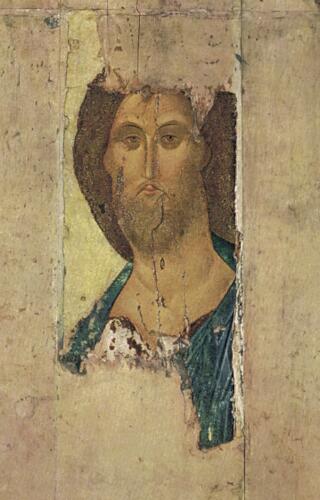
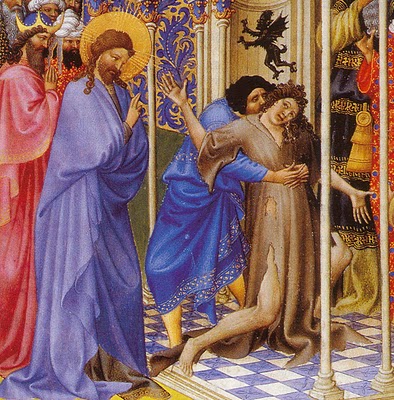
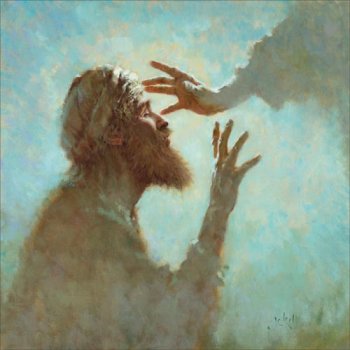
There are three parts of this morning’s Gospel that we should highlight. The first is that the blind man is petitioning the Lord for His help. The lesson from this is that we should never feel guilty or selfish in our continuous requests for assistance from God.

At times we become so overwhelmed with our cares, that we stop our appeals. This may occur out of frustration, a sense of futility, distraction, or weakness of faith.

This sense of frustration directly leads to the meaning of our second highlight, which is the reaction and rebuke of the crowd. The crowd, in its frustration to quiet the blind man – actually censured the man’s faith, attempting to get him to stop and go away. We too, at times, may feel the frustrated rebuke of our own wills which, like the crowd, is molded by the consequences of Original Sin.

Rather than scream at us, our wills may quietly yet incorrectly whisper in our ears that our prayers are not heard, and that we should stop, and retreat, from the Lord’s presence. This, in turn, leads to the Gospel’s final highlight which contradicts our inclination to retreat and run away from prayer. You see, the blind man gives witness to the importance of courageous personal faith.  He shows us that the public rebuke by the crowd did not discourage him because he had faith.

How do we obtain the faith of the blind man? The answer is simple to say, but difficult to implement, because we must first acknowledge that we, too, are needy. The blind man knew that he was in need of Jesus’ healing power, His grace, and he didn’t allow the screams of his own anxiety, or that of the crowd, deter him from petitioning Jesus.

The blind man engaged his heart, mind, and will to not only petition but to believe that the Lord would respond and heal him. His actions, in their clarity and simplicity, are a model for us, too.

As we approach our Thanksgiving holiday, let us remember to give thanks not only for our material blessings – but for the most important spiritual one – the joyful knowledge that our baptismal faith in the Lord and His Holy Sacraments have healed us from the darkness of sin and given us the ability to see the saving power of Jesus in our own lives.

Copyright © 2012 Deacon Paul O. Iacono All Rights Reserved     Image source:http://joshmcclellan.files.wordpress.com

Bishop Josaphat Kuncevych – A Saint of Forgiveness and Unity

In this morning’s Gospel from St. Luke (17: 1-6) we hear Jesus imploring His disciples to teach and practice the art of forgiveness toward those who hurt and abuse us, our families, and friends.

Jesus is teaching that it is so important for people who want to be considered His disciples to follow His example and in no way offer a bad example or scandal to others. Jesus is emphasizing the power of faith to assist us in our efforts to be His disciples. People of faith possess the grace to forgive others.

Our desire to model Jesus enables our hearts to be filled with the grace of the Holy Spirit. This, in turn, empowers us to demonstrate our faith and yes, do the impossible in touching and moving the dead weight of a person’s soul who is mired in sin and dissension.

Faith is infused into our souls at the moment of our Baptism. It is increased at our First Holy Communion and every subsequent Communion, and is increased further still when we receive the Sacrament of Confirmation. The grace of Faith is given to us so that we may possess the spiritual energy to develop a personal relationship with God, and, those around us.

With today’s Gospel in mind we can say that God expects more from us than we can do by ourselves. You see God wants us, with His help, to scale the mountains of our own difficulties and to climb upon the crosses of our everyday life. It is through this stress and burnishing that we receive, in His love, the personality that makes us ready to be His partners in eternity.

We are given numerous examples of this truth through the various saints of the Eastern and Western Rites of the Church. Today we remember Bishop Josaphat Kuncevych who died in 1623. He was born in Poland, and raised within the Ukranian Orthodox Church. He however, as a young adult, converted to the Latin Rite of the Church, became a monk of St. Basil, and ultimately was ordained a bishop.

His fidelity to the Roman Catholic Church, and his outstanding ability to convince members of the Orthodox Rite to unite with Rome while still preserving their Slavonic rite and liturgy, led to his murder and martyrdom for the Church. His enemies dubbed him “the thief of souls.”

St. Josaphat Kuncevych took today’s Gospel to heart. He is, as Pope Pius 11th said of him “the great glory and strength” of the Eastern Rite Slavic Church. He literally was a mover of the mountain of disunity, and energetically believed that there should be fraternal bonds of respectful love, liturgy, and unity between the Eastern and Western Rites of the Catholic Church.

Let us pray today for St. Josaphat’s intercession to obtain the grace of his strength, love, and sense of forgiveness so that we, too, may carry out the Lord’s desire to see the various Rites of His Church living in love and unity.

Copyright © 2012 Deacon Paul O. Iacono All Rights Reserved

St. Teresa of Avila – On Love

On October 15th we celebrate the Memorial of the great Spanish saint and the first woman declared a “Doctor of the Church” – Teresa of Jesus, also known as Teresa of Avila.

Saint Teresa grew up in the early 1500’s and at the age of 20, entered the Carmelite convent in Avila. She freely admitted that for twenty years she had a very difficult time with prayer and distractions. Compounding the problem was the lifestyle of her fellow nuns. In the 16th century, Spanish convents were very relaxed places since a festive, vain, and worldly attitude was prevalent. The idea of strict discipline, contemplative prayer, and living a life of poverty and service was not a priority.

At the age of forty, Teresa’s life suddenly changed. While she was praying she had a profound religious experience. She fully realized the depth of the sacrifice God’s Son Jesus had made for humanity and vowed to pursue a life of spiritual perfection, centering on poverty and developing the art of mental prayer known as contemplation.

She realized that the Carmelite convent that she was living in was not contributing to her spiritual life; and with characteristic energy, she decided to break away from it. With her friend St. John of the Cross, she founded a reformed Carmelite order for friars and nuns known as the Discalced Carmelites. Her new order met with great hostility both from within the Church hierarchy, the regular Carmelite Order, and from the local parishioners, yet, she didn’t give up on her vision of reformation from within the Church.

What does her witness have to say to us today?

First she teaches us the value of perseverance. Both in prayer and in the vision we have been given by God to do whatever He asks us to do. Getting up, going to work every day, reforming a religious order or providing a home for your loved ones, completing your work for the Church – all of this – no matter how mundane or important, is fulfilling the will of God and is evidence of your love for Him.

Second, her life was a model of charitable patience. St. Teresa of Avila received a great deal of verbal, emotional, and spiritual abuse by fellow Catholics. This woman suffered both from physical and mental pain. The physical pain was caused by numerous ailments, however, her emotional pain was caused by people, fellow Catholics, that should have known better, yet, sadly, were far from practicing the cardinal virtues or willing to see the need for internal reformation.

But most importantly, her experiences give us a wonderful description of the art of contemplation and love of God.  In one of her books she says, “Mental prayer, in my opinion, is nothing other than an intimate sharing between friends – between Jesus and ourselves; it means frequently taking the time to be alone with Jesus whom we know loves us. The important thing is not to think much about saying a lot of words, but to love much, and do those actions which best stirs you to the love of our Lord. [What is this spiritual love?] Love is a desire to please God in everything.”

Saint Teresa of Jesus died in 1582 at the age of 67. She disliked gloom and always attempted to radiate joy, cheerfulness, and good spirits. In spite of her many physical ailments and emotional sufferings she kept her sense of humor and her vision of reformation: of self and of her beloved religious community. Her books are filled with optimism as well as a profound understanding of prayer, human nature, and spiritual warfare. We would be wise in applying to our own restless spirits the advice she gave to her fellow nuns, she said:  “Let nothing trouble you, let nothing make you afraid. All these things pass away. God never changes. Patience obtains everything. God alone is enough.”

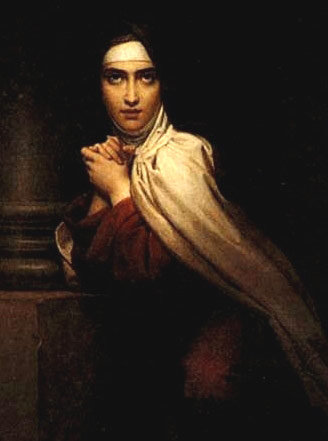
Copyright © 2012 Deacon Paul O. Iacono All Rights Reserved.   Notes on the painting: The above painting is by one of the great painters of the early 19th century – Francois Gerard. Gerard, who died in 1837, painted this masterpiece of St. Teresa of Avila ten years earlier. It was commissioned for a hospital and before its placement was shown in the salons of Paris. It is one of the great masterpieces of French Romanticism. It is painted in oils, on canvas, and measures approximately 3 feet by 5.6 ft.

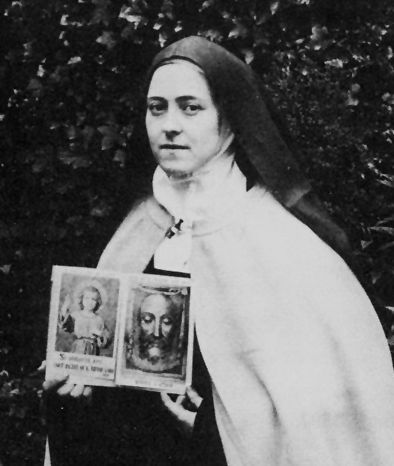
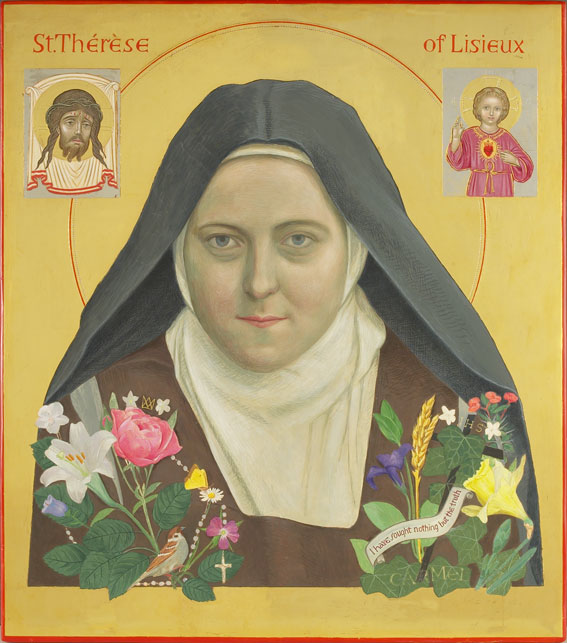
St. Therese of Lisieux and the Christian Way of Beauty

On October 1st we celebrate the memorial to Saint Thérèse of The Holy Face, also known as St. Thérèse of Lisieux and St Thérèse  – The Little Flower. She was born Therese Martin in France in 1873 and died from tuberculosis 24 years later in 1897. When she was fifteen she entered the Carmelite monastery at Lisieux and took the name Thérèse of the Child Jesus and the Holy Face.

She lived a life of simplicity, humility, and trust in God. “Therese never went on missions, never founded a religious order, and never performed great public works. Her only book, published after her death, was a brief edited version of her journal called Story of a Soul,” and in it she dramatically proclaims, “’Love proves itself by deeds, so how am I  to show my love? Great deeds are forbidden me. The only way I can prove my love is by scattering flowers and these flowers are every little sacrifice, every glance and word, and the doing of the least actions for love.’

Her spirituality and her method of achieving holiness is known as “her little way” – her little way – let’s examine for a moment what that means.

Therese saw herself as a child of God. She liked to keep things simple and focused. Trust, especially trust in God, is a childlike, not a childish  virtue – childlike, because its qualities consist of innocence and being down-to-earth. She believed that life presents many challenges and opportunities for grace. This was a young woman who tolerated great emotional, physical and spiritual suffering, yet, she was able to rise above all of it.

Her “Little Way” coaches us to do the ordinary things of life with extraordinary love. A smile, a note or email of encouragement, a phone call or visit, joining your suffering to the suffering of Jesus and Mary, being positive rather than giving in to the impulse to be grumpy, doing simple unnoticed tasks to help another person – deeds done with the love of, and for Christ, who is within each person – this is the heart of her “little way” – her Christian spirituality.

Saint Therese would say that the smallest action, done with love, is more important than great deeds done out of obedience or self-gratification. She was an average person who saw that our daily life is truly not average or ordinary because it provides us with the opportunity for union with Jesus and His life giving energy and grace.

We can also see her greatness in her method of prayer; again, Therese teaches simplicity – talk to the Father, Son, and Holy Spirit in a direct, personal and genuine manner. She tells us, “For me, prayer is a surge of the heart; it is a simple look turned toward heaven, it is a cry of recognition and of love, embracing both trial and joy.”

“She did not like long repetitive prayers; in fact, she was known to fall asleep during community prayer.” What she excelled at was prayer from the heart; she prayed from her heart as a child speaking honestly and trustingly to a parent they love.

We honor Saint Therese today because she was faithful to the Gospel of Jesus and the heart of His message.  So many Catholics are drawn to her because she has shown them that sanctity through simplicity is possible for all of us. She helps us understand that short heartfelt prayers, and simple deeds done with love for both Jesus and neighbor, are a sure path to union with Christ. She truly lived the Christian way of beauty.

Copyright © 2012 Deacon Paul O. Iacono All Rights Reserved. Special thanks to the website the Society of the Little Flower – http://www.littleflower.org/ for information about St. Theresa’s life; and to the iconographer Guillem Ramos-Poqui who painted this beautiful icon of St. Therese of the Holy Face in 2009. It measures 29″ by 251/2 inches.

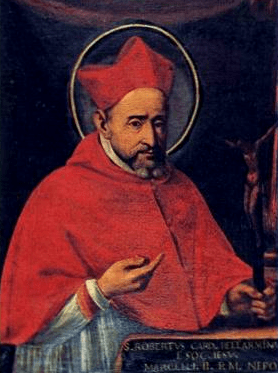
St. Robert Bellarmine, Galileo, and the Glory of God

Today, September 17th, the Church celebrates the memorial of Cardinal Robert Bellarmine. St. Robert was born into a noble Italian family during the crisis filled 16th century – a time of great artistic and scientific achievements and a time of heart breaking dissension within the Catholic Church.

In 1560, St. Robert entered the Society of Jesus, became a teacher, and was ordained ten years later. St. Robert’s Jesuit superiors sent him to the Catholic University in Louvain and there he developed a reputation for scholarship, disputation, and eloquence. When he returned to Rome in 1576, he became a professor of theology and began the systematic dismantling of the Protestant positions on faith and spirituality.

His book Disputations on the Controversies of the Christian Faith criticizing and refuting the Protestant errors was so effective, and caused such a stir throughout Europe, that special faculty positions were established in Protestant colleges in an attempt to refute Bellarmine’s positions.

So why is Saint Robert Bellarmine important for us today?

First, his witness as a scholar and cardinal expresses that the Church must always remain vigilant in its mission to promote the truth and protect its Apostolic and Sacred Tradition. Second, Robert Bellarmine as a Jesuit was loyal to its motto, which is “All for the greater glory of God.” In that motto, you have the structure of a Jesuit’s life, of Saint Bellarmine’s life, for through it he was able to weigh issues in the balance of whether or not they promoted the truth of God’s glory. Allow me to provide a very brief example.

Bellarmine was involved in the early stages of the astronomer Galileo’s difficulties with the Church. In 1615, Cardinal Bellarmine was interested in, and open to, various types of scientific research. He recognized that indeed, the Church’s own astronomers had validated many of Galileo’s scientific observations, and he was certainly knowledgeable of the fact that Cardinal Barberini (the future Pope Urban the 8th) had spoken with Galileo and gave Galileo his personal support.

So what was the problem?

Cardinal Bellarmine said in an open statement that, because Galileo’s scientific theories were not sufficiently supported with solid evidence, then Galileo should follow the position of the Church and call his theories a hypothesis and not scientific fact; and very importantly, he went on to say that, if Galileo’s theories were solidly proven to be true, then care must be taken to interpret Holy Scripture only in accordance with these new scientific truths.

Galileo rebelled against this common sense position. He demanded that his theories be acknowledged as scientific truth and publicly said so. The Holy Office, St. Bellarmine, and the other cardinals had no other choice than to censure him.

They did so not because they completely disagreed with his scientific theories, rather, the censure occurred because Galileo was promoting his ideas as scientific truth when, in reality, he did not have conclusive proof to do so. It should be remembered that St. Bellarmine, in dealing with Galileo, did so “in a sympathetic and not in a heavy handed way.” Bellarmine saw his duty to reason and ethics, and, the decision’s impact on a continent in social and religious turmoil.

Cardinal Bellarmine died in 1621. He was canonized in 1930 and made a Doctor of the Church  a year later.

Galileo had some virtues, however, prudence does not appear to be one of them. As the years went on he continued to do his research; but ultimately got himself into trouble again when he published a book which made his friend, Pope Urban 8th, look like a simpleton.

As a result of this insult, in 1632, he was called to Rome to stand trial for a second time. At that trial the ideas in his new book were examined, and sadly, the case was mishandled on both sides. It was unfortunate that Cardinal Bellarmine was not there to add his reason and judgement. Galileo died ten years later while under house arrest. Many of those years were spent in continued research and writing on various scientific topics.

Cardinal Bellarmine desired to see God glorified, and understood that science, music, art, and architecture were just a few of the ways to do it. He said in one of his essays: “May you consider truly good whatever leads to your goal of the glory of God and your eternal salvation with Him. May you consider truly evil whatever makes you fall away from it.”

Copyright © 2012 Deacon Paul O. Iacono All Rights Reserved

Our Lady of Sorrows – Seven Sorrows – Seven Graces

Today is the memorial of Our Lady of Sorrows.

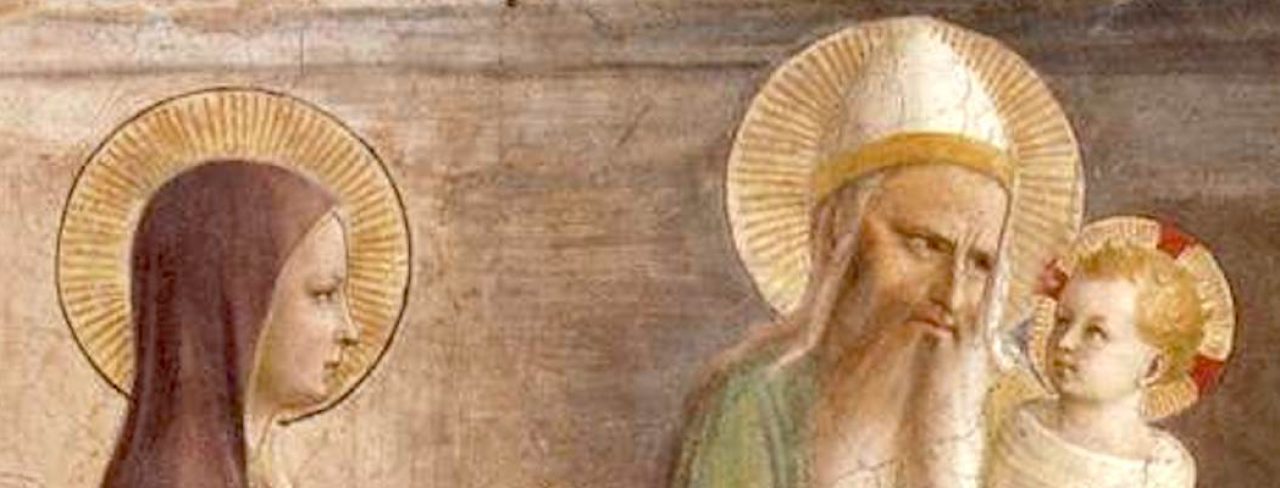
The Roman Breviary tells us that in a sermon by St. Bernard of Clairvaux he explains that “The martyrdom of the Virgin is set forth both in the prophecy of Simeon and in the actual story of our Lord’s passion. The holy old man said of the infant Jesus: He has been established as a sign which will be contradicted. He went on to say to Mary: And your own heart will be pierced by a sword.”

Yesterday, we celebrated the feast of the Exaltation of the Cross. That feast asks us to remember that it was through the Cross, through the violent execution of our Lord, that our redemption took place. The triumph of the Father’s love for His creation, and the Son’s sacrifice, was able to reorder a sin filled world.

As St. Andrew of Crete reminds us “the legal bond of our sin was cancelled and through His death we obtained our freedom and death was trodden underfoot.” Today, the Church in its wisdom again reminds us of the scene of Christ’s victory – and the people that witnessed it.

St. Bernard of Clairvaux eloquently reminds us that along with the death of Christ you have Golgotha being the scene of the martyrdom of Mary. He stresses the phrase, the martyrdom of Mary, because Jesus, as Mary’s child, held a unique and special place in her heart. This is true of the relationship of every mother to their child or children.

All mothers will tell you that every one of their children is special to them; all the more so with Mary, who knew and understood the role that her child was to play in our lives. So when the lance tore through His chest and entered His heart, the prophecy of Simeon, uttered so many years earlier flooded into her mind: “He has been established as a sign which will be contradicted, and your own heart will be pierced by a sword.”

Mary witnessed the execution, she saw the spear tear through her Son’s lifeless body and the violence of that act ripped through her as well. Her body and soul filled with pain and, at that moment, she suffered the martyrdom of every mother who witnesses the death of an innocent child.

At Golgotha, watching the agonizing death of her Son, our blessed Mother, in obedience to the Father’s will for her life, stood by the Cross not only to witness the death of her obedient Son, but to hear her Son say that she was to now be the mother, not only of John, but all of us who believe in Him as Lord and Savior.

Through the sufferings of Mary, the mother of God, we have been made sharers in Christ’s passion. Through Mary’s original obedience to the Father’s will and invitation, we have be given the supreme gift of being able to participate in His Sacramental life, which enables us to share in His rising to everlasting life.

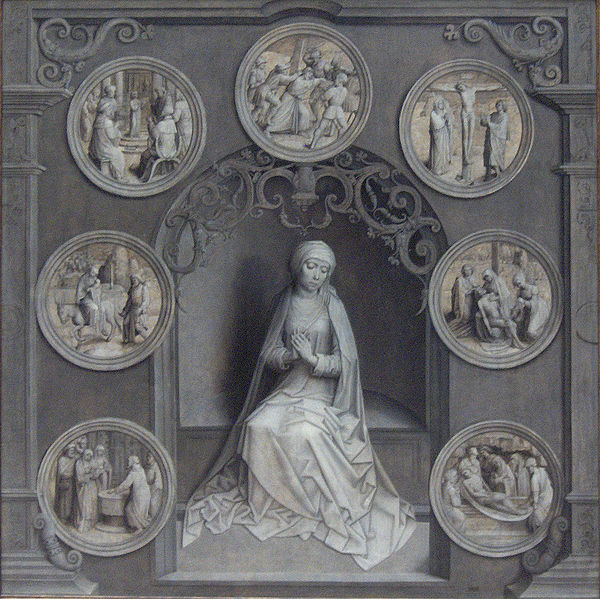
The Church has identified “Seven Sorrows” of Mary: 1) The prophecy of Simeon, 2) The flight into Egypt, 3) The loss of the child Jesus in the Temple, 4) The meeting of Jesus and Mary on the Way of the Cross, 5) The Crucifixion, 6) The taking down of the Body of Jesus from the Cross, 7) The burial of Jesus.

According to the 14th century visions of St. Bridget of Sweden, mystic and patroness of Europe, Our Blessed Mother Mary grants Seven Graces to all souls who honor her on a daily basis by saying seven Hail Mary’s and thinking about the above Seven Sorrows. The Seven Graces are: 1) Mary will grant peace to their families; 2) They will be enlightened about the divine mysteries; 3) They will be comforted in their sickness and assisted in their work; 4) They will be given additional graces as long as what the soul asks for does not violate the will of Jesus or the eventual sanctification of their own soul;  5) Mary will defend the soul in their own particular spiritual battle with the demons, and, will provide her protection to them; 6) The soul will be helped at the time of their death and will experience seeing the face of the Blessed Mother; 7) Mary told St. Bridget that she obtained these graces from Jesus so those souls who are in the state of grace and spread this devotion among their families and friends will be attain Heaven.

St. Paul’s 2nd Letter to Timothy (2: 10-12) directs us to the Scriptural truth of these ideas when he says, “I bear with all this for the sake of those whom God has chosen, in order that they may obtain the salvation to be found in Christ Jesus and with it eternal glory. You can depend on this: If we have died with him we shall also live with him; if we hold out to the end we shall also reign with him.” These words, while not said by Our Blessed Mother, were in reality, lived by her.

our-lady-of-sorrows

Let us pray that through Our Lady of Sorrows, her love and grace shall bring the hearts of all of us to her Son, so that His Heart may reign in the hearts of all mankind.

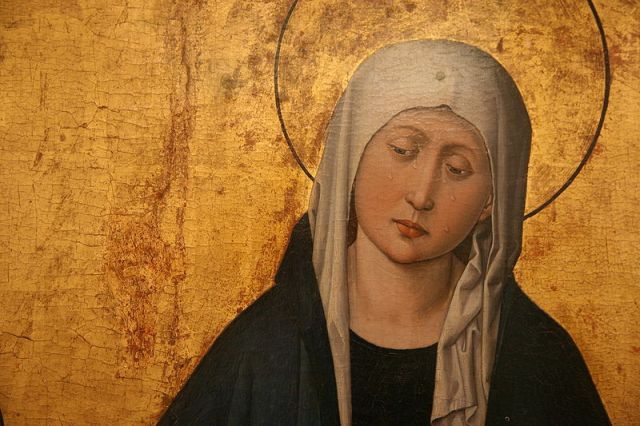
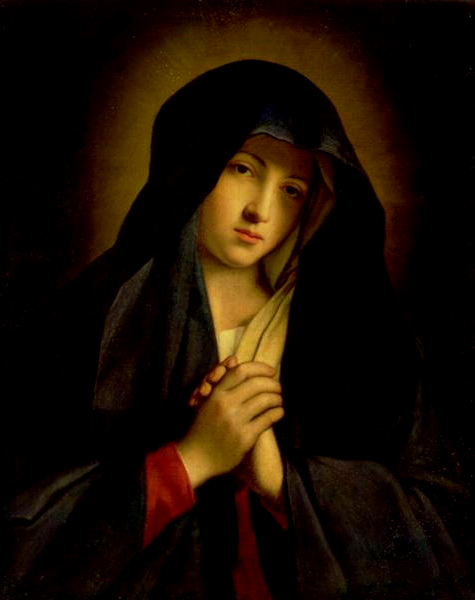
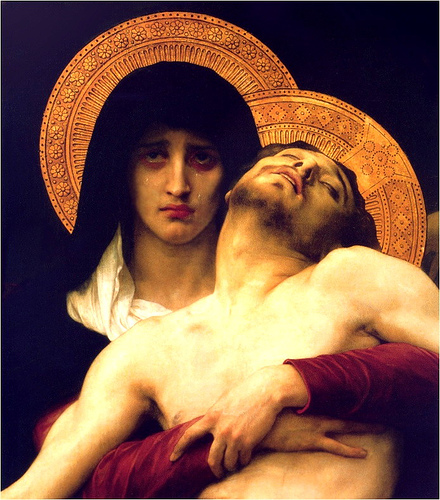
Copyright © 2012 Deacon Paul O. Iacono All Rights Reserved. Notes on the paintings: The first painting is an archetypal Gothic Lady of Sorrows from a triptych by the Master of the Stauffenberg Altarpiece, Alsace, c. 1455. The  second image is of a 15th century sculpture for a cathedral door showing the Seven Sorrows of Our Lady (by Adriaen Isenbrandt, circa 1490 – 1511). The third image, The Madonna in Sorrow, is by the 17th century Italian artist Giovanni Salvi (also known as Sassoferrato). The fourth painting is by William- Adolphe Bougereau, a French realist painter (1825 – 1905).


The Exaltation of the Holy Cross of Jesus

Today we celebrate the feast of the Exaltation of the Holy Cross.

During the first 280 years of its life the Catholic Church was severely persecuted. The symbol of the Cross, the symbol of public humiliation and excruciating death, was rarely used in our Christian iconography. But this doesn’t mean that the early Christians were reluctant to express their devotion to the Cross. Writing in the year 204, the Christian theologian Tertullian said: “At every going in and out, when we put on our clothes, when we sit at table, in all the ordinary actions of daily life, we trace upon the forehead the sign [of the Cross].”

In the year 313, the Emperor Constantine signed the Edict of Milan which proclaimed toleration for the Christian faith within the Roman Empire. Constantine’s mother, Helena, made a pilgrimage to the Holy Land, and with the support of the local bishop, excavated the area known as the site of Golgotha.

Tradition states that portions of the true Cross, with a partial nameplate still attached was found, resulting in Constantine ordering that the Church of the Holy Sepulcher be built over the site. The church was dedicated nine years later, with a portion of the Cross placed inside it.

So the feast that we celebrate today marks the dedication of the Church of the Holy Sepulcher in the year 335. That Church was unfortunately destroyed by the Muslims in the year 1009, only to be rebuilt centuries later, with the new occupants, all Christians from different Rites of the Catholic Church, vying for control of the site.

Unfortunately, even among our brother Christian Churches – Orthodox, Latin, Ethiopian, Coptic, there have been numerous clashes and conflicts over the control of the site. It is as if these guardians of the Church had not internalized the meaning of the true Cross, the meaning of what happened on that site 2000 years ago, the meaning of the supreme sacrifice of God’s love.

Our Holy Scriptures tell us that Moses lifted up the bronze serpent, a sign of sin, and the people were healed. Jesus makes an analogy of the serpent with the healing power of the Cross, since it is a sign of our sin and our redemption.

The meaning of the Cross takes on a new dimension as a result of  the Father, through the power of the Holy Spirit, resurrecting Jesus from the dead. The Resurrection transforms the Holy Cross into a sign of Christ’s victory over sin and the opportunity that we have to personally choose to accept His victory and make it a part of our life.

God, through the instrument of the Holy Cross, shows us the level of His love for His creation. The Father shows His love for us by giving us the best He has, His Son, and His Son shows His obedience and trust in the Father,  through His willingness to become a perfect offering, a pure sacrifice, back to the Father on our behalf.

Let us pray that we, on a daily basis, attempt to imitate this profound love of God. Our love is strengthened by the truth of our faith, and by the historic reality of the Cross. When we do this we will understand that the crosses that we carry, and the sufferings that we endure, unite us to the Lord, and help us transform our lives into His.

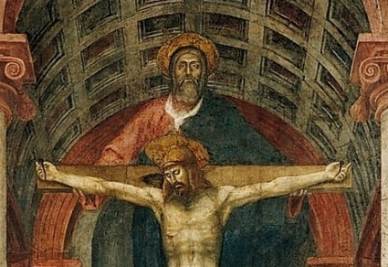
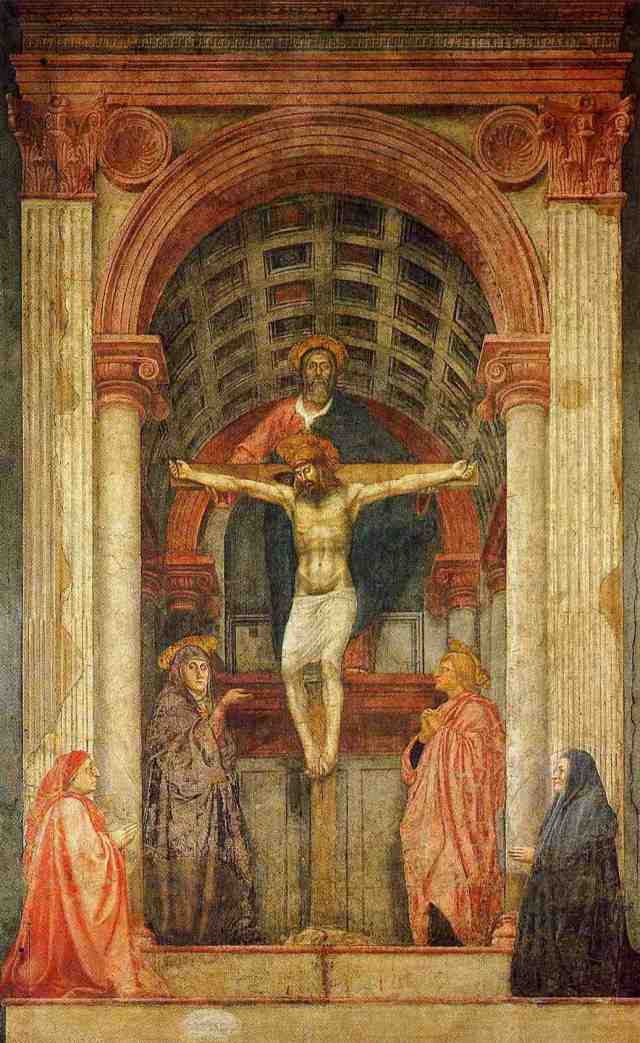
Copyright © 2012 Deacon Paul O. Iacono All Rights Reserved.  Notes on the painting: The above fresco painting and its close-up were completed by the Italian painter Masaccio during the years 1425-27. It is currently located in the church of Santa Maria Novella in Florence, Italy. This is a very important painting in the history of western liturgical art for it combines the images of the Father, Son, and the Holy Spirit (the white dove that appears as a scarf or collar around the Father’s neck). Current research mentions that the brilliant engineer and architect, Philip Brunelleschi, may have been consulted by Masaccio since he had continued the research into the ideas of linear perspective. You can view this sense of linear perspective in this painting in the three dimensional aspect of the vaulting behind the figures. Brunelleschi had continued the studies on linear perspective that were started by the famous painter from Siena, Peter Lorenzetti, in the early 1300’s.

The Most Holy Name of Mary

This is my third post in as many days on Our Blessed Mother Mary. September is an appropriate time to remember the significance of Mary in the life of the Church and, more importantly, in our own lives. For as the Mother of God she is, necessarily, the mother of our own spiritual life. She nurtures us to understand that her Son is always there for us. He does not impose Himself on us and neither does Mary. They desire us to freely choose kinship with them.

Today, September 12th is the memorial of the Most Holy Name of Mary. The name Mary is one of the Greek forms (others being Maria and Mariam) of the Hebrew Miriam (Miryam; and in Aramaic, Maryam). Webster’s Dictionary defines its meaning as “rebellion,” another dictionary refers to the name as meaning  “strong.”

It is interesting to note that Mary’s name contains within it the seed of understanding who and what she means to the Church. God the Father, from all eternity, fashioned Mary in His mind to be His future daughter. The Holy Spirit, at  her immaculate conception, shaped her heart, mind, soul, and body. The incarnate Son of God, Jesus, was in turn shaped by her own womb, and at the end of those nine months, gloriously born to become the Redeemer of Man.

Our Catholic Catechism speaks of this when it says, “Mary, the all-holy ever-Virgin Mother of God, is the masterwork of the mission of the Son and the Spirit in the fullness of time. For the first time in the plan of salvation and because his Spirit had prepared her, the Father found the dwelling place where his Son and his Spirit could dwell among men. In this sense the Church’s Tradition has often read the most beautiful texts on wisdom in relation to Mary (confer Proverbs 8: 1-9: 6; Sirach 24). Mary is acclaimed and represented in the liturgy as the Seat of Wisdom. In her the “wonders of God” that the Spirit was to fulfill in Christ and the Church began to be manifested.” (confer paragraphs 721 – 722ff in the Catechism of the Catholic Church).

Are these ideas prefigured in her name?

If we are to use the terms “rebellion” and “strong” as the meaning for the name Mary then we may ask “Rebellion against what? Strong for what ends?”

The Church’s Tradition, from the earliest centuries, teaches that Mary was to was to be the faith-filled instrument that God would use to enable the Son of God to enter into the world of men, as man and God. She was the instrument of faith, humility and obedience that would model the skills that we personally need in order to rebel against the forces of this world, the forces of Satan, himself. Her name, along with the victory won for us by her Son, is the rallying cry for all who desire to see the forces of Satan destroyed. Her name – Mary – sustains us in our own fight, our own rebellion, against the serpent and his wily attempts to seduce us, too.

Satan’s victory at the Tree in the Garden was short-lived. St. Irenaeus, bishop of Lyon in the second century, speaks of this when he says, “The Lord came visibly to his own domain and was sustained by his own creation which he himself sustains in being. By his obedience upon a tree he reversed the disobedience shown because of another tree. The seduction to which the betrothed virgin Eve had miserably fallen victim was remedied by the truth happily announced by the angel to Mary, another betrothed virgin. As Eve, seduced by a [fallen] angel, turned away from God by disobedience to his word, so Mary, receiving the good news from an angel, bore God in her womb in obedience to his word; and as Eve had been led to disobey God, so Mary obeyed him. Thus the Virgin Mary became the advocate of the virgin Eve.” (excerpted from Mary’s Yes, edited by John Rotelle, O.S.A. Servant Publications, Ann Arbor, MI).

The most holy name of Mary also provides us with spiritual strength. As the angel Gabriel announced, and as our Catechism explains, she is full of grace. These graces, however, do not lie dormant within her. The Catechism explains: “The Holy Spirit prepared Mary by His grace. It is through Mary, that the Holy Spirit prepares men and women into communion with Christ.”

The strength of her humility, faith, obedience, and prayer act as the four cornerstones to assist us in modeling our life on hers. This appeals to humble people; and indeed, the first to witness the birth of the Redeemer were St. Joseph and the shepherds.

Mary is an example of  faith, hope, holiness, obedience, love, and prayer. As “the Daughter of the Father, the Mother of the Son, and the Spouse of the Holy Spirit” she assists us in uniting ourselves to her Son. Her quiet strength, like many human mothers down through the centuries, enables her to meet our needs in both body and soul. We are her spiritual children. Let us run to her with all our cares, with all our spiritual and bodily illnesses, with our anxiety, fears, and despair. She is here to not only comfort us, but to strengthen us, through a multitude of graces, so that we may be powerful witnesses of faith in Christ in the spiritual war that is waging all around us.  May the Holy Name of Mary always give us strength to realize that Jesus Christ is our one true Savior and the fount of all mercy.

Copyright © 2012 Deacon Paul O. Iacono All Rights Reserved

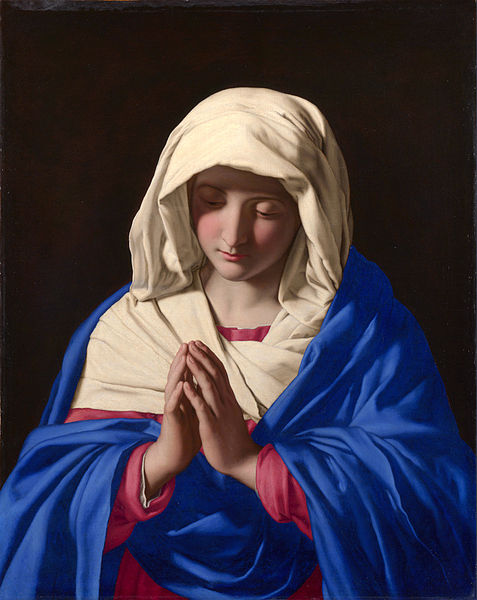
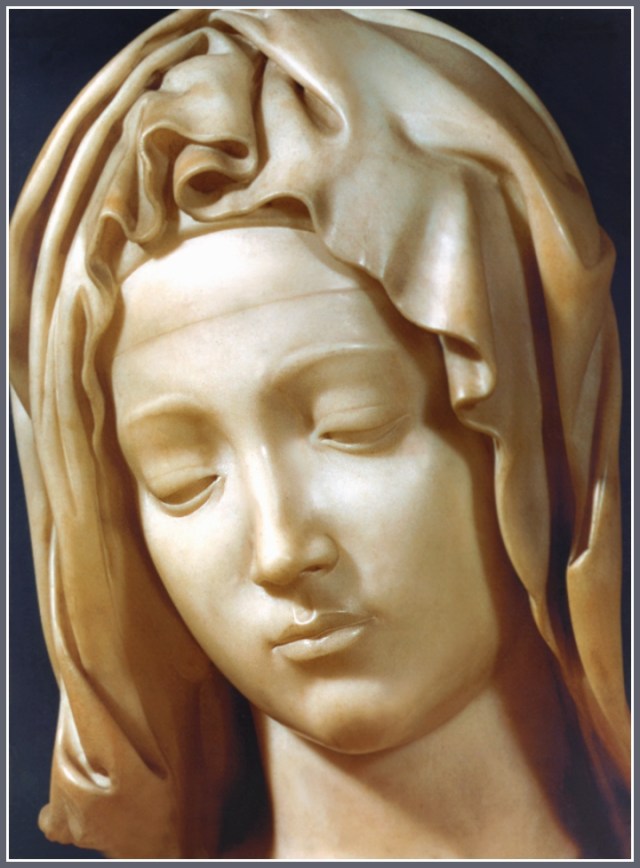
(“Daughter of the Father …etc” passage is taken from a meditation by Father Emanuel d’Alzon, 19th century founder of the Augustinians of the Assumption, excerpted from his book Mary Our Mother, Our Model, Our Queen, translated by M. Angeline Bouchard from the original French, Trente Jours avec Marie. which received the Nihil Obstat and Imprimatur of the Church). Notes on the sacred images: The first painting is by the 17th century Italian artist Giovanni Salvi (also known as Sassoferrato). The title of the painting is The Virgin at Prayer. It is in the National Gallery of Art in London. The second image is a close-up of the Blessed Mother’s face that was sculpted by Michelangelo in 1499 for his extraordinary sculpture known as the Pieta. Michelangelo was 24 years old at the time he sculpted this masterpiece! It is located in the St. Peter’s Basilica in Vatican City.

Mary – The Mystical Spouse of the Holy Spirit and the Wife of Joseph

The question may be asked “How is the word “spouse” used in reference to Mary and the Holy Spirit?

We have all read the nativity accounts of St. Matthew and St. Luke and if you are a Roman Catholic you believe that Sacred Scripture is the foundation on which we build our theology; however, Sacred Tradition and the scholarship and teaching of the Magisterium of the Church are also very important.

Sacred Tradition, scholarship, and the Magisterium (the teaching authority of the Church) act as the counterbalance for our understanding of God’s Truth in Scripture. These elements, together with Sacramental grace, prayer, and good works help us live our life in Christ.

Theologians, saints, and mystics have used marital language to express the love of God for His Church and the mystical relationship between our Blessed Mother and the Holy Spirit. The use of marital language in relation to Mary, the Holy Spirit, and the Church has a long and varied history. A few recent examples of a pope and documents of the Church using this language are Pope John Paul 2 in numerous homilies and encyclicals, and the very important document that resulted from the Second Vatican Council entitled The Dogmatic Constitution of the Church – Lumen Gentium.

If we go back to the earliest writings of the Church, and quickly examine some sources, we see the “marital and spousal” aspect of this mystical language used in a second century AD document called the Odes of Solomon; and as we proceed up through history we see mention of it in the writings of St. Augustine (4th century), St. Ildephonsus, archbishop of Toledo, Spain (7th century), St. Germanus, patriarch of Constantinople (7th century), Cardinal St. Peter Damian (11th century), St. Bonaventure (13th century), Emmanuel d’Alzon (19th century), and, in the many scholars of the 20th century, such as Cardinal Joseph Suenens, Karl Rahner, Pope John Paul 2, Rev. Peter Damian M. Fehlner, F.F.I., and Pope Benedict 16th.

A few examples of how the word “spouse” is used in these theological contexts may be helpful. In 1979, on Pope John Paul 2 first pilgrimage to the United States, he gave a sermon on our Blessed Mother at the National Shrine of the Immaculate Conception and made this point in relation to Mary:

“…Through her, the Sun of Justice was to rise in the world. Through her, the great healer of humanity, the reconciler of hearts and consciences, her Son, the God-Man, Jesus Christ, was to transform the human condition and by his death and resurrection, uplift the entire human family. As a great sign that appeared in the heavens, in the fullness of time, this woman dominates all history as the Virgin Mother of the Son, as the Spouse of the Holy Spirit, and as the Handmaid of humanity.” (excerpted from Mary’s Yes – Meditations on Mary Through The Ages, edited by John Rotelle, O.S.A., Servant Press, Ann Arbor, 1988)
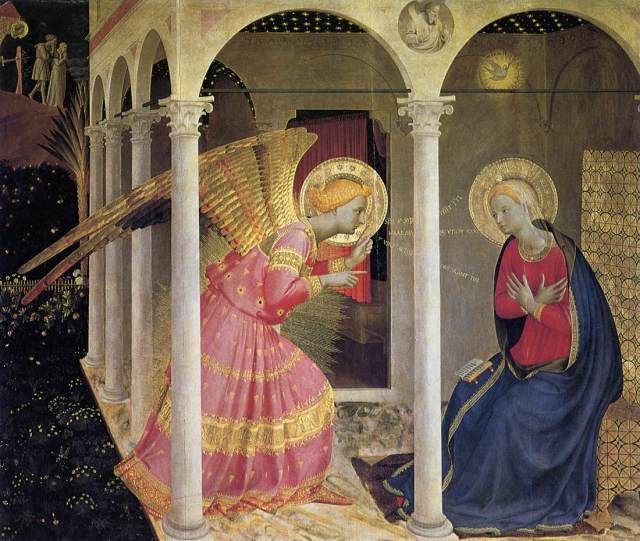
In his important 1986 encyclical on the Holy Spirit  “The Lord and Giver of Life” (Dominum et Vivificantem) Pope John Paul 2 continues to use these expressions to help explain his insights:

“…It is the [2nd Vatican] Council that says to us: “The Blessed Virgin…overshadowed by the Holy Spirit…brought forth…the Son…, he whom God placed as the first-born among many brethren namely the faithful (cf. Romans 8: 29). In their birth and development she cooperates with a maternal love”; she is through “his singular graces and offices…intimately united with the Church…. [She/Mary] is a model of the Church” (Lumen Gentium, note 63). “The Church, moreover, contemplating Mary’s mysterious sanctity, imitating her charity,…becomes herself a mother” and “herself a virgin, who keeps…the fidelity she has pledged to her Spouse. Imitating the Mother of the Lord, and by the power of the Holy Spirit, she preserves with a virginal purity an integral faith, a firm hope, and a sincere charity” (Lumen Gentium note 64).

Pope John Paul 2 continues, “Thus one can understand the profound reason why the Church, united with the Virgin Mother, prays unceasingly as the Bride to her Divine Spouse, as the words of the Book of Revelation, quoted by the [2nd Vatican] Council, attest: “The Spirit and the bride say to the Lord Jesus Christ: Come!” (Rev. 22: 17).

The Church’s prayer is this unceasing invocation, in which “the Spirit himself intercedes for us”: in a certain sense, the Spirit himself utters it with the Church and in the Church.”
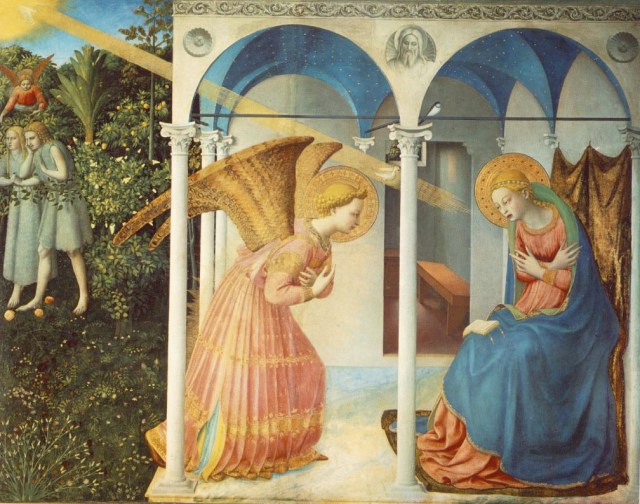
So, we see in these few examples that the Church has used this type of mystical language to help express and make meaningful the divine union of Mary and the Holy Spirit. This, of course, was made possible by Mary’s humility, and the grace of the Holy Spirit which fashioned Mary from the moment of her conception.

God has given Himself as a divine Gift to mankind. This mirrors the gift of self that a husband and wife make of themselves to each other; or, the gift that a consecrated virgin makes of him or herself to God. Our eternal destiny has been played out on this field, for with mystical insight we understand that a divine proposal was made to this young woman Mary, and using her free will and reason, she consented to the request to become the Theotokos – the Mother of God. It is important to remember that she consented, in humility, and out of her profound sense of love, service, and faith in God. These are the characteristics of all consecrated virgins, and the characteristics of all faith-filled wives and husbands who freely give the gift of themselves to their spouse in recognition of their marriage covenant.

At the moment of her “Let it be done to me according to your word,” her Spouse, the Holy Spirit, dwelt within her and uniting with her blood conceived the child Jesus in her womb. This was the divine act of conception – the miracle of  the Incarnation – resulting in a natural child and the full flowering of Mary’s motherhood. In practical terms, her consecrated virginity was not disturbed. She was an immaculate virgin before, during, and after her pregnancy. During her pregnancy and after the birth of Jesus, the Holy Family was exactly that – a holy family. Her legal husband Joseph understood and respected her vow of consecrated virginity, and she dedicated herself to being a model wife and mother – a woman who supported her husband Joseph in his work and her Son, Jesus, in His future ministry.
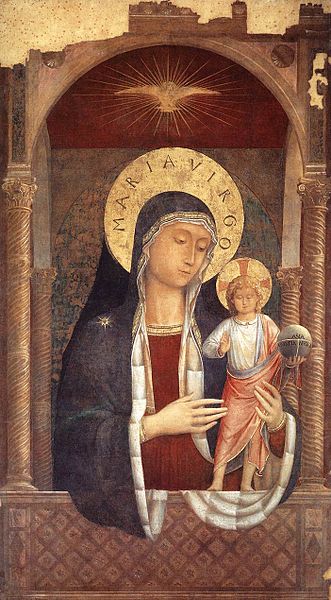
Glory and Praise to God! Praise be to the Mother of God, Mary, most holy! May she always intercede with her Son for mercy on our behalf!

Notes on the paintings: The first painting of the Annunciation is by Fra Angelico (Brother John of Fiesole, died 1455) and is done in egg tempera on wood; completed between 1430-32 it is found in the Museo Diocesano in Cortona, Italy. The second painting is also by Fra Angelico it was painted between 1430-32 and is done in egg tempera on wood. It measures approximately 76 inches by 76 inches and hangs in the Prado Museum in Madrid. The third painting is by Benozzo Gozzoli entitled Madonna and Child Giving Blessings.  Painted in 1449, it is egg tempera on silk and mounted on wood. It is currently located in the church of Santa Maria Sopra Minerva in Rome. It is approximately 100 inches high by 51 inches wide.

Copyright © 2012 Deacon Paul O. Iacono All Rights Reserved.
The Queenship of the Blessed Virgin Mary

Today is the memorial of the Queenship of Mary.

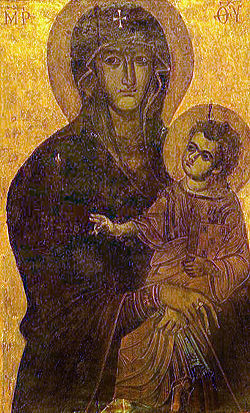
Through the centuries, sacred icons and images have expressed the Queenship and Coronation of the Holy Theotokos – the Mother of God. The icon The Virgin Salus Populi Romani, a 5th century icon, displayed in the Church of Saint Mary Major in Rome, and seen below, shows the Blessed Mother dressed in typical first century Middle Eastern garb as she holds her Son who gives a blessing. This icon is reputed to

be a copy of one that was painted by St. Luke the evangelist who tradition states knew and spoke to the Blessed Mother.

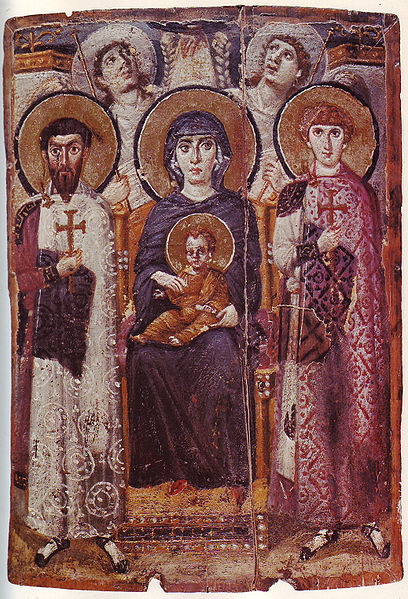
A 6th century icon of Mary and Jesus displays a coronation theme portraying the Blessed Mother and her Son in Heaven. Mary sits on her throne with Her Son on her lap, surrounded by St. Theodore on the left and St. George on the right, while two angels look up as the hand of the Father gives a blessing. This icon is found in the Monastery of St. Catherine in the Sinai Peninsula.

Iconic images painted (“written”) by orthodox iconographers of both the Latin, Greek, Russian, Coptic, and other Rites agree with images found within our Holy Scriptures. For example, a Gospel passage tells us “… the Lord God will give to Him the throne of His father David; and He will reign over the house of Jacob forever, and of His kingdom there will be no end.” This Scripture explains that the Lord willingly takes the initiative to come forth, with hands extended,  to meet us and share the reign of His kingdom.

In sacred art we visualize this not only in the extension of Christ’s hands on the cross – but also, in the extension of the infant Jesus’ hands, to give us a blessing as He sits in His mother’s lap, or is caressed in her arms, an image that is found not only in the above sacred images but in numerous statues found in Latin Rite churches throughout the world.

The prophet Isaiah also speaks of Christ in regal terms as Emmanuel (God is with us) and the “Prince of Peace.”  We can even get apocalyptic and speak of the Books of Daniel and Revelation which recall the truth that the world will be transformed through the birth of the Redeemer, made possible by Mary.  She is a “a woman clothed with the sun, with the moon under her feet, and on her head a crown of twelve stars… who gave birth to a son, a boy destined to shepherd all the nations with an iron rod. Her child was caught up to God and His throne.”  So we see that Mary enables the incorporation of the reign of God into the world. She is the woman destined to crush the head of the apocalyptic serpent.

St. John of Damascus wrote about this in the 8th century when he says of the Blessed Mother that she “has become the terror of demons, the city of refuge for those who turn to her. [He has her say:] Come to me in faith, O people, and draw as from a river of grace. Come to me in faith, without doubt, and draw from the mighty and certain source of grace.”

Last week, on the solemnity of the Assumption, we recalled Blessed John Paul 2 saying  “…the Assumption of the Mother of Christ in Heaven forms part of [the Lord’s teaching about] His victory over death, the beginning of which is found in the death and resurrection of Christ.”

So in today’s memorial, Mary, the humble daughter of Joachim and Anna and the chosen daughter of our Heavenly Father, is garbed in the majestic robes of a queen. She takes her rightful place next to the throne of her resurrected and ascended Son.

Why? 

Because the Church desires to teach us that Mary is privileged,  beyond all other women and men, to be the first and most significant human being to participate in the glory, triumph, and reign of God. By her very willingness to become the Mother of God, the Theotokos, she agreed to become our spiritual Mother, too.

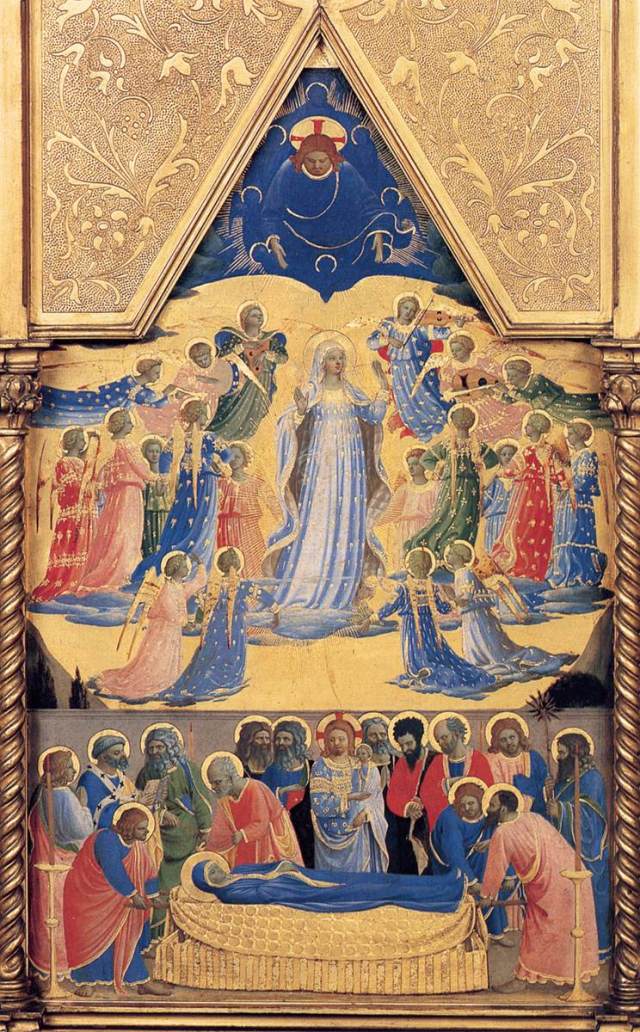
In this beautiful sacred image by Blessed John of Fiesole, also known as Fra Angelico the great Dominican artist of 15th century Florence, portrays the moment of Our Lady’s Coronation with the Heavenly court surrounding her.

We observe men and women saints that were alive thousands of years after Mary’s Coronation observing the event.

Why did the good Friar do that?

He is expressing the fact that Heaven is within the eternal now of the Trinity, so it follows that all the saints are knowledgeable of the truths of Heaven. If we carefully observe the painting we see that the knowledge of that coronation moment is known by St. Thomas Aquinas. We see him looking out at us (in the lower left corner), noting the truth, goodness, and beauty of God, and the fact that God desires this coronation for His beloved and humble human daughter, the Queen of Heaven.

The Blessed Mother, in her regal beauty, authority, and power, has not left us orphans. She is “the Living Temple of the Holy Spirit, the Inviolate Mountain, the ladder” that joins Heaven and earth. Mary is the “One who Shows the Way”  (as the Greeks would say the Hodigitria) to her Son and to our Heavenly reward.

If we remain faithful and loyal to the teachings of Jesus Christ, as expressed through our Sacred Scriptures and our Church, and act on that faith, then we, too, will reign alongside our Heavenly Mother and give praise and glory to God.     Our Lady, Queen of Heaven, pray for us.

Sources: John Paul 2, L’Osservatore Romano, August 15, 1983; Pope Pius 12th – encyclical Ad Caeli Reginam, October 11, 1954.         Copyright © 2012 Deacon Paul O. Iacono All Rights Reserved

The Assumption of Mary

St. Paul’s Letter to the Romans (8:30), sets that stage for this great solemnity: “Those God predestined He likewise called; those He called He also justified; and those He justified He in turn glorified.”

Today we celebrate the solemnity of the Assumption/Dormition of Mary. This is an ancient celebration documented as occurring as early as the 400’s, probably soon after the Council of Ephesus in 431 declared Mary the Theotokos: the Mother of God.

In a homily on the solemnity of the Assumption, Pope John Paul II used  John 14:3 as a Scriptural foundation for understanding the dogma of the Assumption of Mary. In those verses Jesus tells his disciples at the Last Supper, “If I go and prepare a place for you, I will come again, and will receive you to myself; that where I am, you may be there also.” Our belief is that Mary’s rising to Heaven is the pledge of the fulfillment of Christ’s promise to His disciples: “…where I am, you will be also.” Mary, as our spiritual Mother, through Christ’s promise beckons us to follow her.

With this celebration comes the renewal of the truth that Mary not only belonged to Christ as His Blessed Mother, but that she was truly raised on high as our Queen of Heaven. Beautiful Mary, is in her simplicity, the true sign that informs the world of the humility, love, and mercy of her Messiah Son.

Today we acknowledge Mary as a Queen, who takes her place in the throne room of God, not to have power over us, but, rather, to intercede for us as the perfect mother and faith-filled disciple. We witness this truth in this exquisite painting by Beato Fra Angelico completed in the year 1430.

In the “fullness of time” after millennia of human history, the Father of Mercies saw in Mary a loving and lovable woman who possessed great courage. She is the person who in her simplicity and purity would be completely open, totally surrendering, and free from the pollution of pride or self-will.  She was the woman who would be the New Eve, the mother of the living, the mother of a new creation.

She is, as the Eastern Rite proclaims, the All Holy One, the Panagia, who as our spiritual mother shows us the way by guiding us to her Son who through His Redemptive Act and Redeeming Grace enables us to be reborn into eternal life. The Divine Office in Evening Prayer I for the Assumption (the second antiphon) reminds us: “Through Eve the gates of heaven were closed to all mankind; through the Virgin Mother they were opened wide again, alleluia.”

It is through our own rebirth, through water and the Spirit, that we are able to bear fruit and imitate Mary in bringing the newborn Christ to others. St. Maximus the Confessor speaks of this when he says “Every soul that believes, conceives and gives birth to the Word of God according to faith. Christ is the fruit, and all of us, are mothers of the Christ.” (from Vladimir Zelinsky’s  “Mary in the Mystery of the Church: The Orthodox Search for Unity” found in Mary CoRedmptrix, Mediatrix, Advocate – Theological Foundations II. M.I. Miravalle, S.T.D., editor).

The Catechism of the Catholic Church (paragraph 966) states, “The Immaculate Virgin, when the course of her earthly life was finished, was taken up, body and soul, into heavenly glory, and exalted by the Lord as Queen over all things, so that she might be the more fully conformed to her Son, the Lord of Lords, and the conqueror of sin and death”

This proclaims the wonderful news that the Assumption of Mary is a participation in the act of her Son being raised from the dead, and so is a Sign, a Sign that points to our own resurrection and union with God. The Eastern Rite liturgy says on  this solemnity: “In giving birth you kept your virginity; in your Dormition you did not leave the world, O Mother of God, but were joined to the Source of Life.”

Our Blessed Mother’s words in her beautiful Canticle, and her personal destiny, are inseparably linked to our own – for she is one of us; and by keeping our focus on her Son, we too, through the grace of God, will experience His mercy which lasts from age to age on those who fear Him.

In these very troubled times may Our Lady of the Assumption always keep us close to her heart.

(Additional sources: 1 Corinthians 15: 20-27;  Revelation, Chapters 12 and 19; Lumen Gentium, 59; and Pope Pius XII in his Munificentissimus Deus (November, 1950).  

Copyright © 2012 Deacon Paul O. Iacono All Rights Reserved.
Saints Pontian and Hippolytus and Our Call to Duty

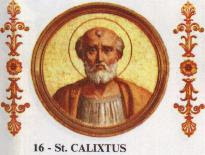
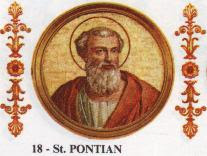
Today we celebrate the martyrdom of Saint Pontian, who was the lawfully elected successor pope to St. Callistus during the early 3rd century. St. Pontian was considered a criminal by the emperor Maximinius and banished to the silver mines in Sardinia – an exile which meant certain death. We also celebrate today a saint by the name of Hippolytus, who was a priest in the Church of Rome at this same moment in time.

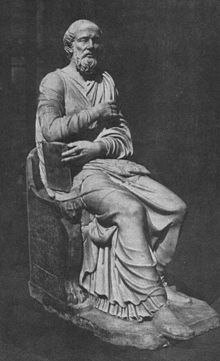
Saint Hippolytus is recognized because of his brilliance and profound scholarship. He is considered to be one of the finest theologians of the 3rd century, and is the source of the 2nd Eucharistic Prayer recited at Mass. Hippolytus’ most important work is a treatise known as The Apostolic Tradition; and scholars such as Dr. Marcellino D’Ambrosio, (at http://www.crossroadsinitiative.com) tell us that it provides “an enlightening and extensive glimpse into the liturgical and devotional life of Roman Christians around the year 200.” The statue found below is of Roman origin, found in the mid 16th century. It has the name Hippolytus carved into it as well as references to works of other Apostolic Fathers. The image is presented through the courtesy of Dr. D’Ambrosio.

Controversy, however, erupted when St. Callistus, was elected to the papacy. St. Hippolytus considered Callistus to be a liberal since Callistus extended absolution to new converts who had committed mortal sins such as adultery and murder. Hippolytus contested the election, violently disagreed when Callistus was affirmed, and then made history by declaring himself pope, thus becoming the first anti-pope in the history of the Church!

As a result of his action he divorced himself from full communion with the Church. When Pope Callistus was martyred, in the year 222, Hippolytus began disagreeing with his successors – the last being Pope Pontian.  Hippolytus’ theological differences and self-imposed actions didn’t mean anything to the Romans for they arrested him, too, and exiled him off to Sardinia; and there, St. Hippolytus – the anti-pope met St Pontian, the true pope and lawful successor to Pope Callistus.

In the silver mines of Sardinia, Pope Pontian abdicated his office, making way for a lawful successor to be elected, and Hippolytus renounced his anti-papacy and was absolved of his sins by Pontian. Fully reconciled they died together for the faith in the year 235.

So, what does this have to do with us?!

Our Gospel today (Matt 17: 22 – 27) provides the answer, for in it our Lord and the Apostles were confronted with the arrogance of the officials who implied they were evading the local taxes.  Jesus attempts to clarify His position not only for St. Peter but for the officials as well.

Jesus is basically saying that, yes, they must pay the tax; the reason being they must not do anything to put a stumbling block in the way of people understanding His ministry and message. Again we see Christ not getting political. He is not ranting about the just or unjust qualities of the Temple tax, or Roman occupation. He is beyond that, and demands that the Apostles, as His successors, not give a bad example to the people.

This is a lesson that St. Hippolytus, for all of his brilliance never learned. He did give bad example to the Church of Rome in declaring himself an anti-pope. His dissension and attacks were not productive or helpful in a highly charged environment which constantly witnessed Roman persecution.

Yet, St. Hippolytus ultimately saw his sin, repented of it, and along with Pope St. Pontian, did his duty and defended the true faith with his life. We must always do the same, and whatever our calling or ministry may be, we must never become a stumbling block that prevents others from seeing and believing in Jesus and His Church.

Copyright © 2012 Deacon Paul O. Iacono All Rights Reserved   Images of all the popes are found in the Basilica of St. Paul Outside the Walls in Rome, Italy. The custom of having a mosaic of a deceased pope put on display was started by Pope Leo the Great.

St. Clare – Our Holy Friend and Lover of God

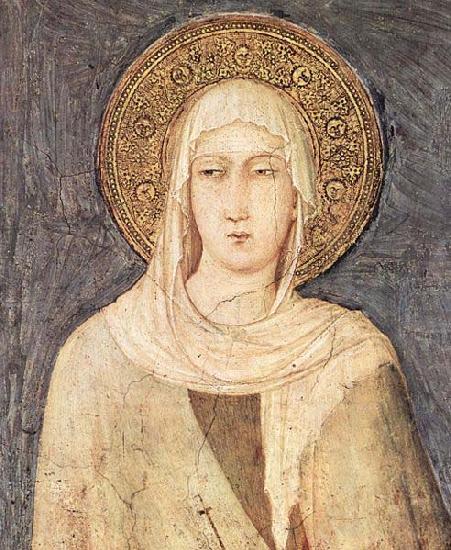
The Church honors today, August 11th, the holy woman, consecrated virgin, founder and Abbess of the religious order known as the Poor Clares, and dear friend of St. Francis of Assisi. We know her by her Anglicized name: Clare.

She was, however, born Chiara Offreduccio in Assisi, Italy on July 16, 1194.

The Italian language has always been especially tuned to convey, through words and sounds, a delicacy and refinement of spirit. Her Italian name, Chiara, gives witness to this observation, since its English equivalent means – clear.

The image above by Simone Martini (1283 – 1344) conveys this quiet asceticism in his lovely fresco of her completed between the years 1312 and 1320 and found in the lower basilica of San Francesco in Assisi (image courtesy of  www.berthemorisot.org/index.htm ).  To the historical and spiritual observer, St. Chiara’s life is very clear in its direction and goal. It is well known that she was influenced by her fellow citizen of Assisi, Francis, yet, an examination of her life shows that she was directed and formed by her profound love for Jesus in Scripture and in His real presence in the Eucharist.

A letter from her to a close friend, Blessed Agnes of Prague, shows the depth of her own mysticism and the clear guidance that directs another onto the correct path: “Happy indeed is she who is granted a place at the divine banquet, for she may cling with her inmost heart to Him whose beauty eternally awes the blessed hosts of heaven; to Him whose love inspires love, whose contemplation, refreshes, who generously satisfies, whose gentleness delights, whose memory shines sweetly as the dawn, to Him whose fragrance revives the dead, and whose glorious vision will bless all the citizens of that heavenly Jerusalem. For He is the splendor of eternal glory, the brightness of eternal light, and the mirror without cloud.”

This great mystic of the Church also led a life of austere poverty, chastity, and obedience, yet, her life, as the Divine Office tells us, was “rich in works of charity and piety.”

St. Chiara, passed on to the heavenly banquet on August 11, 1253.

The following beautiful images are from the excellent website: http://www.sacred-destinations.com  I thank them for the courtesy of providing the images.

The first photo is the church of San Damiano, which St. Francis restored when, after praying before the crucifix within its broken down walls, heard the Lord’s voice saying “Francis, rebuild My Church.”

The second photo is the image of the interior of San Damiano Church. It is this crucifix, painted in a unique Byzantine icon style and which is known as the San Damiano Crucifix, that spoke the words that changed the direction of Francis’ life, and, the life of the Church.

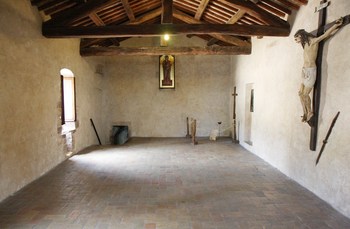
The third photo shows the interior of the room that St. Clare died in on this day 759 years ago. Tradition states that her bed was in the upper right corner of the room.

Copyright © 2012 Deacon Paul O. Iacono All Rights Reserved

St. Lawrence – Archdeacon and Servant of Christ

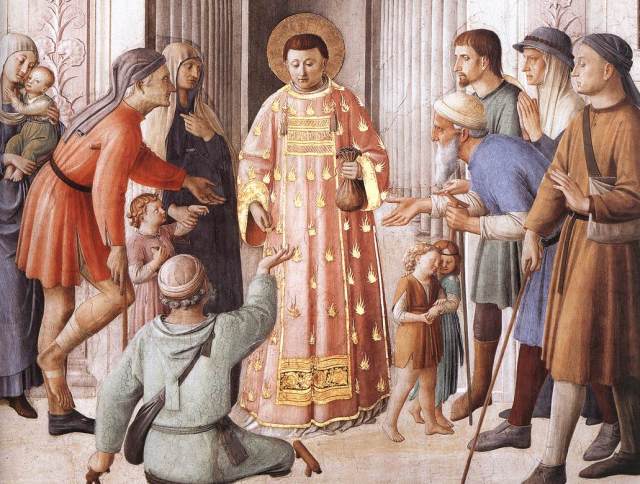
18956-st-lawrence-distributing-alms-fra-angelico
St. Lawrence, archdeacon of Rome, distributing alms to the poor; painted by  Fra Angelico, circa 1447.

Today we celebrate the feast of St. Lawrence, a deacon and third century martyr. St. Lawrence was one of the seven deacons of Rome who served as the Pope’s ministers during Holy Mass and as his administrators to the people of Rome. His execution occurred a few days after the martyrdom of Pope Sixtus II and four deacons (Januarius, Vincent, Magnus, and Stephen). At that time, all the deacons of Rome were executed.

The role of deacon is distinguished by service to the poor – both in mind and body. A deacon serves at “table” which results in his participating in the corporal works of mercy; and he performs service to “the Word,”  which are the spiritual works of mercy. These actions are given witness through various works: teaching the Faith, baptizing adults and infants, reading the Holy Gospel during Mass, distributing alms, admonishing sinners, feeding  and clothing those in need, praying for the living and the dead, serving and visiting the sick, administrating parish and diocesan needs, etc. The deacon is the first Order within the Sacrament of Holy Orders (the other two Orders being the priest and bishop).

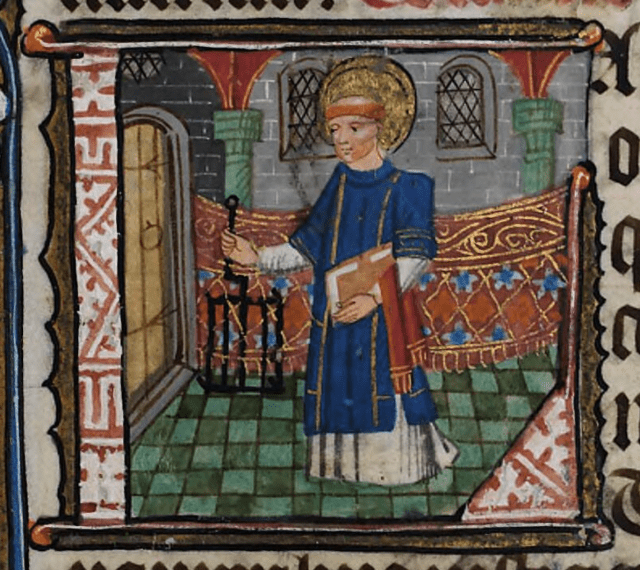
De_Grey_Hours_f.56.r_St._Laurence
St. Lawrence depicted in a Roman Catholic Breviary (Book of Hours). circa 1300’s. He is holding a gridiron, the instrument of his torture and death (he was placed on the gridiron and roasted to death by his Roman executioners).


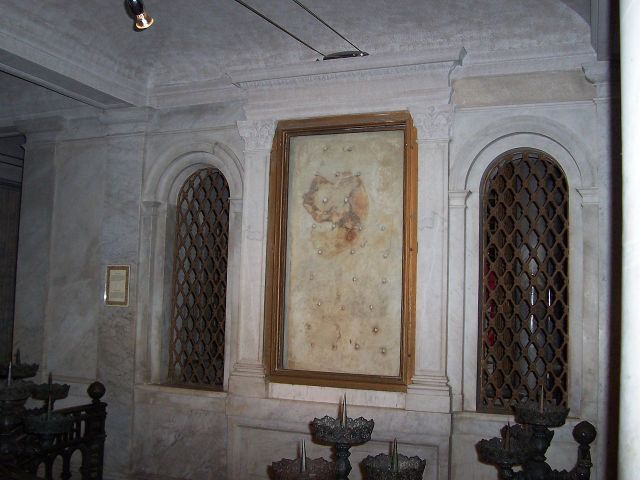
1280px-Saint_Lawrence_stone
According to Church tradition, this is the stone on which St Lawrence’s body was laid after his death. It is located in the church of San Lorenzo fuori le mura (St. Lawrence Outside the Walls) located in Rome. My wife and I were privileged to visit this church in 2007.

These frescoes, and illuminated miniatures are catechesis as well as beautiful art. Fra Angelico’s paintings portray St. Lawrence in an exquisite salmon rose colored dalmatic (the garment which signifies the deacon’s service and loyalty to his bishop). In liturgical use the color salmon rose represents the virtue of joy. This image was painted (fresco) between 1447 – 1449 and is approximately 9 by 7 feet.

18956-st-lawrence-distributing-alms-fra-angelico
St. Lawrence, deacon of Rome, distributing alms to the poor; painted by  Fra Angelico, circa 1447.

Praise be the name of Our Lord Jesus Christ and His faith-filled martyrs.


Copyright © 2011-2012 Deacon Paul O. Iacono – All Rights Reserved. Permission to reprint must be obtained from the author in writing. Students, and those interested, may quote small sections of the article as long as the proper credit and notation is given. Thank you.

Fr. Richard Reiser’s Beautiful Icon of the Transfiguration

The article that is found below my opening comments, and the image of the Transfiguration, is reblogged, through the courtesy of Fr. Richard Reiser, pastor of St. James Catholic Church Omaha, Nebraska.

I really enjoy Fr. Reiser’s iconographic style. He is able to convey the Scriptural truth of the Transfiguration while, at the same time expressing it in artistic language accessible to contemporary Christians. Fr. Reiser studied with noted master iconographer Philip Zimmerman who founded the St. John of Damascus Icon Studio in Pennsylvania. Father Reiser pointed out to me in an email, that St. James is larger than the other saints. This resulted from the fact that he painted this icon for his parish church – St. James Parish.


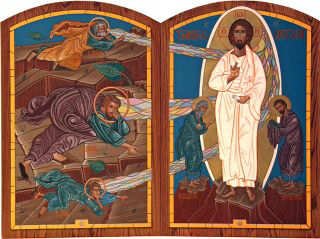
transfiguration_icon
    Icon of the Transfiguration (Mark 9: 2 – 10), by Fr. Richard Reiser, pastor of St. James Catholic Church Omaha, Nebraska. Copyright Fr. Richard J. Reiser, iconographer. Each icon panel measure 36″ x 54.”

God our Father in the transfigured glory of Christ your Son, You strengthen our faith by confirming the witness of Your prophets, and show us the splendor of Your beloved sons and daughters. As we listen to the voice of your Son, help us to become heirs to eternal life with Him who lives and reigns with You and the Holy Spirit, one God, forever and ever. Amen.

THE TRANSFIGURATION OF THE LORD    

by Fr. Richard J. Reiser  

A HISTORY OF ICONS

“An icon is a religious work of art done in a symbolic and stylistic manner. Its main focus is not with realism but with spiritual realities.  The icon was a favorite art form that developed in the early Church and became the preferred style of religious representation for the Eastern Orthodox Church.   In the Roman Catholic Church, mosaics and types of statuary were the prominent styles of art used for religious representation.

Realism or accurate perspective is not a primary concern in iconography. The main purpose of an icon is to draw the viewer into the realm of the holy through contemplation. An icon in this sense means to “see through to the divine,” or to be a “window to heaven”.  In icons, the details of the eyes should draw the viewer into a vision beyond the present. The perspectives are more subject-centered as a way of focus, rather than relying on realistic horizon lines.  The icon does not, after all, represent the material world, but the realm of the Divine.

The stoic faces on the figures in icons suggest that the holy ones, whose lives of service work are now accomplished on earth, now contemplate and rest in the presence of the Divine (signified by the light [halo] which surrounds the heads of the holy figures).

THE TRANSFIGURATION ICON

The two-panel icon of the Transfiguration has been done in a contemporary method and should be understood as a religious painting done in an iconographic style since it was not written (painted) following the strict rules of traditional icons that included rigorous fasting, special prayers, and special mixing of pigments with egg whites. This icon is written with acrylic paints.

The two oaken panels each measure 36″ x 54″, and their rounded tops echo the architectural detail found elsewhere in the church.  The event of the Transfiguration is found in Matthew 17: 1 – 8 and Mark 9: 2 – 8.  The naming of the icon (Transfiguration) is done in English, but in a contemporary Slavonic (Old Russian) style of lettering.

The images on the panels are of Jesus Christ, St. Elijah (1), St. Moses (1), St. Peter, St. James, and St. John. Jesus Christ and St. James are larger than the other figures to give them prominence; Jesus, since he is the main figure of the Transfiguration, and St. James, since he is the patron of the parish.   The icon is designed to invite the viewer to participate in the event of the Transfiguration by allowing the light coming from Christ in the first panel to confront the viewer, then, inviting the viewer to connect the light of Christ to the apostles in the second panel.   The rays of light that emanate from Christ were done in a stained-glass style that reflects the shape and colors of the stained glass found elsewhere in the church (2).

THE MOUNT TABOR PANEL (at right)

The central figure of the right panel is Jesus Christ, clothes in white and surrounded by light in the traditional manner which depicts Him in glory, along with the creedal statement of “Light from Light.”  The aureole (the gold-leaf background) which surrounds the entire body of Jesus.   Christ’s halo contains the traditional Greek letters that identify Jesus Christ as “I Am,” the title of God given to Moses in Exodus 3:14 and given human expression in Jesus as the divine Son of God.   The Greek letters to the left and right of the aureole are the traditional abbreviations for “Jesus Christ.”   High right hand is raised in the traditional gesture of blessing where the two joined fingers represent the two natures (human and divine) of Christ.

A scroll is held in Christ’s left hand and is symbolic of Christ being the Word that became flesh (John 1:14).

The haloed figure of Moses to the right of the Christ figure bows in deference towards Christ who is the completion and fulfillment of the law. Moses reverently holds the two tablets of the Ten Commandments without directly touching them.  They symbolize the law with the word Torah (3) inscribed on them in Hebrew. Moses is represented as the younger man than he was at the time he received the tablets of the law.   The garments of Moses are brownish red and blue.

The haloed figure of Elijah to the left of the Christ figure, also defers to Christ as the completion and fulfillment of the prophets. Elijah was taken up to heaven in a whirlwind. His garments are green and blue.

All three figures on the right panel stand atop Mount Tabor (4).  The mountain suggests the place of God’s revelation to Moses in the Old Testament when he was given the law (Deuteronomy 5), and the place where Elijah the prophet experienced the voice of the Lord in the gentle breeze (1 Kings 19: 8 – 13). Icons of the Transfiguration show Jesus Christ as God’s full revelation by being presented on a mountain.

THE APOSTLES PANEL (at left)

The Apostles panel of the left is divided into three plateaus each supporting one of the apostles closest to Christ. The center plateau is larger and bright and it supports St. James. He is shown humbled on his knees, because of the experience of the Transfiguration.   He is reaching forward while attempting to secure stability and balance on the rocky plane.   He is presented with his hand shielding his face from the light.  His outer garment flows in the wind generated by the force of the transfigured Christ. The trees representing creation also bend by the power of Christ’s transfiguration. He is attempting to seek Christ, but with difficulty. The halo surrounding his head marks him as a saint. His outer garment is purple and his undergarment is green.

The upper plateau supports St. Peter who is held back from the force of the Transfiguration by a ledge where his feet are supported.   His outer garments flows in the win. As the leader of the apostles, he points to the light and to Christ. The haloed figure is presented with the traditional gray hair and beard suggesting wisdom. Positioned on the rock, he is named by Christ as the “Rock” on which Christ will build His Church. His outer garment is the traditional gold, and his undergarment is green.

The haloed figure of St. John is the bottom figure. He is the brother of St. James. His right hand shield his face from the light.   His outer garment flows in the wind. His left hand reaches forward clinging to the rock. A ledge supports his forward right leg and holds him which his back leg waves freely with the force almost releasing his sandal. His beardless face is the traditional way of depicting his youth. He is said to be the youngest of the apostles. His outer garment is green and his undergarment is blue.

The maize-colored border of both panels reflects the color and stained glass of the central rose windows in the church (5).  The medallion on the right panel border holds a piece of rock from Mt. Tabor. The medallion on the left panel border holds a relic of St. James.”

THE INSCRIPTION ON THE BACK OF THE ICON PANEL

“The inscription on the back of the icon panels reads:  The Transfiguration   Feast – August 6.   Blessed by Fr. Richard Reiser   August 6, 2006. Donated by Colleen Mahoney in memory of the William and Colleen Mahoney Family Fr. Richard Reiser, iconographer.”

“Notes:

(1) In the Orthodox tradition, both Elijah and Moses are considered saints.

(2) A similar technique with the fishing net was used by Brother Robert in the “Calling of James” icon in our (St. James) church.

(3) The first five books of the Old Testament’ they present all of the 613 laws and interpretations that are central to Judaism.   In Jewish services the scrolls of the Torah are still extravagantly decorated and venerated with respect when they are proclaimed.

(4) Mount Tabor is more of a geographical mound in the area of Galilee and not a mountain as such.

(5) This border also is found on the “Calling of James” icon.”

Copyright © 2012 Reblogged image and article painted and written by Fr. Richard J. Reiser. All Rights Reserved

We Receive and Give Awards – We Are Deeply Touched!

The Fra Angelico Institute for the Sacred Arts is truly honored to receive three blogging awards. Teresa Rice at Catholiclibertarian has nominated this blog for three awards: The Illuminating Blogger Award, The One Lovely Blog Award, and The Very Inspiring Blogger Award.

Teresa Rice’s blog at Catholiclibertarian is dedicated to discussing contemporary issues through the lens of being a faith-filled Catholic as well as a person who has a mixture of conservative and libertarian political views. Teresa’s columns are always well written, insightful, challenging and dogmatically faithful to the Catholic Church. We are proud, honored, and humbled by her confidence and support for our mission – which is to evangelize the truth, beauty, and goodness of God through the prayerful study and creation of sacred art.

We also received notification this morning that reinkat has awarded this blog an award, too. We are truly touched to the heart by these awards from our readers. We admit, however, that the entire impetus for the Fra Angelico Institute for the Sacred Arts, and this blog, is the work of the Holy Spirit. He deserves all praise, honor, and glory. Everything that we do here develops out of prayer, is performed in prayer, and hopefully, is sustained through prayer. Again, thanks very much. As part of the Award system I am happy to nominate fourteen other bloggers that I regularly read and find illuminating in various ways. Their names are found below.

The conditions for accepting The Illuminating Blogger Award are:

1) Add a picture of the award to your blog post.

2) Thank the blogger who nominated you and include a link to their blog.

3) Nominate 5 to 10 other Bloggers and inform those selected that they have been nominated.

4) Say seven interesting things about yourself to give some insight into what you are like, interested in, etc.

I am happy to award the writers of the following blogs The Illuminating Blogger Award because all of them make you think and provide illumination in various ways. Some of them promote the arts – in all of their various forms; others promote humor (in these days anyone that promotes clean intellectual humor deserves a prize!). A few are promoting the Catholic faith (which from my point of view is very good!), and some are just a lot of wacky fun.

The following blogs are not ranked in any order of one being better than another.

The blogs Catholiclibertarian, reinkat, and Biltrix would have been on the list but they have already received the award.

Here are the blogs that receive the most prestigious Illuminating Blogger Award from me.

1) Via Lucis Photography: http://vialucispress.wordpress.com/

2) Stephen Hipperson: stephenhip.wordpress.com

3) Matthew James Collins: matthewjcollins.wordpress.com

4) The Way of Beauty:  http://thewayofbeauty.org/

5)A Reader’s Guide to Orthodox Icons: http://iconreader.wordpress.com/

6) Hearts on Fire: http://heartsonfire33.wordpress.com/

7) Dr. Boli’s Celebrated Magazine: http://drboli.wordpress.com/

8) carlausery: http://carlausery.com/

9) Chicquero: http://chicquero.com/

10) hesychastic: hesychastic.wordpress.com

11) Elliot in Gotham: http://elliottingotham.wordpress.com/

12) clotildajamcracker: http://clotildajamcracker.wordpress.com/

13) The Big Pulpit: http://bigpulpit.com/

14) knowsphere: http://knowthesphere.wordpress.com/

Here are the seven Award required “interesting things” I will divulge about myself:

1) I sing Christmas songs throughout the year.

2) I enjoy reading about British personalities, fictional and non-fictional. An example being Winston Churchill and what made him tick as a man and personality. Another character that I enjoy is Sherlock Holmes. Very few people are aware (ahem, or care!) that I wrote a definitive monograph in the early 1980’s on the True Location of 221B Baker Street. It was published in the Baker Street Journal to loud huzzahs.

3) I became fascinated with the French Impressionists in college, yet, today, have a deep affection for Cezanne as a man and as an artist.

4) I enjoy solitude, or, the company of very small groups of people.

5) I have had a deep affection for Scottish Terriers since I was in elementary school. Our third Scottie has a huge heart and an extraordinary sense of loyalty for close family members. He has a toughness that is quite admirable; he has been battling cancer for 15 months. Our vets are astounded by his longevity owing to the fact that veterinary science and experience said he had four to six months to live.

6) I would have absolutely no problem eating apple pie as a dessert for breakfast, lunch, and dinner. Let’s not forget snacks. You may ask: Who has a dessert for breakfast? Answer: interesting people.

7) I have a fascination for the woodcuts and drawings of Brother Martin Erspamer, O.S.B.; yet, I have a deep interest and desire to emulate the artistry of Italian painters from the 12th through the mid 15th centuries. There is a spiritual purity in their work; however, I am far from even approaching some sense of true understanding of them and would appreciate anyone who knows of specific research and tomes that could assist me in the understanding of their techniques.

Copyright © 2012 Deacon Paul O. Iacono All Rights Reserved

The Transfiguration of Christ

Today we celebrate the feast of the Transfiguration of the Lord. This feast has been celebrated since the 5th century.          It was inserted into the general calendar of the Church in 1457 by Pope Callistus III in order to celebrate the defeat of the advancing Moslem army in the Serbian city of Belgrade. Today’s feast was announced in Rome on August 6, 1457, and was placed in the calendar to occur forty days before the feast of the Triumph of the Cross, on September 14.

Let’s reflect for a moment on today’s Gospel account (Mark 9: 2-10). Jesus knew exactly what He was doing when He took Peter, James, and John to the top of Mount Tabor. He knew that His Passion and Crucifixion would be so absolutely terrifying, that when the complete horror of the crucifixion settled in over those three Apostles that they needed to have, in the back of their minds, this moment, this glorious moment, of the Transfiguration.

By remembering its truth, beauty, and power they would understand that Jesus walked to His death under His own free will.  No government, no authority – religious or secular – forced Him to go to the Cross. He went under His own power – a power that was completely obedient to His Father’s will. The Father sent Jesus to call and redeem humanity so that we, under our own power – under our own free will, could choose to enter back into relationship with the Father. After the Redemption occurred, Jesus in turn, sent the Holy Spirit to defend us, from all the various worldly and demonic forces arrayed against us.

The Transfiguration is so important to all of us because at the moment in which Jesus’ glory is manifested the identity of Jesus becomes clear not only for the Apostles but for us, too. When we reflect on this moment we recognize what the Apostles came to understand: that the Crossis not the end of the story. There is something more that lies beyond the Cross – not only for Jesus – but for all who believe in Him and are baptized in the name of His Divine Family.

There is an ancient Church hymn, called the Kontakion of the Transfiguration, which has been sung in Greek for thousands of years, it declares:

“You were transfigured on the mount, and Your disciples beheld Your glory as far as they could bear it O Christ our God, so that when they should see You crucified, they would remember that Your suffering was voluntary, and could declare to all the world that You are truly  the radiant splendor of the Father.”

The glory of our faith is that the Holy Trinity desires  this transfiguration for us, too. If we cooperate with God’s grace, spend time with the Lord, and walk the narrow path of holiness, we too, will be resurrected and experience the power of His transfiguration.

Copyright © 2012 Deacon Paul O. Iacono All Rights Reserved. The icon of the Transfiguration is through the courtesy of Fr. Richard Reiser, St. James Roman Catholic Church Omaha, Nebraska – Copyright © Richard Reiser.

Thank You! Our One Year Anniversary!

We are so very grateful to everyone who has visited this website over the past year. It was on August 1, 2011 that I posted my first essay. By midnight tonight over 13,000 people, from 106 nations, will have visited this site and, hopefully, been spiritually fed by the discussion on issues concerning sacred images and iconography, prayer, and reflections on the Holy Scripture.

May God continue to bless all those who have an interest in sacred art and move them to deepen their prayer life by using sacred art as a focal point in their meditations.

Thank you!

May the Blessed Mother continue to intercede for all of us.

Peace and Victory in Christ!

Deacon Paul and Jackie Iacono

Roman Catholic Diocese of Providence, Rhode Island

Copyright © 2012 Deacon Paul O. Iacono All Rights Reserved. The above image on The Annunciation was painted by the great American painter Henry Ossawa Tanner. It may be seen at the Philadelphia Museum of Art.
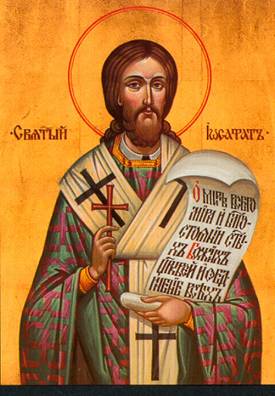
St. Peter Chrysologus’ Appeal By Christ To Be Transformed

Today is the memorial of Saint Peter Chrysologus.

Peter was born in the late 4th century in northern Italy. In 424, after serving as a deacon and priest in Emilia, he became bishop of the Italian city of Ravenna. Little reliable information about St. Peter’s life survives, except that he successfully drove heresy and the remnants of Roman paganism from his diocese by doing two things: providing exceptional pastoral care to the people and by giving practical yet passionate sermons. St. Peter’s brief sermons were so inspiring that he was given the title “Chrysologus” which means “of golden speech.”

He was declared a Doctor of the Church in the 18th century. In order to be called a Doctor of the Church the Pope and Cardinals must agree that the individual possessed three main characteristics during his or her life: truly outstanding holiness; a depth of doctrinal insight; and a body of writings which the Church recommends to people as authentic and life giving. These three qualities contributed to Peter’s success in ministering to the people of his diocese.

Our Gospel today speaks of the tiny mustard seed growing into a large bush, or the tiny yeast germ enabling the flour to rise. This theme of transformation is at the center of the story of the Incarnation. In a homily on this theme, St. Peter beautifully describes how Jesus is able, through His two natures, to touch and transform us. Christ meets us on a daily basis in prayer, and especially through the Scriptures and His real presence in the Holy Eucharist.

By means of these two marvelous gifts St Peter explains that we are able to identify with Jesus and be converted like the mustard seed and yeast germ, into something so much greater –  we are transformed and divinized into the life of Christ Himself. In one of his homilies, he has the Lord speaking and appealing to His people. He says,

“Listen to the Lord’s appeal: In me, [your Lord] I want you to see your own body, your members, your heart, your bones, your blood. You may fear what is divine, but why not love what is human? You may run away from me as the Lord, but why not run to me as your father? Perhaps you are filled with shame for causing my bitter passion. Do not be afraid. This cross inflicts a mortal injury, not on me, but on death.

These nails no longer pain me, but only deepen your love for me. I do not cry out because of these wounds, but through them I draw you into my heart. My body was stretched on the cross as an icon, not of how much I suffered, but of my all-embracing love. I count it no less to shed my blood: it is the price I have paid for your ransom. Come, then, return to me and learn to know me as your father, who repays good for evil, love for injury, and boundless charity for piercing wounds.”

May the Lord continue to raise up men and women with St. Peter Chyrsologus’ gifts to feed and care for His people.

Copyright © 2012 Deacon Paul O. Iacono All Rights Reserved.
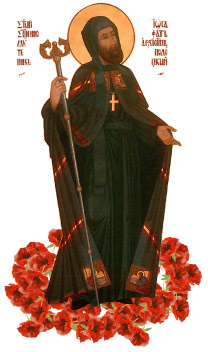
Image of St. Peter Chrysologus courtesy of info@crossroadsinitiative.com


Summer 2012 Workshop in Painting Sacred Images – A Few Reflections

Over the past six years I have participated in numerous workshops in sacred art and have produced a number of sacred images, each of which helped me understand the techniques of this sacred art.

In 2006, I participated in my first workshop at St. Michael’s Institute of Sacred Art at St. Edmund’s Retreat in Mystic, CT. The instructor was Peter Pearson, an Episcopal priest from Pennsylvania. He introduced the class to the beautiful and prayerful experience of painting a sacred image in the Russian Orthodox tradition; however, rather than using egg tempera paints (in which you mix the yolk of an egg with natural earth and mineral pigments) he taught the techniques using acrylic paints.

A note on acrylics versus egg tempera pigments. I personally believe that they are both valid materials to use. I have studied and painted images in each of these techniques and I personally do not have a solid preference, although, I believe it is helpful for a student to learn the techniques in acrylic first and then study sacred imagery using egg tempera pigments. I find both materials – natural or synthetic colors – enjoyable.

There are some people in the Internet community who become quite exercised over the fact that there are artists creating sacred images using acrylic paints. It is not necessary to get into, as Pearson would say, “the egg wars” debate, other than to mention that all sides are respectfully entitled to their opinion. Neither the Catholic or Orthodox faith exclusively owns sacred art, imagery, or iconography. Church art has always been (for at least the last 1500 years) an outgrowth of the Catholic and Orthodox creative spirit desiring to unite art with prayer. It was certainly part of the early tradition of the Roman Catholic Church prior to the winds of Western civilization moving the Catholic artists’ barque into Gothic, Renaissance, and Baroque ports of call.

In the late 20th and early 21st century, a growing element of the sacred art tradition of the Roman Catholic (and the Eastern Rites churches which are in union with Rome) has revolved around reestablishing traditional sacred imagery and iconography as part of the Catholic artistic heritage. Sacred iconography has always been a part of the Orthodox churches liturgical tradition, and they are to be saluted and commended for keeping the bright light of this sacred art tradition alive within the Church community.

It is probably part of the Western European/American mindset to accept and utilize new developments in artistic materials and techniques. This is why I believe some of us do not have any problem using acrylic paints. Acrylics are synthetic paints (composed in a lab) rather than natural earth or mineral pigments. My personal spirituality does not think that the Lord is concerned with the materials used in prayer, rather, He is interested in the intent and the creative outcome of that sincere prayer. You use what you think works, have fun with, and is readily available. There are many ways to catch a fish – as the Lord said to Peter – “throw out your nets again!”

So, on a practical level acrylic paint can be fun to work with, but it can also be problematical. Years ago Peter Pearson recommended a line of paints to us from the Chroma company called JoSonja. These paints are primarily used in the decorative crafts, yet, because of their color lines, they fit the bill for painting in a more traditional way – similar to the Russian tradition. By this I mean that the Russian Orthodox colors are primarily muted, unlike the Greek Orthodox who had a wide range of brilliant colors to choose from for their artwork. Geography and geology play an important part in understanding the color palette and artistic techniques of a civilization.

The nice thing about the JoSonja line of paints (available at DickBlick.com and other outlets such as Jerry’s Artarama) is that they are inexpensive but of surprisingly good quality. They also have an entire range of mediums, (such as flow medium and glazing medium) which are essential in getting the results you want, especially for the multi thin layering and highlights of the image’s face. The JoSonja line has also produced a polyurethane satin varnish that compliments the chemistry of the paints and mediums in their line. It was used on my sacred image for the recent workshop and went on without any problem. I applied this varnish with a one and one-half inch flat wash brush from Princeton Art and Brush Company (item # 4050 FW). It has very fine and soft bristles – perfect for streak free varnishing. I must give you a warning: work quickly as the varnish dries rapidly. It is non toxic and cleans up with soap and water.

I produced a manual for the workshop which explained each step, yet, found myself talking more than I really wanted to, owing to the fact that this was the participants first sacred image, and for many, their first venture into art in many years. A sacred image workshop should be a place in which the participants can enter into prayer while they paint; hopefully, the next workshop will more conducive to this necessary element.

All the adult participants were very good sports and reacted with quite a bit of patience to some of the more difficult parts of the process. They were all happy with the results and want to embark on another workshop – which is good news! Please find below a few photos from the workshop and the Mass at which the sacred images were blessed. You can see the images in the sanctuary in front of the altar. I am behind the altar to the left vested in a green dalmatic, and Father Joseph Upton the Institute’s chaplain, has his hands raised as he recites the blessing over the sacred images. Thanks again to everyone who participated and see you soon!

Copyright photos and images © 2012 Deacon Paul O. Iacono All Rights Reserved

Ken Jan Woo – sacred artist

Please see my post of July 9, 2020 entitled Chinese Martyrs and the Art of Ken Jan Woo. Thank you.


A Decisive Hour for American Catholics

As we approach the conclusion of the Fortnight for Freedom, we draw near to the decisive hour, an hour of decision in the history of our great nation; an hour which truly challenges  American Catholics’ sense of discipleship.

It has been a fortnight in which our bishops have asked us to reflect upon our liberties, our history, and our current state of affairs. If you have thought about these issues at all you know that our history has not lied in this case: America is a nation that was built upon reverence for God, His natural law, and respect for the primacy of individual conscience and religious tradition.

In 1636, one hundred forty years before Jefferson penned the Declaration of Independence, the founder of the little colony of Rhode Island, Roger Williams, made freedom of conscience and religion the keystone of his community.

In 1776, The Declaration of Independence, and in 1789 the Constitution of the United States, all clearly stated the limitations of government; and in 1791, the Bill of Rights, carefully enunciated the rights of each individual citizen – the first right being, freedom of religion.

James Madison, a delegate to the Constitutional Convention and its secretary and recorder, described the legitimacy of conscience as “the most sacred of all property.” (1)   He wrote, “The religion then of every man must be left to the conviction and conscience of every man; and it is the right of every man to exercise it as they may dictate.” (2)

George Washington wrote, “the establishment of civil and religious liberty was the motive that induced [him] to the field of battle.” (3)

In 1804, President Thomas Jefferson assured the Ursuline Sisters of Louisiana – who had, for seventy-seven years, been serving an indigenous population by operating schools, hospitals, and an orphanage – that the principles of the Constitution were a “sure guarantee” that their ministry would be free “to govern itself according to its own voluntary rules, without, interference from the civil authority.” (4)

This is a matter of history. It is not a matter of conjecture, dispute, or equivocation; yet it is clear that the vast majority of our current state and federal government leaders do not accept this understanding of what the founding fathers of our nation wrote, lived, and established as our heritage.

So, we are at a decisive hour – an hour of decision – an hour that will determine the depth of our discipleship and test our understanding of who we are as American Catholics.

Many pundits, commentators, and yes even Catholic politicians, have remarked that there is nothing to worry about with this now Supreme Court approved Health Care Law. Yet our Church leaders – our bishops – are united in telling us that there is something drastically wrong with this law.

The American bishops have been united and clear on this issue and they clearly tell us that the Fortnight for Freedom has been about getting American Catholics – all 52 million of us – to understand that our federal government will force our Church to provide for certain types of medical procedures even though it is in direct violation of our collective conscience. My brothers and sisters, the Federal government’s actions are wrong and must be opposed.

So society may ask, “What do you want?”

Our Church responds, we respond, that as Catholics we ask nothing more than what Saints Peter and Paul and all the martyred saints and true disciples of Jesus Christ wanted; and as Americans we want nothing more than what Roger Williams, George Washington, James Madison, Thomas Jefferson and all true American statesmen and women have wanted: the right to follow our conscience, worship our God as we see fit, and to live out our faith by making a contribution within the public square.

We ask nothing more of our government than what our history has told us is our patrimony, our heritage: our blessed liberties.

This is a decisive hour – for it is the hour of discipleship in Christ Jesus. We must not shrink back in fear; for our sense of commitment to our nation’s heritage, and our loyalty to Jesus Christ and our Church, demands that we do not compromise on this issue.

We believe that all Americans, of all religious persuasions, and not just Federal or state government, must be allowed to have a contribution to the common good as prescribed by their faith and sense of duty. This is a liberty that has always been granted under our system of laws – until, until this critical moment in time.

So you may ask, “What do we do?”

We rise up my brothers and sisters and use all the law abiding and peaceful means at our disposal to inform our elected officials of this singular outrage against freedom of conscience. If they don’t address and rectify our concerns – we must remember it, and respond accordingly when we select our state and federal representatives. We can do no less.

Let us pray that through the intercession of the Holy Spirit we may have the courage to act as disciples of Christ – peaceful, courageous, and steadfast in the face of imperial tyranny.

Copyright © 2012 Deacon Paul O. Iacono All Rights Reserved

Quotations taken from: United States Conference of Catholic Bishops Ad Hoc Committee for Religious Liberty – their document: Our First, Most Cherished Liberty – A Statement on Religious Liberty

1. James Madison, “Property,” March 29, 1792, in The Founding Fathers, Eds. Philip B. Kurland and Ralph Lerner (Chicago: The University of Chicago Press, 1987) accessed March 27, 2012. http://press-pubs.uchicago.edu/founders/documents/v1ch16s23.html.

2.  James Madison, “Memorial and Remonstrance Against Religious Assessment,” June 20, 1785, in The Founding Fathers, accessed March 27, 2012. http://press-pubs.uchicago.edu/founders/documents/amendI_religions43.html.

3. Michael Novak and Jana Novak, Washington’s God, 2006.

4. Anson Phelps Stokes, Church and State in the United States (Harper & Brothers Publishers, 1950), 678.

3rd Century Bronze Medallion of Saints Peter and Paul

In response to a valuable comment made about my post – Part 2 – Icons, Icon Painters, and Praying with Sacred Images, I thought everyone would enjoy seeing one of the oldest images in existence of Saints Peter and Paul: a bronze medallion found in an excavation of the cemetery of Saint Domitilla in Rome.

The Domitilla cemetery is fascinating because it is the oldest of the Roman catacombs and, according to one source, still contain bones. The Domitilla catacombs are very well preserved and contain a second century (AD 101 – 200) fresco of the Last Supper.

This image of the 3rd century bronze medallion is provided through the courtesy of Dr. Margherita Guarducci. It is found in her book The Tomb of Peter, which was published in 1960 through Hawthorn Books. The 1911 edition of the Catholic Encyclopedia verifies the authenticity of this bronze medallion and identifies other sources for the likenesses of Saints Peter and Paul. This bronze medallion is  in the Vatican Museum in Rome.

The medallion is unique, not only because of its age, but for its iconography; for it shows us the typical images of Peter and Paul that we know through our Church’s sacred art. St Paul (on the left) is portrayed with bald head and full beard, and St. Peter is portrayed with a full head of hair and a full beard.

The artistry of the medallion maker in crafting this piece is superb, since we can see that Peter has high cheek bones, a steady gaze, and pleasant facial expression. St. Paul also has unique features, with a specific cast to his nose and gaze in his eyes. The Scriptures tell us that St. Paul was afflicted with a number of ailments, and it appears, that the maker of this medallion was aware of that fact. One of the key features that St. Paul projects in this medallion is the steadiness of the gaze, and what appears to be the readiness to enter into debate and preach the word of God to all that would listen to him.

This is a fine image to pray with and meditate on this week, especially owing to the fact that this Friday, June 29th, is the Solemnity of Saints Peter and Paul. The Depositio Martyrum (dated to the year AD 258) places the solemnity of these two men on that date. They are also the patrons of my Diocese – Providence, Rhode Island, U.S.A.

Saints Peter and Paul, pray for us.

When People Or Governments Get In Our Face

Recently I received a rather funny email from a friend concerning a God loving Marine coming to terms with an atheist professor. It triggered, however, a serious reflection on how we, as Christians, are to confront those who “get in our face” about issues of spiritual beliefs, sacred art, religious freedom, and personal liberty.

The passage from St. Matthew’s Gospel, chapter 5: 38-42, on “an eye for an eye and a tooth for a tooth” gives us an insight into who Jesus is as God. The behaviors that He explains, and asks us to imitate, are actions that He would perform; so in this passage on “an eye for an eye” we are getting a glimpse into the personality of God.

Jesus explains that the old Jewish law of “an eye for an eye and a tooth for a tooth” is no longer appropriate or virtuous in God’s eyes, it doesn’t reflect the behavior and actions that the Lord is trying to teach His people to follow, actions which reflect the Lord’s own mind and heart.

The following photo by talented photographer Kenny Lindstrom found at www.flickr.com/photos/kennylindstrom/ provides meaning, visual imagery, and the clarity of a typical traffic stop sign. We instantly recognize what the creator of this sculpture is trying to say (by the way, is this image done in sand, stone, or clay?). We get the message; but, as in all art, its interpretation depends on the values and beliefs of the viewer. Lindstrom’s photograph is a wonderful example of how a piece of art can display an impression that is both a teaching and reflective moment for the viewer.

The Holy Scriptures, however, are not to be viewed as artistic reflections or suggestions to the reader and listener. The Holy Spirit divinely inspired the Bible; thus, the faithful understand (sometimes better than many of the academics) that Jesus, as the Son of God, came to teach, preach, and heal mankind. His words are not suggestions, they are directions for living within His Sacred Heart; and that demands fortitude, perseverance, and most importantly, His grace.

Over the last two thousand years the Catholic Church has taught that we have a right to defend ourselves – a right to resist the evil that is done to us. But Jesus teaches that we should not resist evil with an evil response or by an evil means  – in other words we should not resist evil with a spirit of vengeance, rage, anger or with an unlawful or excessive physical or verbal response.

So, Jesus is teaching us that the tribal law of an “an eye for an eye and a tooth for a tooth” is destructive and directly opposed to the Father’s plan of a loving spiritual family living within a shared community.  Yet, not everyone in the world is a Christian; and the 20th and 21st centuries are showing themselves to be much more personally and collectively violent than many of the other centuries combined.

So what do we do? Jesus teaches us that our response to evil and insult, as difficult as this may be, should be measured; that is, it should be filled with patience and grace. For if we confront and attempt to defeat evil with an evil or vengeful response, then, we are weakening ourselves and empowering that which we hope to defeat. This does not mean, however, that we are to deny a sense of righteous and justifiable anger over injustices that are done – the Lord Himself gave witness to that when He drove the moneychangers and polluters of His Father’s Temple into the street.

The world can slap us on the cheek, it can take our belongings, it can take away our religious, political, and artistic freedoms and prevent us from speaking out against injustice, and it can even take our lives, but it can never touch our hearts or souls because the Lord God Himself has forever claimed us as His own children.

Let us pray that when we do have to correct our own actions or those of another, we do it based on Jesus’ spirit of graceful moderation, love, and kindness.

Copyright © 2012 Deacon Paul O. Iacono All Rights Reserved

Seeds of Faith and Art

In our Gospel today, from St. Mark Chapter 4: 26-34, we have two important parables concerning the reign of God: the first concerns the farmer’s sowing of seed and the second refers to the growth of the seed.

When we examine the threads running through these parables we hear  Jesus explaining not only the functions that the farmer performs, but the nature of the seed that is sown, as well. This first parable is found only in Mark’s Gospel and explains that through the ministry of Jesus, God’s sovereign and all-powerful rule over mankind is made visible.

This is similar to a passage from the book of Ezekiel, chapter 17: 22-24, where we hear God asserting His sovereignty; the prophet Ezekiel concludes his passage with God saying, “As I, the Lord, have spoken, so will I do.” God is telling the ancient Hebrews that they will see what He can do – He will manifest and make Himself visible to them.

In the first parable the evangelist Mark explains that God is the Divine Sower, the Divine farmer, and that God’s power and fruitfulness appears throughout the history of the Jewish people. Mysteriously, at a time known only to God, His reign would suddenly be made visible and manifest – like a seed which was nestled in the warm soil, suddenly appearing one morning as a young shoot – ready to grow into a fruitful plant.

Jesus is that fruitful plant – that vine – that cedar – that shoot of Jesse that developed out of  the family of King David, and suddenly appeared in ministry to all of Israel.

If we are open to its influence, spiritual and natural growth in the life of Jesus Christ is the process  of entering into the rhythm of God’s beating Sacred Heart; with every beat there is growth. We may be unaware of it – but it occurs – it goes on all around us – it sustains us in our very being –  it sustains the very existence  of the universe.

In the second parable from this passage from Mark’s Gospel, we again hear Jesus speak of a growing plant and tell His disciples that the Kingdom of God works like the natural growth process of a typical mustard seed.

Jesus is emphasizing that the growth of the Kingdom of God, and the reign of God in our individual hearts through faith in Him, is exactly like a natural process. A mustard seed is small but when it matures it becomes a large shrub – and the same is true with faith.

When I was younger, my wife and I enjoyed planting a  large garden. we quickly learned that in order to have a successful garden, we needed to thoroughly pastor the soil, sow the seed in a specific way to allow it to germinate, and then water and feed the plants when they sprouted.

I mention this because the Divine Sower must also pastor the seed of faith in order for it to grow. St. Mark explains that Jesus tells His disciples that the Kingdom of God will sprout and  grow in their hearts. Like a garden, their hearts, as well as  ours – must be tilled, warmed, and watered, to receive the seed of His Son who is Sower, Servant  and Savior. Once that is done, the people of the Kingdom of God – the Church – will grow into a mighty plant, a mighty tree, one in which there will be many branches. That tree, as Ezekiel tells us, will be fed and watered with God’s graces.

So, how does this Gospel challenge us – especially those of us who are artists?

Our faith is like an unmarked packet of seeds – God sows – we grow; and sometimes we stand in astonishment at what has – or has not – taken root. As the faith of a child grows and receives the good, or, bad food that the family, Church, and society provides, he or she ultimately begins to make choices – choices which may, unbeknownst at the time, have a dramatic impact on whether their faith bears fruit abundantly, moderately, or not at all.

God is the Divine Sower of the seeds of faith. Each seed that He sows is good, each soul that receives it is good – and we, as pastors of that seed, must do all that we can to assist God in its growth in our own hearts and the hearts of those around us. If you are Christian, you may have been taught to believe that we must never tire of carefully tending the vine of faith that has enwrapped our hearts. God the Father’s witness is our model. He continuously gives of Himself to His Son, who in turn, gives of Himself to us through Scripture and Sacrament, and sends the Spirit to shower His Gifts upon our hearts.

But this blog reaches many people throughout the world. As of the last count, people in 65 different nations have stopped by and read some of these posts. I am sure that there may be many people who are not Christian who read this blog for one reason or another, Some artists may be  attracted to it because of a “prompting” within their soul to see and read about the truth, goodness, and beauty of God, others may just be curious, and that’s fine, too.

So as artists, I believe that the promptings that we follow to create something new, to experiment with color, clay, sound or image, are sprouts of the divine vine that blooms within our own soul. Our art, whether we realize it or not, is an expression of the fruitfulness of that seed that Jesus speaks of in His parable. The problem that many of us face is that we want the vine to “fruit” as quickly as possible. The virtue of Patience is an absolute necessity for the successful artist. We are not born with this virtue, it must be developed, and cultivated. How many artists have been frustrated and irritated by the fact that some thing, some person, some event has gotten in their way to start or finish a project or piece – whatever it might be. Yet, many times, it is the artist him or herself, that is the cause of the delay. For we forget that the seed, when planted, is a good seed. The concept, the idea, the score or sculpture, is a good idea – we just have to follow through with it and have confidence in our own abilities, that it will “sprout.”

So if the Lord is the Divine Sower, who has planted and enabled the seed to germinate, sprout, and take root, it is now our job – as His servants, to model His work, and tend the seed, tend the gift of our faith and our art, as well as we can; and then, know when to get out of the way, and trust God to do the rest.

Copyright © 2012 Deacon Paul O. Iacono All Rights Reserved.     The painting of The Sower is by Harold Copping. Copping was a British artist who was born in 1863 and died in 1932. He was especially known for his Biblical scenes and travelled to the Middle East on a number of occasions to study the people and places of the Bible. Thanks to Bing images and Wikipedia for the reference.

A New Class of Iconographers Begin Their Studies: The Work of The Holy Spirit

On Wednesday evening, May 23rd, ten members of the Fra Angelico Institute for the Sacred Arts here in the Roman Catholic Diocese of Providence, Rhode Island USA were commissioned and blessed to begin their study, here at the Institute, and work to become competent painters of sacred icons.

As we approach the Solemnity of Pentecost we can certainly see the movement of the Holy Spirit in this work. We are reminded of a commentary by St. Cyril of Alexandria, the bishop and patriarch of Alexandria, Egypt during the years of 412 to his death in 444. He was a man of great learning, holiness, and courage who defended the divinity of Christ and the specific role of Our Blessed Mother – the Holy Theotokos – in the plan of salvation.

In one of his commentaries he summarizes what we see in the early history of our Church, and continue to experience in our own time. He says: “After Christ had completed His mission on earth, it still remained necessary for us to become sharers in the divine nature of the Word. We had to give up our own life and be so transformed that we would begin to live an entirely new kind of life that would be pleasing to God. This, was something we could do only by sharing in the Holy Spirit.” [bold, mine, DPI]

He continues: “It was most fitting that the sending of the Spirit and His descent upon us should take place after the departure of Christ our Savior. As long as Christ was with them in the flesh, it must have seemed to believers that they possessed every blessing in Him, and to dwell in our hearts through faith. Only by His own presence within us in this way could He give us confidence to cry out, Abba, Father, make it easy for us to grow in holiness and, through our possession of the all-powerful Spirit, fortify us invincibly against the wiles of the devil and the assaults of men. It can easily be shown from examples both in the Old Testament and the New that the Spirit changes those in whom He comes to dwell; He so transforms them that they begin to live a completely new kind of life.”

I  briefly mentioned this in passing on Wednesday night to the class of sacred artists.  The statement being that the work of the sacred artist is the work of the Holy Spirit. The Spirit is involved in their training, work, and prayer and He is involved in transforming their lives as well. Why? Because they opened their hearts, and accepted the challenge that was spoken to them in the recesses of their soul.

All sacred artists are intimately involved in Pentecost. They are involved in having their lives changed through the love of the Holy Spirit who comes to dwell in their hearts so their art may give glory to God.

St. Cyril of Alexandria says to us that “….the strength that they [the Apostles at Pentecost] received from the Spirit enabled them to hold firmly to the love of Christ, facing the violence of their persecutors unafraid. Very true, then, was our Savior’s saying that it was to their advantage for Him to return to Heaven: His return was the time appointed for the descent of the Holy Spirit.”

Christian sacred artists throughout the world have been graced by the Lord to create prayer focused art works that have, as their very purpose, to promote prayer and to give glory to God. In this weekend of Pentecost, let us open our hearts, enter into this effort, and together say, “Come Holy Spirit, fill the hearts of your faithful and kindle in them the fire of Your love. Send forth Your Spirit and they shall be created. And You shall renew the face of the earth.”

Sacred Beauty has saved the world.

Copyright © 2012 Deacon Paul O. Iacono All Rights Reserved.   The icon of St. Cyril of Alexandria is from the website: traditioninaction.org Thanks to them for the image.
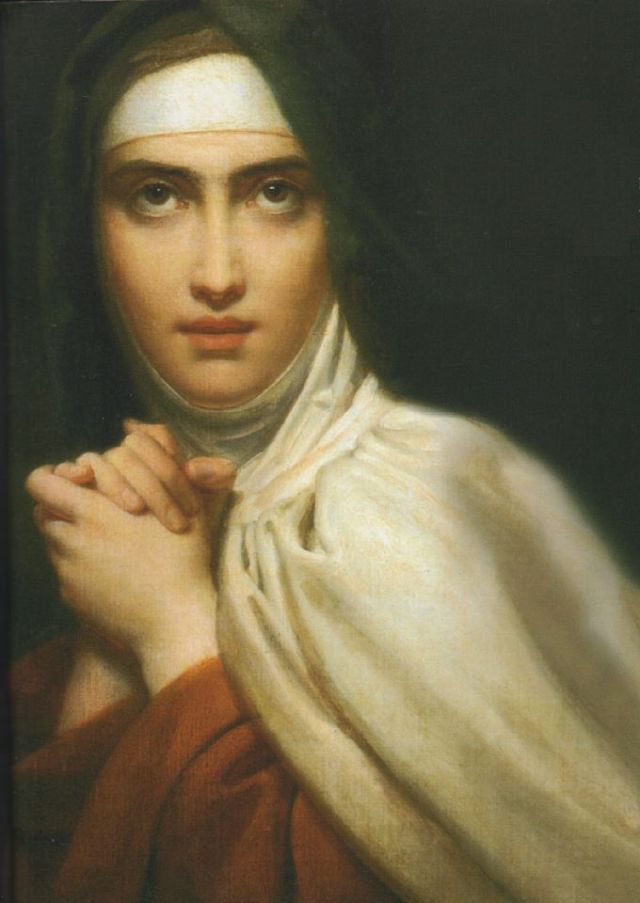
St. Matthias and the Renewal of Easter Hope – The Lord Loves His Friends

Today is the feast day of St. Matthias. The Acts of the Apostles relate that Matthias was chosen by lot to replace the disciple who had betrayed Jesus in the garden.

In chapter 18 of our Gospel, St. John speaks of Judas, who was in collusion with the Romans and the Jewish elders, and brought them to the place where Jesus was staying in the garden; the betrayal took place and the deaths occurred.

In the period after Jesus’ death the Apostles were known as the Eleven.

The Eleven. A title which causes us to pause, even today, two thousand years later. They were twelve, but then the betrayal took place. Judas hung himself; and the Romans hung Jesus on a cross. Even in those anxiety filled days after the death of Jesus, and before His resurrection, the Eleven knew in their hearts that Judas was not the only one, who had betrayed Jesus. For in cold terror they ran from the garden – they ran from the Cross – abandoning their Master and betraying His friendship.

It was only John, and the women, who had the courage to stand there and minister in silence, in tears and sobs, to their dying master. We wonder, that as they stood before the Cross, was there a crisis of trust in their own hearts? Did they wonder about the other ten who were not there? Did they wonder about their own possible betrayal? Yet, all of their self doubts and agony would be washed away through the truth of the Resurrection.

Today’s feast of St. Matthias gives us renewed hope in this, the sixth week, of the Easter season; for it directs us to the great love of God for His friends. It also reminds us that He never leaves His friends alone in their mission of building His Church.

After the Ascension of Jesus into Heaven, Peter, as the great leader of this little group of friends, realized that something had to be done to fill the hole, the gaping hole, that echoed with the cries caused by the betrayal of trust,  friendship, and fidelity to God Himself.

Peter knew that this cavity had to be repaired because Jesus Himself had filled the hole in Peter’s heart. It was Peter’s realization and trust that Jesus could heal him that led to his putting the mantle of leadership back on.

Peter knew that the grace of Jesus could heal them,too, and that they could become the ambassadors of the Good News who would carry out Jesus’ commands. Their group of twelve, by mirroring the twelve tribes of Israel, could evangelize Israel itself.

So, they cast lots – because they did not think themselves worthy to make the choice of their own accord, and wanted some sign [from the Holy Spirit] for their instruction.

Matthias was chosen.

St. Matthias was a disciple of Jesus who loved much, he witnessed the resurrection, he lived in the Father’s love, he followed Jesus’ commands, and was willing to lay down his life for the Lord and His Mission.

May God grant that we have Matthias’ courage to be open to the grace of Christ and use it to  build-up His Church.

Quote taken from a 4th century homily by St. John Chrysostom on the Acts of the Apostles found on pages 1822-24 of The Divine Office volume 2.

The sacred image of St. Matthias is from the workshop of Simone Martini the 14th century painter from Siena whose style influenced the Gothic movement. Martini portrays Matthias wrapped in the red mantle of martyrdom holding  a book that is painted green. Green is the color used by sacred iconographers and sacred artists to represent hope, life, and renewal. The book he is holding is a  reference to the truth of Christ’s Gospel preached by St. Matthias. This painting is dated between 1317-1319. Maestro Martini died in France at the age of 60 in 1344.

Copyright © 2012 Deacon Paul O. Iacono All Rights Reserved

ORO et CREO: PART THREE – A Personal Reflection

This is the third part of a three part series on a Spirit filled idea called Oro et Creo (“I Pray – I Create”). This idea was started by artists Jamie Medeiros and Deacon Tom Lambert. Please check out the first two parts of this series which have already been posted in order to get a full perspective on what they are accomplishing on the parish level.

What is wonderful about what Jamie and Deacon Tom are doing is that they are providing a simple, no anxiety-no pressure structure through which the  Holy Spirit can move the person to unite their artistic and creative impulses to their desire for union and communication with God. This is done in a silent, communal, setting, but it can also be done in an individual setting.

Creativity and prayer go hand-in-hand – it just takes the desire of the individual artist, regardless of the medium, to take the simple step of uniting the creative moment to their spiritual life. How is that done? Simply, it is an affirmation of the will to prepare yourself through short silent prayers, and then to consciously say, “Lord God – I offer this moment of creativity to you, help me to create something which gives You glory;” and  then, you create: poetry, stories, visual art, cosmetic design, fashion design, music, photography – whatever appeals to you.

St. Benedict of Nursia, when he established his community of Benedictine monks at Monte Cassino in 6th century Italy, was concerned that his monks balance their life between work and prayer. He developed his Rule which ordered their day into specific moments of prayer, work, and relaxation. Even in the 21st century we can relate to the significance of this type of structure within our busy day.

The point being that we must be balanced and make time for the important things of our life and not be a slave to the world, materialism, or current fads. St. Paul speaks of this in Colossians 3: 23-24 when he says: “Whatever you do, work at it with your whole being. Do it for the Lord rather than for men, since you know full well you will receive an inheritance from Him as your reward. Be slaves of Christ the Lord.” 

As I perceive it, when we are involved in the Oro et Creo process we have made the decision  to unite ourselves to the Holy Spirit – the Sanctifier – and then, we allow the Holy Spirit to guide us in our creative work. It is through the process of this creative effort that we speak to God and tell Him we love Him.

This process occurs when we are silent, and caught up in the moment of doing our work. It is at these times of intense concentration that we are taken “out of ourselves” (only to come back when we realize that we have been so focused on the creative work that we have forgotten the experience of time).

Our conscious prayerful effort at the beginning of the process expresses to God our love and thanks. From my experience, we don’t have to be consciously involved in constantly praying as we are creating. When your mind reflects on the need to pray – it is then appropriate to say a short prayer – such as “Jesus Christ, Son of God, have mercy on me a sinner” or, “Holy God, Holy Mighty One, Holy Immortal One have mercy on us,” or, just simply, “Jesus, I love and trust you.”

Jamie and Deacon Tom use the phrase Oro et Creo (I Pray – I Create) which was inspired by the Benedictine motto Ora et Labora (Pray and Work). To this I would add another section of the Benedictine Rule:  ut in omnibus glorificetur Deus, “that in all [things] God may be glorified” (Rule, chapter 57.9) which was also adopted and adapted by St. Ignatius of Loyola in his Jesuit motto: All for the Greater Glory of God. So, in our prayer/creative efforts – our intent – whatever results, should always be our desire to give honor, thanks, love, and glory to God. If we enter into these moments with an open heart and pure soul – it will.

Bravo and thank you, Jamie Medeiros and Deacon Tom Lambert, for your faith, prayer, and creativity! I am sure you have inspired many to continue your ideas in their own settings.

Thanks to ad-orientem.blogspot.com/200 for the icon of St. Benedict.

Copyright © 2012 Deacon Paul O. Iacono All Rights Reserved


ORO et CREO: “I Pray – I Create” – Part One

Soon after an article appeared in our Diocesan newspaper (The Rhode Island Catholic) in June 2011 on the Fra Angelico Institute for the Sacred Arts, I spoke on the phone with a talented artist by the name of Jamie Medeiros. We talked about the mission and goals of the Fra Angelico Institute and then she explained to me the mission of a group that she started at her parish in Tiverton, RI. Her group’s name is Oro et Creo (I Pray – I Create). I was fascinated by her description since it clearly was another example of the Holy Spirit’s continuing witness to get Catholics, and Christians of all denominations, interested in uniting the dual impulse of prayer and the creation of sacred art in all its various forms.

The following interview (the first part of a three part series) with Jamie Medeiros and Deacon Tom Lambert illustrate how their combined efforts and continuing positive influence have opened up the creative and spiritual impulses of many people.

The Lambert/Medeiros model can easily be replicated in your parish – regardless of where you are in the world. As of last week, this website/blog on The Fra Angelico Institute for the Sacred Arts, is read by people in 63 nations and on every continent except Antarctica. As far as I am concerned, these numbers are a clear example of how the Holy Spirit utilizes all resources to touch people’s hearts and move them back into a closer relationship with Him. Regardless of where you live in the world, and whether your parish is Roman Catholic, Greek or Russian Orthodox, Middle Eastern Catholic, or one of the Protestant denominations, the Lambert/Medeiros model of Oro et Creo, which unites personal prayer and the creative impulse within a church setting and in community with other artists, is a powerful tool of evangelization.

The Interview:

1) What inspired you to establish the Oro et Creo community?

Jamie Medeiros (St. Theresa’s Parish Tiverton, Rhode Island):     In Chicago at Our Lady of Mt.Carmel I had befriended one of the deacons [Deacon Tom Lambert] who had picked up art in his retirement.  He asked if I would meet one of the RCIA candidates [Belinda Cook Blakely] who was a student at The Art Institute of Chicago.  All three of us met after Mass one day and began a discussion about this common thread of art and God.  We discussed the fact that there seemed to be a lot of artists in our parish.  We joked, “we should start a group!”  The Deacon didn’t miss a beat.  He said, “We SHOULD start a group.”  We proceeded to discuss what it might “look like” if we started one.  This was just at the beginning of Lent [2008].  We all saw the movement of the Holy Spirit and thought the timing of this discussion was remarkable.  We picked a day, wrote up a blurb for the bulletin and decided to see if anyone would show.  They did.  We named it Oro et Creo after the Benedictine motto Ora et Labora (Pray and Work).  It is a time to pray while creating.  We continue to sit in wonder of the role of it as ministry for its participants.

Deacon Tom Lambert (Our Lady of Mt. Carmel Parish Chicago, Illinois): Oro et Creo started at Our Lady of Mt Carmel Church, Chicago when I introduced Jamie [Medeiros] and Belinda [Cook Blakely], two artists, to each other. They then approached me to start Oro et Creo because they didn’t find much connection between art and God in their work environments. Although both have moved on, Jamie to start an Oro et Creo group in Rhode Island, the group they started [here in Chicago] is still going on. For the translation of Oro et Creo I applied its meaning of ” I pray – I create” which says (to me) out of my prayer comes my creation. It is an invitation, a prayerful desire for one to create not a command to others, which is how I see Benedict’s Ora et Labora applying to his monks. [Deacon Tom and Jaime are using the phrase differently then St. Benedict, since St. Benedict was speaking in the imperative, that is, he was giving a command to his monks: “Pray and Work.” Deacon Tom and Jaime, however, are using Oro et Creo, the Latin is spelled differently because it  applies to an individual who prays and then creates, or creates while they are in a prayerful state – I Pray – I Create].

2) How long has your Oro et Creo sessions been in existence, what Church did it begin in, and is it taking place right now – name and geographical location?

Jamie: Oro et Creo first met during Lent 2008.  We began it at Our Lady of Mt. Carmel Church in Chicago, Illinois.  They are still meeting weekly on Monday nights.  Here in Tiverton, Rhode Island, Oro et Creo began the summer of 2010, meeting weekly, and now meets once a month on Mondays (7 pm) at St.Theresa’s Church in Tiverton.

Deacon Tom:  We meet weekly at Our Lady of Mt Carmel Parish 708 W  Belmont, Chicago, IL

3) Is the clergy involved in any way? Can people in your area join at any time and who would they contact and when would they show up?

Jamie: Here in Tiverton, our Pastor approved the program and likes to hear updates.  People are welcome to show up.  We meet at St. Theresa’s in Tiverton, RI on the first Monday of every month at 7 pm, unless it is a Faith Formation GIFT week.  People are welcome to email me with questions.

Deacon Tom: I am involved as a participant and [Parish] staff representative. The leader of the group is a layperson who is an artist.

4) How often do you come together to pray and create? Where do you actually meet – in the Church Hall, in the Church, at someone’s home?

Jamie: We currently meet once a month on Monday nights from 7 – 8:30ish pm.  This is open to change, depending on the seasons/ availability.  We meet in the Church.

Deacon Tom: We meet weekly. We start at the parish ministry center where we gather until everyone arrives. Then we have an opening prayer and then go in silence to the church or chapel. We sketch in silence for about an hour or more. People can sit anywhere in the church outside the sanctuary and sketch whatever they choose to do. Some bring pictures with them to sketch. We then go back to the ministry center where people may or may not choose to show the group what they were working on. Then a closing prayer is said. [Italics and boldface are my emphasis – Deacon Paul Iacono].

Part Two of this Interview with Jamie Medeiros and Deacon Tom Lambert will soon follow. In it they provide additional insights into this wonderful model which can easily be applied in your setting. Come on, what are you waiting for?!! Call one of your friends or church members who is creative, approach the parish clergy for permission to use the church for one hour a week, apply their model and get started!

 Copyright © 2012 Deacon Paul O. Iacono All Rights Reserved

Shaped By The Potter’s Hands

All of us struggle with the reality that the experiences of our life may harden our hearts and deafen our ears to God’s truth. We may be similar to the  disciples in this past Sunday’s Gospel (Luke 24: 35-48), who were filled with anxiety – until – – the moment “He opened their minds to understand the Scriptures.”

Jesus shows them the nail wounds in His hands and feet. He explains to them that the Scriptures teach that we cannot have glory and honor without the willingness to suffer and die to our own sinful will and perceptions.

He teaches them that they need to see the connection between His passion and death with His resurrection. He explains this so that they can understand what He is truly about, and that their mission, “as witnesses to these things” is to go out and preach the truth of His words and resurrection. Jesus explains, if they cooperate with and are open to His teaching, then they will realize that life’s events will shape them into what they are truly meant to be and the Father’s plan will end in glory for them, too.

We can relate the shaping and opening of the disciples’ minds to the creation of a beautiful piece of pottery or a favorite coffee mug or tea cup that we may own. That cup started out as a simple lump of clay. Its creator – the artist – put it on a potter’s wheel, moistened his or her hands, and began to firmly and patiently mold the lump of clay into a cup.

The cup had to be put into a kiln and heated – then taken out, allowed to cool – painted – put back into the kiln again – and then, at the right moment – taken out of the heat and allowed to cool – to eventually be used for the purpose it was created.

The cup – a few days or weeks before – was just a soggy lump of clay – all closed in on itself; but now, after all the pounding, shaping, heat, and stress of its experience – it is open to serve the purpose intended for it by its creator – its ceramic arms now open to embrace and hold what it was intended to receive – and thus, be a useful instrument – a good and faithful servant.

This analogy helps to explain a thread running through the fabric of Holy Scripture, a thread, Jesus probably repeated to His disciples which is from the prophet Jeremiah, it says “As clay in the potter’s hand, so are you in My hand…” (Jer.18.6);

Our creator, God the Father – has spoken to us through His Son and laid His potter’s hands on us – His chosen vessels. We are all lumps of clay. We have all been pounded and shaped on the wheel of life.

We are a people who have been put into the furnace of life’s circumstances, suffered through sickness or various types of torments and troubles, and who sometimes find ourselves hanging on by a mere thread, but with Jesus’ help – in the end – even though we have suffered much – we are made stronger in our faith – and are viewed as beautiful in the eyes of God because we have not given up.  The clay of our life has been moistened by God’s Holy Scriptures and Sacraments – and because we have patiently kept the faith – we have not cracked in the heat of the kiln of life.

Like the disciples in today’s Gospel let us be willing during this Easter season, to have our hearts and minds opened, shaped, and molded through the patient and loving hands of Our Lord in His Words and Sacraments. If we allow Him to do this, even though we have experienced the wheel of life and the kiln of adversity, we will emerge as beautiful and faithful servants of our Lord.

Special thanks to http://blog.lablanchepoterie.com/ for providing the image of the potter cutting the cup away from its base.

Copyright © 2012 Deacon Paul O. Iacono All Rights Reserved

Our Living Hope: The Tomb Cannot Hold Us

Catholics, Orthodox, and Protestants  – we are all an Easter people. For two thousand years we have – through faith in historical documents and human witness – been invited to believe in a divine act of revelation: the Easter resurrection of our Lord and Savior; for it is in that act that our God shows us who He truly is.

We believe that the resurrection of Jesus is a historical and spiritual fact; and that the resurrection of Jesus not only explains the truth of His promises but it demonstrates what has been promised to us.

On the first Easter morning, Mary Magdalene, Peter, and John saw that the stone had been rolled away from Jesus’ tomb; and as they looked in  – they came face to face with their eternal destiny. Since no stone could have stopped the resurrected Jesus, it was pushed away not to let Jesus out – but to let them – and us – in.

Like Mary, Peter, and John, and all the others, we come to realize that we are an Easter people – which means that we are an eternal people – members, through our holy baptism, of the family of the eternal high God. The tomb could never hold the resurrected Jesus, and – as a people of faith – it cannot hold us.

St. Paul tells us in his epistle to the Hebrews that “faith is the assurance of things hoped for, the conviction of things not seen.” (11: 1)

But what is hope? Hope is trust based on a divine promise. We have hope because we trust the words and deeds of Jesus Christ. We trust in His promises to us.

Our hope interacts with our faith in Him – and we are forever changed because of it. You and I are certain of our faith, because we understand and rejoice in the hope that our God does not lie – our Scriptures do not lie  – our Sacred Tradition does not lie; so as an Easter people we possess the hope that St. Peter speaks of when he says: “…we have been born anew to a living hope through the resurrection of Jesus Christ from the dead.   (1 Peter 1:3).

As we celebrate the Easter season, let us – as our Lord tells us today – “Be not afraid”  – let us be joyful and thankful for the gift of faith and the willingness, in the face of all odds, to share our faith and joy with others.

May God grant you a joyous and creative Easter season!

The attached sacred image was painted by Fra Angelico in 1441 and is entitled “The Women at the Tomb.”       Copyright © 2012 Deacon Paul O. Iacono All Rights Reserved

Holy Saturday Meditation: Something Strange Is Happening

“Something strange is happening – there is a great silence on the earth today, a great silence and stillness. The whole earth keeps silence because the King is asleep. The earth trembled and is still because God has fallen asleep in the flesh and he has raised up all who have slept ever since the world began. God has died in the flesh and hell trembles with fear.

He has gone to search for our first parent, as for a lost sheep. Greatly desiring to visit those who live in darkness and in the shadow of death, he has gone to free from sorrow the captives Adam and Eve, he who is both God and the son of Eve.

The Lord approached them bearing the cross, the weapon that had won Him the victory. At the sight of Him Adam, the first man He had created, struck his breast in terror and cried out to everyone: “My Lord be with you all.” Christ answered him: “And with your spirit.” He took him by the hand and raised him up, saying: “Awake, O sleeper, and rise from the dead, and Christ will give you light.”

I am your God, who for your sake have become your son. Out of love for you and for your descendants I now by my own authority command all who are held in bondage to come forth, all who are in darkness to be enlightened, all who are sleeping to arise. I order you, O sleeper to awake. I did not create you to be held a prisoner in hell. Rise from the dead, for I am the life of the dead. Rise up, work of my hands, you who were created in my image. Rise, let us leave this place, for you are in me and I am in you; together we form only one person and we cannot be separated.

…For the sake of you, who left a garden, I was betrayed to the Jews in a garden, and I was crucified in a garden.

See on my face the spittle I received in order to restore to you the life I once breathed into you. See there the marks of the blows I received in order to refashion your warped nature in my image. On my back see the marks of the scourging I endured to remove the burden of sin that weighs upon your back. See my hands, nailed firmly to a tree, for you who once wickedly stretched out your hand to a tree.

…a sword pierced my side for you who slept in paradise and brought forth Eve from  your side. My side has healed the pain in yours. My sleep will rouse you from your sleep in hell. The sword that pierced me has sheathed the sword that was turned against you.

Rise, let us leave this place. The enemy led you out of the earthly paradise. I will not restore you to that paradise, but I will enthrone you in heaven… the kingdom of heaven has been prepared for you from all eternity.”

The above quotation is from an ancient homily of the Catholic Church from its earliest centuries and is found within the Divine Office of the Roman Catholic Church. It is taken from the Office of Readings for Holy Saturday.

The first image of “The Harrowing of Hell” was painted by the Florentine painter Fra Angelico between the years 1437-46. The second image on this same subject was completed around the year 1315 by an artist of the Orthodox Church who painted this wall icon in fresco. It is presently found in the Chora Church in Istanbul, Turkey. The third image of the “Harrowing of Hell” is by the head of the Moscow school of icon painters from the late 15th century – the master Dionysius. This Russian Orthodox  icon was completed around 1481.

Copyright © 2012 Deacon Paul O. Iacono All Rights Reserved

Good Friday Meditations

It was about nine in the morning when they nailed Jesus to the cross.

From noon until three o’clock there was darkness over the whole world.

At three o’clock, Jesus cried out in a loud voice: My God, my God, why have you forsaken me?

It is finished.

When we were His enemies, God reconciled us to Himself by the death of His Son.

Realize that you were delivered from the futile way of life your fathers handed on to you, not by any diminishable sum of silver or gold, but by Christ’s blood beyond all price: the blood of a spotless, unblemished lamb chosen before the world’s foundation and revealed for your sake in these last days. It is through Him that you are believers in God, the God who raised Him from the dead and gave Him glory. Your faith and hope, then, are centered in God.  (1 Peter 1: 18-21)

“Awake, O Sleeper, and rise from the dead, and Christ will give you light.”


Copyright © 2012 Deacon Paul O. Iacono All Rights Reserved

The painting, Christ’s Crucifixion, is by the Spanish master Diego Velazquez (1599 – 1660); it was completed between 1631 – 32.  All the Scriptural quotations are taken from The New American Bible (1970) Confraternity of Christian Doctrine, Washington, D.C. The “Awake, O sleeper…” verse is taken from an ancient homily from the first centuries of the Church.

The Solemnity of the Annunciation – The Confident Sacrifice Of A Pure Heart

Many years ago, Blessed John Paul 2 spoke to the seminarians of Rome on this, the Solemnity of the Annunciation. He began his homily with the phrase: “Fear not!”  Echoing the archangel’s comments to our Blessed Mother he was trying to calm the natural anxiety of those young men as they  prepared for their Gospel ministry in the world. The Pope counseled them that “We must all accept the call. We must listen [to the Holy Spirit],  and use the grace that we have received from God. We must shore up our strength, and say, “Yes” in confidence and certainty to the call that we hear from the whispers of the Holy Spirit.”

Upon hearing the message of the archangel Gabriel, the ultimate decision by Mary that “Let it be done to me according to your word” conclusively and forever changed cosmic and spiritual history. For at the moment she said “Yes” to Gabriel, our salvation and redemption, through the Cross, began.

Let us not forget, however, that Mary’s “Yes” had a tremendous affect on her, too.  It required a great cost from her personally because it resulted in the Crucifixion – it resulted in the sacrifice of her own son Jesus – and – the sacrifice of her own heart.

Blessed John Paul 2 speaks of this when he says:  “Mary in a particular way – unlike any other – experienced mercy, and at the same time, made her participation in the revelation of the Divine Mercy possible with the sacrifice of her own heart.  Such a sacrifice is closely bound up with the Cross of Her Son, at which she was to stand at Calvary… No one has experienced the mystery of the Cross as did the Mother of the Crucified…. Mary is therefore the person who knows the Divine Mercy most deeply. She knows the price; she knows how high it is.”

He goes on to say, “Maybe there is another point: for all people are born at Mary’s Yes.” This must be understood: such a Yes in imitation of Mary creates joy, a new life, a breath, a blessing;” it creates opportunities for us to  sacrifice our own hearts in imitation of her and the Holy Family.

So as we enter the 5th week of Lent let us celebrate this Solemnity by trying our best to live like our Blessed Mother – a person with complete confidence in the Lord. Let us say Yes to God in imitation of Mary and allow the Lord to work wonders in our own lives, as well.

Images in order of appearance: A 13th Century Byzantine icon of the Annunciation from St. Catherine’s Monastery in the Sinai; Henry Ossawa Tanner’s Annunciation (1898); John William Waterhouse’s Annunciation (1914); and Bartolome E. Murillo’s Annunciation completed between 1660 -1665, and please don’t forget to do some research and take a closer look at one of Fra Angelico’s versions of the Annunciation! Please also notice that in Waterhouse’s and Murillo’s renditions both artists have included the tradition that Mary was in the process of sewing the veil that separated the Holy of Holies from the outer room which housed the Altar of Incense in the Temple in Jerusalem; other artists, such as El Greco, do that too.

Copyright © 2012 Deacon Paul O. Iacono All Rights Reserved

The Artist As Contemplative: Part 2: A Simple Step Into Prayer By St. Teresa of Avila

In our last post, The Artist as Contemplative – Part 1: The Proper Approach, we discussed the need to have the proper approach to prayer. One of the assumptions that I have is that if you are reading these posts you are a creative person. You may be an actual working artist, or, you may be attracted to art in one of the various forms it takes and are considering taking the first step in its exploration. Even if you are just beginning to explore a specific art form it is important for you to consider yourself an artist. This is not a fraudulent act. It is the perception of yourself as you truly are as a creation of God – a naturally creative person.

The Lord has made all of us creative beings, and regardless of our job or profession we should make time in our life to develop this creativity and allow it to be expressed. If we have no time for prayer and personal creative growth then we may be in a situation that is truly unhealthy for us. Our Sacred Scriptures tell us that our God is a jealous God – He specifically said that He wants “no other gods before Him” – that is a very sobering thought. So, quiet, prayer time – even if it is only thirty minutes a day – is critical to our spiritual, physical, and creative health.

If we make time for prayer, God’s grace and energy will cascade over into our creative life.  This is very important to artists, regardless of what media or medium we work in, since it demands that we focus our attention on one thing: talking to God in a natural way – talking to Him as we would talk to a close and intimate friend. 

This is difficult for many people. Childhood ignorance or anxieties may still be with us. There may have been bad influences from teachers, members of the clergy and religious life, and others (including, at times, parents) who took a limited view of prayer and taught a specific prayer style to the detriment of other approaches.

By remaining positive we see that a key idea in the prayer process is to remember that when we have a conversation with someone our intellect is remembering ideas and images. We are using those ideas and images in our actual conversation. This allows the conversation to proceed from one point to another and allows ideas or issues to be shared. This is also true in conversation – that is, our prayer – with God. Our intellect, memory, and silent conversation skills within our mind cooperate together to naturally express ourselves to God. Just like the story, in my preceding post, of the little girl receiving her first Holy Communion. She expressed her prayer to God in a natural manner, which made sense and allowed her to share the concerns or ideas with the Lord that were on her mind at that time. Her prayer was a perfect natural prayer.

In examining the teachings and prayer process of St. Teresa of Avila (1515-1585), the Spanish Carmelite, Father Peter Thomas Rohrbach, O.C.D. breaks her basic prayer technique into a simple step formula. He says the goal of prayerful meditation is conversation with Jesus. You achieve  this by engaging your visual memory  with a specific spiritual passage. This con-versation with Jesus about the passage moves to consideration of events within your own life. This process is actual conversation with Jesus in which He, like a good friend, is quietly listening to you.

St. Teresa of Avila (seen above in the portrayal by Gérard) is not promoting a prayer life which is filled with complexities, intellectual knots, and unnatural irritations, rather, she is presenting a style which reminds us of a wise old person who has no need of thinking about numerous paragraphs of words to say to God in prayer. The wise one enters their prayer time thinking about God, and specifically His Son, Jesus – the true icon (image) of God. They then allow their love of Him to take over – and fill the blessed silence of that present moment – not with many words – but with much love. You see this is the goal: to move from quiet conversation to quiet meditation – in love – of God’s truth, goodness, and beauty.

In my next post I will provide you with a meditation taught by St. Teresa of Avila. With  this Lenten meditation you should easily exercise your spiritual muscles. Also, it will help you take some time to reflect on St. Teresa of Avila’s approach and application to other moments in Jesus’ life and yours, too.

Copyright © 2012 Deacon Paul O. Iacono All Rights Reserved.  Thanks to avila.com for the image of St. Teresa of Avila by artist François Gérard (1770-1837).

The Artist As Contemplative – Part 1: The Proper Approach

All artists, by their very nature, contemplate. They are natural born contemplatives.

In its dictionary definitions we see that the word contemplate means: 1) “to intently look at something, 2) to study carefully, and 3) to have in mind the possibility or a plan of action.”

A person whose artistic skills are expressed through photography or the enhancement of physical beauty through fashion or cosmetics can certainly contemplate the meaning of beauty and maintain its traditions or break out and establish new ones. The same is true of a sculptor, painter, musician, needlework artist, poet, writer or any person working within other artistic mediums. For they, too, can “look intently at, study carefully, or have in mind the possibility of a plan” to create beauty or a new interpretation of it. As you see, at first glance there is no overt mention of religious or spiritual themes in these definitions.

Now let’s go a step further and ask a few questions: 1) Can the Christian artist (who has a natural contemplative spirit by virtue of being an artist), establish the artistic process as a vehicle for authentic prayer and union with God? 2) For example, did our friends Vincent Van Gogh or St. Andrei Rublev experience authentic prayer moments in their creative process? 3) When we look intently at  Starry Night or Christ the Redeemer – the Savior of Zvenigorod (seen below) do we feel comfortable using them in our conversation with God, and if not, why not?

Okay, as the old saying goes, “What does this have to do with the price of eggs?”

Young or old, there are times in our lives when we put up barriers in our minds to pursuing some study or some plan of action. This is especially true when it comes to the whole idea of prayer, and specifically, meditation and contemplation. People have a tendency to say, “Oh, that’s for holy people. I’m a sinner. I could never do it nor do I have the skills to do it. Bottom line, no one has ever taught me how to pray other than saying rote memory prayers.”

Good point. That perception is held by many people, especially Christians that have fallen away from the church of their ancestors. But is that belief just another mind barrier?

It is an established fact of being a Christian that we can be in touch with God, specifically His Divine Son, Jesus. We do believe, if we are Christians, that we all have the ability to enter into deep spiritual union and friendship with God by virtue of our Baptism. Baptism was the first very important step, and then, after that, the friendship of Christ is developed through our weekly worship and daily prayer life, our Scripture study and our Sacramental life. It takes effort, yes; but as Christians we understand that we enter into that relationship with Christ by walking with Him through His ministry and onto the path to Calvary.

The reader might say, however, “I am not a Christian. What does this have to do with me?” Even if the artist is not Christian they have the ability to enter into deep spiritual union with God through their own faith traditions. All the major religions of the world speak of and promote prayer; and all artists, even if they are not Christian, can enter into spiritual union with the Divine through the creative process.

But there is a little known maxim in Catholic Christian prayer practice: if you can think and if you can read (at the second grade level) you are capable of meditation; let me repeat, you are capable of experiencing authentic, prayer filled, and profound contemplation of God.
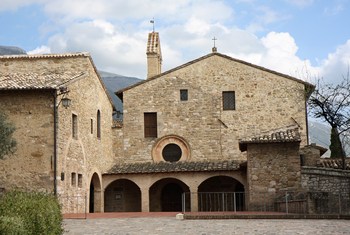
A quick example of this is the story that Father Peter-Thomas Rohrbach, in his important and delightful book Conversation With Christ that I discovered forty-five years ago. He tells of a young Catholic girl’s experience on receiving her first Holy Communion. He says, “The story is related of a small girl who, after the reception of her first Holy Communion, was questioned tenderly by her parents as to what she had done when she arrived back at her pew and prayerfully bowed her head. The girl hesitated momentarily, and then said in her thin, small voice: “‘I prayed to Our Lord for Mommy and Daddy, and for my sister Helen, and my brother George; and then I recited the alphabet to Our Lord and told Him a ghost story.'”
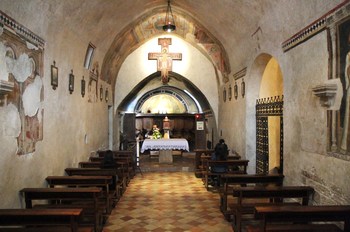
Father Rohrbach continues, “We, of course smile indulgently at the naivete and innocence of the small child; but after reflecting on the story, we might suddenly wake to the realization that the girl possessed the proper approach to prayer – she was actually talking to Our Lord. What she said to Christ was relatively unimportant, what she did was decidedly important: she entered into immediate contact with her Friend, Christ. If we could learn to converse with Christ as she did, we would be making successful prayer; if we could adopt her attitude for the conversation period of our meditation, our problems in this regard would be at an end.”

So, this is what we hope to accomplish in this blog’s series on The Artist  As Contemplative – to learn and develop the proper approach to prayer. My posts over the next month or two will deal with different approaches to prayer that an artist might use to assist in their artistic creativity and in their prayer life; and ultimately, to explore and apply the idea that contemplative prayer is unspoken prayer of the highest order; for it is in contemplative prayer that a person is united to God and ponders His truth, goodness, and beauty.

My next post will discuss the eight simple steps of prayer that has been promoted by the spiritual studies and athleticism of the nuns, brothers, and priests of the Roman Catholic Order of Carmel – Discalced Carmelites – over the last four hundred and fifty years. It is my perception that these simple steps are essential in mastering the procedure of spiritual contemplation and meaningful prayer with Our Lord. Subsequent posts will demonstrate other approaches to Christian prayer, some new, some very creative, and others ancient tried  and true techniques that the Church – both Eastern and Western Rites – have expressed over the last two thousand years of its history.

Copyright © 2012 Deacon Paul O. Iacono All Rights Reserved

Making Room In Your Heart for God, Prayer, and Creativity

The Gospel of St Mark, chapter 9: 14-29, challenges us to ask ourselves the question “How does the effective disciple of Jesus live his or her life?” Clearly the ineffectiveness of Jesus’ disciples in doing His work is evidenced when the father of the possessed boy complains to Jesus that His disciples were unable to help his son, and even questions the power of Jesus to intervene on his son’s behalf.

Jesus responds with disappointment tinged with anger over the actions of some of His disciples; people who took it upon themselves to act in Jesus’ name but were not prepared to do so – for they did not ready themselves through prayer, fasting, and good works.

Jesus was upset with them for their lack of preparation. He implies that they were not effective co-workers. They were not ready to share His mission because they believed  they could remain who they were and still carry out the work of Jesus.

At that point in Christ’s ministry they didn’t realize that they had to be willing to cooperate with Him and transform themselves into His Life; a transformation, which accompanied by the grace of God, demanded great effort on their part.

In private, Jesus’ disciples asked Him why they didn’t have any success. He said, referring to the evil spirits,  “This kind can only come out through prayer.”

An Internet friend of mine from West Virginia, Fr. Paul Wharton recently said, “the transcendent knowing of God in prayer is making room in myself for an experience of His loving presence deep within me and all around me.”

This is such an important point, for we must make room for God deep within ourselves. As spiritual people we must guard against the weakness evidenced by the disciples in this Gospel. They thought they were acting like Christ, they thought they had His power in their lives, but they had not made room for Jesus in their hearts, and when faced with the enemy they were unprepared – they were helpless and impotent.

So, as creative people – as artists in our various fields – how do we become effective disciples of Jesus Christ? I believe our effectiveness is based on four concepts: 1) the grace of God coming to our hearts and souls through Christ’s Holy Sacraments; 2) our willingness to open our hearts and allow God to go deep within our souls so that He may evangelize us; 3)  our personal effort to be transformed into His Gospel Life through prayer, Scripture study, and our  unique approach to the creation of sacred art; and, 4) our faith and trust in His ability to lift us up, like the possessed boy, out of our suffering – or to give us the strength to bear what we are asked to endure.

These four concepts have an important part to play in our creativity and productivity as sacred artists. We must see ourselves, and the various arts that we produce, as part of His divine mission to first, evangelize ourselves, and then, through our art, those around us.

As we approach Ash Wednesday and the first week of Lent, I would like to raise your attention to a series of posts that I will publish during Lent dealing with the idea of prayer as it applies to our creativity. I will explain and explore with you a few valuable methods that I have learned over the years and one that I have recently been made aware of by a fellow member of the Fra Angelico Institute for the Sacred Arts.

I pray that you will profit from these upcoming posts and that they may help you in your process of becoming an effective disciple of Christ and an even more creative and Spirit filled person! May the Lord bless you with a happy and creative Lent.

Copyright © 2012 Deacon Paul O. Iacono All Rights Reserved     Thanks to starrymantle.blogspot for the sacred art rendition of today’s Gospel; and if you have a chance check out Fr. Paul Wharton’s blog at http://heartsonfire33.wordpress.com/2012/02/17/adrian-van-kaam-1920-2007-on-prayer/