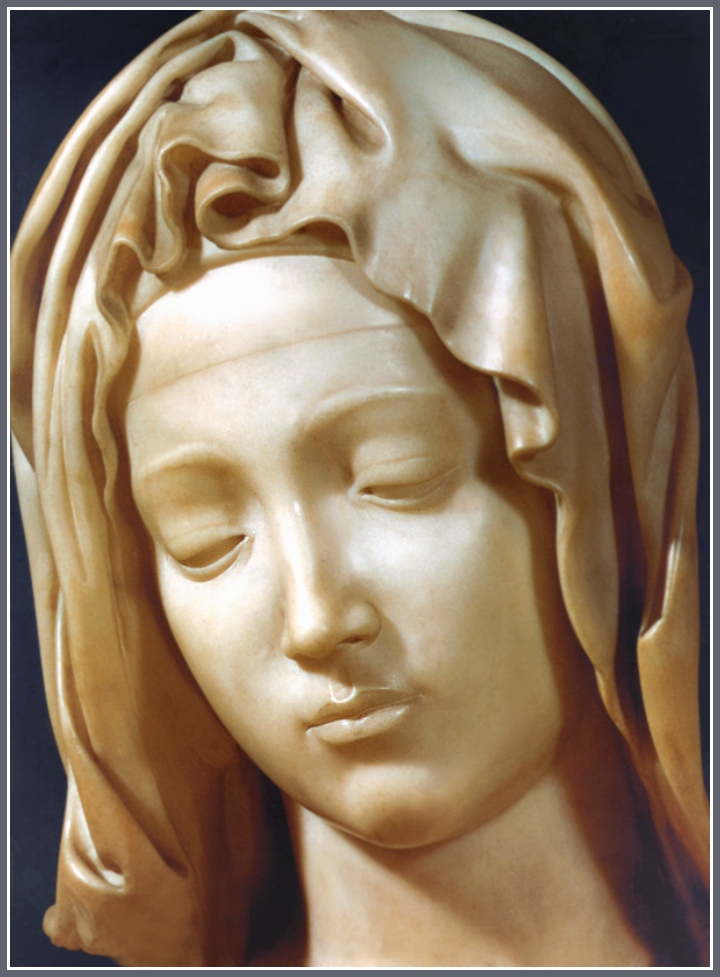
Joy Amid Trials and Rumors of War – Gaudete Sunday

The third Sunday of Advent is celebrated as Gaudete Sunday and it marks the middle of the Advent season. In ecclesiastical Latin, “gaudete” means “rejoice” and is symbolized by the rose-colored candle in the Advent wreath. 

This Sunday’s reading from St. Paul may give you a sense of pause. You may say: “You mean I’m to rejoice even if I have just lost my job, or my spouse is very ill, or my husband, wife, or child has abandoned me and wants nothing to do with me?”

Remarkably, St. Paul’s message is “Yes, give thanks, and rejoice!”  That is a hard pill to swallow. Although, let’s be careful. He is not saying for us to put on blinders and happily skip down the yellow brick road. St. Paul had plenty of trials and accusations leveled against him. His epistles to the various churches of Asia Minor, Greece, and Italy are filled with numerous personal problems and tribulations. Chained, beaten, and thrown into prison Paul came face-to-face with trouble, understood its meaning, and in the end, smiled.

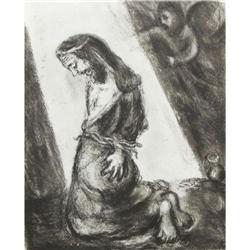
“St. Paul in Prison” by Rembrandt, 1627

An example of this is in Paul’s Epistle to the Philippians, (composed between 52 and 62 AD, source: The Jerusalem Bible, chapter 1, verses 1-11, and following),

“1:1) From Paul and Timothy, servants of Christ Jesus, to all the saints in Christ Jesus, together with their presiding elders and deacons.

1:2) We wish you the grace and peace of God our Father and of the Lord Jesus Christ. (1:3) I thank my God whenever I think of you; and (1:4) every time I pray for all of you, I pray with joy, (1:5) remembering how you have helped to spread the Good News from the day you first heard it right up to the present. (1:6) I am quite certain that the One who began this good work in you will see that it is finished when the Day of Christ Jesus comes.

1:7) It is only natural that I should feel like this towards you all, since you have shared the privileges which have been mine: both my chains and my work defending and establishing the Gospel. You have a permanent place in my heart, (1:8) and God knows how much I miss you all, loving you as Christ Jesus loves you.

1:9) My prayer is that your love for each other may increase more and more and never stop improving your knowledge and deepening your perception, (1:10) so that you can always recognize what is best. This will help you to become pure and blameless, and prepare you for the Day of Christ, (1:11) when you will reach the perfect goodness which Jesus Christ produces in us for the glory and praise of God.”

St. Paul links the ability to possess sincere joy with prayer. Our spiritual, and possibly physical survival, depends on our developing a sincere daily prayer life. Regardless of whether it is long or short the heart of all prayer is a conversation with our Lord. This conversation can only occur when we perceive reality as a trusting and knowledgeable child of God rather than that of a secular adult; however, we must “be as wise as serpents but as innocent as doves” (Matthew 10: 16).

On Gaudete Sunday we rejoice that our faith and trust in His love will enable us to endure any tribulation; and this gives us the strength to love and serve Him by loving, serving, and praying for one another. 

My family and I hope you have a prayerful Advent and a joy-filled Christmas season! May God bless you and your families.

Copyright © 2011- 2024 by Deacon Paul O. Iacono – All Rights Reserved. Permission to reprint essays in their entirety and/or my personal paintings must be obtained from me by using the comment box and making a comment/request on the post. I will respond to you through answering in the comment box. Students, and those interested, may quote small sections of my essays as long as the proper credit and notation is given. Thanks.

The Virtues of St. Francis of Assisi – A Model For Sacred Artists, October 4th

In our celebration of the memorial of St. Francis of Assisi we must pause for a moment and examine the virtues that motivated and energized his life.

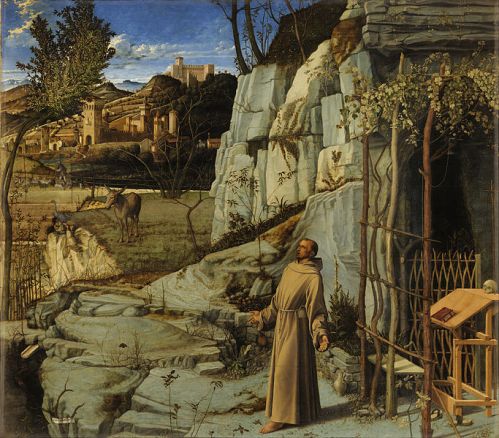
We can begin by saying that he was a simple man. He pursued simplicity. This does not mean that he was of limited intelligence, or that he pursued simplicity for simplicity sake, rather, it means that he was successful at eliminating everything from his life that did not enhance his understanding and love of Jesus.

In other words, he kept to what was essential in life: “God, the state of our soul, judgment and eternal life.” He realized that “to be simple is to see things with the eyes of God. St. Francis pursued simplicity because he innately knew that God Himself is simple” (from a sermon by Fr. Ronald Knox, 1936).

Other characteristics of Francis’ life are the virtues of faith and love. St. Francis understood that by praying  for faith, by acting faithfully and lovingly, his spiritual muscles would be stressed, making him  grow stronger in faith and love of God. He knew that God’s grace would assist him in this spiritual exercise if he committed himself to it.

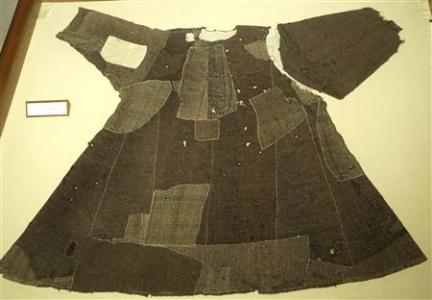
Thus we see his extraordinary reaction to his father’s demand for repayment for the fabrics he took, and sold, to benefit the poor. How did he react when accused? He publicly disrobed; a humble nude standing majestically in the town square. Michelangelo should have attempted to sculpt that scene in marble. For what was the scene?

It was the image of the young Francis, not confronting the Goliath of military invasion, rather, the Goliath of a garden serpent who tempted him to return to the sweet life, la dolce vita. It was the image of the grace of a God given vision to live a virtuous life. Its simple grace would be the stone that would bring down the giant of his own ego and worldliness.

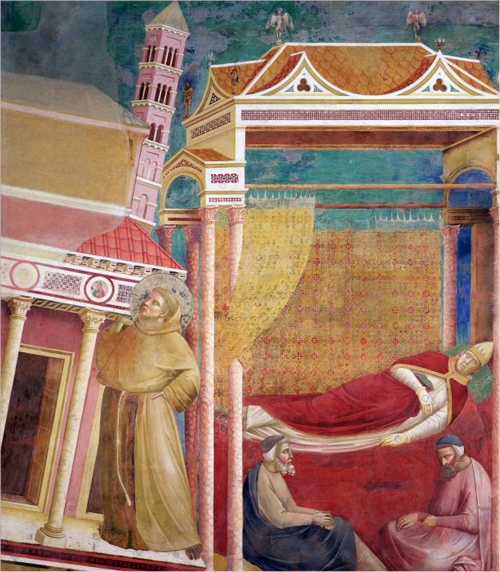
The magnificent Florentine painter, Giotto (1226-1337), born the same year St. Francis died, painted these virtues of St. Francis at work when he portrayed Pope Innocent III’s dream of Francis holding up the pillars of the Church.

It was St. Francis, and his fellow friars that would live in their daily lives the virtues of poverty, chastity, and obedience. These virtues, within the Franciscan perspective, would sweep the imagination of Europe and even gain respect in the Mid East.

How does this apply to an artist? Sacred artists must strive for balance in their spiritual and artistic life. Giotto is a wonderful example for us because he combines the principles of action and contemplation. Like Francis, Giotto was balanced. He achieved simplicity in his portrayal of spiritual truths, and was able to witness  continual dedication to combining action (art) with contemplation (prayer during the creative process).

Giotto was a master of painting sacred images that made St. Francis’ life come alive. For example, he captures the spirit of Francis in the Holy Land and brings a favorite story about him to life. In the year 1219 during the Fifth Crusade, Francis traveled to the Holy Land, where he was captured and beaten by the Muslims.

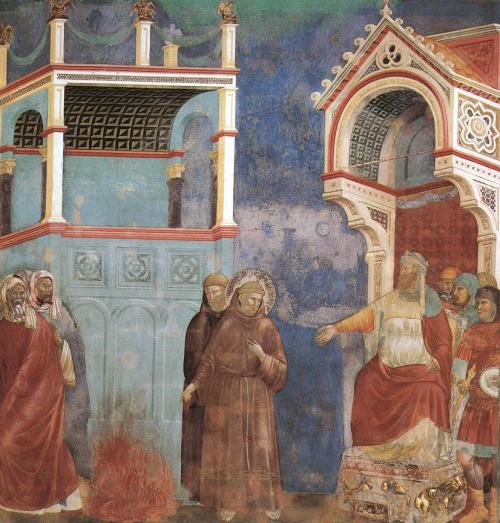
St. Bonaventure tells us in his history of the Franciscan Order that St. Francis was brought before the sultan Al Kamil, and he preached to him about love and the meaning of Jesus’ life. When Francis finished his sermon he then challenged the Sultan’s imams to a religious test to determine which was the true religion – Islam or Catholicism. The painting below, entitled Trial by Fire by Giotto, illustrates the drama of that moment.

“Francis said to the Sultan: “Please have a bonfire lit, and have your imam, along with me, enter the fire – so let it be that his God is the true God whoever emerges from the flames unhurt.”

The Sultan’s eyes lit up – now this is a man of faith!

His imams, however, felt that they had better things to do.

But from that moment on Al Kamil was so impressed with Francis that he gave the Franciscans safe passage to travel and stay unhindered, anywhere, in Muslim occupied territories; and as a direct result of this act, eight hundred years later, if you go to Jerusalem you will see that the Franciscans are still the Catholic Religious Order responsible for the maintenance of the holy shrines.

Theologian Dr. Marcellino D’Ambrosio teaches us that “St. Thomas Aquinas explains that a virtue, like a physical muscle, is a habit – a power or capacity – that gets stronger when its exercised – and atrophies – when it is not.” St. Francis shows us that faith and love, prayer and service are the main muscles in our spiritual body; and for artists they are the virtues that keep our lives balanced. Are we not all artists?

The life of St. Francis of Assisi was, itself, a work of art. For it was one in which the person, Francis, cooperated with the grace of God and allowed himself to be sculpted by the Divine Artist Himself; may we all be as courageous to do the same.

*Readers are welcome to read all my posts on St. Francis, and a relatively new one, entitled St. Francis of Assisi: A Nice Man or a Soldier of Christ? https://fraangelicoinstitute.com/2021/03/04/st-francis-of-assisi-a-nice-man-or-a-soldier-of-christ/

Copyright © 2011- 2024, Deacon Paul O. Iacono – All Rights Reserved. Permission to reprint must be obtained from the author through making comment on this post in its comment section. Students, and those interested, may quote small sections of the article as long as the proper credit and notation is given. Thank you.

Paris Olympics 2024, Outrage and Sacred Art Symbolism

By this time the majority of the 2.3 billion Christians that live on the face of the earth have probably heard of the outrageous and blasphemous opening act of the 2024 Olympics.

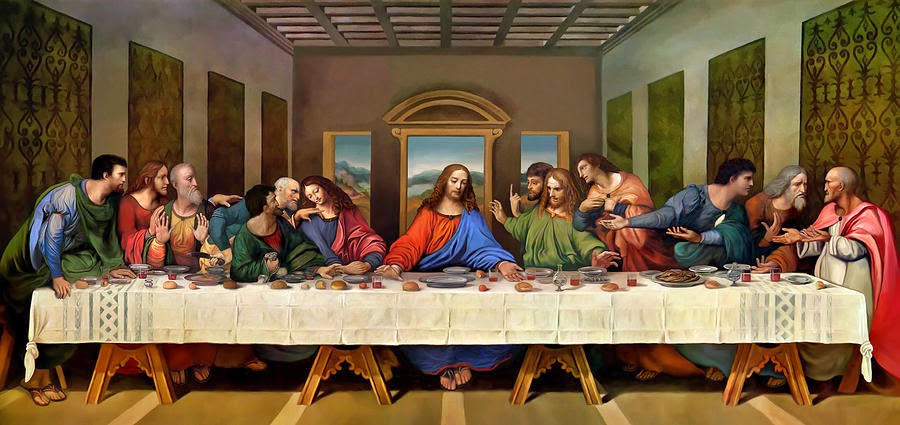
One part of the three plus hours of the show presented LGBTQ+ people depicting what appeared to be the Last Supper Jesus celebrated with His Apostles on the night before His torture and crucifixion.

the-last-supper-leonardo-da-vinci-1605119427

Below you see a woman, representing Jesus, sitting at the center of a long table.

BB1qMf29.img

Is the center figure a priestess? The woman makes a heart shape with her hands. Is that supposed to be a veiled reflection of the love of Christ for His Apostles, or the Sacred Heart of Jesus? She has what appears to be either a headdress, halo, or possibly a Eucharistic host above her head. 

BB1qHOby.img

The Da Vinci painting of the Last Supper shows the moment immediately after Jesus pronounces the words (as found in the Holy Gospels) of consecration and transubstantiation of the bread and wine into His Body and Blood. That moment, re-presented in every Holy Mass, is the source and summit of the Catholic, Orthodox, and the Eastern Rite Churches. It is the institution of the Sacrament of Holy Communion – all Roman Catholics, the 26 cultural Rites in union with Rome, and the Greek and Russian Orthodox Churches believe it to be true.

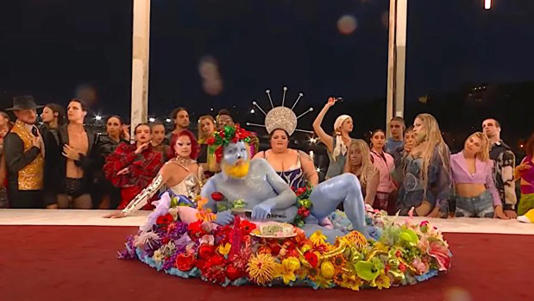
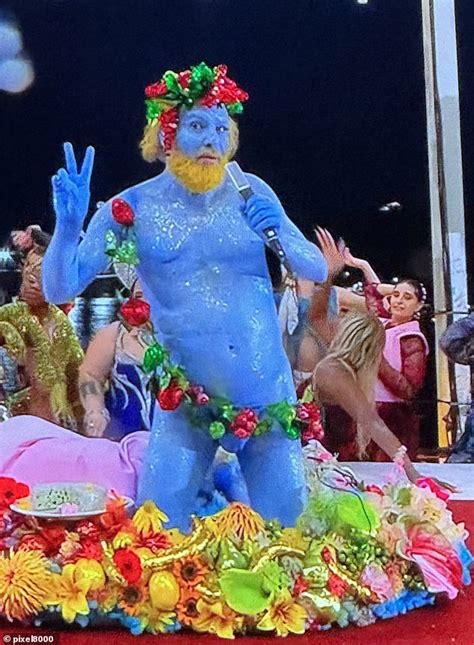
The “blue man,” at the front center was intended to represent Dionysus. Or was he intended to represent the resurrected Jesus Christ? 

In Greek mythology, Dionysus is the Greek god of wine. Dionysian consumption of wine brings a person to spiritual and physical ecstasy. Dionysus is known as a dying-and-rising god (resurrection). He also acts as the divine communicant between the living and the dead, and is known as a god of epiphany. Is this another veiled reference? The feast of Epiphany in the Roman Catholic Church is the celebration of the divine manifestation of the child Jesus to the world  represented by the three wise men (Magi). 

The blue man ascends  (resurrection) in front of the female at the center of the table.  A female Jesus, at the Last Supper before His death, then changes into the blue man. He was on a platter, presumably dead, then rises up, resurrected. He gives us the peace sign. He is also specifically transformed  into a man. A reference to a transvestite? How could the IOC not see the intentional mockery?

th-2456858966

The color blue in Christian sacred art represents divinity, transcendence, and the guidance of a soul to divine life. Dionysus is the god of wine, health, and love. The blue man is surrounded by flowers. Red, in Christian iconography has many meanings, but is especially associated with wine, health, and love (wine -the consecrated body, blood, soul, and divinity of Christ transubstantiated by a priest during Holy Mass; health – when consumed the transubstantiated wine provides the communicant with the divine life of Christ, love – the  redemptive love of Jesus Christ given to His creation). 

Some commentators said that the performance represented the “kitsch” that the city of Paris has embraced since the beginning of the 20th century. I disagree. The performance not only represented kitsch, it represented the contempt, willingness to insult all Christians, and specifically the Roman Catholic, Orthodox, and Rites in union with Rome. It also represented the stupidity of the IOC and all public and private individuals  associated with it.

Thomas Jolly, the artistic director for the ceremony, said that he didn’t see a problem with the act because it was not meant to offend but unify people.

Hah!

For Mr. Jolly, his assistants, and many of the world’s correspondents to say that there is no relation of that Olympic act to the Christian faith is bogus. They are either grossly (and happily?) ignorant of the basic tenets of Christianity or they just don’t care that it was a direct act of contemptuous ridicule of the Christian religion and the Lord our God, Jesus Christ.

I saw a reporter interview Olympic attendees and asked them about the Dionysian performance. The  eight people interviewed said they saw nothing wrong with it. They gave either woke answers or were completely oblivious to the symbolic meaning. I wonder if they would say that if the act portrayed a holy moment within the faith of  Jews or Muslims. I’m sure Jews and Muslims would be in the streets protesting the blasphemy and rightly so. No faith should be mocked.

Christians of all faiths must be willing to speak out and protest such contemptuous insults to God and faith. What are we, and our clerics, waiting for?

Our Lord promised a winnowing.  It will surely come. May God have mercy on our souls.

Copyright © 2011- 2024 by Deacon Paul O. Iacono – All Rights Reserved. Permission to reprint essays in their entirety and/or my personal paintings must be obtained from me by using the comment box and making a comment/request on the post. I will respond to you through answering in the comment box. Students, and those interested, may quote small sections of my essays as long as the proper credit and notation is given. Thanks.

Marko Rupnik, Alleged Sexual Abuse, and Sacred Art

The alleged sexual abuse scandal and charges leveled against sacred artist and former Jesuit priest Marko Rupnik have caused outrage and the call to remove his art from numerous churches, cathedrals, and pilgrimage shrines throughout the United States and Europe.

Last week I was interviewed by a national reporter, Gina Christian, for the print and digital editions of Our Sunday Visitor. She had read my post entitled The Canon of a Catholic Sacred Artist (June 2018) and was interested in obtaining some additional background information for an article on sacred art and the Rupnik scandal. Her questions concerned the former Jesuit Marko Rupnik sexual abuse allegations, the removal of sacred art from Catholic churches and cathedrals, and the comportment of a Catholic sacred artist in the world today.

Some background on Marko Rupnik’s case: Rupnik was removed from the Jesuit Order by the Superior General of that Order, Fr. Arturo Sosa, in June 2023. The alleged sexual abuse charges did not involve children but they did involve adult consecrated nuns over a series of years. These charges did initially cause him to be excommunicated but it was lifted by Pope Francis after Fr. Rupnik had repented of his sins. Marko Rupnik remains a diocesan priest.

The case against Fr. Rupnik was reopened in February 2024 when Gloria Branciani and Mirjam Kovac went public with their stories. Their allegations caused outrage throughout the Catholic world and a call to have Church authorities remove Rupnik’s art from churches, cathedrals, and pilgrimage shrines. The Vatican’s new investigation of the alleged crimes is currently ongoing.

Ms. Christian’s questions (boldface) and my comments (listed within quotation marks) are below:

–Is it possible for a piece of sacred art to be true, good and beautiful if the creative process has been marked by sin and scandal? Why or why not?

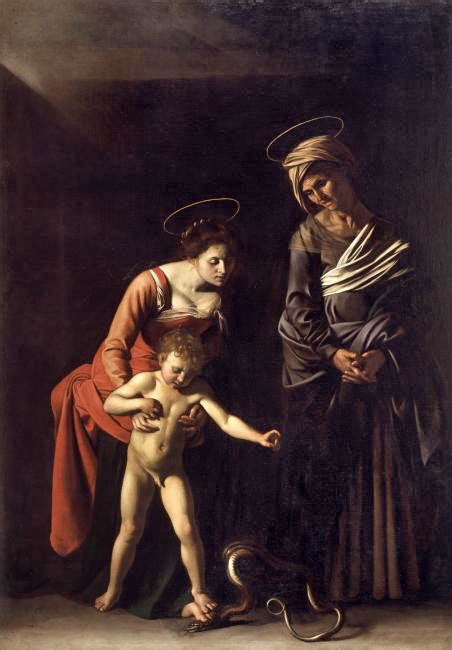
“Caravaggio, a late 16th and early 17th century artist, was a known brawler, swordsman, prone to violent physical outbursts, enjoyed the company of prostitutes, and murdered a man over the love of a woman. He also produced significant sacred art.”

“Yet, Caravaggio had at least three major paintings installed and then removed by the Church. This is a fine line to tread. In one case it was because our Blessed Mother was modeled on a known prostitute. In The Madonna of the Palafrenieri (image found below), Caravaggio used the prostitute as the model for Our Lady, dressed her in the manner of a buxom 17th century woman, and portrayed the naked baby Jesus much larger and older than a one-year-old learning how to walk. At that time Church authorities were not pleased and removed it, however, years later it was reinstalled and today can be seen in the Galleria Borghese.”

“That painting may be understood by someone familiar with symbolism in art, but what about the average person? Does the art cause confusion? Does the viewer come away from the artwork edified or bewildered? Does the artwork assist in the spiritual development of the viewer?”

–Does Rupnik’s art have merit as sacred art? Do you feel the art should be removed, given the abuse allegations and the concerns expressed by survivors?

“As far as the Rupnik case is concerned, it would be improper for me to specifically respond because the case is ongoing.   Some personal opinions on Rupnik’s art: if a work of sacred art displayed in a public place of worship and veneration reminds the viewer of a specific artist’s sin, portrayed, or implied within the sacred image itself, then the Church should remove the artwork. The Church of the past understood the need for this to occur, why doesn’t the Church of today?”

“I am surprised that so many major shrines and churches have selected his style to portray the truths of the Church. There are many highly skilled sacred artists working today that could have been selected to edify their visitors and pilgrims. Examples of well-known contemporary religious artists and architects, are Leonard Porter, Marek Czarnecki, Fr. Silouan Justiniano, Gwyneth Thompson-Briggs, Ellen Ryan, Bernadette Cartensen, Vladimir Grygorenko, Raul Berzosa, architect James C. McCrery, sculptors Cody Swanson, Jonathan Pageau, and so many others in all categories. All the personnel of shrines and churches had to do is contact the Catholic Art Institute in America to receive recommendations and assist in their process of making decisions for American, or even European, placements.”

“Rupnik’s artistic style appears to be a simplified version of the beautiful and culture specific sacred art produced for over one thousand years by artists within the Coptic Church. It is also reminiscent of the sacred images created by Martin Erspamer, O.S.B. of St. Meinrad’s Archabbey. The Coptic Church’s style of sacred art can edify and be spiritually fruitful. The question is whether or not it is appropriate for such large scale Roman Catholic venues.”

“Why isn’t Rupnik’s work appropriate? In my opinion, for over sixty years much of the sacred art selected or commissioned by Church authorities has reflected influences and the desire to present images that are in union with the secular world.”

“We see individuals within the Church making artistic decisions based on the desire to be relevant, or to simply select an artist that other sites have chosen. Sadly, many times individuals or committees choose art that does not inspire or transcend the banality of our world. Some of the modern, supposedly inspirational, sacred art and architecture of the contemporary Church rings hollow. Its representations, construction, and colors can confuse and even repel the average parishioner or pilgrim. It does not inspire – it depresses the soul.”

“Every artist is creative, has a specific perspective, and presents their style and use of materials. In my opinion, all art outwardly portrays the condition of an artist’s soul and perspective of the world.”

–In general, what qualities and practices should govern the process of creating sacred art? How should sacred artists approach not only their work, but their lives and relationships? How would you sum up the theology of creating sacred art?

“I believe, and recommend, that a Catholic artist, in the creation of Roman Catholic sacred art, should strive within their spiritual and artistic life to apply the following principles: 

The Catholic sacred artist must create their art within the boundaries of and maintain loyalty to Holy Scripture and Sacred Tradition.

The Catholic sacred artist should continually strive to be in the state of grace and live a life accompanied by prayer and frequent reception of the Sacraments.

The purpose of Catholic sacred art displayed in a shrine, church, plaza, places of pilgrimage, or home is to uplift the individual to understand the majesty, supreme authority, truth, beauty, charity, and goodness of God, His angels, and saints. 

Catholic sacred art should never cause confusion, bewilderment, or diminish the faith of a viewer. Sacred art should always strive to be beautiful in its entire presentation, respect, and conform to its setting.

The Catholic sacred artist must be disciplined. Their art should never cause scandal or refer the viewer to associate the artist’s personal life to the artwork itself. To do so is a profoundly irresponsible action.

Catholic sacred art should be about the principles exemplified by the dogma/doctrines of the Church and the truth found in the Hebrew and Christian Scriptures; it should never deviate into the artist’s personal view of dogma or Scripture. 

The sacred artist should educate, edify, and challenge the viewer’s mind and soul to love and come closer to God, His angels, and saints.”

In conclusion, some people might find Fr. Rupnik’s art beautiful; others might find it profoundly upsetting. The Catholic Church’s investigation of the Rupnik scandal must be exhaustively and thoroughly completed. It must not drag on. It has been reported (by Associated Press) that more women have come forward with allegations against Fr. Marko Rupnik. A clear and authoritative decision must be quickly made by the Church and if found to be true, both punishment of the perpetrator and compensation to the women, must be made. The women involved deserve no less.


th-4112727946
Caravaggio’s The Madonna of the Palafrenieri, 1605-1606; oil paint.

th-496827950
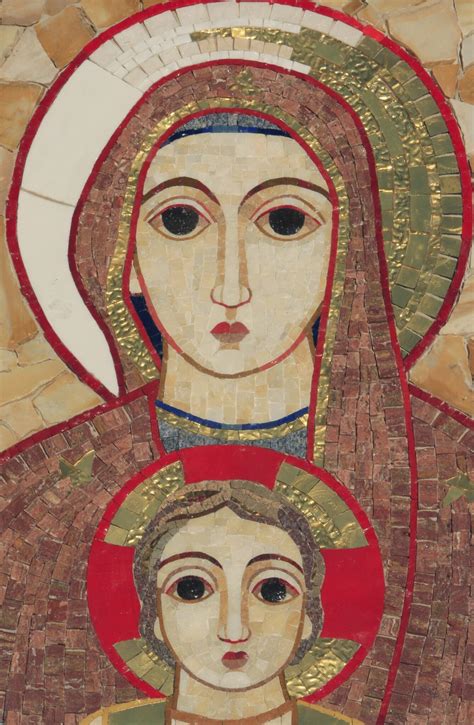
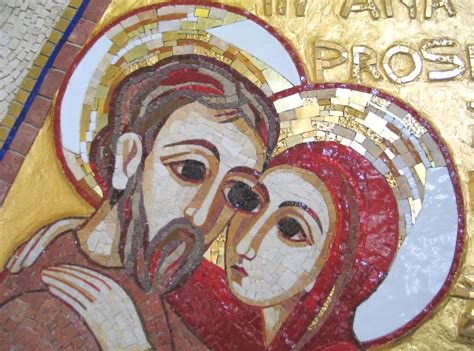
Marko Rupnik, mosaic

th-2666537626
Marko Rupnik, mosaic

th-3547051927-1
Marko Rupnik, mosaic

Copyright © 2011- 2024 by Deacon Paul O. Iacono – All Rights Reserved. Permission to reprint essays in their entirety and/or my personal paintings must be obtained from me by using the comment box and making a comment/request on the post. I will respond to you through answering in the comment box. Students, and those interested, may quote small sections of my essays as long as the proper credit and notation is given. Thanks.

Malinda K. Reese and the Feast of the Epiphany 2023

BAT49982

Today’s Feast of the Epiphany celebrates the revelation of the Incarnation of God, as the child Jesus, to the gentile nations. The Gospel of Mathew (Mt 2: 1-12) speaks of distinguished foreigners Balthazar, Caspar, and Melchior, as they traveled to the home of Jesus, Mary, and Joseph. Three travelers bearing gifts to a Child whose future mission they cannot comprehend. A mission which resulted in excruciating death and glorious resurrection.

The beautiful Church of the Incarnation in Montefrio, Spain was the setting for Ms. Malinda K. Reese’s singing of the 1300 year old Latin Rite monastic hymn “O Come, O Come Emmanuel.” The church was empty at the time of her visit and the natural acoustics of its design beautifully enhanced her voice. Ms. Reese is a singer/songwriter, actress, and YouTube vlogger.

Please listen to her very short performance twice (click on the link below).  In the first viewing it will be natural to watch the foreground, listen to her sing and notice her reactions to the church’s acoustics. In your second viewing, concentrate only on the background – the church’s interior.

The hymn begins with a large life-size crucifix behind her and the camera then circles the interior, the video ending with a direct view of the altar and tabernacle. It is a view which presents us with an explanation of the mission of the Christ Child for it simply points to the Cross. It leads us to our faith in His resurrection, the truth of His words in the Scriptures, and our belief that He is present in the Holy Eucharist at every Mass and in every tabernacle in the world.

Emmanuel: “God is with us.”    Let us raise our eyes and offer Him the gifts of our hearts, minds, and souls.

“Rise up in splendor, Jerusalem. Your light has come, the glory of the Lord shines upon you. See, darkness covers the earth, and thick clouds cover the peoples; but upon you the Lord shines, and over you appears his glory. Nations shall walk by your light, and kings by your shining radiance. Raise your eyes and look about; they all gather and come to you…bearing gold and frankincense, and proclaiming the praises of the Lord.”    (Isaiah 60:1-6)

https://www.youtube.com/watch?v=IlNBnzyiomU

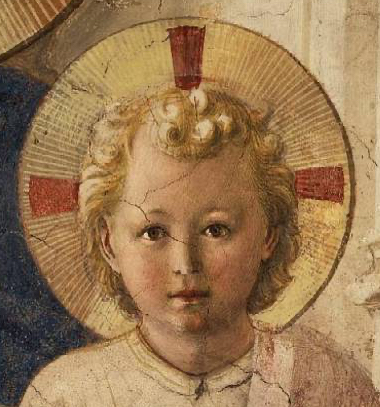
Painting: detail – Christ Child from the Madonna delle Ombre (Madonna of the Shadows), 1450, fresco by Fra Angelico (Guido di Pietro, c.1387-1455). Museo di San Marco dell’Angelico, Florence, Italy.

Copyright © 2011- 2023 by Deacon Paul O. Iacono – All Rights Reserved. Permission to reprint my essays in their entirety and/or my personal paintings must be obtained from me by using the comment box and making a comment/request on the post. I will respond to you through answering in the comment box. Students, and those interested, may quote small sections of my essays as long as the proper credit and notation is given. Thanks.

Waldemar Januszczak Is Wrong About the Shroud of Turin

The other night I watched the popular, opinionated, and entertaining BBC art historian Waldemar Januszczak discuss Medieval and Renaissance art. Over the years he has presented many shows on various artists and artistic movements. His programs, while informative, are distinctly opinionated. That’s fine, there is no law saying that you can’t present your own opinions (the exception, of course, being social media).

In one of his shows Mr. Januszczak briefly mentioned the Shroud of Turin. He said that the Shroud is a fake, a forgery, a bogus remnant of Medieval skullduggery. Yet, based on over fifty years of scientific research one can say that Mr. Januszczak’s opinion and conclusion  is undoubtedly wrong.

It is my informed opinion that the Shroud is more than a just an interesting cultural artifact. I believe that it is a relic of the passion, death, and resurrection of Jesus Christ. My belief is based on faith and scientific evidence.

The Shroud of Turin is a linen herringbone weave cloth. It is 14 ft. 3 in. long by 3 ft. 7 in. wide. It appears to have served as the burial cloth of a man (5 ft. 11 in. tall and of muscular build) who had been severely beaten, scourged with a Roman flagrum, his scalp pierced with thorns or slivers of bone, who fell numerous times on a pavement, and was crucified in the Roman fashion.

Since the 1950’s significant and serious investigations have been completed by reputable physicians, scientists, and specialists on the Shroud.

Research is ongoing. Current results certainly lead the unbiased observer to conclude that the Shroud is not a fake. There are, however, commentators that continue to bang the drum and receive headlines claiming that the Shroud is bogus.

Science can never prove that the Shroud of Turin is the burial cloth of Jesus. That is not its job. It can, however, determine and clearly pronounce the scientific and historical evidence contained within it. Valid research results point to specific conclusions. In the case of the Shroud of Turin science, logic, reason and ultimately faith will lead a Christian to conclude that the Shroud of Turin is the true burial cloth of Jesus.

The responsibility of scientists and specialists gleaning the Shroud is to follow the Scientific Method of establishing a hypothesis, produce correct models of investigation and data collection, accurately and without bias thoroughly investigate, check for error, and publish their conclusions for peer review. Impartial scientists, anthropologists, and historians of the Shroud should have no agendas secret or public.

shroud
Face of the man found on the Shroud of Turin. Notice the blood stains (white blotches and lines), broken nose, swollen eyes. This image is a photographic negative.

The following points are a minuscule portion of the available scientific and historical results related to the Shroud of Turin:

  1. The “Hungarian Pray” Manuscript (1192 – 1195 AD) contains a painting of the burial cloth of Jesus Christ that had, at one time, resided in the city of Constantinople. Interestingly, it clearly shows a herringbone weave, the lack of visible thumbs on the body, L-shaped burn holes that are also on the Turin shroud, etc. The date of that manuscript provides a clear discrepancy with the 1988 Oxford C 14 date of 1260 – 1390 AD.
  2. The Shroud shows over 100 scourge marks on the man’s body resulting from a Roman scourging tool called a flagrum. It is a whip of two or three leather strips with lead balls or pieces of splintered bone attached at the end. Its purpose was to tear pieces of flesh off of the chest, back, thighs, and calves. The man in the Shroud was simultaneously scourged by two men.
  3. There are deep abrasions on the man’s shoulders from carrying a heavy object.
  4.  There are 141 different pollens found within the fibers of the Shroud. Forty-five of them are specifically from the area in and around Jerusalem, and thirteen from the area within and around Constantinople (present day Istanbul, Turkey).
  5. The coloration of the entire image goes only one or two fibers deep into the thread structure. It has been determined that no paint was used to discolor the fibers. The fibers were scorched by some unknown process which contributed to the image being formed of the crucified man.
  6. The facial features of an icon of Christ (known as Christ Pantocrator), found in St. Catherine’s Monastery in Egypt, perfectly corresponds to the facial image found on the Shroud of Turin and the Sudarium of Oviedo (the face cloth that covered the face of a man who was severely beaten). That specific icon of Jesus Christ is dated to the 500’s, not the Middle Ages.
  7. Human blood is found throughout the Shroud. It is type AB. “The blood has a high bilirubin content and nanoparticles of creatinine bound to ferritin” indicating that the man on the Shroud was severely tortured (quotation of research by scientist Robert Rucker which is found on-line).
  8. The Shroud shows the location of nail wounds possibly through the wrist. The nails may have extended up through the palm; this would allow the nails to suspend the man without having his body’s weight tearing him away from the cross/tree.
  9. Photographs taken in 1988 show Giovanni Riggi cutting samples from a part of the Shroud that would be Carbon 14 tested that year. Riggi is not wearing protective gloves or face mask. Cardinal Ballestrero is leaning on the table over the Shroud, and another technician has his ungloved hand on the table right next to the area that was being sampled. How can we conclude that this sampling was pure since its data collection methodology was so flawed and sloppy? This provides another fact that throws the 1988 C-14 date into question
  10. Pope Stephen III (768 – 772 AD) specifically discusses the Shroud and how the “Lord’s face and entire body …was transfigured on the cloth so that those who could not see Him bodily were able to see Him divinely transfigured on the cloth” (quotation found in Ian Wilson’s The Shroud of Turin. Image Books, 1979). Other Popes, prior to 1200 also speak publicly about the Shroud.

If you are interested in this subject you should seek out additional research papers and books (that are legitimate) to help you form your own conclusions (start with Vittorio Guerrera’s book – The Shroud of Turin, published 2001. He provided the basis for the above ten points). Ultimately,  for many Christians, belief in the Shroud as the burial cloth of Jesus, comes down to scientific evidence, personal faith, and the realization that Jesus Christ’s savage death led to our Redemption and the joy of His glorious resurrection.

Copyright © 2011- 2022 by Deacon Paul O. Iacono – All Rights Reserved. Permission to reprint essays and/or my paintings must be obtained from me by, using the comment box and making a comment/request on the post. I will respond to you through answering in the comment box. Students, and those interested, may quote small sections of my essays as long as the proper credit and notation is given. Thank you.

A Journey

Road-to-Emmaus-Apolinare-Nuovo-Ravenna-6th-c.--300x206
Mosaic of two disciples of Christ encountering Him on the Road to Emmaus. This image is from the truly extraordinary mosaics found in the Basilica of Saint’Apollinare in Ravenna, Italy (6th century) Confer the Gospel of Luke Chapter 24: 13-35.

You may consider the mosaic of Christ speaking with two disciples on the journey to Emmaus to be a strange image to use today, Ash Wednesday, since it is found in Scripture as taking place after the Resurrection of Christ. The men pictured are on a practical, yet, spiritual journey. We see them prayerfully reflect about the extraordinary events that just occurred in Jerusalem. They ask, “What does it mean? Can it be true? Didn’t our hearts burn with happiness as He drew closer to us!”

The days of Lent are a practical and spiritual journey for us, too. Like every pilgrimage Lent has a conclusion, an endpoint, a destination achieved. But our journey’s conclusion can only be truly enjoyed and understood if we have prepared for it.

In the Roman Rite of the Catholic Church these Lenten days are a time of preparation. They are a time of personal repentance and sacrifice. These acts lead us to a point in which we are able to fully and joyfully participate in the Holy Triduum: Holy Thursday, Good Friday, and Easter Sunday.

For all Christians Lent is a time to renew ourselves in penance, prayer, and good works. For Roman Catholics it is also a moment for formal repentance of sins in the Sacrament of Reconciliation, for how can we come to the Easter Banquet with the road’s dust and dirt clinging to us?

May your journey this Lent be a happy and penitential one.

Copyright © 2011- 2022 by Deacon Paul O. Iacono – All Rights Reserved. Permission to reprint essays and/or my paintings must be obtained from me by, using the comment box and making a comment/request on the post. I will respond to you through answering in the comment box. Students, and those interested, may quote small sections of my essays as long as the proper credit and notation is given. Thank you.

Catechesis and Naive Sacred Art: St. Peter – A Lesson Plan

IMG_5011
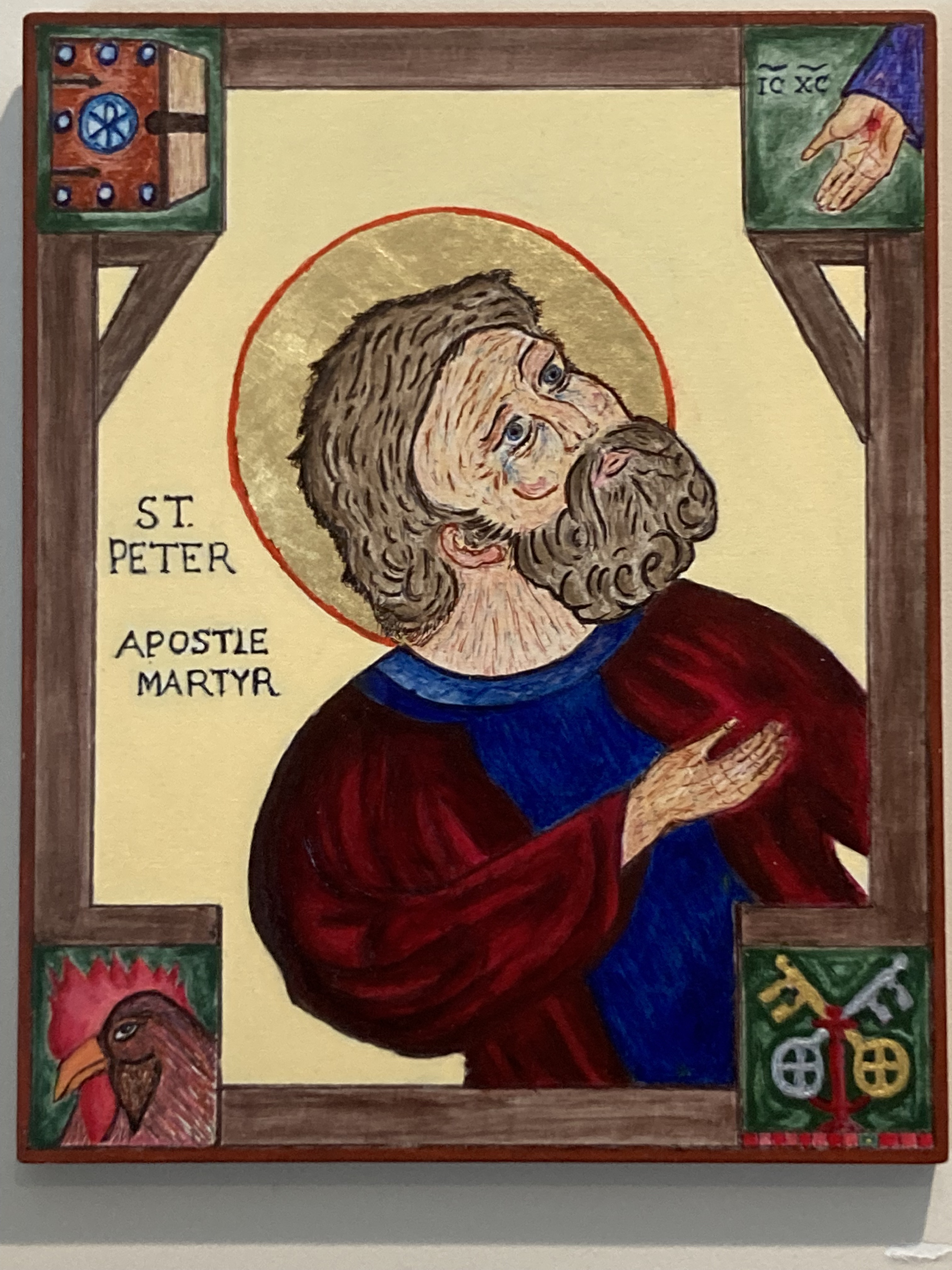
Image painted by Deacon Paul O. Iacono Copyright © 2021-2022

One of my goals in painting the above image of St. Peter was to provide a catechist/observer with seven focus ideas within one image. This sacred image also presents some of the life events of the “Rock” on which Jesus Christ built His Church. I have painted this image with the approach of the Naive/Folk Art genre or “school.” I will discuss the Naive/Folk art approach in my next post. Below are my seven fundamental ideas that can be used as a lesson plan(s) for the above image:

  1. The image is based on Christ’s words and Peter’s actions within the New Testament (have the students look up the verses found within the Gospels and Epistles).
  2. The image itself presents the presence of Peter who is suffering (his posture, body movement, expression, tears, and the extension of his hand). He is requesting Christ’s forgiveness.
  3. Christ is identified by the label IC XC (the Greek abbreviation for the name Jesus Christ). Christ is extending His hand in forgiveness and to raise Peter’s spirit.
  4. The rooster in the bottom left corner is harkening back to its crowing after Peter denies Jesus (Scripturally predicted by Christ). The rooster is also looking at the viewer, reminding us of our personal sins.
  5. Papal authority. Peter is the first pope. He is the first bishop of Rome, the spiritual leader of the Church, and is symbolized by the two keys that are given to him, echoing Christ’s words of “you are Peter (Petros) and on this rock/stone (Petra) I will build my Church.” The keys are painted in gold and silver. Gold represents spiritual authority in union with the Church’s bishops. The silver key represents the papal influence within the world for issues that would affect the good of the Church and people as a whole. The keys are united by a red anchor (symbol of hope and steadfastness – found in the catacombs and the Epistle to the Hebrews). The sufferings of the clergy and laity are built upon the sufferings of Christ and the ministry/martyrdom of the first Apostles (12 squares under the keys; the green square represents St. John who was not martyred). The brown border encapsulating St. Peter reminds us of the cross on which he was martyred as well as the Cross of Christ.
  6. Diagonal lines could be visually drawn through Peter from the upper left corner of the books of the Holy Scriptures to the lower right representing the teaching authority of the pope (Peter’s successors); as well as the upper right of Christ’s hand to the rooster on the lower left reminding us of Peter’s denial and Christ’s forgiveness.
  7. This denial by Peter is not the denial of Judas Iscariot who was also an Apostle. Throughout the Catholic Church’s history we have had both clergy and lay people deny Christ through their words and actions. It all began with the Apostles; however the difference between Peter and Judas is that Peter despaired, pleaded for forgiveness, and was picked up through Christ’s forgiveness. Judas despaired, did not plead for forgiveness, and threw himself down on the end of a rope.

If you find this subject interesting I recommend you read my post on Catechesis and Catholic Art published on June 26, 2021. Thanks.

Copyright © 2011- 2022 by Deacon Paul O. Iacono – All Rights Reserved. Permission to reprint essays and/or my paintings must be obtained from me by, using the comment box and making a comment/request on the post. I will respond to you through answering in the comment box. Students, and those interested, may quote small sections of my essays as long as the proper credit and notation are given. Thank you.

Bethlehem Journey

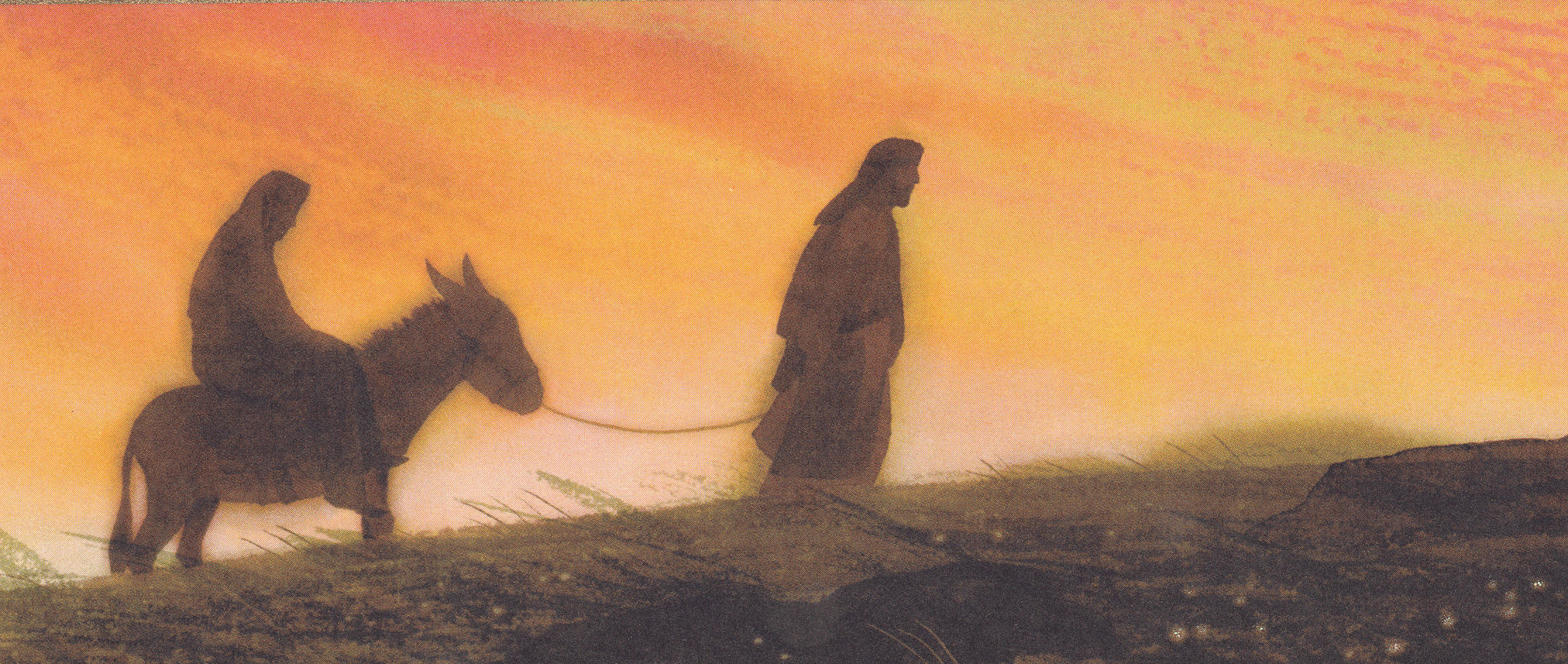
to-Bethlehem

This is a beautiful painting. Yet, I think something is wrong. It’s not the technical expertise, that is very good, or the colors, they are well chosen.

I believe it is St. Joseph himself. He is too far away from Mary. 

He would have been much closer to her, to give her comfort and to be quickly aware of any of her needs. He would have been much closer to the donkey’s head, holding the reins softly yet securely in order to prevent any bucks or missteps that the animal might be in mind to give.

The rope shows a distance, a separation, between them. Possibly it indicates the separation that a husband experiences when his wife is in the last days, or hours, before the birth. It is a separation because no husband can understand or experience his wife’s physical pain, her labor, and her extreme maternal joy at the moment of birth.

But, on this night, as they slowly travel toward Bethlehem, they are not separated at all. They are united in their humility, the silent secrets of their own thoughts, and their total obedience and trust in God’s will, and, each other.

May you be united to Jesus, Mary, and Joseph this Christmas Day and throughout the New Year. Glory be to the Father, and the Son, and the Holy Spirit as it was in the beginning, is now, and will be forever. Amen. Alleluia.

Merry Christmas from my home to yours!

** I have not been able to discover the artist of the above painting. If anyone knows who he or she is please comment and I’ll give the proper credit. Thanks

Copyright © 2011- 2021 by Deacon Paul O. Iacono – All Rights Reserved. Permission to reprint essays and/or my paintings must be obtained from me by, using the comment box and making a comment/request on the post. I will respond to you through answering in the comment box. Students, and those interested, may quote small sections of my essays as long as the proper credit and notation is given. Thank you.

Catechesis and Catholic Art

Sacred art, by its very nature, is catechetical. The purpose of this art was and continues to be a method of instruction. The Catholic Church, in its Latin and Greek Rites, and the twenty-six Catholic Rites that are in union with Rome, have all produced magnificent sacred calligraphy and art; non-Catholic faiths have done this, too.

Two thousand years ago Christians hiding in Rome inscribed images of Christ, the Blessed Mother and with the Christ child, and other Scriptural images on the walls of the catacombs. That art contributed to the catechesis of the early Christians. Two millennia later, Pope St. John Paul II in paragraph 18 of his Apostolic Exhortation, Catachesi tradendae, speaks of this function: it is “an education in the faith… in an organic and systematic way, with a view to initiating the hearers into the fullness of Christian life.”

Sacred art, in tandem with scholarship, edifies and makes beautiful the truth, goodness, and beauty of God. One of my favorite forms of sacred art is that of the Coptic Christian Church (historically based in Alexandria, Egypt). Coptic art is presented in an especially down to earth way. It is beautiful and humble at the same time. It is catechetical and colorful. It possesses a fine palette, yet the viewer does not get caught up in the colors to the detriment of catechesis. 

The Coptic faith’s icons are simple, yet, profound. They convey theological truths in a way that can be understood by all age groups and are excellent sources of catechesis. 

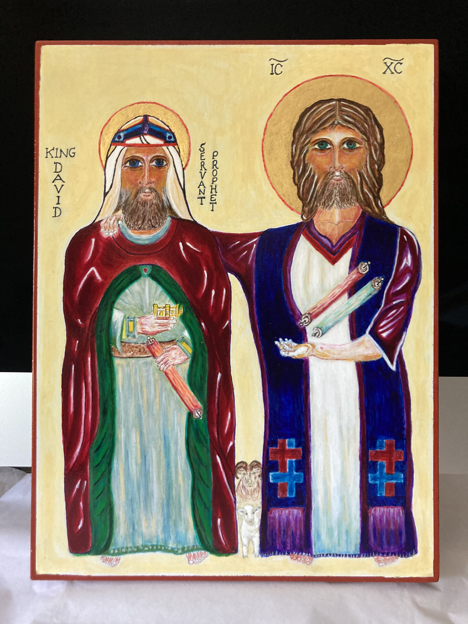
The first image above is a 7th century Coptic icon. It was discovered at the Monastery of Bawit (Egypt) in the early 20th century by two French archaeologists who brought it, and other Monastery artifacts, back to Paris. Currently located in the Byzantine wing of the Louvre it is unique because it presents Jesus affectionately putting his arm around the Monastery’s abbot – Abbot Mena.

The second sacred image is my original composition. It is painted in archival ink, acrylic paint, and the halos are 23 karat gold leaf. My style slightly follows the Coptic in that it portrays figures that are not intimidating, are easily understandable, and act as a teaching tool for children and adults. It does present additional symbolism which further explains key theological truths of our faith.

Symbolism of the second sacred image:

The IC XC is the Greek abbreviation for Jesus Christ. 

The slightly larger than normal eyes represents holiness, spiritual wisdom, and maturity.  

Jesus’ white alb (tunic): purity; King David’s light green alb: hope for spiritual growth and friendship with God. 

Jesus’ outer garments consist of two parts: robe and stole which are painted in various shades of royal purple. Royal purple indicates kingly authority. The tassels of His stole are multicolored representing the intersection of purity and kingship. Christ’s lower stole’s has an intersecting weave representing Jesus’ blood and water shed for us on the Holy Cross. Liturgically, deacons, priests, and bishops all wear albs, cinctures (belts), stoles, and outer garments (dalmatic or chasuble). These articles of clothing each symbolize different aspects of Jesus’ Passion and ministry.

Elevated above Jesus’ left hand are the scrolls of the Old (Hebrew) and New (Christian) Testaments. The color symbolism for the Hebrew Scriptures’ scroll: green, which represents hope, expectation of the Messiah, and devotion to God. The Christian Scriptures‘ scroll: red, representing Jesus divine and human energy, love, Redemptive sacrifice, and His mercy and justice.

Jesus’ arm is around David’s shoulder. His gesture to David expresses His love, affection, and mercy which are evident and available to everyone. However, the expression that I put on Jesus’ face, especially His eyes, conveys the severe justice that Jesus’ renders to all non repentant sinners. David committed murder and adultery yet ultimately becomes aware of the enormity of his sins. His Psalms were written to plead for mercy, express sorrow for sins, and give praise and thanksgiving to God (see especially: Psalms: 1, 51, 56, 65, and 117). David’s crimson coat symbolizes human life and energy, it is trimmed in dark green symbolizing his hope for mercy.

Circa 1000 BC, David and his armies captured Jerusalem and brought the Ark of the Covenant into the city (1 & 2 Samuel). King David is holding the city of Jerusalem in his right hand; and in his left the book of Psalms. David’s son Solomon built the First Temple to house the Ark of the Covenant (1 & 2 Kings). 

Between David and Jesus are a ram and a new born lamb.

The ram refers to the sacrifice by Abram (Abraham) of a ram caught in a thicket in substitution for the sacrifice of his son Isaac (Genesis 22). Jesus and David are members of the same genealogical family, stretching all the way back to Abraham and Isaac and Isaac’s son Jacob.

The newborn lamb represents Jesus Christ, the “lamb of God” (John 1: 29). He was given in sacrifice by the Holy Trinity for the Redemption of mankind from their sins. That Redemptive act by Our Lord and Savior, Jesus the Christ, instituted the New Covenant which was sealed with His, the Lamb of God’s, blood.

The New Covenant does not replace the Old Covenant God made with the Hebrews. The New Covenant of Christ’s sacrifice (as described in the 27 books of the Christian Scriptures) fulfills the Old Covenant promise of a Savior found within the 45 books of the Hebrew Scriptures. The ram and the lamb provide the visible connection between the Hebrew Scriptures (Old Covenant) and Christian Scriptures (New Covenant).

The New Covenant is continued down through the centuries by the un-bloody sacrifice of Holy Mass. Selections from the Hebrew and Christian Scriptures are read. The Gospel is proclaimed prior to the priest representing Christ, in Persona Christi, transubstantiating the host and wine into the Body, Blood, Soul and Divinity of Jesus Christ.

In faith and action Catholics consume His Body and Blood toward the end of Holy Mass. This consumption does not transform Him, as simple food, into ourselves. Rather, we (as repentant sinners) are transformed by Him (through Sanctifying Grace) into Himself.  He doesn’t become part of us, rather, we become part of Him. This is an article of faith believed by all Catholic Christians of the Western an Eastern Rites of the Church. The reception of Holy Communion by Catholics is not a “right,” it is a privilege given by Jesus Christ to worthy (repentant and Reconciled) recipients (culminating in our giving eternal thanks and praise to Him in Heaven; see Matthew 26: 29).

Therefore, in this non-intimidating sacred image you have a teaching tool that includes elements of Sacred Scripture and Sacred Tradition. It is simple grist for any informed catechist’s mill.

UPDATE: If you find this subject interesting I recommend you read my post on Catechesis and Naive Sacred Art: St. Peter – A Lesson Plan, published on January 25, 2022. Thanks!

Copyright © 2011- 2021 by Deacon Paul O. Iacono – All Rights Reserved. Permission to reprint essays and/or my paintings must be obtained from me by, using the comment box and making a comment/request on this post. I will respond to you through answering in the comment box. Students, and those interested, may quote small sections of my essays as long as the proper credit and notation are given. Thank you.


The Holy Trinity – A Scientific Analogy

This weekend we celebrate the Solemnity of the Holy Trinity. 

The Holy Trinity, one of the five Dogmas of the Church, is an extraordinary and unfathomable mystery. Our limited intellects are unable to comprehend its reality, yet, our Scriptures and scholarly Tradition makes it known to us.

The scientific analogy that will be provided in a few moments is truly inadequate to describe the Holy Trinity. It does, however, provide the proverbial “grist for the mill” for all of us, believers and skeptics alike, that such a concept of “Three existing in One” does exist in nature and can be scientifically proven. So, if an actual physical and observable process exists in nature then why can it not be a reflection of its existence in the spiritual and religious world of Faith?

A number of years ago, one of my RCIA students (an engineer who graduated from Annapolis, America’s Naval Academy) mentioned a physical property of water that aided our discussion. He correctly said that God is One Being of three Divine Persons. He then went on to apply a new analogy regarding water. We know that water consists of two atoms of hydrogen and one atom of oxygen and it can exist in three independent states: liquid, solid, and gas. It is one substance, water, in every state that it is in.

So, as far as the new analogy is concerned, he said the question should be asked: “Can water exist as a liquid, solid, and gas at the same time?”

The answer: “Yes, it can, because of the scientific reality known as the Triple Point.”

“The Triple Point is the single combination of pressure and temperature at which liquid water, solid ice, and water vapor can coexist.” The coexistence means that the water’s states of liquid, solid, and gas are present, yet independent, at the same time. Scientifically, and observationally, “This occurs at exactly 273.16 K (0.01 °C) and a partial vapor pressure of 611.73 pascals (ca. 6.1173 millibars, 0.0060373 atm).” For further inquiry see this article: http://en.wikipedia.org/wiki/Triple_point

The article also goes on to state that the Triple Point pressure of water was used during the Mariner 9 mission to Mars as a reference point to define “sea level”. More recent missions use laser altimetry and gravity measurements instead of pressure to define elevation on Mars.[3] [There are numerous other elements and substances that possess Triple Points, and are easily referenced in additional Wikipedia articles]. Some of the data comes from the U.S. National Bureau of Standards (now NIST).[4]”

So, while understandably inadequate to even skim the surface of the mystery of the Holy Trinity, the Triple Point of water at least shows that a simple framework for comprehending the reality of the Trinity does exist in nature. Science can assist us in understanding theological truths.

Besides science and nature, our Holy Scriptures and Sacred Tradition provide additional historic and religious truth to substantiate the Dogma of the Holy Trinity. Examples are found in the Gospel of Matthew: the 3rd chapter (the Baptism of Jesus)  and in the 28th chapter (Jesus’ commissioning His Apostles to go out and make disciples of all the nations, “baptizing them in the name of the Father, and the Son, and the Holy Spirit.” St. Paul also refers to the Holy Trinity in his second epistle to the Corinthians (13: 11-13) and Romans (8: 14-17) and (5: 1-5).

The Early Fathers of the Church (AD 100 through AD 800) also discussed and provided extraordinary scholarship in developing our basic understanding of this dogma. St. Thomas Aquinas, 450 years later also wrote persuasively about the Holy Trinity, too.

The Holy Trinity, while being a Mystery, can still be approached and discussed through spiritual faith. Faith is the assent of an individual’s intellect and will to believe the teachings of the Church. It is a supernatural gift from God to a person’s soul and intellect at the moment of their Baptism. Faith is sustained through parental modeling, formal teaching, prayer, study, and the reverential reception of the Holy Sacraments.

The Catechism of the Council of Trent and the New Catechism of the Catholic Church (2nd edition) contain wonderful explanations about this dogma of our faith. Also, teacher and apologist Frank Sheed, in his book Theology For Beginners, (pp. 33-36), provides us with additional insights into the truth of the Holy Trinity:

” …God utters a word [John 1:1]. … So it is a word in the mind of God, not sounding outwardly as our words sound, akin rather to a thought or an idea. What idea produced in God’s mind could possibly be God? Christian thinking saw early that it could be only the idea God has of Himself. The link between having a Son and having an idea of oneself is that both are ways of producing likeness.
    … [B]ecause God is infinite, eternal, all-powerful, His idea of Himself is infinite, eternal, all-powerful. Because God is God, His idea is God.
    … The Father knows and loves; so His idea knows and loves. In other words, the idea is a Person …, for He – this Person – can know and love. The thinker and the idea are distinct, the one is not the other, Father and Son are two persons; but they are not separate.
    … Father and Son love each other … They unite to express their love and … [this] expression is a third Divine Person: the Holy Spirit. In the Son, the Father utters His self-knowledge; in the Holy Spirit, Father and Son utter their mutual love. Their love is infinite; its expression cannot be less.
… As the one great operation of spirit, Knowing, produces the Second Person, so the other, Loving, produces the Third Person of the Holy Trinity.”

Glory Be to the Father, and the Son, and the Holy Spirit; as it was in the beginning, is now, and will be forever. Amen.

dt3613-768x794
                                                 The Trinity in an Initial B, Master of the Codex Rossiano (https://www.metmuseum.org/art/collection/search/461298)

Copyright © 2011- 2021. Deacon Paul O. Iacono – All Rights Reserved. Permission to reprint must be obtained from the author in writing. Students, and those interested, may quote small sections of the article as long as the proper credit and notation is given. Thank you.

Good Friday/Easter 2021: Christ’s Embrace

Jesus Christ Our Lord and Redeemer silently hangs in agony on the Cross. His bloody arms stretched wide as if to embrace us.

We safely stand at a distance. We are mute and deafened by sounds that intensify our cowardice.

Death arrives and it is over. Jesus is quietly carried away and buried.

Days pass, filled with doubts we walk along a path and suddenly see Someone.

Jesus.

We draw back, stopped by the sight of the pierced hands of the One we know and love.

We are hesitant, but the sound of His voice propels us toward Him.

He embraces and kisses us. We in turn kiss Him, not with the kiss of Judas but the kiss of an intimate friend.

Copyright © 2011- 2021, Deacon Paul O. Iacono – All Rights Reserved.

judas-passion-passion-of-christ

Copyright © 2011- 2021, Deacon Paul O. Iacono – All Rights Reserved. Permission to reprint must be obtained from the author in writing. Students, and those interested, may quote small sections of the article as long as the proper credit and notation is given. Thank you.

The above photograph is taken from Mr. Mel Gibson’s movie The Passion of the Christ.  It is an extraordinary film that is brilliantly acted and directed. Thanks to Mr. Gibson and his staff for allowing me to use it.

Vatican Creche – 2020 – A Contemptuous Insult

The Vatican, last week, unveiled the 2020 Christmas crèche in St. Peter’s Square.

Historical tradition explains that St. Francis of Assisi was the first to promote the display of the birth of Our Lord. He believed that it would edify and improve  prayerful worship of Jesus, the moment of His Nativity, and subsequent events.

For approximately 800 years the Christmas crèche has been portrayed in a respectful and accurate way. It combined different elements of the Nativity found in Sacred Scripture into one scene that conveys spiritual and historical truth to the viewer. Within the last fifty years people with specific agendas have changed that tradition.

I rarely use the first person pronoun in this blog. There are times that it must be done, this is one of them.

I believe that the Christmas crèche that was unveiled this past week, with the approval of certain high ranking Vatican authorities, is atrocious. The current crèche is presumed to be an example of modern Christian sacred art. It is not sacred art; it is secular art masquerading as sacred.

The purpose of sacred art (in both the Latin and Greek Rites of the Catholic Church, and the cultural Rites in union with Rome) is to edify and remind the viewer of the events surrounding the Incarnation of Jesus Christ, the Second Person of the Holy Trinity. Successful and reverent sacred art instructs and edifies the mind and soul of the viewer to those basic truths.

Christian sacred art does not confuse; it is not duplicitous. It is clear in proclaiming the Gospel of Christ and the witness of His faithful followers. Sacred art personalizes the Truths of the Church. It accomplishes that goal by being beautiful, good, and truthful as well as being spiritually transcendent.

The sacred art of the Church does not demean its history, Scriptures, dogma, traditions, and visual or musical arts. It acts in the same way as photographs which are remembrances of loved ones, activities, friends, places, and personalities. The Roman Catholic, Greek and Russian Orthodox, and the twenty-six ethnic Rites in union with Rome, have never worshipped sacred images; we venerate them in the same way we remember our loved ones.

Christian sacred art snaps our attention back to the preeminent Lover and Loved One, Our Lord and Savior Jesus Christ. The writings of St. John of Damascus (Damascene, born 675 – died 749) were successfully used during the Second Council of Nicaea (787), to explain these points and to explode the errors of the iconoclasts then, and, today.

The 2020 Vatican Christmas Creche, in my opinion, falls significantly short of the mark. It is a complete and total failure. It would be laughable if it wasn’t so important.

Briefly, it portrays the Blessed Mother, in what resembles a sarcophagus, looking like a reincarnation of an Egyptian Queen. A huge angel appears to resemble something out of a bad dream (I cannot understand its large rib cage). There is an astronaut (or is it a deep sea diver)? Let us not forget the repulsive and weird looking thing, with a horned helmet, to the right of the astronaut/diver.  Sheep resemble goats. Geese are running around in a frenzy of honking. The main characters all have oversized heads reminiscent of the dolls called Cabbage Patch Kids which were all the rage with my daughters and nieces over forty years ago (at least the dolls were cute). At night a single hideous crooked string of neon lights illuminate the figures. Instead of traditional and appropriate sacred music the viewer is subjected to a bizarre rendition of what appears to be a compilation of joyless ethnic music from a specific area of the world. There is more of this vapid artistic effort but this is enough to give you the scope of the travesty.

vatican-nativity-scene-2020-05-640x368
The Christmas angel looking like the head logo for a popular coffee company.

The 2020 Vatican Creche display is a very sad example of the misguided and ignorant intentions of those that approved it. It displays contempt for Scripture and Tradition and is an insult to all Christians. If the students who created it over a period of years wanted the public to see their final product then they should have displayed it on their campus not sacred ground.

If you are in Rome, do not take your children to see it – they will either collapse in laughter or run screaming from the Square.

You can view the clearest pictures of the monstrosity at the following site: https://novusordowatch.org/2020/12/mayday-vatican-nativity-scene-unveiled/

Copyright © 2011- 2020, Deacon Paul O. Iacono – All Rights Reserved. Permission to reprint must be obtained from me by using the comment box of this post. I will respond to you through answering in the comment box. Students, and those interested, may quote small sections of the article as long as the proper credit and notation is given. Thank you.

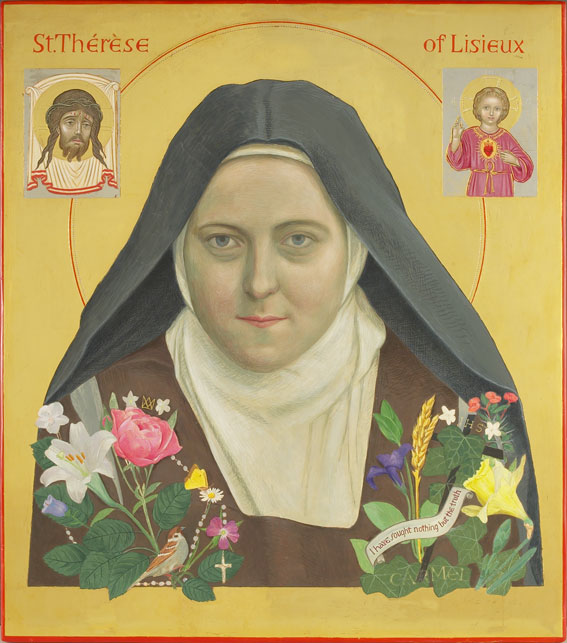
St. Thérèse of Lisieux – “The Little Way” to Jesus Christ

St. Thérèse of the Child Jesus (of Lisieux) died, a victim of tuberculosis, at the age of 24 on September 30, 1897. Every year her Memorial is celebrated in the Roman Catholic Church on October 1st.  She was later named a Doctor of the Church because of her extraordinary spiritual insights and witness to God’s love for us.

Those drawn to her life and spiritual perceptions desire to know the basics of her “Little Way” to union with Jesus. Many desire to understand her procedure to “the arms of Jesus'” love before they read her short autobiography entitled The Story of a Soul. 

John Nelson in his excellent book and fine introduction to the Little Way of St. Thérèse provides us with some very helpful steps. He says, The core elements of the Little Way are:

  1. Joyful humility as a little child of God [that is, understanding of the need for our awe of God, and persistent love of God and neighbor; our willingness to work and pray to achieve the virtue of humility];
  2. Bold confidence in God’s mercy and loving kindness;
  3. Tranquil trust in the actions of God’s limitless love
  4. Persistence in prayer as a simple raising of the heart to God;
  5. Daily practice of the little way of love.” 

He continues,“The Little Way to spiritual health is that of a child of God who humbly welcomes its utter inability, weakness, and poverty as a little one.”

The phrase “little one” refers to the person as a spiritual child that needs to learn from Jesus as they continually seek to be embraced within His loving arms.

The soul that commits to this process “…is boldly confident in its total dependence on the goodness, limitless love, and action of its Heavenly Father. Such a child of God desires only His Will, and to live solely through love [of Jesus] and for love” [of God and neighbor].

“Since love drives out fear [fear is the foundation of all anxiety], it never fears the justice of God, knowing that He comes to save His little ones.”  (all quotes above are from the book by John Nelson, The Little Way of St. Therese of Lisieux – Into the Arms of Love. Liguori Press, 1997).  

As a Carmelite nun, St. Thérèse of Lisieux lived an extremely virtuous life of humility, evangelical simplicity, and trust in God. Besides her contemplative prayer, and communal obligations, she devoted her short life to teaching these virtues to the novices in her community.

The late 15th century contemplative, Thomas à Kempis, in his masterpiece on spirituality and the path to God, The Imitation of Christ,  also helps us understand how to put the “love” that St. Therese speaks of into practice: “A good deed done without love goes for nothing, but if anything is done for love, however small and inconsiderable it may be, every bit of it is counted. God considers what lies behind the deed, and not what is actually done” [that is, accomplished]. (Book 1, section 15, page 48; edited by H.C. Gardiner, S.J.; Doubleday Image Book, 1955).

-st-therese-of-lisieux-incorruptible-saints
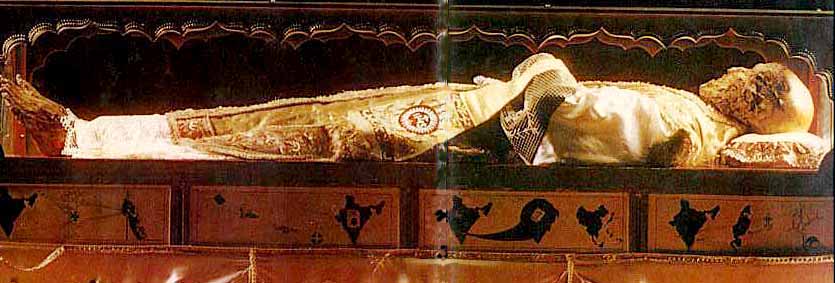
Close-up of her face – incorrupt body of St. Therese of Lisieux. She died in 1897.


St. Therese of Lisieux Incorrupt
                        Incorrupt body of St. Therese of Lisieux.

Copyright © 2011- 2020, Deacon Paul O. Iacono – All Rights Reserved. Permission to reprint must be obtained from the author in writing. Students, and those interested, may quote small sections of the article as long as the proper credit and notation is given. Thank you.

Sacred Art – Its Fate When a Catholic Church Closes Its Doors

A subscriber recently asked me about the process of the movement of sacred art from a local church or cathedral into a secular or religiously affiliated museum and is there a specific “Rite” of the Church that applies to this situation?

Before I answer the question allow me to provide a quick review in reference to the word “Rite/rite.”

When a capital “R” is used it refers to specific Rites, such as the Rite of Christian Initiation of Adults, the Rite of Baptism, the Rite of Anointing of the Sick, etc.

Also, a capital R is used when referring to the Rite of the Western (Latin/Roman) Catholic Church, the Eastern Catholic Rites in union with Rome (there are 5), and the liturgical subsets of these five Eastern Catholic Rites. These liturgical subsets, which are all in union with Rome, number more than twenty specific cultural groups.

If the word “rite” is not capitalized it refers to the basic definition, which is: “the ceremonial practices of a Church governing the words and actions for a specific liturgical ceremony.

We may also look at the basic question from three different angles or categories.

In reference to the question asked by the subscriber: The first category is when a piece or pieces of sacred art is owned by one, or many, dioceses and are collected to be shown in a secular or religiously affiliated museum. The local Roman Catholic Bishop may allow this because the sacred art is  considered an opportunity and expression of beauty and catechesis for its viewers. This is especially important  since numerous faithful might never see the art because of personal circumstances or its public availability. An example of this was the opportunity I had to view some of Fra Angelico’s extraordinary paintings in Boston during the late winter and spring of 2018.

I posted some of my observations of these masterpieces in the exhibition “Fra Angelico – Heaven on Earth” that were loaned to Boston’s Isabella Stewart Gardner Museum. I would have never been able to see many of these paintings if they hadn’t been loaned to that Museum. That viewing, presented in a very respectful way by the Museum staff, became a spiritual and artistic experience for many people. It provided an opportunity to appreciate Fra Angelico’s enormous talent and the paintings ability to express Scriptural and Traditional truths of the Church. I am not aware of any blessing “rite” that occurred prior to their removal and/or reception as a loan to the Gardner exhibition, however, if the paintings were part of a specific diocesan collection, here or abroad, the local Bishop/Cardinal, may have supported such a blessing.

In another case, if a particular piece of sacred art was desecrated as a result of a museum’s irresponsibility or their insufficient security, I am sure the sacred art in question would be blessed prior to its being reinstalled in its original diocesan location. A specific blessing may be used; such a blessing may be found in the Roman Catholic “Book of Blessings” (numerous blessings for specific occasions). It would be given by the local bishop or his designee in a specified and prescribed form.

The second category is the sacred art that was/is created for a specific patron. This art is created to be venerated or simply enjoyed by the patron and his/her family and friends.

For the last 1,500 years wealthy patrons throughout the world  have commissioned and placed sacred art in their private chapels or rooms dedicated to it. Kings, queens, and other wealthy secular patrons (such as the Medici) may have had a deacon, priest, or normally the bishop bless the sacred art. The bishop may have used a particular blessing current at that point in history, or in contemporary times, within the “Book of Blessings” or other manuals, that every diocese possesses and its bishops, priests and deacons use.

Upon the death of the original patron the piece would probably be passed from one family generation to another until funds were needed and it was sold to another secular patron, or the piece was sold or donated to the Church or a museum.

There is a third category. If a diocese or a cleric commissions or purchases sacred art to hang within their basilica, cathedral, or parish church and uses diocesan or parish funds to do so, and eventually that cathedral or church is, for whatever reason closed, then, as in all of the above categories the question can be asked, “What happens to the sacred art?”

The answer is straightforward and the following process would normally occur (note well, the local bishop must always agree to the process undertaken whatever form it may take):

1. If a specific diocesan cleric commissioned the art for their parish church (legally a religious corporation) that parish, within a specific diocese, is the legal owner of the sacred art. It is not owned by the individual cleric but by the parish and diocese as a whole. If it was received by the parish or diocese as a gift  from the sacred artist it would normally receive a blessing when it was installed in the cathedral or parish church.

2. A privately or museum owned piece of sacred art would not fall under the category of requiring a Church blessing since it was probably blessed when it was in the possession of a Catholic patron, or a Catholic church that used it within a liturgical or sacred setting. If a secular museum, or non Catholic patron, acquires a piece of sacred art the Church would not require the non Catholic patron or museum to have the art blessed.

3. In the case of a church being closed, the local diocese would in turn transfer the art, based on need, to a parish church within their jurisdiction. Normally, it would never be sold to an individual; however, in a financial crisis the Bishop might sell a particular piece(s) to another Catholic diocese outside of his jurisdiction or a secular museum.

4. Diocesan pastors would be notified of the closing of a particular church and the distribution of its sacred items such as crucifixes, liturgical vessels, sacramentary, lectionaries, monstrances, thuribles, sacred paintings, sculptures, etc. These items would be available based on the need of another diocesan parish church. I am aware of such transfer of items having occurred within my own diocese from a parish church that closed to an active church.

5. Each case, especially when the sacred art is of great value (such as gold chalices, ciboria, stained glass, etc), has to be appropriately evaluated by the Bishop and/or individuals within his chancery office. The local bishop must always agree to the process undertaken.

Copyright © 2011- 2020, Deacon Paul O. Iacono – All Rights Reserved. Permission to reprint must be obtained from the author in writing. Students, and those interested, may quote small sections of the article as long as the proper credit and notation is given. Thank you.

The Assumption by Fra Angelico
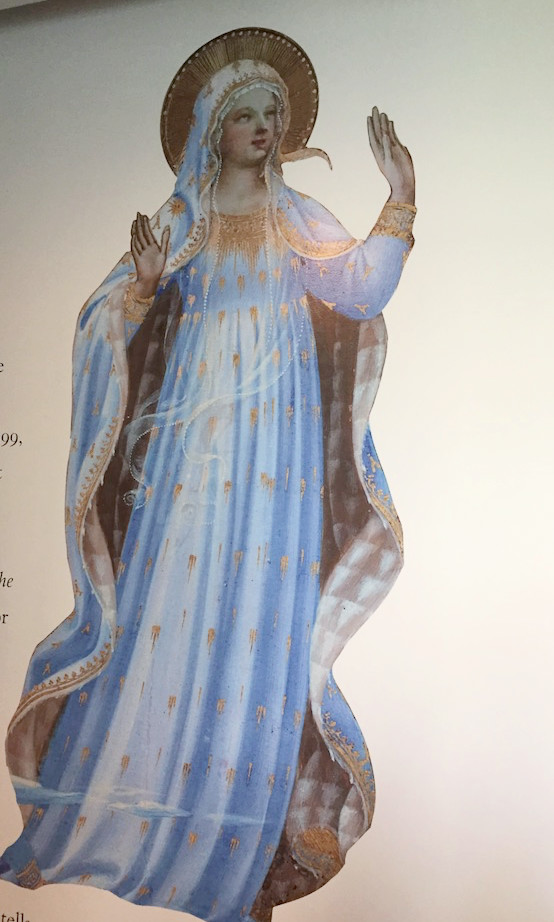
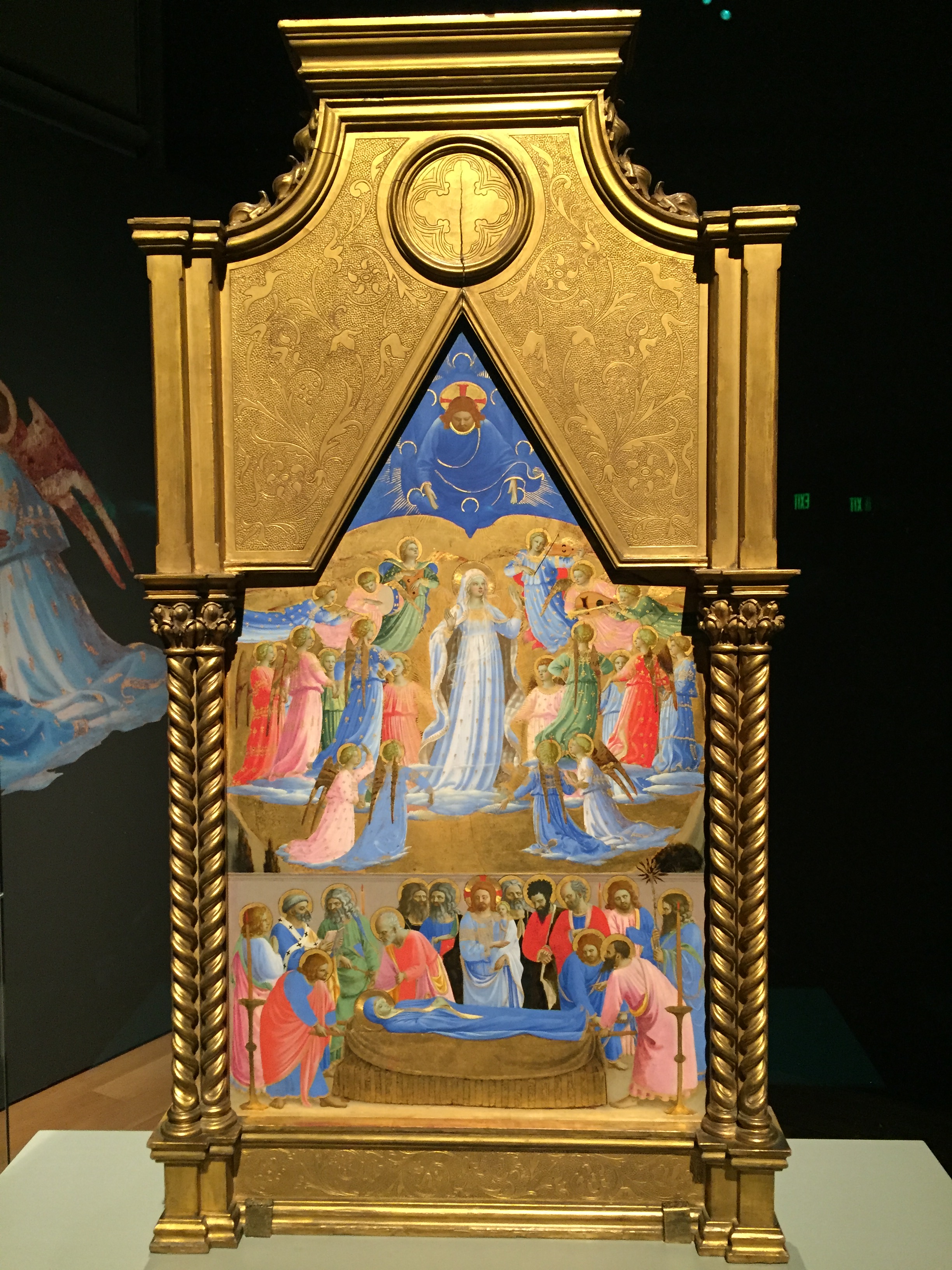
One of Fra Angelico’s reliquary paintings. This small segment, greatly increased in size, shows the detail of the Virgin Mary entering Heaven at the moment of her Assumption. It was part of the very large poster that a visitor would first see as they entered the 2018 exhibition at the Isabella Stewart Gardner Museum in Boston. The reliquaries on display all showed different scenes of the Blessed Virgin. They are stunning to behold.

IMG_1704
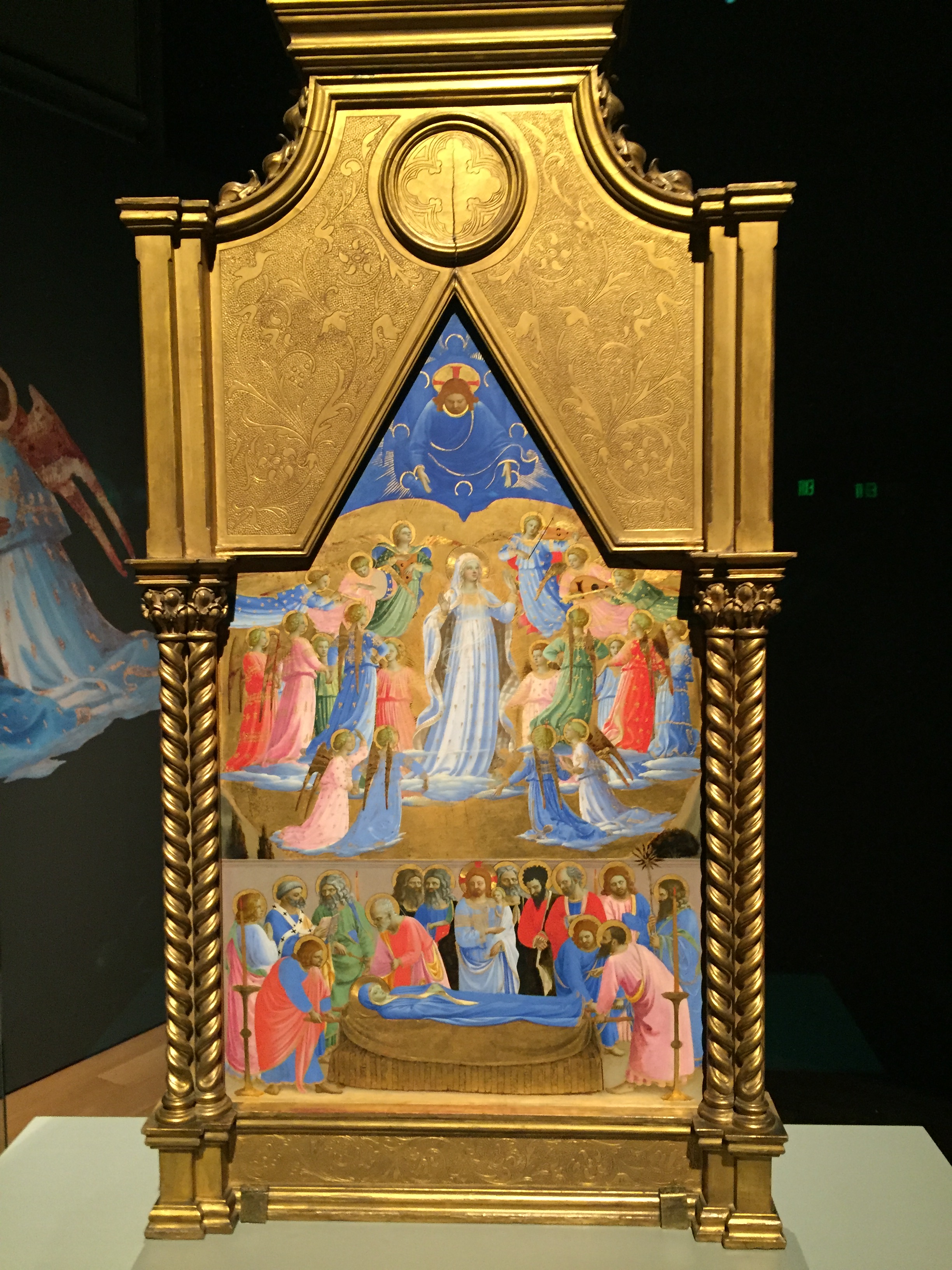
One of Fra Angelico ‘s reliquary paintings – The Dormition and Assumption of Mary – on display at the Isabella Stewart Gardner Museum in 2018. It shows the Dormition of Mary (her “falling asleep” at the end of her human life), her Assumption into Heaven and being welcomed by God. You can see the image of the Blessed Virgin greatly increased in size in the above poster. The reliquary is small, approximately 2 1/2 ft high.

St. Lawrence – Deacon and Martyr

18956-st-lawrence-distributing-alms-fra-angelico
St. Lawrence, deacon of Rome, distributing alms to the poor; painted by  Fra Angelico, circa 1447.

Today we celebrate the feast of St. Lawrence, a deacon and third century martyr.

St. Lawrence was one of the seven deacons of Rome who served as the Pope’s ministers during Holy Mass and as his administrators to the people of Rome.

There is little historical evidence remaining on St. Lawrence. His Acts had been lost by the time of St. Augustine in the 4th century, yet, Pope St. Leo the Great and St. Augustine wrote about him and his martyrdom. The tradition of the Church states that he was a native of northern Spain and was ordained by Pope St. Sixtus II. The Pope made Lawrence responsible for the distribution of the Church’s alms.

St. Lawrence died during a persecution by the Emperor Valerian (circa 258). His death occurred a few days after the martyrdom of Pope Sixtus II and four deacons (Januarius, Vincent, Magnus, and Stephen).

Art historian Carl Brandon Strehlke (see note at bottom) has mentioned that there is controversy over the specific date of his martyrdom. Some accounts state that  Lawrence was martyred under the emperor Decius (AD 249 – 251) and others insist that it was under the reign of Valerian (253 – 260).

Regardless, the Church’s tradition states that he was martyred soon after the emperor Valerian issued an edict in early August, 257. This edict required all Catholic bishops, priests, and deacons to be denied trial and be immediately put to death.

As the Pope and four of his deacons were led to their deaths, Lawrence is purported to have said: “Where are you going, Holy Father, without your son? Where, O Bishop, without your archdeacon? Before you never approached the altar of sacrifice without your servant, and now you are going without me?”  Pope St. Sixtus commented that Lawrence would soon follow him.

Valerian’s administrators came to Lawrence and demanded access to the wealth of the Church. He asked for a few days to assemble it, and subsequently, distributed much of the Church’s treasury to the poor.

The money transfer to the Roman government was to occur on August 10th. Lawrence led the prefect and guards to a room within the Vatican. Upon opening the door and with the force of  a saint he declared:  “Behold the jewels of the Church.” The room contained some of Rome’s blind, poor, sick and maimed!

On the same day Valerian ordered that Lawrence be taken out and slowly martyred in payment for his cheeky behavior towards imperial dignity. St. Lawrence refused to renounce our holy Faith, and was roasted on a gridiron used for cattle. Legend says that he was of good humor to the very end, at one point saying to his executioners: “I’m done on this side. You can turn me over now!”

Many centuries later his story of faith and heroism was artistically proclaimed to the faithful. In 1447 Pope Nicholas V selected Fra Angelico to decorate a Vatican chapel dedicated to the two famous martyrs and deacons of the Church: the protomartyr St. Stephen of Jerusalem and St. Lawrence of Rome.

Fra Angelico successfully linked the narratives of their stories together so that they convincingly expressed the main elements of each saint’s life. They are catechesis as well as beautiful art. Angelico’s painting portrays St. Lawrence in an exquisite rose colored dalmatic (the garment which signifies the deacon’s service and loyalty to his bishop). The fresco is approximately 9 by 7 feet and was painted between 1447 – 1449.

Note: Carl Brandon Strehlke’s comments on St. Lawrence are to be found in Kanter and Palladino. Fra Angelico. Metropolitan Museum of Art, Yale University Press, 2005.

Copyright © 2011- 2020, Deacon Paul O. Iacono – All Rights Reserved. Permission to reprint must be obtained from the author in writing. Students, and those interested, may quote small sections of the article as long as the proper credit and notation is given. Thank you.


Holy War: The Battle for Our Souls and the Soul of the Church

What is our strategic plan in the Holy War to save our personal faith?

The overall plan is simple: it is to win the war for our soul.

Our tactics are paramount. For they must be in sync with the truth that God has given us Free Will (the ability to make decisions) and Reason (the ability to think through and logically make those decisions in the light of Scripture and Tradition).

What are the tactics that support our efforts? The first is to realize that we are not powerless. Our God-given freedom allows us to make personal decisions for good or bad. For example, the decision to agree with our Catechism which explains our ultimate goal of  personal and eternal union with Christ.

Our tactics are varied: the Western and Eastern Rites of the Catholic Church, and the Orthodox Church believe in the need for prayer, fasting, almsgiving, reception of Holy Eucharist, and the frequent (preferably monthly) reception of the Sacrament of Confession. This Sacrament, once avidly used by the faithful, is now sadly ignored. It is critical in our personal war, and through prayer, the goal of purifying our Church. A Church suffering from the effects of clerical sins and the heresy of Modernism.

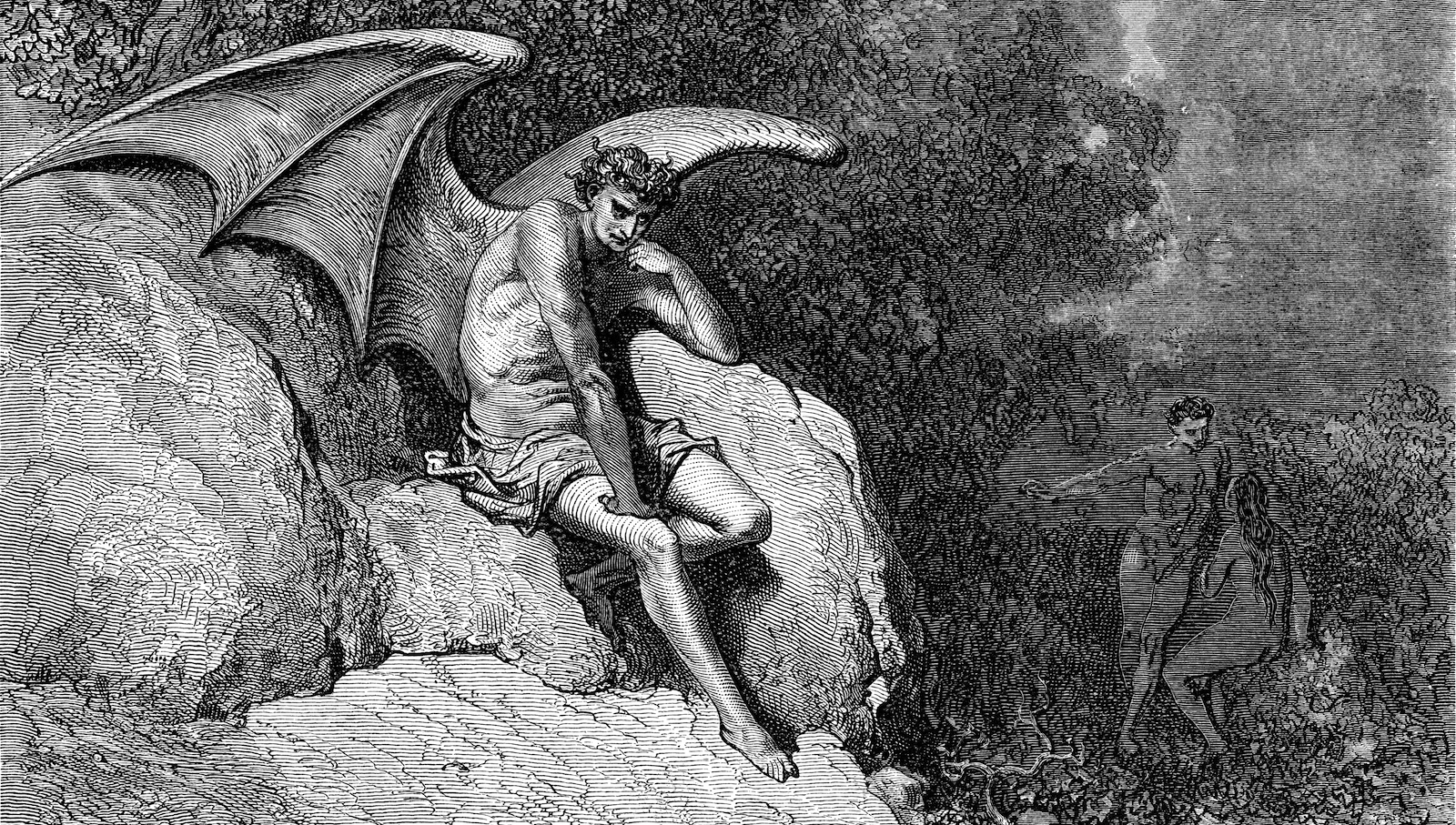
Satan planning his strategy, from engravings by Gustave Dore. From Milton’s Paradise Lost by Robert Vaughan, D.D. Chicago and New York 1885

The Sacrament of Confession is proclaimed in the Epistle of St. James (5: 16), St. Paul’s 2nd Letter to the Corinthians (5: 18),  St. Luke’s Acts of the Apostles (19:18), Jesus’ words in the Gospel of John (20: 21-23), and the proclamations of the Early Church Fathers. It is not a Sacrament that the post-Reformation Church thought up during the Council of Trent. Through history was this Sacrament clarified and given appropriate form to meet the needs of growing Christian civilization? Yes, of course, but that doesn’t mean that it didn’t exist in the early Church or was given witness to in the Christian Scriptures.

If we ignore Grace we have removed many of the foundation stones of our personal faith. Ignorance or belittling the truth of Holy Scripture, or the Sacramental weapons of Grace, effectively renders us defenseless in this Holy War for our souls.

As you will see, Greek Orthodox monk, Elder Paisios’, words ring like a bell of prophecy. They are especially poignant since he wrote them before his death in 1994.

Holy War is upon us. We have witnessed it since Eve handed the apple to Adam. Our enemies are clear: Satan, his demons, false teachers, and our own tranquil indifference.

9fb4864f7592abd9e000ea904250598c
The War in Heaven – Fallen Angels by Gustave Dore.


The words of a Greek Orthodox monk, Elder Paisios:


“What unsettles me is the reigning mood of tranquility. Something is in the works. We still haven’t understood properly either what’s going on, or the fact that we will die. I don’t know what will come of this. The situation is very complicated. The fate of the world depends on just a few people, but God is still putting on the brakes. We have to pray a lot, and with pain in our hearts, so that God will intervene: our times are very hard to understand. A lot of ash, rubbish, and indifference has accumulated, and a strong wind will be needed to blow it all away. It’s frightening! The Tower of Babel is upon us! Divine intervention is needed: Great upheavals are happening. What a bedlam! The minds of whole nations are in confusion. But in spite of the ferment I feel a certain consolation inside, a certain confidence. God still dwells in a part of the Christians. God’s people, people of prayer, still remain, and God in his all-goodness still tolerates us and will put everything in order. Don’t be afraid! We’ve gone through many storms, and still haven’t perished. So should we be afraid of the storm which is now gathering? We’ll not perish this time either! God loves us. In Man there’s a hidden power which comes out when necessary. The difficult years will be few. Just a lot of thunder. Don’t get upset in the least, for God is above everything. He rules everyone and will bring all to the defendant’s bench to answer for what they’ve done, according to which each will receive his just desserts from God. Those who’ve in some way helped the cause of good will be rewarded, and those who do evil will be punished. God will put everyone in their place in the end, but each of us will answer for what they did in these difficult years, both in prayer and in deeds. Today they’re trying to destroy faith, and for the edifice of faith to fall they quietly pull out one stone, then another. But we’re all responsible for the destruction; not just those who destroy but we who see how faith is being undermined and make no effort to strengthen it.

As a result the seducers are emboldened to create even greater difficulties for us, and their rage against the Church and the monastic life increases. Today’s situation can be resisted only spiritually, not by worldly means. The storm will continue to rage a bit, will throw all the flotsam, everything unnecessary, onto the shore, and then the situation will become clearer. Some will receive their reward, while others will have to pay their debts. Today there are many who strive to corrupt everything: the family, the youth, the Church. In our day it’s a true witness to speak up for one’s people, for the state is waging war against divine law. Its laws are directed against the Law of God. But we are responsible for not letting the enemies of the Church corrupt everything. Though I’ve heard even priests say: “Don’t get involved in that. It’s none of your business!” If they had reached such a non-striving condition through prayer I would kiss their feet. But no! They’re indifferent because they want to please everyone and live in comfort. Indifference is unacceptable even for laymen, and all the more so for the clergy. An honest, spiritual man doesn’t do anything with indifference. “Cursed be he that doeth the work of the Lord deceitfully”, says the Prophet Jeremiah (Jer. 48:10).

There’s a war on today, a holy war. I must be on the front lines. There are so many Marxists, so many Masons, so many Satanists and assorted others! So many possessed, anarchists and seduced ones! I see what awaits us, and it’s painful for me. The bitter taste of human pain is in my mouth”

paisios-of-mount-athos


Copyright © 2011- 2020, Deacon Paul O. Iacono – All Rights Reserved. Permission to reprint must be obtained from the author in writing. Students, and those interested, may quote small sections of the article as long as the proper credit and notation is given. Thank you.

Elijah, Pagans, and Our Lady of Mt Carmel

 Sacred Scripture has always celebrated the beauty and significance of the mountain in Israel called Carmel.

It is significant for two reasons:

  1. In a dramatic contest with the priests of the pagan god Baal, Elijah fought the false gods of King Ahab and  Queen Jezebel of Israel; a king and queen who were dramatically attempting to turn the Israelites away from the belief of monotheism to polytheism. It is believed that the base of the mountain is where the Hebrew prophet Elijah prayed, contemplated God, defeated the priests of Baal, and  defended the purity of Israel’s faith (confer 1 Kgs 18:17–46).
  2. It is also the site of the Stella Maris Monastery, the world headquarters of the Carmelites, a Catholic contemplative religious order. Three great saints of the Carmelite Order are St. Theresa of Avila, St. John of the Cross, and St. Therese of Lisieux.  Through their witness and books they continue to make significant contributions to the mystical life and contemplative prayer of clergy and laity alike.

During the 12th century Catholic hermits withdrew to the mountain of Carmel to form a small community of religious brothers. Near a spring that was named after the prophet Elijah they founded their society desiring to devote themselves to contemplative prayer and Holy Scripture. These men called themselves “the Brothers of the Blessed Virgin Mary of Mount Carmel.” This society was the seed of the present world-wide Carmelite Order. According to the Carmelite Rule of St. Albert “Carmelites are devoted to the contemplative life under the patronage of Mary, the Holy Mother of God.”

The charism of present day Carmelite monks and contemplative sisters is to  share the fruits of their contemplative prayer life with others. Contemplation and ministerial action are not contradictory forces within this Order.

The Carmelite Order is also associated with the Brown Scapular of Our Lady of Mt. Carmel. A scapular, in many religious societies, is a piece of clothing that a monk or religious sister wears over their regular habit when they are working at various communal tasks. Today, laity, deacons, priests, and bishops may wear the Brown Scapular, too.

A scapular is a “sacramental,” it is not a charm or superstitious trinket. As a sacramental it assists in a person’s prayer life by turning the mind and soul toward the beauty and love of God. The scapular associated with the Carmelites is called the Brown Scapular.

The Brown Scapular is two pieces of small cloth, about 2 by 2 inches, that are attached by a cord which is paced around the neck. One side of the cloth rests on the back and the other on the chest. This scapular has images of the Blessed Mother with the baby Jesus on one cloth, and St. Simon Stock on the other. Roman Catholics believe that St. Simon Stock, who was a 13th century English Carmelite, received the first Brown Scapular from our Blessed Mother.

The Church of Saints Peter and Paul in Singapore has a lovely summary of the significance of the Brown Scapular on their website: “By the wearing of the scapular, we express our commitment to be disciples of Christ, and following the example of Mary, the perfect disciple, we learn:

  1. To be open to God’s will;
  2. To listen to the word of God, and put it into practice.
  3. To pray at all times, as a way of discovering the presence of God in all that is happening around us.
  4. To share in the paschal mystery of Christ by means of voluntary penance.
  5. The Brown Scapular has become a sign and symbol of the special dedication of the Blessed Mother’s protection. This spiritual meaning has been approved by the Church.
  6. The devotion of wearing the Scapular has become, like other devotions to Mary, a rich treasure for the whole Church – an expression of love and trust in her motherly intercession.”

It is recommended that you purchase the Brown Scapular of Mt. Carmel. Have it blessed by a priest or deacon, and wear or carry it with you. In these days of social unrest and apostasy it is very beneficial to have our Blessed Mother close to us.

Please remember that Roman Catholics, Catholics of the Middle Eastern Rites, and the Greek and Russian Orthodox, venerate the Virgin Mary. We do not worship her. We worship only God.

Our Lady of Mt. Carmel pray for us.

Our Lady of Mt. Carmel
Personally, I think this is the most beautiful of all the sacred images of Our Lady of Mt. Carmel. The source of this image is: http://www.museumofdivinestatues.com/mods/our-lady-of-mount-carmel-mount-carmel.html


Copyright © 2011- 2020, Deacon Paul O. Iacono – All Rights Reserved. Permission to reprint must be obtained from the author in writing. Students, and those interested, may quote small sections of the article as long as the proper credit and notation is given. Thank you.


Chinese Martyrs and the Beautiful Art of Ken Jan Woo

We remember today, July 9th, the 120 martyrs who died in China between the years 1648 and 1930. Eighty-seven of these were native born Chinese and were children, parents, catechists, and simple laborers ranging in age from nine to seventy-two.

In the early 19th century, St. Augustine Zhao Rong was a Chinese soldier who accompanied French missionary Bishop John Gabriel Taurin Dufresse to his martyrdom in Bejiing.  He was profoundly touched by the Bishop’s courage in the face of great trials, humiliation, and eventual death. As a result, Zhao Rong sought baptism, was given the baptismal name of Augustine, and soon ordained a diocesan priest. He spoke often of Bishop Dufresse’s sense of hope, love of Christ, and confidence.

In 1815 the Chinese government martyred Father Augustine Zhao Rong.

An icon of Father Zhao Rong was completed by the brilliant Chinese artist Ken Jan Woo. Many of his icons and sacred art can be seen at his website http://www.kenwooart.com/index.html. Classically trained, Ken brings a new contemporary spirit to the sacred images of the Church’s past history. His exquisite rendering of this saint, in a typical icon format, is powerful in its simplicity and harmony.

The witness of these Chinese saints, in association with the Gospel passage of Matthew 9: 18-26, begs a question: What sets St. Zhao Rong, his martyred companions, and the people in the Gospel apart from many in our society?

Jesus provided the people with faith-filled hope even when circumstances dictated that their situation was hopeless. Why is this?  It is because Jesus’ love for them, and willingness to share The Truth, was always directed back to His Father. Jesus tells us, “With God, all things are possible to those who believe.”

Jesus’ words were incendiary; for He said to the woman “Take heart, daughter – your faith has made you well.” That phrase “Take heart” ignited the woman’s expectant faith. Her belief allowed her to cooperate with the healing process.

Matthew’s Gospel passage provides witness to the local ruler’s spiritual courage to request Jesus’ help. The girl was already considered dead.  Professional mourners had already been hired to demonstrate the family’s public grief. The mourners and others in the crowd scornfully laughed at Jesus. Their grief was as bogus as their lack of faith. Jesus’ was ready to heal, teach, and be open to the needs of that family. It gave them a glimpse into the mind and heart of God; and it provides us with a model to follow, too.

Let our prayer be the prayer of the martyrs: Lord, you love each of us with a unique and personal love. As we face our troubles with confident hope, touch our souls with your saving power, and restore us to the fullness of your eternal life. Amen

Artwork Copyright © Ken Jan Woo. All Rights Reserved.

Copyright © 2011- 2020, Deacon Paul O. Iacono – All Rights Reserved. Permission to reprint must be obtained from the author in email/writing. Students, and those interested, may quote small sections of the article as long as the proper credit and notation is given. Thank you.

The Virgin Mary – Racial Supremacy and Artistic Diversity

Artistic images of the Blessed Mother of Jesus, as portrayed by different cultures within historical periods, have been part of world history for centuries. Below are a few examples of these images.

Attachment-1
Japanese Courtesy of: https://blogofthecourtierdotcom.files.wordpress.com/2013/01/japan.jpg

iu-6
Native American – Hopi

iu-7
Chinese

iu-8
Native American – Cheyenne

iu-9
Mexican

iu-10
Italian – Baroque Period

iu-18
African

iu-19
Medieval Europe

iu-22
European (Polish)

The various images of Jesus and His Mother portrayed by each ethnic group are beautiful and have spiritual meaning. Are the artists of these works prejudiced or racist?

Because of the controversy over comments made by political activists over the last few weeks it would appear that the motive of cultural artistic contributions is based on racial superiority. Their opinion  points to the obvious truth that in our social and political climate confusion is very possible.

A debate is occurring within the fields of physical anthropology, genetics, and evolutionary biology concerning the issues of race and racial supremacy. Some scholars have concluded that racial supremacy and even the various categories of human races do not exist.

Evolutionary biologist, Alan R. Templeton’s recent genetic research contributes to the discussion. The abstract of his research is published in final form as: Stud Hist Philos Biol Biomed Sci. 2013 Sep; 44(3): 262–271.

Highlights of Templeton’s research:

  1. “Races are highly genetically differentiated populations with sharp geographical boundaries.
  2. Alternatively, races can be distinct evolutionary lineages within a species.
  3. By either definition, races do not exist in humans but do exist in chimpanzees. [italics mine, P.O.I]
  4. Adaptive traits such as skin color do not define races and are often discordant with one another.
  5. Human populations are interwoven by genetic interchanges; there is no tree of populations.”

Thus, in the grand scheme of things superficial traits are what separate us not genetic differences. Valid scientific evidence may be proving that the concept of five races is outmoded and not substantiated by modern genetic research. It is correct to say that specific ethnic groups, with superficial physical traits, living within specific geographical areas, do exist.

If American or European “white” artists portray Jesus and all the individuals found in Holy Scripture as members of Caucasian ethnic groups, they would in the majority of cases, be artistically portrayed as having the superficial physical genetic traits of European/Middle Eastern populations.

The images above certainly portray that the artists within another culture, or dominant ethnic group/cultures in specific regions of the world, do the same thing. This is logical because the artist of a specific ethnicity paints or sculpts to meet their group’s spiritual needs, or, the patron’s specific request. That is not an act of ethnic supremacy or racism.

Genetically, can we say with any assurance what the genetic make-up of Jesus, Mary, and His fellow Hebrews were when they existed? There is historical evidence to contribute to the answer.

Since the time of the Patriarch Abraham’s son Isaac, and Isaac’s son Jacob, there occurred the development of the twelve tribes of Israel.

These tribes definitely took shape and became a cultural, military, and political force by circa 1925 BC. Tribal leaders were very strict about intermarriage with other populations. Under Moses’ leadership, circa 1250 BC, they did not allow it at all. They were a large enough population to marry within the system of their tribes, and their members conformed to the demands of God and their leaders.

Abram (Abraham) and his flock of followers originated within the city of Ur, which was a Chaldean city-state of the Sumerian civilization. Today the archeological remains of the  city of Ur are located in Southern Iraq. Ur was Abram’s home before he, his family, and followers were given the order by God to travel to the land of Canaan.

Abram would later be given the name Abraham by God. “In various sources, “Canaan” refers to an area encompassing parts of Syria, Lebanon, Jordan, and Israel. The Israelites occupied and conquered Palestine, or Canaan, beginning around 1750 BC, or perhaps earlier. The Bible justifies such occupation by identifying Canaan with the Promised Land, the land promised to the Israelites by God” (source: https://www.britannica.com/place/Ur

Bottom line, Jesus, Mary, and “His friends” were ethnic Israelite/Hebrews. They were Hebrews from the genetic line of King David. David’s genetic line originated from Abraham’s son, Isaac, and grandson Jacob. There is no way to prove that Abraham, Isaac, and Jacob’s genetics are related to the people of today’s southern Iraq, or any other ethnic group.

If a person believes in the truth of the Holy Scriptures then the answer is that Jesus, His family, and Apostles, were all of the genetic line of Israelite/Hebrews with the superficial physical traits of that ethnic group.

Ultimately, Roman Catholic, Orthodox, and Anglican Biblical sacred art is not about race or superficial physical traits. The entire Hebrew and Christian Scriptures point to the truth that the human nature of the Son of God, Jesus the Christ, was born of Mary within Roman occupied Israel. The spiritual union of the power of the Holy Spirit with the consent of Mary  led to the birth of Jesus, the Redeemer of mankind.

Supremacy is not found in race, ethnic group, or prejudice/bigotry. It is only found in the authority and power of the Holy Trinity.

Praise be the name of Our Lord Jesus Christ.

Copyright © 2011- 2020, Deacon Paul O. Iacono – All Rights Reserved. Permission to reprint must be obtained from the author in writing. Students, and those interested, may quote small sections of the article as long as the proper credit and notation is given. Thank you.

Iconoclasm and Shaun King

In the June 22, 2020 issue of Newsweek an on-line article by Aila Slisco reported some statements by political activist Mr. Shaun King. 

She states: “He [King] also remarked that stained glass windows and other images of a white Jesus, his European mother and their white friends should all be destroyed, insisting they are racist, examples of ethnic propaganda, and “a form of white supremacy. “They should all come down.” (I’ll comment on these statements by Mr. King in another post).

King’s comments came in association with Black Lives Matter protests against the brutality of some police officers toward minorities. These protests quickly moved away from the issue of police brutality in some major cites and expanded into protests against historic and artistic representations of American/European civilization and the “white supremacy” that it allegedly represented. 

We have observed over the last two weeks examples of the new iconoclasm. 

Rhetoric like Mr. King’s and other activists could be passed off as uninformed except for the fact that two California mobs tore down and desecrated a statue of the Spanish missionary Fr. Serra. In the process they also harassed Catholic college students, laity, and a priest who were defending it.

Legitimate non-violent protests are protected by the U.S. Constitution, however, the destruction of public or private property is not. 

Public religious, military and political statues are the property of the local churches and governments. What happened to the government’s responsibility to protect them? Churches, and whatever articles they contain, are the property of the church regardless of denomination. Will the governments across the nation protect them?

Religious statues, sacred art, stained glass windows, etc, are defended by the 1st amendment of the U. S. Constitution. Is Mr. King saying that a Satanic statue of Baphomet can be placed in a public square but a statue of a Roman Catholic saint, who is specifically honored for his cultural contributions, cannot? 

Are the representations of the God and saints of the Roman Catholic Church, who has been a major contributor to world civilization, to be torn down because a segment of the population believe that they, without taking into account time period or cultural conditions, have been historically ethnocentric and intolerant of other cultures? Are these legitimate religious statues equivalent to the statues of Lenin, Stalin, Mao or Saddam Hussein?

What happened to Martin Luther King Jr.’s call for positive non violent change and tolerance in America?

Today, July 1st, is the Roman Catholic Church’s memorial of the missionary efforts of Fr. Junipero Serra, an 18th century Spanish missionary priest. Fr. Serra’s leadership and contributions to improving the educational and technological life of Native Americans and development of California is recognized as a public act and not just a religious effort; this is why his statues were erected by the state of California. His statue also stands in Statuary Hall in the U. S. Capitol building in Washington, D. C.  At various times national and state politicians, of both political parties, were present to honor him.

Fr. Serra’s main goal was to be an effective Christian missionary. He was following the Gospel injunction of Christ Himself in the 28th chapter of the Gospel of Matthew: “All power in heaven and earth has been given to me. Go, therefore, and make disciples of all nations, baptizing them in the name of the Father, and of the Son, and the Holy Ghost, teaching them to observe all that I have commanded you. And behold, I am with you always, until the end of the age.”

The new iconoclasm appears to be intolerant, or unaware, of history. The adherents public efforts, both in word and deed, are clearly seen in the mobs in California and specifically in St. Louis, Missouri where they beat Catholics who were praying in front of a monument of St. Louis IX. In both cases mob action desires to vent its anger, ideology, and psychological wounds against historic personalities. The mob desires to sponge away the past rather than continue to lawfully, peacefully, and vigorously work for social change. 

Is significant change necessary in the way some police departments train their recruits? Absolutely. Productive change can occur. It cannot occur when the structures of Constitutional democracy are trampled upon. Polarization has never accomplished anything; positive social change has never occurred through a mob’s physical or verbal violence.

The past cannot be rewritten. In America, many times statues regardless of being religious, political, or military, celebrate the good that people have accomplished, not their ethnocentrism. If small groups through mob action tear down public property, or Church property, then they are no better than many other mobs, tyrants and demagogues through history; such as Mao Zedong’s actions during the ten years of China’s Cultural Revolution, Lenin and Stalin’s iconoclasm and political/religious oppression during the 70 odd years of their Communist debacle, Hitler’s 13 year rampage of mass destruction and inhumanity, or present day Isil and their damage of populations and  archaeological sites in the name of religious ideology.

As civilizations are we still unable to learn from the lessons of history? Is it too late?

Copyright © 2011- 2020, Deacon Paul O. Iacono – All Rights Reserved. Permission to reprint must be obtained from the author in writing. Students, and those interested, may quote small sections of the article as long as the proper credit and notation is given. Thank you.

Holy Saturday/Easter 2020

Today, Holy Saturday, is observed by the Western and Eastern Rites of the Catholic Church, and other denominations as the Anastasis (Greek, “resurrection”), or the Harrowing of Hell by Jesus Christ.

In this harrowing, Christ’s purpose was to free the righteous people of the Old and New Testaments from their inability to enter Heaven. This occurred because of their death prior to the passion and death of Jesus. His Redemptive acts freed them from what Roman Catholics would call Purgatory and the Eastern Rites and some Protestant denominations would call Hades.

Anastasis_at_Chora
The Anastasis, or the Harrowing of Hades, a fresco found in the Chora Church, Istanbul, Turkey dated around 1315. It depicts the freeing of Adam and Eve and other righteous souls from Purgatory. This icon is usually in tandem with an icon of the bodily Resurrection. Notice Christ standing on the doors of Hades or Purgatory as he takes the hands of Adam and Eve and literally pulls them out of their resting places.

There are over fifteen verses and references found in both the Hebrew  and the Christian Scriptures that mention Hades. It is also discussed in non-canonical apocryphal writings such as the Gospel of Nicodemus. Its referred to as Purgatory because it is “the state of those souls who die in God’s friendship, assured of their eternal salvation, but who still have need of purgation to enter into the happiness of Heaven” (CCCC; para. 210, see notation below).

An analogy for Purgatory, though limited, would be the understanding that you cannot enter a beautiful wedding without showering and dressing appropriately. Hell, however, is the place of eternal damnation for those who through reason and free will die in the state of unconfessed mortal sin. They have deliberately intended to separate from the love of God by pursuing and participating in deadly sins.

31_limbo
Egg tempera fresco by Fra Angelico. Notice Jesus standing on the doors of Purgatory as he leads the righteous souls out of their captivity. The beatified Fra Angelico interestingly puts a demon in the left corner and under the door! The demons and eternally lost souls were /are aware of the Redemption by Christ. This fresco, dated  1440, is found in the Museum of St. Mark (San Marco, a former Dominican priory) in Florence.

Please enjoy another Fra Angelico fresco of the Resurrection of Christ. I wish you a happy and  blessed Easter!

angelico women rev

CCCC: refers to the Compendium of the Catechism of the Catholic Church. 2nd edition, 2012.

Copyright © 2011- 2020, Deacon Paul O. Iacono – All Rights Reserved. Permission to reprint must be obtained from the author in writing. Students, and those interested, may quote small sections of the article as long as the proper credit and notation is given. Thank you.

Good Friday 2020

Father, by the merits of your Son’s passion, death, and resurrection  hear us in our troubles and fears. Strengthen us against anxiety and illness. This day allow us to join Jesus’ suffering with ours. Please have mercy on the souls of those who, from this current pandemic, pass into eternal life.

Thank you Lord, for Your Son’s sacrifice, love, and mercy.

“It was about nine in the morning when they nailed Jesus to the Cross. From noon until three o’clock there was darkness over the whole world. At three o’clock, Jesus cried out in a loud voice: ‘Father, into Thy hands I commend My spirit;’ and having said this He expired.”

maxresdefault
Closeup of the face on the Holy Shroud of Turin. A forensic artist’s recreation of a potential human likeness of the image found on the Shroud.

St. John Chrysostom, an Early Church Father, tells us: “There flowed from His side water and blood. Beloved do not pass over this mystery without thought; it has yet another hidden meaning, which I will explain to you. I said that water and blood symbolized Baptism and the Holy Eucharist. From these two Sacraments the Church is born: from Baptism, the cleansing water that gives rebirth [into the family of God] and renewal through the Holy Spirit, and from the Holy Eucharist [physical and spiritual nourishment; as He said: “Take and eat this is My Body. Take and drink for this is My blood]…   (Excerpts from the Holy Gospels and the Catechesis by St. John Chrysostom, AD 347 – 407, Archbishop of Constantinople).


image7
Full view of the Holy Shroud of Turin. It shows the results of the scourging on both sides of His Body, the crowning with thorns, the wound in His side, and the marks of the nails in His feet and wrists (necessary because the wrists would have been able to hold the weight of His Body). The triangular patches surrounded by white areas on the Shroud are the result of a fire which melted a lead casket encasing the Shroud. 

On this day our Redemption [from sin] was earned by the suffering and death of Jesus, the Son of God; by His wounds you were healed. JESUS CHRIST IS LORD!  (Philippians 2: 6-11, and 1 Peter (chapter 2: 21-24).

Copyright © 2011- 2020, Deacon Paul O. Iacono – All Rights Reserved. Permission to reprint must be obtained from the author in writing. Students, and those interested, may quote small sections of the article as long as the proper credit and notation is given. Thank you.

Do Pagans Go To Heaven or Hell?

by Deacon Paul O. Iacono, Diocese of Providence, Rhode Island USA

The author of the interesting and challenging blog site on sacred art and its analysis called Catchlight sent me two questions yesterday. They related to my last post which was entitled Fatima Messages, Pagans in the Vatican, and the End Times.

“Paul, your protestations begs the question, do pagans go to Heaven? If so, why? If not, why not?”      from Bernard Gallagher

These are excellent questions.

Before I attempt to answer them my readers should understand that I am a committed and Traditional Roman Catholic. His questions will be answered through the lens of the teachings of my Faith. That Faith is based on a foundation of Holy Scripture, Sacred Tradition, and two thousand years of Catholic scholarship.

Allow me to also mention that we need to understand that two Councils of the Church, the Councils of Orange and Trent (1000 years later), are critical in forming a correct answer to Mr. Gallagher’s questions. The Councils of Orange are significant (both of them were held in the city of Orange in Southern France, AD 441 and 529). The more important Second Council of Orange’s episcopal deliberations were sent to Rome and approved by Pope Boniface II in AD 531. That Council specifically proclaimed that everyone (who has reached the “age of reason”) is given sufficient Grace to be saved from eternal damnation. God will give, and has given all people, Actual Grace. If a person accepts and acts on that Grace, they will be saved.

What is Actual Grace? Actual Grace is an admonition by God for a person to correct their way of life, desire, search after, and make the sincere effort to obtain the Sanctifying Grace provided by the Catholic ChurchThe key action which achieves salvation and eternal life with God is the Holy Sacrament of Baptism. This allows the person to enter into God’s family. The Sacrament of Baptism removes Original Sin from an individual’s soul and enables it to receive additional Sacramental Sanctifying Grace. All Grace enables a person to become holy in God’s eyes. The other six Sacraments flow from the waters of Baptism. Pope Pius 9th (papal reign 1846 -1878) proclaimed that it would be extraordinary for an unbaptized person to achieve the eternal salvation and reward of Heaven.

First principle,

a) The Roman Catholic Church, the ethnic church Rites that are in union with Rome, the Greek and Russian Orthodox Churches, and some of the Protestant churches say that Jesus Christ, is the Word of God, the Son of the Father, begotten not made and consubstantial with Him. He is the Messiah, the Savior.  His human life, ministry, passion, death, and resurrection redeemed mankind from their sins. His divinity is expressed through His position as the Second Person of the Blessed Trinity.

b) He is known to mankind through the historical Gospels and Epistles of the Apostles, the witness of His Mother, the Virgin Mary (especially at her apparition at Fatima, Portugal in 1917. When asked what sin was most harmful and condemned unrepentant people to Hell she responded: ‘The sins of impurity are one of the major reasons why men and women are condemned to Hell.'” We cannot ignore our sins or consider them unimportant because of the current worldview. Also, the erudition of the Catholic Church Fathers, Doctors of the Church, Saints, and the historical teaching authority of the Church have all provided the scholarship and analysis that is sufficient for humanity to understand God’d Revelation and laws.

c) He is also known through the extraordinary scholarship of St. Augustine and St. Thomas Aquinas. The teaching authority of the Church, (as found in its Magisterium), is the Church’s responsibility to give to the world an authentic interpretation of the Revelation of God as found in Sacred Scripture and Sacred Tradition.

d) Additionally, let us not forget the importance of the testimony of the angels found in Holy Scripture, and the saints, of whom Jesus’ Mother Mary is the greatest of saints. All of these facts contribute to mankind’s understanding and witness of our Savior Jesus Christ.

e) Jesus commissioned His Apostles (the first bishops) to make known the free gift of His Redemption and graces. These critical graces are found in the Seven Sacraments of the Church, beginning with the keystone Sacrament, Baptism.

Hagiasophia-christ-1
An icon of Jesus Christ. It is found within the former Eastern Rite Church of Hagia Sophia (Holy Wisdom). The Church was built in the early 6th century and is located in Istanbul, Turkey (formerly Constantinople). It was a mosque, then was a museum since 1935, but recently it was converted back into a mosque.

Second, let’s refer to what Jesus Christ says in response to Nicodemus’ questions concerning eternal life in the Gospel of St. John, John 3: 1-21: “Amen, amen, I say to you, unless a man be born again, he cannot see the kingdom of God.” Nicodemus continues to question Him, and Jesus responds, “Amen, amen, I say to you, unless a man be born again of water and the Spirit, he cannot enter the kingdom of God…You must be born again.”

The great significance of the necessity of Baptism into the Christian faith is again stressed in another passage of the Gospels. The Gospel of St. Matthew, in its very last passage deals with the commissioning of the Apostles which occurred after His resurrection and before His Ascension back to the Father. Jesus emphasizes that combined with their preaching and works they must baptize faith-filled individuals because of Adam and Eve’s sin. Humanity’s broken relationship with God must be healed. It was healed through the death and resurrection of the Father’s Son Jesus the Christ. Jesus death, on our behalf allowed the formation of the Church and the Sacraments to be instituted to provide the grace to a broken humanity. Baptism is the Sacrament that makes this happen. It makes an individual’s body and soul a member of God’s family. Matthew 28: 18-20: “Jesus drew near and spoke to them saying, “all power in Heaven and on earth has been given to me. Go, therefore, and make disciples of all nations, baptizing them in the name of the Father, and the Son, and the Holy Spirit, teaching them to observe all that I have commanded you; and behold, I am with you always, to the close of the age.” 

Third, it appears, within the Christian faith, that we can come to specific conclusions that will provide a springboard for my response to Mr. Gallagher:

  1. If the human race was alienated from God, and the spiritual relationship with Him was broken, then a loving and merciful God would not give up on His children. Thus, through the course of history God has slowly manifested and revealed Himself to humanity starting with our spiritual parents, Adam and Eve; then through the patriarchs, leaders, and prophets of the chosen Jewish tribes culminating in the Incarnation of His Son, Jesus the Christ. God desires us to love Him and conform to His Laws. He has given us reason and free will. He has given us the ability to think and act not like robots but as free men and women. His revealed truths and laws must be evangelized and faithfully kept by individuals and mankind as a whole. The “Good News” must be spread by the Church as a whole and individuals, too.
  2. The First Commandment applies, as we see in Exodus 20: 1-6ff: “I, the Lord am your God, who brought you out of the land of Egypt, that place of slavery. You shall not have other gods besides Me. You shall not carve idols for yourselves…you shall not bow down to them or worship them. For I the Lord am a jealous God…inflicting punishment on those who are wicked and hate me…and mercy on those who love Me and keep My commandments.”
  3. Through Scripture and study of the Catechisms of the Council of Trent and that of Pope St. John Paul II, united with faith we also know that Jesus Christ is the consubstantial only Son of God and the promised Savior. Now, have (for example) the Amazonian pagans that we recently observed in Rome, or the new pagans of the 20th and 21st centuries been exposed to that truth?
  4. Christ freely offered Himself for our eternal salvation. This was accomplished through the words and actions of His human ministry and ultimately through His Passion, death, and resurrection. Jesus Christ is the Way, the Truth, and the Life. Have apostates, pagans, or other non believers been exposed to that truth?
  5. We see God through faith in Him, participating in prayer, Scripture study, good works, and the Sanctifying Grace found in the Seven Sacraments. Have pagans, past and present, been exposed to and accept these truths?

Fourth, so,  are pagans going to Heaven or Hell?

In a nutshell, I would never presume to know God’s mind, except from that which He revealed through Holy Scripture and Sacred Tradition. I would never make a judgement on another person’s soul as he or she are seen by God at the time of their death and individual judgement. Unknown to the world, even a great sinner may suddenly, in their last moments, repent of their sins and ask for God’s mercy. But, make no mistake about it, Scriptural Revelation, and the Sacred Tradition of the Catholic Church and specifically the words of Jesus in the Holy Scriptures, states that there is a Hell (Matthew 10: 28; 22: 13. Luke 16: 26; etc.); there is a Heaven, and, damnation into Hell for all eternity. 

It is believed that there is also a place of natural happiness called Limbo. It is not within Heaven, nor is it in the fires of the Hell of the Damned. It is a state of natural happiness and joy. It is not supernatural happiness because its inhabitants do not have the Beatific Vision (see additional discussion in the Summa Theologica, Supplement 1, 3rd part article 2, by Fra Rainaldo da Piperino). The question of what happens to infants who die without the Sanctifying Grace of Baptism is a much debated issue. Many Traditionalists support the idea of Limbo; however, contemporary scholarship supports the idea that God, in His mercy, would not withdraw the vision of His glory to unbaptized infants who have died.

Some additional issues:

  1. Let’s take a look at three major Greek philosophers: Socrates, Plato, and Aristotle. They were scholars who lived and died before the birth and ministry of  Jesus Christ. They lived within a pagan/pantheistic society whose members believed in a multitude of gods  Are Socrates, Plato, and Aristotle in Heaven or Hell?
  2. The answer is, “I don’t know!”
  3. But Jesus said, “I am the Way, and the Truth, and the Life. No one comes to the Father but through Me” (John 14: 6). Wouldn’t that statement preclude the unbaptized Greek philosophers entrance into Heaven?
  4. The answer is “Not automatically.”
  5. So, what do we know? We know that those three philosophers were men who searched for the truth, not only about  themselves as individuals but about the world itself. They searched after the truth. They made the sincere effort to find the truth by thinking, questioning, analyzing reality, both physical and metaphysical. They used all the evidence at their disposal to do so. They lived, before the Son of God was incarnated. They did not have the witness of Jesus Christ and to His specific and eternal revelation as the Son of God, both human and divine. They also probably did not have any exposure to the history of the Jewish people and God’s revelation to them. As per the the points made earlier, did they act on God’s Actual Grace to truly desire life with Him?
  6. But, in the time after the Incarnation and Ascension of Jesus, a person who had the opportunity to be exposed to and Baptized into the  Christian Faith (in the full expression of it in the Western and Eastern Rites of the Catholic Church, and some of the Protestant and Anglican churches if they use the Trinitarian formula), would have a critical free choice to make.
  7. If they are pagan, agnostic, atheist, Catholic Christian, Deist, Protestant Christian, Satanist, Wiccan, etc, and they would then, after an effort to know the truth, reject Actual Grace and the witness of Jesus Christ out of intentional misunderstanding, intellectual arrogance, stubbornness, cultural and historic prejudices, selfishness, willful rejection of Christian Revelation, narcissistic impulses, apostasy, or some evil influence, they would be freely putting their eternal soul into mortal sin. They would be facing the eternal punishment of Hell because they chose the path, through their own free will of “definitive self-exclusion from communion with God and the blessed in Heaven” (confer page 269 in the Catechism of the Catholic Church,  2nd edition).
  8. God is loving and compassionate. He is filled with mercy for those who sincerely repent their sins. God is merciful; however, our God is a God of Justice. Why would Jesus Christ be Incarnated to minister, suffer, die, and be resurrected if the Holy Trinity would give mortal sinners “A get into Heaven free pass?” The “Pass theory” doesn’t make sense, it is illogical, bogus, and yes it is a lie. There are dire consequences for freely turning your back on Jesus Christ: Hell.
  9. But do today’s pagans turn their backs?
  10. The answer to that question is: Have they made the effort to know the Truth? Have they been exposed to the truths of the Hebrew and Christian Scriptures? Have they been evangelized by courageous and selfless missionaries who are willing to undergo all sorts of hardships and possibly even martyrdom for the sake of their flocks’ eternal souls? Have they deliberately turned their backs on the truth and revelation of God through the Christian Scriptures, and the documents and witness of the Apostles, Saints, Church’s Doctors and Fathers, bishops and Pope as they present the truth on faith and morals? Have the pagans or people of other religions acted on the free gift of God’s Actual Grace?
  11. The Church’s duty and responsibility is to bring, without arrogance or condescension, the Holy Scriptures, Sacred Traditions, and the Holy Sacraments to the world. If its bishops, priests, deacons, consecrated brothers and sisters in various religious orders, and laity shirk or compromise their duties and teaching authority, give bad example through public and private sin, then they possibly will be denied entrance into Heaven, too.
  12. Is the Church giving sufficient resources to the missionaries in the field? Are we able to inspire young men and women in today’s world of the necessity and challenge to enter the life of a missionary? Have we thrown in the towel?
  13. This is my great concern about what I see in the Church today (especially the recent blessing of the pagan Pachamama statue in Rome; (by the way, all of the Amazonian Pachamama rituals were condemned by six Cardinals). The Christian churches should not be about assimilation of pagan cultures into the Faith in order “to learn from them,” or do so in a “spirit of dialogue” and accommodation.
  14.  The Western and Eastern Rites of the Catholic Church have the complete and total revelation of God to humanity. We have the complete revealed truth of The Trinity. We have the example of what it means to live in the heart of the Father through the life of Jesus Christ. Christ’s life, redemptive death, and resurrection made possible our entrance into God’s family. This entrance is accomplished through the Sacrament of Baptism (using the Trinitarian formula), and individuals’ growth in faith and good works.
  15. Matthew 28: 18-20, relates Jesus’ specific command. Our duty is to compassionately and without arrogance teach pagans and other non-believers about Jesus Christ, baptizing them in the name of the Father, and the Son, and the Holy Spirit.
  16. It is intellectually and morally irresponsible to give the impression that apostates, heretics, pagan/polytheistic cultures, and people of other faiths can add to the Deposit of Faith.We either understand the gift of the Deposit of the Faith or we don’t. There should be no waffling.
  17. We either proclaim His truth effectively and with conviction or we will see the Church continue to decline, make compromises, cause confusion, anxiety, division, and resentment among its faithful. Hell is a reality. It is our responsibility to act with courage and truthfulness to ensure that a person’s eternal salvation is not compromised through confused or false teachings.
  18. The Gospel of Luke 18: 8 challenges us to examine our own hearts: “When the Son of Man comes will He find faith on the earth?” 
  19. To paraphrase Peter Kreeft, Ph.D and Rev. Ronald Tacelli S.J. “if we have a diamond of immense and extraordinary value (our Catholic/Christian Faith) why would we go about the world seeking additional baubles?
  20. Refer also to the Catechism of the Catholic Church (2nd edition, 1997, pages 311-324) which has an excellent section on the Sacrament of Baptism.

Copyright © 2011- 2019, Deacon Paul O. Iacono – All Rights Reserved. Permission to reprint must be obtained (through the Comments section below) from the author in writing. Students, and those interested, may quote small sections of the article as long as the proper credit and notation is given. Thank you

St. Athanasius and St. Spyridon: A Correction and Another Interpretation – Let’s Take A Closer Look!

I am always very appreciative of my readers writing to me and providing new information and interpretations of sacred icons and images. Happily, that occurred last evening when a reader, Mr. John Daly from Australia, provided me with information on the second icon that was in yesterday’s post on St. Athanasius. Let me provide you with that image so we will have a reference point:

THE_FIRST_COUNCIL_OF_NICEA
This is the sacred icon of a bishop confronting a heretic at the Council of Nicaea (AD 325). Mr. John Daly of Melbourne, Australia informed me that we should take a closer look at the details of this icon because of how it depicts the bishop’s castigation of the heretic. I concluded erroneously that it must be St. Athanasius since he was a pivotal orthodox figure at the Council. Even though he was a deacon at that time, and not a bishop at the Council, he was ordained a priest and bishop about three years later, so the iconographer just inserted him as a bishop. Mr. Daly recommends a closer look to discover that it is St. Spyridon of Cyprus.

Mr. Daly is correct – it is St. Spyridon (born AD 270, died 340).

Let’s take a look at the reasons for this correction:

  1. The bishop castigating the heretic Arius is wearing a distinctive hat. The hat is unique. It is shaped like a beehive. It is made of woven straw and was traditionally worn by Cypriot and other shepherds tending their flocks – an apt metaphor for a bishop caring for the flock of his faithful.
  2. St. Spyridon was from the island of Cyprus, and eventually became a bishop serving the people of Trimythous, thus, he would have been invited to the First Council of Nicaea as were all the other bishops in Christendom.
  3. At another time, possibly in Cyprus, St. Spyridon was involved in a debate with a pagan philosopher whom he ultimately converted to Christianity. Besides his theological arguments about the Holy Trinity, the good bishop used a piece of pottery or a brick, to demonstrate to the philosopher how you could have one single substance be also composed of three separate substances (pottery and bricks consist of clay, water, and are unified by the substance of fire).
  4. The story of his discussion with the pagan philosopher continues and says that as soon as St. Spyridon finished speaking the piece of pottery or brick burst into flame, water dripped from it, and clay ash remained in his hand. Well that would have been enough to place me on the road to conversion, and so it was with the philosopher, too. If you look closely at the icon above you can perceive the fire bursting out of the brick and the water puddling beneath it. Hmm, I didn’t see that! As Sherlock Holmes once said, “Watson, you see, but you do not  observe” (taken from the story A Scandal in Bohemia by Sir A.C. Doyle).  Wise advice.
  5. Mr. Daly also relates that it was [and probably still is] common for an iconographer to fuse the two incidents of St. Spyridon converting a pagan, and St. Spyridon at the Council of Nicaea debating with the heretic Arius.
  6. There it is: the beehive woven straw hat, the bishop’s vestments, the water, fire and ash metaphor, the confrontation with an individual that has an opposite argument, and the public venue for both incidents.
  7. So where is St. Athanasius in this icon? Mr. Daly offers that in the upper left corner of the icon, we see an individual portrayed as listening intently to St. Spyridon. He is dressed in a dark alb with a white collar. He suggests that this is St. Athanasius. That argument makes some sense because, as a deacon, Athanasius may not have been up front with the bishops, rather he possibly would be located near the altar ready to perform his diaconal duties. At the same time he is still involved in the proceedings, and/or ready to respond to the needs of his bishop – Alexander of Alexandria.  You notice the priests and monks in the back of the room, too, in dark conical monastic hats and cassocks.
  8. My only issue with that interpretation is that the figure portrayed in the upper left does not have a nimbus (halo) circling his head, nor is he wearing his deacon’s stole; however, the scribe in the lower left corner is wearing a deacon’s stole. My stole comes across my chest from the left shoulder and is gathered at the right hip; and the scribe’s stole does the same thing. Is this individual St. Athanasius? There appears to be writing on his stole. I have no proficiency in Greek so I cannot be of help there.
  9. The scribe in the lower left corner has a halo, too, and so do all the bishops. Did the iconographer think that all the bishops present were saints?  This is not unlikely, since they produced a Creed for Christendom in three months. Truly, a stunning achievement. It indicates that the assembled bishops were very clear in their own minds what the Faith, based on Scripture and Apostolic Tradition, was all about. The bishops all appear very animated and involved in the Council proceedings. It’s obvious that the Holy Spirit was working within that Council!
  10. There is a lot going on in the upper part of this icon, too. Christ, as a young child, is found walking across what appears to be an altar towards another bishop. That bishop on the upper right is seen discussing some issue with, possibly, another dissenter (a priest, or deacon; even though the priests and deacons in attendance didn’t vote, they certainly could influence the bishop of their diocese on issues and arguments).
  11. Sadly, I believe that the only existing documents that we have concerning this Council that are still in existence are the Nicene Creed itself, the procedural rules of the Council, and Emperor Constantine’s address to the assembled bishops. It is said that many of the bishops came, returned to their dioceses, and then came back to the Council. This probably contributes to the fact that we don’t have all the names of the participating bishops, just those mentioned in other documents or in the stories that were passed on through to the faithful (confer Anna Erakhtina’s article The “Model of Meekness,” and Slapping Arius, at http://www.orthochristian.com, May 22, 2016, specifically the contribution by Archpriest Vladislav Tsypin. He discusses the documents available to us today). If anyone has additional information on the actual participants please tell me your source, and the participants, and I will spread the information through a post.
  12. St. Spyridon was also known as a miracle worker, especially for his successful intervention (caused by the prayers of the soldiers and sailors of the Catholic Rites) in the 1716 battles with the invading Ottoman Turks on the Greek island of Corfu.

John, thanks again; this was a fun interaction.

Additional images of St. Spyridon:

ST. Spyridon Orthodox
A contemporary Sacred Icon of St. Spyridon showing his beehive woven straw hat, his bishops stole, the blazing potsherd or brick with water dripping from it, and his holding the book of the Gospels (dogmatic truth based on the Holy Scriptures and the Sacred Apostolic Traditions of the Western and Eastern Rites of the Catholic Church. If anyone knows that artist that is responsible for this beautiful icon please tell me and I will credit him/her in this post. Icon found on Wikipedia and originates at St. Spyridon Orthodox Church in Loveland, Colorado (thanks to them for posting the image of this magnificent icon).

220px-Zemen-monastery-st-spiridon
A medieval icon of St. Spyridon, wall fresco, Bulgarian Orthodox, found in the  Zemen Monastery, Bulgaria. Photograph may have been taken by I.E. Stankov in 2012 using a Canon EOS 600D camera.

In the Roman Catholic Church, St. Spyridon is venerated on his feast day, December 14th; and on December 12th in the Eastern Rites and the Orthodox Church.

Thanks for stopping by and reading this post.

Copyright © 2011- 2019, Deacon Paul O. Iacono – All Rights Reserved. Permission to reprint must be obtained from the author in writing. Students, and those interested, may quote small sections of the article as long as the proper credit and notation is given. Thank you.

Luke: 16: 19-31 – Is Lazarus in Your House?

This passage from the Gospel of St. Luke is a parable about a destitute man named Lazarus and a rich man, who at times is called by the name Dives (the word dives in the Latin Bible refers to a “rich man”).

Jesus places Lazarus sitting day after day by the rich man’s front door. Lazarus is sick. He is at Dives’ home hoping to receive a scrap of food from his table. The food never comes.

Jesus continues to tell the story which culminates in the death of both men and their subsequent judgment.  Lazarus is welcomed into Paradise and is seen talking to Abraham, while Dives is condemned to the flames of Hell hoping for a drop of water to quench his thirst.

The parable concludes with Abraham rejecting Dives’ wish that someone from Paradise will inform his relatives of his eternal sentence in an attempt to get them to change their way of life.

Abraham says that it is fruitless: “‘If they do not listen to Moses and the prophets, neither will they be convinced even if someone rises from the dead.'”

You see its not just the issue of Dives, as a fellow human being, not providing nourishment and solace to Lazarus. It is the fact that Dives does not even acknowledge Lazarus. He and his servants pass him every day with no perception, no acknowledgement, no understanding, no charity.

How many times have we done that to men and women standing at intersections, asking for a scrap that falls from our table. We get uncomfortable at the thought that they are there. Irritated at bad government decisions that pushed them out on the street, supposedly to be helped by the social justice safety nets; nets filled with holes. I saw a woman today holding a sign that said “I need a miracle.” There was no exclamation point or happy face penned next to it.

Lazarus may be outside our front door, or, even in the house.

Question: are we passing by people in our own family who are in need? The neighbor who lives next door? A member of our parish? Are we passing by Jesus Christ?

Lent is the natural time to reflect on how well we remember and assist, in some small way, those around us who are in need. It may be financial help, or it might just be they need someone to talk to.

Upon reflection, we may find ourselves missing the mark, even committing sins of omission. Let’s remember that, unlike Dives, we still have time to do something about it.

300px-Meister_des_Codex_Aureus_Epternacensis_001
“Meister des Codex Aureus of Echternach” (the Master’s Golden Book of Echternach) – a page from this illuminated Gospel created in the mid 11th century. When seen by the Holy Roman Emperor, Henry III, it stimulated him to commission similar manuscripts from the Abbey of Echternach (Germany).


My thanks to Rev. Msgr. Anthony Mancini, Pastor of the Cathedral of St. Peter and Paul, Providence, Rhode Island USA, for stimulating this blog post.

Copyright © 2011- 2019 Deacon Paul O. Iacono – All Rights Reserved.

Christ in the Wilderness: Lent – the Season of Preparation – Luke 4: 1-2.

Jesus, full of the Holy Spirit, returned from the Jordan and was led by the Spirit into the wilderness, where for forty days He was tempted by the devil. He ate nothing at all during those days, and when they were over, He was famished. (Gospel of Luke chapter 4: verses 1-2)

In the extraordinary painting  below, we see Jesus after He was led into the desert wilderness by the Holy Spirit. He is surrounded by rocks and sand. He sits on a boulder, hands in front of Him. His eyes are filled with the knowledge of reality, of passions, power, and pain, ego and emptiness, sin and self aggrandizement.

This painting may move us from the awareness that in the desert wilderness Jesus is not only thinking through His ministry, Passion, and death but is also viewing our lives – our ministries, our passions, our death.

What do we see?

Let us examine His face.

christ_in_the_wilderness_detail_400

We see the seriousness of the forthcoming temptations; the physical, mental, and the spiritually violent struggle with the devil. It is written plainly upon His emaciated face.

We see the irrefutable fact of Jesus’ humanity.

We see that He is like unto us, except for sin.

This is the face of our Savior; but the victory is not His, yet.

His temptations, public ministry, Passion, and death are still to occur.

What do we see?

We see a man who knows His Mind. He knows His Body, Soul, and Spirit.

He knows His freely accepted duty to accomplish His Father’s will.

This is not the face of a defeated man. It is the face of a determined man who is also Lord and Savior.

**679px-Kramskoi_Christ_dans_le_désert

Observe Christ’s clenched hands, gaze deeply into His eyes, and you will see the artist’s portrayal of a Savior that is already, at the beginning of His ministry, aware of the viciousness of the tempter and the burden of our sins. Sins accepted by Him, and through His Passion and death, makes all things new.

christ_in_the_wilderness_detail_400

Jesus had to confront in that desert assault whether or not He was going to be faithful to His mission.

The Gospel passage above challenges us with the same questions: are we going to be faithful to the Commandments, to our Baptismal promises, to the mission given us in Confirmation to live and practice the truths that He taught us?

Are we going to be faithful to the spiritual power and grace given to us, not just when we feel like it, but even in the most difficult of circumstances?

As disciples of Christ we are on a daily basis constantly revolving around the axis of temptation and sin – faith and grace. We understand that temptation, in and of itself, is a test – it is not sin. It is only sin when we willfully place ourselves in its shackles, when we give into its fueled power to overwhelm our body and soul. That power  – a deadly power – obtains its animus and energy from the original tempter and liar – Lucifer himself.

Hell is real. It is not a mental construct. To say that it doesn’t exist is to call Jesus a liar, and His Passion, death, and Resurrection meaningless.

Jesus the Christ lived heroically in the face of Hell’s demons and witnessed to the power of God’s grace.

But you say, I am not Jesus Christ, I am a weak man or woman, boy or girl.

I say true, we all are; but by virtue of our faithful reception of the Holy Sacraments (Holy Mysteries) of Reconciliation (Penance/Confession) and the Holy Eucharist we have the power of Christ’s grace within us. A power, freely given by God and unmerited by us, to resist and overcome temptation and sin.

If we do sin – if we do “miss the mark” – we have a remedy.  We follow St. Paul’s advice: pick yourself up, dust yourself off (confess your sins), and confidently continue on your journey. We must do our part in cooperation with God’s love and mercy.

The Season of Lent is a time of joyful repentance, prayer, and fasting.

Let’s remember the  words of Nehemiah, who in the Hebrew Scriptures says: Today is holy to the Lord your God. Do not be sad, and do not weep; for today is holy to our Lord. Do not be saddened this day, for rejoicing in the Lord must be your strength! (Nehemiah 8: 9-10. 5th century BC)

***

The painting above was created and completed in the late 19th century by Ivan Kramskoi. He was a gifted Russian painter, noted portraitist, draughtsman, and teacher. The painting is entitled Christ in the Wilderness.

Copyright © 2011- 2019 Deacon Paul O. Iacono All Rights Reserved. Portions of this essay may be used in accordance with correct notation and bibliographical insertion; contact deaconiacono@icloud.com for more information or questions.

Apologists – Additional Saints Prior to the Council of Nicaea

Today’s post will continue to add to my two previous posts: The Apologists (Defenders of the Faith) – Part 7, and The Apologists – Comparing Icons. 

The men below are also known as the Ante Nicene Fathers. The word Ante (before) refers to the fact that they defended the Faith during the terrible persecutions of the first three centuries of the Church (the Domitian, Decian, Valerian, and Diocletian persecutions). These persecutions occurred prior to the Council of Nicaea (AD 325).

The Council of Nicaea was called by the Emperor Constantine in order for the assembled bishops, and their representatives from throughout the Empire, to discuss, debate, and establish the basic elements of a Creed for the Catholic Church (Eastern and Western Rites).

Prior to calling this Council, Constantine had proclaimed the toleration of Christianity throughout the Roman Empire. He accomplished this through the Edict of Milan. This Edict (AD 313) did not mandate that Christianity was the official religion of the Roman Empire, that was to be done by a later Emperor – Theodosius I – in AD 380. The Edict just allowed for Christianity’s toleration as a religion.

The list below provides the additional Apologists who significantly contributed to the defense of all the aspects of the Early Christian Faith, such as the Real Presence of Christ in the Eucharist, the Seven Sacraments, the Holy Sacrifice of the Mass, etc.:

St. Justin Martyr, (born circa AD 100), an excellent writer, debater and teacher. He defended the Sacraments of the Church, especially the Real Presence of Christ in the Eucharist, the genuineness and inerrancy of the four Gospels, the Trinity, the two natures of Christ, how reason can come to know God, the Sacraments, God’s revelation and inspiration, etc. He also saw some aspects of ancient philosophy as a precursor of the Christian faith, and wrote two powerful defenses of the Faith to the Emperor and the Roman Senate. He was martyred, along with six other Christians, in AD 165.

St. Justin Martyr is a very important witness to the developing beliefs of the Catholic Church (Western and Eastern Rites) because he is discussing and describing many of the primary dogmatic and doctrinal beliefs of the Church which would be established over one hundred and fifty years later in the Nicene Creed (AD 325), and clarified and confirmed in the Council of Constantinople in AD 381.

St-Justin-Martyr-e1464838721698
A sacred icon of St Justin Martyr, martyred AD 165. He was a powerful teacher, writer, and Defender of the Faith as it was passed down to him from Apostolic Times.

St. Melito of Sardis, (died circa AD 185),  a scholar who saw the immense value and importance of the Hebrew Scriptures and how they contributed to the Christian Scriptures; in AD 175, wrote a defense of the Christian Faith which was published in a letter to Emperor Marcus Aurelius. He was also instrumental in teaching and explaining the two natures of Jesus Christ: one divine and one human. His explanations kept the two natures separate, and teaches that Jesus was truly human and truly divine. He fought the Christological heresies that were developing at this time (especially Marcion’s heresy concerning Jesus’ physical body).

Tertullian, (died circa AD 222) a powerful, yet, at times, tactless writer and lawyer. He wrote on many aspects of early Church theology. He also wrote a spirited defense of the Christian Faith in a letter to the Roman Emperor. Interestingly, he is known for his description of the members of the Christian Faith: “See those Christians, how they love one another,” and “The blood of Christians is [the] seed [of the Church].”

St. Hippolytus of Rome, (died circa AD 236) in his book – The Apostolic Tradition – sets down a manual of liturgical prayers and tradition and it refers to an order of the Holy Mass. The current Eucharistic Prayer 2, in the Sacramentary (liturgical missal) used in the Western Rite, is attributed to the central prayer found in his The Apostolic Tradition.

Origen of Alexandria, (died AD 254), a genius in speculative theology who wrote extensively on subjects such as the belief in One God, the Three Persons of the Holy Trinity, the Holy Sacraments of the Church, etc. He was a voluminous writer and died a martyr.

St. Cyprian of Carthage, (born circa AD 200); he was a student of Tertullian. St. Cyprian was a tireless theologian and worker for unity within the Church, and through his patient and good-hearted efforts solved many controversies and squabbles. As a bishop he proclaimed that he was willing to welcome any pagan or heretic into the Church who confessed their sins, were willing to do penance, and were baptized. His defense and scholarship on the Holy Sacraments is considered important. He died a martyr in AD 258.

In my next post, Part 8, I will briefly discuss the Golden Era of the Apostolic Fathers (AD 325 – 430) whose blossoming occurred after the Council of Nicaea; also in that post, I will discuss and list the Post Nicene Fathers (circa AD 430 – AD 800). In Part 9, I will briefly list some of the important Church Councils of the 5th century and how they affected the Church’s sacred art.

Please review the bibliography page (found at the post of February 8, 2019). It provides the sources that I have been using in this specific sequence of posts on Church history.

Thanks for visiting with me. On this Ash Wednesday allow me to offer you my best wishes for a productive and prayerful Lenten Season.

Copyright © 2011- 2019, Deacon Paul O. Iacono – All Rights Reserved. Permission to reprint must be obtained from the author in writing. Students may quote small sections of the article as long as the proper credit and notation is given. Thank you.


Icons – Important Similarities/Differences

Can you pick out the seven similarities between the two sacred icons of Church Apologists that are below? The differences?

IconPM-Irenaeus-2
St. Irenaeus of Lyons (died circa 201). Famous for his manuscripts Against Heresies. He used 21 out of the 27 books of the New Testament in his writings and sermons.


SAINT-CLEMENT-I
St. Clement of Alexandria, Egypt.  Born AD 150, died AD 215.                                                               Famous for his manuscripts on the Blessed Mother Mary as the New Eve, the significance of the Holy Eucharist, and other catechetical works.

Let’s take a look at the two icons above.

Both are correct in the way they are represented. From an artistic and symbolic point-of-view there are distinct similarities.

They have seven similarities: the beard (signifying experience, authority, and that the saint is an elder); a large, high forehead (signifying Christian wisdom as influenced by the Holy Spirit which is visualized through the saint’s works and knowledge); the Holy Cross upon the priest’s stole (it appears as a garment that circles the neck and extends down the torso which signifies Christ’s Redemptive suffering and the saint’s  willingness to give witness and suffer for Christ); the presence of the book of the Gospels (the revealed truth of God through His Son, Jesus Christ); the script of the saint’s name at the top or side of the icon; and the halo circling the head (representing the sanctity of the saint).

There are two absolutely necessary and critical indicators that designate a valid orthodox icon or sacred image: the artist must distinguish the person represented with his or her name, and, the icon must give witness to their life and ministry to the Church.

How does the sacred artist accomplish this requirement?

The artist needs to follow this rule: if the person(s) represented is/are a cleric (deacon, priest, or bishop) they need to be clothed with the proper vestments of their rank, and prototypical appearance. If their physical appearance is known (such as St. Therese of Lisieux or St. Maximillian Kolbe) they must be represented in a correct and accurate manner. The artist must also represent some aspect that distinguishes their ministry, such as the Book of the Gospels.

This is also true if the person(s) is/are a martyr, holy man or woman, monk, etc. This is, again, necessary since  the faithful need to know the name of the saint so they “may honor, revere, and give salutation to them and aspire after them” (from The Seventh Ecumenical Council: Concerning the Holy Icons).

The differences between these two icons of Church Fathers are primarily in the icons’ age, the colors used by each sacred artist, the adornment of the garments and book of the Gospels, and whether or not the halo, and area surrounding the figure is gilded. Many of these differences reflect the specific culture the sacred artist lived in, the time period of the artist’s life, and the artistic resources (such as pigments) that were available.

Historically, violent disputes broke out between icon supporters and icon destroyers. The situation came to a head in October AD 787, when the 2nd Council of Nicaea, among other issues, reinstated the validity and necessity of the veneration of holy icons/images. It specifically quoted: Genesis 31: 34; Exodus 25: 19 ff; Numbers 7: 89; and Hebrews 9: 5 ff;) in support of their position. The Council Fathers especially cited various passages of the Fathers of the Church which proved to be critical in the authority of their proclamation. They were also heavily influenced by the writings of St. John Damascene. The Council documents were signed by the Byzantine Empress Irene, as many as (or more than) 300 bishops, and two legates of the Pope.

Sacred icons, sacred images, statues, etc are never worshipped. Worship belongs to God alone as represented in the Holy Trinity. The holy personalities represented give witness to unity with Christ and point us in the truthful –  orthodox –  direction. We venerate sacred statues, icons, and sacred images – never worship them. (See the documents of the 7th Ecumenical Council of the Church (AD 787) to reiterate this position).

Church tradition also warns the sacred artist who paints sacred icons to guard against unnecessary innovations and artistic flourishes. Please remember that in my blog I make a distinction between sacred icons and sacred images. My articles on this subject can be found in the Category window found on the top, right hand side, of my Home Page. You may find that my article A Canon for Catholic Sacred Artists, found in the Category: Sacred Artists, in the month April, 2018 (once there, scroll down to April 2, 2018 and you’ll find the article). That article has a short section in the Notes following the ten elements of my suggested “Canon” that express my opinion on the differences between sacred icons and sacred images.

Thanks for visiting with me. My best wishes for a relaxing weekend.

Copyright © 2011- 2019 Deacon Paul O. Iacono All Rights Reserved. Permission to reprint must be obtained from the author in writing. Students may quote small sections of the article as long as the proper credit and notation is given. Thank you. Deacon Paul Iacono, at deaconiacono@icloud.com.


Amazing Grace – Amazing Piano!

Okay, we have reached Wednesday, the supposed day that if we can just get through it we will be on the downward slide toward the weekend.

In an attempt to put a little pick-me-up in your afternoon I ask you to put aside your pencils, pens, and paint brushes and take 4 minutes and 9 seconds to listen to a “Dude Rocks Out Amazing Grace on the Piano.”

The “Dude” in the green jacket and rose colored glasses is Terry Miles. He is an accomplished pianist, yet, this day he sits down to a public piano in a London train station and puts a little joy into peoples’ hearts.

The song starts out as usual and then slowly, with a little flutter, breaks into Terry’s personal interpretation; but, then at approximately 1 minute 20 seconds into the piece, he takes off! The style is called “Boogie Woogie;” and believe it or not, it is one of my favorite types of music from my teen age years.

Click on the red or blue site address below (which gives a short description), click on the red and white arrow (depending on how it loads, at the top or bottom of the page), and enjoy!!

I hope I linked it correctly. If it doesn’t pop up for you use the address below in your search engine. For those unfamiliar with searching YouTube – enter youtube.com for “Terry Miles Amazing Grace” in your search box, click on it, and it should pop-up for you.

Thanks to godtube.com for posting Terry’s video.

https://www.godtube.com/watch/?v=YYYGG7NX

The Apostolic Fathers in Roman Catholic Sacred Art – Part Six

This post and an upcoming posts will very briefly explain some of the major figures in the Church history during the period of AD 65 through AD 155 – the period known as the age of the Apostolic Fathers. Ultimately, Parts 7 through 9 will cover some of the key leaders within the three subsequent periods of the early  Church (circa AD 155 to circa AD 800). I am presenting this material because it is critical for anyone studying and painting sacred images and sacred icons to be aware of the theological understanding of the scholars and bishops in the Church’s early history.  Sacred art developed in tandem with the approved theology of the Church. I will ultimately show you how this is expressed, specifically how our Blessed Mother Mary is artistically portrayed in Part Nine and subsequent  posts.

After Jesus Ascension to Heaven the Apostolic Fathers continued the mission of Jesus and His Apostles to shepherd the early Church. The term “Father” refers to the early leaders of the Church who remained faithful to the Apostolic faith and traditions and brought the early Church out of “diapers” into “young adulthood.” These men carried on the spiritual beliefs and religious traditions of the Apostles and, in some cases, directly knew the Apostles (for example, both St. Ignatius of Antioch and St. Polycarp were disciples of St. John the Apostle, and St. Peter consecrated St. Clement of Rome a bishop).

The Apostolic Fathers lived and died between the years AD 65 through AD 155. Their writings began to be circulated around the year AD 95. Apostolic Fathers that I will not cover in this post are Marcion, who was an eye-witness to the martyrdom of St. Polycarp and wrote an account of it and the anonymous writers of important documents: (The Shepherd of Hermas – this document and the Apocalypse of Peter were eventually removed from the canonical collections of Christian writings), The Didache, The Epistle to Diognetus, and The Epistle of Barnabas.

Many scholars believe that the four Gospels: Matthew, Mark, Luke, and John, and the Epistles: of Paul, Peter, James, Jude, and John  were all written before the year AD 100. Yet  it took approximately another four hundred years for the dogmas, doctrines, writings and the Church approved Gospels/Epistles to be studied, discussed, codified, and accepted or eliminated by the bishops of the Catholic Church (Eastern and Western Rites). Concomitantly, the sacred art of the early Church was affected by and developed within these cultural and spiritual currents. To exemplify this I will definitely present images of these developments, as they apply to Our Blessed Mother Mary, in upcoming posts.

The Apostolic Fathers confronted numerous controversies and heresies. For example, Pope St. Clement of Rome (martyred in AD 99 or 101) addressed the question of the authority of the Bishop of Rome and clerical leadership (see his very important Letter to the Church at Corinth written in the first century). The Emperor Trajan (reigned AD 98 – 117) had him martyred by being thrown into the sea with an anchor around his neck.

St Clement of Rome
Pope St. Clement being martyred by drowning (Renaissance image)

While traveling to Rome to be martyred, the bishop St. Ignatius of Antioch wrote significant letters to various churches in Asia Minor on important theological issues. He promoted the structure of clerical hierarchy (deacons, priests, and bishops). Adhering to Apostolic Tradition, Ignatius promoted belief in the Real Presence of Jesus Christ in the Holy Eucharist (which was achieved by a validly ordained male priest through the Scriptural words of Consecration within the liturgical structure of the Holy Mass). St. Ignatius of Antioch is also the first bishop to use the word “catholic” (universal) to describe the first Christian Church communities. He was martyred in Rome’s Circus Maximus by being savaged by lions. His martyrdom occurred in AD 107 – 108.

ignatius_of_antioch_2
Martyrdom of St. Ignatius of Antioch (contemporary sacred icon)

The last Apostolic Father that I will briefly discuss in this post is the bishop St. Polycarp of Smyrna (a city in Asia Minor – currently in Turkey). Polycarp’s name, in Greek, means “much fruit.” St. Polycarp was a friend and disciple of St. John the Apostle; and he was known as a New Testament scholar, and author of an important letter to a Church community in Greece.

St. Polycarp was tireless in his fight against the Marcionite heresy. That heresy grew out of a heresy accepted by some interpreters of the Hebrew Scriptures who claimed that there were “two Gods” – one good and one bad. Polycarp was martyred in AD 155 or 156. The story of his martyrdom relates the attempted burning of this good bishop at the stake, but when the fire had no affect at all his frustrated executioners pulled him out and did the deed with a dagger!

polycarp-martyrdom
Martyrdom of the bishop St. Polycarp (not a contemporary sacred icon; possibly 15th century).Notice that it remains loyal to the story of his witness and martyrdom.


The “Great Schism” between the Roman Catholic and Greek Catholic (Orthodox) Rites did not occur until AD 1056; and the Protestant movement did not begin until the middle of the 15th century. The Protestant Revolt came to full force in the early 16th century and continued through to the 17th century. The Protestant sects viewed sacred art as unnecessary for the faithful since they needed to concentrate only on Sacred Scripture (Sola Scriptura).

Prior to AD 1056 all Christians were “Catholics” from different cultural areas of Europe, Africa, and the Near East. Each one of these Eastern and Western Rite communities applied their own interpretation to appropriate liturgical music, sacred art, liturgical disciplines to their regional church environments. Examples of this interpretation are  celibacy for male deacons and priests, and liturgical use of cultural specific language. This was achieved by remaining faithful to approved Catholic Creeds (Nicene and Apostles), Holy Scripture, clerical/hierarchical organization, etc. A unified set of Church dogmas and doctrines developed out of this 800 year history.

Thank you for stopping by and reading this brief post. My next post will briefly review the next group of “Fathers of the Church” – the Apologists.

My best wishes for a restful weekend; and if you are in the United Stats an enjoyable Super Bowl football game!

Copyright © 2011- 2019 Deacon Paul O. Iacono All Rights Reserved. Permission to reprint must be obtained from the author in writing. Students may quote small sections of the article as long as the proper credit and notation is given. Thank you. Deacon Paul Iacono, deaconiacono@icloud.com.

Roman Catholic Sacred Art: A Prayer to Accompany The First Theological Theme

“And only where God is seen does life truly begin.

Only when we meet the living God in Christ do we know what life is.

We are not some casual and meaningless product of evolution.

Each of us is the result of a thought of God.

Each of us is willed, each of us is loved, each of us is necessary.

There is nothing more beautiful than to be surprised by the Gospel, by the encounter with Christ.

There is nothing more beautiful than to know Him and to speak to others of our friendship with Him.”

          The above was written by Pope Emeritus Benedict XVI

If I may add just a few lines inspired by his thoughts:

There is nothing more beautiful than to become aware of what Jesus sacrificed for us in order to make us members of His family.

There is nothing more beautiful than when we repent of our sins, implore His mercy, and amend our lives, in love for Him.

There is nothing more beautiful than an innocent child in their mother’s womb and  being cared for by a loving parent(s).

A relevant theme: as Americans, regardless of religious creed, we need to remember the sixty million nine hundred and ninety-six thousand, nine hundred and ninety-four abortions, that is, the murder of 60 million, 996 thousand, 994 innocent children, that have been surgically murdered since the Roe vs, Wade U.S. Supreme Court decision of 1/22/1973. This number does not include those abortions that have been chemically induced. The estimate for chemically induced abortions in the United States is approximately 250 million children.

In the United States today one abortion is performed every 20 seconds.

World statistics, which began being tabulated in 1980, total: 1,522,353,500. murdered children.

In the world today one abortion is surgically performed every second.

The source for these statistics is a non partisan reproductive health and family planning organization known as the Guttmacher Institute. These statistics, tabulated minute-by-minute, can be found at: http://www.numberofabortions.com

What can Americans do? Those that are against abortion can do three things: physically protest by legally, prayerfully, and peacefully demonstrating in front of abortion clinics and through legal and peaceful mass demonstrations. Catholic Americans that are unable to do so because of age, employment, or health concerns can prayerfully say the Holy Rosary every day. The Rosary can be found on-line by just entering the title – Holy Land Rosary. This will take you to a number of sites, some contain music, others such as the one (which I find very beautiful in its pace and view of Holy Land sites), linked here, is prayed by a Canadian Catholic priest and his Holy Land Tour group: https://youtu.be/a3Z3Sfp_0bA

You can say a prayerful Glorious, Joyful, Sorrowful, and Luminous Rosary at this site. An entire Mystery of five decades can be prayed in under 20 minutes. Save it to your phone, say it while driving or performing other tasks with the intention of interceding with Jesus and His Blessed Mother to touch the hearts of mothers and medical personnel so they do not proceed with the abortions.

A child or children’s lives depend on our prayers.

God bless your daily efforts to end this Satanic scourge of the world’s children.

Thank you.

maxresdefault
Closeup of the face on the Holy Shroud of Turin. At right is a forensic artist’s recreation of a potential human likeness of the image found on the Shroud.


Copyright © 2011- 2019 Deacon Paul O. Iacono All Rights Reserved

Roman Catholic Sacred Art – Part Five: The First Theological Theme

In the past four posts I briefly reviewed the following topics: Part 1: What is Art, Part 2: Roman Catholic Sacred Art – Categories, Part 3: Roman Catholic Sacred Art – Painting Schematic, and Part 4: Roman Catholic Sacred Art – Three Major and Minor Stages.

Today in Part 5, I would like to provide you with a brief review of a major, historically based, theological theme that directly impacts the creation of Roman Catholic and Orthodox Greek/Russian sacred art.

It is an historical fact that in the year AD 30, the Roman historian Tacitus writes in his Annals that “The Christ is condemned to death by Pontius Pilate, under the emperor Tiberius.”

It is a belief of all devout Christians that Jesus, the Son of God and through the power of the Holy Spirit, was born of the Virgin Mary. His ministry to the Israeli people was the fulfillment of Hebrew prophecy. At the end of His ministry He was unjustly tried by the Romans, condemned to death, tortured, crucified, and died in reparation for our sins. Three days after His death, through the power of the Father and the Holy Spirit, He rose from the dead and was seen and interacted with the twelve Apostles and hundreds of His disciples. Before His ascent to Heaven the Apostles are told by Jesus to “Go therefore, and make disciples of all nations, baptizing them in the name of the Father, and the Son, and the Holy Spirit, teaching them to observe all that I have commanded you; and behold, I am with you always, to the close of the age” (Gospel of Matthew, chapter 28: vs. 19-20).

St. Paul explains to us in his letter to the Colossians (1:15) that Jesus Christ is the image, the icon (eikon) of the invisible, all powerful, God. Our foundation from the Hebrew and Christian Scriptures explains that God communicates with us through historic events, His prophets, and His Son Jesus (“God is With Us” – Emmanuel).

orthodox_icon_of_our_jesus_pantocrator_of_sinai._large
6th century painting of Jesus as Pantocrator (all knowing, all powerful)

The Holy Trinity – Father, Son, and Holy Spirit, communicate among themselves, too. The Father communicates with His creation through His incarnated Son. The Father discussed His plan for our eternal salvation, with His Son, and the Son  – Jesus, the Christ, agreed to both the Father’s plan for our Redemption and His Incarnation into human history. He also agreed to humbly obey His Father’s will.

Thus, through His Incarnation, Jesus expresses his two natures: human and divine. He does this while “hiding” the full majesty of His divinity (except for His Transfiguration and Resurrection). The full ramifications of the Incarnation of Jesus is one of the great mysteries of our Faith. It demands of us humility, faith, and loving obedience to God’s revealed teachings.

trinityicon
15th century painting by St. Andrei Rublev of the Holy Trinity (Jesus is in the center)

The Incarnation of Jesus Christ changed the Universe. God became flesh, thus, all matter is good. Nature’s matter – its water, mineral, plant, and animal life – and its living beings – must be enjoyed and respected in obedience to God’s Laws.

Thus, we have our first theological theme: God the Father has communicated His love and laws to us. He has achieved this through His revealed word in the Scriptures, and the ministry, death, and resurrection of His Son, Jesus, the Christ. Our Redemption by Jesus has made it possible for the Holy Spirit – the Sanctifier – to  express the love of the Holy Trinity to us through the Sanctifying Grace of the Seven Holy Sacraments.

Through theologically based sacred art these truths come alive. We are able to experience the life of our Redeemer  and the historic life of the One, Holy, Catholic, and Apostolic Faith. This is all made visible to us through the painting, sculpture, music, drama, literature, poetry, and architecture of two thousand years of gifted artists.

Thanks for visiting with me. My best wishes for a great weekend!

Copyright © 2011- 2019 Deacon Paul O. Iacono All Rights Reserved


What is Art?

Hello!  Glad to be back after a series of learning experiences which took me away from the keyboard. I see from the website’s analytics that we are still popular on a worldwide level (thank you!). I also appreciate and thank all of the hundreds of subscribers that have stayed with this blog and continue to use and enjoy the material I’ve presented and the many tens of thousands that have popped in and out over the past seven years.

Last week I made a church presentation (a power point lecture) on “Our Blessed Mother and Sacred Art Applied to Prayer.” For the upcoming weeks, during the Advent and Christmas seasons, I will be presenting to you – in short form – my lecture notes accompanied by relevant sacred and religious art. This is probably one of the busiest times of the year so I will be blogging it to you in small doses on a frequent basis. If you use any of it in your work, ministry, or studies please reference me. Thanks.

My lecture had  three major goals:

  1. What is Art and its forms of sacred, religious, and absurd religious painting?
  2. What are the major/minor stages of  sacred art within the history of the Roman Catholic Church?
  3. How do we apply sacred art, specifically in reference to the Blessed Mother, to the prayer form of Lectio Divina?

Let’s tackle the first part of the first goal: What is Art?

My perception is that art is a process in which an artist: 

  1. Creatively thinks,
  2. Makes a product (there are seven major historical disciplines in which products are made: architecture, drama, literature, music, painting, poetry, and sculpture),
  3. Intends that the product will cause a reaction/response (for the artist alone and/or from the public).

The above process occurs in all seven major disciplines of art. More recent historical artistic disciplines such as photography, computer art, grand and small scale landscape architecture possess this process, too.

Also, Professor Dennis J. Sporre has discussed that “Art has four functions: artifact, entertainment, social and political commentary, and therapy. These functions, or options, are not mutually exclusive, nor is one more important than the others” (found in his book The Creative Impulse, Prentice Hall, 4th ed., 1996. When I taught Humanities years ago this highly valuable book was one of the foundation blocks of my lectures and activities).

Tomorrow I will discuss Roman Catholic sacred art within the discipline of painting.

Thanks for joining me today.

Copyright © 2011- 2018 Deacon Paul O. Iacono All Rights Reserved


St. Joseph’s Art Workshop: Lesson 4 – Applying Color and Modeling the Face

Just wanted to notify the people who are following the art lessons in my St. Joseph Art Workshop tab that I just published Lesson 4: Applying Color and Modeling the Face. You need to go to the Menu tab above and click on Lesson 4 to see it.

My next post in the St. Joseph’s Art Workshop tab will be Lesson 5. It will be the last post in my Art Exercise of Painting Sacred Images using Acrylic Paint. 

Thanks.


Fra Angelico’s Four Reliquaries for the Church of Santa Maria Novella – Part 4 of the “Heaven on Earth” Exhibition

Today’s post is Part 4 in my series that began on May 16, 2018 concerning the recently concluded exhibition of extraordinary egg tempera paintings by the Dominican friar Beato Fra Angelico. The exhibition was held at the Isabella Stewart Gardner Museum in Boston, Massachusetts during the Spring of 2018 and was entitled Fra Angelico – Heaven on Earth.

Nathaniel Silver, Associate Curator of the Collection for this exhibition, includes in his book, Fra Angelico – Heaven on Earth, articles by eleven scholars. Each paper is a quality contribution to scholarship. There is one article authored by Chiara Pidatella, entitled “The Provenance of the Four Reliquaries for the Church of Santa Maria Novella.” It clarifies and answers the confusion surrounding the provenance of the four reliquaries. Ms. Pidatella has written an important paper in that it compiles the documentary evidence that proves that the four sacred images within the reliquaries in the sacristy of the Church of Santa Maria Novella in Florence, were painted by Fra Angelico. These reliquaries and other Angelico masterpieces were on display in the Gardner Museum.

A reliquary is an ornate elaborately constructed box, frame, etc. that is made of wood or precious metals and contains the remains of an individual or multiple saints. These remains may be small or large particles of bone, hair, etc of the deceased saint.  Depending on the design of the frame the openings for the relics are contained in the top or bottom, and in the center if it is a box with lid. You can see the potential opening for the relics at the top of the frame in The Dormition and Assumption of Mary.  It would be within the top circle that is vertically sliced in the center, the relics would be put in that small opening behind “the doors.” It should be noted that Colnaghi & Co. built a new frame for that painting in 1899. I presume they were loyal to the original design of a gabled early Renaissance reliquary, and that the vertical slice is actually an opening for the relic(s).

The reliquaries in the exhibition are embellished with four extraordinary paintings of events in the life of the Blessed Virgin Mary. Ms Pidatella says that “The fact that the saints whose relics they [the reliquaries] contained are not explicitly named suggests that the relics were of minor importance, especially in comparison to others mentioned in the same documents and described with great precision (particularly those decorated with gemstones and precious metals). The third inventory also confirms that all four reliquaries stayed together in the sacristy until at least 1772″ [Pidatella, p. 25]. 

The history of the movements of the four reliquaries is interesting. I won’t go into the historic details yet one incident deserves mentioning  (I recommend that you purchase the book, Fra Angelico – Heaven on Earth, 2018, Gardner Museum, and Paul Holberton, London). The incident concerns the events of the early 19th century when the French government was required (under orders from Napoleon) to make an inventory of Italian artworks. The result being the French government took a very hard stand in relation to Italian art. Ms. Pidatella mentions their belief “that only France deserved to exhibit works from the most important moments in the history of art” (emphasis mine) [Pidatella, p. 27].   Pretty cheeky.

While three of the reliquaries remained in Florence, the Dormition/Assumption of Mary reliquary (one of four seen below) made its way into a collection of an English family headed by Rev. John Sanford (1777 – 1855; he was the chaplain to the Duke of Cambridge, brother of the British King George IV). This acquisition occurred  in the early 19th century; however economic difficulties led to Sanford’s daughter, Anna Horatia Caroline Methuen, to put this Angelico painting on the market. When this occurred Bernard Berenson recommended Isabella Stewart Gardner of Boston to purchase the piece, which she ultimately did in 1899, for £4000 [Howard, p. 18, Fra Angelico – Heaven on Earth]. The Dormition and Assumption of Mary painting then became the first Fra Angelico to be displayed in the United States. Its current frame (that you will see below) was commissioned by Colnaghi & Co.(art dealers) in 1899. Their focus was to frame it in its original gable design {Howard, p. 18-19, ibid].

It is my privilege to present to you my quickly snapped photos of these masterpieces of the four reliquaries (through the courtesy of the Isabella Stewart Gardner Museum) . I will also provide my photograph of the back of one of the reliquaries to show you the wooden panel on which the egg tempera paint was applied. You will see that the panel was covered with a decorated piece of paper-like parchment. The reliquaries are approximately 24 inches tall by 15 inches wide.

The Annunciation and Adoration of the Magi (painted 1426-27) egg tempera and gold on wood panel. This frame is not slightly tipped to the right in reality. It was my attempt to snap a photo before someone stepped in front of me; I didn’t realize the photo was tipped at the time!

IMG_1775


IMG_1777

IMG_1710

The above two are closeups of the Annunciation and Adoration. Slight tipping resulting from a quick snap occurred here, too. The green squares to the left of Mary’s head are not part of the painting. I did not use a flash. I don’t know what they are, possibly security lights. Notice the extraordinary grill work in back of the Virgin Mary, the angel Gabriel, and the Magi.

IMG_1703

The Dormition and Assumption of Mary (1433-34, egg tempera and gold on wood panel). Purchased by Isabella Stewart Gardner in 1899, making it the first Fra Angelico painting in America. The painting shows in the lower section the Dormition (falling asleep, death, and above it the resurrection of Mary, the Mother of God ( that is, Mother of Jesus’ human nature) and her simultaneous Assumption into Heaven. The angel, dressed in a blue garment to the left of the frame, is one of a number of larger than life size posters that graced the black walls surrounding the exhibit. These poster angels were copied from Fra Angelico’s paintings. They provided a dramatic effect to the entire exhibit.

Adj ASSUMPTION FRA A.

The above is a closeup of Mary which has also been expanded into a larger than life size poster image found in the above Assumption painting. This image was the first you saw as you rounded the second floor stairs into the exhibit at the Gardner Museum. It was taken from the above reliquary on the Dormition and Assumption of Mary and introduced visitors to the beauty of the exhibit.

IMG_1707

The Coronation of the Virgin (1429). The lower image within this reliquary is contained in a small rectangular panel called a predella. It shows the Adoration of the Christ Child by Mary, St. Joseph, and six angels. It also is completed in egg tempera, gold, on a wooden panel. You see more poster angels taken from the Dormition and Assumption of Mary painting in pink and blue garments to the right of this reliquary on the black walls of the exhibit.

IMG_1709

This is a closeup of the Coronation of the Virgin found within the above reliquary. Below are gathered a group of saints. The saint looking over his shoulder at the viewer near the extraordinary translucent stairs is Saint Peter holding the keys of Heaven. St. John the Baptist is on his left. Dominican saints, St. Peter Martyr and theologian St. Thomas Aquinas are also present, St. Francis of Assisi showing the stigmata in his hands, two deacons (St. Stephen, the first martyr (protomartyr), and possibly the deacon St. Benjamin, and some Old Testament prophets. St. Thomas Aquinas (above within the  bigger photo) is looking at the viewer. He is situated next to a pope (the Benedictine Gregory the Great?), possibly placed in that position because both Aquinas and the pope were not martyrs.

IMG_1720

The Madonna della Stella (The Madonna of the Star, 1433/34). Within the predella are the major saints of the Dominican Order (Order of Preachers). Saint Dominic (middle) flanked on the right by St. Thomas Aquinas and on the left by Saint Peter Martyr. The small circular photo of the Church of Santa Maria Novella on the back wall of the exhibit accidentally was included in my quick snap of this picture.  It is interesting that it appeared, I did not plan it. It is the church that the four reliquary paintings were originally housed before they were split up during the last two and one-half centuries.  Presently the Gardner Museum has the Dormition/Assumption of Mary reliquary staying in its collection and the other three will be returned to the Museo San Marco in Florence, Italy.


IMG_1722

Closeup of the Madonna della Stella, showing the symbolic colors of the garments worn by the figures. The color blue represents divine attributes, which in the Blessed Mother’s case, represents the belief that she was always immaculate – without sin – and that the Holy Spirit “overshadowed” her resulting in the Incarnation taking place within her physical body. The presence of her immaculate nature was within Mary from the moment of her conception. The Latin Rite, the Eastern Rites in union with Rome, the Coptic Church, and the Orthodox Rites believe that Mary is not God, or a goddess. All of these Rites and Churches do not worship Mary; she is venerated by them. Worship and veneration are two very different concepts; they should never be equated.

The color red of Mary’s inner cloak (as well as Jesus’ outer cloak) represents their human nature. The orange trim of her cloak represents the specific spiritual illumination, and self knowledge, of her status as the Mother of Jesus’ human nature, not His divine nature.

With the two lower angels you notice that the blue/red colors are reversed. The inner cloak is blue representing their spiritual illumination and unique qualities/functions, yet, their outer cloak is red. This is done because Fra Angelico represents them all with human features, but, in the case of the two lower angels he represented their outer cloaks as red. I can place no other interpretation on it other than to say that because Jesus and Mary were resurrected from the dead, and have new physical bodies (with unique and specific qualities) the angels dressed in red outer cloaks may be serving Mary’s physical needs (whatever they may be) in Heaven. Heaven is viewed as both a physical (while different from ours) and a spiritual dimension.

As you know, angels are spiritual beings living within the divine atmosphere of Heaven. According to the Latin Rite (Roman Catholic) and other Rites, there are nine “choirs” of angels; each choir possesses specific attributes and functions. Fra Angelico may be distinguishing one “choir” from another through the different colors of the angels’ garments. Angels are pure spiritual beings; they do not have human features or bodies. They are represented that way in Latin and Greek Rite paintings, and some of them in the Holy Scriptures, in order to give the observer/reader a way to relate and understand their functions.

The Dominican Order was keen on expressing the theology of illumination as expressed in the Blessed Mother, their founder – St. Dominic (who illuminated Europe with his sermons against heretics) – and the illumination of the doctrines and dogmas of the Catholic faith provided through the writings of 13th century theologian St. Thomas Aquinas.

For Mary, Fra Angelico expressed that illumination through the orange pigment of Mary’s inner garment and the extraordinary gilding of the rays of light emanating from Mary and Jesus’ bodies. Notice that Fra Angelico shows the love between the two by having the child Jesus place His head close to His Blessed Mother as if He is about to give her a kiss with the Madonna lovingly holds Him.

IMG_1723

Closeup of the Madonna della Stella; also showing a lovely lavender angel on her left.

IMG_1715

The back of one of the reliquaries showing the structure of the wooden panel, and its decorated paper covering. On the front Fra Angelico applied a base coat of gesso, and then his egg tempera paints and gilding.

I hope you enjoyed viewing my four part series on this extraordinary work by Beato Fra Angelico – Fra (Friar) Giovanni di Fiesole. My deep gratitude to Peggy Fogelman  (Director), Nathaniel Silver (Associate Curator) and the very talented staff  of Boston’s Isabella Stewart Gardner Museum for bringing these masterpieces to America. For my wife and I it was a once in a lifetime experience. Congratulations to them and my sincere thanks, too.

I will be featuring some of the remaining single paintings within this exhibition at appropriate times during 2018-19. Some of the remaining Fra Angelico images from this exhibit are the marriage of St. Joseph and the Blessed Mother, the Deposition (taking down) of Jesus from the Cross, another painting of the Dormition of Mary, and events in the life of of Saints Cosmas and Damian.

June 12, 2018

© Deacon Paul O. Iacono 2011-2018 – text and photos. Photos were taken through the courtesy and generosity of the Isabella Stewart Gardner Museum, Boston, Massachusetts, USA. I took the photos with an iPhone 6, no flash.


St. Joseph the Worker and Sacred Artists

Today, May 1, is the memorial of St. Joseph the Worker. I chose him to be the patron of St. Joseph’s Art Workshop (found within this site’s Menu Tab at the top of the page) because he is, of all the saints, the most important next to Our Blessed Mother. He was a righteous man (in the finest sense of that spiritual word), a devout and very prayerful Jew, a carpenter, the beloved spouse of our Blessed Mother, and the foster father of Jesus Christ. Today we honor him as a worker. A worker in the professional sense and a worker in God’s vineyard.

Saint Joseph provides us with a model for some of the attributes that all Catholic artists should cultivate: the proper use of time, patience in learning the techniques and meaning of our work, and the daily work itself – making a prayerful commitment to find some time during the day to learn something new about sacred art and practicing the skills necessary for its proper construction.

You will find below a few of the phrases, prayers, and Scripture readings from today’s Divine Office (the Liturgy of the Hours) for the memorial of St. Joseph the Worker.

Come let us worship Christ the Lord who was honored to be known as the son of a carpenter.

God made him the master of His household, alleluia, alleluia. He gave him charge over all His possessions. 

Saint Joseph faithfully practiced the carpenter’s trade. He is a shining example for all workers, alleluia. 

A reading from the letter of Paul to the Colossians (3: 23-24):  Whatever you do, work at it with your whole being. Do it for the Lord rather than for men, since you know full well you will receive an inheritance from Him as your reward. Be slaves of Christ the Lord.     

The just man shall blossom like the lily, alleluia, alleluia.

All-holy Father, you revealed to Saint Joseph Your eternal plan of salvation in Christ, deepen our understanding of Your Son, true God and true man.

God of all righteousness, You want us all to be like You, may Saint Joseph inspire us to walk always in Your way of holiness. 

God our Father, creator and ruler of the universe, in every age you call man to develop and use his gifts for the good of others. With Saint Joseph as our example and guide, help us to do the work You have asked and come to the rewards You have promised. We ask this through our Lord Jesus Christ, your Son, who lives and reigns with You and the Holy Spirit, one God, for ever and ever. Amen

Saint Joseph, please pray for us now and at the hour of our death. Amen.

Stained glass image of St. Joseph with the Child Jesus

May 1, 2018

© Deacon Paul O. Iacono 2011-2018

Jesus Our Savior – An Image that is a Work in Progress

I have the happy service of presenting a new workshop to interested adults from Massachusetts and Rhode Island beginning on Saturday February 14th, 2015.

In an attempt to give everyone individual attention the class is currently filled at a limit of ten people. We will be pursuing our studies of painting sacred images in the Latin iconographic tradition. I hope to make the artists aware of the importance of studying the Latin and Byzantine origins of sacred images and its inevitable blossoming within the Greek and Russian civilizations.

The workshop will run over a five-week period, for a total of twenty hours of class time. While they will not be painting the sacred image that is found below of Jesus Our Savior, the technique that I used to paint this image will be taught to the artists. Note that the image is painted using acrylic paints; however, I have developed a different approach in manipulating the layers of the paints. This approach evolved out of studying the work of the 12th century Benedictine monk, Theophilus the Presbyter (whom I have written about in previous essays on this blog), and my own experiments over the past few years of working with egg tempera and acrylic paints.

I specialize in painting personal prayer images (9 by 12 inches, or 12 by 16 inches) rather than images that would be found in large church or chapel applications. The image found below (95% finished) is typical of my approach. It is an image that the person in prayer can relate to, yet, it also carries a sense of transcendence. This approach will be taught in the upcoming workshop. I attempt to teach simplicity in both technique and spirituality. I  avoid flourishes and excessive naturalism in facial or garment representation. In this way I have ignored the typical approach of many Latin Rite sacred artists from the mid 14th century onward. I am attempting to rediscover, or reestablish, the Latin Rite techniques of painting sacred icons. This endeavor is a work in progress!

In the upcoming workshop the students will be studying my technique and actually paint an image of St. Michael the Archangel. Upon completion of that sacred image, they will eventually move on to painting an image of the Holy Theotokos, the Blessed Mother, and then complete the sequence in studying and painting a sacred image of Jesus Christ. In upcoming posts I will be blogging about their experience and the steps that they will take in completing the sacred image of St. Michael.

My approach to the painting of sacred images in the iconographic tradition owes a debt of gratitude to my many teachers in the Byzantine and secular artistic traditions. I also owe a profound thank you to the Holy Spirit, whose grace has enabled my hands to paint sacred images. I pray that my sacred art has not offended Him. The image below appears slightly brighter than it actually is as a result of the flash.

Jesus Our Savior by Deacon Paul O. Iacono, Fra Angelico Institute for the Sacred Arts, Copyright © 2011- 2015 Deacon Paul O. Iacono All Rights Reserved


Copyright © 2011- 2015 Deacon Paul O. Iacono All Rights Reserved

The Gospel of John 1:35-42 – An Invitation to Follow Jesus

In our Gospel today we hear John the Baptist proclaim “Behold the Lamb of God.”

We see in our mind’s eye, Andrew and another disciple, probably St. John, listening to the Baptist say those words.

Immediately after Jesus walks by they look at one another and, without saying a word, begin to follow Jesus.

Jesus, sensing their presence, turns and seeing them says,

“What are you looking for?”

They say: “Rabbi where do you live?”

They didn’t presume to say, “Rabbi we want to be your companions – we want to learn from you.” Rather they instinctually knew that this man, whom John the Baptist had proclaimed “The Lamb of God,” was the Lamb of God – the promised Messiah; and they wanted to be with Him.

In what must have been an astonishing moment for them, Jesus in turn says, “Come, and you will see.”

What did they see in those three years they spent with Him? That is what John believed he had to write down.

Those three years, and then the following years of John’s own ministry, had to be written down.

Two thousand years later we experience his excitement in the short clips of his memory as we read the significant facts and unique moments of what he experienced.

For in those facts and moments are contained the unique vision of John’s Gospel and Epistles.

They proclaim his experience of the truth that the Word of God – the Mind of God – was incarnated into the man Jesus, the Son of God.

This was done so that the Father could fully express the meaning of His love and His desire to share that love with His creation.

“Rabbi, where do you live?”

“Come and you will see.”

But this is the 21st century; and many of us do not hear the call of God to “Come and see.”

Maybe Jesus is calling to us and we are too distracted, or hurt, or swallowed up by life’s events; or maybe we don’t know how to see or listen to His message, or are just not listening at all.

But the message of this Gospel is that Jesus’ call – His invitation – is always open.

He invites us, like Andrew and John, to join Him for the afternoon and share a simple meal of bread and wine.

He invites us to be baptised into His family so we can receive the many gifts He desires to give us.

He invites us to know His laughter and joy; and He invites us to suffer with Him by knowing loneliness, sickness, heartache, and loss.

“Rabbi, where do you live?”

“Come and you will see.”

Our imagination can visualize a small Hebrew home, with a low doorway so large animals would not wander in.

IEC-exhibition

We can imagine that this is where Jesus lived: in a small but adequate house on a simple Hebrew street.

Jesus, and any visitors, would have to bend down to get through the door.

We are asked to bend down, too.

We are to lower ourselves in humility, patience, reconciliation, and love.

For how are we to live with the Creator of the Universe if we, in the light of the One who loves us, are unwilling to honestly look at our own souls, ask for the forgiveness of our sins, and implore His mercy?

Ultimately, we respond to Jesus’ call by inviting Him into our heart. For that is where He truly wants to live, and rest, and share a simple meal of bread and wine.

++++++++++++++++++++++++++++++

The above post is my homily for the 2nd Sunday of Ordinary Time. Year B. I delivered this homily at St. Francis of Assisi Church in Wakefield, Rhode Island on January 18. 2015 at the 8 AM and 10 AM Masses. It was updated on January 11, 2019.  Copyright © 2011- 2019, Deacon Paul O. Iacono All Rights Reserved  Thanks to the blog Clerical Whispers for the photograph of a typical Hebrew street scene. Their site can be located at: http://clericalwhispers.blogspot.com/2012/05/exhibition-recreates-gospel-village-for.html


Link to the Film Within the Post: The Sacred Artist’s Cultivation of Silence

A few readers have emailed me to say that they are having a problem linking to the film mentioned in yesterday’s post. Since many subscribers receive these postings through their email address the easiest way to link to the film is to click on the blue title of the post that appears at the top of your opened email. When you single or double click on this blue title you are redirected to the actual website. The film appears within the website posting.

Another way to connect to the film is to go down to the last part of the opened email and you see the titles of the “tags and categories.” Connected to this section is a URL address, if you click on that URL address it will redirect you to the film, too. It is much easier to read the posts if you  come to the actual website rather than trying to read the tiny print of the email.

I have Cox Communications and when the posts come back to me in my email they are appearing in a font size that is close to size 8, which is pretty hard to read for these old eyes! So click on the blue title and it will redirect you to the website which is in a much bigger, and more enjoyable, font. If you still are having problems, please email me and I will make other arrangements for you to see the film.

The Sacred Artist’s Cultivation of Silence

I recently received a post from the always challenging and informative blog entitled Catholicism Pure and Simple. It features a short film by the Benedictine monk Abbot Christopher Jamison, O.S.B.

In this film Fr. Jamison speaks about silence and how critical it is for our well being. He mentions that its cultivation is a necessary prerequisite for certain types of prayer. The good news is that we can begin the process of cultivating silence by setting aside at least five minutes but no more than thirty minutes during the day. During that time we participate in an ancient Christian technique of developing awareness of our breathing, the silence that is within us, and the need to enter into this type of prayer in order to hear the still, quiet voice, of God. I’ll have more about this ancient Christian prayer technique in future posts.

Finding silence is especially important for the sacred artist. Sacred artists must prepare themselves prior to picking up the tools of their art and creating a sacred image. They accomplish this  through the cultivation of prayer throughout the creative process. The disciplines of silence, fasting in its various forms, and repentance for sins are important components of the Christian artistic and soul journey.

What is especially helpful about this ten minute film is that Fr. Jamison and a parishioner demonstrate the process of cultivating silence through an actual short period of silent relaxation and spiritual meditation. It is a simple yet profound moment that demonstrates how easily you can connect with the rhythms of your body and soul, and in the process, develop your prayer life with the Lord, His angels, and saints. This film is not only necessary viewing for the sacred artist but for all who are interested in a mature relationship with God.

The Way of Beauty On-Line Course and Reimbursement Scholarship Opportunities

The mission of the Fra Angelico Institute for the Sacred Arts is to teach the truth, goodness, and beauty of God through the prayerful creation of sacred art.

We are happy to announce that we have recently entered into a partnership with Thomas More College of Liberal Arts to present a wonderful on-line course to anyone interested in Catholic Culture and the sacred art of the Church. We also have a special opportunity for teachers of history, art, religion, and the humanities in Catholic high schools of the Diocese of Providence who complete this course.

Thomas More College of Liberal Arts is offering an on-line course entitled The Way of Beauty. This course has been designed by David Clayton and is being successfully implemented at Thomas More College of Liberal Arts. David is an Oxford University graduate, sacred artist, published author and broadcaster, and holds the position of Artist-in-Residence and lecturer in Liberal Arts at the College. David is passionate about Catholic art and music, the forms it has taken through the centuries, and the reinvigoration of Catholic culture. David’s blog can be found at www.thewayofbeauty.org.

As stated on the College website the Way of Beauty course “focuses on what shapes a Catholic culture and what makes it beautiful. It discusses the general connection between worship, culture and beauty particularly through the prism of visual art. The course program consists of a 13 episode video series and an e-book written by David Clayton. This book is only available to those who take this course. Participants who complete the on-line program are eligible to receive 25 hours of Continuing Education Units endorsed by Thomas More College of Liberal Arts. The College is regionally accredited by the New England Association of Schools and Colleges. Time spent in this program may also be able to be used towards later college credit offerings.” The cost of the on-line course is $99.00.

For the 2014-2015 academic year, The Fra Angelico Institute will provide reimbursement scholarships, through a competitive selection process, to Diocese of Providence high school teachers who enroll and complete the Way of Beauty on-line course.

In an attempt to provide a competitive atmosphere among the teachers, The Fra Angelico Institute for the Sacred Arts will provide a total of five reimbursement scholarships, one per high school, to Catholic high school teachers with the best implementation process.

In order to enter the competition to receive the reimbursement scholarship an interested Diocesan teacher will:

1) Notify the Fra Angelico Institute of their interest through our email at frainstitute@cox.net.

2) Formally register by clicking on the tab and following the prompts for the On-Line Course through www.thewayofbeauty.org.

3) Through the teacher’s personal Google account, participate in the program which consists of 13 on-line videos (approximately 30 minutes apiece) produced in association with Catholic TV.

4) Read the e-book – The Way of Beauty: Liturgy, Education, Art, and Inspiration. This e-book has been written exclusively for this course.

5) Submit on school stationary a statement from the teacher that the course has been completed, a one-page summary of how the course will be actually implemented in their curriculum, and one or two suggestions on how the course may be improved.

6) Submit a letter from the principal of their high school stating that they support the teacher in their desire to implement the goals of this course.

Using the US Postal System, these documents should be mailed to: Deacon Paul Iacono, Fra Angelico Institute for the Sacred Arts, St. Francis of Assisi Church, 114 High Street, Wakefield, RI 02879.

We hope you enjoy the course and best wishes to the teachers who compete for the reimbursement scholarships!

Copyright © 2011- 2014 Deacon Paul O. Iacono All Rights Reserved

Albert Lapierre – Sacred Artist and Iconographer

This past July I had the pleasure of restoring an icon that was written by the fine artist, Albert Lapierre, from Attleboro, Massachusetts. It is a beautifully done and was commissioned by Joan O’Gara on the occasion of the birthday of her sister, Rosalind, in October, 1998.

Rosalind told me that her sister knew of her appreciation and devotion to the Gospel account of the Visitation of Mary to her cousin Elizabeth; however, Joan was not able to locate a print of this particular icon. In 1997 Joan decided to contact Albert Lapierre who was resposible for the creation of many religious objects, statues, and sacred images. Prior to his passing he had a store and studio in Attleboro, Massachusetts. There are many examples of his work at the LaSalette Shrine in Attleboro.

At the time of Joan’s request, Albert was busily engaged at the Shrine with many projects, and was reluctant to take on another commission. Joan persuaded him, however, to take on this project – telling him that “Our Lady really wanted him to paint this image.” I am told that he didn’t have a comeback for that request!

Mr. Lapierre was able to fit its creation into his busy schedule and it was varnished and ready to be delivered by October, 1998. Needless to say, Rosalind was thrilled by Joan’s gift and it remains to this day an important focal point in Rosalind’s prayer life.

Time does take its toll and the icon sustained some accidental damage over the years. Rosalind located me through a Google search and phoned for a consult. She was especially concerned about areas that had chipped and lost pigment. We met and discussed the damage and she requested that I try to repair it as best as possible.

The repair turned out to be an interesting challenge. First, I believe that it is absolutely essential that a restorer not impact or change the design, colors, or compositional elements of the piece being restored. Respect for the original artist, and what they created, is paramount. Ultimately, the viewer must be able look at the restored piece and be unaware of the fact that it has been restored. There should be no distractions from the original intent of the artist.

My biggest challenge in this restoration was matching the original colors. For this particular icon Mr. Lapierre used acrylics. Since the painting was only seventeen years old, and had not been kept in direct sunlight, the paint had not deteriorated or dulled to any great degree. Thus, my task was to repair the chips that could be restored and then blend in the pigment restoration. The restoration was a success and it was blessed, and delivered to a grateful Rosalind, at a Mass here in South Kingstown at St. Francis of Assisi Church in August 2014.

Albert Lapierre died a number of years ago. Sadly, I never met the man that created such a sensitive and dynamic icon. It was a distinct honor to work on it. I thank Joan and Rosalind O’Gara for the privilege of doing so.

Below are a few images of the piece with a close-up of Mary’s face, and the beautiful catechetical scene of Elizabeth’s husband, Zechariah, praying in the Temple.

Copyright © 2011- 2014 Deacon Paul O. Iacono All Rights Reserved

IMG_3803


IMG_3805

IMG_3813

Discipleship, Wisdom’s Light, and the Art of Charles Bosseron Chambers

The Gospel of Luke 8:16-18 emphasizes that God desires us to respond to His generosity by using our gifts in union with His wisdom and grace. The Lord desires to give us His gifts but He also desires to challenge us. As good stewards of His wisdom, we are not meant to conceal Wisdom’s Light under a “vessel or hide it under a bed.” By virtue of our Baptism, we are all sent out into the vineyard – some early – some late, but called and sent nonetheless, to proclaim the good news of God’s salvation.

We need to remember, however, that we will be attacked and maligned when we stand in the vineyard of our existence and promote His love and defend the truth of the Church. Christian discipleship does have a cost.

As you read this, Christian martyrs of our own day die in Asia at the hands of the Islamic State, or through the harassment and torture of hostile governments throughout the world. Spiritual martyrdom is also happening in America, at the hands of a secular and hostile media and government that appears to have lost its sense of ethics, Constitutional roots, and tradition. This is exemplified by the recent action of the Oklahoma City Convention Center refusing to hear the arguments of Christians, and Catholics in particular, who are deeply offended and outraged by the planned Satanic mass and exorcism of the Holy Spirit that will occur in a few days.  Archbishop Paul S. Coakley of the Archdiocese of Oklahoma City, and his staff, have shown courage and determination in attempting to stop this blasphemy; thankfully, they were at least successful (through the persuasion of a lawsuit) in getting the Satanists to hand over the consecrated host which was to be desecrated in their ceremony.

What does the bravery of Archbishop Coakley tell us? It tells us once again that our Church, under pressure and intimidation, refuses to run, refuses to fold, and refuses to hide the Light of Christ’s love, truth, and beauty in a darkened world. Let us pray that the bravery of today’s martyrs who suffer in the public square, or in silence, may inspire us in our ministry of discipleship.

lightoftheworld

The above painting, entitled The Light of the World, was painted by Charles Bosseron Chambers (1882 – 1964). Mr. Chambers was born in St. Louis and was known for his figurative work, mainly portraits and works with religious motifs. He studied art at the Berlin Royal Academy and at the Royal Academy in Vienna. In 1916, Chambers returned to America and settled in New York City. It was in New York City that he painted the The Light of the World.

This painting by Chambers was the first painting that made an impression on me as a child. My mother hung a  framed reproduction of it in the bedroom. I remember staring at it in the dim light that filtered into the room from the hallway and wondering what the child Jesus was thinking. At that time it appeared to me that He had a concerned look in His eye. Why? What was He concerned about?

We still have the picture. It is 2014, and I’ve just completed my 66th  year of life.  I now understand why He is so concerned, but I recognize that it is a concern enveloped in eternal love; a Love that will never be diminished, a Light that will never be withdrawn, no matter what the blasphemies hurled against Him.

Copyright © 2011- 2014 Deacon Paul O. Iacono All Rights Reserved

David Clayton Has Another Great Idea for Catholic Evangelization

The following essay was written by David Clayton a lecturer in sacred art, author of the very fine book on the implementation of the New Evangelization of the Catholic Church entitled The Little Oratory – A Beginner’s Guide to Praying in the Home, successful blogger, fellow sacred artist, and friend. His essay captures the imagination that Catholics need to develop if we are to be effective witnesses of the truth of Christ and His Church in today’s world. The following essay takes you through an experience of evangelization that a Protestant church in Nashua, New Hampshire has developed into a welcoming and community based operation. Please take a relaxed moment with a cup of tea or coffee to allow Clayton’s Catholic application of a successful idea to seep in and stimulate you. Think about whether it could apply to your parish, your Catholic college, or within your Diocese, share it, pray about it, and gather some friends to implement it if you are moved by the Spirit to do so.

Contact David at Thomas More College of Liberal Arts: thewayofbeauty.org/contact/

A Model for A Cultural Center for the New Evangelization
by DAVID CLAYTON on JULY 4, 2014
Going Local for Global Change.

How About a Chant Cafe with Real Coffee ..and Real Chant?

There is a British comedienne who in her routine adopted an onstage persona of a lady who couldn’t get a boyfriend and was very bitter about it (although in fact as she became a TV personality beyond the comedy routines, she revealed herself as a naturally engaging and warm character who was in fact happily married with a child). Jo Brand is her name and she used to tell a joke in which she said: ‘I’m told that a way to a man’s heart is through his stomach. I know that’s nonsense – guys will take all the food you give them but it doesn’t make them love you. In fact I’ll tell you the only certain way to man’s heart…through the rib cage with a bread knife!’

Well, wry humour aside, I think that in fact there is more truth to the old adage than Jo Brand would have acknowledged (on stage at least). Perhaps we can touch people’s hearts in the best way through food and drink, and in particular coffee.

There is a coffee shop in Nashua NH where I live called Bonhoeffer’s. It is the perfect place for conversation. They have designed it so that people like to sit and hang out – pleasing decor, free wifi, and different sitting arrangements, from pairs of cozy arm chairs to highbacked chairs around tables. The staff are personable and it is roomy enough that they can place clusters of chairs and sofas that are far enough apart so that you don’t feel that you are eavesdropping on your neighbors’ conversation; and close enough together that you feel part of a general buzz of conversation around you. There is not an extensive food menu but what they have is good and goes nicely with the image it conveys of coffee and relaxed conversation – pastries, a slice of quiche or crepes for example. It has successfully made itself a meeting place in the town because of this.

This is all very well and good, if not unremarkable. But, you wouldn’t know unless you recognized the face of the German protestant theologian Dietrich Bonhoeffer in the cafe logo and started to ask questions, or noticed and took the time to read the display close the door as you are on your way out, that it is run by the protestant church next door, Grace Fellowship Church. Furthermore a proportion of turnover goes towards supporting locally based charities around the world – they list as examples projects in the Ukraine, Myanmar, Ethiopia, Haiti and Jamaica on their website. Talks and events linked to their faith are organised and there are pleasant well equipped meeting rooms available for hire. I include the logo and website to illustrate my points, but also in the hope that if Bonhoeffer’s see this they might push an occasional free coffee in my direction…come on guys!

Well, it was worth a try. Anyway, back to more serious things…the presentation of their mission does not even dominate the cafe website which talks more about things such as the beans they use in their coffee, prices and opening times and the food menu. The most eye-catching aspect when I was nosing around is the announcement of the new crepes menu! There is one tab that has the heading Hope and Life Kids and when you click it it takes you through to a dedicated website of that name, here , which talks about the charity work that is done.

20130711_142724-600x450

I went into Bonhoeffer’s recently with Dr William Fahey, the President of Thomas More College, just for cup of coffee and a chat, of course, and he remarked to me as we sat down that this is the sort of the thing that protestants seem to be able to organize; and how we wished he saw more Catholics doing the same thing.

I agree. What the people behind this little cafe had done was to create a hub for the local community that has an international reach. It is at once global and personal. I would like to see exactly what they have done replicated by Catholics. But, crucially, good though it is I would add to it, and make it distinctly Catholic so that it attracts even more coffee drinkers and then can become a subtle interface with the Faith, a focus for the New Evangelization in the neighborhood.

I don’t know how to run coffee shops, so I would be happy with a first step that copied precisely theirs – the establishment of coffee shop that competes with all others in doing what coffee shops are meant to do, sell coffee. Then I would offer through this interface talks and classes that transmit the Way of Beauty, many of which are likely to have an appeal to many more than Catholics (especially those with a ‘new-age spiritual’ bent). There are a number that come to mind that attract non-Christians and can be presented without compromising on truth – icon painting classes; or ‘Cosmic Beauty’ a course in traditional proportion in harmony based upon the observation of the cosmos; or praying with the cosmos – a chant class that teaches people to chant the psalms and explains how the traditional pattern of prayer conforms to cosmic beauty.

Another class that might engage people is a practical philosophy class that directs people towards the metaphysical and emphasizes the need of all people to lead a good life and to worship God in order to be happy and feel fulfilled. This latter part is vital for it is the practice of worship that draws people up from a lived philosophy into a lived theology and ultimately to the Faith. For it is only once experienced that people become convinced and want more. This works. When I was living in London I used to see advertisements in the Tube for a course in practical philosophy. These were offered by a group that had a modern ‘universalist’ approach to religion in which they saw each great ‘spiritual tradition’ as different cultural expressions of a single truth that were equally valid. The adverts however, did not mention religion at all but talked about the love and pursuit of universal wisdom that looked like a new agey mix of Eastern mysticism and Plato. The content of the classes, they said, was derived from the common experience of many if not all people and from it one could hope to lead a happy useful life. They had great success in attracting educated un-churched professionals not only to attend the class, but also to go in to attend more classes and ultimately to commit their lives to their recommended way of living. They were also prepared to donate generously – this is a rich organisation. Their secret was the emphasis on living the life that reason lead you to and not require, initially at least a commitment to formal religion. Most became religious in time, which ultimately lead some to convert to Christianity – although many, because of the flaws in the opening premises and the conclusion this lead to, were lead astray too. It was by meeting some of these converts that I first heard about it. There is room, I think, for a properly worked out Catholic version of this.

Along a similar line are classes that help people to discern their personal vocation, again using traditional Catholic methods. Once we discover this then we truly flourish. God made us to desire Him and to desire the means by which we find Him. While the means by which we find Him is the same in principle for each of us, we are all meant to travel a unique path that is personal to us. To the degree that we travel this path, the journey of life, as well as its end, is an experience of transformation and joy.

Drawing on people from the local Catholic parishes I would hope to start groups that meet for the singing of an Office – Vespers and or Compline or Choral Evensong and fellowship on a week night; and have talks on the prayer in the home and parish as described by the The Little Oratory. This book was intended as a manual for the spiritual life of the New Evangelization and would ideally be one that supports the transmission of practices that are best communicated by seeing, listening and doing. These weekly ‘TLO meetings’ would be the ideal foundation for learning and transmitting the practices. They would be very likely a first point of commitment for Catholics who might then be interested in getting involved in other ways. It would enable them also to go back to their families and parishes teach any others there who might be interested to learn.

banner2

We could perhaps sell art by making it visible on the walls or have a permanent, small gallery space adjacent to the sitting area (provided it was good enough of course – better nothing at all than mediocre art!). All would available in print form online as well of course, just as talks could be made available much more widely and broadcasted out across the net if there was interest. This is how the local becomes global.

What I am doing here is taking the business model of the cafe and combining it with the business model of the Institute of Catholic Culture which is based in Arlington Diocese in Virginia. I wrote about the great work of Deacon Sabatino and his team at the ICC in Virginia in an article here – thewayofbeauty.org/2012/09/the-institute-for-catholic-culture-an-organisational-model-for-the-new-evangelisation/ called An Organisational Model for the New Evangelization – How To Make it At Once Personal and Local, and have International Recognition. His work is focussed on Catholic audiences, and is aimed predominently at forming the evangelists, rather than reaching those who have not faith (although I imagine some will come along to their talks). By having an excellent program and by taking care to ensure that his volunteers feel involved and are appreciated and part of a community (even organising special picnics for them) Deacon Sabatino has managed to get hundreds volunteering regularly.

Another group that does this as just well is the Fra Angelico Institute for Sacred Arts – https://fraangelicoinstitute.com/ – in Rhode Island. It is  run by Deacon Paul Iacono. I have written about his great work here. The addition of a coffee shop may give it a permanent base and interface with non-Catholics and even the non-churched.

I would start in a city neighborhood in an area with a high population and ideally with several Catholic parishes close by that would provide the people interested in attending and be volunteers and donors helping the non-coffee programs. It always strikes me that the Bay Area of San Francisco, especially Berkeley, is made for such a project. There is sufficiently high concentration of Catholics to make it happen, a well established cafe culture; and the population is now so far past ‘post-Christian’ that there is an powerful but undirected yearning for all things spiritual that directs them to a partial answer in meditation centers, wellness groups, spiritual growth and transformation classes, talks on reaching for your ‘higher self’ and so on. Many are admittedly hostile to Christianity, but they seek all the things that traditional, orthodox Christianity offers in its fullness although they don’t know it. Provided that they can presented with these things in such a way that it doesn’t arouse prejudice, they will respond because these things meet the deepest desire of every person.

Here’s the additional element that holds it all together. As well as the workshops or classes I have mentioned I would have the Liturgy of the Hours prayed in a small but beautiful chapel adjacent to and accessible from the cafe on a regular basis, ideally with the full Office sung. The idea is for people in the cafe to be aware that this is happening, but not to feel bound to go or guilty for not doing so. I thought perhaps a bell and announcement: ‘Lauds will be chanted beginning in five minutes in the chapel for any who are interested.’ Those who wish to could go to the chapel and pray, either listening or chanting with them. The prayer would not be audible in the cafe. So those who were not interested might pause momentarily and then resume their conversations.

From the people who attend the TLO meetings I would recruit a team of volunteers might volunteer to sing in one or more extra Offices during the week if they could. If you have two people together, meeting in the name of Jesus, they can sing an Office for all. The aim is to have the Office sung on the premises give good and worthy praise to God for the benefit of the customers, the neighbourhood, society and the families and groups that each participates in aside from this and for the Church.

When the point is reached that the Office is oversubscribed, we might encourage groups to pray on behalf of others also in different locations by, for example singing Vespers regularly in local hospitals or nursing homes. I describe the practice of doing this in an appendix in The Little Oratory and in a blog post here: thewayofbeauty.org/2012/12/send-out-the-l-team-making-a-sacrifice-of-praise-for-american-veterans  Send Out the L-Team, Making a Sacrifice of Praise for American Veterans.

As this grows, the temptation would be to create a larger and larger organization. This would be a great error I think. The preservation of a local community as a driving force is crucial to giving this its appeal as people walk through the door. There is a limit to how big you can get and still feel like a community. Like Oxford colleges, when it gets to big, you don’t grow into a giant single institution, but limit the growth and found a new college. So each neighborhood could have its own chant cafe independently run. There might be, perhaps a central organization that offers franchises in The Way of Beauty Cafes so that the materials and knowledge needed to make it a success in your neighborhood are available to others if they want it.

I have made the point before that eating and drinking are quasi-liturgical activities by which we echo the consuming of Christ Himself in the Eucharist (it is not the other way around – the Eucharist comes first in the hierarchy). So it should be no surprise to us that food and drink offered with loving care and attention open up the possibilities of directing people to the love of God. If the layout and decor are made appropriate to that of a beautiful coffee shop and subtly and incorporating traditional ideas of harmony and proportion, and colour harmony then it will be another aspect of the wider culture that will stimulate the liturgical instincts of those who attend. (I have described how that can be done in the context of a retail outlet in an appendix of The Little Oratory.) We should bare in mind Pope Benedict’s words from Sacramentum Caritatis (71):

‘Christianity’s new worship includes and transfigures every aspect of life: “Whether you eat or drink, or whatever you do, do all to the glory of God.” (1Cor 10:13) Here the instrinsically eucharistic nature of Christian life begins to take shape. The Eucharist, since it embraces the concrete, everyday existence of the believer, makes possible, day by day, the progressive transfiguration of all those called by grace to reflect the image of the Son of God (cf Rom 8:29ff). There is nothing authentically human – our thoughts and affections, our words and deeds – that does not find in the sacrament of the Eucharist the form it needs to be lived in the full.’

So Jo Brand, we’ll put away the bread knife and offer the bread instead!

Step one seems to be…first get your coffee shop. Anyone who thinks they can help us here please get in touch and we’ll make it happen!

Contact David at Thomas More College of Liberal Arts: thewayofbeauty.org/contact/

Copyright © 2009–2014 David Clayton. All rights reserved.


Lesley Green – A Rhode Island Sacred Artist

One of the great blessings the Lord has granted me is the privilege of meeting so many wonderful people who are interested in studying and creating sacred art. An example of this is the fine Rhode Island artist, Lesley Green.

Lesley is no stranger to art. She has been interested in it since adolescence and received a BFA from the Rhode Island School of Design. She continued to pursue her studies while taking time out to marry and raise a family.

I first met Lesley a number of years ago, when my wife and I started the Fra Angelico Institute for the Sacred Arts.  We invited people from around the Diocese of Providence to come to our first informational meeting. I could tell upon first meeting her that she was highly motivated to consider studying and prayerfully create sacred art.

My first workshop in sacred art soon followed that meeting and Lesley came to learn the basics of how to paint a sacred icon. Her excitement and interest were, and still are, gratifying to see. She continued to make rapid progress with me and took the advice that I give to all of my students: “Branch out, and study with as many other sacred artists as you can.”

I firmly believe that a sacred artist needs to be exposed to, not only a variety of artistic talents and skills, but to the prayerfulness of other iconographers as they practice their ministry in sacred art. As a result, she has since enjoyed studying with Rev. Peter Pearson and Michael Kapeluck, two artists from Pennsylvania who paint in the Russian Orthodox style.

Lesley realizes that her art is more than art for art’s sake. As a committed Roman Catholic she understands that her art is a dramatic form of silent evangelization of the Word of God. She takes seriously the invitation of St. John Paul 2’s 1999 Letter to Artists to participate in the “call” to the vocation of a sacred artist. He tells us that in doing so we fulfill our personal responsibility to do our part in spreading the Good News of Christ. He says,

“In order to communicate the message entrusted to her by Christ, the Church needs art.  Art must make perceptible, and as far as possible attractive, the world of the spirit, of the invisible, of God.  It must therefore translate into meaningful terms, which is in itself ineffable.

Art has a unique capacity to take one or other facet of the message and translate it into colors, shapes and sounds, which nourish the intuition of those who look or listen. It does so without emptying the message itself of its transcendent value and its aura of mystery.” 

It is this “aura of mystery” that Lesley is prayerfully attempting to make visible to the viewer of her art. For, as sacred artists, we are all called to make visible the “ineffable mystery” that is God, His angels, and His saints.

Lesley’s most recent completed icons of Saint Gabriel and St. John the Baptist are quite lovely. I especially like the fact that St. Gabriel is shown holding the Holy Eucharist. As you know, the Archangel Gabriel was depicted in the Hebrew Scriptures as being a healer, especially of the eyes. This sacred icon aptly shows that the source of the Archangel’s power is Christ Himself. The second icon showing St. John the Baptist in a prayerful pose indicates that even in Heaven he continues his mission of imploring us to repent of our sins.

St. Gabriel the Archangel and St. John the Baptist, pray for us.

image description


image description

Copyright © 2011- 2014 Deacon Paul O. Iacono All Rights Reserved


The Little Oratory – A Beginner’s Guide to Praying in the Home – A New Book by Clayton and Lawler

Friend and fellow sacred artist David Clayton, in association with Leila Marie Lawler, has written a wonderful book entitled The Little Oratory: A Beginner’s Guide to Praying in the Home. Sophia Institute Press published this book in the spring of 2014.

In a beautiful writing style that is truly accessible to all readers, Clayton and Lawler explain the purpose of a home oratory, the role that prayer, chant, and sacred art can play in the life of an individual or family, and the significance of maintaining a faith filled prayer life with young and adolescent children.

The word oratory derives from the Latin oratorium, and orare, which means to pray. An oratory is a sacred space set aside for prayer and meditation. A little oratory refers to a space within a home that is recognized as the home’s sacred space, and which is used as a focal point for individual and family prayer. It may be small as a simple shelf containing a crucifix and sacred art, or it could be a larger corner table space. The authors perform a marvelous service in reviewing all the questions that a family, single parent, or individual will face in designing their home’s sacred space.

I was happy to read chapters and sections that describe how to keep children on track during prayer, the length of a daily prayer time, leadership of the family prayer group, praying with a breviary (The Divine Office) and Holy Scripture. There are also sections on how to introduce the rosary into family life, and many other valuable and pertinent issues such as the role that chant and sacred art plays in the life of today’s Roman Catholic.

The Little Oratory is divided into twelve chapters and eight appendices. It contains lovely in-text illustrations by Deirdre M. Folley, and eight sacred images drawn and painted by David Clayton. These sacred images by Mr. Clayton may be separated from the binding of the book so that they can be framed and prayed with during each liturgical season of the year. They also provide for you a publisher’s website through which you can download additional images and line drawings that may be used for children’s activities.

You may ask why does each Catholic home need a little oratory? Good question, for the answer reaches to the heart of who we are as 21st century Catholics. It is obvious that we are surrounded by a secular society that bombards us with continuous messages that can easily distract and exhaust us. In response to this onslaught we need to make a space within our homes that is a quiet and reflective corner that focuses on God and will allow us to recharge our minds and rest our souls. This sacred space will be a visual reminder of the holy presence of God, the Blessed Mother, the angels and saints in our lives. So our little oratory acts as a bridge between our homes, our parish church, and the Lord Himself. It is a link that connects us with Divine Word, Song, and Image during the course of our week. Through the authors’ efforts families and individuals relearn, or learn for the first time, the necessity of understanding and respecting the idea of a sacred prayer space in the home

The Little Oratory – A Beginner’s Guide to Praying in the Home is a valuable and resource filled book. Every Catholic that reads it will come away refreshed and filled with ideas on how to bring the life of the Church into their home. It can be purchased on-line or through any major bookstore. This paperback’s cover price is $19.95.

Copyright © 2011- 2014 Deacon Paul O. Iacono All Rights Reserved


The Black Mass at Harvard – Is It A Hate Crime?

News reports have been circulating the story that Harvard University’s Memorial Hall will be the site of a Satanic Black Mass on Monday evening May 12, 2014. The Satanic Mass, by its very nature, is a spiritual crime against the truth, goodness, and beauty of the Catholic Mass and everything that it stands for – specifically the transubstantiation of bread and wine into the real presence of the Body, Blood, Soul, and Divinity of Jesus Christ, the Son of God.

The Harvard Extension Cultural Studies Club is hosting this despicable event. Its promoters and supporters know exactly what they are doing and why they are doing it, and the attempt to sugar coat this blasphemy by saying that it is an attempt to promote cultural understanding is preposterous and vile.

Reports from the Catholic News Agency (http://www.catholicnewsagency.com/news/priest-sees-deluge-of-support-against-harvard-black-mass/) state that “Early media reports included confirmation from Priya Dua, a spokesperson for The Satanic Temple, which is staging the event, that a consecrated host would be used. However, updates to the initial reports said that Dua later retracted her statement, saying that there had been a miscommunication and no consecrated host would be used.”

It is my belief, and the belief of over one billion other Christians in the Latin, Greek, and Russian Rites, that a consecrated host is the most sacred and precious object on earth and the “source and summit” of our faith. I do not understand, how is it not a crime if the original intent is to show a ritual that promoted the desecration of the Mass in its Word and Matter?

If a person or organization desecrates a Koran, or promotes racism or sexism would we not vociferously object and demand justice?

Would Harvard University allow a reenactment to occur in Memorial Hall in which students were shown how to desecrate a Koran, or stone  a woman because she desired an education, or bullwhip a racial or sexual minority for their culture or personal views. What’s next, a symposium on teaching the elite student body of Harvard how to tie a correct knot for a lynching?

We are not taking about an avant garde theatrical performance in which the boundaries of good taste can be obliterated and the right of free speech can be stretched. We are talking about a Satanic ritual that has for many years had the express purpose of spewing hate and ridicule against the specific liturgical and spiritual meaning and reality of the Catholic and Orthodox Mass.

Catholics in the Harvard and MIT communities and the Archdiocese of Boston are wisely protesting and engaging in prayer and witness to this affront to all Christians.

Allow me to pose two questions: What is the definition of a hate crime, and, is Harvard University, by allowing this event to take place in Memorial Hall, condoning a hate crime?

Laws.com states that a hate crime is “an intentional, deliberate, and methodically-charged crime executed in order to cause harm or damage with regard to a specific victim chosen as a result of prejudice, racism, bias, and unlawful resentment.” It goes on to say, “The following are commonly associated with charges of a Hate Crime:

a. Prejudice: Unfounded opinions that are preconceived in nature.

b. Bias: Favoritism that is not based on empirical or pragmatic reasoning.

c. Aggravated Felony: A classification of an intentional, premeditated crime that is severe in nature.

d. Defamation: The slandering or unjust conveying of libelous sentiment.

e. Ethnicity: The country or nation of origin belonging to an individual or entity.

f. Racism: Preconceived prejudice resulting from bias with regard to race.

g. Religion: The process of spiritual belief latent in an individual.

h. Sexual Orientation: The nature and particularity of the sexual attraction latent in an individual.

i. Unalienable Rights: The right of every citizen to ‘Life, Liberty, and the Pursuit of Happiness’.

j. First Amendment: The right of every citizen to the Freedom of Speech.” (http://criminal.laws.com/hate-crimes)

Don’t some of the above ten articles apply to this situation?

Catholics, Orthodox, and Protestants believe that the Holy Trinity is the repository of all truth, goodness, and beauty. In the Trinity’s love and mercy for humanity they have shared themselves with us through word, grace, and sacrament. The ministry, suffering, and death of Jesus Christ won for us the opportunity to be fully participating members of God’s family. Christ’s resurrection is the proof of His victory over sin and Satan. With this in mind we should not be afraid, but we do need to be prudent.

Jesus warned us that Satan, and his minions, still prowl the earth searching for souls to devour. We must be as innocent as doves but as clear eyed as the eagle. Let us pray this afternoon and evening for the Harvard Catholic Community that they may have the strength to witness, in a non-violent Christ-like manner, against Satanic hate.

Copyright © 2011- 2014 Deacon Paul O. Iacono All Rights Reserved


St. Thomas: Skeptic, Cynic, and Repentant Saint

It is the evening hour on the first Easter Sunday. Gathered in the upper room the Apostles were in turmoil. They doubt. They fear. They have lost their sense of trust. They believed that Jesus was dead; and they knew that the Temple guards had orders to arrest all of them on sight. Earlier that morning, Peter and John had entered Jesus’ tomb, and came away amazed at what they saw. But the other Apostles in that room (all were present except Judas and Thomas) had not witnessed the empty tomb.

The doors to the upper chamber, like their hearts and minds, were locked – bolted tight. Fear choked their bodies. They felt trapped and disoriented. They doubted. They despaired. The words of Mary Magdalene, John, or Peter himself, were insufficient to break the fear, break the anxiety, break “the idle talk,” as Thomas, had so precisely framed it earlier in the day. At that moment, the Apostles did not realize that Jesus’ mission was still incomplete.

Then it all changes.

Jesus enters their room, blessing them with His peace and Spirit. You see, Jesus returned that night to deliver a very personal message to each of them. He desired to share an understanding of what it means to be members of His divine family who share in His mission to spread the good news of the Gospel.

What is this “Good News”? It is the news of the reality of our redemption won for us by Jesus’ sacrifice. It is the news of the divine mercy of Christ offered to all who desire it. It is the news of the reality of Jesus’ Sacramental grace that comes to us through the Apostles and their successors; and it is the good news of the Gifts and Fruits of the Holy Spirit that dwell within us specifically through the Sacraments of Baptism and Confirmation.

Jesus, the Eternal Wisdom, in perfect obedience to His Heavenly Father, knew that He had to give them practical spiritual gifts, because His mission would ultimately become their mission to the world. That night, seeing the resurrected Jesus, was the beginning of the awareness of their new role. Full recognition of it would only come at their reception of the Holy Spirit, their Confirmation, on Pentecost.

16 th cen ICON-157F1_large

A week later, Thomas returned to the upper room. He proved stubborn and unbelieving. He wasn’t there on that first night. He had not seen the facts as they had. As a cynic he was distrustful and contemptuous of human nature and the motives, goodness, and sincerity of others. As a prototype for modern man, he insisted on experiencing it for himself. He wanted contact. He wanted to put his finger into the wounds in Christ’s hands and side.

Then Jesus appears a second time.

Confronted with the resurrected Person of Jesus, challenged with the sight and touch of Jesus’ mortal wounds, and hearing the words “Thomas, do not be unbelieving, but believe – [trust in Me],’” – at that moment, Thomas unbolted the locks of cynicism that had bound him, repented and sincerely proclaimed: “My Lord and My God!”  In front of those assembled, Thomas witnessed and experienced the finest quality of God – the attribute of divine mercy.

Aspects of Thomas’ personality can be found in all of us. We want to believe but have never actually heard the risen Christ speak or seen Him in His resurrected flesh. We observe the behavior of fellow Christians and the temptation to judge them rises in our minds, and, we doubt – the doubt of Thomas: “How can this be true. Look at how they behave.” Vacillation, anger, materialism, pseudo-sophistication, and adolescent anti-authoritarianism are just a few of the things that may fuel our judgmental natures.

You see, the trouble is not with our Scriptural evidence, but with ourselves – with our priorities. By virtue of our Baptism and Confirmation we should walk in faith, not judging others but lifting them up, renewing them, offering them a drink of the cool water of reconciliation with God. A reconciliation made possible by Jesus’ sacrifice and the Gifts of the Spirit.

From these Trinitarian Gifts come the exceptional graces of divine mercy that the Apostles needed for their mission. From these gifts, the timidity, doubt, despair, and dejection of the Apostles turns to courage, faith, love, and trust in Jesus as Lord and God. These Gifts provide them with a life that is totally devoted to spreading the “Good News” – a life that is filled with outward obedience and interior peace.

With this in mind it is truly appropriate that Popes John 23 and John Paul 2 were canonized today in Rome. Their immense gifts, nurtured by the Holy Spirit, filled the Church and the world with an understanding of the peace and loving Mercy that Jesus offers to all of us.

It is also interesting to note that the motto of Saint John’s papacy was “Obedience and Peace” and that of Saint John Paul 2 was “Totally Yours.” These two men, linked by the gifts of obedient Christian service, love of the Blessed Mother, and the desire to maintain interior peace through prayer and the Sacraments provide us with clear direction for living as fruitful Catholics in a weak and faltering world.

Let us pray with devotion and love to our new saints and remember that today’s Gospel has Jesus challenging us as well as St. Thomas when He says: “Trust in me;” and we, like Thomas, need to respond with the simple, yet profound prayer, “My Lord and My God, I trust in you.”


cloister of santo-domingo-de-silos-spain1100 

Copyright © 2011- 2014 Deacon Paul O. Iacono All Rights Reserved. The above is my homily of 4/27/2014 delivered at St. Francis of Assisi Church at the 10 AM and Noon Masses in Wakefield, Rhode Island USA.  Note on the artwork: The icon dates from the 16th century; the stone pillar relief is found in the Cloister de Santo Domingo de Silos in Northern Spain. It was carved during the renovation of the monastery and dates to 1150. The 13th century saint and founder of the Dominican Order, Dominic Guzman, mother’s name was Joan. She is considered a saint of the Latin Rite of the Catholic Church. St. Joan prayed to the famous Spanish Benedictine monk. St. Dominic of Silos. She named her son, Dominic, in honor of him. St. Dominic of Silos is also considered the patron of all women who are pregnant. During his lifetime St. Dominic of Silos was known for his medical and healing abilities and has been considered the patron saint of women with difficult pregnancies. He died at the age of 73 in the year 1073.

Eugene Burnand and The Greatest Easter Painting Ever Made | Crisis Magazine

Clicking on the attached link found below produces an excellent article by Elise Ehrhard in Crisis Magazine describing the Swiss painter Eugène Burnand’s late 19th century masterpiece The Disciples Peter and John Running to the Sepulchre on the Morning of the Resurrection. 

One writer has described this painting as a visual Lectio Divina since the observer cannot help but feel the joy, hope, and love of these disciples for the Lord. 

May you and your families experience an Easter season filled with the healing love of Christ.

The Greatest Easter Painting Ever Made | Crisis Magazine.


Beautiful Russian Sacred Icons at the New Haven Knights of Columbus Museum

If you are in the vicinity of New Haven, Connecticut within the next two weeks take the opportunity to stop by the Knights of Columbus Museum for their magnificent exhibit entitled “Windows into Heaven – Russian Icons and Treasures.”

The Museum is located at One State Street, New Haven, and offers free admission and parking. They are open from 10 to 5 pm.

For the past year it has hosted a private collection of spectacular Russian sacred icons and liturgical artifacts. It is the finest collection of Russian sacred icons that I have observed in the Northeast owing to the fact that each of the icons and treasures are in excellent condition.

You will enjoy artifacts such as a 7th century Byzantine Reliquary (bronze, traces of gold plate, and blue enamel) and three rooms of sacred icons encompassing the portrayal of Jesus Christ, His Mother – the Blessed Theotokos, much loved saints, and angels.

Their website,  www.kofcmuseum.org/en/index.html provides a wonderful overview of the 225 pieces that are on exhibit. They mention that “few customs or traditions have endured for longer than a millennium, but the use of icons in Russia is among them. In this exhibition, the Knights of Columbus Museum is pleased to share more than examples of Russian Orthodox iconography, along with other liturgical and devotional items.

windows2

Icons are often called windows into heaven because they are said to give the viewer a glimpse of the eternal realm. Many of the items are more than 100 years old, predating the Bolshevik Revolution (1917).

In AD 988 Prince Vladimir of Kiev converted to Orthodox Christianity, and he persuaded his countrymen and women to do the same. Thus, iconography was introduced as a means of fostering religious understanding and devotion among all the people of Kievan Rus (present day Ukraine, Belarus and northwest Russia).

The artistic traditon followed the strict models and formulas of the Byzantine Greek Orthodox tradition (these artistic practices developed in Constantinople and Greece and spread both East and West). Ultimately, the Russian sacred art tradition developed its own distinctive styles within each major city of Russia.

As a form of sacred art, iconographers historically prayed or fasted before and during the creation of an icon. Traditionally, icons were painted in egg tempera on wood and often accented with gold leaf or covered with ornately gilt metal covers called rizas. Rich in symbolism, they are still used extensively in Orthodox churches and monasteries, and many Russian homes have icons hanging on the wall in a “beautiful” (or prayer) corner.”

“Icons have been synonymous with Christian prayer and practice for centuries,” said Supreme Knight Carl Anderson. “One of the great traditions of Eastern Christianity, icons are less well known here, and we are pleased that this exhibit will enable residents of the Northeast to grow in their understanding of the history and religious significance of these windows into heaven.” This exhibit concludes on April 27, 2014.

windows1

Viewing this exhibit during Holy Week or the First Week of Easter leading up to Divine Mercy Sunday and the canonization of Pope John 23rd and Pope John Paul 2 on April 27th would be of great assistance in your joyful experience of the reality of the resurrected Christ. My prayers are with you for a prayerful Holy Week and a blessed Easter Season!

Copyright © 2011- 2014 Deacon Paul O. Iacono All Rights Reserved. The sacred icons shown are taken from the Knights of Columbus website which offers a history of each sacred image or artifact exhibited.


Correction on Medieval Graffiti Post

It has come to my attention that the links for today’s post that was sent by email to my subscribers are not appropriately linking to Matt Champion’s or Robin Stummers’ articles in The Guardian and The Observer. I believe the problem has been fixed, however, to see the post with the corrected links the email subscriber must click on the Blue Title of today’s post that appears when you open up the email on your computer. The corrected article/links should appear for you in a more easily read environment.  Thanks.

Medieval Graffiti in English Churches – The Case of John Lydgate, O.S.B.

A fascinating series of articles came to my attention today by Tatjana Jovanovic, a top contributor of a Linkedin group called Medieval and Renaissance Art, Antiques, Architecture, Archaeology, History and Music Her article is entitled “Medieval Banksy: Confession of Medieval Graffiti Artist, Monk, and Writer.”

Ms. Jovanovic is an aesthetician and artistic designer. She basis her article on two pieces that appeared in the US edition of The Guardian/The Observer. The first by Matt Champion provides a gallery of 13th and 14th century graffiti that is being collected by a British association known as the Norfolk Medieval Graffiti Survey www.theguardian.com/artanddesign/gallery/2014/mar/29/medieval-graffiti-pictures-lydgate

A second article by Robin Stummer in The Observer provides an overview of the life of a Benedictine monk John Lydgate. He was a well-known and well connected poet and writer who had as clients the Mayor of London, various dukes, and the Kings Henry IV, Henry V, and Henry VI.

Lydgate was born around the year 1370, lived a self-described dissolute youth, and entered religious life joining the Benedictine Order. He travelled throughout Britain and the Continent. He admits, however, that in his youth he had more fondness for “clear wine” than his religious studies!  Stummer’s detailed article can be found here: http://www.theguardian.com/books/2014/mar/29/john-lydgate-graffiti-chaucer-monk-literary-talent  

Both Champion and Stummer provide insight into 14th century English society. They help clarify the artistic aspects of the graffiti found on church walls and pillars, as well as Lydgate’s own contribution to the graffiti through his use of verse and puzzle. The Norfolk Survey has found a specific graffiti with Lydgate’s name attached, and it may prove to be the oldest known signature of an English poet/writer in existence.

I have attached for your enjoyment (courtesy of Matt Champion and The Guardian) a few of the images that the Norfolk Medieval Graffiti Survey have discovered; some of them remind me of abstract portraits, are quite playful and even humorous.

Lydgate inscriptionThe first one has now generated great interest it shows an inscription found this week in St Mary’s church, Lidgate, Suffolk. The text on the pillar, a few millimetres high, translates from the Latin as ‘John Lydgate made this on the day of St Simon and St Jude’. That feast day is 28 October, with the year some time between 1390 and 1450.

The following 13th, 14th, and 15th century images show a musician, accompanied by a singer, and a happy bishop in his mitre. The last is a profile, possibly the local vicar, that looks like it could have been drawn for a New Yorker magazine cartoon. Great fun!

Musician playing pipe graffitihouse graffitiBishop graffiti

A late medieval caricature portrait

A Recent Art Workshop Leads to Another! – The Fra Angelico Institute

This past month the Fra Angelico Institute for the Sacred Arts was happy to sponsor a two day workshop. The purpose of this workshop was to introduce people to the idea that everyone has the capacity for expressing themselves in art. Using acrylic paints the participants were taught the process of “seeing” an image of a rose, breaking down its component parts, drawing the rose, applying and mixing pigments, painting the rose, etc.

Our desire was to ultimately interest people, who possibly never considered themselves as having artistic talent, to see that they could paint a good quality representation of an object. This would then lead to their participation in a sacred art workshop in which they would be learning how to reveal, through prayer, study, and artistic techniques, the spiritual message of sacred images painted in an iconographic style.

IMG_0119

I am happy to say that this workshop will lead to another sacred art workshop here at St. Francis of Assisi Church in Wakefield, Rhode Island. We will conduct our Spring 2014 workshop on Saturday mornings from 9:30 to 11:30 on March 29th, April 5th, 12th, and 26th. An assessment will be made on the 26th to determine if we need additional sessions. The cost of the workshop is $35.00.

Each participant will receive a photocopy of a sacred image, personal instruction, a brief “process” manual of steps, a 1/2 inch wooden board, and brushes. Tube acrylic paints will be provided.  If each participant desires their own tube of paints the cost will be higher. Members of the Institute, or others interested in the process of painting a sacred image in the iconographic tradition, are welcome to contact me by March 20th if they desire to participate in the Spring 2014 workshop. Members of the Institute who have participated in past sacred art workshops will be given the opportunity to paint a new sacred image in the iconographic style. If you are interested please email me at frainstitute@cox.net. 

Copyright © 2011- 2014 Deacon Paul O. Iacono All Rights Reserved

The Messages of St. Joseph – His Predestination and Preeminence

Readers: 

The statement below proclaims that the apparitions and messages have been approved by a few Roman Catholic bishops. I provide them here for your edification and prayerful consideration in light of the approaching feast day of St. Joseph.  I have never heard of these messages and found them to be a fascinating expression of the witness of St. Joseph. I also recommend to you the wonderful article by Dominican scholar Fr. Reginald Garrigou-Lagrange, O.P. on the Predestination of St. Joseph and his preeminence among the saints.  (Deacon P.I. 3/15/2014). I have reblogged this from the following website: http://www.motherofallpeoples.com/2010/10/the-messages-of-st-joseph-in-our-lady-of-america/

The Messages of St. Joseph in Our Lady of America

Published on October 29, 2010 by  in Marian Private Revelation

“The following are messages of St. Joseph as contained in the messages of Our Lady of America. Cardinal Raymond Burke (then Bishop Burke) wrote a letter to the United States Conference of Catholic Bishops on May 31, 1997. He establishes that, in his canonical opinion, these apparitions are already approved in virtue of the repeated support of Archbishop Paul F. Leibold, spiritual of the visionary Sr. Mary Ephrem. These messages of St. Joseph comprise one of the most extraordinary and profound revelations regarding the truth that, after Our Lady, St. Joseph is the greatest saint of all time. – Editor of the source website.

Message of Early October, 1956

In early October, 1956, about a week after Our Lady’s first appearance, St, Joseph, though I did not see him at this time, spoke to me the following words; “It is true, my daughter, that immediately after my conception I was, through the future merits of Jesus and because of my exceptional role of future Virgin-Father, cleansed from the stain of original sin. I was from that moment confirmed in grace and never had the slightest stain on my soul. This is my unique privilege among men.

My pure heart also was from the first moment of existence inflamed with love for God. Immediately, at the moment when my soul was cleansed from original sin, grace was infused into it in such abundance that, excluding my holy spouse, I surpassed the holiness of the highest angel in the angelic choir. My heart suffered with the Hearts of Jesus and Mary. Mine was a silent suffering, for it was my special vocation to hide and shield, as long as God willed, the Virgin Mother and Son from the malice and hatred of men.

The most painful of my sorrows was that I knew beforehand of their passion, yet would not be there to console them. Their future suffering was ever present to me and became my daily cross, so I became, in union with my holy spouse, co-redemptor of the human race. Through compassion for the sufferings of Jesus and Mary I co-operated, as no other, in the salvation of the world.

St. Joseph    Message of March 11, 1958

On March 11, 1958, Our Lady said to me: “St. Joseph will come on the eve of his feast. Prepare yourself well. There will be a special message. My holy spouse has an important part to play in bringing peace to the world.” St. Joseph came as was promised, and these are the words he spoke at this time:

“Kneel down, my daughter, for what you will hear and what you will write will bring countless souls to a new way of life. Through you, small one, the Trinity desires to make known to souls Its desire to be adored, honored, and loved within the kingdom, the interior kingdom of their hearts. I bring to souls the purity of my life and the obedience that crowned it. All fatherhood is blest in me whom the Eternal Father chose as His representative on earth, the Virgin-Father of His own Divine Son. Through me the Heavenly Father has blessed all fatherhood, and through me He continues and will continue to do so till the end of time. My spiritual fatherhood extends to all God’s children, and together with my Virgin Spouse I watch over them with great love and solicitude. Fathers must come to me, small one, to learn obedience to authority: to the Church always, as the mouthpiece of God, to the laws of the country in which they live, insofar as these do not go against God and their neighbor. Mine was perfect obedience to the Divine Will, as it was shown and made known to me by the Jewish law and religion. To be careless in this is most displeasing to God and will be severely punished in the next world. Let fathers also imitate my great purity of life and the deep respect I held for my Immaculate Spouse. Let them be an example to their children and fellowmen, never willfully doing anything that would cause scandal among God’s people. Fatherhood is from God, and it must take once again its rightful place among men.”

As St. Joseph ceased speaking I saw his most pure heart. It seemed to be lying on a cross which was of brown color. It appeared to me that at the top of the heart, in the midst of the flames pouring out, was a pure white lily. Then I heard these words: “Behold this pure heart so pleasing to Him Who made it.”  St. Joseph then continued:

“The cross, my little one, upon which my heart rests is the cross of the Passion, which was ever present before me, causing me intense suffering. I desire souls to come to my heart that they may learn true union with the Divine Will. It is enough, my child; I will come again tomorrow. Then I will make known to you how God wishes me to be honored in union with Jesus and Mary to obtain peace among men and nations. Good night, my little one.”

Message of March 19, 1958

On the evening of the next day, March 19, 1958, St. Joseph again appeared to me as he had promised and addressed me in these words:

“My child, I desire a day to be set aside to honor my fatherhood. The privilege of being chosen by God to be the Virgin-Father of His Son was mine alone, and no honor, excluding that bestowed upon my Holy Spouse, was ever, or will ever, be as sublime or as high as this. The Holy Trinity desires thus to honor me that in my unique fatherhood all fatherhood might be blessed. Dear child, I was king in the little home of Nazareth, for I sheltered within it the Prince of Peace and the Queen of Heaven. To me they looked for protection and sustenance, and I did not fail them. I received from them the deepest love and reverence, for in me they saw Him Whose place I took over them. So the head of the family must be loved, obeyed, and respected, and in return be a true father and protector to those under his care. In honoring in a special way my fatherhood, you also honor Jesus and Mary. The Divine Trinity has placed into our keeping the peace of the world. The imitation of the Holy Family, my child, of the virtues we practiced in our little home at Nazareth is the way for all souls to that peace which comes from God alone and which none other can give.”

Then suddenly, as he ceased speaking, I was favored with a unique and marvelous vision of the glorious St. Joseph, He seemed suspended, as it were, a short distance above what had the appearance of a large globe with clouds moving about it. His head was slightly raised, the eyes gazing upward as if in ecstasy. The hands were in a position similar to that of the priest during the celebration of Holy Mass, only they extended upward somewhat. The color of his hair, as also of his rather small and slightly forked beard, seemed a very dark brown. His eyes resembled in color the hair and beard. He was clothed in a white robe that reached to his ankles. Over this he wore a sort of cloak which did not come together at the throat, but covering the shoulders and draped gracefully over each arm, reached to the hem of the robe. The cloak at times had, or seemed to have, the appearance of a brown, sometimes a purple, hue, or perhaps a slight blending of the two. The belt about his waist was of a gold color, as were his sandals. His appearance, though quite youthful, gave at the same time the impression of rare maturity combined with great strength. He seemed a bit taller than medium height. The lines of his face appeared strong and purposeful, softened somewhat by a gentle serenity. I also saw his most pure heart at this time. Moreover, I saw the Holy Spirit in the form of a dove hovering above his head. Standing sideways, facing each other, were two angels, one on the right, the other on the left. Each carried what appeared to be a small pillow in a satin covering, the pillow on the right bearing a gold crown, the one on the left, a gold scepter. The angels were all white, ever their faces and hair. It was a beautiful whiteness that reminded me of the stainlessness of heaven. Then I heard these words:

“Thus should he be honored whom the King desires to honor.”

When the vision ended, St. Joseph before taking leave spoke to me in the following manner:

“The Holy Father need have no fear, for I have been appointed his special protector. As God chose me to be the special guardian of His Son, so has He chosen me as the special guardian of him who in Christ’s Name is head of the Mystical Body of that same Son on earth. My special protection of the Holy Father and the Church should be made known to him. God wishes to make this known to him that he may receive thereby renewed consolation and encouragement. During the war, little daughter, it was I who saved him from death at the hands of his enemies. Continually I watch over him and the Church, and I desire this to be acknowledged for the greater glory of God and the good of souls. Lovely child, precious to the heart of your spiritual father, I will come again on the last Sunday of this month. Jesus and Mary will come also in a special visit. Receive my blessing.”

As I knelt down to receive it, I felt his hands on my head and heard the words: “May Jesus and Mary through my hands bestow upon you eternal peace.”

Message of March 30, 1958

As he had promised, St. Joseph came again on March 30. His requests were similar to those of Our Lady and the First Saturday. The Sacred Hearts of Jesus, Mary, and Joseph have been chosen by the Most Holy Trinity to bring peace to the world; hence, their request for special love and honor, also, in particular, reparation and imitation. These are the words of St. Joseph as recorded on March 30:

“I am the protector of the Church and the home, as I was the protector of Christ and His Mother while I lived upon earth. Jesus and Mary desire that my pure heart, so long hidden and unknown, be now honored in a special way. Let my children honor my most pure heart in a special manner on the First Wednesday of the month by reciting the Joyful Mysteries of the rosary in memory of my life with Jesus and Mary and the love I bore them, the sorrow I suffered with them. Let them receive Holy Communion in union with the love with which I received the Savior for the first time and each time I held Him in my arms. Those who honor me in this way will be consoled by my presence at their death, and I myself will conduct them safely into the presence of Jesus and Mary. I will come again, little child of my most pure heart. Until then, continue in patience and humility, which is so pleasing to God.”

As St. Joseph had promised, Jesus and Mary also came on March 30. Jesus had the appearance of a boy about fifteen or sixteen year old. He spoke to me first. It was about the sanctification of the family and other matters. He said it would not be required of me to write it at this time, as He would ask this of me at a later date. Our Lady and St. Joseph also spoke to me concerning the same subject and also about the Divine Indwelling.”

+++++++++++++++++++++++

My thanks again to voxpopuli@voxpopuli.org at http://www.motherofallpeoples.com/2010/10/the-messages-of-st-joseph-in-our-lady-of-america/ for providing this information. Happy St. Joseph and St. Patrick’s Day!

Christ in the Wilderness, a Russian Artist, and a Challenge

In the late 19th century a Russian painter, the noted portraitist, draughtsman, and teacher Ivan Kramskoi painted a haunting image of Jesus alone in the desert. It is a painting which expresses the internal struggle of the flesh versus the spirit. It portrays Jesus, in the early morning hours and the cold air of the dawn, with the sun rising over His back.

He is surrounded by small boulders and sits on a rock, hands in front of him, eyes filled with anguish and pain. This portrait of Christ in the desert is not one of victory; looking closely at His face you recognize the seriousness of the struggle and the irrefutable fact of Jesus’ humanity.

christ_in_the_wilderness_detail_400

Observe Christ’s clenched hands, gaze deeply into His eyes, and you will see the artist’s portrayal of a Savior that is already at the beginning of His ministry aware of the viciousness of the tempter and the burden of our sins that will weigh upon Him.

Kramskoi’s painting is so powerful because it shows not the physical tearing that was to come in the scourging and crucifixion, but the sensual, psychological, and spiritual battles that would challenge the mission and authority of Jesus Christ.

**679px-Kramskoi_Christ_dans_le_désert

Jesus had to confront, in that very first desert assault, whether or not He was going to be faithful to His mission; was He going to be faithful to the anointing that He received from the Father and the Spirit at His baptism?

The Gospel challenges us with the same questions: are we faithful to our Baptismal promises? Are we faithful to the Commandments? Are we faithful to the call that we received at our Confirmation to live and practice the truths that He taught us, not just when we feel like it, but everyday – even in the most difficult of circumstances?

As disciples of Christ we are on a daily basis constantly revolving around the axis of temptation and sin – faith and grace. We understand that temptation, in and of itself, is a test – it is not sin. It is only sin when we willfully place ourselves in its power, when we give into its power to overwhelm our body and soul, – a deadly power that obtains its animus and energy from the original tempter – Satan himself.

Christ lived blamelessly in the face of evil, but you say, I am not Christ, I am a weak man or woman, boy or girl. I say true, we all are, but by virtue of our faithful reception of the Sacraments we have the power of Christ’s grace within us.

Unlike Christ we don’t enter the wilderness of our own temptations alone. When we do face the anguish of our own sin, our own desolation in the face of Satan’s onslaughts, when we peer over the edge of the pit of sin – Christ’s witness tells us “Do not despair. Do not dwell in the pit. Do not accept the pit of sin as being permanent.” Jesus Christ tells us that He has instituted a Church that, with all its human sins and imperfections, still exists – in purity – to convey through its clergy the grace of God.

One of the first things that you notice about Christ in this portrait is that here, at the beginning of Jesus’ ministry, the artist has Jesus’ hands clasped together. Yet, when you walk into a Catholic or Orthodox Church, and look at the crucifix or an icon of one, you see Jesus as He ends His ministry on the Cross, with His hands unclasped, and stretched out, stretched out for each one of us.

This Lenten season we need to reach out our hands to the One, who 2000 years ago, stretched out His hands for our Redemption – and who still reaches out for us today. Reach out to Him in prayer and the Sacrament of Reconciliation, and through Jesus, reach out to those around you who are suffering in the same way, and lead them back to the love of Christ.

Copyright © 2011- 2014 Deacon Paul O. Iacono All Rights Reserved

Sin and the Sacred Artist

Our society is quite adept at pointing out the sins and foolishness of others. Cable TV, radio talk shows, and various web sites love to dwell on the ignorant and immoral actions of politicians, celebrities, and the man in the street. But, as sacred artists within the Christian Tradition, what does Jesus require of us?

Jesus demands that we become countercultural. He requires us to be more concerned with our own sinfulness rather than the sins or inadequacies of others.

th

When we first heard it years ago, last Sunday’s Gospel of Matthew 5: 17-37 must have caught us off guard – with talk of plucking out of eyes and cutting off of hands. Today, as adults and sacred artists, we certainly would have a difficult time practicing our craft if we took Jesus at His word. As you know the graphic figures of speech that Jesus uses are meant to shake us up – to provoke a reaction in us by vividly describing what we should figuratively do rather than falling into certain types of sin.

The vivid images that He uses emphasizes the truth of how dangerous these sins are to our souls. He uses this phrase twice: “it would be better to lose one of your members than to have your whole body thrown into Gehenna.”

What is He saying?

Human nature, combined with the age that we live in, contribute to our forgetting the essence of this Gospel and reflecting on its purpose. It is apparent that Jesus is emphasizing the following three truths: 1) Sin is real; 2) We will be judged on our sins; and 3) Gehenna, that is, Hell, is a real place: the place of eternal sorrow and separation from God.

Now, in the last fifty years, there exists some Catholic and non-Catholic theologians that would disagree with all or some of these three Scriptural truths; in fact, some of them would even cast doubt on the authenticity of the Holy Scriptures. But make no mistake; it is the doctrine of the Holy Catholic Church that we will be personally judged, not by these theologians, but by Jesus Himself.

So, it is wise and prudent for us to understand that Jesus is not mincing any words in this section of Matthew’s Gospel. For Jesus is challenging us to take seriously God’s perception of reality, and the truth that we can, through our personal and social sinful acts, be separated from God not only in this life but for all eternity, too.

Jesus’ words are timeless because He cites pride, anger, vengeance, unlawful divorce, lust, and lying as problems that affect not only the Jewish community – but our community as well. Jesus knows our hearts; and He knew the hearts of the men and women that stood before Him. His goal was to teach and heal us, and most importantly, willfully sacrifice Himself so that we would be redeemed of the stain of Original Sin and the subsequent sins of our life.

Jesus-Picture-Carrying-Cross-The-Passion-Of-Christ-Movie

So Jesus is presenting us with an opportunity to be a student in His school of discipleship. Jesus’ school, however, demands that we be honest with ourselves, as artists and as Christians, and recognize and strive to eliminate all sins –  all  barriers – to being His disciple. For how can we produce sacred art in the Tradition of the Church if we are carrying the burden of unrepented sin?

We pray that the Holy Spirit uses us as His instruments to promote the truth, goodness, and beauty of God, His angels and His saints. It follows then that if we are His instruments we must make every effort to model ourselves after Him.  Rather than just copying the image of the sacred model, as a fellow artist Jesus desires us to become the model – alter Christus – another Christ.

I don’t need to tell you that, over the last fifty years within the Latin Rite of the Catholic Church in certain parts of the world, the Sacrament of Reconciliation is widely ignored as a throw back to the Middle Ages. This attitude by American and European Catholics is based on poor catechesis and, possibly, an unwillingness to accept and repent of their own faults and sins. We may have forgotten the reality of sin, but  Jesus, our Judge, has not; and why hasn’t He?

It is because sin is the reality of our separation from Him – and He is always aware of it. It is the reason why He suffered and died for us; however, along with this is His desire to share His mercy with us – if – we want it. Christ’s mercy is always available to us; and as Catholics we are blessed to have the Sacrament of Reconciliation to spiritually cleanse us from our sins. Why would we cast aside such a valuable gift?

Today, Jesus is calling us to repent – let us not turn a deaf ear, and a hard heart, to Him.

Copyright © 2011- 2014 Deacon Paul O. Iacono All Rights Reserved. This essay is a modified form of a homily I delivered last week at St. Francis of Assisi Parish in Wakefield, Rhode Island, USA. Photo Credits: “Jesus,” and “Jesus Carrying the Cross” from Mel Gibson’s classic film: The Passion of the Christ.

PREPARE! Bruno Mars in Light of Matthew 5: 13-16

If you had the opportunity to watch the Super Bowl half-time show last weekend you saw that there were a number of symbolic messages that were being sent by the producers and main performer of the show; interestingly, variations on these messages continued to be sent throughout the game in the form of the commercials.

The singer Bruno Mars’ half-time performance sent one specific message – one specific word – that flashed three times behind him at the beginning of his act, the word was: prepare.

Prepare. But prepare for what?

The verb prepare in and of itself, is a neutral word. It means to “to make someone or something ready.” A negative intonation on that word might carry the meaning that we are to prepare for a terrorist attack, war,  plague, the collapse of the dollar, or increased government dysfunction.

But our concern here is about our Catholic identity and even though much of the world has either turned against Christianity or is indifferent to it, let’s look on the positive side, and say that we are to prepare for something good, something holy, even if, in the process, we might become uncomfortable.

Only the producers know the answer as to why the message to “prepare” was used so often during some of the Super Bowl commercials and half-time show; yet, does its presence last Sunday, in the light of this Sunday’s Scriptures, carry a message for us now?

Figuratively when we chew on the hearty meal that is our Holy Scripture we experience personalities called by God, who at first, are reluctant to prepare and respond to His call.

For example, Moses tells God that he is frightened to speak to the people. The prophet Isaiah humbly tells the Lord that impure speech has passed his lips and this makes him unfit to be His prophet. Sarah, Abraham’s wife, bluntly says that she is too old and tired to have a child; and Peter confesses that he is just too sinful. In Sunday’s Epistle, Paul declares to the Corinthians that he came to their sophisticated audiences with “weakness, fear, and much trembling.

To their credit all of these people ultimately prepared and responded with a sense of hope and trust. From their witness we learn that nothing is impossible with God; for He takes ordinary people and, through His grace and their prayerful preparation, transforms them into His salt, light, and lampstand. He does this so that His disciples may enhance the bland flavor of today’s society and preserve and penetrate it with the richness of Christ’s message, thereby becoming a welcomed light that guides people on their spiritual journey.

So the challenge of Sunday’s Gospel is “Do we exclude ourselves from the promise of discipleship because of our lack of preparation?”

Now, you could say “Well let the ordained clergy do it: the deacon, the priest, the bishop. Or, let the brotherhood or sisterhood do it, because I’m just too busy or I’m not “called” in a formal way.” But if we hold that attitude we are ignoring the grace of our Baptism and Confirmation, we are rejecting the truth that we are all called and gifted.

Now what does preparation entail? It demands that we pray and continuously use the Sacraments available to us, especially Reconciliation, so that grace may transform us into disciples that are the salt of the earth.

Isaiah reminds us today, “to share our bread, shelter the oppressed and the homeless, and clothe the naked when you see them.”  He clearly tells us “Do not turn your back on your own.”  But important as that work is, we are not called to be just a Church of social workers. We are called to be a holy Church, a pure Church, a prayerfully prepared Church that responds to the Redemptive act of Jesus’ life so that our family and friends will be transformed, through God’s grace and our efforts, into fellow disciples of Christ.

As we begin thinking about the Lenten season, let us double our efforts this year to be prayerfully prepared for whatever may happen, and with confidence put our fear, weakness, and trepidation aside and give glory to Our Heavenly Father, by radiating the love and truth of Jesus to those around us.

1908478_647139965352837_541813607_n

Copyright © 2011- 2014 Deacon Paul O. Iacono.  All Rights Reserved. Photo courtesy of: Dr. Marcellino D’Ambrosio (from his Facebook Timeline Photos).

Baptism, Discipleship, and the Art of Lorenzo Lotto

In our Gospel last week we stood at the banks of the Jordan River and witnessed Jesus’ baptism by John the Baptist. Today we hear John announce to all that the Spirit of God rests upon Jesus who is described as the Lamb of God and the Light of the World. John goes on to say that Jesus is not an angel, a prophet, nor a magician; rather, He is the incarnate Son of the Most High God. John reminds us that as the “Lamb of God” Jesus has a specific mission. His role is to teach and preach, and most importantly, it is to heal, and that healing can only occur through sacrificial service – specifically through the sacrifice of His own blood.

We are just one month past the celebration of the birth of Jesus and today our Gospel reminds us of the purpose of His mission.

Five hundred years ago a beautiful painting was completed by the Italian artist Lorenzo Lotto entitled the Nativity of Christ. Lotto presents the typical stable scene, yet, his spiritual insight focuses on one specific artistic touch: he places on the wall behind a kneeling St. Joseph the image of a crucifix with the body of Christ emanating a beautiful glowing light that spills out onto the wood of the cross and the stable itself.

nativity

To my knowledge, Lotto’s innovation was the first time such an insight had been seen in Western art, but its originality is emphasized by the fact that your eye naturally moves from the crucifix, through the eyes of Joseph and Mary, and then down to the open arms of Jesus. Here as an infant, on the wood of the manger, He freely opened His arms to Mary and Joseph; and as an adult carpenter, He freely laid Himself down upon the wood of the Cross, to be sacrificed in an open embrace of love for all.

The challenge of this Gospel is that Christ offers us, as His disciples, the model of sacrificial service. No matter who you are, or what your age or station in life, you can perform sacrificial service to those around you. But it must be offered in the same redemptive spirit that Christ offered His service: with spiritual love and compassion for the souls of those in need. By virtue of our own Baptism we are all called to serve others as Christ has served us. You may be a mother or father caring for children or elderly parents – this care, if offered in the spirit of Christ – is sacrificial service. You may be a sacred artist, laboring quietly and prayerfully to create beautiful images that will assist yourself and others in prayer. This creative labor is sacrificial service.

You may be a child or teenager that courageously doesn’t participate in the bullying of another and comforts the one injured – if offered in the spirit of Christ – this is sacrificial service. You may be an adult – sick or aching from the pain of years of courageous work for your family or on behalf of the Church’s needs, such as supporting the pro-life movement or other social and moral justice issues. You see, if in prayer – you offer up your pain and efforts for souls in need – this is Christ-like, redemptive, sacrificial service. So as we offer sacrificial service on behalf of others, we turn our mind to God and place ourselves in His presence. This presence is a moment of prayer for us.

Allow me to make a recommendation: when we offer sacrificial service we should say the first verse of Psalm 70, which says, “God come to my assistance, Lord make haste to help me.” By saying this prayer, awareness of our Baptismal discipleship takes root. For it is in that short verse that we successfully unite ourselves to Jesus in the Jordan River, and like Him, receive grace from the Father to continue our mission, even if it ends up on Calvary.

As we travel through the dark days of winter, let us not forget that the Light of Christ is always present to us, and that Jesus’ arms will always remain open to patiently help us as we serve others.

God come to our assistance. Lord, make haste to help us.

***The above homily will be delivered by me at St. Romuald Chapel at 10 AM, and Noon at St. Francis of Assisi Church, South Kingstown, Rhode Island, USA on Sunday January 19, 2014. Copyright © 2011- 2014 Deacon Paul O. Iacono All Rights Reserved. Notes on the Painting: Lorenzo Lotto’s Nativity of Christ was completed in 1523. It is painted in oil on wood, and is presently in The National Gallery of Art in Washington, D.C.

“The Nativity” – Presented by the Jim and Jane Henson Family Puppets – Christmas Eve on CBS

Floridian Sean Keohane, a member of the Fra Angelico Institute for the Sacred Arts, and a participant in the beautiful CBS/Paulist Production of “The Nativity” sent me the following information on an American television Christmas Eve Special that will be broadcast this Tuesday evening on CBS at 11:30 PM. You will want to set your DVR’s to record the show. I am sure that it will prove to be quite beautiful and a wonderful addition to your enjoyment of the holy Christmas season.  Sean is an artist and has been working with the famous Henson puppeters and the Jim Henson Creature Shop. He included a note and some pictures from Cheryl Henson that I would like to share with you.

Merry Christmas to all and best wishes for a safe and secure New Year, Deacon Paul and Jackie Iacono.

“A special note from Cheryl Henson:

I want to let you know about this special presentation of our mother’s puppet performance of “The Nativity” that will be a part of a CBS special on Christmas Eve. Heather Henson and I worked with Father Eric Andrews at Paulist Productions to remount this beautiful classic production as a tribute to Jane Henson. Mom had created this production over the past five years together with Heather and Sean Keohane in Orlando. The piece workshopped at The National Puppetry Conference at The Eugene O’Neill Theater Center. From there, Mom sculpted the heads for the first group of puppets which were then built and costumed by the New York Workshop. In remounting the show, the workshop made a few important additions, a bowing donkey and two shepherds among them. Vandy Wood designed a beautiful light weight set with a blue back drop dyed by Jason Weber. Everyone who worked on the show did a spectacular job.

We were blessed with an excellent team of performers who we know from shows we have funded through the Jim Henson Foundation and from the Henson workshop. Amanda Maddock directed the puppets for the television production, working with storyboards from Sean Keohane and Heather Henson. Chris Green, Erin Or, Eric Wright, Ulysses Jones, Yoko Myoi, Amy Rush joined her as puppeteers, delivering elegant breath taking performances.

We couldn’t be prouder of how this came together quickly to create a lasting tribute to our mother. There will even be mini documentary tribute to Jane included at the end of the commercial free hour. In addition to Jane Henson’s puppets, the show also includes the kites of Curtiss Lee Mitchell, flown by Curtiss and Heather Henson. The extraordinary spirit kites that they performed at mom’s service in April take flight over three spectacular songs; “Ave Maria,” “Silent Night” and “Joy to the World.” Everyone on the production agreed that all church services should include kites. They help the spirit soar!

We miss our mother and are glad to be able to celebrate her this holiday season. Please tune in or record this production if you can. Happy holidays and thank you for being a part of this community that she loved so much.

Cheryl Henson”emailed_image_v3

lizandmaryThe Visitation” Mary and Cousin Elizabeth in Jane Henson’s ‘Nativity Story’ for its premiere at St James Catholic Cathedral in Orlando, 2010, Puppet heads sculpted by Jane Henson, tabletop puppets built and costumed by the Jim Henson Creature Shop. Photo by John Henson.

Copyright © 2011- 2013 Deacon Paul O. Iacono All Rights Reserved

Mary and Joseph’s “Yes” – The Risk of an Open Heart

Our Gospel today (4th Sunday of Advent, Matthew 1: 18-24)) provides us with the story of a young couple, Mary and Joseph, who through their pondering of God’s request for understanding and trust provide humanity with the opportunity for divine Redemption. It is in their collective “Yes” to the angel’s request, that God’s plan could be fulfilled. His strategy for humanity’s Redemption was patiently planned and executed. It was a plan, seen in the Holy Scriptures, that shows Him searching for His broken human family, seeking ways in which He can communicate His desire for love and friendship.

God is very methodical in His attempts to search for His lost children. The first question ever asked in Holy Scripture is found in the book of Genesis. It is there that God asks the question: “Where are you?” He asks of the first family, Adam and Eve, “Where are you hiding?”  We know that they were hiding because of their sin; because of their collective “No” to God’s request of them to stay away from the Tree of Knowledge of Good and Evil.

With their sinful actions, God set into motion His plan for our Redemption – a plan that ultimately saw His entrance into human history to teach, heal, and redeem it from the sins of our spiritual parents. At the birth of Christ, the seven hundred year old messianic prophecies of Isaiah became a historic reality; and on a yearly basis, we celebrate that moment at Christmas.

But today we also need, in light of our Gospel, to pause and rejoice in remembrance of Mary and Joseph’s courage and willingness to say, “Yes,” to God. We need to consider that their “Yes” was not a simple act – it contained enormous risks since Mary’s circumstances after that “Yes” were at the very least – precarious.

She was a young woman, probably in her mid teens, engaged to be married, and is suddenly pregnant, not from the man she loves, but, by an unseen Holy Spirit of God; moreover, what about Joseph? He was a successful carpenter in Nazareth who had fallen deeply in love with Mary, was publicly betrothed and ready to live a happy life with her. Then the news: “I’m pregnant.” As a result under Jewish law, Mary faced a public humiliation and stoning and Joseph, stunned and confused, faced feelings of betrayal, pain, and anger. Understandably, at first, he is not ready to say “yes” to Mary and her story of divine intervention, there are few men that would.

But through divine intercession you have God, through His angel, making another request:

474px-'Joseph's_Dream',_painting_by_Gaetano_Gandolfi,_c._1790

“Joseph, Joseph, do not be afraid to take Mary your wife into your home.” With Joseph’s “Yes,” to this request his pain and anger subside and are replaced with a joyful nurturing spirit that enables him to take leadership of the situation and begin acting as a faith-filled stepfather. So the collective “No” by our spiritual parents Adam and Eve, is now trumped by the collective “Yes” of the first Christian family: Mary and Joseph.

Now it may be hard for us to relate to this Gospel. Our lives may be filled with anger, worry, family resentments, and disappointments. We may conclude that this story really doesn’t relate to us because the sharp axe of pain and frustration has severed the roots of our own sense of joy, hope, and love. If that is our dilemma, we must call out to God for His direction and try to remember, that in this Christmas season we can, with His help, change our focus. We can say, maybe for the first time with maturity, “Yes” to God and His call to us. You see the story of Mary and Joseph and the Christ child is absolutely relevant. For the angel’s request to Joseph of “Be not afraid” applies to us, too.

The request of  “Be not afraid” involves many different opportunities: the opportunity of forgiving others who have hurt us; or confronting our own sinfulness and unburdening ourselves of our sins, or the opportunity of being a person who desires to seriously investigate their faith and explore the reasons why we believe.

You see all of this involves the same risk that Mary and Joseph experienced: the risk of exposing our mind, heart, and soul to God’s love and allowing Jesus, through His sacramental grace, to be joyfully born into our own hearts and to give us the courage to truly live as a Catholic Christian.

So my brothers and sisters, as we make our final preparations for the celebration of Christmas, let us make every effort to imitate Mary and Joseph by saying “Yes” to God’s call, and in so doing, open the doors of our own hearts to provide a loving home for the Lord.

hol fam-1

Copyright © 2011- 2013 Deacon Paul O. Iacono All Rights Reserved. This is a homily that Deacon Paul O. Iacono delivered at the 8 and 10 AM Masses at St. Francis of Assisi Church in Wakefield, Rhode Island USA on Sunday December 22, 2013. Information on the painting: This painting was completed by Gaetano Gandolfi (1734 – 1802). It is entitled Joseph’s Dream, is oil on canvas, and is approximately 37 inches high by 30 inches wide. It was completed in 1790.  Information on the mosaic: Detail of the apse mosaic in the St Joseph’s chapel of Westminster Cathedral. It was installed in 2003, and the designer is Christopher Hobbs who worked with mosaic artist, Tessa Hunkin. – See more at: http://elmiradominicans.blogspot.com/2011/12/holy-family-of-jesus-mary-and-joseph.html#sthash.vVewiGgP.dpuf

Thanksgiving Day – A Christian Homily

Ken Burns’ extraordinary film series on World War 2 was recently on PBS. In that series, he explored the lives of a variety of Americans  – average people – in and out of uniform, from small towns and big cities who quietly, competently, and generously responded when America, thrust into war, called for their help.

As I listened to the elders describe war experiences their caring and competent words resonated through me. Words expressed their concern for their own personal survival but they also spoke of their apprehension for those around them.

Nobel Prize winning author Elie Wiesel has written that dangerous or tragic events motivate “Americans to help one another…” He said, “Human beings are defined by their solidarity with other people, especially when the other fellow is threatened or wounded.”

War, or catastrophic weather, earthquakes, personal or familial tragedy shocks us into the reality of perceiving what is truly important in life. These events should also trigger us to spontaneously appreciate what we have and give thanks to God.

Yet, our lives are usually not filled with these catastrophic problems, and as we move through life we may miss what is truly important. I am reminded of a man who made this point so very well.

Captain J. Charles Plumb was a Navy jet fighter pilot in Vietnam.  After 75 combat missions, his plane, on May 19, 1967, was destroyed by a surface-to-air missile.  Plumb ejected over North Vietnam and parachuted into enemy hands.  He and his radar intercept officer, Gary Anderson were captured, tortured, and spent six horrific years in a Communist prison camp. He survived the ordeal and was released in 1973. He occasionally speaks on lessons learned from those years.  In one of those lectures, he told a thought-provoking story.

Upon his return to the States, he and his wife Cathy were dining out in a restaurant, and a man at another table came up and said, “You’re Plumb! You were a fighter pilot in Vietnam from the carrier Kitty Hawk; and you were shot down!”

“How in the world did you know that?” asked Plumb.

The man looked at him for a few seconds and said:  “I’m the guy that packed your parachute!”

Captain Plumb recalled that he wasn’t able sleep that night, thinking about that man. He told his wife, “I kept wondering what he might have looked like in a Navy uniform.  I wonder how many times I might have seen him and not even said, “Good morning, how are you?” or anything because, you see, I was a fighter pilot and he was a sailor.”

He thought of the many hours the sailor had spent at a table in the belly of the ship weaving the shrouds and carefully folding the silks of each chute. There were over 5600 officers and sailors on the Kitty Hawk, and here was this unnamed sailor, vigilantly and patiently working, holding in his hands the fate of someone he probably didn’t even know.

On this Thanksgiving Day we need to ask ourselves: “Who’s packing our parachute?”

Whether we recognize it or not we all have someone who provides what we need to make it through the day – it may be a loved one, or, it may be God Himself. Fighter pilot Plumb’s words nudge us to do a gut check. His words prod us to give thanks for the people in our life, and in our history as a nation. To give thanks for the food that will today grace our tables and for the religious and political liberty that we enjoy; for the ability to pursue a dream whatever it might be, or the confidence that comes from knowing that when we climb into the cockpit of our lives other people are there to support us, the most important person being God Himself.

So as we continue our Eucharistic banquet, let us remember that God packs our parachute every day. He, too, may be unseen, down in the belly of our soul, carefully folding and weaving the silks of our life; His care, love, and mercy enabling us to enjoy the harvest of our labors and appreciate those who love us.

On this important day, and in preparation for the Lord’s Supper, let us now say that beautiful prayer that we all learned as children: Bless us O Lord and these Thy gifts which we are about to receive from Thy bounty through Christ, our Lord. Amen.

Copyright © 2011- 2013 Deacon Paul O. Iacono All Rights Reserved. Thanks to the American Ex POW website:  http://www.axpow.org/stories-whopacksyourparachute.htm for the story of Captain J. Charles Plumb. The above post is the Thanksgiving Day (11/28/2013) homily that Deacon Paul O. Iacono will deliver at the 9 AM Mass at St. Francis of Assisi Church in Wakefield, RI USA.

The Apocalypse and Christian Duty – 33rd Sunday in Ordinary Time

It has been said that we are living between times – between Advents – in the times between Christ’s first coming – as an infant in the manger, and His second coming – as Lord and Judge of this earth. Our Scriptures challenge us today – the 33rd Sunday in Ordinary Time – with an important question: “Do my actions in public and private indicate that I am a disciple of Christ, dutifully preparing to meet the Lord?”

You see, we could spend a lot of time and effort trying to figure out the signs of the times, discussing this visionary and that seer, trying to determine whether or not we are in the actual last days before the Second Coming. We could speculate on how various personalities in the media discuss the deterioration of political effectiveness, the degradation of cultural discourse, or our precarious economic situation. We could also become unsettled over the apocalyptic scenario of what continues to occur at the destroyed Fukushima nuclear plant in Japan, the possible demise of its nuclear core, and the resulting catastrophic impact on the Pacific region.

Troubled times were also prevalent two thousand years ago when St. Paul penned his letters to the Greeks of Thessaly. St. Paul was alarmed that the gossiping about current events and apocalyptic speculations were causing disruptive behavior. The Greek word that Paul uses to describe their behavior refers “to actions that interrupt the truthful announcement and living out” of the Good News of Christ. He carefully tells us that these alarmists are false prophets if they are causing such unease as to reduce the effectiveness and the realization of the Gospel in the lives of the people.

So what does Jesus and St. Paul suggest?

First, we need to take them seriously and not be overly concerned about when the last days will come. Christians should be alert – but not worry; rather, like Noah upon hearing the word of God, they should prepare and rejoice. We need not worry because we have plenty to do in the interim by concentrating our attention on our duties to love God with our whole heart and our whole soul, repent of our sins, and love and assist our neighbors, too.

St. Paul, echoing Christ, is very specific on this point, he says, “Your love must be sincere. Detest what is evil, cling to what is good. Love one another with the affection of brothers and sisters. Anticipate each other in showing respect. Do not grow slack but be fervent in spirit; He whom you serve is the Lord. Rejoice in hope, be patient under trial, and persevere in prayer.” (Romans 12: 9-12)

Let us pray that whatever the role we find ourselves in, we faithfully carry out the duties the Holy Spirit has asked us to complete. Each of our jobs and duties are important in the eyes of God. How, and in what spirit we perform them affects our life, and the lives of others, both on earth and in eternity. So let us be worthy of the trust, love, and friendship that Jesus has for us. If we do that, and live in the prayer and grace-filled life of His Word and Sacraments, we will have nothing to fear.

Copyright © 2011- 2013 Deacon Paul O. Iacono All Rights Reserved. I will deliver this homily at St. Francis of Assisi Church in Wakefield, Rhode Island on Sunday November 17, 2013.

God’s Playfulness – Video and Verse

If you have a moment, click on this link, expand the very brief video to full screen, then sit back and enjoy the playfulness of God and the gift of His creative grace. After watching it, I composed a few verses, which I share with you.

http://www.guideposts.org/video/mysterious-ways/the-miracle-of-flight?int_source=MysteriousWays&int_medium=RN&int_campaign=Starlingmurmurations

Thanksgiving 

Grace, the gift of God’s energy; the sharing of Divine life. 

God plays with His creation – mutual joy crashes in on our senses, like the lovely waves of the starlings’ wings, to drench us with His beauty.

Grace, God freely shares His friendship.

We are graced.  

We rejoice and give thanks.

Copyright © 2011- 2013 Deacon Paul O. Iacono All Rights Reserved. I would like to thank nature photographer Dylan Winter for the incredible starling murmurations video and for the Guideposts website for featuring it. 

St. Francis of Assisi, Faith, and Grace

The following is my homily for the 27th Week in Ordinary time delivered at St. Francis of Assisi Church Wakefield, Rhode Island USA, October 6, 2013. The memorial of St. Francis of Assisi was celebrated on October 4th. 

St_Francis_394233c

This weekend, as the Church remembers the life of St. Francis of Assisi, let’s pause for a moment and examine the virtues that energized Francis’ life.

We can begin by saying that he was a simple man. He pursued simplicity. This does not mean that he was of limited intelligence, or that he pursued simplicity for simplicity sake, rather, it means that he was successful at eliminating everything from his life that did not enhance his love of Jesus and service to his fellow man.

In other words, he was continually aware of the four eternal goals of life: keeping our soul in the state of grace, awareness of judgment by God, eternal life, and companionship with God Himself.

He realized that “to be simple is to see things with the eyes of God. St. Francis pursued simplicity because he innately knew that God Himself is simple.”

Other characteristics of Francis’ life are the virtues of faith and love. St. Francis understood that by praying for faith, by acting faithfully and lovingly, his spiritual life would be stressed – like an athlete preparing for a match – enabling him grow stronger in faith and love of God. He knew that if he committed himself to it God’s grace would assist him in this spiritual exercise.

In St. Francis’ life story we see his extraordinary reaction to his father’s demand for repayment for the fabrics he took, and sold, to benefit the poor.

How did he react when accused by his father?

In innocence and detachment he publicly disrobed –  a humble nude standing majestically in the Assisi town square.

Michelangelo should have attempted to sculpt that scene in marble. For what was the scene?

It was the image of the young Francis, not confronting the Goliath of military invasion, rather, the Goliath of a garden serpent (in the form of acceptance by society and his father’s love) who tempted him to return to the sweet life, “la dolce vita”.

But it was also the image of the grace of a Divine call to live a virtuous and detached life, filled with love for God and His creation.

The simple grace of Francis’ vision would be the stone that would bring down the giant of his own ego and worldliness.

Now let’s apply this to our Gospel (Luke 17: 5-10).

In today’s parable Jesus demonstrates the power of faith for overcoming temptation and obstacles.

But what did Jesus mean when He said that our faith could move trees and mountains? (see  also Matt.17: 20; Mark 11:23)

In the Middle East  – even to this day – the term “mountain mover” is used for someone who could provide the solutions to great difficulties.

So when Jesus tells us that if our faith was just the size of a mustard seed we could “uproot trees and mountains,” His emphasis is on His grace working in conjunction with our faith.

The gift of His grace is sufficient to assist us in dealing with our problems. Jesus doesn’t say that all our problems will instantly go away, rather, He says that we will be able to endure them, and yes, like Christ Himself, even overcome them.

So, we know St. Francis of Assisi today because he responded, in a heroic way, to the specific grace that he was given as a disciple of Christ.

Faith and grace was infused into his soul, and ours, at the moment of Baptism. If we choose to participate in Christ’s Sacraments, and do so on a regular basis, grace will build upon grace, and like Francis, our perception will become clearer, we will understand our personal Christian duty, and know how to respond to it.

With today’s Gospel, and St Francis in mind, we can say that God wants us to respond to His grace and scale the mountains of our own difficulties – to climb upon the crosses of our everyday life – because it is through this effort that we receive, in His love, the ability to be His partners in eternity.

At the end of his life, if St. Francis had been asked the question of what did he accomplish, he would have probably answered that he accomplished – nothing.

Rather, he may have said that it was as a loving disciple of Christ that he responded to the gift of God’s grace – and that it was God’s grace working through him that enabled him to perform good deeds and loving actions.

Let us pray that, in the spirit of St. Francis, we respond to God’s grace with the same faith, love, and generosity of spirit.

683px-Giovanni_Bellini_-_Saint_Francis_in_the_Desert_-_Google_Art_Project

hand of st francis bellini

r

Copyright © 2011- 2013 Deacon Paul O. Iacono All Rights Reserved. Notes on the art: The first image of St. Francis is a 13th century contemporary image of him. It is found in the Benedictine Monastery in Subiaco, Italy. Thanks to Digitalnun at www.ibenedictines.org. The second and third paintings are by Giovanni Bellini (1430-1516). Bellini painted this around 1480. The third painting is a close-up of a section of this painting by Bellini which shows a curious and loving rabbit peeking out of his den just as St. Francis receives the stigmata. The last photo is of a cloak that was worn by St. Francis. You may observe it and other personal items of St. Francis, such as his prayer book, slipper, and a cincture in the Basilica of St. Francis in Assisi, Italy. Quotations on simplicity based on a 1936 sermon by Fr. Ronald Knox. The reference to “mountain mover” and its usage in the Middle East was provided by D. Schwager. My thanks to him.

The Virtue of Christian Responsibility

This weekend’s Gospel (26th Week in Ordinary Time) about Lazarus, and a rich man by the name of Dives, is filled with very concrete images about the virtue of Christian responsibility.

Jesus’ message is twofold: first, He is saying that during his earthly life the rich man was not applying the teaching of the first five books of the Hebrew Scriptures which speak of the obligation to hospitably help those around us.

Jesus is also challenging us by mentioning that the rich man sinned. In the Hebrew language the word sin means to “miss the mark” and the rich man Dives clearly missed the mark.

diveslazarusdrawn by an unknown illustrator of petrus comestar's biblehistorialecrop

Father Ron Rolheiser tells us that the Hebrew Scriptures are filled with the concept that giving to the poor was never a negotiable moral option. Rather “it was an obligation” which stated  “giving a certain amount to the poor” in your community was “prescribed by law.”

For example, in the book of Leviticus (25:23) Moses clearly states that nothing is really ours because everything belongs to God. “We are only its stewards and guardians.” We may enjoy it because we worked for it, but with the understanding that our enjoyment is possible because God Himself allows us to earn and take pleasure from it, yet, everything ultimately belongs to God.

How does this apply to us?

The answer brings us to the second part – the silent challenge within Jesus’ parable. Missing the mark, that is, sin, is a deliberate human act that denies or defies the teachings of God. Ultimately, it is an act of narcissism – an act of self-absorption – an act of self-will that puts “the almighty me” first, and the laws of God and His Church, second.

Jesus challenges us to examine how we put our trust in other things: pleasure, pride, power, or possessions – to the neglect of God. What did Dives – the rich man – trust? From the parable we see that he trusted in his wealth. Now, there is nothing wrong with wealth; wealth, however, can become a problem – and lead to sinful behavior – when we as its stewards fulfill only our own needs to the detriment of those suffering around us.

The rich man committed a sin of omission in that he failed to help a needy person that was right in front of him; so the rich man’s wealth, which in itself was morally neutral, enabled him to make the decision to become gluttonous, avaricious, and selfish. This leads us to understand that the root of all sin is pride and the inability to consistently act with humility before the Lord.

Jesus’ challenge in this story is extremely applicable, for we need to determine whether we are going through our lives committing sinful acts with little regard for the consequences of our behavior. When this happens – we – like Dives – miss the mark, and ultimately, we will go unfulfilled in this life, and like him, unfulfilled in the next so, what must we do?

Well, if Dives – the rich man – trusted in his wealth, Lazarus – the poor man – trusted in God. In fact, the name Lazarus means God is my help. Despite a life of misfortune and suffering, Lazarus, in humility, did not lose hope in God.

Like Lazarus we must rediscover, or discover for the first time, the joy and freedom of completely trusting in God.

And what does this mean?

It means that the virtue of Christian responsibility demands that  we perform our work, worship God alone, and acknowledge that He is our only lasting treasure. By doing that we will escape the deadly trap that befell the rich man – for when we love God with all our heart we never forget to help those in need.

Let our prayer be: Lord, increase my thirst for You and for Your way of happiness. Give me a generous heart so I may responsibly share with others the wealth you have given to me.

Copyright © 2011- 2013 Deacon Paul O. Iacono All Rights Reserved The above is a homily that was delivered by Deacon Paul O. Iacono on the weekend of September 28/29, 2013 at St. Francis of Assisi Church in Wakefield, Rhode Island USA. Notes on the painting: The painting above is an illustration drawn by an anonymous illustrator for the Petrus Comestar (Peter Comestor) Commentaries on the Gospels. Peter Comestor, a French priest and scholar, died in Paris in 1178. He was considered one of the three most learned men in France during his lifetime.

The Gospel of St. Luke 12: 49-53 – The Sword of Christ

The following is a homily that will be delivered by Deacon Paul O. Iacono at St. Francis of Assisi Church, South Kingstown, Rhode Island on the weekend of August 17/18 2013.

In our first Scriptural reading for this weekend (Jeremiah 38: 4-6, 8-10) we see the prophet Jeremiah thrown into a well as a result of his faith-filled preaching. He was lowered into a mud filled cistern in an attempt to shut him up and tame his ability to disturb the people’s apathy.

8303777_1m

A month ago we witnessed the spiritually uplifting events of Steubenville East held here in South Kingstown, in which Catholic teenagers and young adults from all over the Northeast gathered together to worship God and share experiences in a faith-filled setting.

The following week we saw Pope Francis travel to Brazil, express his love, teach, and witness to as many as three million people at World Youth Day.

But when these young people returned home you can be sure that advice was given to some of them, by well meaning people, who said, “Its great that you had an uplifting experience but don’t get carried away and go off the deep end.”

What does that kind of talk do?

It throws cold water on the fire of enthusiasm – it attempts to tame and control a person’s faith.

All people, regardless of age, who desire to live out and practice the Holy Scriptures in their daily lives must guard against being tamed by the world, and even at times, by some well meaning people within the Church.

jeremiah_pit

The message of this weekend’s Gospel (Luke 12: 49-53) is counter cultural. The Gospel does, at times, cause trouble. It can set a soul on fire with love for God and fellow man, and that soul then understands through wise spiritual counseling, the mission it has been given by the Lord to continue His work here on earth.

The saints all experienced this fire, this blaze of mystical love and desire for God that not only consumed them, but – by their witness –  those around them, too.

Jesus tells us in St. Luke’s Gospel that He wants to inspire a mystical fire – a blaze of faith, love, and action, and yet, He knows this will cause division; Jesus is exclaiming that His peace is not the peace of the world.

The peace and love that Jesus offers to us is often at odds with the frauds, shams, and counterfeits of this world: the politics, economics, and religious expressions that do not lift people up in love, unity of purpose, and individual liberty, but tear them apart, in anger, stress, and confusion.

When the Gospel of Jesus Christ becomes a blaze roaring in our souls the Holy Spirit gives us the gifts of fortitude and perseverance. These gifts strengthen us to stand up to pagan society both in a public and private way. This strength makes us dangerous, and historically has been a cause for division in the eyes of societies – from the time of the Roman Empire to the world today. Why else would members of the entertainment world and the news media attack the Catholic Church’s beliefs, its clergy, religious, and laity alike?

They attack a Church weakened by the public and private sins of her people but still bold enough to proclaim the Gospel.

They attack because they know the Gospel message is dangerous to their agenda.

They attack because they know that a core group of faithful followers, that cross denominational lines and who truly still number in the millions, cannot be bought off or intimidated. 

My brothers and sisters, Jesus Christ’s Redemption of mankind brought us salvation, peace, and love; but the sword He carries does have two sides – for it sharply divides those who take the Cross and the Gospel seriously from those who do not.

Today’s Gospel challenges us to know that like Jesus, Jeremiah, and the saints we must expect misunderstanding, ill treatment, and possibly even death when we glorify God by living a Gospel centered life.

Our faith provides us with the grace and love of God. Yet, the Cross refines our perspective to see that God’s love is a purifying fire of salvation and covenant that demands that  His people not compromise with the world, or declare a bogus truce with evil. So when you stand before society proclaiming your faith – do not be afraid. Keep your eyes fixed on Jesus and the witness of His Blessed Mother and the saints – in the end all will be well.

Copyright © 2011- 2013 Deacon Paul O. Iacono All Rights Reserved. The first image of Jeremiah in the cistern was painted by the artist Marc Chagall; the second image is by Paul Hardy. Thanks to Wikipaintings for the images.

Pentecost 2013

As we celebrate the birth of the Church at Pentecost (confer the Acts of the Apostles, Chapter 2 ff), we should be filled with an urgent need to obtain and, most importantly, use the Seven Gifts of the Holy Spirit that are available to us.

Our Scriptures tells us that the Seven Gifts of the Holy Spirit are: fear of the Lord (which means that we desire not to offend God in any way), understanding, counsel (which is supernatural prudence), fortitude, knowledge, piety, and wisdom. These Seven Gifts are received as a grace of God at the moment of our Baptism; and they are strengthened and completed at the moment of our Confirmation.

pentecost 2 detail

In our Gospels, Jesus explains these Gifts by using the two analogies of breath and water. Jesus tells His disci- ples: “Let anyone who thirsts come to me and drink. Rivers of living water will flow from within him who believes in me”  – and – “the water that I shall give will become in him a fountain of living water, welling up into eternal life.”

Jesus explains that this new water, “the living water” of the Holy Spirit, is a new kind of water because it is given to those who are worthy to receive it.

Christ uses the analogy of living water to express the grace of the Spirit, because all things are fundamentally dependent on water, and all plants and animals have their origins in water.

One of the early Fathers of the Church, St. Cyril of Jerusalem, tells us: “When water comes down from the heavens as rain, it is always the same in itself, yet, it produces different effects – one in a flower, another in a tree, and yet a third and fourth in an animal or person. So the grace of the Holy Spirit,  like water, adapts itself to the needs of every creature that receives it. In the same way the Holy Spirit, whose nature is always the same, simple, and indivisible, gives grace to each man [or woman] as  He, [the Holy Spirit] wills.” (St Cyril of Jerusalem)

We have all received the saving grace, and the Seven Gifts of the Holy Spirit at Baptism, but there comes a moment, usually around the age of our Confirmation, in which we are asked to recognize, develop, and use those seven Gifts.

But there is a condition, my brothers and sisters for this to happen: like a dry plant in your garden, the soul is able to produce the many flowers of holiness only when the soil of the soul has been raked and fertilized through repentance, and Sacramental reconciliation. This act of repentance is both an intellectual and spiritual action. Repentance has made your soul ready to effectively use the water, the grace, the Gifts of the Holy Spirit.

St. Paul and St. Cyril remind us that “the Holy Spirit makes one person a teacher, another a healer, a third a prophet, and a fourth a pastor. Scripture tells us that in each person [who is free from serious sin] the Spirit reveals His presence in a particular way for the common good.” (St. Cyril of Jerusalem)

Ultimately, if we actively apply these truths we are able to impact the spiritual life of those around us. How does this happen? It happens by virtue of our own dedication to holiness as we live out the Seven Gifts of the Holy Spirit.

Pentecost Sunday reminds us that we were Sacramen- tally Baptized and Confirmed to be apostles – to go forth and use these Seven Gifts that God has given us – to work on behalf of the family of God.

Let us be joyous on this Pentecost Sunday; let us rejoice in the truth that the Holy Spirit will always remain with our Church and sanctify us with His many graces; and let us recommit ourselves to allowing the Holy Spirit, through the graces of all the Sacraments, to energize us, and if necessary, change our natures for the better – so that we, too, may be fruitful apostles for Christ.

Copyright © 2011- 2013 Deacon Paul O. Iacono All Rights Reserved This essay was delivered as a homily by Deacon Iacono at St. Francis of Assisi Church, Wakefield, RI USA on Pentecost Sunday May 19, 2013.  Notes on painting: Jan Joest van Kalkar (c. 1450 – 1519). Pentecost (Pfingsten) 1505 – 1508, Oil on wood, 41 x 28 1/4 inches, location: St. Nicholai’s Church (Katholische Pfarrkirche Sankt Nikolai), Kalkar Kreis Kleve. Link to the source of this information: http://idlespeculations-terryprest.blogspot.com/2011/06/pentecost.html Thanks to Terry Prest for providing the image and its source.


Roger of Helmarshausen O.S.B. – Theophilus the Presbyter: Part 3 – The Prologues

Last February, in Parts 1 and 2 of this article, I shared with you some thoughts on an important figure in the history of Western European art: the Benedictine monk, Roger of Helmarshausen, also known by his pen name, Theophilus the Presbyter.

Dom Roger was born in the late 11th century during a dramatic time in Western European history. In 1066 the Normans successfully invaded England and defeated the Saxons, which forever changed the history of England and the Continent. In 1084, St. Bruno founded the Carthusian Order in France, and in 1098 the foundation monastery of Citeaux saw the beginning of the Cistercian Order.

In 1095, at the Council of Clermont, Pope Urban II preached the First Crusade in an attempt to restore Christianity to the Holy Land. In 1115, St. Bernard became the abbot of the monastery of Clairvaux; and remained its abbot until his death in 1153. In 1120 we have the extraordinary sculptor Gislebertus working on the tympanum of Autun Cathedral in the Burgundy region of eastern France, and in 1150 we have Abbot Suger beginning the rebuilding of the abbey-church of St. Denis in Paris, which ushers in the beautiful Gothic period in Western art and architecture.

It is within this dynamic and exciting environment of the early 12th century that the Benedictine monk, Roger of Helmarshausen (considered by many, but not all scholars, to be Theophilus the Presbyter) compiles and writes his important manuscript De diversis artibus (On Divers Arts), also known as Schedula diversarum artium, or simply the Schedula. His book contains three chapters of which only one (the most extensive and detailed) deals with metallurgy, the other two deal with painting and the making of stained glass.

Many scholars believe that On Divers Arts was written/compiled between the years 1100 and 1140. Besides its importance as a medieval artistic treatise, On Diverse Arts is known as containing the first very early description of oil paint, thus, conclusively proving Georgio Vasari (1511-74) was mistaken in claiming that the van Ecyk’s were the first to develop the use of painting in oils.

Dom Roger’s artistic skills revolved around metallurgy, specifically in the crafting of exquisite gold and silver liturgical furnishings, an example of which can be seen in the image below of a Portable Altar, c. 1120, Oak box, clad in partly gilded silver, feet of gilded bronze, 165 x 345 x 212 mm (approx. 6.6 by 13.6 by 8 inches), found in the Cathedral of Paderborn, Germany.

2altar

Dom Roger’s contributions to the understanding of late 11th and early 12th century Western European sacred art are so numerous as to be out of the purview of this post to catalogue them all. My goal today is to mention how specifically a contemporary sacred artist in the Western Tradition could benefit in reading his book On Diverse Arts.

This is my main point: if a sacred artist picks up Dom Roger’s book and quickly scans through the Prologues to each of the three chapters in the book they will miss the entire point of what he was trying to accomplish. It is a book that requires the reader to view its contents not as another medieval manuscript of pigment recipes or the social anthropology of a highly skilled 12th century artist. Clearly, Dom Roger is inviting us into his working world and the spiritual perception of the application of prayer to work, which is true to the motto of his Benedictine Order: Ora et Labora.

Each of the three prologues discusses the development of specific spiritual values in relation to the sacred art (painting, glass making, or metalworking) the student is pursuing. There is a progression through different skills and obstacles that the student must master in order to reach the heights of individual artistry.

St. John Climacus and other Patristic Fathers in discussing a soul’s spiritual journey speak of a similar progression up the “ladder of ascent” to the Godhead and spiritual union with God. The soul’s journey is fraught with problems and obstacles, yet, those souls that persevere are rewarded for their efforts. Dr. Heidi Gearhart, presently of Harvard University, also speaks of this idea in her research on Dom Roger when she identifies the intention that he is interested in a progression forward, an ascent, through different and more complex art forms to the pinnacle (in his mind) of artistry – which is Dom Roger’s own specialty: the art of gold, silver, and bronze metal work.

The First Prologue to the chapter on painting emphasizes the need for the sacred artist to be humble in his/her approach, they should not neglect the wisdom of the past, nor should they be idle or selfish with the artistic gifts they have received. They have the duty to pass on to their receptive students the wisdom of the arts that they have been given by God, and have gained through study, and experience; and lastly, your art should always give glory to God and to His holy name.

In the Second Prologue, which is the preface to the chapter on glass making, we read that Dom Roger is emphasizing his adherence to the guidance of Holy Wisdom. In a passage of mystical quality he says “I drew near to the forecourt of holy Wisdom and I saw the sanctuary filled with a variety of all kinds of differing colors, displaying the utility and nature of each pigment…” He goes on to say that he can accomplish superior effects through the use of glass alone, thus, “without repelling the daylight and the rays of the sun.”  We wonder whether Abbot Suger in Paris was familiar with Dom Roger’s experiments with glass prior to or during his renovation of the abbey church of St. Denis – the precursor of French Gothic churches.

The Third, and last, Prologue, the preface to the art of metal work, takes us into the recesses of Dom Roger’s soul, for in this preface he is stressing that the Holy Spirit bestows on the sacred artist the grace of the Seven Gifts of the Holy Spirit. These Seven Gifts: Fear of the Lord (which means that we do not desire or act to offend God in any way), Understanding, Counsel (Spiritual Prudence), Fortitude, Knowledge, Piety, and Wisdom have been given to us through the compassion of God. These Gifts are given to the artist who sincerely desires them through the Sacraments of the Church, sincere prayer, and activity, which acknowledges the truth, goodness, and beauty of God. The sacred artist should always be open to cooperate with the grace of God. Dom Roger implores his students to understand that their work should reflect the truth that it is executed under the authority, direction, and guidance of the Holy Spirit.

Dom Roger’s perspective is solidly within the Benedictine tradition of attempting to live within a state of spiritual wisdom, and to transfer that wisdom, through teaching and practical workshop application, to another generation of monk/artists. Humility, creative technique, investigation, silence, prayer – listening to Holy Wisdom – enable him to succeed at his art.

His approach is to remain true to his spiritual values as a Benedictine. He recognizes the absolute significance of the role that the Holy Spirit plays in assisting, molding, and inspiring the artist in his or her efforts to create artworks which give glory to God and to share their knowledge with those who are willing to learn.

My next post on this subject will present a brief overview of some salient research by an outstanding scholar of this period of European art history: Dr. Heidi Gearhart of Harvard University.

Copyright © 2011- 2013 Deacon Paul O. Iacono All Rights Reserved         The quotations are taken from the John G. Hawthorne and Cyril S. Smith translation from the Latin of Theophilus’ On Divers Arts, published by Dover Publications, New York, 1979.

Aidan Hart’s New Book on Sacred Iconography

The article below is reblogged from the always informative Orthodox Arts Journal. The article is the 9th in a series about sacred iconography that was written by Brother Aidan Hart, a British iconographer. Brother Hart has written extensively on all aspects of sacred iconography and has recently published a very comprehensive book on the subject called Techniques of Icon and Wall Painting. The editor at the Orthodox Arts Journal highly recommends it. Brother Hart’s articles are available at his website and he also offers sacred iconography workshops in Britain. This nine part article is well worth the effort of perusing through all of it. His series contains many gems of information that will add to your knowledge of the sacred arts. Links to his site and the series are provided for you below.

Designing Icons (pt.9): Perspective Systems in Icons [from Orthodox Arts Journal]

April 16, 2013

By 

____________________________________________________________

 Editorial note:  We have convinced Aidan Hart to post a chapter from his new book. “Techniques of Icon and Wall Painting” which is being hailed as the most comprehensive book to date on practicing the art of Iconography.  At 450 pages, with 460 paintings, 150 drawings and covering everything from theology and design to gilding and varnishing, it is a prized possession for anyone interested in the traditional arts.  The chapter being serialized over the next weeks is called “Designing Icons”.  You will see why Archimandrate Vasileos of Iviron called this book the “Confessio of a man who epitomizes the liturgical beauty of the Orthodox Church”.  More details about the book on Aidan’s website.    

____________________________________________________________

In this section, Aidan discusses the different perspective systems used in icons.

This is part 9  of a series.  Part 1Part 2 Part 3Part 4Part 5Part 6Part 7Part 8

Inverse perspective.

With inverse perspective the lines of a building do not converge on a point on the horizon, inside the painting, but instead they converge on us, the viewers. This serves to include us in the action depicted. The Orthodox hymns make it plain that a sacred event in the past is still acting on us today: “Today Christ is born”, they say, “Today Christ is risen. Let us join with the angels in praising His third day resurrection!”

The Hospitality of Abraham / "Old Testament Trinity" by Fr. Silouan

An example of inverse perspective.  The Hospitality of Abraham / “Old Testament Trinity” by Fr. Silouan

Inverse perspective also gives us the sense that the persons depicted are looking out at us. It is as though the image is drawn not from our own point of view but theirs, and ultimately, God’s. We have already discussed the meaning of repentance as being a change of seeing. We could also explain it as a change of perspective, where we realize that we are not the centre of the universe, but God.

Inverse perspective also draws our attention to the real space between the image and ourselves. The emphasis is on the grace coming to us through real space, rather than us being drawn into an imaginary world or reconstructed scene within the picture. Iconography is above all a liturgical art, designed to be part of a larger sacred dance that involves the church building, the space within the building, the hymns sung within it, and the liturgical movements during services.  As Gervase Mathews puts it:

In the Renaissance system of perspective the picture is conceived as a window opening on to a space beyond…The Byzantine mosaic or picture opens onto the space before it. The ‘picture space’ of Byzantine art was primarily that of the church or palace room in which it was placed, since art was considered a function of architecture.[1]

Flatness

Icons do not attempt to create a great sense of depth. They do use enough highlighting and perspective to affirm that the material world is real and good and part of the spiritual life. Nevertheless, things are kept somewhat more on a plane than in naturalistic painting. In a group icon, like that of Mid-Pentecost for example, people in the rear will be shown the same size, or sometimes even larger, than those closer. Every person is thus kept intimate with the viewer. The mystery of the person overcomes the limits of physical space and distance.

an example of flatness. Mid Pentecost, by Aidan Hart

an example of flatness. Mid Pentecost, by Aidan Hart

Why else do icons retain this flatness? It helps us to pass through the icon to the persons and the events depicted. The aim of the icon is not to replace the subjects depicted, but to bring us into living relationship with them. This explains why statues are not as a rule used in the icon tradition. Their three dimensionality makes them too self contained. Where sculpture is utilized it is kept to base relief.

Romanesque cross by Aidan Hart

Romanesque cross by Aidan Hart

Flatness can also be seen as a intentional weakness, a deliberate imperfection that constantly reminds us that this image is not the reality but a door to its prototype.

There is also an honesty in this flatness. There no attempt to make the picture plane what it can never be, a three dimensional object, let alone the real thing itself.  Incidentally it is this honesty to the picture plane that inspired the American art movement called colour field painting of the 1940’s and 1950’s.

Planarity also gives much greater freedom to arrange things according to their spiritual importance rather than being limited to their position in three-dimensional space. The figures within the icon of Christ’s birth, for example, are often arranged in three bands to represent the heavenly, earthly and unitary realms, and also in a circle centred on the Christ child

072Nativity 3 copy 2

This symbolic arrangement would not be possible if the event were depicted naturalistically, with figures receding toward the distance.

Multi-view perspective

Sometimes a building is shown as though seen simultaneously from left and right, below and above. This helps us to see things as God sees them, and as they are in themselves and not merely as they appear from our single view-point, limited as this is to one place at a time.

073IMG_3774 copy 2

The same multi-view perspective is sometimes applied to time, where the same person is depicted more than once in the same image, such as with Christ in the Nativity icon. The icon tradition can also place an important person in an event at which they were not historically present, but in which they later came to participate spiritually. Icons show things from the view of divine time (kairos  in Greek) and not merely chronological time (kronos). One example is Saint Paul in the Pentecost icon (fig. PentecostIMG copy.tif). He was not even a believer at the time of Pentecost, but later came to be great among the apostles and a pillar of the Church together with Peter, who is shown opposite him.

Isometry

In this approach the sides and edges of an object are depicted parallel, neither converging nor diverging. This affirms how a thing is in itself, rather than how it appears to us. All things have been called into unity in Christ, and this unity preserves and strengthens the integrity of each thing, rather than reducing it to a numerical one. Unity presupposes relationship which in turn presupposes otherness, though not separateness. Isometry affirms this otherness.

An example of isometry

An example of isometry

Hierarchical perspective

Often a personage who is more important than others will be enlarged. A typical example of this is the Virgin in the Nativity icon (see Nativity icon posted above). Conversely someone might be made particularly small to make a spiritual point. The Christ Child is often depicted thus in Nativity icons, to emphasize God the Word’s humility in becoming man for our sakes.

Vanishing point perspective

Although inverse perspective is more commonly used, we do also find instances where lines converge toward a point in the icon’s distance. This is not pursued in the systematic, mathematical way devised by the Renaissance painter, architect and sculptor Alberti Brunelleschi. In fact when this system is used you are likely to find as many convergence points as there are objects. This in itself transports the viewer out of the static vantage point assumed by mathematical perspective, and presupposes instead a much more dynamic experience – surely something closer to our actual experience of life.


[1] Gervase Mathews, page 30.

St. Peter’s Affirmation of His Love for Christ Is A Model for Us

In our Scriptures for the 3rd Sunday of Easter we have the extraordinary contrast of St. Peter’s deeds in the first reading with that of his behavior in our Gospel. In the first reading from the Acts of the Apostles we see Peter’s defiance of the priests and the elders in the Temple. This defiance is in direct contrast to his cowardice two months earlier on the night of Jesus’ arrest; and it also differs from what we visualize in today’s Gospel.

The events of this Gospel occur before our first reading and the coming of the Holy Spirit at Pentecost. This Gospel recounts the third appearance of Jesus to the disciples after the resurrection. St. John tells us that even though Jesus had commissioned the disciples in His first two appearances, to go out and spread the Good News, they are still a little shaky on what they should be doing.

Their confusion caused them to be stressed, and like all of us today, they relieved their stress by returning to some activity they were comfortable with – in their case it was fishing, but they weren’t successful, they fished all night long and came up empty.

As dawn breaks upon the Sea of Galilee, John first notices someone standing on the shore, and that person called out to them: “Have you caught anything to eat?”

tissot-christ-appears-on-the-shore-of-lake-tiberias-741x484

They respond – “No.”   So this Person tells them where to fish – and their nets overflow. John, at that point realizes who it is, and tells Peter  –  “It’s the Lord!” and Peter immediately swims ashore. They all arrive to find that it truly is Jesus and He has made breakfast for them! After their shared meal, Jesus gets down to business: He begins to test Peter.

It is natural for us to feel uncomfortable for Peter. He is being asked three times whether or not he loves Jesus. The humiliation of the public questioning must have stung him and yet Jesus continues to ask, and He responds to Peter’s affirmations with:  “Feed my lambs,” “Tend my sheep,” “Feed my sheep.”

Jesus is asking Peter to totally bare his soul to Him. In Peter’s threefold denial of Jesus on Holy Thursday night, in his propensity for loudly proclaiming his devotion to Christ, in his subsequent denials, in his guilt, in his sins, in his pre Pentecost lack of action  – Peter is, ultimately, a reflection of all of us; but Peter is dramatically different – from us and from the other Apostles, because it is in this flawed man that Jesus continues to recognize and affirm “the rock,” on which His Church would be built.

Peter’s answers on that Galilean beach, and his willingness to publicly say that his deeds would follow his words, became the affirmation of his most inner self back to the Lord. His sincere “Yes” enabled him to become a leader, a man of deeds, and not empty words. His affirmation enabled Peter to receive the grace of Jesus’ mercy and love, and this enabled him to complete his mission to be the shepherd, the leader, the Vicar of His flock.

Pentecost provided Peter and the Apostles with the final graces of total transformation. A Eucharistic banquet on the beach and the confirming fire of the Spirit at Pentecost enflamed these once confused and dejected men to go out, and in the name of Jesus Christ, transform the world.

We have received the sacramental grace of the Spirit   in Baptism, many of us have received the grace of Confirmation, and we are fed on a weekly basis through the Eucharistic Banquet at Mass. Similar to Peter and the Apostles, we are on that Galilean beach surrounded by the  love and mercy of Jesus Christ.

My brothers and sisters by the virtue of the Sacramental graces that we have received, we in turn, have the same mission. For we are required to tend the flock – the lambs – the sheep – of our own families, friends, strangers, and help open their hearts to the love and mercy of Christ.

Let us pray for the continued outpouring of the gifts of the Holy Spirit that will enable us, like St. Peter, to stand up in the marketplace of our lives and feed the flock that we have been called to shepherd.

Copyright © 2011- 2013 Deacon Paul O. Iacono All Rights Reserved. The above was a homily delivered by Deacon P. Iacono at St. Francis of Assisi Church Wakefield, Rhode Island on Sunday 4/14/2013. Notes on the artist: The painting of Christ Appearing on the Shore of Lake Tiberias is by James J. Tissot (15 October 1836 – 8 August 1902). Tissot was a French artist who spent much of his career in Britain. He was born in 1836 to a family of Italian descent in the port town of Nantes, France. His father, Marcel Théodore Tissot, was a successful drapery merchant while his mother, Marie Durand, assisted her husband in his business and designed hats. His mother was also a devout Catholic and instilled pious devotion in Tissot from a very young age. In 1885, Tissot experienced a re-conversion to Catholicism, which led him to spend the rest of his life illustrating the Bible. To assist in his completion of Biblical illustrations, Tissot traveled to the Middle East in 1886, 1889, and 1896 to make studies of the landscape and people. (source: Wikipedia article on the artist, and the Brooklyn Museum: www.artabase.net/exhibition/1868-james-tissot-the-life-of-christ).

Evgeny Baranov’s Miniature Icons and Rashid and Inessa Azbuhanov Icon Carvings

My sincere thanks to Jonathan Pageau at the Orthodox Arts Journal,  http://www.orthodoxartsjournal.org/, for permission to repost his wonderful presentation of the sacred icon miniatures of Russian artist Evgeny Baranov and the spectacular icon wood carvings by Rashid and Inessa Azbuhanov.

We must take care when we paint/”write” large icons, yet, to complete an icon miniature or a wood carving, with such grace and spiritual truth, demands in my humble opinion, even more skill and patience! Enjoy, and be filled with astonishment!

To see all of Baranov’s miniatures please visit their site:www.orthodoxartsjournal.org/miniature-icons-by-evgeny-baranov/ .

To see the lovely icon wood carvings of the Asbuhanov’s please take a look at the last two images in this post, if you would like to see all of their work please visit this site: /www.orthodoxartsjournal.org/the-russian-master-icon-carvers/

Miniature Icons by Evgeny Baranov and Russian Master Icon Carvers

April 9th and 10th, 2013

By 

Here are some of the most astounding miniature icons I have seen.  They are made by a Russian artisan named Evgeny Baranov who is also a very good goldsmith as you will see below.   These pictures were taken from his facebook page.  I have been trying to get a short interview with some more details, and my lack of Russian seems to stand in the way…  but really, the work stands on its own.

Rashid and Inessa Azbuhanov are a Russian couple who are leading the rediscovery of icon carving in the Russian Church.  Their works grace the collections of Russian politicians from Gorbachev to Putin, European royal families and church authorities from the Russian Patriarch to the Pope of Rome. 

Their works are often large and highly detailed, like wooden lace as they include much chip carving into the patterns of clothing, backgrounds and frames.   There is a certain folk aspect to their work, especially in some of the faces which do not follow the more usual formal tradition of icon carving but are often effective nonetheless.  They recently had a show of their work in Moscow and so I thought it a good opportunity to put up some of their icons.

Despite their great success, they are warm and quite generous, just like their carvings.

More pictures can be found on their website:  http://www.azbuhanov.ru/

Here  also is a detailed article on their recent Moscow show.

[The first five images below are the work of Evgeny Baranov and the last two wood carvings are the work of Rashid and Inessa Azbuhanov.]

860865_521439324567156_763328432_o-1024x768

860752_521110697933352_1170790055_o-736x1024

841144_509812712396484_2096937401_o-827x1024  856099_522478041129951_543035943_o

793738_509808235730265_2014731202_o-610x1024

3686569_orig

2280142_orig

Easter 2013

“The splendor of Christ risen from the dead has shone on the people redeemed by His blood, alleluia.”

“Our Redeemer has risen from the tomb; let us sing a hymn of praise to the Lord our God, alleluia.”

“Alleluia, the Lord is risen as He promised, alleluia.”

Fra_Angelico_024

God our Father, by raising Christ Your Son You conquered the power of death and opened for us the way to eternal life. Let our celebration today raise us up and renew our lives by the Spirit that is within us [through our Baptism into Your Life]. Grant this through our Lord Jesus Christ, Your Son, who lives and reigns with You and the Holy Spirit, one God, for ever and ever.” Amen

Notes on the painting: This painting by Fra Angelico is found in one of the “cells” (cell 31), that is, one of the rooms that were used by Dominican friars as their personal living quarters in their priory, or what is today called the Museo de San Marco, in Florence, Italy. The painting portrays Jesus Christ, after His resurrection on Easter Sunday morning, entering into that spiritual place where the souls of the righteous deceased were waiting for their expected liberation by the Messiah. Christ’s hand is extended to Adam, Eve is behind him and St. John the Baptist is next to her, followed by all the righteous from past history. Jesus, the Son of God, will now lead them into Heaven, to rejoice forever with the Trinity. The door to this spiritual place has been shattered, catching a demon under its fall. Other demons cower in a corner, totally overcome by the beauty, majesty, and spiritual power of God Himself. Jesus Christ’s image is one of love, mercy, tenderness, and welcoming. He is happy to be there and to be the source of their personal spiritual Redemption and liberation. This Redemption was made possible by Jesus’ bloody sacrifice and death on the Holy Cross which is represented on the standard that He holds.

This painting is a fresco and is approximately 5 feet by 6 feet in size. It is called Christ Storming Hell, and is also known as Christ in Limbo. It was completed between 1437 and 1450.

We pray that  you have a Happy Easter Day and a grace filled Easter Season!

The quotations are taken from volume 2 of the Roman Breviary – The Divine Office, page 524-526, antiphons and closing prayer for Easter Sunday morning.

Copyright © 2011- 2013 Deacon Paul O. Iacono All Rights Reserved

Good Friday

“Come, let us worship Jesus Christ, the Son of God, who redeemed us with His Precious Blood.”

“If we wish to  understand the power of Christ’s blood, we should go back to the ancient account of its prefiguration in Egypt. Sacrifice a lamb without blemish, a one year old male, commanded Moses, and sprinkle its blood on your doors. If we were to ask him what he meant, and how the blood of an irrational beast could possible save men endowed with reason, his answer would be that the saving power lies not in the blood itself, but in the fact that it is a sign of the Lord’s blood. In those days, when the destroying angel saw the blood on the doors he did not dare to enter, so how much less will the devil approach now when he sees, not that figurative blood on the doors, but the true blood on the lips of believers, the doors of the temple of Christ.

If you desire further proof of the power of this blood, remember where it came from, how it ran down from the cross, flowing from the Master’s side. The gospel records that when Christ was dead, but still hung on the cross, a soldier came and pierced his side with a lance and immediately there poured out water and blood. Now the water was a symbol of baptism and the blood, of the holy eucharist. The soldier pierced the Lord’s side, he breached the wall of  the sacred temple, and I have found the treasure and made it my own. So also with the lamb: the Jews sacrificed the victim and I have been saved by it.”

It was about nine in the morning when they nailed Jesus to the cross.

From noon until three o’clock there was darkness over the whole world.

christ_cross

At three o’clock, Jesus cried out in a loud voice: My God, my God, why have you forsaken me?

It is finished.

When we were His enemies, God reconciled us to Himself by the death of His Son Jesus Christ.

An innocent Jesus sacrificed for us, the guilty.

Realize that you were delivered from the futile way of life your fathers handed on to you, not by any diminishable sum of silver or gold, but by Christ’s blood beyond all price: the blood of a spotless, unblemished lamb chosen before the world’s foundation and revealed for your sake in these last days. It is through Him that you are believers in God, the God who raised Him from the dead and gave Him glory. Your faith and hope, then, are centered in God.  (1 Peter 1: 18-21)

“Awake, O Sleeper, and rise from the dead, and Christ will give you light.”

Copyright © 2013 Deacon Paul O. Iacono All Rights Reserved

Notes on the painting: Christ’s Crucifixion, is by the Spanish master Diego Velazquez (1599 – 1660); it was completed between 1631 – 32.

All the Scriptural quotations are taken from The New American Bible (1970) Confraternity of Christian Doctrine, Washington, D.C. The “Awake, O sleeper…” verse is taken from an ancient homily from the first centuries of the Church. First quotation is from The Roman Breviary: The Divine Office, volume 2, page 467. The second quotation is from The Catecheses by Saint John Chrysostom (AD 347-407), archbishop of Constantinople, Byzantium (present day Istanbul, Turkey). His Catecheses is also found in volume 2 of the Breviary, pages 473-475.

The Last Supper – Jesus as Servant, Christ as Sacrifice: An Evening Meditation

At the Last Supper, on the night He was betrayed, our Savior entrusted to His Church the memorial of His death and resurrection.
This memorial came to us through the Institution of the Holy Eucharist, a memorial that He intended would be celebrated forever by His Church in the magnificent prayer that is known as the Holy Mass.
Let us adore Him, and say:
Jesus, sanctify Your people, redeemed by Your blood.
Lord, You humbled Yourself by being obedient to the Father’s will, even to accepting death, death on a cross.
Please give all who faithfully serve You the gifts of:
obedience to Your Holy Word found in Your Gospel,
service to our neighbor because they are reflections of You,
and patient endurance in all our troubles and tests.
Christ Washing Peter's Feet, Ford Madox Brown

Jesus Washing Peter’s Feet, (1852-56) by Ford Madox Brown (1821 – 1893), Tate Britain, London.

(Meditation based on the Intercessions, Evening Prayer for Holy Thursday, found in the Roman Breviary: The Divine Office, volume 2, page 465. Thanks to the Catholic Artists Society for the posting of Ford Madox Brown’s painting, please visit their site and consider becoming a member: http://catholicartistssociety.posterous.com ).

Copyright © 2011- 2013 Deacon Paul O. Iacono All Rights Reserved


The Meaning of Lent: Repentance and Renewal

The following is a homily that was delivered at St. Francis of Assisi Church and St. Romuald Chapel in Wakefield, Rhode Island USA by Deacon Paul O. Iacono on the weekend of the 5th Sunday of Lent –  March 16/17, 2013.

Last week’s Gospel related the story of the prodigal son; this week the prodigal daughter stands before us.

These two people start with dissent against authority and its commands. Their actions led to life altering, almost near death experiences. They end their self-destructive journey with a conversion that speaks to all repentant sinners of the availability of the astonishing love, mercy, and forgiveness of God.

In last week’s Gospel, the merciful father pardons his prodigal son; today, God’s merciful Son pardons the sinful daughter.

Last week, the oldest son questioned the father’s reasoning; today, the Jewish elders question Jesus’ reasoning, and He responds to this challenge with questions of His own.

Jesus’ first challenge is to the mob: “Let the one among you who is without sin be the first to throw a stone at her.”

This inquisitive command forces even the most proud and dogmatic of them into uncomfortable moments of self-reflection, and to see in that mirror their own sins – which results in their silently walking away.

Then Jesus turns, and looks at the woman – twenty-four hours earlier she was beautiful and appealing. What does He see now?  A woman whose feet were bloodied from running in panic through the streets, clothes torn, hair askew, mind and heart filled with panic at her impending death.

Her defiance of the 6th Commandment was gone; as she was running for her life defiance gave way to abject terror and remorse, and when finally caught, her grief gave way to despair.

In lust’s name, she had betrayed married love – publicly humiliated and publicly condemned – she stood surrounded by the mob – waiting for the first rock to be thrown – staring alternately at Jesus and the ground.

But, Jesus’ second challenge is to the woman herself. His challenge doesn’t wound her, rather, she comes into full contact with Jesus’ Sacred Heart. His words, spoken from His heart – caresses her heart; and as their eyes meet He says:    “Neither do I condemn you. Go, and sin no more.”

Stunned with disbelief she must have stood there for a few moments, staring into Jesus’ eyes, the realization of His forgiveness washing over her – her heart filled with a new sense of hope and an overwhelming awareness of the invitation to live in His love and mercy.

The woman caught in adultery was blinded by her own lust, caught in the web of darkness she was unable to hear and speak to God, yet, what does Jesus do?

Ben1047ChristAndTheWomanInAdultery1659MunichW

He opens her eyes and ears; He gives her interior light; He covers her nakedness with a mantle of love and mercy and renews her ability to live a life that respects the laws of God.

At that moment Jesus blessed the adulterous woman with all the graces that are available to us in the Sacrament of Reconciliation

In the stories of the prodigal son and daughter, we have a new awareness that in our own ways, we too, are prodigals; and relief – relief in the knowledge that when we do Sacramentally repent, and attempt to sin no more, we receive extraordinary graces and the invitation to live in the love of divine mercy.

This is the meaning of Lent my brothers and sisters. For it teaches us that we have no reason to fear Christ – no reason to fear reconciliation with Him – for He freely offers us His Sacramental strength so that we may walk in His freedom, be renewed, and become more like Him.

Like the prodigal son and daughter, let us put aside our sinful ways, and grasp the hand of our merciful God in Sacramental Confession. Let us trust in Him; for Jesus’ love is vast and the waters of His mercy, to those who repent, continually refresh and satisfy our deepest longings to rest in Him.

Copyright © 2011- 2013 Deacon Paul O. Iacono All Rights Reserved. Notes on painting: The above artwork is a preliminary sketch by Rembrandt for his finished painting on Christ and the  Woman Taken in Adultery (1644). I thank art historian Gary Schwartz for providing an image of that sketch at his website: www.garyschwartzarthistorian.nl/. Rembrandt’s finished painting is now displayed at the National Gallery in London, England.  

Beauty – “The Great Legacy” of Pope Benedict XVI

I am interrupting my series on Theophilus the Presbyter and the affect he had on the development Medieval art and technology with this post that just came in from the Catholic News Service/EWTN.

The following article is very important and relevant to our understanding of the significant role that his Holiness Emeritus Benedict XVI had in moving the Church forward while appreciating and applying the beauty of our faith, in all of its component parts, to our holy liturgy, prayer, and devotion to our Eucharistic Lord. This understanding contributes to our appreciation of what it means to be a member of the Latin Rite of the Catholic Church. The complete article appears below:

Beauty in liturgy the ‘great legacy’ of Benedict XVI

By Carl Bunderson

VATICAN CITY, March 1, 2013 (CNA/EWTN News) .  Pope Emeritus Benedict XVI will be remembered in Church history for his work to recover the beauty of traditional liturgy, according to Bishop James D. Conley.

The head of the Lincoln, Neb. Diocese, who has been reading Benedict’s writings on liturgy for decades, said these works “will remain a great contribution to liturgical theology for years to come.”

“His great legacy,” Bishop Conley told CNA Feb. 27, “will be the re-discovery of the beauty of the traditional liturgy.”

Benedict awakened a “new way” of looking at the ordinary form of the Mass – the liturgy which came after the 1960s Second Vatican Council – “with a greater attempt to be more attentive to the rubrics.”

In the former pontiff’s view, Mass should be celebrated with beauty, dignity, and in continuity with the tradition of the Church, Bishop Conley noted.

Benedict’s liturgical legacy also includes his “blessing” of those “who have a great attachment to the old Mass” and who are in union with the Holy See, the bishop said.

In 2007, Pope Benedict released a directive titled “Summorum pontificum,” which in a “watershed moment,” gave every priest permission to say Mass using the 1962, or pre-Vatican II Missal.

“He made it one of his priorities to…introduce the ‘hermeneutic of continuity’, trying to show that the pre-conciliar liturgy of the 1962 Missal is the same liturgy as the Roman Missal of Pope Paul VI,” the bishop explained.

Pope Benedict “allowed the traditions to harmonize…so the cross-pollination could take place; so the very best of the reforms of the post-conciliar liturgy could be enhanced and influenced, by an open, unbiased acceptance of the Mass that preceded it.”

Bishop Conley believes that Pope Benedict has allowed the pre-conciliar liturgy to flourish alongside of the post-conciliar liturgy “in a hope that some of the transcendence, the beauty, the tradition, the Latin” will permeate the new liturgy.

The Pope’s own manner of celebrating Mass, including subtle “symbolic gestures” have “sent a message” and have had “a catechetical value” for both priests and faithful, said Bishop Conley.

These gestures include distributing Communion to the faithful kneeling; beautiful vestments and those which had fallen into disuse; ensuring a cross and candles are on the altar; and celebrating facing the same direction as the faithful, all elements of a “reform of the reform of the liturgy.”

“He even created a new way of looking at the two traditions,” reflected Bishop Conley, “the extraordinary form and the ordinary form.” Pope Benedict coined these terms in “Summorum pontificum,” to refer to pre and post Vatican liturgies respectively.

“They’re two parts of the same form, and of the same Roman rite: that’s what he really wanted to emphasize by that change in language.”

Transcendence and beauty

Pope Benedict has long been “trying to recover that sense of transcendence and beauty of the liturgy,” reflected the bishop.

Part of this effort was his involvement in the translation of the third edition of the Roman Missal. Bishop Conley noted the former Roman pontiff’s concern that the Latin prayers be translated both accurately and “also with a sense of beauty in the language.”

The bishop also noted Pope Benedict’s creation in November of a “Pontifical Academy for Latin.” He sees this as tied to the Pontiff’s desire to increase the use of Latin in the Church’s life, including in her liturgy.

Bishop Conley also noted how Pope Benedict’s vision was shaped by the Liturgical Movement of the early 20th century, an effort that called for a reform of the Church’s worship, led largely by Benedictines.

“He knew the great players of the Liturgical Movement back before the Council,” the bishop said.

One of his major writings on the liturgy was his 2000 work The Spirit of the Liturgy. That publication hearkened back to a book of the same name by Father Romano Guardini, known as one of those “great players.”

In The Spirit of the Liturgy,  Benedict – as a theologian writing before his rise to the papacy – encouraged a “New Liturgical Movement” that would recall the best elements of the first Liturgical Movement.

Benedict’s concern with beauty and liturgy is not one of mere aesthetics, Bishop Conley noted, but flows from a recognition that liturgical prayer is the “source and summit” of the Christian life, as the Second Vatican Council taught.

“A lot of people are talking about the impact that he’s had on the Church, and you certainly have to say that the liturgy is going to be one; primarily because he took such a personal interest in it and he believed that…everything flows from prayer,” said Bishop Conley.

“That’s what he said when he announced his resignation, that he made this decision after deep prayer. And now he’s going to a life of deep meditation and contemplation, and all that centers on the Eucharist, and the liturgical worship of the Church, which he very much has a profound love for.”


A continuing influence

Doctor Horst Buchholz, director of music at the St. Louis archdiocese, told CNA Feb. 25 that Pope Benedict has offered such a wealth of teaching on the liturgy that his influence has yet to come to full fruition.

“There has been no Pope since Pius X, or even before, with such a fervent love for liturgy and Sacred Music like Benedict XVI…We still have to accept, digest, and adapt many of Benedict’s thoughts and directives on liturgy and Sacred Music,” he said.

Buchholz commended Pope Benedict’s example of including the use of the Gradual at his recent Masses in St. Peter’s Basilica. The Gradual is an ancient form of singing the psalm between the readings that may replace the responsorial psalm.

“The Gradual is rarely, rarely ever sung, so that is a very good sign, that people are even aware that there is an option like that,” largely through the example of the Pope’s Masses.

Illustration, not imposition

Jeffrey Tucker, publications director for the Church Music Association of America, agreed that Pope Benedict has led by example in liturgy.

“I knew he would show us the beauty of the Roman rite in a way people hadn’t seen it before, and inspire people through example,” he said to CNA Feb. 20.

Tucker called Pope Benedict a liberal, “in the best sense of that term.” The Roman Pontiff provided “a kind of license” for the pre-conciliar liturgy, he said, and integrated “the reformed Mass into the tradition of the Roman rite more generally.”

“The reforms at St. Peter’s Masses and (papal) liturgy generally have been astonishing, extraordinary, especially from a musical standpoint,” Tucker said.

He pointed particularly to the use of the Introit, the official text from the psalms meant to be sung at the beginning of Mass, at every large Mass said at St. Peter’s recently.

“He’s worked to make the Roman rite more true to itself, which is very encouraging for those of us at the grass roots level, because now we can point to papal liturgies as a useful example of what we’re seeking to accomplish in our own parish lives.”

Tucker praised the fact that while Pope Benedict did make minor changes in liturgical laws, he recognized that “beauty itself, once it’s liberated, compels belief in a sense.” He described the Pope as working not through imposition, but with “inspiration, illustration, example – putting beauty on display and creating a kind of global hunger for solemnity and seriousness, and ritual.

Charles Cole, director of the schola at the London Oratory, told Vatican Radio Feb. 24 that “under the pontificate of Benedict XVI there has been a particular focus on the relationship of the liturgy and music and this remarkable heritage and its grown to ever greater prominence.”

In 2007 Pope Benedict wrote an apostolic exhortation on the Eucharist, “Sacramentum Caritatis,” cementing some of his teachings on the liturgy into the Magisterium.

Writing for The Catholic Herald, Dom Alcuin Reid, a Benedictine monk, said that “his conviction expressed therein, that ‘everything related to the Eucharist should be marked by beauty,’ was reflected in papal liturgies. These became master classes on how to celebrate the modern liturgy in continuity with tradition, where the best of the old and of the new serve to raise our minds and hearts to God.”

Bishop Conley concluded with CNA by remembering the Pope’s constant example of reverence and beauty in celebrating the liturgy.

“When I first came to Rome in 1989 as a priest-student, on Thursday mornings he would celebrate Mass in a chapel of the proto-martyrs inside the Vatican.”

“It would be a Latin Novus Ordo mass, always Novus Ordo, but always celebrated very reverently and with a great sense of transcendence. So not only by his writings, but by the way he celebrated Mass, he was teaching.”
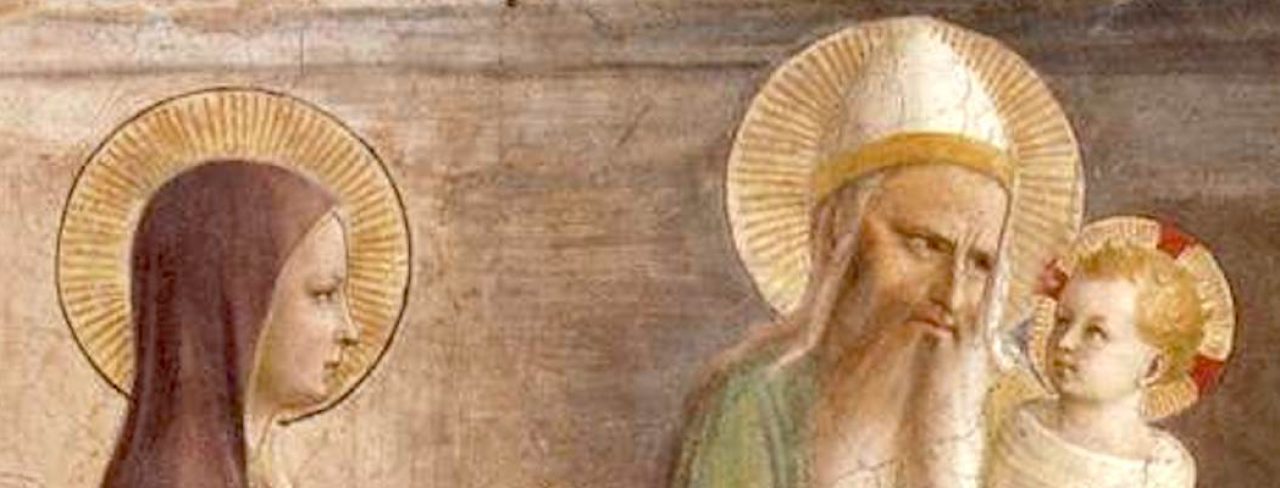
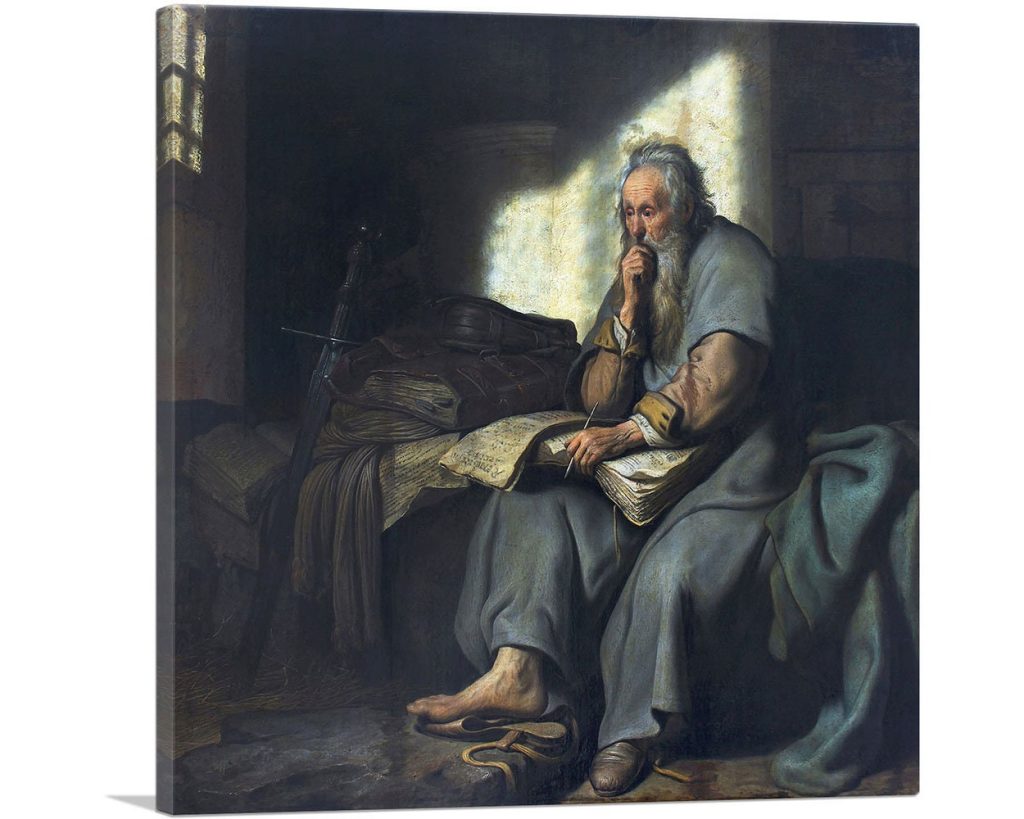
 

Theophilus, the Art of Iconography, and the Contemporary Sacred Artist – Part 2

Please take a moment to read the first part of this multi-part essay that I posted a few days ago. I am requesting that you do this in order for you to understand my perspective on creating contemporary sacred art within the Latin Rite.

Creating sacred art for me is a service ministry. It is a ministry through which a sacred artist unites him or herself to God’s Redemptive efforts. If you are a Baptized Christian who has been educated in the faith, regardless of the Rite or the denomination, you know that the Christian faith requires you to cooperate with the grace that the Holy Spirit provides to you through Scripture and the Sacraments. If one does this, and maintains a disciplined prayer life, you are cooperating with the Spirit in the duties that you must perform in your life.

For a Christian, human history is more than the individual searching for God. As the book of Genesis (3: 8-9) tells us, God walked through the Garden of Eden searching for us – for our spiritual parents: “When they heard the sound of the Lord God walking in the garden in the cool of the day, the man and his wife hid themselves from the Lord God among the trees of the garden. But the Lord God called the man and said to him, “Where are you?”

The Lord asks that question of us, too. 

Jesus is constantly calling out to us, constantly searching for us, constantly knocking on the door of our hearts hoping to hear our loving response. Christianity is the faith through which a searching God shows Himself to be so loving and so merciful as to persevere, to the point of sacrificing His own Son, in the effort of bringing rebellious humanity back into His family.

So the history of Christian sacred art shows us that people desired sacred icons (Greek, eikon: image) to reference that sense of family, in the same way that we have photographs today of family members, living and dead, which remind us of the love shared and their importance to our lives. These photographs or images are not idols. Even if a loved one does kiss a photograph or a sacred icon or image, the meaning behind that gesture is that the kiss – the love and respect – is not meant for the celluloid, or the wood and pigment; rather, it is meant for the prototype, for the person it represents, the loved one, God, His saints and angels.

Unfortunately, the faith family that is the Church split in the Great Schism of 1054. The Latin Rite and the Greek/Russian Rite split along cultural, theological, philosophical, political, and artistic lines. This Schism is one of the great scandals that has affected Christ’s Church.

The Schism, however, did not affect trade and the exchange of ideas among the laity. Commerce continued and new products, artistic materials, and techniques were evaluated, bought, and sold. The development of the Latin Rite artistic tradition after the Schism indicates that in Western Europe the linking of faith with the creative impulse was very strong and did much to solidify and unify the various cultural groups within the Latin Rite.

But, what was the Latin Rite tradition post AD 1054? What were the techniques of the Latin Rite artists of the Romanesque and early to mid Gothic period? Were there artistic manuals that were more than just recipe books on preparing pigments and varnishes and which discussed the spiritual underpinnings of the artisan’s art?

Where to begin?

As mentioned before, I happily discovered Pope Benedict XVI’s book –The Spirit of the Liturgy. This became my starting point, with its expression that the three periods within the liturgical art of the Latin Rite can be found in the Iconographic, Gothic, and Baroque styles of art.

I was searching for the techniques that Catholic artists would have used approximately one thousand years ago. Sacred artists within the late Iconographic period and early Romanesque period (AD 900 – 1300) would have approached their art within a disciplined theological, semantic, and aesthetic viewpoint. As Western Europeans, however, they easily accepted innovation and even experimentation if it provided a final product which met the artisan’s demanding and critical eye, and especially that of the master artisan of the workshop.

In the Spring of 2012 I discovered a twelfth century book entitled On Diverse Arts by Theophilus the Presbyter (translated by Hawthorne and Smith, Dover Press, 1979, 216 pages). This book is the critical corner stone of my attempt to link contemporary sacred art with its medieval roots. For Theophilus the Presbyter – a twelfth century master artist – is an individual who can still effectively speak to us in our own time. Theophilus has the perspective and the attitude that provides us with a foundation for our spiritual view of art.

This does not mean that we are slavishly going back in an attempt to reproduce the twelfth century. To do that would not be honest, rather, while staying true to the theological, semantic, and aesthetic beliefs of artists like Theophilus we are able to reinterpret and refresh our current situation in light of the contributions and truths discovered and lived in the past. Truth, goodness, and beauty are not limited by space and time.

O Beauty, ever ancient, O Beauty, ever new.

One of the key ideas of Theophilus that needs to be shared with Christian sacred artists is that the Holy Spirit is moving through our creative efforts, and is actively involved in the artist’s daily work. It is my belief that Theophilus sees the role of the artist as a person with a specific vocation, a calling, who is to unite his call by God to create beautiful works of art with his own prayer life and the Catholic spiritual view of reality.

Many, but not all art historians, believe that Theophilus is the pen name for a Benedictine monk by the name of Roger of Helmarshausen. Roger was a master at metalworking, specializing in gold and silver, and lived in the Benedictine monastery located in the town of Helmarshausen in modern day Germany.

In his manual, On Diverse Arts, Theophilus not only lays out his spiritual vision in three specific prologues to his chapters on painting, glassmaking, and metalworking but he provides specific directions and guidance to fellow artists. For example, he lays out – step by step – the process for creating a sacred image: the types of pigments to use, specific colors for the base coat, shadows, colors to use for hair, beards, skin, drapery, etc.

Theophilus’ union of a sincere spiritual perspective with technical guidance shows him to be a master teacher and mentor. He accomplished this within his own Benedictine monastery at Helmarshausen and his reputation expanded throughout the Rhine-Meuse River Valley in Germany.

In my next post I hope to discuss the spiritual importance of Theophilus’ three chapter prologues, and ultimately their relationship to the contemporary Catholic sacred artist.

In my fourth post in this series I will discuss a marvelous doctoral dissertation on Theophilus that was written in 2010 by Heidi Gearhart, Ph.D.

And in my fifth and last post in this series I will discuss how, in the mode of Theophilus, I am developing a practical sacred art workbook that provides step-by-step advice for the contemporary sacred artist. I have two of the four chapters completed and I will probably self-publish it for my sacred art workshops prior to a publisher (hopefully, :{) !) formally printing it.

Copyright © 2011- 2013 Deacon Paul O. Iacono All Rights Reserved

The Penitent Magdalene and the Way to True Conversion of Heart – A RePost Of Fr. Jason Smith’s Essay

As we begin the season of Lent I thought you would enjoy this article by Father Jason Smith. It contains a magnificent sacred image painted by George de La Tour (1593 – 1652). La Tour is one of my favorite artists; I especially enjoy his beautiful sacred image of St. Joseph teaching the child Jesus. During his lifetime La Tour was considered to be the painter for the French nobility. His son Etienne became his pupil and followed his father’s style so closely that it is very difficult for today’s art historians to determine the author of certain paintings within their collection.
La Tour was a master of the chiarascuro (light/dark/shadow) technique. He developed this technique in new ways, adopting a softer, gentler, and simple approach to presenting the interplay of light, shadow, and color.  After his involvement with a Franciscan led spiritual revival he eventually devoted himself to religious subjects. His two paintings on Mary Magdalene are masterpieces of this style of art and they truly speak to the soul who is interested in listening.
The de La Tour family unfortunately died in 1652 as a result of an epidemic that devastated his city.
The essay below was written a few years ago by Fr. Jason Smith. Fr. Smith’s essay on the truth, beauty, and meaning of de La Tour’s painting reflects the Lord’s ability to use sacred artists to express His continual grace and mercy to us. It is my wish that you spiritually profit by the painting and its analysis. Thank you Fr. Smith for posting this fine essay.

The Penitent Magdalene and the Way to True Conversion of Heart   By Fr Jason Smith, published at the Biltrix blog 

“I have found no better representation of conversion and penance in art than The Penitent Magdalene, by George de La Tour. Though simple, it expresses the essential elements behind every conversion, and we can find in it powerful lessons to apply to our own life. Let’s take a closer look.

The Penitent Magdalen, George de la Tour

The painting presents Mary at the very beginning of her conversion, on the night that she met Jesus Christ for the first time. Her life is just as it was the day the Lord crossed her path. Yet the subtle but evocative tension in the painting makes it evident that her world has been shaken and she knows she must change.

She has returned home, alone, and cannot sleep. She sits down at her vanity which until this afternoon was the center of her life. La Tour paints nothing superfluous here; only those things most dear to her, things to which she has clung for happiness and fulfillment, but that have only served to leave her feeling empty inside: Her richly embroidered clothing, her silver mirror with its carved and gilded frame, her fine jewels and her string of pearls which, while tossed aside, are still within her grasp.

Interestingly enough Mary’s head is turned away from the viewer—leaving us to imagine her expression, and even better, identify ourselves with it—and, while facing the mirror, she is not looking into it. She is gazing far beyond; she has realized there is something more to life then what is external, then in those things which she has placed her security and happiness. The Lord had cast seven demons from her life, seven lies that she had believed about God and about herself; this night, however, she is finally free of them, but she knows that the changes she has to make and which still lie ahead will be hard.

The flickering flame of the candle is the primary source of light. It is soft, calm, inviting, strong, and supersedes the light of an ordinary candle. It keeps the menacing darkness away. It illuminates her face and her heart—primarily her heart—to show that she has focused on the core of who she is, and subtly shows the love that she has felt that day. Yet it also shines on the mirror and on her robes and on her jewels—the light of Christ has begun to enlighten everything in her life. It is the power of the Holy Spirit through which all true conversion and penance is inspired.

She holds a skull, which at first seems macabre, and certainly was not a fitting decoration for her vanity, but is symbolic of the gravity and seriousness of the assessment she is making of her life. Her hands are folded calmly upon it and it rests gently in her lap; this is not an anxious and tense conversion, but a realistic one. She knows her life will end; she recognizes her mortality; she is asking herself what is truly important in her life—not her mirror or her jewels—and she is preparing her heart to die to those things.

But what will she exchange them with after she gives them up? What will tomorrow morning bring? She stares into the darkness looking for an answer but there is no reply. Conversion always requires faith. The answers and the way are presented gradually. There is a natural trepidation when it comes to change, conversion, stepping out to follow the Lord, and, yes, penance—but this is only a smaller aspect of a larger and more liberating truth, which Pope Benedict expressed so well in his inaugural homily:

Are we not perhaps all afraid in some way? If we let Christ enter fully into our lives, if we open ourselves totally to him, are we not afraid that He might take something away from us? Are we not perhaps afraid to give up something significant, something unique, something that makes life so beautiful? Do we not then risk ending up diminished and deprived of our freedom? And once again the Pope said: No! If we let Christ into our lives, we lose nothing, nothing, absolutely nothing of what makes life free, beautiful and great. No! Only in this friendship are the doors of life opened wide. Only in this friendship is the great potential of human existence truly revealed. Only in this friendship do we experience beauty and liberation. And so, today, with great strength and great conviction, on the basis of long personal experience of life, I say to you, dear young people: Do not be afraid of Christ! He takes nothing away, and he gives you everything. When we give ourselves to him, we receive a hundredfold in return. Yes, open, open wide the doors to Christ – and you will find true life.

Conversion and penance should never be thought of as a loss but as a transformation, an exchange, for something greater: From what is bad to good, from good to better, and from better to best. In reality the Lord does not ask us to give anything up; rather, he asks that we chose the better part, to go from vice to virtue, from complaining to gratitude, from bitterness to forgiveness, from vanity to humility, from lust to love, from anger to patience, from discouragement to hope, from where we are to where we know we are called by the Lord to be.

Conversion and all it entails is a calling of love and is not reached with an empty white knuckle attitude. Notice how gently her hands are folded upon the skull. It is not angst but Christ’s transforming love that impels and inspires her to change. The strength to do this does not come from within one’s own will, though the will is certainly needed, but from the light and the guidance and the power and the fire of the Holy Spirit active in an open heart. Notice how Mary’s garments show how open her heart is.

I’m not certain if George de la Tour ever underwent a conversion himself, but through candlelight and shadow, a mirror and jewels, a skull and robes, and a facial expression we can’t see, he captures the essential elements of one: The love of Christ and the guidance of the Holy Spirit.”

Fr Jason Smith

Penitent Magdalene essay: Copyright © 2012-2013 Fr. Jason Smith. All Rights Reserved

Copyright © 2011-2013 Deacon Paul O. Iacono All Rights Reserved

Pope Benedict 16th – Evangelization Demands Courage and the Truth

No sooner had Pope Benedict announced his planned abdication of St. Peter’s chair when the attacks on him began to appear. I am posting on this story because the Fra Angelico Institute for the Sacred Arts is primarily concerned with evangelization of the Catholic faith through the prayerful study and creation of the sacred arts. Be that as it may, when a vicious and false attack occurs on the Church or a member of the clergy it is incumbent upon us as Catholics to respond with courage and the truth.

The Catholic League for Religious and Civil Rights, based in New York, and headed by Bill Donohue, Ph.D is in the forefront of presenting the truth when the Church is attacked. It deserves our support and prayers.

The following re-post which concerns an attack on Pope Benedict 16th (found below after my comments) is from their website http://www.catholicleague.org/.

Bill Donohue wrote the post which tells the truth about the Pope’s actions and it deserves to be read by every Catholic. We cannot sit idly by while the Church is being attacked. If you read this blog then you are interested in sacred beauty and the truth, goodness, and beauty of God that the Church has faithfully taught for two thousand years. Yet, it is very easy to get lost in beauty. We must support the arts, but we must not retreat into them. Saying, “Well, there is nothing I can do about it.” Wrong. There is something you can do about it.

There are two ways to support the Church in this effort: first through your prayers for those who are in the front-lines fighting on behalf of the Church, and second, through your actual involvement by defending the Church when you see or hear it attacked. We are in a very dynamic spiritual war. We cannot sit on the side-lines. The Lord Himself said that we need to choose – one side or the other – but don’t be neutral. He was very specific about the truth that He is sickened by neutrality (confer Revelation 3: 13 – 22; Romans 16: 17-18).

The re-post of Bill Donohue’s article concerns a now dead atheist British journalist named Christopher Hitchens (1949-2011) who loved to attack the Church and any public figures who he believed were wrong or, in his opinion, frauds (from Mother Teresa, to Winston Churchill, to Princess Diana).

The article that Bill Donohue wrote and published this morning relates some of the lies that Hitchens told concerning Pope Benedict 16th. These lies have been picked up and resold as the truth by another journalist by the name of Andrew Sullivan. I have posted this article by Donohue so you can be armed with the truth.

We must unite as a force for truth-filled evangelization and arm ourselves with the facts. Donohue’s article contains the facts – arm yourself with them and use the grace you received at your Confirmation to patiently, but firmly, inform those that malign our Catholic faith, the papacy, and Benedict in particular, with the truth.

Here is Bill Donohue’s article:

Hitchens is Back from the Dead

February 12, 2013

“Bill Donohue takes note of the resurrection of Christopher Hitchens:

Hitchens has been brought back from the dead by Slate and Andrew Sullivan, but it won’t do them any good. Yesterday, they republished a hit piece by the atheist from 2010 that was vintage Hitchens: the man was a great polemicist but a third-class scholar. Facts never mattered to him.

Hitchens said the scandal “has only just begun.” Wrong. It began in the mid-60s and ended in the mid-80s. Current reports are almost all about old cases.

Hitchens said Munich Archbishop Joseph Ratzinger (the pope) transferred an offending cleric to another parish. Wrong. Ratzinger’s deputy placed the priest in a new parish after he received therapy (the tonic loved by those pushing rehabilitation), and even the New York Times admitted there was no evidence that Ratzinger knew about it. By the way, there were 1,717 priests serving under him at the time.

Hitchens said Ratzinger wrote a 2001 letter to the bishops telling them it was a crime to report sexual abuse. Wrong. The letter dealt with desecrating the Eucharist, and the sexual solicitation by a priest in the confessional (the letter cited a 1962 document detailing harsh sanctions).

Hitchens said Ratzinger was obstructing justice when he crafted new norms on sexual abuse in 2001. Wrong. He actually added new sanctions and extended the statute of limitations for such offenses.

Hitchens says Ratzinger ignored accusations against Father Marcial Maciel. Wrong. It was Benedict who got him removed from ministry (he was too infirm to put on trial) and put his religious order in receivership.

In short, Hitchens’ hatred of Catholicism allowed him to swing wildly. That he should be resurrected by Slate and Andrew Sullivan makes them all look incompetent, as well as vicious.”

Copyright © 2013 Deacon Paul O. Iacono All Rights Reserved

Pope Benedict 16th and the Virtues of Humility and Patience

May the Peace of Christ be with you on this unique day in the history of the Roman Catholic Church.
Today we commemorate the memorial of Our Lady of Lourdes which reminds us that the Virgin Mary appeared to St. Bernadette in 1858 at Lourdes, France. Her message was clear and concise to the young Bernadette: “I am the Immaculate Conception.” She requested Bernadette to tell the local clergy that a church should be built on the site of the apparition so that the sick and suffering might come to find comfort, and healing of both body and soul.
A beautiful church was built, and on a yearly basis hundreds of thousands of people  come to Lourdes to be in prayerful union with the suffering Christ and His Immaculate Mother.
In 1992 Pope John Paul 2nd declared this day as the “World Day of the Sick.” He said that this day was to be a “special time of prayer and sharing, of offering one’s suffering for the good of the Church, and of reminding us to see in our sick brothers and sisters the face of Christ, who, by suffering, dying, and rising, achieved the salvation of humankind.”
John Paul 2 in his later years provided a great witness to the nobility of the elderly since he modeled for us the suffering Christ. His successor and close friend, Pope Benedict 16th, has also given us the witness of a man who silently suffered many troubles while valiantly leading the Church and protecting its traditions and spiritual truths.
With the news this morning of Pope Benedict’s announcement of his planned resignation on February 28th the Church has entered a transitional period which has not occurred since Pope Gregory 12th resigned the papacy in 1415.
What does this tell us?
It tells us that the Holy Spirit continues to guide the Holy Catholic Church. Christ is the Head of the Church and we, faith-filled clergy and laity, are its Body.
The papacy, originating with St. Peter, has provided the Church with the leadership that was and is required in any continually maturing and growing institution.
The papacy has, at times, been on a roller coaster ride of popularity, yet, throughout the two thousand years of its history it has never done anything to confuse or limit the truths found in the revealed word of God or the Traditional faith and moral teachings of the Church itself.
People may like the personality or find the historical stance or perception of one pope more acceptable than another, yet, if one truly looks at the history of the papacy, without the proverbial axe to grind, you find an institution based in the humanity of Jesus Christ giving Peter “the Keys to the Kingdom” (Matthew 16: 13-20) and which continues to be guided and protected by the wisdom of the Holy Spirit.
That wisdom guided, and continues to guide, Pope Benedict 16th, for his decision to resign his office speaks volumes about his understanding of the virtues of humility and patience. Humility, in that he understands that owing to his age and physical condition, it is right to turn over the chair of Peter to another man; and patience, in that he knows (and lovingly trusts) that the Holy Spirit will patiently guide the Cardinals to select a new pope who will continue to lead the Church with love and fidelity to Christ and His teachings.
We wish Pope Benedict 16th well and pray for the continued blessings of the Holy Trinity to be with him. We thank him for his great gifts of teaching, scholarship, and leadership to the Church over the long history of his service to us as deacon, priest, bishop, cardinal, and pope.
We must continue to remember him in our prayers.
The Catholic League for Civil Rights
http://www.catholicleague.org/ just posted a wonderful summary of the Legacy of Pope Benedict 16th, I have reposted it below for your edification.

Pope’s Legacy is Secure

February 11, 2013

“Bill Donohue offers seven good reasons why the pope’s legacy is secure:

Religion for Pope Benedict XVI is as much a public issue as it is a private one.

In 2008, he warned American bishops against “the subtle influence of secularism,” holding that “any tendency to treat religion as a private matter must be resisted.”

The pope made it clear that religious freedom was not only a God-given right, it was “the path to peace.”

He knew religion could be abused, leading even to violence. His much misunderstood 2006 Regensburg University lecture was really about the uncoupling of religion from reason (reason not united to faith also leads to violence).

The pope reached out to dissidents on the right and the left, seeking to bring them to communion. Not all his efforts succeeded, but his attempts were noble.

No one did more to successfully address the problem of priestly sexual abuse than Joseph Ratzinger. Just weeks before he was chosen to be the new pope, he spoke bluntly about this issue: “How much filth there is in the Church, and even among those who, in the priesthood, ought to belong entirely to Him!”

Addressing those who still blame Jews for the death of Christ, the pope settled the issue with authority by pointing out that no one should be blamed since, as he argued, the crucifixion was necessary for God’s plan of universal redemption.

The pope’s many references to what he called “the dictatorship of relativism” were a constant reminder that one of the greatest threats to freedom today is the abandonment of the search for truth.

Pope Benedict XVI’s willingness to step aside comes as a surprise this Monday morning. What is not surprising is his humility. Indeed, it is one of his most defining characteristics, one that separates him from today’s ego-centric public figures.”

Copyright © 2013 Deacon Paul O. Iacono All Rights Reserved

Mary, The Holy Mother of God – The Sign of Our Unity

We celebrate on this the first day of the New Year the Solemnity of Mary, the Holy Mother of God.

Mary, by this very title, is the Holy Mother of the human nature of Jesus Christ. We receive insights on how the Church came to this title within the Holy Scriptures; for through a prayerful reading of them we come to an understanding of who this remarkable young woman was and what she means for us today. Three evangelists, Matthew, Luke, and John help us with this in their presentation of Mary as a woman who was clear minded, humble, intelligent, devout, loving, immensely strong, and quietly, yet fiercely, devoted to her Son.

Our beautiful Scriptural readings for this Solemnity (Numbers 6: 22-27, Galatians 4: 4-7, and Luke 2: 16-21) help us  approach today’s celebration through the perception of Mary herself. Today’s Scriptures remind us that Mary and  Joseph were devout Jews who understood the importance of faith, family devotion, tradition, and the fulfillment of the Jewish Law itself. It was with Holy Scripture – Hebrew and Christian – in mind, and the sacred tradition provided by the Apostolic fathers, that the debate over Mary’s title rested upon.

The designation of Mary, as the Holy Mother of God was debated and decided upon at the third Ecumenical Council of the Church. It was held in the year 431 at the city of Ephesus in Asia Minor. This Church Council was known as the First Council of Ephesus and was attended by over 250 bishops from the four (soon to be five) patriarchates of the Catholic Church: Rome, Alexandria, Antioch, Constantinople, and eventually, in 451, Jerusalem (Jerusalem, at the time of the First Council of Ephesus was part of the Patriarchate of Antioch, Syria). Now that the formal persecutions by the Roman Empire had ended, the fifth century saw much activity within the Church to formally secure theological positions on both Christ and the role of His mother in salvation history. The catechesis of the people was paramount. Using their gifts of reason and the Holy Spirit, combined with the Holy Scriptures, and the sacred Tradition of the early Church the assembled bishops determined to safeguard the Truth of the Church while simultaneously further establishing the foundations for the  catechesis of its clergy and laity.

But at the heart of the matter, for all Christians, Jesus is the human incarnation of God Almighty. He presents to us in His Person, the true, physical Presence, of God; and with His Divine Nature intact, He in turn with a true human nature, could then call us His brothers and sisters. We are, through Him, and Mary’s maternity, adopted sons and daughters of our Father in Heaven. Mary is the Mother of Jesus’ human nature, and, she is the Mother of the Church.

How do we know this?

We know it because Jesus said it was so: “Whatever you did for the least of My brothers and sisters, you did for Me” Matthew 25:40; and let us not forget John 19: 26-27: Jesus saw His own mother, and the disciple [John] standing near whom He loved; He said to His mother, “Woman, behold your son.” Then He said to the disciple, “Behold your mother.” And from that hour, he took his mother into his family.” 

Such is the love of God for His creation.

Theotokos

While doing some other research a few weeks ago, I was struck  by some quotes from the three main leaders of the 16th century Protestant revolt. While certainly these men steered their new churches along a different path from the Tradition of the Western and Eastern Rites, the quotes provided below show them to have an understanding and love for Mary as the Holy Mother of God and the significance of her perpetual virginity.

Martin Luther: “It is an article of faith that Mary is Mother of the Lord and still a virgin… Christ, we believe, came forth from a womb left perfectly intact.” (Works of Luther, Vol. 11, pages 319-320; Vol. 6, page 510.)

John Calvin: “There have been certain folk who have wished to suggest from this passage [Matthew 1:25] that the Virgin Mary had other children than the Son of God, and that Joseph had then dwelt with her later; but what folly this is! For the gospel writer did not wish to record what happened afterwards; he simply wished to make clear Joseph’s obedience and to show that Joseph had been well and truly assured that it was God who had sent His angel to Mary. He had therefore never dwelt with her nor had he shared her company… And beside this Our Lord Jesus Christ is called the first-born. This is not because there was a second or a third, but because the gospel writer is paying regard to the precedence. Scripture speaks thus of naming the first-born whether or no there was any question of the second.” (Sermon on Matthew 1:22-25. Published in 1562.)

Ulrich Zwingli: “I firmly believe that Mary, according to the words of the gospel, as a pure Virgin brought forth for us the Son of God and in childbirth and after childbirth forever remained a pure, intact Virgin.” (Zwingli Opera, Vol. 1, page 424.)

Perhaps, in God’s Divine Plan, the beautiful and holy virgin Mary – the Holy Mother of God – will be the cause for the reunification of all the Christian Churches: Catholic, Orthodox, and Protestant.

As a fellow Christian, please consider making the following prayer that I wrote a few hours ago part of your own prayer arsenal for the New Year: “Holy Mary, Mother of God, keep us within your most precious and immaculate heart. Through your maternal love, intercede with your Son to remove the painful scars of division and hurt that lie within our own hardened hearts. We implore you to ask your Son to strengthen us with His Truth, Goodness, and Beauty so that we may always fulfill His Divine Will. Amen.”

Copyright © 2013 Deacon Paul O. Iacono All Rights Reserved

Notes: Source of the sacred icon of the Holy Theotokos with the Christ: http://en.lpj.org/2011/12/30/solennite-de-marie-mere-de-dieu/ 

Protestant leader quotations taken from http://blackieschurchmilitant-apocalypsis.blogspot.com/2008/01/perpetual-viginity-of-blessed-virgin.html


The Christmas Star of Bethlehem – Merry Christmas, Everyone!

Even though the vast majority of us are not astronomers, the famous star of Bethlehem still has a great ability to intrigue us especially as it relates to its actual astronomical occurrence. As Christians we believe in the Christmas story, not as legend or myth, but as an actual historical occurrence which led to the Redemption of mankind by the Son of God – Jesus Christ.

There are many elements of the Nativity of Christ that are expressed by the evangelists, and one of the most interesting is the illumination of Israel by a brilliant star at the time of the actual birth of Jesus. The Christmas Star has intrigued artists and poets in its ability to shed light on the truth of the cosmic meaning of Christmas; and in recent years some research has been done using computer animation and astronomical programs to determine if, when, and where it actually occurred.

The EWTN network usually airs a contemporary and extremely popular documentary entitled The Star  (of Bethlehem) (please examine the filmmaker – Rick Larson’s site – for a wonderful, multipart, overview of his documentary: www.bethlehemstar.net/

The following post attempts to determine the birth date of Jesus Christ in light of the astronomical evidence. The quotes I provide are taken from a fascinating study entitled Probable Date of Birth of Christ found in this website: www: copiosa.org/christmas/birth_date.htm by Father William G. Most (Fr. Most’s article offers a summary of the work done by  E. L. Martin, in his book The Star That Astonished the World, ASK Publications).

“In the evening of June 17, 2 BC, there was a spectacular astronomical event in the western sky. Venus moved eastward seemingly going to collide with Jupiter. They appeared as one star, not two, dominating the twilight of the western sky in the direction of Palestine. This conjunction had not happened for centuries, and would not happen again for more centuries. Jupiter was considered the Father, Venus the Mother.

Then not many days later, Venus came within 0.36 degrees of Mercury. On September 11 came the New Moon, the Jewish New Year. This happened when Jupiter, the King planet was approaching Regulus, the King star. Further, there were three conjunctions of Jupiter and Regulus within the constellation of Leo, the lion, which was considered the head of the Zodiac.

Now Genesis 49:10 had foretold there would always be a ruler from Judah, whom Jacob called the lion, until the time of the Messiah. The star Regulus, which astronomers called the King Star, dominated Leo.

The Magi, being astronomers and astrologers, would surely read these signs. (The three conjunctions with Regulus were August 12, 3 BC; February 17, 2 BC, and May 8/9, 2 BC). In Hebrew, Jupiter was called sedeq = “righteous,” a term especially pertaining to the Messiah.

On September 11, Jupiter was close in the constellation of Virgo, the virgin. On September 3rd of 3 BC Jupiter was in conjunction with Regulus, the brightest star in the constellation of Leo — Leo the Lion, which was associated with Kings, and the Lion of Judah, as foretold by the dying Jacob in Egypt in Genesis 49:10.

Also, on December 25 of 2 BC, Jupiter stopped for 6 days over Bethlehem. This is a normal motion for Jupiter; it stops twice, and reverses its seeming movement. This may have been the very time the Magi came with their gifts. This was also the time of the Hanukkah festival, during which it was customary for Jewish Fathers to give gifts to their children.

The shepherds watching their flocks in the fields indicate a date either in late summer or early fall.

E.L. Martin [whose research this article is based on] thinks the birth of Jesus was in September, 3 BC (Jupiter in conjunction with Regulus), and the probable date of the Magi was December 25, 2 BC (Jupiter stopped for 6 days over Bethlehem).”

Please don’t forget when we speak in BC time, the “ladder of time” comes down from let us say 10,000 BC to 1 BC, in a descending order, so 3 BC comes before 2 BC.

In AD time (Anno Domini, a Latin phrase which means “the year of Our Lord” the “ladder of time” is ascending, so, we are currently in the year 2012, but as of midnight December 31st, we will then be in the year 2013, or two thousand and thirteen years since the birth of Christ. When this Gregorian Calendar system was developed and applied to western Europe, approximately five hundred years ago, they did not have the sophistication of computer/astronomical observations to correct the date of Christ’s birth, if we agree with Martin’s research, to the year 3 BC.

“The above span of dates (approx. 16 months) coincides with The Slaughter of the Innocents, where Herod killed all males under the age of two years. Herod died shortly thereafter. Interestingly, More than 600 planetariums here and in Europe have revised their Christmas star show to match this work of E. L. Martin.”

594px-Giotto_-_Scrovegni_-_-18-_-_Adoration_of_the_Magi

The above painting is entitled the Adoration of the Magi by Florentine painter Giotto di Bondone (1267–1337). The Star of Bethlehem is shown as a comet above the child. Giotto witnessed an appearance of Halley’s Comet in 1301.

“Magi were not really just astrologers. They served as court advisors, going from one royal court to another. It would not then be difficult to suppose they had come from a great distance with gifts. In those days all astronomers were acquainted with astrology. They were also mathematicians.” This is the end of Fr. Most’s article.

For more information check out Fr. Most’s website: copiosa.org/christmas/index.htm. As you go down this index on the left hand side you will see Fr. Most’s complete article on the Probable Date of the Birth of Christ. His site has some very interesting articles that can be very helpful in explaining to people – especially children – the origins of Catholic Christmas traditions.

220px-Nativity_Icon

The above icon was written (painted) in Russia and displays, in a lovely catechetical way, the entire Nativity narrative: the angel’s appearance to the shepherds, the Star of Bethlehem (appearing as a disk with a shaft of light coming down to the cave of the birth, the actual birth of the child Jesus being wrapped in swaddling clothes by His Blessed Mother – Mary, the coming of the Magi, the washing of the child Jesus, and St. Joseph being visited by an old man in furs (some refer to this last image as the temptation to doubt that confronted Joseph.

Soon after the dream visitation by an angel, St. Joseph realizes the nature of this Child. He understands that he is given the responsibility to care for Him and His mother and raise the child as if He was his very own. St. Joseph does exactly that; he is the epitome of quiet, loving leadership, and a model for all fathers.

St. Joseph is silent throughout the entire Gospel narrative. Yet, his actions speak louder than words. We see in St. Matthew’s Gospel (Chapter 1: 18ff) that he ultimately had a thoughtful plan to quietly divorce Mary when he learns that she is pregnant; however, he is not stubborn or hard of heart, for when the angel Gabriel visits him and tells him what is happening he does not rebel and say “No, I will not do it” out of pride or ego. Rather, he changes his plan and trusts the angel’s message which was sent by God to him.

This is so important – and it should speak volumes to us – if we, too, have open hearts and minds to hear what God is telling us in prayer, Scripture, and the grace of the Holy Sacraments. These three sacred tools, along with a holy orthodox spiritual director, will assist us on our path – and like the Star of Bethlehem – lead us to the Christ.

In the immortal words of Tiny Tim Cratchit: “… and a Merry Christmas, everyone!”

Copyright © 2012 Deacon Paul O. Iacono All Rights Reserved

The Magnificat of Mary – A Beautiful Analysis By The Venerable Bede

This morning’s selection from the Office of Readings in the Roman Breviary is written by an English monk named “the Venerable Bede.” It discusses Mary’s joy-filled song – The Magnificat.

Bede was born in the year 673 and died in 735. He lived in Northumbria, primarily in the two monasteries of Saint Peter and Saint Paul. These monasteries had accumulated a wonderful collection of Greek, Latin, and early Church manuscripts. Bede spent his life studying, writing, and dictating the results of his research and prayer. He is known primarily for his most famous tome which is The Ecclesiastsical History of the English People. This work resulted in later generations giving him the title “The Father of English History.”

In 1899, Pope Leo 13th made Bede a Doctor of the Church. Bede was a skilled translator, linguist, and writer. His ability to compose insightful spiritual essays, and skill in making the writings of the Early Church Fathers accessible to his fellow Anglo-Saxons, significantly contributed to the growth of Roman Catholicism in England.

Let us take a moment today to dwell upon one of his perceptive and rich essays on the Blessed Mother. In the selection below, Bede provides us with an essay on Mary’s response to the knowledge that she will be the mother of the Savior. Her poetic song is known as The Magnificat, said in the presence of her cousin Elizabeth (and possibly Elizabeth’s husband Zechariah). They mutually rejoice in the knowledge that they are both pregnant (The Visitation).

visitation

Mary’s song of joy, faith, and trust is here separated by Bede and analyzed for our prayerful consideration. Mary’s words appear in bold italics, Scriptural references are in plain italics, Bede’s are in regular print. The entire Magnificat can be found in the first chapter of the Gospel of St. Luke, verses 46 – 55.

00.159.19_PS1

Mary said: My soul proclaims the greatness of the Lord, my spirit rejoices in God my Savior.

Bede’s comments have Mary thinking these thoughts: “The Lord has exalted me by a gift so great, so unheard of, that language is useless to describe it, and the depths of love in my heart can scarcely grasp it. I offer then all the powers of my soul in praise and thanksgiving. As I contemplate his greatness, which knows no limits, I joyfully surrender my whole life, my senses, my judgment, for my spirit rejoices in the eternal Godhead of that Jesus, that Savior, whom I have conceived in this world of time.”

The Almighty has done great things for me, and holy is his name.

“Mary looks back to the beginning of her song, where she said: My soul proclaims the greatness of the Lord. Only that soul for whom the Lord in His love does great things can proclaim his greatness with fitting praise and encourage those who share her desire and purpose, saying: Join with me in proclaiming the greatness of the Lord; let us extol His name together.”

“Those who know the Lord, yet refuse to proclaim His greatness and sanctify His name to the limit of their power, will be called least in the kingdom of Heaven. His name is called holy because in the sublimity of his unique power He surpasses every creature and is far removed from all that He has made.”

He has come to the help of His servant Israel, for He has remembered His promise of mercy.

“In a beautiful phrase Mary calls Israel the servant of the Lord. The Lord came to his aid to save him. Israel is an obedient and humble servant, in the words of Hosea: Israel was a servant, and I loved him.”

“Those who refuse to be humble cannot be saved. They cannot say with the prophet: See, God comes to my aid; the Lord is the helper of my soul. But anyone who makes himself humble like a little child is greater in the kingdom of Heaven.”

The promise He made to our fathers, to Abraham and his children for ever.

“This does not refer to the physical descendants of Abraham, but to his spiritual children. These are his descendants, sprung not from the flesh only, but who, whether circumcised or not, have followed him in faith. Circumcised as he was, Abraham believed, and this was credited to him as an act of righteousness.

The coming of the Savior was promised to Abraham and to his descendants forever. These are the children of promise, to whom it is said: If you belong to Christ, then you are descendants of Abraham, heirs in accordance with the promise.”

The Responsory Prayer (Luke 1: 48 – 50) follows this reading:

“From this day all generations will call me blessed. The Almighty has done great things for me, holy is His name. He has mercy on those who fear Him in every generation.”

Bede’s words are beautiful words and the sacred images shown may be very helpful to you as we enter the eve of Christmas. May you all have a holy and joy filled Christmas day and good fortune in the New Year! You are in my prayers. Thank you for reading my post.

Copyright © 2012 Deacon Paul O. Iacono All Rights Reserved. Notes on the paintings: The first sacred image is a contemporary sacred image written/painted in the iconographic style; I do not know its author. The second sacred image of Mary lost in ecstasy as she sang The Magnificat, was completed by James J. Tissot, a French painter (1836 – 1902). This painting currently hangs in the Brooklyn Museum. The medium is opaque watercolor over graphite on gray woven paper. It is approximately five by ten inches in size. Bede’s commentary is taken from The Liturgy of the Hours, Volume 1. Catholic Book Publishing Co., New York, 1975, page 362.


December 21, 2012 – The Archangel Gabriel’s Greeting to Zechariah

A very clear narrative greets us in the Gospel by St. Luke. He tells us that both Zechariah and his wife Elizabeth were both righteous before God: walking in all the commandments and ordinances of the Lord – they were blameless; but they have no child. Elizabeth was barren and both were elderly. We read of Zechariah silently bringing his heavy heart before the Lord – even after all those years – it was still burdened with disappointment. The couple probably remembered Psalm 112 which says:

“Happy the man who fears the Lord, who takes delight in his commands. His sons will be powerful on earth; the children of the upright are blessed.”

Zechariah was a priest, and on that day – by lot – it was his turn to enter the chamber within the Temple called the Holy Place and burn incense on the special altar. The Holy Place was a small chamber that led to the Holy of Holies, which housed the Ark of the Covenant.

For whatever reason, Zechariah that morning carried his disappointment with him into the Holy Place; and while he was there the archangel, Gabriel, appeared on the right side of the Altar of Incense. Gabriel tells Zechariah not to be afraid and that his prayer was heard before the throne of God. Gabriel continues with the joyous news that Elizabeth will bear a son, and that he will be called John – which in Hebrew means – “the Lord is gracious.” This child will grow and be great before the Lord, and even from his mother’s womb – he will be filled with the Holy Spirit.

But, in a typically human way, Zechariah questions the archangel’s announcement. His query must have been different in tone. It must have had the typical masculine attitude of “Are you kidding me!” Zechariah’s tenor makes Gabriel, and possibly God, indignant – and Zechariah is struck speechless for his insolence.

In Scripture, few lines later, we see Gabriel’s announcement to Mary. She questions him, too, as “How can this be since I do not know man? But Gabriel does not strike her speechless. We have to be struck by this difference. What does it teach us?

It is clear that God knows our hearts. God knew what was on Zechariah’s heart when he was in the Holy Place. Zechariah does not trust the message or the messenger, and by inference – he does not trust God. God knows his heart; and disciplines this good man. Like Zechariah, we, too, may disbelieve God. In our sophistication or position in life we may say “Well that’s fine, but, the Scriptures don’t apply to our situation, or this specific teaching was acceptable years ago, but, too much time has passed and it doesn’t apply to my problems.

The Gospel says that Zechariah and his wife were good and righteous people. It was mentioned that he kept all the Commandments and ordinances. Yet, when his big moment comes – where is all that goodness and righteousness? It might still be there in his heart, but, there was also a pocket of doubt – a crevice of skepticism – that was significant enough for him, as a priest of the Almighty God, to be struck speechless in punishment for not trusting Gabriel’s message.

As sacred artists, as Christians, this Gospel asks us to stop, and check our souls in this last week of Advent. It asks us how patient, confident, and trusting have we been of the Lord’s message to our hearts, and have we allowed this to carry over into our actions? Have we become more interested in all the hype about the end of the world from a pagan culture, or, have we trusted in the Word of the Lord and His messengers?

Zechariah learned the hard way that when the Lord prepares us for His coming He desires us to be alive, awake, and alert to His call and to trust His message. So, our prayer in these last days of Advent should echo that of Zechariah, who in the months of speechless waiting, most likely in his mental prayer said,  “Lord, I believe; cleanse me of my disbelief. Lord, I trust, heal me of my distrust;” and it should also echo that of Mary – who in humility and expectation waited patiently for the graciousness of the Lord to take fruit in her womb.

Copyright © 2012 Deacon Paul O. Iacono All Rights Reserved

Thanks to angels-angelology.com for stained glass window image

Gaudete Sunday In Light of the Tragedy in Newtown, Connecticut

Today we celebrate Gaudete Sunday. Gaudete means, “Rejoice!” – and we visualize this by the rose-colored vestments and candle in the Advent wreath.

Yet, it is so difficult to rejoice in light of the unspeakable horror and evil that befell the 27 innocent children and adults in Newtown, Connecticut, or the 22 children and an adult who were slashed by a man wielding a knife in a city in China, or the teenager arrested in Oklahoma for plotting to kill his fellow students and bomb his high school; and this all occurred on the morning of December 14th.

Connecticut Governor Dan Malloy, at the Vigil service at St. Rose of Lima Church on Friday night, spoke of the fact that true evil had touched the community of Newtown and that this evil would continue to have repercussions for many years.

Its consequences would be long lasting because it would continue to test the faith of the children and all those families and residents affected by this tragedy. He went on to say that it would be “a test not only of our faith in God, but faith in our fellow man – our community.”

He was right in saying that, given that the forces of darkness have always preyed upon mankind in an attempt to subvert and infect the beauty of the most significant element of God’s creation – our fellow human beings.

Through distortion of the good, and the promotion of rage and evil, the forces of darkness attempt to drag mankind down into the despair, and loss of God, that they themselves feel.

But, the knowledge of that ancient cosmic distortion of God’s creation, perpetrated by Satan himself, on a spiritual and historical level, is the exact reason for our celebration of the solemnity of Christmas. It is the reason for our rejoicing – for the moment of the birth of the innocent Savior marks the beginning of the end of the period of time that evil will reign on this earth.

We cannot help but remember another madman, King Herod, who upon learning from the Magi of the birth of this innocent child, gave the order to kill over a hundred children, and their parents, if they attempted to get in the way of his psychotic depravity. And we remember another grieving mother, Our Blessed Mother, who witnessed the horror of the killing of her child – and the tears that must have flowed from her.

Rage against motherhood, rage against childhood, rage against innocence: in two thousand years of Christian history this has become the sad spectacle of man’s inhumanity to man; it appears nothing has changed.

But, if we are a people of faith, we have opened our minds and hearts to understand that the birth and death of Jesus Christ – has, in reality, changed everything.

Today, Gaudete Sunday, we are called to rejoice, as St. Paul tells us “Rejoice in the Lord always” – not just in good times but in bad, as well.

How do we do that?

How do the parents, and husbands, and wives, the teachers and children, the communities of Newtown, Columbine, Aurora, and many other cities and towns in America, and the world, surrounded by the darkness of evil and senseless violence – do that?

To a secular person the answer would come simply from psychological and grief counseling that would occur over many years. Yet important as that is, it is not the only answer.

A close reading of the letters of St. Paul show us that it was St. Paul’s faith – the knowledge in his mind and heart that he shared a deep personal relationship with the Savior of the world – that enabled him to withstand all sorts of evil.

It was that mental memory of who Jesus was – what He preached – how He suffered and died – and the truth that Jesus – the Word of God and the Light of the World – had resurrected from the dead and had appeared to him – face to face – mind to mind – to express His love for all of us and to say that evil would never endure – it would never in the end – win.

It is this focus, this trust, this faith that enabled St. Paul to deal with his problems and maintain joy in the knowledge that all the evil that he faced, and that ultimately would kill him, was overcome by the life, death, and resurrection of Jesus Christ.

St. Paul tells us today “Have no anxiety at all, but in everything by prayer and petition, with thanksgiving, make your requests known to God. Then the peace of God that surpasses all understanding will guard your hearts and minds in Christ Jesus.”

My brothers and sisters, the Apostle Paul does not speak empty words. They are there for us to hang on to with dear life in times of great trial and grief as we turn our heavy hearts over to Jesus and Our Blessed Mother.

It will be many, many years before the grieving parents, and the innocent children and adults heal from the trauma of Friday morning; yet, St. Paul tells us that healing is possible.  The Blessed Mother’s life – and Jesus Himself – tells us that healing is possible: through daily prayer, faith, trust, and the love of God Himself. When we pray we must not forget these families or the families throughout the world who suffer, and walk the path to Calvary, carrying their own crosses thrust upon them by a violent world.

It is at times like these that we truly understand our own fragility and brokenness – and realize that we are not able to survive without the grace of God and the support of the people in our own families and community.

So on this Gaudete Sunday, our hearts and prayers go out to all the grieving people of Newtown, and we remember that we are called to rejoice in the truth that, even though evil swirls all around us, Jesus our Savior loves us – was born and was killed for us – and He will never abandon us; with that knowledge, and His grace and strength, we can endure any tribulation.

Copyright © 2012 Deacon Paul O. Iacono All Rights Reserved.  Sermon delivered by Deacon Iacono on Sunday December 16, 2012 at St. Francis of Assisi Church and St. Romuald Chapel  Wakefield, Rhode Island USA

Our Lady of Guadalupe – An Icon of The Woman Who Will Crush The Serpent

Today’s feast of Our Lady of Guadalupe, the patroness of all the Americas, recalls the apparition of our Blessed Mother on the hill of Tepeyac in present day Mexico City. This approved apparition occurred from December 9th through the 12th 1531. Guadalupe is the Spanish translation of the Aztec phrase that Juan Diego heard Mary associate herself with – the name, interestingly, in Aztec means “she will crush the serpent of stone.”

In the same year as this Marian apparition, rebellion and protest against the Latin Rite of the Catholic Church was sweeping Germany, France, and England. While millions of people were leaving the faith in Europe, the  Blessed Mother, through the miraculous image that appeared on Juan Diego’s tilma, convinces millions of people to enter the Catholic faith in Central America.

As the European rebellion was tearing down millennia of Church theology and sacred tradition, Our Lady was building up the understanding of both the Spanish clergy in Mexico and the Native American population of the love of God and the assurance of her compassion and protection.

Our Lady spoke to Juan Diego in his native dialect. She identified herself and said:  “Juanito, the humblest of my children, know and understand that I am the ever virgin Mary, Mother of the true God through whom all things live. It is my ardent desire that a church be erected here so that in it I can show and bestow my love, compassion, help, and protection to all who inhabit this land and to those others who love me, that they might call upon and confide in me. Go to the Bishop of Mexico to make known to him what I greatly desire. Go and put all your efforts into this.” (footnote 1)

You probably know the rest of the story. The Bishop is told of this event, disbelieves Juan Diego, and then the bishop asks for a sign. Juan Diego reports back to Mary and is told by her to cut the Castilian roses that are growing and put them in his poncho which is called a tilma. The tilma is opened in front of the Bishop and other witnesses, the roses fall out, and the miraculous image of Our Lady appears on the tilma.

But is this story true?

Here are some of the historical facts:

1) The extraordinary conversion of multi-millions of Native Americans, and the Aztecs in particular, who, as a blood thirsty civilization, were known to kill as many as 20,000 human beings in one day to appease the blood lust of their primary god.

2) The roses that Juan Diego cut were native of Damascus, Syria, and did grow in Spain, but were unknown in Mexico at that time.

3) The tilma, or poncho, that Juan Diego wore was made of the agave fibers traditionally used by the Native Americans. These fibers were a natural substance that should have deteriorated within 35 years, and yet, today, the 481st anniversary of the event – this tilma is still in excellent condition.

4) Through scientific analysis done over the last forty years, it has been determined that the pigments used on the tilma are not of natural or man-made material, and there is no glue or sizing on the tilma to fix the pigment in place. Plus the colorization or iridescence of the image on this “icon not made with human hands” would not have been able to be produced by a human artist in the 16th century. This iridescent effect would have been seen only in nature.

5) Our Lady is represented in the colors and dress of a pregnant Aztec princess. Modern astronomical research has shown that the stars on Our Lady’s image are in the configuration of the stars in the heavens on the nights of the apparition in 1531.

6) Most remarkably, a microscopic analysis of Our Lady’s eyes was completed by Peruvian engineer and optical scientist Dr. Jose Aste Tonsmann (who trained at Cornell University and worked at IBM). He magnified the iris of the Virgin’s eyes 2,500 times and, through mathematical and optical calculations, was able to identify the witnesses of the Guadalupan miracle at the moment Juan Diego unfurled his tilma before the bishop and other witnesses [the bishop was Juan de Zumarraga, the Franciscan bishop of Mexico City.] (footnote 2)

But most importantly, these few miraculous facts about the icon of Our Lady of Guadalupe, do not stress the key issues of this apparition:

1) You see, Our Lady came to the Mexican people – as she comes to us this Advent season – as a pregnant young woman who is promoting life and her protection – not only for her unborn child – but for all of us.

2) Our Lady calls to us through this icon to stress that she loves us, has compassion for us, sees our tears, and desires to offer us her love and comfort.

3) As the Mother of the incarnate Son of God she also points to her Son, and desires a church to be built so He can be properly worshipped, the people receive His graces, and so she can be there to assist us in our prayers to God.

4) Mary has always reminded us that He is the One, True, All Powerful God who desires our love, respect, and obedience.

As the Roman Breviary says this morning: “Who is this that comes forth like the dawn, as beautiful as the moon, as resplendent as the sun? You are the glory of Jerusalem, the joy of Israel; you are the fairest honor of our race. O Virgin Mary, how great your cause for joy; God found you worthy to bear Christ our Savior.”

And as the Book of Revelation tells us, God has found Mary worthy to crush the head of the Serpent. All praise, honor, and glory be to God! And may the Blessed Virgin’s love help transform us into the image of Christ. Amen.

Copyright © 2012 Deacon Paul O. Iacono All Rights Reserved

Footnotes and  sites to investigate for more information:

(1) From a report by Don Antonio Valeriano, a Native American author of the 16th century; as published in the Supplement of the New Feasts and Memorials for the General Roman Calendar – The Liturgy of the Hours.

(2) “Science Sees What Mary Saw From Juan Diego’s Tilma”   Zenit News Service, 2001.

Zenit News Agency. Science Stunned by Virgin of Guadalupe’s Eyes. 1/14/2001

http://www.miraclehunter.com/marian_apparitions/index.html

The Immaculate Conception of Mary – The Beauty of the New Eve

We are about to begin the second week of Advent and as you may know the word Advent has its root in the Latin word adventus which means “coming.” The liturgical term adventus is similar to the Greek word parousia which refers to the Second Coming of Christ at the final judgment of the world.

Through the millenia Church scholars have linked these two words together because they hope to instill within us the understanding that we are on a spiritual journey. In this journey we experience the waiting period – the longing – for the coming of Jesus, the actual birth of Jesus, and then, we again experience the waiting time for His return at the Second Coming.

As part of our preparation for the great solemnity of Christmas, the Catholic Church, in both the Western and Eastern Rites, remembers the significance of Mary’s immaculate purity as being a necessary part of this entire spiritual journey.  For in her humble “Yes” to the invitation to be the Mother of the Messiah, Mary becomes the New Eve – the mother of Jesus – and the Mother of the Church.

Our sacred Tradition tells us that Mary was the daughter of Saints Joachim and Anne. They were devoted Jews who raised their child to be loyal and pure within the Jewish holy tradition. Mary was born within the royal line of King David and was betrothed, and later married under Jewish law, to Joseph, a respected Jewish carpenter from Nazareth.

Little is known of Mary’s day-to-day life other than the references to her in the Gospels. Those early references indicate that she was a loving, concerned, and devoted person. During her Son’s ministry she attended the wedding feast at Cana, was present at Jesus’ crucifixion, and was most likely with the Apostles at the coming of the Holy Spirit on Pentecost.

The most famous Old Testament prophecies concerning the coming of the Messiah are Genesis 3:15, Isaiah 7:14 and Micah 5:1-4. In all three prophecies the Mother of the Messiah plays a prominent role.”Therefore the Lord Himself shall give you a sign; Behold, a virgin shall conceive, and bear a son, and shall call his name Immanuel.” [Isaiah 7:10-14].  The name Immanuel in Hebrew means “God is with us.”

As the mother of Jesus, and the wife of Saint Joseph, Mary is the greatest saint. She is the model of faith, purity, and maternal devotion for all Christians. Mary is called the Blessed Virgin because our Sacred Scriptures tell us that she conceived Jesus by the power of the Holy Spirit, so Saint Joseph is the foster father, not the biological father, of Jesus.

To become the mother of the Savior, Mary was “enriched by God with gifts appropriate to such a role.” (Lumen Gentium). Mary freely gave herself to God with complete trust even in the face of possible confusion about what was happening to her, and she freely responded and consented to God’s Will for her life. Mary’s “Yes” to God’s request that she become the Mother of the Incarnate Son of God, Jesus, enabled our Redemption to occur.

What is the Dogma of the Immaculate Conception?

The Church teaches that Mary was conceived without sin.  This is the Dogma of the Immaculate Conception which we celebrate on December 8th of every year. This Solemnity explains to us that Mary received from God a special grace which is known as Prevenient Grace. Prevenient Grace is a “grace that comes before.” This means that prior to Mary’s biological conception, God decided that in His plan for salvation history He needed a totally pure woman to be the New Eve – to be the New Ark – free from all stain of sin and free from any future sin.

This was possible through God’s gift of Prevenient Grace which was given at her conception. Mary burned with God’s grace, purity, and love – gifts that were freely given by God.  She, like the burning bush that Moses confronted, was enriched by these gifts and, like a warming fire, softly radiated the grace of God’s love to those around her.

As The Catechism of the Catholic Church states in paragraph 491, the Dogma of the Immaculate Conception means that “Mary was redeemed from the moment of her conception.”  Pope Pius 9th  announced this Dogma when he said: “Mary was preserved immune from all stain of original sin.” This was accomplished through the power of God. He willed and acted so that Mary should be free from the stain of sin. Mary, as the angel Gabriel described is “full of grace”… “Hail Full of Grace / Rejoice Highly Favored One.”

The Fathers of the Eastern Catholic Church also agree with this truth and verify it when they address the Mother of God as “the All-Holy” (Panagia) and celebrate her as free from any stain of sin.

Theotokos-the-burning-bush-Inner-Liturgy-of-the-Heart

An interesting article entitled Mary in Scripture, on the EWTN website, explains “The angel Gabriel’s greeting to Mary is of great consequence for our understanding of Mary and Marian doctrine. The greeting has been variously translated as “Rejoice highly favored” and “Hail full of grace.”

The object of the varied translations is the Greek word kecharitomene which refers to one who has been transformed by God’s grace. The word is used only one other time in the New Testament and that is in the Epistle to the Ephesians where Paul is addressing those who, by becoming Christians, are transformed by grace and receive the remission of sins. It is clearly significant that Mary is considered to already have been transformed by grace before the birth of Christ.” ( Confer the article “Mary in Scripture” at this site: http://www.ewtn.com/library/MARY/MARYINSC.htm

So, we see that God intervened and did not allow the stain of Original Sin to be passed to Mary. She – as the pure vessel – would receive the redemptive grace of God before the actual Redemption took place. This is logical and filled with common sense. Why would God the Father have His Incarnate Son be conceived in a woman who was tainted by the stain of Original Sin? As the Scriptures state – we do not put new wine into old wineskins. To make a commonplace analogy: would any self respecting surgeon, cook, artist, or musician use soiled instruments as they were healing, creating, or performing a masterpiece in their art?

The Christian scholar Origen (AD 185 – 254) made a very interesting observation, he said,  ”Because the angel greeted Mary with new expressions, which I [Origen] have never encountered elsewhere in the Scriptures, it is necessary to comment on this. I do not, in fact, recall having read in any other place in the Sacred Scriptures these words: “Rejoice highly favored one, O Full of Grace. “ Neither of these expressions is ever addressed to a man: such a special greeting was reserved only for Mary.” (quote taken from the article referenced above – “Mary in Scripture.”

In the year AD 431, at the Council of Ephesus in present day Turkey (attended by over 200 bishops from throughout Christendom), Mary was named Theotokos (the God Bearer) and a model of Christian living. “Mary is truly “Mother of God” since she is the mother of the eternal Son of God made man, who is God Himself.” (Catechism of the Catholic Church, 2nd edition, #509).

She is called the New Eve because just as the original Eve brought sin and death into the world, Mary, as the bearer of spiritual life, brought Jesus (the New Adam) into the world. This provided the opportunity for grace, Redemption from Sin, and salvation to impact and transform mankind for all eternity.

Since 1964, Mary has been honored as the Mother of the Church She is called The Mother of the Church because through her free choice she cooperated with God’s plan to be the Mother of God – mother of our Redeemer. As a result of His life, ministry death, and resurrection He was able to transform us into a new people and build a new “arc of salvation” (the Church) for us.

By the 700’s the Catholic Church celebrated four major Marian solemnities: the Annunciation (Gabriel’s announcement to Mary that she would be the Mother of the Savior), the Presentation of Mary in the Temple, the Assumption of Mary into Heaven, and the Birthday of Mary. The Immaculate Conception became popular by the tenth century. Saint Bernard of Clairvaux, Saint Louis de Montfort, Pope John Paul II and many other saints of the Church have written extensively on Mary and her role in the Church and in the lives of individuals. The Church teaches that Mary was assumed into heaven with body and soul united. 

Roman Catholics, Greek Orthodox, Russian Orthodox, and all of the Eastern Rite Catholic Churches DO NOT worship Mary. WORSHIP IS RESERVED FOR GOD ALONE. The Western and Eastern Rites of the Catholic Church pay respect and reverence to Mary but never worship her.

ourlady2

The meaning of Our Blessed Mother Mary for us today is that, especially at this time in history, we must remember that she spiritually pleads for mercy on behalf of us before the throne of God. She does this in the same way that a mother would intercede with the father on behalf of her children. She loves us with the love of a true mother – for she sees not only our faults but our inherent goodness, too. Please God that we respond to the graces she has to offer us. Hail Mary, full of grace. The Lord is with you. Blessed are you among women, and blessed is the fruit of your womb, Jesus.

Copyright © 2012 Deacon Paul O. Iacono All Rights Reserved

Some sources on the concept of Prevenient Grace: “Every time we begin to pray to Jesus it is the Holy Spirit who draws us on the way of prayer by his prevenient grace” (#2670 Catechism of the Catholic Church). “That grace is preceded by no merits. A reward is due to good works, if they are performed; but grace, which is not due, precedes, that they may be done [St. Prosper].” Can. 18. #191 Council of Orange II A.D. 529 (Second Council of Orange).  St. Augustine also wrote extensively on the concept of grace; and my Associate Pastor Rev. Joseph R. Upton, also mentioned it in his beautiful sermon for this solemnity’s vigil Mass on December 7, 2012 at St. Francis of Assisi Church in Wakefield, Rhode Island.  Special thanks to the blog: http://classicalchristianity.com/category/holyfathers/theotokos-mary/ for the Orthodox sacred icon of Mary and the Child Jesus surrounded by the Burning Bush.

What Does Charles Dickens Have To Do With St. Francis Xavier?!

The novels of Charles Dickens have always been a favorite of mine, for contained within them are so many marvelous and accurate observations of human nature.

For example, in his novel The Christmas Carol, Dickens knew that each of us carries within our hearts and memories an accumulation of past Advent and Christmas seasons – seasons that dramatically influence the way we prepare and celebrate the birth of Jesus.

All of our past and present preparations for the Solemnity of Christmas either enriches or diminishes our love for our Lord and for those who will share in His birthday with us.

With this in mind, possibly we can admit that our past Advent preparations have not been as good as they should have been; maybe we were more concerned with the sights, sounds, tastes, and smells of the season rather than the state of our hearts and souls.

If this is so, then we should joyfully take the prophet Isaiah’s advice and “Climb the Lord’s mountain, to the house of the God of Jacob, that He may instruct us in His ways and we may walk in His paths.” (Isaiah 2: 3).

The prophet’s instruction in this morning’s reading  demand that we remain alert and awake, to the promptings of His voice and the movement of His Spirit.

Perhaps, most importantly, he demands that we spend time in prayer – learning and reflecting on the fact that Advent is a time of penitentially preparing for Jesus to enter our lives right now by being born into our hearts.

If Christmas Day is to be especially meaningful for us this year, we need to embrace Jesus not just as the past babe in the manger or the future righteous king; but as the present healer, Savior, and teacher who alone is capable of touching our hearts and bringing joy into our lives.

It is in this spirit of healer and teacher that we also remember today, the witness of one of the founding members of the Jesuit Order, St. Francis Xavier, who preached throughout Asia and brought the love and hope of Christ to those who lived in darkness and ignorance of the Redemptive sacrifice of Christ.

st-francisxavierbody-7128321

The above photograph is of the incorrupt body of St. Francis Xavier S.J. He died on this day in 1552. Forensic pathologists have examined his body and have concluded that while it is decomposed in spots, the body is, for the most part, incorrupt. It presently resides in the Church of the Baby Jesus in Goa, India. Xavier possessed indefatigable zeal, extraordinary and heroic faith, and desire to spur others to see themselves as missionaries; because of this he is known as the patron saint of all missionaries.

Charles Dickens, the 19th century English writer has captivated many people with his extraordinary ability to paint word pictures of unforgettable characters and scenes. But, what is it that links St. Francis Xavier with Charles Dickens?

Charles Dickens

It could be said that they both, as very gifted men, had the ability to speak to the heart of their listeners. They desired to touch not just the emotions, but the will of their audience. By that I mean that they both desired to see that their listeners had an experience which took them beyond themselves into a realm that opened their minds, hearts, and wills to act on the message that was being given. Who can disagree with Xavier’s ability to sway the hearts and minds of the Indian people who desired to hear him and follow his call to turn their lives over to Christ?

And what of Dickens?  Because of their emotional and psychological impact he was known to have people faint at his public readings of his most loved stories. Who can forget the haunting and cutting words of the Ghost of Christmas Present when he says to Scrooge “Are there no poor houses? Are there no prisons?” after showing Ebenezer the scrawny bodies of Ignorance and Want.

As we begin this Advent Season, let us pray that we possess the faith, hope and love of St. Francis Xavier, and, yes, even the gift of a Charles Dickens’ story, to express that our Lord will quietly work in our own lives to prepare our hearts to be ready to hold and comfort Him on Christmas morning and throughout the year.

Copyright © 2012 Deacon Paul O. Iacono All Rights Reserved

The Lumen Christi Award

Teresa Rice, prolific essayist and insightful commentator at the catholibertarian.com blog has nominated The Fra Angelico Institute for the Sacred Arts for the Lumen Christi award.

This is our fourth award nomination, and I must say, I am also deeply touched an honored by it. Thank you very much.

I am told that I must answer three questions, and then nominate another blogger.

First, “the name of my favorite saint,” well, its a split decision: St. Thomas Aquinas and Beato Fra Angelico. For Aquinas expressed the truth, goodness, and beauty of God through scholarship and Angelico expressed it through artistic creativity.

Second, “Name my favorite part of the Mass”: the moment of the Consecration of the Holy Eucharist and Precious Blood and then my reception of the Divine Presence; the Eucharist – “the Source and Summit” of Our Faith.

Third, “My favorite part of being a Catholic.”  I hope my answer does not fall into the category of spiritual pride. “The favorite part” is the knowledge that, over a two thousand year period, the truths that Jesus Christ handed down to the Apostles have been continuously protected, expressed, evangelized, and elucidated by elegant teachers of the Church – in both the Latin and Greek Rites. These teachers were not afraid to explore the meaning of our faith as well as investigate and contribute to secular fields of study. Fine Catholic men and women have contributed much to world civilization; and with God’s help, will continue to do so in the future.

My nomination: I nominate the blog called The Pulpit: bigpulpit.com  It is compiled by Tito Benedictus and it is one of the finest resources for insightful, meaningful, and always thought provoking articles from around the Catholic world: Latin Rite, Eastern Rites, Coptics, and the Orthodox Rite. It is truly a cornucopia of information. Check it out!

Copyright © 2012 Deacon Paul O. Iacono All Rights Reserved


Our Lord Jesus Christ, King of the Universe

Thought you might enjoy my homily for this weekend’s solemnity of Christ the King:

Today, the last Sunday of the liturgical year, we celebrate the solemnity of Our Lord Jesus Christ, King of the Universe; yet, our Gospel presents to us a scene that recalls Good Friday. For we again hear and visualize Pilate’s interrogation of Christ and His kingdom.

In the Book of Revelation Jesus is given the title King of Kings and Lord of Lords (Rev. 19:16); and today, at the heart of this Gospel, we are challenged to respond to that title.

It is a challenge that implores us to answer the most important question that we will ever confront:

Do I recognize – accept – and live my lifeas a witness to the truth that Jesus Christ is my Lord and King?” 

In 1925, when this solemnity of Christ the King was first instituted by Pope Pius 11th, the Pope realized that humanity was beset by all sorts of conflicting thoughts, ideologies, movements and distractions that continually cried out for attention and acceptance.

Pius 11th knew that the situation had to be addressed and that he needed to clearly state to the world that Jesus the Christ should be the only King of our hearts and souls.

“The Pope understood that “the claim of Christ came first: Pax Christi in regno Christi: the peace of Christ in the kingdom of Christ (as related by Fr. Ronald Knox).”  In other words – the peace of Christ comes only when we live our lives within and according to the kingdom of Christ.

We are here today because we know this to be true. Yet, there are many Catholics, and maybe even some of us – clergy and laity alike – who are similar to the people that Pope Pius was addressing in 1925.

We are conflicted. We are distracted. We are beset by numerous loyalties that, when examined are truly not of Christ – loyalties whether social, political, sexual, or financial that are more akin to the Kingdom of Darkness and Shadows – the Kingdom of Deception  – than the kingdom of Light and Truth.

We are beset by numerous confusions or lack of comprehension that affects our entire understanding of who Jesus is, what He accomplished on the Cross, and is capable of doing  for us in our own lives.

We shouldn’t be surprised by the statistics. There are approximately 68 million Catholics in this nation, but only 30% – or 21 million of them – actually practice their faith on a weekly basis and these numbers hold true for even our own parish.  (Gallup Poll, Parish census)

Based on these numbers alone, we must again ask the question: “Is Christ our King?”

If Catholics do not participate in the great prayer of the Kingdom of God – which is the Holy Mass – and have no understanding of the reality of Christ’s true presence in Holy Communion, and rarely receive the Sacrament of Reconciliation because they have lost all awareness of the concept of sin and have convinced themselves that they do not sin – will they receive the welcome of God’s love and fellowship at the time of their deaths?

My brothers and sisters – Jesus Christ is truly our Lord and King – but He will never force Himself on us. He gave all of us, repentant and unrepentant, the gifts of reason and free will; and through the Sacraments He freely gives to us the gifts of His saving grace.

Jesus does not want mankind to be robotic in their love and worship of Him; we can freely choose to be members of the Kingdom of Light  – or  –  the Kingdom of Darkness.

Remember Christ’s words in His Gospel – ‘Choose one Kingdom or the other’ – regardless of what the pundits say – there is no middle ground.

Next weekend we begin a new liturgical year, and as we do so it is incumbent upon us, in this Year of Faith, to evaluate ourselves and do everything we can to accept, practice, and proclaim that Jesus Christ is the king of our lives and souls – not just for an hour on Sunday – but for all eternity.

Copyright © 2012 Deacon Paul O. Iacono All Rights Reserved.

Thanks to livingscripture.wordpress.com for the icon of Jesus Christ, King of the Universe. The artist of this image was not listed.

We Are All Blind – We Are All Needy

There are three parts of this morning’s Gospel that we should highlight. The first is that the blind man is petitioning the Lord for His help. The lesson from this is that we should never feel guilty or selfish in our continuous requests for assistance from God.

At times we become so overwhelmed with our cares, that we stop our appeals. This may occur out of frustration, a sense of futility, distraction, or weakness of faith.

This sense of frustration directly leads to the meaning of our second highlight, which is the reaction and rebuke of the crowd. The crowd, in its frustration to quiet the blind man – actually censured the man’s faith, attempting to get him to stop and go away. We too, at times, may feel the frustrated rebuke of our own wills which, like the crowd, is molded by the consequences of Original Sin.

Rather than scream at us, our wills may quietly yet incorrectly whisper in our ears that our prayers are not heard, and that we should stop, and retreat, from the Lord’s presence. This, in turn, leads to the Gospel’s final highlight which contradicts our inclination to retreat and run away from prayer. You see, the blind man gives witness to the importance of courageous personal faith.  He shows us that the public rebuke by the crowd did not discourage him because he had faith.

How do we obtain the faith of the blind man? The answer is simple to say, but difficult to implement, because we must first acknowledge that we, too, are needy. The blind man knew that he was in need of Jesus’ healing power, His grace, and he didn’t allow the screams of his own anxiety, or that of the crowd, deter him from petitioning Jesus.

The blind man engaged his heart, mind, and will to not only petition but to believe that the Lord would respond and heal him. His actions, in their clarity and simplicity, are a model for us, too.

As we approach our Thanksgiving holiday, let us remember to give thanks not only for our material blessings – but for the most important spiritual one – the joyful knowledge that our baptismal faith in the Lord and His Holy Sacraments have healed us from the darkness of sin and given us the ability to see the saving power of Jesus in our own lives.

Copyright © 2012 Deacon Paul O. Iacono All Rights Reserved     Image source:http://joshmcclellan.files.wordpress.com

Bishop Josaphat Kuncevych – A Saint of Forgiveness and Unity

In this morning’s Gospel from St. Luke (17: 1-6) we hear Jesus imploring His disciples to teach and practice the art of forgiveness toward those who hurt and abuse us, our families, and friends.

Jesus is teaching that it is so important for people who want to be considered His disciples to follow His example and in no way offer a bad example or scandal to others. Jesus is emphasizing the power of faith to assist us in our efforts to be His disciples. People of faith possess the grace to forgive others.

Our desire to model Jesus enables our hearts to be filled with the grace of the Holy Spirit. This, in turn, empowers us to demonstrate our faith and yes, do the impossible in touching and moving the dead weight of a person’s soul who is mired in sin and dissension.

Faith is infused into our souls at the moment of our Baptism. It is increased at our First Holy Communion and every subsequent Communion, and is increased further still when we receive the Sacrament of Confirmation. The grace of Faith is given to us so that we may possess the spiritual energy to develop a personal relationship with God, and, those around us.

With today’s Gospel in mind we can say that God expects more from us than we can do by ourselves. You see God wants us, with His help, to scale the mountains of our own difficulties and to climb upon the crosses of our everyday life. It is through this stress and burnishing that we receive, in His love, the personality that makes us ready to be His partners in eternity.

We are given numerous examples of this truth through the various saints of the Eastern and Western Rites of the Church. Today we remember Bishop Josaphat Kuncevych who died in 1623. He was born in Poland, and raised within the Ukranian Orthodox Church. He however, as a young adult, converted to the Latin Rite of the Church, became a monk of St. Basil, and ultimately was ordained a bishop.

His fidelity to the Roman Catholic Church, and his outstanding ability to convince members of the Orthodox Rite to unite with Rome while still preserving their Slavonic rite and liturgy, led to his murder and martyrdom for the Church. His enemies dubbed him “the thief of souls.”

St. Josaphat Kuncevych took today’s Gospel to heart. He is, as Pope Pius 11th said of him “the great glory and strength” of the Eastern Rite Slavic Church. He literally was a mover of the mountain of disunity, and energetically believed that there should be fraternal bonds of respectful love, liturgy, and unity between the Eastern and Western Rites of the Catholic Church.

Let us pray today for St. Josaphat’s intercession to obtain the grace of his strength, love, and sense of forgiveness so that we, too, may carry out the Lord’s desire to see the various Rites of His Church living in love and unity.

Copyright © 2012 Deacon Paul O. Iacono All Rights Reserved

St. Teresa of Avila – On Love

On October 15th we celebrate the Memorial of the great Spanish saint and the first woman declared a “Doctor of the Church” – Teresa of Jesus, also known as Teresa of Avila.

Saint Teresa grew up in the early 1500’s and at the age of 20, entered the Carmelite convent in Avila. She freely admitted that for twenty years she had a very difficult time with prayer and distractions. Compounding the problem was the lifestyle of her fellow nuns. In the 16th century, Spanish convents were very relaxed places since a festive, vain, and worldly attitude was prevalent. The idea of strict discipline, contemplative prayer, and living a life of poverty and service was not a priority.

At the age of forty, Teresa’s life suddenly changed. While she was praying she had a profound religious experience. She fully realized the depth of the sacrifice God’s Son Jesus had made for humanity and vowed to pursue a life of spiritual perfection, centering on poverty and developing the art of mental prayer known as contemplation.

She realized that the Carmelite convent that she was living in was not contributing to her spiritual life; and with characteristic energy, she decided to break away from it. With her friend St. John of the Cross, she founded a reformed Carmelite order for friars and nuns known as the Discalced Carmelites. Her new order met with great hostility both from within the Church hierarchy, the regular Carmelite Order, and from the local parishioners, yet, she didn’t give up on her vision of reformation from within the Church.

What does her witness have to say to us today?

First she teaches us the value of perseverance. Both in prayer and in the vision we have been given by God to do whatever He asks us to do. Getting up, going to work every day, reforming a religious order or providing a home for your loved ones, completing your work for the Church – all of this – no matter how mundane or important, is fulfilling the will of God and is evidence of your love for Him.

Second, her life was a model of charitable patience. St. Teresa of Avila received a great deal of verbal, emotional, and spiritual abuse by fellow Catholics. This woman suffered both from physical and mental pain. The physical pain was caused by numerous ailments, however, her emotional pain was caused by people, fellow Catholics, that should have known better, yet, sadly, were far from practicing the cardinal virtues or willing to see the need for internal reformation.

But most importantly, her experiences give us a wonderful description of the art of contemplation and love of God.  In one of her books she says, “Mental prayer, in my opinion, is nothing other than an intimate sharing between friends – between Jesus and ourselves; it means frequently taking the time to be alone with Jesus whom we know loves us. The important thing is not to think much about saying a lot of words, but to love much, and do those actions which best stirs you to the love of our Lord. [What is this spiritual love?] Love is a desire to please God in everything.”

Saint Teresa of Jesus died in 1582 at the age of 67. She disliked gloom and always attempted to radiate joy, cheerfulness, and good spirits. In spite of her many physical ailments and emotional sufferings she kept her sense of humor and her vision of reformation: of self and of her beloved religious community. Her books are filled with optimism as well as a profound understanding of prayer, human nature, and spiritual warfare. We would be wise in applying to our own restless spirits the advice she gave to her fellow nuns, she said:  “Let nothing trouble you, let nothing make you afraid. All these things pass away. God never changes. Patience obtains everything. God alone is enough.”

Copyright © 2012 Deacon Paul O. Iacono All Rights Reserved.   Notes on the painting: The above painting is by one of the great painters of the early 19th century – Francois Gerard. Gerard, who died in 1837, painted this masterpiece of St. Teresa of Avila ten years earlier. It was commissioned for a hospital and before its placement was shown in the salons of Paris. It is one of the great masterpieces of French Romanticism. It is painted in oils, on canvas, and measures approximately 3 feet by 5.6 ft.

The Virtues of St. Francis of Assisi – A Model For Sacred Artists, October 4th

(This post is a reprint of my 2012 post on this topic).

In our celebration of the memorial of St. Francis of Assisi we must pause for a moment and examine the virtues that motivated and energized his life.

We can begin by saying that he was a simple man. He pursued simplicity. This does not mean that he was of limited intelligence, or that he pursued simplicity for simplicity sake, rather, it means that he was successful at eliminating everything from his life that did not enhance his understanding and love of Jesus.

In other words, he kept to what was essential in life: “God, the state of our soul, judgment and eternal life.” He realized that “to be simple is to see things with the eyes of God. St. Francis pursued simplicity because he innately knew that God Himself is simple” (from a sermon by Fr. Ronald Knox, 1936).

Other characteristics of Francis’ life are the virtues of faith and love. St. Francis understood that by praying  for faith, by acting faithfully and lovingly, his spiritual muscles would be stressed, making him  grow stronger in faith and love of God. He knew that God’s grace would assist him in this spiritual exercise if he committed himself to it.

Thus we see his extraordinary reaction to his father’s demand for repayment for the fabrics he took, and sold, to benefit the poor. How did he react when accused? He publicly disrobed; a humble nude standing majestically in the town square. Michelangelo should have attempted to sculpt that scene in marble. For what was the scene?

It was the image of the young Francis, not confronting the Goliath of military invasion, rather, the Goliath of a garden serpent who tempted him to return to the sweet life, la dolce vita. It was the image of the grace of a God given vision to live a virtuous life. Its simple grace would be the stone that would bring down the giant of his own ego and worldliness.

The magnificent Florentine painter, Giotto (1226-1337), born the same year St. Francis died, painted these virtues of St. Francis at work when he portrayed Pope Innocent III’s dream of Francis holding up the pillars of the Church.

It was St. Francis, and his fellow friars that would live in their daily lives the virtues of poverty, chastity, and obedience. These virtues, within the Franciscan perspective, would sweep the imagination of Europe and even gain respect in the Mid East.

How does this apply to an artist? Sacred artists must strive for balance in their spiritual and artistic life. Giotto is a wonderful example for us because he combines the principles of action and contemplation. Like Francis, Giotto was balanced. He achieved simplicity in his portrayal of spiritual truths, and was able to witness  continual dedication to combining action (art) with contemplation (prayer during the creative process).

Giotto was a master of painting sacred images that made St. Francis’ life come alive. For example, he captures the spirit of Francis in the Holy Land and brings a favorite story about him to life. In the year 1219 during the Fifth Crusade, Francis traveled to the Holy Land, where he was captured and beaten by the Muslims.

St. Bonaventure tells us in his history of the Franciscan Order that St. Francis was brought before the sultan Al Kamil, and he preached to him about love and the meaning of Jesus’ life. When Francis finished his sermon he then challenged the Sultan’s imams to a religious test to determine which was the true religion – Islam or Catholicism. The painting below, entitled Trial by Fire by Giotto, illustrates the drama of that moment.

“Francis said to the Sultan: “Please have a bonfire lit, and have your imam, along with me, enter the fire – so let it be that his God is the true God whoever emerges from the flames unhurt.”

The Sultan’s eyes lit up – now this is a man of faith!

His imams, however, felt that they had better things to do.

But from that moment on Al Kamil was so impressed with Francis that he gave the Franciscans safe passage to travel and stay unhindered, anywhere, in Muslim occupied territories; and as a direct result of this act, eight hundred years later, if you go to Jerusalem you will see that the Franciscans are still the Catholic Religious Order responsible for the maintenance of the holy shrines.

Theologian Dr. Marcellino D’Ambrosio teaches us that “St. Thomas Aquinas explains that a virtue, like a physical muscle, is a habit – a power or capacity – that gets stronger when its exercised – and atrophies – when it is not.” St. Francis shows us that faith and love, prayer and service are the main muscles in our spiritual body; and for artists they are the virtues that keep our lives balanced. Are we not all artists?

The life of St. Francis of Assisi was, itself, a work of art. For it was one in which the person, Francis, cooperated with the grace of God and allowed himself to be sculpted by the Divine Artist Himself; may we all be as courageous to do the same.

*Readers are welcome to read all my posts on St. Francis, and a relatively new one, entitled St. Francis of Assisi: A Nice Man or a Soldier of Christ? https://fraangelicoinstitute.com/2021/03/04/st-francis-of-assisi-a-nice-man-or-a-soldier-of-christ/

Copyright © 2011- 2021, Deacon Paul O. Iacono – All Rights Reserved. Permission to reprint must be obtained from the author through making comment on this post in its comment section. Students, and those interested, may quote small sections of the article as long as the proper credit and notation is given. Thank you.

St. Therese of Lisieux and the Christian Way of Beauty

On October 1st we celebrate the memorial to Saint Thérèse of The Holy Face, also known as St. Thérèse of Lisieux and St Thérèse  – The Little Flower. She was born Therese Martin in France in 1873 and died from tuberculosis 24 years later in 1897. When she was fifteen she entered the Carmelite monastery at Lisieux and took the name Thérèse of the Child Jesus and the Holy Face.

She lived a life of simplicity, humility, and trust in God. “Therese never went on missions, never founded a religious order, and never performed great public works. Her only book, published after her death, was a brief edited version of her journal called Story of a Soul,” and in it she dramatically proclaims, “’Love proves itself by deeds, so how am I  to show my love? Great deeds are forbidden me. The only way I can prove my love is by scattering flowers and these flowers are every little sacrifice, every glance and word, and the doing of the least actions for love.’

Her spirituality and her method of achieving holiness is known as “her little way” – her little way – let’s examine for a moment what that means.

Therese saw herself as a child of God. She liked to keep things simple and focused. Trust, especially trust in God, is a childlike, not a childish  virtue – childlike, because its qualities consist of innocence and being down-to-earth. She believed that life presents many challenges and opportunities for grace. This was a young woman who tolerated great emotional, physical and spiritual suffering, yet, she was able to rise above all of it.

Her “Little Way” coaches us to do the ordinary things of life with extraordinary love. A smile, a note or email of encouragement, a phone call or visit, joining your suffering to the suffering of Jesus and Mary, being positive rather than giving in to the impulse to be grumpy, doing simple unnoticed tasks to help another person – deeds done with the love of, and for Christ, who is within each person – this is the heart of her “little way” – her Christian spirituality.

Saint Therese would say that the smallest action, done with love, is more important than great deeds done out of obedience or self-gratification. She was an average person who saw that our daily life is truly not average or ordinary because it provides us with the opportunity for union with Jesus and His life giving energy and grace.

We can also see her greatness in her method of prayer; again, Therese teaches simplicity – talk to the Father, Son, and Holy Spirit in a direct, personal and genuine manner. She tells us, “For me, prayer is a surge of the heart; it is a simple look turned toward heaven, it is a cry of recognition and of love, embracing both trial and joy.”

“She did not like long repetitive prayers; in fact, she was known to fall asleep during community prayer.” What she excelled at was prayer from the heart; she prayed from her heart as a child speaking honestly and trustingly to a parent they love.

We honor Saint Therese today because she was faithful to the Gospel of Jesus and the heart of His message.  So many Catholics are drawn to her because she has shown them that sanctity through simplicity is possible for all of us. She helps us understand that short heartfelt prayers, and simple deeds done with love for both Jesus and neighbor, are a sure path to union with Christ. She truly lived the Christian way of beauty.

Copyright © 2012 Deacon Paul O. Iacono All Rights Reserved. Special thanks to the website the Society of the Little Flower – http://www.littleflower.org/ for information about St. Theresa’s life; and to the iconographer Guillem Ramos-Poqui who painted this beautiful icon of St. Therese of the Holy Face in 2009. It measures 29″ by 251/2 inches.

St. Robert Bellarmine, Galileo, and the Glory of God

Today, September 17th, the Church celebrates the memorial of Cardinal Robert Bellarmine. St. Robert was born into a noble Italian family during the crisis filled 16th century – a time of great artistic and scientific achievements and a time of heart breaking dissension within the Catholic Church.

In 1560, St. Robert entered the Society of Jesus, became a teacher, and was ordained ten years later. St. Robert’s Jesuit superiors sent him to the Catholic University in Louvain and there he developed a reputation for scholarship, disputation, and eloquence. When he returned to Rome in 1576, he became a professor of theology and began the systematic dismantling of the Protestant positions on faith and spirituality.

His book Disputations on the Controversies of the Christian Faith criticizing and refuting the Protestant errors was so effective, and caused such a stir throughout Europe, that special faculty positions were established in Protestant colleges in an attempt to refute Bellarmine’s positions.

So why is Saint Robert Bellarmine important for us today?

First, his witness as a scholar and cardinal expresses that the Church must always remain vigilant in its mission to promote the truth and protect its Apostolic and Sacred Tradition. Second, Robert Bellarmine as a Jesuit was loyal to its motto, which is “All for the greater glory of God.” In that motto, you have the structure of a Jesuit’s life, of Saint Bellarmine’s life, for through it he was able to weigh issues in the balance of whether or not they promoted the truth of God’s glory. Allow me to provide a very brief example.

Bellarmine was involved in the early stages of the astronomer Galileo’s difficulties with the Church. In 1615, Cardinal Bellarmine was interested in, and open to, various types of scientific research. He recognized that indeed, the Church’s own astronomers had validated many of Galileo’s scientific observations, and he was certainly knowledgeable of the fact that Cardinal Barberini (the future Pope Urban the 8th) had spoken with Galileo and gave Galileo his personal support.

So what was the problem?

Cardinal Bellarmine said in an open statement that, because Galileo’s scientific theories were not sufficiently supported with solid evidence, then Galileo should follow the position of the Church and call his theories a hypothesis and not scientific fact; and very importantly, he went on to say that, if Galileo’s theories were solidly proven to be true, then care must be taken to interpret Holy Scripture only in accordance with these new scientific truths.

Galileo rebelled against this common sense position. He demanded that his theories be acknowledged as scientific truth and publicly said so. The Holy Office, St. Bellarmine, and the other cardinals had no other choice than to censure him.

They did so not because they completely disagreed with his scientific theories, rather, the censure occurred because Galileo was promoting his ideas as scientific truth when, in reality, he did not have conclusive proof to do so. It should be remembered that St. Bellarmine, in dealing with Galileo, did so “in a sympathetic and not in a heavy handed way.” Bellarmine saw his duty to reason and ethics, and, the decision’s impact on a continent in social and religious turmoil.

Cardinal Bellarmine died in 1621. He was canonized in 1930 and made a Doctor of the Church  a year later.

Galileo had some virtues, however, prudence does not appear to be one of them. As the years went on he continued to do his research; but ultimately got himself into trouble again when he published a book which made his friend, Pope Urban 8th, look like a simpleton.

As a result of this insult, in 1632, he was called to Rome to stand trial for a second time. At that trial the ideas in his new book were examined, and sadly, the case was mishandled on both sides. It was unfortunate that Cardinal Bellarmine was not there to add his reason and judgement. Galileo died ten years later while under house arrest. Many of those years were spent in continued research and writing on various scientific topics.

Cardinal Bellarmine desired to see God glorified, and understood that science, music, art, and architecture were just a few of the ways to do it. He said in one of his essays: “May you consider truly good whatever leads to your goal of the glory of God and your eternal salvation with Him. May you consider truly evil whatever makes you fall away from it.”

Copyright © 2012 Deacon Paul O. Iacono All Rights Reserved

Our Lady of Sorrows – Seven Sorrows – Seven Graces

Today is the memorial of Our Lady of Sorrows.

The Roman Breviary tells us that in a sermon by St. Bernard of Clairvaux he explains that “The martyrdom of the Virgin is set forth both in the prophecy of Simeon and in the actual story of our Lord’s passion. The holy old man said of the infant Jesus: He has been established as a sign which will be contradicted. He went on to say to Mary: And your own heart will be pierced by a sword.”

Yesterday, we celebrated the feast of the Exaltation of the Cross. That feast asks us to remember that it was through the Cross, through the violent execution of our Lord, that our redemption took place. The triumph of the Father’s love for His creation, and the Son’s sacrifice, was able to reorder a sin filled world.

As St. Andrew of Crete reminds us “the legal bond of our sin was cancelled and through His death we obtained our freedom and death was trodden underfoot.” Today, the Church in its wisdom again reminds us of the scene of Christ’s victory – and the people that witnessed it.

St. Bernard of Clairvaux eloquently reminds us that along with the death of Christ you have Golgotha being the scene of the martyrdom of Mary. He stresses the phrase, the martyrdom of Mary, because Jesus, as Mary’s child, held a unique and special place in her heart. This is true of the relationship of every mother to their child or children.

All mothers will tell you that every one of their children is special to them; all the more so with Mary, who knew and understood the role that her child was to play in our lives. So when the lance tore through His chest and entered His heart, the prophecy of Simeon, uttered so many years earlier flooded into her mind: “He has been established as a sign which will be contradicted, and your own heart will be pierced by a sword.”

Mary witnessed the execution, she saw the spear tear through her Son’s lifeless body and the violence of that act ripped through her as well. Her body and soul filled with pain and, at that moment, she suffered the martyrdom of every mother who witnesses the death of an innocent child.

At Golgotha, watching the agonizing death of her Son, our blessed Mother, in obedience to the Father’s will for her life, stood by the Cross not only to witness the death of her obedient Son, but to hear her Son say that she was to now be the mother, not only of John, but all of us who believe in Him as Lord and Savior.

Through the sufferings of Mary, the mother of God, we have been made sharers in Christ’s passion. Through Mary’s original obedience to the Father’s will and invitation, we have be given the supreme gift of being able to participate in His Sacramental life, which enables us to share in His rising to everlasting life.

The Church has identified “Seven Sorrows” of Mary: 1) The prophecy of Simeon, 2) The flight into Egypt, 3) The loss of the child Jesus in the Temple, 4) The meeting of Jesus and Mary on the Way of the Cross, 5) The Crucifixion, 6) The taking down of the Body of Jesus from the Cross, 7) The burial of Jesus.

According to the 14th century visions of St. Bridget of Sweden, mystic and patroness of Europe, Our Blessed Mother Mary grants Seven Graces to all souls who honor her on a daily basis by saying seven Hail Mary’s and thinking about the above Seven Sorrows. The Seven Graces are: 1) Mary will grant peace to their families; 2) They will be enlightened about the divine mysteries; 3) They will be comforted in their sickness and assisted in their work; 4) They will be given additional graces as long as what the soul asks for does not violate the will of Jesus or the eventual sanctification of their own soul;  5) Mary will defend the soul in their own particular spiritual battle with the demons, and, will provide her protection to them; 6) The soul will be helped at the time of their death and will experience seeing the face of the Blessed Mother; 7) Mary told St. Bridget that she obtained these graces from Jesus so those souls who are in the state of grace and spread this devotion among their families and friends will be attain Heaven.

St. Paul’s 2nd Letter to Timothy (2: 10-12) directs us to the Scriptural truth of these ideas when he says, “I bear with all this for the sake of those whom God has chosen, in order that they may obtain the salvation to be found in Christ Jesus and with it eternal glory. You can depend on this: If we have died with him we shall also live with him; if we hold out to the end we shall also reign with him.” These words, while not said by Our Blessed Mother, were in reality, lived by her.

our-lady-of-sorrows

Let us pray that through Our Lady of Sorrows, her love and grace shall bring the hearts of all of us to her Son, so that His Heart may reign in the hearts of all mankind.

Copyright © 2012 Deacon Paul O. Iacono All Rights Reserved. Notes on the paintings: The first painting is an archetypal Gothic Lady of Sorrows from a triptych by the Master of the Stauffenberg Altarpiece, Alsace, c. 1455. The  second image is of a 15th century sculpture for a cathedral door showing the Seven Sorrows of Our Lady (by Adriaen Isenbrandt, circa 1490 – 1511). The third image, The Madonna in Sorrow, is by the 17th century Italian artist Giovanni Salvi (also known as Sassoferrato). The fourth painting is by William- Adolphe Bougereau, a French realist painter (1825 – 1905).


The Exaltation of the Holy Cross of Jesus

Today we celebrate the feast of the Exaltation of the Holy Cross.

During the first 280 years of its life the Catholic Church was severely persecuted. The symbol of the Cross, the symbol of public humiliation and excruciating death, was rarely used in our Christian iconography. But this doesn’t mean that the early Christians were reluctant to express their devotion to the Cross. Writing in the year 204, the Christian theologian Tertullian said: “At every going in and out, when we put on our clothes, when we sit at table, in all the ordinary actions of daily life, we trace upon the forehead the sign [of the Cross].”

In the year 313, the Emperor Constantine signed the Edict of Milan which proclaimed toleration for the Christian faith within the Roman Empire. Constantine’s mother, Helena, made a pilgrimage to the Holy Land, and with the support of the local bishop, excavated the area known as the site of Golgotha.

Tradition states that portions of the true Cross, with a partial nameplate still attached was found, resulting in Constantine ordering that the Church of the Holy Sepulcher be built over the site. The church was dedicated nine years later, with a portion of the Cross placed inside it.

So the feast that we celebrate today marks the dedication of the Church of the Holy Sepulcher in the year 335. That Church was unfortunately destroyed by the Muslims in the year 1009, only to be rebuilt centuries later, with the new occupants, all Christians from different Rites of the Catholic Church, vying for control of the site.

Unfortunately, even among our brother Christian Churches – Orthodox, Latin, Ethiopian, Coptic, there have been numerous clashes and conflicts over the control of the site. It is as if these guardians of the Church had not internalized the meaning of the true Cross, the meaning of what happened on that site 2000 years ago, the meaning of the supreme sacrifice of God’s love.

Our Holy Scriptures tell us that Moses lifted up the bronze serpent, a sign of sin, and the people were healed. Jesus makes an analogy of the serpent with the healing power of the Cross, since it is a sign of our sin and our redemption.

The meaning of the Cross takes on a new dimension as a result of  the Father, through the power of the Holy Spirit, resurrecting Jesus from the dead. The Resurrection transforms the Holy Cross into a sign of Christ’s victory over sin and the opportunity that we have to personally choose to accept His victory and make it a part of our life.

God, through the instrument of the Holy Cross, shows us the level of His love for His creation. The Father shows His love for us by giving us the best He has, His Son, and His Son shows His obedience and trust in the Father,  through His willingness to become a perfect offering, a pure sacrifice, back to the Father on our behalf.

Let us pray that we, on a daily basis, attempt to imitate this profound love of God. Our love is strengthened by the truth of our faith, and by the historic reality of the Cross. When we do this we will understand that the crosses that we carry, and the sufferings that we endure, unite us to the Lord, and help us transform our lives into His.

Copyright © 2012 Deacon Paul O. Iacono All Rights Reserved.  Notes on the painting: The above fresco painting and its close-up were completed by the Italian painter Masaccio during the years 1425-27. It is currently located in the church of Santa Maria Novella in Florence, Italy. This is a very important painting in the history of western liturgical art for it combines the images of the Father, Son, and the Holy Spirit (the white dove that appears as a scarf or collar around the Father’s neck). Current research mentions that the brilliant engineer and architect, Philip Brunelleschi, may have been consulted by Masaccio since he had continued the research into the ideas of linear perspective. You can view this sense of linear perspective in this painting in the three dimensional aspect of the vaulting behind the figures. Brunelleschi had continued the studies on linear perspective that were started by the famous painter from Siena, Peter Lorenzetti, in the early 1300’s.

The Most Holy Name of Mary

This is my third post in as many days on Our Blessed Mother Mary. September is an appropriate time to remember the significance of Mary in the life of the Church and, more importantly, in our own lives. For as the Mother of God she is, necessarily, the mother of our own spiritual life. She nurtures us to understand that her Son is always there for us. He does not impose Himself on us and neither does Mary. They desire us to freely choose kinship with them.

Today, September 12th is the memorial of the Most Holy Name of Mary. The name Mary is one of the Greek forms (others being Maria and Mariam) of the Hebrew Miriam (Miryam; and in Aramaic, Maryam). Webster’s Dictionary defines its meaning as “rebellion,” another dictionary refers to the name as meaning  “strong.”

It is interesting to note that Mary’s name contains within it the seed of understanding who and what she means to the Church. God the Father, from all eternity, fashioned Mary in His mind to be His future daughter. The Holy Spirit, at  her immaculate conception, shaped her heart, mind, soul, and body. The incarnate Son of God, Jesus, was in turn shaped by her own womb, and at the end of those nine months, gloriously born to become the Redeemer of Man.

Our Catholic Catechism speaks of this when it says, “Mary, the all-holy ever-Virgin Mother of God, is the masterwork of the mission of the Son and the Spirit in the fullness of time. For the first time in the plan of salvation and because his Spirit had prepared her, the Father found the dwelling place where his Son and his Spirit could dwell among men. In this sense the Church’s Tradition has often read the most beautiful texts on wisdom in relation to Mary (confer Proverbs 8: 1-9: 6; Sirach 24). Mary is acclaimed and represented in the liturgy as the Seat of Wisdom. In her the “wonders of God” that the Spirit was to fulfill in Christ and the Church began to be manifested.” (confer paragraphs 721 – 722ff in the Catechism of the Catholic Church).
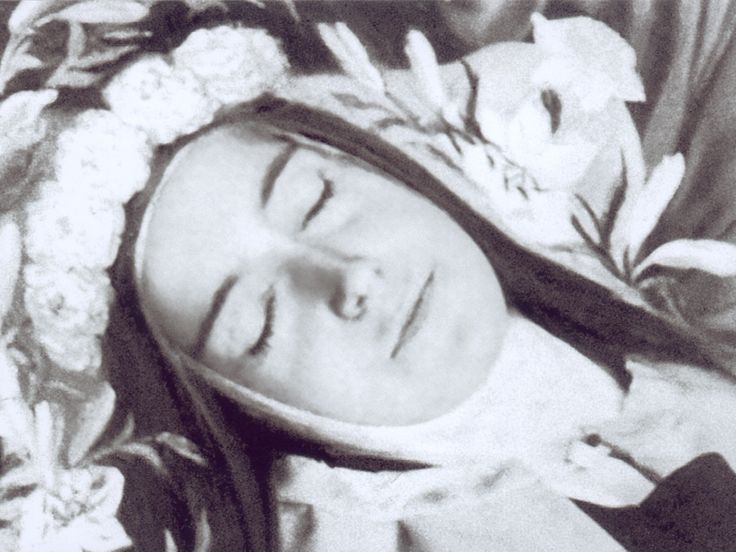
Are these ideas prefigured in her name?

If we are to use the terms “rebellion” and “strong” as the meaning for the name Mary then we may ask “Rebellion against what? Strong for what ends?”
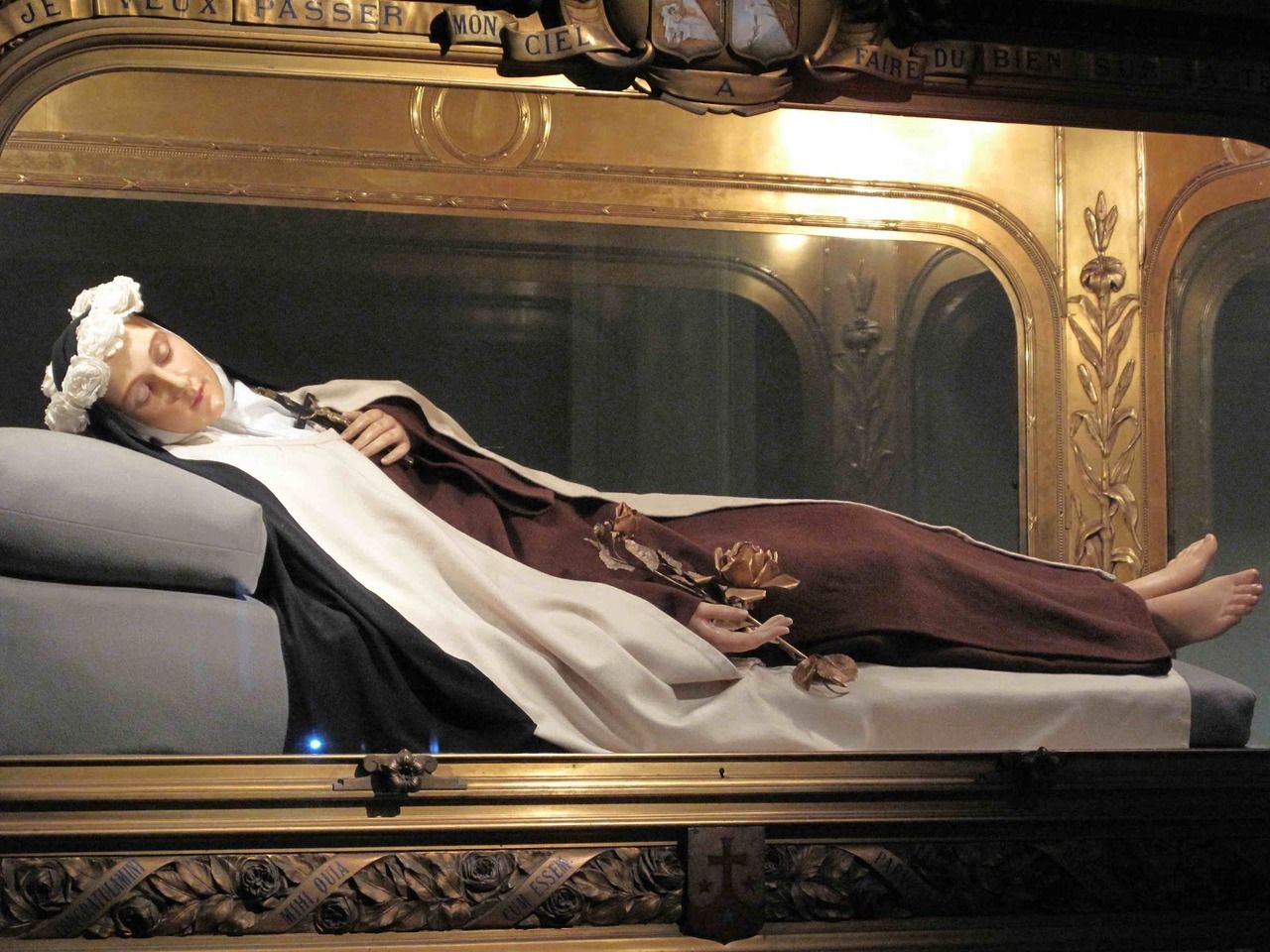
The Church’s Tradition, from the earliest centuries, teaches that Mary was to was to be the faith-filled instrument that God would use to enable the Son of God to enter into the world of men, as man and God. She was the instrument of faith, humility and obedience that would model the skills that we personally need in order to rebel against the forces of this world, the forces of Satan, himself. Her name, along with the victory won for us by her Son, is the rallying cry for all who desire to see the forces of Satan destroyed. Her name – Mary – sustains us in our own fight, our own rebellion, against the serpent and his wily attempts to seduce us, too.

Satan’s victory at the Tree in the Garden was short-lived. St. Irenaeus, bishop of Lyon in the second century, speaks of this when he says, “The Lord came visibly to his own domain and was sustained by his own creation which he himself sustains in being. By his obedience upon a tree he reversed the disobedience shown because of another tree. The seduction to which the betrothed virgin Eve had miserably fallen victim was remedied by the truth happily announced by the angel to Mary, another betrothed virgin. As Eve, seduced by a [fallen] angel, turned away from God by disobedience to his word, so Mary, receiving the good news from an angel, bore God in her womb in obedience to his word; and as Eve had been led to disobey God, so Mary obeyed him. Thus the Virgin Mary became the advocate of the virgin Eve.” (excerpted from Mary’s Yes, edited by John Rotelle, O.S.A. Servant Publications, Ann Arbor, MI).

The most holy name of Mary also provides us with spiritual strength. As the angel Gabriel announced, and as our Catechism explains, she is full of grace. These graces, however, do not lie dormant within her. The Catechism explains: “The Holy Spirit prepared Mary by His grace. It is through Mary, that the Holy Spirit prepares men and women into communion with Christ.”

The strength of her humility, faith, obedience, and prayer act as the four cornerstones to assist us in modeling our life on hers. This appeals to humble people; and indeed, the first to witness the birth of the Redeemer were St. Joseph and the shepherds.
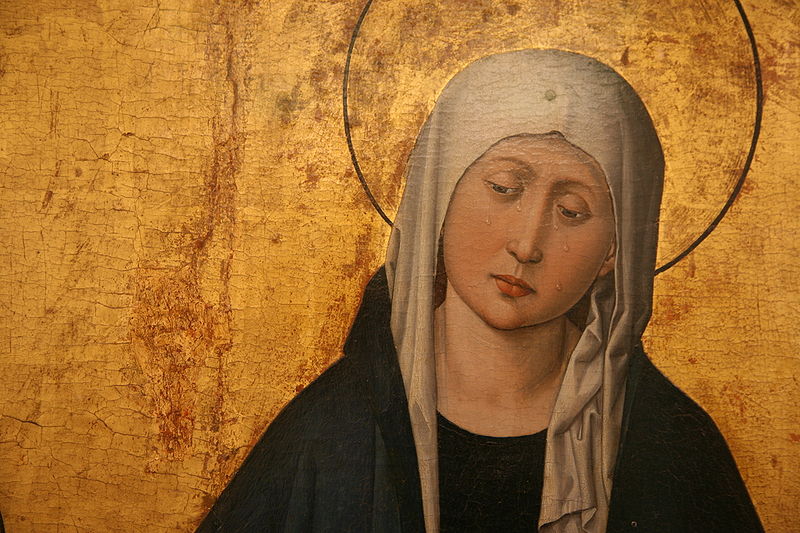
Mary is an example of  faith, hope, holiness, obedience, love, and prayer. As “the Daughter of the Father, the Mother of the Son, and the Spouse of the Holy Spirit” she assists us in uniting ourselves to her Son. Her quiet strength, like many human mothers down through the centuries, enables her to meet our needs in both body and soul. We are her spiritual children. Let us run to her with all our cares, with all our spiritual and bodily illnesses, with our anxiety, fears, and despair. She is here to not only comfort us, but to strengthen us, through a multitude of graces, so that we may be powerful witnesses of faith in Christ in the spiritual war that is waging all around us.  May the Holy Name of Mary always give us strength to realize that Jesus Christ is our one true Savior and the fount of all mercy.

Copyright © 2012 Deacon Paul O. Iacono All Rights Reserved

(“Daughter of the Father …etc” passage is taken from a meditation by Father Emanuel d’Alzon, 19th century founder of the Augustinians of the Assumption, excerpted from his book Mary Our Mother, Our Model, Our Queen, translated by M. Angeline Bouchard from the original French, Trente Jours avec Marie. which received the Nihil Obstat and Imprimatur of the Church). Notes on the sacred images: The first painting is by the 17th century Italian artist Giovanni Salvi (also known as Sassoferrato). The title of the painting is The Virgin at Prayer. It is in the National Gallery of Art in London. The second image is a close-up of the Blessed Mother’s face that was sculpted by Michelangelo in 1499 for his extraordinary sculpture known as the Pieta. Michelangelo was 24 years old at the time he sculpted this masterpiece! It is located in the St. Peter’s Basilica in Vatican City.