Virgin Mary: Trust and Obedience in the Lord

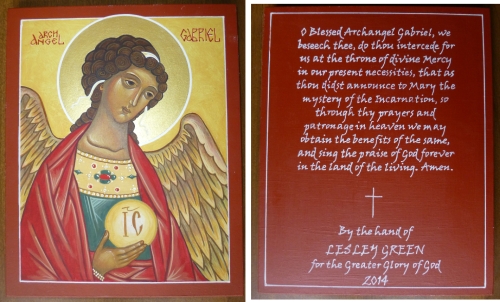
On this solemnity of the Annunciation, March 25th, we remember St. Luke’s account of the Annunciation:

“Now in the sixth month the angel Gabriel was sent from God to a town of Galilee called Nazareth, to a virgin betrothed to a man named Joseph, of the house of David, and the virgin’s name was Mary.”

“And when the angel had come to her, he said, “Hail, full of grace, the Lord is with thee. Blessed art thou among women.” When she had heard him she was troubled at his word and kept pondering what manner of greeting this might be.

And the angel said to her, “Do not be afraid, Mary, for thou hast found grace with God. Behold, thou shalt conceive in thy womb and shalt bring forth a son; and thou shalt call his name Jesus. He shall be great, and shall be called the Son of the Most High; and the Lord God will give him the throne of David his father, and he shall be king over the house of Jacob forever; and of his kingdom there shall be no end”

“But Mary said to the angel, “How shall this happen, since I do not know man?”

“And the angel answered and said to her, “The Holy Spirit shall come upon thee and the power of the Most High shall overshadow thee; and therefore the Holy One to be born shall be called the Son of God. And behold, Elizabeth thy kinswoman also has conceived a son in her old age, and she who was called barren is now in her sixth month; for nothing shall be impossible with God.”

And Mary said, “Behold the handmaid of the Lord; be it done to me according to thy word.” And the angel departed from her.” (Luke 1: 26-38)

Mary, the Blessed Mother, the Theotokos – “the God bearer” at first, questions Gabriel, “How shall this happen…” Upon his explanation Mary undertakes her all important journey with perfect trust and obedience to God’s will. She accepts her eternal role not in fear but in love. Mary will be the God Bearer, the bearer of her Son Jesus, our Savior, the Second Person of the Holy Trinity.

Jesus, at the moment of His conception, is both true God and true man: two natures in one Person.

iu-2
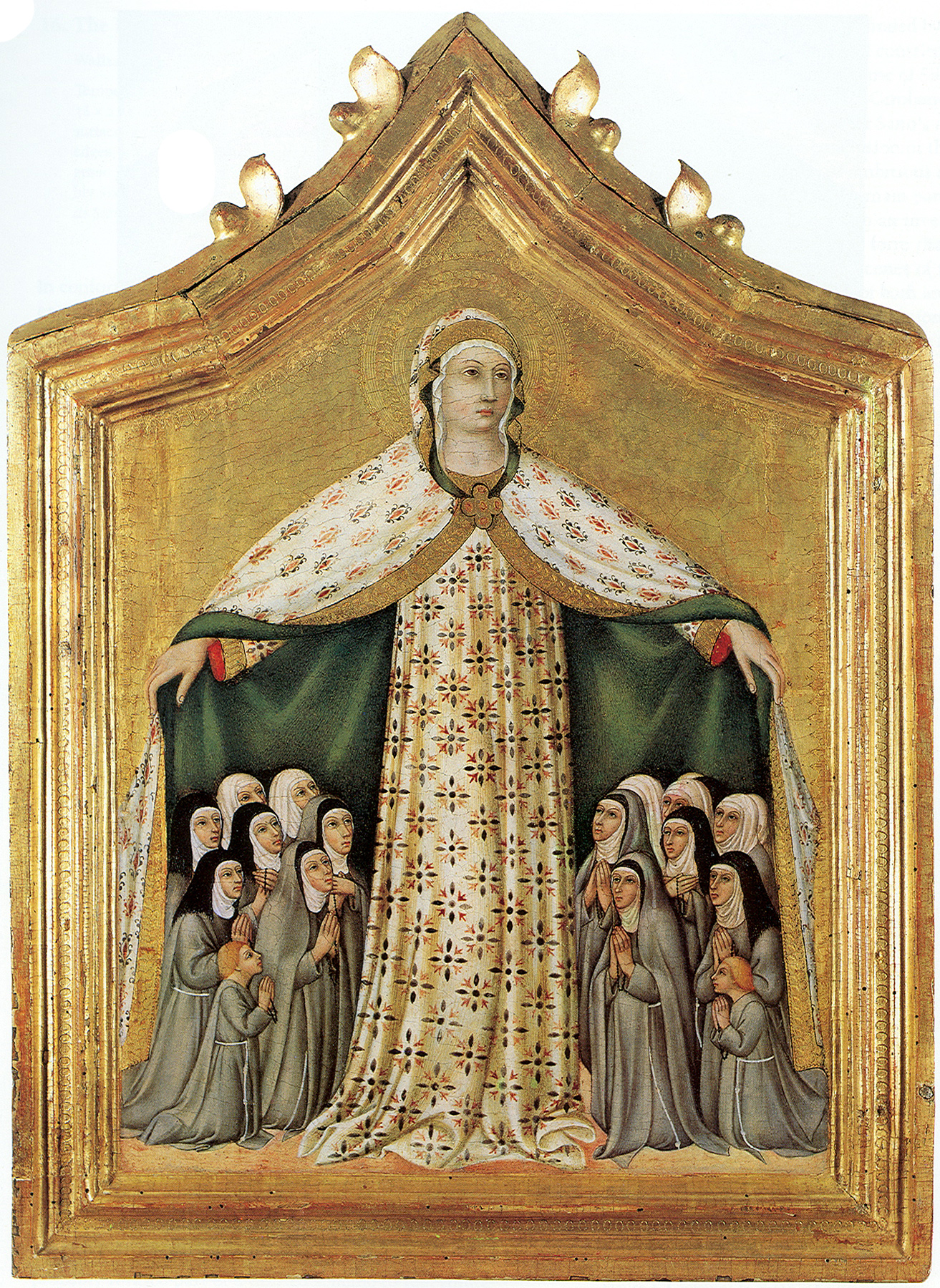
Icon of Mary: it is the icon called The Madonna of Saint Sisto, located in Rome in the Dominican convent of Monte Mario. It is one of the oldest and most beautiful icons of the Virgin from antiquity.


Mary is the perfect disciple of God. She provides us with the model of love, obedience, and trust in Him. There were many times throughout her life that she had to express her trust and obedience, and at times not knowing where the journey would lead. It led from the great joy of her pregnancy, Jesus’ birth, family life, through to His ministry, and her motherly presence before the Holy Cross.

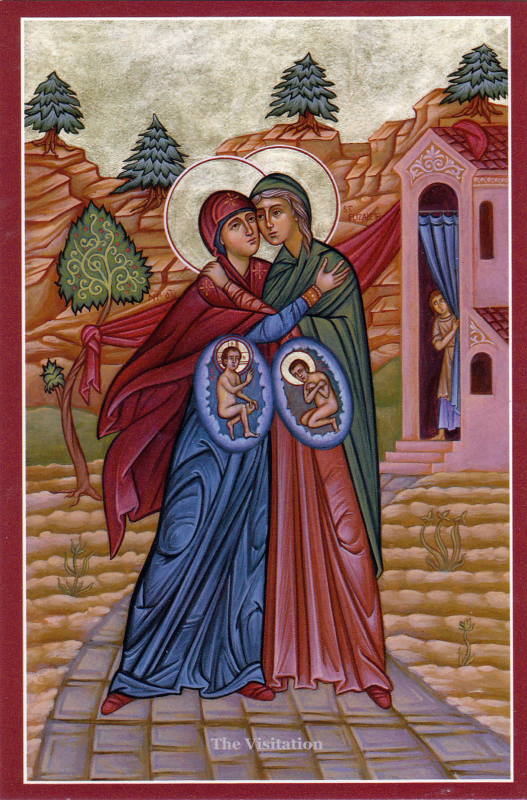
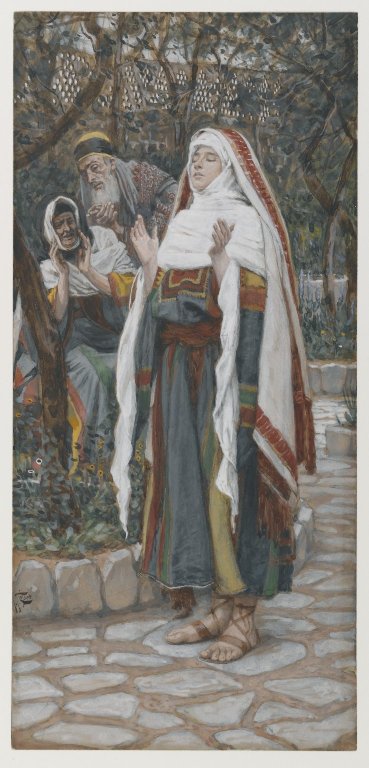
A few verses later, in her beautiful canticle the Magnificat, she exclaimed to her kinswoman Elizabeth her lack of doubt in what has happened.  She praises the mercy of God and her willingness to be the servant of Him who is faithful to His word. In her humility, trust, love, and obedience to God, Mary, as the New Eve, will be given the privilege of crushing Satan at the end of time.

From the beginning, the Catholic Church has never worshipped Mary. The Church venerates her as the first disciple and its greatest saint.

On this beautiful Solemnity of the Annunciation let us join with the great St. John Henry Cardinal Newman in his prayer to Jesus: “Dear Jesus, Your Holy Mother cooperated with the divine plan for the human race. Let me try to imitate her in her obedience and service to You.” Thank you, Jesus.

Note: The sacred image that appears at the top of all of my posts is The Annunciation by Fra Angelico.

Copyright © 2011- 2020, Deacon Paul O. Iacono – All Rights Reserved. Permission to reprint must be obtained from the author in writing. Students, and those interested, may quote small sections of the article as long as the proper credit and notation is given. Thank you.

Do Pagans Go To Heaven or Hell?

by Deacon Paul O. Iacono, Diocese of Providence, Rhode Island USA

The author of the interesting and challenging blog site on sacred art and its analysis called Catchlight sent me two questions yesterday. They related to my last post which was entitled Fatima Messages, Pagans in the Vatican, and the End Times.

“Paul, your protestations begs the question, do pagans go to Heaven? If so, why? If not, why not?”      from Bernard Gallagher

These are excellent questions.

Before I attempt to answer them my readers should understand that I am a committed and Traditional Roman Catholic. His questions will be answered through the lens of the teachings of my Faith. That Faith is based on a foundation of Holy Scripture, Sacred Tradition, and two thousand years of Catholic scholarship.

Allow me to also mention that we need to understand that two Councils of the Church, the Councils of Orange and Trent (1000 years later), are critical in forming a correct answer to Mr. Gallagher’s questions. The Councils of Orange are significant (both of them were held in the city of Orange in Southern France, AD 441 and 529). The more important Second Council of Orange’s episcopal deliberations were sent to Rome and approved by Pope Boniface II in AD 531. That Council specifically proclaimed that everyone (who has reached the “age of reason”) is given sufficient Grace to be saved from eternal damnation. God will give, and has given all people, Actual Grace. If a person accepts and acts on that Grace, they will be saved.

What is Actual Grace? Actual Grace is an admonition by God for a person to correct their way of life, desire, search after, and make the sincere effort to obtain the Sanctifying Grace provided by the Catholic ChurchThe key action which achieves salvation and eternal life with God is the Holy Sacrament of Baptism. This allows the person to enter into God’s family. The Sacrament of Baptism removes Original Sin from an individual’s soul and enables it to receive additional Sacramental Sanctifying Grace. All Grace enables a person to become holy in God’s eyes. The other six Sacraments flow from the waters of Baptism. Pope Pius 9th (papal reign 1846 -1878) proclaimed that it would be extraordinary for an unbaptized person to achieve the eternal salvation and reward of Heaven.

First principle,

a) The Roman Catholic Church, the ethnic church Rites that are in union with Rome, the Greek and Russian Orthodox Churches, and some of the Protestant churches say that Jesus Christ, is the Word of God, the Son of the Father, begotten not made and consubstantial with Him. He is the Messiah, the Savior.  His human life, ministry, passion, death, and resurrection redeemed mankind from their sins. His divinity is expressed through His position as the Second Person of the Blessed Trinity.

b) He is known to mankind through the historical Gospels and Epistles of the Apostles, the witness of His Mother, the Virgin Mary (especially at her apparition at Fatima, Portugal in 1917. When asked what sin was most harmful and condemned unrepentant people to Hell she responded: ‘The sins of impurity are one of the major reasons why men and women are condemned to Hell.'” We cannot ignore our sins or consider them unimportant because of the current worldview. Also, the erudition of the Catholic Church Fathers, Doctors of the Church, Saints, and the historical teaching authority of the Church have all provided the scholarship and analysis that is sufficient for humanity to understand God’d Revelation and laws.

c) He is also known through the extraordinary scholarship of St. Augustine and St. Thomas Aquinas. The teaching authority of the Church, (as found in its Magisterium), is the Church’s responsibility to give to the world an authentic interpretation of the Revelation of God as found in Sacred Scripture and Sacred Tradition.

d) Additionally, let us not forget the importance of the testimony of the angels found in Holy Scripture, and the saints, of whom Jesus’ Mother Mary is the greatest of saints. All of these facts contribute to mankind’s understanding and witness of our Savior Jesus Christ.

e) Jesus commissioned His Apostles (the first bishops) to make known the free gift of His Redemption and graces. These critical graces are found in the Seven Sacraments of the Church, beginning with the keystone Sacrament, Baptism.

Hagiasophia-christ-1
An icon of Jesus Christ. It is found within the former Eastern Rite Church of Hagia Sophia (Holy Wisdom). The Church was built in the early 6th century and is located in Istanbul, Turkey (formerly Constantinople). It was a mosque, then was a museum since 1935, but recently it was converted back into a mosque.

Second, let’s refer to what Jesus Christ says in response to Nicodemus’ questions concerning eternal life in the Gospel of St. John, John 3: 1-21: “Amen, amen, I say to you, unless a man be born again, he cannot see the kingdom of God.” Nicodemus continues to question Him, and Jesus responds, “Amen, amen, I say to you, unless a man be born again of water and the Spirit, he cannot enter the kingdom of God…You must be born again.”

The great significance of the necessity of Baptism into the Christian faith is again stressed in another passage of the Gospels. The Gospel of St. Matthew, in its very last passage deals with the commissioning of the Apostles which occurred after His resurrection and before His Ascension back to the Father. Jesus emphasizes that combined with their preaching and works they must baptize faith-filled individuals because of Adam and Eve’s sin. Humanity’s broken relationship with God must be healed. It was healed through the death and resurrection of the Father’s Son Jesus the Christ. Jesus death, on our behalf allowed the formation of the Church and the Sacraments to be instituted to provide the grace to a broken humanity. Baptism is the Sacrament that makes this happen. It makes an individual’s body and soul a member of God’s family. Matthew 28: 18-20: “Jesus drew near and spoke to them saying, “all power in Heaven and on earth has been given to me. Go, therefore, and make disciples of all nations, baptizing them in the name of the Father, and the Son, and the Holy Spirit, teaching them to observe all that I have commanded you; and behold, I am with you always, to the close of the age.” 

Third, it appears, within the Christian faith, that we can come to specific conclusions that will provide a springboard for my response to Mr. Gallagher:

  1. If the human race was alienated from God, and the spiritual relationship with Him was broken, then a loving and merciful God would not give up on His children. Thus, through the course of history God has slowly manifested and revealed Himself to humanity starting with our spiritual parents, Adam and Eve; then through the patriarchs, leaders, and prophets of the chosen Jewish tribes culminating in the Incarnation of His Son, Jesus the Christ. God desires us to love Him and conform to His Laws. He has given us reason and free will. He has given us the ability to think and act not like robots but as free men and women. His revealed truths and laws must be evangelized and faithfully kept by individuals and mankind as a whole. The “Good News” must be spread by the Church as a whole and individuals, too.
  2. The First Commandment applies, as we see in Exodus 20: 1-6ff: “I, the Lord am your God, who brought you out of the land of Egypt, that place of slavery. You shall not have other gods besides Me. You shall not carve idols for yourselves…you shall not bow down to them or worship them. For I the Lord am a jealous God…inflicting punishment on those who are wicked and hate me…and mercy on those who love Me and keep My commandments.”
  3. Through Scripture and study of the Catechisms of the Council of Trent and that of Pope St. John Paul II, united with faith we also know that Jesus Christ is the consubstantial only Son of God and the promised Savior. Now, have (for example) the Amazonian pagans that we recently observed in Rome, or the new pagans of the 20th and 21st centuries been exposed to that truth?
  4. Christ freely offered Himself for our eternal salvation. This was accomplished through the words and actions of His human ministry and ultimately through His Passion, death, and resurrection. Jesus Christ is the Way, the Truth, and the Life. Have apostates, pagans, or other non believers been exposed to that truth?
  5. We see God through faith in Him, participating in prayer, Scripture study, good works, and the Sanctifying Grace found in the Seven Sacraments. Have pagans, past and present, been exposed to and accept these truths?

Fourth, so,  are pagans going to Heaven or Hell?

In a nutshell, I would never presume to know God’s mind, except from that which He revealed through Holy Scripture and Sacred Tradition. I would never make a judgement on another person’s soul as he or she are seen by God at the time of their death and individual judgement. Unknown to the world, even a great sinner may suddenly, in their last moments, repent of their sins and ask for God’s mercy. But, make no mistake about it, Scriptural Revelation, and the Sacred Tradition of the Catholic Church and specifically the words of Jesus in the Holy Scriptures, states that there is a Hell (Matthew 10: 28; 22: 13. Luke 16: 26; etc.); there is a Heaven, and, damnation into Hell for all eternity. 

It is believed that there is also a place of natural happiness called Limbo. It is not within Heaven, nor is it in the fires of the Hell of the Damned. It is a state of natural happiness and joy. It is not supernatural happiness because its inhabitants do not have the Beatific Vision (see additional discussion in the Summa Theologica, Supplement 1, 3rd part article 2, by Fra Rainaldo da Piperino). The question of what happens to infants who die without the Sanctifying Grace of Baptism is a much debated issue. Many Traditionalists support the idea of Limbo; however, contemporary scholarship supports the idea that God, in His mercy, would not withdraw the vision of His glory to unbaptized infants who have died.

Some additional issues:

  1. Let’s take a look at three major Greek philosophers: Socrates, Plato, and Aristotle. They were scholars who lived and died before the birth and ministry of  Jesus Christ. They lived within a pagan/pantheistic society whose members believed in a multitude of gods  Are Socrates, Plato, and Aristotle in Heaven or Hell?
  2. The answer is, “I don’t know!”
  3. But Jesus said, “I am the Way, and the Truth, and the Life. No one comes to the Father but through Me” (John 14: 6). Wouldn’t that statement preclude the unbaptized Greek philosophers entrance into Heaven?
  4. The answer is “Not automatically.”
  5. So, what do we know? We know that those three philosophers were men who searched for the truth, not only about  themselves as individuals but about the world itself. They searched after the truth. They made the sincere effort to find the truth by thinking, questioning, analyzing reality, both physical and metaphysical. They used all the evidence at their disposal to do so. They lived, before the Son of God was incarnated. They did not have the witness of Jesus Christ and to His specific and eternal revelation as the Son of God, both human and divine. They also probably did not have any exposure to the history of the Jewish people and God’s revelation to them. As per the the points made earlier, did they act on God’s Actual Grace to truly desire life with Him?
  6. But, in the time after the Incarnation and Ascension of Jesus, a person who had the opportunity to be exposed to and Baptized into the  Christian Faith (in the full expression of it in the Western and Eastern Rites of the Catholic Church, and some of the Protestant and Anglican churches if they use the Trinitarian formula), would have a critical free choice to make.
  7. If they are pagan, agnostic, atheist, Catholic Christian, Deist, Protestant Christian, Satanist, Wiccan, etc, and they would then, after an effort to know the truth, reject Actual Grace and the witness of Jesus Christ out of intentional misunderstanding, intellectual arrogance, stubbornness, cultural and historic prejudices, selfishness, willful rejection of Christian Revelation, narcissistic impulses, apostasy, or some evil influence, they would be freely putting their eternal soul into mortal sin. They would be facing the eternal punishment of Hell because they chose the path, through their own free will of “definitive self-exclusion from communion with God and the blessed in Heaven” (confer page 269 in the Catechism of the Catholic Church,  2nd edition).
  8. God is loving and compassionate. He is filled with mercy for those who sincerely repent their sins. God is merciful; however, our God is a God of Justice. Why would Jesus Christ be Incarnated to minister, suffer, die, and be resurrected if the Holy Trinity would give mortal sinners “A get into Heaven free pass?” The “Pass theory” doesn’t make sense, it is illogical, bogus, and yes it is a lie. There are dire consequences for freely turning your back on Jesus Christ: Hell.
  9. But do today’s pagans turn their backs?
  10. The answer to that question is: Have they made the effort to know the Truth? Have they been exposed to the truths of the Hebrew and Christian Scriptures? Have they been evangelized by courageous and selfless missionaries who are willing to undergo all sorts of hardships and possibly even martyrdom for the sake of their flocks’ eternal souls? Have they deliberately turned their backs on the truth and revelation of God through the Christian Scriptures, and the documents and witness of the Apostles, Saints, Church’s Doctors and Fathers, bishops and Pope as they present the truth on faith and morals? Have the pagans or people of other religions acted on the free gift of God’s Actual Grace?
  11. The Church’s duty and responsibility is to bring, without arrogance or condescension, the Holy Scriptures, Sacred Traditions, and the Holy Sacraments to the world. If its bishops, priests, deacons, consecrated brothers and sisters in various religious orders, and laity shirk or compromise their duties and teaching authority, give bad example through public and private sin, then they possibly will be denied entrance into Heaven, too.
  12. Is the Church giving sufficient resources to the missionaries in the field? Are we able to inspire young men and women in today’s world of the necessity and challenge to enter the life of a missionary? Have we thrown in the towel?
  13. This is my great concern about what I see in the Church today (especially the recent blessing of the pagan Pachamama statue in Rome; (by the way, all of the Amazonian Pachamama rituals were condemned by six Cardinals). The Christian churches should not be about assimilation of pagan cultures into the Faith in order “to learn from them,” or do so in a “spirit of dialogue” and accommodation.
  14.  The Western and Eastern Rites of the Catholic Church have the complete and total revelation of God to humanity. We have the complete revealed truth of The Trinity. We have the example of what it means to live in the heart of the Father through the life of Jesus Christ. Christ’s life, redemptive death, and resurrection made possible our entrance into God’s family. This entrance is accomplished through the Sacrament of Baptism (using the Trinitarian formula), and individuals’ growth in faith and good works.
  15. Matthew 28: 18-20, relates Jesus’ specific command. Our duty is to compassionately and without arrogance teach pagans and other non-believers about Jesus Christ, baptizing them in the name of the Father, and the Son, and the Holy Spirit.
  16. It is intellectually and morally irresponsible to give the impression that apostates, heretics, pagan/polytheistic cultures, and people of other faiths can add to the Deposit of Faith.We either understand the gift of the Deposit of the Faith or we don’t. There should be no waffling.
  17. We either proclaim His truth effectively and with conviction or we will see the Church continue to decline, make compromises, cause confusion, anxiety, division, and resentment among its faithful. Hell is a reality. It is our responsibility to act with courage and truthfulness to ensure that a person’s eternal salvation is not compromised through confused or false teachings.
  18. The Gospel of Luke 18: 8 challenges us to examine our own hearts: “When the Son of Man comes will He find faith on the earth?” 
  19. To paraphrase Peter Kreeft, Ph.D and Rev. Ronald Tacelli S.J. “if we have a diamond of immense and extraordinary value (our Catholic/Christian Faith) why would we go about the world seeking additional baubles?
  20. Refer also to the Catechism of the Catholic Church (2nd edition, 1997, pages 311-324) which has an excellent section on the Sacrament of Baptism.

Copyright © 2011- 2019, Deacon Paul O. Iacono – All Rights Reserved. Permission to reprint must be obtained (through the Comments section below) from the author in writing. Students, and those interested, may quote small sections of the article as long as the proper credit and notation is given. Thank you

Bernini’s Bronze Sculpture of Four “Giants” of the Church

Today, May 2nd, is the “Memorial” day of St. Athanasius, a Doctor (profound theologian) of the Church.

There are four “giants” of the Nicene  and Post Nicene period, all are known as “Doctors” of the Church: St. Athanasius, St. Ambrose, St. John Chrysostom, and St. Augustine. They are immortalized in bronze by  the Renaissance sculptor, Bernini, and are portrayed in his magnificent sculpture of the Throne of St. Peter found in the sanctuary of St. Peter’s Basilica.

St. Athanasius and St. John Chrysostom are saints of both the Latin and the Greek Rites of the Church. Both were bishops. Yet, Bernini does not put the Bishop’s mitre on their heads. Sadly, the sting of the Great Schism of 1054 between the Latin and Greek Rites still stung in the 17th century.

Thus, these two Greek Fathers of the Church were slighted, not because of anything that they did (they were profound shepherds and theologians), but because Bernini wanted the authority of and preeminence of St. Peter’s position of “first among many” and the importance of two of the Latin Rite Fathers, to be showcased in bronze and remembered in the centuries to come.

e80a2ad5a5ec983a87fa7030ac16c092

The above photo is the “Chair of St. Peter” and is found in St. Peter’s Basilica (Chair created 1656 – 1665). It is an extraordinary masterpiece by Gian Lorenzo Bernini (1598 – 1680) which he made for Pope Alexander VII (Chigi family, 1655/67). Bernini was a child prodigy and polymath. This Chair proved to be a wooden throne dating to the year 875. It was donated by Charles the Bald to Pope John VIII (served AD 872/882) on the occasion of his coronation to the papacy. Four humongous bronze statues of Doctors of the Church flank the chair: In front to the right “St. Augustine”, to the left “St. Ambrose” (Latin Rite). Behind to the left “St. Athanasius”, to the right “St. John Chrysostom” (Greek Rite). The entire bronze structure’s weight is 74 tonnes (81.5 tons). The height is 14.74 m (48.3 feet). The statues of the Doctors of the Church are 5.35 m (17.5 feet) high. Above the four saints is located a stained glass window: “Dove of the Holy Spirit,” dated 1911 by the German glassmaker Hagle from the original design of Giovanni Paolo Schor (1615/74). These facts are from https://romapedia.blogspot.com/2013/10/basilica-of-st-peter-second-part_3.html. That blog is edited by David Macch. This is an excellent website about all aspects of the art, architecture, and history of Rome.

There are five Councils of the Church that had major impact on the development of the Church’s sacred art: the Council of Nicaea, the First Council of Nicaea/Constantinople, the Council of Ephesus, the Council of Chalcedon, and the 2nd Council of Nicaea (2nd Nicaea met in AD 787 and is the last of the Seven Ecumenical Councils). Besides these Councils all the Church Fathers through their scholarship, pastoral zeal, and extraordinary homilies, witnessed to the truth, beauty, and goodness of the Holy Trinity.

The list below provides the names and birth/death dates of the Fathers of the Church within the “Post Nicene” (that is, the time after the Council of Nicaea, AD 325) period of Church history. A quick review of each of their contributions will prove to be beneficial to you if you decide to paint a sacred image of them. How can you truly benefit from painting a sacred image of a person that you don’t know! 🙂

I recommend that you refer to my bibliography (“Early Church Fathers”) provided in my post of February 8, 2019. There are a number of different books in that bibliography that will prove to be helpful to you.

The Post Nicene Church Fathers born within the Western (Latin) Rite are:

St. Ambrose (AD 340-397),

St. Jerome (AD 345 – 420),

St. Augustine (AD 345-430),

Pope St. Leo the Great (AD 400 – AD 461),

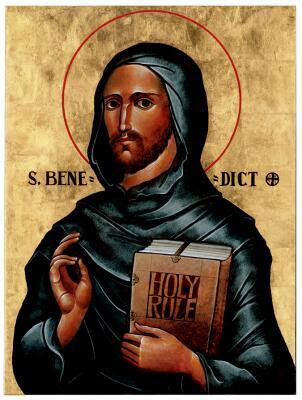
St. Benedict of Nursia (AD 480 – 547) and

Pope St. Gregory the Great (AD 540 – 604);

the Post Nicene Fathers born within the Eastern (Greek) Rite are:

St. Athanasius (AD 295 -373) – (he straddles the Nicene and Post Nicene Periods),

St. Basil the Great (AD 330 – 379),

St. Gregory of Nazianzus (AD 330 – 390),

St. Gregory of Nyssa (AD 330 – 395)

St. John Chrysostom (AD 345 – 407),

and St. John Damascene (Damascus) (AD 675 – 749) 

All of the saints listed, including those in the Greek Rite, are venerated within the Western Rite of the Catholic Church.

Ciao!

Copyright © 2011- 2019, Deacon Paul O. Iacono – All Rights Reserved. Permission to reprint must be obtained from the author in writing. Students, and those interested, may quote small sections of the article as long as the proper credit and notation is given. Thank you.

Sacred Icons and Sacred Images – the Nicene Debate Continues!

AyaSofya
A photo of the inside of the Aya Sofya (Hagia Sophia) church in what is the present-day city of Iznik, Turkey. Iznik was called Nicaea prior to the rule of the Ottoman Turks . This photo shows the interior of one of the rooms in the  building complex that served as the location for the First Council of Nicaea (AD 325). Also, in the late 8th century the Seventh Ecumenical Council met in this building, too. That Council met to debate and decide the issue of iconoclasm (should sacred icons and images be prohibited and destroyed). The written arguments of St. John Damascene (Damascus) won the day and sacred icons were allowed to continue to be made. Iconoclasm was to raise its ugly head again in later years, and came to full fruition during the Protestant rebellion/reformation, the French Revolution, and worldwide Communism in all its cultural forms.  This photo of the inside of the Nicaean building is from Bryan Cross’ website: calledtocommunion.com. It was posted in May, 2010. Thanks Bryan!

I would like to thank one of my readers who identified the  contemporary icon of St. Spyridon (thanks Carol!). The iconographer is the Catholic priest William Hart McNichols. He is a very talented artist who paints traditional icons and sacred images. At times, he steps out of the bounds of the traditional approach and adds his own personal interpretation of the person he is portraying. His artistic vision is unique.

John Daly from Australia emailed me this morning to provide further grist for our mill concerning St. Athanasius, St. Spyridon, and the Council of Nicaea. One of the participants in his iconography school is a Greek Orthodox lady who is the sister-in-law of an Orthodox priest. He is coincidentally named Athanasius.

John had the opportunity to discuss with her the icons that we were analyzing in my posts of the last few days. She provided John some valuable information by explaining  that her mother had given her a beautiful sacred image of the First Council of Nicaea and specifically St. Spyridon’s role in the debate with the heretic Arius. The sacred image is below.

1555507279899blob.png
Greek Orthodox sacred image of the First Council of Nicaea. Notice St. Nicholas on the lower right about to possibly physically strike Arius who reacts by pulling away. On the left you see St. Spyridon, holding a brick with flames streaming upward and water puddling below it to the floor (confer yesterday’s post of April 16th to obtain the explanation of that imagery). The room of the actual Council, as portrayed in this sacred image is quite ornate.

Also, like the sacred icon we examined in yesterday’s post we see the Emperor Constantine, dressed in the royal robes of Byzantine reddish purple (almost a maroon) sitting on the right. On the Emperor’s right we again observe a bishop, maybe its Bishop Alexander of Alexandria, Egypt. In front of him we again see a deacon, dressed in what is either an alb or dalmatic (he would have to stand up to see all the garments).

In the above sacred image, the deacon is again seated at the scribe’s desk. This makes sense, since a deacon serves the administrative needs and report’s directly to his bishop. That is true to this day; yet, throughout the world today the local bishop has his deacons serving in parishes, hospitals, prisons, etc. rather than in an administrative capacity in the local chancery. Notice the bishop is behind the deacon scribe to facilitate accurate communication.

The above sacred  image, which I have never seen before John Daly sending it to me, is very well done. The painter has captured the meaning of the Council as a whole and two of its major participants: St. Nicholas’, in his famous interaction with the heretic Arius, and the great oratorical and mystical abilities of St. Spyridon challenging Arius, too.

Is the deacon pictured in the painting from the Latin Rite or is he Orthodox? Truly, there is no way to accurately tell because the deacon is seated, and what is showing of the deacon’s stole is inconclusive. Depending on the angle of view both the Western and Eastern Rites’ deacon’s stole placement looks the same.

In today’s painting and in yesterday’s post of the icon, the deacon is seated and the possible vertical panel on the Eastern Rite and Orthodox stole is in shadow or not detectable, yet, the panel that drapes from left shoulder and gathers at the waist is visible, and would appear, as you see below, in both Latin, Eastern, and Orthodox Rites!

Just between you and me, I think the deacon depicted in the icon, from my April 16, 2019 post and today’s, is St. Athanasius from Alexandria, Egypt. The Catholic Church, the Eastern Rites in union with Rome, and all the Orthodox Churches venerate St. Athanasius as a great saint and designate specific feast days for him. He belongs to all of us.

The deacon’s stole in the Eastern Rites of the Catholic Church that are in union with Rome; and, the Greek Orthodox, the Russian Orthodox, and Coptic Orthodox deacon stoles look like this:

Unknown
Orthodox deacon’s stole in a royal Byzantine fabric (in  what appears to be a royal maroon purple) is bordered in gold thread with gold crosses. Originating at the left shoulder, gathered at the waist, with the fabric of the stole hanging vertically on the left shoulder both in the front and the back. The stole is worn on top of  the ornate gold and white dalmatic.

The cassock, alb, stole, and dalmatic all have the same meaning and functions in both the Western and Eastern Rites of the Church. In today’s Western, that is, the Latin Rite (Roman Catholic) tradition, a deacon wears the rank of his ministry and ordination, the stole, over the alb but under the dalmatic. Latin Rite deacons would wear their stole’s in this manner:

th-3
A Roman Catholic deacon’s stole running from the left shoulder and gathered at the waist, then hangs vertically under the right arm. It is worn on top of a white alb, and under a dalmatic. The dalmatic is only worn during Holy Mass. When the deacon performs baptisms, marriage and funeral services, liturgical prayer services, and formal blessings, etc. the deacon would not wear a dalmatic, so the deacon would appear as in the above photo wearing a simple white or cream colored alb and a stole in the appropriate color..  The stole’s fabric in the photo above is dyed dark purple for Lent; during the season of Advent a purple stole is used, too; sometimes, it is of a lighter purple than the Lenten penitential purple. A white stole would be used for Baptisms. Marriages, Funerals, Holy Thursday services, and during the Easter and Christmas season. Red stoles would be worn at Palm Sunday and Good Friday services, Pentecost, and on the feast days of martyrs.

th-5
A Roman Catholic deacon’s dalmatic which is worn over the white alb and the stole. The dalmatic is in the corresponding color to the stole. The color green is worn during “Ordinary” time (which is the liturgical period that borders the great seasons of Advent, Christmas, Lent, and Easter).

I’ve really enjoyed this lively information exchange. Thanks to all who participated in it!

May you have a blessed Easter Tridiuum of the Passion and Resurrection of Our Lord Jesus Christ.

Peace be with you.

Copyright © 2011- 2019, Deacon Paul O. Iacono – All Rights Reserved. Permission to reprint must be obtained from the author in writing. Students, and those interested, may quote small sections of the article as long as the proper credit and notation is given. Thank you.

St. Athanasius and St. Spyridon: A Correction and Another Interpretation – Let’s Take A Closer Look!

I am always very appreciative of my readers writing to me and providing new information and interpretations of sacred icons and images. Happily, that occurred last evening when a reader, Mr. John Daly from Australia, provided me with information on the second icon that was in yesterday’s post on St. Athanasius. Let me provide you with that image so we will have a reference point:

THE_FIRST_COUNCIL_OF_NICEA
This is the sacred icon of a bishop confronting a heretic at the Council of Nicaea (AD 325). Mr. John Daly of Melbourne, Australia informed me that we should take a closer look at the details of this icon because of how it depicts the bishop’s castigation of the heretic. I concluded erroneously that it must be St. Athanasius since he was a pivotal orthodox figure at the Council. Even though he was a deacon at that time, and not a bishop at the Council, he was ordained a priest and bishop about three years later, so the iconographer just inserted him as a bishop. Mr. Daly recommends a closer look to discover that it is St. Spyridon of Cyprus.

Mr. Daly is correct – it is St. Spyridon (born AD 270, died 340).

Let’s take a look at the reasons for this correction:

  1. The bishop castigating the heretic Arius is wearing a distinctive hat. The hat is unique. It is shaped like a beehive. It is made of woven straw and was traditionally worn by Cypriot and other shepherds tending their flocks – an apt metaphor for a bishop caring for the flock of his faithful.
  2. St. Spyridon was from the island of Cyprus, and eventually became a bishop serving the people of Trimythous, thus, he would have been invited to the First Council of Nicaea as were all the other bishops in Christendom.
  3. At another time, possibly in Cyprus, St. Spyridon was involved in a debate with a pagan philosopher whom he ultimately converted to Christianity. Besides his theological arguments about the Holy Trinity, the good bishop used a piece of pottery or a brick, to demonstrate to the philosopher how you could have one single substance be also composed of three separate substances (pottery and bricks consist of clay, water, and are unified by the substance of fire).
  4. The story of his discussion with the pagan philosopher continues and says that as soon as St. Spyridon finished speaking the piece of pottery or brick burst into flame, water dripped from it, and clay ash remained in his hand. Well that would have been enough to place me on the road to conversion, and so it was with the philosopher, too. If you look closely at the icon above you can perceive the fire bursting out of the brick and the water puddling beneath it. Hmm, I didn’t see that! As Sherlock Holmes once said, “Watson, you see, but you do not  observe” (taken from the story A Scandal in Bohemia by Sir A.C. Doyle).  Wise advice.
  5. Mr. Daly also relates that it was [and probably still is] common for an iconographer to fuse the two incidents of St. Spyridon converting a pagan, and St. Spyridon at the Council of Nicaea debating with the heretic Arius.
  6. There it is: the beehive woven straw hat, the bishop’s vestments, the water, fire and ash metaphor, the confrontation with an individual that has an opposite argument, and the public venue for both incidents.
  7. So where is St. Athanasius in this icon? Mr. Daly offers that in the upper left corner of the icon, we see an individual portrayed as listening intently to St. Spyridon. He is dressed in a dark alb with a white collar. He suggests that this is St. Athanasius. That argument makes some sense because, as a deacon, Athanasius may not have been up front with the bishops, rather he possibly would be located near the altar ready to perform his diaconal duties. At the same time he is still involved in the proceedings, and/or ready to respond to the needs of his bishop – Alexander of Alexandria.  You notice the priests and monks in the back of the room, too, in dark conical monastic hats and cassocks.
  8. My only issue with that interpretation is that the figure portrayed in the upper left does not have a nimbus (halo) circling his head, nor is he wearing his deacon’s stole; however, the scribe in the lower left corner is wearing a deacon’s stole. My stole comes across my chest from the left shoulder and is gathered at the right hip; and the scribe’s stole does the same thing. Is this individual St. Athanasius? There appears to be writing on his stole. I have no proficiency in Greek so I cannot be of help there.
  9. The scribe in the lower left corner has a halo, too, and so do all the bishops. Did the iconographer think that all the bishops present were saints?  This is not unlikely, since they produced a Creed for Christendom in three months. Truly, a stunning achievement. It indicates that the assembled bishops were very clear in their own minds what the Faith, based on Scripture and Apostolic Tradition, was all about. The bishops all appear very animated and involved in the Council proceedings. It’s obvious that the Holy Spirit was working within that Council!
  10. There is a lot going on in the upper part of this icon, too. Christ, as a young child, is found walking across what appears to be an altar towards another bishop. That bishop on the upper right is seen discussing some issue with, possibly, another dissenter (a priest, or deacon; even though the priests and deacons in attendance didn’t vote, they certainly could influence the bishop of their diocese on issues and arguments).
  11. Sadly, I believe that the only existing documents that we have concerning this Council that are still in existence are the Nicene Creed itself, the procedural rules of the Council, and Emperor Constantine’s address to the assembled bishops. It is said that many of the bishops came, returned to their dioceses, and then came back to the Council. This probably contributes to the fact that we don’t have all the names of the participating bishops, just those mentioned in other documents or in the stories that were passed on through to the faithful (confer Anna Erakhtina’s article The “Model of Meekness,” and Slapping Arius, at http://www.orthochristian.com, May 22, 2016, specifically the contribution by Archpriest Vladislav Tsypin. He discusses the documents available to us today). If anyone has additional information on the actual participants please tell me your source, and the participants, and I will spread the information through a post.
  12. St. Spyridon was also known as a miracle worker, especially for his successful intervention (caused by the prayers of the soldiers and sailors of the Catholic Rites) in the 1716 battles with the invading Ottoman Turks on the Greek island of Corfu.

John, thanks again; this was a fun interaction.

Additional images of St. Spyridon:

ST. Spyridon Orthodox
A contemporary Sacred Icon of St. Spyridon showing his beehive woven straw hat, his bishops stole, the blazing potsherd or brick with water dripping from it, and his holding the book of the Gospels (dogmatic truth based on the Holy Scriptures and the Sacred Apostolic Traditions of the Western and Eastern Rites of the Catholic Church. If anyone knows that artist that is responsible for this beautiful icon please tell me and I will credit him/her in this post. Icon found on Wikipedia and originates at St. Spyridon Orthodox Church in Loveland, Colorado (thanks to them for posting the image of this magnificent icon).

220px-Zemen-monastery-st-spiridon
A medieval icon of St. Spyridon, wall fresco, Bulgarian Orthodox, found in the  Zemen Monastery, Bulgaria. Photograph may have been taken by I.E. Stankov in 2012 using a Canon EOS 600D camera.

In the Roman Catholic Church, St. Spyridon is venerated on his feast day, December 14th; and on December 12th in the Eastern Rites and the Orthodox Church.

Thanks for stopping by and reading this post.

Copyright © 2011- 2019, Deacon Paul O. Iacono – All Rights Reserved. Permission to reprint must be obtained from the author in writing. Students, and those interested, may quote small sections of the article as long as the proper credit and notation is given. Thank you.

St. Athanasius – Coptic and Eastern Orthodox Icons

St. Athanasius of Alexandria was “the Lion” of the Council of Nicaea. He was instrumental in providing well argued testimony rebuking the heretic Arius during the Council’s debates. His verbal skills, as powerful and commanding as a lion, shredded Arius’ arguments. His eloquence convinced the assembled bishops of the correct dogma that Jesus Christ has two, separate and distinct, natures (divine and human), and that Jesus Christ is fully human and fully divine. The heretic Arius insisted that Jesus was “just a creature” of God.

Icon-St.-Athanaius-the-Great
A contemporary icon, completed in The Egyptian Christian Coptic style, of St. Athanasius of Alexandria standing on the back of the heretic Arius (seen in very dark colored clothing) at the Council of Nicaea (AD 325). Athanasius is seen in front of the assembled bishops from the Eastern and Western Rites of the Catholic Church. He is holding the Council’s accepted conclusions in the document known as the Nicene Creed. Notice that he does not have a bishop’s mitre on his head similar to the bishops sitting in attendance behind him, and is dressed in what appears to be a deacon’s dalmatic with cape. The style of this sacred icon is very similar to the style of the Coptic (Egyptian) Orthodox Church’s sacred art; yet, the inscription above his head is in Greek rather than Coptic. Image found at churchofourladyofkazan.org; (thanks to them) throughWikipedia images.

The Council’s main purpose was to address the divine nature of Jesus Christ and the concept of HIs being the Son of God the Father. This had to be done in order to squash the Arian heresy once and for all. It was also to establish a date for the celebration of Easter, resolve organizational and clerical issues, and the development of Church law (what today is called Canon Law). They were also attempting  to settle a schism that had occurred in Egypt. That schism was being fomented by another bishop who had enlisted with the heretic Arius.

The Council was also tasked with development of a Christian Creed that would provide unity of belief for both the Eastern and Western Rites of the Church. This unity of belief was critical since the Church needed a formal set of beliefs  that could be used as a catechetical tool and a binder that kept all the cultural and geographical “Catholic” churches together.

The Council of Nicaea basically resolved all the main issues of its agenda. It was a stunning achievement. The priest Arius was banished for promoting heresy and his ideas declared anathema. Yet, the problem the Council still faced was convincing Arius’ followers of their heretical errors. Banishment or not, an unrepentant Arius continued to spread  his opinions fomenting confusion throughout the Empire.

THE_FIRST_COUNCIL_OF_NICEA
The above image is another example of a sacred icon, however, it is not completed in the Coptic style which originated in Egypt. It is an Eastern Orthodox icon (Greek, Russian, or one of the many other Eastern Rites of the Church), completed centuries after the Council ended in the summer of the year 325. It shows a non-heretical bishop castigating the heretic priest Arius (who is raising his hand in an attempt to stop the speaker). The bishop, because of his hat (mitre), appears to be labeled with Athanasius’ name found at the bottom); however, he is not clothed in a deacon’s dalmatic, nor did deacon’s wear that style of hat. It is believed that Athanasius was not ordained a priest and bishop until after the Council ended. The Emperor Constantine sits on the right dressed in imperial clothes and it may be surmised that it is Bishop Alexander of Alexandria (the bishop of Arius’ and Athanasius’ diocese) who sits to the immediate right of the Emperor.

The Eastern and Western Rites of the Catholic and Orthodox Church have always believed that sacred icons and sacred images are always venerated by the faithful; they have never and are never worshipped.To worship sacred icons, sacred images, statues, and other visual reminders of the glory of God and His saints is against the 1st Commandment (confer Exodus 20: 2-17, and Deuteronomy 5: 6 – 21). If anyone worshipped those visual images they would correctly be called idolaters. Worship is for God alone, that is, the Holy Trinity – the Father, the Son, and the Holy Spirit; Three Divine Persons in One God.

Our Savior Jesus Christ is One Person with two natures: human and divine; that is a state of being which is part of the great Mystery of the Incarnation of God into human existence.

Jesus Christ is the Lamb of God, sacrificed in Jerusalem through His Passion, Crucifixion, and death. Jesus, following His Father’s will, suffered and died for us in order to atone for all of humanity’s sins (past, present, future). God the Father and God the Holy Spirit responded by raising Jesus from the dead on the third day, ultimately enabling Jesus to interact and be seen by His Apostles and hundreds of disciples.

Truth, Goodness, Beauty, and Love, incarnate in our Savior.

Thanks for stopping by.

May you continue to have a prayerful Holy Week and a joyous Easter Season.

Copyright © 2011- 2019, Deacon Paul O. Iacono – All Rights Reserved. Permission to reprint must be obtained from the author in writing. Students, and those interested, may quote small sections of the article as long as the proper credit and notation is given. Thank you.


Saint Nicholas Slaps a Heretic! A Reflection Appropriate for Palm Sunday

The extensive Gospel reading for Palm Sunday relates the Scriptural and historical truth that Jesus  triumphantly entered Jerusalem, yet, five days later He was arrested, put on trial, tortured, and executed.

As you know, the religious and secular leaders of Israel did not accept Jesus as the Messiah and Son of God. They were adamant about the fact that Jesus was just a man and that His claims, teachings, and healings were all fraudulent.  Their disbelief took place during the first century, yet, two hundred years later there were Christians saying the same thing.

The questions came down to, “Who is Jesus Christ? Is He a man? Is He God? Is He both?”

These were the same questions that the people of Jerusalem, some of them waving palm branches, and their leaders were asking each other.

In the year 325 scholars and clerics were still grappling with those questions, too.

Many deacons, priests, and bishops of the Church had settled the question in their own mind, yet, all of Christendom was not in agreement. Emperor Constantine was worried; as a military man he knew trouble when he saw it. Religious disagreements could easily spread into civil war. Something had to be done.

Stories have come down to us through the centuries that St. Nicholas of Myra, a faith-filled bishop, decided to defend Sacred Tradition and the Scriptural interpretation of the reality of Jesus as the Son of God the Father. The story relates that he not only vigorously defended Sacred Tradition but became so worked up that during one of the debates he slapped the author of this heresy which was called Arianism.

But, was it a verbal or physical slap?

Let’s take a brief look at some of the details:

th
Partial icon of the “incident” at the 1st Council of Nicaea. Immortalized in an early icon. The Early Church was well aware of the importance of this Council in debating and agreeing to the specific dogmas of the Church that would be ultimately proclaimed in the Nicene Creed. All catechumens that enter the Church at the Easter Vigil Mass proclaim their belief in the great Sacred Mysteries and historical truths of the Nicene Creed.

Who: Saint Nicholas of Myra, Bishop, (Myra, an Ancient Greek city on the coast of present day Turkey),  vs.  Arius, priest from the diocese of Alexandria, (Alexandria, a city on Egypt’s Mediterranean coastline). Emperor Constantine, Roman Empire, centered in the new city named in his honor: Constantinople (present day Istanbul, Turkey). Constantine convenes an ecumenical council of bishops from the five major patriarchies of Christendom (Alexandria, Antioch, Constantinople, Jerusalem, and Rome).

What: Supposed incident of Bishop Nicholas “slapping” the priest Arius, at the first ecumenical Council of Bishops: the Council of Nicaea. This was the first Council since the Council of Jerusalem (held in the first century and was attended by luminaries such as St. Peter and St. James).

When: Late Spring and early Summer of the year 325.

Why: The incident concerned the critical issue of who is Jesus Christ, and whether Jesus Christ is “the same in being and the same in essence” as God the Father. Arius was promoting the heresy that Jesus Christ was “just a creature” of God and not a divine Person of the Holy Trinity.

Where: Nicaea, an ancient city in Asia Minor; it is the present day city of Iznik, Turkey.

As it applies to sacred art, the Council of Nicaea provided a specific creed: a set of theological proclamations that impacted  sacred artists from the 4th century to the present day. It is stated clearly in this Creed that God the Father has communicated His love, mercy, and laws to humanity through His revealed word in the Hebrew and Christian Scriptures. This action culminated in the ministry, passion, death, and resurrection of His incarnated Word, His Son Jesus Christ.

The Nicene Creed definitively proclaimed that Jesus Christ is the same in essence, and the same in being, as God the Father and God the Holy Spirit. So we have the great Mystery of the Incarnation, the nature of Jesus Christ: He is both human and divine – the Son of God – One Person with two natures – human and divine.

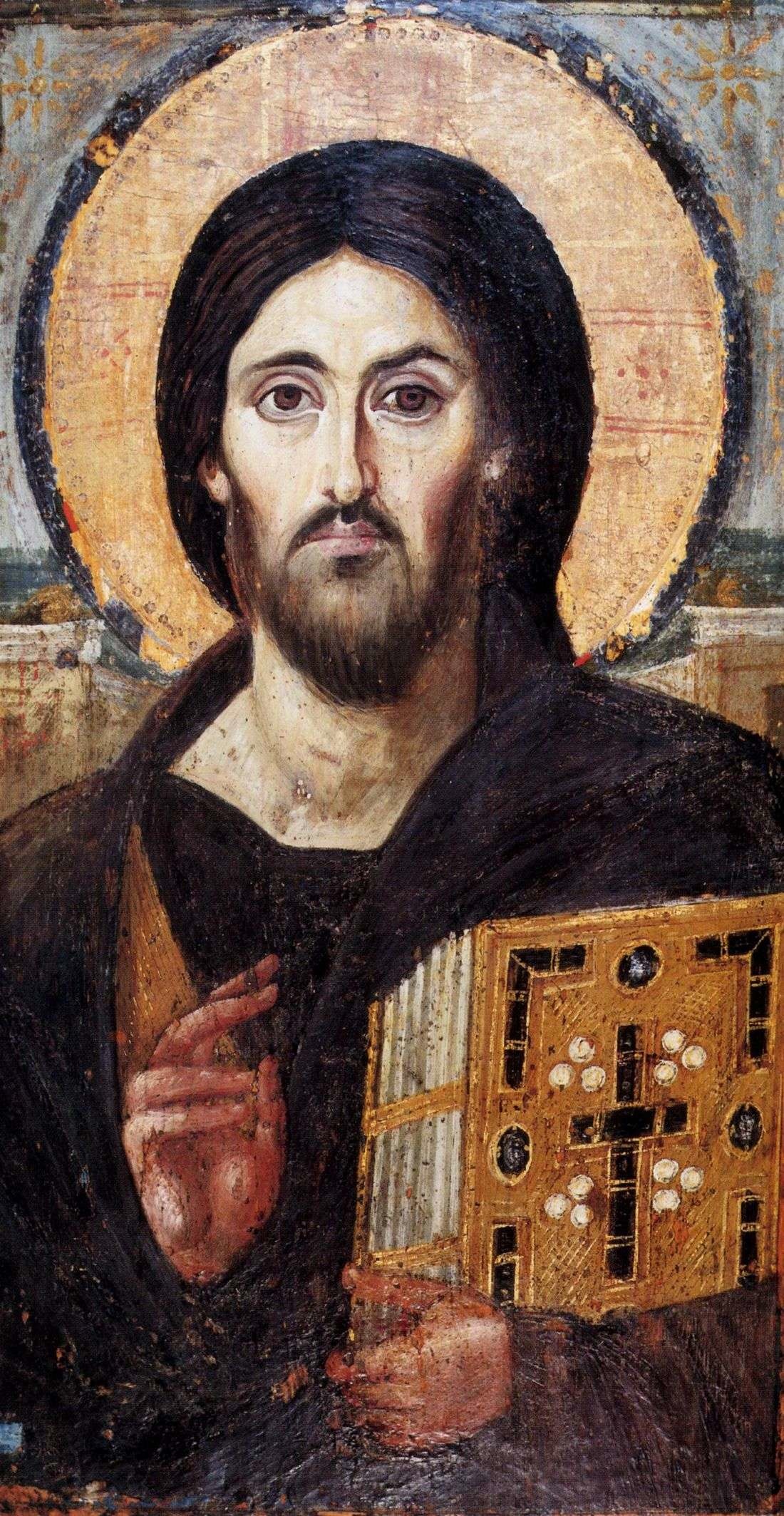
orthodox_icon_of_our_jesus_pantocrator_of_sinai._large
The above is a 6th century sacred icon of Jesus as Pantocrator. Pantocrator is a Greek word describing the all knowing, all powerful Son of God: Jesus Christ. The Council of Nicaea declared that Christ, as God, is consubstantial: Jesus is the same in essence (substance) and in being as the Father and the Holy Spirit. Also, Jesus possesses two natures: human and divine. This is truly a great Mystery of the Church. The sacred artist of the above icon, probably a monk, used hot pigmented wax (the encaustic method) to render this likeness. This sacred icon is currently located in St. Catherine’s Monastery, Sinai Peninsula, Egypt. The face has a striking resemblance to the face on the Holy Shroud of Turin.

The day-to-day proceedings and debate notes of the Council have been lost to history, so we will never know if St. Nicholas gave Arius a physical or just a verbal “slap.” Regardless, St. Nicholas made his point and contributed to giving us the gift of the Nicene Creed.

In AD 381, the Nicene Creed was edited and amended at the First Council of Constantinople (thus, the Creed is called the Niceno-Constantinopolitan Creed. Try to say that phrase fast, three times!😃).

Thanks for visiting with me. May you have a prayer-filled Holy Week.

Sources for the above post are found in my bibliography post, entitled Early Church Fathers – A Short bibliography of February 8, 2019. I relied primarily on Pope Emeritus Benedict XVI’s works, also Aquilina and D’Ambrosio’s volumes.

Copyright © 2011- 2019, Deacon Paul O. Iacono – All Rights Reserved. Permission to reprint must be obtained from the author in writing. Students may quote small sections of the article as long as the proper credit and notation is given. Thank you.


The Holy Trinity – Communication Through Word and Art

Is communication just a trait of human beings? Is it a trait of God?

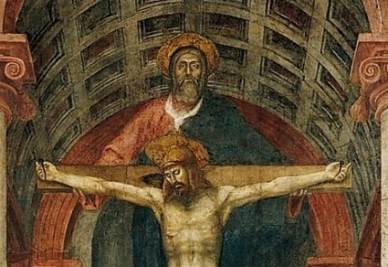
The Dogma of the Holy Trinity is one of the great Mysteries of the Christian Faith.  All Christians acknowledge and accept that The One True God, the divine Holy Trinity, are three separate and distinct Persons of the Father, Son, and Holy Spirit. The Holy Trinity is not three separate Gods. They are one God in three Divine Persons. This is known as the dogma of the “consubstantial” Trinity: each of the three Persons is God – completely and entirely.

These ideas were debated and verified by the assembled bishops at the First Council of Nicaea in AD 325 and subsequent Councils (specifically the ecumenical Council of Nicaea/Constantinople in AD 381).

In the 13th century the Fourth Lateran Council stated: “Each of the Persons is that supreme reality (nature, essence, and substance) of God” (confer Catechism of the Catholic Church, 2nd edition, paragraphs 198 through 315, pp. 54-84).

These three Divine Persons relate and communicate among themselves and desire to communicate and relate with Their creation. This is verified through Holy Scripture, Sacred Tradition, and the historic teachings of the Apostles, the Ecumenical Councils, and the saints of the Church.

The  first of Their creation, the nine choirs of angels, communicate with God and each other, too.

Obviously, human beings communicate and relate through speech, behavior, and the written word, though at times, not very well. To a much lesser extent, there is “communication” in the other members of the animal kingdom (by instinct, chemical, and behavioral signals) and in the plant kingdom (through chemical signals).

God the Father has communicated specifically through His Word, the incarnated Son, Jesus Christ. In accordance with the Father’s will the human Jesus is “born of a woman” into space and time through the great Mystery of the Incarnation of Christ.

Jesus agreed to humbly obey His Father’s will. Through His Incarnation the Divine Son Jesus expresses His two natures: human and divine. He does this while “hiding” the full majesty of His divinity (except for the moments of His Transfiguration, Resurrection, and subsequent appearances to His Apostles).

The Holy Spirit (as the Council of Florence stated in 1439) “Is eternally from the Father and Son; He has His nature and subsistence at once from the Father and the Son. He proceeds eternally from both as from one principle and through one spiration (the life-giving breath of God).”

“When the Father sends His Word to His Creation He also sends His Breath. “Jesus and the Holy Spirit are on a joint mission, while at the same time being distinct but inseparable. It is the Son who is seen, the visible image of the invisible God, while it is the Holy Spirit that reveals Him.” (please refer to page 181 of the Catechism of the Catholic Church, 2nd edition, also pages 54 through 90).

The Holy Spirit communicates and spiritually shapes us through the Holy Scriptures, liturgical and private prayer, the teachings of the Western and Eastern Rites of the Church, and with the Father and Son in the seven Holy Sacraments (in the Eastern Rites – the Holy Mysteries).

The solemnity of Pentecost recalls the full expression of the Holy Spirit’s “Fruits and Gifts” to the Apostles, and through the Holy Sacraments to us, too  (refer in the Christian Scriptures to the Acts of the Apostles chapter 2, verses 1 – 42; and in St. Paul’s letters to the Galatians chapter 5: verses 22 ff; and 1st Corinthians chapter 12, verses 4 ff; also refer in the Hebrew Scriptures  to the book of the prophet Isaiah chapter 11, versus 2 – 3).

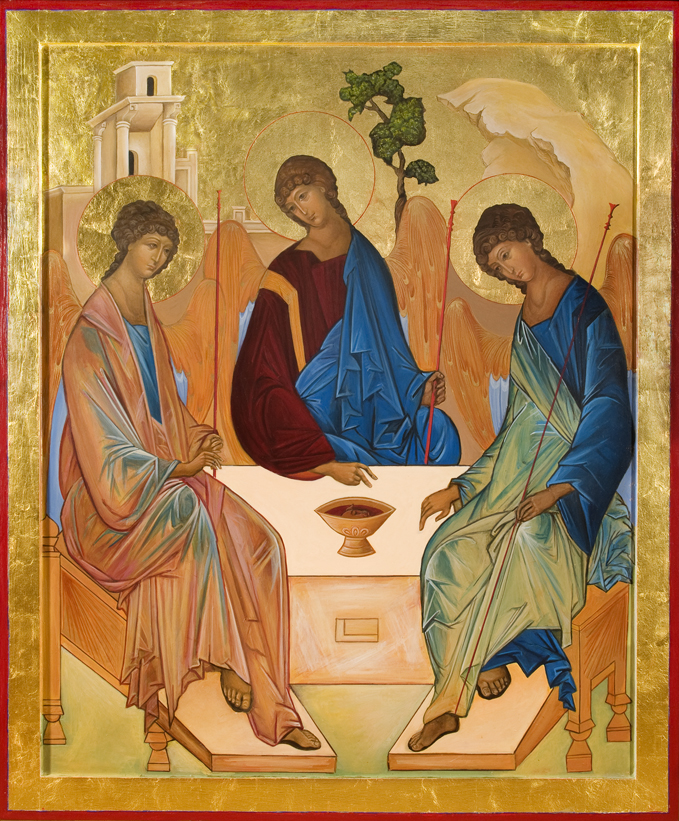
iconorininal
“The Trinity”: early 15th century; egg tempera and gold on wood panel by St. Andrei Rublev (1370 – 1430).  St. Rublev was a Russian Orthodox monk. He resided and “wrote” with egg tempera paint to produce images of God, the angels, and the saints in sacred  icons. He lived at St. Sergius Monastery in Moscow, Russia. His sacred icon above captures some of  the truth of the Three Persons of the Holy Trinity communicating with each other. God the Son, Jesus Christ, is the figure in the center of this painting.  You see two of His fingers extended to express His human and divine nature, and in a pointing gesture, to the “Cup of His Blood”  made manifest through His Redemptive sacrifice. In this masterpiece you observe the colors blue representing divine life and purple madder/burgundy signifying Christ’s humanity. God the Father is on your left and God the Holy Spirit is on your right. The Holy Spirit is garbed in blue and in green as a symbol of new life and spiritual growth through prayer and the Holy Sacraments (Holy Mysteries). God the Father is painted in both blue, green, and a very light, transparent gold ochre. The First Council of Nicaea (AD 325) verified and promoted the Dogma of the Holy Trinity. This Dogma was reaffirmed, and further explained by the Council of Nicaea/Constantinople in AD 381.


trinityicon
A contemporary copy of the original Trinity by Rublev.

God the Father sent His Son to be born of a woman through the fecundity of the Holy Spirit. The Incarnation of Jesus Christ changed the Universe. God became flesh and walked among us. Why?  In order to teach, heal, and redeem us from our sins. The New Covenant with His creation is written in His Blood. There is, if you have the gift of faith, ample proof that God wants to communicate with you.

It is up to each man and woman to honestly determine whether or not they are ignoring Him, and if so, to decide what to do about it. Time is short.

Copyright © 2011- 2019 Deacon Paul O. Iacono All Rights Reserved.

Luke: 16: 19-31 – Is Lazarus in Your House?

This passage from the Gospel of St. Luke is a parable about a destitute man named Lazarus and a rich man, who at times is called by the name Dives (the word dives in the Latin Bible refers to a “rich man”).

Jesus places Lazarus sitting day after day by the rich man’s front door. Lazarus is sick. He is at Dives’ home hoping to receive a scrap of food from his table. The food never comes.

Jesus continues to tell the story which culminates in the death of both men and their subsequent judgment.  Lazarus is welcomed into Paradise and is seen talking to Abraham, while Dives is condemned to the flames of Hell hoping for a drop of water to quench his thirst.

The parable concludes with Abraham rejecting Dives’ wish that someone from Paradise will inform his relatives of his eternal sentence in an attempt to get them to change their way of life.

Abraham says that it is fruitless: “‘If they do not listen to Moses and the prophets, neither will they be convinced even if someone rises from the dead.'”

You see its not just the issue of Dives, as a fellow human being, not providing nourishment and solace to Lazarus. It is the fact that Dives does not even acknowledge Lazarus. He and his servants pass him every day with no perception, no acknowledgement, no understanding, no charity.

How many times have we done that to men and women standing at intersections, asking for a scrap that falls from our table. We get uncomfortable at the thought that they are there. Irritated at bad government decisions that pushed them out on the street, supposedly to be helped by the social justice safety nets; nets filled with holes. I saw a woman today holding a sign that said “I need a miracle.” There was no exclamation point or happy face penned next to it.

Lazarus may be outside our front door, or, even in the house.

Question: are we passing by people in our own family who are in need? The neighbor who lives next door? A member of our parish? Are we passing by Jesus Christ?

Lent is the natural time to reflect on how well we remember and assist, in some small way, those around us who are in need. It may be financial help, or it might just be they need someone to talk to.

Upon reflection, we may find ourselves missing the mark, even committing sins of omission. Let’s remember that, unlike Dives, we still have time to do something about it.

300px-Meister_des_Codex_Aureus_Epternacensis_001
“Meister des Codex Aureus of Echternach” (the Master’s Golden Book of Echternach) – a page from this illuminated Gospel created in the mid 11th century. When seen by the Holy Roman Emperor, Henry III, it stimulated him to commission similar manuscripts from the Abbey of Echternach (Germany).


My thanks to Rev. Msgr. Anthony Mancini, Pastor of the Cathedral of St. Peter and Paul, Providence, Rhode Island USA, for stimulating this blog post.

Copyright © 2011- 2019 Deacon Paul O. Iacono – All Rights Reserved.

Christ in the Wilderness: Lent – the Season of Preparation – Luke 4: 1-2.

Jesus, full of the Holy Spirit, returned from the Jordan and was led by the Spirit into the wilderness, where for forty days He was tempted by the devil. He ate nothing at all during those days, and when they were over, He was famished. (Gospel of Luke chapter 4: verses 1-2)

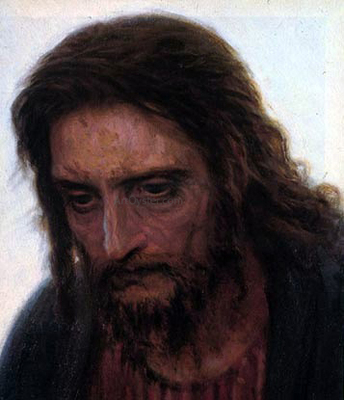
In the extraordinary painting  below, we see Jesus after He was led into the desert wilderness by the Holy Spirit. He is surrounded by rocks and sand. He sits on a boulder, hands in front of Him. His eyes are filled with the knowledge of reality, of passions, power, and pain, ego and emptiness, sin and self aggrandizement.

This painting may move us from the awareness that in the desert wilderness Jesus is not only thinking through His ministry, Passion, and death but is also viewing our lives – our ministries, our passions, our death.

What do we see?

Let us examine His face.

christ_in_the_wilderness_detail_400

We see the seriousness of the forthcoming temptations; the physical, mental, and the spiritually violent struggle with the devil. It is written plainly upon His emaciated face.

We see the irrefutable fact of Jesus’ humanity.

We see that He is like unto us, except for sin.

This is the face of our Savior; but the victory is not His, yet.

His temptations, public ministry, Passion, and death are still to occur.

What do we see?

We see a man who knows His Mind. He knows His Body, Soul, and Spirit.

He knows His freely accepted duty to accomplish His Father’s will.

This is not the face of a defeated man. It is the face of a determined man who is also Lord and Savior.

**679px-Kramskoi_Christ_dans_le_désert

Observe Christ’s clenched hands, gaze deeply into His eyes, and you will see the artist’s portrayal of a Savior that is already, at the beginning of His ministry, aware of the viciousness of the tempter and the burden of our sins. Sins accepted by Him, and through His Passion and death, makes all things new.

christ_in_the_wilderness_detail_400

Jesus had to confront in that desert assault whether or not He was going to be faithful to His mission.

The Gospel passage above challenges us with the same questions: are we going to be faithful to the Commandments, to our Baptismal promises, to the mission given us in Confirmation to live and practice the truths that He taught us?

Are we going to be faithful to the spiritual power and grace given to us, not just when we feel like it, but even in the most difficult of circumstances?

As disciples of Christ we are on a daily basis constantly revolving around the axis of temptation and sin – faith and grace. We understand that temptation, in and of itself, is a test – it is not sin. It is only sin when we willfully place ourselves in its shackles, when we give into its fueled power to overwhelm our body and soul. That power  – a deadly power – obtains its animus and energy from the original tempter and liar – Lucifer himself.

Hell is real. It is not a mental construct. To say that it doesn’t exist is to call Jesus a liar, and His Passion, death, and Resurrection meaningless.

Jesus the Christ lived heroically in the face of Hell’s demons and witnessed to the power of God’s grace.

But you say, I am not Jesus Christ, I am a weak man or woman, boy or girl.

I say true, we all are; but by virtue of our faithful reception of the Holy Sacraments (Holy Mysteries) of Reconciliation (Penance/Confession) and the Holy Eucharist we have the power of Christ’s grace within us. A power, freely given by God and unmerited by us, to resist and overcome temptation and sin.

If we do sin – if we do “miss the mark” – we have a remedy.  We follow St. Paul’s advice: pick yourself up, dust yourself off (confess your sins), and confidently continue on your journey. We must do our part in cooperation with God’s love and mercy.

The Season of Lent is a time of joyful repentance, prayer, and fasting.

Let’s remember the  words of Nehemiah, who in the Hebrew Scriptures says: Today is holy to the Lord your God. Do not be sad, and do not weep; for today is holy to our Lord. Do not be saddened this day, for rejoicing in the Lord must be your strength! (Nehemiah 8: 9-10. 5th century BC)

***

The painting above was created and completed in the late 19th century by Ivan Kramskoi. He was a gifted Russian painter, noted portraitist, draughtsman, and teacher. The painting is entitled Christ in the Wilderness.

Copyright © 2011- 2019 Deacon Paul O. Iacono All Rights Reserved. Portions of this essay may be used in accordance with correct notation and bibliographical insertion; contact deaconiacono@icloud.com for more information or questions.

Apologists – Additional Saints Prior to the Council of Nicaea

Today’s post will continue to add to my two previous posts: The Apologists (Defenders of the Faith) – Part 7, and The Apologists – Comparing Icons. 

The men below are also known as the Ante Nicene Fathers. The word Ante (before) refers to the fact that they defended the Faith during the terrible persecutions of the first three centuries of the Church (the Domitian, Decian, Valerian, and Diocletian persecutions). These persecutions occurred prior to the Council of Nicaea (AD 325).

The Council of Nicaea was called by the Emperor Constantine in order for the assembled bishops, and their representatives from throughout the Empire, to discuss, debate, and establish the basic elements of a Creed for the Catholic Church (Eastern and Western Rites).

Prior to calling this Council, Constantine had proclaimed the toleration of Christianity throughout the Roman Empire. He accomplished this through the Edict of Milan. This Edict (AD 313) did not mandate that Christianity was the official religion of the Roman Empire, that was to be done by a later Emperor – Theodosius I – in AD 380. The Edict just allowed for Christianity’s toleration as a religion.

The list below provides the additional Apologists who significantly contributed to the defense of all the aspects of the Early Christian Faith, such as the Real Presence of Christ in the Eucharist, the Seven Sacraments, the Holy Sacrifice of the Mass, etc.:

St. Justin Martyr, (born circa AD 100), an excellent writer, debater and teacher. He defended the Sacraments of the Church, especially the Real Presence of Christ in the Eucharist, the genuineness and inerrancy of the four Gospels, the Trinity, the two natures of Christ, how reason can come to know God, the Sacraments, God’s revelation and inspiration, etc. He also saw some aspects of ancient philosophy as a precursor of the Christian faith, and wrote two powerful defenses of the Faith to the Emperor and the Roman Senate. He was martyred, along with six other Christians, in AD 165.

St. Justin Martyr is a very important witness to the developing beliefs of the Catholic Church (Western and Eastern Rites) because he is discussing and describing many of the primary dogmatic and doctrinal beliefs of the Church which would be established over one hundred and fifty years later in the Nicene Creed (AD 325), and clarified and confirmed in the Council of Constantinople in AD 381.

St-Justin-Martyr-e1464838721698
A sacred icon of St Justin Martyr, martyred AD 165. He was a powerful teacher, writer, and Defender of the Faith as it was passed down to him from Apostolic Times.

St. Melito of Sardis, (died circa AD 185),  a scholar who saw the immense value and importance of the Hebrew Scriptures and how they contributed to the Christian Scriptures; in AD 175, wrote a defense of the Christian Faith which was published in a letter to Emperor Marcus Aurelius. He was also instrumental in teaching and explaining the two natures of Jesus Christ: one divine and one human. His explanations kept the two natures separate, and teaches that Jesus was truly human and truly divine. He fought the Christological heresies that were developing at this time (especially Marcion’s heresy concerning Jesus’ physical body).

Tertullian, (died circa AD 222) a powerful, yet, at times, tactless writer and lawyer. He wrote on many aspects of early Church theology. He also wrote a spirited defense of the Christian Faith in a letter to the Roman Emperor. Interestingly, he is known for his description of the members of the Christian Faith: “See those Christians, how they love one another,” and “The blood of Christians is [the] seed [of the Church].”

St. Hippolytus of Rome, (died circa AD 236) in his book – The Apostolic Tradition – sets down a manual of liturgical prayers and tradition and it refers to an order of the Holy Mass. The current Eucharistic Prayer 2, in the Sacramentary (liturgical missal) used in the Western Rite, is attributed to the central prayer found in his The Apostolic Tradition.

Origen of Alexandria, (died AD 254), a genius in speculative theology who wrote extensively on subjects such as the belief in One God, the Three Persons of the Holy Trinity, the Holy Sacraments of the Church, etc. He was a voluminous writer and died a martyr.

St. Cyprian of Carthage, (born circa AD 200); he was a student of Tertullian. St. Cyprian was a tireless theologian and worker for unity within the Church, and through his patient and good-hearted efforts solved many controversies and squabbles. As a bishop he proclaimed that he was willing to welcome any pagan or heretic into the Church who confessed their sins, were willing to do penance, and were baptized. His defense and scholarship on the Holy Sacraments is considered important. He died a martyr in AD 258.

In my next post, Part 8, I will briefly discuss the Golden Era of the Apostolic Fathers (AD 325 – 430) whose blossoming occurred after the Council of Nicaea; also in that post, I will discuss and list the Post Nicene Fathers (circa AD 430 – AD 800). In Part 9, I will briefly list some of the important Church Councils of the 5th century and how they affected the Church’s sacred art.

Please review the bibliography page (found at the post of February 8, 2019). It provides the sources that I have been using in this specific sequence of posts on Church history.

Thanks for visiting with me. On this Ash Wednesday allow me to offer you my best wishes for a productive and prayerful Lenten Season.

Copyright © 2011- 2019, Deacon Paul O. Iacono – All Rights Reserved. Permission to reprint must be obtained from the author in writing. Students may quote small sections of the article as long as the proper credit and notation is given. Thank you.


Christian Witness and Sacred Art – The Early Church Fathers – Part 7

A Challenge: Are you as a Christian artist willing to internalize the message of the saint, scene, or Scripture passage you are artistically representing, and then, correctly portray it according to Church tradition?

Sacred artists must have more than just an awarenesses of Jesus, His Mother, angels and  saints because their witness provides us with the foundation stones of our Faith. Sacred artists must be more than artists who propose “Art for art’s sake”.

If we do this what do we become? We become evangelists to the truth, goodness, and beauty of God, through the witness of Jesus Christ and the holy men and women who called Him the Son of God.

In the years immediately following St. Polycarp’s martyrdom (died, circa AD 155, and remembered yesterday, February 22nd, in the Roman Breviary and Missal) a group of eight Western and Eastern Rite scholars and clerics arose known as the Apologists (Defenders of the Faith).

The Apologists defended the beliefs and traditions of the Church that passed down to them, in an uninterrupted line, directly from the Apostles and Apostolic Fathers.  This occurred during the years of continued persecution – AD 155 through AD 313.

The works and ministerial witness of the Apologists provide evidence for the continuity of beliefs and dogmas in the Early Christian Church. It is through this historic development, and the literary and physical witness of their efforts, that we have  religious and cultural traditions which dramatically affected the growth of sacred art. These clerics and scholars desired to unify and establish the beliefs of the Western and Eastern Rites of the Church.

Church artists, and the later group of clerics and scholars known as the Nicene Fathers (who I will cover in later posts), were heavily influenced by their efforts. These two groups, the Ante Nicene and Nicene Fathers all desired to make concrete and visible the correct teaching – the orthodoxy – of the Church. These efforts ultimately produced artistic representations of these early spiritual heroes – a visible sign of the truths of the Gospels being preached – and in some cases, their witness in blood.

The Apologists have also been termed The Ante (Before) Nicene Fathers because they lived and died prior to the establishment of the  Creed of the Catholic Faith, ultimately to be known as the Nicene Creed.

Let us briefly review two of the Apologists: St. Irenaeus of Lyons, and St. Clement of Alexandria. In a subsequent post you will have the opportunity to read three or four sentence descriptions of the contributions of the other six  Apologists.

St. Irenaeus of Lyons was born in AD 130 and died circa AD 202. He speaks of the four Gospels as being the “Four Pillars of the Church,” and was in a position to know that since he heard St. Polycarp (a friend and disciple of the Apostle John) preach. He was steadfast in supporting the belief in Apostolic Tradition. He taught that the true Faith is the one imparted by the bishops of the Church who, in turn, received it directly in an uninterrupted set of teachings from the Apostles. St. Irenaeus was tenacious in his fight against heterodoxy, specifically the Gnostic heresy.

St. Irenaeus understood the value of St. Polycarp’s New Testament scholarship and his emphasis on the Church’s sacred Tradition. He spoke with authority on Mary as the New Eve, and the Holy Eucharist. St. Irenaeus barely escaped death during the persecution of Emperor Marcus Aurelius, however during the round-up approximately 50 other Christians had the joy of earning the holy crown of martyrdom. He may have eventually died a martyr, yet, there is not sufficient evidence to support it.

IconPM-Irenaeus-2
St. Irenaeus of Lyons (died circa 202). Famous for his manuscripts Against Heresies. He used 21 out of the 27 books of the New Testament in his writings and sermons.

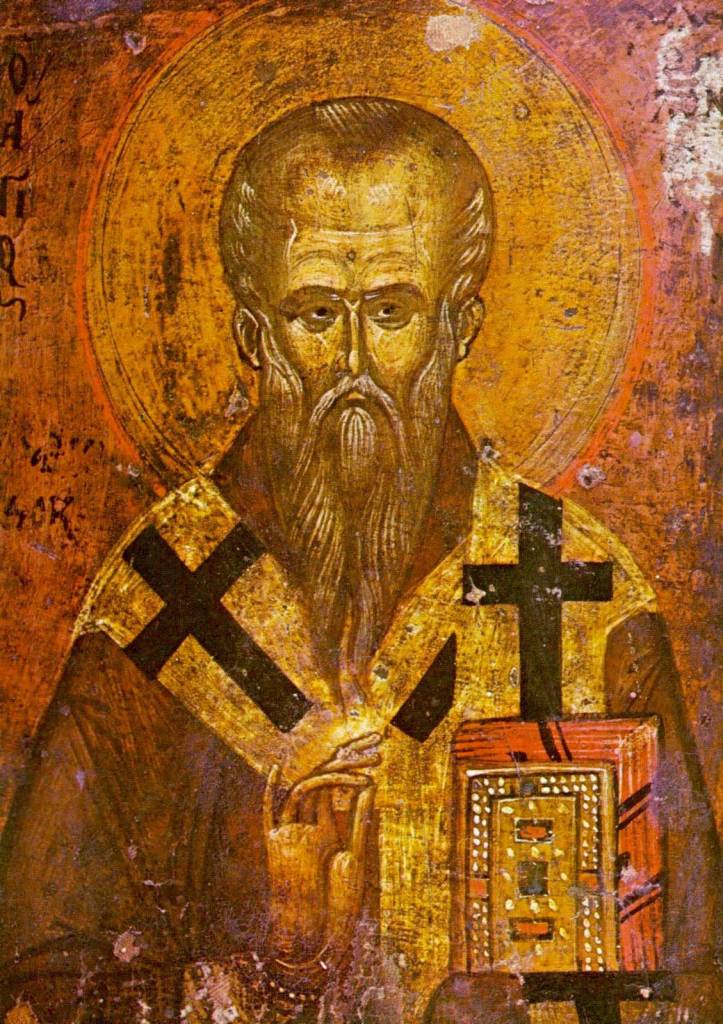
Another critical Apologist is St. Clement of Alexandria (born circa AD 150, died circa 215). He led a major catechetical school in Alexandria, Egypt and agreed with St. Irenaeus that the truth and knowledge of the holy Gospels proceed through the bishops and are for the population as a whole and not for any secret society (thus, he fought against the Gnostic heresy).

He taught that in order to understand the truths of the Gospels you must have faith in unison with reason. He is also known for three major catechetical works which are still in existence. These works were meant to accompany catechumens and those baptized into the Christian faith as an aid to their spiritual development. He was not martyred.

SAINT-CLEMENT-I
St. Clement of Alexandria – an Apologist of the Early Church – as represented by an early iconographer of the Eastern Rite of the Catholic Church.


Thanks for stopping by the Institute. I hope you have a relaxing weekend.

Copyright © 2011- 2019 Deacon Paul O. Iacono All Rights Reserved. Permission to reprint must be obtained from the author in writing. Students may quote small sections of the article as long as the proper credit and notation is given. Thank you. Permission to copy these posts must be obtained from Deacon Paul Iacono at deaconiacono@icloud.com.

Roman Catholic Sacred Art – Part Five: The First Theological Theme

In the past four posts I briefly reviewed the following topics: Part 1: What is Art, Part 2: Roman Catholic Sacred Art – Categories, Part 3: Roman Catholic Sacred Art – Painting Schematic, and Part 4: Roman Catholic Sacred Art – Three Major and Minor Stages.

Today in Part 5, I would like to provide you with a brief review of a major, historically based, theological theme that directly impacts the creation of Roman Catholic and Orthodox Greek/Russian sacred art.

It is an historical fact that in the year AD 30, the Roman historian Tacitus writes in his Annals that “The Christ is condemned to death by Pontius Pilate, under the emperor Tiberius.”

It is a belief of all devout Christians that Jesus, the Son of God and through the power of the Holy Spirit, was born of the Virgin Mary. His ministry to the Israeli people was the fulfillment of Hebrew prophecy. At the end of His ministry He was unjustly tried by the Romans, condemned to death, tortured, crucified, and died in reparation for our sins. Three days after His death, through the power of the Father and the Holy Spirit, He rose from the dead and was seen and interacted with the twelve Apostles and hundreds of His disciples. Before His ascent to Heaven the Apostles are told by Jesus to “Go therefore, and make disciples of all nations, baptizing them in the name of the Father, and the Son, and the Holy Spirit, teaching them to observe all that I have commanded you; and behold, I am with you always, to the close of the age” (Gospel of Matthew, chapter 28: vs. 19-20).

St. Paul explains to us in his letter to the Colossians (1:15) that Jesus Christ is the image, the icon (eikon) of the invisible, all powerful, God. Our foundation from the Hebrew and Christian Scriptures explains that God communicates with us through historic events, His prophets, and His Son Jesus (“God is With Us” – Emmanuel).

orthodox_icon_of_our_jesus_pantocrator_of_sinai._large
6th century painting of Jesus as Pantocrator (all knowing, all powerful)

The Holy Trinity – Father, Son, and Holy Spirit, communicate among themselves, too. The Father communicates with His creation through His incarnated Son. The Father discussed His plan for our eternal salvation, with His Son, and the Son  – Jesus, the Christ, agreed to both the Father’s plan for our Redemption and His Incarnation into human history. He also agreed to humbly obey His Father’s will.

Thus, through His Incarnation, Jesus expresses his two natures: human and divine. He does this while “hiding” the full majesty of His divinity (except for His Transfiguration and Resurrection). The full ramifications of the Incarnation of Jesus is one of the great mysteries of our Faith. It demands of us humility, faith, and loving obedience to God’s revealed teachings.

trinityicon
15th century painting by St. Andrei Rublev of the Holy Trinity (Jesus is in the center)

The Incarnation of Jesus Christ changed the Universe. God became flesh, thus, all matter is good. Nature’s matter – its water, mineral, plant, and animal life – and its living beings – must be enjoyed and respected in obedience to God’s Laws.

Thus, we have our first theological theme: God the Father has communicated His love and laws to us. He has achieved this through His revealed word in the Scriptures, and the ministry, death, and resurrection of His Son, Jesus, the Christ. Our Redemption by Jesus has made it possible for the Holy Spirit – the Sanctifier – to  express the love of the Holy Trinity to us through the Sanctifying Grace of the Seven Holy Sacraments.

Through theologically based sacred art these truths come alive. We are able to experience the life of our Redeemer  and the historic life of the One, Holy, Catholic, and Apostolic Faith. This is all made visible to us through the painting, sculpture, music, drama, literature, poetry, and architecture of two thousand years of gifted artists.

Thanks for visiting with me. My best wishes for a great weekend!

Copyright © 2011- 2019 Deacon Paul O. Iacono All Rights Reserved


Roman Catholic Sacred Art – Categories

Tonight we will use yesterday’s post as a starting point to examine Roman Catholic painting. I mentioned that there are seven disciplines within the definition of Art. One of those disciplines is painting.

As it applies to this discussion when we consider the discipline of painting we can say that there are two major categoriesRoman Catholic Sacred Painting and Secular Painting.

We can then subdivide these two major categories.

Within the category of Roman Catholic Sacred Painting we have two major subcategories: Sacred Icons and Sacred Images.

I propose that there is a subcategory below Sacred Images, it is called Religious Images. I will explain in later posts the difference between Sacred Images and Religious Images.

Within the category of Secular Painting we can say that there are two subcategories. Let us call the first subcategory A Variety of Images. It consists of all the different types of paintings, made for the purpose of being “artifact, entertainment, political or social commentary, therapy, or a combination of two or more.” (Sporre, 1996; see previous post). It begins with the many generational wall and ceiling cave paintings painted by Paleolithic Man in the Vezere Valley, France approximately 17,000 years ago and continues with contemporary painters. Mankind loves to paint pictures.

The second subcategory within Secular Painting, as it applies to this discussion, is what I call Absurd Religious Images. Even though it has religious subject matter it is, in my opinion, secular art. I will provide a definition of that subcategory in an upcoming post and images which will make it recognizable.

Thanks for stopping by and spending some time here.

Copyright © 2011- 2018 Deacon Paul O. Iacono All Rights Reserved

St. Joseph’s Art Workshop: Lesson 4 – Applying Color and Modeling the Face

Just wanted to notify the people who are following the art lessons in my St. Joseph Art Workshop tab that I just published Lesson 4: Applying Color and Modeling the Face. You need to go to the Menu tab above and click on Lesson 4 to see it.

My next post in the St. Joseph’s Art Workshop tab will be Lesson 5. It will be the last post in my Art Exercise of Painting Sacred Images using Acrylic Paint. 

Thanks.


Fra Angelico’s Four Reliquaries for the Church of Santa Maria Novella – Part 4 of the “Heaven on Earth” Exhibition

Today’s post is Part 4 in my series that began on May 16, 2018 concerning the recently concluded exhibition of extraordinary egg tempera paintings by the Dominican friar Beato Fra Angelico. The exhibition was held at the Isabella Stewart Gardner Museum in Boston, Massachusetts during the Spring of 2018 and was entitled Fra Angelico – Heaven on Earth.

Nathaniel Silver, Associate Curator of the Collection for this exhibition, includes in his book, Fra Angelico – Heaven on Earth, articles by eleven scholars. Each paper is a quality contribution to scholarship. There is one article authored by Chiara Pidatella, entitled “The Provenance of the Four Reliquaries for the Church of Santa Maria Novella.” It clarifies and answers the confusion surrounding the provenance of the four reliquaries. Ms. Pidatella has written an important paper in that it compiles the documentary evidence that proves that the four sacred images within the reliquaries in the sacristy of the Church of Santa Maria Novella in Florence, were painted by Fra Angelico. These reliquaries and other Angelico masterpieces were on display in the Gardner Museum.

A reliquary is an ornate elaborately constructed box, frame, etc. that is made of wood or precious metals and contains the remains of an individual or multiple saints. These remains may be small or large particles of bone, hair, etc of the deceased saint.  Depending on the design of the frame the openings for the relics are contained in the top or bottom, and in the center if it is a box with lid. You can see the potential opening for the relics at the top of the frame in The Dormition and Assumption of Mary.  It would be within the top circle that is vertically sliced in the center, the relics would be put in that small opening behind “the doors.” It should be noted that Colnaghi & Co. built a new frame for that painting in 1899. I presume they were loyal to the original design of a gabled early Renaissance reliquary, and that the vertical slice is actually an opening for the relic(s).

The reliquaries in the exhibition are embellished with four extraordinary paintings of events in the life of the Blessed Virgin Mary. Ms Pidatella says that “The fact that the saints whose relics they [the reliquaries] contained are not explicitly named suggests that the relics were of minor importance, especially in comparison to others mentioned in the same documents and described with great precision (particularly those decorated with gemstones and precious metals). The third inventory also confirms that all four reliquaries stayed together in the sacristy until at least 1772″ [Pidatella, p. 25]. 

The history of the movements of the four reliquaries is interesting. I won’t go into the historic details yet one incident deserves mentioning  (I recommend that you purchase the book, Fra Angelico – Heaven on Earth, 2018, Gardner Museum, and Paul Holberton, London). The incident concerns the events of the early 19th century when the French government was required (under orders from Napoleon) to make an inventory of Italian artworks. The result being the French government took a very hard stand in relation to Italian art. Ms. Pidatella mentions their belief “that only France deserved to exhibit works from the most important moments in the history of art” (emphasis mine) [Pidatella, p. 27].   Pretty cheeky.

While three of the reliquaries remained in Florence, the Dormition/Assumption of Mary reliquary (one of four seen below) made its way into a collection of an English family headed by Rev. John Sanford (1777 – 1855; he was the chaplain to the Duke of Cambridge, brother of the British King George IV). This acquisition occurred  in the early 19th century; however economic difficulties led to Sanford’s daughter, Anna Horatia Caroline Methuen, to put this Angelico painting on the market. When this occurred Bernard Berenson recommended Isabella Stewart Gardner of Boston to purchase the piece, which she ultimately did in 1899, for £4000 [Howard, p. 18, Fra Angelico – Heaven on Earth]. The Dormition and Assumption of Mary painting then became the first Fra Angelico to be displayed in the United States. Its current frame (that you will see below) was commissioned by Colnaghi & Co.(art dealers) in 1899. Their focus was to frame it in its original gable design {Howard, p. 18-19, ibid].

It is my privilege to present to you my quickly snapped photos of these masterpieces of the four reliquaries (through the courtesy of the Isabella Stewart Gardner Museum) . I will also provide my photograph of the back of one of the reliquaries to show you the wooden panel on which the egg tempera paint was applied. You will see that the panel was covered with a decorated piece of paper-like parchment. The reliquaries are approximately 24 inches tall by 15 inches wide.

The Annunciation and Adoration of the Magi (painted 1426-27) egg tempera and gold on wood panel. This frame is not slightly tipped to the right in reality. It was my attempt to snap a photo before someone stepped in front of me; I didn’t realize the photo was tipped at the time!

IMG_1775


IMG_1777

IMG_1710

The above two are closeups of the Annunciation and Adoration. Slight tipping resulting from a quick snap occurred here, too. The green squares to the left of Mary’s head are not part of the painting. I did not use a flash. I don’t know what they are, possibly security lights. Notice the extraordinary grill work in back of the Virgin Mary, the angel Gabriel, and the Magi.

IMG_1703

The Dormition and Assumption of Mary (1433-34, egg tempera and gold on wood panel). Purchased by Isabella Stewart Gardner in 1899, making it the first Fra Angelico painting in America. The painting shows in the lower section the Dormition (falling asleep, death, and above it the resurrection of Mary, the Mother of God ( that is, Mother of Jesus’ human nature) and her simultaneous Assumption into Heaven. The angel, dressed in a blue garment to the left of the frame, is one of a number of larger than life size posters that graced the black walls surrounding the exhibit. These poster angels were copied from Fra Angelico’s paintings. They provided a dramatic effect to the entire exhibit.

Adj ASSUMPTION FRA A.

The above is a closeup of Mary which has also been expanded into a larger than life size poster image found in the above Assumption painting. This image was the first you saw as you rounded the second floor stairs into the exhibit at the Gardner Museum. It was taken from the above reliquary on the Dormition and Assumption of Mary and introduced visitors to the beauty of the exhibit.

IMG_1707

The Coronation of the Virgin (1429). The lower image within this reliquary is contained in a small rectangular panel called a predella. It shows the Adoration of the Christ Child by Mary, St. Joseph, and six angels. It also is completed in egg tempera, gold, on a wooden panel. You see more poster angels taken from the Dormition and Assumption of Mary painting in pink and blue garments to the right of this reliquary on the black walls of the exhibit.

IMG_1709

This is a closeup of the Coronation of the Virgin found within the above reliquary. Below are gathered a group of saints. The saint looking over his shoulder at the viewer near the extraordinary translucent stairs is Saint Peter holding the keys of Heaven. St. John the Baptist is on his left. Dominican saints, St. Peter Martyr and theologian St. Thomas Aquinas are also present, St. Francis of Assisi showing the stigmata in his hands, two deacons (St. Stephen, the first martyr (protomartyr), and possibly the deacon St. Benjamin, and some Old Testament prophets. St. Thomas Aquinas (above within the  bigger photo) is looking at the viewer. He is situated next to a pope (the Benedictine Gregory the Great?), possibly placed in that position because both Aquinas and the pope were not martyrs.

IMG_1720

The Madonna della Stella (The Madonna of the Star, 1433/34). Within the predella are the major saints of the Dominican Order (Order of Preachers). Saint Dominic (middle) flanked on the right by St. Thomas Aquinas and on the left by Saint Peter Martyr. The small circular photo of the Church of Santa Maria Novella on the back wall of the exhibit accidentally was included in my quick snap of this picture.  It is interesting that it appeared, I did not plan it. It is the church that the four reliquary paintings were originally housed before they were split up during the last two and one-half centuries.  Presently the Gardner Museum has the Dormition/Assumption of Mary reliquary staying in its collection and the other three will be returned to the Museo San Marco in Florence, Italy.


IMG_1722

Closeup of the Madonna della Stella, showing the symbolic colors of the garments worn by the figures. The color blue represents divine attributes, which in the Blessed Mother’s case, represents the belief that she was always immaculate – without sin – and that the Holy Spirit “overshadowed” her resulting in the Incarnation taking place within her physical body. The presence of her immaculate nature was within Mary from the moment of her conception. The Latin Rite, the Eastern Rites in union with Rome, the Coptic Church, and the Orthodox Rites believe that Mary is not God, or a goddess. All of these Rites and Churches do not worship Mary; she is venerated by them. Worship and veneration are two very different concepts; they should never be equated.

The color red of Mary’s inner cloak (as well as Jesus’ outer cloak) represents their human nature. The orange trim of her cloak represents the specific spiritual illumination, and self knowledge, of her status as the Mother of Jesus’ human nature, not His divine nature.

With the two lower angels you notice that the blue/red colors are reversed. The inner cloak is blue representing their spiritual illumination and unique qualities/functions, yet, their outer cloak is red. This is done because Fra Angelico represents them all with human features, but, in the case of the two lower angels he represented their outer cloaks as red. I can place no other interpretation on it other than to say that because Jesus and Mary were resurrected from the dead, and have new physical bodies (with unique and specific qualities) the angels dressed in red outer cloaks may be serving Mary’s physical needs (whatever they may be) in Heaven. Heaven is viewed as both a physical (while different from ours) and a spiritual dimension.

As you know, angels are spiritual beings living within the divine atmosphere of Heaven. According to the Latin Rite (Roman Catholic) and other Rites, there are nine “choirs” of angels; each choir possesses specific attributes and functions. Fra Angelico may be distinguishing one “choir” from another through the different colors of the angels’ garments. Angels are pure spiritual beings; they do not have human features or bodies. They are represented that way in Latin and Greek Rite paintings, and some of them in the Holy Scriptures, in order to give the observer/reader a way to relate and understand their functions.

The Dominican Order was keen on expressing the theology of illumination as expressed in the Blessed Mother, their founder – St. Dominic (who illuminated Europe with his sermons against heretics) – and the illumination of the doctrines and dogmas of the Catholic faith provided through the writings of 13th century theologian St. Thomas Aquinas.

For Mary, Fra Angelico expressed that illumination through the orange pigment of Mary’s inner garment and the extraordinary gilding of the rays of light emanating from Mary and Jesus’ bodies. Notice that Fra Angelico shows the love between the two by having the child Jesus place His head close to His Blessed Mother as if He is about to give her a kiss with the Madonna lovingly holds Him.

IMG_1723

Closeup of the Madonna della Stella; also showing a lovely lavender angel on her left.

IMG_1715

The back of one of the reliquaries showing the structure of the wooden panel, and its decorated paper covering. On the front Fra Angelico applied a base coat of gesso, and then his egg tempera paints and gilding.

I hope you enjoyed viewing my four part series on this extraordinary work by Beato Fra Angelico – Fra (Friar) Giovanni di Fiesole. My deep gratitude to Peggy Fogelman  (Director), Nathaniel Silver (Associate Curator) and the very talented staff  of Boston’s Isabella Stewart Gardner Museum for bringing these masterpieces to America. For my wife and I it was a once in a lifetime experience. Congratulations to them and my sincere thanks, too.

I will be featuring some of the remaining single paintings within this exhibition at appropriate times during 2018-19. Some of the remaining Fra Angelico images from this exhibit are the marriage of St. Joseph and the Blessed Mother, the Deposition (taking down) of Jesus from the Cross, another painting of the Dormition of Mary, and events in the life of of Saints Cosmas and Damian.

June 12, 2018

© Deacon Paul O. Iacono 2011-2018 – text and photos. Photos were taken through the courtesy and generosity of the Isabella Stewart Gardner Museum, Boston, Massachusetts, USA. I took the photos with an iPhone 6, no flash.


Fra Angelico and the Armadio degli Argenti – Part 3 of the “Heaven on Earth” Exhibition

Today’s post is Part 3 in my series that began on May 16, 2018 concerning the recently concluded exhibition of extraordinary egg tempera paintings by Fra Angelico. The exhibition was held at the Isabella Stewart Gardner Museum in Boston, Massachusetts and entitled Fra Angelico – Heaven on Earth.

Today’s  painting concerns a major piece of the exhibition – the Armadio degli Argenti.  The four panels of which the Gardner Museum only showed one is also known as the “Silver Chest.” It was commissioned in 1450 and completed in 1452, three years before Fra Angelico’s death.

This panel (123 x 160 cm) includes eleven compartments: The Road to Calvary, The Disrobing of Christ, The Crucifixion of Christ, the Entombment of Christ, The Descent into Limbo, The Three Marys at Christ’s Tomb, The Ascension of Christ, Pentecost, The Last Judgment, The Coronation of the Virgin, and the Lex Amoris (Law of Love). The panel is seen below.

IMG_1759

This panel is one of four that decorated a large cupboard-like chest. The chest contained highly valuable silver votive offerings that were donated by the faithful of Florence to the Church of Santissima Annunziata. Their donations were in honor of a miracle working fresco of the Annunciation of Mary in a side chapel of that church.

The entire chest was commissioned by Piero di Cosimo de’Medici during the church’s restoration. The paintings within the thirty-six “compartments” are painted in egg tempera and gold on a wood panel (The Last Judgement occupies two compartments).

In 1782, the panels were separated from the chest in, thankfully, an unsuccessful attempt to sell them. In 1812 they began their journey to the Galleria dell’Academia, and finally to their current resting place – the Museo di San Marco.

Some close-ups of the panel are found below.

IMG_1763

The “compartment” above was entitled Lex Amoris (Law of Love) by Fra Angelico. It shows a menorah covered with scrolls on which are written items relating to the New and Old Law, and emphasizing the New Law as superior. The scrolls specifically relate to the Sacraments of the Church and specifics of the faith. We also see the twelve Apostles and the twelve Hebrew prophets on each side of the menorah showing that they are all connected through the holy Cross of Christ (top center with red and white standard). The purpose of this panel is to explain that in the coming of Jesus Christ you see the fulfillment of the Biblical prophecy of the Messiah, which does not stand alone, but is related to other events in Jewish history. Notice the female in the lower left corner holding a shield which proclaims “Lex Amoris” (Law of Love) versus the Jewish tradition of “Lex Timoris” (Law of Fear). In her right hand she holds an open book. A beautiful allegory of faith that is beautifully executed by Fra Angelico.

IMG_1762The above photo is one of the thirty-six panels describing events of the New Testament, in this case the Coming of the Holy Spirit at Pentecost. Notice Jesus’ mother Mary at the top center of the image with the Apostles and disciples (Peter is on her top right, and John is on her top left). They are receiving the Gifts and Fruits of the Holy Spirit symbolized by the tongues of fire. A curious crowd gathers below the upper room as described in the Acts of the Apostles. IMG_1760

This is a close-up photo of one of panels in the Armadio degli Argenti in this case showing part of the image of the Last Judgment. Notice one of the angels dragging a sinner from the right side of Christ, the abode of the saved – to the left side of Christ, the abode of the damned prior to their being cast into hell.

The beautiful book, published in union with the Gardner Exhibition, Fra Angelico – Heaven on Earth – was edited by Nathaniel Silver and published in 2018 (Boston, London). It was extremely helpful (pages 210 – 215) in my commentary.

photos (iPhone 6, no flash) and text © Deacon Paul O. Iacono 2011-2018

St. Joseph’s Art Workshop – Lesson 3 – Applying Pigment

To all those that have expressed interest in the FREE on-line sacred art workshop that I am offering here at fraangelicoinstitute.com please note that yesterday I posted Lesson 3 in Exercise 1: Painting an Image of St. Rose of Lima.

Just click on the St. Joseph’s Art Workshop Tab on top of the image of St. Gabriel and the Virgin Mary and you will see the first Workshop page.

If you have already visited the Workshop Tab then just continue to scroll down to find the Lessons that I have posted so far. I am putting all the Lessons in one place because it will be easier for you to scroll up and down to refer back and forth to other Lessons for Exercise 1.

More lessons will be posted in the upcoming weeks. You have enough to read and keep you busy for now!

Feel free to participate and enjoy the process of creating art!

Fra Angelico – “Heaven on Earth” Exhibition – Part 2 – Ascension, Pentecost, the Last Judgement

I hope you had a blessed Feast of Pentecost!

Please read Part 1 of “Fra Angelico – Heaven on Earth” (posted here on May 16, 2018) in order to receive a proper introduction to the Isabella Stewart Gardner Museum’s extraordinary exhibition that, unfortunately, closed this weekend..

As you moved into the gallery that exhibited this once in a lifetime collection of Fra Angelico paintings you first saw the beautiful painting entitled The Ascension of Christ, The Last Judgement, and Pentecost (the Corsini Triptych). It is painted in egg tempera with gold leaf on a wood panel. Fra Angelico painted it during the years 1447-1448, seven years before his death in 1455. It was loaned to the Gardner Museum from the Galleria Nazionali d’Arte Antica di Roma – Galerie Barberini Corsini, Palazzo Corsini.

My photographic images of that painting are found below:

The Ascension, Last Judgement, and PentecostIMG_1686

The following quotation is taken from the Exhibition’s commentary found on the right side of the painting. Mesmerizing in its detail, Fra Angelico’s painting pictures three biblical events. At left, Christ ascends into heaven over the heads of the Virgin Mary and the  Apostles. At right, a masterfully foreshortened dove – the Holy Spirit – descends to earth. The story culminates in the center. Christ passes judgment over the living and the dead, saving the worthy (left) and condemning the wicked (right). While the damned cower from fearsome devils who attack the poor souls with claws, angels embrace the blessed.

“This small devotional triptych – a painting with three parts – served a cultivated individual, probably a cleric (deacon, priest, or bishop) in Rome.” Please compare its three episodes to others in my upcoming posts. In the above painting Fra Angelico adopts a vertical presentation. This energizes the connection and communication between heaven and earth. The Gardner Museum’s curator remarked that this technique “enlarges the central scene, and emphasizes” the Catholic Church’s spiritual power.

Fra Angelico, as a Dominican priest, desired to present that Jesus’ act of Redemption (passion, death, and resurrection), and His Ascension back to the Father, made possible the moment of Pentecost. Christ’s actions enabled the eventual opportunity for our free will to choose to accept His Truth and be fed by the Spirit’s power. It is the Father and the Son’s will to have the Holy Spirit nourish us through His grace. This grace is available to us through the proper administration and worthy reception of the Holy Sacraments. Thus, we come to the central panel –  the Last Judgement. Did we freely accept His Sacramental grace or did we ignore, and thereby, reject it? At that moment will we be on the right or the left of Christ?

Allow me to make some personal points on the three close-up photos below. In the first panel of this painting, notice the gold work around the body of Christ. I was allowed to closely examine it. I have never seen a painting’s gold work done with such precision and delicacy. It is not just gold leaf that is applied in a flat manner to the panel. It appears to be actual raised strands, or threads of gold, all applied with great precision. As you slowly move left or right around that part of the painting you notice the light catching the gold and literally radiating and shimmering around the image of Christ. IMG_1745

The Ascension, with Pentecost below.

Second, the image of Pentecost, with the Blessed Mother in the center of the Apostles as the dove hovers and the fire of the Holy Spirit descends upon them and gives them the gifts and fruits of the Holy Spirit (Isaiah 11:23; 1st Corinthians 12: 4 ff; Galatians 5: 22 ff).

Notice St. Peter, filled with conviction, speaking to the assembly of men below (“Peter’s Discourse” found in the Acts of the Apostles chapter 2, verses 14 ff.). Also, notice the clothing on one of the men who gather outside of the upper room listening to Peter: the detail of the lace work on the bottom of one of his garments, and the shadows on the man’s red leotard/shoe. If you stand away from the painting at approximately eight to ten feet to take it all in (as you see in the panoramic top photo) you don’t notice all the detail; but the blessed Fra with his extraordinary perception, noticed the need for it, and he painted it in. A master of detail, and as a true maestro, he knew how to successfully accomplish it. Wonderful!     The last two close-up pictures are below.

IMG_1748

IMG_1749

My photos (through the kindness of the Isabella Stewart Gardner Museum), and            my text © Deacon Paul O. Iacono 2011-2018. Photos taken with an iPhone 6, no flash.


Fra Angelico – The “Heaven on Earth” Exhibition – Part 1

The Isabella Stewart Gardner Museum in Boston, Massachusetts is the only venue in America for the extraordinary “Fra Angelico: Heaven on Earth” exhibition. This amazing collection of reliquaries which express the life of the Virgin Mary, and other paintings of the greatest painter of the Early Renaissance, will be on display until this Sunday May 20th, 2018. Earlier incorrect media reports had the last day as May 28th.

I will be posting my photos of the Gardner Museum’s exhibit starting with this post and continuing on through the upcoming weeks and months. The exhibit consists of more than just the exquisite four reliquaries and it will be my pleasure to bring to you my photos of all of it. I am grateful to the Isabella Stewart Gardner Museum for allowing me to take photographs of the exhibit.

I will proceed with the first photo showing the image that you see as you climb the stairs of the Museum to the second floor where the exhibit is located. That image is of the Assumption of the Virgin Mary, surrounded by angels as she ascends in a vortex-like movement, toward God the Father. The reliquary containing the complete image was acquired by Isabella Stewart Gardner in 1899. This is the first time in history that all four reliquaries are reunited since they were split up and acquired by collectors and museums around the world.

My wife and I were privileged to visit the Museum and exhibition last week. Words cannot describe the restored reliquaries and paintings in this display.  I am not embarrassed to say that at one point I was choked up with emotion as to the beauty, technical skill, narrative brilliance in explaining Sacred Scripture, and the theological depth that Fra Angelico expressed in these sacred images.

Beato Fra Angelico (birth name Guido di Pietro) was a Dominican friar and known by his religious name as Brother John of Fiesole. The first historical record of Fra Angelico as a painter is the 1418 record of payment for a painting commissioned by the church of Santo Stefano al Ponte in Florence. Fra Angelico is believed to have been born in the late 1390’s and died in 1455. He is buried in Rome at the church of Santa Maria sopra Minerva. He was beatified (beato) by Pope Saint John Paul 2 on October 3, 1982, and in 1984 the Pope declared that Fra Angelico was the patron of Catholic artists (that is why I named this blog after him). Beato Fra Angelico’s feast day is celebrated every year on February 18th.

As you come up the stairs  leading to the second floor of the Museum and turn the corner you first see an enlarged version of Fra Angelico’s Dormition and Assumption of the Virgin located below. This image is showcased because it is found within the reliquary acquired by Isabella Stewart Gardner in 1899.

Adj ASSUMPTION FRA A.

This enlarged version of the Virgin Mary is found within the reliquary, and is its centerpiece, seen below.Dormition and Assumption

The above outer frame and base, which contains Fra Angelico’s painting, is known as a   reliquary. A reliquary is a container which holds the relics (bones, hair, etc) of deceased holy people or declared saints of the Roman Catholic Church. The reliquary allows the faithful to venerate, not worship, the life, deeds, and mortal remains of the person whose relics it contains. Fra Angelico painted the four reliquaries’ images specifically for the church of Santa Maria Novella in Florence between the years 1424 through 1434 The painting is rendered in egg tempera, oil glazes, and gold. It is simply stunning.

There is another separate painting in the exhibit which concentrates just on the dormition of the Virgin Mary. I will show that to you in the next post.

The “Heaven on Earth” exhibition is made possible with the support, in part, by the Robert Lehman Foundation and the Massachusetts Cultural Council (the Council receives its funding from the State of Massachusetts and the National Endowment for the Arts). The media sponsor is WBUR in Boston. The Museum’s Executive Director, chief conservator, curators, conservators, and support staff brilliantly provided the technical expertise and planning for this exhibit. The companion book, edited by Dr. Nathaniel Silver (with contributions by more than ten experts) is also very well done and a worthy addition to your library.

Photos and text © Deacon Paul O. Iacono 2011-2018. Thanks again to the Isabella Stewart Gardner Museum for this beautiful exhibit and enabling the public to enjoy, be edified, and to take photos of it.

St. Joseph the Worker and Sacred Artists

Today, May 1, is the memorial of St. Joseph the Worker. I chose him to be the patron of St. Joseph’s Art Workshop (found within this site’s Menu Tab at the top of the page) because he is, of all the saints, the most important next to Our Blessed Mother. He was a righteous man (in the finest sense of that spiritual word), a devout and very prayerful Jew, a carpenter, the beloved spouse of our Blessed Mother, and the foster father of Jesus Christ. Today we honor him as a worker. A worker in the professional sense and a worker in God’s vineyard.

Saint Joseph provides us with a model for some of the attributes that all Catholic artists should cultivate: the proper use of time, patience in learning the techniques and meaning of our work, and the daily work itself – making a prayerful commitment to find some time during the day to learn something new about sacred art and practicing the skills necessary for its proper construction.

You will find below a few of the phrases, prayers, and Scripture readings from today’s Divine Office (the Liturgy of the Hours) for the memorial of St. Joseph the Worker.

Come let us worship Christ the Lord who was honored to be known as the son of a carpenter.

God made him the master of His household, alleluia, alleluia. He gave him charge over all His possessions. 

Saint Joseph faithfully practiced the carpenter’s trade. He is a shining example for all workers, alleluia. 

A reading from the letter of Paul to the Colossians (3: 23-24):  Whatever you do, work at it with your whole being. Do it for the Lord rather than for men, since you know full well you will receive an inheritance from Him as your reward. Be slaves of Christ the Lord.     

The just man shall blossom like the lily, alleluia, alleluia.

All-holy Father, you revealed to Saint Joseph Your eternal plan of salvation in Christ, deepen our understanding of Your Son, true God and true man.

God of all righteousness, You want us all to be like You, may Saint Joseph inspire us to walk always in Your way of holiness. 

God our Father, creator and ruler of the universe, in every age you call man to develop and use his gifts for the good of others. With Saint Joseph as our example and guide, help us to do the work You have asked and come to the rewards You have promised. We ask this through our Lord Jesus Christ, your Son, who lives and reigns with You and the Holy Spirit, one God, for ever and ever. Amen

Saint Joseph, please pray for us now and at the hour of our death. Amen.

Stained glass image of St. Joseph with the Child Jesus

May 1, 2018

© Deacon Paul O. Iacono 2011-2018

St. Joseph’s Art Workshop, Lesson 2: Obtaining, Drawing, and Applying the Sacred Image to A Panel

If you click on the Tab in the Menu titled St. Joseph’s Art Workshop, and scroll down, you will find my recent addition (as of April 26, 2018) on painting a sacred image. That new post – LESSON 2 – describes obtaining, drawing, and applying a sacred image to a wood panel. Enjoy!

April 26, 2018         © Deacon Paul O. Iacono 2011-2018

St. Joseph’s Art Workshop – Part 3: Pigments and Mediums

Good day,  I just posted, starting at # 8 in the list, Part 3: Pigments and Mediums, required to paint the sacred image. Please note that the pigments in bold face are the ones you need to purchase for the sacred image in Exercise Number 1. Please remember that you will have to scroll down in the St. Joseph’s Art Workshop Tab in the Menu at the top of the site in order to reach the new post. Thanks.

April 17, 2018              © Deacon Paul O. Iacono 2011-2018


The Canon of a Catholic Sacred Artist

Allow me to suggest to my fellow Catholic sacred artists a “canon” of ten fundamental propositions. These ideas and proposals are my personal musings. They assist me in organizing my thoughts and behavior. It is my hope that they will act as an organizational tool for the interested reader, too. They may also assist you, as they have for me, in providing clarity to our foundation and purpose as sacred artists.

The term “Catholic” in this document refers to the Latin Rite (Rome) and the more than twenty Rites of the Eastern Rite Catholic Churches that are in union with Rome. Sacred artists within the Orthodox Rites and the Protestant denominations may also find some of the proposals helpful in their work.

The use of the term “canon” refers to the the original Greek word, kanon, which indicates a “model” or “standard.” My suggestion is that the following “canon” acts as a “model” for the sacred artist since this is the first in-depth publication of my thoughts on this subject and there is no consensus by the Catholic sacred art community as to its acceptance by a majority of artists and commentators in the field. Consensus may or may not be achieved in the future. Please consider these thoughts as a beginning, a starting point.

This post is a revision of a previous post in March 2017 with a similar theme. Also, as mentioned earlier, I will eventually discuss the spiritual and artistic values of Beato Fra Angelico (Guido di Pietro – Fra Giovanni da Fiesole, 1395 – 1455). I would be remiss if I did not say that he was my model for this post. I perceive Fra Angelico as being an artistic and spiritual giant of Latin Rite art who exemplified, in his behavior and sacred art, many of the ideas found in the “Canon” below.

The reader should also view the Explanatory Notes that follow the ten propositions to obtain commentary.  I have provided a list (which is also a starting point) of five organizations in the Explanatory Notes below to assist you in your own studies. If you are aware of other organizations or Catholic colleges that promote the sacred arts, please contact me with that information. You are invited to reflect on these ideas in the Comments Section or, if you wish, send me a private email at deaconiacono@icloud.com.

The Canon of a Catholic Sacred Artist

1) The Latin Rite, and the more than twenty other Rites of the Catholic Church that are in union with Rome, have a traditional foundation: Sacred Scripture, Sacred Tradition, and the dogmas and doctrines of the Church. This foundation ultimately impacts the Catholic sacred artist within a specific cultural tradition. Catholic sacred artists accept and believe in this foundation.

2) A Catholic sacred artist’s first priority is to develop his or her personal holiness in light of the prayer and Sacramental traditions of our Church; specifically, worship through attendance at the sacred liturgy of the Holy Sacrifice of the Mass, reception of the Sacraments, and liturgical prayer – through the Liturgy of the Hours and/or sacred music.

3) A Catholic sacred artist understands the value of the Adoration of the Eucharistic Face of Christ (the true icon). Eucharistic Adoration is necessary, and highly recommended, because it is based on the artist’s desire for friendship with Jesus Christ, the need to express that friendship in an act of praise and thanksgiving, and Jesus’ desire for friendship with the artist. Within that prayer form, which requires the development of interior silence and stillness of soul, the sacred artist receives inspiration and solace. Pope Emeritus Benedict XVI has reminded us in his book The Spirit of the Liturgy (Ignatius Press, page 90) that “Communion only reaches its true depth when it is supported and surrounded by adoration.” The word “adoration” is used because we are acknowledging the Real Presence of the Body, Blood, Soul, and Divinity of Jesus Christ in the Eucharist.

4) Creativity within Catholic sacred art is influenced by many ideas, the foremost being the expression of the truth, goodness, and beauty of God. The creativity of the sacred artist should always be disciplined by the truth that the artistic product must be able to be clearly understood by the viewer or listener so that it may aid their worship and veneration of God, His saints, and angels.

5) Catholic sacred art brings artistic life to Christ’s Gospel message and the witness of the historic and spiritual personalities of the Church. Sacred art, in all its various forms, contributes to the New Evangelization of the Catholic Church.

6) Catholic sacred art can be a sacramental if  it conforms to the aesthetic, semantic, and theological principles of our Faith.

7) Catholic sacred artists believe that the Sacramental grace of God strengthens personal faith and allows them to become co-creators of artistic beauty. The artist becomes a co-creator when he/she attempts to make a beautiful artifact and ensures that the attributes of the artifact are truthful, good, and beautiful.  For the Catholic artist, God is the source of all beauty, truth, and goodness.

8) Catholic sacred art is a critical part of the liturgical work and prayer of the Catholic Church. An artist’s creative act of making their art form, and the finished product, is not just art; it is communion with God. Sacred art, therefore, is a cultural artifact that turns our heart, mind and soul towards God in praise, penance, petition, and thanksgiving,

9) Catholic sacred art enhances the sacred liturgy of the Church, and may make a significant contribution to the praise, thanksgiving, and repentance of the viewer or listener.

10) Catholic sacred artists are willing to continually learn not only about their Faith and Church traditions, but to professionally grow by increasing their awareness of developments within Catholic sacred arts, its present day contributors, networking and sharing ideas, and continually improving their personal artistic techniques within their artistic discipline.

Explanatory notes – the numbers below correspond to the number of the specific statement above

1) Culture is the fundamental engine that propels history; and the foundation stones of any culture is its Faith. An acceptance of the importance of a faith tradition (and tolerance of other faith traditions) by the people of a nation or continent significantly contributes to the growth of its inhabitants; rejection of the role of faith has shown that a culture will be stunted and eventually collapse. Within a culture that is growing in a positive manner there is the belief in a critical idea: tradition. This idea applies to faith and religious systems, political life, scientific exploration (such as the scientific method), the arts, etc. Tradition, however, is not an idea that is, in its application, suffocating to an individual’s growth or creativity. Positive change can certainly occur within a culture that follows specific traditions.

Briefly let us apply this word, tradition, to the Rites of the Catholic Church. A Rite represents a church tradition about how the Holy Sacraments are to be celebrated. There are over 23 Rites within the Catholic Church, of which the Latin Rite (Roman Catholic) is the largest with over 1.5 billion members. The other 23 Eastern Catholic Rites are in union with Rome, however, the Greek and Russian Orthodox Churches, have not been in union with Rome since the 11th century.

Faith in Jesus Christ and the Nicene Creed has been the mortar between the foundation stones of every culture of Eastern and Western Europe for millennia and for hundreds of years in the Americas. Our Faith and its religious tradition must be viewed in two ways: a small “t” relating to cultural norms of behavior within our specific Rite, and, a capital “T” referring to Church Tradition. This idea of Sacred Tradition was specified by Jesus Christ, the Apostles, the Fathers of the Church, and the many hierarchical pronouncements proclaimed by Ecumenical Councils and Popes (such as the Nicene Creed, or the 7th Ecumenical Council and its promotion of sacred icons). This understanding is in association with the teaching authority (the Magisterium) of the Latin Rite of the Catholic Church and Eastern Catholic Rites that are in union with Rome.

Colin B. Donovan, STL informs us (confer EWTN website) that when we consider the transmission of faith we must acknowledge that historically there are three major groupings of Rites: Roman, the Antiochian (Syria) and the Alexandrian (Egypt). The Byzantine Rite, the fourth major Rite, developed out of the Antiochian. These various Rites came into existence because the Apostolic ministry, within different cultural centers of the Roman Empire, ultimately saw the elements of the Faith being “clothed in the symbols and trappings” of a particular culture. This was promoted because the One, Holy, Catholic, and Apostolic Faith required that the Church become “all things to all men so that some might be saved” (see First Corinthians 9:22).

Historically, the four major Rites ultimately gave birth to over 20 liturgical Rites that currently exist, are in union with Rome, and to this day are serving the faithful. Applying this idea we can say that it is incumbent upon sacred artists within these Rites to ensure that their art provides a clear, unambiguous message to the world (in relation to the “t” and “T” of  tradition). This demands faith, loyalty, and trust by the artist in Jesus Christ and the truths of the Church.

2) Rev. Deacon Lawrence Klimecki from Pontifex University has written insightfully on his blog about creativity, beauty, the role of the artist, and sacred art. He asks an important question: “What is sacred art? Is it liturgical art? Devotional art? Art with religious themes? The Catholic artist must address the issue of “who” is the audience? What purpose and need is the “sacred” artist trying to meet” in their creative act of making art, architecture, music, poetry, drama, or literature? In trying to answer Deacon Klimecki’s valuable questions we may begin by saying that the term sacred, from the Catholic Church’s cultural point-of-view, is any idea or artifact that refers to, and makes visible (if possible) the truth, goodness, and beauty of God, His saints, and angels. It also critically assists in a person’s worship of God and veneration of His angels and saints. Sacred artistic artifacts convey or represent the dogmas, doctrines, artistic styles within a specific time period, and the historic personalities of the Faith.

Sacred art, in all its various forms (architecture, painting, sculpture, stained glass, illuminated manuscripts, metalworking, music, etc) are the visual and auditory means through which we are assisted in our desire, through our soul, intellect, and senses, to be in union with the all knowing, all powerful, and beautiful God of Sacred Scripture and Tradition. Sacred art, therefore, is a cultural artifact that turns our heart, mind and soul towards God in praise, penance, petition, and thanksgiving, 

Catholic sacred artists undertake a great spiritual responsibility. This responsibility requires that the artist be firmly rooted in faith, the reception of the Holy Sacraments (especially Reconciliation and Holy Eucharist), and personal and liturgical prayer. Besides Eucharistic Adoration, some prayer aids for sacred artists would be participating in sacred music and/or praying the Liturgy of the Hours (Divine Office) either alone or in a group.

3) Saint John Paul 2, in note 61 of his encyclical Ecclesia de Eucharistia (The Church Comes from the Eucharist) explains that “By giving the Eucharist the prominence it deserves, and by being careful not to diminish any of its dimensions or demands, we show that we are truly conscious of the greatness of this gift. We are urged to do so by an uninterrupted tradition, which from the first centuries on has found the Christian community ever vigilant in guarding this ‘treasure.’ Inspired by love, the Church is anxious to hand on to future generations of Christians, without loss, her faith and teaching with regard to the mystery of the Eucharist. There can be no danger of excess in our care for this mystery, for “in this sacrament is recapitulated the whole mystery of our salvation.”

What is prayer? The saints tell us that prayer is the turning of the heart toward Our Lord, His Blessed Mother, the angels and the saints and allowing our mind and heart to sincerely speak words of love, praise, thanksgiving, and repentance to them. The sacred artist enters into communion with the Heavenly Court through the union of their prayer with creativity.  This communion comforts and assists the sacred artist in their work. Unity allows a sacred artist to walk the various paths of Holy Scripture and experience the moment that the Scripture, or a story of the saints, presents to the soul. This experience feeds and transforms the sacred artist by affecting the clarity, line, form, and colors of their art (a tip-of-the-hat to my friend and teacher Dr. George Kordis and his seminal work on line, color, and form). This may also be how Beato Fra Angelico experienced the Crucifixion, and according to Vasari, as he painted he wept over the enormity of Christ’s sacrifice. In this process Fra Angelico prefigures Ignatius of Loyola by about 125 years in the ability to experience the words of Holy Scripture within his imagination. The use of the word – “imagination” – does not mean or imply “fantasy,” nor does the person in prayer “make-up” images not found in the Gospels or Church history. St. Andrei Rublev, Beato Fra Angelico, St. Ignatius of Loyola and others utilized this type of prayer experience to affect their work.

4) While remaining loyal to Sacred Tradition, the Church’s artistic tradition is fluid and is always affected by the artist’s creativity and understanding. This may lead to new styles and interpretations of artistic expression. These new expressions, however, are never vulgar or disrespectful, and will provide no confusion as to the meaning of the images within the art form. Sacred art, while not exclusively catechetical, does certainly play a role in the catechesis of the faithful.

5) Also, the Western Rite, and the Eastern Rites, affirm that preaching the Gospel message through (word, service (Spiritual and Corporal Works of Mercy, and sacred art), and celebrating the Holy Sacraments is critical for the evangelization, spiritual health, and salvation of God’s people.

6) Icons, sacred images, woodcarvings, calligraphy and other sacred arts if based on the Holy Gospels and Church Tradition spread the Good News of the Gospel. The sacred arts are sacramentals when they point the way to God. Sacramentals are blessings. The seven Sacraments provide the grace that interiorly heal and nourish us. Sacramentals, however, assist us in the exterior visualization of Our Lord Jesus who made that process possible through His Incarnation and Redemption of humanity. It also assists us in the visualization of His angels and especially His Blessed Mother and the saints, who modeled Jesus in their own lives.

An icon is a sacred image (confer John 1:14). An iconographer follows specific traditions of craftsmanship and specific elements of Theological (Scriptural and dogmatic content), Semantic (the visual language of the icon, appropriate perspective, the use of light, line, and color to create form, and correct use of signs and symbols within the icon), and Aesthetic principles (the quality of beauty with the icon itself). These three principles are based upon the sacred Tradition of the Church. The history of the Western and Eastern Rites illustrates that the sacred artist has continually moved through different artistic periods and technical understanding. Within sacred art artistic styles change (this may be a good thing), but the truth of the Faith, and the witness of the Church’s spiritual giants – the witness of Jesus Christ and His saints – cannot.

David Clayton, Provost at Pontifex University,  has pointed out that we need to remember and apply the two ideas of  St. Theodore the Studite (AD 759-826) in his criteria which must be followed if an icon is to be considered a sacramental, thus, worthy of veneration: 1) The icon must display the title of the saint or feast day represented, and,  2) the image needs to display the essential physical characteristics and attributes of the saint represented, such as keys for St. Peter; a book of Scriptures, a bald head, or sword for St. Paul; dalmatics, the Book of the Gospels, or thuribles, for deacons; or the gaunt figure of St. Mary of Egypt, etc.. Each angel or saint has a specific name and attributes.

The Roman Catholic Church moved out of an Iconographic period into the Gothic period, and then into the Baroque period. The Greek and Russian Orthodox Church and many of the Eastern Catholic Churches in union with Rome stayed within the period of Iconography that developed out of the early centuries of the Church. Cultural conditions (such as geographical location, political influence, and the affect of the Western European Enlightenment in the 17th and 18th centuries), access to earth pigments, artistic differences and changes in style all affected the Iconographic period within the Eastern Rite of the Church.

It is important to note that within the Latin Rite a sacred image is a religious image that is created of a historical holy person or religious scene; however, the artist allows their full creativity and personal interpretation to enter into the craftsmanship and artistic process (an example being Michaelangelo’s Sistine Chapel).

Historically, personal creativity and technique, and the change of specific artistic styles are present within Eastern Rite iconography. Their sacred icons are affected by the culture, historical moment, style, and geographical location of the artist (examples being Coptic vs. Greek, or, Novgorod vs. Moscow). The Eastern Rites, those that are in union with Rome, and those that are not, believe that the sacred icon must be faithful to Sacred Scripture, historic reality, and the Traditions the Church.  The icon’s meaning must be easily recognizable by the viewer. The artistic style may change but there is no room for personal interpretation to change the way Christ, His angels, or saints are portrayed (an example of this would be portraying Christ as doing some action outside the truth and witness of the Gospels, or having Him beheaded rather than crucified). Sacred icons should never be static and “flat.” The personality of the sacred artist is present in their art, and yet, that is not the most important issue.

A sacred icon is made in a specific manner. The techniques of production (from type of board to board preparation, drawing of the image, the necessity of line giving form to color – “its logos” as discussed by one of my teachers, George Kordis, the type of perspective, the predominant use of egg tempera and natural materials – earths and minerals, the lack of symmetry, moving from dark colors to light, and the final blessing by a priest or deacon) are taken seriously by the Orthodox and Eastern Rite Churches. It is my opinion  that if a Latin Rite artist decides to paint a sacred icon, out of respect, they should study and follow the traditions of the Eastern Catholic Rites and the Orthodox Church. This can be accomplished by either studying with their iconographers or with Roman Catholics who have studied with them and follow their traditions of iconography.

I do believe that a Latin Rite sacred artist may paint a religious image in the style of a sacred icon, but, must be careful to explain the difference between the two types of representation. I currently follow this methodology of differentiating a sacred image (religious art) from a sacred icon, and, religious art painted in the style of a sacred icon. My basis for this is respect for the Orthodox and Eastern Rite traditions and how they view their sacred art forms. Yet, it must be admitted that the “traditions” of Orthodox sacred art were primarily formalized by the Greek artist Photis Kontoglou (1895-1965), and the Russian artist and historian Leonid Ouspensky (1902-1987). Thus, these two scholars, within the last one hundred years, outlined what they believed was the historic “tradition” of Orthodox painting, and this “tradition” became formalized within the Orthodox community.  A Catholic artist from another Rite, or within the Latin Rite, may not be concerned with these issues. I believe, however, that the Latin Rite sacred artist must not only be aware of the currents within the Orthodox sacred art community but be respectful of it, too.

In his book Spirit of the Liturgy, Pope Emeritus Benedict XVI provides a wonderful overview of the three periods of sacred art within the Roman Catholic Church (Iconographic, Gothic, and Baroque).  You will notice that even though he discusses the Renaissance he does not include it within the three traditions. High Renaissance artists were not inspired purely by prayer or catechesis in the production of their art. For many their motivation was the desire to please themselves, their patrons, or the profit motive. Renaissance sacred images do have spiritual value and some can motivate the viewer to prayer and communion with God.

An example of an icon is St. Andrei Rublev’s image of Christ, or his icon of the Holy Trinity. An example of a sacred image is Pietro Annigoni’s image of St. Joseph and the Child Jesus in Joseph’s workshop, or Masaccio’s Holy Trinity. A sacred image painted in the style of an icon is my rendition of St. Michael Holding the Holy Eucharist. Pictures of these icons and images are found below.

7) The attributes of the sacred artifacts are beautiful. These attributes conform to the three basic elements of beauty as defined in the writings of St. Thomas Aquinas: clarity – the listener or viewer can discern what the artifact is, what it means, and that it reflects a “radiance” to those who perceive it; proportion – the listener or viewer can discern the artifact’s unity, order, harmony, and the correct relationship of its individual parts;  and integrity  – the listener or viewer is able to understand the “wholeness” of the artifact. Is beauty in the eye of the beholder? Certainly it is affected by the individual’s culture, geographical location, historic period, and other issues; but, we can also say that it is objective, in that people of Faith do not deny the Truth, Goodness, and Beauty of God.

Within the Roman Catholic Church and the Eastern Churches, it is believed that “Our justification comes from the grace of God which was merited for us by the Passion, Death, and Resurrection of Jesus Christ.” Sacramental Grace is a participation in the life of God. Justification is conferred through the Sacramental grace of Baptism. “Grace is the free and undeserved help that God gives us to respond to His call to become [members of His family], children of God, adoptive sons and daughters, partakers [through the Holy Sacraments] of the divine nature and eternal life” (confer John 1:12-18; 17:3; Romans 8: 14-17; 2 Peter 1:3-4). As the Council of Trent teaches – grace is known by faith – and faith, in association with the gifts and fruits of the Holy Spirit, produce good works. Our Lord teaches in Matthew 7: 20 “You will know them by their fruits” (confer Catechism of the Catholic Church, 2nd edition, paragraphs 1987 through 2005).

8) Contemporary Greek artist and iconographer, Dr. George Kordis, writes of this principle in his book Icon As Communion. Numerous authors have written in this field, to name a few, with the titles of their books:  Sister Wendy Beckett’s Real Presence, Meditations on the Mysteries of Our Faith, and  Encounters With God; Paul Evdokimov’s The Art of the Icon; David Clayton’s The Way of Beauty: Liturgy, Education, and Inspiration; John Saward’s The Beauty of Holiness and the Holiness of Beauty; Christoph Cardinal Schonborn’s God’s Human Face; Jem Sullivan’s The Beauty of Faith; Monsignor Timothy Verdon’s Art and Prayer; and Jeana Visel, OSB, Icons in the Western Church.

9) In the Roman Catholic Church, liturgy as defined in the New Testament, “refers not only to the celebration of divine worship but also to the proclamation of the Gospel and to active charity” (confer Luke 1:23; Acts 13:2; Romans 15:16, 27; 2 Corinthians 9:12; Philippians 2: 14-17, 25, 30. Also, review the Catechism of the Catholic Church, 2nd edition, paragraphs 1066 through 1209).

The work of a sacred artist (this of course includes all the sacred arts) can be viewed as a liturgical act because it provides a service to our neighbor, in that the sacred art elucidates and visualizes the reality of the truth, goodness, and beauty of God. The sacred artist assists the Church in making the reality of Christ present within the community of believers. Sacred artists, by providing this service, are participants in active charity. They aid in providing a “visible sign of communion in Christ between God and men” (confer paragraph 1071, Catechism of the Catholic Church, 2nd edition).

10) Transformation in Christ is a Sacramental, prayerful, intellectual, and fellowship process. A Catholic sacred artist must be involved in all four of these transformative elements in order to reach their full potential. A student of this process would be remiss if they did not investigate the writings of St. Thomas Aquinas and St. Augustine on these issues.  St. Augustine writes beautifully in his Confessions on the truth and the beauty of God, one paragraph begins: “Late have I loved you, O Beauty ever ancient, ever new, late have I loved you”….  Artists are wise to remember that their art must not only be good and truthful in its message, but beautiful as well because they are reflecting the truth, goodness, and beauty of God Himself.

Catholic sacred artists, as they study the various manifestations of sacred art over the last two millennia, should network and become aware of the contributions of contemporary leaders and contributors in the various fields of Catholic sacred art. The Catholic Art Guild, The Catholic Artists Society, The Foundation for Sacred Arts, and the Institute of Catholic Culture are organizations to help you discover contemporary issues in Catholic sacred art; they also occasionally provide seminars and lectures in sacred art. Pontifex University, an on-line Master of Arts Degree program in Roman Catholic sacred art, is also another opportunity for a sacred artist or student who desires to advance their knowledge and understanding of sacred art.

Some of the recent Popes have expressed valuable insights on beauty, sacred art, and the role of the sacred artist. A few examples: the many writings of Pope Emeritus Benedict XVI such as, his 2008 homily in St. Patrick’s Cathedral in which he discussed the architecture and stained glass windows of St. Patrick’s as a quest for truth and faith; his Meeting With Artists in November 2009, his 2002 comments “The Feeling of Things: The Contemplation of Beauty,” and his  book The Spirit of the Liturgy. Professor Matthew Ramage’s January 2015 essay “Pope Benedict XVI’s Theology of Beauty and The New Evangelization” (found in Homiletic and Pastoral Review), is an excellent introduction to Pope Benedict XVI”s contributions to truth and beauty in sacred art.

Emphasis must also be placed on the absolutely critical document for any sacred artist: Pope Saint St. John Paul II’s Letter to Artists. Pope Pius XII’s 1947 encyclical, Mediator Dei, from a liturgical point-of-view it explains in paragraph 187 that “Three characteristics of which our predecessor Pope Pius Xth spoke should adorn all liturgical services: sacredness, which abhors any profane influence; nobility, which true and genuine arts should serve and foster; and universality, which, while safeguarding local and legitimate custom, reveals the catholic unity of the Church” (Pius XII referenced this from an Apostolic Letter of Pope Pius X of November 1903). These three principles, when united with the principles of aesthetic, semantic, and theological truth, provide the Catholic sacred artist with a firm foundation on which to build their creative work.

Thank you for reading this and I look forward to your comments. Please see the images below, too.

Pax Christi,   Deacon Paul O. Iacono

Originally posted April 2, 2018; updated June 2, 2018

Fra Angelico Institute for Sacred Art.

Copyright © 2011- 2018 Deacon Paul O. Iacono All Rights Reserved

Images:
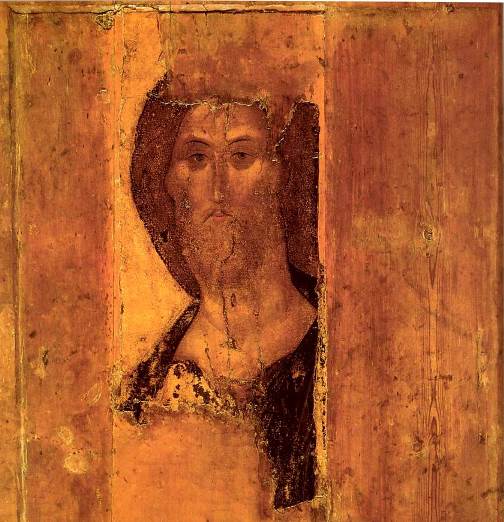
Christ-Pantocrator.-Andrei-Rublev.-1410-1420s.-The-central-part-of-the-iconographic-Deesis-of-Zvenigorod.-Moscow-The-State-Tretyakov-Gallery

St. Andrei Rublev’s icons: Christ (completed 1410, above) and his                                         The Trinity (1411, or 1425-27)trinity-rublev-1410


Masaccio_Holy_Trinity

Masaccio’s sacred image: Holy Trinity (completed 1428, above) and

Pietro Annigoni’s sacred image: St. Joseph the Worker (altarpiece, completed 1963, below)annigoni, st joseph

Deacon Paul O. Iacono’s sacred image done in the style of an icon: of St. Michael Holding the Holy Eucharist, (completed 2015-2017). Please see my post on this blog of September 29, 2017 for a brief explanation.

IMG_0193

My text/last photo, Copyright © 2011- 2018 Deacon Paul O. Iacono All Rights Reserved
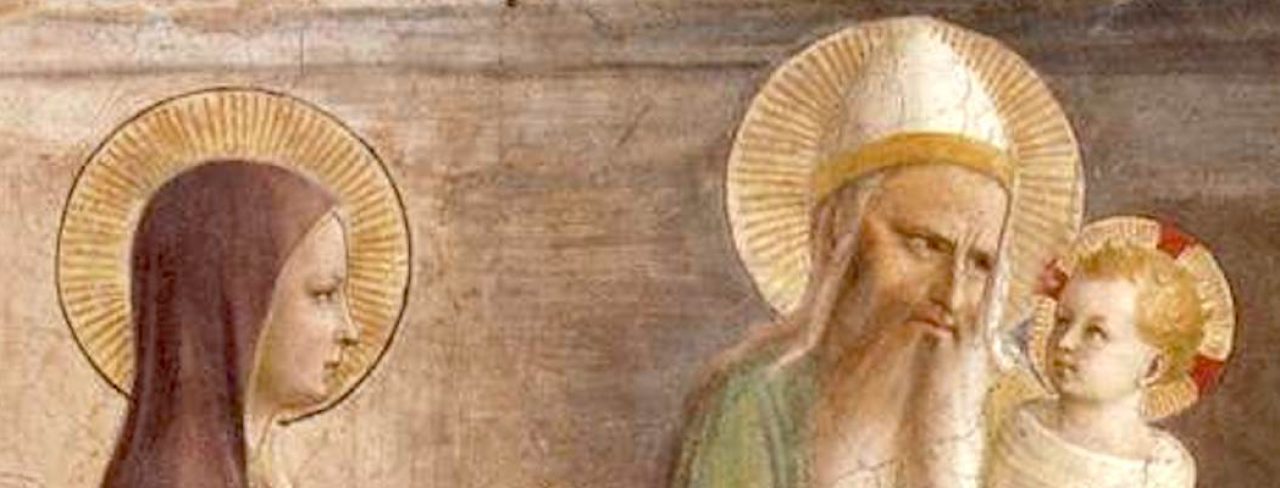


David Clayton Has Another Great Idea for Catholic Evangelization

The following essay was written by David Clayton a lecturer in sacred art, author of the very fine book on the implementation of the New Evangelization of the Catholic Church entitled The Little Oratory – A Beginner’s Guide to Praying in the Home, successful blogger, fellow sacred artist, and friend. His essay captures the imagination that Catholics need to develop if we are to be effective witnesses of the truth of Christ and His Church in today’s world. The following essay takes you through an experience of evangelization that a Protestant church in Nashua, New Hampshire has developed into a welcoming and community based operation. Please take a relaxed moment with a cup of tea or coffee to allow Clayton’s Catholic application of a successful idea to seep in and stimulate you. Think about whether it could apply to your parish, your Catholic college, or within your Diocese, share it, pray about it, and gather some friends to implement it if you are moved by the Spirit to do so.

Contact David at Thomas More College of Liberal Arts: thewayofbeauty.org/contact/

A Model for A Cultural Center for the New Evangelization
by DAVID CLAYTON on JULY 4, 2014
Going Local for Global Change.

How About a Chant Cafe with Real Coffee ..and Real Chant?

There is a British comedienne who in her routine adopted an onstage persona of a lady who couldn’t get a boyfriend and was very bitter about it (although in fact as she became a TV personality beyond the comedy routines, she revealed herself as a naturally engaging and warm character who was in fact happily married with a child). Jo Brand is her name and she used to tell a joke in which she said: ‘I’m told that a way to a man’s heart is through his stomach. I know that’s nonsense – guys will take all the food you give them but it doesn’t make them love you. In fact I’ll tell you the only certain way to man’s heart…through the rib cage with a bread knife!’

Well, wry humour aside, I think that in fact there is more truth to the old adage than Jo Brand would have acknowledged (on stage at least). Perhaps we can touch people’s hearts in the best way through food and drink, and in particular coffee.

There is a coffee shop in Nashua NH where I live called Bonhoeffer’s. It is the perfect place for conversation. They have designed it so that people like to sit and hang out – pleasing decor, free wifi, and different sitting arrangements, from pairs of cozy arm chairs to highbacked chairs around tables. The staff are personable and it is roomy enough that they can place clusters of chairs and sofas that are far enough apart so that you don’t feel that you are eavesdropping on your neighbors’ conversation; and close enough together that you feel part of a general buzz of conversation around you. There is not an extensive food menu but what they have is good and goes nicely with the image it conveys of coffee and relaxed conversation – pastries, a slice of quiche or crepes for example. It has successfully made itself a meeting place in the town because of this.

This is all very well and good, if not unremarkable. But, you wouldn’t know unless you recognized the face of the German protestant theologian Dietrich Bonhoeffer in the cafe logo and started to ask questions, or noticed and took the time to read the display close the door as you are on your way out, that it is run by the protestant church next door, Grace Fellowship Church. Furthermore a proportion of turnover goes towards supporting locally based charities around the world – they list as examples projects in the Ukraine, Myanmar, Ethiopia, Haiti and Jamaica on their website. Talks and events linked to their faith are organised and there are pleasant well equipped meeting rooms available for hire. I include the logo and website to illustrate my points, but also in the hope that if Bonhoeffer’s see this they might push an occasional free coffee in my direction…come on guys!

Well, it was worth a try. Anyway, back to more serious things…the presentation of their mission does not even dominate the cafe website which talks more about things such as the beans they use in their coffee, prices and opening times and the food menu. The most eye-catching aspect when I was nosing around is the announcement of the new crepes menu! There is one tab that has the heading Hope and Life Kids and when you click it it takes you through to a dedicated website of that name, here , which talks about the charity work that is done.

20130711_142724-600x450

I went into Bonhoeffer’s recently with Dr William Fahey, the President of Thomas More College, just for cup of coffee and a chat, of course, and he remarked to me as we sat down that this is the sort of the thing that protestants seem to be able to organize; and how we wished he saw more Catholics doing the same thing.

I agree. What the people behind this little cafe had done was to create a hub for the local community that has an international reach. It is at once global and personal. I would like to see exactly what they have done replicated by Catholics. But, crucially, good though it is I would add to it, and make it distinctly Catholic so that it attracts even more coffee drinkers and then can become a subtle interface with the Faith, a focus for the New Evangelization in the neighborhood.

I don’t know how to run coffee shops, so I would be happy with a first step that copied precisely theirs – the establishment of coffee shop that competes with all others in doing what coffee shops are meant to do, sell coffee. Then I would offer through this interface talks and classes that transmit the Way of Beauty, many of which are likely to have an appeal to many more than Catholics (especially those with a ‘new-age spiritual’ bent). There are a number that come to mind that attract non-Christians and can be presented without compromising on truth – icon painting classes; or ‘Cosmic Beauty’ a course in traditional proportion in harmony based upon the observation of the cosmos; or praying with the cosmos – a chant class that teaches people to chant the psalms and explains how the traditional pattern of prayer conforms to cosmic beauty.

Another class that might engage people is a practical philosophy class that directs people towards the metaphysical and emphasizes the need of all people to lead a good life and to worship God in order to be happy and feel fulfilled. This latter part is vital for it is the practice of worship that draws people up from a lived philosophy into a lived theology and ultimately to the Faith. For it is only once experienced that people become convinced and want more. This works. When I was living in London I used to see advertisements in the Tube for a course in practical philosophy. These were offered by a group that had a modern ‘universalist’ approach to religion in which they saw each great ‘spiritual tradition’ as different cultural expressions of a single truth that were equally valid. The adverts however, did not mention religion at all but talked about the love and pursuit of universal wisdom that looked like a new agey mix of Eastern mysticism and Plato. The content of the classes, they said, was derived from the common experience of many if not all people and from it one could hope to lead a happy useful life. They had great success in attracting educated un-churched professionals not only to attend the class, but also to go in to attend more classes and ultimately to commit their lives to their recommended way of living. They were also prepared to donate generously – this is a rich organisation. Their secret was the emphasis on living the life that reason lead you to and not require, initially at least a commitment to formal religion. Most became religious in time, which ultimately lead some to convert to Christianity – although many, because of the flaws in the opening premises and the conclusion this lead to, were lead astray too. It was by meeting some of these converts that I first heard about it. There is room, I think, for a properly worked out Catholic version of this.

Along a similar line are classes that help people to discern their personal vocation, again using traditional Catholic methods. Once we discover this then we truly flourish. God made us to desire Him and to desire the means by which we find Him. While the means by which we find Him is the same in principle for each of us, we are all meant to travel a unique path that is personal to us. To the degree that we travel this path, the journey of life, as well as its end, is an experience of transformation and joy.

Drawing on people from the local Catholic parishes I would hope to start groups that meet for the singing of an Office – Vespers and or Compline or Choral Evensong and fellowship on a week night; and have talks on the prayer in the home and parish as described by the The Little Oratory. This book was intended as a manual for the spiritual life of the New Evangelization and would ideally be one that supports the transmission of practices that are best communicated by seeing, listening and doing. These weekly ‘TLO meetings’ would be the ideal foundation for learning and transmitting the practices. They would be very likely a first point of commitment for Catholics who might then be interested in getting involved in other ways. It would enable them also to go back to their families and parishes teach any others there who might be interested to learn.

banner2

We could perhaps sell art by making it visible on the walls or have a permanent, small gallery space adjacent to the sitting area (provided it was good enough of course – better nothing at all than mediocre art!). All would available in print form online as well of course, just as talks could be made available much more widely and broadcasted out across the net if there was interest. This is how the local becomes global.

What I am doing here is taking the business model of the cafe and combining it with the business model of the Institute of Catholic Culture which is based in Arlington Diocese in Virginia. I wrote about the great work of Deacon Sabatino and his team at the ICC in Virginia in an article here – thewayofbeauty.org/2012/09/the-institute-for-catholic-culture-an-organisational-model-for-the-new-evangelisation/ called An Organisational Model for the New Evangelization – How To Make it At Once Personal and Local, and have International Recognition. His work is focussed on Catholic audiences, and is aimed predominently at forming the evangelists, rather than reaching those who have not faith (although I imagine some will come along to their talks). By having an excellent program and by taking care to ensure that his volunteers feel involved and are appreciated and part of a community (even organising special picnics for them) Deacon Sabatino has managed to get hundreds volunteering regularly.

Another group that does this as just well is the Fra Angelico Institute for Sacred Arts – https://fraangelicoinstitute.com/ – in Rhode Island. It is  run by Deacon Paul Iacono. I have written about his great work here. The addition of a coffee shop may give it a permanent base and interface with non-Catholics and even the non-churched.

I would start in a city neighborhood in an area with a high population and ideally with several Catholic parishes close by that would provide the people interested in attending and be volunteers and donors helping the non-coffee programs. It always strikes me that the Bay Area of San Francisco, especially Berkeley, is made for such a project. There is sufficiently high concentration of Catholics to make it happen, a well established cafe culture; and the population is now so far past ‘post-Christian’ that there is an powerful but undirected yearning for all things spiritual that directs them to a partial answer in meditation centers, wellness groups, spiritual growth and transformation classes, talks on reaching for your ‘higher self’ and so on. Many are admittedly hostile to Christianity, but they seek all the things that traditional, orthodox Christianity offers in its fullness although they don’t know it. Provided that they can presented with these things in such a way that it doesn’t arouse prejudice, they will respond because these things meet the deepest desire of every person.

Here’s the additional element that holds it all together. As well as the workshops or classes I have mentioned I would have the Liturgy of the Hours prayed in a small but beautiful chapel adjacent to and accessible from the cafe on a regular basis, ideally with the full Office sung. The idea is for people in the cafe to be aware that this is happening, but not to feel bound to go or guilty for not doing so. I thought perhaps a bell and announcement: ‘Lauds will be chanted beginning in five minutes in the chapel for any who are interested.’ Those who wish to could go to the chapel and pray, either listening or chanting with them. The prayer would not be audible in the cafe. So those who were not interested might pause momentarily and then resume their conversations.

From the people who attend the TLO meetings I would recruit a team of volunteers might volunteer to sing in one or more extra Offices during the week if they could. If you have two people together, meeting in the name of Jesus, they can sing an Office for all. The aim is to have the Office sung on the premises give good and worthy praise to God for the benefit of the customers, the neighbourhood, society and the families and groups that each participates in aside from this and for the Church.

When the point is reached that the Office is oversubscribed, we might encourage groups to pray on behalf of others also in different locations by, for example singing Vespers regularly in local hospitals or nursing homes. I describe the practice of doing this in an appendix in The Little Oratory and in a blog post here: thewayofbeauty.org/2012/12/send-out-the-l-team-making-a-sacrifice-of-praise-for-american-veterans  Send Out the L-Team, Making a Sacrifice of Praise for American Veterans.

As this grows, the temptation would be to create a larger and larger organization. This would be a great error I think. The preservation of a local community as a driving force is crucial to giving this its appeal as people walk through the door. There is a limit to how big you can get and still feel like a community. Like Oxford colleges, when it gets to big, you don’t grow into a giant single institution, but limit the growth and found a new college. So each neighborhood could have its own chant cafe independently run. There might be, perhaps a central organization that offers franchises in The Way of Beauty Cafes so that the materials and knowledge needed to make it a success in your neighborhood are available to others if they want it.

I have made the point before that eating and drinking are quasi-liturgical activities by which we echo the consuming of Christ Himself in the Eucharist (it is not the other way around – the Eucharist comes first in the hierarchy). So it should be no surprise to us that food and drink offered with loving care and attention open up the possibilities of directing people to the love of God. If the layout and decor are made appropriate to that of a beautiful coffee shop and subtly and incorporating traditional ideas of harmony and proportion, and colour harmony then it will be another aspect of the wider culture that will stimulate the liturgical instincts of those who attend. (I have described how that can be done in the context of a retail outlet in an appendix of The Little Oratory.) We should bare in mind Pope Benedict’s words from Sacramentum Caritatis (71):

‘Christianity’s new worship includes and transfigures every aspect of life: “Whether you eat or drink, or whatever you do, do all to the glory of God.” (1Cor 10:13) Here the instrinsically eucharistic nature of Christian life begins to take shape. The Eucharist, since it embraces the concrete, everyday existence of the believer, makes possible, day by day, the progressive transfiguration of all those called by grace to reflect the image of the Son of God (cf Rom 8:29ff). There is nothing authentically human – our thoughts and affections, our words and deeds – that does not find in the sacrament of the Eucharist the form it needs to be lived in the full.’

So Jo Brand, we’ll put away the bread knife and offer the bread instead!

Step one seems to be…first get your coffee shop. Anyone who thinks they can help us here please get in touch and we’ll make it happen!

Contact David at Thomas More College of Liberal Arts: thewayofbeauty.org/contact/

Copyright © 2009–2014 David Clayton. All rights reserved.


Lesley Green – A Rhode Island Sacred Artist

One of the great blessings the Lord has granted me is the privilege of meeting so many wonderful people who are interested in studying and creating sacred art. An example of this is the fine Rhode Island artist, Lesley Green.

Lesley is no stranger to art. She has been interested in it since adolescence and received a BFA from the Rhode Island School of Design. She continued to pursue her studies while taking time out to marry and raise a family.

I first met Lesley a number of years ago, when my wife and I started the Fra Angelico Institute for the Sacred Arts.  We invited people from around the Diocese of Providence to come to our first informational meeting. I could tell upon first meeting her that she was highly motivated to consider studying and prayerfully create sacred art.

My first workshop in sacred art soon followed that meeting and Lesley came to learn the basics of how to paint a sacred icon. Her excitement and interest were, and still are, gratifying to see. She continued to make rapid progress with me and took the advice that I give to all of my students: “Branch out, and study with as many other sacred artists as you can.”

I firmly believe that a sacred artist needs to be exposed to, not only a variety of artistic talents and skills, but to the prayerfulness of other iconographers as they practice their ministry in sacred art. As a result, she has since enjoyed studying with Rev. Peter Pearson and Michael Kapeluck, two artists from Pennsylvania who paint in the Russian Orthodox style.

Lesley realizes that her art is more than art for art’s sake. As a committed Roman Catholic she understands that her art is a dramatic form of silent evangelization of the Word of God. She takes seriously the invitation of St. John Paul 2’s 1999 Letter to Artists to participate in the “call” to the vocation of a sacred artist. He tells us that in doing so we fulfill our personal responsibility to do our part in spreading the Good News of Christ. He says,

“In order to communicate the message entrusted to her by Christ, the Church needs art.  Art must make perceptible, and as far as possible attractive, the world of the spirit, of the invisible, of God.  It must therefore translate into meaningful terms, which is in itself ineffable.

Art has a unique capacity to take one or other facet of the message and translate it into colors, shapes and sounds, which nourish the intuition of those who look or listen. It does so without emptying the message itself of its transcendent value and its aura of mystery.” 

It is this “aura of mystery” that Lesley is prayerfully attempting to make visible to the viewer of her art. For, as sacred artists, we are all called to make visible the “ineffable mystery” that is God, His angels, and His saints.

Lesley’s most recent completed icons of Saint Gabriel and St. John the Baptist are quite lovely. I especially like the fact that St. Gabriel is shown holding the Holy Eucharist. As you know, the Archangel Gabriel was depicted in the Hebrew Scriptures as being a healer, especially of the eyes. This sacred icon aptly shows that the source of the Archangel’s power is Christ Himself. The second icon showing St. John the Baptist in a prayerful pose indicates that even in Heaven he continues his mission of imploring us to repent of our sins.

St. Gabriel the Archangel and St. John the Baptist, pray for us.

image description


image description

Copyright © 2011- 2014 Deacon Paul O. Iacono All Rights Reserved
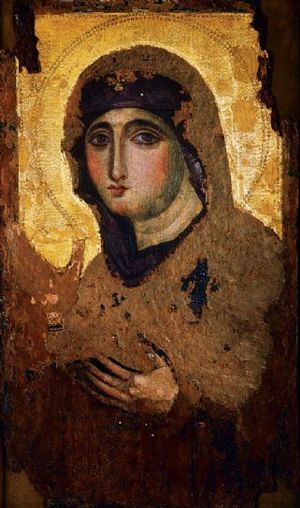
 

The Black Mass at Harvard – Is It A Hate Crime?

News reports have been circulating the story that Harvard University’s Memorial Hall will be the site of a Satanic Black Mass on Monday evening May 12, 2014. The Satanic Mass, by its very nature, is a spiritual crime against the truth, goodness, and beauty of the Catholic Mass and everything that it stands for – specifically the transubstantiation of bread and wine into the real presence of the Body, Blood, Soul, and Divinity of Jesus Christ, the Son of God.

The Harvard Extension Cultural Studies Club is hosting this despicable event. Its promoters and supporters know exactly what they are doing and why they are doing it, and the attempt to sugar coat this blasphemy by saying that it is an attempt to promote cultural understanding is preposterous and vile.

Reports from the Catholic News Agency (http://www.catholicnewsagency.com/news/priest-sees-deluge-of-support-against-harvard-black-mass/) state that “Early media reports included confirmation from Priya Dua, a spokesperson for The Satanic Temple, which is staging the event, that a consecrated host would be used. However, updates to the initial reports said that Dua later retracted her statement, saying that there had been a miscommunication and no consecrated host would be used.”

It is my belief, and the belief of over one billion other Christians in the Latin, Greek, and Russian Rites, that a consecrated host is the most sacred and precious object on earth and the “source and summit” of our faith. I do not understand, how is it not a crime if the original intent is to show a ritual that promoted the desecration of the Mass in its Word and Matter?

If a person or organization desecrates a Koran, or promotes racism or sexism would we not vociferously object and demand justice?

Would Harvard University allow a reenactment to occur in Memorial Hall in which students were shown how to desecrate a Koran, or stone  a woman because she desired an education, or bullwhip a racial or sexual minority for their culture or personal views. What’s next, a symposium on teaching the elite student body of Harvard how to tie a correct knot for a lynching?

We are not taking about an avant garde theatrical performance in which the boundaries of good taste can be obliterated and the right of free speech can be stretched. We are talking about a Satanic ritual that has for many years had the express purpose of spewing hate and ridicule against the specific liturgical and spiritual meaning and reality of the Catholic and Orthodox Mass.

Catholics in the Harvard and MIT communities and the Archdiocese of Boston are wisely protesting and engaging in prayer and witness to this affront to all Christians.

Allow me to pose two questions: What is the definition of a hate crime, and, is Harvard University, by allowing this event to take place in Memorial Hall, condoning a hate crime?

Laws.com states that a hate crime is “an intentional, deliberate, and methodically-charged crime executed in order to cause harm or damage with regard to a specific victim chosen as a result of prejudice, racism, bias, and unlawful resentment.” It goes on to say, “The following are commonly associated with charges of a Hate Crime:

a. Prejudice: Unfounded opinions that are preconceived in nature.

b. Bias: Favoritism that is not based on empirical or pragmatic reasoning.

c. Aggravated Felony: A classification of an intentional, premeditated crime that is severe in nature.

d. Defamation: The slandering or unjust conveying of libelous sentiment.

e. Ethnicity: The country or nation of origin belonging to an individual or entity.

f. Racism: Preconceived prejudice resulting from bias with regard to race.

g. Religion: The process of spiritual belief latent in an individual.

h. Sexual Orientation: The nature and particularity of the sexual attraction latent in an individual.

i. Unalienable Rights: The right of every citizen to ‘Life, Liberty, and the Pursuit of Happiness’.

j. First Amendment: The right of every citizen to the Freedom of Speech.” (http://criminal.laws.com/hate-crimes)

Don’t some of the above ten articles apply to this situation?

Catholics, Orthodox, and Protestants believe that the Holy Trinity is the repository of all truth, goodness, and beauty. In the Trinity’s love and mercy for humanity they have shared themselves with us through word, grace, and sacrament. The ministry, suffering, and death of Jesus Christ won for us the opportunity to be fully participating members of God’s family. Christ’s resurrection is the proof of His victory over sin and Satan. With this in mind we should not be afraid, but we do need to be prudent.

Jesus warned us that Satan, and his minions, still prowl the earth searching for souls to devour. We must be as innocent as doves but as clear eyed as the eagle. Let us pray this afternoon and evening for the Harvard Catholic Community that they may have the strength to witness, in a non-violent Christ-like manner, against Satanic hate.

Copyright © 2011- 2014 Deacon Paul O. Iacono All Rights Reserved


St. Thomas: Skeptic, Cynic, and Repentant Saint

It is the evening hour on the first Easter Sunday. Gathered in the upper room the Apostles were in turmoil. They doubt. They fear. They have lost their sense of trust. They believed that Jesus was dead; and they knew that the Temple guards had orders to arrest all of them on sight. Earlier that morning, Peter and John had entered Jesus’ tomb, and came away amazed at what they saw. But the other Apostles in that room (all were present except Judas and Thomas) had not witnessed the empty tomb.

The doors to the upper chamber, like their hearts and minds, were locked – bolted tight. Fear choked their bodies. They felt trapped and disoriented. They doubted. They despaired. The words of Mary Magdalene, John, or Peter himself, were insufficient to break the fear, break the anxiety, break “the idle talk,” as Thomas, had so precisely framed it earlier in the day. At that moment, the Apostles did not realize that Jesus’ mission was still incomplete.

Then it all changes.

Jesus enters their room, blessing them with His peace and Spirit. You see, Jesus returned that night to deliver a very personal message to each of them. He desired to share an understanding of what it means to be members of His divine family who share in His mission to spread the good news of the Gospel.

What is this “Good News”? It is the news of the reality of our redemption won for us by Jesus’ sacrifice. It is the news of the divine mercy of Christ offered to all who desire it. It is the news of the reality of Jesus’ Sacramental grace that comes to us through the Apostles and their successors; and it is the good news of the Gifts and Fruits of the Holy Spirit that dwell within us specifically through the Sacraments of Baptism and Confirmation.

Jesus, the Eternal Wisdom, in perfect obedience to His Heavenly Father, knew that He had to give them practical spiritual gifts, because His mission would ultimately become their mission to the world. That night, seeing the resurrected Jesus, was the beginning of the awareness of their new role. Full recognition of it would only come at their reception of the Holy Spirit, their Confirmation, on Pentecost.

16 th cen ICON-157F1_large

A week later, Thomas returned to the upper room. He proved stubborn and unbelieving. He wasn’t there on that first night. He had not seen the facts as they had. As a cynic he was distrustful and contemptuous of human nature and the motives, goodness, and sincerity of others. As a prototype for modern man, he insisted on experiencing it for himself. He wanted contact. He wanted to put his finger into the wounds in Christ’s hands and side.

Then Jesus appears a second time.

Confronted with the resurrected Person of Jesus, challenged with the sight and touch of Jesus’ mortal wounds, and hearing the words “Thomas, do not be unbelieving, but believe – [trust in Me],’” – at that moment, Thomas unbolted the locks of cynicism that had bound him, repented and sincerely proclaimed: “My Lord and My God!”  In front of those assembled, Thomas witnessed and experienced the finest quality of God – the attribute of divine mercy.

Aspects of Thomas’ personality can be found in all of us. We want to believe but have never actually heard the risen Christ speak or seen Him in His resurrected flesh. We observe the behavior of fellow Christians and the temptation to judge them rises in our minds, and, we doubt – the doubt of Thomas: “How can this be true. Look at how they behave.” Vacillation, anger, materialism, pseudo-sophistication, and adolescent anti-authoritarianism are just a few of the things that may fuel our judgmental natures.

You see, the trouble is not with our Scriptural evidence, but with ourselves – with our priorities. By virtue of our Baptism and Confirmation we should walk in faith, not judging others but lifting them up, renewing them, offering them a drink of the cool water of reconciliation with God. A reconciliation made possible by Jesus’ sacrifice and the Gifts of the Spirit.

From these Trinitarian Gifts come the exceptional graces of divine mercy that the Apostles needed for their mission. From these gifts, the timidity, doubt, despair, and dejection of the Apostles turns to courage, faith, love, and trust in Jesus as Lord and God. These Gifts provide them with a life that is totally devoted to spreading the “Good News” – a life that is filled with outward obedience and interior peace.

With this in mind it is truly appropriate that Popes John 23 and John Paul 2 were canonized today in Rome. Their immense gifts, nurtured by the Holy Spirit, filled the Church and the world with an understanding of the peace and loving Mercy that Jesus offers to all of us.

It is also interesting to note that the motto of Saint John’s papacy was “Obedience and Peace” and that of Saint John Paul 2 was “Totally Yours.” These two men, linked by the gifts of obedient Christian service, love of the Blessed Mother, and the desire to maintain interior peace through prayer and the Sacraments provide us with clear direction for living as fruitful Catholics in a weak and faltering world.

Let us pray with devotion and love to our new saints and remember that today’s Gospel has Jesus challenging us as well as St. Thomas when He says: “Trust in me;” and we, like Thomas, need to respond with the simple, yet profound prayer, “My Lord and My God, I trust in you.”


cloister of santo-domingo-de-silos-spain1100 

Copyright © 2011- 2014 Deacon Paul O. Iacono All Rights Reserved. The above is my homily of 4/27/2014 delivered at St. Francis of Assisi Church at the 10 AM and Noon Masses in Wakefield, Rhode Island USA.  Note on the artwork: The icon dates from the 16th century; the stone pillar relief is found in the Cloister de Santo Domingo de Silos in Northern Spain. It was carved during the renovation of the monastery and dates to 1150. The 13th century saint and founder of the Dominican Order, Dominic Guzman, mother’s name was Joan. She is considered a saint of the Latin Rite of the Catholic Church. St. Joan prayed to the famous Spanish Benedictine monk. St. Dominic of Silos. She named her son, Dominic, in honor of him. St. Dominic of Silos is also considered the patron of all women who are pregnant. During his lifetime St. Dominic of Silos was known for his medical and healing abilities and has been considered the patron saint of women with difficult pregnancies. He died at the age of 73 in the year 1073.

Eugene Burnand and The Greatest Easter Painting Ever Made | Crisis Magazine

Clicking on the attached link found below produces an excellent article by Elise Ehrhard in Crisis Magazine describing the Swiss painter Eugène Burnand’s late 19th century masterpiece The Disciples Peter and John Running to the Sepulchre on the Morning of the Resurrection. 

One writer has described this painting as a visual Lectio Divina since the observer cannot help but feel the joy, hope, and love of these disciples for the Lord. 

May you and your families experience an Easter season filled with the healing love of Christ.

The Greatest Easter Painting Ever Made | Crisis Magazine.


Theophilus, the Art of Iconography, and the Contemporary Sacred Artist – Part 2

Please take a moment to read the first part of this multi-part essay that I posted a few days ago. I am requesting that you do this in order for you to understand my perspective on creating contemporary sacred art within the Latin Rite.

Creating sacred art for me is a service ministry. It is a ministry through which a sacred artist unites him or herself to God’s Redemptive efforts. If you are a Baptized Christian who has been educated in the faith, regardless of the Rite or the denomination, you know that the Christian faith requires you to cooperate with the grace that the Holy Spirit provides to you through Scripture and the Sacraments. If one does this, and maintains a disciplined prayer life, you are cooperating with the Spirit in the duties that you must perform in your life.

For a Christian, human history is more than the individual searching for God. As the book of Genesis (3: 8-9) tells us, God walked through the Garden of Eden searching for us – for our spiritual parents: “When they heard the sound of the Lord God walking in the garden in the cool of the day, the man and his wife hid themselves from the Lord God among the trees of the garden. But the Lord God called the man and said to him, “Where are you?”

The Lord asks that question of us, too. 

Jesus is constantly calling out to us, constantly searching for us, constantly knocking on the door of our hearts hoping to hear our loving response. Christianity is the faith through which a searching God shows Himself to be so loving and so merciful as to persevere, to the point of sacrificing His own Son, in the effort of bringing rebellious humanity back into His family.

So the history of Christian sacred art shows us that people desired sacred icons (Greek, eikon: image) to reference that sense of family, in the same way that we have photographs today of family members, living and dead, which remind us of the love shared and their importance to our lives. These photographs or images are not idols. Even if a loved one does kiss a photograph or a sacred icon or image, the meaning behind that gesture is that the kiss – the love and respect – is not meant for the celluloid, or the wood and pigment; rather, it is meant for the prototype, for the person it represents, the loved one, God, His saints and angels.

Unfortunately, the faith family that is the Church split in the Great Schism of 1054. The Latin Rite and the Greek/Russian Rite split along cultural, theological, philosophical, political, and artistic lines. This Schism is one of the great scandals that has affected Christ’s Church.

The Schism, however, did not affect trade and the exchange of ideas among the laity. Commerce continued and new products, artistic materials, and techniques were evaluated, bought, and sold. The development of the Latin Rite artistic tradition after the Schism indicates that in Western Europe the linking of faith with the creative impulse was very strong and did much to solidify and unify the various cultural groups within the Latin Rite.

But, what was the Latin Rite tradition post AD 1054? What were the techniques of the Latin Rite artists of the Romanesque and early to mid Gothic period? Were there artistic manuals that were more than just recipe books on preparing pigments and varnishes and which discussed the spiritual underpinnings of the artisan’s art?

Where to begin?

As mentioned before, I happily discovered Pope Benedict XVI’s book –The Spirit of the Liturgy. This became my starting point, with its expression that the three periods within the liturgical art of the Latin Rite can be found in the Iconographic, Gothic, and Baroque styles of art.

I was searching for the techniques that Catholic artists would have used approximately one thousand years ago. Sacred artists within the late Iconographic period and early Romanesque period (AD 900 – 1300) would have approached their art within a disciplined theological, semantic, and aesthetic viewpoint. As Western Europeans, however, they easily accepted innovation and even experimentation if it provided a final product which met the artisan’s demanding and critical eye, and especially that of the master artisan of the workshop.

In the Spring of 2012 I discovered a twelfth century book entitled On Diverse Arts by Theophilus the Presbyter (translated by Hawthorne and Smith, Dover Press, 1979, 216 pages). This book is the critical corner stone of my attempt to link contemporary sacred art with its medieval roots. For Theophilus the Presbyter – a twelfth century master artist – is an individual who can still effectively speak to us in our own time. Theophilus has the perspective and the attitude that provides us with a foundation for our spiritual view of art.

This does not mean that we are slavishly going back in an attempt to reproduce the twelfth century. To do that would not be honest, rather, while staying true to the theological, semantic, and aesthetic beliefs of artists like Theophilus we are able to reinterpret and refresh our current situation in light of the contributions and truths discovered and lived in the past. Truth, goodness, and beauty are not limited by space and time.

O Beauty, ever ancient, O Beauty, ever new.

One of the key ideas of Theophilus that needs to be shared with Christian sacred artists is that the Holy Spirit is moving through our creative efforts, and is actively involved in the artist’s daily work. It is my belief that Theophilus sees the role of the artist as a person with a specific vocation, a calling, who is to unite his call by God to create beautiful works of art with his own prayer life and the Catholic spiritual view of reality.

Many, but not all art historians, believe that Theophilus is the pen name for a Benedictine monk by the name of Roger of Helmarshausen. Roger was a master at metalworking, specializing in gold and silver, and lived in the Benedictine monastery located in the town of Helmarshausen in modern day Germany.

In his manual, On Diverse Arts, Theophilus not only lays out his spiritual vision in three specific prologues to his chapters on painting, glassmaking, and metalworking but he provides specific directions and guidance to fellow artists. For example, he lays out – step by step – the process for creating a sacred image: the types of pigments to use, specific colors for the base coat, shadows, colors to use for hair, beards, skin, drapery, etc.

Theophilus’ union of a sincere spiritual perspective with technical guidance shows him to be a master teacher and mentor. He accomplished this within his own Benedictine monastery at Helmarshausen and his reputation expanded throughout the Rhine-Meuse River Valley in Germany.

In my next post I hope to discuss the spiritual importance of Theophilus’ three chapter prologues, and ultimately their relationship to the contemporary Catholic sacred artist.

In my fourth post in this series I will discuss a marvelous doctoral dissertation on Theophilus that was written in 2010 by Heidi Gearhart, Ph.D.

And in my fifth and last post in this series I will discuss how, in the mode of Theophilus, I am developing a practical sacred art workbook that provides step-by-step advice for the contemporary sacred artist. I have two of the four chapters completed and I will probably self-publish it for my sacred art workshops prior to a publisher (hopefully, :{) !) formally printing it.

Copyright © 2011- 2013 Deacon Paul O. Iacono All Rights Reserved

Theophilus, Iconography, and the Contemporary Sacred Artist – Part One

Today’s sacred artist within the Western tradition may have been exposed to many different artistic traditions. Artists may have been classically trained in a formal academy such as the Florence Academy of Art, or, they may have been educated at a secular institution that emphasizes a modern abstract expressionistic form of art. Other models are available, too. Some artists may have been self-taught, or, as in my case, study with specific masters of sacred art that offered intensive workshops to interested groups or individuals.

Upon my retirement from a career in education, I finally had the opportunity to study and actually make art. I knew that the form of art that I wanted to pursue was sacred art and sacred iconography spoke to me as a specific art form. Sacred art necessarily carried with it two elements that were critical for me: a devotion to conversation with God while making the art and an interest in a specific historical methodology for the creative process.

Between 2006 and 2010, I happily studied with four contemporary masters in the field of sacred iconography. They taught me different approaches, techniques, and the use of a variety of materials. This was all well and good, a necessary series of steps for a student artist to go through in order to develop some sense of familiarity and a working comfort level.

After spending time with the last two of my art teachers (Marek Czarnecki and Anna Pokrovsky Gouriev) an important question  had to be answered. They wisely asked all of us to eventually answer this question: “Do you want to paint sacred images in the Russian Orthodox or the Western Latin Rite tradition?”

You see, Marek is Roman Catholic and Anna is Russian Orthodox. They both paint/”write” sacred icons in the Russian Orthodox tradition. Anna’s mother, Ksenia Pokrovsky (marylowell.wix.com/hexaemeron-6#!__xenia-pokrovsky) is a master iconographer who has added a great deal to our understanding of the techniques of sacred iconography within the Russian Orthodox and earlier Byzantine traditions.

Ksenia founded the well known Izograph School of Iconography near Boston, MA, and Marek and Anna assist her with teaching, the creation of sacred icons, and restoration work. Their work is quite beautiful and I highly recommend them to you, your parish, or an educational institution that is interested in high quality iconographic work in the Byzantine tradition.

It is important for a contemporary sacred artist to understand the artistic approaches of the Byzantine/Russian tradition. I learned a great deal from them, not only about sacred art but about myself; yet, their question continued to haunt me. For the year or so after I studied with them I continued to paint in the Russian Orthodox tradition. My first teachers in this art form – Peter Pearson and Dimitryi Andreyev – had built a strong foundation for me. Dimitryi’s father Vladislav, founded the Prosopon School of Iconography, another influential school, in New York City (www.prosoponschool.org).

So, with all of this rich and fruitful tradition passed on to me by four wonderful and prayerful people, I was still left with the unanswered question: Orthodox or Latin Rite? My training had been in pure Orthodox tradition. Wonderful as it is, I still had not answered the question Marek and Anna had posed. Before I could answer it I had to discover if there was a Latin Rite tradition to painting sacred images/icons. This brought up the question of “Why is it that when we hear talk of “sacred icons” today it is always in the context of the Byzantine Catholic/Greek/Russian Orthodox Rite?”

The Western European/Latin (Roman) Rite of the Catholic Church had co-existed and was in communion with the Greek Orthodox/Byzantine/Eastern Rite since the first century. It was 900 years old prior to Russian Grand Prince Vladimir of Novgorod formally converting the Russian people to the Eastern Rite of the Catholic Church. So you would think that there would have been some communication between the Eastern and Western Rites of the Catholic Church and the sharing of information and ideas about sacred art.

So, why do we now just associate sacred icons with the Eastern Rite tradition? It is primarily because of the western European sense of artistic experimentation and creativity that developed around the 12th century. Different artistic, theological, and philosophical traditions developed within Western Europe that affected the Latin Rite of the Church and produced different artistic results. Yet the Byzantine Rite’s art continued to influence Latin Rite artists all the way up to the fourteenth century.

Whereas the Greek/Byzantine/Russian Orthodox approach to sacred art and icons remained steadfast to tradition. While there were different “schools” of sacred iconography within their tradition and different masters anchoring those schools, they always remained faithful to the basic tradition of painting/”writing” sacred icons. You begin to see a shift in thinking within this tradition in the early 18th century when influences from the Western European artistic tradition begin to seep into the Orthodox schools and workshops.

Usually when we think of Latin Rite sacred art we have the images of Giotto, Michelangelo, Leonardo, and Raphael immediately pop into our mind. As Pope Benedict XVI has said in his book The Spirit of the Liturgy the Latin Rite had three specific stages of sacred art develop in its history: the Iconographic, the Gothic, and the Baroque. Each one of these stages contributed to the liturgical life of the Church and had a unique catechetical message for the faithful. It is not to say that the Renaissance artists, many of them working with sacred themes, did not contribute to the artistic tradition of the Church. They certainly did, however, their emphasis, at times, was more on pleasing the patron then on fostering a sense of prayer in the individual penitent.

So, I spent the year 2012 investigating the sources of the Latin Rite’s artistic tradition. The next few posts will reveal what I found, and the fact that a very talented 12th century metalworker and artist, the Benedictine monk Roger of Helmarshausen (also known as Theophilus) was at the forefront of the Latin Rite’s artistic techniques.

It was what Theophilus taught me that finally allowed me to answer Marek and Anna’s question and change my artistic technique. The witness and work of the good Benedictine Theophilus continues to inspire me in the teaching of my own students the prayerful benefits of sacred art. More on Theophilus in the next few days!

Copyright © 2011- 2013 Deacon Paul O. Iacono All Rights Reserved

The Penitent Magdalene and the Way to True Conversion of Heart – A RePost Of Fr. Jason Smith’s Essay

As we begin the season of Lent I thought you would enjoy this article by Father Jason Smith. It contains a magnificent sacred image painted by George de La Tour (1593 – 1652). La Tour is one of my favorite artists; I especially enjoy his beautiful sacred image of St. Joseph teaching the child Jesus. During his lifetime La Tour was considered to be the painter for the French nobility. His son Etienne became his pupil and followed his father’s style so closely that it is very difficult for today’s art historians to determine the author of certain paintings within their collection.
La Tour was a master of the chiarascuro (light/dark/shadow) technique. He developed this technique in new ways, adopting a softer, gentler, and simple approach to presenting the interplay of light, shadow, and color.  After his involvement with a Franciscan led spiritual revival he eventually devoted himself to religious subjects. His two paintings on Mary Magdalene are masterpieces of this style of art and they truly speak to the soul who is interested in listening.
The de La Tour family unfortunately died in 1652 as a result of an epidemic that devastated his city.
The essay below was written a few years ago by Fr. Jason Smith. Fr. Smith’s essay on the truth, beauty, and meaning of de La Tour’s painting reflects the Lord’s ability to use sacred artists to express His continual grace and mercy to us. It is my wish that you spiritually profit by the painting and its analysis. Thank you Fr. Smith for posting this fine essay.

The Penitent Magdalene and the Way to True Conversion of Heart   By Fr Jason Smith, published at the Biltrix blog 

“I have found no better representation of conversion and penance in art than The Penitent Magdalene, by George de La Tour. Though simple, it expresses the essential elements behind every conversion, and we can find in it powerful lessons to apply to our own life. Let’s take a closer look.

The Penitent Magdalen, George de la Tour

The painting presents Mary at the very beginning of her conversion, on the night that she met Jesus Christ for the first time. Her life is just as it was the day the Lord crossed her path. Yet the subtle but evocative tension in the painting makes it evident that her world has been shaken and she knows she must change.

She has returned home, alone, and cannot sleep. She sits down at her vanity which until this afternoon was the center of her life. La Tour paints nothing superfluous here; only those things most dear to her, things to which she has clung for happiness and fulfillment, but that have only served to leave her feeling empty inside: Her richly embroidered clothing, her silver mirror with its carved and gilded frame, her fine jewels and her string of pearls which, while tossed aside, are still within her grasp.

Interestingly enough Mary’s head is turned away from the viewer—leaving us to imagine her expression, and even better, identify ourselves with it—and, while facing the mirror, she is not looking into it. She is gazing far beyond; she has realized there is something more to life then what is external, then in those things which she has placed her security and happiness. The Lord had cast seven demons from her life, seven lies that she had believed about God and about herself; this night, however, she is finally free of them, but she knows that the changes she has to make and which still lie ahead will be hard.

The flickering flame of the candle is the primary source of light. It is soft, calm, inviting, strong, and supersedes the light of an ordinary candle. It keeps the menacing darkness away. It illuminates her face and her heart—primarily her heart—to show that she has focused on the core of who she is, and subtly shows the love that she has felt that day. Yet it also shines on the mirror and on her robes and on her jewels—the light of Christ has begun to enlighten everything in her life. It is the power of the Holy Spirit through which all true conversion and penance is inspired.

She holds a skull, which at first seems macabre, and certainly was not a fitting decoration for her vanity, but is symbolic of the gravity and seriousness of the assessment she is making of her life. Her hands are folded calmly upon it and it rests gently in her lap; this is not an anxious and tense conversion, but a realistic one. She knows her life will end; she recognizes her mortality; she is asking herself what is truly important in her life—not her mirror or her jewels—and she is preparing her heart to die to those things.

But what will she exchange them with after she gives them up? What will tomorrow morning bring? She stares into the darkness looking for an answer but there is no reply. Conversion always requires faith. The answers and the way are presented gradually. There is a natural trepidation when it comes to change, conversion, stepping out to follow the Lord, and, yes, penance—but this is only a smaller aspect of a larger and more liberating truth, which Pope Benedict expressed so well in his inaugural homily:

Are we not perhaps all afraid in some way? If we let Christ enter fully into our lives, if we open ourselves totally to him, are we not afraid that He might take something away from us? Are we not perhaps afraid to give up something significant, something unique, something that makes life so beautiful? Do we not then risk ending up diminished and deprived of our freedom? And once again the Pope said: No! If we let Christ into our lives, we lose nothing, nothing, absolutely nothing of what makes life free, beautiful and great. No! Only in this friendship are the doors of life opened wide. Only in this friendship is the great potential of human existence truly revealed. Only in this friendship do we experience beauty and liberation. And so, today, with great strength and great conviction, on the basis of long personal experience of life, I say to you, dear young people: Do not be afraid of Christ! He takes nothing away, and he gives you everything. When we give ourselves to him, we receive a hundredfold in return. Yes, open, open wide the doors to Christ – and you will find true life.

Conversion and penance should never be thought of as a loss but as a transformation, an exchange, for something greater: From what is bad to good, from good to better, and from better to best. In reality the Lord does not ask us to give anything up; rather, he asks that we chose the better part, to go from vice to virtue, from complaining to gratitude, from bitterness to forgiveness, from vanity to humility, from lust to love, from anger to patience, from discouragement to hope, from where we are to where we know we are called by the Lord to be.

Conversion and all it entails is a calling of love and is not reached with an empty white knuckle attitude. Notice how gently her hands are folded upon the skull. It is not angst but Christ’s transforming love that impels and inspires her to change. The strength to do this does not come from within one’s own will, though the will is certainly needed, but from the light and the guidance and the power and the fire of the Holy Spirit active in an open heart. Notice how Mary’s garments show how open her heart is.

I’m not certain if George de la Tour ever underwent a conversion himself, but through candlelight and shadow, a mirror and jewels, a skull and robes, and a facial expression we can’t see, he captures the essential elements of one: The love of Christ and the guidance of the Holy Spirit.”

Fr Jason Smith

Penitent Magdalene essay: Copyright © 2012-2013 Fr. Jason Smith. All Rights Reserved

Copyright © 2011-2013 Deacon Paul O. Iacono All Rights Reserved

Pope Benedict 16th – Evangelization Demands Courage and the Truth

No sooner had Pope Benedict announced his planned abdication of St. Peter’s chair when the attacks on him began to appear. I am posting on this story because the Fra Angelico Institute for the Sacred Arts is primarily concerned with evangelization of the Catholic faith through the prayerful study and creation of the sacred arts. Be that as it may, when a vicious and false attack occurs on the Church or a member of the clergy it is incumbent upon us as Catholics to respond with courage and the truth.

The Catholic League for Religious and Civil Rights, based in New York, and headed by Bill Donohue, Ph.D is in the forefront of presenting the truth when the Church is attacked. It deserves our support and prayers.

The following re-post which concerns an attack on Pope Benedict 16th (found below after my comments) is from their website http://www.catholicleague.org/.

Bill Donohue wrote the post which tells the truth about the Pope’s actions and it deserves to be read by every Catholic. We cannot sit idly by while the Church is being attacked. If you read this blog then you are interested in sacred beauty and the truth, goodness, and beauty of God that the Church has faithfully taught for two thousand years. Yet, it is very easy to get lost in beauty. We must support the arts, but we must not retreat into them. Saying, “Well, there is nothing I can do about it.” Wrong. There is something you can do about it.

There are two ways to support the Church in this effort: first through your prayers for those who are in the front-lines fighting on behalf of the Church, and second, through your actual involvement by defending the Church when you see or hear it attacked. We are in a very dynamic spiritual war. We cannot sit on the side-lines. The Lord Himself said that we need to choose – one side or the other – but don’t be neutral. He was very specific about the truth that He is sickened by neutrality (confer Revelation 3: 13 – 22; Romans 16: 17-18).

The re-post of Bill Donohue’s article concerns a now dead atheist British journalist named Christopher Hitchens (1949-2011) who loved to attack the Church and any public figures who he believed were wrong or, in his opinion, frauds (from Mother Teresa, to Winston Churchill, to Princess Diana).

The article that Bill Donohue wrote and published this morning relates some of the lies that Hitchens told concerning Pope Benedict 16th. These lies have been picked up and resold as the truth by another journalist by the name of Andrew Sullivan. I have posted this article by Donohue so you can be armed with the truth.

We must unite as a force for truth-filled evangelization and arm ourselves with the facts. Donohue’s article contains the facts – arm yourself with them and use the grace you received at your Confirmation to patiently, but firmly, inform those that malign our Catholic faith, the papacy, and Benedict in particular, with the truth.

Here is Bill Donohue’s article:

Hitchens is Back from the Dead

February 12, 2013

“Bill Donohue takes note of the resurrection of Christopher Hitchens:

Hitchens has been brought back from the dead by Slate and Andrew Sullivan, but it won’t do them any good. Yesterday, they republished a hit piece by the atheist from 2010 that was vintage Hitchens: the man was a great polemicist but a third-class scholar. Facts never mattered to him.

Hitchens said the scandal “has only just begun.” Wrong. It began in the mid-60s and ended in the mid-80s. Current reports are almost all about old cases.

Hitchens said Munich Archbishop Joseph Ratzinger (the pope) transferred an offending cleric to another parish. Wrong. Ratzinger’s deputy placed the priest in a new parish after he received therapy (the tonic loved by those pushing rehabilitation), and even the New York Times admitted there was no evidence that Ratzinger knew about it. By the way, there were 1,717 priests serving under him at the time.

Hitchens said Ratzinger wrote a 2001 letter to the bishops telling them it was a crime to report sexual abuse. Wrong. The letter dealt with desecrating the Eucharist, and the sexual solicitation by a priest in the confessional (the letter cited a 1962 document detailing harsh sanctions).

Hitchens said Ratzinger was obstructing justice when he crafted new norms on sexual abuse in 2001. Wrong. He actually added new sanctions and extended the statute of limitations for such offenses.

Hitchens says Ratzinger ignored accusations against Father Marcial Maciel. Wrong. It was Benedict who got him removed from ministry (he was too infirm to put on trial) and put his religious order in receivership.

In short, Hitchens’ hatred of Catholicism allowed him to swing wildly. That he should be resurrected by Slate and Andrew Sullivan makes them all look incompetent, as well as vicious.”

Copyright © 2013 Deacon Paul O. Iacono All Rights Reserved

The Christmas Star of Bethlehem – Merry Christmas, Everyone!

Even though the vast majority of us are not astronomers, the famous star of Bethlehem still has a great ability to intrigue us especially as it relates to its actual astronomical occurrence. As Christians we believe in the Christmas story, not as legend or myth, but as an actual historical occurrence which led to the Redemption of mankind by the Son of God – Jesus Christ.

There are many elements of the Nativity of Christ that are expressed by the evangelists, and one of the most interesting is the illumination of Israel by a brilliant star at the time of the actual birth of Jesus. The Christmas Star has intrigued artists and poets in its ability to shed light on the truth of the cosmic meaning of Christmas; and in recent years some research has been done using computer animation and astronomical programs to determine if, when, and where it actually occurred.

The EWTN network usually airs a contemporary and extremely popular documentary entitled The Star  (of Bethlehem) (please examine the filmmaker – Rick Larson’s site – for a wonderful, multipart, overview of his documentary: www.bethlehemstar.net/

The following post attempts to determine the birth date of Jesus Christ in light of the astronomical evidence. The quotes I provide are taken from a fascinating study entitled Probable Date of Birth of Christ found in this website: www: copiosa.org/christmas/birth_date.htm by Father William G. Most (Fr. Most’s article offers a summary of the work done by  E. L. Martin, in his book The Star That Astonished the World, ASK Publications).

“In the evening of June 17, 2 BC, there was a spectacular astronomical event in the western sky. Venus moved eastward seemingly going to collide with Jupiter. They appeared as one star, not two, dominating the twilight of the western sky in the direction of Palestine. This conjunction had not happened for centuries, and would not happen again for more centuries. Jupiter was considered the Father, Venus the Mother.

Then not many days later, Venus came within 0.36 degrees of Mercury. On September 11 came the New Moon, the Jewish New Year. This happened when Jupiter, the King planet was approaching Regulus, the King star. Further, there were three conjunctions of Jupiter and Regulus within the constellation of Leo, the lion, which was considered the head of the Zodiac.

Now Genesis 49:10 had foretold there would always be a ruler from Judah, whom Jacob called the lion, until the time of the Messiah. The star Regulus, which astronomers called the King Star, dominated Leo.

The Magi, being astronomers and astrologers, would surely read these signs. (The three conjunctions with Regulus were August 12, 3 BC; February 17, 2 BC, and May 8/9, 2 BC). In Hebrew, Jupiter was called sedeq = “righteous,” a term especially pertaining to the Messiah.

On September 11, Jupiter was close in the constellation of Virgo, the virgin. On September 3rd of 3 BC Jupiter was in conjunction with Regulus, the brightest star in the constellation of Leo — Leo the Lion, which was associated with Kings, and the Lion of Judah, as foretold by the dying Jacob in Egypt in Genesis 49:10.

Also, on December 25 of 2 BC, Jupiter stopped for 6 days over Bethlehem. This is a normal motion for Jupiter; it stops twice, and reverses its seeming movement. This may have been the very time the Magi came with their gifts. This was also the time of the Hanukkah festival, during which it was customary for Jewish Fathers to give gifts to their children.

The shepherds watching their flocks in the fields indicate a date either in late summer or early fall.

E.L. Martin [whose research this article is based on] thinks the birth of Jesus was in September, 3 BC (Jupiter in conjunction with Regulus), and the probable date of the Magi was December 25, 2 BC (Jupiter stopped for 6 days over Bethlehem).”

Please don’t forget when we speak in BC time, the “ladder of time” comes down from let us say 10,000 BC to 1 BC, in a descending order, so 3 BC comes before 2 BC.

In AD time (Anno Domini, a Latin phrase which means “the year of Our Lord” the “ladder of time” is ascending, so, we are currently in the year 2012, but as of midnight December 31st, we will then be in the year 2013, or two thousand and thirteen years since the birth of Christ. When this Gregorian Calendar system was developed and applied to western Europe, approximately five hundred years ago, they did not have the sophistication of computer/astronomical observations to correct the date of Christ’s birth, if we agree with Martin’s research, to the year 3 BC.

“The above span of dates (approx. 16 months) coincides with The Slaughter of the Innocents, where Herod killed all males under the age of two years. Herod died shortly thereafter. Interestingly, More than 600 planetariums here and in Europe have revised their Christmas star show to match this work of E. L. Martin.”

594px-Giotto_-_Scrovegni_-_-18-_-_Adoration_of_the_Magi

The above painting is entitled the Adoration of the Magi by Florentine painter Giotto di Bondone (1267–1337). The Star of Bethlehem is shown as a comet above the child. Giotto witnessed an appearance of Halley’s Comet in 1301.

“Magi were not really just astrologers. They served as court advisors, going from one royal court to another. It would not then be difficult to suppose they had come from a great distance with gifts. In those days all astronomers were acquainted with astrology. They were also mathematicians.” This is the end of Fr. Most’s article.

For more information check out Fr. Most’s website: copiosa.org/christmas/index.htm. As you go down this index on the left hand side you will see Fr. Most’s complete article on the Probable Date of the Birth of Christ. His site has some very interesting articles that can be very helpful in explaining to people – especially children – the origins of Catholic Christmas traditions.

220px-Nativity_Icon

The above icon was written (painted) in Russia and displays, in a lovely catechetical way, the entire Nativity narrative: the angel’s appearance to the shepherds, the Star of Bethlehem (appearing as a disk with a shaft of light coming down to the cave of the birth, the actual birth of the child Jesus being wrapped in swaddling clothes by His Blessed Mother – Mary, the coming of the Magi, the washing of the child Jesus, and St. Joseph being visited by an old man in furs (some refer to this last image as the temptation to doubt that confronted Joseph.

Soon after the dream visitation by an angel, St. Joseph realizes the nature of this Child. He understands that he is given the responsibility to care for Him and His mother and raise the child as if He was his very own. St. Joseph does exactly that; he is the epitome of quiet, loving leadership, and a model for all fathers.

St. Joseph is silent throughout the entire Gospel narrative. Yet, his actions speak louder than words. We see in St. Matthew’s Gospel (Chapter 1: 18ff) that he ultimately had a thoughtful plan to quietly divorce Mary when he learns that she is pregnant; however, he is not stubborn or hard of heart, for when the angel Gabriel visits him and tells him what is happening he does not rebel and say “No, I will not do it” out of pride or ego. Rather, he changes his plan and trusts the angel’s message which was sent by God to him.

This is so important – and it should speak volumes to us – if we, too, have open hearts and minds to hear what God is telling us in prayer, Scripture, and the grace of the Holy Sacraments. These three sacred tools, along with a holy orthodox spiritual director, will assist us on our path – and like the Star of Bethlehem – lead us to the Christ.

In the immortal words of Tiny Tim Cratchit: “… and a Merry Christmas, everyone!”

Copyright © 2012 Deacon Paul O. Iacono All Rights Reserved

The Magnificat of Mary – A Beautiful Analysis By The Venerable Bede

This morning’s selection from the Office of Readings in the Roman Breviary is written by an English monk named “the Venerable Bede.” It discusses Mary’s joy-filled song – The Magnificat.

Bede was born in the year 673 and died in 735. He lived in Northumbria, primarily in the two monasteries of Saint Peter and Saint Paul. These monasteries had accumulated a wonderful collection of Greek, Latin, and early Church manuscripts. Bede spent his life studying, writing, and dictating the results of his research and prayer. He is known primarily for his most famous tome which is The Ecclesiastsical History of the English People. This work resulted in later generations giving him the title “The Father of English History.”

In 1899, Pope Leo 13th made Bede a Doctor of the Church. Bede was a skilled translator, linguist, and writer. His ability to compose insightful spiritual essays, and skill in making the writings of the Early Church Fathers accessible to his fellow Anglo-Saxons, significantly contributed to the growth of Roman Catholicism in England.

Let us take a moment today to dwell upon one of his perceptive and rich essays on the Blessed Mother. In the selection below, Bede provides us with an essay on Mary’s response to the knowledge that she will be the mother of the Savior. Her poetic song is known as The Magnificat, said in the presence of her cousin Elizabeth (and possibly Elizabeth’s husband Zechariah). They mutually rejoice in the knowledge that they are both pregnant (The Visitation).

visitation

Mary’s song of joy, faith, and trust is here separated by Bede and analyzed for our prayerful consideration. Mary’s words appear in bold italics, Scriptural references are in plain italics, Bede’s are in regular print. The entire Magnificat can be found in the first chapter of the Gospel of St. Luke, verses 46 – 55.

00.159.19_PS1

Mary said: My soul proclaims the greatness of the Lord, my spirit rejoices in God my Savior.

Bede’s comments have Mary thinking these thoughts: “The Lord has exalted me by a gift so great, so unheard of, that language is useless to describe it, and the depths of love in my heart can scarcely grasp it. I offer then all the powers of my soul in praise and thanksgiving. As I contemplate his greatness, which knows no limits, I joyfully surrender my whole life, my senses, my judgment, for my spirit rejoices in the eternal Godhead of that Jesus, that Savior, whom I have conceived in this world of time.”

The Almighty has done great things for me, and holy is his name.

“Mary looks back to the beginning of her song, where she said: My soul proclaims the greatness of the Lord. Only that soul for whom the Lord in His love does great things can proclaim his greatness with fitting praise and encourage those who share her desire and purpose, saying: Join with me in proclaiming the greatness of the Lord; let us extol His name together.”

“Those who know the Lord, yet refuse to proclaim His greatness and sanctify His name to the limit of their power, will be called least in the kingdom of Heaven. His name is called holy because in the sublimity of his unique power He surpasses every creature and is far removed from all that He has made.”

He has come to the help of His servant Israel, for He has remembered His promise of mercy.

“In a beautiful phrase Mary calls Israel the servant of the Lord. The Lord came to his aid to save him. Israel is an obedient and humble servant, in the words of Hosea: Israel was a servant, and I loved him.”

“Those who refuse to be humble cannot be saved. They cannot say with the prophet: See, God comes to my aid; the Lord is the helper of my soul. But anyone who makes himself humble like a little child is greater in the kingdom of Heaven.”

The promise He made to our fathers, to Abraham and his children for ever.

“This does not refer to the physical descendants of Abraham, but to his spiritual children. These are his descendants, sprung not from the flesh only, but who, whether circumcised or not, have followed him in faith. Circumcised as he was, Abraham believed, and this was credited to him as an act of righteousness.

The coming of the Savior was promised to Abraham and to his descendants forever. These are the children of promise, to whom it is said: If you belong to Christ, then you are descendants of Abraham, heirs in accordance with the promise.”

The Responsory Prayer (Luke 1: 48 – 50) follows this reading:

“From this day all generations will call me blessed. The Almighty has done great things for me, holy is His name. He has mercy on those who fear Him in every generation.”

Bede’s words are beautiful words and the sacred images shown may be very helpful to you as we enter the eve of Christmas. May you all have a holy and joy filled Christmas day and good fortune in the New Year! You are in my prayers. Thank you for reading my post.

Copyright © 2012 Deacon Paul O. Iacono All Rights Reserved. Notes on the paintings: The first sacred image is a contemporary sacred image written/painted in the iconographic style; I do not know its author. The second sacred image of Mary lost in ecstasy as she sang The Magnificat, was completed by James J. Tissot, a French painter (1836 – 1902). This painting currently hangs in the Brooklyn Museum. The medium is opaque watercolor over graphite on gray woven paper. It is approximately five by ten inches in size. Bede’s commentary is taken from The Liturgy of the Hours, Volume 1. Catholic Book Publishing Co., New York, 1975, page 362.


The Exaltation of the Holy Cross of Jesus

Today we celebrate the feast of the Exaltation of the Holy Cross.

During the first 280 years of its life the Catholic Church was severely persecuted. The symbol of the Cross, the symbol of public humiliation and excruciating death, was rarely used in our Christian iconography. But this doesn’t mean that the early Christians were reluctant to express their devotion to the Cross. Writing in the year 204, the Christian theologian Tertullian said: “At every going in and out, when we put on our clothes, when we sit at table, in all the ordinary actions of daily life, we trace upon the forehead the sign [of the Cross].”

In the year 313, the Emperor Constantine signed the Edict of Milan which proclaimed toleration for the Christian faith within the Roman Empire. Constantine’s mother, Helena, made a pilgrimage to the Holy Land, and with the support of the local bishop, excavated the area known as the site of Golgotha.

Tradition states that portions of the true Cross, with a partial nameplate still attached was found, resulting in Constantine ordering that the Church of the Holy Sepulcher be built over the site. The church was dedicated nine years later, with a portion of the Cross placed inside it.

So the feast that we celebrate today marks the dedication of the Church of the Holy Sepulcher in the year 335. That Church was unfortunately destroyed by the Muslims in the year 1009, only to be rebuilt centuries later, with the new occupants, all Christians from different Rites of the Catholic Church, vying for control of the site.

Unfortunately, even among our brother Christian Churches – Orthodox, Latin, Ethiopian, Coptic, there have been numerous clashes and conflicts over the control of the site. It is as if these guardians of the Church had not internalized the meaning of the true Cross, the meaning of what happened on that site 2000 years ago, the meaning of the supreme sacrifice of God’s love.

Our Holy Scriptures tell us that Moses lifted up the bronze serpent, a sign of sin, and the people were healed. Jesus makes an analogy of the serpent with the healing power of the Cross, since it is a sign of our sin and our redemption.

The meaning of the Cross takes on a new dimension as a result of  the Father, through the power of the Holy Spirit, resurrecting Jesus from the dead. The Resurrection transforms the Holy Cross into a sign of Christ’s victory over sin and the opportunity that we have to personally choose to accept His victory and make it a part of our life.

God, through the instrument of the Holy Cross, shows us the level of His love for His creation. The Father shows His love for us by giving us the best He has, His Son, and His Son shows His obedience and trust in the Father,  through His willingness to become a perfect offering, a pure sacrifice, back to the Father on our behalf.

Let us pray that we, on a daily basis, attempt to imitate this profound love of God. Our love is strengthened by the truth of our faith, and by the historic reality of the Cross. When we do this we will understand that the crosses that we carry, and the sufferings that we endure, unite us to the Lord, and help us transform our lives into His.

Copyright © 2012 Deacon Paul O. Iacono All Rights Reserved.  Notes on the painting: The above fresco painting and its close-up were completed by the Italian painter Masaccio during the years 1425-27. It is currently located in the church of Santa Maria Novella in Florence, Italy. This is a very important painting in the history of western liturgical art for it combines the images of the Father, Son, and the Holy Spirit (the white dove that appears as a scarf or collar around the Father’s neck). Current research mentions that the brilliant engineer and architect, Philip Brunelleschi, may have been consulted by Masaccio since he had continued the research into the ideas of linear perspective. You can view this sense of linear perspective in this painting in the three dimensional aspect of the vaulting behind the figures. Brunelleschi had continued the studies on linear perspective that were started by the famous painter from Siena, Peter Lorenzetti, in the early 1300’s.

The Assumption of Mary

St. Paul’s Letter to the Romans (8:30), sets that stage for this great solemnity: “Those God predestined He likewise called; those He called He also justified; and those He justified He in turn glorified.”

Today we celebrate the solemnity of the Assumption/Dormition of Mary. This is an ancient celebration documented as occurring as early as the 400’s, probably soon after the Council of Ephesus in 431 declared Mary the Theotokos: the Mother of God.

In a homily on the solemnity of the Assumption, Pope John Paul II used  John 14:3 as a Scriptural foundation for understanding the dogma of the Assumption of Mary. In those verses Jesus tells his disciples at the Last Supper, “If I go and prepare a place for you, I will come again, and will receive you to myself; that where I am, you may be there also.” Our belief is that Mary’s rising to Heaven is the pledge of the fulfillment of Christ’s promise to His disciples: “…where I am, you will be also.” Mary, as our spiritual Mother, through Christ’s promise beckons us to follow her.

With this celebration comes the renewal of the truth that Mary not only belonged to Christ as His Blessed Mother, but that she was truly raised on high as our Queen of Heaven. Beautiful Mary, is in her simplicity, the true sign that informs the world of the humility, love, and mercy of her Messiah Son.

Today we acknowledge Mary as a Queen, who takes her place in the throne room of God, not to have power over us, but, rather, to intercede for us as the perfect mother and faith-filled disciple. We witness this truth in this exquisite painting by Beato Fra Angelico completed in the year 1430.

In the “fullness of time” after millennia of human history, the Father of Mercies saw in Mary a loving and lovable woman who possessed great courage. She is the person who in her simplicity and purity would be completely open, totally surrendering, and free from the pollution of pride or self-will.  She was the woman who would be the New Eve, the mother of the living, the mother of a new creation.

She is, as the Eastern Rite proclaims, the All Holy One, the Panagia, who as our spiritual mother shows us the way by guiding us to her Son who through His Redemptive Act and Redeeming Grace enables us to be reborn into eternal life. The Divine Office in Evening Prayer I for the Assumption (the second antiphon) reminds us: “Through Eve the gates of heaven were closed to all mankind; through the Virgin Mother they were opened wide again, alleluia.”

It is through our own rebirth, through water and the Spirit, that we are able to bear fruit and imitate Mary in bringing the newborn Christ to others. St. Maximus the Confessor speaks of this when he says “Every soul that believes, conceives and gives birth to the Word of God according to faith. Christ is the fruit, and all of us, are mothers of the Christ.” (from Vladimir Zelinsky’s  “Mary in the Mystery of the Church: The Orthodox Search for Unity” found in Mary CoRedmptrix, Mediatrix, Advocate – Theological Foundations II. M.I. Miravalle, S.T.D., editor).

The Catechism of the Catholic Church (paragraph 966) states, “The Immaculate Virgin, when the course of her earthly life was finished, was taken up, body and soul, into heavenly glory, and exalted by the Lord as Queen over all things, so that she might be the more fully conformed to her Son, the Lord of Lords, and the conqueror of sin and death”

This proclaims the wonderful news that the Assumption of Mary is a participation in the act of her Son being raised from the dead, and so is a Sign, a Sign that points to our own resurrection and union with God. The Eastern Rite liturgy says on  this solemnity: “In giving birth you kept your virginity; in your Dormition you did not leave the world, O Mother of God, but were joined to the Source of Life.”

Our Blessed Mother’s words in her beautiful Canticle, and her personal destiny, are inseparably linked to our own – for she is one of us; and by keeping our focus on her Son, we too, through the grace of God, will experience His mercy which lasts from age to age on those who fear Him.

In these very troubled times may Our Lady of the Assumption always keep us close to her heart.

(Additional sources: 1 Corinthians 15: 20-27;  Revelation, Chapters 12 and 19; Lumen Gentium, 59; and Pope Pius XII in his Munificentissimus Deus (November, 1950).  

Copyright © 2012 Deacon Paul O. Iacono All Rights Reserved.

Saints Pontian and Hippolytus and Our Call to Duty

Today we celebrate the martyrdom of Saint Pontian, who was the lawfully elected successor pope to St. Callistus during the early 3rd century. St. Pontian was considered a criminal by the emperor Maximinius and banished to the silver mines in Sardinia – an exile which meant certain death. We also celebrate today a saint by the name of Hippolytus, who was a priest in the Church of Rome at this same moment in time.

Saint Hippolytus is recognized because of his brilliance and profound scholarship. He is considered to be one of the finest theologians of the 3rd century, and is the source of the 2nd Eucharistic Prayer recited at Mass. Hippolytus’ most important work is a treatise known as The Apostolic Tradition; and scholars such as Dr. Marcellino D’Ambrosio, (at http://www.crossroadsinitiative.com) tell us that it provides “an enlightening and extensive glimpse into the liturgical and devotional life of Roman Christians around the year 200.” The statue found below is of Roman origin, found in the mid 16th century. It has the name Hippolytus carved into it as well as references to works of other Apostolic Fathers. The image is presented through the courtesy of Dr. D’Ambrosio.

Controversy, however, erupted when St. Callistus, was elected to the papacy. St. Hippolytus considered Callistus to be a liberal since Callistus extended absolution to new converts who had committed mortal sins such as adultery and murder. Hippolytus contested the election, violently disagreed when Callistus was affirmed, and then made history by declaring himself pope, thus becoming the first anti-pope in the history of the Church!

As a result of his action he divorced himself from full communion with the Church. When Pope Callistus was martyred, in the year 222, Hippolytus began disagreeing with his successors – the last being Pope Pontian.  Hippolytus’ theological differences and self-imposed actions didn’t mean anything to the Romans for they arrested him, too, and exiled him off to Sardinia; and there, St. Hippolytus – the anti-pope met St Pontian, the true pope and lawful successor to Pope Callistus.

In the silver mines of Sardinia, Pope Pontian abdicated his office, making way for a lawful successor to be elected, and Hippolytus renounced his anti-papacy and was absolved of his sins by Pontian. Fully reconciled they died together for the faith in the year 235.

So, what does this have to do with us?!

Our Gospel today (Matt 17: 22 – 27) provides the answer, for in it our Lord and the Apostles were confronted with the arrogance of the officials who implied they were evading the local taxes.  Jesus attempts to clarify His position not only for St. Peter but for the officials as well.

Jesus is basically saying that, yes, they must pay the tax; the reason being they must not do anything to put a stumbling block in the way of people understanding His ministry and message. Again we see Christ not getting political. He is not ranting about the just or unjust qualities of the Temple tax, or Roman occupation. He is beyond that, and demands that the Apostles, as His successors, not give a bad example to the people.

This is a lesson that St. Hippolytus, for all of his brilliance never learned. He did give bad example to the Church of Rome in declaring himself an anti-pope. His dissension and attacks were not productive or helpful in a highly charged environment which constantly witnessed Roman persecution.

Yet, St. Hippolytus ultimately saw his sin, repented of it, and along with Pope St. Pontian, did his duty and defended the true faith with his life. We must always do the same, and whatever our calling or ministry may be, we must never become a stumbling block that prevents others from seeing and believing in Jesus and His Church.

Copyright © 2012 Deacon Paul O. Iacono All Rights Reserved   Images of all the popes are found in the Basilica of St. Paul Outside the Walls in Rome, Italy. The custom of having a mosaic of a deceased pope put on display was started by Pope Leo the Great.

A Decisive Hour for American Catholics

As we approach the conclusion of the Fortnight for Freedom, we draw near to the decisive hour, an hour of decision in the history of our great nation; an hour which truly challenges  American Catholics’ sense of discipleship.

It has been a fortnight in which our bishops have asked us to reflect upon our liberties, our history, and our current state of affairs. If you have thought about these issues at all you know that our history has not lied in this case: America is a nation that was built upon reverence for God, His natural law, and respect for the primacy of individual conscience and religious tradition.

In 1636, one hundred forty years before Jefferson penned the Declaration of Independence, the founder of the little colony of Rhode Island, Roger Williams, made freedom of conscience and religion the keystone of his community.

In 1776, The Declaration of Independence, and in 1789 the Constitution of the United States, all clearly stated the limitations of government; and in 1791, the Bill of Rights, carefully enunciated the rights of each individual citizen – the first right being, freedom of religion.

James Madison, a delegate to the Constitutional Convention and its secretary and recorder, described the legitimacy of conscience as “the most sacred of all property.” (1)   He wrote, “The religion then of every man must be left to the conviction and conscience of every man; and it is the right of every man to exercise it as they may dictate.” (2)

George Washington wrote, “the establishment of civil and religious liberty was the motive that induced [him] to the field of battle.” (3)

In 1804, President Thomas Jefferson assured the Ursuline Sisters of Louisiana – who had, for seventy-seven years, been serving an indigenous population by operating schools, hospitals, and an orphanage – that the principles of the Constitution were a “sure guarantee” that their ministry would be free “to govern itself according to its own voluntary rules, without, interference from the civil authority.” (4)

This is a matter of history. It is not a matter of conjecture, dispute, or equivocation; yet it is clear that the vast majority of our current state and federal government leaders do not accept this understanding of what the founding fathers of our nation wrote, lived, and established as our heritage.

So, we are at a decisive hour – an hour of decision – an hour that will determine the depth of our discipleship and test our understanding of who we are as American Catholics.

Many pundits, commentators, and yes even Catholic politicians, have remarked that there is nothing to worry about with this now Supreme Court approved Health Care Law. Yet our Church leaders – our bishops – are united in telling us that there is something drastically wrong with this law.

The American bishops have been united and clear on this issue and they clearly tell us that the Fortnight for Freedom has been about getting American Catholics – all 52 million of us – to understand that our federal government will force our Church to provide for certain types of medical procedures even though it is in direct violation of our collective conscience. My brothers and sisters, the Federal government’s actions are wrong and must be opposed.

So society may ask, “What do you want?”

Our Church responds, we respond, that as Catholics we ask nothing more than what Saints Peter and Paul and all the martyred saints and true disciples of Jesus Christ wanted; and as Americans we want nothing more than what Roger Williams, George Washington, James Madison, Thomas Jefferson and all true American statesmen and women have wanted: the right to follow our conscience, worship our God as we see fit, and to live out our faith by making a contribution within the public square.

We ask nothing more of our government than what our history has told us is our patrimony, our heritage: our blessed liberties.

This is a decisive hour – for it is the hour of discipleship in Christ Jesus. We must not shrink back in fear; for our sense of commitment to our nation’s heritage, and our loyalty to Jesus Christ and our Church, demands that we do not compromise on this issue.

We believe that all Americans, of all religious persuasions, and not just Federal or state government, must be allowed to have a contribution to the common good as prescribed by their faith and sense of duty. This is a liberty that has always been granted under our system of laws – until, until this critical moment in time.

So you may ask, “What do we do?”

We rise up my brothers and sisters and use all the law abiding and peaceful means at our disposal to inform our elected officials of this singular outrage against freedom of conscience. If they don’t address and rectify our concerns – we must remember it, and respond accordingly when we select our state and federal representatives. We can do no less.

Let us pray that through the intercession of the Holy Spirit we may have the courage to act as disciples of Christ – peaceful, courageous, and steadfast in the face of imperial tyranny.

Copyright © 2012 Deacon Paul O. Iacono All Rights Reserved

Quotations taken from: United States Conference of Catholic Bishops Ad Hoc Committee for Religious Liberty – their document: Our First, Most Cherished Liberty – A Statement on Religious Liberty

1. James Madison, “Property,” March 29, 1792, in The Founding Fathers, Eds. Philip B. Kurland and Ralph Lerner (Chicago: The University of Chicago Press, 1987) accessed March 27, 2012. http://press-pubs.uchicago.edu/founders/documents/v1ch16s23.html.

2.  James Madison, “Memorial and Remonstrance Against Religious Assessment,” June 20, 1785, in The Founding Fathers, accessed March 27, 2012. http://press-pubs.uchicago.edu/founders/documents/amendI_religions43.html.

3. Michael Novak and Jana Novak, Washington’s God, 2006.

4. Anson Phelps Stokes, Church and State in the United States (Harper & Brothers Publishers, 1950), 678.

Icons, Icon Painters, and Praying With Sacred Icons: PART 3

My favorite sacred icon of  Our Lord Jesus Christ is the 6th century encaustic icon of Christ Pantocrator (Christ The Almighty One) from St. Catherine’s Monastery in the Sinai Peninsula.

This sacred image was a paradigm shift in the way early Christians viewed and portrayed Jesus Christ. This icon (shown below) is not the thin young  Messiah of the Catacombs, or the Roman nobleman presentation of the first four centuries of Church art (for examples confer Pierre du Bourguet’s book on Early Christian Painting). The Sinai Christ Pantocrator is portrayed as a robust Semitic man, who knows exactly what He is about, what His mission is, and what He expects of His followers in their living out of His Gospel life.

Interestingly, recent research has shown that when the image from the Shroud of Turin is compared to the image of Christ in this icon of Christ Pantocrator there are many points of similarity between the two images; possibly implying that the painter of Christ Pantocrator had seen the facial image found on the Shroud of Turin.

Allow me to suggest that when we are painting a sacred image/icon we must prayerfully enter into conversation with the Heavenly person we are representing, we must research his or her life, and then view what the Traditional forms of their representation has been in the history of sacred iconography.

We should then explore how we could make the truth of the Lord’s or a saint’s holy witness speak – using the language of the palette – to the 21st century. We should learn from the past, and absorb and pass on the beauty that is found within Holy Tradition.

Yet, at the same time, we need to constantly examine the work of some of the fine icon painters in the world today, people like my teachers: Peter Pearson, Marek Czarnecki, Anna Gouriev Pokrovsky, and Dimitri Andreyev. I have recently been influenced by the work of  Ksenia (Xenia) Mikhailovna Pokrovskaya, originally from Moscow, and now living in Massachusetts. Not to be missed is the work of Vladimir Grygorenko from Dallas, Texas. His sacred icons have a richness and luminous quality that is very beautiful and spiritual. We must also become familiar with the work of British iconographers Brother Aidan Hart, and David Clayton; the Norwegian Solrunn Nes, and the Russians: Archimandrite Zinon from the Pskov-Caves Monastery, and Philip Davydov and Olga Shalymova from St. Petersburg, Russia –  all of these people, and many others, prayerfully create beautiful icons that speak to 21st century people who are willing to listen. The wonderful news is that there are many sacred artists and iconographers – known and unknown – that are prayerfully engaging the ancient traditions of Catholic and Orthodox art, and prayer from the heart, throughout the world.

As we enter into our study of sacred art and iconography we need to first start with a survey book which gives us an overview of the sacred artistic tradition of the Eastern Church. We should first examine the great little book Icons and Saints of the Eastern Orthodox Church (ISBN 0-89236-845-4; translated by Stephen Sartarelli and published by the J. Paul-Getty Museum, 2004) and use it as a starting point to observe the styles and techniques of the various regional traditions over the last 1500 years.

We don’t have to “like” all the styles of the images that icon painters, from various cultures, have portrayed down through the centuries. But, we must respect their efforts because, hopefully, they were created in the true spirit of prayer, and each of them can teach us something about technique, color, symbol and theology.

When we begin our studies with a teacher of iconography, and sit down to draw the sacred image and apply the paint and gold-leaf, we must remember that we have a sacred responsibility to the faithful who view our sacred icons and images. These images must be correct from a theological, semantic, and aesthetic point-of-view. Our call, our ministry, is to lead the viewer to prayer and communion with Christ and His Saints, not to a secular admiration for an avant-garde or cavalier attitude toward our Holy Faith, or the people who died witnessing to it.

Copyright © 2012 Deacon Paul O. Iacono All Rights Reserved

ORO et CREO: PART THREE – A Personal Reflection

This is the third part of a three part series on a Spirit filled idea called Oro et Creo (“I Pray – I Create”). This idea was started by artists Jamie Medeiros and Deacon Tom Lambert. Please check out the first two parts of this series which have already been posted in order to get a full perspective on what they are accomplishing on the parish level.

What is wonderful about what Jamie and Deacon Tom are doing is that they are providing a simple, no anxiety-no pressure structure through which the  Holy Spirit can move the person to unite their artistic and creative impulses to their desire for union and communication with God. This is done in a silent, communal, setting, but it can also be done in an individual setting.

Creativity and prayer go hand-in-hand – it just takes the desire of the individual artist, regardless of the medium, to take the simple step of uniting the creative moment to their spiritual life. How is that done? Simply, it is an affirmation of the will to prepare yourself through short silent prayers, and then to consciously say, “Lord God – I offer this moment of creativity to you, help me to create something which gives You glory;” and  then, you create: poetry, stories, visual art, cosmetic design, fashion design, music, photography – whatever appeals to you.

St. Benedict of Nursia, when he established his community of Benedictine monks at Monte Cassino in 6th century Italy, was concerned that his monks balance their life between work and prayer. He developed his Rule which ordered their day into specific moments of prayer, work, and relaxation. Even in the 21st century we can relate to the significance of this type of structure within our busy day.

The point being that we must be balanced and make time for the important things of our life and not be a slave to the world, materialism, or current fads. St. Paul speaks of this in Colossians 3: 23-24 when he says: “Whatever you do, work at it with your whole being. Do it for the Lord rather than for men, since you know full well you will receive an inheritance from Him as your reward. Be slaves of Christ the Lord.” 

As I perceive it, when we are involved in the Oro et Creo process we have made the decision  to unite ourselves to the Holy Spirit – the Sanctifier – and then, we allow the Holy Spirit to guide us in our creative work. It is through the process of this creative effort that we speak to God and tell Him we love Him.

This process occurs when we are silent, and caught up in the moment of doing our work. It is at these times of intense concentration that we are taken “out of ourselves” (only to come back when we realize that we have been so focused on the creative work that we have forgotten the experience of time).

Our conscious prayerful effort at the beginning of the process expresses to God our love and thanks. From my experience, we don’t have to be consciously involved in constantly praying as we are creating. When your mind reflects on the need to pray – it is then appropriate to say a short prayer – such as “Jesus Christ, Son of God, have mercy on me a sinner” or, “Holy God, Holy Mighty One, Holy Immortal One have mercy on us,” or, just simply, “Jesus, I love and trust you.”

Jamie and Deacon Tom use the phrase Oro et Creo (I Pray – I Create) which was inspired by the Benedictine motto Ora et Labora (Pray and Work). To this I would add another section of the Benedictine Rule:  ut in omnibus glorificetur Deus, “that in all [things] God may be glorified” (Rule, chapter 57.9) which was also adopted and adapted by St. Ignatius of Loyola in his Jesuit motto: All for the Greater Glory of God. So, in our prayer/creative efforts – our intent – whatever results, should always be our desire to give honor, thanks, love, and glory to God. If we enter into these moments with an open heart and pure soul – it will.

Bravo and thank you, Jamie Medeiros and Deacon Tom Lambert, for your faith, prayer, and creativity! I am sure you have inspired many to continue your ideas in their own settings.

Thanks to ad-orientem.blogspot.com/200 for the icon of St. Benedict.

Copyright © 2012 Deacon Paul O. Iacono All Rights Reserved


Good Friday Meditations

It was about nine in the morning when they nailed Jesus to the cross.

From noon until three o’clock there was darkness over the whole world.

At three o’clock, Jesus cried out in a loud voice: My God, my God, why have you forsaken me?

It is finished.

When we were His enemies, God reconciled us to Himself by the death of His Son.

Realize that you were delivered from the futile way of life your fathers handed on to you, not by any diminishable sum of silver or gold, but by Christ’s blood beyond all price: the blood of a spotless, unblemished lamb chosen before the world’s foundation and revealed for your sake in these last days. It is through Him that you are believers in God, the God who raised Him from the dead and gave Him glory. Your faith and hope, then, are centered in God.  (1 Peter 1: 18-21)

“Awake, O Sleeper, and rise from the dead, and Christ will give you light.”


Copyright © 2012 Deacon Paul O. Iacono All Rights Reserved

The painting, Christ’s Crucifixion, is by the Spanish master Diego Velazquez (1599 – 1660); it was completed between 1631 – 32.  All the Scriptural quotations are taken from The New American Bible (1970) Confraternity of Christian Doctrine, Washington, D.C. The “Awake, O sleeper…” verse is taken from an ancient homily from the first centuries of the Church.

The Artist As Contemplative: Part 2: A Simple Step Into Prayer By St. Teresa of Avila

In our last post, The Artist as Contemplative – Part 1: The Proper Approach, we discussed the need to have the proper approach to prayer. One of the assumptions that I have is that if you are reading these posts you are a creative person. You may be an actual working artist, or, you may be attracted to art in one of the various forms it takes and are considering taking the first step in its exploration. Even if you are just beginning to explore a specific art form it is important for you to consider yourself an artist. This is not a fraudulent act. It is the perception of yourself as you truly are as a creation of God – a naturally creative person.

The Lord has made all of us creative beings, and regardless of our job or profession we should make time in our life to develop this creativity and allow it to be expressed. If we have no time for prayer and personal creative growth then we may be in a situation that is truly unhealthy for us. Our Sacred Scriptures tell us that our God is a jealous God – He specifically said that He wants “no other gods before Him” – that is a very sobering thought. So, quiet, prayer time – even if it is only thirty minutes a day – is critical to our spiritual, physical, and creative health.

If we make time for prayer, God’s grace and energy will cascade over into our creative life.  This is very important to artists, regardless of what media or medium we work in, since it demands that we focus our attention on one thing: talking to God in a natural way – talking to Him as we would talk to a close and intimate friend. 

This is difficult for many people. Childhood ignorance or anxieties may still be with us. There may have been bad influences from teachers, members of the clergy and religious life, and others (including, at times, parents) who took a limited view of prayer and taught a specific prayer style to the detriment of other approaches.

By remaining positive we see that a key idea in the prayer process is to remember that when we have a conversation with someone our intellect is remembering ideas and images. We are using those ideas and images in our actual conversation. This allows the conversation to proceed from one point to another and allows ideas or issues to be shared. This is also true in conversation – that is, our prayer – with God. Our intellect, memory, and silent conversation skills within our mind cooperate together to naturally express ourselves to God. Just like the story, in my preceding post, of the little girl receiving her first Holy Communion. She expressed her prayer to God in a natural manner, which made sense and allowed her to share the concerns or ideas with the Lord that were on her mind at that time. Her prayer was a perfect natural prayer.

In examining the teachings and prayer process of St. Teresa of Avila (1515-1585), the Spanish Carmelite, Father Peter Thomas Rohrbach, O.C.D. breaks her basic prayer technique into a simple step formula. He says the goal of prayerful meditation is conversation with Jesus. You achieve  this by engaging your visual memory  with a specific spiritual passage. This con-versation with Jesus about the passage moves to consideration of events within your own life. This process is actual conversation with Jesus in which He, like a good friend, is quietly listening to you.

St. Teresa of Avila (seen above in the portrayal by Gérard) is not promoting a prayer life which is filled with complexities, intellectual knots, and unnatural irritations, rather, she is presenting a style which reminds us of a wise old person who has no need of thinking about numerous paragraphs of words to say to God in prayer. The wise one enters their prayer time thinking about God, and specifically His Son, Jesus – the true icon (image) of God. They then allow their love of Him to take over – and fill the blessed silence of that present moment – not with many words – but with much love. You see this is the goal: to move from quiet conversation to quiet meditation – in love – of God’s truth, goodness, and beauty.

In my next post I will provide you with a meditation taught by St. Teresa of Avila. With  this Lenten meditation you should easily exercise your spiritual muscles. Also, it will help you take some time to reflect on St. Teresa of Avila’s approach and application to other moments in Jesus’ life and yours, too.

Copyright © 2012 Deacon Paul O. Iacono All Rights Reserved.  Thanks to avila.com for the image of St. Teresa of Avila by artist François Gérard (1770-1837).

The Artist As Contemplative – Part 1: The Proper Approach

All artists, by their very nature, contemplate. They are natural born contemplatives.

In its dictionary definitions we see that the word contemplate means: 1) “to intently look at something, 2) to study carefully, and 3) to have in mind the possibility or a plan of action.”

A person whose artistic skills are expressed through photography or the enhancement of physical beauty through fashion or cosmetics can certainly contemplate the meaning of beauty and maintain its traditions or break out and establish new ones. The same is true of a sculptor, painter, musician, needlework artist, poet, writer or any person working within other artistic mediums. For they, too, can “look intently at, study carefully, or have in mind the possibility of a plan” to create beauty or a new interpretation of it. As you see, at first glance there is no overt mention of religious or spiritual themes in these definitions.

Now let’s go a step further and ask a few questions: 1) Can the Christian artist (who has a natural contemplative spirit by virtue of being an artist), establish the artistic process as a vehicle for authentic prayer and union with God? 2) For example, did our friends Vincent Van Gogh or St. Andrei Rublev experience authentic prayer moments in their creative process? 3) When we look intently at  Starry Night or Christ the Redeemer – the Savior of Zvenigorod (seen below) do we feel comfortable using them in our conversation with God, and if not, why not?

Okay, as the old saying goes, “What does this have to do with the price of eggs?”

Young or old, there are times in our lives when we put up barriers in our minds to pursuing some study or some plan of action. This is especially true when it comes to the whole idea of prayer, and specifically, meditation and contemplation. People have a tendency to say, “Oh, that’s for holy people. I’m a sinner. I could never do it nor do I have the skills to do it. Bottom line, no one has ever taught me how to pray other than saying rote memory prayers.”

Good point. That perception is held by many people, especially Christians that have fallen away from the church of their ancestors. But is that belief just another mind barrier?

It is an established fact of being a Christian that we can be in touch with God, specifically His Divine Son, Jesus. We do believe, if we are Christians, that we all have the ability to enter into deep spiritual union and friendship with God by virtue of our Baptism. Baptism was the first very important step, and then, after that, the friendship of Christ is developed through our weekly worship and daily prayer life, our Scripture study and our Sacramental life. It takes effort, yes; but as Christians we understand that we enter into that relationship with Christ by walking with Him through His ministry and onto the path to Calvary.

The reader might say, however, “I am not a Christian. What does this have to do with me?” Even if the artist is not Christian they have the ability to enter into deep spiritual union with God through their own faith traditions. All the major religions of the world speak of and promote prayer; and all artists, even if they are not Christian, can enter into spiritual union with the Divine through the creative process.

But there is a little known maxim in Catholic Christian prayer practice: if you can think and if you can read (at the second grade level) you are capable of meditation; let me repeat, you are capable of experiencing authentic, prayer filled, and profound contemplation of God.

A quick example of this is the story that Father Peter-Thomas Rohrbach, in his important and delightful book Conversation With Christ that I discovered forty-five years ago. He tells of a young Catholic girl’s experience on receiving her first Holy Communion. He says, “The story is related of a small girl who, after the reception of her first Holy Communion, was questioned tenderly by her parents as to what she had done when she arrived back at her pew and prayerfully bowed her head. The girl hesitated momentarily, and then said in her thin, small voice: “‘I prayed to Our Lord for Mommy and Daddy, and for my sister Helen, and my brother George; and then I recited the alphabet to Our Lord and told Him a ghost story.'”

Father Rohrbach continues, “We, of course smile indulgently at the naivete and innocence of the small child; but after reflecting on the story, we might suddenly wake to the realization that the girl possessed the proper approach to prayer – she was actually talking to Our Lord. What she said to Christ was relatively unimportant, what she did was decidedly important: she entered into immediate contact with her Friend, Christ. If we could learn to converse with Christ as she did, we would be making successful prayer; if we could adopt her attitude for the conversation period of our meditation, our problems in this regard would be at an end.”

So, this is what we hope to accomplish in this blog’s series on The Artist  As Contemplative – to learn and develop the proper approach to prayer. My posts over the next month or two will deal with different approaches to prayer that an artist might use to assist in their artistic creativity and in their prayer life; and ultimately, to explore and apply the idea that contemplative prayer is unspoken prayer of the highest order; for it is in contemplative prayer that a person is united to God and ponders His truth, goodness, and beauty.

My next post will discuss the eight simple steps of prayer that has been promoted by the spiritual studies and athleticism of the nuns, brothers, and priests of the Roman Catholic Order of Carmel – Discalced Carmelites – over the last four hundred and fifty years. It is my perception that these simple steps are essential in mastering the procedure of spiritual contemplation and meaningful prayer with Our Lord. Subsequent posts will demonstrate other approaches to Christian prayer, some new, some very creative, and others ancient tried  and true techniques that the Church – both Eastern and Western Rites – have expressed over the last two thousand years of its history.

Copyright © 2012 Deacon Paul O. Iacono All Rights Reserved

Making Room In Your Heart for God, Prayer, and Creativity

The Gospel of St Mark, chapter 9: 14-29, challenges us to ask ourselves the question “How does the effective disciple of Jesus live his or her life?” Clearly the ineffectiveness of Jesus’ disciples in doing His work is evidenced when the father of the possessed boy complains to Jesus that His disciples were unable to help his son, and even questions the power of Jesus to intervene on his son’s behalf.

Jesus responds with disappointment tinged with anger over the actions of some of His disciples; people who took it upon themselves to act in Jesus’ name but were not prepared to do so – for they did not ready themselves through prayer, fasting, and good works.

Jesus was upset with them for their lack of preparation. He implies that they were not effective co-workers. They were not ready to share His mission because they believed  they could remain who they were and still carry out the work of Jesus.

At that point in Christ’s ministry they didn’t realize that they had to be willing to cooperate with Him and transform themselves into His Life; a transformation, which accompanied by the grace of God, demanded great effort on their part.

In private, Jesus’ disciples asked Him why they didn’t have any success. He said, referring to the evil spirits,  “This kind can only come out through prayer.”

An Internet friend of mine from West Virginia, Fr. Paul Wharton recently said, “the transcendent knowing of God in prayer is making room in myself for an experience of His loving presence deep within me and all around me.”

This is such an important point, for we must make room for God deep within ourselves. As spiritual people we must guard against the weakness evidenced by the disciples in this Gospel. They thought they were acting like Christ, they thought they had His power in their lives, but they had not made room for Jesus in their hearts, and when faced with the enemy they were unprepared – they were helpless and impotent.

So, as creative people – as artists in our various fields – how do we become effective disciples of Jesus Christ? I believe our effectiveness is based on four concepts: 1) the grace of God coming to our hearts and souls through Christ’s Holy Sacraments; 2) our willingness to open our hearts and allow God to go deep within our souls so that He may evangelize us; 3)  our personal effort to be transformed into His Gospel Life through prayer, Scripture study, and our  unique approach to the creation of sacred art; and, 4) our faith and trust in His ability to lift us up, like the possessed boy, out of our suffering – or to give us the strength to bear what we are asked to endure.

These four concepts have an important part to play in our creativity and productivity as sacred artists. We must see ourselves, and the various arts that we produce, as part of His divine mission to first, evangelize ourselves, and then, through our art, those around us.

As we approach Ash Wednesday and the first week of Lent, I would like to raise your attention to a series of posts that I will publish during Lent dealing with the idea of prayer as it applies to our creativity. I will explain and explore with you a few valuable methods that I have learned over the years and one that I have recently been made aware of by a fellow member of the Fra Angelico Institute for the Sacred Arts.

I pray that you will profit from these upcoming posts and that they may help you in your process of becoming an effective disciple of Christ and an even more creative and Spirit filled person! May the Lord bless you with a happy and creative Lent.

Copyright © 2012 Deacon Paul O. Iacono All Rights Reserved     Thanks to starrymantle.blogspot for the sacred art rendition of today’s Gospel; and if you have a chance check out Fr. Paul Wharton’s blog at http://heartsonfire33.wordpress.com/2012/02/17/adrian-van-kaam-1920-2007-on-prayer/
Perilous Times For People Of All Faiths

There is a very striking phrase from yesterday morning’s Gospel:  Mark says, “…and when they got out of the boat, the people at once recognized Him…”  – they immediately recognized Him. The question that begs to be asked is “If they immediately recognized Him – what did they recognize?”

Was it just the fact that they identified a teacher of profound importance, or a powerful prophet, or a new healer with extraordinary ability?  Or did they recognize the fact that this person was someone totally above and beyond that – a man truly sent from God – to do God’s will and to meet all of their spiritual needs?

Possibly, St. Mark desires to communicate that besides the truth that Jesus was capable of performing astonishing healings, there was the blatant truth that the simple people of Israel were approaching Him with faith – they were approaching with expectant faith.  They brought their sick and demon possessed to Him because they instinctively knew that He could heal them and, more importantly, that He would heal them. What does this teach us? It teaches us that their faith was alive – their faith was confident.

Yesterday, I wore a red dalmatic and stole as I assisted our Assistant Pastor Fr. Joseph P. Upton at Holy Mass. We wore red in honor of St. Paul Miki, a Japanese Jesuit Scholastic, who along with twenty-five of his companions including two other Jesuits, six Franciscans, fifteen Franciscan tertiaries, and two laymen were all put to death on February 5, 1597 on the order of the ruler Hideyoshi.

These martyrs gave witness to Christ within a hostile society whose people and rulers were unable to see and accept the Truth. Their courage speaks volumes as to the ability of average men and women to stand up to tyranny and promote the truth and love of our Lord Jesus Christ. These martyrs were able to defy governmental tyranny because their faith was alive and confident.

This is not a political blog. It is a blog that is intended to promote the prayer life, the artistic appreciation, and creation of sacred art by its subscribers; but, we cannot fail to observe with sadness and deep concern all of the repugnant and anti-Constitutional acts that have been imposed on the Catholic Church as an institution, and upon its individual members within the last few weeks (here, most recently, I speak of the bishops, priests, and deacons who serve within the Armed Services who were told not to publicly read a letter of opposition from the Catholic bishops in response to the Executive Branch’s mandate to impose its Health and Human Services Policy throughout the nation).

As primarily artists of faith we cannot fail to see the implications of the Administration’s actions. They are embarking the ship of state on very dangerous waters. These are perilous times for people of all faiths.

I cannot and should not fail to mention the witness, a week or so ago within our own State of Rhode Island, of the courageous students, laypeople, and clergy who gathered at the State House to pray in favor of the Pro-Life movement. They were met not with the opportunity, guaranteed by the Constitution, to freely express their views – rather, they were met with opposition members of various groups (one being identified as Occupy Providence) who shouted them down, prevented them from expressing their prayer, and pelted female high school students with condoms. Is this what public discourse has come to in our State and Nation?

As you may know the forces of secularism will stop at nothing in their attempt to shout down the Pro Life’s right to freedom of speech; but we should remember that the Pro Life Movement mirrors the witness of the simple people of Israel in yesterday’s Gospel – and the testimony of the martyrs – because like them they are willing to publicly stand up to the forces of darkness and say – with charity  – “Our faith is alive and confident – we believe in Jesus Christ and the witness for life that He embodies – and the darkness of secularism will never stifle the shining light of His Truth.”

As writers, as artists in various media, as musicians, and as performance artists who may be Catholic, Protestant, Orthodox, or Jewish, or members of other faiths – it is critical that we do not lose sight of what is happening in our society. We cannot pursue our art in a vacuum. Rather, we pursue our art, and the Holy Spirit as well, so that our faith and confidence will be strengthened, and our sense of gratitude will be increased, for all those within our Church – and those from other denominations – who courageously witness to the truth of the Gospel and promote the value of life in their  prayer, art, and social action.

Copyright © 2012 Deacon Paul O. Iacono All Rights Reserved

Thanks to/redemptores.blogspot.com/2011/02/st-paul-miki-companions-m.html for the image of St. Paul Miki and companions.

The Demons Say “We Are Legion.” Jesus says “Trust Me.”

The Gospels of Matthew, Mark, and Luke all contain the story of the demoniac from the territory in northern Israel called the land of the Gerasenes. They describe the fact that the demons had united within this man for a specific purpose – to torment this poor sinner and to terrorize the countryside with demonic power so concentrated – that the evil was unable to be controlled.

Unclean spirits fueled the demoniac’s actions; and as Jesus steps out of the boat onto the shore the demoniac immediately confronts Jesus and the demons within him beg to be left alone.

Jesus enters into dialogue with the possessed man. He asks him his name, and the demons respond, “My name is Legion, for we are many.” The disciples, hearing this response would have been horrified because a legion, at that time, was no small force – in the Roman army a legion encompassed  6,000 soldiers.

What’s left of the possessed man’s free will had run toward the Lord – and the psalmist tells us to do the same because they both realize who God is, the magnitude of His power and mercy, and that true healing, security, and protection from evil can only be found under His protection.


Psalm 91 alludes to this, and uses military language to express its message as it says: “A thousand may fall at your side, ten thousand at your right hand; but [evil] will not come near you Because you have made the Lord your refuge, the Most High your habitation.”

At times, our technologically driven society has desensitized us to the wonder of Jesus’ mercy, or, like the people in the city – upon hearing of the demoniac’s healing – recoil from Mercy’s power. Like them we may be satisfied with our own circumstances, we may feel that we do not need to be healed or evangelized, that we don’t need the grace of God’s mercy in the Sacraments, especially the Sacrament of Recon-ciliation,  what an extraordinary mistake – what a rejection of God’s grace that would be for us.

Perhaps we are afraid to pay the price of liberation from the power of evil in our lives. Yet, what is the cost to us? Is it the cost of being healed of our sins? The true cost was paid by Jesus Christ in His suffering and death upon the Cross.

The cost, having been paid by the Son, provides the opportunity for the Father and the Holy Spirit to freely give us the grace that Christ has merited for us. The only thing that Jesus requests of the healed demoniac is that he go home and give witness. Jesus says,  “Go home to your friends, and [and in thanks] tell them how much the Lord has done for you, and how He has had mercy on you.”

The only price that needs to be paid is the price of thankful witness – the price of unselfconsciously showing others that we have turned away from evil – and that God has changed our lives through the power of His grace and mercy.

The freed and healed demoniac was asked to evangelize his friends, and we, are asked to do the same. Interestingly, the territory of the Ten Cities – the Decapolis – which were primarily Greek and pagan territories was an extraordinarily difficult missionary area. The now healed man was asked to go into that territory – to those Ten Cities –and preach to them of his healing and deliverance. He was, in no uncertain terms, a missionary – a missionary to the Gentile people of the Decapolis. It appears that he was successful, because, Mark (in his Gospel’s 7th  chapter, vs. 31ff) speaks of the hopeful crowds from the Ten Cities bringing Jesus another man to be healed.

So what is the final message of this Gospel for us today? It may be that even though, thank God, we may not be possessed by one or thousands of demons, we are still tempted, we fall, and we do sin.

So we are always in need of God’s mercy – and after repenting of our sins and receiving God’s forgiveness, mercy, and healing in the Sacrament of Reconciliation we need to give thanks to the Lord; and like the healed demoniac, share the story of our spiritual journey, healing,  and God’s love for us with all those who will listen.

Copyright © 2012 Deacon Paul O. Iacono All Rights Reserved

Five Days Before Christmas: A Unique Story About The Graciousness of God

A very clear narrative greeted us in yesterday morning’s Gospel by St. Luke. He tells us that both Zechariah and his wife Elizabeth were both righteous before God: walking in all the commandments and ordinances of the Lord – they were blameless; but they have no child. Elizabeth was barren and both were elderly. We read of Zechariah silently bringing his heavy heart before the Lord – even after all those years – it was still burdened with disappointment. The couple probably remembered Psalm 112 which says:

“Happy the man who fears the Lord, who takes delight in his commands. His sons will be powerful on earth; the children of the upright are blessed.”

Zechariah was a priest, and on that day – by lot – it was his turn to enter the chamber within the Temple called the Holy Place and burn incense on the special altar. The Holy Place was a small chamber that led to the Holy of Holies, which housed the Ark of the Covenant.

For whatever reason, Zechariah that morning carried his disappointment with him into the Holy Place; and while he was there the archangel, Gabriel, appeared on the right side of the Altar of Incense. Gabriel tells Zechariah not to be afraid and that his prayer was heard before the throne of God. Gabriel continues with the joyous news that Elizabeth will bear a son, and that he will be called John – which in Hebrew means – “the Lord is gracious.” This child will grow and be great before the Lord, and even from his mother’s womb – he will be filled with the Holy Spirit.

But, in a typically human way, Zechariah questions the archangel’s announcement. His query must have been different in tone. It must have had the typical masculine attitude of “Are you kidding me!” Zechariah’s tenor makes Gabriel, and possibly God, indignant – and Zechariah is struck speechless for his insolence.

In Scripture, few lines later, we see Gabriel’s announcement to Mary. She questions him, too, as “How can this be since I do not know man? But Gabriel does not strike her speechless. We have to be struck by this difference. What does it teach us?

It is clear that God knows our hearts. God knew what was on Zechariah’s heart when he was in the Holy Place. Zechariah does not trust the message or the messenger, and by inference – he does not trust God. God knows his heart; and disciplines this good man. Like Zechariah, we, too, may disbelieve God. In our sophistication or position in life we may say “Well that’s fine, but, the Scriptures don’t apply to our situation, or this specific teaching was acceptable years ago, but, too much time has passed and it doesn’t apply to my problems. Remember, the Gospel says that Zechariah and his wife were good and righteous people. It was mentioned that he kept all the Commandments and ordinances. Yet, when his big moment comes – where is all that goodness and righteousness? It might still be there in his heart, but, there was also a pocket of doubta crevice of skepticism – that was significant enough for him, as a priest of the Almighty God, to be struck speechless in punishment for not trusting Gabriel’s message.

As sacred artists, as Christians, this Gospel asks us to stop, and check our souls in this last week of Advent. It asks us how patient, confident, and trusting have we been of the Lord’s message to our hearts, and have we allowed this to carry over into our actions?

Zechariah learned the hard way that when the Lord prepares us for His coming He desires us to be alive, awake, and alert to His call and to trust His message. So, our prayer this week should echo that of Zechariah, who in the months of speechless waiting, most likely in his mental prayer said,  “Lord, I believe; cleanse me of my disbelief. Lord, I trust, heal me of my distrust;” and it should also echo that of Mary – who in humility and expectation waited patiently for the graciousness of the Lord to take fruit in her womb.

Copyright © 2011 Deacon Paul O. Iacono All Rights Reserved

Thanks to angels-angelology.com for stained glass window image.

Sacred Photography – A Shot That Will Rock Your Soul

The following photograph haunts my mind.

I found it on the blog (http://soulblindministry.com/2011/12/12/necessity/) of an artist who had a horrific life changing experience and has now turned his life, and possibly his art, over to Christ.

The photo stopped me cold.

But you say, these shoppers could be wonderful, God fearing, neighbor loving people.

True enough.

Then, why do you judge them?

I don’t.

It’s the entire photograph.

It makes me judge, and question, myself – in relation to God and my neighbor.

This is truly one of the functions of the sacred arts.

Copyright © 2011 Deacon Paul O. Iacono All Rights Reserved

The Joy Filled Christian – A Sermon on Survival in the Face of Tribulation

Today is Gaudete Sunday. Gaudete means “Rejoice!” The Church has us  visualize this by the rose colored candle in the Advent wreath and the rose colored vestments. Gaudete Sunday appears at the midpoint of the Advent season, and we pause to rejoice and reflect on the marvelous work of God and His plan of salvation for us.

Our readings show us Isaiah speaking of the splendid work of God – – St. Paul telling us to “give thanks and rejoice always,” not just in good times, but in all circumstances, and our Gospel describes St. John the Baptist testifying that the Light of the World would soon begin His ministry.

But today’s reading from St. Paul may have given you pause and trouble: you may say:  “You mean I’m to rejoice even if I have just lost my job, even if corporate and governmental corruption has destroyed my retirement income, even if I am mourning a deceased loved one, even if my husband, wife, or child is sick, or has abandoned me, or wants nothing to do with me?

Remarkably, St. Paul’s message is “Yes, give thanks, and rejoice!” 

Although, let’s be careful, he is not saying for us to put on blinders and act like Pollyanna. St. Paul knew what trouble was. He had plenty of trials to deal with, his letters to the various churches of Asia Minor, Greece, and Italy are filled with numerous personal problems and tribulations.

Yet, through all of that, he kept his vision focused firmly on Jesus. It was that mental memory of who Jesus was, what He preached, how He suffered and died; and the truth that was well known to St. Paul and many others that Jesus the Word of God and the Light of the World had resurrected from the dead and had appeared to him, face to face, mind to mind, to express His love for those Paul was persecuting, and to ask him to stop, and to follow Him as Lord.

It is this focus, this trust, this faith that enabled St. Paul to deal with his problems.  

It is this focus, this trust, this faith that enabled him to maintain joy in the knowledge that his eternal salvation was certain through faith in Jesus Christ.

St. Paul’s focus was on his eternal salvation through Jesus – not on the trials of this world.

But how does St. Paul keep his focus?

You see, Paul links the ability to possess sincere joy with praying; because joy is a gift from God. It comes to us through His grace – it is a specific fruit of the Holy Spirit.

So, joy enters our world when we humble ourselves to receive God’s grace and see the real meaning of our life as a child of God – when we look at our own fragility and brokenness – and realize that we are not able to survive without the help of God.

Joy will come into our life when we realize that survival depends on our developing a prayer filled and Sacramental relationship with Christ – which leads to our being sanctified by His grace. This relationship can only occur when we seriously view our prayer life – and Christ’s Sacraments – through the eyes of a trusting and knowledgeable child – rather than that of a worldly wise adult.

We must be humble enough to start with daily traditional prayer; however, there will come a moment in which these prayers move us into a dialogue, a conversation with our Lord, and this is the heart of prayer.  Saints Paul, John the Baptist, and Isaiah all spent time in deep conversation with God. It is through their prayer life that the gift of God’s joy was able to fill their hearts.

So on this Gaudete Sunday we remember that we are called to rejoice through prayer in the truth that, regardless of how dismal our personal circumstances, Jesus our Savior loves us – and will never abandon us.

Let us remember that our lives should be a testimony, not to sorrow, guilt, or fear, but to the mature trust and joy that delights in the knowledge that – by virtue of the saving power of Jesus Christ and His Sacramental grace – we are redeemed children of God, who with His grace and strength, can endure any tribulation.

Copyright © 2011 Deacon Paul O. Iacono All Rights Reserved

The above is a sermon Deacon Paul O. Iacono gave at St. Francis of Assisi Church in Wakefield, Rhode Island on the weekend of December 10/11, 2011 Scriptural references referred to in this, the 3rd Sunday of Advent, were from Isaiah 61: 1-2, 10-11; 1st Thessalonians. 5: 16-24;  John. 1: 6 -8, 19-28.

The Immaculate Conception – A Time To Reflect On The Meaning of Mary

1) Mary’s Personal History

Tradition tells us that Mary was the daughter of Saints Joachim and Anne. They were devoted Jews who raised their child to be loyal and pure within the Jewish holy tradition. Mary was born within the royal line of King David and was betrothed and later married Joseph, a respected Jewish carpenter from Nazareth. Little is known of Mary’s day-to-day life other than the references to her in the Gospels. Those early references indicate that she was a loving, concerned, and devoted person. During her Son’s ministry she attended the wedding feast at Cana, was present at Jesus’ crucifixion, and was most likely with the Apostles at the coming of the Holy Spirit on Pentecost.

 2) Mary Prefigured in the Hebrew Scriptures

“The most famous Old Testament prophecies concerning the coming of the Messiah are Genesis 3:15, Isaiah 7:14 and Micah 5:1-4. In all three prophecies the Mother of the Messiah plays a prominent role. “Therefore the Lord Himself shall give you a sign; Behold, a virgin shall conceive, and bear a son, and shall call his name Immanuel.” [Isaiah 7:10-14].  The name Immanuel in Hebrew means “God is with us.”

 3) Mary as Mother and Saint

As the mother of Jesus, and the wife of Saint Joseph, Mary is the greatest saint. She is the model of faith, purity, and maternal devotion for all Christians. Mary is called the Blessed Virgin because she conceived Jesus by the power of the Holy Spirit (this is part of the Mystery of the Incarnation).  Saint Joseph is the foster father, not the biological father, of Jesus.

To become the mother of the Savior, Mary was “enriched by God with gifts appropriate to such a role.” (Lumen Gentium). Mary freely gave herself to God (confer Chapter 1 in the Gospels of Luke and Matthew), with complete trust even in the face of possible confusion about what was happening to her, and she freely responded and consented to God’s Will for her life.  Mary’s “Yes” to God’s request that she become the Mother of the Incarnate Son of God, Jesus, enabled our Redemption to occur.

What is the Dogma of the Immaculate Conception? The Church teaches that Mary was conceived without sin.  This is the Dogma of the Immaculate Conception which we celebrate today.

As The Catechism of the Catholic Church states in paragraph 491, the Dogma of the Immaculate Conception means that “Mary was redeemed from the moment of her conception.”  Pope Pius 9th announced this Dogma when he said: “Mary was preserved immune from all stain of original sin.” This was accomplished through the power of God. He willed and acted so that Mary should be free from the stain of sin. Mary, as the angel Gabriel described is “full of grace”… “Hail Full of Grace / Rejoice Highly Favored One.” The Fathers of the Eastern Catholic Church also agree with this truth and verify it when they address the Mother of God as “the All-Holy” (Panagia) and celebrate her as free from any stain of sin.

An interesting article entitled Mary in Scripture explains “The angel Gabriel’s greeting to Mary is of great consequence for our understanding of Mary and Marian doctrine. The greeting has been variously translated as “Rejoice highly favored” and “Hail full of grace.” The object of the varied translations is the Greek word kecharitomene which refers to one who has been transformed by God’s grace. The word is used only one other time in the New Testament and that is in the Epistle to the Ephesians where Paul is addressing those who, by becoming Christians, are transformed by grace and receive the remission of sins. It is clearly significant that Mary is considered to already have been transformed by grace before the birth of Christ.” ( Confer the article “Mary in Scripture” at this site: http://www.ewtn.com/library/MARY/MARYINSC.htm

So, we see that God intervened and did not allow the stain of Original Sin to be passed to Mary. She – as the pure vessel – would receive the redemptive grace of God before the actual Redemption took place. This is logical and filled with common sense. Why would God the Father have His Incarnate Son be conceived in a woman who was tainted by the stain of Original Sin? As the Scriptures state – we do not put new wine into old wineskins. To make a commonplace analogy: would any self respecting surgeon, cook, artist, or musician use soiled instruments as they were healing, creating, or performing a masterpiece in their art?

The scholar Origen (AD 185 -254) made a very interesting observation, he said,  “Because the angel greeted Mary with new expressions, which I have never encountered elsewhere in the Scriptures, it is necessary to comment on this. I do not, in fact, recall having read in any other place in the Sacred Scriptures these words: “Rejoice highly favored one, O Full of Grace. ” Neither of these expressions is ever addressed to a man: such a special greeting was reserved only for Mary.” (This quote is also taken from the article referenced above – “Mary in Scripture.”)

 4) Some of the Titles of Mary

In the year AD 431, at the Council of Ephesus (attended by over 200 bishops from throughout Christendom), Mary was named Theotokos (the God Bearer) and a model of Christian living. “Mary is truly “Mother of God” since she is the mother of the eternal Son of God made man, who is God Himself.” (Catechism of the Catholic Church, 2nd edition, #509).

She is called the New Eve because just as the original Eve brought sin and death into the world, Mary, as the bearer of spiritual life, brought Jesus (the New Adam) into the world. This provided the opportunity for grace, redemption, and salvation to impact and transform mankind for all eternity.

Since 1964, Mary has been honored as the Mother of the Church.  She is called The Mother of the Church because through her free choice she cooperated with God’s plan to build a new “arc of salvation” (the Church) for His people.

By the eighth century (700’s) the Catholic Church celebrated the Annunciation (Gabriel’s announcement to Mary that she would be the Mother of the Savior), the Presentation of Mary in the Temple, the Assumption of Mary, and the Birthday of Mary. The Immaculate Conception became popular by the tenth century (900’s). Saint Bernard of Clairvaux, Saint Louis de Montfort, Pope John Paul II and many other saints of the Church have written extensively on Mary and her role in the Church and in the lives of individuals. The Church teaches that Mary was assumed into heaven with body and soul united.  This is the Dogma of the Assumption of Mary.

5) Mary as Intercessor

Roman Catholics, Greek Orthodox, Russian Orthodox, and any of the Eastern Rite Catholic Churches DO NOT worship Mary. WORSHIP IS RESERVED FOR GOD ALONE. These Churches pay respect and reverence to Mary but never worship her.

The meaning of Our Blessed Mother Mary for us today is that, especially at this time in history, we must remember that she spiritually intercedes (pleads for mercy on behalf of us – the Church) before the throne of God. She does this in the same way that a mother would intercede with the father on behalf of her children. She loves us with the love of a true mother – for she sees not only our faults but our inherent goodness, too. Please God that we respond to the graces she has to offer us. Hail Mary, full of grace. The Lord is with you. Blessed are you among women, and blessed is the fruit of your womb, Jesus.

This painting is by Sano di Pietro an early Renaissance painter. It is entitled Our Lady of Mercy and was painted in the 1440’s. Sano di Pietro was from Siena.

Copyright © 2011 Deacon Paul O. Iacono All Rights Reserved


A Custodian of Beauty – The Talent of Artist Jamie Medeiros

After an article explaining the mission of the Fra Angelico Institute for the Sacred Arts appeared last June in our Diocesan newspaper, the Rhode Island Catholic, I received a call from a lovely young woman by the name of Jamie Medeiros. She explained that she was from Massachusetts and that she, too, had been touched by the Holy Spirit to offer people the opportunity to blend the creation of beauty with personal prayer. She described the process through which she currently leads people to express themselves in art while they are praying – actually to make prayer part of their artisitc process. She told me that she calls their parish meetings Pray and Create, and that they successfully had a number of parishioners involved who were doing exactly that – joining prayer with artistic expression.

As she was explaining what she was doing in her Pray and Create sessions I couldn’t help but stand in awe of the power of the Holy Spirit to be touching people with the same impulse throughout the United States. This same impulse – the same desire – to combine prayer with art; from the Fra Angelico Institute for the Sacred Arts in Rhode Island to the Catholic Artists Society in New York City, to Pray and Create in Massachusetts, and the Way of Beauty at Thomas More College in New Hampshire, to the Foundation for the Sacred Arts in Washington, D.C. – all attempting to examine and put into practice the words of Beato John Paul 2 and Pope Benedict 16th to become “custodians of sacred beauty.”

By becoming involved in the sacred movement to be a custodian of beauty we refashion culture and ourselves. We accomplish that end by evangelizing the truth, goodness and beauty of God through the study and creation of sacred art.

We continued to talk and I invited Jamie to become a member of the Fra Angelico Institute for the Sacred Arts, and she graciously accepted. Jamie has a wealth of experience in the arts, having received a Master of Fine Arts in painting from the American University in Italy, and an undergraduate degree from the Catholic University of America. She currently is a self employed artist and lives in Massachusetts. A self portrait appears here:

Jamie’s talent can be appreciated in the above portrait as well as in a sampling of her sketches (seen below) – which she showed at our Autumn Meeting. To see more of Jamie’s paintings and sketches please go to her web site iliveinhope.com. She has a potpourri of different photographs, sketches, paintings, and whimsical studies. I especially like the work she has done of her dog “Daisy” and – a Rhode Island icon: Mr. Potato Head! Actually, I am sure that as soon as  Hasbro Industries (headquartered in Rhode Island and the creator of Mr. Potato Head), or Hasbro Children’s Hospital in Providence sees them they will snatch up those beauties!

The sketches below were done during her Pray and Create sessions at her parish church. Photos taken and used with the permission of Jamie Medeiros. Her painting and sketches are Copyright © 2011 Jamie Medeiros All Rights Reserved.
Very powerful, indeed! Thank you Jamie for the time, talent, and treasure that you are willing to share with others who accompany you on our beautiful spiritual journey back to the Lord.

Photos taken and used with the permission of Jamie Medeiros. Her painting and sketches are Copyright © 2011 Jamie Medeiros All Rights Reserved.

 Copyright © 2011 Deacon Paul O. All Rights Reserved.

The Fra Angelico Institute’s Appearance on Catholictv.com

My wife and I were invited by Catholictv.com to appear on their network on November 4, 2011 to explain the Fra Angelico Institute for the Sacred Arts and its relation to the New Evangelization of the Church. We appeared on the “This Is The Day” show hosted by Father Robert Reed and Mr. Jay Fadden.  We appear approximately seventeen minutes into the show. The interview lasts about twelve minutes.

You can catch our appearance on your cable TV channel if you have Comcast, VerizonFIOS, or Sky Angel, (however, they are not on Cox), or double click on the address below and it should send you right to their address. Enjoy the show!

www.catholictv.com/New-Catholic-Evangelization.aspx


If that doesn’t work for you go to catholictv.com to the tab entitled “Shows” and then type in, or click on, the show entitled “The New Evangelization.”  The show was filmed on November 4, 2011.

The “This is the Day” show airs live every Tuesday and Friday through the independent Catholic network on the internet and various cable systems around the nation such as Comcast, Sky Angel VerizonFIOS, etc. Catholic TV is a 24/7 media network that is currently appearing in over ten million homes and is growing on a monthly basis. Their program is the Catholic TV’s version of a Today Show format in which they report the major Catholic news stories that have occurred within the last seventy-two hours plus conduct interviews with various guests on topics of interest to the Catholic community. Our segment was filmed in their studios outside of Boston in Watertown, Massachusetts.

Copyright © 2011 Deacon Paul O. Iacono All Rights Reserved