Marko Rupnik, Alleged Sexual Abuse, and Sacred Art

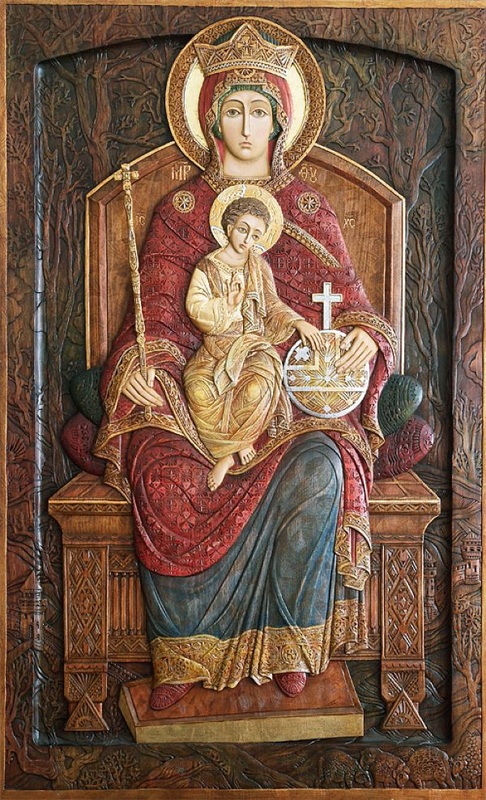
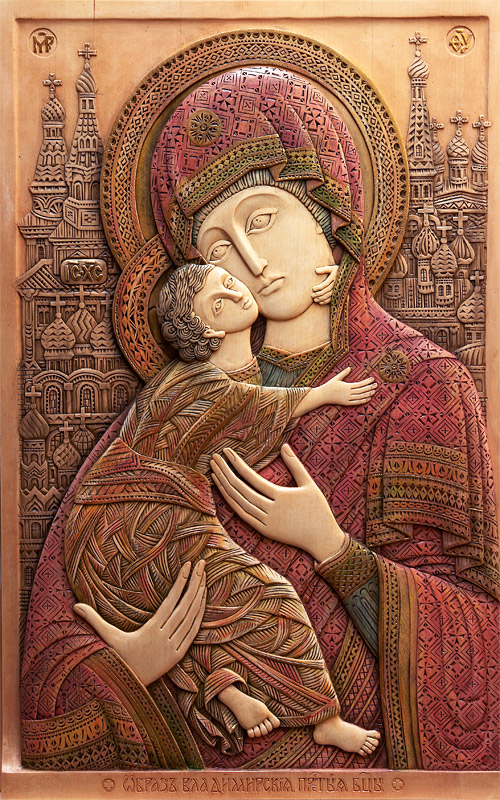
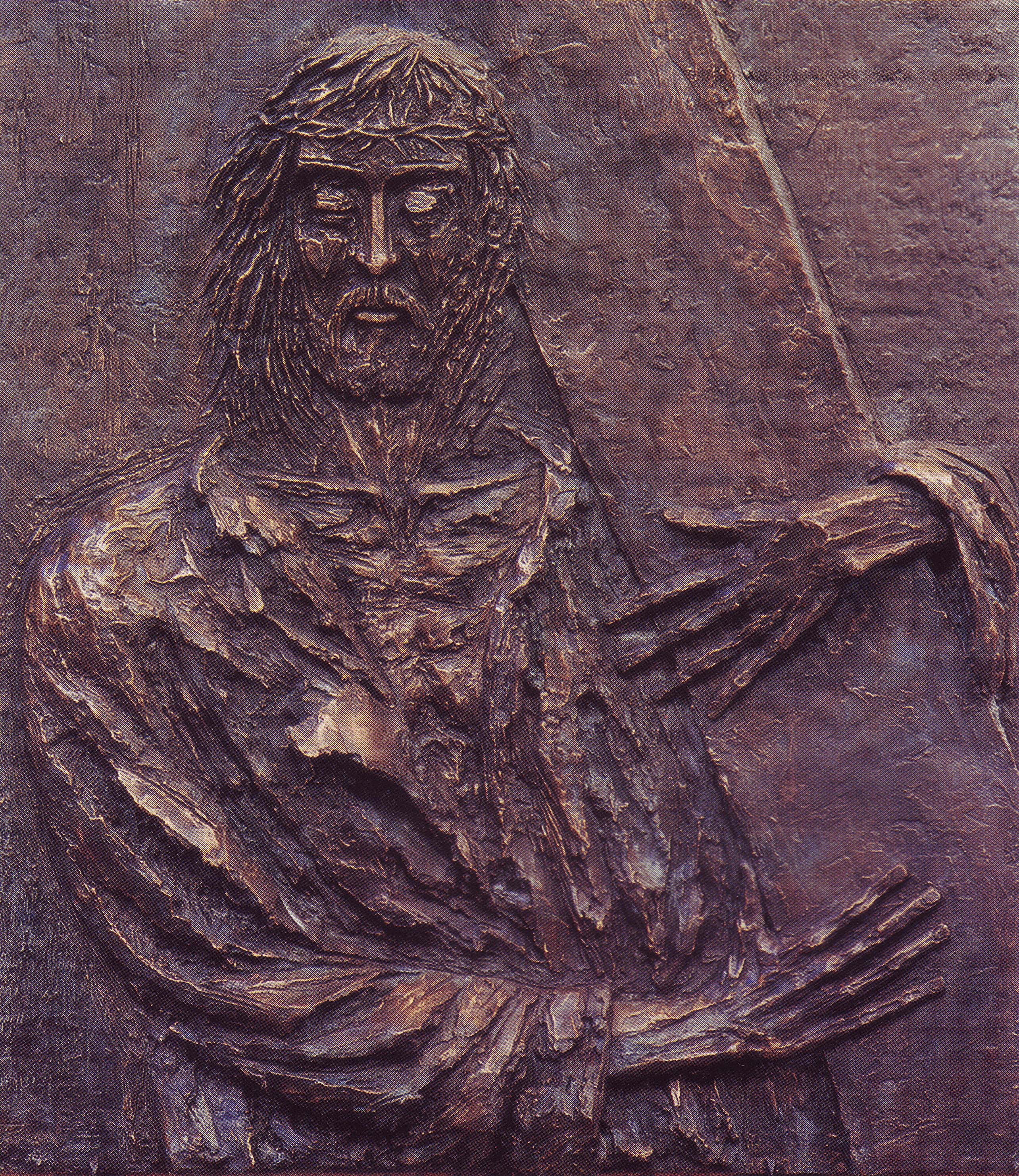
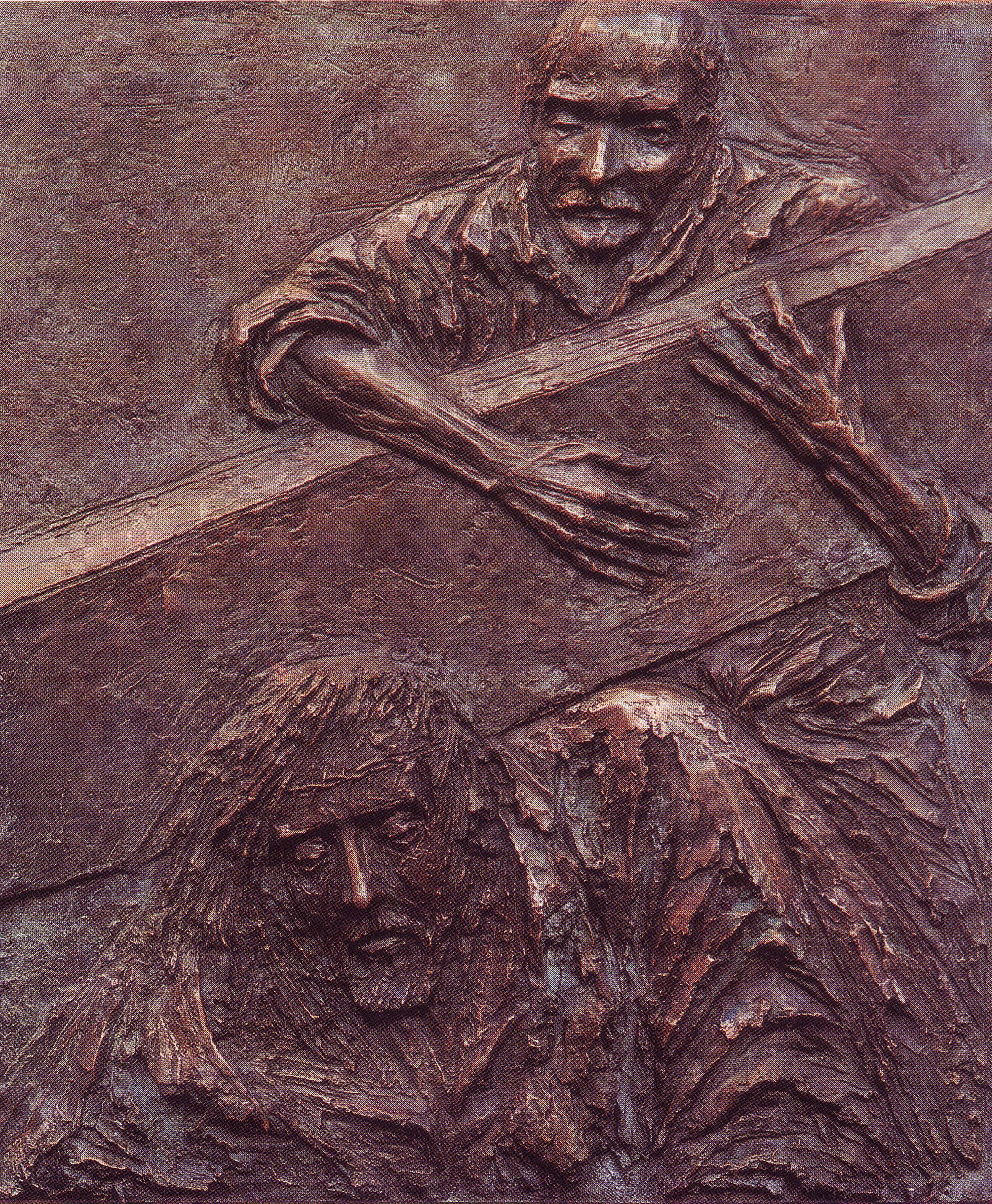
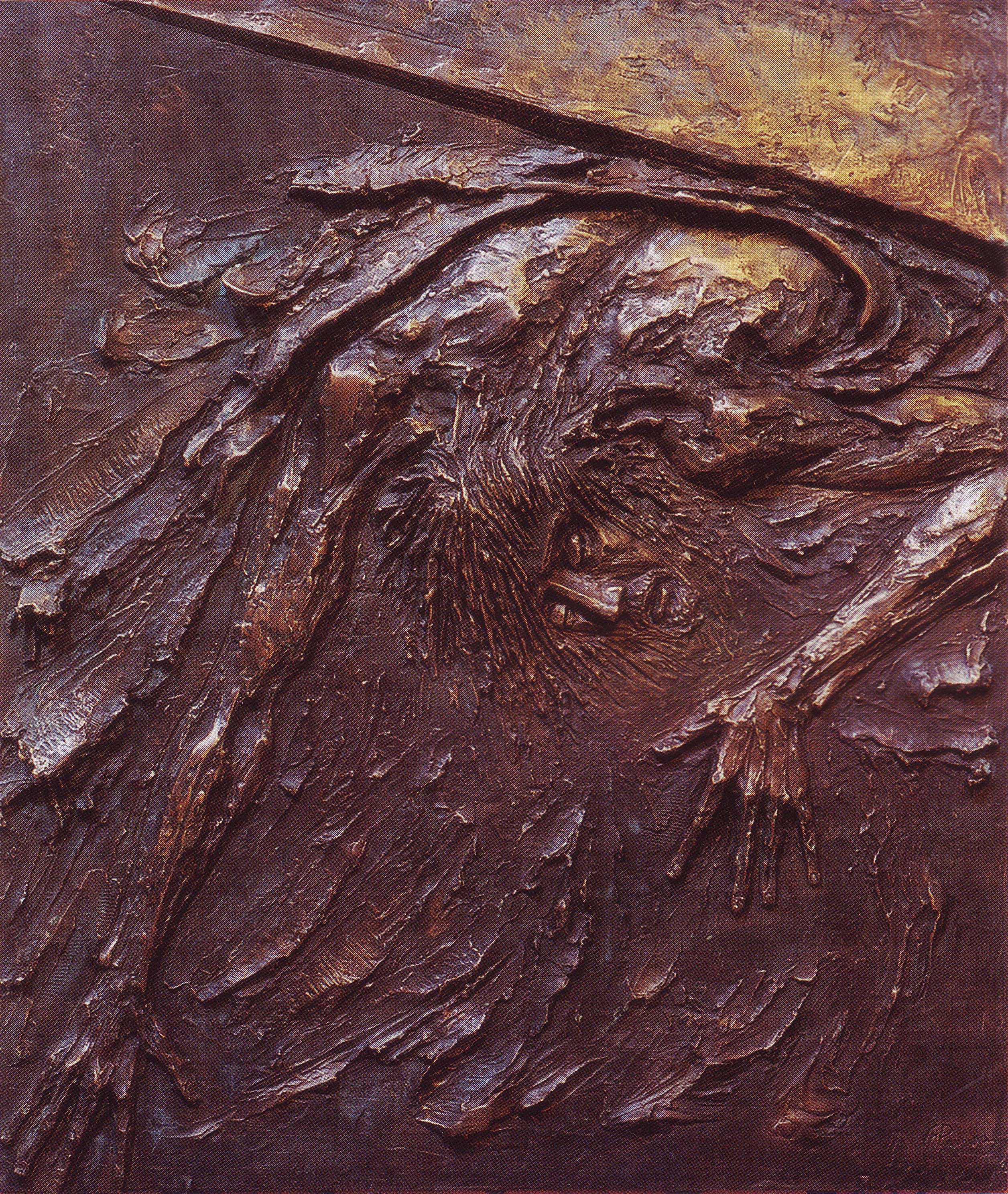
The alleged sexual abuse scandal and charges leveled against sacred artist and former Jesuit priest Marko Rupnik have caused outrage and the call to remove his art from numerous churches, cathedrals, and pilgrimage shrines throughout the United States and Europe.

Last week I was interviewed by a national reporter, Gina Christian, for the print and digital editions of Our Sunday Visitor. She had read my post entitled The Canon of a Catholic Sacred Artist (June 2018) and was interested in obtaining some additional background information for an article on sacred art and the Rupnik scandal. Her questions concerned the former Jesuit Marko Rupnik sexual abuse allegations, the removal of sacred art from Catholic churches and cathedrals, and the comportment of a Catholic sacred artist in the world today.

Some background on Marko Rupnik’s case: Rupnik was removed from the Jesuit Order by the Superior General of that Order, Fr. Arturo Sosa, in June 2023. The alleged sexual abuse charges did not involve children but they did involve adult consecrated nuns over a series of years. These charges did initially cause him to be excommunicated but it was lifted by Pope Francis after Fr. Rupnik had repented of his sins. Marko Rupnik remains a diocesan priest.

The case against Fr. Rupnik was reopened in February 2024 when Gloria Branciani and Mirjam Kovac went public with their stories. Their allegations caused outrage throughout the Catholic world and a call to have Church authorities remove Rupnik’s art from churches, cathedrals, and pilgrimage shrines. The Vatican’s new investigation of the alleged crimes is currently ongoing.

Ms. Christian’s questions (boldface) and my comments (listed within quotation marks) are below:

–Is it possible for a piece of sacred art to be true, good and beautiful if the creative process has been marked by sin and scandal? Why or why not?

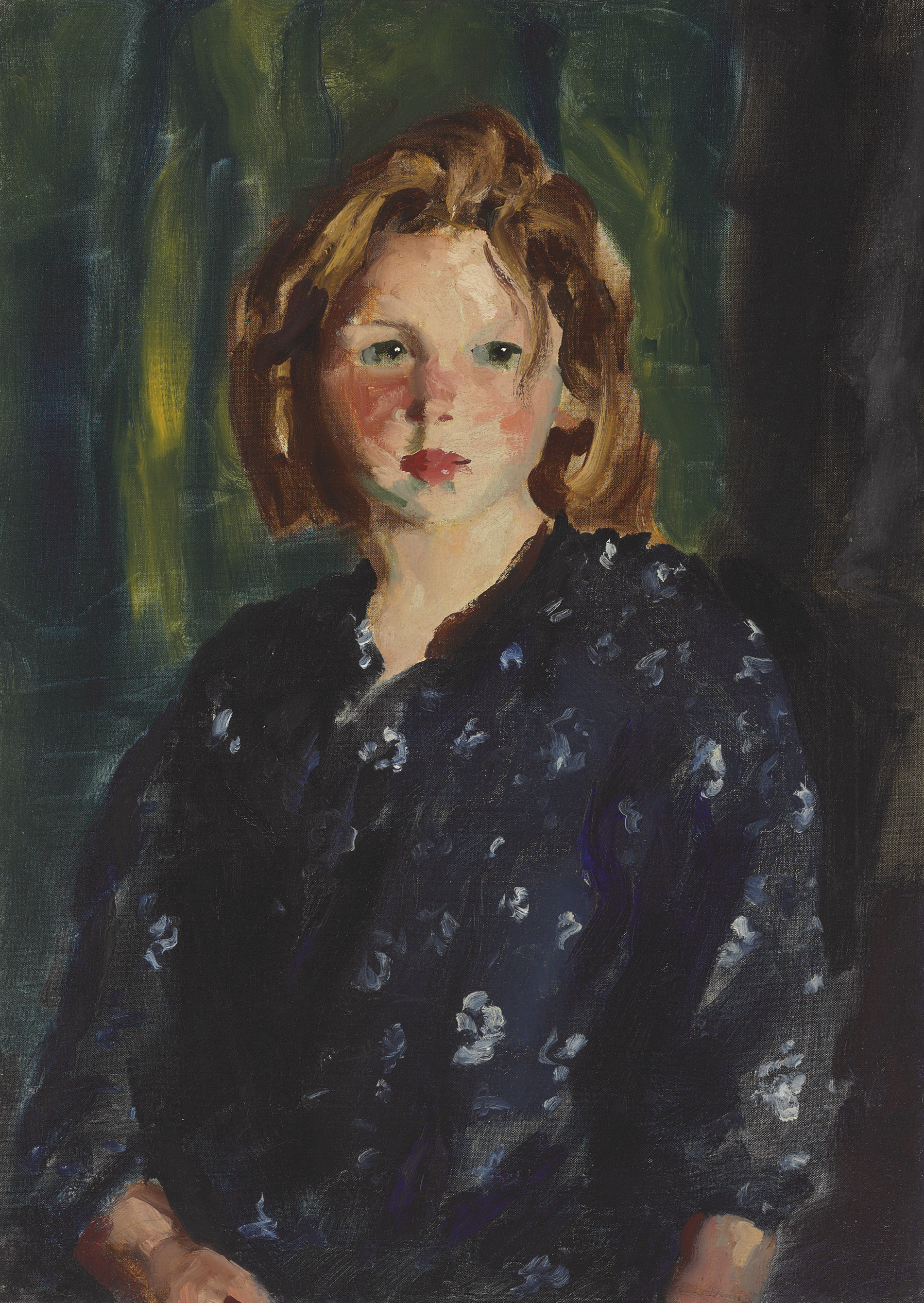
“Caravaggio, a late 16th and early 17th century artist, was a known brawler, swordsman, prone to violent physical outbursts, enjoyed the company of prostitutes, and murdered a man over the love of a woman. He also produced significant sacred art.”

“Yet, Caravaggio had at least three major paintings installed and then removed by the Church. This is a fine line to tread. In one case it was because our Blessed Mother was modeled on a known prostitute. In The Madonna of the Palafrenieri (image found below), Caravaggio used the prostitute as the model for Our Lady, dressed her in the manner of a buxom 17th century woman, and portrayed the naked baby Jesus much larger and older than a one-year-old learning how to walk. At that time Church authorities were not pleased and removed it, however, years later it was reinstalled and today can be seen in the Galleria Borghese.”

“That painting may be understood by someone familiar with symbolism in art, but what about the average person? Does the art cause confusion? Does the viewer come away from the artwork edified or bewildered? Does the artwork assist in the spiritual development of the viewer?”

–Does Rupnik’s art have merit as sacred art? Do you feel the art should be removed, given the abuse allegations and the concerns expressed by survivors?

“As far as the Rupnik case is concerned, it would be improper for me to specifically respond because the case is ongoing.   Some personal opinions on Rupnik’s art: if a work of sacred art displayed in a public place of worship and veneration reminds the viewer of a specific artist’s sin, portrayed, or implied within the sacred image itself, then the Church should remove the artwork. The Church of the past understood the need for this to occur, why doesn’t the Church of today?”

“I am surprised that so many major shrines and churches have selected his style to portray the truths of the Church. There are many highly skilled sacred artists working today that could have been selected to edify their visitors and pilgrims. Examples of well-known contemporary religious artists and architects, are Leonard Porter, Marek Czarnecki, Fr. Silouan Justiniano, Gwyneth Thompson-Briggs, Ellen Ryan, Bernadette Cartensen, Vladimir Grygorenko, Raul Berzosa, architect James C. McCrery, sculptors Cody Swanson, Jonathan Pageau, and so many others in all categories. All the personnel of shrines and churches had to do is contact the Catholic Art Institute in America to receive recommendations and assist in their process of making decisions for American, or even European, placements.”

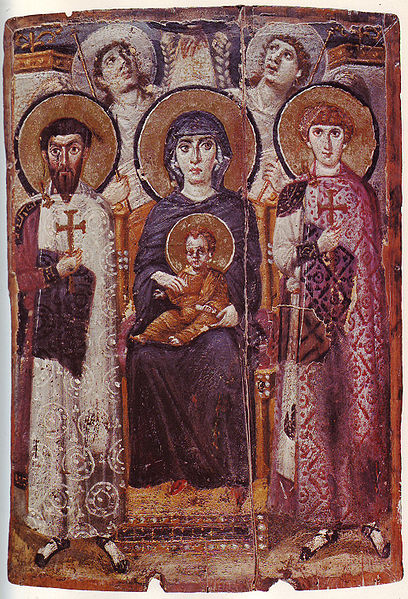
“Rupnik’s artistic style appears to be a simplified version of the beautiful and culture specific sacred art produced for over one thousand years by artists within the Coptic Church. It is also reminiscent of the sacred images created by Martin Erspamer, O.S.B. of St. Meinrad’s Archabbey. The Coptic Church’s style of sacred art can edify and be spiritually fruitful. The question is whether or not it is appropriate for such large scale Roman Catholic venues.”

“Why isn’t Rupnik’s work appropriate? In my opinion, for over sixty years much of the sacred art selected or commissioned by Church authorities has reflected influences and the desire to present images that are in union with the secular world.”

“We see individuals within the Church making artistic decisions based on the desire to be relevant, or to simply select an artist that other sites have chosen. Sadly, many times individuals or committees choose art that does not inspire or transcend the banality of our world. Some of the modern, supposedly inspirational, sacred art and architecture of the contemporary Church rings hollow. Its representations, construction, and colors can confuse and even repel the average parishioner or pilgrim. It does not inspire – it depresses the soul.”

“Every artist is creative, has a specific perspective, and presents their style and use of materials. In my opinion, all art outwardly portrays the condition of an artist’s soul and perspective of the world.”

–In general, what qualities and practices should govern the process of creating sacred art? How should sacred artists approach not only their work, but their lives and relationships? How would you sum up the theology of creating sacred art?

“I believe, and recommend, that a Catholic artist, in the creation of Roman Catholic sacred art, should strive within their spiritual and artistic life to apply the following principles: 

The Catholic sacred artist must create their art within the boundaries of and maintain loyalty to Holy Scripture and Sacred Tradition.

The Catholic sacred artist should continually strive to be in the state of grace and live a life accompanied by prayer and frequent reception of the Sacraments.

The purpose of Catholic sacred art displayed in a shrine, church, plaza, places of pilgrimage, or home is to uplift the individual to understand the majesty, supreme authority, truth, beauty, charity, and goodness of God, His angels, and saints. 

Catholic sacred art should never cause confusion, bewilderment, or diminish the faith of a viewer. Sacred art should always strive to be beautiful in its entire presentation, respect, and conform to its setting.

The Catholic sacred artist must be disciplined. Their art should never cause scandal or refer the viewer to associate the artist’s personal life to the artwork itself. To do so is a profoundly irresponsible action.

Catholic sacred art should be about the principles exemplified by the dogma/doctrines of the Church and the truth found in the Hebrew and Christian Scriptures; it should never deviate into the artist’s personal view of dogma or Scripture. 

The sacred artist should educate, edify, and challenge the viewer’s mind and soul to love and come closer to God, His angels, and saints.”

In conclusion, some people might find Fr. Rupnik’s art beautiful; others might find it profoundly upsetting. The Catholic Church’s investigation of the Rupnik scandal must be exhaustively and thoroughly completed. It must not drag on. It has been reported (by Associated Press) that more women have come forward with allegations against Fr. Marko Rupnik. A clear and authoritative decision must be quickly made by the Church and if found to be true, both punishment of the perpetrator and compensation to the women, must be made. The women involved deserve no less.


th-4112727946
Caravaggio’s The Madonna of the Palafrenieri, 1605-1606; oil paint.

th-496827950
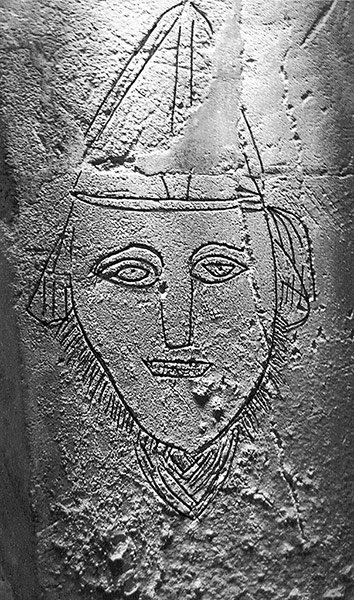
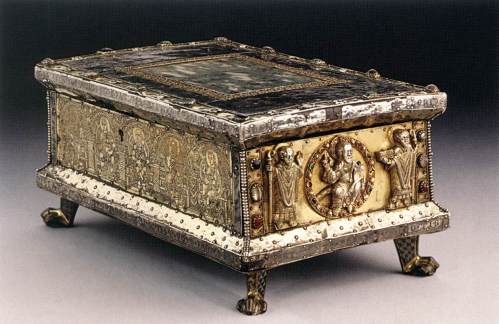
Marko Rupnik, mosaic

th-2666537626
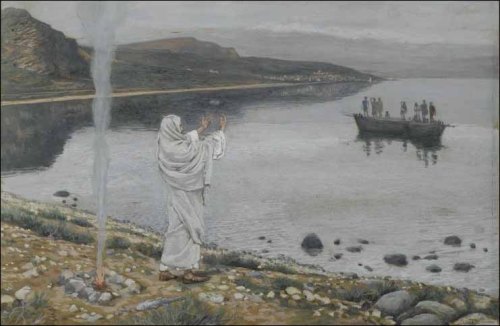
Marko Rupnik, mosaic

th-3547051927-1
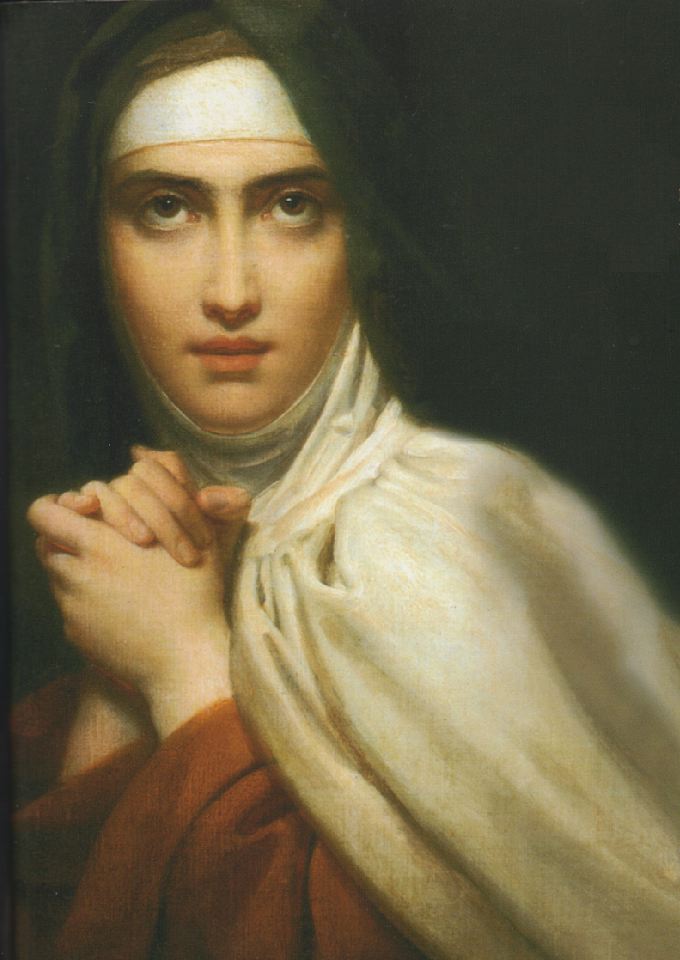
Marko Rupnik, mosaic

Copyright © 2011- 2024 by Deacon Paul O. Iacono – All Rights Reserved. Permission to reprint essays in their entirety and/or my personal paintings must be obtained from me by using the comment box and making a comment/request on the post. I will respond to you through answering in the comment box. Students, and those interested, may quote small sections of my essays as long as the proper credit and notation is given. Thanks.

Bernini’s Bronze Sculpture of Four “Giants” of the Church

Today, May 2nd, is the “Memorial” day of St. Athanasius, a Doctor (profound theologian) of the Church.

There are four “giants” of the Nicene  and Post Nicene period, all are known as “Doctors” of the Church: St. Athanasius, St. Ambrose, St. John Chrysostom, and St. Augustine. They are immortalized in bronze by  the Renaissance sculptor, Bernini, and are portrayed in his magnificent sculpture of the Throne of St. Peter found in the sanctuary of St. Peter’s Basilica.

St. Athanasius and St. John Chrysostom are saints of both the Latin and the Greek Rites of the Church. Both were bishops. Yet, Bernini does not put the Bishop’s mitre on their heads. Sadly, the sting of the Great Schism of 1054 between the Latin and Greek Rites still stung in the 17th century.

Thus, these two Greek Fathers of the Church were slighted, not because of anything that they did (they were profound shepherds and theologians), but because Bernini wanted the authority of and preeminence of St. Peter’s position of “first among many” and the importance of two of the Latin Rite Fathers, to be showcased in bronze and remembered in the centuries to come.

e80a2ad5a5ec983a87fa7030ac16c092

The above photo is the “Chair of St. Peter” and is found in St. Peter’s Basilica (Chair created 1656 – 1665). It is an extraordinary masterpiece by Gian Lorenzo Bernini (1598 – 1680) which he made for Pope Alexander VII (Chigi family, 1655/67). Bernini was a child prodigy and polymath. This Chair proved to be a wooden throne dating to the year 875. It was donated by Charles the Bald to Pope John VIII (served AD 872/882) on the occasion of his coronation to the papacy. Four humongous bronze statues of Doctors of the Church flank the chair: In front to the right “St. Augustine”, to the left “St. Ambrose” (Latin Rite). Behind to the left “St. Athanasius”, to the right “St. John Chrysostom” (Greek Rite). The entire bronze structure’s weight is 74 tonnes (81.5 tons). The height is 14.74 m (48.3 feet). The statues of the Doctors of the Church are 5.35 m (17.5 feet) high. Above the four saints is located a stained glass window: “Dove of the Holy Spirit,” dated 1911 by the German glassmaker Hagle from the original design of Giovanni Paolo Schor (1615/74). These facts are from https://romapedia.blogspot.com/2013/10/basilica-of-st-peter-second-part_3.html. That blog is edited by David Macch. This is an excellent website about all aspects of the art, architecture, and history of Rome.

There are five Councils of the Church that had major impact on the development of the Church’s sacred art: the Council of Nicaea, the First Council of Nicaea/Constantinople, the Council of Ephesus, the Council of Chalcedon, and the 2nd Council of Nicaea (2nd Nicaea met in AD 787 and is the last of the Seven Ecumenical Councils). Besides these Councils all the Church Fathers through their scholarship, pastoral zeal, and extraordinary homilies, witnessed to the truth, beauty, and goodness of the Holy Trinity.

The list below provides the names and birth/death dates of the Fathers of the Church within the “Post Nicene” (that is, the time after the Council of Nicaea, AD 325) period of Church history. A quick review of each of their contributions will prove to be beneficial to you if you decide to paint a sacred image of them. How can you truly benefit from painting a sacred image of a person that you don’t know! 🙂

I recommend that you refer to my bibliography (“Early Church Fathers”) provided in my post of February 8, 2019. There are a number of different books in that bibliography that will prove to be helpful to you.

The Post Nicene Church Fathers born within the Western (Latin) Rite are:

St. Ambrose (AD 340-397),

St. Jerome (AD 345 – 420),

St. Augustine (AD 345-430),

Pope St. Leo the Great (AD 400 – AD 461),

St. Benedict of Nursia (AD 480 – 547) and

Pope St. Gregory the Great (AD 540 – 604);

the Post Nicene Fathers born within the Eastern (Greek) Rite are:

St. Athanasius (AD 295 -373) – (he straddles the Nicene and Post Nicene Periods),

St. Basil the Great (AD 330 – 379),

St. Gregory of Nazianzus (AD 330 – 390),

St. Gregory of Nyssa (AD 330 – 395)

St. John Chrysostom (AD 345 – 407),

and St. John Damascene (Damascus) (AD 675 – 749) 

All of the saints listed, including those in the Greek Rite, are venerated within the Western Rite of the Catholic Church.

Ciao!

Copyright © 2011- 2019, Deacon Paul O. Iacono – All Rights Reserved. Permission to reprint must be obtained from the author in writing. Students, and those interested, may quote small sections of the article as long as the proper credit and notation is given. Thank you.

Sacred Icons and Sacred Images – the Nicene Debate Continues!

AyaSofya
A photo of the inside of the Aya Sofya (Hagia Sophia) church in what is the present-day city of Iznik, Turkey. Iznik was called Nicaea prior to the rule of the Ottoman Turks . This photo shows the interior of one of the rooms in the  building complex that served as the location for the First Council of Nicaea (AD 325). Also, in the late 8th century the Seventh Ecumenical Council met in this building, too. That Council met to debate and decide the issue of iconoclasm (should sacred icons and images be prohibited and destroyed). The written arguments of St. John Damascene (Damascus) won the day and sacred icons were allowed to continue to be made. Iconoclasm was to raise its ugly head again in later years, and came to full fruition during the Protestant rebellion/reformation, the French Revolution, and worldwide Communism in all its cultural forms.  This photo of the inside of the Nicaean building is from Bryan Cross’ website: calledtocommunion.com. It was posted in May, 2010. Thanks Bryan!

I would like to thank one of my readers who identified the  contemporary icon of St. Spyridon (thanks Carol!). The iconographer is the Catholic priest William Hart McNichols. He is a very talented artist who paints traditional icons and sacred images. At times, he steps out of the bounds of the traditional approach and adds his own personal interpretation of the person he is portraying. His artistic vision is unique.

John Daly from Australia emailed me this morning to provide further grist for our mill concerning St. Athanasius, St. Spyridon, and the Council of Nicaea. One of the participants in his iconography school is a Greek Orthodox lady who is the sister-in-law of an Orthodox priest. He is coincidentally named Athanasius.

John had the opportunity to discuss with her the icons that we were analyzing in my posts of the last few days. She provided John some valuable information by explaining  that her mother had given her a beautiful sacred image of the First Council of Nicaea and specifically St. Spyridon’s role in the debate with the heretic Arius. The sacred image is below.

1555507279899blob.png
Greek Orthodox sacred image of the First Council of Nicaea. Notice St. Nicholas on the lower right about to possibly physically strike Arius who reacts by pulling away. On the left you see St. Spyridon, holding a brick with flames streaming upward and water puddling below it to the floor (confer yesterday’s post of April 16th to obtain the explanation of that imagery). The room of the actual Council, as portrayed in this sacred image is quite ornate.

Also, like the sacred icon we examined in yesterday’s post we see the Emperor Constantine, dressed in the royal robes of Byzantine reddish purple (almost a maroon) sitting on the right. On the Emperor’s right we again observe a bishop, maybe its Bishop Alexander of Alexandria, Egypt. In front of him we again see a deacon, dressed in what is either an alb or dalmatic (he would have to stand up to see all the garments).

In the above sacred image, the deacon is again seated at the scribe’s desk. This makes sense, since a deacon serves the administrative needs and report’s directly to his bishop. That is true to this day; yet, throughout the world today the local bishop has his deacons serving in parishes, hospitals, prisons, etc. rather than in an administrative capacity in the local chancery. Notice the bishop is behind the deacon scribe to facilitate accurate communication.

The above sacred  image, which I have never seen before John Daly sending it to me, is very well done. The painter has captured the meaning of the Council as a whole and two of its major participants: St. Nicholas’, in his famous interaction with the heretic Arius, and the great oratorical and mystical abilities of St. Spyridon challenging Arius, too.

Is the deacon pictured in the painting from the Latin Rite or is he Orthodox? Truly, there is no way to accurately tell because the deacon is seated, and what is showing of the deacon’s stole is inconclusive. Depending on the angle of view both the Western and Eastern Rites’ deacon’s stole placement looks the same.

In today’s painting and in yesterday’s post of the icon, the deacon is seated and the possible vertical panel on the Eastern Rite and Orthodox stole is in shadow or not detectable, yet, the panel that drapes from left shoulder and gathers at the waist is visible, and would appear, as you see below, in both Latin, Eastern, and Orthodox Rites!

Just between you and me, I think the deacon depicted in the icon, from my April 16, 2019 post and today’s, is St. Athanasius from Alexandria, Egypt. The Catholic Church, the Eastern Rites in union with Rome, and all the Orthodox Churches venerate St. Athanasius as a great saint and designate specific feast days for him. He belongs to all of us.

The deacon’s stole in the Eastern Rites of the Catholic Church that are in union with Rome; and, the Greek Orthodox, the Russian Orthodox, and Coptic Orthodox deacon stoles look like this:

Unknown
Orthodox deacon’s stole in a royal Byzantine fabric (in  what appears to be a royal maroon purple) is bordered in gold thread with gold crosses. Originating at the left shoulder, gathered at the waist, with the fabric of the stole hanging vertically on the left shoulder both in the front and the back. The stole is worn on top of  the ornate gold and white dalmatic.

The cassock, alb, stole, and dalmatic all have the same meaning and functions in both the Western and Eastern Rites of the Church. In today’s Western, that is, the Latin Rite (Roman Catholic) tradition, a deacon wears the rank of his ministry and ordination, the stole, over the alb but under the dalmatic. Latin Rite deacons would wear their stole’s in this manner:

th-3
A Roman Catholic deacon’s stole running from the left shoulder and gathered at the waist, then hangs vertically under the right arm. It is worn on top of a white alb, and under a dalmatic. The dalmatic is only worn during Holy Mass. When the deacon performs baptisms, marriage and funeral services, liturgical prayer services, and formal blessings, etc. the deacon would not wear a dalmatic, so the deacon would appear as in the above photo wearing a simple white or cream colored alb and a stole in the appropriate color..  The stole’s fabric in the photo above is dyed dark purple for Lent; during the season of Advent a purple stole is used, too; sometimes, it is of a lighter purple than the Lenten penitential purple. A white stole would be used for Baptisms. Marriages, Funerals, Holy Thursday services, and during the Easter and Christmas season. Red stoles would be worn at Palm Sunday and Good Friday services, Pentecost, and on the feast days of martyrs.

th-5
A Roman Catholic deacon’s dalmatic which is worn over the white alb and the stole. The dalmatic is in the corresponding color to the stole. The color green is worn during “Ordinary” time (which is the liturgical period that borders the great seasons of Advent, Christmas, Lent, and Easter).

I’ve really enjoyed this lively information exchange. Thanks to all who participated in it!

May you have a blessed Easter Tridiuum of the Passion and Resurrection of Our Lord Jesus Christ.

Peace be with you.

Copyright © 2011- 2019, Deacon Paul O. Iacono – All Rights Reserved. Permission to reprint must be obtained from the author in writing. Students, and those interested, may quote small sections of the article as long as the proper credit and notation is given. Thank you.

St. Athanasius and St. Spyridon: A Correction and Another Interpretation – Let’s Take A Closer Look!

I am always very appreciative of my readers writing to me and providing new information and interpretations of sacred icons and images. Happily, that occurred last evening when a reader, Mr. John Daly from Australia, provided me with information on the second icon that was in yesterday’s post on St. Athanasius. Let me provide you with that image so we will have a reference point:

THE_FIRST_COUNCIL_OF_NICEA
This is the sacred icon of a bishop confronting a heretic at the Council of Nicaea (AD 325). Mr. John Daly of Melbourne, Australia informed me that we should take a closer look at the details of this icon because of how it depicts the bishop’s castigation of the heretic. I concluded erroneously that it must be St. Athanasius since he was a pivotal orthodox figure at the Council. Even though he was a deacon at that time, and not a bishop at the Council, he was ordained a priest and bishop about three years later, so the iconographer just inserted him as a bishop. Mr. Daly recommends a closer look to discover that it is St. Spyridon of Cyprus.

Mr. Daly is correct – it is St. Spyridon (born AD 270, died 340).

Let’s take a look at the reasons for this correction:

  1. The bishop castigating the heretic Arius is wearing a distinctive hat. The hat is unique. It is shaped like a beehive. It is made of woven straw and was traditionally worn by Cypriot and other shepherds tending their flocks – an apt metaphor for a bishop caring for the flock of his faithful.
  2. St. Spyridon was from the island of Cyprus, and eventually became a bishop serving the people of Trimythous, thus, he would have been invited to the First Council of Nicaea as were all the other bishops in Christendom.
  3. At another time, possibly in Cyprus, St. Spyridon was involved in a debate with a pagan philosopher whom he ultimately converted to Christianity. Besides his theological arguments about the Holy Trinity, the good bishop used a piece of pottery or a brick, to demonstrate to the philosopher how you could have one single substance be also composed of three separate substances (pottery and bricks consist of clay, water, and are unified by the substance of fire).
  4. The story of his discussion with the pagan philosopher continues and says that as soon as St. Spyridon finished speaking the piece of pottery or brick burst into flame, water dripped from it, and clay ash remained in his hand. Well that would have been enough to place me on the road to conversion, and so it was with the philosopher, too. If you look closely at the icon above you can perceive the fire bursting out of the brick and the water puddling beneath it. Hmm, I didn’t see that! As Sherlock Holmes once said, “Watson, you see, but you do not  observe” (taken from the story A Scandal in Bohemia by Sir A.C. Doyle).  Wise advice.
  5. Mr. Daly also relates that it was [and probably still is] common for an iconographer to fuse the two incidents of St. Spyridon converting a pagan, and St. Spyridon at the Council of Nicaea debating with the heretic Arius.
  6. There it is: the beehive woven straw hat, the bishop’s vestments, the water, fire and ash metaphor, the confrontation with an individual that has an opposite argument, and the public venue for both incidents.
  7. So where is St. Athanasius in this icon? Mr. Daly offers that in the upper left corner of the icon, we see an individual portrayed as listening intently to St. Spyridon. He is dressed in a dark alb with a white collar. He suggests that this is St. Athanasius. That argument makes some sense because, as a deacon, Athanasius may not have been up front with the bishops, rather he possibly would be located near the altar ready to perform his diaconal duties. At the same time he is still involved in the proceedings, and/or ready to respond to the needs of his bishop – Alexander of Alexandria.  You notice the priests and monks in the back of the room, too, in dark conical monastic hats and cassocks.
  8. My only issue with that interpretation is that the figure portrayed in the upper left does not have a nimbus (halo) circling his head, nor is he wearing his deacon’s stole; however, the scribe in the lower left corner is wearing a deacon’s stole. My stole comes across my chest from the left shoulder and is gathered at the right hip; and the scribe’s stole does the same thing. Is this individual St. Athanasius? There appears to be writing on his stole. I have no proficiency in Greek so I cannot be of help there.
  9. The scribe in the lower left corner has a halo, too, and so do all the bishops. Did the iconographer think that all the bishops present were saints?  This is not unlikely, since they produced a Creed for Christendom in three months. Truly, a stunning achievement. It indicates that the assembled bishops were very clear in their own minds what the Faith, based on Scripture and Apostolic Tradition, was all about. The bishops all appear very animated and involved in the Council proceedings. It’s obvious that the Holy Spirit was working within that Council!
  10. There is a lot going on in the upper part of this icon, too. Christ, as a young child, is found walking across what appears to be an altar towards another bishop. That bishop on the upper right is seen discussing some issue with, possibly, another dissenter (a priest, or deacon; even though the priests and deacons in attendance didn’t vote, they certainly could influence the bishop of their diocese on issues and arguments).
  11. Sadly, I believe that the only existing documents that we have concerning this Council that are still in existence are the Nicene Creed itself, the procedural rules of the Council, and Emperor Constantine’s address to the assembled bishops. It is said that many of the bishops came, returned to their dioceses, and then came back to the Council. This probably contributes to the fact that we don’t have all the names of the participating bishops, just those mentioned in other documents or in the stories that were passed on through to the faithful (confer Anna Erakhtina’s article The “Model of Meekness,” and Slapping Arius, at http://www.orthochristian.com, May 22, 2016, specifically the contribution by Archpriest Vladislav Tsypin. He discusses the documents available to us today). If anyone has additional information on the actual participants please tell me your source, and the participants, and I will spread the information through a post.
  12. St. Spyridon was also known as a miracle worker, especially for his successful intervention (caused by the prayers of the soldiers and sailors of the Catholic Rites) in the 1716 battles with the invading Ottoman Turks on the Greek island of Corfu.

John, thanks again; this was a fun interaction.

Additional images of St. Spyridon:

ST. Spyridon Orthodox
A contemporary Sacred Icon of St. Spyridon showing his beehive woven straw hat, his bishops stole, the blazing potsherd or brick with water dripping from it, and his holding the book of the Gospels (dogmatic truth based on the Holy Scriptures and the Sacred Apostolic Traditions of the Western and Eastern Rites of the Catholic Church. If anyone knows that artist that is responsible for this beautiful icon please tell me and I will credit him/her in this post. Icon found on Wikipedia and originates at St. Spyridon Orthodox Church in Loveland, Colorado (thanks to them for posting the image of this magnificent icon).

220px-Zemen-monastery-st-spiridon
A medieval icon of St. Spyridon, wall fresco, Bulgarian Orthodox, found in the  Zemen Monastery, Bulgaria. Photograph may have been taken by I.E. Stankov in 2012 using a Canon EOS 600D camera.

In the Roman Catholic Church, St. Spyridon is venerated on his feast day, December 14th; and on December 12th in the Eastern Rites and the Orthodox Church.

Thanks for stopping by and reading this post.

Copyright © 2011- 2019, Deacon Paul O. Iacono – All Rights Reserved. Permission to reprint must be obtained from the author in writing. Students, and those interested, may quote small sections of the article as long as the proper credit and notation is given. Thank you.

St. Athanasius – Coptic and Eastern Orthodox Icons

St. Athanasius of Alexandria was “the Lion” of the Council of Nicaea. He was instrumental in providing well argued testimony rebuking the heretic Arius during the Council’s debates. His verbal skills, as powerful and commanding as a lion, shredded Arius’ arguments. His eloquence convinced the assembled bishops of the correct dogma that Jesus Christ has two, separate and distinct, natures (divine and human), and that Jesus Christ is fully human and fully divine. The heretic Arius insisted that Jesus was “just a creature” of God.

Icon-St.-Athanaius-the-Great
A contemporary icon, completed in The Egyptian Christian Coptic style, of St. Athanasius of Alexandria standing on the back of the heretic Arius (seen in very dark colored clothing) at the Council of Nicaea (AD 325). Athanasius is seen in front of the assembled bishops from the Eastern and Western Rites of the Catholic Church. He is holding the Council’s accepted conclusions in the document known as the Nicene Creed. Notice that he does not have a bishop’s mitre on his head similar to the bishops sitting in attendance behind him, and is dressed in what appears to be a deacon’s dalmatic with cape. The style of this sacred icon is very similar to the style of the Coptic (Egyptian) Orthodox Church’s sacred art; yet, the inscription above his head is in Greek rather than Coptic. Image found at churchofourladyofkazan.org; (thanks to them) throughWikipedia images.

The Council’s main purpose was to address the divine nature of Jesus Christ and the concept of HIs being the Son of God the Father. This had to be done in order to squash the Arian heresy once and for all. It was also to establish a date for the celebration of Easter, resolve organizational and clerical issues, and the development of Church law (what today is called Canon Law). They were also attempting  to settle a schism that had occurred in Egypt. That schism was being fomented by another bishop who had enlisted with the heretic Arius.

The Council was also tasked with development of a Christian Creed that would provide unity of belief for both the Eastern and Western Rites of the Church. This unity of belief was critical since the Church needed a formal set of beliefs  that could be used as a catechetical tool and a binder that kept all the cultural and geographical “Catholic” churches together.

The Council of Nicaea basically resolved all the main issues of its agenda. It was a stunning achievement. The priest Arius was banished for promoting heresy and his ideas declared anathema. Yet, the problem the Council still faced was convincing Arius’ followers of their heretical errors. Banishment or not, an unrepentant Arius continued to spread  his opinions fomenting confusion throughout the Empire.

THE_FIRST_COUNCIL_OF_NICEA
The above image is another example of a sacred icon, however, it is not completed in the Coptic style which originated in Egypt. It is an Eastern Orthodox icon (Greek, Russian, or one of the many other Eastern Rites of the Church), completed centuries after the Council ended in the summer of the year 325. It shows a non-heretical bishop castigating the heretic priest Arius (who is raising his hand in an attempt to stop the speaker). The bishop, because of his hat (mitre), appears to be labeled with Athanasius’ name found at the bottom); however, he is not clothed in a deacon’s dalmatic, nor did deacon’s wear that style of hat. It is believed that Athanasius was not ordained a priest and bishop until after the Council ended. The Emperor Constantine sits on the right dressed in imperial clothes and it may be surmised that it is Bishop Alexander of Alexandria (the bishop of Arius’ and Athanasius’ diocese) who sits to the immediate right of the Emperor.

The Eastern and Western Rites of the Catholic and Orthodox Church have always believed that sacred icons and sacred images are always venerated by the faithful; they have never and are never worshipped.To worship sacred icons, sacred images, statues, and other visual reminders of the glory of God and His saints is against the 1st Commandment (confer Exodus 20: 2-17, and Deuteronomy 5: 6 – 21). If anyone worshipped those visual images they would correctly be called idolaters. Worship is for God alone, that is, the Holy Trinity – the Father, the Son, and the Holy Spirit; Three Divine Persons in One God.

Our Savior Jesus Christ is One Person with two natures: human and divine; that is a state of being which is part of the great Mystery of the Incarnation of God into human existence.

Jesus Christ is the Lamb of God, sacrificed in Jerusalem through His Passion, Crucifixion, and death. Jesus, following His Father’s will, suffered and died for us in order to atone for all of humanity’s sins (past, present, future). God the Father and God the Holy Spirit responded by raising Jesus from the dead on the third day, ultimately enabling Jesus to interact and be seen by His Apostles and hundreds of disciples.

Truth, Goodness, Beauty, and Love, incarnate in our Savior.

Thanks for stopping by.

May you continue to have a prayerful Holy Week and a joyous Easter Season.

Copyright © 2011- 2019, Deacon Paul O. Iacono – All Rights Reserved. Permission to reprint must be obtained from the author in writing. Students, and those interested, may quote small sections of the article as long as the proper credit and notation is given. Thank you.


Saint Nicholas Slaps a Heretic! A Reflection Appropriate for Palm Sunday

The extensive Gospel reading for Palm Sunday relates the Scriptural and historical truth that Jesus  triumphantly entered Jerusalem, yet, five days later He was arrested, put on trial, tortured, and executed.

As you know, the religious and secular leaders of Israel did not accept Jesus as the Messiah and Son of God. They were adamant about the fact that Jesus was just a man and that His claims, teachings, and healings were all fraudulent.  Their disbelief took place during the first century, yet, two hundred years later there were Christians saying the same thing.

The questions came down to, “Who is Jesus Christ? Is He a man? Is He God? Is He both?”

These were the same questions that the people of Jerusalem, some of them waving palm branches, and their leaders were asking each other.

In the year 325 scholars and clerics were still grappling with those questions, too.

Many deacons, priests, and bishops of the Church had settled the question in their own mind, yet, all of Christendom was not in agreement. Emperor Constantine was worried; as a military man he knew trouble when he saw it. Religious disagreements could easily spread into civil war. Something had to be done.

Stories have come down to us through the centuries that St. Nicholas of Myra, a faith-filled bishop, decided to defend Sacred Tradition and the Scriptural interpretation of the reality of Jesus as the Son of God the Father. The story relates that he not only vigorously defended Sacred Tradition but became so worked up that during one of the debates he slapped the author of this heresy which was called Arianism.

But, was it a verbal or physical slap?

Let’s take a brief look at some of the details:

th
Partial icon of the “incident” at the 1st Council of Nicaea. Immortalized in an early icon. The Early Church was well aware of the importance of this Council in debating and agreeing to the specific dogmas of the Church that would be ultimately proclaimed in the Nicene Creed. All catechumens that enter the Church at the Easter Vigil Mass proclaim their belief in the great Sacred Mysteries and historical truths of the Nicene Creed.

Who: Saint Nicholas of Myra, Bishop, (Myra, an Ancient Greek city on the coast of present day Turkey),  vs.  Arius, priest from the diocese of Alexandria, (Alexandria, a city on Egypt’s Mediterranean coastline). Emperor Constantine, Roman Empire, centered in the new city named in his honor: Constantinople (present day Istanbul, Turkey). Constantine convenes an ecumenical council of bishops from the five major patriarchies of Christendom (Alexandria, Antioch, Constantinople, Jerusalem, and Rome).

What: Supposed incident of Bishop Nicholas “slapping” the priest Arius, at the first ecumenical Council of Bishops: the Council of Nicaea. This was the first Council since the Council of Jerusalem (held in the first century and was attended by luminaries such as St. Peter and St. James).

When: Late Spring and early Summer of the year 325.

Why: The incident concerned the critical issue of who is Jesus Christ, and whether Jesus Christ is “the same in being and the same in essence” as God the Father. Arius was promoting the heresy that Jesus Christ was “just a creature” of God and not a divine Person of the Holy Trinity.

Where: Nicaea, an ancient city in Asia Minor; it is the present day city of Iznik, Turkey.

As it applies to sacred art, the Council of Nicaea provided a specific creed: a set of theological proclamations that impacted  sacred artists from the 4th century to the present day. It is stated clearly in this Creed that God the Father has communicated His love, mercy, and laws to humanity through His revealed word in the Hebrew and Christian Scriptures. This action culminated in the ministry, passion, death, and resurrection of His incarnated Word, His Son Jesus Christ.

The Nicene Creed definitively proclaimed that Jesus Christ is the same in essence, and the same in being, as God the Father and God the Holy Spirit. So we have the great Mystery of the Incarnation, the nature of Jesus Christ: He is both human and divine – the Son of God – One Person with two natures – human and divine.

orthodox_icon_of_our_jesus_pantocrator_of_sinai._large
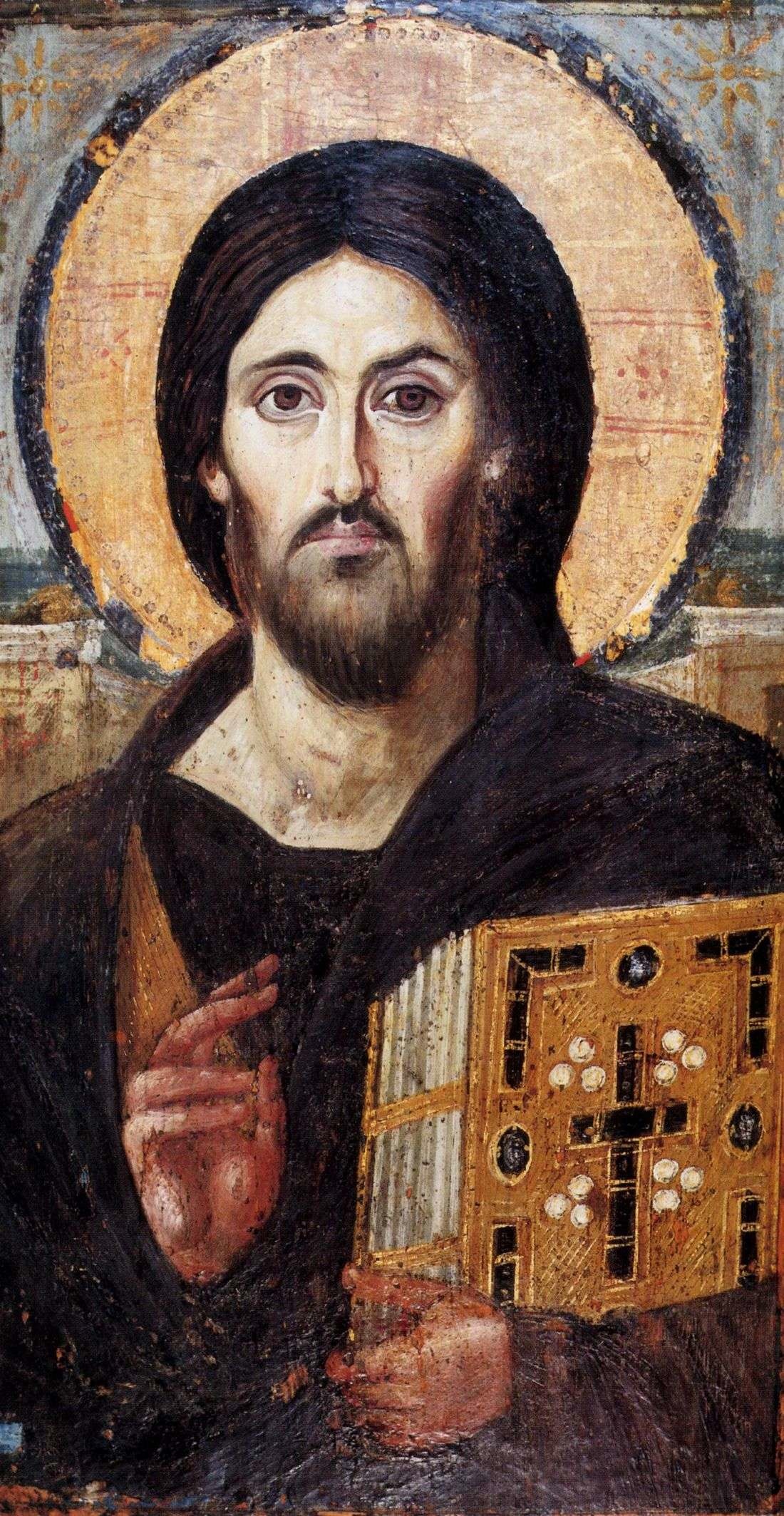
The above is a 6th century sacred icon of Jesus as Pantocrator. Pantocrator is a Greek word describing the all knowing, all powerful Son of God: Jesus Christ. The Council of Nicaea declared that Christ, as God, is consubstantial: Jesus is the same in essence (substance) and in being as the Father and the Holy Spirit. Also, Jesus possesses two natures: human and divine. This is truly a great Mystery of the Church. The sacred artist of the above icon, probably a monk, used hot pigmented wax (the encaustic method) to render this likeness. This sacred icon is currently located in St. Catherine’s Monastery, Sinai Peninsula, Egypt. The face has a striking resemblance to the face on the Holy Shroud of Turin.

The day-to-day proceedings and debate notes of the Council have been lost to history, so we will never know if St. Nicholas gave Arius a physical or just a verbal “slap.” Regardless, St. Nicholas made his point and contributed to giving us the gift of the Nicene Creed.

In AD 381, the Nicene Creed was edited and amended at the First Council of Constantinople (thus, the Creed is called the Niceno-Constantinopolitan Creed. Try to say that phrase fast, three times!😃).

Thanks for visiting with me. May you have a prayer-filled Holy Week.

Sources for the above post are found in my bibliography post, entitled Early Church Fathers – A Short bibliography of February 8, 2019. I relied primarily on Pope Emeritus Benedict XVI’s works, also Aquilina and D’Ambrosio’s volumes.

Copyright © 2011- 2019, Deacon Paul O. Iacono – All Rights Reserved. Permission to reprint must be obtained from the author in writing. Students may quote small sections of the article as long as the proper credit and notation is given. Thank you.


Luke 15: 1-3, 11-32. The Prodigal: Which Brother Are We?

I once heard a friend repeat a quote by the author Katherine Mansfield: If you wish to live, you must first attend your own funeral.”

How true. We begin to live life perceptively only when we project ourselves to the time of our own death, imagining how we’ve lived our life and wondering whether we’ve met the mark.

Depending on our frame of mind, and perspective on life, we may not include the spiritual in our self-assessment, or, only give it a passing thought. That is why Mansfield’s phrase may be viewed as spiritually deficient.

In today’s Gospel on the parable of the Prodigal Son there are family members that Jesus is requiring us to understand. The behavior of these people, the father and the two sons, provokes four questions. Questions not so much about our secular situation but our spiritual – our relation to God, and, each other.

At first glance, the younger son impresses us as an individual who is quite selfish. When he requests his inheritance from his father, he isn’t just asking for the cash, he is in effect saying to his father: “I want to live my life now and without any strings attached. To me you’re unimportant, this family is unimportant. Just let me get on with my life and give me my share right now.”

Are we living in  a way that categorizes God? Are we willing to acknowledge  Him only because we want to get something out of Him? Do we play upon His charity and generosity?

If this is so, if we have the younger son’s attitude, we end up like him – swimming with the pigs.  What will be our inheritance? It will undoubtedly be spiritual poverty and secular discontent. Sadly, sometimes people understand this only in the last few months of their life, or, in the moments right before their death.

Jesus is teaching us that the prodigal son was only able to enter into a state of recovery when he “attended his own funeral.” When he was able to perceive his own personal endpoint, his own material and spiritual poverty. He was finally able to admit that he was grievously wrong only when this realization slammed into his consciousness.

His new perception demanded that he learn the root causes of his problem, reject his worldly self, and humbly ask for repentance. He needed to realize that his father and family were all important to his happiness. This required acceptance of and humbly requesting his father’s mercy and love.

This perception did not demand psychoanalysis. He did not need years of therapy on a psychologist’s couch. He had the intelligence to figure it out because he confronted himself as he truly was and extended that personal analysis to his family and surroundings. He acknowledged his sins, and how truly needy he was of his father’s love and mercy.

We are half way through the Season of Lent. Like the younger son, have we confronted our own faults, our lack of perception, and yes – our own sins?

The Prodigal says: “I will arise and go to my father, and will say unto him, father, I have sinned against heaven, and before you.”

This is the turning point in the Prodigal’s life. It can also be ours.

Improvement begins with a decision to change the way we do things, the way we behave and perceive reality, both in a secular and spiritual sense. If you are a Western Rite Catholic, this is accomplished in three ways: Sacramental Confession, prayer, and resolution of purpose. Reconciliation is always possible. Our God is a God of justice, but also, a God of infinite familial love and mercy.

Do we behave like the younger son or the elder son? Are our hearts cold?

What the younger son ultimately accepts the elder son initially rejects. At first, the elder son resents the generosity of the father’s love – he resents the generosity of the act of forgiveness. It appears that he is unable to accept his repentant brother or his generous father.

Does this, in any way, apply to us? Do we ignore the Father, Son, and Holy Spirit’s love for us; do we resent people who have converted, changed their spiritual way of life? Or do we continue to judge them as if they were still enveloped by their sins? Do we verbalize our resentment or question their repentance? Are we unwilling to repent of these attitudes? Are our hearts cold?

I am a sinner and you are a sinner. There are very few people on this earth that are living saints. Regardless of whether our sins are small or large, visible or hidden, it is paramount that we remember the words of St. Paul: God the Father “reconciles us to Himself [through the passion and death of His Son] and has given us the ministry of reconciliation. Be reconciled to God. For our sake He made Him [Jesus Christ] to be sin who did not know sin, so that we might become the righteousness of God in Him” (2 Corinthians 5: 17-21).

We need to take stock of ourselves this Lenten season, repent and return to the Father’s embrace. This can only be done through the Sacrament of Confession/Reconciliation – a Sacrament made possible through the life, death, and resurrection of Jesus Christ, our Lord and Savior.

the-return-of-the-prodigal-son-illustration-for-the-life-of-christ1.jpglarge
Painting by James Tissot (French; 1836 – 1902). “Return of the Prodigal Son.”

Thank you for reading this post.

 Copyright © 2011- 2019, Deacon Paul O. Iacono – All Rights Reserved. Permission to reprint must be obtained from the author in writing. Students, and those interested, may quote small sections of the article as long as the proper credit and notation is given. Thank you.


Luke: 16: 19-31 – Is Lazarus in Your House?

This passage from the Gospel of St. Luke is a parable about a destitute man named Lazarus and a rich man, who at times is called by the name Dives (the word dives in the Latin Bible refers to a “rich man”).

Jesus places Lazarus sitting day after day by the rich man’s front door. Lazarus is sick. He is at Dives’ home hoping to receive a scrap of food from his table. The food never comes.

Jesus continues to tell the story which culminates in the death of both men and their subsequent judgment.  Lazarus is welcomed into Paradise and is seen talking to Abraham, while Dives is condemned to the flames of Hell hoping for a drop of water to quench his thirst.

The parable concludes with Abraham rejecting Dives’ wish that someone from Paradise will inform his relatives of his eternal sentence in an attempt to get them to change their way of life.

Abraham says that it is fruitless: “‘If they do not listen to Moses and the prophets, neither will they be convinced even if someone rises from the dead.'”

You see its not just the issue of Dives, as a fellow human being, not providing nourishment and solace to Lazarus. It is the fact that Dives does not even acknowledge Lazarus. He and his servants pass him every day with no perception, no acknowledgement, no understanding, no charity.

How many times have we done that to men and women standing at intersections, asking for a scrap that falls from our table. We get uncomfortable at the thought that they are there. Irritated at bad government decisions that pushed them out on the street, supposedly to be helped by the social justice safety nets; nets filled with holes. I saw a woman today holding a sign that said “I need a miracle.” There was no exclamation point or happy face penned next to it.

Lazarus may be outside our front door, or, even in the house.

Question: are we passing by people in our own family who are in need? The neighbor who lives next door? A member of our parish? Are we passing by Jesus Christ?

Lent is the natural time to reflect on how well we remember and assist, in some small way, those around us who are in need. It may be financial help, or it might just be they need someone to talk to.

Upon reflection, we may find ourselves missing the mark, even committing sins of omission. Let’s remember that, unlike Dives, we still have time to do something about it.

300px-Meister_des_Codex_Aureus_Epternacensis_001
“Meister des Codex Aureus of Echternach” (the Master’s Golden Book of Echternach) – a page from this illuminated Gospel created in the mid 11th century. When seen by the Holy Roman Emperor, Henry III, it stimulated him to commission similar manuscripts from the Abbey of Echternach (Germany).


My thanks to Rev. Msgr. Anthony Mancini, Pastor of the Cathedral of St. Peter and Paul, Providence, Rhode Island USA, for stimulating this blog post.

Copyright © 2011- 2019 Deacon Paul O. Iacono – All Rights Reserved.

Christ in the Wilderness: Lent – the Season of Preparation – Luke 4: 1-2.

Jesus, full of the Holy Spirit, returned from the Jordan and was led by the Spirit into the wilderness, where for forty days He was tempted by the devil. He ate nothing at all during those days, and when they were over, He was famished. (Gospel of Luke chapter 4: verses 1-2)

In the extraordinary painting  below, we see Jesus after He was led into the desert wilderness by the Holy Spirit. He is surrounded by rocks and sand. He sits on a boulder, hands in front of Him. His eyes are filled with the knowledge of reality, of passions, power, and pain, ego and emptiness, sin and self aggrandizement.

This painting may move us from the awareness that in the desert wilderness Jesus is not only thinking through His ministry, Passion, and death but is also viewing our lives – our ministries, our passions, our death.

What do we see?

Let us examine His face.

christ_in_the_wilderness_detail_400

We see the seriousness of the forthcoming temptations; the physical, mental, and the spiritually violent struggle with the devil. It is written plainly upon His emaciated face.

We see the irrefutable fact of Jesus’ humanity.

We see that He is like unto us, except for sin.

This is the face of our Savior; but the victory is not His, yet.

His temptations, public ministry, Passion, and death are still to occur.

What do we see?

We see a man who knows His Mind. He knows His Body, Soul, and Spirit.

He knows His freely accepted duty to accomplish His Father’s will.

This is not the face of a defeated man. It is the face of a determined man who is also Lord and Savior.

**679px-Kramskoi_Christ_dans_le_désert

Observe Christ’s clenched hands, gaze deeply into His eyes, and you will see the artist’s portrayal of a Savior that is already, at the beginning of His ministry, aware of the viciousness of the tempter and the burden of our sins. Sins accepted by Him, and through His Passion and death, makes all things new.

christ_in_the_wilderness_detail_400

Jesus had to confront in that desert assault whether or not He was going to be faithful to His mission.

The Gospel passage above challenges us with the same questions: are we going to be faithful to the Commandments, to our Baptismal promises, to the mission given us in Confirmation to live and practice the truths that He taught us?

Are we going to be faithful to the spiritual power and grace given to us, not just when we feel like it, but even in the most difficult of circumstances?

As disciples of Christ we are on a daily basis constantly revolving around the axis of temptation and sin – faith and grace. We understand that temptation, in and of itself, is a test – it is not sin. It is only sin when we willfully place ourselves in its shackles, when we give into its fueled power to overwhelm our body and soul. That power  – a deadly power – obtains its animus and energy from the original tempter and liar – Lucifer himself.

Hell is real. It is not a mental construct. To say that it doesn’t exist is to call Jesus a liar, and His Passion, death, and Resurrection meaningless.

Jesus the Christ lived heroically in the face of Hell’s demons and witnessed to the power of God’s grace.

But you say, I am not Jesus Christ, I am a weak man or woman, boy or girl.

I say true, we all are; but by virtue of our faithful reception of the Holy Sacraments (Holy Mysteries) of Reconciliation (Penance/Confession) and the Holy Eucharist we have the power of Christ’s grace within us. A power, freely given by God and unmerited by us, to resist and overcome temptation and sin.

If we do sin – if we do “miss the mark” – we have a remedy.  We follow St. Paul’s advice: pick yourself up, dust yourself off (confess your sins), and confidently continue on your journey. We must do our part in cooperation with God’s love and mercy.

The Season of Lent is a time of joyful repentance, prayer, and fasting.

Let’s remember the  words of Nehemiah, who in the Hebrew Scriptures says: Today is holy to the Lord your God. Do not be sad, and do not weep; for today is holy to our Lord. Do not be saddened this day, for rejoicing in the Lord must be your strength! (Nehemiah 8: 9-10. 5th century BC)

***

The painting above was created and completed in the late 19th century by Ivan Kramskoi. He was a gifted Russian painter, noted portraitist, draughtsman, and teacher. The painting is entitled Christ in the Wilderness.

Copyright © 2011- 2019 Deacon Paul O. Iacono All Rights Reserved. Portions of this essay may be used in accordance with correct notation and bibliographical insertion; contact deaconiacono@icloud.com for more information or questions.

Icons – Important Similarities/Differences

Can you pick out the seven similarities between the two sacred icons of Church Apologists that are below? The differences?

IconPM-Irenaeus-2
St. Irenaeus of Lyons (died circa 201). Famous for his manuscripts Against Heresies. He used 21 out of the 27 books of the New Testament in his writings and sermons.


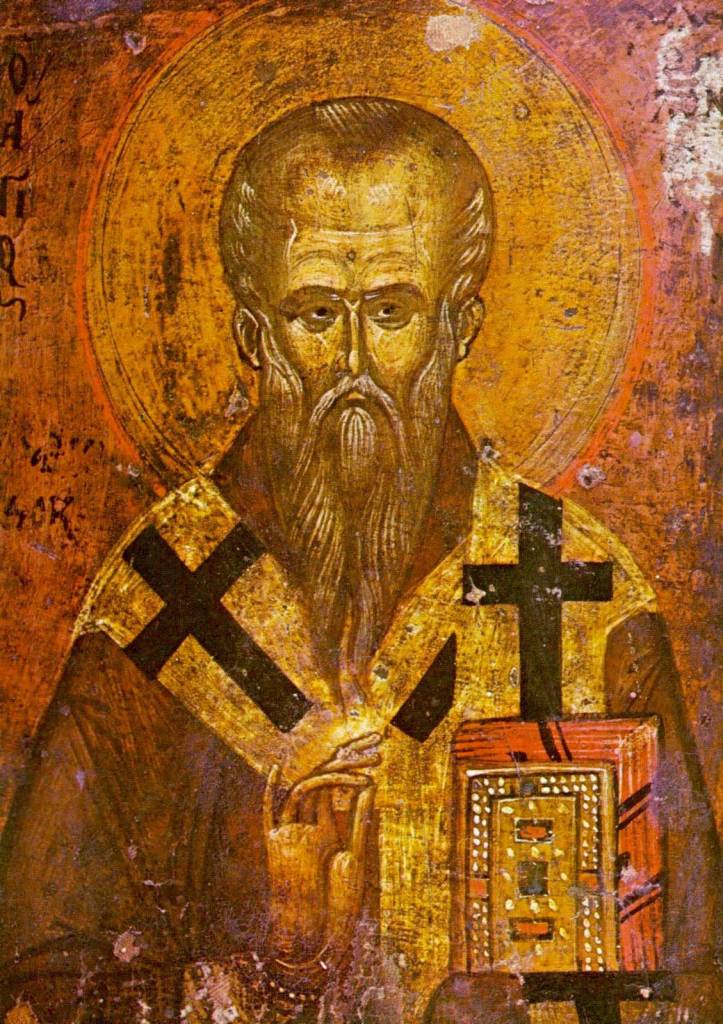
SAINT-CLEMENT-I
St. Clement of Alexandria, Egypt.  Born AD 150, died AD 215.                                                               Famous for his manuscripts on the Blessed Mother Mary as the New Eve, the significance of the Holy Eucharist, and other catechetical works.

Let’s take a look at the two icons above.

Both are correct in the way they are represented. From an artistic and symbolic point-of-view there are distinct similarities.

They have seven similarities: the beard (signifying experience, authority, and that the saint is an elder); a large, high forehead (signifying Christian wisdom as influenced by the Holy Spirit which is visualized through the saint’s works and knowledge); the Holy Cross upon the priest’s stole (it appears as a garment that circles the neck and extends down the torso which signifies Christ’s Redemptive suffering and the saint’s  willingness to give witness and suffer for Christ); the presence of the book of the Gospels (the revealed truth of God through His Son, Jesus Christ); the script of the saint’s name at the top or side of the icon; and the halo circling the head (representing the sanctity of the saint).

There are two absolutely necessary and critical indicators that designate a valid orthodox icon or sacred image: the artist must distinguish the person represented with his or her name, and, the icon must give witness to their life and ministry to the Church.

How does the sacred artist accomplish this requirement?

The artist needs to follow this rule: if the person(s) represented is/are a cleric (deacon, priest, or bishop) they need to be clothed with the proper vestments of their rank, and prototypical appearance. If their physical appearance is known (such as St. Therese of Lisieux or St. Maximillian Kolbe) they must be represented in a correct and accurate manner. The artist must also represent some aspect that distinguishes their ministry, such as the Book of the Gospels.

This is also true if the person(s) is/are a martyr, holy man or woman, monk, etc. This is, again, necessary since  the faithful need to know the name of the saint so they “may honor, revere, and give salutation to them and aspire after them” (from The Seventh Ecumenical Council: Concerning the Holy Icons).

The differences between these two icons of Church Fathers are primarily in the icons’ age, the colors used by each sacred artist, the adornment of the garments and book of the Gospels, and whether or not the halo, and area surrounding the figure is gilded. Many of these differences reflect the specific culture the sacred artist lived in, the time period of the artist’s life, and the artistic resources (such as pigments) that were available.

Historically, violent disputes broke out between icon supporters and icon destroyers. The situation came to a head in October AD 787, when the 2nd Council of Nicaea, among other issues, reinstated the validity and necessity of the veneration of holy icons/images. It specifically quoted: Genesis 31: 34; Exodus 25: 19 ff; Numbers 7: 89; and Hebrews 9: 5 ff;) in support of their position. The Council Fathers especially cited various passages of the Fathers of the Church which proved to be critical in the authority of their proclamation. They were also heavily influenced by the writings of St. John Damascene. The Council documents were signed by the Byzantine Empress Irene, as many as (or more than) 300 bishops, and two legates of the Pope.

Sacred icons, sacred images, statues, etc are never worshipped. Worship belongs to God alone as represented in the Holy Trinity. The holy personalities represented give witness to unity with Christ and point us in the truthful –  orthodox –  direction. We venerate sacred statues, icons, and sacred images – never worship them. (See the documents of the 7th Ecumenical Council of the Church (AD 787) to reiterate this position).

Church tradition also warns the sacred artist who paints sacred icons to guard against unnecessary innovations and artistic flourishes. Please remember that in my blog I make a distinction between sacred icons and sacred images. My articles on this subject can be found in the Category window found on the top, right hand side, of my Home Page. You may find that my article A Canon for Catholic Sacred Artists, found in the Category: Sacred Artists, in the month April, 2018 (once there, scroll down to April 2, 2018 and you’ll find the article). That article has a short section in the Notes following the ten elements of my suggested “Canon” that express my opinion on the differences between sacred icons and sacred images.

Thanks for visiting with me. My best wishes for a relaxing weekend.

Copyright © 2011- 2019 Deacon Paul O. Iacono All Rights Reserved. Permission to reprint must be obtained from the author in writing. Students may quote small sections of the article as long as the proper credit and notation is given. Thank you. Deacon Paul Iacono, at deaconiacono@icloud.com.


Christian Witness and Sacred Art – The Early Church Fathers – Part 7

A Challenge: Are you as a Christian artist willing to internalize the message of the saint, scene, or Scripture passage you are artistically representing, and then, correctly portray it according to Church tradition?

Sacred artists must have more than just an awarenesses of Jesus, His Mother, angels and  saints because their witness provides us with the foundation stones of our Faith. Sacred artists must be more than artists who propose “Art for art’s sake”.

If we do this what do we become? We become evangelists to the truth, goodness, and beauty of God, through the witness of Jesus Christ and the holy men and women who called Him the Son of God.

In the years immediately following St. Polycarp’s martyrdom (died, circa AD 155, and remembered yesterday, February 22nd, in the Roman Breviary and Missal) a group of eight Western and Eastern Rite scholars and clerics arose known as the Apologists (Defenders of the Faith).

The Apologists defended the beliefs and traditions of the Church that passed down to them, in an uninterrupted line, directly from the Apostles and Apostolic Fathers.  This occurred during the years of continued persecution – AD 155 through AD 313.

The works and ministerial witness of the Apologists provide evidence for the continuity of beliefs and dogmas in the Early Christian Church. It is through this historic development, and the literary and physical witness of their efforts, that we have  religious and cultural traditions which dramatically affected the growth of sacred art. These clerics and scholars desired to unify and establish the beliefs of the Western and Eastern Rites of the Church.

Church artists, and the later group of clerics and scholars known as the Nicene Fathers (who I will cover in later posts), were heavily influenced by their efforts. These two groups, the Ante Nicene and Nicene Fathers all desired to make concrete and visible the correct teaching – the orthodoxy – of the Church. These efforts ultimately produced artistic representations of these early spiritual heroes – a visible sign of the truths of the Gospels being preached – and in some cases, their witness in blood.

The Apologists have also been termed The Ante (Before) Nicene Fathers because they lived and died prior to the establishment of the  Creed of the Catholic Faith, ultimately to be known as the Nicene Creed.

Let us briefly review two of the Apologists: St. Irenaeus of Lyons, and St. Clement of Alexandria. In a subsequent post you will have the opportunity to read three or four sentence descriptions of the contributions of the other six  Apologists.

St. Irenaeus of Lyons was born in AD 130 and died circa AD 202. He speaks of the four Gospels as being the “Four Pillars of the Church,” and was in a position to know that since he heard St. Polycarp (a friend and disciple of the Apostle John) preach. He was steadfast in supporting the belief in Apostolic Tradition. He taught that the true Faith is the one imparted by the bishops of the Church who, in turn, received it directly in an uninterrupted set of teachings from the Apostles. St. Irenaeus was tenacious in his fight against heterodoxy, specifically the Gnostic heresy.

St. Irenaeus understood the value of St. Polycarp’s New Testament scholarship and his emphasis on the Church’s sacred Tradition. He spoke with authority on Mary as the New Eve, and the Holy Eucharist. St. Irenaeus barely escaped death during the persecution of Emperor Marcus Aurelius, however during the round-up approximately 50 other Christians had the joy of earning the holy crown of martyrdom. He may have eventually died a martyr, yet, there is not sufficient evidence to support it.

IconPM-Irenaeus-2
St. Irenaeus of Lyons (died circa 202). Famous for his manuscripts Against Heresies. He used 21 out of the 27 books of the New Testament in his writings and sermons.

Another critical Apologist is St. Clement of Alexandria (born circa AD 150, died circa 215). He led a major catechetical school in Alexandria, Egypt and agreed with St. Irenaeus that the truth and knowledge of the holy Gospels proceed through the bishops and are for the population as a whole and not for any secret society (thus, he fought against the Gnostic heresy).

He taught that in order to understand the truths of the Gospels you must have faith in unison with reason. He is also known for three major catechetical works which are still in existence. These works were meant to accompany catechumens and those baptized into the Christian faith as an aid to their spiritual development. He was not martyred.

SAINT-CLEMENT-I
St. Clement of Alexandria – an Apologist of the Early Church – as represented by an early iconographer of the Eastern Rite of the Catholic Church.


Thanks for stopping by the Institute. I hope you have a relaxing weekend.

Copyright © 2011- 2019 Deacon Paul O. Iacono All Rights Reserved. Permission to reprint must be obtained from the author in writing. Students may quote small sections of the article as long as the proper credit and notation is given. Thank you. Permission to copy these posts must be obtained from Deacon Paul Iacono at deaconiacono@icloud.com.

Amazing Grace – Amazing Piano!

Okay, we have reached Wednesday, the supposed day that if we can just get through it we will be on the downward slide toward the weekend.

In an attempt to put a little pick-me-up in your afternoon I ask you to put aside your pencils, pens, and paint brushes and take 4 minutes and 9 seconds to listen to a “Dude Rocks Out Amazing Grace on the Piano.”

The “Dude” in the green jacket and rose colored glasses is Terry Miles. He is an accomplished pianist, yet, this day he sits down to a public piano in a London train station and puts a little joy into peoples’ hearts.

The song starts out as usual and then slowly, with a little flutter, breaks into Terry’s personal interpretation; but, then at approximately 1 minute 20 seconds into the piece, he takes off! The style is called “Boogie Woogie;” and believe it or not, it is one of my favorite types of music from my teen age years.

Click on the red or blue site address below (which gives a short description), click on the red and white arrow (depending on how it loads, at the top or bottom of the page), and enjoy!!

I hope I linked it correctly. If it doesn’t pop up for you use the address below in your search engine. For those unfamiliar with searching YouTube – enter youtube.com for “Terry Miles Amazing Grace” in your search box, click on it, and it should pop-up for you.

Thanks to godtube.com for posting Terry’s video.

https://www.godtube.com/watch/?v=YYYGG7NX

Roman Catholic Sacred Art – Three Major Stages

Allow me to wish everyone a belated Merry Christmas and a Happy New Year! I can do that because, liturgically, we are still in the Christmas Season! That Season ends this Sunday – the Baptism of the Lord.

Okay, we left off in the last post with a schematic of the discipline of painting. The previous posts also provided a simple definition of Art and its disciplines.

As we now return to our study allow me to provide you with the three “Major Periods” of Catholic Sacred Art. These Periods also impact what I, in my humble opinion, have labelled “minor stages” of sacred art. These minor stages were outgrowths and were dramatically influenced by the previous major period. The academic source for the Major Periods is Pope Emeritus Benedict XVI’s book: The Spirit of the Liturgy.

I labelled the other stages minor not because they are any less in value, artistic merit, or cultural import, rather, I gave them that designation because the Major Periods promoted specific Catholic theological insights. The minor stages while artistically very significant, continued the theological themes and dogmas of the previous major period.  The minor stages contributed to culture and sacred art by providing different artistic interpretations of the previous major period.

I am emphasizing that Catholic theology and its cultural environment dramatically affected Catholic sacred art. This is not a “new” insight on my part, just one that I believe should be emphasized in our studies. The beginning and end dates for the Periods below are fluid and, depending on the region of Europe you are studying, can be slightly increased or decreased in time.

My chart of the Periods/Stages is below:

image002.png

Soon I will begin posting the development of specific theological themes, and a brief explanation of the major periods and minor stages. I will provide some artistic examples, too.

Your comments and constructive criticism are always welcome.

Thanks for visiting and have a great weekend.

Copyright © 2011- 2019 Deacon Paul O. Iacono. All Rights Reserved.

Art Schematic of Church Painting


This is an easier way to view the material within yesterday’s post.

image001


Copyright © 2011- 2018 Deacon Paul O. Iacono All Rights Reserved

Roman Catholic Sacred Art – Categories

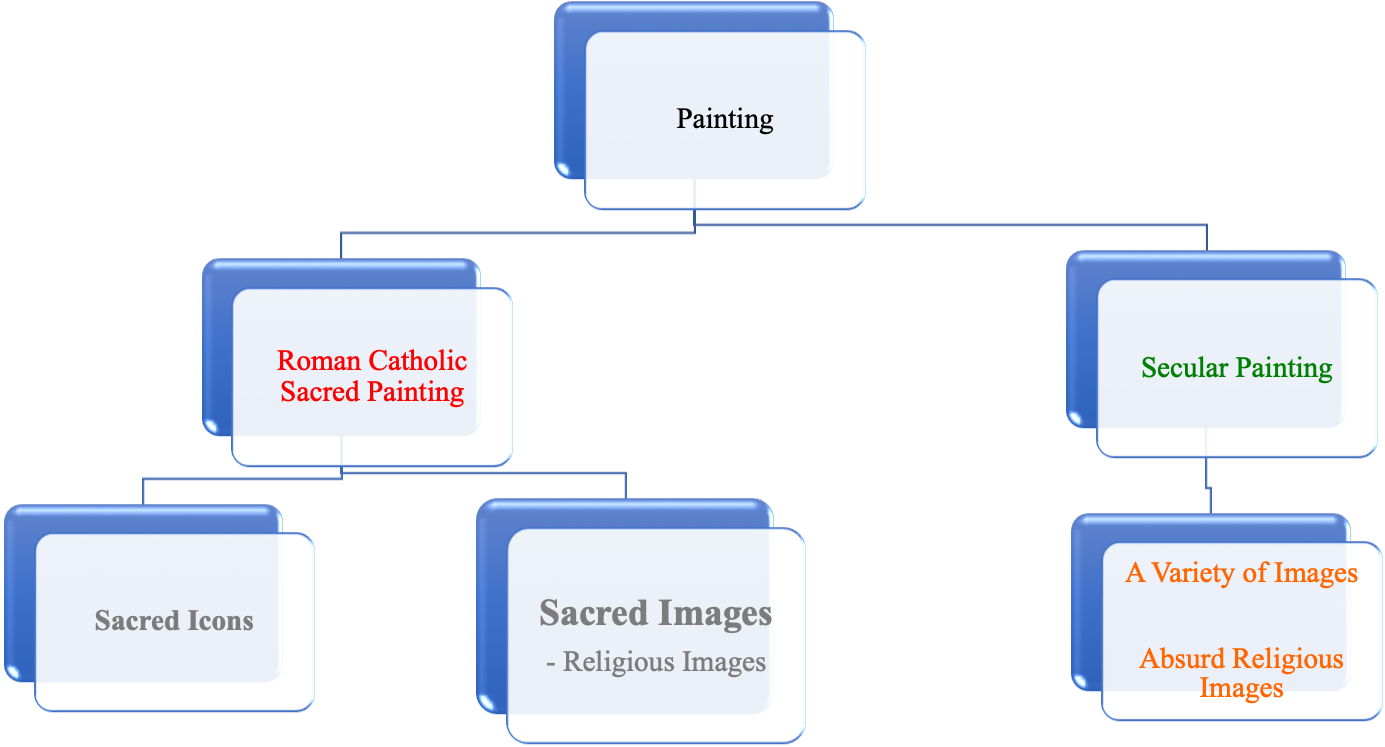
Tonight we will use yesterday’s post as a starting point to examine Roman Catholic painting. I mentioned that there are seven disciplines within the definition of Art. One of those disciplines is painting.

As it applies to this discussion when we consider the discipline of painting we can say that there are two major categoriesRoman Catholic Sacred Painting and Secular Painting.

We can then subdivide these two major categories.

Within the category of Roman Catholic Sacred Painting we have two major subcategories: Sacred Icons and Sacred Images.

I propose that there is a subcategory below Sacred Images, it is called Religious Images. I will explain in later posts the difference between Sacred Images and Religious Images.

Within the category of Secular Painting we can say that there are two subcategories. Let us call the first subcategory A Variety of Images. It consists of all the different types of paintings, made for the purpose of being “artifact, entertainment, political or social commentary, therapy, or a combination of two or more.” (Sporre, 1996; see previous post). It begins with the many generational wall and ceiling cave paintings painted by Paleolithic Man in the Vezere Valley, France approximately 17,000 years ago and continues with contemporary painters. Mankind loves to paint pictures.

The second subcategory within Secular Painting, as it applies to this discussion, is what I call Absurd Religious Images. Even though it has religious subject matter it is, in my opinion, secular art. I will provide a definition of that subcategory in an upcoming post and images which will make it recognizable.

Thanks for stopping by and spending some time here.

Copyright © 2011- 2018 Deacon Paul O. Iacono All Rights Reserved

St. Joseph’s Art Workshop: Lesson 4 – Applying Color and Modeling the Face

Just wanted to notify the people who are following the art lessons in my St. Joseph Art Workshop tab that I just published Lesson 4: Applying Color and Modeling the Face. You need to go to the Menu tab above and click on Lesson 4 to see it.

My next post in the St. Joseph’s Art Workshop tab will be Lesson 5. It will be the last post in my Art Exercise of Painting Sacred Images using Acrylic Paint. 

Thanks.


Fra Angelico and the Armadio degli Argenti – Part 3 of the “Heaven on Earth” Exhibition

Today’s post is Part 3 in my series that began on May 16, 2018 concerning the recently concluded exhibition of extraordinary egg tempera paintings by Fra Angelico. The exhibition was held at the Isabella Stewart Gardner Museum in Boston, Massachusetts and entitled Fra Angelico – Heaven on Earth.

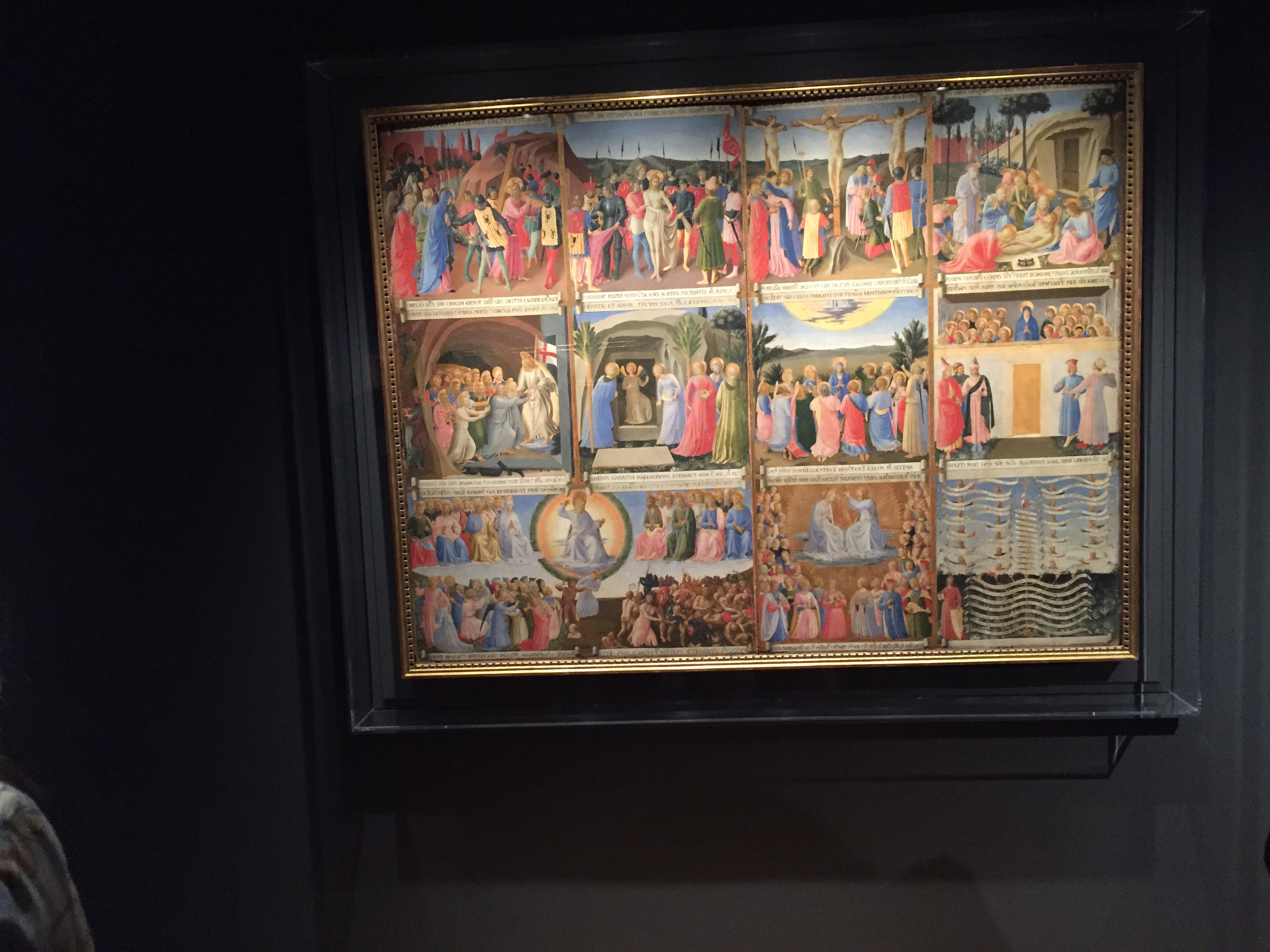
Today’s  painting concerns a major piece of the exhibition – the Armadio degli Argenti.  The four panels of which the Gardner Museum only showed one is also known as the “Silver Chest.” It was commissioned in 1450 and completed in 1452, three years before Fra Angelico’s death.

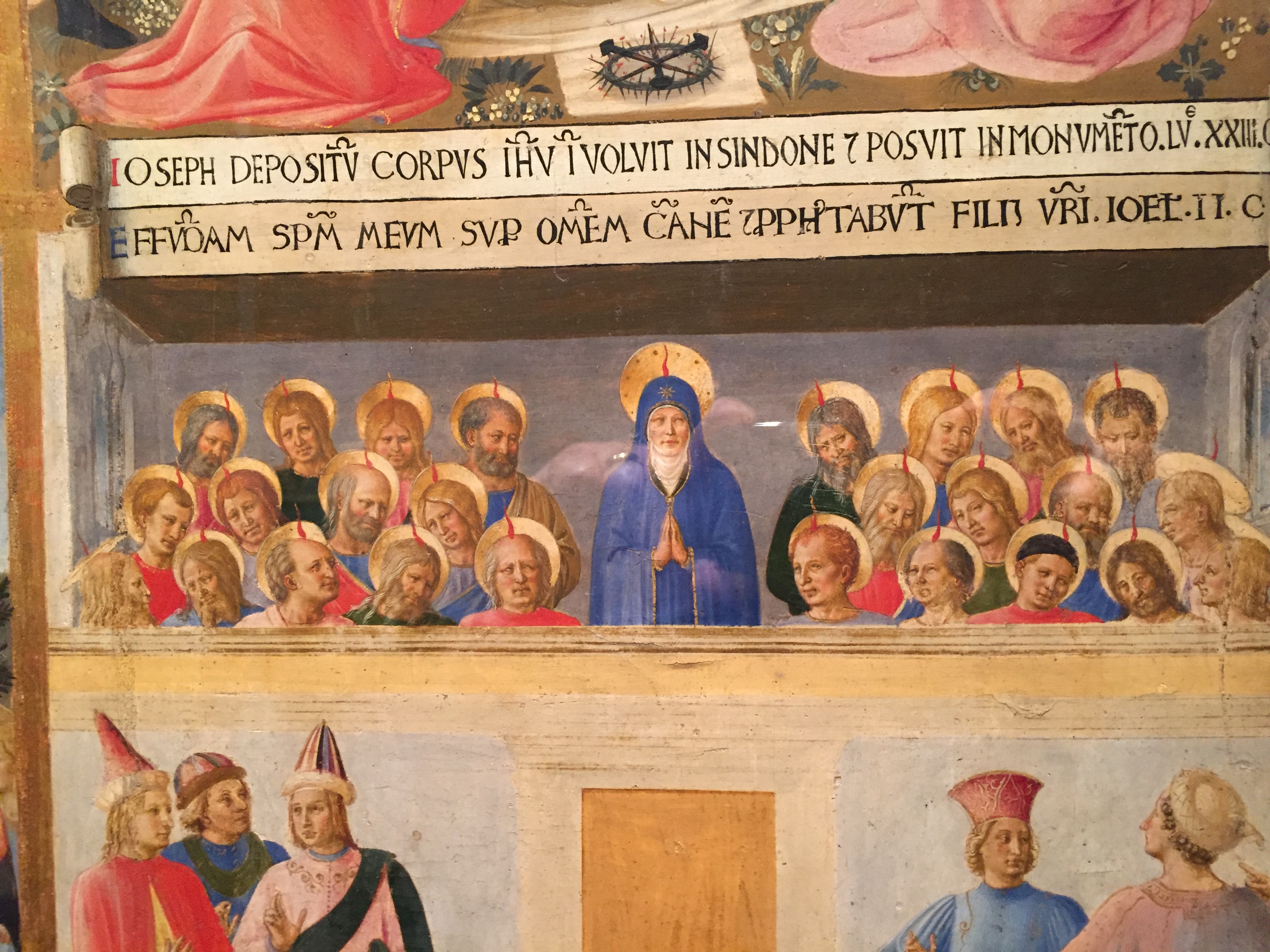
This panel (123 x 160 cm) includes eleven compartments: The Road to Calvary, The Disrobing of Christ, The Crucifixion of Christ, the Entombment of Christ, The Descent into Limbo, The Three Marys at Christ’s Tomb, The Ascension of Christ, Pentecost, The Last Judgment, The Coronation of the Virgin, and the Lex Amoris (Law of Love). The panel is seen below.

IMG_1759

This panel is one of four that decorated a large cupboard-like chest. The chest contained highly valuable silver votive offerings that were donated by the faithful of Florence to the Church of Santissima Annunziata. Their donations were in honor of a miracle working fresco of the Annunciation of Mary in a side chapel of that church.

The entire chest was commissioned by Piero di Cosimo de’Medici during the church’s restoration. The paintings within the thirty-six “compartments” are painted in egg tempera and gold on a wood panel (The Last Judgement occupies two compartments).

In 1782, the panels were separated from the chest in, thankfully, an unsuccessful attempt to sell them. In 1812 they began their journey to the Galleria dell’Academia, and finally to their current resting place – the Museo di San Marco.

Some close-ups of the panel are found below.

IMG_1763

The “compartment” above was entitled Lex Amoris (Law of Love) by Fra Angelico. It shows a menorah covered with scrolls on which are written items relating to the New and Old Law, and emphasizing the New Law as superior. The scrolls specifically relate to the Sacraments of the Church and specifics of the faith. We also see the twelve Apostles and the twelve Hebrew prophets on each side of the menorah showing that they are all connected through the holy Cross of Christ (top center with red and white standard). The purpose of this panel is to explain that in the coming of Jesus Christ you see the fulfillment of the Biblical prophecy of the Messiah, which does not stand alone, but is related to other events in Jewish history. Notice the female in the lower left corner holding a shield which proclaims “Lex Amoris” (Law of Love) versus the Jewish tradition of “Lex Timoris” (Law of Fear). In her right hand she holds an open book. A beautiful allegory of faith that is beautifully executed by Fra Angelico.

IMG_1762The above photo is one of the thirty-six panels describing events of the New Testament, in this case the Coming of the Holy Spirit at Pentecost. Notice Jesus’ mother Mary at the top center of the image with the Apostles and disciples (Peter is on her top right, and John is on her top left). They are receiving the Gifts and Fruits of the Holy Spirit symbolized by the tongues of fire. A curious crowd gathers below the upper room as described in the Acts of the Apostles. IMG_1760

This is a close-up photo of one of panels in the Armadio degli Argenti in this case showing part of the image of the Last Judgment. Notice one of the angels dragging a sinner from the right side of Christ, the abode of the saved – to the left side of Christ, the abode of the damned prior to their being cast into hell.

The beautiful book, published in union with the Gardner Exhibition, Fra Angelico – Heaven on Earth – was edited by Nathaniel Silver and published in 2018 (Boston, London). It was extremely helpful (pages 210 – 215) in my commentary.

photos (iPhone 6, no flash) and text © Deacon Paul O. Iacono 2011-2018

St. Joseph’s Art Workshop – Lesson 3 – Applying Pigment

To all those that have expressed interest in the FREE on-line sacred art workshop that I am offering here at fraangelicoinstitute.com please note that yesterday I posted Lesson 3 in Exercise 1: Painting an Image of St. Rose of Lima.

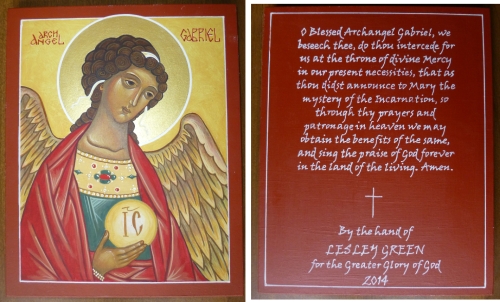
Just click on the St. Joseph’s Art Workshop Tab on top of the image of St. Gabriel and the Virgin Mary and you will see the first Workshop page.

If you have already visited the Workshop Tab then just continue to scroll down to find the Lessons that I have posted so far. I am putting all the Lessons in one place because it will be easier for you to scroll up and down to refer back and forth to other Lessons for Exercise 1.

More lessons will be posted in the upcoming weeks. You have enough to read and keep you busy for now!

Feel free to participate and enjoy the process of creating art!

Fra Angelico – “Heaven on Earth” Exhibition – Part 2 – Ascension, Pentecost, the Last Judgement

I hope you had a blessed Feast of Pentecost!

Please read Part 1 of “Fra Angelico – Heaven on Earth” (posted here on May 16, 2018) in order to receive a proper introduction to the Isabella Stewart Gardner Museum’s extraordinary exhibition that, unfortunately, closed this weekend..

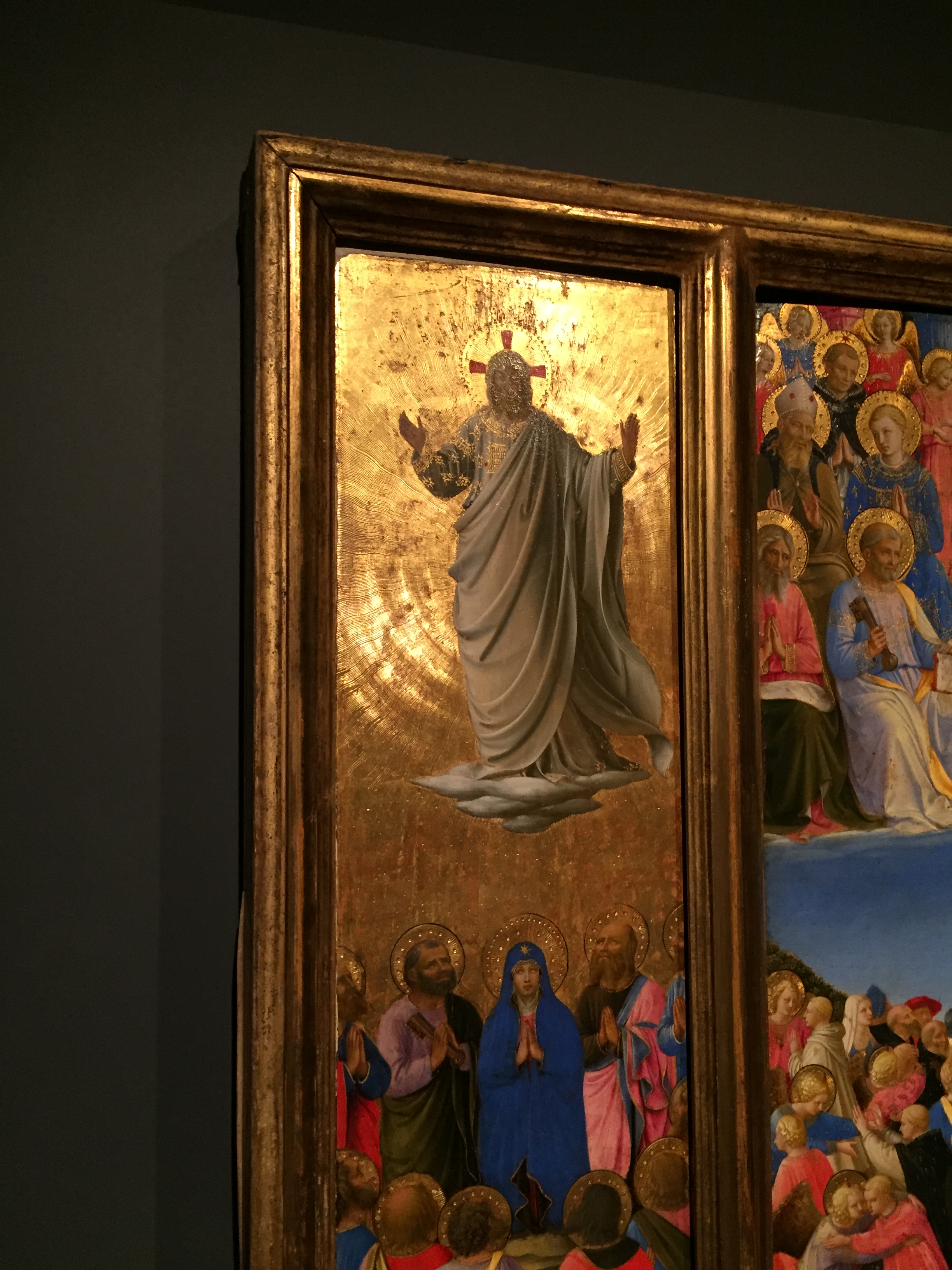
As you moved into the gallery that exhibited this once in a lifetime collection of Fra Angelico paintings you first saw the beautiful painting entitled The Ascension of Christ, The Last Judgement, and Pentecost (the Corsini Triptych). It is painted in egg tempera with gold leaf on a wood panel. Fra Angelico painted it during the years 1447-1448, seven years before his death in 1455. It was loaned to the Gardner Museum from the Galleria Nazionali d’Arte Antica di Roma – Galerie Barberini Corsini, Palazzo Corsini.

My photographic images of that painting are found below:

The Ascension, Last Judgement, and PentecostIMG_1686

The following quotation is taken from the Exhibition’s commentary found on the right side of the painting. Mesmerizing in its detail, Fra Angelico’s painting pictures three biblical events. At left, Christ ascends into heaven over the heads of the Virgin Mary and the  Apostles. At right, a masterfully foreshortened dove – the Holy Spirit – descends to earth. The story culminates in the center. Christ passes judgment over the living and the dead, saving the worthy (left) and condemning the wicked (right). While the damned cower from fearsome devils who attack the poor souls with claws, angels embrace the blessed.

“This small devotional triptych – a painting with three parts – served a cultivated individual, probably a cleric (deacon, priest, or bishop) in Rome.” Please compare its three episodes to others in my upcoming posts. In the above painting Fra Angelico adopts a vertical presentation. This energizes the connection and communication between heaven and earth. The Gardner Museum’s curator remarked that this technique “enlarges the central scene, and emphasizes” the Catholic Church’s spiritual power.

Fra Angelico, as a Dominican priest, desired to present that Jesus’ act of Redemption (passion, death, and resurrection), and His Ascension back to the Father, made possible the moment of Pentecost. Christ’s actions enabled the eventual opportunity for our free will to choose to accept His Truth and be fed by the Spirit’s power. It is the Father and the Son’s will to have the Holy Spirit nourish us through His grace. This grace is available to us through the proper administration and worthy reception of the Holy Sacraments. Thus, we come to the central panel –  the Last Judgement. Did we freely accept His Sacramental grace or did we ignore, and thereby, reject it? At that moment will we be on the right or the left of Christ?

Allow me to make some personal points on the three close-up photos below. In the first panel of this painting, notice the gold work around the body of Christ. I was allowed to closely examine it. I have never seen a painting’s gold work done with such precision and delicacy. It is not just gold leaf that is applied in a flat manner to the panel. It appears to be actual raised strands, or threads of gold, all applied with great precision. As you slowly move left or right around that part of the painting you notice the light catching the gold and literally radiating and shimmering around the image of Christ. IMG_1745

The Ascension, with Pentecost below.

Second, the image of Pentecost, with the Blessed Mother in the center of the Apostles as the dove hovers and the fire of the Holy Spirit descends upon them and gives them the gifts and fruits of the Holy Spirit (Isaiah 11:23; 1st Corinthians 12: 4 ff; Galatians 5: 22 ff).

Notice St. Peter, filled with conviction, speaking to the assembly of men below (“Peter’s Discourse” found in the Acts of the Apostles chapter 2, verses 14 ff.). Also, notice the clothing on one of the men who gather outside of the upper room listening to Peter: the detail of the lace work on the bottom of one of his garments, and the shadows on the man’s red leotard/shoe. If you stand away from the painting at approximately eight to ten feet to take it all in (as you see in the panoramic top photo) you don’t notice all the detail; but the blessed Fra with his extraordinary perception, noticed the need for it, and he painted it in. A master of detail, and as a true maestro, he knew how to successfully accomplish it. Wonderful!     The last two close-up pictures are below.

IMG_1748

IMG_1749

My photos (through the kindness of the Isabella Stewart Gardner Museum), and            my text © Deacon Paul O. Iacono 2011-2018. Photos taken with an iPhone 6, no flash.


Fra Angelico – The “Heaven on Earth” Exhibition – Part 1

The Isabella Stewart Gardner Museum in Boston, Massachusetts is the only venue in America for the extraordinary “Fra Angelico: Heaven on Earth” exhibition. This amazing collection of reliquaries which express the life of the Virgin Mary, and other paintings of the greatest painter of the Early Renaissance, will be on display until this Sunday May 20th, 2018. Earlier incorrect media reports had the last day as May 28th.

I will be posting my photos of the Gardner Museum’s exhibit starting with this post and continuing on through the upcoming weeks and months. The exhibit consists of more than just the exquisite four reliquaries and it will be my pleasure to bring to you my photos of all of it. I am grateful to the Isabella Stewart Gardner Museum for allowing me to take photographs of the exhibit.

I will proceed with the first photo showing the image that you see as you climb the stairs of the Museum to the second floor where the exhibit is located. That image is of the Assumption of the Virgin Mary, surrounded by angels as she ascends in a vortex-like movement, toward God the Father. The reliquary containing the complete image was acquired by Isabella Stewart Gardner in 1899. This is the first time in history that all four reliquaries are reunited since they were split up and acquired by collectors and museums around the world.

My wife and I were privileged to visit the Museum and exhibition last week. Words cannot describe the restored reliquaries and paintings in this display.  I am not embarrassed to say that at one point I was choked up with emotion as to the beauty, technical skill, narrative brilliance in explaining Sacred Scripture, and the theological depth that Fra Angelico expressed in these sacred images.

Beato Fra Angelico (birth name Guido di Pietro) was a Dominican friar and known by his religious name as Brother John of Fiesole. The first historical record of Fra Angelico as a painter is the 1418 record of payment for a painting commissioned by the church of Santo Stefano al Ponte in Florence. Fra Angelico is believed to have been born in the late 1390’s and died in 1455. He is buried in Rome at the church of Santa Maria sopra Minerva. He was beatified (beato) by Pope Saint John Paul 2 on October 3, 1982, and in 1984 the Pope declared that Fra Angelico was the patron of Catholic artists (that is why I named this blog after him). Beato Fra Angelico’s feast day is celebrated every year on February 18th.

As you come up the stairs  leading to the second floor of the Museum and turn the corner you first see an enlarged version of Fra Angelico’s Dormition and Assumption of the Virgin located below. This image is showcased because it is found within the reliquary acquired by Isabella Stewart Gardner in 1899.

Adj ASSUMPTION FRA A.

This enlarged version of the Virgin Mary is found within the reliquary, and is its centerpiece, seen below.Dormition and Assumption

The above outer frame and base, which contains Fra Angelico’s painting, is known as a   reliquary. A reliquary is a container which holds the relics (bones, hair, etc) of deceased holy people or declared saints of the Roman Catholic Church. The reliquary allows the faithful to venerate, not worship, the life, deeds, and mortal remains of the person whose relics it contains. Fra Angelico painted the four reliquaries’ images specifically for the church of Santa Maria Novella in Florence between the years 1424 through 1434 The painting is rendered in egg tempera, oil glazes, and gold. It is simply stunning.

There is another separate painting in the exhibit which concentrates just on the dormition of the Virgin Mary. I will show that to you in the next post.

The “Heaven on Earth” exhibition is made possible with the support, in part, by the Robert Lehman Foundation and the Massachusetts Cultural Council (the Council receives its funding from the State of Massachusetts and the National Endowment for the Arts). The media sponsor is WBUR in Boston. The Museum’s Executive Director, chief conservator, curators, conservators, and support staff brilliantly provided the technical expertise and planning for this exhibit. The companion book, edited by Dr. Nathaniel Silver (with contributions by more than ten experts) is also very well done and a worthy addition to your library.

Photos and text © Deacon Paul O. Iacono 2011-2018. Thanks again to the Isabella Stewart Gardner Museum for this beautiful exhibit and enabling the public to enjoy, be edified, and to take photos of it.

St. Joseph’s Art Workshop, Lesson 2: Obtaining, Drawing, and Applying the Sacred Image to A Panel

If you click on the Tab in the Menu titled St. Joseph’s Art Workshop, and scroll down, you will find my recent addition (as of April 26, 2018) on painting a sacred image. That new post – LESSON 2 – describes obtaining, drawing, and applying a sacred image to a wood panel. Enjoy!

April 26, 2018         © Deacon Paul O. Iacono 2011-2018

St. Joseph’s Art Workshop – Part 3: Pigments and Mediums

Good day,  I just posted, starting at # 8 in the list, Part 3: Pigments and Mediums, required to paint the sacred image. Please note that the pigments in bold face are the ones you need to purchase for the sacred image in Exercise Number 1. Please remember that you will have to scroll down in the St. Joseph’s Art Workshop Tab in the Menu at the top of the site in order to reach the new post. Thanks.

April 17, 2018              © Deacon Paul O. Iacono 2011-2018


St. Joseph’s Art Workshop: Part 1 and 2 – Materials

I just posted Part 1 and 2, which deals with the materials needed to paint a sacred image. It can be found within the St. Joseph’s Art Workshop tab in the Menu section at the top of the page.

The next Workshop posts will deal with the names of the paints you need to purchase, the sacred image I have chosen for this exercise, where you may obtain it on the web, and beginning  the drawing process. I will, hopefully, post them by April 22, 2018.

Thanks for reading and participating in this artistic adventure!

© Deacon Paul O. Iacono 2011-2018

The Canon of a Catholic Sacred Artist

Allow me to suggest to my fellow Catholic sacred artists a “canon” of ten fundamental propositions. These ideas and proposals are my personal musings. They assist me in organizing my thoughts and behavior. It is my hope that they will act as an organizational tool for the interested reader, too. They may also assist you, as they have for me, in providing clarity to our foundation and purpose as sacred artists.

The term “Catholic” in this document refers to the Latin Rite (Rome) and the more than twenty Rites of the Eastern Rite Catholic Churches that are in union with Rome. Sacred artists within the Orthodox Rites and the Protestant denominations may also find some of the proposals helpful in their work.

The use of the term “canon” refers to the the original Greek word, kanon, which indicates a “model” or “standard.” My suggestion is that the following “canon” acts as a “model” for the sacred artist since this is the first in-depth publication of my thoughts on this subject and there is no consensus by the Catholic sacred art community as to its acceptance by a majority of artists and commentators in the field. Consensus may or may not be achieved in the future. Please consider these thoughts as a beginning, a starting point.

This post is a revision of a previous post in March 2017 with a similar theme. Also, as mentioned earlier, I will eventually discuss the spiritual and artistic values of Beato Fra Angelico (Guido di Pietro – Fra Giovanni da Fiesole, 1395 – 1455). I would be remiss if I did not say that he was my model for this post. I perceive Fra Angelico as being an artistic and spiritual giant of Latin Rite art who exemplified, in his behavior and sacred art, many of the ideas found in the “Canon” below.

The reader should also view the Explanatory Notes that follow the ten propositions to obtain commentary.  I have provided a list (which is also a starting point) of five organizations in the Explanatory Notes below to assist you in your own studies. If you are aware of other organizations or Catholic colleges that promote the sacred arts, please contact me with that information. You are invited to reflect on these ideas in the Comments Section or, if you wish, send me a private email at deaconiacono@icloud.com.

The Canon of a Catholic Sacred Artist

1) The Latin Rite, and the more than twenty other Rites of the Catholic Church that are in union with Rome, have a traditional foundation: Sacred Scripture, Sacred Tradition, and the dogmas and doctrines of the Church. This foundation ultimately impacts the Catholic sacred artist within a specific cultural tradition. Catholic sacred artists accept and believe in this foundation.

2) A Catholic sacred artist’s first priority is to develop his or her personal holiness in light of the prayer and Sacramental traditions of our Church; specifically, worship through attendance at the sacred liturgy of the Holy Sacrifice of the Mass, reception of the Sacraments, and liturgical prayer – through the Liturgy of the Hours and/or sacred music.

3) A Catholic sacred artist understands the value of the Adoration of the Eucharistic Face of Christ (the true icon). Eucharistic Adoration is necessary, and highly recommended, because it is based on the artist’s desire for friendship with Jesus Christ, the need to express that friendship in an act of praise and thanksgiving, and Jesus’ desire for friendship with the artist. Within that prayer form, which requires the development of interior silence and stillness of soul, the sacred artist receives inspiration and solace. Pope Emeritus Benedict XVI has reminded us in his book The Spirit of the Liturgy (Ignatius Press, page 90) that “Communion only reaches its true depth when it is supported and surrounded by adoration.” The word “adoration” is used because we are acknowledging the Real Presence of the Body, Blood, Soul, and Divinity of Jesus Christ in the Eucharist.

4) Creativity within Catholic sacred art is influenced by many ideas, the foremost being the expression of the truth, goodness, and beauty of God. The creativity of the sacred artist should always be disciplined by the truth that the artistic product must be able to be clearly understood by the viewer or listener so that it may aid their worship and veneration of God, His saints, and angels.

5) Catholic sacred art brings artistic life to Christ’s Gospel message and the witness of the historic and spiritual personalities of the Church. Sacred art, in all its various forms, contributes to the New Evangelization of the Catholic Church.

6) Catholic sacred art can be a sacramental if  it conforms to the aesthetic, semantic, and theological principles of our Faith.

7) Catholic sacred artists believe that the Sacramental grace of God strengthens personal faith and allows them to become co-creators of artistic beauty. The artist becomes a co-creator when he/she attempts to make a beautiful artifact and ensures that the attributes of the artifact are truthful, good, and beautiful.  For the Catholic artist, God is the source of all beauty, truth, and goodness.

8) Catholic sacred art is a critical part of the liturgical work and prayer of the Catholic Church. An artist’s creative act of making their art form, and the finished product, is not just art; it is communion with God. Sacred art, therefore, is a cultural artifact that turns our heart, mind and soul towards God in praise, penance, petition, and thanksgiving,

9) Catholic sacred art enhances the sacred liturgy of the Church, and may make a significant contribution to the praise, thanksgiving, and repentance of the viewer or listener.

10) Catholic sacred artists are willing to continually learn not only about their Faith and Church traditions, but to professionally grow by increasing their awareness of developments within Catholic sacred arts, its present day contributors, networking and sharing ideas, and continually improving their personal artistic techniques within their artistic discipline.

Explanatory notes – the numbers below correspond to the number of the specific statement above

1) Culture is the fundamental engine that propels history; and the foundation stones of any culture is its Faith. An acceptance of the importance of a faith tradition (and tolerance of other faith traditions) by the people of a nation or continent significantly contributes to the growth of its inhabitants; rejection of the role of faith has shown that a culture will be stunted and eventually collapse. Within a culture that is growing in a positive manner there is the belief in a critical idea: tradition. This idea applies to faith and religious systems, political life, scientific exploration (such as the scientific method), the arts, etc. Tradition, however, is not an idea that is, in its application, suffocating to an individual’s growth or creativity. Positive change can certainly occur within a culture that follows specific traditions.

Briefly let us apply this word, tradition, to the Rites of the Catholic Church. A Rite represents a church tradition about how the Holy Sacraments are to be celebrated. There are over 23 Rites within the Catholic Church, of which the Latin Rite (Roman Catholic) is the largest with over 1.5 billion members. The other 23 Eastern Catholic Rites are in union with Rome, however, the Greek and Russian Orthodox Churches, have not been in union with Rome since the 11th century.

Faith in Jesus Christ and the Nicene Creed has been the mortar between the foundation stones of every culture of Eastern and Western Europe for millennia and for hundreds of years in the Americas. Our Faith and its religious tradition must be viewed in two ways: a small “t” relating to cultural norms of behavior within our specific Rite, and, a capital “T” referring to Church Tradition. This idea of Sacred Tradition was specified by Jesus Christ, the Apostles, the Fathers of the Church, and the many hierarchical pronouncements proclaimed by Ecumenical Councils and Popes (such as the Nicene Creed, or the 7th Ecumenical Council and its promotion of sacred icons). This understanding is in association with the teaching authority (the Magisterium) of the Latin Rite of the Catholic Church and Eastern Catholic Rites that are in union with Rome.

Colin B. Donovan, STL informs us (confer EWTN website) that when we consider the transmission of faith we must acknowledge that historically there are three major groupings of Rites: Roman, the Antiochian (Syria) and the Alexandrian (Egypt). The Byzantine Rite, the fourth major Rite, developed out of the Antiochian. These various Rites came into existence because the Apostolic ministry, within different cultural centers of the Roman Empire, ultimately saw the elements of the Faith being “clothed in the symbols and trappings” of a particular culture. This was promoted because the One, Holy, Catholic, and Apostolic Faith required that the Church become “all things to all men so that some might be saved” (see First Corinthians 9:22).

Historically, the four major Rites ultimately gave birth to over 20 liturgical Rites that currently exist, are in union with Rome, and to this day are serving the faithful. Applying this idea we can say that it is incumbent upon sacred artists within these Rites to ensure that their art provides a clear, unambiguous message to the world (in relation to the “t” and “T” of  tradition). This demands faith, loyalty, and trust by the artist in Jesus Christ and the truths of the Church.

2) Rev. Deacon Lawrence Klimecki from Pontifex University has written insightfully on his blog about creativity, beauty, the role of the artist, and sacred art. He asks an important question: “What is sacred art? Is it liturgical art? Devotional art? Art with religious themes? The Catholic artist must address the issue of “who” is the audience? What purpose and need is the “sacred” artist trying to meet” in their creative act of making art, architecture, music, poetry, drama, or literature? In trying to answer Deacon Klimecki’s valuable questions we may begin by saying that the term sacred, from the Catholic Church’s cultural point-of-view, is any idea or artifact that refers to, and makes visible (if possible) the truth, goodness, and beauty of God, His saints, and angels. It also critically assists in a person’s worship of God and veneration of His angels and saints. Sacred artistic artifacts convey or represent the dogmas, doctrines, artistic styles within a specific time period, and the historic personalities of the Faith.

Sacred art, in all its various forms (architecture, painting, sculpture, stained glass, illuminated manuscripts, metalworking, music, etc) are the visual and auditory means through which we are assisted in our desire, through our soul, intellect, and senses, to be in union with the all knowing, all powerful, and beautiful God of Sacred Scripture and Tradition. Sacred art, therefore, is a cultural artifact that turns our heart, mind and soul towards God in praise, penance, petition, and thanksgiving, 

Catholic sacred artists undertake a great spiritual responsibility. This responsibility requires that the artist be firmly rooted in faith, the reception of the Holy Sacraments (especially Reconciliation and Holy Eucharist), and personal and liturgical prayer. Besides Eucharistic Adoration, some prayer aids for sacred artists would be participating in sacred music and/or praying the Liturgy of the Hours (Divine Office) either alone or in a group.

3) Saint John Paul 2, in note 61 of his encyclical Ecclesia de Eucharistia (The Church Comes from the Eucharist) explains that “By giving the Eucharist the prominence it deserves, and by being careful not to diminish any of its dimensions or demands, we show that we are truly conscious of the greatness of this gift. We are urged to do so by an uninterrupted tradition, which from the first centuries on has found the Christian community ever vigilant in guarding this ‘treasure.’ Inspired by love, the Church is anxious to hand on to future generations of Christians, without loss, her faith and teaching with regard to the mystery of the Eucharist. There can be no danger of excess in our care for this mystery, for “in this sacrament is recapitulated the whole mystery of our salvation.”

What is prayer? The saints tell us that prayer is the turning of the heart toward Our Lord, His Blessed Mother, the angels and the saints and allowing our mind and heart to sincerely speak words of love, praise, thanksgiving, and repentance to them. The sacred artist enters into communion with the Heavenly Court through the union of their prayer with creativity.  This communion comforts and assists the sacred artist in their work. Unity allows a sacred artist to walk the various paths of Holy Scripture and experience the moment that the Scripture, or a story of the saints, presents to the soul. This experience feeds and transforms the sacred artist by affecting the clarity, line, form, and colors of their art (a tip-of-the-hat to my friend and teacher Dr. George Kordis and his seminal work on line, color, and form). This may also be how Beato Fra Angelico experienced the Crucifixion, and according to Vasari, as he painted he wept over the enormity of Christ’s sacrifice. In this process Fra Angelico prefigures Ignatius of Loyola by about 125 years in the ability to experience the words of Holy Scripture within his imagination. The use of the word – “imagination” – does not mean or imply “fantasy,” nor does the person in prayer “make-up” images not found in the Gospels or Church history. St. Andrei Rublev, Beato Fra Angelico, St. Ignatius of Loyola and others utilized this type of prayer experience to affect their work.

4) While remaining loyal to Sacred Tradition, the Church’s artistic tradition is fluid and is always affected by the artist’s creativity and understanding. This may lead to new styles and interpretations of artistic expression. These new expressions, however, are never vulgar or disrespectful, and will provide no confusion as to the meaning of the images within the art form. Sacred art, while not exclusively catechetical, does certainly play a role in the catechesis of the faithful.

5) Also, the Western Rite, and the Eastern Rites, affirm that preaching the Gospel message through (word, service (Spiritual and Corporal Works of Mercy, and sacred art), and celebrating the Holy Sacraments is critical for the evangelization, spiritual health, and salvation of God’s people.

6) Icons, sacred images, woodcarvings, calligraphy and other sacred arts if based on the Holy Gospels and Church Tradition spread the Good News of the Gospel. The sacred arts are sacramentals when they point the way to God. Sacramentals are blessings. The seven Sacraments provide the grace that interiorly heal and nourish us. Sacramentals, however, assist us in the exterior visualization of Our Lord Jesus who made that process possible through His Incarnation and Redemption of humanity. It also assists us in the visualization of His angels and especially His Blessed Mother and the saints, who modeled Jesus in their own lives.

An icon is a sacred image (confer John 1:14). An iconographer follows specific traditions of craftsmanship and specific elements of Theological (Scriptural and dogmatic content), Semantic (the visual language of the icon, appropriate perspective, the use of light, line, and color to create form, and correct use of signs and symbols within the icon), and Aesthetic principles (the quality of beauty with the icon itself). These three principles are based upon the sacred Tradition of the Church. The history of the Western and Eastern Rites illustrates that the sacred artist has continually moved through different artistic periods and technical understanding. Within sacred art artistic styles change (this may be a good thing), but the truth of the Faith, and the witness of the Church’s spiritual giants – the witness of Jesus Christ and His saints – cannot.

David Clayton, Provost at Pontifex University,  has pointed out that we need to remember and apply the two ideas of  St. Theodore the Studite (AD 759-826) in his criteria which must be followed if an icon is to be considered a sacramental, thus, worthy of veneration: 1) The icon must display the title of the saint or feast day represented, and,  2) the image needs to display the essential physical characteristics and attributes of the saint represented, such as keys for St. Peter; a book of Scriptures, a bald head, or sword for St. Paul; dalmatics, the Book of the Gospels, or thuribles, for deacons; or the gaunt figure of St. Mary of Egypt, etc.. Each angel or saint has a specific name and attributes.

The Roman Catholic Church moved out of an Iconographic period into the Gothic period, and then into the Baroque period. The Greek and Russian Orthodox Church and many of the Eastern Catholic Churches in union with Rome stayed within the period of Iconography that developed out of the early centuries of the Church. Cultural conditions (such as geographical location, political influence, and the affect of the Western European Enlightenment in the 17th and 18th centuries), access to earth pigments, artistic differences and changes in style all affected the Iconographic period within the Eastern Rite of the Church.

It is important to note that within the Latin Rite a sacred image is a religious image that is created of a historical holy person or religious scene; however, the artist allows their full creativity and personal interpretation to enter into the craftsmanship and artistic process (an example being Michaelangelo’s Sistine Chapel).

Historically, personal creativity and technique, and the change of specific artistic styles are present within Eastern Rite iconography. Their sacred icons are affected by the culture, historical moment, style, and geographical location of the artist (examples being Coptic vs. Greek, or, Novgorod vs. Moscow). The Eastern Rites, those that are in union with Rome, and those that are not, believe that the sacred icon must be faithful to Sacred Scripture, historic reality, and the Traditions the Church.  The icon’s meaning must be easily recognizable by the viewer. The artistic style may change but there is no room for personal interpretation to change the way Christ, His angels, or saints are portrayed (an example of this would be portraying Christ as doing some action outside the truth and witness of the Gospels, or having Him beheaded rather than crucified). Sacred icons should never be static and “flat.” The personality of the sacred artist is present in their art, and yet, that is not the most important issue.

A sacred icon is made in a specific manner. The techniques of production (from type of board to board preparation, drawing of the image, the necessity of line giving form to color – “its logos” as discussed by one of my teachers, George Kordis, the type of perspective, the predominant use of egg tempera and natural materials – earths and minerals, the lack of symmetry, moving from dark colors to light, and the final blessing by a priest or deacon) are taken seriously by the Orthodox and Eastern Rite Churches. It is my opinion  that if a Latin Rite artist decides to paint a sacred icon, out of respect, they should study and follow the traditions of the Eastern Catholic Rites and the Orthodox Church. This can be accomplished by either studying with their iconographers or with Roman Catholics who have studied with them and follow their traditions of iconography.

I do believe that a Latin Rite sacred artist may paint a religious image in the style of a sacred icon, but, must be careful to explain the difference between the two types of representation. I currently follow this methodology of differentiating a sacred image (religious art) from a sacred icon, and, religious art painted in the style of a sacred icon. My basis for this is respect for the Orthodox and Eastern Rite traditions and how they view their sacred art forms. Yet, it must be admitted that the “traditions” of Orthodox sacred art were primarily formalized by the Greek artist Photis Kontoglou (1895-1965), and the Russian artist and historian Leonid Ouspensky (1902-1987). Thus, these two scholars, within the last one hundred years, outlined what they believed was the historic “tradition” of Orthodox painting, and this “tradition” became formalized within the Orthodox community.  A Catholic artist from another Rite, or within the Latin Rite, may not be concerned with these issues. I believe, however, that the Latin Rite sacred artist must not only be aware of the currents within the Orthodox sacred art community but be respectful of it, too.

In his book Spirit of the Liturgy, Pope Emeritus Benedict XVI provides a wonderful overview of the three periods of sacred art within the Roman Catholic Church (Iconographic, Gothic, and Baroque).  You will notice that even though he discusses the Renaissance he does not include it within the three traditions. High Renaissance artists were not inspired purely by prayer or catechesis in the production of their art. For many their motivation was the desire to please themselves, their patrons, or the profit motive. Renaissance sacred images do have spiritual value and some can motivate the viewer to prayer and communion with God.

An example of an icon is St. Andrei Rublev’s image of Christ, or his icon of the Holy Trinity. An example of a sacred image is Pietro Annigoni’s image of St. Joseph and the Child Jesus in Joseph’s workshop, or Masaccio’s Holy Trinity. A sacred image painted in the style of an icon is my rendition of St. Michael Holding the Holy Eucharist. Pictures of these icons and images are found below.

7) The attributes of the sacred artifacts are beautiful. These attributes conform to the three basic elements of beauty as defined in the writings of St. Thomas Aquinas: clarity – the listener or viewer can discern what the artifact is, what it means, and that it reflects a “radiance” to those who perceive it; proportion – the listener or viewer can discern the artifact’s unity, order, harmony, and the correct relationship of its individual parts;  and integrity  – the listener or viewer is able to understand the “wholeness” of the artifact. Is beauty in the eye of the beholder? Certainly it is affected by the individual’s culture, geographical location, historic period, and other issues; but, we can also say that it is objective, in that people of Faith do not deny the Truth, Goodness, and Beauty of God.

Within the Roman Catholic Church and the Eastern Churches, it is believed that “Our justification comes from the grace of God which was merited for us by the Passion, Death, and Resurrection of Jesus Christ.” Sacramental Grace is a participation in the life of God. Justification is conferred through the Sacramental grace of Baptism. “Grace is the free and undeserved help that God gives us to respond to His call to become [members of His family], children of God, adoptive sons and daughters, partakers [through the Holy Sacraments] of the divine nature and eternal life” (confer John 1:12-18; 17:3; Romans 8: 14-17; 2 Peter 1:3-4). As the Council of Trent teaches – grace is known by faith – and faith, in association with the gifts and fruits of the Holy Spirit, produce good works. Our Lord teaches in Matthew 7: 20 “You will know them by their fruits” (confer Catechism of the Catholic Church, 2nd edition, paragraphs 1987 through 2005).

8) Contemporary Greek artist and iconographer, Dr. George Kordis, writes of this principle in his book Icon As Communion. Numerous authors have written in this field, to name a few, with the titles of their books:  Sister Wendy Beckett’s Real Presence, Meditations on the Mysteries of Our Faith, and  Encounters With God; Paul Evdokimov’s The Art of the Icon; David Clayton’s The Way of Beauty: Liturgy, Education, and Inspiration; John Saward’s The Beauty of Holiness and the Holiness of Beauty; Christoph Cardinal Schonborn’s God’s Human Face; Jem Sullivan’s The Beauty of Faith; Monsignor Timothy Verdon’s Art and Prayer; and Jeana Visel, OSB, Icons in the Western Church.

9) In the Roman Catholic Church, liturgy as defined in the New Testament, “refers not only to the celebration of divine worship but also to the proclamation of the Gospel and to active charity” (confer Luke 1:23; Acts 13:2; Romans 15:16, 27; 2 Corinthians 9:12; Philippians 2: 14-17, 25, 30. Also, review the Catechism of the Catholic Church, 2nd edition, paragraphs 1066 through 1209).

The work of a sacred artist (this of course includes all the sacred arts) can be viewed as a liturgical act because it provides a service to our neighbor, in that the sacred art elucidates and visualizes the reality of the truth, goodness, and beauty of God. The sacred artist assists the Church in making the reality of Christ present within the community of believers. Sacred artists, by providing this service, are participants in active charity. They aid in providing a “visible sign of communion in Christ between God and men” (confer paragraph 1071, Catechism of the Catholic Church, 2nd edition).

10) Transformation in Christ is a Sacramental, prayerful, intellectual, and fellowship process. A Catholic sacred artist must be involved in all four of these transformative elements in order to reach their full potential. A student of this process would be remiss if they did not investigate the writings of St. Thomas Aquinas and St. Augustine on these issues.  St. Augustine writes beautifully in his Confessions on the truth and the beauty of God, one paragraph begins: “Late have I loved you, O Beauty ever ancient, ever new, late have I loved you”….  Artists are wise to remember that their art must not only be good and truthful in its message, but beautiful as well because they are reflecting the truth, goodness, and beauty of God Himself.

Catholic sacred artists, as they study the various manifestations of sacred art over the last two millennia, should network and become aware of the contributions of contemporary leaders and contributors in the various fields of Catholic sacred art. The Catholic Art Guild, The Catholic Artists Society, The Foundation for Sacred Arts, and the Institute of Catholic Culture are organizations to help you discover contemporary issues in Catholic sacred art; they also occasionally provide seminars and lectures in sacred art. Pontifex University, an on-line Master of Arts Degree program in Roman Catholic sacred art, is also another opportunity for a sacred artist or student who desires to advance their knowledge and understanding of sacred art.

Some of the recent Popes have expressed valuable insights on beauty, sacred art, and the role of the sacred artist. A few examples: the many writings of Pope Emeritus Benedict XVI such as, his 2008 homily in St. Patrick’s Cathedral in which he discussed the architecture and stained glass windows of St. Patrick’s as a quest for truth and faith; his Meeting With Artists in November 2009, his 2002 comments “The Feeling of Things: The Contemplation of Beauty,” and his  book The Spirit of the Liturgy. Professor Matthew Ramage’s January 2015 essay “Pope Benedict XVI’s Theology of Beauty and The New Evangelization” (found in Homiletic and Pastoral Review), is an excellent introduction to Pope Benedict XVI”s contributions to truth and beauty in sacred art.

Emphasis must also be placed on the absolutely critical document for any sacred artist: Pope Saint St. John Paul II’s Letter to Artists. Pope Pius XII’s 1947 encyclical, Mediator Dei, from a liturgical point-of-view it explains in paragraph 187 that “Three characteristics of which our predecessor Pope Pius Xth spoke should adorn all liturgical services: sacredness, which abhors any profane influence; nobility, which true and genuine arts should serve and foster; and universality, which, while safeguarding local and legitimate custom, reveals the catholic unity of the Church” (Pius XII referenced this from an Apostolic Letter of Pope Pius X of November 1903). These three principles, when united with the principles of aesthetic, semantic, and theological truth, provide the Catholic sacred artist with a firm foundation on which to build their creative work.

Thank you for reading this and I look forward to your comments. Please see the images below, too.

Pax Christi,   Deacon Paul O. Iacono

Originally posted April 2, 2018; updated June 2, 2018

Fra Angelico Institute for Sacred Art.

Copyright © 2011- 2018 Deacon Paul O. Iacono All Rights Reserved

Images:
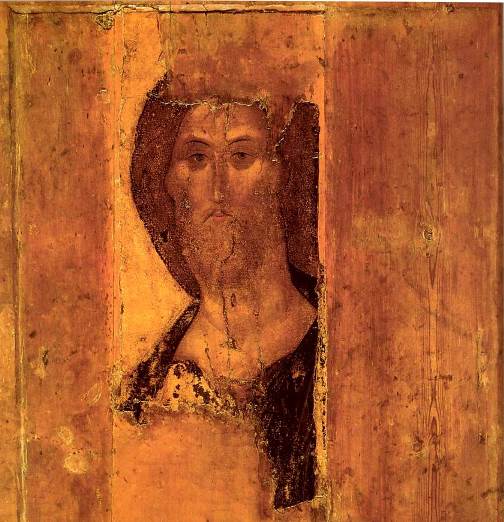
Christ-Pantocrator.-Andrei-Rublev.-1410-1420s.-The-central-part-of-the-iconographic-Deesis-of-Zvenigorod.-Moscow-The-State-Tretyakov-Gallery

St. Andrei Rublev’s icons: Christ (completed 1410, above) and his                                         The Trinity (1411, or 1425-27)trinity-rublev-1410


Masaccio_Holy_Trinity

Masaccio’s sacred image: Holy Trinity (completed 1428, above) and

Pietro Annigoni’s sacred image: St. Joseph the Worker (altarpiece, completed 1963, below)annigoni, st joseph

Deacon Paul O. Iacono’s sacred image done in the style of an icon: of St. Michael Holding the Holy Eucharist, (completed 2015-2017). Please see my post on this blog of September 29, 2017 for a brief explanation.

IMG_0193

My text/last photo, Copyright © 2011- 2018 Deacon Paul O. Iacono All Rights Reserved
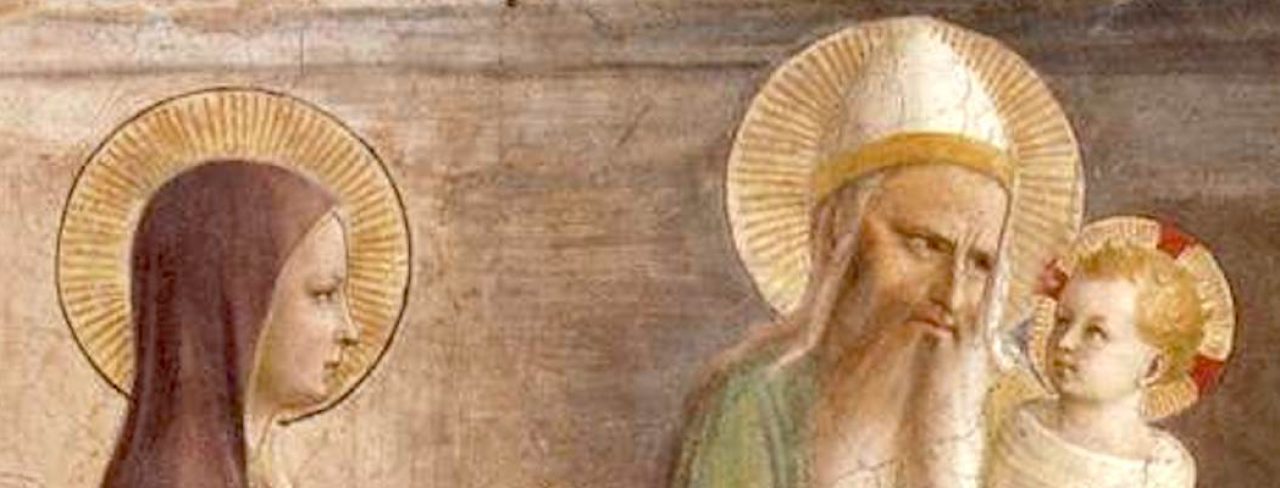


Jesus Our Savior – An Image that is a Work in Progress

I have the happy service of presenting a new workshop to interested adults from Massachusetts and Rhode Island beginning on Saturday February 14th, 2015.

In an attempt to give everyone individual attention the class is currently filled at a limit of ten people. We will be pursuing our studies of painting sacred images in the Latin iconographic tradition. I hope to make the artists aware of the importance of studying the Latin and Byzantine origins of sacred images and its inevitable blossoming within the Greek and Russian civilizations.

The workshop will run over a five-week period, for a total of twenty hours of class time. While they will not be painting the sacred image that is found below of Jesus Our Savior, the technique that I used to paint this image will be taught to the artists. Note that the image is painted using acrylic paints; however, I have developed a different approach in manipulating the layers of the paints. This approach evolved out of studying the work of the 12th century Benedictine monk, Theophilus the Presbyter (whom I have written about in previous essays on this blog), and my own experiments over the past few years of working with egg tempera and acrylic paints.

I specialize in painting personal prayer images (9 by 12 inches, or 12 by 16 inches) rather than images that would be found in large church or chapel applications. The image found below (95% finished) is typical of my approach. It is an image that the person in prayer can relate to, yet, it also carries a sense of transcendence. This approach will be taught in the upcoming workshop. I attempt to teach simplicity in both technique and spirituality. I  avoid flourishes and excessive naturalism in facial or garment representation. In this way I have ignored the typical approach of many Latin Rite sacred artists from the mid 14th century onward. I am attempting to rediscover, or reestablish, the Latin Rite techniques of painting sacred icons. This endeavor is a work in progress!

In the upcoming workshop the students will be studying my technique and actually paint an image of St. Michael the Archangel. Upon completion of that sacred image, they will eventually move on to painting an image of the Holy Theotokos, the Blessed Mother, and then complete the sequence in studying and painting a sacred image of Jesus Christ. In upcoming posts I will be blogging about their experience and the steps that they will take in completing the sacred image of St. Michael.

My approach to the painting of sacred images in the iconographic tradition owes a debt of gratitude to my many teachers in the Byzantine and secular artistic traditions. I also owe a profound thank you to the Holy Spirit, whose grace has enabled my hands to paint sacred images. I pray that my sacred art has not offended Him. The image below appears slightly brighter than it actually is as a result of the flash.

Jesus Our Savior by Deacon Paul O. Iacono, Fra Angelico Institute for the Sacred Arts, Copyright © 2011- 2015 Deacon Paul O. Iacono All Rights Reserved
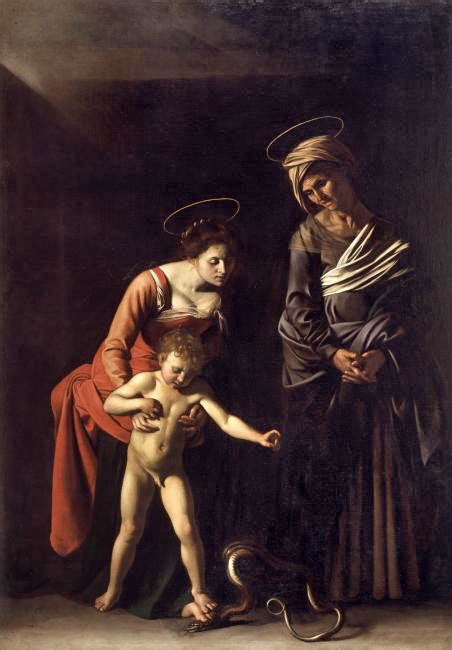


Copyright © 2011- 2015 Deacon Paul O. Iacono All Rights Reserved
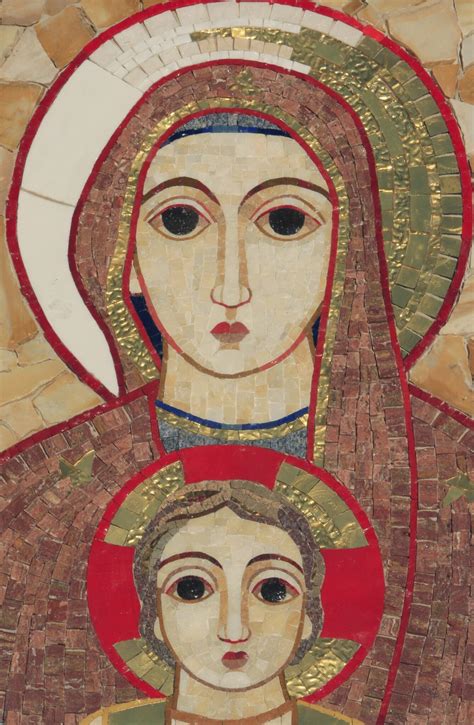
Link to the Film Within the Post: The Sacred Artist’s Cultivation of Silence

A few readers have emailed me to say that they are having a problem linking to the film mentioned in yesterday’s post. Since many subscribers receive these postings through their email address the easiest way to link to the film is to click on the blue title of the post that appears at the top of your opened email. When you single or double click on this blue title you are redirected to the actual website. The film appears within the website posting.

Another way to connect to the film is to go down to the last part of the opened email and you see the titles of the “tags and categories.” Connected to this section is a URL address, if you click on that URL address it will redirect you to the film, too. It is much easier to read the posts if you  come to the actual website rather than trying to read the tiny print of the email.

I have Cox Communications and when the posts come back to me in my email they are appearing in a font size that is close to size 8, which is pretty hard to read for these old eyes! So click on the blue title and it will redirect you to the website which is in a much bigger, and more enjoyable, font. If you still are having problems, please email me and I will make other arrangements for you to see the film.

The Sacred Artist’s Cultivation of Silence

I recently received a post from the always challenging and informative blog entitled Catholicism Pure and Simple. It features a short film by the Benedictine monk Abbot Christopher Jamison, O.S.B.

In this film Fr. Jamison speaks about silence and how critical it is for our well being. He mentions that its cultivation is a necessary prerequisite for certain types of prayer. The good news is that we can begin the process of cultivating silence by setting aside at least five minutes but no more than thirty minutes during the day. During that time we participate in an ancient Christian technique of developing awareness of our breathing, the silence that is within us, and the need to enter into this type of prayer in order to hear the still, quiet voice, of God. I’ll have more about this ancient Christian prayer technique in future posts.

Finding silence is especially important for the sacred artist. Sacred artists must prepare themselves prior to picking up the tools of their art and creating a sacred image. They accomplish this  through the cultivation of prayer throughout the creative process. The disciplines of silence, fasting in its various forms, and repentance for sins are important components of the Christian artistic and soul journey.

What is especially helpful about this ten minute film is that Fr. Jamison and a parishioner demonstrate the process of cultivating silence through an actual short period of silent relaxation and spiritual meditation. It is a simple yet profound moment that demonstrates how easily you can connect with the rhythms of your body and soul, and in the process, develop your prayer life with the Lord, His angels, and saints. This film is not only necessary viewing for the sacred artist but for all who are interested in a mature relationship with God.

Albert Lapierre – Sacred Artist and Iconographer

This past July I had the pleasure of restoring an icon that was written by the fine artist, Albert Lapierre, from Attleboro, Massachusetts. It is a beautifully done and was commissioned by Joan O’Gara on the occasion of the birthday of her sister, Rosalind, in October, 1998.

Rosalind told me that her sister knew of her appreciation and devotion to the Gospel account of the Visitation of Mary to her cousin Elizabeth; however, Joan was not able to locate a print of this particular icon. In 1997 Joan decided to contact Albert Lapierre who was resposible for the creation of many religious objects, statues, and sacred images. Prior to his passing he had a store and studio in Attleboro, Massachusetts. There are many examples of his work at the LaSalette Shrine in Attleboro.

At the time of Joan’s request, Albert was busily engaged at the Shrine with many projects, and was reluctant to take on another commission. Joan persuaded him, however, to take on this project – telling him that “Our Lady really wanted him to paint this image.” I am told that he didn’t have a comeback for that request!

Mr. Lapierre was able to fit its creation into his busy schedule and it was varnished and ready to be delivered by October, 1998. Needless to say, Rosalind was thrilled by Joan’s gift and it remains to this day an important focal point in Rosalind’s prayer life.

Time does take its toll and the icon sustained some accidental damage over the years. Rosalind located me through a Google search and phoned for a consult. She was especially concerned about areas that had chipped and lost pigment. We met and discussed the damage and she requested that I try to repair it as best as possible.

The repair turned out to be an interesting challenge. First, I believe that it is absolutely essential that a restorer not impact or change the design, colors, or compositional elements of the piece being restored. Respect for the original artist, and what they created, is paramount. Ultimately, the viewer must be able look at the restored piece and be unaware of the fact that it has been restored. There should be no distractions from the original intent of the artist.

My biggest challenge in this restoration was matching the original colors. For this particular icon Mr. Lapierre used acrylics. Since the painting was only seventeen years old, and had not been kept in direct sunlight, the paint had not deteriorated or dulled to any great degree. Thus, my task was to repair the chips that could be restored and then blend in the pigment restoration. The restoration was a success and it was blessed, and delivered to a grateful Rosalind, at a Mass here in South Kingstown at St. Francis of Assisi Church in August 2014.

Albert Lapierre died a number of years ago. Sadly, I never met the man that created such a sensitive and dynamic icon. It was a distinct honor to work on it. I thank Joan and Rosalind O’Gara for the privilege of doing so.

Below are a few images of the piece with a close-up of Mary’s face, and the beautiful catechetical scene of Elizabeth’s husband, Zechariah, praying in the Temple.

Copyright © 2011- 2014 Deacon Paul O. Iacono All Rights Reserved
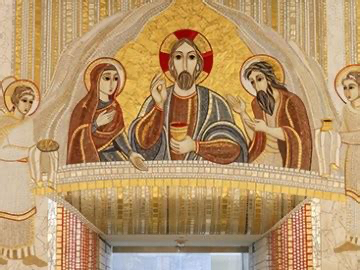
IMG_3803


IMG_3805

IMG_3813

Lesley Green – A Rhode Island Sacred Artist

One of the great blessings the Lord has granted me is the privilege of meeting so many wonderful people who are interested in studying and creating sacred art. An example of this is the fine Rhode Island artist, Lesley Green.

Lesley is no stranger to art. She has been interested in it since adolescence and received a BFA from the Rhode Island School of Design. She continued to pursue her studies while taking time out to marry and raise a family.

I first met Lesley a number of years ago, when my wife and I started the Fra Angelico Institute for the Sacred Arts.  We invited people from around the Diocese of Providence to come to our first informational meeting. I could tell upon first meeting her that she was highly motivated to consider studying and prayerfully create sacred art.

My first workshop in sacred art soon followed that meeting and Lesley came to learn the basics of how to paint a sacred icon. Her excitement and interest were, and still are, gratifying to see. She continued to make rapid progress with me and took the advice that I give to all of my students: “Branch out, and study with as many other sacred artists as you can.”

I firmly believe that a sacred artist needs to be exposed to, not only a variety of artistic talents and skills, but to the prayerfulness of other iconographers as they practice their ministry in sacred art. As a result, she has since enjoyed studying with Rev. Peter Pearson and Michael Kapeluck, two artists from Pennsylvania who paint in the Russian Orthodox style.

Lesley realizes that her art is more than art for art’s sake. As a committed Roman Catholic she understands that her art is a dramatic form of silent evangelization of the Word of God. She takes seriously the invitation of St. John Paul 2’s 1999 Letter to Artists to participate in the “call” to the vocation of a sacred artist. He tells us that in doing so we fulfill our personal responsibility to do our part in spreading the Good News of Christ. He says,

“In order to communicate the message entrusted to her by Christ, the Church needs art.  Art must make perceptible, and as far as possible attractive, the world of the spirit, of the invisible, of God.  It must therefore translate into meaningful terms, which is in itself ineffable.

Art has a unique capacity to take one or other facet of the message and translate it into colors, shapes and sounds, which nourish the intuition of those who look or listen. It does so without emptying the message itself of its transcendent value and its aura of mystery.” 

It is this “aura of mystery” that Lesley is prayerfully attempting to make visible to the viewer of her art. For, as sacred artists, we are all called to make visible the “ineffable mystery” that is God, His angels, and His saints.

Lesley’s most recent completed icons of Saint Gabriel and St. John the Baptist are quite lovely. I especially like the fact that St. Gabriel is shown holding the Holy Eucharist. As you know, the Archangel Gabriel was depicted in the Hebrew Scriptures as being a healer, especially of the eyes. This sacred icon aptly shows that the source of the Archangel’s power is Christ Himself. The second icon showing St. John the Baptist in a prayerful pose indicates that even in Heaven he continues his mission of imploring us to repent of our sins.

St. Gabriel the Archangel and St. John the Baptist, pray for us.

image description


image description

Copyright © 2011- 2014 Deacon Paul O. Iacono All Rights Reserved
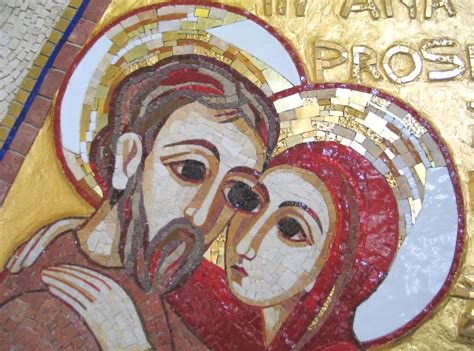
 

Eugene Burnand and The Greatest Easter Painting Ever Made | Crisis Magazine

Clicking on the attached link found below produces an excellent article by Elise Ehrhard in Crisis Magazine describing the Swiss painter Eugène Burnand’s late 19th century masterpiece The Disciples Peter and John Running to the Sepulchre on the Morning of the Resurrection. 

One writer has described this painting as a visual Lectio Divina since the observer cannot help but feel the joy, hope, and love of these disciples for the Lord. 

May you and your families experience an Easter season filled with the healing love of Christ.

The Greatest Easter Painting Ever Made | Crisis Magazine.


Beautiful Russian Sacred Icons at the New Haven Knights of Columbus Museum

If you are in the vicinity of New Haven, Connecticut within the next two weeks take the opportunity to stop by the Knights of Columbus Museum for their magnificent exhibit entitled “Windows into Heaven – Russian Icons and Treasures.”

The Museum is located at One State Street, New Haven, and offers free admission and parking. They are open from 10 to 5 pm.

For the past year it has hosted a private collection of spectacular Russian sacred icons and liturgical artifacts. It is the finest collection of Russian sacred icons that I have observed in the Northeast owing to the fact that each of the icons and treasures are in excellent condition.

You will enjoy artifacts such as a 7th century Byzantine Reliquary (bronze, traces of gold plate, and blue enamel) and three rooms of sacred icons encompassing the portrayal of Jesus Christ, His Mother – the Blessed Theotokos, much loved saints, and angels.

Their website,  www.kofcmuseum.org/en/index.html provides a wonderful overview of the 225 pieces that are on exhibit. They mention that “few customs or traditions have endured for longer than a millennium, but the use of icons in Russia is among them. In this exhibition, the Knights of Columbus Museum is pleased to share more than examples of Russian Orthodox iconography, along with other liturgical and devotional items.

windows2

Icons are often called windows into heaven because they are said to give the viewer a glimpse of the eternal realm. Many of the items are more than 100 years old, predating the Bolshevik Revolution (1917).

In AD 988 Prince Vladimir of Kiev converted to Orthodox Christianity, and he persuaded his countrymen and women to do the same. Thus, iconography was introduced as a means of fostering religious understanding and devotion among all the people of Kievan Rus (present day Ukraine, Belarus and northwest Russia).

The artistic traditon followed the strict models and formulas of the Byzantine Greek Orthodox tradition (these artistic practices developed in Constantinople and Greece and spread both East and West). Ultimately, the Russian sacred art tradition developed its own distinctive styles within each major city of Russia.

As a form of sacred art, iconographers historically prayed or fasted before and during the creation of an icon. Traditionally, icons were painted in egg tempera on wood and often accented with gold leaf or covered with ornately gilt metal covers called rizas. Rich in symbolism, they are still used extensively in Orthodox churches and monasteries, and many Russian homes have icons hanging on the wall in a “beautiful” (or prayer) corner.”

“Icons have been synonymous with Christian prayer and practice for centuries,” said Supreme Knight Carl Anderson. “One of the great traditions of Eastern Christianity, icons are less well known here, and we are pleased that this exhibit will enable residents of the Northeast to grow in their understanding of the history and religious significance of these windows into heaven.” This exhibit concludes on April 27, 2014.

windows1

Viewing this exhibit during Holy Week or the First Week of Easter leading up to Divine Mercy Sunday and the canonization of Pope John 23rd and Pope John Paul 2 on April 27th would be of great assistance in your joyful experience of the reality of the resurrected Christ. My prayers are with you for a prayerful Holy Week and a blessed Easter Season!

Copyright © 2011- 2014 Deacon Paul O. Iacono All Rights Reserved. The sacred icons shown are taken from the Knights of Columbus website which offers a history of each sacred image or artifact exhibited.


Correction on Medieval Graffiti Post

It has come to my attention that the links for today’s post that was sent by email to my subscribers are not appropriately linking to Matt Champion’s or Robin Stummers’ articles in The Guardian and The Observer. I believe the problem has been fixed, however, to see the post with the corrected links the email subscriber must click on the Blue Title of today’s post that appears when you open up the email on your computer. The corrected article/links should appear for you in a more easily read environment.  Thanks.

Medieval Graffiti in English Churches – The Case of John Lydgate, O.S.B.

A fascinating series of articles came to my attention today by Tatjana Jovanovic, a top contributor of a Linkedin group called Medieval and Renaissance Art, Antiques, Architecture, Archaeology, History and Music Her article is entitled “Medieval Banksy: Confession of Medieval Graffiti Artist, Monk, and Writer.”

Ms. Jovanovic is an aesthetician and artistic designer. She basis her article on two pieces that appeared in the US edition of The Guardian/The Observer. The first by Matt Champion provides a gallery of 13th and 14th century graffiti that is being collected by a British association known as the Norfolk Medieval Graffiti Survey www.theguardian.com/artanddesign/gallery/2014/mar/29/medieval-graffiti-pictures-lydgate

A second article by Robin Stummer in The Observer provides an overview of the life of a Benedictine monk John Lydgate. He was a well-known and well connected poet and writer who had as clients the Mayor of London, various dukes, and the Kings Henry IV, Henry V, and Henry VI.

Lydgate was born around the year 1370, lived a self-described dissolute youth, and entered religious life joining the Benedictine Order. He travelled throughout Britain and the Continent. He admits, however, that in his youth he had more fondness for “clear wine” than his religious studies!  Stummer’s detailed article can be found here: http://www.theguardian.com/books/2014/mar/29/john-lydgate-graffiti-chaucer-monk-literary-talent  

Both Champion and Stummer provide insight into 14th century English society. They help clarify the artistic aspects of the graffiti found on church walls and pillars, as well as Lydgate’s own contribution to the graffiti through his use of verse and puzzle. The Norfolk Survey has found a specific graffiti with Lydgate’s name attached, and it may prove to be the oldest known signature of an English poet/writer in existence.

I have attached for your enjoyment (courtesy of Matt Champion and The Guardian) a few of the images that the Norfolk Medieval Graffiti Survey have discovered; some of them remind me of abstract portraits, are quite playful and even humorous.

Lydgate inscriptionThe first one has now generated great interest it shows an inscription found this week in St Mary’s church, Lidgate, Suffolk. The text on the pillar, a few millimetres high, translates from the Latin as ‘John Lydgate made this on the day of St Simon and St Jude’. That feast day is 28 October, with the year some time between 1390 and 1450.

The following 13th, 14th, and 15th century images show a musician, accompanied by a singer, and a happy bishop in his mitre. The last is a profile, possibly the local vicar, that looks like it could have been drawn for a New Yorker magazine cartoon. Great fun!

Musician playing pipe graffitihouse graffitiBishop graffiti

A late medieval caricature portrait

A Recent Art Workshop Leads to Another! – The Fra Angelico Institute

This past month the Fra Angelico Institute for the Sacred Arts was happy to sponsor a two day workshop. The purpose of this workshop was to introduce people to the idea that everyone has the capacity for expressing themselves in art. Using acrylic paints the participants were taught the process of “seeing” an image of a rose, breaking down its component parts, drawing the rose, applying and mixing pigments, painting the rose, etc.

Our desire was to ultimately interest people, who possibly never considered themselves as having artistic talent, to see that they could paint a good quality representation of an object. This would then lead to their participation in a sacred art workshop in which they would be learning how to reveal, through prayer, study, and artistic techniques, the spiritual message of sacred images painted in an iconographic style.

IMG_0119

I am happy to say that this workshop will lead to another sacred art workshop here at St. Francis of Assisi Church in Wakefield, Rhode Island. We will conduct our Spring 2014 workshop on Saturday mornings from 9:30 to 11:30 on March 29th, April 5th, 12th, and 26th. An assessment will be made on the 26th to determine if we need additional sessions. The cost of the workshop is $35.00.

Each participant will receive a photocopy of a sacred image, personal instruction, a brief “process” manual of steps, a 1/2 inch wooden board, and brushes. Tube acrylic paints will be provided.  If each participant desires their own tube of paints the cost will be higher. Members of the Institute, or others interested in the process of painting a sacred image in the iconographic tradition, are welcome to contact me by March 20th if they desire to participate in the Spring 2014 workshop. Members of the Institute who have participated in past sacred art workshops will be given the opportunity to paint a new sacred image in the iconographic style. If you are interested please email me at frainstitute@cox.net. 

Copyright © 2011- 2014 Deacon Paul O. Iacono All Rights Reserved

Christ in the Wilderness, a Russian Artist, and a Challenge

In the late 19th century a Russian painter, the noted portraitist, draughtsman, and teacher Ivan Kramskoi painted a haunting image of Jesus alone in the desert. It is a painting which expresses the internal struggle of the flesh versus the spirit. It portrays Jesus, in the early morning hours and the cold air of the dawn, with the sun rising over His back.

He is surrounded by small boulders and sits on a rock, hands in front of him, eyes filled with anguish and pain. This portrait of Christ in the desert is not one of victory; looking closely at His face you recognize the seriousness of the struggle and the irrefutable fact of Jesus’ humanity.

christ_in_the_wilderness_detail_400

Observe Christ’s clenched hands, gaze deeply into His eyes, and you will see the artist’s portrayal of a Savior that is already at the beginning of His ministry aware of the viciousness of the tempter and the burden of our sins that will weigh upon Him.

Kramskoi’s painting is so powerful because it shows not the physical tearing that was to come in the scourging and crucifixion, but the sensual, psychological, and spiritual battles that would challenge the mission and authority of Jesus Christ.

**679px-Kramskoi_Christ_dans_le_désert

Jesus had to confront, in that very first desert assault, whether or not He was going to be faithful to His mission; was He going to be faithful to the anointing that He received from the Father and the Spirit at His baptism?

The Gospel challenges us with the same questions: are we faithful to our Baptismal promises? Are we faithful to the Commandments? Are we faithful to the call that we received at our Confirmation to live and practice the truths that He taught us, not just when we feel like it, but everyday – even in the most difficult of circumstances?

As disciples of Christ we are on a daily basis constantly revolving around the axis of temptation and sin – faith and grace. We understand that temptation, in and of itself, is a test – it is not sin. It is only sin when we willfully place ourselves in its power, when we give into its power to overwhelm our body and soul, – a deadly power that obtains its animus and energy from the original tempter – Satan himself.

Christ lived blamelessly in the face of evil, but you say, I am not Christ, I am a weak man or woman, boy or girl. I say true, we all are, but by virtue of our faithful reception of the Sacraments we have the power of Christ’s grace within us.

Unlike Christ we don’t enter the wilderness of our own temptations alone. When we do face the anguish of our own sin, our own desolation in the face of Satan’s onslaughts, when we peer over the edge of the pit of sin – Christ’s witness tells us “Do not despair. Do not dwell in the pit. Do not accept the pit of sin as being permanent.” Jesus Christ tells us that He has instituted a Church that, with all its human sins and imperfections, still exists – in purity – to convey through its clergy the grace of God.

One of the first things that you notice about Christ in this portrait is that here, at the beginning of Jesus’ ministry, the artist has Jesus’ hands clasped together. Yet, when you walk into a Catholic or Orthodox Church, and look at the crucifix or an icon of one, you see Jesus as He ends His ministry on the Cross, with His hands unclasped, and stretched out, stretched out for each one of us.

This Lenten season we need to reach out our hands to the One, who 2000 years ago, stretched out His hands for our Redemption – and who still reaches out for us today. Reach out to Him in prayer and the Sacrament of Reconciliation, and through Jesus, reach out to those around you who are suffering in the same way, and lead them back to the love of Christ.

Copyright © 2011- 2014 Deacon Paul O. Iacono All Rights Reserved

Sin and the Sacred Artist

Our society is quite adept at pointing out the sins and foolishness of others. Cable TV, radio talk shows, and various web sites love to dwell on the ignorant and immoral actions of politicians, celebrities, and the man in the street. But, as sacred artists within the Christian Tradition, what does Jesus require of us?

Jesus demands that we become countercultural. He requires us to be more concerned with our own sinfulness rather than the sins or inadequacies of others.

th

When we first heard it years ago, last Sunday’s Gospel of Matthew 5: 17-37 must have caught us off guard – with talk of plucking out of eyes and cutting off of hands. Today, as adults and sacred artists, we certainly would have a difficult time practicing our craft if we took Jesus at His word. As you know the graphic figures of speech that Jesus uses are meant to shake us up – to provoke a reaction in us by vividly describing what we should figuratively do rather than falling into certain types of sin.

The vivid images that He uses emphasizes the truth of how dangerous these sins are to our souls. He uses this phrase twice: “it would be better to lose one of your members than to have your whole body thrown into Gehenna.”

What is He saying?

Human nature, combined with the age that we live in, contribute to our forgetting the essence of this Gospel and reflecting on its purpose. It is apparent that Jesus is emphasizing the following three truths: 1) Sin is real; 2) We will be judged on our sins; and 3) Gehenna, that is, Hell, is a real place: the place of eternal sorrow and separation from God.

Now, in the last fifty years, there exists some Catholic and non-Catholic theologians that would disagree with all or some of these three Scriptural truths; in fact, some of them would even cast doubt on the authenticity of the Holy Scriptures. But make no mistake; it is the doctrine of the Holy Catholic Church that we will be personally judged, not by these theologians, but by Jesus Himself.

So, it is wise and prudent for us to understand that Jesus is not mincing any words in this section of Matthew’s Gospel. For Jesus is challenging us to take seriously God’s perception of reality, and the truth that we can, through our personal and social sinful acts, be separated from God not only in this life but for all eternity, too.

Jesus’ words are timeless because He cites pride, anger, vengeance, unlawful divorce, lust, and lying as problems that affect not only the Jewish community – but our community as well. Jesus knows our hearts; and He knew the hearts of the men and women that stood before Him. His goal was to teach and heal us, and most importantly, willfully sacrifice Himself so that we would be redeemed of the stain of Original Sin and the subsequent sins of our life.

Jesus-Picture-Carrying-Cross-The-Passion-Of-Christ-Movie

So Jesus is presenting us with an opportunity to be a student in His school of discipleship. Jesus’ school, however, demands that we be honest with ourselves, as artists and as Christians, and recognize and strive to eliminate all sins –  all  barriers – to being His disciple. For how can we produce sacred art in the Tradition of the Church if we are carrying the burden of unrepented sin?

We pray that the Holy Spirit uses us as His instruments to promote the truth, goodness, and beauty of God, His angels and His saints. It follows then that if we are His instruments we must make every effort to model ourselves after Him.  Rather than just copying the image of the sacred model, as a fellow artist Jesus desires us to become the model – alter Christus – another Christ.

I don’t need to tell you that, over the last fifty years within the Latin Rite of the Catholic Church in certain parts of the world, the Sacrament of Reconciliation is widely ignored as a throw back to the Middle Ages. This attitude by American and European Catholics is based on poor catechesis and, possibly, an unwillingness to accept and repent of their own faults and sins. We may have forgotten the reality of sin, but  Jesus, our Judge, has not; and why hasn’t He?

It is because sin is the reality of our separation from Him – and He is always aware of it. It is the reason why He suffered and died for us; however, along with this is His desire to share His mercy with us – if – we want it. Christ’s mercy is always available to us; and as Catholics we are blessed to have the Sacrament of Reconciliation to spiritually cleanse us from our sins. Why would we cast aside such a valuable gift?

Today, Jesus is calling us to repent – let us not turn a deaf ear, and a hard heart, to Him.

Copyright © 2011- 2014 Deacon Paul O. Iacono All Rights Reserved. This essay is a modified form of a homily I delivered last week at St. Francis of Assisi Parish in Wakefield, Rhode Island, USA. Photo Credits: “Jesus,” and “Jesus Carrying the Cross” from Mel Gibson’s classic film: The Passion of the Christ.

PREPARE! Bruno Mars in Light of Matthew 5: 13-16

If you had the opportunity to watch the Super Bowl half-time show last weekend you saw that there were a number of symbolic messages that were being sent by the producers and main performer of the show; interestingly, variations on these messages continued to be sent throughout the game in the form of the commercials.

The singer Bruno Mars’ half-time performance sent one specific message – one specific word – that flashed three times behind him at the beginning of his act, the word was: prepare.

Prepare. But prepare for what?

The verb prepare in and of itself, is a neutral word. It means to “to make someone or something ready.” A negative intonation on that word might carry the meaning that we are to prepare for a terrorist attack, war,  plague, the collapse of the dollar, or increased government dysfunction.

But our concern here is about our Catholic identity and even though much of the world has either turned against Christianity or is indifferent to it, let’s look on the positive side, and say that we are to prepare for something good, something holy, even if, in the process, we might become uncomfortable.

Only the producers know the answer as to why the message to “prepare” was used so often during some of the Super Bowl commercials and half-time show; yet, does its presence last Sunday, in the light of this Sunday’s Scriptures, carry a message for us now?

Figuratively when we chew on the hearty meal that is our Holy Scripture we experience personalities called by God, who at first, are reluctant to prepare and respond to His call.

For example, Moses tells God that he is frightened to speak to the people. The prophet Isaiah humbly tells the Lord that impure speech has passed his lips and this makes him unfit to be His prophet. Sarah, Abraham’s wife, bluntly says that she is too old and tired to have a child; and Peter confesses that he is just too sinful. In Sunday’s Epistle, Paul declares to the Corinthians that he came to their sophisticated audiences with “weakness, fear, and much trembling.

To their credit all of these people ultimately prepared and responded with a sense of hope and trust. From their witness we learn that nothing is impossible with God; for He takes ordinary people and, through His grace and their prayerful preparation, transforms them into His salt, light, and lampstand. He does this so that His disciples may enhance the bland flavor of today’s society and preserve and penetrate it with the richness of Christ’s message, thereby becoming a welcomed light that guides people on their spiritual journey.

So the challenge of Sunday’s Gospel is “Do we exclude ourselves from the promise of discipleship because of our lack of preparation?”

Now, you could say “Well let the ordained clergy do it: the deacon, the priest, the bishop. Or, let the brotherhood or sisterhood do it, because I’m just too busy or I’m not “called” in a formal way.” But if we hold that attitude we are ignoring the grace of our Baptism and Confirmation, we are rejecting the truth that we are all called and gifted.

Now what does preparation entail? It demands that we pray and continuously use the Sacraments available to us, especially Reconciliation, so that grace may transform us into disciples that are the salt of the earth.

Isaiah reminds us today, “to share our bread, shelter the oppressed and the homeless, and clothe the naked when you see them.”  He clearly tells us “Do not turn your back on your own.”  But important as that work is, we are not called to be just a Church of social workers. We are called to be a holy Church, a pure Church, a prayerfully prepared Church that responds to the Redemptive act of Jesus’ life so that our family and friends will be transformed, through God’s grace and our efforts, into fellow disciples of Christ.

As we begin thinking about the Lenten season, let us double our efforts this year to be prayerfully prepared for whatever may happen, and with confidence put our fear, weakness, and trepidation aside and give glory to Our Heavenly Father, by radiating the love and truth of Jesus to those around us.

1908478_647139965352837_541813607_n

Copyright © 2011- 2014 Deacon Paul O. Iacono.  All Rights Reserved. Photo courtesy of: Dr. Marcellino D’Ambrosio (from his Facebook Timeline Photos).

Baptism, Discipleship, and the Art of Lorenzo Lotto

In our Gospel last week we stood at the banks of the Jordan River and witnessed Jesus’ baptism by John the Baptist. Today we hear John announce to all that the Spirit of God rests upon Jesus who is described as the Lamb of God and the Light of the World. John goes on to say that Jesus is not an angel, a prophet, nor a magician; rather, He is the incarnate Son of the Most High God. John reminds us that as the “Lamb of God” Jesus has a specific mission. His role is to teach and preach, and most importantly, it is to heal, and that healing can only occur through sacrificial service – specifically through the sacrifice of His own blood.

We are just one month past the celebration of the birth of Jesus and today our Gospel reminds us of the purpose of His mission.

Five hundred years ago a beautiful painting was completed by the Italian artist Lorenzo Lotto entitled the Nativity of Christ. Lotto presents the typical stable scene, yet, his spiritual insight focuses on one specific artistic touch: he places on the wall behind a kneeling St. Joseph the image of a crucifix with the body of Christ emanating a beautiful glowing light that spills out onto the wood of the cross and the stable itself.

nativity

To my knowledge, Lotto’s innovation was the first time such an insight had been seen in Western art, but its originality is emphasized by the fact that your eye naturally moves from the crucifix, through the eyes of Joseph and Mary, and then down to the open arms of Jesus. Here as an infant, on the wood of the manger, He freely opened His arms to Mary and Joseph; and as an adult carpenter, He freely laid Himself down upon the wood of the Cross, to be sacrificed in an open embrace of love for all.

The challenge of this Gospel is that Christ offers us, as His disciples, the model of sacrificial service. No matter who you are, or what your age or station in life, you can perform sacrificial service to those around you. But it must be offered in the same redemptive spirit that Christ offered His service: with spiritual love and compassion for the souls of those in need. By virtue of our own Baptism we are all called to serve others as Christ has served us. You may be a mother or father caring for children or elderly parents – this care, if offered in the spirit of Christ – is sacrificial service. You may be a sacred artist, laboring quietly and prayerfully to create beautiful images that will assist yourself and others in prayer. This creative labor is sacrificial service.

You may be a child or teenager that courageously doesn’t participate in the bullying of another and comforts the one injured – if offered in the spirit of Christ – this is sacrificial service. You may be an adult – sick or aching from the pain of years of courageous work for your family or on behalf of the Church’s needs, such as supporting the pro-life movement or other social and moral justice issues. You see, if in prayer – you offer up your pain and efforts for souls in need – this is Christ-like, redemptive, sacrificial service. So as we offer sacrificial service on behalf of others, we turn our mind to God and place ourselves in His presence. This presence is a moment of prayer for us.

Allow me to make a recommendation: when we offer sacrificial service we should say the first verse of Psalm 70, which says, “God come to my assistance, Lord make haste to help me.” By saying this prayer, awareness of our Baptismal discipleship takes root. For it is in that short verse that we successfully unite ourselves to Jesus in the Jordan River, and like Him, receive grace from the Father to continue our mission, even if it ends up on Calvary.

As we travel through the dark days of winter, let us not forget that the Light of Christ is always present to us, and that Jesus’ arms will always remain open to patiently help us as we serve others.

God come to our assistance. Lord, make haste to help us.

***The above homily will be delivered by me at St. Romuald Chapel at 10 AM, and Noon at St. Francis of Assisi Church, South Kingstown, Rhode Island, USA on Sunday January 19, 2014. Copyright © 2011- 2014 Deacon Paul O. Iacono All Rights Reserved. Notes on the Painting: Lorenzo Lotto’s Nativity of Christ was completed in 1523. It is painted in oil on wood, and is presently in The National Gallery of Art in Washington, D.C.

“The Nativity” – Presented by the Jim and Jane Henson Family Puppets – Christmas Eve on CBS

Floridian Sean Keohane, a member of the Fra Angelico Institute for the Sacred Arts, and a participant in the beautiful CBS/Paulist Production of “The Nativity” sent me the following information on an American television Christmas Eve Special that will be broadcast this Tuesday evening on CBS at 11:30 PM. You will want to set your DVR’s to record the show. I am sure that it will prove to be quite beautiful and a wonderful addition to your enjoyment of the holy Christmas season.  Sean is an artist and has been working with the famous Henson puppeters and the Jim Henson Creature Shop. He included a note and some pictures from Cheryl Henson that I would like to share with you.

Merry Christmas to all and best wishes for a safe and secure New Year, Deacon Paul and Jackie Iacono.

“A special note from Cheryl Henson:

I want to let you know about this special presentation of our mother’s puppet performance of “The Nativity” that will be a part of a CBS special on Christmas Eve. Heather Henson and I worked with Father Eric Andrews at Paulist Productions to remount this beautiful classic production as a tribute to Jane Henson. Mom had created this production over the past five years together with Heather and Sean Keohane in Orlando. The piece workshopped at The National Puppetry Conference at The Eugene O’Neill Theater Center. From there, Mom sculpted the heads for the first group of puppets which were then built and costumed by the New York Workshop. In remounting the show, the workshop made a few important additions, a bowing donkey and two shepherds among them. Vandy Wood designed a beautiful light weight set with a blue back drop dyed by Jason Weber. Everyone who worked on the show did a spectacular job.

We were blessed with an excellent team of performers who we know from shows we have funded through the Jim Henson Foundation and from the Henson workshop. Amanda Maddock directed the puppets for the television production, working with storyboards from Sean Keohane and Heather Henson. Chris Green, Erin Or, Eric Wright, Ulysses Jones, Yoko Myoi, Amy Rush joined her as puppeteers, delivering elegant breath taking performances.

We couldn’t be prouder of how this came together quickly to create a lasting tribute to our mother. There will even be mini documentary tribute to Jane included at the end of the commercial free hour. In addition to Jane Henson’s puppets, the show also includes the kites of Curtiss Lee Mitchell, flown by Curtiss and Heather Henson. The extraordinary spirit kites that they performed at mom’s service in April take flight over three spectacular songs; “Ave Maria,” “Silent Night” and “Joy to the World.” Everyone on the production agreed that all church services should include kites. They help the spirit soar!

We miss our mother and are glad to be able to celebrate her this holiday season. Please tune in or record this production if you can. Happy holidays and thank you for being a part of this community that she loved so much.

Cheryl Henson”emailed_image_v3

lizandmaryThe Visitation” Mary and Cousin Elizabeth in Jane Henson’s ‘Nativity Story’ for its premiere at St James Catholic Cathedral in Orlando, 2010, Puppet heads sculpted by Jane Henson, tabletop puppets built and costumed by the Jim Henson Creature Shop. Photo by John Henson.

Copyright © 2011- 2013 Deacon Paul O. Iacono All Rights Reserved

Sun Rainbow Photos by Joan Weist

Joan Weist, a good friend of ours here in South Kingstown, Rhode Island was doing some gardening on Saturday afternoon May 18, 2013 and her neighbor brought to her attention an amazing circular rainbow that appeared around the sun.

She grabbed her camera and snapped these extraordinary photos of the rainbow. Joan lives about ten minutes from us and her home is within walking distance to the Atlantic Ocean.

The photos were taken on her IPhone 5. The color blotches which appear on her first photo also occur on her IPhone and is not a result of my computer’s coloration. I am not a photographer so I cannot explain why her IPhone picked up those colorful circles inside the rainbow on top of the sun. Please comment if you know what they are or how they have been produced.

This circular rainbow lasted for about one half hour and appeared between Noon and 12:30 PM.

I have never seen a circular rainbow – what a happy event.

Hmm, is it a sign from Heaven? I think so, a sign to rejoice in the beauty of God’s creation! Check out these four unbelievable photos. What a treat!

Copyright © 2011- 2013 Deacon Paul O. Iacono All Rights Reserved. PHOTOS Copyright ©JOAN WEIST

photo 1

photo 3photo 2PHOTOS Copyright ©JOAN WEISTphoto

Roger of Helmarshausen O.S.B. – Theophilus the Presbyter: Part 3 – The Prologues

Last February, in Parts 1 and 2 of this article, I shared with you some thoughts on an important figure in the history of Western European art: the Benedictine monk, Roger of Helmarshausen, also known by his pen name, Theophilus the Presbyter.

Dom Roger was born in the late 11th century during a dramatic time in Western European history. In 1066 the Normans successfully invaded England and defeated the Saxons, which forever changed the history of England and the Continent. In 1084, St. Bruno founded the Carthusian Order in France, and in 1098 the foundation monastery of Citeaux saw the beginning of the Cistercian Order.

In 1095, at the Council of Clermont, Pope Urban II preached the First Crusade in an attempt to restore Christianity to the Holy Land. In 1115, St. Bernard became the abbot of the monastery of Clairvaux; and remained its abbot until his death in 1153. In 1120 we have the extraordinary sculptor Gislebertus working on the tympanum of Autun Cathedral in the Burgundy region of eastern France, and in 1150 we have Abbot Suger beginning the rebuilding of the abbey-church of St. Denis in Paris, which ushers in the beautiful Gothic period in Western art and architecture.

It is within this dynamic and exciting environment of the early 12th century that the Benedictine monk, Roger of Helmarshausen (considered by many, but not all scholars, to be Theophilus the Presbyter) compiles and writes his important manuscript De diversis artibus (On Divers Arts), also known as Schedula diversarum artium, or simply the Schedula. His book contains three chapters of which only one (the most extensive and detailed) deals with metallurgy, the other two deal with painting and the making of stained glass.

Many scholars believe that On Divers Arts was written/compiled between the years 1100 and 1140. Besides its importance as a medieval artistic treatise, On Diverse Arts is known as containing the first very early description of oil paint, thus, conclusively proving Georgio Vasari (1511-74) was mistaken in claiming that the van Ecyk’s were the first to develop the use of painting in oils.

Dom Roger’s artistic skills revolved around metallurgy, specifically in the crafting of exquisite gold and silver liturgical furnishings, an example of which can be seen in the image below of a Portable Altar, c. 1120, Oak box, clad in partly gilded silver, feet of gilded bronze, 165 x 345 x 212 mm (approx. 6.6 by 13.6 by 8 inches), found in the Cathedral of Paderborn, Germany.

2altar

Dom Roger’s contributions to the understanding of late 11th and early 12th century Western European sacred art are so numerous as to be out of the purview of this post to catalogue them all. My goal today is to mention how specifically a contemporary sacred artist in the Western Tradition could benefit in reading his book On Diverse Arts.

This is my main point: if a sacred artist picks up Dom Roger’s book and quickly scans through the Prologues to each of the three chapters in the book they will miss the entire point of what he was trying to accomplish. It is a book that requires the reader to view its contents not as another medieval manuscript of pigment recipes or the social anthropology of a highly skilled 12th century artist. Clearly, Dom Roger is inviting us into his working world and the spiritual perception of the application of prayer to work, which is true to the motto of his Benedictine Order: Ora et Labora.

Each of the three prologues discusses the development of specific spiritual values in relation to the sacred art (painting, glass making, or metalworking) the student is pursuing. There is a progression through different skills and obstacles that the student must master in order to reach the heights of individual artistry.

St. John Climacus and other Patristic Fathers in discussing a soul’s spiritual journey speak of a similar progression up the “ladder of ascent” to the Godhead and spiritual union with God. The soul’s journey is fraught with problems and obstacles, yet, those souls that persevere are rewarded for their efforts. Dr. Heidi Gearhart, presently of Harvard University, also speaks of this idea in her research on Dom Roger when she identifies the intention that he is interested in a progression forward, an ascent, through different and more complex art forms to the pinnacle (in his mind) of artistry – which is Dom Roger’s own specialty: the art of gold, silver, and bronze metal work.

The First Prologue to the chapter on painting emphasizes the need for the sacred artist to be humble in his/her approach, they should not neglect the wisdom of the past, nor should they be idle or selfish with the artistic gifts they have received. They have the duty to pass on to their receptive students the wisdom of the arts that they have been given by God, and have gained through study, and experience; and lastly, your art should always give glory to God and to His holy name.

In the Second Prologue, which is the preface to the chapter on glass making, we read that Dom Roger is emphasizing his adherence to the guidance of Holy Wisdom. In a passage of mystical quality he says “I drew near to the forecourt of holy Wisdom and I saw the sanctuary filled with a variety of all kinds of differing colors, displaying the utility and nature of each pigment…” He goes on to say that he can accomplish superior effects through the use of glass alone, thus, “without repelling the daylight and the rays of the sun.”  We wonder whether Abbot Suger in Paris was familiar with Dom Roger’s experiments with glass prior to or during his renovation of the abbey church of St. Denis – the precursor of French Gothic churches.

The Third, and last, Prologue, the preface to the art of metal work, takes us into the recesses of Dom Roger’s soul, for in this preface he is stressing that the Holy Spirit bestows on the sacred artist the grace of the Seven Gifts of the Holy Spirit. These Seven Gifts: Fear of the Lord (which means that we do not desire or act to offend God in any way), Understanding, Counsel (Spiritual Prudence), Fortitude, Knowledge, Piety, and Wisdom have been given to us through the compassion of God. These Gifts are given to the artist who sincerely desires them through the Sacraments of the Church, sincere prayer, and activity, which acknowledges the truth, goodness, and beauty of God. The sacred artist should always be open to cooperate with the grace of God. Dom Roger implores his students to understand that their work should reflect the truth that it is executed under the authority, direction, and guidance of the Holy Spirit.

Dom Roger’s perspective is solidly within the Benedictine tradition of attempting to live within a state of spiritual wisdom, and to transfer that wisdom, through teaching and practical workshop application, to another generation of monk/artists. Humility, creative technique, investigation, silence, prayer – listening to Holy Wisdom – enable him to succeed at his art.

His approach is to remain true to his spiritual values as a Benedictine. He recognizes the absolute significance of the role that the Holy Spirit plays in assisting, molding, and inspiring the artist in his or her efforts to create artworks which give glory to God and to share their knowledge with those who are willing to learn.

My next post on this subject will present a brief overview of some salient research by an outstanding scholar of this period of European art history: Dr. Heidi Gearhart of Harvard University.

Copyright © 2011- 2013 Deacon Paul O. Iacono All Rights Reserved         The quotations are taken from the John G. Hawthorne and Cyril S. Smith translation from the Latin of Theophilus’ On Divers Arts, published by Dover Publications, New York, 1979.

Aidan Hart’s New Book on Sacred Iconography

The article below is reblogged from the always informative Orthodox Arts Journal. The article is the 9th in a series about sacred iconography that was written by Brother Aidan Hart, a British iconographer. Brother Hart has written extensively on all aspects of sacred iconography and has recently published a very comprehensive book on the subject called Techniques of Icon and Wall Painting. The editor at the Orthodox Arts Journal highly recommends it. Brother Hart’s articles are available at his website and he also offers sacred iconography workshops in Britain. This nine part article is well worth the effort of perusing through all of it. His series contains many gems of information that will add to your knowledge of the sacred arts. Links to his site and the series are provided for you below.

Designing Icons (pt.9): Perspective Systems in Icons [from Orthodox Arts Journal]

April 16, 2013

By 

____________________________________________________________

 Editorial note:  We have convinced Aidan Hart to post a chapter from his new book. “Techniques of Icon and Wall Painting” which is being hailed as the most comprehensive book to date on practicing the art of Iconography.  At 450 pages, with 460 paintings, 150 drawings and covering everything from theology and design to gilding and varnishing, it is a prized possession for anyone interested in the traditional arts.  The chapter being serialized over the next weeks is called “Designing Icons”.  You will see why Archimandrate Vasileos of Iviron called this book the “Confessio of a man who epitomizes the liturgical beauty of the Orthodox Church”.  More details about the book on Aidan’s website.    

____________________________________________________________

In this section, Aidan discusses the different perspective systems used in icons.

This is part 9  of a series.  Part 1Part 2 Part 3Part 4Part 5Part 6Part 7Part 8

Inverse perspective.

With inverse perspective the lines of a building do not converge on a point on the horizon, inside the painting, but instead they converge on us, the viewers. This serves to include us in the action depicted. The Orthodox hymns make it plain that a sacred event in the past is still acting on us today: “Today Christ is born”, they say, “Today Christ is risen. Let us join with the angels in praising His third day resurrection!”

The Hospitality of Abraham / "Old Testament Trinity" by Fr. Silouan

An example of inverse perspective.  The Hospitality of Abraham / “Old Testament Trinity” by Fr. Silouan

Inverse perspective also gives us the sense that the persons depicted are looking out at us. It is as though the image is drawn not from our own point of view but theirs, and ultimately, God’s. We have already discussed the meaning of repentance as being a change of seeing. We could also explain it as a change of perspective, where we realize that we are not the centre of the universe, but God.

Inverse perspective also draws our attention to the real space between the image and ourselves. The emphasis is on the grace coming to us through real space, rather than us being drawn into an imaginary world or reconstructed scene within the picture. Iconography is above all a liturgical art, designed to be part of a larger sacred dance that involves the church building, the space within the building, the hymns sung within it, and the liturgical movements during services.  As Gervase Mathews puts it:

In the Renaissance system of perspective the picture is conceived as a window opening on to a space beyond…The Byzantine mosaic or picture opens onto the space before it. The ‘picture space’ of Byzantine art was primarily that of the church or palace room in which it was placed, since art was considered a function of architecture.[1]

Flatness

Icons do not attempt to create a great sense of depth. They do use enough highlighting and perspective to affirm that the material world is real and good and part of the spiritual life. Nevertheless, things are kept somewhat more on a plane than in naturalistic painting. In a group icon, like that of Mid-Pentecost for example, people in the rear will be shown the same size, or sometimes even larger, than those closer. Every person is thus kept intimate with the viewer. The mystery of the person overcomes the limits of physical space and distance.

an example of flatness. Mid Pentecost, by Aidan Hart

an example of flatness. Mid Pentecost, by Aidan Hart

Why else do icons retain this flatness? It helps us to pass through the icon to the persons and the events depicted. The aim of the icon is not to replace the subjects depicted, but to bring us into living relationship with them. This explains why statues are not as a rule used in the icon tradition. Their three dimensionality makes them too self contained. Where sculpture is utilized it is kept to base relief.

Romanesque cross by Aidan Hart

Romanesque cross by Aidan Hart

Flatness can also be seen as a intentional weakness, a deliberate imperfection that constantly reminds us that this image is not the reality but a door to its prototype.

There is also an honesty in this flatness. There no attempt to make the picture plane what it can never be, a three dimensional object, let alone the real thing itself.  Incidentally it is this honesty to the picture plane that inspired the American art movement called colour field painting of the 1940’s and 1950’s.

Planarity also gives much greater freedom to arrange things according to their spiritual importance rather than being limited to their position in three-dimensional space. The figures within the icon of Christ’s birth, for example, are often arranged in three bands to represent the heavenly, earthly and unitary realms, and also in a circle centred on the Christ child

072Nativity 3 copy 2

This symbolic arrangement would not be possible if the event were depicted naturalistically, with figures receding toward the distance.

Multi-view perspective

Sometimes a building is shown as though seen simultaneously from left and right, below and above. This helps us to see things as God sees them, and as they are in themselves and not merely as they appear from our single view-point, limited as this is to one place at a time.

073IMG_3774 copy 2

The same multi-view perspective is sometimes applied to time, where the same person is depicted more than once in the same image, such as with Christ in the Nativity icon. The icon tradition can also place an important person in an event at which they were not historically present, but in which they later came to participate spiritually. Icons show things from the view of divine time (kairos  in Greek) and not merely chronological time (kronos). One example is Saint Paul in the Pentecost icon (fig. PentecostIMG copy.tif). He was not even a believer at the time of Pentecost, but later came to be great among the apostles and a pillar of the Church together with Peter, who is shown opposite him.

Isometry

In this approach the sides and edges of an object are depicted parallel, neither converging nor diverging. This affirms how a thing is in itself, rather than how it appears to us. All things have been called into unity in Christ, and this unity preserves and strengthens the integrity of each thing, rather than reducing it to a numerical one. Unity presupposes relationship which in turn presupposes otherness, though not separateness. Isometry affirms this otherness.

An example of isometry

An example of isometry

Hierarchical perspective

Often a personage who is more important than others will be enlarged. A typical example of this is the Virgin in the Nativity icon (see Nativity icon posted above). Conversely someone might be made particularly small to make a spiritual point. The Christ Child is often depicted thus in Nativity icons, to emphasize God the Word’s humility in becoming man for our sakes.

Vanishing point perspective

Although inverse perspective is more commonly used, we do also find instances where lines converge toward a point in the icon’s distance. This is not pursued in the systematic, mathematical way devised by the Renaissance painter, architect and sculptor Alberti Brunelleschi. In fact when this system is used you are likely to find as many convergence points as there are objects. This in itself transports the viewer out of the static vantage point assumed by mathematical perspective, and presupposes instead a much more dynamic experience – surely something closer to our actual experience of life.


[1] Gervase Mathews, page 30.

St. Peter’s Affirmation of His Love for Christ Is A Model for Us

In our Scriptures for the 3rd Sunday of Easter we have the extraordinary contrast of St. Peter’s deeds in the first reading with that of his behavior in our Gospel. In the first reading from the Acts of the Apostles we see Peter’s defiance of the priests and the elders in the Temple. This defiance is in direct contrast to his cowardice two months earlier on the night of Jesus’ arrest; and it also differs from what we visualize in today’s Gospel.

The events of this Gospel occur before our first reading and the coming of the Holy Spirit at Pentecost. This Gospel recounts the third appearance of Jesus to the disciples after the resurrection. St. John tells us that even though Jesus had commissioned the disciples in His first two appearances, to go out and spread the Good News, they are still a little shaky on what they should be doing.

Their confusion caused them to be stressed, and like all of us today, they relieved their stress by returning to some activity they were comfortable with – in their case it was fishing, but they weren’t successful, they fished all night long and came up empty.

As dawn breaks upon the Sea of Galilee, John first notices someone standing on the shore, and that person called out to them: “Have you caught anything to eat?”

tissot-christ-appears-on-the-shore-of-lake-tiberias-741x484

They respond – “No.”   So this Person tells them where to fish – and their nets overflow. John, at that point realizes who it is, and tells Peter  –  “It’s the Lord!” and Peter immediately swims ashore. They all arrive to find that it truly is Jesus and He has made breakfast for them! After their shared meal, Jesus gets down to business: He begins to test Peter.

It is natural for us to feel uncomfortable for Peter. He is being asked three times whether or not he loves Jesus. The humiliation of the public questioning must have stung him and yet Jesus continues to ask, and He responds to Peter’s affirmations with:  “Feed my lambs,” “Tend my sheep,” “Feed my sheep.”

Jesus is asking Peter to totally bare his soul to Him. In Peter’s threefold denial of Jesus on Holy Thursday night, in his propensity for loudly proclaiming his devotion to Christ, in his subsequent denials, in his guilt, in his sins, in his pre Pentecost lack of action  – Peter is, ultimately, a reflection of all of us; but Peter is dramatically different – from us and from the other Apostles, because it is in this flawed man that Jesus continues to recognize and affirm “the rock,” on which His Church would be built.

Peter’s answers on that Galilean beach, and his willingness to publicly say that his deeds would follow his words, became the affirmation of his most inner self back to the Lord. His sincere “Yes” enabled him to become a leader, a man of deeds, and not empty words. His affirmation enabled Peter to receive the grace of Jesus’ mercy and love, and this enabled him to complete his mission to be the shepherd, the leader, the Vicar of His flock.

Pentecost provided Peter and the Apostles with the final graces of total transformation. A Eucharistic banquet on the beach and the confirming fire of the Spirit at Pentecost enflamed these once confused and dejected men to go out, and in the name of Jesus Christ, transform the world.

We have received the sacramental grace of the Spirit   in Baptism, many of us have received the grace of Confirmation, and we are fed on a weekly basis through the Eucharistic Banquet at Mass. Similar to Peter and the Apostles, we are on that Galilean beach surrounded by the  love and mercy of Jesus Christ.

My brothers and sisters by the virtue of the Sacramental graces that we have received, we in turn, have the same mission. For we are required to tend the flock – the lambs – the sheep – of our own families, friends, strangers, and help open their hearts to the love and mercy of Christ.

Let us pray for the continued outpouring of the gifts of the Holy Spirit that will enable us, like St. Peter, to stand up in the marketplace of our lives and feed the flock that we have been called to shepherd.

Copyright © 2011- 2013 Deacon Paul O. Iacono All Rights Reserved. The above was a homily delivered by Deacon P. Iacono at St. Francis of Assisi Church Wakefield, Rhode Island on Sunday 4/14/2013. Notes on the artist: The painting of Christ Appearing on the Shore of Lake Tiberias is by James J. Tissot (15 October 1836 – 8 August 1902). Tissot was a French artist who spent much of his career in Britain. He was born in 1836 to a family of Italian descent in the port town of Nantes, France. His father, Marcel Théodore Tissot, was a successful drapery merchant while his mother, Marie Durand, assisted her husband in his business and designed hats. His mother was also a devout Catholic and instilled pious devotion in Tissot from a very young age. In 1885, Tissot experienced a re-conversion to Catholicism, which led him to spend the rest of his life illustrating the Bible. To assist in his completion of Biblical illustrations, Tissot traveled to the Middle East in 1886, 1889, and 1896 to make studies of the landscape and people. (source: Wikipedia article on the artist, and the Brooklyn Museum: www.artabase.net/exhibition/1868-james-tissot-the-life-of-christ).

Evgeny Baranov’s Miniature Icons and Rashid and Inessa Azbuhanov Icon Carvings

My sincere thanks to Jonathan Pageau at the Orthodox Arts Journal,  http://www.orthodoxartsjournal.org/, for permission to repost his wonderful presentation of the sacred icon miniatures of Russian artist Evgeny Baranov and the spectacular icon wood carvings by Rashid and Inessa Azbuhanov.

We must take care when we paint/”write” large icons, yet, to complete an icon miniature or a wood carving, with such grace and spiritual truth, demands in my humble opinion, even more skill and patience! Enjoy, and be filled with astonishment!

To see all of Baranov’s miniatures please visit their site:www.orthodoxartsjournal.org/miniature-icons-by-evgeny-baranov/ .

To see the lovely icon wood carvings of the Asbuhanov’s please take a look at the last two images in this post, if you would like to see all of their work please visit this site: /www.orthodoxartsjournal.org/the-russian-master-icon-carvers/

Miniature Icons by Evgeny Baranov and Russian Master Icon Carvers

April 9th and 10th, 2013

By 

Here are some of the most astounding miniature icons I have seen.  They are made by a Russian artisan named Evgeny Baranov who is also a very good goldsmith as you will see below.   These pictures were taken from his facebook page.  I have been trying to get a short interview with some more details, and my lack of Russian seems to stand in the way…  but really, the work stands on its own.

Rashid and Inessa Azbuhanov are a Russian couple who are leading the rediscovery of icon carving in the Russian Church.  Their works grace the collections of Russian politicians from Gorbachev to Putin, European royal families and church authorities from the Russian Patriarch to the Pope of Rome. 

Their works are often large and highly detailed, like wooden lace as they include much chip carving into the patterns of clothing, backgrounds and frames.   There is a certain folk aspect to their work, especially in some of the faces which do not follow the more usual formal tradition of icon carving but are often effective nonetheless.  They recently had a show of their work in Moscow and so I thought it a good opportunity to put up some of their icons.

Despite their great success, they are warm and quite generous, just like their carvings.

More pictures can be found on their website:  http://www.azbuhanov.ru/

Here  also is a detailed article on their recent Moscow show.

[The first five images below are the work of Evgeny Baranov and the last two wood carvings are the work of Rashid and Inessa Azbuhanov.]

860865_521439324567156_763328432_o-1024x768

860752_521110697933352_1170790055_o-736x1024

841144_509812712396484_2096937401_o-827x1024  856099_522478041129951_543035943_o

793738_509808235730265_2014731202_o-610x1024

3686569_orig

2280142_orig

The Last Supper – Jesus as Servant, Christ as Sacrifice: An Evening Meditation

At the Last Supper, on the night He was betrayed, our Savior entrusted to His Church the memorial of His death and resurrection.
This memorial came to us through the Institution of the Holy Eucharist, a memorial that He intended would be celebrated forever by His Church in the magnificent prayer that is known as the Holy Mass.
Let us adore Him, and say:
Jesus, sanctify Your people, redeemed by Your blood.
Lord, You humbled Yourself by being obedient to the Father’s will, even to accepting death, death on a cross.
Please give all who faithfully serve You the gifts of:
obedience to Your Holy Word found in Your Gospel,
service to our neighbor because they are reflections of You,
and patient endurance in all our troubles and tests.
Christ Washing Peter's Feet, Ford Madox Brown

Jesus Washing Peter’s Feet, (1852-56) by Ford Madox Brown (1821 – 1893), Tate Britain, London.

(Meditation based on the Intercessions, Evening Prayer for Holy Thursday, found in the Roman Breviary: The Divine Office, volume 2, page 465. Thanks to the Catholic Artists Society for the posting of Ford Madox Brown’s painting, please visit their site and consider becoming a member: http://catholicartistssociety.posterous.com ).

Copyright © 2011- 2013 Deacon Paul O. Iacono All Rights Reserved


Theophilus, the Art of Iconography, and the Contemporary Sacred Artist – Part 2

Please take a moment to read the first part of this multi-part essay that I posted a few days ago. I am requesting that you do this in order for you to understand my perspective on creating contemporary sacred art within the Latin Rite.

Creating sacred art for me is a service ministry. It is a ministry through which a sacred artist unites him or herself to God’s Redemptive efforts. If you are a Baptized Christian who has been educated in the faith, regardless of the Rite or the denomination, you know that the Christian faith requires you to cooperate with the grace that the Holy Spirit provides to you through Scripture and the Sacraments. If one does this, and maintains a disciplined prayer life, you are cooperating with the Spirit in the duties that you must perform in your life.

For a Christian, human history is more than the individual searching for God. As the book of Genesis (3: 8-9) tells us, God walked through the Garden of Eden searching for us – for our spiritual parents: “When they heard the sound of the Lord God walking in the garden in the cool of the day, the man and his wife hid themselves from the Lord God among the trees of the garden. But the Lord God called the man and said to him, “Where are you?”

The Lord asks that question of us, too. 

Jesus is constantly calling out to us, constantly searching for us, constantly knocking on the door of our hearts hoping to hear our loving response. Christianity is the faith through which a searching God shows Himself to be so loving and so merciful as to persevere, to the point of sacrificing His own Son, in the effort of bringing rebellious humanity back into His family.

So the history of Christian sacred art shows us that people desired sacred icons (Greek, eikon: image) to reference that sense of family, in the same way that we have photographs today of family members, living and dead, which remind us of the love shared and their importance to our lives. These photographs or images are not idols. Even if a loved one does kiss a photograph or a sacred icon or image, the meaning behind that gesture is that the kiss – the love and respect – is not meant for the celluloid, or the wood and pigment; rather, it is meant for the prototype, for the person it represents, the loved one, God, His saints and angels.

Unfortunately, the faith family that is the Church split in the Great Schism of 1054. The Latin Rite and the Greek/Russian Rite split along cultural, theological, philosophical, political, and artistic lines. This Schism is one of the great scandals that has affected Christ’s Church.

The Schism, however, did not affect trade and the exchange of ideas among the laity. Commerce continued and new products, artistic materials, and techniques were evaluated, bought, and sold. The development of the Latin Rite artistic tradition after the Schism indicates that in Western Europe the linking of faith with the creative impulse was very strong and did much to solidify and unify the various cultural groups within the Latin Rite.

But, what was the Latin Rite tradition post AD 1054? What were the techniques of the Latin Rite artists of the Romanesque and early to mid Gothic period? Were there artistic manuals that were more than just recipe books on preparing pigments and varnishes and which discussed the spiritual underpinnings of the artisan’s art?

Where to begin?

As mentioned before, I happily discovered Pope Benedict XVI’s book –The Spirit of the Liturgy. This became my starting point, with its expression that the three periods within the liturgical art of the Latin Rite can be found in the Iconographic, Gothic, and Baroque styles of art.

I was searching for the techniques that Catholic artists would have used approximately one thousand years ago. Sacred artists within the late Iconographic period and early Romanesque period (AD 900 – 1300) would have approached their art within a disciplined theological, semantic, and aesthetic viewpoint. As Western Europeans, however, they easily accepted innovation and even experimentation if it provided a final product which met the artisan’s demanding and critical eye, and especially that of the master artisan of the workshop.

In the Spring of 2012 I discovered a twelfth century book entitled On Diverse Arts by Theophilus the Presbyter (translated by Hawthorne and Smith, Dover Press, 1979, 216 pages). This book is the critical corner stone of my attempt to link contemporary sacred art with its medieval roots. For Theophilus the Presbyter – a twelfth century master artist – is an individual who can still effectively speak to us in our own time. Theophilus has the perspective and the attitude that provides us with a foundation for our spiritual view of art.

This does not mean that we are slavishly going back in an attempt to reproduce the twelfth century. To do that would not be honest, rather, while staying true to the theological, semantic, and aesthetic beliefs of artists like Theophilus we are able to reinterpret and refresh our current situation in light of the contributions and truths discovered and lived in the past. Truth, goodness, and beauty are not limited by space and time.

O Beauty, ever ancient, O Beauty, ever new.

One of the key ideas of Theophilus that needs to be shared with Christian sacred artists is that the Holy Spirit is moving through our creative efforts, and is actively involved in the artist’s daily work. It is my belief that Theophilus sees the role of the artist as a person with a specific vocation, a calling, who is to unite his call by God to create beautiful works of art with his own prayer life and the Catholic spiritual view of reality.

Many, but not all art historians, believe that Theophilus is the pen name for a Benedictine monk by the name of Roger of Helmarshausen. Roger was a master at metalworking, specializing in gold and silver, and lived in the Benedictine monastery located in the town of Helmarshausen in modern day Germany.

In his manual, On Diverse Arts, Theophilus not only lays out his spiritual vision in three specific prologues to his chapters on painting, glassmaking, and metalworking but he provides specific directions and guidance to fellow artists. For example, he lays out – step by step – the process for creating a sacred image: the types of pigments to use, specific colors for the base coat, shadows, colors to use for hair, beards, skin, drapery, etc.

Theophilus’ union of a sincere spiritual perspective with technical guidance shows him to be a master teacher and mentor. He accomplished this within his own Benedictine monastery at Helmarshausen and his reputation expanded throughout the Rhine-Meuse River Valley in Germany.

In my next post I hope to discuss the spiritual importance of Theophilus’ three chapter prologues, and ultimately their relationship to the contemporary Catholic sacred artist.

In my fourth post in this series I will discuss a marvelous doctoral dissertation on Theophilus that was written in 2010 by Heidi Gearhart, Ph.D.

And in my fifth and last post in this series I will discuss how, in the mode of Theophilus, I am developing a practical sacred art workbook that provides step-by-step advice for the contemporary sacred artist. I have two of the four chapters completed and I will probably self-publish it for my sacred art workshops prior to a publisher (hopefully, :{) !) formally printing it.

Copyright © 2011- 2013 Deacon Paul O. Iacono All Rights Reserved

St. Teresa of Avila – On Love

On October 15th we celebrate the Memorial of the great Spanish saint and the first woman declared a “Doctor of the Church” – Teresa of Jesus, also known as Teresa of Avila.

Saint Teresa grew up in the early 1500’s and at the age of 20, entered the Carmelite convent in Avila. She freely admitted that for twenty years she had a very difficult time with prayer and distractions. Compounding the problem was the lifestyle of her fellow nuns. In the 16th century, Spanish convents were very relaxed places since a festive, vain, and worldly attitude was prevalent. The idea of strict discipline, contemplative prayer, and living a life of poverty and service was not a priority.

At the age of forty, Teresa’s life suddenly changed. While she was praying she had a profound religious experience. She fully realized the depth of the sacrifice God’s Son Jesus had made for humanity and vowed to pursue a life of spiritual perfection, centering on poverty and developing the art of mental prayer known as contemplation.

She realized that the Carmelite convent that she was living in was not contributing to her spiritual life; and with characteristic energy, she decided to break away from it. With her friend St. John of the Cross, she founded a reformed Carmelite order for friars and nuns known as the Discalced Carmelites. Her new order met with great hostility both from within the Church hierarchy, the regular Carmelite Order, and from the local parishioners, yet, she didn’t give up on her vision of reformation from within the Church.

What does her witness have to say to us today?

First she teaches us the value of perseverance. Both in prayer and in the vision we have been given by God to do whatever He asks us to do. Getting up, going to work every day, reforming a religious order or providing a home for your loved ones, completing your work for the Church – all of this – no matter how mundane or important, is fulfilling the will of God and is evidence of your love for Him.

Second, her life was a model of charitable patience. St. Teresa of Avila received a great deal of verbal, emotional, and spiritual abuse by fellow Catholics. This woman suffered both from physical and mental pain. The physical pain was caused by numerous ailments, however, her emotional pain was caused by people, fellow Catholics, that should have known better, yet, sadly, were far from practicing the cardinal virtues or willing to see the need for internal reformation.

But most importantly, her experiences give us a wonderful description of the art of contemplation and love of God.  In one of her books she says, “Mental prayer, in my opinion, is nothing other than an intimate sharing between friends – between Jesus and ourselves; it means frequently taking the time to be alone with Jesus whom we know loves us. The important thing is not to think much about saying a lot of words, but to love much, and do those actions which best stirs you to the love of our Lord. [What is this spiritual love?] Love is a desire to please God in everything.”

Saint Teresa of Jesus died in 1582 at the age of 67. She disliked gloom and always attempted to radiate joy, cheerfulness, and good spirits. In spite of her many physical ailments and emotional sufferings she kept her sense of humor and her vision of reformation: of self and of her beloved religious community. Her books are filled with optimism as well as a profound understanding of prayer, human nature, and spiritual warfare. We would be wise in applying to our own restless spirits the advice she gave to her fellow nuns, she said:  “Let nothing trouble you, let nothing make you afraid. All these things pass away. God never changes. Patience obtains everything. God alone is enough.”

Copyright © 2012 Deacon Paul O. Iacono All Rights Reserved.   Notes on the painting: The above painting is by one of the great painters of the early 19th century – Francois Gerard. Gerard, who died in 1837, painted this masterpiece of St. Teresa of Avila ten years earlier. It was commissioned for a hospital and before its placement was shown in the salons of Paris. It is one of the great masterpieces of French Romanticism. It is painted in oils, on canvas, and measures approximately 3 feet by 5.6 ft.

The Queenship of the Blessed Virgin Mary

Today is the memorial of the Queenship of Mary.

Through the centuries, sacred icons and images have expressed the Queenship and Coronation of the Holy Theotokos – the Mother of God. The icon The Virgin Salus Populi Romani, a 5th century icon, displayed in the Church of Saint Mary Major in Rome, and seen below, shows the Blessed Mother dressed in typical first century Middle Eastern garb as she holds her Son who gives a blessing. This icon is reputed to

be a copy of one that was painted by St. Luke the evangelist who tradition states knew and spoke to the Blessed Mother.

A 6th century icon of Mary and Jesus displays a coronation theme portraying the Blessed Mother and her Son in Heaven. Mary sits on her throne with Her Son on her lap, surrounded by St. Theodore on the left and St. George on the right, while two angels look up as the hand of the Father gives a blessing. This icon is found in the Monastery of St. Catherine in the Sinai Peninsula.

Iconic images painted (“written”) by orthodox iconographers of both the Latin, Greek, Russian, Coptic, and other Rites agree with images found within our Holy Scriptures. For example, a Gospel passage tells us “… the Lord God will give to Him the throne of His father David; and He will reign over the house of Jacob forever, and of His kingdom there will be no end.” This Scripture explains that the Lord willingly takes the initiative to come forth, with hands extended,  to meet us and share the reign of His kingdom.

In sacred art we visualize this not only in the extension of Christ’s hands on the cross – but also, in the extension of the infant Jesus’ hands, to give us a blessing as He sits in His mother’s lap, or is caressed in her arms, an image that is found not only in the above sacred images but in numerous statues found in Latin Rite churches throughout the world.

The prophet Isaiah also speaks of Christ in regal terms as Emmanuel (God is with us) and the “Prince of Peace.”  We can even get apocalyptic and speak of the Books of Daniel and Revelation which recall the truth that the world will be transformed through the birth of the Redeemer, made possible by Mary.  She is a “a woman clothed with the sun, with the moon under her feet, and on her head a crown of twelve stars… who gave birth to a son, a boy destined to shepherd all the nations with an iron rod. Her child was caught up to God and His throne.”  So we see that Mary enables the incorporation of the reign of God into the world. She is the woman destined to crush the head of the apocalyptic serpent.

St. John of Damascus wrote about this in the 8th century when he says of the Blessed Mother that she “has become the terror of demons, the city of refuge for those who turn to her. [He has her say:] Come to me in faith, O people, and draw as from a river of grace. Come to me in faith, without doubt, and draw from the mighty and certain source of grace.”

Last week, on the solemnity of the Assumption, we recalled Blessed John Paul 2 saying  “…the Assumption of the Mother of Christ in Heaven forms part of [the Lord’s teaching about] His victory over death, the beginning of which is found in the death and resurrection of Christ.”

So in today’s memorial, Mary, the humble daughter of Joachim and Anna and the chosen daughter of our Heavenly Father, is garbed in the majestic robes of a queen. She takes her rightful place next to the throne of her resurrected and ascended Son.

Why? 

Because the Church desires to teach us that Mary is privileged,  beyond all other women and men, to be the first and most significant human being to participate in the glory, triumph, and reign of God. By her very willingness to become the Mother of God, the Theotokos, she agreed to become our spiritual Mother, too.

In this beautiful sacred image by Blessed John of Fiesole, also known as Fra Angelico the great Dominican artist of 15th century Florence, portrays the moment of Our Lady’s Coronation with the Heavenly court surrounding her.

We observe men and women saints that were alive thousands of years after Mary’s Coronation observing the event.

Why did the good Friar do that?

He is expressing the fact that Heaven is within the eternal now of the Trinity, so it follows that all the saints are knowledgeable of the truths of Heaven. If we carefully observe the painting we see that the knowledge of that coronation moment is known by St. Thomas Aquinas. We see him looking out at us (in the lower left corner), noting the truth, goodness, and beauty of God, and the fact that God desires this coronation for His beloved and humble human daughter, the Queen of Heaven.

The Blessed Mother, in her regal beauty, authority, and power, has not left us orphans. She is “the Living Temple of the Holy Spirit, the Inviolate Mountain, the ladder” that joins Heaven and earth. Mary is the “One who Shows the Way”  (as the Greeks would say the Hodigitria) to her Son and to our Heavenly reward.

If we remain faithful and loyal to the teachings of Jesus Christ, as expressed through our Sacred Scriptures and our Church, and act on that faith, then we, too, will reign alongside our Heavenly Mother and give praise and glory to God.     Our Lady, Queen of Heaven, pray for us.

Sources: John Paul 2, L’Osservatore Romano, August 15, 1983; Pope Pius 12th – encyclical Ad Caeli Reginam, October 11, 1954.         Copyright © 2012 Deacon Paul O. Iacono All Rights Reserved

St. Lawrence – Archdeacon and Servant of Christ

18956-st-lawrence-distributing-alms-fra-angelico
St. Lawrence, archdeacon of Rome, distributing alms to the poor; painted by  Fra Angelico, circa 1447.

Today we celebrate the feast of St. Lawrence, a deacon and third century martyr. St. Lawrence was one of the seven deacons of Rome who served as the Pope’s ministers during Holy Mass and as his administrators to the people of Rome. His execution occurred a few days after the martyrdom of Pope Sixtus II and four deacons (Januarius, Vincent, Magnus, and Stephen). At that time, all the deacons of Rome were executed.

The role of deacon is distinguished by service to the poor – both in mind and body. A deacon serves at “table” which results in his participating in the corporal works of mercy; and he performs service to “the Word,”  which are the spiritual works of mercy. These actions are given witness through various works: teaching the Faith, baptizing adults and infants, reading the Holy Gospel during Mass, distributing alms, admonishing sinners, feeding  and clothing those in need, praying for the living and the dead, serving and visiting the sick, administrating parish and diocesan needs, etc. The deacon is the first Order within the Sacrament of Holy Orders (the other two Orders being the priest and bishop).

De_Grey_Hours_f.56.r_St._Laurence
St. Lawrence depicted in a Roman Catholic Breviary (Book of Hours). circa 1300’s. He is holding a gridiron, the instrument of his torture and death (he was placed on the gridiron and roasted to death by his Roman executioners).


1280px-Saint_Lawrence_stone
According to Church tradition, this is the stone on which St Lawrence’s body was laid after his death. It is located in the church of San Lorenzo fuori le mura (St. Lawrence Outside the Walls) located in Rome. My wife and I were privileged to visit this church in 2007.

These frescoes, and illuminated miniatures are catechesis as well as beautiful art. Fra Angelico’s paintings portray St. Lawrence in an exquisite salmon rose colored dalmatic (the garment which signifies the deacon’s service and loyalty to his bishop). In liturgical use the color salmon rose represents the virtue of joy. This image was painted (fresco) between 1447 – 1449 and is approximately 9 by 7 feet.

18956-st-lawrence-distributing-alms-fra-angelico
St. Lawrence, deacon of Rome, distributing alms to the poor; painted by  Fra Angelico, circa 1447.

Praise be the name of Our Lord Jesus Christ and His faith-filled martyrs.


Copyright © 2011-2012 Deacon Paul O. Iacono – All Rights Reserved. Permission to reprint must be obtained from the author in writing. Students, and those interested, may quote small sections of the article as long as the proper credit and notation is given. Thank you.

Fr. Richard Reiser’s Beautiful Icon of the Transfiguration

The article that is found below my opening comments, and the image of the Transfiguration, is reblogged, through the courtesy of Fr. Richard Reiser, pastor of St. James Catholic Church Omaha, Nebraska.

I really enjoy Fr. Reiser’s iconographic style. He is able to convey the Scriptural truth of the Transfiguration while, at the same time expressing it in artistic language accessible to contemporary Christians. Fr. Reiser studied with noted master iconographer Philip Zimmerman who founded the St. John of Damascus Icon Studio in Pennsylvania. Father Reiser pointed out to me in an email, that St. James is larger than the other saints. This resulted from the fact that he painted this icon for his parish church – St. James Parish.


transfiguration_icon
    Icon of the Transfiguration (Mark 9: 2 – 10), by Fr. Richard Reiser, pastor of St. James Catholic Church Omaha, Nebraska. Copyright Fr. Richard J. Reiser, iconographer. Each icon panel measure 36″ x 54.”

God our Father in the transfigured glory of Christ your Son, You strengthen our faith by confirming the witness of Your prophets, and show us the splendor of Your beloved sons and daughters. As we listen to the voice of your Son, help us to become heirs to eternal life with Him who lives and reigns with You and the Holy Spirit, one God, forever and ever. Amen.

THE TRANSFIGURATION OF THE LORD    

by Fr. Richard J. Reiser  

A HISTORY OF ICONS

“An icon is a religious work of art done in a symbolic and stylistic manner. Its main focus is not with realism but with spiritual realities.  The icon was a favorite art form that developed in the early Church and became the preferred style of religious representation for the Eastern Orthodox Church.   In the Roman Catholic Church, mosaics and types of statuary were the prominent styles of art used for religious representation.

Realism or accurate perspective is not a primary concern in iconography. The main purpose of an icon is to draw the viewer into the realm of the holy through contemplation. An icon in this sense means to “see through to the divine,” or to be a “window to heaven”.  In icons, the details of the eyes should draw the viewer into a vision beyond the present. The perspectives are more subject-centered as a way of focus, rather than relying on realistic horizon lines.  The icon does not, after all, represent the material world, but the realm of the Divine.

The stoic faces on the figures in icons suggest that the holy ones, whose lives of service work are now accomplished on earth, now contemplate and rest in the presence of the Divine (signified by the light [halo] which surrounds the heads of the holy figures).

THE TRANSFIGURATION ICON

The two-panel icon of the Transfiguration has been done in a contemporary method and should be understood as a religious painting done in an iconographic style since it was not written (painted) following the strict rules of traditional icons that included rigorous fasting, special prayers, and special mixing of pigments with egg whites. This icon is written with acrylic paints.

The two oaken panels each measure 36″ x 54″, and their rounded tops echo the architectural detail found elsewhere in the church.  The event of the Transfiguration is found in Matthew 17: 1 – 8 and Mark 9: 2 – 8.  The naming of the icon (Transfiguration) is done in English, but in a contemporary Slavonic (Old Russian) style of lettering.

The images on the panels are of Jesus Christ, St. Elijah (1), St. Moses (1), St. Peter, St. James, and St. John. Jesus Christ and St. James are larger than the other figures to give them prominence; Jesus, since he is the main figure of the Transfiguration, and St. James, since he is the patron of the parish.   The icon is designed to invite the viewer to participate in the event of the Transfiguration by allowing the light coming from Christ in the first panel to confront the viewer, then, inviting the viewer to connect the light of Christ to the apostles in the second panel.   The rays of light that emanate from Christ were done in a stained-glass style that reflects the shape and colors of the stained glass found elsewhere in the church (2).

THE MOUNT TABOR PANEL (at right)

The central figure of the right panel is Jesus Christ, clothes in white and surrounded by light in the traditional manner which depicts Him in glory, along with the creedal statement of “Light from Light.”  The aureole (the gold-leaf background) which surrounds the entire body of Jesus.   Christ’s halo contains the traditional Greek letters that identify Jesus Christ as “I Am,” the title of God given to Moses in Exodus 3:14 and given human expression in Jesus as the divine Son of God.   The Greek letters to the left and right of the aureole are the traditional abbreviations for “Jesus Christ.”   High right hand is raised in the traditional gesture of blessing where the two joined fingers represent the two natures (human and divine) of Christ.

A scroll is held in Christ’s left hand and is symbolic of Christ being the Word that became flesh (John 1:14).

The haloed figure of Moses to the right of the Christ figure bows in deference towards Christ who is the completion and fulfillment of the law. Moses reverently holds the two tablets of the Ten Commandments without directly touching them.  They symbolize the law with the word Torah (3) inscribed on them in Hebrew. Moses is represented as the younger man than he was at the time he received the tablets of the law.   The garments of Moses are brownish red and blue.

The haloed figure of Elijah to the left of the Christ figure, also defers to Christ as the completion and fulfillment of the prophets. Elijah was taken up to heaven in a whirlwind. His garments are green and blue.

All three figures on the right panel stand atop Mount Tabor (4).  The mountain suggests the place of God’s revelation to Moses in the Old Testament when he was given the law (Deuteronomy 5), and the place where Elijah the prophet experienced the voice of the Lord in the gentle breeze (1 Kings 19: 8 – 13). Icons of the Transfiguration show Jesus Christ as God’s full revelation by being presented on a mountain.

THE APOSTLES PANEL (at left)

The Apostles panel of the left is divided into three plateaus each supporting one of the apostles closest to Christ. The center plateau is larger and bright and it supports St. James. He is shown humbled on his knees, because of the experience of the Transfiguration.   He is reaching forward while attempting to secure stability and balance on the rocky plane.   He is presented with his hand shielding his face from the light.  His outer garment flows in the wind generated by the force of the transfigured Christ. The trees representing creation also bend by the power of Christ’s transfiguration. He is attempting to seek Christ, but with difficulty. The halo surrounding his head marks him as a saint. His outer garment is purple and his undergarment is green.

The upper plateau supports St. Peter who is held back from the force of the Transfiguration by a ledge where his feet are supported.   His outer garments flows in the win. As the leader of the apostles, he points to the light and to Christ. The haloed figure is presented with the traditional gray hair and beard suggesting wisdom. Positioned on the rock, he is named by Christ as the “Rock” on which Christ will build His Church. His outer garment is the traditional gold, and his undergarment is green.

The haloed figure of St. John is the bottom figure. He is the brother of St. James. His right hand shield his face from the light.   His outer garment flows in the wind. His left hand reaches forward clinging to the rock. A ledge supports his forward right leg and holds him which his back leg waves freely with the force almost releasing his sandal. His beardless face is the traditional way of depicting his youth. He is said to be the youngest of the apostles. His outer garment is green and his undergarment is blue.

The maize-colored border of both panels reflects the color and stained glass of the central rose windows in the church (5).  The medallion on the right panel border holds a piece of rock from Mt. Tabor. The medallion on the left panel border holds a relic of St. James.”

THE INSCRIPTION ON THE BACK OF THE ICON PANEL

“The inscription on the back of the icon panels reads:  The Transfiguration   Feast – August 6.   Blessed by Fr. Richard Reiser   August 6, 2006. Donated by Colleen Mahoney in memory of the William and Colleen Mahoney Family Fr. Richard Reiser, iconographer.”

“Notes:

(1) In the Orthodox tradition, both Elijah and Moses are considered saints.

(2) A similar technique with the fishing net was used by Brother Robert in the “Calling of James” icon in our (St. James) church.

(3) The first five books of the Old Testament’ they present all of the 613 laws and interpretations that are central to Judaism.   In Jewish services the scrolls of the Torah are still extravagantly decorated and venerated with respect when they are proclaimed.

(4) Mount Tabor is more of a geographical mound in the area of Galilee and not a mountain as such.

(5) This border also is found on the “Calling of James” icon.”

Copyright © 2012 Reblogged image and article painted and written by Fr. Richard J. Reiser. All Rights Reserved

We Receive and Give Awards – We Are Deeply Touched!

The Fra Angelico Institute for the Sacred Arts is truly honored to receive three blogging awards. Teresa Rice at Catholiclibertarian has nominated this blog for three awards: The Illuminating Blogger Award, The One Lovely Blog Award, and The Very Inspiring Blogger Award.

Teresa Rice’s blog at Catholiclibertarian is dedicated to discussing contemporary issues through the lens of being a faith-filled Catholic as well as a person who has a mixture of conservative and libertarian political views. Teresa’s columns are always well written, insightful, challenging and dogmatically faithful to the Catholic Church. We are proud, honored, and humbled by her confidence and support for our mission – which is to evangelize the truth, beauty, and goodness of God through the prayerful study and creation of sacred art.

We also received notification this morning that reinkat has awarded this blog an award, too. We are truly touched to the heart by these awards from our readers. We admit, however, that the entire impetus for the Fra Angelico Institute for the Sacred Arts, and this blog, is the work of the Holy Spirit. He deserves all praise, honor, and glory. Everything that we do here develops out of prayer, is performed in prayer, and hopefully, is sustained through prayer. Again, thanks very much. As part of the Award system I am happy to nominate fourteen other bloggers that I regularly read and find illuminating in various ways. Their names are found below.

The conditions for accepting The Illuminating Blogger Award are:

1) Add a picture of the award to your blog post.

2) Thank the blogger who nominated you and include a link to their blog.

3) Nominate 5 to 10 other Bloggers and inform those selected that they have been nominated.

4) Say seven interesting things about yourself to give some insight into what you are like, interested in, etc.

I am happy to award the writers of the following blogs The Illuminating Blogger Award because all of them make you think and provide illumination in various ways. Some of them promote the arts – in all of their various forms; others promote humor (in these days anyone that promotes clean intellectual humor deserves a prize!). A few are promoting the Catholic faith (which from my point of view is very good!), and some are just a lot of wacky fun.

The following blogs are not ranked in any order of one being better than another.

The blogs Catholiclibertarian, reinkat, and Biltrix would have been on the list but they have already received the award.

Here are the blogs that receive the most prestigious Illuminating Blogger Award from me.

1) Via Lucis Photography: http://vialucispress.wordpress.com/

2) Stephen Hipperson: stephenhip.wordpress.com

3) Matthew James Collins: matthewjcollins.wordpress.com

4) The Way of Beauty:  http://thewayofbeauty.org/

5)A Reader’s Guide to Orthodox Icons: http://iconreader.wordpress.com/

6) Hearts on Fire: http://heartsonfire33.wordpress.com/

7) Dr. Boli’s Celebrated Magazine: http://drboli.wordpress.com/

8) carlausery: http://carlausery.com/

9) Chicquero: http://chicquero.com/

10) hesychastic: hesychastic.wordpress.com

11) Elliot in Gotham: http://elliottingotham.wordpress.com/

12) clotildajamcracker: http://clotildajamcracker.wordpress.com/

13) The Big Pulpit: http://bigpulpit.com/

14) knowsphere: http://knowthesphere.wordpress.com/

Here are the seven Award required “interesting things” I will divulge about myself:

1) I sing Christmas songs throughout the year.

2) I enjoy reading about British personalities, fictional and non-fictional. An example being Winston Churchill and what made him tick as a man and personality. Another character that I enjoy is Sherlock Holmes. Very few people are aware (ahem, or care!) that I wrote a definitive monograph in the early 1980’s on the True Location of 221B Baker Street. It was published in the Baker Street Journal to loud huzzahs.

3) I became fascinated with the French Impressionists in college, yet, today, have a deep affection for Cezanne as a man and as an artist.

4) I enjoy solitude, or, the company of very small groups of people.

5) I have had a deep affection for Scottish Terriers since I was in elementary school. Our third Scottie has a huge heart and an extraordinary sense of loyalty for close family members. He has a toughness that is quite admirable; he has been battling cancer for 15 months. Our vets are astounded by his longevity owing to the fact that veterinary science and experience said he had four to six months to live.

6) I would have absolutely no problem eating apple pie as a dessert for breakfast, lunch, and dinner. Let’s not forget snacks. You may ask: Who has a dessert for breakfast? Answer: interesting people.

7) I have a fascination for the woodcuts and drawings of Brother Martin Erspamer, O.S.B.; yet, I have a deep interest and desire to emulate the artistry of Italian painters from the 12th through the mid 15th centuries. There is a spiritual purity in their work; however, I am far from even approaching some sense of true understanding of them and would appreciate anyone who knows of specific research and tomes that could assist me in the understanding of their techniques.

Copyright © 2012 Deacon Paul O. Iacono All Rights Reserved

Thank You! Our One Year Anniversary!

We are so very grateful to everyone who has visited this website over the past year. It was on August 1, 2011 that I posted my first essay. By midnight tonight over 13,000 people, from 106 nations, will have visited this site and, hopefully, been spiritually fed by the discussion on issues concerning sacred images and iconography, prayer, and reflections on the Holy Scripture.

May God continue to bless all those who have an interest in sacred art and move them to deepen their prayer life by using sacred art as a focal point in their meditations.

Thank you!

May the Blessed Mother continue to intercede for all of us.

Peace and Victory in Christ!

Deacon Paul and Jackie Iacono

Roman Catholic Diocese of Providence, Rhode Island

Copyright © 2012 Deacon Paul O. Iacono All Rights Reserved. The above image on The Annunciation was painted by the great American painter Henry Ossawa Tanner. It may be seen at the Philadelphia Museum of Art.

Summer 2012 Workshop in Painting Sacred Images – A Few Reflections

Over the past six years I have participated in numerous workshops in sacred art and have produced a number of sacred images, each of which helped me understand the techniques of this sacred art.

In 2006, I participated in my first workshop at St. Michael’s Institute of Sacred Art at St. Edmund’s Retreat in Mystic, CT. The instructor was Peter Pearson, an Episcopal priest from Pennsylvania. He introduced the class to the beautiful and prayerful experience of painting a sacred image in the Russian Orthodox tradition; however, rather than using egg tempera paints (in which you mix the yolk of an egg with natural earth and mineral pigments) he taught the techniques using acrylic paints.

A note on acrylics versus egg tempera pigments. I personally believe that they are both valid materials to use. I have studied and painted images in each of these techniques and I personally do not have a solid preference, although, I believe it is helpful for a student to learn the techniques in acrylic first and then study sacred imagery using egg tempera pigments. I find both materials – natural or synthetic colors – enjoyable.

There are some people in the Internet community who become quite exercised over the fact that there are artists creating sacred images using acrylic paints. It is not necessary to get into, as Pearson would say, “the egg wars” debate, other than to mention that all sides are respectfully entitled to their opinion. Neither the Catholic or Orthodox faith exclusively owns sacred art, imagery, or iconography. Church art has always been (for at least the last 1500 years) an outgrowth of the Catholic and Orthodox creative spirit desiring to unite art with prayer. It was certainly part of the early tradition of the Roman Catholic Church prior to the winds of Western civilization moving the Catholic artists’ barque into Gothic, Renaissance, and Baroque ports of call.

In the late 20th and early 21st century, a growing element of the sacred art tradition of the Roman Catholic (and the Eastern Rites churches which are in union with Rome) has revolved around reestablishing traditional sacred imagery and iconography as part of the Catholic artistic heritage. Sacred iconography has always been a part of the Orthodox churches liturgical tradition, and they are to be saluted and commended for keeping the bright light of this sacred art tradition alive within the Church community.

It is probably part of the Western European/American mindset to accept and utilize new developments in artistic materials and techniques. This is why I believe some of us do not have any problem using acrylic paints. Acrylics are synthetic paints (composed in a lab) rather than natural earth or mineral pigments. My personal spirituality does not think that the Lord is concerned with the materials used in prayer, rather, He is interested in the intent and the creative outcome of that sincere prayer. You use what you think works, have fun with, and is readily available. There are many ways to catch a fish – as the Lord said to Peter – “throw out your nets again!”

So, on a practical level acrylic paint can be fun to work with, but it can also be problematical. Years ago Peter Pearson recommended a line of paints to us from the Chroma company called JoSonja. These paints are primarily used in the decorative crafts, yet, because of their color lines, they fit the bill for painting in a more traditional way – similar to the Russian tradition. By this I mean that the Russian Orthodox colors are primarily muted, unlike the Greek Orthodox who had a wide range of brilliant colors to choose from for their artwork. Geography and geology play an important part in understanding the color palette and artistic techniques of a civilization.

The nice thing about the JoSonja line of paints (available at DickBlick.com and other outlets such as Jerry’s Artarama) is that they are inexpensive but of surprisingly good quality. They also have an entire range of mediums, (such as flow medium and glazing medium) which are essential in getting the results you want, especially for the multi thin layering and highlights of the image’s face. The JoSonja line has also produced a polyurethane satin varnish that compliments the chemistry of the paints and mediums in their line. It was used on my sacred image for the recent workshop and went on without any problem. I applied this varnish with a one and one-half inch flat wash brush from Princeton Art and Brush Company (item # 4050 FW). It has very fine and soft bristles – perfect for streak free varnishing. I must give you a warning: work quickly as the varnish dries rapidly. It is non toxic and cleans up with soap and water.

I produced a manual for the workshop which explained each step, yet, found myself talking more than I really wanted to, owing to the fact that this was the participants first sacred image, and for many, their first venture into art in many years. A sacred image workshop should be a place in which the participants can enter into prayer while they paint; hopefully, the next workshop will more conducive to this necessary element.

All the adult participants were very good sports and reacted with quite a bit of patience to some of the more difficult parts of the process. They were all happy with the results and want to embark on another workshop – which is good news! Please find below a few photos from the workshop and the Mass at which the sacred images were blessed. You can see the images in the sanctuary in front of the altar. I am behind the altar to the left vested in a green dalmatic, and Father Joseph Upton the Institute’s chaplain, has his hands raised as he recites the blessing over the sacred images. Thanks again to everyone who participated and see you soon!

Copyright photos and images © 2012 Deacon Paul O. Iacono All Rights Reserved

A Sacred Image – The Sun of Justice, Jesus Christ

You are probably thinking, the poor old fellow has made a mistake in his spelling. Shouldn’t the title read “Son” of Justice?

One evening a passage from Evening Prayer in the Divine Office caught my attention. It was the final prayer and it read: “Father, yours is the morning and yours is the evening. Let the Sun of Justice, Jesus Christ, shine for ever in our hearts and draw us to that light where you live in radiant glory.” That phrase provided this image’s title: Sun of Justice, Jesus Christ.

My intent was to have the image direct the prayerful observer to meditate on the truth that Jesus Christ is metaphorically the Sun, which as a result of His obedient and willing sacrifice on the holy wood of the Cross, shines in our hearts. It is up to us to prevent its eclipse in our soul.

Through his death and resurrection He redeemed us of our sins and guides us back to the Father. He is the Son and the Word of the Father. He is the Light of the World. He is also the Sun of Justice, in that we as individuals will all surely have His light illumine our souls and be judged by His standards.

The face and garments of the sacred image are not  painted in the artistic language of traditional iconography. I made preliminary sketches and based them on the drawings and wood carvings of Brother Martin Erspamer, O.S.B.      I attempted to emulate woodcarving methods.

I am happy to say that when you are praying in its presence it does provide comfort to your soul.

This sacred image of The Sun of Justice, Jesus Christ was a gift to Fr. Joseph R. Upton. He is a wonderful and holy priest who serves as the Chaplain of the Fra Angelico Institute for Sacred Art.

Essay and photo of the above sacred image – Copyright © 2012. Deacon Paul O. Iacono All Rights Reserved

Robert Henri – Artist and Teacher

One of the great pleasures of life is discovering and becoming friends with people who have a similar philosophy of life – especially when it comes to understanding truth, goodness, and beauty.

We are fortunate if we had the experience of five teachers on a combined high school, college, and graduate school level whose influence on us was greater than simple superficiality.

I spent thirty years in the field of education. Two of those years were in an administrative role, and twenty-eight were in the classroom. During that time I had the opportunity to study not only the philosophy of education but implement it as well.

In the process of the great adventure of being a classroom teacher, you come across individuals and books that have a marvelous impact on your own style and understanding of the art and craft of teaching.  For example, Gilbert Highet first introduced me to viewing teaching as an art, and the truth that all who desired to be great teachers must become artists of their craft. Another who molded my teaching behavior (literally like a potter molding a vase) was Haim Ginott. Ponder this beautiful and critical phrase as it presents the power that a teacher has over the lives of their students (from Ginott’s book Teacher and Child):

“I am the decisive element in the classroom. It is my personal approach that creates the climate. It is my daily mood that makes the weather. As a teacher I possess tremendous power to make a child’s life miserable or joyous. I can be a tool of torture or an instrument of inspiration. I can humiliate or humor, hurt or heal. In all situations, it is my response that decides whether a crisis will be escalated or de-escalated, and a child humanized or de-humanized.”

Robert Henri was also an important influence on me. Henri was an influential artist, art teacher, and critical force in the American art community during the early 20th century. In his wonderful book, The Art Spirit (1923), I find a brother in arms. He teaches us that our weapons are the tools of our art and our helmet are our words that inspire others to see themselves as artists.

He challenges us:

“Art when really understood is the province of every human being. It is simply a question of doing things, anything, well. It is not an outside, extra thing. When the artist is alive in any person, whatever his [or her] kind of work may be, he becomes an inventive, searching, daring, self-expressing creature. He becomes interesting to other people. He disturbs, upsets, enlightens, and he opens ways for a better understanding. Where those who are not artists are trying to close the book, he opens it, shows there are still more pages possible. Art tends towards balance, order, judgment of relative values, the laws of growth, the economy of living – very good things for anyone to be interested in.”

Highet, Ginott, and Henri implore us to see ourselves as people who desire to create beauty, express truth as we understand it, and to always keep the book open in a spirit of charity and goodness. Specifically, the spirit of Robert Henri continues to teach and prod me to create everyday. Maybe he will touch your mind and heart, too.2008_NYR_02058_0141_000(045104)-442857698

Painting by Robert Henri (1865 – 1929). This post was edited and reblogged by me on 12/29/2024. Copyright © 2012-2024, Deacon Paul O. Iacono. All Rights Reserved.

Photo of Robert Henri courtesy of the Parrish Art Museum:http://www.parrishart.org/.

Ken Jan Woo – sacred artist

Please see my post of July 9, 2020 entitled Chinese Martyrs and the Art of Ken Jan Woo. Thank you.


3rd Century Bronze Medallion of Saints Peter and Paul

In response to a valuable comment made about my post – Part 2 – Icons, Icon Painters, and Praying with Sacred Images, I thought everyone would enjoy seeing one of the oldest images in existence of Saints Peter and Paul: a bronze medallion found in an excavation of the cemetery of Saint Domitilla in Rome.

The Domitilla cemetery is fascinating because it is the oldest of the Roman catacombs and, according to one source, still contain bones. The Domitilla catacombs are very well preserved and contain a second century (AD 101 – 200) fresco of the Last Supper.

This image of the 3rd century bronze medallion is provided through the courtesy of Dr. Margherita Guarducci. It is found in her book The Tomb of Peter, which was published in 1960 through Hawthorn Books. The 1911 edition of the Catholic Encyclopedia verifies the authenticity of this bronze medallion and identifies other sources for the likenesses of Saints Peter and Paul. This bronze medallion is  in the Vatican Museum in Rome.

The medallion is unique, not only because of its age, but for its iconography; for it shows us the typical images of Peter and Paul that we know through our Church’s sacred art. St Paul (on the left) is portrayed with bald head and full beard, and St. Peter is portrayed with a full head of hair and a full beard.

The artistry of the medallion maker in crafting this piece is superb, since we can see that Peter has high cheek bones, a steady gaze, and pleasant facial expression. St. Paul also has unique features, with a specific cast to his nose and gaze in his eyes. The Scriptures tell us that St. Paul was afflicted with a number of ailments, and it appears, that the maker of this medallion was aware of that fact. One of the key features that St. Paul projects in this medallion is the steadiness of the gaze, and what appears to be the readiness to enter into debate and preach the word of God to all that would listen to him.

This is a fine image to pray with and meditate on this week, especially owing to the fact that this Friday, June 29th, is the Solemnity of Saints Peter and Paul. The Depositio Martyrum (dated to the year AD 258) places the solemnity of these two men on that date. They are also the patrons of my Diocese – Providence, Rhode Island, U.S.A.

Saints Peter and Paul, pray for us.

Icons, Icon Painters, and Praying With Sacred Icons: PART 3

My favorite sacred icon of  Our Lord Jesus Christ is the 6th century encaustic icon of Christ Pantocrator (Christ The Almighty One) from St. Catherine’s Monastery in the Sinai Peninsula.

This sacred image was a paradigm shift in the way early Christians viewed and portrayed Jesus Christ. This icon (shown below) is not the thin young  Messiah of the Catacombs, or the Roman nobleman presentation of the first four centuries of Church art (for examples confer Pierre du Bourguet’s book on Early Christian Painting). The Sinai Christ Pantocrator is portrayed as a robust Semitic man, who knows exactly what He is about, what His mission is, and what He expects of His followers in their living out of His Gospel life.

Interestingly, recent research has shown that when the image from the Shroud of Turin is compared to the image of Christ in this icon of Christ Pantocrator there are many points of similarity between the two images; possibly implying that the painter of Christ Pantocrator had seen the facial image found on the Shroud of Turin.

Allow me to suggest that when we are painting a sacred image/icon we must prayerfully enter into conversation with the Heavenly person we are representing, we must research his or her life, and then view what the Traditional forms of their representation has been in the history of sacred iconography.

We should then explore how we could make the truth of the Lord’s or a saint’s holy witness speak – using the language of the palette – to the 21st century. We should learn from the past, and absorb and pass on the beauty that is found within Holy Tradition.

Yet, at the same time, we need to constantly examine the work of some of the fine icon painters in the world today, people like my teachers: Peter Pearson, Marek Czarnecki, Anna Gouriev Pokrovsky, and Dimitri Andreyev. I have recently been influenced by the work of  Ksenia (Xenia) Mikhailovna Pokrovskaya, originally from Moscow, and now living in Massachusetts. Not to be missed is the work of Vladimir Grygorenko from Dallas, Texas. His sacred icons have a richness and luminous quality that is very beautiful and spiritual. We must also become familiar with the work of British iconographers Brother Aidan Hart, and David Clayton; the Norwegian Solrunn Nes, and the Russians: Archimandrite Zinon from the Pskov-Caves Monastery, and Philip Davydov and Olga Shalymova from St. Petersburg, Russia –  all of these people, and many others, prayerfully create beautiful icons that speak to 21st century people who are willing to listen. The wonderful news is that there are many sacred artists and iconographers – known and unknown – that are prayerfully engaging the ancient traditions of Catholic and Orthodox art, and prayer from the heart, throughout the world.

As we enter into our study of sacred art and iconography we need to first start with a survey book which gives us an overview of the sacred artistic tradition of the Eastern Church. We should first examine the great little book Icons and Saints of the Eastern Orthodox Church (ISBN 0-89236-845-4; translated by Stephen Sartarelli and published by the J. Paul-Getty Museum, 2004) and use it as a starting point to observe the styles and techniques of the various regional traditions over the last 1500 years.

We don’t have to “like” all the styles of the images that icon painters, from various cultures, have portrayed down through the centuries. But, we must respect their efforts because, hopefully, they were created in the true spirit of prayer, and each of them can teach us something about technique, color, symbol and theology.

When we begin our studies with a teacher of iconography, and sit down to draw the sacred image and apply the paint and gold-leaf, we must remember that we have a sacred responsibility to the faithful who view our sacred icons and images. These images must be correct from a theological, semantic, and aesthetic point-of-view. Our call, our ministry, is to lead the viewer to prayer and communion with Christ and His Saints, not to a secular admiration for an avant-garde or cavalier attitude toward our Holy Faith, or the people who died witnessing to it.

Copyright © 2012 Deacon Paul O. Iacono All Rights Reserved

Part Two: Icons, Icon Painters, and Praying With Sacred Icons

The sacred icon is a visual aid that helps the person enter into a conversation with God, an angel, or a saint. If a sacred icon is to be painted with this purpose in mind then it it is a major responsibility of the sacred artist to construct the icon so that it may serve, rather than interfere with or destroy, that purpose. Thus, it is necessary for the sacred artist to curb the desire for ornateness, since it might detract from the prayer itself by focusing the viewer’s eyes on embellishment versus Person, or saint. 

Of all the physical features in an icon, in my opinion, the most important are the eyes. The eyes of the person represented in the icon – Our Lord, the angels, or the saints – are critical. They normally look out at the viewer. They are painted this way because icons, which should be painted in a spirit of deep prayer, are trying to establish or renew our relationship with the Heavenly person portrayed. So, as in typical conversation, we look at the person and they look at us. Yet, in many cases the eyes of the Blessed Mother, as the greatest of the saints, do not look at us; they are usually looking at her Son, or, are looking away from the viewer, or present us with  a “distant gaze.” These particular types of steady and intense looks of the Blessed Mother may also be seen in statues – especially those of medieval France. Please note the following link to an excellent site which shows some of these gazes in statues of Mother Mary and the Christ Child:

vialucispress.wordpress.com/2012/05/04/the-thrones-of-wisdom-dennis-aubrey/  By the way, I highly recommend Dennis Aubrey and PJ McKey’s site for your subscription.

Sacred icons are the traditional form of artistic expression of the Eastern and Western Rites of  the Catholic Church from approximately the 6th century on. The Western Rite moved away from purely painting sacred icons in approximately the 12th century and moved into the Gothic Period of sacred art. The Eastern Rite continued to develop its devotion to sacred icons with differences being seen within the various cultural areas of Orthodoxy – from Greece, to Serbia, Russia, Crete, etc.

As mentioned above, the use of a sacred icon is of practical spiritual value in that it is an aid in prayer. On an additional note, when we pray with a sacred icon, we are doing the same thing as when we speak to someone that we know and love. We speak to them, we may be in their physical presence, or we may be on a phone or computer connection with them, but we are with them in the sense that we are focusing on them at that moment in time – either physically facing them – or –  on a phone or computer screen. So when we pray to an icon we are looking at it in the same way we would look at someone in a face-to-face conversation; for that is what prayer is: conversation with God, Our Blessed Mother, the angels, or a particular saint.

Some people have a tendency to get themselves upset over the use of the term iconographer (icon writer) versus icon painter. The word graphein in Greek means “to write,” and it also means, “to paint.” A linguist and museum curator by the name of David Coomler informs us that in the Russian language the English word “write” is pisat, and the word “paint” is pisat. So, in Greek and Russian we have a double meaning for one word that represents both “to paint” and “to write;” however, this doesn’t transfer into the English language since in English we obviously have two different words to express graphein and pisat: write and paint.

I have no problem with people saying “I am a sacred icon painter.” The reason being – it is correct English. The term iconographer, however, is used and you see it in numerous books and in conversation in non-Russian or Greek formats. When people ask me how I identify myself – as an icon painter or an icon writer – I respond that I am a simple “sacred artist”!

Yet, we have an obligation to be truthful to our Holy Faith, so, when we paint icons we need to be attentive to and follow Sacred Scripture and Sacred Tradition. In that sense, we are “writing” icons because we are scribing into visual form – using paint rather than just ink – the images from Sacred Scripture and Tradition. I may be breaking a grammatical rule in saying that; yet, I feel that it is appropriate owing to the nature of what we are trying to do in painting sacred icons.

May I suggest that as icon painters we must be conscious of the truth that the images that we copy of Our Lord, Our Blessed Mother, the angels, and the saints (saints prior to the 14th century) were and are built on our human imagination, for we do not have an actual authentic portrait of Our Lord, or Our Blessed Mother. There is consensus that St. Peter had a full head of hair and full beard, while St. Paul had a bald or balding head and full beard. I can say that because recent archaeological discoveries in Rome have continued to show those pictorial images for these two saints.

Still, that being said, we cannot be absolutely sure of this because we have no photographs, or, first century portraits of them; but, we do have a sacred tradition that portrays them that way; but this is not true for many of the saints – unfortunately, we just don’t know what they looked like. So we have to be very careful in our portrayal of saints, and remember, that basic cultural and historic research will help us in painting a quality sacred icon or image.

The above photo shows a recent interesting archaeological discovery that occurred in June 2010: The link below shows the cameraman filming  paintings of some of the earliest known images of the Apostles Peter and Paul (these ceiling paintings date from between AD 350 and 400) in a catacomb located under a modern office building in Rome. The images were uncovered using lasers and were under thick deposits of calcium carbonate. ((AP Photo/Pier Paolo Cito)) Click on this link below to see more photos:

http://www.foxnews.com/scitech/2010/06/22/ancient-icons-apostles-peter-paul-rome/#ixzz1voqaPpKJ  Thanks to this site for the information.

 Copyright © 2012 Deacon Paul O. Iacono All Rights Reserved
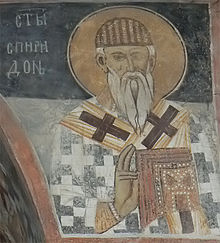
A New Class of Iconographers Begin Their Studies: The Work of The Holy Spirit

On Wednesday evening, May 23rd, ten members of the Fra Angelico Institute for the Sacred Arts here in the Roman Catholic Diocese of Providence, Rhode Island USA were commissioned and blessed to begin their study, here at the Institute, and work to become competent painters of sacred icons.

As we approach the Solemnity of Pentecost we can certainly see the movement of the Holy Spirit in this work. We are reminded of a commentary by St. Cyril of Alexandria, the bishop and patriarch of Alexandria, Egypt during the years of 412 to his death in 444. He was a man of great learning, holiness, and courage who defended the divinity of Christ and the specific role of Our Blessed Mother – the Holy Theotokos – in the plan of salvation.

In one of his commentaries he summarizes what we see in the early history of our Church, and continue to experience in our own time. He says: “After Christ had completed His mission on earth, it still remained necessary for us to become sharers in the divine nature of the Word. We had to give up our own life and be so transformed that we would begin to live an entirely new kind of life that would be pleasing to God. This, was something we could do only by sharing in the Holy Spirit.” [bold, mine, DPI]

He continues: “It was most fitting that the sending of the Spirit and His descent upon us should take place after the departure of Christ our Savior. As long as Christ was with them in the flesh, it must have seemed to believers that they possessed every blessing in Him, and to dwell in our hearts through faith. Only by His own presence within us in this way could He give us confidence to cry out, Abba, Father, make it easy for us to grow in holiness and, through our possession of the all-powerful Spirit, fortify us invincibly against the wiles of the devil and the assaults of men. It can easily be shown from examples both in the Old Testament and the New that the Spirit changes those in whom He comes to dwell; He so transforms them that they begin to live a completely new kind of life.”

I  briefly mentioned this in passing on Wednesday night to the class of sacred artists.  The statement being that the work of the sacred artist is the work of the Holy Spirit. The Spirit is involved in their training, work, and prayer and He is involved in transforming their lives as well. Why? Because they opened their hearts, and accepted the challenge that was spoken to them in the recesses of their soul.

All sacred artists are intimately involved in Pentecost. They are involved in having their lives changed through the love of the Holy Spirit who comes to dwell in their hearts so their art may give glory to God.

St. Cyril of Alexandria says to us that “….the strength that they [the Apostles at Pentecost] received from the Spirit enabled them to hold firmly to the love of Christ, facing the violence of their persecutors unafraid. Very true, then, was our Savior’s saying that it was to their advantage for Him to return to Heaven: His return was the time appointed for the descent of the Holy Spirit.”

Christian sacred artists throughout the world have been graced by the Lord to create prayer focused art works that have, as their very purpose, to promote prayer and to give glory to God. In this weekend of Pentecost, let us open our hearts, enter into this effort, and together say, “Come Holy Spirit, fill the hearts of your faithful and kindle in them the fire of Your love. Send forth Your Spirit and they shall be created. And You shall renew the face of the earth.”

Sacred Beauty has saved the world.

Copyright © 2012 Deacon Paul O. Iacono All Rights Reserved.   The icon of St. Cyril of Alexandria is from the website: traditioninaction.org Thanks to them for the image.

Icons, Icon Painters, and Praying With Sacred Icons: Part One

A few issues have come up in discussing some basic terms with people. I would like to be clear on how I have come to understand these words because it may affect how we view our “ministry” to be painters of sacred icons and or sacred images.

From my understanding, the word icon in English, Greek, and Latin, is the word for image. In our usage as sacred artists, it refers to a sacred image of Our Lord, Our Blessed Mother, angels, or specific saints. The purpose of a  sacred icon is that, as a piece of sacred art, it  focuses an individual in prayer.  A sacred icon is a specific type of sacred art. It is created following certain traditions – tradition with a small “t” and a large “T.”

Many sacred icons are presented with a simplicity of style, the use of color, the types of colors used, the use of symbols, etc. A sacred icon is different from a sacred image, in that the sole purpose of the sacred icon is that it is to be used as a focal point for personal or communal prayer.

A sacred image, however, may have been commissioned by a patron for personal prayer, but it may also have been commissioned for the pure enjoyment of its beauty. In the case of Renaissance sacred art, the Roman Catholic Church became the patron of many pieces of sacred art in order to affect the communal prayer of the faithful who came to the small churches and the great basilicas for Holy Mass.

With a sacred image (such as a religious image painted by Michelangelo or Leonardo) you have the artist’s personal imagination heavily influencing and entering into the creation of the beauty of the image, possibly even manipulating and combining Scriptural passages for the purpose of the story the artist would like to tell. Yet, even though I have just made that statement, the truth of the matter is that it is not always so clear cut. We do have icons, such as the famous Nativity icon of the birth of Christ, in which you have numerous Scriptural passages – conveying different events – being used to convey a catechetical sequence surrounding the birth of Our Lord – and all of this is done on the same icon panel!

In a sacred icon, the imagination of the artist is present, yet, it is supposed to be subordinate to his/her faith’s perception of Sacred Scripture and Sacred Tradition (how the early Church viewed their beliefs and expressed them within their specific cultural tradition). So, if a sacred artist is painting a sacred icon, he or she is aware of the theological, aesthetic, and semantic rules that have been developed and followed through the centuries. These rules – “the Canon of Iconography” – are affected by cultural area and religious Sacred Tradition.

For example, a Coptic sacred icon (see image below), by a painter of the Egyptian Coptic Church will express the image of Christ and a saint (in the icon below an abbot of the Coptic Christian Church) somewhat differently than a Greek or Russian Orthodox painter; and yet, there is nothing wrong with this, as long as the painter is not fomenting apostasy or heresy.

All of that being said, sacred images, for example, by Renaissance painters, can certainly be used to focus an individual in their personal prayer, as do the beautiful stained glass windows of the great Gothic cathedrals. Care must be taken, however, in selecting appropriate images for use in personal prayer. It is my perception that the type of image a soul uses in personal prayer – sacred icons (from the Eastern Rite) or sacred images (from the Western Rite) – is a matter of personal preference and certainly does not  indicate that one type is better or “more truthful” than another. Eastern and Western sacred artists are both working off of their own perceptions and spirituality; there are disagreements with this, but we must always remain charitable with each other.

Within the last twenty years there have been many Western sacred artists that have rediscovered the beauty of painting sacred icons, and are trying to be sensitive to the Eastern Rites’ traditions,  as they bring it back into the consciousness of the Roman Catholic Church. The Eastern Orthodox Churches, thankfully, never lost appreciation for their tradition.

I will post Parts Two and Three on this same theme in the upcoming days. Be sure to look for them on-line or in the archives. Thanks.

Copyright © 2012 Deacon Paul O. Iacono All Rights Reserved

The image of Christ and the Abbot – a panel depicting a monk with Christ. It was excavated in the early 20th century from a monastery in Egypt and is located in the Bawit room at the Louvre. Thanks to: Photo by Clio 20, CC attribution share-alike 3.0. I believe the icon dates to about the 7th century.

St. Matthias and the Renewal of Easter Hope – The Lord Loves His Friends

Today is the feast day of St. Matthias. The Acts of the Apostles relate that Matthias was chosen by lot to replace the disciple who had betrayed Jesus in the garden.

In chapter 18 of our Gospel, St. John speaks of Judas, who was in collusion with the Romans and the Jewish elders, and brought them to the place where Jesus was staying in the garden; the betrayal took place and the deaths occurred.

In the period after Jesus’ death the Apostles were known as the Eleven.

The Eleven. A title which causes us to pause, even today, two thousand years later. They were twelve, but then the betrayal took place. Judas hung himself; and the Romans hung Jesus on a cross. Even in those anxiety filled days after the death of Jesus, and before His resurrection, the Eleven knew in their hearts that Judas was not the only one, who had betrayed Jesus. For in cold terror they ran from the garden – they ran from the Cross – abandoning their Master and betraying His friendship.

It was only John, and the women, who had the courage to stand there and minister in silence, in tears and sobs, to their dying master. We wonder, that as they stood before the Cross, was there a crisis of trust in their own hearts? Did they wonder about the other ten who were not there? Did they wonder about their own possible betrayal? Yet, all of their self doubts and agony would be washed away through the truth of the Resurrection.

Today’s feast of St. Matthias gives us renewed hope in this, the sixth week, of the Easter season; for it directs us to the great love of God for His friends. It also reminds us that He never leaves His friends alone in their mission of building His Church.

After the Ascension of Jesus into Heaven, Peter, as the great leader of this little group of friends, realized that something had to be done to fill the hole, the gaping hole, that echoed with the cries caused by the betrayal of trust,  friendship, and fidelity to God Himself.

Peter knew that this cavity had to be repaired because Jesus Himself had filled the hole in Peter’s heart. It was Peter’s realization and trust that Jesus could heal him that led to his putting the mantle of leadership back on.

Peter knew that the grace of Jesus could heal them,too, and that they could become the ambassadors of the Good News who would carry out Jesus’ commands. Their group of twelve, by mirroring the twelve tribes of Israel, could evangelize Israel itself.

So, they cast lots – because they did not think themselves worthy to make the choice of their own accord, and wanted some sign [from the Holy Spirit] for their instruction.

Matthias was chosen.

St. Matthias was a disciple of Jesus who loved much, he witnessed the resurrection, he lived in the Father’s love, he followed Jesus’ commands, and was willing to lay down his life for the Lord and His Mission.

May God grant that we have Matthias’ courage to be open to the grace of Christ and use it to  build-up His Church.

Quote taken from a 4th century homily by St. John Chrysostom on the Acts of the Apostles found on pages 1822-24 of The Divine Office volume 2.

The sacred image of St. Matthias is from the workshop of Simone Martini the 14th century painter from Siena whose style influenced the Gothic movement. Martini portrays Matthias wrapped in the red mantle of martyrdom holding  a book that is painted green. Green is the color used by sacred iconographers and sacred artists to represent hope, life, and renewal. The book he is holding is a  reference to the truth of Christ’s Gospel preached by St. Matthias. This painting is dated between 1317-1319. Maestro Martini died in France at the age of 60 in 1344.

Copyright © 2012 Deacon Paul O. Iacono All Rights Reserved

Stones that Sing – The Photography of Dennis Aubrey and PJ McKey

A few months ago I discovered the exquisite photography of Dennis Aubrey and PJ McKey. They have a blog here on WordPress called Via Lucis.

Their post of May 10th discusses and shows the beauty of a Romanesque church (Our Lady of the Assumption) located in the Burgundy region of France. Dennis entitles the church as “The Great Survivor.” When you read the fascinating history of this church (a priory church was first built on this site in the 9th century) you see that it is, indeed, a great survivor. For it has survived the onslaughts of man’s barbarity in the name of religion, or in the case of the secularists of the French Revolution, desecration in the name of “The  Citizen.”

Like a magnificent athlete who has taken a punishing series of blows, blocks, and beatings this church still stands tall. Quietly proclaiming to the world that no matter what it does, short of hauling her down in a pile of rubble, it will remain standing giving witness to the glory of God and the faith of the men and women who with their sweat, toil, and treasure built it in the name of love and honor of God.

Even if future generations haul it down and reduce it to a pile of rubble, those stones will continue to sing, will continue to give glory to God – as they should – for the love that went into building the church remains – embracing the stones – caressing the stones like ancient mortar.

Please visit Dennis and PJ’s beautiful site (it contains their magnificent sacred photography). You will be inspired by the artistry of their photography. The link is here: vialucispress.wordpress.com/2012/05/10/anzy-le-duc-the-great-survivor-dennis-aubrey/

Thanks to Dennis Aubrey for allowing me to paste the photo: Église Notre-Dame de l’Assomption, Anzy-le-Duc (Saône-et-Loire) Photo by Dennis Aubrey. Photo Copyright © Dennis Aubrey. All Rights Reserved.

Copyright © 2012 Deacon Paul O. Iacono All Rights Reserved

ORO et CREO: PART THREE – A Personal Reflection

This is the third part of a three part series on a Spirit filled idea called Oro et Creo (“I Pray – I Create”). This idea was started by artists Jamie Medeiros and Deacon Tom Lambert. Please check out the first two parts of this series which have already been posted in order to get a full perspective on what they are accomplishing on the parish level.

What is wonderful about what Jamie and Deacon Tom are doing is that they are providing a simple, no anxiety-no pressure structure through which the  Holy Spirit can move the person to unite their artistic and creative impulses to their desire for union and communication with God. This is done in a silent, communal, setting, but it can also be done in an individual setting.

Creativity and prayer go hand-in-hand – it just takes the desire of the individual artist, regardless of the medium, to take the simple step of uniting the creative moment to their spiritual life. How is that done? Simply, it is an affirmation of the will to prepare yourself through short silent prayers, and then to consciously say, “Lord God – I offer this moment of creativity to you, help me to create something which gives You glory;” and  then, you create: poetry, stories, visual art, cosmetic design, fashion design, music, photography – whatever appeals to you.

St. Benedict of Nursia, when he established his community of Benedictine monks at Monte Cassino in 6th century Italy, was concerned that his monks balance their life between work and prayer. He developed his Rule which ordered their day into specific moments of prayer, work, and relaxation. Even in the 21st century we can relate to the significance of this type of structure within our busy day.

The point being that we must be balanced and make time for the important things of our life and not be a slave to the world, materialism, or current fads. St. Paul speaks of this in Colossians 3: 23-24 when he says: “Whatever you do, work at it with your whole being. Do it for the Lord rather than for men, since you know full well you will receive an inheritance from Him as your reward. Be slaves of Christ the Lord.” 

As I perceive it, when we are involved in the Oro et Creo process we have made the decision  to unite ourselves to the Holy Spirit – the Sanctifier – and then, we allow the Holy Spirit to guide us in our creative work. It is through the process of this creative effort that we speak to God and tell Him we love Him.

This process occurs when we are silent, and caught up in the moment of doing our work. It is at these times of intense concentration that we are taken “out of ourselves” (only to come back when we realize that we have been so focused on the creative work that we have forgotten the experience of time).

Our conscious prayerful effort at the beginning of the process expresses to God our love and thanks. From my experience, we don’t have to be consciously involved in constantly praying as we are creating. When your mind reflects on the need to pray – it is then appropriate to say a short prayer – such as “Jesus Christ, Son of God, have mercy on me a sinner” or, “Holy God, Holy Mighty One, Holy Immortal One have mercy on us,” or, just simply, “Jesus, I love and trust you.”

Jamie and Deacon Tom use the phrase Oro et Creo (I Pray – I Create) which was inspired by the Benedictine motto Ora et Labora (Pray and Work). To this I would add another section of the Benedictine Rule:  ut in omnibus glorificetur Deus, “that in all [things] God may be glorified” (Rule, chapter 57.9) which was also adopted and adapted by St. Ignatius of Loyola in his Jesuit motto: All for the Greater Glory of God. So, in our prayer/creative efforts – our intent – whatever results, should always be our desire to give honor, thanks, love, and glory to God. If we enter into these moments with an open heart and pure soul – it will.

Bravo and thank you, Jamie Medeiros and Deacon Tom Lambert, for your faith, prayer, and creativity! I am sure you have inspired many to continue your ideas in their own settings.

Thanks to ad-orientem.blogspot.com/200 for the icon of St. Benedict.

Copyright © 2012 Deacon Paul O. Iacono All Rights Reserved


ORO et CREO: I Pray – I Create – Part Two – A Wonderful Idea For Your Church

This is the second part of a three part series with Jamie Medeiros, an artist whose parish is in Tiverton, Rhode Island, and Deacon Tom Lambert, a Permanent Deacon within the Diocese of Chicago, and whose parish is Our Lady of Mt. Carmel in Chicago, Illinois.

Please be sure to read Part One of this two part interview in order to obtain a complete understanding of what the Lambert/Medeiros model of prayer and the creation of art is trying to accomplish. It is a model easily applicable to any Christian parish, within any Christian denomination, in the world.

The Interview: continued…

5) Is there any specific format that you use – such as – do you gather after Sunday Mass, do you say specific prayers together, or do you say prayers in individual meditation? Are all the participants Catholic?

Jamie: We begin in the church with some music (to help us transition from our busy days to awareness of God’s presence) and a brief reflection or guided meditation (usually a quote from Scripture or contemplative reading, followed by questions to think about).  We then begin our hour of prayerful creation.  We each go to an area of the church we are drawn to and create for an hour.  As we create, we let the images, questions, and movements guide us in our conversation with God.  Sometimes getting in the creating “zone” helps us rest in His presence. After one hour of prayerful creation, we meet in the front of the church and discuss our prayers (if we feel comfortable doing so).  Everyone places their artwork out for others to see and each of us explains what was going on, what we were thinking about, how it lead us to our results, etc.  There is a closing prayer.

Not all participants are Catholic, but all are Christian.

Deacon Tom: [He answered the format question in the previous post]. It is a parish ministry offered for members of our parish. We do occasionally get non-parishioners.

6) Does the “create” side of the session happen simultaneously with your prayer, or have you divided it – such as 10 minutes for prayer, 50 minutes for “create” after the communal or individual prayer session? Or do the participants desire for it to happen spontaneously?  What types of art are being produced: sketches, paintings, literary, etc. Have you ever had any formal or informal showings of the art that has been produced? Would your parish be open to displaying the art produced?

Jamie: For Oro et Creo, the prayer IS the creation (the Benedictines use the motto Ora et Labora – Pray and Work, we use Oro et Creo – I Pray – I Create, because creating can be prayer).  Our format is basically– an opening prayer, one hour of prayerful creation, and a closing prayer.  The opening prayer varies in length depending on what reflection I find for the week (usually having to do with current liturgical season, daily readings, or creation [the creative process]).

The type of art that is being produced are drawings, paintings, poetry, photography, and mixes of all of these. We have not had any exhibition of works yet.  We have talked about it.  I’m sure our parish would be open to it.

We definitely want to make sure that the practice remains prayerful and that participants are not pressured toward “perfection” of a work because others will see it, but it remains a space for a deep listening and responding to God’s voice.

Deacon Tom: [See previous post, question # 3]. We haven’t had any formal showings of the participants artwork. We have talked about the possibility of displaying the art but most are content to do this as a form of personal prayer

7) Do you have any guidelines that would be important for other parishes within the Diocese or other Dioceses around the world to be conscious of so that it would develop with the minimum number of personal or organizational potholes?

Deacon Tom: We are open to movement of the Spirit and the priority of art as a prayer experience. Silence [during the creative moments] is an important aspect [of what we are doing].

Jamie: I second what Deacon Tom said, “We are open to movement of the Spirit and the priority of art as a prayer experience.” Silence is an important aspect [of the creative moment].

8) Would you mind having people contact you – through your blog  or email – about the process?

Jamie:  Not at all.  They can email me at: medeirosjamie@gmail.com, at my website: www.iliveinhope.com, or blog: jamiedmedeiros.wordpress.com

Deacon Tom:  People can contact me at  olmcinfo2@aol.com  or Deacon Tom Lambert         Our Lady of Mt Carmel Parish    708 W Belmont, Chicago, IL 60657        773-525-0453 x 21.

In the third and last post of this series I will offer a personal reflection on what they have accomplished.

Copyright © 2012 Deacon Paul O. Iacono All Rights Reserved

ORO et CREO: “I Pray – I Create” – Part One

Soon after an article appeared in our Diocesan newspaper (The Rhode Island Catholic) in June 2011 on the Fra Angelico Institute for the Sacred Arts, I spoke on the phone with a talented artist by the name of Jamie Medeiros. We talked about the mission and goals of the Fra Angelico Institute and then she explained to me the mission of a group that she started at her parish in Tiverton, RI. Her group’s name is Oro et Creo (I Pray – I Create). I was fascinated by her description since it clearly was another example of the Holy Spirit’s continuing witness to get Catholics, and Christians of all denominations, interested in uniting the dual impulse of prayer and the creation of sacred art in all its various forms.

The following interview (the first part of a three part series) with Jamie Medeiros and Deacon Tom Lambert illustrate how their combined efforts and continuing positive influence have opened up the creative and spiritual impulses of many people.

The Lambert/Medeiros model can easily be replicated in your parish – regardless of where you are in the world. As of last week, this website/blog on The Fra Angelico Institute for the Sacred Arts, is read by people in 63 nations and on every continent except Antarctica. As far as I am concerned, these numbers are a clear example of how the Holy Spirit utilizes all resources to touch people’s hearts and move them back into a closer relationship with Him. Regardless of where you live in the world, and whether your parish is Roman Catholic, Greek or Russian Orthodox, Middle Eastern Catholic, or one of the Protestant denominations, the Lambert/Medeiros model of Oro et Creo, which unites personal prayer and the creative impulse within a church setting and in community with other artists, is a powerful tool of evangelization.

The Interview:

1) What inspired you to establish the Oro et Creo community?

Jamie Medeiros (St. Theresa’s Parish Tiverton, Rhode Island):     In Chicago at Our Lady of Mt.Carmel I had befriended one of the deacons [Deacon Tom Lambert] who had picked up art in his retirement.  He asked if I would meet one of the RCIA candidates [Belinda Cook Blakely] who was a student at The Art Institute of Chicago.  All three of us met after Mass one day and began a discussion about this common thread of art and God.  We discussed the fact that there seemed to be a lot of artists in our parish.  We joked, “we should start a group!”  The Deacon didn’t miss a beat.  He said, “We SHOULD start a group.”  We proceeded to discuss what it might “look like” if we started one.  This was just at the beginning of Lent [2008].  We all saw the movement of the Holy Spirit and thought the timing of this discussion was remarkable.  We picked a day, wrote up a blurb for the bulletin and decided to see if anyone would show.  They did.  We named it Oro et Creo after the Benedictine motto Ora et Labora (Pray and Work).  It is a time to pray while creating.  We continue to sit in wonder of the role of it as ministry for its participants.

Deacon Tom Lambert (Our Lady of Mt. Carmel Parish Chicago, Illinois): Oro et Creo started at Our Lady of Mt Carmel Church, Chicago when I introduced Jamie [Medeiros] and Belinda [Cook Blakely], two artists, to each other. They then approached me to start Oro et Creo because they didn’t find much connection between art and God in their work environments. Although both have moved on, Jamie to start an Oro et Creo group in Rhode Island, the group they started [here in Chicago] is still going on. For the translation of Oro et Creo I applied its meaning of ” I pray – I create” which says (to me) out of my prayer comes my creation. It is an invitation, a prayerful desire for one to create not a command to others, which is how I see Benedict’s Ora et Labora applying to his monks. [Deacon Tom and Jaime are using the phrase differently then St. Benedict, since St. Benedict was speaking in the imperative, that is, he was giving a command to his monks: “Pray and Work.” Deacon Tom and Jaime, however, are using Oro et Creo, the Latin is spelled differently because it  applies to an individual who prays and then creates, or creates while they are in a prayerful state – I Pray – I Create].

2) How long has your Oro et Creo sessions been in existence, what Church did it begin in, and is it taking place right now – name and geographical location?

Jamie: Oro et Creo first met during Lent 2008.  We began it at Our Lady of Mt. Carmel Church in Chicago, Illinois.  They are still meeting weekly on Monday nights.  Here in Tiverton, Rhode Island, Oro et Creo began the summer of 2010, meeting weekly, and now meets once a month on Mondays (7 pm) at St.Theresa’s Church in Tiverton.

Deacon Tom:  We meet weekly at Our Lady of Mt Carmel Parish 708 W  Belmont, Chicago, IL

3) Is the clergy involved in any way? Can people in your area join at any time and who would they contact and when would they show up?

Jamie: Here in Tiverton, our Pastor approved the program and likes to hear updates.  People are welcome to show up.  We meet at St. Theresa’s in Tiverton, RI on the first Monday of every month at 7 pm, unless it is a Faith Formation GIFT week.  People are welcome to email me with questions.

Deacon Tom: I am involved as a participant and [Parish] staff representative. The leader of the group is a layperson who is an artist.

4) How often do you come together to pray and create? Where do you actually meet – in the Church Hall, in the Church, at someone’s home?

Jamie: We currently meet once a month on Monday nights from 7 – 8:30ish pm.  This is open to change, depending on the seasons/ availability.  We meet in the Church.

Deacon Tom: We meet weekly. We start at the parish ministry center where we gather until everyone arrives. Then we have an opening prayer and then go in silence to the church or chapel. We sketch in silence for about an hour or more. People can sit anywhere in the church outside the sanctuary and sketch whatever they choose to do. Some bring pictures with them to sketch. We then go back to the ministry center where people may or may not choose to show the group what they were working on. Then a closing prayer is said. [Italics and boldface are my emphasis – Deacon Paul Iacono].

Part Two of this Interview with Jamie Medeiros and Deacon Tom Lambert will soon follow. In it they provide additional insights into this wonderful model which can easily be applied in your setting. Come on, what are you waiting for?!! Call one of your friends or church members who is creative, approach the parish clergy for permission to use the church for one hour a week, apply their model and get started!

 Copyright © 2012 Deacon Paul O. Iacono All Rights Reserved

Our Living Hope: The Tomb Cannot Hold Us

Catholics, Orthodox, and Protestants  – we are all an Easter people. For two thousand years we have – through faith in historical documents and human witness – been invited to believe in a divine act of revelation: the Easter resurrection of our Lord and Savior; for it is in that act that our God shows us who He truly is.

We believe that the resurrection of Jesus is a historical and spiritual fact; and that the resurrection of Jesus not only explains the truth of His promises but it demonstrates what has been promised to us.

On the first Easter morning, Mary Magdalene, Peter, and John saw that the stone had been rolled away from Jesus’ tomb; and as they looked in  – they came face to face with their eternal destiny. Since no stone could have stopped the resurrected Jesus, it was pushed away not to let Jesus out – but to let them – and us – in.

Like Mary, Peter, and John, and all the others, we come to realize that we are an Easter people – which means that we are an eternal people – members, through our holy baptism, of the family of the eternal high God. The tomb could never hold the resurrected Jesus, and – as a people of faith – it cannot hold us.

St. Paul tells us in his epistle to the Hebrews that “faith is the assurance of things hoped for, the conviction of things not seen.” (11: 1)

But what is hope? Hope is trust based on a divine promise. We have hope because we trust the words and deeds of Jesus Christ. We trust in His promises to us.

Our hope interacts with our faith in Him – and we are forever changed because of it. You and I are certain of our faith, because we understand and rejoice in the hope that our God does not lie – our Scriptures do not lie  – our Sacred Tradition does not lie; so as an Easter people we possess the hope that St. Peter speaks of when he says: “…we have been born anew to a living hope through the resurrection of Jesus Christ from the dead.   (1 Peter 1:3).

As we celebrate the Easter season, let us – as our Lord tells us today – “Be not afraid”  – let us be joyful and thankful for the gift of faith and the willingness, in the face of all odds, to share our faith and joy with others.

May God grant you a joyous and creative Easter season!

The attached sacred image was painted by Fra Angelico in 1441 and is entitled “The Women at the Tomb.”       Copyright © 2012 Deacon Paul O. Iacono All Rights Reserved

Good Friday Meditations

It was about nine in the morning when they nailed Jesus to the cross.

From noon until three o’clock there was darkness over the whole world.

At three o’clock, Jesus cried out in a loud voice: My God, my God, why have you forsaken me?

It is finished.

When we were His enemies, God reconciled us to Himself by the death of His Son.

Realize that you were delivered from the futile way of life your fathers handed on to you, not by any diminishable sum of silver or gold, but by Christ’s blood beyond all price: the blood of a spotless, unblemished lamb chosen before the world’s foundation and revealed for your sake in these last days. It is through Him that you are believers in God, the God who raised Him from the dead and gave Him glory. Your faith and hope, then, are centered in God.  (1 Peter 1: 18-21)

“Awake, O Sleeper, and rise from the dead, and Christ will give you light.”


Copyright © 2012 Deacon Paul O. Iacono All Rights Reserved

The painting, Christ’s Crucifixion, is by the Spanish master Diego Velazquez (1599 – 1660); it was completed between 1631 – 32.  All the Scriptural quotations are taken from The New American Bible (1970) Confraternity of Christian Doctrine, Washington, D.C. The “Awake, O sleeper…” verse is taken from an ancient homily from the first centuries of the Church.

What Does The Silence Of Christ Say To Us?

In the passage from the first Epistle of Peter known as the Canticle of Peter (1 Peter 2: 21-24) Peter describes Jesus’ acceptance of His passion. He explains:

“Christ suffered for you, and left you an example to have you follow in His footsteps. He did no wrong; no deceit was found in His mouth. When He was insulted He returned no insult. When He was made to suffer, He did not counter with threats. Instead He delivered Himself up to the One who judges justly. In His own body He brought your sins to the cross, so that all of us, dead to sin, could live in accord with God’s will. By His wounds you were healed.”

In this morning’s first reading we have Isaiah tell us, “He [the suffering servant] does not cry out or shout aloud, or make his voice heard in the streets.”

We can picture Jesus carrying the Cross, carrying the weight of our sins through the streets of Jerusalem to His place of execution.

After receiving a savage beating and scourging at the hands of the Roman soldiers, He said nothing; after having the weight of the Cross thrust upon His raw and bleeding shoulders – He said nothing; as He stumbled and zigzagged through the streets of Jerusalem, being hounded every step of the way by sadistic soldiers and a callous mob, He said — nothing.

What does His silence say to us?

Possibly, if we unite ourselves to His sufferings, we can see that our own life consists of spiritual, physical, and emotional beatings, scourgings, sufferings, and crosses that are thrust upon us.

Like Jesus, we may feel that we are being ground into the street by the suffering we are experiencing – but like Him – we must rise up – to carry our personal cross as best we can.

As Catholic Christians – actually, all Christians regardless of denomination – have as our calling the duty to carry our trials and troubles in the same way that Jesus did. Like Him, we will zigzag through the streets, we too, will stumble and fall; but Holy Week reminds us that we must always see Jesus’ composure, humility and strength in the face of unbelievable pain and extraordinary adversity as a model that we must strive to emulate.

Jesus was not a masochist; nor are we. But we understand that the mystery of suffering contains within it the seed of our redemption – the seed of our spiritual rebirth – for a seed must fall to the ground and have its outer shell stressed, broken, and yes, pulverized, so that its center may take root and give birth to new life.

This week we must make a silent prayer, to join our trials and sufferings, those of our loved ones, and those of our nation – to His, and to implore the Father to help us raise up our nation, family, and ourselves as best we can, so that we may, as Saint Peter tells us, “follow in His footsteps” and silently and without complaint, carry our own cross – as well as the crosses of others.

Special thanks to Fernando Mario Paonessa a contemporary artist for providing the images of Jesus suffering the Way of the Cross. Fernando created these stunning sculptures (reliefs); more images may be found on his website: http://fernandomariopaonessa.eu/pages/via_crucis.htm

Copyright © 2012 Deacon Paul O. Iacono All Rights Reserved

The Solemnity of the Annunciation – The Confident Sacrifice Of A Pure Heart

Many years ago, Blessed John Paul 2 spoke to the seminarians of Rome on this, the Solemnity of the Annunciation. He began his homily with the phrase: “Fear not!”  Echoing the archangel’s comments to our Blessed Mother he was trying to calm the natural anxiety of those young men as they  prepared for their Gospel ministry in the world. The Pope counseled them that “We must all accept the call. We must listen [to the Holy Spirit],  and use the grace that we have received from God. We must shore up our strength, and say, “Yes” in confidence and certainty to the call that we hear from the whispers of the Holy Spirit.”

Upon hearing the message of the archangel Gabriel, the ultimate decision by Mary that “Let it be done to me according to your word” conclusively and forever changed cosmic and spiritual history. For at the moment she said “Yes” to Gabriel, our salvation and redemption, through the Cross, began.

Let us not forget, however, that Mary’s “Yes” had a tremendous affect on her, too.  It required a great cost from her personally because it resulted in the Crucifixion – it resulted in the sacrifice of her own son Jesus – and – the sacrifice of her own heart.

Blessed John Paul 2 speaks of this when he says:  “Mary in a particular way – unlike any other – experienced mercy, and at the same time, made her participation in the revelation of the Divine Mercy possible with the sacrifice of her own heart.  Such a sacrifice is closely bound up with the Cross of Her Son, at which she was to stand at Calvary… No one has experienced the mystery of the Cross as did the Mother of the Crucified…. Mary is therefore the person who knows the Divine Mercy most deeply. She knows the price; she knows how high it is.”

He goes on to say, “Maybe there is another point: for all people are born at Mary’s Yes.” This must be understood: such a Yes in imitation of Mary creates joy, a new life, a breath, a blessing;” it creates opportunities for us to  sacrifice our own hearts in imitation of her and the Holy Family.

So as we enter the 5th week of Lent let us celebrate this Solemnity by trying our best to live like our Blessed Mother – a person with complete confidence in the Lord. Let us say Yes to God in imitation of Mary and allow the Lord to work wonders in our own lives, as well.

Images in order of appearance: A 13th Century Byzantine icon of the Annunciation from St. Catherine’s Monastery in the Sinai; Henry Ossawa Tanner’s Annunciation (1898); John William Waterhouse’s Annunciation (1914); and Bartolome E. Murillo’s Annunciation completed between 1660 -1665, and please don’t forget to do some research and take a closer look at one of Fra Angelico’s versions of the Annunciation! Please also notice that in Waterhouse’s and Murillo’s renditions both artists have included the tradition that Mary was in the process of sewing the veil that separated the Holy of Holies from the outer room which housed the Altar of Incense in the Temple in Jerusalem; other artists, such as El Greco, do that too.

Copyright © 2012 Deacon Paul O. Iacono All Rights Reserved

The Artist As Contemplative – Part 4 – A Meditation on the Scourging of Christ

In this series on the Artist As Contemplative it is my hope that you are exposed to some different techniques that may assist you in your prayer relationship with Our Lord.

The last post in this series specifically mentioned that we do not need to use many words during prayer. This may be uncomfortable for us at first since we have developed into a species that appears to constantly need some type of noise, talk, music, or in some cases, cacophony going on inside our mind. I am not a social psychologist so I will not venture a reason for such a trend within American society, other than to say that it may be an attempt to buffer the anxiety that people, especially the young, feel.

We must reduce the amount of noise, superfluous talk, and loud dissonant music that hammers our nervous system. We have to do this in order to allow sacred silence the opportunity to blanket us with its warmth so we can settle into a comfortable conversation with Christ.

St. Teresa of Avila is very helpful in this regard. Fr. Peter-Thomas Rohrbach, O.C.D.  clearly states in his wonderful book Conversation With Christ that the prayer doctrine of St. Teresa is clear: “Prayer does not consist in involved, complicated reasoning, but in thought which is productive of conversation with Christ.” So prayer, productive prayer, is conversation with Jesus.

Fr. Rohrbach then goes on to provide an actual demonstration of true meditation provided by St. Teresa of Avila in her own autobiography.

She says: “We begin to meditate upon a scene of the Passion – let us say upon the binding of the Lord to the columns. The mind sets to work to seek out the reasons, which are to be found for the great afflictions, and distress, which His Majesty must have suffered when He was alone there.

It also meditates on the many other lessons, which, if it is industrious, or well stored with learning, this mystery can teach. This method should be the beginning, the middle, and the end of prayer for us: it is a most excellent and safe road until the Lord leads us to other methods, which are supernatural…   it is well to reflect for a time and to think of the pains which He bore there, why He bore them, Who He is that bore them and with what love He suffered them.

But we must not always tire ourselves by going in search of such ideas; we must sometimes remain by His side with our minds hushed in silence. If we can, we should occupy ourselves in looking upon Him Who is looking at us; keep Him company, talk with Him; pray to Him; humble ourselves before Him; have our delight in Him, and remember that He never deserved to be there. Anyone who can do this, though he may be but a beginner in prayer, will derive great benefit from it, for this kind of prayer brings many benefits; at least, so my soul has found.”

The beauty of this approach is that it is completely natural for us to do what she directs in prayer. If we look again at the passages that I have highlighted in bold face you will see that this prayer behavior is the same we would express if we were with a close friend or relative experiencing a troubled or stress filled moment in their life.

So the watchwords here are sensitivity, awareness, and humility. Sensitivity because we need to be willing to listen, and humility in knowing we don’t have all the answers, and the awareness to know that sometimes it is necessary just to keep someone company, and quietly talk to them, without trying to provide solutions.

But it is more than that, isn’t it; because in our prayer we are talking to God. We are talking to the Son of God who suffered for us, because it was the Father’s desire, which He willingly accepts in order to accomplish the salvific act of our Redemption. Our ability to keep ourselves humble before God, delight in His Divine Presence, and remember His Life and Death is critical for a healthy prayer experience.

Our intellect and will working with the faculty of our memory of scenes from Sacred Scripture provide us with the ability to soak ourselves in the meaning of Christ’s great sacrifice. For this is who we are as Catholics, Orthodox, or Protestants – people who bring the images and truth of Scripture and the saints of our traditions into our prayer life.

Does any of this apply to sacred art? Yes, as sacred artists, St. Teresa of Avila would probably say, “Paint and use the best quality and Scripturally correct icons, paintings, sculpture, etc as prayer aids. We need these aids to help the entire person: mind, heart, soul, and body to be focused on Him.”

I’d also venture to suggest that she would say “If you are a sacred artist produce a piece of sacred art that correctly portrays the Scriptural Jesus, the Blessed Mother, His angels, and saints. Remember, a sacred artist must be a person of deep prayer.”

St. John Damascene (Damascus), thirteen hundred years ago, in his writings and teachings very clearly stated that when we do this it is not idol worship. We believe that the Son of God became man; therefore, He became the iconthe image – of God for us to see, hear, touch, scourge, and crucify – “The Word became flesh and dwelt among us.”

This is not idol worship, just as it is not idol worship when you have a picture of your deceased parents on your bureau – you are not making an idol of them – your are not worshipping them – rather, you are remembering them through a celluloid image – an image which helps you relive what they taught and how they loved you – and still do from beyond the grave. So never fear your imagination – or images of the Lord – as long as you guard yourself with images and imagination that are focused with correct theology, semantics, and aesthetics.

I’ll let Father Rohrbach have the last word, he says: “St. Teresa presents us a crystal-clear picture of meditation: the mind furnishing matter for the heart’s talk with Christ. And above all, her fundamental rule that prayer consists not in thought, but in love.”

The above image of St. Teresa of Avila is considered to be the closest likeness to her. It was painted in 1576 when she was 61 years old.

Copyright © 2012 Deacon Paul O. Iacono All Rights Reserved

The Artist As Contemplative – Part 3 – Prayer Tips

Today, we are asking our good friend, St. Teresa of Avila to help us in the process of thinking clearly about prayer.  She is a worthy mentor – for she cuts to the heart of the matter in a practical and meaningful way.

In her Book of Foundations, she makes many important observations that will help us become more focused on what we are doing in prayer. This focus will in turn help us with our artistic creativity.

A few examples of her perceptive thoughts:

“The first thing I wish to discuss, as far as my limited understanding will allow, is the nature of the essence of perfect prayer. I have come across people who believe that the whole thing consists in thought, [but] if they become distracted and their efforts to think of good things fail, they at once become greatly discouraged and suppose themselves to be lost. It must be recognized that not everyone has by nature an imagination capable of meditating, whereas all souls are capable of love.”

It is my belief, however, that as creative people, artists are very capable of meditation because it involves the imagination. It is crucial, however, that they learn the proper process, and especially for them to remember, if they are a Catholic Christian, that St. Teresa of Avila happily gives sound advice and clear direction to conversation with Christ.

St. Teresa continues, “I am anxious to explain that the soul is not thought, nor will it be controlled by thought – it would be great misfortune if it were. The soul’s profit, then, consists not in thinking much, but in loving much.”

“Do not imagine that I want you to make long meditations on our divine Savior or much reasoning or profound and subtle conceptions. If you cannot do more, [just] keep your eyes fixed for some moments on your adorable Savior [really present in your church’s tabernacle, or, who as Love personified, was nailed to a cross for our Redemption].”

“[Rather than] spending time in prayer profoundly investigating some subject on which they are meditating [you should] place yourself in the presence of Our Lord and converse with Him, heart to heart, without fatiguing the understanding, and tasting the happiness of being in His company.”

The Lord doesn’t need many words from us – less, truly is, more; but He does thirst for our creative and heartfelt love.

As creative people, we necessarily have many things on our “to do” lists. You don’t need me to tell you that 21st century life is exhausting. With that in mind, St. Teresa’s advice is all the more relevant. For we should avoid at all costs making our prayer life another intellectual challenge – another task – that saps the little energy we have left!

She counsels us to meditate using some simple techniques of, at first, opening our mind and heart to the stillness – the quiet – that two friends experience in which they can be in each other’s company and not have to constantly be talking. The subconscious – or conscious – stress of having to keep up the conversation is gone. It is like a husband and a wife, who after many years of marriage, can be in each other’s company, enjoying moments that could stretch on for some time, and yet, not needing to say more than some words of awareness, support, agreement, or recognition.

My next post will provide a meditation by St. Teresa on Our Lord’s Passion.

Copyright © 2012 Deacon Paul O. Iacono All Rights Reserved
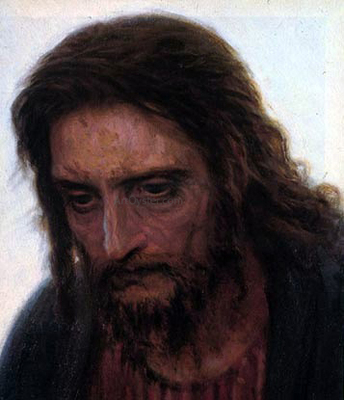
The Artist As Contemplative: Part 2: A Simple Step Into Prayer By St. Teresa of Avila

In our last post, The Artist as Contemplative – Part 1: The Proper Approach, we discussed the need to have the proper approach to prayer. One of the assumptions that I have is that if you are reading these posts you are a creative person. You may be an actual working artist, or, you may be attracted to art in one of the various forms it takes and are considering taking the first step in its exploration. Even if you are just beginning to explore a specific art form it is important for you to consider yourself an artist. This is not a fraudulent act. It is the perception of yourself as you truly are as a creation of God – a naturally creative person.

The Lord has made all of us creative beings, and regardless of our job or profession we should make time in our life to develop this creativity and allow it to be expressed. If we have no time for prayer and personal creative growth then we may be in a situation that is truly unhealthy for us. Our Sacred Scriptures tell us that our God is a jealous God – He specifically said that He wants “no other gods before Him” – that is a very sobering thought. So, quiet, prayer time – even if it is only thirty minutes a day – is critical to our spiritual, physical, and creative health.

If we make time for prayer, God’s grace and energy will cascade over into our creative life.  This is very important to artists, regardless of what media or medium we work in, since it demands that we focus our attention on one thing: talking to God in a natural way – talking to Him as we would talk to a close and intimate friend. 

This is difficult for many people. Childhood ignorance or anxieties may still be with us. There may have been bad influences from teachers, members of the clergy and religious life, and others (including, at times, parents) who took a limited view of prayer and taught a specific prayer style to the detriment of other approaches.

By remaining positive we see that a key idea in the prayer process is to remember that when we have a conversation with someone our intellect is remembering ideas and images. We are using those ideas and images in our actual conversation. This allows the conversation to proceed from one point to another and allows ideas or issues to be shared. This is also true in conversation – that is, our prayer – with God. Our intellect, memory, and silent conversation skills within our mind cooperate together to naturally express ourselves to God. Just like the story, in my preceding post, of the little girl receiving her first Holy Communion. She expressed her prayer to God in a natural manner, which made sense and allowed her to share the concerns or ideas with the Lord that were on her mind at that time. Her prayer was a perfect natural prayer.

In examining the teachings and prayer process of St. Teresa of Avila (1515-1585), the Spanish Carmelite, Father Peter Thomas Rohrbach, O.C.D. breaks her basic prayer technique into a simple step formula. He says the goal of prayerful meditation is conversation with Jesus. You achieve  this by engaging your visual memory  with a specific spiritual passage. This con-versation with Jesus about the passage moves to consideration of events within your own life. This process is actual conversation with Jesus in which He, like a good friend, is quietly listening to you.

St. Teresa of Avila (seen above in the portrayal by Gérard) is not promoting a prayer life which is filled with complexities, intellectual knots, and unnatural irritations, rather, she is presenting a style which reminds us of a wise old person who has no need of thinking about numerous paragraphs of words to say to God in prayer. The wise one enters their prayer time thinking about God, and specifically His Son, Jesus – the true icon (image) of God. They then allow their love of Him to take over – and fill the blessed silence of that present moment – not with many words – but with much love. You see this is the goal: to move from quiet conversation to quiet meditation – in love – of God’s truth, goodness, and beauty.

In my next post I will provide you with a meditation taught by St. Teresa of Avila. With  this Lenten meditation you should easily exercise your spiritual muscles. Also, it will help you take some time to reflect on St. Teresa of Avila’s approach and application to other moments in Jesus’ life and yours, too.

Copyright © 2012 Deacon Paul O. Iacono All Rights Reserved.  Thanks to avila.com for the image of St. Teresa of Avila by artist François Gérard (1770-1837).

The Artist As Contemplative – Part 1: The Proper Approach

All artists, by their very nature, contemplate. They are natural born contemplatives.

In its dictionary definitions we see that the word contemplate means: 1) “to intently look at something, 2) to study carefully, and 3) to have in mind the possibility or a plan of action.”

A person whose artistic skills are expressed through photography or the enhancement of physical beauty through fashion or cosmetics can certainly contemplate the meaning of beauty and maintain its traditions or break out and establish new ones. The same is true of a sculptor, painter, musician, needlework artist, poet, writer or any person working within other artistic mediums. For they, too, can “look intently at, study carefully, or have in mind the possibility of a plan” to create beauty or a new interpretation of it. As you see, at first glance there is no overt mention of religious or spiritual themes in these definitions.

Now let’s go a step further and ask a few questions: 1) Can the Christian artist (who has a natural contemplative spirit by virtue of being an artist), establish the artistic process as a vehicle for authentic prayer and union with God? 2) For example, did our friends Vincent Van Gogh or St. Andrei Rublev experience authentic prayer moments in their creative process? 3) When we look intently at  Starry Night or Christ the Redeemer – the Savior of Zvenigorod (seen below) do we feel comfortable using them in our conversation with God, and if not, why not?

Okay, as the old saying goes, “What does this have to do with the price of eggs?”

Young or old, there are times in our lives when we put up barriers in our minds to pursuing some study or some plan of action. This is especially true when it comes to the whole idea of prayer, and specifically, meditation and contemplation. People have a tendency to say, “Oh, that’s for holy people. I’m a sinner. I could never do it nor do I have the skills to do it. Bottom line, no one has ever taught me how to pray other than saying rote memory prayers.”

Good point. That perception is held by many people, especially Christians that have fallen away from the church of their ancestors. But is that belief just another mind barrier?

It is an established fact of being a Christian that we can be in touch with God, specifically His Divine Son, Jesus. We do believe, if we are Christians, that we all have the ability to enter into deep spiritual union and friendship with God by virtue of our Baptism. Baptism was the first very important step, and then, after that, the friendship of Christ is developed through our weekly worship and daily prayer life, our Scripture study and our Sacramental life. It takes effort, yes; but as Christians we understand that we enter into that relationship with Christ by walking with Him through His ministry and onto the path to Calvary.

The reader might say, however, “I am not a Christian. What does this have to do with me?” Even if the artist is not Christian they have the ability to enter into deep spiritual union with God through their own faith traditions. All the major religions of the world speak of and promote prayer; and all artists, even if they are not Christian, can enter into spiritual union with the Divine through the creative process.

But there is a little known maxim in Catholic Christian prayer practice: if you can think and if you can read (at the second grade level) you are capable of meditation; let me repeat, you are capable of experiencing authentic, prayer filled, and profound contemplation of God.

A quick example of this is the story that Father Peter-Thomas Rohrbach, in his important and delightful book Conversation With Christ that I discovered forty-five years ago. He tells of a young Catholic girl’s experience on receiving her first Holy Communion. He says, “The story is related of a small girl who, after the reception of her first Holy Communion, was questioned tenderly by her parents as to what she had done when she arrived back at her pew and prayerfully bowed her head. The girl hesitated momentarily, and then said in her thin, small voice: “‘I prayed to Our Lord for Mommy and Daddy, and for my sister Helen, and my brother George; and then I recited the alphabet to Our Lord and told Him a ghost story.'”

Father Rohrbach continues, “We, of course smile indulgently at the naivete and innocence of the small child; but after reflecting on the story, we might suddenly wake to the realization that the girl possessed the proper approach to prayer – she was actually talking to Our Lord. What she said to Christ was relatively unimportant, what she did was decidedly important: she entered into immediate contact with her Friend, Christ. If we could learn to converse with Christ as she did, we would be making successful prayer; if we could adopt her attitude for the conversation period of our meditation, our problems in this regard would be at an end.”

So, this is what we hope to accomplish in this blog’s series on The Artist  As Contemplative – to learn and develop the proper approach to prayer. My posts over the next month or two will deal with different approaches to prayer that an artist might use to assist in their artistic creativity and in their prayer life; and ultimately, to explore and apply the idea that contemplative prayer is unspoken prayer of the highest order; for it is in contemplative prayer that a person is united to God and ponders His truth, goodness, and beauty.

My next post will discuss the eight simple steps of prayer that has been promoted by the spiritual studies and athleticism of the nuns, brothers, and priests of the Roman Catholic Order of Carmel – Discalced Carmelites – over the last four hundred and fifty years. It is my perception that these simple steps are essential in mastering the procedure of spiritual contemplation and meaningful prayer with Our Lord. Subsequent posts will demonstrate other approaches to Christian prayer, some new, some very creative, and others ancient tried  and true techniques that the Church – both Eastern and Western Rites – have expressed over the last two thousand years of its history.

Copyright © 2012 Deacon Paul O. Iacono All Rights Reserved

St. Vincent of Saragossa – Martyr – And An Artistic Challenge!

Today, January 23rd, is the Feast Day of Saint Vincent of Saragossa.  St. Vincent was a deacon and served as a minister and trustworthy pastoral assistant of Bishop Valerius, of Saragossa, Spain. He was martyred in the year 304 during the ferocious persecution of the Roman Emperor Diocletian. Saint Vincent is the most famous martyr of Spain, and St. Augustine testifies to this in his sermons that Vincent’s acts of love and loyalty to Jesus Christ, and service to the Catholic faith, were so respected that they were read and discussed in all the churches of North Africa.

Owing to the fact that Bishop Valerius had a speech impediment, Deacon Vincent was given the faculty to do all the preaching in their diocese. When the persecutions resumed, the Roman governor Dacian had Vincent and the bishop dragged in chains to Valencia where they were imprisoned. Bishop Valerius was subsequently banished, but Deacon Vincent, as a result of his preaching, was subjected to many cruel tortures such as the rack, the gridiron, and frequent scourging, all of which ultimately led to his martyrdom.

Legend tells us that even in death his murderers were not satisfied, for they threw his corpse into a field to be devoured by vultures; but, according to eyewitnes- ses, a raven defended his body by successfully fighting off the scavengers. His body was later buried and a chapel built over it.

In Vincent’s story we have the witness of a man who stood up, in Christian love and faith, to the might of a Roman imperial government that did all it could to destroy him in life and in death. They were so outraged by him because Saint Vincent would not renounce his sacred ordination to the diaconate, would not renounce the truth of the Church, and would not renounce Jesus Christ even in the face of unspeakable and savage tortures.

St. Vincent of Saragossa is a man who deserves to be recognized. If we review the images of this early Spanish saint, we see  a number that are sensitive and well-done, but it really is time to produce a new icon, or sacred image, of this great witness to the truth, love, and mercy of Jesus Christ. If you are a sacred artist or iconographer, and are interested in producing an icon or sacred image of St. Vincent, I will happily post it (with your permission of course) on this blog. He is a great model for all Christian young people today and we need an image of him that is contemporary to our age.

Come and join us, and like St. Vincent of Saragossa, have some of your art, or all of it, spread the Good News that the love, life, death, and resurrection of Jesus Christ has healed our broken relationship with God the Father!

Copyright © 2012 Deacon Paul O. Iacono All Rights Reserved

Whose Star Do We Follow?

St. Thomas, in his Summa Theologiae, has a wonderful meditation on today’s Solemnity of the Epiphany. He says that “Salvation was to be through Christ and apply to all sorts and conditions of men because in Christ Jesus there cannot be Greek or Jew, slave and free man. In order that this should be foreshadowed in Christ’s birth, he was made known to men and women of all conditions, because as St. Augustine says, the shepherds were Israelites, the Magi were Gentiles, the first were near, the latter from afar: both hastened to Christ the cornerstone…. The Magi were wise and powerful, the shepherds, simple and lowly. He was also manifested to the just, Simon and Anna, and to sinners, namely the Magi. And also both to men and to women… so as to show that no human condition was barred from His salvation.”

Dominican Father Andrew Carl Wisdom, OP adds to these observations the following prayer: “Newborn King, you show no partiality in your love for us. Young or old, rich or poor, educated or uneducated, you could not love us any more in the next moment than you do in this moment. But my witness wavers at times, Lord. I lose track of the real Star, caught up in becoming one myself. Help me to once again kneel before you like a little child and open up my treasuries of time and talent on behalf of the work which I was sent.”

As you know, this blog is dedicated to evangelizing the truth, goodness, and beauty of God through the study and creation of sacred art in His honor. As artists the meaning of the Epiphany is very important solemnity to us. Why? Because it reminds us and redirects our creative efforts away from following the supposed light and friendship of the secular world, the television, the political party, or the glow of the computer screen, to the true Light – the Light emanating from the face of Christ.

Yes, we have to exist within our particular culture. We have to make a living and provide for ourselves and our loved ones. Yet, as Christians, Jesus Christ’s manifestation to the Magi asks us to remember that we must live in the world but not have our souls be overcome or compromised by it. The shepherds and Magi were changed by the Light of Christ’s face – may His Light and Presence change us, too.
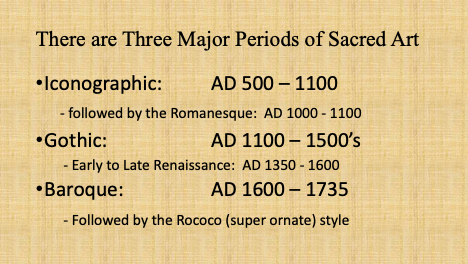
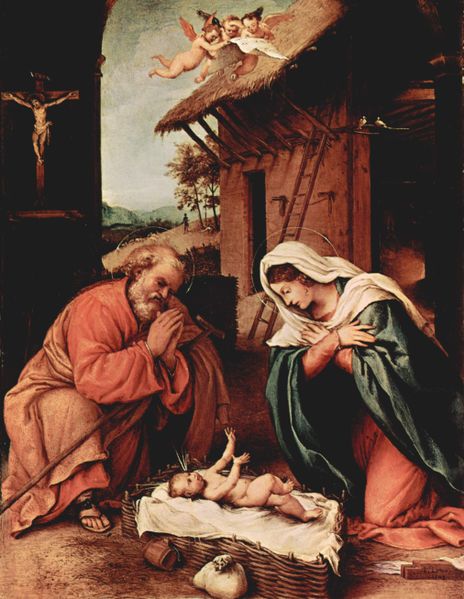
Image of Jesus Christ by Blessed Fra Angelico (1387 – 1455).

Copyright © 2012 Deacon Paul O. Iacono All Rights Reserved